Assessing the Implementation of Artificial Intelligence-Based Systems for Sustainable Solid Waste Management in Selected Countries in Asia, Europe and North America: A Systematic Review



Abstract
1. Introduction
- What is the extent of AI automation in the solid waste management value chain of the selected countries?
- What are the benefits and challenges of AI implementation in the selected countries?
2. Research Methods
2.1. Search Strategy and Selection Criteria
2.1.1. Defining the Scope of the Review
2.1.2. Literature Search
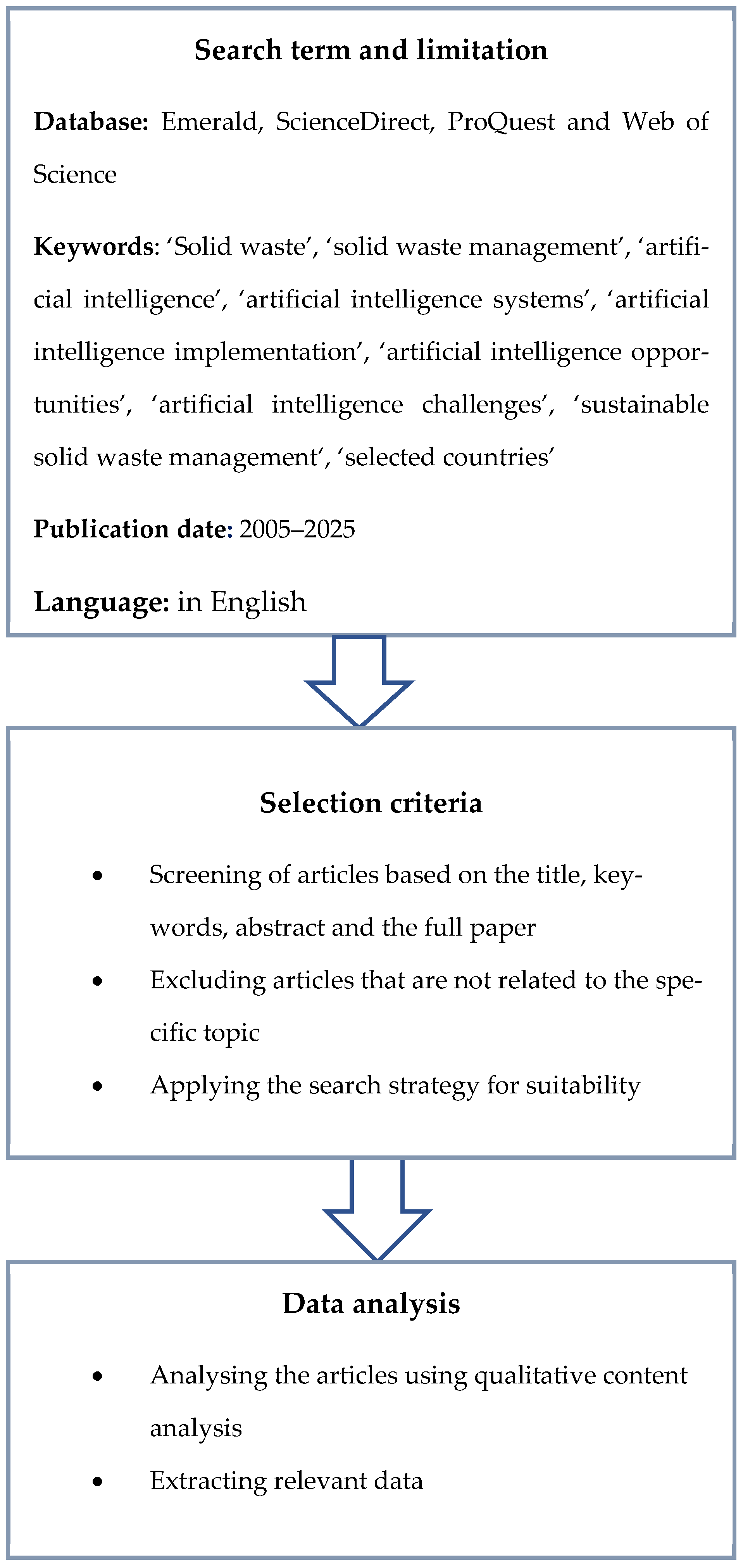
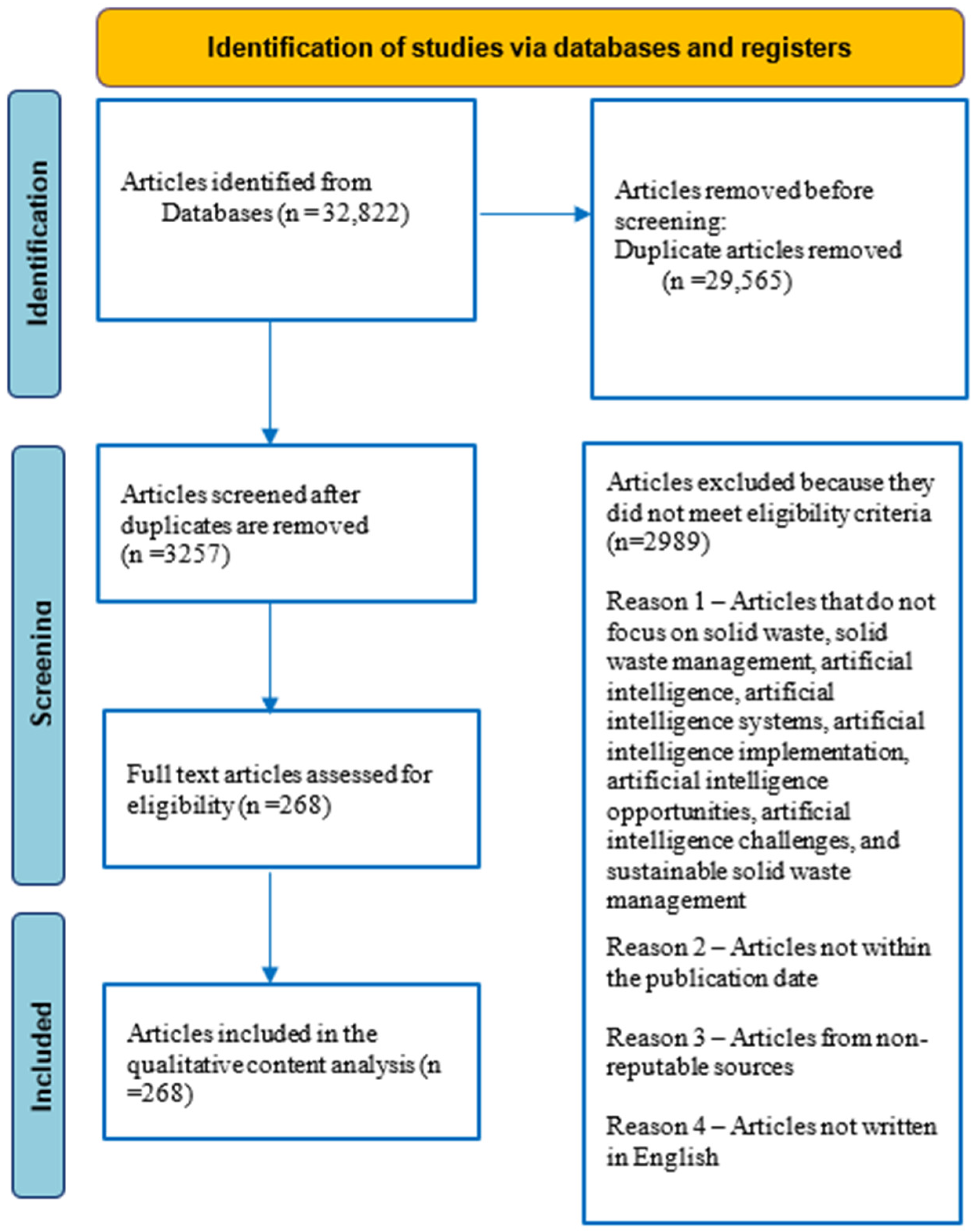
2.1.3. Final Article Selection
2.1.4. Analysing the Samples Using Qualitative Content Analysis
3. Results of the Review
3.1. Overview of AI
3.2. Global AI Statistics in Solid Waste Management
3.3. AI in Solid Waste Management and SDGs in the Selected Countries
3.3.1. AI in Solid Waste Management for Social Sustainability
3.3.2. AI in Solid Waste Management for Economic Sustainability
3.3.3. AI in Solid Waste Management for Environmental Sustainability
3.4. AI Implementation in Solid Waste Management in Selected Countries
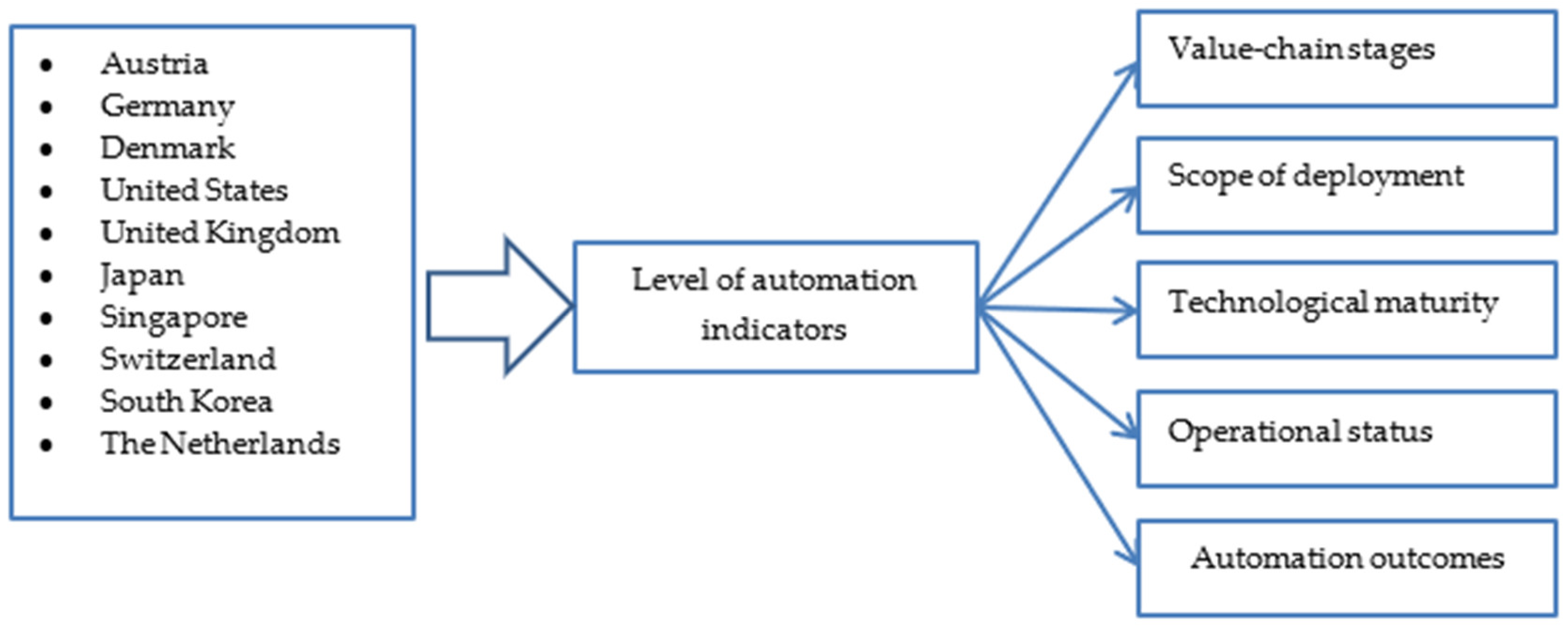
3.4.1. Framework for Assessing AI Automation Levels in Selected Countries
3.4.2. Germany
3.4.3. United Kingdom (UK)
3.4.4. South Korea
3.4.5. Denmark
3.4.6. Austria
3.4.7. Switzerland
3.4.8. Singapore
3.4.9. United States
3.4.10. Netherlands
3.4.11. Japan
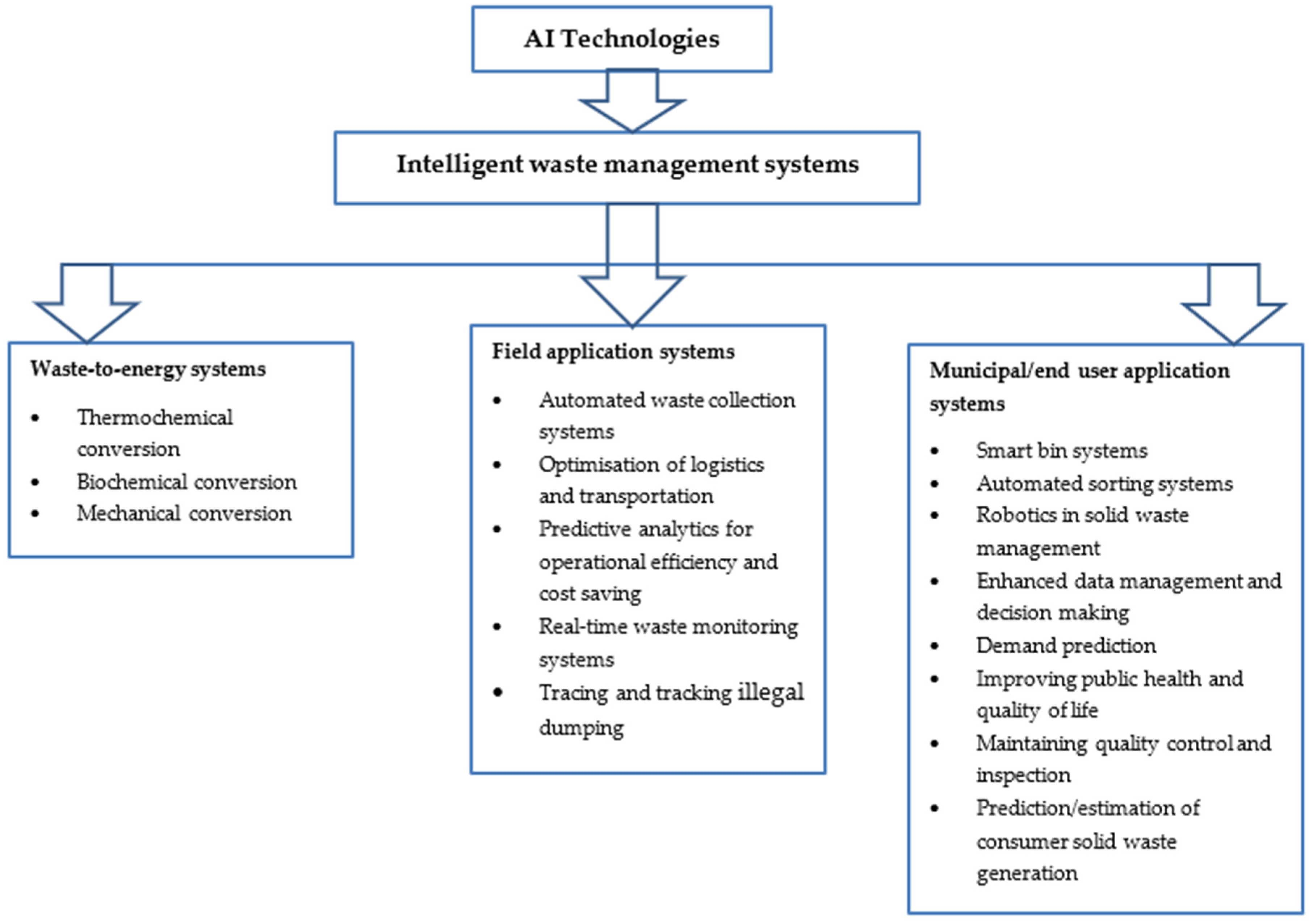
3.5. Practical Application Areas of AI in Solid Waste Management in the Selected Countries
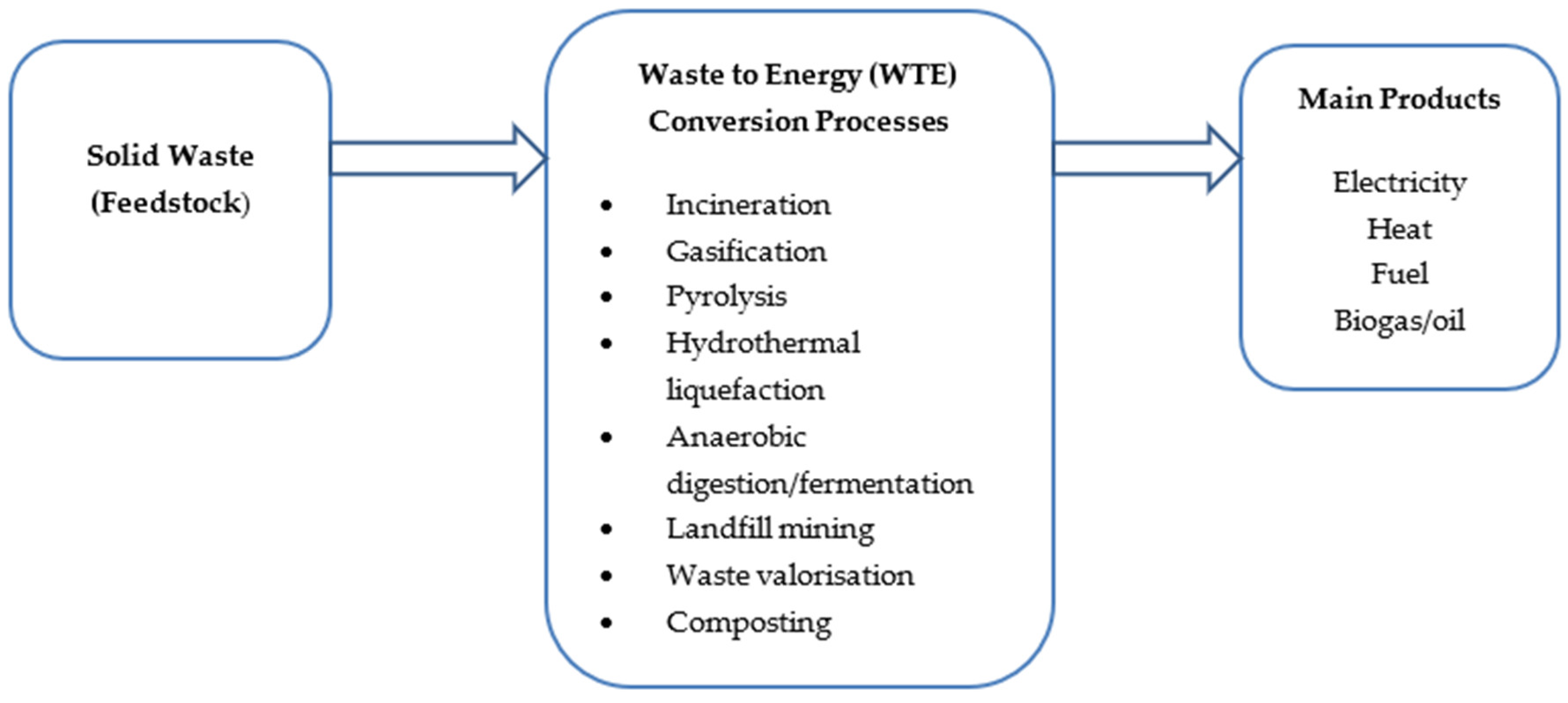
3.5.1. Waste-to-Energy Systems
Thermochemical Conversion
- Incineration
- Pyrolysis
- Gasification
- Hydrothermal liquefaction
Biochemical Conversion
- Anaerobic digestion
- Waste valorisation
Mechanical Conversion
- Landfilling equipped with biogas production
3.5.2. Field Application Systems
- Automated waste collection operations
- Optimisation of logistics and transportation
- Predictive analytics for operational efficiency and cost saving
- Real-time waste monitoring systems
- Tracing and tracking illegal dumping
3.5.3. Municipal/End User Application Systems
- Smart bin systems
- Automated Sorting Systems
- Predicting/estimating consumers’ solid waste generation
- Robotics in solid waste management
- Demand prediction
- Enhanced data management and decision-making
- Maintaining quality control and inspection
- Improving public health and quality of life
4. Analysis of the Results
4.1. Summary of Results, Benefits and Challenges of Implementing AI in the Selected Countries
4.1.1. Summary of Results
4.1.2. Benefits
4.1.3. Challenges
- Infrastructure requirements and costs
- Availability and quality of data
- Concerns about privacy and security
- Ethical concerns
4.1.4. Future Directions of AI in Solid Waste Management in the Selected Countries
- Integration and consolidation of AI and Internet of Things (IoT)
- Improvements and expansion in machine learning and deep learning
- Collaboration, teamwork and knowledge sharing
- Policy and regulatory frameworks
5. Conclusions and Recommendations
5.1. Conclusions
5.2. Recommendations
- -
- Strengthen SWM data availability and quality.
- Governments and waste management organisations should establish standardised systems for collecting, storing, sharing, and validating solid waste data to improve the accuracy of AI predictions and decision-making.
- -
- Improve data security and privacy.
- Organisations should implement encryption, access controls, authentication, data anonymisation, and regular security assessments to protect sensitive information and build stakeholder trust in AI-powered SWM systems.
- -
- Invest in AI infrastructure and R&D.
- Governments, industry, and academia should increase investment in smart bins, IoT sensors, automated sorting systems, digital connectivity, and R&D to develop AI solutions suited to local SWM challenges.
- -
- Develop skills and capacity.
- Waste management organisations should provide continuous training and capacity-building programmes for SWM professionals to improve their understanding and effective use of AI technologies.
- -
- Promote responsible and inclusive AI implementation.
- Policymakers and SWM stakeholders should address ethical issues, algorithmic bias, privacy, employment impacts, and environmental fairness while involving waste workers and communities in AI implementation.
- -
- Establish pilot projects, regulations, and performance standards.
- Governments and waste management organisations should implement pilot projects before large-scale adoption and establish clear regulatory frameworks and measurable indicators covering costs, recycling rates, collection efficiency, resource recovery, and environmental outcomes.
Supplementary Materials
Author Contributions
Funding
Institutional Review Board Statement
Informed Consent Statement
Data Availability Statement
Conflicts of Interest
References
- de Oliveira, M.F.; de Souza Castro, C.F.; Couto, B.D. Global Solid Waste Management and Climate-Relevant Innovations: A Scientometric Assessment (2014–2024). Sustain. Chem. Clim. Action 2025, 8, 100181. [Google Scholar] [CrossRef] [Scilit]
- Wilts, H.; Garcia, B.R.; Garlito, R.G.; Gómez, L.S.; Prieto, E.G. Artificial intelligence in the sorting of municipal waste as an enabler of the circular economy. Resources 2021, 10, 28. [Google Scholar] [CrossRef] [Scilit]
- Olawade, D.B.; Wada, O.Z.; Ore, O.T.; David-Olawade, A.C.; Esan, D.T.; Egbewole, B.I.; Ling, J. Trends of solid waste generation during COVID-19 pandemic: A review. Waste Manag. Bull. 2023, 1, 93–103. [Google Scholar] [CrossRef] [Scilit]
- Andeobu, L.; Wibowo, S.; Grandhi, S. Artificial intelligence applications for sustainable solid waste management practices in Australia: A systematic review. Sci. Total Environ. 2022, 834, 155389. [Google Scholar] [CrossRef] [Scilit] [PubMed]
- World Bank. What A Waste 2.0: A Global Snapshot of Solid Waste Management to 2050; International Bank for Reconstruction and Development; World Bank: Washington, DC, USA, 2018; Available online: https://openknowledge.worldbank.org/handle/10986/30317 (accessed on 5 May 2024).
- Abdallah, M.; Talib, M.A.; Feroz, S.; Nasir, Q.; Abdalla, H.; Mahfood, B. Artificial intelligence applications in solid waste management: A systematic research review. Waste Manag. 2020, 109, 231–246. [Google Scholar] [CrossRef] [Scilit] [PubMed]
- Andeobu, L.; Wibowo, S.; Grandhi, S. An assessment of E-waste generation and environmental management of selected countries in Africa, Europe and North America: A systematic review. Sci. Total Environ. 2021, 792, 148078. [Google Scholar] [CrossRef] [Scilit] [PubMed]
- Adeleke, O.; Akinlabi, S.A.; Jen, T.C.; Dunmade, I. Application of artificial neural networks for predicting the physical composition of municipal solid waste: An assessment of the impact of seasonal variation. Waste Manag. Res. 2021, 39, 1058–1068. [Google Scholar] [CrossRef] [Scilit] [PubMed]
- Yigitcanlar, T.; Cugurullo, F. The sustainability of artificial intelligence: An urbanistic viewpoint from the lens of smart and sustainable cities. Sustainability 2020, 12, 8548. [Google Scholar] [CrossRef] [Scilit]
- Mukherjee, A.G.; Wanjari, U.R.; Chakraborty, R.; Renu, K.; Vellingiri, B.; George, A.; Rajan, S.; Gopalakrishnan, A.V. A review on modern and smart technologies for efficient waste disposal and management. J. Environ. Manag. 2021, 297, 113347. [Google Scholar] [CrossRef] [Scilit] [PubMed]
- Fang, B.; Yu, J.; Chen, Z.; Osman, A.I.; Farghali, M.; Ihara, I.; Hamza, E.H.; Rooney, D.W.; Yap, P.S. Artificial intelligence for waste management in smart cities: A review. Environ. Chem. Lett. 2023, 21, 1959–1989. [Google Scholar] [CrossRef] [Scilit] [PubMed]
- Vyas, S.; Prajapati, P.; Shah, A.V.; Kumar Srivastava, V.; Varjani, S. Opportunities and knowledge gaps in biochemical interventions for mining of resources from solid waste: A special focus on anaerobic digestion. Fuel 2022, 311, 122625. [Google Scholar] [CrossRef] [Scilit]
- King, S.; Hutchinson, S.A.; Boxall, N.J. Advanced Recycling Technologies to Address Australia’s Plastic Waste; CSIRO: Canberra, Australia, 2021.
- Asefi, H.; Zhang, Y.; Lim, S.; Maghrebi, M. An integrated approach to suitability assessment of municipal solid waste landfills in New South Wales, Australia. Australas. J. Environ. Manag. 2020, 27, 63–83. [Google Scholar] [CrossRef] [Scilit]
- Abbasi, M.; Hanandeh, A. Forecasting municipal solid waste generation using artificial intelligence modelling approaches. Waste Manag. 2016, 56, 13–22. [Google Scholar] [CrossRef] [Scilit] [PubMed]
- Organisation for Economic Corporation and Development (OECD). OECD Recycling Statistics. 2023. Available online: https://www.worldatlas.com/articles/oecd-leading-countries-in-recycling.html (accessed on 22 April 2024).
- Lee, D.; Yoon, S.N. Application of artificial intelligence-based technologies in the healthcare industry: Opportunities and challenges. Int. J. Environ. Res. Public Health 2021, 18, 271. [Google Scholar] [CrossRef] [Scilit] [PubMed]
- Busetto, L.; Wick, W.; Gumbinger, C. How to use and assess qualitative research methods. Neurol. Res. Pract. 2020, 2, 14. [Google Scholar] [CrossRef] [Scilit] [PubMed]
- Wolfswinkel, J.F.; Furtmuelle, E.; Wilderom, P.M. Using grounded theory as a method for rigorously reviewing 894 literature. Eur. J. Inf. Syst. 2013, 22, 45–55. [Google Scholar] [CrossRef] [Scilit]
- Chu, H. Research methods in library and information science: Content analysis. Libr. Inf. Sci. Res. 2015, 37, 36–41. [Google Scholar] [CrossRef] [Scilit]
- Srivastava, A.; Thomson, S.B. Framework analysis: A qualitative methodology for applied research note policy research. J. Adm. Gov. 2009, 4, 72–79. [Google Scholar]
- Ritchie, J.; Lewis, J. Qualitative Research Practice: A Guide for Social Science Students and Researchers; Sage Publications Ltd.: London, UK, 2003. [Google Scholar]
- Patton, M. Qualitative Research and Evaluation Methods, 3rd ed.; Sage Publications: Thousand Oaks, CA, USA, 2002. [Google Scholar]
- Walsh, T.; Levy, N.; Bell, G.; Elliott, A.; Maclaurin, J.; Mareels, I.M.Y.; Wood, F.M. The Effective and Ethical Development of Artificial Intelligence: An Opportunity to Improve Our Wellbeing; Report for the Australian Council of Learned Academies; Australian Council of Learned Academies: Melbourne, Victoria, 2019. [Google Scholar]
- Iyamu, H.O.; Anda, M.; Ho, G. A review of municipal solid waste management in the BRIC and high-income countries: A thematic framework for low-income countries. Habitat Int. 2020, 95, 102097. [Google Scholar] [CrossRef] [Scilit]
- Gao, S.; He, L.; Chen, Y.; Li, D.; Lai, K. Public perception of artificial intelligence in medical care: Content analysis of social media. J. Med. Internet Res. 2020, 22, 16649. [Google Scholar] [CrossRef] [Scilit] [PubMed]
- Chaudhry, S.; Dhawan, S. AI-based recommendation system for social networking. In Soft Computing: Theories and Applications; Springer: Singapore, 2020; pp. 617–629. [Google Scholar]
- Performance Reviews: Denmark Waste Materials Management and Circular Economy. Available online: https://www.oecd.org/en/publications/oecd-environmental-performance-reviews-denmark-2019_1eeec492-en/full-report/component-12.html (accessed on 9 June 2024).
- Zhang, W.; Li, J.; Liu, T.; Leng, S.; Yang, L.; Peng, H.; Jiang, S.; Zhou, W.; Leng, L.; Li, H. Machine learning prediction and optimization of bio-oil production from hydrothermal liquefaction of algae. Bioresour. Technol. 2021, 342, 126011. [Google Scholar] [CrossRef] [Scilit] [PubMed]
- Dubey, S.; Singh, P.; Yadav, P.; Singh, K.K. Household waste management system using IoT and machine learning. Procedia Comput. Sci. 2020, 167, 1950–1959. [Google Scholar] [CrossRef] [Scilit]
- Ullah, Z.; Al-Turjman, F.; Mostarda, L.; Gagliardi, R. Applications of artificial intelligence and machine learning in smart cities. Comput. Commun. 2020, 154, 313–323. [Google Scholar] [CrossRef] [Scilit]
- Ahmed, S.; Mubarak, S.; Du, J.T.; Wibowo, S. Forecasting the status of municipal waste in smart bins using deep learning. Int. J. Environ. Res. Public Health 2022, 19, 16798. [Google Scholar] [CrossRef] [Scilit] [PubMed]
- Bijos, J.C.B.F.; Queiroz, L.M.; Zanta, V.M.; Oliveira-Esquerre, K.P. Towards artificial intelligence in urban waste management: An early prospect for Latin America. IOP Conf. Ser. Mater. Sci. Eng. 2021, 1196, 012030. [Google Scholar] [CrossRef] [Scilit]
- Olawade, D.B.; Wada, O.J.; David-Olawade, A.C.; Kunonga, E.; Abaire, O.; Ling, J. Using artificial intelligence to improve public health: A narrative review. Front. Public Health 2023, 11, 1196397. [Google Scholar] [CrossRef] [Scilit] [PubMed]
- Fuqaha, S.; Nursetiawan, N. Artificial intelligence and IoT for smart waste management: Challenges, opportunities, and future directions. J. Future Artif. Intell. Technol. 2025, 2, 24–46. [Google Scholar] [CrossRef] [Scilit]
- Gundupalli, S.P.; Hait, S.; Thakur, A. A review on automated sorting of source-separated municipal solid waste for recycling. Waste Manag. 2017, 60, 56–74. [Google Scholar] [CrossRef] [Scilit] [PubMed]
- Ma, S.; Zhou, C.; Chi, C.; Liu, Y.; Yang, G. Estimating physical composition of municipal solid waste in China by applying artificial neural network method. Environ. Sci. Technol. 2020, 54, 9609–9617. [Google Scholar] [CrossRef] [Scilit] [PubMed]
- Kutty, A.; Abdella, G. Tools and techniques for food security and sustainability related assessments: A focus on the data and food waste management system. In Proceedings of the 5th International Conference on Industrial Engineering and Operations Management, Detroit, Michigan, USA, 10–14 August 2020; IEOM International: Southfield, MI, USA, 2020; pp. 1–11. [Google Scholar]
- Yan, W.; Tyler, H.; Corinne, D.S. Tree-based automated machine learning to predict biogas production for anaerobic co-digestion of organic waste. ACS Sustain. Chem. Eng. 2021, 9, 12990–13000. [Google Scholar] [CrossRef] [Scilit]
- Mookkaiah, S.S.; Thangavelu, G.; Hebbar, R.; Haldar, N.; Singh, H. Design and development of smart Internet of Things–based solid waste management system using computer vision. Environ. Sci. Pollut. Res. 2022, 29, 64871–64885. [Google Scholar] [CrossRef] [Scilit] [PubMed]
- Dash, B.; Sharma, P. Role of artificial intelligence in smart cities for information gathering and dissemination—A review. Acad. J. Res. Sci. Publ. 2022, 4, 58–75. [Google Scholar] [CrossRef] [Scilit]
- Nwokediegwu, Z.Q.S.; Ugwuanyi, E.D. Implementing AI-driven waste management systems in underserved communities in the USA. Eng. Sci. Technol. J. 2024, 5, 794–802. [Google Scholar] [CrossRef] [Scilit]
- Bibri, S.E.; Krogstie, J.; Kaboli, A.; Alahi, A. Smarter eco-cities and their leading-edge artificial intelligence of things solutions for environmental sustainability: A comprehensive systematic review. Environ. Sci. Ecotechnol. 2024, 19, 100330. [Google Scholar] [CrossRef] [Scilit] [PubMed]
- Munir, M.T.; Li, B.; Naqvi, M. Revolutionizing municipal solid waste management (MSWM) with machine learning as a clean resource: Opportunities, challenges and solutions. Fuel 2023, 348, 128548. [Google Scholar] [CrossRef] [Scilit]
- Assef, F.M.; Steiner, M.T.A.; de Lima, E.P. A review of clustering techniques for waste management. Heliyon 2022, 8, e08784. [Google Scholar] [CrossRef] [Scilit] [PubMed]
- Agrawal, P.; Kaur, G.; Kolekar, S.S. Investigation on biomedical waste management of hospitals using cohort intelligence algorithm. Soft Comput. Lett. 2021, 3, 100008. [Google Scholar] [CrossRef] [Scilit]
- Anh Khoa, T.; Phuc, C.H.; Lam, P.D.; Nhu, L.M.; Trong, N.M.; Phuong, N.T.; Dung, N.V.; Tan, Y.N.; Nguyen, H.N.; Duc, D.N. Waste management system using IoT-based machine learning in University. Wirel. Commun. Mob. Comput. 2020, 2020, 6138637. [Google Scholar] [CrossRef] [Scilit]
- Bakhshi, T.; Ahmed, M. IoT-enabled smart city waste management using machine learning analytics. In 2018 2nd International Conference on Energy Conservation and Efficiency (ICECE); IEEE: New York, NY, USA, 2018; pp. 66–71. [Google Scholar] [CrossRef] [Scilit]
- Liao, B.; Wang, T. Research on industrial waste recovery network optimization: Opportunities brought by artificial intelligence. Math. Probl. Eng. 2020, 2020, 3618424. [Google Scholar] [CrossRef] [Scilit]
- Garre, A.; Ruiz, M.C.; Hontoria, E. Application of machine learning to support production planning of a food industry in the context of waste generation under uncertainty. Oper. Res. Perspect. 2020, 7, 100147. [Google Scholar] [CrossRef] [Scilit]
- Salam, M.A.; Ahmed, K.; Akter, N.; Hossain, T.; Abdullah, B. A review of hydrogen production via biomass gasification and its prospect in Bangladesh. Int. J. Hydrogen Energy 2018, 43, 14944–14973. [Google Scholar] [CrossRef] [Scilit]
- Reza, M. AI-driven solutions for enhanced waste management and recycling in urban areas. Int. J. Sustain. Infrastruct. Cities Soc. 2023, 8, 1–13. [Google Scholar]
- Sarc, R.; Curtis, A.; Kandlbauer, L.; Khodier, K.; Lorber, K.E.; Pomberger, R. Digitalisation and intelligent robotics in value chain of circular economy oriented waste management—A review. Waste Manag. 2019, 95, 476–492. [Google Scholar] [CrossRef] [Scilit] [PubMed]
- Monzambe, G.M.; Mpofu, K.; Daniyan, I.A. Statistical analysis of determinant factors and framework development for the optimal and sustainable design of municipal solid waste management systems in the context of industry 4.0. Procedia CIRP 2019, 84, 245–250. [Google Scholar] [CrossRef] [Scilit]
- Mao, W.L.; Chen, W.C.; Wang, C.T.; Lin, Y.H. Recycling waste classification using optimized convolutional neural network. Resour. Conserv. Recycl. 2021, 164, 105132. [Google Scholar] [CrossRef] [Scilit]
- Wang, C.; Qin, J.; Qu, C.; Ran, X.; Liu, C.; Chen, B. A smart municipal waste management system based on deep-learning and Internet of Things. Waste Manag. 2021, 135, 20–29. [Google Scholar] [CrossRef] [Scilit] [PubMed]
- Bharti, S.; Fatma, S.; Kumar, V. AI in Waste Management: The Savage of Environment. In Environmental Informatics: Challenges and Solutions; Paul, P.K., Choudhury, A., Biswas, A., Singh, B.K., Eds.; Springer Nature: Singapore, 2022; pp. 97–123. [Google Scholar] [CrossRef] [Scilit]
- Nafiz, M.S.; Das, S.S.; Morol, M.K.; Al Juabir, A.; Nandi, D. ConvoWaste: An automatic waste segregation machine using deep learning. In 2023 3rd International Conference on Robotics, Electrical and Signal Processing Techniques (ICREST); IEEE: New York, NY, USA, 2023; pp. 181–186. [Google Scholar] [CrossRef] [Scilit]
- Bui, T.D.; Tseng, M.L. Understanding the barriers to sustainable solid waste management in Society 5.0 under uncertainties: A novelty of socials and technical perspectives on performance driving. Environ. Sci. Pollut. Res. 2022, 29, 16265–16293. [Google Scholar] [CrossRef] [Scilit] [PubMed]
- Rajasekaran, P.; Dutta, R.; Gowda, G.M.; Singh, S. Enhanced Waste Management System for Smart Cities. In International Conference on Information and Communication Technology for Intelligent Systems; Springer Nature: Singapore, 2025; pp. 487–494. [Google Scholar]
- Ali, R.A.; Nik Ibrahim, N.N.L.; Wan Ab Karim Ghani, W.A.; Lam, H.L.; Sani, N.S. Utilization of process network synthesis and machine learning as decision-making tools for municipal solid waste management. Int. J. Environ. Sci. Technol. 2022, 19, 1985–1996. [Google Scholar] [CrossRef] [Scilit]
- Nguyen, V.T.; Ta, Q.T.; Nguyen, P.K. Artificial intelligence-based modelling and optimization of microbial electrolysis cell-assisted anaerobic digestion fed with alkaline-pre-treated waste-activated sludge. Biochem. Eng. J. 2022, 187, 108670. [Google Scholar] [CrossRef] [Scilit]
- Ahmad, S.; Imran; Jamil, F.; Iqbal, N.; Kim, D. Optimal route recommendation for waste carrier vehicles for efficient waste collection: A step forward towards sustainable cities. IEEE Access 2020, 8, 77875–77887. [Google Scholar] [CrossRef] [Scilit]
- Yan, B.; Liang, R.; Li, B.; Tao, J.; Chen, G.; Cheng, Z.; Zhu, Z.; Li, X. Fast identification and characterization of residual wastes via laser-induced breakdown spectroscopy and machine learning. Resour. Conserv. Recycl. 2021, 174, 105851. [Google Scholar] [CrossRef] [Scilit]
- Kumar, A.; Samadder, S.R. A review on technological options of waste to energy for effective management of municipal solid waste. Waste Manag. 2017, 69, 407–422. [Google Scholar] [CrossRef] [Scilit] [PubMed]
- Ge, S.; Yek, P.N.Y.; Cheng, Y.W.; Xia, C.; Wan Mahari, W.A.; Liew, R.K.; Peng, W.; Yuan, T.Q.; Tabatabaei, M.; Aghbashlo, M.; et al. Progress in microwave pyrolysis conversion of agricultural waste to value-added biofuels: A batch to continuous approach. Renew. Sustain. Energy Rev. 2021, 135, 110148. [Google Scholar] [CrossRef] [Scilit]
- Varjani, S.; Shahbeig, H.; Popat, K.; Patel, Z.; Vyas, S.; Shah, A.V.; Damia, B.; Huu, H.N.; Christian, S.; Su, S.L.; et al. Sustainable management of municipal solid waste through waste-to-energy technologies. Bioresour. Technol. 2022, 355, 127247. [Google Scholar] [CrossRef] [Scilit] [PubMed]
- Suárez Valdés, M.Á.; Soriano Disla, J.M.; Gambuzzi, E.; Castejón Martínez, G. Innovative circular biowaste valorisation—State of the art and guidance for cities and regions. Sustainability 2024, 16, 8963. [Google Scholar] [CrossRef] [Scilit]
- Foong, S.Y.; Liew, R.K.; Yang, Y.; Cheng, Y.W.; Ye, P.N.Y.; Wan Mahari, W.A.; Lee, X.Y.; Han, C.S.; Vo, D.V.N.; van Le, Q.; et al. Valorization of biomass waste to engineered activated biochar by microwave pyrolysis: Progress, challenges, and future directions. Chem. Eng. J. 2020, 389, 124401. [Google Scholar] [CrossRef] [Scilit]
- Wynsberghe, A. Sustainable AI: AI for sustainability and the sustainability of AI. AI Ethics 2021, 1, 213–218. [Google Scholar] [CrossRef] [Scilit]
- Brundtland, G.H. Our Common Future. In World Commission on the Environment and Development; United Nations: Brussels, Belgium, 1987. [Google Scholar]
- Marzouki, A.; Chouikh, A.; Mellouli, S.; Haddad, R. From Sustainable Development Goals to Sustainable Cities: A Social Media Analysis for Policy-Making Decision. Sustainability 2021, 13, 8136. [Google Scholar] [CrossRef] [Scilit]
- Vinuesa, R.; Azizpour, H.; Leite, I.; Balaam, M.; Dignum, V.; Domisch, S.; Domisch, S.; Fellander, A.; Langhans, S.D.; Tegmark, M.; et al. The role of artificial intelligence in achieving the Sustainable Development Goals. Nat. Commun. 2020, 11, 233. [Google Scholar] [CrossRef] [Scilit] [PubMed]
- Di Vaio, A.; Palladino, R.; Hassan, R.; Escobar, O. Artificial intelligence and business models in the sustainable development goals perspective: A systematic literature review. J. Bus. Res. 2020, 121, 283–314. [Google Scholar] [CrossRef] [Scilit]
- Galaz, V.; Centeno, M.A.; Callahan, P.W.; Causevic, A.; Patterson, T.; Brass, I.; Baum, S.; Farber, D.; Fischer, J.; Garcia, D.; et al. Artificial intelligence, systemic risks, and sustainability. Technol. Soc. 2021, 67, 101741. [Google Scholar] [CrossRef] [Scilit]
- Yigitcanlar, T.; Mehmood, R.; Corchado, J.M. Green artificial intelligence: Towards an efficient, sustainable and equitable technology for smart cities and futures. Sustainability 2021, 13, 8952. [Google Scholar] [CrossRef] [Scilit]
- Bjola, C. AI for development: Implications for theory and practice. Oxf. Dev. Stud. 2021, 50, 78–90. [Google Scholar] [CrossRef] [Scilit]
- Yadav, H.; Soni, U.; Kumar, G. Analysing challenges to smart waste management for a sustainable circular economy in developing countries: A fuzzy DEMATEL study. Smart Sustain. Built Environ. 2023, 12, 361–384. [Google Scholar] [CrossRef] [Scilit]
- Organisation for Economic Corporation and Development (OECD). The State of Implementation of the OECD AI Principles Four Years on; OECD Artificial Intelligence Papers, No. 3; OECD Publishing: Paris, France, 2023. [Google Scholar] [CrossRef] [Scilit]
- United Nations Environmental Program. Global Waste Management Outlook 2024: Beyond an Age of Waste-Turning Rubbish into a Resource. 2024. Available online: https://www.developmentaid.org/api/frontend/cms/file/2023/03/global_waste_management_outlook_2024.pdf (accessed on 11 August 2026).
- Laureti, L.; Costantiello, A.; Anobile, F.; Leogrande, A.; Magazzino, C. Waste management and innovation: Insights from Europe. Recycling 2024, 9, 82. [Google Scholar] [CrossRef] [Scilit]
- Department of Climate Change, Energy the Environment and Water (DEECCW). National Waste and Resource Recovery Reporting: International Comparisons and Exports. 2025. Available online: https://www.dcceew.gov.au/environment/protection/waste/publications/national-waste-resource-recovery-reporting/international-comparisons-exports-2024 (accessed on 11 August 2026).
- Esmaeilian, B.; Wang, B.; Lewis, K. The future of waste management in smart and sustainable cities: A review and concept paper. Waste Manag. 2018, 81, 177–195. [Google Scholar] [CrossRef] [Scilit] [PubMed]
- Anagnostopoulos, T.; Zaslavsky, A.; Kolomvatsos, K. Challenges and opportunities of waste management in IoT-enabled smart cities: A survey. IEEE Trans. Sustain. Comput. 2017, 2, 275–289. [Google Scholar] [CrossRef] [Scilit]
- Ramos, T.R.P.; de Morais, C.S.; Barbosa-Povoa, A.P. The smart waste collection routing problem: Alternative operational management approaches. Expert Syst. With Appl. 2018, 103, 146–158. [Google Scholar] [CrossRef] [Scilit]
- Shah, P.J.; Anagnostopoulos, T.; Zaslavsky, A.; Behdad, S. A stochastic optimization framework for planning of waste collection and value recovery operations in smart and sustainable cities. Waste Manag. 2018, 78, 104–114. [Google Scholar] [CrossRef] [Scilit] [PubMed]
- Wagland, S.T.; Veltre, F.; Longhurst, P.J. Development of an image-based analysis method to determine the physical composition of a mixed waste material. Waste Manag. 2012, 32, 245–248. [Google Scholar] [CrossRef] [Scilit] [PubMed]
- Rovetta, A.; Xiumin, F.; Vicentini, F.; Minghua, Z.; Giusti, A.; Qichang, H. Early detection and evaluation of waste through sensorized containers for a collection monitoring application. Waste Manag. 2009, 29, 2939–2949. [Google Scholar] [CrossRef] [Scilit] [PubMed]
- Shokrollahi, M. German Artificial Intelligence (AI) Technologies in Waste Management Industry That Can Be Implemented in Iran; University of Europe for Applied Science: Berlin, Germany, 2024; pp. 1–16. [Google Scholar]
- Federal Ministry for the Environment, Nature Conservation and Nuclear Safety (BMUV). Waste Management in Germany 2018: Facts, Data, Diagrams; Federal Ministry for the Environment, Nature Conservation and Nuclear Safety: Bonn, Germany, 2018. [Google Scholar]
- Wales Audit Office (WAO). Waste Management in Wales—Preventing Waste; Wales Audit Office: Cardiff, Wales, 2019. [Google Scholar]
- Yjlee, E. South Korea: The Future of Trash. Atmos Earth, 2020. Available online: https://atmos.earth/south-korea-recycling-technology/ (accessed on 3 May 2024).
- Henam, S.; Sambyal, S. Ten Zero-Waste Cities: How Seoul Came to Be Among the Best in Recycling. 2019. Available online: https://www.downtoearth.org.in/news/waste/ten-zero-waste-cities-how-seoul-came-to-be-among-the-best-in-recycling-68585 (accessed on 20 April 2024).
- Stadlmann, C.; Zehetner, A. Comparing AI-based and traditional prospect generating methods. J. Promot. Manag. 2022, 28, 160–174. [Google Scholar] [CrossRef] [Scilit]
- Ang, K. Understanding Singapore’s Waste Management and Recycling System. 2024. Available online: https://www.wisemove.sg/post/understanding-singapores-waste-management-and-recycling-system (accessed on 20 May 2024).
- Mansveld, W. Waste Recycling in the Netherlands: Analysis of the Success; Ministry of Infrastructure and Environment: The Hague, The Netherlands, 2024. Available online: https://www.government.nl/ministries/ministry-of-infrastructure-and-water-management (accessed on 16 August 2024).
- Adeleke, O.; Jen, T.C. Explainable AI and machine learning-based analysis of municipal solid waste generation rate: A South African case study. Waste Manag. 2025, 206, 115036. [Google Scholar] [CrossRef] [Scilit] [PubMed]
- Borchard, R.; Zeiss, R.; Recker, J. Digitalization of waste management: Insights from German private and public waste management firms. Waste Manag. Res. 2022, 40, 775–792. [Google Scholar] [CrossRef] [Scilit] [PubMed]
- Bravo, E. The German Recycling System: The World’s Best Recycling Country 2021. 2021. Available online: https://tomorrow.city/a/german-recycling-system (accessed on 22 April 2024).
- Nelles, M.; Gruenes, J.; Morscheck, G. Waste management in Germany–development to a sustainable circular economy? Procedia Environ. Sci. 2016, 35, 6–14. [Google Scholar] [CrossRef] [Scilit]
- Welsh Local Government Association (WLGA). Waste and Resource Management. 2021. Available online: https://www.wlga.wales/waste-and-resource-management (accessed on 26 August 2024).
- World Bank. South Korea—Waste Disposal Project (English); World Bank Group: Washington, DC, USA, 2022; Available online: http://documents.worldbank.org/curated/en/650721468773716959/Korea-Waste-Disposal-Project (accessed on 10 April 2024).
- Global Waste Index The Biggest Waste Producers Worldwide: Sensonseo Global Waste Index 2019. 2019. Available online: https://sensoneo.com/global-waste-index/ (accessed on 11 April 2024).
- Eunomia. Recycling—Who Really Leads the World? Identifying the World’s Best Municipal Waste Recyclers. 2020. Available online: https://eeb.org/wp-content/uploads/2019/06/Recycling_who-really-leads-the-world-REPORT.pdf (accessed on 11 April 2024).
- Organisation for Economic Corporation and Development (OECD). OECD Environmental Performance Reviews: Denmark 2019. Available online: https://www.oecd.org/en/publications/oecd-environmental-performance-reviews-denmark-2019_1eeec492-en.html (accessed on 12 April 2024).
- European Environment Agency (EEA). Municipal Waste Management in Denmark: Early Warning Assessment Related to the 2025 Targets for Municipal Waste and Packaging Waste. 2022. Available online: https://www.eea.europa.eu/en/analysis/publications (accessed on 12 April 2024).
- Moller-Andersen, F.; Cimpan, C.; Dall, O.; Habib, K.; Holmboe, B.; Münster, M.; Pizarro Alonso, A.R.; Wenzel, H. Alternatives for Future Waste Management in Denmark: Final Report of Top Waste; DTU Management Engineering: Kongens Lyngby, Denmark, 2016. [Google Scholar]
- Andersen, J.; Frandsen, S.; Krause, S. Harnessing the Opportunity of Artificial Intelligence in Denmark; MacKinsey Company Report: Chicago, IL, USA, 2019. [Google Scholar]
- Kladnik, V.; Dworak, S.; Schwarzböck, T. Composition of public waste-a case study from Austria. Waste Manag. 2024, 178, 210–220. [Google Scholar] [CrossRef] [Scilit] [PubMed]
- Blasenbauer, D.; Lipp, A.M.; Fellner, J.; Tischberger-Aldrian, A.; Stipanović, H.; Lederer, J. Recovery of plastic packaging from mixed municipal solid waste. A case study from Austria. Waste Manag. 2024, 180, 9–22. [Google Scholar] [CrossRef] [Scilit]
- Van Eygen, E.; Laner, D.; Fellner, J. Circular economy of plastic packaging: Current practice and perspectives in Austria. Waste Manag. 2018, 72, 55–64. [Google Scholar] [CrossRef] [Scilit] [PubMed]
- Mamadzhanov, R.; Zakirova, Y.; Umarov, M. Municipal waste management in towns of Switzerland: A foreign ecologist’s view. E3S Web Conf. 2020, 169, 02010. [Google Scholar] [CrossRef] [Scilit]
- Magazzino, C.; Mele, M.; Schneider, N. The relationship between municipal solid waste and greenhouse gas emissions: Evidence from Switzerland. Waste Manag. 2020, 113, 508–520. [Google Scholar] [CrossRef] [Scilit] [PubMed]
- Bai, R.; Sutanto, M. The practice and challenges of solid waste management in Singapore. Waste Manag. 2002, 22, 557–567. [Google Scholar] [CrossRef] [Scilit] [PubMed]
- Zhang, D.; Keat, T.S.; Gersberg, R.M. A comparison of municipal solid waste management in Berlin and Singapore. Waste Manag. 2010, 30, 921–933. [Google Scholar] [CrossRef] [Scilit] [PubMed]
- Sheng, T.; Islam, M.; Misran, N.; Baharuddin, M.; Arshad, H.; Islam, M.; Islam, M. An internet of things based smart waste management system using lora and tensorflow deep learning model. IEEE Access 2020, 8, 148793–148811. [Google Scholar] [CrossRef] [Scilit]
- Cha, G.W.; Moon, H.J.; Kim, Y.M.; Hong, W.H.; Hwang, J.H.; Park, W.J.; Kim, Y.C. Development of a prediction model for demolition waste generation using a random forest algorithm based on small datasets. Int. J. Environ. Res. Public Health 2020, 17, 6997. [Google Scholar] [CrossRef] [Scilit] [PubMed]
- Ghahramani, M.; Zhou, M.; Mölter, A.; Pilla, F. IoT-based route recommendation for an intelligent waste management system. IEEE Internet Things J. 2022, 9, 11883–11892. [Google Scholar] [CrossRef] [Scilit]
- European Environmental Agency (EEA). Waste Management Country Profile with a Focus on Municipal and Packaging Waste—Netherland 2025. Available online: https://www.eea.europa.eu/en/topics/in-depth/waste-and-recycling/municipal-and-packaging-waste-management-country-profiles-2025/nl-municipal-waste-factsheet.pdf/@@download/file (accessed on 17 August 2026).
- Dijkgraaf, E.; Gradus, R. The Effectiveness of Dutch Municipal Recycling Policies (No. 14-155/VI); Tinbergen Institute Discussion Paper; Tinbergen Institute, Amsterdam and Rotterdam: Rotterdam, Netherlands, 2014; Available online: https://www.researchgate.net/publication/315432781_The_Effectiveness_of_Dutch_Municipal_Recycling_Policies (accessed on 4 August 2024).
- Eckert, C.; Rial, C.S. Solid waste recycling in the Netherlands: Ethnography of the circular economy. Vibrant Virtual Braz. Anthropol. 2023, 20, 20904. [Google Scholar] [CrossRef] [Scilit]
- Moshkal, M.; Akhapov, Y.; Ogihara, A. Sustainable waste management in Japan: Challenges, achievements, and future prospects: A review. Sustainability 2024, 16, 7347. [Google Scholar] [CrossRef] [Scilit]
- Alzamora, B.R.; Barros, R.T. Review of municipal waste management charging methods in different countries. Waste Manag. 2020, 115, 47–55. [Google Scholar] [CrossRef] [Scilit] [PubMed]
- Wahyudi, J.; Novitasari, M.R. Generating renewable energy from municipal waste sector: A comparative study between Japan and Indonesia. Int. J. Environ. Sci. Dev. 2018, 9, 380–384. [Google Scholar] [CrossRef] [Scilit]
- Taddeo, M.; McCutcheon, T.; Floridi, L. Trusting artificial intelligence in cybersecurity is a double-edged sword. Nat. Mach. Intell. 2019, 1, 557–560. [Google Scholar] [CrossRef] [Scilit]
- Abdallah, M.; Adghim, M.; Maraqa, M.; Aldahab, E. Simulation and optimization of dynamic waste collection. Waste Manag. Res. 2019, 37, 793–802. [Google Scholar] [CrossRef] [Scilit] [PubMed]
- Singh, D.; Satija, A. Prediction of municipal solid waste generation for optimum planning and management with artificial neural network—Case study: Faridabad City in Haryana State (India). Int. J. Syst. Assur. Eng. Manag. 2018, 9, 91–97. [Google Scholar] [CrossRef] [Scilit]
- He, L.; Bai, L.; Dionysiou, D.D.; Wei, Z.; Spinney, R.; Chu, C.; Lin, Z.; Xiao, R. Applications of computational chemistry, artificial intelligence, and machine learning in aquatic chemistry research. Chem. Eng. J. 2021, 426, 131810. [Google Scholar] [CrossRef] [Scilit]
- CSIRO. Australia’s AI Roadmap. 2020. Available online: https://research.csiro.au/robotics/australias-ai-roadmap-launched-solving-problems-growing-the-economy-and-improving-our-quality-of-life/ (accessed on 30 May 2024).
- Ahmad, I.; Khan, M.I.; Khan, H.; Ishaq, M.; Tariq, R.; Gul, K.; Ahmad, W. Pyrolysis study of polypropylene and polyethylene into premium oil products. Int. J. Green Energy 2015, 12, 663–671. [Google Scholar] [CrossRef] [Scilit]
- Varjani, S.; Pandey, A.; Upasani, V.N. Petroleum sludge polluted soil remediation: Integrated approach involving novel bacterial consortium and nutrient application. Sci. Total Environ. 2021, 750, 142934. [Google Scholar] [CrossRef] [Scilit] [PubMed]
- Bari, A.; Arshi, O.; Mondal, S. Advancements in waste management: A comprehensive review of artificial intelligence applications in smart cities. Smart Constr. Sustain. Cities 2026, 4, 7. [Google Scholar] [CrossRef] [Scilit]
- Chand Malav, L.; Yadav, K.K.; Gupta, N.; Kumar, S.; Sharma, G.K.; Krishnan, S.; Rezania, S.; Kamyab, H.; Pham, Q.B.; Yadav, S.; et al. A review on municipal solid waste as a renewable source for waste-to-energy project in India: Current practices, challenges, and future opportunities. J. Clean. Prod. 2020, 277, 123227. [Google Scholar] [CrossRef] [Scilit]
- Moya, D.; Aldas, C.; Lopez, G.; Kaparaju, P. Municipal solid waste as a valuable renewable energy resource: A worldwide opportunity of energy recovery by using waste-to-energy technologies. Energy Procedia 2017, 134, 286–295. [Google Scholar] [CrossRef] [Scilit]
- Ouda, O.K.M.; Raza, S.A.; Al-Waked, R.; Al-Asad, J.F.; Nizami, A.S. Waste-to-energy potential in the Western Province of Saudi Arabia. J. King Saud. Univ.-Eng. Sci. 2017, 29, 212–220. [Google Scholar] [CrossRef] [Scilit]
- Shan, C.; Pandyaswargo, A.H.; Ogawa, A.; Tsubouchi, R.; Onoda, H. Japanese public perceptions on smart bin potential to support PAYT systems. Waste Manag. 2024, 177, 278–288. [Google Scholar] [CrossRef] [Scilit] [PubMed]
- United States Energy Information Administration USEIA. International Energy Outlook 2023. 2023. Available online: https://www.eia.gov/outlooks/ieo/ (accessed on 18 June 2024).
- Lombardi, L.; Carnevale, E.A. Evaluation of the environmental sustainability of different waste-to-energy plant configurations. Waste Manag. 2018, 73, 232–246. [Google Scholar] [CrossRef] [Scilit] [PubMed]
- Beyene, H.D.; Werkneh, A.A.; Ambaye, T.G. Current updates on waste to energy (WtE) technologies: A review. Renew. Energy Focus 2018, 24, 1–11. [Google Scholar] [CrossRef] [Scilit]
- Tsui, T.H.; Wong, J.W. A critical review: Emerging bioeconomy and waste-to-energy technologies for sustainable municipal solid waste management. Waste Dispos. Sustain. Energy 2019, 1, 151–167. [Google Scholar] [CrossRef] [Scilit]
- Chintala, V. Production, upgradation and utilization of solar assisted pyrolysis fuels from biomass—A technical review. Renew. Sustain. Energy Rev. 2018, 90, 120–130. [Google Scholar] [CrossRef] [Scilit]
- Andeobu, L.; Wibowo, S.; Grandhi, S. Informal e-waste recycling practices and environmental pollution in Africa: What is the way forward? Int. J. Hyg. Environ. Health 2023, 252, 114192. [Google Scholar] [CrossRef] [Scilit] [PubMed]
- Ye, P.; Fang, L.; Song, D.; Zhang, M.; Li, R.; Awasthi, M.K.; Zhang, Z.; Xiao, R.; Chen, X. Insights into carbon loss reduction during aerobic composting of organic solid waste: A meta-analysis and comprehensive literature review. Sci. Total Environ. 2023, 862, 160787. [Google Scholar] [CrossRef] [Scilit] [PubMed]
- Al-Salem, S.M.; Leeke, G.A.; El-Eskandarany, M.S.; Van Haute, M.; Constantinou, A.; Dewil, R.; Baeyens, J. On the implementation of the circular economy route for E-waste management: A critical review and an analysis for the case of the state of Kuwait. J. Environ. Manag. 2022, 323, 116181. [Google Scholar] [CrossRef] [Scilit] [PubMed]
- Alaedini, A.H.; Tourani, H.K.; Saidi, M. A review of waste-to-hydrogen conversion technologies for solid oxide fuel cell (SOFC) applications: Aspect of gasification process and catalyst development. J. Environ. Manag. 2023, 329, 117077. [Google Scholar] [CrossRef] [Scilit] [PubMed]
- Akinpelu, D.A.; Adekoya, O.A.; Oladoye, P.O.; Ogbaga, C.C.; Okolie, J.A. Machine learning applications in biomass pyrolysis: From biorefinery to end-of-life product management. Digit. Chem. Eng. 2023, 8, 100103. [Google Scholar] [CrossRef] [Scilit]
- Zaifullizan, Y.M.; Salema, A.A.; Lim, M.K. Application of Artificial Intelligence (AI) to biomass pyrolysis system. In Proceedings of the PyroASIA Symposium 2023, Kuala Lumpur, Malaysia, 11–13 May 2023. [Google Scholar]
- United States Department of Energy. U.S. Department of Energy Invests over $9 Million to Advance Hydrogen Technology That Converts Waste to Clean. 2024. Available online: https://www.energy.gov/fecm/articles/us-department-energy-invests-over-9-million-advance-hydrogen-technology-converts (accessed on 15 August 2024).
- Gulec, F.; Williams, O.; Kostas, E.T.; Samson, A.; Lester, E. A comprehensive comparative study on the energy application of chars produced from different biomass feedstocks via hydrothermal conversion, pyrolysis, and torrefaction. Energy Convers. Manag. 2022, 270, 116260. [Google Scholar] [CrossRef] [Scilit]
- Shafizadeh, A.; Shahbeig, H.; Nadian, M.H.; Mobli, H.; Dowlati, M.; Gupta, V.K.; Peng, W.; Lam, S.S.; Tabatabeal, M.; Aghbashlo, M. Machine learning predicts and optimizes hydrothermal liquefaction of biomass. Chem. Eng. J. 2022, 445, 136579. [Google Scholar] [CrossRef] [Scilit]
- Koechermann, J.; Goersch, K.; Wirth, B.; Muehlenberg, J.; Klemm, M. Hydrothermal carbonization: Temperature influence on hydrochar and aqueous phase composition during process water recirculation. J. Environ. Chem. Eng. 2018, 6, 5481–5487. [Google Scholar] [CrossRef] [Scilit]
- Li, Q.; Faramarzi, A.; Zhang, S.; Wang, Y.; Hu, X.; Gholizadeh, M. Progress in catalytic pyrolysis of municipal solid waste. Energy Convers. Manag. 2020, 226, 113525. [Google Scholar] [CrossRef] [Scilit]
- Gopirajan, P.V.; Gopinath, K.P.; Sivaranjani, G.; Arun, J. Optimization of hydrothermal liquefaction process through machine learning approach: Process conditions and oil yield. Biomass Convers. Biorefin. 2021, 13, 1213–1222. [Google Scholar] [CrossRef] [Scilit]
- Usman, M.; Cheng, S.; Boonyubol, S.; Cross, J.S. From biomass to biocrude: Innovations in hydrothermal liquefaction and upgrading. Energy Convers. Manag. 2024, 302, 118093. [Google Scholar] [CrossRef] [Scilit]
- Ungureanu, N.; Vlăduț, N.-V.; Biriș, S.-Ș.; Ionescu, M.; Gheorghiță, N.-E. Municipal solid waste gasification: Technologies, process parameters, and sustainable valorization of by-products in a circular economy. Sustainability 2025, 17, 6704. [Google Scholar] [CrossRef] [Scilit]
- Sharma, S.; Basu, S.; Shetti, N.P.; Kamali, M.; Walvekar, P.; Aminabhavi, T.M. Waste-to-energy nexus: A sustainable development. Environ. Pollut. 2020, 267, 115501. [Google Scholar] [CrossRef] [Scilit] [PubMed]
- Romsaiyud, A.; Songkasiri, W.; Nopharatana, A.; Chaiprasert, P. Combination effect of pH and acetate on enzymatic cellulose hydrolysis. J. Environ. Sci. 2009, 21, 965–970. [Google Scholar] [CrossRef] [Scilit] [PubMed]
- Mishra, A.; Kumar, M.; Bolan, N.S.; Kapley, A.; Kumar, R.; Singh, L. Multidimensional approaches of biogas production and up-gradation: Opportunities and challenges. Bioresour. Technol. 2021, 338, 125514. [Google Scholar] [CrossRef] [Scilit] [PubMed]
- Ukpabi, N.; Okorie, O.O.; Isu, J.; Peters, E. The production of biogas using cow dung and food waste. Int. J. Mater. Chem. 2017, 7, 21–24. [Google Scholar] [CrossRef] [Scilit]
- Mahdy, A.; Bi, S.; Song, Y.; Qiao, W.; Dong, R. Overcome inhibition of anaerobic digestion of chicken manure under ammonia stressed condition by lowering the organic loading rate. Bioresour. Technol. Rep. 2020, 9, 100359. [Google Scholar] [CrossRef] [Scilit]
- Prajapati, P.; Varjani, S.; Singhania, R.R.; Patel, A.K.; Awasthi, M.K.; Sindhu, R.; Zhang, Z.; Binod, P.; Awasthi, S.K.; Chaturvedi, P. Critical review on technological advancements for effective waste management of municipal solid waste-Updates and way forward. Environ. Technol. Innov. 2021, 23, 101749. [Google Scholar] [CrossRef] [Scilit]
- Helander, H.; Bruckner, M.; Leipold, S.; Wulansari, D.; Karlinasari, L.; Ekayani, M.; Mariam, N.; Valerie, K.; Karin, D.; Suhartini, S.; et al. Estimation of methane and electricity potential from canteen food waste. IOP Conf. Ser. Earth Environ. Sci. 2019, 230, 012075. [Google Scholar] [CrossRef] [Scilit]
- Liu, J.; Li, Q.; Gu, W.; Wang, C. The impact of consumption patterns on the generation of municipal solid waste in China: Evidences from provincial data. Int. J. Environ. Res. Public Health 2019, 16, 1717. [Google Scholar] [CrossRef] [Scilit] [PubMed]
- Ziganshin, A.M.; Schmidt, T.; Lv, Z.; Liebetrau, J.; Richnow, H.H.; Kleinsteuber, S.; Nikolausz, M. Reduction of the hydraulic retention time at constant high organic loading rate to reach the microbial limits of anaerobic digestion in various reactor systems. Bioresour. Technol. 2016, 217, 62–71. [Google Scholar] [CrossRef] [Scilit] [PubMed]
- Andeobu, L.; Wibowo, S.; Grandhi, S. Renewable hydrogen for the energy transition in Australia—Current trends, challenges and future directions. Int. J. Hydrogen Energy 2024, 87, 1207–1223. [Google Scholar] [CrossRef] [Scilit]
- Zhen, X.; Yilmaz, M. Renewable energy cooperation in Northeast Asia: Incentives, mechanisms and challenges. Energy Strategy Rev. 2020, 29, 100468. [Google Scholar] [CrossRef] [Scilit]
- Cruz, I.A.; Chuenchart, W.; Long, F.; Surendra, K.C.; Andrade, L.R.S.; Bilal, M.; Ferreira, L.F.R. Application of machine learning in anaerobic digestion: Perspectives and challenges. Bioresour. Technol. 2022, 345, 126433. [Google Scholar] [CrossRef] [Scilit] [PubMed]
- World Biogas Association (WBA). Biogas: Pathways to 2030. 2021. Available online: https://www.worldbiogasassociation.org (accessed on 2 June 2024).
- Subramanian, K.; Sarkar, M.K.; Wang, H.; Qin, Z.H.; Chopra, S.S.; Jin, M.; Kumar, V.; Chen, C.; Wing, C.; Tsang, A.; et al. An overview of cotton and polyester, and their blended waste textile valorisation to value-added products: A circular economy approach–research trends, opportunities and challenges. Crit. Rev. Environ. Sci. Technol. 2022, 52, 3921–3942. [Google Scholar] [CrossRef] [Scilit]
- Rashid, A.; Asif, F.M.; Krajnik, P.; Nicolescu, C.M. Resource conservative manufacturing: An essential change in business and technology paradigm for sustainable manufacturing. J. Clean. Prod. 2013, 57, 166–177. [Google Scholar] [CrossRef] [Scilit]
- Kanani, F.; Heidari, M.D.; Gilroyed, B.H.; Pelletier, N. Waste valorization technology options for the egg and broiler industries: A review and recommendations. J. Clean. Prod. 2020, 262, 121129. [Google Scholar] [CrossRef] [Scilit]
- Hayashi, A.; Homma, T.; Akimoto, K. The potential contribution of food wastage reductions driven by information technology on reductions of energy consumption and greenhouse gas emissions in Japan. Environ. Chall. 2022, 8, 100588. [Google Scholar] [CrossRef] [Scilit]
- International Solid Waste Association (ISWA). Improving Waste Recycling with Artificial Intelligence. 2021. Available online: https://waste-management-world.com/artikel/improving-waste-recycling-with-artificial-intelligence/ (accessed on 12 March 2024).
- Javad-Asgari, M.; Safavi, K.; Mortazaeinezahad, F. Landfill biogas production process. In International Conference on Food Engineering and Biotechnology; IACSIT Press: Singapore, 2011. [Google Scholar]
- Hoornweg, D.; Bhada-Tata, P. What a Waste: A Global Review of Solid Waste Management; Urban Development Series; Knowledge Papers no. 15; World Bank: Washington, DC, USA, 2012; Available online: http://hdl.handle.net/10986/17388 (accessed on 15 April 2024).
- Duan, Z.; Kjeldsen, P.; Scheutz, C. Efficiency of gas collection systems at Danish landfills and implications for regulations. Waste Manag. 2022, 139, 269–278. [Google Scholar] [CrossRef] [Scilit] [PubMed]
- Sharma, P.; Vaid, U. Emerging role of artificial intelligence in waste management practices. IOP Conf. Ser. Earth Environ. Sci. 2021, 889, 012047. [Google Scholar] [CrossRef] [Scilit]
- Kaya, M.M.; Taskıran, Y.; Kanoglu, A.; Demirtas¸, A.; Zor, E.; Burçak, I.; Nacak, M.; Akgul, F. Designing a smart home management system with artificial intelligence & machine learning. IEEE Access 2021, 9, 133082–133094. [Google Scholar] [CrossRef]
- Ahmad, S.; Kim, D.H. Quantum GIS based descriptive and predictive data analysis for effective planning of waste management. IEEE Access 2020, 8, 46193–46205. [Google Scholar] [CrossRef] [Scilit]
- Ghoreishi, M.; Happonen, A. Key enablers for deploying artificial intelligence for circular economy embracing sustainable product design. Three Case Stud. AIP Conf. Proc. 2020, 2233, 050008. [Google Scholar] [CrossRef] [Scilit]
- Elshaboury, N.; Mohammed Abdelkader, E.; Al-Sakkaf, A.; Alfalah, G. Predictive analysis of municipal solid waste generation using an optimized neural network model. Processes 2021, 9, 2045. [Google Scholar] [CrossRef] [Scilit]
- Andeobu, L.; Wibowo, S.; Grandhi, S. A systematic review on plastic waste management and recycling in Australia: Current trends, environmental impacts and future directions. In Proceedings of the 21st International Conference on Waste Management and Technology, Shanghai, China, 4–7 July 2026; Tsinghua University: Beijing, China, 2026; p. 1. [Google Scholar]
- Cha, G.W.; Moon, H.J.; Kim, Y.C. Comparison of random forest and gradient boosting machine models for predicting demolition waste based on small datasets and categorical variables. Int. J. Environ. Res. Public Health 2021, 18, 8530. [Google Scholar] [CrossRef] [Scilit] [PubMed]
- Salman, M.Y.; Hasar, H. Review on environmental aspects in smart city concept: Water, waste, air pollution and transportation smart applications using IoT techniques. Sustain. Cities Soc. 2023, 94, 104567. [Google Scholar] [CrossRef] [Scilit]
- Srinivas, T.; Mahalaxmi, G.; Varaprasad, R.; Donald, A.D.; Thippanna, G. AI in transportation: Current and promising applications. IUP J. Telecommun. 2022, 14, 37–57. [Google Scholar]
- Mounadel, A.; Ech-Cheikh, H.; Lissane Elhaq, S.; Rachid, A.; Sadik, M.; Abdellaoui, B. Application of artificial intelligence techniques in municipal solid waste management: A systematic literature review. Environ. Technol. Rev. 2023, 12, 316–336. [Google Scholar] [CrossRef] [Scilit]
- Olawade, D.B.; Fapohunda, O.; Wada, O.Z.; Usman, S.O.; Ige, A.O.; Ajisafe, O.; Oladapo, B.I. Smart waste management: A paradigm shift enabled by artificial intelligence. Waste Manag. Bull. 2024, 2, 244–263. [Google Scholar] [CrossRef] [Scilit]
- Akkad, M.Z.; Haidar, S.; Bányai, T. Design of cyber-physical waste management systems focusing on energy efficiency and sustainability. Designs 2022, 6, 39. [Google Scholar] [CrossRef] [Scilit]
- Lu, W. Big data analytics to identify illegal construction waste dumping: A Hong Kong study. Resour. Conserv. Recycl. 2019, 141, 264–272. [Google Scholar] [CrossRef] [Scilit]
- Du, L.; Xu, H.; Zuo, J. Status quo of illegal dumping research: Way forward. J. Environ. Manag. 2021, 290, 112601. [Google Scholar] [CrossRef] [Scilit] [PubMed]
- Shahab, S.; Anjum, M. Solid waste management scenario in India and illegal dump detection using deep learning: An AI approach towards the sustainable waste management. Sustainability 2022, 14, 15896. [Google Scholar] [CrossRef] [Scilit]
- Zhang, Q.; Li, H.; Wan, X.; Skitmore, M.; Sun, H. An intelligent waste removal system for smarter communities. Sustainability 2020, 12, 6829. [Google Scholar] [CrossRef] [Scilit]
- Almusaed, A.; Yitmen, I.; Almssad, A. Enhancing smart home design with AI models: A case study of living spaces implementation review. Energies 2023, 16, 2636. [Google Scholar] [CrossRef] [Scilit]
- Dubey, S.; Singh, M.K.; Singh, P.; Aggarwal, S. Waste Management of Residential Society using Machine Learning and IoT Approach. In 2020 International Conference on Emerging Smart Computing and Informatics (ESCI); IEEE: New York, NY, USA, 2020; pp. 293–297. [Google Scholar] [CrossRef] [Scilit]
- Yang, Z.; Xue, F.; Lu, W. Handling missing data for construction waste management: Machine learning based on aggregated waste generation behaviours. Resour. Conserv. Recycl. 2021, 175, 105809. [Google Scholar] [CrossRef] [Scilit]
- Bobulski, J.; Kubanek, M. Project of sorting system for plastic garbage in sorting plant based on artificial intelligence. In 9th International Conference on Advanced Information Technologies and Applications (ICAITA 2020); AIRCC Publishing Corporation: Chennai, India, 2020; pp. 27–35. [Google Scholar] [CrossRef] [Scilit]
- Wilson, M.; Paschen, J.; Pitt, L. The circular economy meets artificial intelligence (AI): Understanding the opportunities of AI for reverse logistics. Manag. Environ. Qual. An. Int. J. 2022, 33, 9–25. [Google Scholar] [CrossRef] [Scilit]
- Coskuner, G.; Jassim, M.S.; Zontul, M.; Karateke, S. Application of artificial intelligence neural network modelling to predict the generation of domestic, commercial and construction wastes. Waste Manag. Res. 2021, 39, 499–507. [Google Scholar] [CrossRef] [Scilit] [PubMed]
- Cha, G.W.; Choi, S.H.; Hong, W.H.; Park, C.W. Development of machine learning model for prediction of demolition waste generation rate of buildings in redevelopment areas. Int. J. Environ. Res. Public Health 2023, 20, 107. [Google Scholar] [CrossRef] [Scilit] [PubMed]
- Vu, H.L.; Bolingbroke, D.; Ng, K.T.W.; Fallah, B. Assessment of waste characteristics and their impact on GIS vehicle collection route optimization using ANN waste forecasts. Waste Manag. 2019, 88, 118–130. [Google Scholar] [CrossRef] [Scilit] [PubMed]
- Johnson, N.E.; Ianiuk, O.; Cazap, D.; Liu, L.; Starobin, D.; Dobler, G.; Ghandehari, M. Patterns of waste generation: A gradient boosting model for short-term waste prediction in New York City. Waste Manag. 2017, 62, 3–11. [Google Scholar] [CrossRef] [Scilit] [PubMed]
- Rutqvist, D.; Kleyko, D.; Blomstedt, F. An automated machine learning approach for smart waste management systems. IEEE Trans. Ind. Inform. 2020, 16, 384–392. [Google Scholar] [CrossRef] [Scilit]
- Brintha, V.P.; Rekha, R.; Nandhini, J.; Sreekaarthick, N.; Ishwaryaa, B.; Rahul, R. Automatic Classification of Solid Waste Using Deep Learning. In Proceedings of International Conference on Artificial Intelligence, Smart Grid and Smart City Applications; Kumar, L.A., Jayashree, L.S., Manimegalai, R., Eds.; Springer International Publishing: Cham, Switzerland, 2020; pp. 881–889. [Google Scholar] [CrossRef] [Scilit]
- Sallam, K.; Mohamed, M.; Mohamed, A.W. Internet of Things (IoT) in supply chain management: Challenges, opportunities, and best practices. Sustain. Mach. Intell. J. 2023, 2, 32. [Google Scholar] [CrossRef] [Scilit]
- Oguz-Ekim, P. Machine learning approaches for municipal solid waste generation forecasting. Environ. Eng. Sci. 2021, 38, 489–499. [Google Scholar] [CrossRef] [Scilit]
- Cha, G.W.; Choi, S.H.; Hong, W.H.; Park, C.W. Developing a prediction model of demolition-waste generation-rate via principal component analysis. Int. J. Environ. Res. Public Health 2023, 20, 3159. [Google Scholar] [CrossRef] [Scilit] [PubMed]
- Akanbi, L.A.; Oyedele, A.O.; Oyedele, L.O.; Salami, R.O. Deep learning model for Demolition Waste Prediction in a circular economy. J. Clean. Prod. 2020, 274, 122843. [Google Scholar] [CrossRef] [Scilit]
- Modak, S.; Mokarizadeh, H.; Karbassiyazdi, E.; Hosseinzadeh, A.; Esfahani, M.R. The AI-assisted removal and sensor-based detection of contaminants in the aquatic environment. In Artificial Intelligence and Data Science in Environmental Sensing; Elsevier: Amsterdam, The Netherlands, 2022; pp. 211–244. [Google Scholar] [CrossRef] [Scilit]
- Moirogiorgou, K.; Raptopoulos, F.; Livanos, G.; Orfanoudakis, S.; Papadogiorgaki, M.; Zervakis, M.; Maniadakis, M. Intelligent robotic system for urban waste recycling. In 2022 IEEE International Conference on Imaging Systems and Techniques (IST); IEEE: New York, NY, USA, 2022; pp. 1–6. [Google Scholar] [CrossRef] [Scilit]
- Araujo-Andrade, C.; Bugnicourt, E.; Philippet, L.; Rodriguez-Turienzo, L.; Nettleton, D.; Hoffmann, L.; Schlummer, M. Review on the photonic techniques suitable for automatic monitoring of the composition of multi-materials wastes in view of their posterior recycling. Waste Manag. Res. 2021, 39, 631–651. [Google Scholar] [CrossRef] [Scilit] [PubMed]
- Pluskal, J.; Somplak, R.; Nevrly, V.; Smejkalova, V.; Pavlas, M. Strategic decisions leading to sustainable waste management: Separation, sorting and recycling possibilities. J. Clean. Prod. 2021, 278, 123359. [Google Scholar] [CrossRef] [Scilit]
- Tanveer, M.; Hassan, S.; Bhaumik, A. Academic policy regarding sustainability and Artificial Intelligence (AI). Sustainability 2020, 12, 9435. [Google Scholar] [CrossRef] [Scilit]
- Uche, E.; Caglar, A.E.; Radulescu, M. Assessing the environmental sustainability corridor in Japan: The role of artificial intelligence and low-carbon energy. Humanit. Soc. Sci. Commun. 2025, 12, 1918. [Google Scholar] [CrossRef] [Scilit]
- Waste Management World. Advanced Technology Powers Europe’s Most Sophisticated Lightweight Packaging Sorting Facility. 2025. Available online: https://waste-management-world.com/resource-use/advanced-technology-powers-europes-most-sophisticated-lightweightpackaging-sortingfacility/ (accessed on 14 August 2026).
- Brunn, M. Recycleye Brings AI-Powered Waste-Sorting Robots to Germany. 2022. Available online: https://www.recycling-magazine.com/24257/recycleye-brings-ai-powered-waste-sorting-robots-to-germany (accessed on 14 August 2026).
- Magazzino, C.; Mele, M.; Schneider, N.; Sarkodie, S. Waste generation, wealth and ghg emissions from the waste sector: Is denmark on the path towards circular economy? Sci. Total Environ. 2021, 755, 142510. [Google Scholar] [CrossRef] [Scilit] [PubMed]
- Danish Technological Institute. Robot System Extracts Dangerous and Valuable Items from Waste Using AI. 2018. Available online: https://www.dti.dk/robot-for-waste-sorting/39554 (accessed on 13 August 2026).
- Aberger, J.; Brensberger, L.; Pestana, J.; Sopidis, G.; Häcker, B.; Haslgrübler, M.; Sarc, R. RecAIcle: An intelligent assistance system for manual waste sorting -Validation and scalability. Recycling 2025, 10, 221. [Google Scholar] [CrossRef] [Scilit]
- MVSC Research Reports. United Kingdom Waste Management Market. 2025. Available online: https://www.nextmsc.com/report/uk-waste-management-market (accessed on 13 August 2026).
- Voice of America (VoA). Japanese Companies Use Technology to Fight Food Waste. 2021. Available online: https://learningenglish.voanews.com/a/japanese-companies-use-technology-to-fight-food-waste/5797580.html (accessed on 15 August 2026).
- Veolia. How South Korea Is Leading in AI-Powered Sustainability and Digital Transformation. 2025. Available online: https://www.veolia.kr/en/planet/how-south-korea-leading-ai-powered-sustainability-and-digital-transformation (accessed on 14 August 2026).
- Salem, K.S.; Clayson, K.; Salas, M.; Haque, N.; Rao, R.; Agate, S.; Singh, A.; Levis, J.W.; Mittal, A.; Yarbrough, J.M.; et al. A critical review of existing and emerging technologies and systems to optimize solid waste management for feedstocks and energy conversion. Matter 2023, 6, 3113–3684. [Google Scholar] [CrossRef] [Scilit]
- Rakhio, A. Research advancements in recycling: YOLOV4 and darknet-powered object detection of hazardous items. Paradig. Plus 2024, 5, 1–11. [Google Scholar] [CrossRef] [Scilit]
- Negreiros-Gomes, M.J.; Palhano, A.W.d.C.; Reis, E.C. Sector arc routing-based spatial decision support system for waste collection in Brazil. Waste Manag. Res. 2023, 41, 214–221. [Google Scholar] [CrossRef] [Scilit] [PubMed]
- Chen, M.; Liu, Q.; Huang, S.; Dang, C. Environmental cost control system of manufacturing enterprises using artificial intelligence based on value chain of circular economy. Enterp. Inf. Syst. 2022, 16, 1856422. [Google Scholar] [CrossRef] [Scilit]
- Bhubalan, K.; Tamothran, A.M.; Kee, S.H.; Foong, S.Y.; Lam, S.S.; Ganeson, K.; Vigneswari, S.; Amirul, A.A.; Ramakrishna, S. Leveraging blockchain concepts as watermarkers of plastics for sustainable waste management in progressing circular economy. Environ. Res. 2022, 213, 113631. [Google Scholar] [CrossRef] [Scilit] [PubMed]
- Tsui, T.H.; Van Loosdrecht, M.C.; Dai, Y.; Tong, Y.W. Machine learning and circular bio economy: Building new resource efficiency from diverse waste streams. Bioresour. Technol. 2023, 369, 128445. [Google Scholar] [CrossRef] [Scilit] [PubMed]
- Verma, D.; Okhawilai, M.; Dalapati, G.; Ramakrishna, S.; Sharma, A.; Sonar, P.; Krishnamurthy, S.; Biring, S.; Sharma, M. Blockchain technology and AI-facilitated polymers recycling: Utilization, realities, and sustainability. Polym. Compos. 2022, 43, 8587–8601. [Google Scholar] [CrossRef] [Scilit]
- Dimri, A.; Nautiyal, A.; Vaish, D.A. Outline study and development of waste bin and wastage recycling system in India. Int. J. Tech. Res. Sci. 2020, 31–37. [Google Scholar] [CrossRef] [Scilit] [PubMed]
- Edinov, S.; Fauzi, R. Community behavior in artificial intelligence-based waste management. Formosa J. Sustain. Res. 2023, 2, 341–350. [Google Scholar] [CrossRef] [Scilit]
- Abioye, S.O.; Oyedele, L.O.; Akanbi, L.; Ajayi, A.; Davila Delgado, J.M.; Bilal, M.; Akinade, O.O.; Ahmed, A. Artificial intelligence in the construction industry: A review of present status, opportunities and future challenges. J. Build. Eng. 2021, 44, 103299. [Google Scholar] [CrossRef] [Scilit]
- Farjami, J.; Dehyouri, S.; Mohamadi, M. Evaluation of waste recycling of fruits based on Support Vector Machine (SVM). Cogent Environ. Sci. 2020, 6, 1712146. [Google Scholar] [CrossRef] [Scilit]
- Ihsanullah, I.; Alam, G.; Jamal, A.; Shaik, F. Recent advances in applications of artificial intelligence in solid waste management: A review. Chemosphere 2022, 309, 136631. [Google Scholar] [CrossRef] [Scilit] [PubMed]
- Al-Sharafi, M.A.; Al-Emran, M.; Arpaci, I.; Iahad, N.A.; AlQudah, A.A.; Iranmanesh, M.; Al-Qaysi, N. Generation Z use of artificial intelligence products and its impact on environmental sustainability: A cross-cultural comparison. Comput. Hum. Behav. 2023, 143, 107708. [Google Scholar] [CrossRef] [Scilit]
- Brendel, A.B.; Mirbabaie, M.; Lembcke, T.-B.; Hofeditz, L. Ethical management of artificial intelligence. Sustainability 2021, 13, 1974. [Google Scholar] [CrossRef] [Scilit]
- Ijemaru, G.K.; Ang, L.M.; Seng, K.P. Swarm intelligence internet of vehicles approaches for opportunistic data collection and traffic engineering in smart city waste management. Sustainability 2023, 23, 2860. [Google Scholar] [CrossRef] [Scilit] [PubMed]
- Martikkala, A.; Mayanti, B.; Helo, P.; Lobov, A.; Ituarte, I.F. Smart textile waste collection system—Dynamic route optimization with IoT. J. Environ. Manag. 2023, 335, 117548. [Google Scholar] [CrossRef] [Scilit] [PubMed]
- Mousavi, S.; Hosseinzadeh, A.; Golzary, A. Challenges, recent development, and opportunities of smart waste collection: A review. Sci. Total Environ. 2023, 886, 163925. [Google Scholar] [CrossRef] [Scilit] [PubMed]
- Li, Y.; Qin, X.; Zhang, Z.; Dong, H. A robust identification method for nonferrous metal scraps based on deep learning and superpixel optimization. Waste Manag. Res. 2021, 39, 573–583. [Google Scholar] [CrossRef] [Scilit] [PubMed]
- Adeleke, O.; Akinlabi, S.; Jen, T.C.; Dunmade, I. A machine learning approach for investigating the impact of seasonal variation on physical composition of municipal solid waste. J. Reliab. Intell. Environ. 2023, 9, 99–118. [Google Scholar] [CrossRef] [Scilit]
- Oruganti, R.K.; Biji, A.P.; Lanuyanger, T.; Show, P.L.; Sriariyanun, M.; Upadhyayula, V.K.K.; Gadhamshetty, V.; Bhattacharyya, D. Artificial intelligence and machine learning tools for high-performance microalgal wastewater treatment and algal biorefinery: A critical review. Sci. Total Environ. 2023, 876, 162797. [Google Scholar] [CrossRef] [Scilit] [PubMed]
- Heikkila, S.; Malahat, G.; Deviatkin, I. From Waste to Value: Enhancing Circular Value Creation in Municipal Solid Waste Management Ecosystem Through Artificial Intelligence-powered Robots. In Sustainable and Circular Management of Resources and Waste Towards a Green Deal; Elsevier: Amsterdam, The Netherlands, 2023; pp. 415–428. [Google Scholar] [CrossRef] [Scilit]
- Kolditz, O.; Jacques, D.; Claret, F.; Bertrand, J.; Churakov, S.V.; Debayle, C.; Diaconu, D.; Fuzik, K.; Garcia, D.; Graebling, N.; et al. Digitalisation for nuclear waste management: Predisposal and disposal. Environ. Earth Sci. 2023, 82, 42. [Google Scholar] [CrossRef] [Scilit]
- Amirsoleymani, Y.; Abessi, O.; Ghajari, Y.E. A spatial decision support system for municipal solid waste landfill sites (case study: The Mazandaran Province, Iran). Waste Manag. Res. 2022, 40, 940–952. [Google Scholar] [CrossRef] [Scilit] [PubMed]
- Kurniawan, T.A.; Liang, X.; O’callaghan, E.; Goh, H.; Othman, M.H.D.; Avtar, R.; Kusworo, T.D. Transformation of solid waste management in China: Moving towards sustainability through digitalization-based circular economy. Sustainability 2022, 14, 2374. [Google Scholar] [CrossRef] [Scilit]
- Zhang, A.; Venkatesh, V.G.; Liu, Y.; Wan, M.; Qu, T.; Huisingh, D. Barriers to smart waste management for a circular economy in China. J. Clean. Prod. 2019, 240, 118198. [Google Scholar] [CrossRef] [Scilit]
- Andeobu, L.; Wibowo, S.; Grandhi, S. A systematic review on the adoption of artificial intelligence technologies in renewable energy systems in Australia. Eng. Appl. Artif. Intell. 2026, 164, 113333. [Google Scholar] [CrossRef] [Scilit]
- Singh, E.; Kumar, A.; Mishra, R.; Kumar, S. Solid waste management during COVID-19 pandemic: Recovery techniques and responses. Chemosphere 2022, 288, 132451. [Google Scholar] [CrossRef] [Scilit] [PubMed]
- Page, M.J.; McKenzie, J.E.; Bossuyt, P.M.; Boutron, I.; Hoffmann, T.; Mulrow, C.D.; Shamseer, L.; Tetzlaff, J.M.; Akl, E.A.; Brennan, S.E.; et al. The PRISMA 2020 statement: An updated guideline for reporting systematic reviews. BMJ 2021, 372, n71. [Google Scholar] [CrossRef] [Scilit] [PubMed]




| Inclusion Criteria | Exclusion Criteria |
|---|---|
|
|
|
|
|
|
|
|
| AI Systems | Global Emerging Trends in Solid Waste Management | References |
|---|---|---|
| Smart bins and IoT integration | The solid waste management sector is increasingly utilising smart bins that leverage AI and Internet of Things (IoT) technologies. These bins can automatically sort solid waste and optimise collection schedules by analysing waste types, fill-levels and thereby enhancing efficiency in solid waste processing and recovery. | Zhang et al. [29]; Dubey et al. [30]; Ullah et al. [31]; Ahmed et al. [32]; Bijos et al. [33]; Olawade et al. [34]; Fuqaha and Nursetiawan [35] |
| AI-powered sorting systems | These AI powered sorting systems have become a key trend in SWM. The systems can recognise and separate diverse kinds of solid waste materials with high accuracy, consequently improving recycling rates and reducing contamination in recycling streams. | Gundupalli et al. [36]; Ma et al. [37]; Kutty and Abdella [38]; Yan et al. [39]; Mookkaiah et al. [40]; Dash and Sharma [41] |
| Route optimisation for solid waste collection systems | Solid waste collection via route optimisation improves waste collection and helps in making the process as efficient as possible for the waste truck. It reduces the number of miles made to accomplish a route of collection; reduces carbon emissions; reduces costs and improves fleet management. The systems uniquely support waste collections and ensure that waste collection processes in the field are captured in the systems. | Nwokediegwu et al. [42]; Bibri et al. [43]; Munir et al. [44]; Assef et al. [45]; Agrawal et al. [46]; Anh et al. [47] |
| Predictive analytics for operational efficiency systems | AI-driven predictive analytics systems are currently being used to forecast waste generation patterns and optimise logistics. This includes planning the routes for collection trucks and operational times, thereby reducing operational costs. | Bakh and Ahmed [48]; Liao and Wang [49]; Garre et al. [50]; Andeobu et al. [4]; Salam et al. [51]; Reza et al. [52]; |
| Robotics in waste management systems | Robotic systems powered by AI are currently being implemented to handle and sort solid waste more efficiently. These robots can operate in environments that are unsafe for humans, improving productivity. | Sarc et al. [53]; Monzambe et al. [54]; Mao et al. [55]; Wang et al. [56]; Bhari et al. [57]; Nafiz et al. [58]; Bui et al. [59] |
| Enhanced waste data management systems | AI is improving data management in solid waste management through supporting the analysis of large datasets to track waste generation and management trends. This leads to better decision-making and regulatory compliance. | Rajasekaran et al. [60]; Ali et al. [61]; Nguyen et al. [62]; Ahmad et al. [63]; Andeobu et al. [4]; Yan et al. [64] |
| Waste to energy systems (WTE) | The procedure for producing energy that takes the form of electricity and/or heat from the primary processing of solid waste is known as waste-to-energy (WTE). As a procedure of recovering energy, WtE uses various AI powered technologies that can convert non-recyclable solid wastes into energy through several processes such as gasification, incineration, pyrolysis, anaerobic digestion and landfill gas recovery. | Kumar et al. [65]; Ge et al. [66]; Varjani et al. [67]; Suárez Valdés et al. [68]; Foong et al. [69] |
| Selected Countries | AI automation and Implementation Progress Indicators | ||||
|---|---|---|---|---|---|
| Value-Chain Stages | Scope of Deployment | Technological Maturity | Operational Status | Automation Outcomes | |
| Austria | Progressing speedily | Progressing | Progressing slowly | Progressing | Progressing |
| Denmark | Progressing speedily | Progressing speedily | Progressing | Progressing | Progressing speedily |
| Germany | Progressing speedily | Progressing speedily | Progressing speedily | Progressing speedily | Progressing speedily |
| United States | Progressing speedily | Progressing slowly | Progressing slowly | Progressing slowly | Progressing |
| United Kingdom | Progressing speedily | Progressing speedily | Progressing | Progressing | Progressing speedily |
| Japan | Progressing speedily | Progressing speedily | Progressing speedily | Progressing speedily | Progressing speedily |
| Singapore | Progressing speedily | Progressing slowly | Progressing slowly | Progressing slowly | Progressing |
| Switzerland | Progressing speedily | Progressing speedily | Progressing slowly | Progressing slowly | Progressing |
| South Korea | Progressing speedily | Progressing speedily | Progressing speedily | Progressing speedily | Progressing speedily |
| The Netherlands | Progressing speedily | Progressing speedily | Progressing slowly | Progressing slowly | Progressing |
| Criteria | Key Considerations | Description |
|---|---|---|
| AI technologies | Type, quantity and quality of waste | Compatibility of a specific AI technology with the composition, energy value, the volume of the solid waste generated in the country |
| Volume of waste generated | Amount of energy produced from waste using a specific AI technique. Generally, the technique that generates the maximum energy is desirable | |
| Waste segregation technique | Sensitivity of a specific AI technology used in the waste segregation process. Generally, AI technology with a lower sensitivity is often preferable | |
| The potential for energy generation | Quantity of energy produced using a specific AI technology. The AI technology adopted is the technology that generates the maximum energy | |
| Consistency of supply | Sensitivity of the AI technology adopted to the consistency of supply | |
| Social factors | Health and safety of the public | The use of specific AI technology that would be less detrimental to human health and safety during the plant’s operation |
| Social acceptance | Resistance of the locals which can adversely impact on the establishment of waste to energy plants. Type of automation generally acknowledged by the locals is generally desirable | |
| Economic factors | Cost of capital | Initial investment needed for the plant to commence operation. |
| Operation and maintenance costs | Operational and maintenance costs such as repairs, plant consumables, purchases including insurance and replacements | |
| Environmental Factors | Production of hazardous/toxic waste | Quantities of dioxins and furans during the operation of a specific AI technology. The lesser the emission, the more desirable the AI technology |
| Greenhouse gas (GHG) emissions | Amount of GHG emission from a specific technology during the energy conversion process |
| WTE Technologies | Thermal Process/Methodologies Adopted | Operating Temperatures | Feedstock Requirements |
|---|---|---|---|
| Thermochemical conversion | Incineration Pyrolysis Gasification Hydrothermal liquefaction | Incineration −850–1200 °C Pyrolysis −400–800 °C Gasification −800–1600 °C Hydrothermal liquefaction –300–350 °C | Dry waste |
| Mechanical conversion | Landfilling equipped with biogas production | 900–1200 °C | Organic and dry waste |
| WTE Technology | Application | Advantages | Disadvantages |
|---|---|---|---|
| Incineration |
|
|
|
| Pyrolysis |
|
|
|
| Gasification |
|
|
|
| Hydrothermal liquefaction |
|
|
|
| Anaerobic digestion |
|
|
|
| Waste valorisation |
|
|
|
| Landfilling |
|
|
|
| Country | AI Application Areas | Representative Projects | Deployment Scale | Benefits | Limitations |
|---|---|---|---|---|---|
| Austria | Austria applies AI in SWM in waste through computer vision on collection trucks for real-time contamination tracking, AI-driven fire prevention and material sorting in recycling facilities, track municipal refuse, waste-to-energy as well as smart sensor networks for dynamic route optimisation. | Key initiatives of Austrian AI-Waste projects include: PreZero’s AI sorting plant, RecAL aluminium recycling project, and Austria’s smart waste collection pilots | Overall deployment is progressing. For example, the PreZero facility in Sollenau stands as one of Europe’s largest and most complex deployments, utilising automated process control for up to 20 material fractions |
|
|
| Germany | Germany integrates AI across its waste management sector to optimise waste sorting, enforce stringent household recycling policies, guidelines and laws, as well as to streamline municipal logistics. Key application areas include computer-vision recycling plants, sensor-based waste monitoring, automated contamination tracking, and smart collection routes. | Key initiatives include robotic sorting plants, smart garbage trucks project, AI-powered smart scanners project, AI-powered industrial and construction recycling plants | Deployment is progressing and includes municipal smart-bin logistics, deep-learning sorting systems, AI-powered material recovery facilities and predictive route optimisation |
|
|
| Denmark | Denmark uses AI and advanced robotics technologies to optimise waste sorting, streamline collection logistics, waste-to-energy, censored based waste monitoring and advance its circular economy objectives | Key initiatives include NOMI4S and Solum’s construction recycling plants, AI-driven E-waste recycling plants led by Danish Technological Institute (DTI), Smart municipal collection routing project, Copenhagen RGS Nordic Robotic Facility and Ento municipal energy waste projects | Denmark deploys AI in waste management at a targeted, growing, commercial and early-stage municipal scale routing and administrative automation |
|
|
| United States | AI in SWM in the United States is used in material recovery facilities, optimisation of municipal truck routes, waste-to-energy and in reducing contamination in recycling streams through the use of computer vision, robotics, and predictive analytics | United States AI-waste projects mostly focus on automated recycling sorting, municipal solid waste diversion, waste-to-energy, commercial food waste reduction using computer vision and machine learning. Examples of key projects include: Recology Recycling Plant in Seattle, Washington, AMP ONE in Portsmouth Virginia, and Alameda County Industries (California) Winnow Solutions (US commercial food tracking sites) | Key deployment areas include Material recovery facilities (MRFs), Route optimisation, Smart monitoring and Waste-to-energy |
|
|
| United Kingdom | AI in SWM in the UK uses computer vision, machine learning, and robotics technologies to streamline operations from sorting facilities to street-level collection. Major players include: Renewi Plc, Viridor Limited, FCC Environment, Mick George, DS Smith, and Reconomy, among others | UK AI waste management projects focus on automated sorting, regulatory compliance, and food redistribution. These projects leverage computer vision and cloud analytics to optimise recycling and curb surplus waste. Examples include Greyparrot AI Analyzers deployed by major UK waste operators like Biffa and FCC Environment; Veolia UK AI Sorting Lines and Innovate UK BridgeAI Food Redistribution Pilot plants | The deployment scale of AI in United Kingdom waste management is expanding rapidly from facility-level sorting to official regulatory compliance. Deployment areas include: Material Recovery Facilities (MRFs), Regulatory Reporting; Smart Bin and Fleet Logistics, and Recycleye Computer Vision |
|
|
| Japan | Japan applies AI to waste management to manage stringent recycling rules and labour shortages, strict circular economy goals, and dense urban centres. Key areas include waste-to-energy, automated sorting with computer vision, optimisation of collection logistics, forecasting maintenance of processing plants, Environmental Monitoring, and in reducing commercial food waste | Japan combines government funding, robotics, and AI to tackle municipal waste, marine debris, and food loss. Key initiatives include: EII recycling infrastructure projects; advanced municipal sorting lines, Takanome by Pirika, Inc. projects, NEC & Convenience Store Demand Forecasting project | AI applications in SWM are deployed across municipalities and major transit hubs in Japan. Major operators, such as those in Tokyo and Central Japan Railway, have implemented AI-enabled sorting plants, IoT sensors, and robotic arms to optimise recycling and waste-processing workflows. |
|
|
| Singapore | Singapore applies AI in SWM to optimise collection routes, automate material sorting, enhance recycling purity, and forecast food waste. These smart systems reduce fuel use, lower carbon emissions, and support the nation’s zero-waste goals under the Smart Nation initiative | Singapore uses AI and robotics to optimise waste management, sorting, and recycling. Key projects include multi-spectral AI plastic-sorting project, AI-powered robotic sorting lines, automated e-waste processing plants, and IoT & Sensor-optimised collection plants | Singapore is deploying AI-driven SWM at a city-wide scale under its smart nation initiative by integrating IoT fill-level sensors, route optimisation algorithms, and automated recycling facilities to manage dense urban sanitation, reduce collection trips, and achieve sorting accuracy. Core areas of deployment include smart bins and IoT sensors, route optimisation, AI-enhanced sorting facilities, carbon and efficiency targets and national recycling goals |
|
|
| Switzerland | Switzerland applies AI to enhance recycling accuracy, reduce waste recycling costs, and prevent food loss through the use of computer vision sorting systems and machine learning platforms tracking disposal streams in real-time | Swiss waste projects use AI to optimise waste sorting, waste-to-energy, track food loss, and streamline municipal collection. Notable examples include real-time material recovery systems such as SENS eRecycling project, Burgdorf Smart Waste Collection plant, and EbiMIK high capacity recycling plant | Switzerland deploys AI in waste management at a targeted, growing municipal and industrial scale. Key AI deployment areas include: urban cleanliness and litter mapping, facility sorting and recycling copilots plants |
|
|
| South Korea | South Korea applies AI heavily to municipal solid waste and plastic recycling, utilising deep-learning sorting robots, smart infrastructure, and predictive facility management to meet zero-waste and circular economy goals | Key projects include SuperBin (Nephron) project, AETECH (Airo-MRF) project, Government Textile AI Project and Nuvilab Food Scanners project | South Korea is scaling up AI in waste management through municipal robotic sorting centres, smart automated collection networks, and vertically integrated digital tracking. Key areas of deployment include: AI sorting & recycling robots, smart collection & bins, predictive plant operations, facility monitoring & safety and waste generation forecasting & logistics |
|
|
| The Netherlands | In the Netherlands, AI is transforming waste management to meet ambitious national circular economy goals. Key application areas include waste-to-energy, AI-powered high-purity recycling and material sorting, computer vision for public cleanliness monitoring, logistics and route optimisation, and food waste prevention analytics | The Netherlands uses AI and smart data systems to tackle municipal waste, plastic sorting, food waste, and wastewater treatment. These projects boost recycling precision, reduce carbon output, and optimise resource recovery. Key projects include High-Capacity PET Recycling plant, Circular Economy Research project and RWZI Tilburg DARROW Project | The deployment scale of AI in SWM across the Netherlands is progressing speedily from localised municipal pilots to high-capacity industrial implementations. Dutch recycling and engineering enterprises are deploying AI-driven computer vision, sensor fusion, and analytics software to automate complex sorting and optimise municipal collection networks. |
|
|
Disclaimer/Publisher’s Note: The statements, opinions and data contained in all publications are solely those of the individual author(s) and contributor(s) and not of MDPI and/or the editor(s). MDPI and/or the editor(s) disclaim responsibility for any injury to people or property resulting from any ideas, methods, instructions or products referred to in the content. |
© 2026 by the authors. Licensee MDPI, Basel, Switzerland. This article is an open access article distributed under the terms and conditions of the Creative Commons Attribution (CC BY) license.
Share and Cite
Andeobu, L.; Wibowo, S.; Grandhi, S. Assessing the Implementation of Artificial Intelligence-Based Systems for Sustainable Solid Waste Management in Selected Countries in Asia, Europe and North America: A Systematic Review. Sustainability 2026, 18, 8802. https://doi.org/10.3390/su18178802
Andeobu L, Wibowo S, Grandhi S. Assessing the Implementation of Artificial Intelligence-Based Systems for Sustainable Solid Waste Management in Selected Countries in Asia, Europe and North America: A Systematic Review. Sustainability. 2026; 18(17):8802. https://doi.org/10.3390/su18178802
Chicago/Turabian StyleAndeobu, Lynda, Santoso Wibowo, and Srimannarayana Grandhi. 2026. "Assessing the Implementation of Artificial Intelligence-Based Systems for Sustainable Solid Waste Management in Selected Countries in Asia, Europe and North America: A Systematic Review" Sustainability 18, no. 17: 8802. https://doi.org/10.3390/su18178802
APA StyleAndeobu, L., Wibowo, S., & Grandhi, S. (2026). Assessing the Implementation of Artificial Intelligence-Based Systems for Sustainable Solid Waste Management in Selected Countries in Asia, Europe and North America: A Systematic Review. Sustainability, 18(17), 8802. https://doi.org/10.3390/su18178802