


Abstract
Student engagement in developing open educational resources (OER; openly licensed materials without fees to access) may be critically important for sustainable higher education and for developing important skills. There has been substantial debate about the use of generative artificial intelligence (GenAI) for the sustainability of OER, but little empirical inquiry. In this quasi-experimental study in the United States, two sections of college students (N = 113) collaborated with their instructor to improve the sources cited in an OER textbook. In one section, students only used traditional library databases to find suitable sources (traditional; n = 55). In another section, students were instructed on how to use GenAI to locate and understand scholarly journal articles using Scite.ai and SciSpace (AI-enhanced; n = 58). Both sections of students reported improved source-finding skills based on pre- and post-semester questionnaires; however, there was no evidence of improved growth with AI enhancement. Students in the traditional section appeared to have better assignment scores. In contrast, students in the AI-enhanced section were more likely to successfully submit assignments. Findings are discussed in the context of how open pedagogy with or without AI tools may support the sustainability of OER as well as overall sustainable education goals in higher education.
1. Introduction
Open educational resources (OER), which are teaching and learning materials licensed so that they can be freely shared and edited [1], are important to achieving the United Nations (UN) goals in education in its 2030 Agenda for Sustainable Development [2,3]. This is because OER align with the goal to “ensure inclusive and equitable quality education” (p. 21 [4]), as numerous studies have indicated that OER have similar learning outcomes as expensive materials (for meta-analyses see Cho & Permzadian [5]; Clinton & Khan [6]; Tlili et al. [7,8]). Importantly, OER may be edited and adapted to improve inclusion and equity, which is generally not possible with the licensing of commercial materials [9,10].
OER itself needs sustainability in order for improvement and development of materials [11]. OER sustainability discussions typically focus on systems and platforms [11,12]; however, open pedagogy, in which students edit or create digital works that are licensed for sharing [13,14], is a technique to contribute to the OER ecosystem that is within an individual instructor’s control. However, there has been little examination of how open pedagogy relates to student learning outcomes [7,15]. Furthermore, generative artificial intelligence (GenAI) may be useful in developing and improving OER through open pedagogy, but this has had minimal empirical examination [16]. Knowing how open pedagogy and GenAI relate to student learning is critically important for educators to make informed decisions about both.
Students have easy access to information in the digital age. Unfortunately, many students struggle with effectively finding, evaluating, and using information online [17]. These skills are critical for students’ academic success and future employment [18,19]. Therefore, college faculty need to support students’ information literacy skill development. In addition to consuming digital information, students need skills in creating digital information to be successful in academics and in their careers [20]. These skills may be referred to as digital information literacy, which involves evaluating, using, and creating information on digital platforms [20]. However, it is uncertain whether assignments designed to enhance digital information literacy are effective. Open pedagogy, in which students edit or create digital works that are licensed for sharing, is one promising approach to foster digital information literacy skills [21]. The primary purpose of this proposed study is to examine how a semester-long open pedagogy project is linked to growth in students’ information literacy skills.
The ubiquity of generative artificial intelligence (GenAI) has prompted curiosity in the role of these technologies in both information literacy and open pedagogy [16,22,23]. GenAI tools could be used to scaffold students in finding appropriate sources and then understanding the information in the source to apply it appropriately for a given task [24,25]. Furthermore, GenAI may be helpful in open pedagogy as students learn to use tools ethically to create or edit openly licensed products [26,27]. However, despite ongoing debate in the open education community about the role of GenAI [28,29,30], there has been remarkably little empirical inquiry into the topic (see Panke [26] and Ren et al. [27] for exceptions). Without such empirical examination, it is uncertain what exactly the role of GenAI in the sustainable development of OER through open pedagogy is. The secondary purpose of this study is to examine how the use of GenAI tools to find and understand information for an open pedagogy project relates to student learning and experiences.
2. Literature Review
Open educational resources are teaching and learning materials that have flexible licensing that allows for them to be shared without financial costs to access and for the materials to be legally edited [31]. This flexible licensing not only reduces financial barriers for students but allows for creative and meaningful course assignments through open pedagogy (Adil, Ali, Sultan, Ashiq & Rafiq [32]; Clinton-Lisell [33]). Open pedagogy involves having students and faculty work together to create or edit OER that are then available for others to use [13,15,34]. Open pedagogy is also referred to as OER-enabled pedagogy because it involves teaching and learning techniques made possible through open educational resources [35]. Open pedagogy may be conceptualized as having four principles: student-focused creation or co-creation, collaborations among students and between students and instructors, an authentic audience for work outside of the class, and open educational resources [36]. Open pedagogy provides students with opportunities for their work to have purpose outside of the classroom through the creation or improvement of OER [34,37]. Examples of open pedagogy assignments include creating websites, editing Wikipedia, taking photographs, creating videos, and authoring books and other documents [38,39,40,41,42]. Open pedagogy with OER textbooks typically involves students co-creating with instructors [43].
It is important to acknowledge the roots of open pedagogy [44]. Co-creating OER with instructors may support democratizing a course and as such the concepts of open pedagogy are grounded in emancipatory education as developed in the works of scholars such as Paulo Freire, bell hooks, Ira Shore, Henry Giroux, and Peter McLaren [45,46]. In emancipatory education, students are empowered to critique and change the curriculum while educators serve as guides [47]. For these reasons, OER and open pedagogy are methods to achieve the UN’s sustainability goal for inclusive and equitable education [3,48].
Open pedagogy supports active learning because students are knowledge producers rather than merely knowledge consumers [49,50]. Students may be more engaged in the course content for this reason. This engagement may explain why open pedagogy appears to be more motivating for students than traditional, disposable assignments [37,51,52]. Students also find the agency afforded through choice and skill use in open pedagogy motivating [53], which likely is related to the empowerment students may experience with open pedagogy [54].
One potential application of open pedagogy is for students to collaborate with their instructor to update an OER [55]. OER textbooks in particular need updating as new research is conducted and the findings reported in the textbook may be found to be inaccurate or incomplete given the current body of knowledge. Course open pedagogy projects updating OER textbooks benefit future students by providing more recent information and could potentially improve current students’ information literacy. Information literacy, the skills needed to determine how information is created and how to use information to create new materials, is a critically important outcome for college students [56,57]. Students who have taken a course in information literacy have higher college grade point averages than their peers who did not take such a course [18]. Moreover, many professions now require information literacy skills, particularly for working with digital information [19]. Learning information literacy skills also fosters students’ broader critical thinking skills [58]. Generally speaking, college students lack the skills to effectively search for, evaluate, and use information they find online [17].
The Association of College & Research Libraries (part of the American Library Association) has developed a well-regarded framework for information literacy in higher education. This framework consists of six frames or key concepts fundamental to information literacy [56]. In Table 1, each frame is stated with an explanation of what it means and how it is addressed in the course open pedagogy project (updating the citations in an openly licensed textbook).
Table 1.
ACRL Information Literacy Frames with explanation and project relevance [56].
Skills in information literacy such as those articulated in the ACRL’s frames are important for sustainability [59]. Part of a quality education (UN sustainable development goal 4) is how to properly find knowledge and understand how knowledge is created and shared [60]. These skills are particularly important for when students leave formal education and engage in independent lifelong learning [61,62]. Students who do not have information literacy skills are susceptible to misinformation about sustainability topics such as climate change [63,64]. Believing misinformation may subsequently lead to undesirable behaviors [65]. In the case of sustainability, this could mean students supporting policies that are harmful to the environment or engaging in behaviors they think are helpful, when they are not.
GenAI could have important roles in both open pedagogy and information literacy developments. Generative AI has saturated modern life, and student learning is no exception. The use of GenAI for student learning is highly controversial. There have been numerous meta-analyses that have indicated learning benefits for students [66,67,68,69]. It is possible that AI tools could provide scaffolds to support student learning that are not feasible through other approaches [70]. This is based on the concept of the Zone of Proximal Development, in which student learning is optimized when they receive supports (scaffolds) to achieve goals they would not be able to do independently [71]. Previous studies have found that scaffolds provided through GenAI may benefit student learning [72,73]. Indeed, GenAI has been found to promote sustainable development through improved education quality in previous research studies [74].
Conversely, GenAI may interfere with the “productive struggle” needed for meaningful learning [75]. Moreover, students may become dependent on GenAI to complete memory and problem-solving tasks for them, a phenomenon known as cognitive offloading, and not appropriately develop their own cognitive skills [76]. In terms of theories of instructional scaffolding, fading, the gradual removal of scaffolds, may be a challenge with GenAI [77]. Students may not have independent practice without GenAI scaffolding that they need to truly develop skills if they have consistent access to the scaffolds provided by GenAI. Another issue is that GenAI output is often inaccurate, and subsequently it is arguably unethical to encourage students to use unreliable sources [78]. These concerns are in addition to the very serious ethical concerns about biases in AI output and its environmental and privacy impacts [79,80,81]. To further complicate matters is whether educators have an obligation to guide students in appropriate use of GenAI given its widespread use in the workforce [82,83]. Indeed, one study on students using GenAI in open pedagogy found that students greatly appreciated the opportunity to learn how to appropriately and ethically use AI [26]. A different study on GenAI use in open pedagogy identified the theme that students perceived learning important AI skills from the experience [27].
To assist educators in how to handle various issues regarding AI use by students, UNESCO has provided a guide on AI in higher education [84]. In this guide, there is a list of roles in which GenAI may be appropriately used in education (roles originally developed by Sharples [85]). One role that may be particularly relevant to open pedagogy assignments to update OER is “collaboration coach.” With a collaboration coach role, students use GenAI as a scaffold to find information to solve problems. In case studies of students using GenAI in open pedagogy, students used GenAI tools to find scholarly sources and create materials [26,27].
It is important to note the environmental impact of AI when considering whether to use AI tools, particularly when the purpose is to work towards sustainability goals. There are a variety of AI tools that have been developed to enhance students’ knowledge about sustainability and how to make responsible choices about the environment [86,87]. However, AI is notorious for its impact on the environment and the trade-off between benefits to sustainable education, such as improving OER through open pedagogy, and the environmental resources AI consumes needs to be considered. For example, small gains in improving the performance of AI require vast amounts of energy and water for the specialized computations involved [88]. It is difficult to determine exactly how much water and energy are consumed by AI data centers because of a lack of disclosure [89]. One estimate is that AI systems have approximately the same carbon footprint as all of New York City [89]. However, AI has also been found to reduce resource consumption through increased efficiency for companies and government [90,91,92]. Following this, if AI improves the sustainability of OER, it is possible that this trade-off could mitigate environmental concerns.
In summary, instructional use of OER supports sustainable education goals and open pedagogy, in turn, supports the sustainability of OER themselves. Open pedagogy may potentially support students’ information literacy skills, which are key to sustainable education, but these skills, along with learning outcomes in general, have had little inquiry. GenAI improves the efficiency of open pedagogy, but this is a contentious idea with many concerns and little empirical inquiry.
The Current Study
In the current study, the open pedagogy project will consist of updating an openly licensed textbook across two cohorts of students. This textbook is an example of an open educational resource defined as “learning, teaching and research materials in any format and medium that reside in the public domain or are under copyright that have been released under an open license, that permit no-cost access, re-use, re-purpose, adaptation and redistribution by others” [93]. Because of its licensing, the textbook may be legally edited and shared with others without financial cost to access. The benefits of cost savings for OER are well noted, with students having fewer course withdrawals, more credit enrollment per term, and similar or better grades with OER compared to commercial textbooks [6,7,8,94]. Moreover, the evidence for open pedagogy in which students create or edit OER indicates that students have positive experiences and perceive benefits for learning [15,95]. However, there is limited evidence on how open pedagogy is linked with student learning outcomes [7,8,15]. This proposed study would seek to address that gap while having students collaborate on updating a textbook that will provide a freely accessible resource for future students.
In one section of the study, students were introduced to GenAI tools to assist in locating and understanding research articles. Previous studies have indicated that GenAI may be helpful in guiding students in information literacy skills [24,25]. Furthermore, learning how to appropriately use GenAI is an information literacy skill in and of itself. The use of GenAI tools has been a topic of debate in open education, but there has been limited inquiry into whether it is beneficial. In one study, students used GenAI to help them find and understand journal articles to write chapters to create an OER about AI and education [26]. Based on student reflections, students viewed GenAI as valuable tools for empowering learning. The question of whether GenAI in open pedagogy supports student learning is uncertain though. One possibility is that GenAI provides support for students to learn information literacy skills that are not feasible with only human interactions [70]. In this case, one would expect students to perform better on the assignments and report more growth in information literacy skills. Alternatively, students may have less engagement due to the ease of using GenAI and offloading tasks, leading to diminished learning [75]. If so, we would see students report less growth in information literacy skills and perform worse on assignments in which they used GenAI compared to students who did not use such tools.
Two research questions guide this study:
- (1)
- Did an open pedagogy project appear to support information literacy skills?
- (2)
- How did AI tools used during the open pedagogy project relate to students’ information literacy skills both perceived and as shown on course assignments?
3. Materials and Methods
3.1. Textbook
The course textbook is Child Growth and Development [96], which is an open educational resource available without financial cost to students. This introductory-level textbook was produced through the California Community Colleges. The textbook license is CC-BY, indicating that it is licensed appropriately for revisions to be made and redistributed providing attribution is given. There are 420 pages in total covering child development from conception through age 18 in a chronological manner (i.e., topics are covered in the order children grow older). Each age group has a chapter on physical, cognitive, and social-emotional development (i.e., three chapters per age group).
3.2. Study Design
This study used a quasi-experimental design, as is common in applied educational research. A quasi-experimental design was selected as it allows for different conditions (in the case of this study, traditional versus AI-enhanced) to be compared. However, students were not randomly assigned; therefore, it cannot be determined whether factors beyond the study conditions affected results, and subsequently causal claims cannot be made, which weakens the internal validity of quasi-experiments compared to true experiments with random assignment. Acknowledging these weaknesses, quasi-experimental designs are beneficial for examination of interventions in real-world settings when random assignment is not possible (e.g., students cannot be randomly assigned to college courses). In this way, the findings from quasi-experiments can be very useful for educators to use for improving their teaching practices [97].
3.3. Context and Procedures
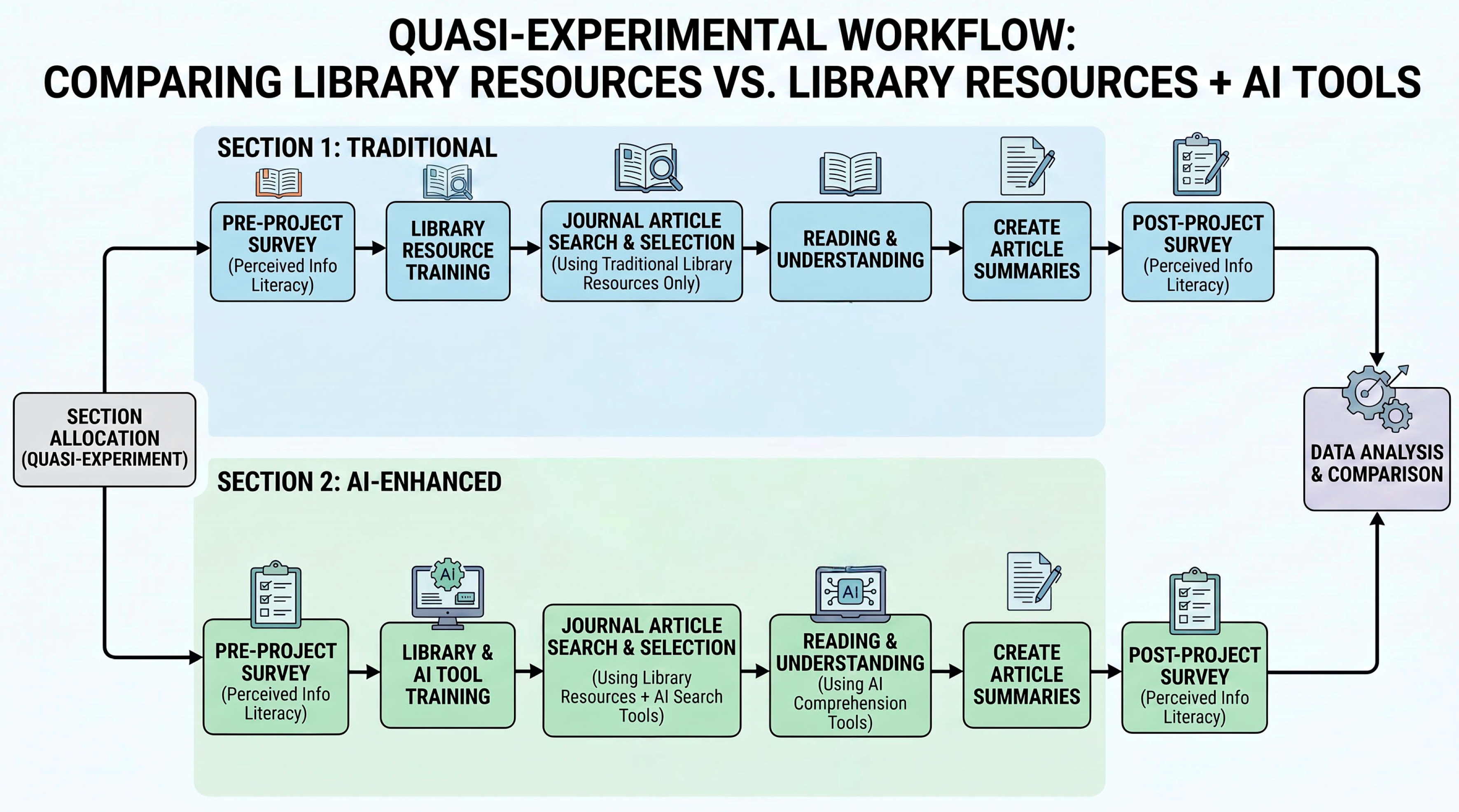
The study activities were part of a semester-long, face-to-face Child Development course (introductory level) in the College of Education and Human Development at the University of North Dakota, which is a mid-sized public university in the upper Midwest region of the United States. Throughout the course, students were assigned to read chapters from the textbook. For each of the 15 chapters, students were required to social annotate the textbook using the platform Perusall. They were instructed to use the annotation feature to flag citations in the textbook that were more than five years old. At the end of the term, students were randomly assigned to a chapter and needed to find a scholarly journal article to update an outdated source. A librarian taught a class session on how to identify and find scholarly sources. In one course section (the traditional section), students were only shown how to use the university’s library databases to locate articles. In another section (the AI-enhanced section), students were shown how to use Scite.ai (http://scite.ai) to find journal articles. Students in the AI-enhanced section were also shown how to use SciSpace to help them understand scholarly journal articles (https://scispace.com/). In both sections, the students were encouraged to reach out to the librarian for help, and the instructor had worktime built into the class during which she was available for inquiries.
Students were required to locate two different journal articles. One was a historical article by or about an underrepresented scholar (woman and/or person of color) in child development. The second was an updated reference for the OER textbook. Once their article was approved, students organized the information in the journal articles into tables with bibliographic details about the article (e.g., title, authors), key findings, how and where the article could be incorporated into the OER textbook, and the APA citation. The instructor has been using these completed tables to update the textbook for use with future students. Before data collection, ethical approval was received from the author’s Institutional Review Board. The project and study activities took place from the end of August through mid-December in 2024 and 2025 (16-week fall semester at this institution). The teaching materials used for this project, including instructions for students in both the traditional and AI-enhanced sections and instructor-created examples, are available in this study’s Open Science Framework files [98].
The study process and design are illustrated in the graphic workflow in Figure 1. Note that generative AI was used to create this workflow using the tool Sci-Draw AI (https://sci-draw.com/).
Figure 1.
Graphical overview of the study design and procedures.
3.4. Participants
Students in both sections of the course were asked to complete online surveys at the beginning and end of the term. Of the 123 enrolled in the course Sections (59 in the traditional and 64 in the AI-enhanced), 86 completed both surveys (beginning and end of semester) and both article tables. Of these students, 40 were in the traditional section, and 46 were in the AI-enhanced section. Based on the demographic reporting in the surveys, one was nonbinary, one was female/gender fluid, one was trans masculine, four were men, and 83 were women. The remaining students did not share their gender identities. In terms of racial and ethnic identities, two students were Black, one was South Asian, two indicated multiple identities, and 76 were White. The remaining students did not share their racial and ethnic identities. In terms of year in school, 60.9% were first-year students, 20.9% were sophomores, 14.5% were juniors, and 3.6% were seniors. All students enrolled in the course who consented to having their assignments analyzed were included in the course assignment analyses (55 in the traditional course and 58 in the AI-enhanced course, total N = 113). Not all students enrolled in the course consented to having their assignments included in the study, which is why the number of students in course assignment analyses is less than the number of students enrolled in the course.
3.5. Measures
3.5.1. Source Skills
To assess students’ skills in finding and evaluating sources, 10 items from the Information Literacy Self-Efficacy Scale were used [99]. These items were chosen because they addressed how to initiate searches for appropriate sources and determine if a source is appropriate, which were the targets of the intervention. Students indicated how competent they felt in various skills, such as “determine the currentness of the information source” and “identify whether an article is from a peer-reviewed journal” on a scale of 1–5 ranging from “extremely incompetent” to “extremely competent.” All items can be seen in Appendix A. The reliability of the measure of McDonald’s omega was calculated using a macro for SPSS developed by Hayes & Coutts [100]. McDonald’s omega provides a metric of correspondence of the items with each other [100]. Reliability was good at both the beginning of the term (McDonald’s omega = 0.82) and at the end of the term (McDonald’s omega = 0.90).
3.5.2. Course Assignments
The number of attempts necessary to have their article approved by the instructor and student scores on their article summary assignments were also examined. Students needed to have an article approved by the instructor. To compare whether the AI tools were useful in identifying appropriate sources, the number of submissions prior to article approval was compared by course sections (traditional and AI-enhanced). One submission would be considered ideal in that the student successfully found and submitted a suitable source on their first attempt. Zero submissions would indicate the student did not submit any sources. Two or more submissions (the highest number was 3) would indicate the student needed multiple attempts to successfully find and submit a suitable source. After articles were approved, students were assigned to develop tables summarizing key information. Students were required to submit an annotated PDF of the article indicating where the information for the table summary was found in the article. These were scored using a rubric and were worth up to 90 points.
3.5.3. Perceived Skills
All students were asked an open-ended item about the skills they learned from the journal article assignments. Only responses from students who completed the assignments were included, as they could not learn skills from the assignments without doing the assignments. A total of 87 students provided responses to this item and completed both assignments. Inductive content analysis was used to identify themes [101]. Following this approach, the study’s researcher read through each student’s response several times and took notes on reoccurring themes [102]. The researcher then coded each of the responses for the themes it corresponded to. The total number of responses for each theme was tallied. In this process, it is possible for a single response to have more than one theme [103].
4. Results
For all statistical analyses, SPSS software version 32 was used. To prepare data for analysis, the dataset was prepared by merging beginning and end-of-semester surveys. In addition, course assignment data was entered from the course learning management system. The perceived source skills items were added together and divided by the number of items to provide a meaningful metric in descriptive statistics reporting (i.e., to better understand the means in the context of the rating scale). Missing survey data were not included in analyses.
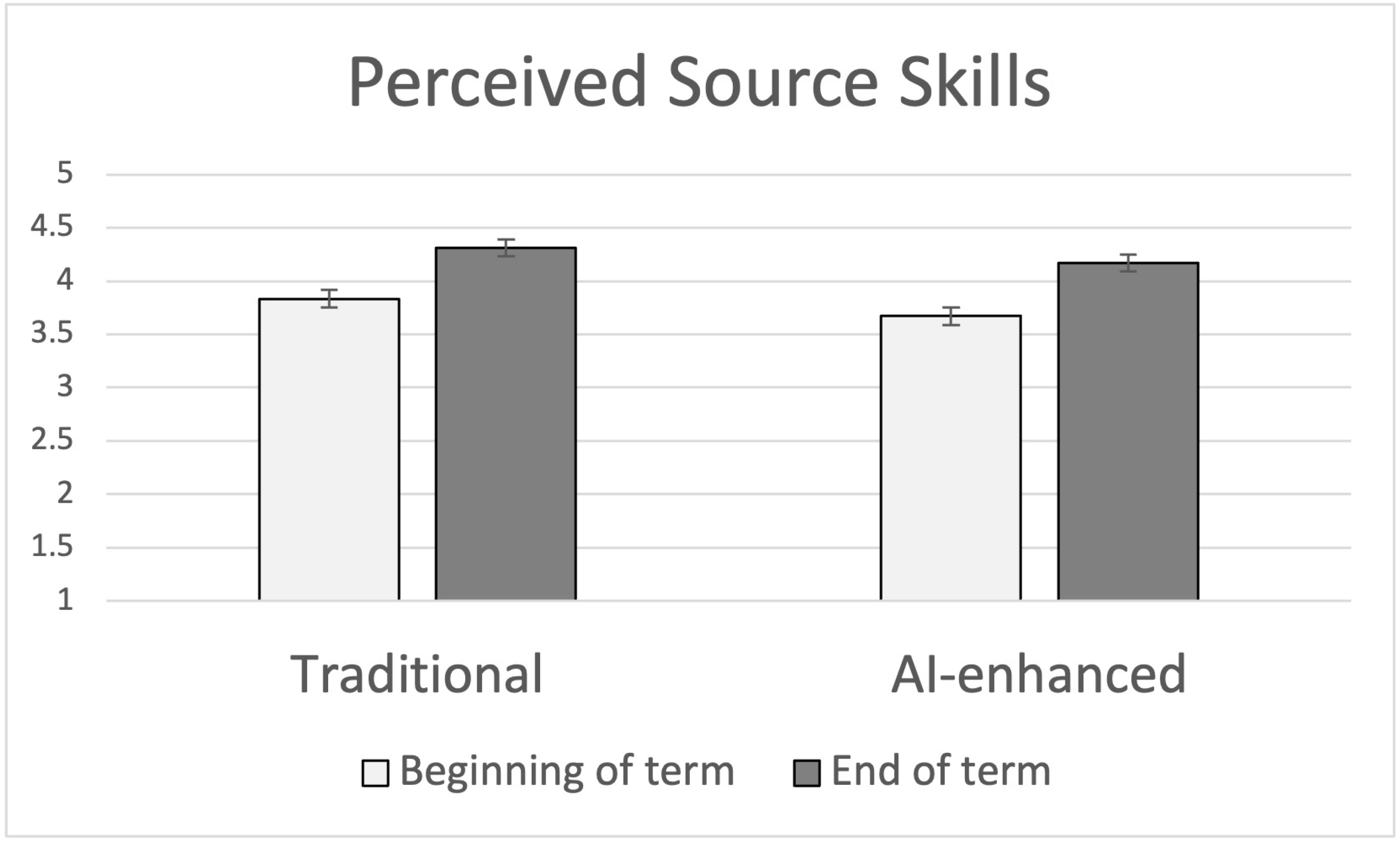
To address the first and second research questions, a mixed ANOVA was conducted with beginning and end of term perceived source skills as a within-subjects comparison and course section (AI-enhanced or traditional) as a between-subjects comparison (see Table 2 for descriptives and Figure 2 for bar chart of findings). Mixed ANOVA was an appropriate methodological choice given that the dependent variable (perceived source skills) was continuous, one of the independent variables was between-subjects (course section), one of the independent variables was within-subjects (time in terms of comparing beginning and end of term perceived source skills), and the assumptions were met [104]. Based on the lack of statistical significance for Box’s test of equality of covariance matrices, Box’s M = 1.80, p = 0.63, the assumption of homogeneity was met. The assumption of normality was examined through Q-Q plots, in which the data were found to be near the diagonal line, and thereby normality was assumed.
Table 2.
Descriptive statistics of perceived source skills.
Figure 2.
Bar chart of perceived source skills by section and time.
Based on the findings from the within-subjects comparison, students’ perceived source skills appeared to increase throughout the semester, F(1, 84) = 47.30, p < 0.001, partial η2 = 0.36. There was no reliable difference in perceived source skills by course section, F(1, 84) = 2.99, p = 0.09, partial η2 = 0.03, nor was there evidence of an interaction between time and course section, F(1, 84) = 0.04, p = 0.85, partial η2 = 0.00. This indicates that students in both sections grew their perceived source skills during the semester, but that AI enhancement did not appear to affect how much growth students experienced. This can also be noted by the similar average change in scores from the beginning to the end of the term. Note that only students who completed the open pedagogy assignments were included in the analyses, as there is no reason to anticipate a change in source skills if they did not show they did the activity intended to improve source skills.
Students’ perceived skills were also examined through their responses to an open-ended item about the skills they developed in the project. The themes identified through inductive content analysis were finding scholarly sources, identifying scholarly sources, reading journal articles and in general, critical thinking, need for recent research, child development knowledge, and no new skills. Table 3 indicates the percentages of student responses for each theme (by course section and combined) as well as examples of themes.
Table 3.
Themes in student responses to the skills learned in the open pedagogy project.
As can be seen in Table 3, the project objectives were frequently mentioned in students’ responses about the skills they developed. Namely, finding scholarly sources was the most common, with almost half of students indicating it. Reading journal articles and in general was reported by over a third of students, and nearly a quarter recognized the need for research findings to be recent in a textbook. A notable minority mentioned other skills such as child development knowledge, which was the overall objective of the course, or organizational skills. Very few students indicated that they did not learn any new skills. Percentages were relatively similar between course sections, with the exception of reading journal articles and in general. Because of the number of themes and the relatively small sample, the likelihood of Type I errors from repeated testing in which differences are noted due to chance rather than a true difference was a concern [105]. Therefore, statistical analyses were not conducted on student responses.
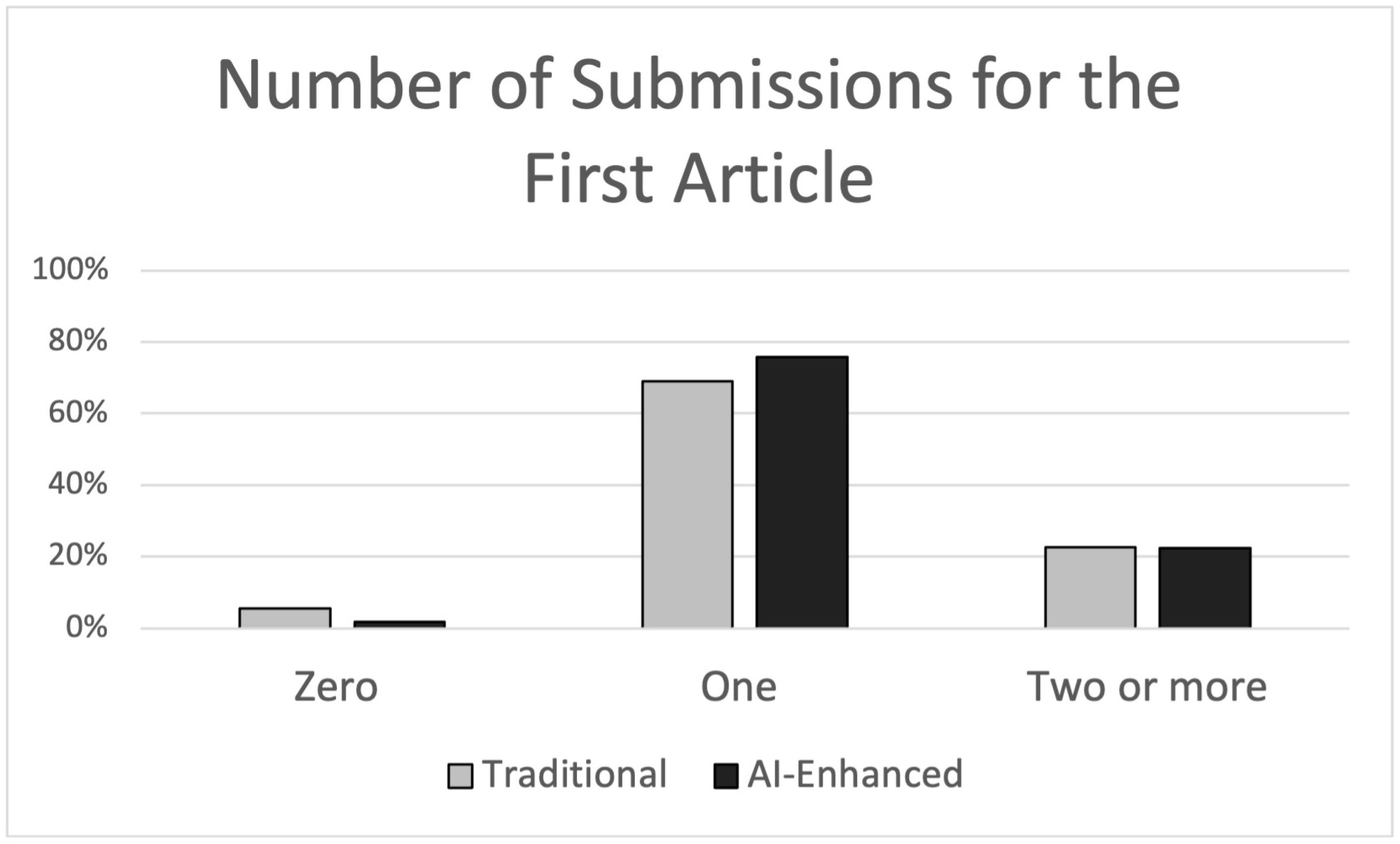
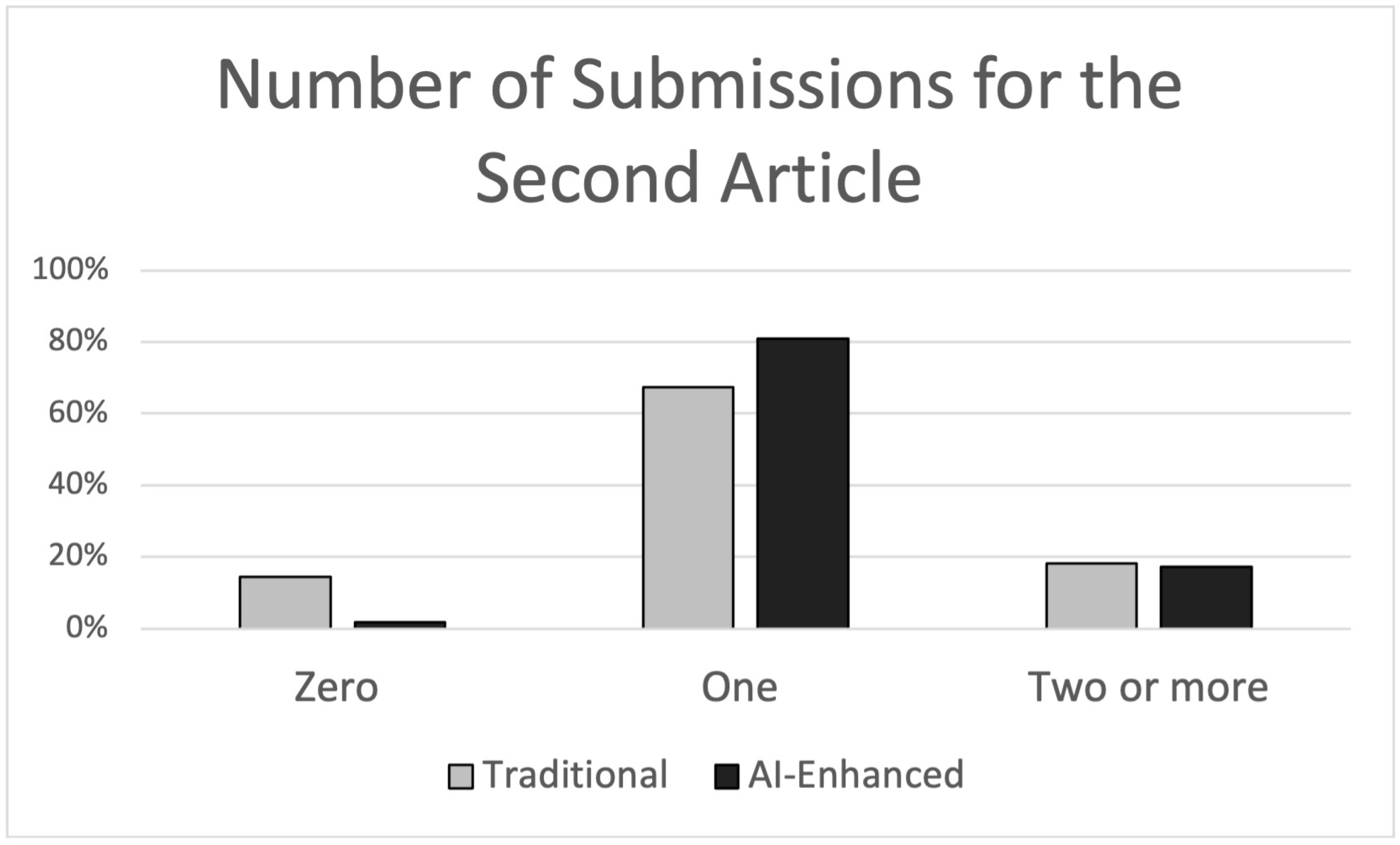
The second research question was further addressed through examining the course assignments. First, the number of source submissions for approval by the instructor was examined through chi-square analyses comparing the distributions of submissions by course section. One submission would indicate better source skills than students with zero submissions or two or more submissions. Based on the analyses, there were no reliable differences between course sections for the distribution of number of submissions for the first (historical) article, χ2(2) = 1.40, p = 0.50, Cramer’s V = 0.14. However, for the second (recent) article, there was a reliable difference in distributions, χ2(2) = 6.56, p = 0.04, Cramer’s V = 0.25, with students in the AI-enhanced section being more likely to have an article approved after the first submission. See Table 4 for the distribution of submissions by article and section and Figure 3 and Figure 4 for bar charts of the findings.
Table 4.
Number of submissions for article approval by course section.
Figure 3.
Number of submissions for the first article by section.
Figure 4.
Number of submissions for the second article by section.
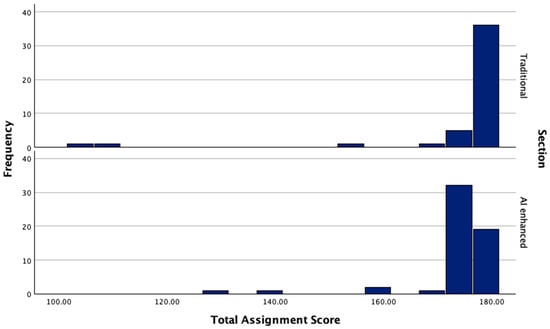
The scores on the student summary tables were compared by course section for students who completed both assignments. The means for the two course sections were very similar, with both sections having high average scores (traditional M = 174.73, SD = 15.40 and AI-enhanced M = 173.86, SD = 8.87; NB: total possible points were 180). Because the assumption of normality for ANOVA was not met due to ceiling effects in the scores, an independent-samples Mann–Whitney U test was conducted. The Mann–Whitney U test is a nonparametric test that, unlike ANOVA, does not have assumptions of normality and instead of comparing means, it tests ranks [106]. This is done by combining observations for each condition and ranking them to compare distributions. In this way, the Mann–Whitney U test indicates whether one condition tends to have different values (either larger or smaller) than another condition. The U statistic indicates how frequently one condition’s observations are a higher value than the other condition’s observations. Based on this test, the assignment score distributions were different between the two conditions, Mann–Whitney U = 618.00, p < 0.001, r = 0.44. The mean rank for the traditional section was higher than the AI-enhanced section (65.27 compared to 39.54). A higher mean rank indicates higher assignment scores in the distribution for the traditional section compared to the AI-enhanced section. As can be seen in the frequency distribution of assignment scores by section in Figure 5, this appears to be due to a higher concentration of perfect scores in the traditional section than in the AI-enhanced section.
Figure 5.
Distribution of total assignment scores by section.
The likelihood that students completed both summary tables was examined through a chi-square analysis. Based on the findings, 96.6% of students in the AI-enhanced course section completed both table summaries compared to 81.8% of students in the traditional course section, which was a significant difference in distributions, χ2(1) = 6.46, p = 0.01, Cramer’s V = 0.24.
5. Discussion
The primary purpose of this study was to examine how an open pedagogy project related to information literacy skills. In this open pedagogy project, students collaborated with the instructor to improve the citations of a course OER textbook. Based on a measure of perceived skills, students’ skills in finding suitable sources appeared to increase from before the project to after they had completed the project. Moreover, students reported that they developed information literacy skills such as finding suitable sources and understanding the need for recent research findings. Students who completed the project performed quite well with an average percent score of approximately 97%, which is an A grade in the course.
The secondary purpose of this study was to compare student information literacy skills between a section using only traditional library resources (traditional) and a section in which GenAI tools were incorporated (AI enhanced). These GenAI tools were specifically for finding suitable sources and understanding scholarly journal articles. Based on a measure of perceived skill development, there were no reliable differences in information literacy skills between the traditional and AI-enhanced sections. Students in the traditional section appeared to be more likely to have higher scores on the course assignment than did students in the AI-enhanced section. However, students in the AI-enhanced section were more likely to submit a suitable source and more likely to submit both open pedagogy assignments.
OER foster equity and inclusion in education [9,10,44], which supports the UN’s goals in education in 2030 Agenda for Sustainable Development [48]. In order for OER to be sustainable, there needs to be a cycle of development and improvement of materials [11]. Open pedagogy projects, such as the one described in this study, are one approach to supporting the sustainability of OER. Although policies to support this cycle are critical to the continuation of the OER ecosystem [11,12], this study illustrates a method to contribute to the UN’s sustainable education goal that is within an individual instructor’s control.
Collaborating with an instructor to update an OER textbook was anticipated to support students’ information skill development [21]. Each frame in the ACRL’s information literacy framework was targeted through this open pedagogy project (see Table 1, Association of College and Research Libraries [ACRL] [56]). Indeed, students’ self-reported skills in finding and evaluating sources were higher after the open pedagogy project. When asked about the skills they learned from working on the project, students mentioned aspects of the ACRL frames such as being able to find valuable information and understanding the need for research findings to be regularly updated. Importantly, students who completed the open pedagogy project assignments generally did so successfully, indicating that they were able to effectively apply their information literacy skills. Although it is important to acknowledge the lack of a control group for the open pedagogy aspect, the findings from this study do provide evidence that open pedagogy may improve student learning outcomes. There is a lack of inquiry into student learning outcomes in open pedagogy research [7,8,15]; therefore, this study provides a needed contribution by measuring skills students learned through open pedagogy. Information literacy is critical for sustainability so that students can better inform themselves to make choices to benefit the environment [59,60]. Information literacy is also an important learning outcome given that it fosters academic success, prepares students for future employment, and supports broader critical thinking skills [18,19,58]. In this way, this study provides empirical support for the use of open pedagogy beyond what has previously been reported regarding student experiences and motivation in the literature [37,51,52,53,54].
GenAI tools to help find and understand scholarly sources were incorporated into the open pedagogy project for the AI-enhanced section. Considering the roles for GenAI in education [84,85], these tools could best be categorized as providing a “collaboration coach” to support students in finding appropriate information to address the problem of updating citations in the OER textbook. Students appeared to be more likely to have a lower score on the assignment if they were in the AI-enhanced section compared to the traditional section. This would indicate that having GenAI as a collaboration coach to scaffold their learning tasks was not helpful for student performance. Conversely, students in the AI-enhanced section were more likely to submit both assignments in the open pedagogy project compared to students in the control section (81.8% in the control and 96.6% in the AI-enhanced). Because students needed to have an article approved prior to submitting the assignment, this difference is likely driven by the difference in submitting the second journal article. In the control section, 14.5% of students did not submit a second article, whereas only 1.7% of students failed to do so in the AI-enhanced course.
One possible explanation for the lower scores in the AI-enhanced section is that students who struggle to the point that they would typically not submit an assignment did submit with the use of GenAI tools, and they received a low score because they were struggling. An alternative explanation is that GenAI may have made for students doing less well on the assignment because they were less engaged [75]. In this way, GenAI may have provided scaffolding to help complete the assignment but did not promote in-depth understanding to perform as well on the assignment compared to students without the GenAI scaffold available. Unfortunately, both explanations are merely conjectures that cannot be properly tested with the current study design and measures.
If indeed the GenAI tools facilitated assignment completion, one potential explanation is that GenAI may have reduced frustration experienced when finding and submitting a suitable source. If this were the case, it is possible that having GenAI tools to assist in finding and understanding a scholarly article may have provided the scaffolds needed to actually do the assignment. Indeed, one study found that students may be more comfortable asking GenAI for assistance compared to humans, in this case, the instructor or librarian [107]. This relates to another study in which students felt reluctant to reach out for help from educators out of concerns for burdening them or pride in self-reliance [108]. According to that study, connecting personally with students may alleviate these issues [108]; however, another study indicated that students may perceive GenAI as more convenient as it is available on demand [109].
Practical Implications
The strong performance on these assignments provides support for its use by instructors wishing to support OER sustainability and the United Nations’ 2030 sustainable development goal of quality education [2,3,11]. On average, students in an introductory course met the expectations for updating the textbook when provided with scaffolding, regardless of whether the scaffolding involved GenAI tools. Instructors may use these findings to consider how to collaborate with their students on similar projects, which would contribute to the sustainability of OER. Notably, student performance on the open pedagogy assignments was strong despite the course being an introductory level one with approximately 60 students enrolled. The high average grades on the open pedagogy project indicate that open pedagogy may be useful for instructors to use to scaffold collaboration with students to update OER textbooks. Most studies on open pedagogy projects have been with small, upper-level or graduate courses [15]; the characteristics of the course in this study provide a novel contribution to the open pedagogy literature.
There were two competing predictions for information literacy skill outcomes in the AI-enhanced section compared to the control section that only incorporated traditional library resources. One was that introducing and modeling GenAI tools would provide helpful scaffolds that are not feasible without GenAI, and students’ learning outcomes would subsequently appear to benefit [70]. The other prediction was that GenAI tools would make the learning process so easy that students would lack engagement and subsequently their learning would appear to be diminished [75]. This could be related to a lack of fading of the GenAI scaffolds, which is an important aspect of effective scaffolding [77,110]. The current study’s findings did not neatly support either prediction. Students’ self-reported skills in finding suitable sources appeared to have similar patterns of growth in both the control and AI-enhanced sections. However, students in the traditional section were more likely to have higher assignment scores than were students in the AI-enhanced section. This was detected through nonparametric statistics ranking the assignment scores in each section due to ceiling effects, as the overall average grades in the section were 97%. Ceiling effects with the assignment grades would make it difficult to detect differences in means based on GenAI tools given the lack of room for improvement. It should be noted that the information literacy skills, both self-reports and grades, were only examined for students who completed the assignments (students who did not complete the assignments rarely completed the self-report measures and cannot be meaningfully compared).
Students reported a variety of information literacy skills developed from the project in the open-ended item analyses. In terms of whether GenAI was incorporated, the skills reported were fairly similar, although statistical analyses were not conducted and the quasi-experimental design does not allow for causal claims to be made. Being mindful of these limitations, it should be noted that the theme of reading journal articles and in general, did have a large difference by course section. Over twice as many students in the AI-enhanced section noted some kind of reading skill development from the project compared to the students in the traditional section. One possible reason for this could be the GenAI tool to help students understand journal articles. Given the difficulty students can have reading journal articles [111], this may be something instructors should consider when deciding whether to incorporate GenAI tools into their instruction. However, this possibility is only conjecture given the study design.
Instructional guidelines for GenAI in the classroom may be informed by the results of this study. GenAI has been noted for its potential in supporting the OER ecosystem, which would contribute towards the United Nations’ sustainable development goal for quality education [2,3]. In this study, GenAI was used in a “collaborative coach” role based on a guide by UNESCO on AI in higher education [84]. GenAI was envisioned as a scaffold to help students find and understand scholarly research articles, similar to approaches in previous studies [72,73]. However, there was no way to fade, or pull away, the scaffold of GenAI in the tasks, as students had independent, consistent access to these tools. Given the mixed findings regarding GenAI tools in this study, the results could be interpreted as supporting cautious, limited, and mindful use of GenAI in the classroom. Students may be helped in actually completing the work, but there is a concern that the quality of the work could have consequences with GenAI tools. It is the author of this study’s view that GenAI use in the classroom should be carefully monitored, and students need to be aware of the risks of using GenAI in their courses. Furthermore, the potential tradeoff of increased efficiency in the sustainability OER ecosystem through GenAI for open pedagogy must be measured against the environmental resources consumed by GenAI.
6. Limitations, Future Directions, and Conclusions
Because this study involved real course assignments and in-person instruction, random assignment to GenAI tools was not possible. Subsequently, causal claims cannot be made, as confounds are not controlled for as well in a quasi-experimental design compared to a true experiment with random assignment. Future studies could address this through larger samples in which course sections could receive random assignment or online studies in which students are randomly assigned to receive guidance in using GenAI tools.
The study examined students’ assignments based solely on quantitative metrics. This afforded statistical comparisons through the quasi-experimental design, but lacked nuance and detail about the student work. A qualitative, in-depth approach would provide an inquiry into the depth of student skills observed in their assignments and would be an important avenue for future research. Furthermore, the information literacy skills beyond the assignments were examined through self-reports (both the quantitative, Likert scale measure and the open-ended responses). Future studies with more objective measures, such as information literacy exams, would build on this work.
This study examined a particular type of open pedagogy assignment and two GenAI tools in one course. The demographics of the students were overwhelmingly young, White women, and the context was in one location in the United States. For these reasons, broad generalizations based on this study’s findings would be inappropriate, as is the case with any applied research using a homogenous sample [112,113], especially when examining GenAI in educational contexts [114]. Future studies could build off the current study by examining other forms of open pedagogy, more or different GenAI tools, and samples with more age, racial, and gender diversity. In addition, longitudinal studies to examine how student skills are applied in future courses would be informative.
Open educational resources (OER) are tools to support sustainability in quality education, which is part of the UN’s 2030 Agenda for Sustainable Development [2,3,48]. In order for OER to be sustainable, continuous improvement is necessary. In this study, an example of how individual instructors can collaborate with their students to update the citations of a course OER is provided. Importantly, students appeared to develop their information literacy skills in this process. Providing access to and modeling of GenAI tools to find and understand scholarly sources may be beneficial for supporting students to complete the assignment. GenAI tools do not appear to provide any support for information literacy skill development and may be related to weaker scores on the assignment. These findings may be useful for instructors who wish to engage their students in the sustainability of open education and meaningfully support information literacy skills. However, instructors should be aware that GenAI tools may be a double-edged sword in which students are scaffolded in completing course projects, but the projects may be lower in quality.
Funding
This research received no external funding.
Institutional Review Board Statement
The study was conducted in accordance with the Declaration of Helsinki, and the protocol was approved by the Institutional Review Board of the University of North Dakota of IRB0006091 on 8 March 2024.
Informed Consent Statement
Verbal informed consent was obtained from the participants. Verbal consent was obtained rather than written because all students were provided with study information and informed that they could request to not have their assignments included in the study.
Data Availability Statement
The original deidentified data and materials presented in the study are openly available in Open Science Framework at https://osf.io/vznts/, (accessed on 1 August 2026). The directions and materials for the assignment are also openly available in the same location.
Acknowledgments
I thank my students for engaging in improving their textbook and sharing their experiences. I also thank the William and Flora Hewlett Foundation for their years of support for open education. During the preparation of this manuscript, the author used Sci-Draw AI (https://sci-draw.com/) to generate Figure 1. The author has reviewed and edited the output and take full responsibility for the content of this publication.
Conflicts of Interest
The author declares no conflicts of interest.
Abbreviations
The following abbreviations are used in this manuscript:
| OER | Open Educational Resources |
| UN | United Nations |
| GenAI | Generative artificial intelligence |
Appendix A
Information Literacy Self-Efficacy Scale items and prompt used in the study.
Please indicate how confident and competent (skilled) you feel about doing each of the following:
Identify a variety of potential sources of information.
Limit search strategies by subject, language, and date.
Initiate search strategies by using keywords and Boolean logic.
Use multiple resources to provide the information needed for a project.
Determine the currentness of the information source.
Select information most appropriate for the need.
Identify points of agreement and disagreement among sources.
Evaluate internet sources.
Find peer-reviewed journal articles using the library databases.
Identify whether an article is from a peer-reviewed journal.
References
- UNESCO. Recommendation on Open Educational Resources (OER). 2019. Available online: https://www.unesco.org/en/legal-affairs/recommendation-open-educational-resources-oer (accessed on 16 July 2026).
- Guarini, P.; Rossi, M.; Savino, F.P.; Finestrone, F. Intersectionality Between Open Educational Resources and Sustainable Development Goals: Future Perspectives. In Psychology, Learning, Technology; Di Fuccio, R., Toto, G.A., Eds.; Springer Nature: Berlin/Heidelberg, Germany, 2025; pp. 63–77. [Google Scholar] [CrossRef] [Scilit]
- Ossiannilsson, E. Open Educational Resources (OER) and Some of the United Nations Sustainable Development Goals. Int. J. Inf. Learn. Technol. 2023, 40, 548–561. [Google Scholar] [CrossRef] [Scilit]
- United Nations General Assembly. Transforming Our World: The 2030 Agenda for Sustainable Development (A/RES/70/1); United Nations Digital Library: New York, NY, USA, 2015; Available online: https://sdgs.un.org/2030agenda (accessed on 16 July 2026).
- Cho, K.W.; Permzadian, V. The Impact of Open Educational Resources on Student Achievement: A Meta-analysis. Int. J. Educ. Res. 2024, 126, 102365. [Google Scholar] [CrossRef] [Scilit]
- Clinton, V.; Khan, S. Efficacy of Open Textbook Adoption on Learning Performance and Course Withdrawal Rates: A Meta-analysis. AERA Open 2019, 5, 2332858419872212. [Google Scholar] [CrossRef] [Scilit]
- Tlili, A.; Garzón, J.; Salha, S.; Huang, R.; Xu, L.; Burgos, D.; Denden, M.; Farrell, O.; Farrow, R.; Bozkurt, A.; et al. Are Open Educational Resources (OER) and Practices (OEP) Effective in Improving Learning Achievement? A Meta-analysis and Research Synthesis. Int. J. Educ. Technol. High. Educ. 2023, 20, 54. [Google Scholar] [CrossRef] [Scilit]
- Tlili, A.; Zhang, X.; Lampropoulos, G.; Salha, S.; Garzón, J.; Bozkurt, A.; Huang, R.; Burgos, D. Uncovering the Black Box Effect of Open Educational Resources (OER) and Practices (OEP): A Meta-analysis and Meta-synthesis from the Perspective of Activity Theory. Humanit. Soc. Sci. Commun. 2025, 12, 504. [Google Scholar] [CrossRef] [Scilit]
- Clinton-Lisell, V.; Legerski, E.M.; Rhodes, B.; Gilpin, S. Open Educational Resources as Tools to Foster Equity. In Teaching and Learning for Social Justice and Equity in Higher Education: Content Areas; Ozaki, C.C., Parson, L., Eds.; Springer International Publishing: Berlin/Heidelberg, Germany, 2021; pp. 317–337. [Google Scholar] [CrossRef] [Scilit]
- Lambert, S.R. Changing Our (Dis) Course: A Distinctive Social Justice Aligned Definition of Open Education. J. Learn. Dev. 2018, 5, 225–244. [Google Scholar] [CrossRef] [Scilit]
- Alsuhaymi, A.O.; Atallah, F.A. Governing Open Educational Resources as Sustainable Knowledge Commons: A Policy and Institutional Framework for Higher Education. Sustainability 2026, 18, 4024. [Google Scholar] [CrossRef] [Scilit]
- Otto, D.; Kerres, M. Increasing Sustainability in Open Learning: Prospects of a Distributed Learning Ecosystem for Open Educational Resources. Front. Educ. 2022, 7, 866917. [Google Scholar] [CrossRef] [Scilit]
- Hegarty, B. Attributes of Open Pedagogy: A Model for Using Open Educational Resources. Educ. Technol. 2015, 55, 3–13. [Google Scholar]
- Tietjen, P.; Asino, T.I. What Is Open Pedagogy? Identifying Commonalities. Int. Rev. Res. Open Distrib. Learn. 2021, 22, 185–204. [Google Scholar] [CrossRef] [Scilit]
- Clinton-Lisell, V. Open Pedagogy: A Systematic Review of Empirical Findings. J. Learn. Dev. 2021, 8, 2. [Google Scholar] [CrossRef] [Scilit]
- Duan, C. The Evolution of Open Educational Practices: A Comparative Analysis of Models and a New Framework for the AI Era. Smart Learn. Environ. 2026, 13, 15. [Google Scholar] [CrossRef] [Scilit]
- LeMire, S.; Xu, Z.; Hahn, D. First-Year and First-Gen: Assessing the Information Literacy Skills of First-Year, First-Generation College Students. Coll. Res. Libr. 2025, 86, 31. [Google Scholar] [CrossRef] [Scilit]
- Jones, W.L.; Mastrorilli, T. Assessing the Impact of an Information Literacy Course on Students’ Academic Achievement: A Mixed-Methods Study. Evid. Based Libr. Inf. Pract. 2022, 17, 61–87. [Google Scholar] [CrossRef] [Scilit]
- Nikou, S.; De Reuver, M.; Mahboob Kanafi, M. Workplace Literacy Skills—How Information and Digital Literacy Affect Adoption of Digital Technology. J. Doc. 2022, 78, 371–391. [Google Scholar] [CrossRef] [Scilit]
- Sparks, J.R.; Katz, I.R.; Beile, P.M. Assessing Digital Information Literacy in Higher Education: A Review of Existing Frameworks and Assessments with Recommendations for Next-Generation Assessment. ETS. Res. Rep. Ser. 2016, 2016, 1–33. [Google Scholar] [CrossRef] [Scilit]
- Hare, S.; Frye, J.M.; Samuelson, B.L. Open Pedagogy as an Approach to Introducing Doctoral Students to Open Educational Resources and Information Literacy Concepts. Libr. Trends 2020, 69, 435–468. [Google Scholar] [CrossRef] [Scilit]
- Carroll, A.J.; Borycz, J. Integrating Large Language Models and Generative Artificial Intelligence Tools into Information Literacy Instruction. J. Acad. Librariansh. 2024, 50, 102899. [Google Scholar] [CrossRef] [Scilit]
- Mills, A.; Bali, M.; Eaton, L. How Do We Respond to Generative AI in Education? Open Educational Practices Give Us a Framework for an Ongoing Process. J. Appl. Learn. Teach. 2023, 6, 16–30. [Google Scholar] [CrossRef] [Scilit]
- Boyle, C. ChatGPT, Gemini, & Copilot: Using Generative AI as a Tool for Information Literacy Instruction. Ref. Libr. 2025, 66, 13–29. [Google Scholar] [CrossRef] [Scilit]
- Chaudhuri, J.; Terrones, L. Reshaping Academic Library Information Literacy Programs in the Advent of ChatGPT and Other Generative AI Technologies. Internet Ref. Serv. Q. 2025, 29, 1–25. [Google Scholar] [CrossRef] [Scilit]
- Panke, S. Open Educational Resources and Artificial Intelligence for Future Open Education. Mousaion 2026, 42, 1–23. [Google Scholar] [CrossRef] [Scilit] [PubMed]
- Ren, X.; Luo, T.; Detrick, R. Exploring Students’ Perceptions and Experiences of Adopting Generative Artificial Intelligence in OER-Enabled Pedagogy. Open Learn. J. Open Distance E-Learn. 2026, 1–21. [Google Scholar] [CrossRef] [Scilit]
- Bender, E.M.; Costello, E.; Lee, K.; Farrow, R.; Ferreira, G. Unsafe AI for Education: A Conversation on Stochastic Parrots and Other Learning Metaphors ⚠. J. Interact. Media Educ. 2025, 2025, 10. [Google Scholar] [CrossRef] [Scilit]
- Bozkurt, A. Generative AI, Synthetic Contents, Open Educational Resources (OER), and Open Educational Practices (OEP): A New Front in the Openness Landscape. Open Prax. 2023, 15, 178–184. [Google Scholar] [CrossRef] [Scilit]
- Tlili, A.; Farrow, R.; Bozkurt, A.; Amiel, T.; Wiley, D.; Downes, S. The Double-Edged Sword: Open Educational Resources in the Era of Generative Artificial Intelligence. J. Appl. Learn. Teach. 2026, 9, 11–19. [Google Scholar] [CrossRef] [Scilit]
- SPARC. Open Education. 2024. Available online: https://sparcopen.org/open-education/ (accessed on 12 August 2026).
- Adil, H.M.; Ali, S.; Sultan, M.; Ashiq, M.; Rafiq, M. Open Education Resources’ Benefits and Challenges in the Academic World: A Systematic Review. Glob. Knowl. Mem. Commun. 2022, 73, 274–291. [Google Scholar] [CrossRef] [Scilit]
- Clinton-Lisell, V. Designing Inclusive and Equitable Research in Active Learning in Higher Education. Act. Learn. High. Educ. 2026, 27, 231–239. [Google Scholar] [CrossRef] [Scilit]
- Witt, A.N. Toward a Working Definition of Open Pedagogy. Int. J. Open Educ. Resour. 2020, 3, 1–19. [Google Scholar] [CrossRef] [Scilit]
- Wiley, D.; Hilton, J.L., III. Defining OER-Enabled Pedagogy. Int. Rev. Res. Open Distrib. Learn. 2018, 19, 133–147. [Google Scholar] [CrossRef] [Scilit]
- Rollag Yoon, S.; Gilpin, S. Open Pedagogy Practices in Teacher Education: Digital Spaces for Preservice Teachers’ Identities. Contemp. Issues Technol. Teach. Educ. 2022, 22, 778–801. Available online: https://www.learntechlib.org/primary/p/219882/ (accessed on 12 August 2026).
- Gilpin, S.; Yoon, S.R.; Clinton-Lisell, V. Exploring Open Pedagogy Principles: A Qualitative Study of Undergraduate Experiences. J. Open Flex. Distance Learn. 2025, 29, 132–150. Available online: https://search.informit.org/doi/10.3316/informit.T2026021400006090995658438 (accessed on 14 June 2026).
- Biddle, A.M.; Clinton-Lisell, V. “The Pictures Allowed Me to Connect to the Material More”: Student Perceptions of a Diversity-Focused Open Pedagogy Assignment. Scholarsh. Teach. Learn. Psychol. 2023, 9, 405–418. [Google Scholar] [CrossRef] [Scilit]
- Chen, D.; Hendricks, C. Open Pedagogy Benefits and Challenges: Student Perceptions of Writing Open Case Studies. Open Prax. 2023, 15, 27–36. [Google Scholar] [CrossRef] [Scilit]
- Hilton, J.; Wiley, D.; Chaffee, R.; Darrow, J.; Guilmett, J.; Harper, S.; Hilton, B. Student Perceptions of Open Pedagogy: An Exploratory Study. Open Prax. 2019, 11, 275. [Google Scholar] [CrossRef] [Scilit]
- Hollister, C. Using Open Pedagogy to Engage LIS Students: A Case Study. J. Librariansh. Sch. Commun. 2020, 8, eP2357. [Google Scholar] [CrossRef] [Scilit]
- McKenney, E.A.; Gates, T.A.; Goller, C.C.; Tully, D.; Leggett, Z.; Lupek, M.; Cross, W.; Krieg, C. Strategies to Empower Students Through Open Pedagogy and Citizen Science. Int. J. Open Educ. Resour. 2024, 5, 1–31. [Google Scholar] [CrossRef] [Scilit]
- Pei, W.; Deschamps, D.; McNally, M. Open Pedagogy from Creation to Dissemination: Student Engagement in Open Textbook Publication. J. Open Educ. Resour. Higher Educ. 2025, 3, 170–188. [Google Scholar] [CrossRef] [Scilit]
- Clinton-Lisell, V.E.; Roberts-Crews, J.; Gwozdz, L. SCOPE of Open Education: A New Framework for Research. Int. Rev. Res. Open Distrib. Learn. 2023, 24, 135–153. [Google Scholar] [CrossRef] [Scilit]
- Nouri, A.; Sajjadi, S. Emancipatory Pedagogy in Practice: Aims, Principles and Curriculum Orientation. Int. J. Crit. Pedagog. 2014, 5, 76–87. Available online: https://janeway.uncpress.org/ijcp/article/id/696/ (accessed on 12 August 2026).
- Seiferle-Valencia, M. It’s Not (Just) About the Cost: Academic Libraries and Intentionally Engaged OER for Social Justice. Libr. Trends 2020, 69, 469–487. [Google Scholar] [CrossRef] [Scilit]
- Omolade, B. A Black Feminist Pedagogy. Womens Stud. Q. 1993, 21, 31–38. Available online: https://www.jstor.org/stable/40022003 (accessed on 12 August 2026).
- Ossiannilsson, E.; Zhang, X.; Wetzler, J.; Gusmão, C.; Aydin, C.H.; Jhangiani, R.; Glapa-Grossklag, J.; Makoe, M.; Harichandan, D. From Open Educational Resources to Open Educational Practices: For Resilient Sustainable Education. Distance Mediat. Knowl. 2020, 31, 5393. [Google Scholar] [CrossRef] [Scilit]
- Vañó García, I. A Call for Critical and Open Pedagogies in Spanish Heritage Language Instruction: Students as Knowledge Producers of Open Educational Resources (OERs). Euroam. J. Appl. Linguist. Lang. 2023, 10, 21–38. [Google Scholar] [CrossRef] [Scilit]
- Paskevicius, M.; Irvine, V. Open Education and Learning Design: Open Pedagogy in Praxis. J. Interact. Media Educ. 2019, 2019, 10. [Google Scholar] [CrossRef] [Scilit]
- Clinton-Lisell, V.; Gwozdz, L. Understanding Student Experiences of Renewable and Traditional Assignments. Coll. Teach. 2023, 71, 125–134. [Google Scholar] [CrossRef] [Scilit]
- Kuo, Y.-T.; Kuo, Y.-C. Exploring the Impact of Open Pedagogy on Minority Students’ Motivation, Computational Thinking, and Perceived Learning in Interactive Computer Game Development. J. Intell. 2026, 14, 16. [Google Scholar] [CrossRef] [Scilit] [PubMed]
- Werth, E.; Williams, K. Exploring Student Perceptions as Co-authors of Course Material. Open Prax. 2021, 13, 53. [Google Scholar] [CrossRef] [Scilit]
- Werth, E.; Williams, K. What Motivates Students About Open Pedagogy? Motivational Regulation Through the Lens of Self-Determination Theory. Int. Rev. Res. Open Distrib. Learn. 2021, 22, 34–54. [Google Scholar] [CrossRef] [Scilit]
- Tillinghast, B.; Fialkowski, M.K.; Draper, J. Exploring Aspects of Open Educational Resources Through OER-Enabled Pedagogy. Front. Educ. 2020, 5, 76. [Google Scholar] [CrossRef] [Scilit]
- Association of College and Research Libraries. Framework for Information Literacy for Higher Education. 2016. Available online: https://www.ala.org/acrl/standards/ilframework/ (accessed on 12 August 2026).
- LeMire, S.; Xu, Z.; Dorsey, L.G.; Hahn, D. Information Literacy Skill Mastery Across the Undergraduate Degree: An Examination of First-Generation and Continuing-Generation Students. J. Acad. Librariansh. 2024, 50, 102932. [Google Scholar] [CrossRef] [Scilit]
- Zou’bi, R.A. The Impact of Media and Information Literacy on Acquiring the Critical Thinking Skill by the Educational Faculty’s Students. Think. Ski. Creat. 2021, 39, 100782. [Google Scholar] [CrossRef] [Scilit]
- Cuevas-Cerveró, A.; Colmenero-Ruiz, M.J.; Martínez-Ávila, D. Critical Information Literacy as a Form of Information Activism. J. Acad. Librariansh. 2023, 49, 102786. [Google Scholar] [CrossRef] [Scilit]
- Unegbu, M.C.; Immaculata, O.; Emuchay, B.N. Information Literacy and Sustainable Development Goals Implementation: The Role of Libraries and Librarians. Int. J. Soc. Sci. Educ. Res. Stud. 2023, 3, 1017–1112. [Google Scholar] [CrossRef] [Scilit]
- Repanovici, A.; Salcă Rotaru, C.; Murzea, C. Development of Sustainable Thinking by Information Literacy. Sustainability 2021, 13, 1287. [Google Scholar] [CrossRef] [Scilit]
- Tripathi, A.; Ansari, M.S.; Srivastava, N.A. Redefining Information Literacy Standards for Lifelong Learning: A Comparative Analysis Across Libraries, Disciplines, and Global Contexts. Coll. Undergrad. Libr. 2026, 33, 1–21. [Google Scholar] [CrossRef] [Scilit]
- Anthonysamy, L.; Sivakumar, P. A New Digital Literacy Framework to Mitigate Misinformation in Social Media Infodemic. Glob. Knowl. Mem. Commun. 2024, 73, 809–827. [Google Scholar] [CrossRef] [Scilit]
- McGrew, S.; Chinoy, I. Fighting Misinformation in College: Students Learn to Search and Evaluate Online Information Through Flexible Modules. Inf. Learn. Sci. 2022, 123, 45–64. [Google Scholar] [CrossRef] [Scilit]
- Ecker, U.K.H.; Tay, L.Q.; Spearing, E.R.; van der Linden, S.; Lewandowsky, S. Misinformation-Based Beliefs Can Have Behavioral Consequences. Psychol. Inq. 2025, 36, 23–25. [Google Scholar] [CrossRef] [Scilit]
- Dong, Y. Generative AI Technologies and Educational Outcomes: A Comprehensive Meta-analysis Comparing Traditional and AI-Driven Approaches. Humanit. Soc. Sci. Commun. 2026, 13, 559. [Google Scholar] [CrossRef] [Scilit]
- Gu, J.; Yan, Z. Effects of GenAI Interventions on Student Academic Performance: A Meta-analysis. J. Educ. Comput. Res. 2025, 63, 1460–1492. [Google Scholar] [CrossRef] [Scilit]
- Liu, Z.; Zuo, H.; Lu, Y. The Impact of ChatGPT on Students’ Academic Achievement: A Meta-analysis. J. Comput. Assist. Learn. 2025, 41, e70096. [Google Scholar] [CrossRef] [Scilit]
- Ma, N.; Zhong, Z. A Meta-analysis of the Impact of Generative Artificial Intelligence on Learning Outcomes. J. Comput. Assist. Learn. 2025, 41, e70117. [Google Scholar] [CrossRef] [Scilit]
- Pallant, J.L.; Blijlevens, J.; Campbell, A.; Jopp, R. Mastering Knowledge: The Impact of Generative AI on Student Learning Outcomes. Stud. Higher Educ. 2026, 51, 714–735. [Google Scholar] [CrossRef] [Scilit]
- Vygotsky, L.S.; Cole, M. Mind in Society: The Development of Higher Psychological Processes; Harvard University Press: Cambridge, MA, USA, 1978. [Google Scholar]
- Kim, H.; Hwang, J.; Kim, T.; Choi, M.; Lee, D.; Ko, J. Impact of Generative Artificial Intelligence on Learning: Scaffolding Strategies and Self-Directed Learning Perspectives. Int. J. Hum.–Comput. Interact. 2026, 42, 2965–2987. [Google Scholar] [CrossRef] [Scilit]
- Melanou, C.; Beege, M. Scaffolding Generative AI as a Tutor: A Quasi-Experimental Study of Learning Outcomes and Motivational, Cognitive and Metacognitive Processes. Educ. Sci. 2026, 16, 651. [Google Scholar] [CrossRef] [Scilit]
- Leal Filho, W.; Ben Hassen, T.; Martins, V.W.B.; Skouloudis, A. The Contribution of Artificial Intelligence to Achieving the United Nations Sustainable Development Goals. Environ. Dev. Sustain. 2026. [Google Scholar] [CrossRef] [Scilit]
- Rus, V.; Kendeou, P. Are LLMs Actually Good for Learning? AI Soc. 2025, 40, 5617–5618. [Google Scholar] [CrossRef] [Scilit]
- Gerlich, M. AI Tools in Society: Impacts on Cognitive Offloading and the Future of Critical Thinking. Societies 2025, 15, 6. [Google Scholar] [CrossRef] [Scilit]
- Liu, D.; Fan, G.; Pan, L. Tool, Tutor, or Crutch?: A Grounded Theory of Cognitive Scaffolding and Offloading in AI-Assisted Programming Education. Int. J. STEM. Educ. 2026, 13, 10. [Google Scholar] [CrossRef] [Scilit]
- Flenady, G.; Sparrow, R. Cut the Bullshit: Why GenAI Systems Are Neither Collaborators nor Tutors. Teach. High. Educ. 2026, 31, 163–172. [Google Scholar] [CrossRef] [Scilit]
- Gupta, D.; Anumula, S.K.; Panpatil, A.Y.; Sidhu, H.J.K.; Sreeramula, S.; Rao, S.; Tripathi, M. Privacy in AI in Education. In Teacher Perspectives and Responsible Practice for Integrating AI in the Classroom; Papadakis, S., Ed.; IGI Global Scientific: Hershey, PA, USA, 2026; pp. 119–148. [Google Scholar] [CrossRef] [Scilit]
- Lindgren, S.; Rudolph, J.; Tang, F.X.; Ismail, F.; Tan, S. Not Anti-technology, but Anti-capitalist: A Critical Theory of AI. An Interview with Professor Simon Lindgren. J. Appl. Learn. Teach. 2026, 9, e3971. [Google Scholar] [CrossRef] [Scilit]
- Selwyn, N. The Future of AI and Education: Some Cautionary Notes. Eur. J. Educ. 2022, 57, 620–631. [Google Scholar] [CrossRef] [Scilit]
- Beckman, K.; Apps, T.; Howard, S.K.; Rogerson, C.; Rogerson, A.; Tondeur, J. The GenAI Divide Among University Students: A Call for Action. Internet High. Educ. 2025, 67, 101036. [Google Scholar] [CrossRef] [Scilit]
- Zhai, X. Transforming Teachers’ Roles and Agencies in the Era of Generative AI: Perceptions, Acceptance, Knowledge, and Practices. J. Sci. Educ. Technol. 2025, 34, 1323–1333. [Google Scholar] [CrossRef] [Scilit]
- Sabzalieva, E.; Valentini, A. ChatGPT and Artificial Intelligence in Higher Education: Quick Start Guide; UNESCO Digital Library: Paris, France, 2023; Available online: https://unesdoc.unesco.org/ark:/48223/pf0000385146 (accessed on 12 August 2026).
- Sharples, M. Towards Social Generative AI for Education: Theory, Practices and Ethics. Learn. Res. Pract. 2023, 9, 159–167. [Google Scholar] [CrossRef] [Scilit]
- Al-Shamrani, A.S.A.; Alhomayani, R.E.S.; Ibrahim, A.M. The Role of Generative Artificial Intelligence in Advancing Sustainable and Environmentally Responsible Teaching Practices Among Postgraduate Students. Sustainability 2026, 18, 2450. [Google Scholar] [CrossRef] [Scilit]
- Harish, V.; Sharma, R.; Rana, G.; Nayyar, A. Artificial Intelligence in Sustainable Education: Benefits, Applications, Framework, and Potential Barriers. In The Role of Sustainability and Artificial Intelligence in Education Improvement; Chapman & Hall/CRC: New York, NY, USA, 2023. [Google Scholar]
- Falk, S.; Kluge Corrêa, N.; Luccioni, S.; Biber-Freudenberger, L.; van Wynsberghe, A. From Computation to Environmental Cost the Resource Burden of Artificial Intelligence. Commun. Earth Environ. 2026, 7, 397. [Google Scholar] [CrossRef] [Scilit]
- de Vries-Gao, A. The Carbon and Water Footprints of Data Centers and What This Could Mean for Artificial Intelligence. Patterns 2026, 7, 101430. [Google Scholar] [CrossRef] [Scilit] [PubMed]
- Filimonau, V.; Ashton, M.; Derqui, B.; Hernandez-Maskivker, G. Exploring How Artificial Intelligence (AI) Can Enable Sustainability in the Hospitality Industry. Sustain. Dev. 2025, 33, 9123–9143. [Google Scholar] [CrossRef] [Scilit]
- Masud, M.M.; Shamem, A.S.M.; Saif, A.N.M.; Bari, M.F.; Mostafa, R. The Role of Artificial Intelligence in Sustainable Water Management in Asia: A Systematic Literature Review with Bibliographic Network Visualization. Int. J. Energ. Water Res. 2025, 9, 247–265. [Google Scholar] [CrossRef] [Scilit]
- Pimenow, S.; Pimenowa, O.; Prus, P.; Niklas, A. The Impact of Artificial Intelligence on the Sustainability of Regional Ecosystems: Current Challenges and Future Prospects. Sustainability 2025, 17, 4795. [Google Scholar] [CrossRef] [Scilit]
- UNESCO. Open Educational Resources, n.d. Available online: https://www.unesco.org/en/open-educational-resources (accessed on 12 August 2026).
- Clinton-Lisell, V. How Does OER Efficacy Vary Based on Student Age and Course Modality? A Multi-institutional Analysis. Am. J. Distance Educ. 2023, 37, 217–233. [Google Scholar] [CrossRef] [Scilit]
- Lazzara, J.; Bloom, M.; Clinton-Lisell, V. Renewable Assignments: Comparing Faculty and Student Perceptions. Open Prax. 2024, 16, 514–525. [Google Scholar] [CrossRef] [Scilit]
- Paris, J.; Ricardo, A.; Rymond, D. Child Growth and Development; College of the Canyons: Santa Clarita, CA, USA, 2019; Available online: https://open.umn.edu/opentextbooks/textbooks/750 (accessed on 12 August 2026).
- Lam, C.; Wolfe, J. An Introduction to Quasi-Experimental Research for Technical and Professional Communication Instructors. J. Bus. Tech. Commun. 2023, 37, 174–193. [Google Scholar] [CrossRef] [Scilit]
- Clinton-Lisell, V. Open Pedagogy Information Literacy. OSF. 10 August 2026. Available online: http://osf.io/vznts (accessed on 1 August 2026).
- Sommer, M.; Kohnen, A.M.; Ritzhaupt, A.D.; Hampton, J. Investigation of the Validity Evidence of the Information Literacy Self-Efficacy Scale (ILSES) Among Undergraduate Students. Commun. Inf. Lit. 2021, 15, 1–23. [Google Scholar] [CrossRef] [Scilit]
- Hayes, A.F.; Coutts, J.J. Use Omega Rather than Cronbach’s Alpha for Estimating Reliability. But…. Commun. Methods Meas. 2020, 14, 1–24. [Google Scholar] [CrossRef] [Scilit]
- Albrecht, K.; Archibold, E. Inductive Survey Research. In The Sage Handbook of Survey Development and Application; Ford, L.R., Scandura, T.A., Eds.; Sage Publications: Thousand Oaks, CA, USA, 2023; pp. 93–108. [Google Scholar] [CrossRef] [Scilit]
- McKibben, W.B.; Cade, R.; Purgason, L.L.; Wahesh, E. How to Conduct a Deductive Content Analysis in Counseling Research. Couns. Outcome Res. Eval. 2022, 13, 156–168. [Google Scholar] [CrossRef] [Scilit]
- Hansen, K.; Świderska, A. Integrating Open- and Closed-Ended Questions on Attitudes Towards Outgroups with Different Methods of Text Analysis. Behav. Res. Methods 2024, 56, 4802–4822. [Google Scholar] [CrossRef] [Scilit] [PubMed]
- Murrar, S.; Brauer, M. Mixed Model Analysis of Variance. In The SAGE Encyclopedia of Educational Research, Measurement, and Evaluation; Sage Publications Inc.: Thousand Oaks, CA, USA, 2018; Volume 4. [Google Scholar] [CrossRef] [Scilit]
- Akobeng, A.K. Understanding Type I and Type II Errors, Statistical Power and Sample Size. Acta Paediatr. 2016, 105, 605–609. [Google Scholar] [CrossRef] [Scilit] [PubMed]
- Asare, B.; Arthur, Y.D.; Obeng, B.A.; Alija, S.; Orhani, S. Mann–Whitney U Test for Two Independent Groups. J. Res. Didact. Sci. 2026, 5, 13–31. [Google Scholar] [CrossRef] [Scilit] [PubMed]
- Durgungoz, A.; Kharrufa, A. “ChatGPT Is Like a Study Buddy, a Teacher and Sometimes Just a Friend”: A Longitudinal Exploration of Students’ Interactions, Perception and Acceptance. Interact. Learn. Environ. 2026, 34, 758–777. [Google Scholar] [CrossRef] [Scilit]
- Sapiro, B.; Shpiegel, S.; Ramirez Quiroz, S.; Ventola, M.; Nwankwo, O.H.; Munyereyi, T. “It’s Just Hard Reaching Out”: Factors Affecting Help-Seeking Behaviors Among Independent College Students. J. Coll. Stud. Retent. Res. Theory Pract. 2025, 27, 131–156. [Google Scholar] [CrossRef] [Scilit]
- Guo, M.; Chow, W.; Samadi, H.; Atiq, A.; Linden, T. Personalized, Accessible, but Imperfect: Why Students Turn to GenAI for Academic Help. In Proceedings of the ISCAP Conference ISSN, Louisville, KY, USA, 5–8 November 2025; Volume 2473. [Google Scholar]
- Puntambekar, S. Distributed Scaffolding: Scaffolding Students in Classroom Environments. Educ. Psychol. Rev. 2022, 34, 451–472. [Google Scholar] [CrossRef] [Scilit]
- Kershaw, T.C.; Lippman, J.P.; Fugate, J.M.B. Practice Makes Proficient: Teaching Undergraduate Students to Understand Published Research. Instr. Sci. 2018, 46, 921–946. [Google Scholar] [CrossRef] [Scilit]
- Roberts, S.O.; Mortenson, E. Challenging the White = Neutral Framework in Psychology. Perspect. Psychol. Sci. 2023, 18, 597–606. [Google Scholar] [CrossRef] [Scilit] [PubMed]
- Sherman, J.W. There Is Nothing WEIRD About Basic Research: The Critical Role of Convenience Samples in Psychological Science. Am. Psychol. 2025, 80, 1073–1080. [Google Scholar] [CrossRef] [Scilit] [PubMed]
- Degen, P.-B. Revisiting Generalizability Theory in the Age of Artificial Intelligence: Implications for Empirical Educational Research. Comput. Educ. Open 2025, 9, 100278. [Google Scholar] [CrossRef] [Scilit]

Disclaimer/Publisher’s Note: The statements, opinions and data contained in all publications are solely those of the individual author(s) and contributor(s) and not of MDPI and/or the editor(s). MDPI and/or the editor(s) disclaim responsibility for any injury to people or property resulting from any ideas, methods, instructions or products referred to in the content. |
© 2026 by the author. Licensee MDPI, Basel, Switzerland. This article is an open access article distributed under the terms and conditions of the Creative Commons Attribution (CC BY) license.