Knowledge Co-Creation in the Commons: Facilitating Collaboration in the Circular Economy of Plastic with “Closing the Loop” Game


Abstract
1. Introduction
1.1. Plastic Dilemma as a Common-Pool Resource Problem
1.2. Knowledge Co-Creation as a Postulated Solution
- (1)
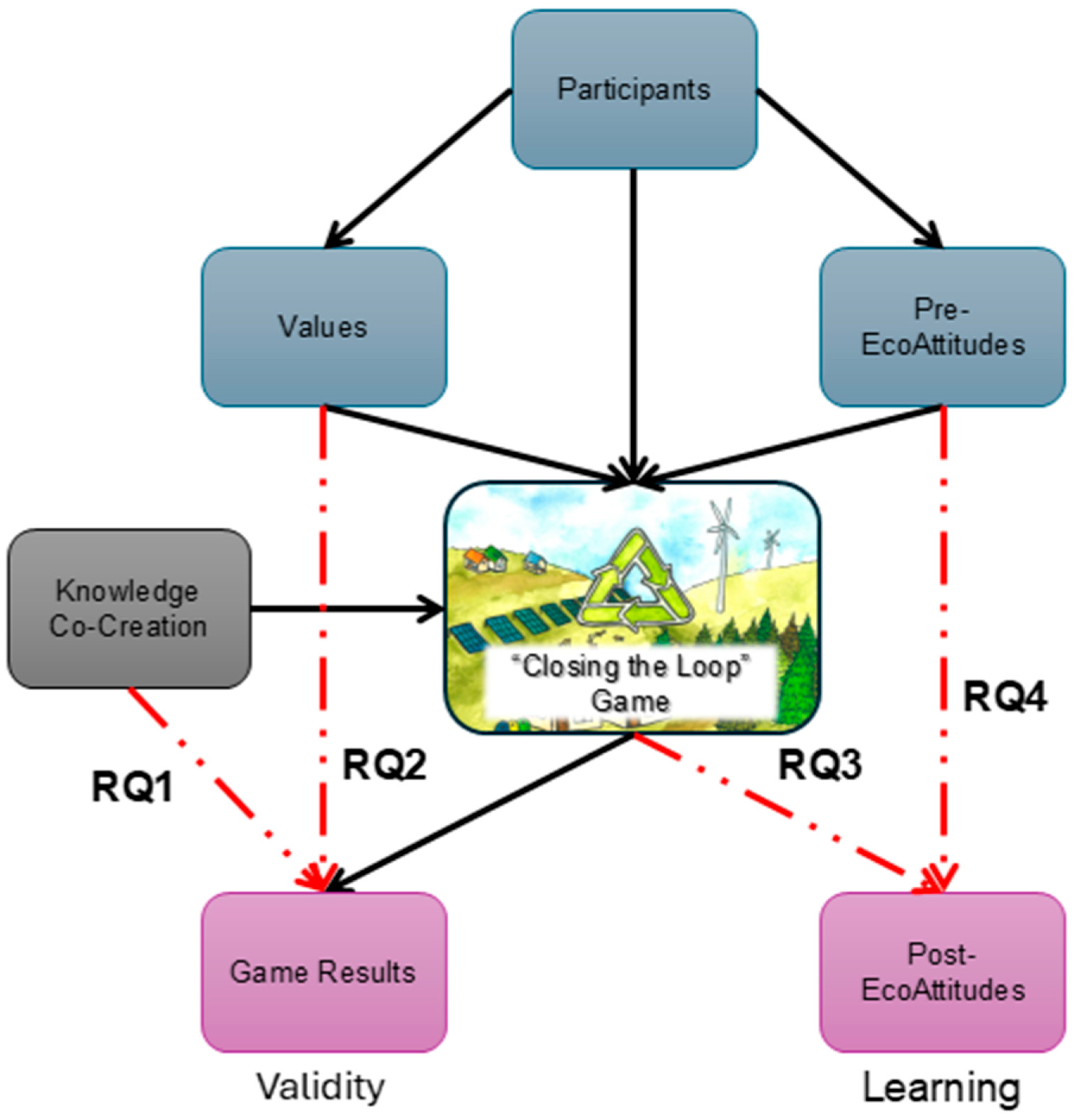
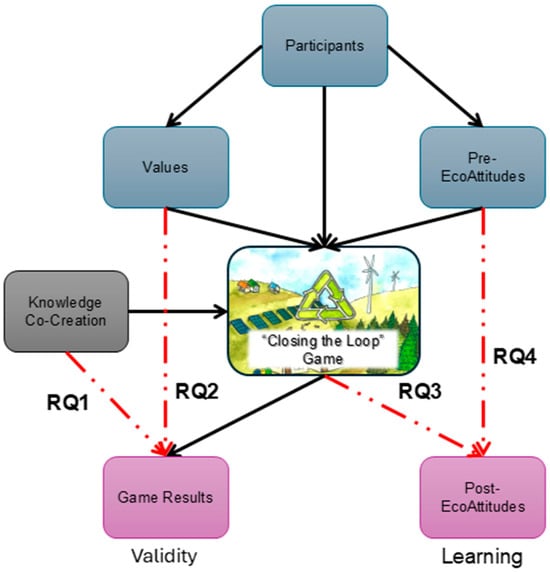
- Does player exchange help govern common-pool resources in the Closing the Loop simulation game?
- (2)
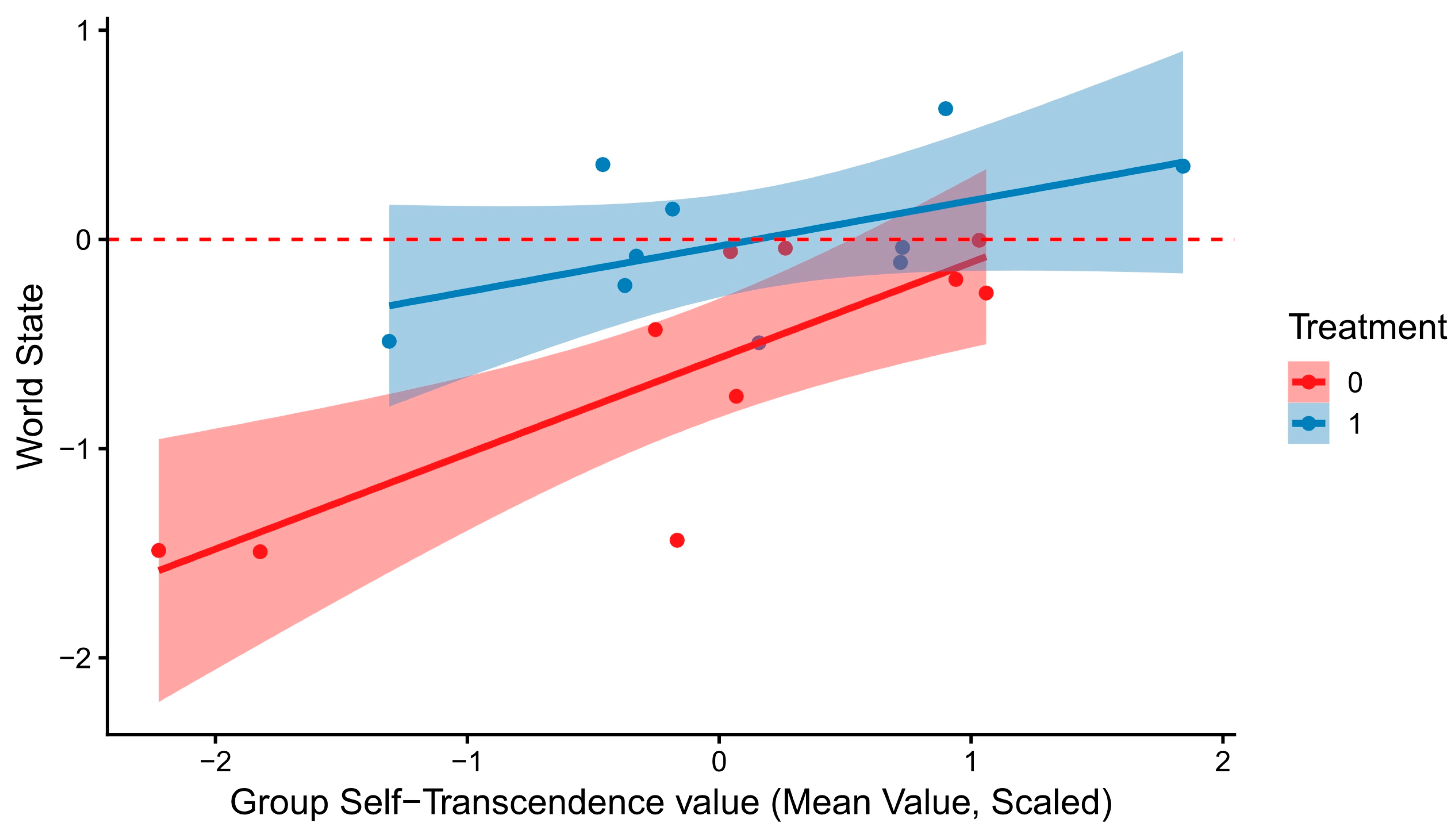
- Do the values held by the participants affect the results of such a game?
- (3)
- Does participation in the game affect the attitudes of players towards collaboration between science and business in support of the circular economy?
- (4)
- Does the game affect environmentally oriented participants differently?
2. Materials and Methods
2.1. Game Model Design
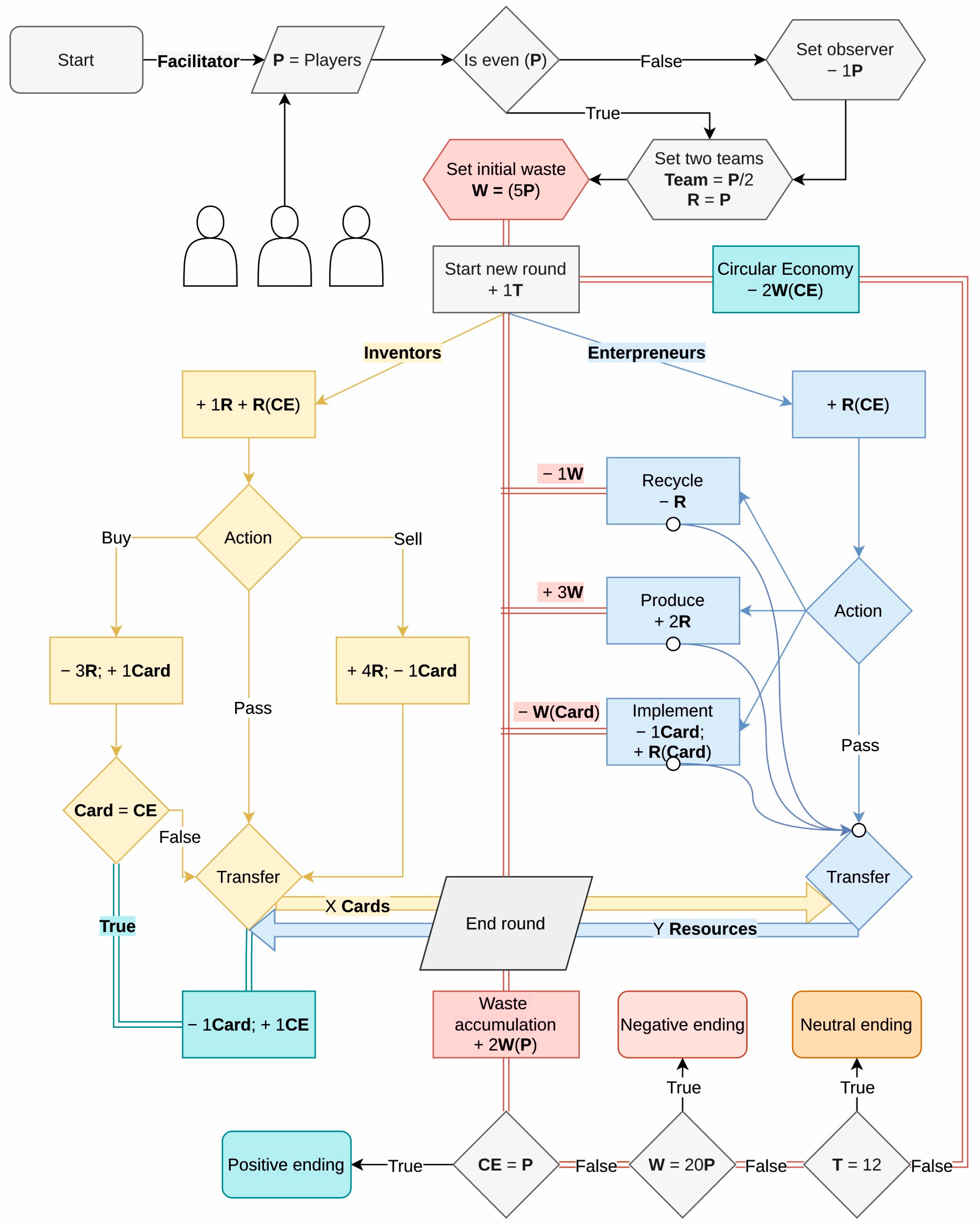
2.2. Simplified Description of the Game
- (1)
- Negative—the waste limit is exceeded: no one wins prizes;
- (2)
- Neutral—the waste limit is not exceeded: prizes are distributed in relation to the resources acquired individually;
- (3)
- Positive—all the circular economy cards are implemented: prizes are distributed with an additional bonus for each participant of +1 per person.
2.3. Model Evaluation
2.3.1. Model Variables
2.3.2. Predictors
2.3.3. Validation of the PVQ-RR Scale
2.4. Other Methods
2.5. Data Collection
3. Results
3.1. Effects of Communication and Values on the Game Results (The World State)
3.2. Experiential Learning Outcomes: Effects of Participation on Players’ Attitudes
3.3. Differences in Response with Respect to Primary Attitude
3.4. Qualitative Observations
3.5. Participants’ Subjective Evaluation of the Game
4. Discussion
Limitations
5. Conclusions
Supplementary Materials
Author Contributions
Funding
Institutional Review Board Statement
Informed Consent Statement
Data Availability Statement
Conflicts of Interest
References
- Charles, D.; Kimman, L.; Minderoo Foundation. Plastic Waste Makers Index 2023. 2023. Available online: https://www.minderoo.org/resources/ (accessed on 20 May 2026).
- OECD. Global Plastics Outlook: Policy Scenarios to 2060. Available online: https://www.oecd.org/en/publications/global-plastics-outlook_aa1edf33-en.html (accessed on 30 July 2026).
- European Union. Directive (EU) 2019/904 of the European Parliament and of the Council of 5 June 2019 on the Reduction of the Impact of Certain Plastic Products on the Environment (Text with EEA Relevance). Off. J. Eur. Union 2019, 155, 1–19. [Google Scholar]
- Geyer, R.; Jambeck, J.R.; Law, K.L. Production, Use, and Fate of All Plastics Ever Made. Sci. Adv. 2017, 3, e1700782. [Google Scholar] [CrossRef] [Scilit] [PubMed]
- Houssini, K.; Li, J.; Tan, Q. Complexities of the Global Plastics Supply Chain Revealed in a Trade-Linked Material Flow Analysis. Commun. Earth Environ. 2025, 6, 257. [Google Scholar] [CrossRef] [Scilit]
- Hamilton, L.A.; Feit, S. Plastic & Climate: The Hidden Costs of a Plastic Planet; Center for International Environmental Law: Washington, DC, USA, 2019. [Google Scholar]
- Iqbal, B.; Zhao, T.; Yin, W.; Zhao, X.; Xie, Q.; Khan, K.Y.; Zhao, X.; Nazar, M.; Li, G.; Du, D. Impacts of Soil Microplastics on Crops: A Review. Appl. Soil Ecol. 2023, 181, 104680. [Google Scholar] [CrossRef] [Scilit]
- Lakhiar, I.A.; Yan, H.; Zhang, J.; Wang, G.; Deng, S.; Bao, R.; Zhang, C.; Syed, T.N.; Wang, B.; Zhou, R.; et al. Plastic Pollution in Agriculture as a Threat to Food Security, the Ecosystem, and the Environment: An Overview. Agronomy 2024, 14, 548. [Google Scholar] [CrossRef] [Scilit]
- Marfella, R.; Prattichizzo, F.; Sardu, C.; Fulgenzi, G.; Graciotti, L.; Spadoni, T.; D’Onofrio, N.; Scisciola, L.; Grotta, R.L.; Frigé, C.; et al. Microplastics and Nanoplastics in Atheromas and Cardiovascular Events. N. Engl. J. Med. 2024, 390, 900–910. [Google Scholar] [CrossRef] [Scilit] [PubMed]
- Knoblauch, D.; Mederake, L. Government Policies Combatting Plastic Pollution. Curr. Opin. Toxicol. 2021, 28, 87–96. [Google Scholar] [CrossRef] [Scilit]
- Vince, J.; Hardesty, B.D. Governance Solutions to the Tragedy of the Commons That Marine Plastics Have Become. Front. Mar. Sci. 2018, 5, 214. [Google Scholar] [CrossRef] [Scilit]
- Ostrom, E. Governing the Commons: The Evolution of Institutions for Collective Action; Canto Classics; Cambridge University Press: Cambridge, UK, 2015. [Google Scholar]
- Gardner, R.; Ostrom, E.; Walker, J.M. The Nature of Common-Pool Resource Problems. Ration. Soc. 1990, 2, 335–358. [Google Scholar] [CrossRef] [Scilit]
- von Neumann, J.; Morgenstern, O. Theory of Games and Economic Behavior: 60th Anniversary Commemorative Edition; Princeton University Press: Princeton, NJ, USA, 2007. [Google Scholar]
- Sandler, T. Collective Action: Fifty Years Later. Public Choice 2015, 164, 195–216. [Google Scholar] [CrossRef] [Scilit]
- Liro, M.; Zielonka, A.; van Emmerik, T.H.M.; Grodzińska-Jurczak, M.; Liro, J.; Kiss, T.; Mihai, F.-C. Mountains of Plastic: Mismanaged Plastic Waste along the Carpathian Watercourses. Sci. Total Environ. 2023, 888, 164058. [Google Scholar] [CrossRef] [Scilit]
- Schuch, E.; Nhim, T.; Richter, A. Coordinating on Good and Bad Outcomes in Threshold Games—Evidence from an Artefactual Field Experiment in Cambodia. Ecol. Econ. 2025, 232, 108547. [Google Scholar] [CrossRef] [Scilit]
- Cornago, E.; Börkey, P.; Brown, A. Preventing Single-Use Plastic Waste: Implications of Different Policy Approaches; OECD Environment Working Papers; OECD Publishing: Paris, France, 2021. [Google Scholar] [CrossRef]
- Bilal, M.; Arslan, M.; Khan, S.; Shi, J.; Li, Z.; Guo, Y.; Sun, X.; Xiaobo, Z. Sustainable Food Packaging: Life Cycle Assessment, Recycling Innovations, and Pestalotiopsis Microspora in Biodegradable Solutions. Trends Food Sci. Technol. 2025, 166, 105400. [Google Scholar] [CrossRef] [Scilit]
- Stahel, W.R. The Product-Life Factor. In An Inquiry into the Nature of Sustainable Societies: The Role of the Private Sector; Houston Area Research Center: Geneva, Switzerland, 1982; pp. 72–105. [Google Scholar]
- Chamorro, F.; Carpena, M.; Fraga-Corral, M.; Echave, J.; Riaz Rajoka, M.S.; Barba, F.J.; Cao, H.; Xiao, J.; Prieto, M.A.; Simal-Gandara, J. Valorization of Kiwi Agricultural Waste and Industry By-Products by Recovering Bioactive Compounds and Applications as Food Additives: A Circular Economy Model. Food Chem. 2022, 370, 131315. [Google Scholar] [CrossRef] [Scilit] [PubMed]
- Lieder, M.; Rashid, A. Towards Circular Economy Implementation: A Comprehensive Review in Context of Manufacturing Industry. J. Clean. Prod. 2016, 115, 36–51. [Google Scholar] [CrossRef] [Scilit]
- Rizos, V.; Behrens, A.; der Gaast, W.V.; Hofman, E.; Ioannou, A.; Kafyeke, T.; Flamos, A.; Rinaldi, R.; Papadelis, S.; Hirschnitz-Garbers, M.; et al. Implementation of Circular Economy Business Models by Small and Medium-Sized Enterprises (SMEs): Barriers and Enablers. Sustainability 2016, 8, 1212. [Google Scholar] [CrossRef] [Scilit]
- Grodzińska-Jurczak, M.; Krawczyk, A.; Akhshik, A.; Dedyk, Z.; Strzelecka, M. Contradictory or Complementary? Stakeholders’ Perceptions of a Circular Economy for Single-Use Plastics. Waste Manag. 2022, 142, 1–8. [Google Scholar] [CrossRef] [Scilit]
- Karhunmaa, K. Performing a Linear Model: The Professor Group on Energy Policy. Environ. Sci. Policy 2020, 114, 587–594. [Google Scholar] [CrossRef] [Scilit]
- Caplan, N. The Two-Communities Theory and Knowledge Utilization. Am. Behav. Sci. 1979, 22, 459–470. [Google Scholar] [CrossRef] [Scilit]
- Krawczyk, A.; Jaguszewska, N.; Ziółkiewicz, W.; Grodzińska-Jurczak, M. The Ivory Tower of Academia in the Era of Climate Change: European Scientists’ Engagement in Science Popularization Related to Single-Use Plastics. Environ. Sci. Policy 2023, 146, 185–202. [Google Scholar] [CrossRef] [Scilit]
- Renfors, S.-M. Education for the Circular Economy in Higher Education: An Overview of the Current State. Int. J. Sustain. High. Educ. 2024, 25, 111–127. [Google Scholar] [CrossRef] [Scilit]
- Nikoloudakis, N.; Rangoussi, M. Introducing Green, Eco-Friendly Practices and Circular Economy Principles in Vocational Education Through a Novel Analysis-Synthesis Method: Design, Implementation and Evaluation. Int. J. Res. Vocat. Educ. Train. 2024, 11, 429–459. [Google Scholar] [CrossRef] [Scilit]
- Serrano-Bedia, A.-M.; Perez-Perez, M. Transition towards a Circular Economy: A Review of the Role of Higher Education as a Key Supporting Stakeholder in Web of Science. Sustain. Prod. Consum. 2022, 31, 82–96. [Google Scholar] [CrossRef] [Scilit]
- Oliver, T.H.; Benini, L.; Borja, A.; Dupont, C.; Doherty, B.; Grodzińska-Jurczak, M.; Iglesias, A.; Jordan, A.; Kass, G.; Lung, T.; et al. Knowledge Architecture for the Wise Governance of Sustainability Transitions. Environ. Sci. Policy 2021, 126, 152–163. [Google Scholar] [CrossRef] [Scilit]
- Kolb, D.A. The Kolb Learning Style Inventory: LSI Workbook; HayGroup: Philadelphia, PA, USA, 2007. [Google Scholar]
- Zhonggen, Y. A Meta-Analysis of Use of Serious Games in Education over a Decade. Int. J. Comput. Games Technol. 2019, 2019, 4797032. [Google Scholar] [CrossRef] [Scilit]
- Diekert, F.K. The Tragedy of the Commons from a Game-Theoretic Perspective. Sustainability 2012, 4, 1776–1786. [Google Scholar] [CrossRef] [Scilit]
- Duke, R.D. Origin and Evolution of Policy Simulation: A Personal Journey. Simul. Gaming 2011, 42, 342–358. [Google Scholar] [CrossRef] [Scilit]
- Manshoven, S.; Gillabel, J. Learning through Play: A Serious Game as a Tool to Support Circular Economy Education and Business Model Innovation. Sustainability 2021, 13, 13277. [Google Scholar] [CrossRef] [Scilit]
- Lange, K.P.H.; Korevaar, G.; Oskam, I.F.; Herder, P.M. Re-Organise: 19th European Roundtable for Sustainable Consumption and Production; Institute for Sustainability Science and Technology, Universitat Politècnica de Catalunya: Barcelona, Spain, 2019. [Google Scholar]
- Fraccascia, L.; Sabato, A.; Yazan, D.M. An Industrial Symbiosis Simulation Game: Evidence from the Circular Sustainable Business Development Class. J. Ind. Ecol. 2021, 25, 1688–1706. [Google Scholar] [CrossRef] [Scilit]
- Khoury, M.; Evans, B.; Chen, O.; Chen, A.S.; Vamvakeridou-Lyroudia, L.; Savic, D.A.; Djordjevic, S.; Bouziotas, D.; Makropoulos, C.; Mustafee, N. NEXTGEN: A Serious Game Showcasing Circular Economy in the Urban Water Cycle. J. Clean. Prod. 2023, 391, 136000. [Google Scholar] [CrossRef] [Scilit]
- Fornasari, T.; Gennari, F. Beyond Participation: A Multitheoretical Framework for Stakeholder Relationship Management in Circular Economy Initiatives. Corp. Soc. Responsib. Environ. Manag. 2026. Epub ahead of printing. [Google Scholar] [CrossRef] [Scilit]
- Roukouni, A.; Lukosch, H.; Verbraeck, A.; Zuidwijk, R. Let the Game Begin: Enhancing Sustainable Collaboration among Actors in Innovation Ecosystems in a Playful Way. Sustainability 2020, 12, 8494. [Google Scholar] [CrossRef] [Scilit]
- Ouariachi, T. Facilitating Multi-Stakeholder Dialogue and Collaboration in the Energy Transition of Municipalities through Serious Gaming. Energies 2021, 14, 3374. [Google Scholar] [CrossRef] [Scilit]
- Santonen, T.; Purola, A.; Nevmerzhitskaya, J. Board Game for Co-Creating Ecosystem Based Circular Economy Business Models. In Proceedings of ISPIM Connects Bangkok: Partnering for an Innovative Community; International Society for Professional Innovation Management: Bangkok, Thailand, 2020. [Google Scholar]
- Frens, J.C.; Bekebrede, G.; Quist, J. Using Serious Games for (Social) Engagement in Vision Development for Circular Business Parks. In Proceedings of the 8th International GamiFIN Conference 2024 (GamiFIN 2024), Ruka, Finland, 2–5 April 2024. [Google Scholar]
- Ostrom, E. Rules, Games, and Common-Pool Resources; University of Michigan Press: Ann Arbor, MI, USA, 1994. [Google Scholar]
- Menaker, B.E.; Sanchez, L.D.; Haase, T.W.; Kakadiaris, I. The Academic–Practitioner Research Dance: Synergistic Research Collaborations in Emergency Management. J. Emerg. Manag. 2026, 24, 405–414. [Google Scholar] [CrossRef] [Scilit]
- Umpleby, S.A. A Short History of Cybernetics in the United States: The Origin of Cybernetics. Österr. Z. Für Geschichtswissenschaften 2008, 19, 28–40. [Google Scholar] [CrossRef]
- von Foerster, H. Cybernetics of Cybernetics: Or, the Control of Control and the Communication of Communication, 2nd ed.; Future Systems: Minneapolis, MN, USA, 1995. [Google Scholar]
- Leydesdorff, L. Sustainable Technological Developments and Second-Order Cybernetics. Technol. Anal. Strateg. Manag. 1997, 9, 329–343. [Google Scholar] [CrossRef] [Scilit]
- Boons, F. Self-Organization and Sustainability: The Emergence of a Regional Industrial Ecology. Emerg. Complex. Organ. 2008, 10, 41. [Google Scholar]
- Fjællingsdal, K.S.; Klöckner, C.A. Green Across the Board: Board Games as Tools for Dialogue and Simplified Environmental Communication. Simul. Gaming 2020, 51, 632–652. [Google Scholar] [CrossRef] [Scilit]
- Brase, G.L. How Different Types of Participant Payments Alter Task Performance. Judgm. Decis. Mak. 2009, 4, 419–428. [Google Scholar] [CrossRef] [Scilit]
- Balliet, D. Communication and Cooperation in Social Dilemmas: A Meta-Analytic Review. J. Confl. Resolut. 2010, 54, 39–57. [Google Scholar] [CrossRef] [Scilit]
- Simmel, G. The Sociology of Georg Simmel; Simon and Schuster: New York, NY, USA, 1950. [Google Scholar]
- Harada, T. Three Heads Are Better than Two: Comparing Learning Properties and Performances across Individuals, Dyads, and Triads through a Computational Approach. PLoS ONE 2021, 16, e0252122. [Google Scholar] [CrossRef] [Scilit]
- Schwartz, S.H.; Cieciuch, J. Measuring the Refined Theory of Individual Values in 49 Cultural Groups: Psychometrics of the Revised Portrait Value Questionnaire. Assessment 2022, 29, 1005–1019. [Google Scholar] [CrossRef] [Scilit]
- Krawczyk, A.; Salas, B.O.; Grodzińska-Jurczak, M. Plastic Detectives Are Watching Us: Citizen Science Towards Alternative Single-Use-Plastic-Related Behaviour. Recycling 2025, 10, 4. [Google Scholar] [CrossRef] [Scilit]
- Hogg, M.A.; Williams, K.D. From I to We: Social Identity and the Collective Self. Group Dyn. Theory Res. Pract. 2000, 4, 81–97. [Google Scholar] [CrossRef]
- Whalen, K.A.; Berlin, C.; Ekberg, J.; Barletta, I.; Hammersberg, P. ‘All They Do Is Win’: Lessons Learned from Use of a Serious Game for Circular Economy Education. Resour. Conserv. Recycl. 2018, 135, 335–345. [Google Scholar] [CrossRef] [Scilit]
- Olejniczak, K.; Kupiec, T.; Widawski, I. Knowledge Brokers in Action: A Game-Based Approach for Strengthening Evidence-Based Policies. In Proceedings of the Simulation and Gaming in the Network Society; Kaneda, T., Kanegae, H., Toyoda, Y., Rizzi, P., Eds.; Springer: Singapore, 2016; pp. 427–441. [Google Scholar]
- Worker Placement|Board Game Mechanic|BoardGameGeek. Available online: https://boardgamegeek.com/boardgamemechanic/2082/worker-placement (accessed on 3 August 2026).
- Sweeting, B. Design Research as a Variety of Second-Order Cybernetic Practice. In New Horizons for Second-Order Cybernetics; Series on Knots and Everything; World Scientific: Singapore, 2017; Volume 60, pp. 227–238. [Google Scholar]
- Bekelman, J.E.; Li, Y.; Gross, C.P. Scope and Impact of Financial Conflicts of Interest in Biomedical Research: A Systematic Review. JAMA 2003, 289, 454–465. [Google Scholar] [CrossRef] [Scilit]
- Ertör-Akyazi, P.; Akçay, Ç. Moral Intuitions Predict Pro-Social Behaviour in a Climate Commons Game. Ecol. Econ. 2021, 181, 106918. [Google Scholar] [CrossRef] [Scilit]
- Russo, C.; Danioni, F.; Zagrean, I.; Barni, D. Changing Personal Values through Value-Manipulation Tasks: A Systematic Literature Review Based on Schwartz’s Theory of Basic Human Values. Eur. J. Investig. Health Psychol. Educ. 2022, 12, 692–715. [Google Scholar] [CrossRef] [Scilit]
- Bilancini, E.; Boncinelli, L.; Di Paolo, R. Game-Based Education Promotes Practices Supporting Sustainable Water Use. Ecol. Econ. 2023, 208, 107801. [Google Scholar] [CrossRef] [Scilit]
- Henrich, J.; Heine, S.J.; Norenzayan, A. The Weirdest People in the World? Behav. Brain Sci. 2010, 33, 61–83. [Google Scholar] [CrossRef] [Scilit]
- Bingham, R.D.; Felbinger, C.L. Evaluation in Practice: A Methodological Approach; SAGE Publications: Thousand Oaks, CA, USA, 2002. [Google Scholar]
- Elston, D.M. The Novelty Effect. J. Am. Acad. Dermatol. 2021, 85, 565–566. [Google Scholar] [CrossRef] [Scilit]
- Krumpal, I. Determinants of Social Desirability Bias in Sensitive Surveys: A Literature Review. Qual. Quant. 2013, 47, 2025–2047. [Google Scholar] [CrossRef] [Scilit]
- Six, B.; van Zimmeren, E.; Popa, F.; Frison, C. Trust and Social Capital in the Design and Evolution of Institutions for Collective Action. Int. J. Commons 2015, 9, 151. [Google Scholar] [CrossRef]
- Becu, N.; Neef, A.; Schreinemachers, P.; Sangkapitux, C. Participatory Computer Simulation to Support Collective Decision-Making: Potential and Limits of Stakeholder Involvement. Land Use Policy 2008, 25, 498–509. [Google Scholar] [CrossRef] [Scilit]
- Demssie, Y.N.; Biemans, H.J.A.; Wesselink, R.; Mulder, M. Fostering Students’ Systems Thinking Competence for Sustainability by Using Multiple Real-World Learning Approaches. Environ. Educ. Res. 2023, 29, 261–286. [Google Scholar] [CrossRef] [Scilit]
- Laker, D.R.; Powell, J.L. The Differences between Hard and Soft Skills and Their Relative Impact on Training Transfer. Hum. Resour. Dev. Q. 2011, 22, 111–122. [Google Scholar] [CrossRef] [Scilit]
- Albarracin, D.; Shavitt, S. Attitudes and Attitude Change. Annu. Rev. Psychol. 2018, 69, 299–327. [Google Scholar] [CrossRef] [Scilit]
- AlAfnan, M.A.; Dishari, S. ESD Goals and Soft Skills Competencies through Constructivist Approaches to Teaching: An Integrative Review. J. Educ. Learn. 2024, 18, 708–718. [Google Scholar] [CrossRef] [Scilit]



| Entrepreneurs | Accumulate | Invest | Entrepreneurs | Accumulate | Invest | ||||
|---|---|---|---|---|---|---|---|---|---|
| Inventors | 0 | 0 | Inventors | 0 | 0 | ||||
| Accumulate | 0 | A | Accumulate | 0 | 2 | ||||
| A | 1 + A | 2 | 5 | ||||||
| Invest | 0 | 1 + A | Invest | 0 | 1 | ||||
| Term | Estimate | Std.Error | F Statistic | 2.5% | 97.5% | p.Value | Sig |
|---|---|---|---|---|---|---|---|
| (Intercept) | −0.595 | 0.118 | −5.024 | −0.847 | −0.343 | 0.000 | *** |
| Treatment | 0.595 | 0.175 | 3.400 | 0.222 | 0.968 | 0.004 | ** |
| Transcendence | 0.497 | 0.115 | 4.329 | 0.252 | 0.742 | 0.001 | *** |
| Enhancement | 0.094 | 0.097 | 0.960 | −0.114 | 0.301 | 0.352 | |
| Treatment:Transcendence | −0.255 | 0.173 | −1.478 | −0.623 | 0.113 | 0.160 |
| Term | df | Chi-Square | p.Value | Sig |
|---|---|---|---|---|
| Question | 20 | 228.332 | 0.000 | *** |
| Treatment | 1 | 1.922 | 0.166 | |
| PrePost | 1 | 18.810 | 0.000 | *** |
| Question:Treatment | 20 | 31.823 | 0.045 | |
| Question:PrePost | 20 | 102.299 | 0.000 | *** |
| Question | Contrast | Filtered Responses | Estimate | SE | Asymp.LCL | Asymp.UCL | p.Value | Sig |
|---|---|---|---|---|---|---|---|---|
| 1. Current free-market principles promote the flow of knowledge from scientists to entrepreneurs. | POST–PRE | 10.64% | −0.848 | 0.196 | −1.2312 | −0.4638 | 0.0000 | *** |
| 2. Scientists should focus on acquiring knowledge; the free market will make the best ideas come to life. | POST–PRE | 43.09% | −2.241 | 0.262 | −2.7554 | −1.7267 | 0.0000 | *** |
| 3. Entrepreneurs will find out on their own which scientific discoveries are worth implementing. | POST–PRE | 31.38% | −1.089 | 0.241 | −1.5605 | −0.6165 | 0.0000 | *** |
| 4. Financing science should be the domain of the state. | PRE–POST | 39.89% | −0.002 | 0.245 | −0.4831 | 0.4788 | 0.9930 | |
| 5. Innovation should primarily serve economic prosperity. | POST–PRE | 10.64% | −1.145 | 0.199 | −1.5343 | −0.7556 | 0.0000 | *** |
| 6. It is enough to develop economic potential and the free market will solve the waste problem. | POST–PRE | 45.74% | −0.513 | 0.252 | −1.0061 | −0.0189 | 0.0419 | |
| 7. We have enough time to solve the waste problem. | POST–PRE | 43.62% | −1.090 | 0.265 | −1.6092 | −0.5703 | 0.0000 | *** |
| 8. There are already many scientific discoveries that could solve many environmental problems if someone implemented them. | PRE–POST | 26.06% | 0.032 | 0.217 | −0.3936 | 0.4568 | 0.8843 | |
| 9. Scientists should focus on acquiring knowledge; the free market will ensure that the best ideas are implemented. | POST–PRE | 32.98% | −0.418 | 0.218 | −0.8456 | 0.01 | 0.0556 | |
| 10. Scientific discoveries are communicated effectively enough. | POST–PRE | 34.04% | −0.804 | 0.227 | −1.2488 | −0.3592 | 0.0004 | ** |
| 11. Science is primarily the domain of universities and colleges. | POST–PRE | 13.30% | −0.413 | 0.2009 | −0.8063 | −0.0187 | 0.0400 | |
| 12. Entrepreneurs, when introducing new technologies, should above all consider whether they can earn profits from them. | POST–PRE | 42.02% | −1.073 | 0.254 | −1.5703 | −0.5758 | 0.0000 | *** |
| 13. Scientists should not engage in communication with the public or business. | POST–PRE | 61.17% | −1.730 | 0.329 | −2.375 | −1.0844 | 0.0000 | *** |
| 14. Science should be independent and set its own goals | POST–PRE | 7.45% | −1.185 | 0.204 | −1.5848 | −0.7851 | 0.0000 | *** |
| 15. Science should focus on the most profitable areas | POST–PRE | 55.32% | −0.579 | 0.286 | −1.1386 | −0.0194 | 0.0426 | |
| 16. The only commitment of the industry towards the environment is ecological neutrality | POST–PRE | 32.45% | −1.132 | 0.228 | −1.5782 | −0.6859 | 0.0000 | *** |
| 17. Since you cannot make money from ecology, entrepreneurs shouldn’t deal with it too much. | POST–PRE | 76.60% | −0.784 | 0.428 | −1.6234 | 0.0547 | 0.0669 | |
| 18. Science will sooner or later solve the problem of plastic waste on its own. | POST–PRE | 42.55% | −0.624 | 0.253 | −1.1183 | −0.1286 | 0.0135 | . |
| 19. Recycling is a sufficient form of dealing with plastic waste. | POST–PRE | 60.11% | −0.388 | 0.3 | −0.9761 | 0.201 | 0.1968 | |
| 20. I know well what the circular economy is. | PRE–POST | 13.83% | −1.730 | 0.222 | −2.1658 | −1.2942 | 0.0000 | *** |
| 21. Plastic waste is not one of the most urgent problems. | POST–PRE | 41.49% | −0.804 | 0.257 | −1.3068 | −0.3015 | 0.0017 | * |
| Term | df | Chi-Square | p.Value | Sig |
|---|---|---|---|---|
| Question | 20 | 92.282 | 0.000 | *** |
| Attitude | 1 | 147.259 | 0.000 | *** |
| Treatment | 1 | 1.109 | 0.292 | |
| Question:Attitude | 20 | 61.941 | 0.000 | *** |
| Question:Treatment | 20 | 36.386 | 0.0139 |
Disclaimer/Publisher’s Note: The statements, opinions and data contained in all publications are solely those of the individual author(s) and contributor(s) and not of MDPI and/or the editor(s). MDPI and/or the editor(s) disclaim responsibility for any injury to people or property resulting from any ideas, methods, instructions or products referred to in the content. |
© 2026 by the authors. Licensee MDPI, Basel, Switzerland. This article is an open access article distributed under the terms and conditions of the Creative Commons Attribution (CC BY) license.
Share and Cite
Rostankowski, D.; Tusznio, J.; Grodzińska-Jurczak, M. Knowledge Co-Creation in the Commons: Facilitating Collaboration in the Circular Economy of Plastic with “Closing the Loop” Game. Sustainability 2026, 18, 8685. https://doi.org/10.3390/su18178685
Rostankowski D, Tusznio J, Grodzińska-Jurczak M. Knowledge Co-Creation in the Commons: Facilitating Collaboration in the Circular Economy of Plastic with “Closing the Loop” Game. Sustainability. 2026; 18(17):8685. https://doi.org/10.3390/su18178685
Chicago/Turabian StyleRostankowski, Dawid, Joanna Tusznio, and Małgorzata Grodzińska-Jurczak. 2026. "Knowledge Co-Creation in the Commons: Facilitating Collaboration in the Circular Economy of Plastic with “Closing the Loop” Game" Sustainability 18, no. 17: 8685. https://doi.org/10.3390/su18178685
APA StyleRostankowski, D., Tusznio, J., & Grodzińska-Jurczak, M. (2026). Knowledge Co-Creation in the Commons: Facilitating Collaboration in the Circular Economy of Plastic with “Closing the Loop” Game. Sustainability, 18(17), 8685. https://doi.org/10.3390/su18178685