


Abstract
In this study, a composite adsorbent (CS-ABnt) based on activated bentonite and chitosan was prepared using a simple coating method in the form of beads designed to combine high adsorption performance with the ease of solid–liquid separation typical of bead-type materials, serving as a low-cost tetracycline adsorbent. The composite was characterized by FTIR, EDX, and zeta potential measurements, which confirmed successful chitosan coating of the bentonite surface and a marked shift in the point of zero charge (from pH 5.54 for chitosan to pH 7.32 for CS-ABnt). Batch adsorption experiments showed that tetracycline removal was strongly pH-dependent, with an optimum near pH 6, and that the CS-ABnt composite consistently outperformed its individual components (chitosan and activated bentonite) across all tested doses, contact times, and temperatures. Equilibrium data were best described by the Langmuir isotherm, yielding a maximum adsorption capacity of 49.11 mg·g−1, while kinetic data followed the pseudo-second-order model, revealing that the rate-limiting step is chemisorption. The thermodynamic parameters (ΔG° < 0, ΔH° > 0, ΔS° > 0) indicated a spontaneous, endothermic adsorption process. Taken together, these results enabled a 95% removal efficiency of tetracycline to be achieved.
1. Introduction
Tetracycline is a bacteriostatic antibiotic causing serious problems for the environment and human health. These problems can be attributed both to tetracycline’s persistence in the environment and to the antibiotic resistance it induces. Although tetracycline is commonly used in human and veterinary medicine as well as in the aquaculture industry, the majority of this antibiotic is discharged into either surface water or soil. Common wastewater treatment methods are frequently incapable of its effective removal. Consequently, tetracycline is consistently present in wastewater, posing a significant risk to public health and the environment [1,2]. Beyond their persistent presence, tetracycline residues in water bodies also promote the development and spread of antibiotic-resistant bacteria and genes that can be detrimental to aquatic ecosystems and human health over time. Removing tetracycline from water bodies has been considered using adsorption on engineered biochar, which has proved efficacious in removing tetracycline and other antibiotics [3,4], and detection with electrochemical metal-organic framework sensors [5] and upconversion aptasensors [6], as there is considerable scientific interest in monitoring and controlling contamination by tetracycline. Adsorption is considered one of the most effective methods because it is simple, low-cost, and universally applicable across different types of adsorbents, which provides an incentive for the design of new, cost-effective, easy-to-recover adsorbent materials such as the one developed in this study. Several studies have demonstrated that water treatment for antibiotics such as tetracycline is one of the main principles of the blue economy and sustainable development. The use of water for sewage treatment is a must, as it affects the biodiversity and natural processes of many aquatic plants and animals. As stated above, the presence of tetracycline in water threatens the very essence of the blue economy, which relies on a healthy, productive, and resilient aquatic ecosystem [7]. Therefore, we need to find effective, efficient, and low-cost adsorbents. Conventional methods such as biodegradation, advanced oxidation, and membrane filtration are often ineffective, cost-prohibitive, or generate secondary pollutants for tetracycline removal [8]. Because of these limitations, alternative low-cost methods such as adsorption have been sought. On top of that, powdered sorbents such as activated carbon, clay, and metal–organic frameworks are difficult to separate and recycle after treatment [9,10]. Sustainable solutions are needed for green chemistry and the circular economy to improve the water treatment process. Since bentonite is eco-friendly and low-cost, chitosan and bentonite are both biocompatible and relatively low-cost. For example, bentonite is known for its large surface area and high cation exchange capacity. However, raw bentonite’s hydrophilic character limits its affinity for relatively hydrophobic organic antibiotics such as tetracycline, and its powdery form complicates handling and recovery after treatment. This limitation has motivated the development of modified bentonite adsorbents, which have been shown to substantially improve tetracycline removal efficiency [11,12]. Similarly, ceramsite composites made from bentonite, red mud, and pine sawdust have been used successfully to remove tetracycline. Despite its neutral removal efficiency (2.13 mg·g−1 after three cycles), the ceramsite was able to remove tetracycline well (about 1 mg·g−1) in the presence of ions (Na+ or Ca2+), which supports the limitations of using bentonite alone [13,14,15]. Chitosan is a polysaccharide with -NH2 and -OH groups. Although this biopolymer can bind to tetracycline in its powder form, its recovery is difficult [16,17,18]. Composites with chitosan and bentonite show better tetracycline adsorption [19,20,21]. Furthermore, chitosan–bentonite sphere hydrogels provide improved adsorption with capacities reaching approximately 39.5 mg·g−1, according to Freundlich and pseudo-second-order kinetic models [22,23]. In other examples, magnetic composites based on chitosan and Fe3O4 significantly increase the adsorption capacity of TC (up to 215 mg·g−1) and facilitate magnetic separation [24]. In another study, the adsorbent (CS/Fe3O4) achieved a maximum tetracycline capacity of 211.21 mg g−1 at pH 7 [25]. However, these composites are complex to synthesize and potentially costly to produce on a large scale. In terms of the blue economy, the high adsorption capacity means that less adsorbent material is needed per unit of treated water, which reduces the consumption of raw materials, the production of solid waste, and the overall carbon and material footprint of the water treatment process. To our knowledge, only a few studies have reported the use of non-powdered bentonite particles, such as beads, granules, or structured forms, functionalized with chitosan in the removal of tetracycline from wastewater. The majority of published studies are focused on composites of powdered bentonite and chitosan, which, in spite of their high adsorption performance, are limited due to the well-documented limitations associated with fine-particle-based systems, including difficult solid-liquid separation and limited reusability. The limited number of studies involving non-powdered, shaped bentonite-based materials functionalized with chitosan represents a significant gap in this field, especially in view of the practical requirements for sustainable and easy-to-recover adsorbents in wastewater treatment applications. There have been several reports on chitosan–bentonite composites to remove tetracycline, but most exist in powder form, which is problematic for recycling and reuse [26]. Recent bead- or granule-based alternatives combining chitosan with clay minerals are few and do not report any acid activation of the mineral before composite formation, or any electrostatic (zeta potential) characteristics of the composite [27,28]. Our study differs from these prior studies in three respects: (i) we use sulfuric acid-activated bentonite rather than raw clay to improve the surface reactivity of the base before grafting chitosan; (ii) we assess the electrostatic properties of the composite as a function of pH, directly linking surface charge to the pH-dependent tetracycline adsorption; and (iii) we test the material specifically in bead form to evaluate its adsorption performance in combination with solid–liquid separation, rather than just dust-form adsorption data.
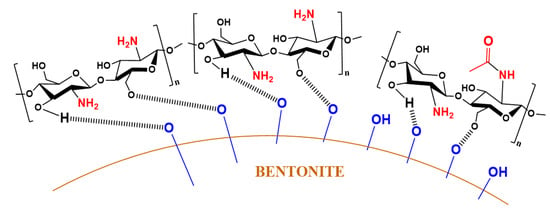
The ability to re-use an adsorbent over a few cycles is also an important sustainability indicator in the circular and blue economies, not only because it suggests the durability of the adsorbent but also because it satisfies the sustainability values of zero waste and resource efficiency, which are fundamental to sustainable water use [29,30]. To address some of the limitations of existing tetracycline treatment methods, we present an improved bead-type composite adsorbent that combines the advantages of chitosan and activated bentonite (CS–ABnt), to remove tetracycline from wastewater. We are interested in tetracycline removal because it is becoming a major water pollutant. It is urgent to develop an effective adsorbent for removing this substance from wastewater. The main advantage of our approach is based on several key factors. First, in contrast to conventional powders based on activated carbon and modified clays [31,32], which present serious challenges in terms of separation and recovery, our composite beads are capable of performing simple, rapid, and cost-effective solid–liquid separation, making them suitable for potential industrialization. Second, while activated bentonite alone has a limited capacity to adsorb organic antibiotics due to its hydrophilic nature, its combination with chitosan, which contains -NH2 and -OH functional groups, significantly improves the binding of tetracycline. Third, our choice of a bead formulation rather than a powder ensures ease of handling as well as excellent material recovery after adsorption, with low environmental impact, due to the biocompatibility of chitosan and bentonite. The development of an adsorbent based on chitosan, a byproduct of the fishing industry, and bentonite, a naturally abundant clay, is in accordance with the principles of the circular economy, which further enhances the sustainability benefits of the proposed CS–ABnt beads. Thus, in this study, we aim to (i) optimize the synthesis of CS–ABnt (Figure 1) beads to maximize their tetracycline adsorption capacity, (ii) characterize these beads with EDX-700HS (Shimadzu, Japan), XRD-6000 diffractometer (Shimadzu, Japan), and Perkin Elmer Spectrum BX FT-IR FTIR (USA), and (iii) study their adsorption kinetics, isotherms, and thermodynamics under realistic conditions. The approach proposed in this study offers an effective solution to the urgent need to develop methods for treating water contaminated with tetracycline, combining high adsorption performance, ease of separation, and low cost for potential industrial-scale application, all of which are fully aligned with the goals of sustainable development and the blue economy.
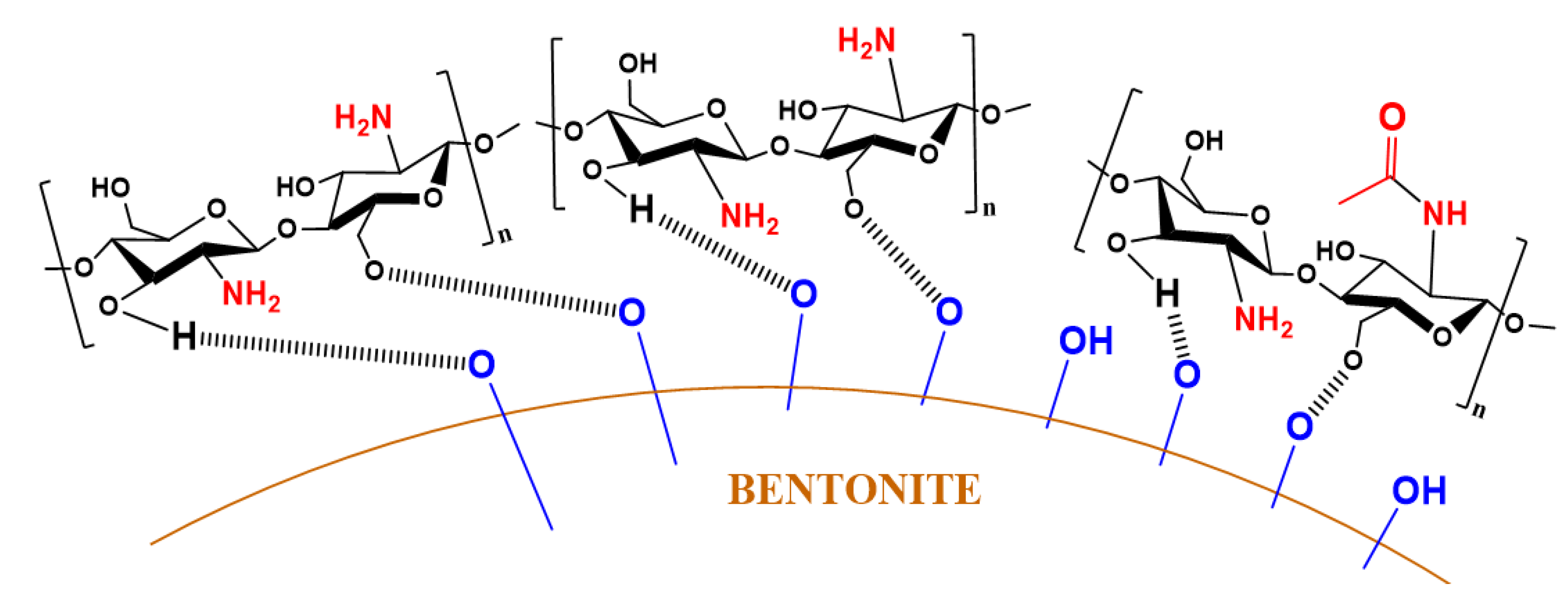
Figure 1.
Structure of CS–ABnt composite.
The structural representation shown in Figure 1 is a schematic illustration of the proposed CS–ABnt architecture, based on the layered phyllosilicate structure of montmorillonite-type bentonite. This structure is combined with the chitosan coating mechanism inferred from our FTIR and EDX results (Section 3.1).
2. Materials and Methods
2.1. Materials and Reagents
Chitosan (deacetylation degree 75%, medium molecular weight, Sigma-Aldrich, France, sulfuric acid (95–98%, Sigma-Aldrich, France, acetic acid (glacial, ≥99%, Sigma-Aldrich, Saint-Quentin-Fallavier, France, calcium chloride (anhydrous, ≥97%, Sigma-Aldrich, France, and tetracycline hydrochloride (≥95%, Sigma-Aldrich, France were used.
All chemicals were used without further purification. Raw bentonite clay was collected from deposits in the Nador region (northeastern Morocco). Distilled water was used to prepare all solutions.
2.2. Preparation of Activated Bentonite (ABnt)
Raw bentonite was washed repeatedly with distilled water until the washings were free of visible suspended matter, then dried at 105 °C overnight. The dried material was milled and sieved to obtain a fraction of 50–200 µm. Chemical activation was carried out by refluxing 10 g of the sieved clay with 0.5 M H2SO4 (200 mL) at 90 °C for 4 h under magnetic stirring. After treatment, the suspension was filtered, and the solid was washed with distilled water until the filtrate reached neutral pH. The activated bentonite (ABnt) was dried at 80 °C for 12 h and stored in a desiccator until use. Activated bentonite adsorbed more tetracycline than would be expected for the raw clay, consistent with the well-documented increase in specific surface area and accessible sorption sites produced by moderate sulfuric acid activation of bentonite clays [33,34].
2.3. Preparation of Chitosan/Activated Bentonite Composite (CS-ABnt)
A 2% (w/v) chitosan solution was prepared by dissolving chitosan powder in 1% (v/v) acetic acid under magnetic stirring for 24 h at room temperature. Activated bentonite (50–200 µm) was dispersed into this chitosan solution at a 1:1 (w/w) bentonite-to-chitosan ratio and stirred for 3 h to obtain a homogeneous suspension. This suspension was added dropwise using a syringe into a 5% (w/v) calcium chloride cross-linking bath under gentle stirring, forming spherical beads instantaneously through ionotropic gelation. The beads were left to harden in the CaCl2 bath for 12 h, then collected by filtration, rinsed with distilled water until the rinse water reached neutral pH, and dried at 60 °C.
2.4. Zeta Potential Measurement
The zeta potential of bentonite, chitosan, and CS–ABnt suspensions (0.1 g/L in deionized water) was measured as a function of pH (3–12, adjusted with 0.1 M HCl/NaOH) using a Zetasizer Nano ZS (ZEN3600, Malvern Panalytical, Malvern, UK) at 25 °C. Each measurement was performed in triplicate, and the average value was reported.
2.5. Adsorption Tests
Batch adsorption experiments were conducted to evaluate tetracycline (TC) removal. In a typical experiment, 0.05 g of adsorbent was added to 50 mL of TC solution with the desired initial concentration (C0 between 10 and 200 mg L−1) under orbital agitation at 150 rpm in a temperature-controlled orbital shaker at selected temperatures (298, 308, 318 K). The influence of pH was investigated over the range of 2.0–10.0 by adjusting with 0.1 M HCl and 0.1 M NaOH. After equilibration or at predetermined times for kinetic runs, suspensions were centrifuged (3500 rpm, 20 min) and the residual TC concentration in the supernatant was measured by varian cary 4000 UV-Vis spectrophotometer (USA) at λ = 357 nm. The adsorption capacity at equilibrium and the removal percentage were calculated using Equations (1) and (2) [35]:
where C0 is the initial concentration of TC (mg L−1), Ce is the concentration of TC at equilibrium (mg L−1), qe is the adsorption capacity at equilibrium, V is the solution volume (L), and m is the mass of adsorbent (g). All experimental procedures and theoretical explanations are presented in the Supplementary Materials.
3. Results and Discussion
3.1. Characterization of Materials
3.1.1. FTIR Analysis
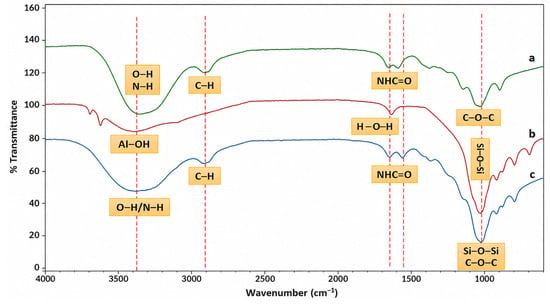
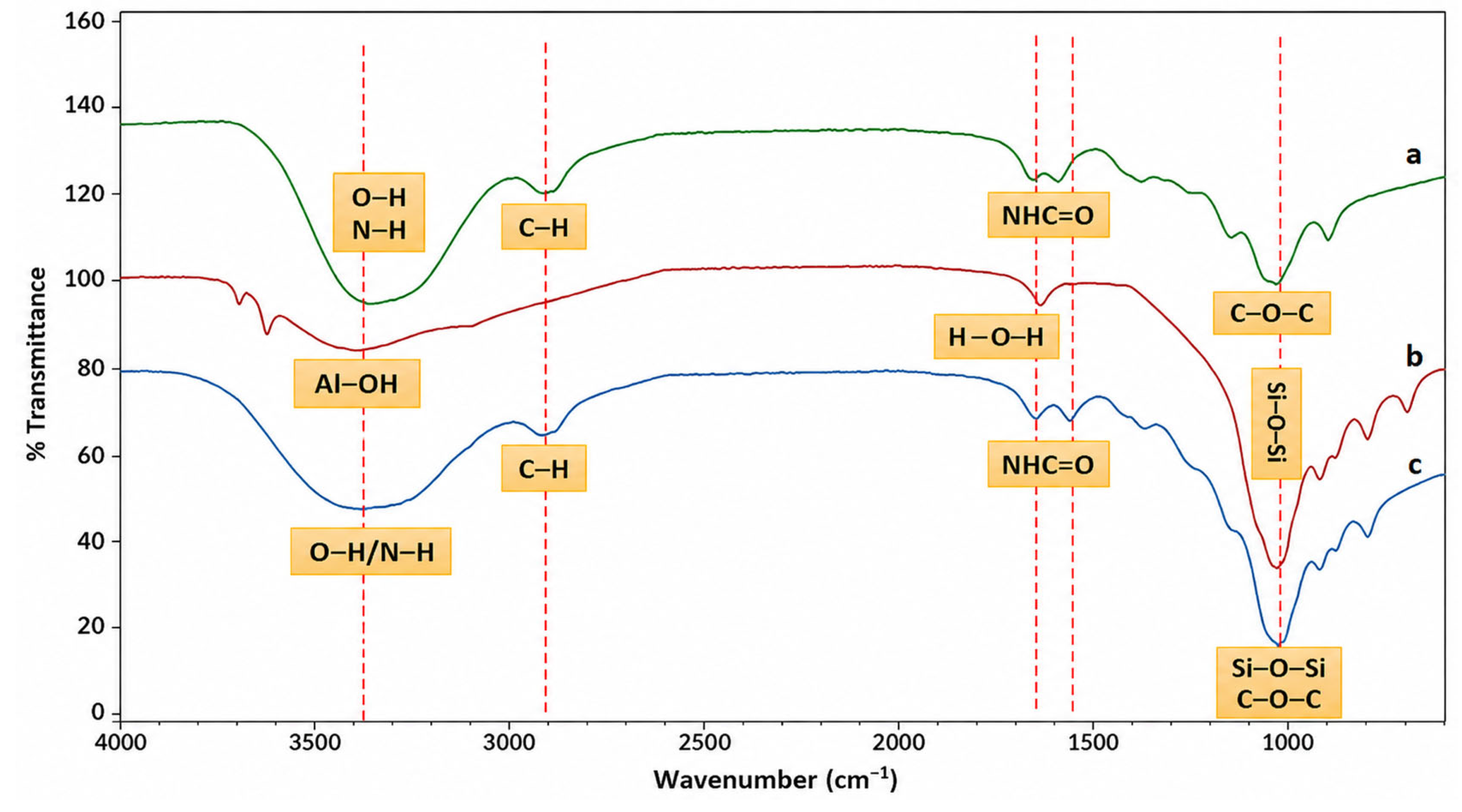
FTIR spectra of chitosan (Figure 2a), bentonite (Figure 2b), and the CS–ABnt composite (Figure 2c) show characteristic bands of each parent material, together with measurable shifts upon composite formation that provide quantitative evidence of the interactions between them. Chitosan displays a broad band at 3400 cm−1, assigned to overlapping O-H and N-H stretching vibrations, aliphatic C-H stretching bands at 2925–2800 cm−1, and the characteristic amide I (~1650 cm−1, C=O stretching) and amide II (~1560–1520 cm−1, N-H bending) bands. Bentonite shows an intense Si-O-Si stretching band at 1040 cm−1, an Al-Al-OH bending band near 920 cm−1, and a broad O-H stretching band at 3380 cm−1 arising from structural silanols and adsorbed water. In the CS–ABnt composite, the combined O-H/N-H stretching band shifts from 3400–3380 cm−1 (chitosan/bentonite) to approximately 3250 cm−1, a red shift of ~130–150 cm−1. In this case, the shift is large and characteristic of hydrogen bonds, since hydrogen bonding weakens the O-H/N-H bond and reduces its frequency. For a pure additive (non-interacting) superposition of the two spectra, a similar shift is unlikely. Our results show that the hydroxyl groups of bentonite (silanols, Si-OH) and the hydroxyl/amino groups in chitosan (-OH, -NH2) are directly involved in hydrogen bonding at the organic/inorganic interface. The aliphatic C-H bands of chitosan (2925–2800 cm−1) are not altered in this composite, which suggests that the backbone of chitosan is chemically intact and incorporated onto the bentonite surface rather than being destroyed during composite formation. The persistence of the bentonite Si-O-Si band near 1040 cm−1 in the composite, with only a minor shift, further indicates that the layered clay framework is structurally preserved, while its slight broadening is consistent with the coating of chitosan on the clay surface. Taken together, the magnitude and direction of these shifts point to hydrogen bonding as the dominant interaction responsible for chitosan–bentonite association, with the possible additional contribution of electrostatic interaction between protonated chitosan amino groups (-NH3+) and negatively charged bentonite sites, consistent with the zeta potential results (Section 3.1.3).
Figure 2.
FTIR spectra of (a) chitosan, (b) bentonite, and (c) CS–ABnt composite.
3.1.2. EDX Analysis
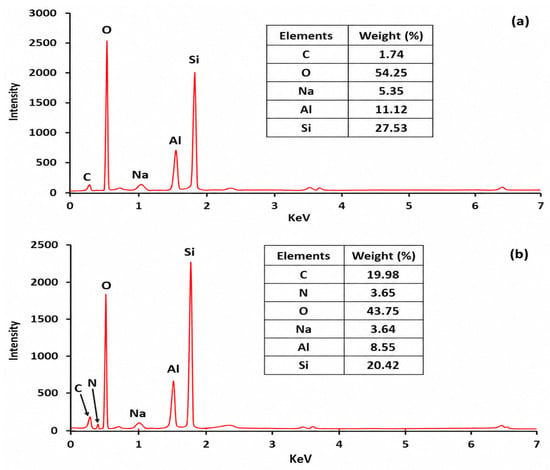
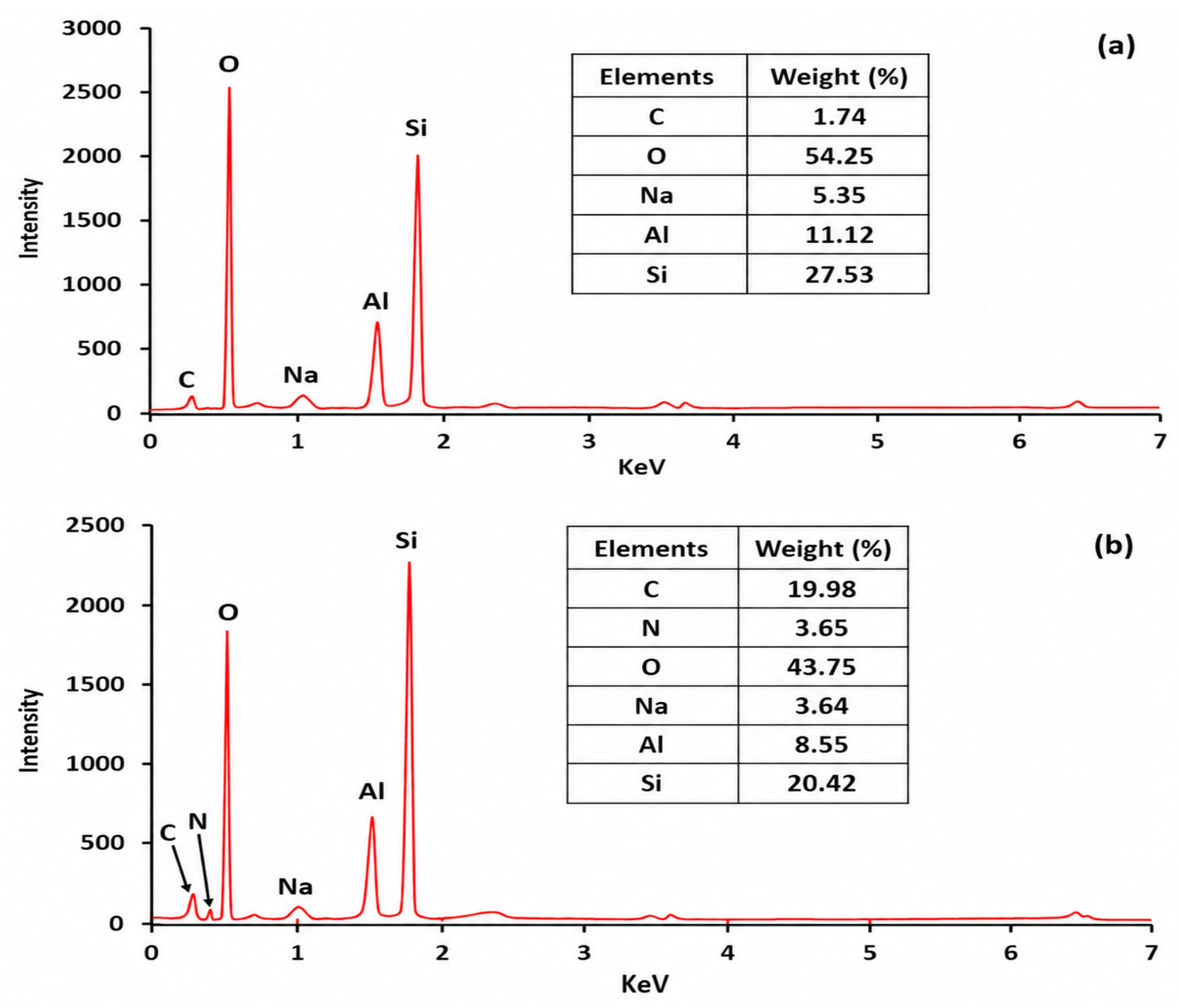
EDX spectra of bentonite (Figure 3a) and chitosan-coated bentonite (Figure 3b) were compared in order to confirm the preparation of the CS-ABnt composite. Bentonite resembles sodium montmorillonite, which contains 54.25% by weight of oxygen, followed by silicon (27.53%), aluminum (10.12%) and sodium (4.35%). Bentonite has a low carbon content (3.74%), which is due to organic contamination of samples during preparation for EDX analysis. The presence of sodium as a compensating cation in the interlaminar space confirms the sodium content of the bentonite used. After chitosan coating, the EDX spectrum changes markedly, indicating that the chitosan coating is effective. The carbon content increases from 1.74% to 19.98% due to the presence of chitosan carbon chains on and between the bentonite layers. A new peak for nitrogen is observed at around 0.39 keV, with a concentration of 3.65%, which is a completely absent element in the spectral characteristics of bentonite. The most characteristic and specific chemical indicator of the presence of the amino groups (-NH2) of chitosan in the CS–ABnt composite is nitrogen. The mineral components of the bentonite are relatively diluted, with a decline in the contents of oxygen (43.75%), silicon (20.42%), and aluminum (8.55%); this is not a degradation of the clay phase, but merely a redistribution of mass fractions in the composite. The small decrease in sodium (3.64%) may suggest a partial ion exchange between the ammonium groups of the protonated chitosan and the intercalated Na+ cations in the montmorillonite. These results confirm that the chitosan successfully coated the surface of the clay layers without affecting the structural integrity of the bentonite.
Figure 3.
EDX graphs of (a) bentonite, and (b) CS–ABnt composite.
3.1.3. Zeta Potential Analysis
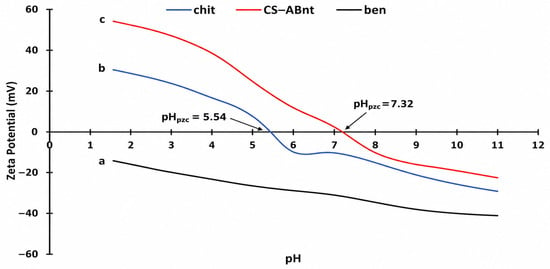
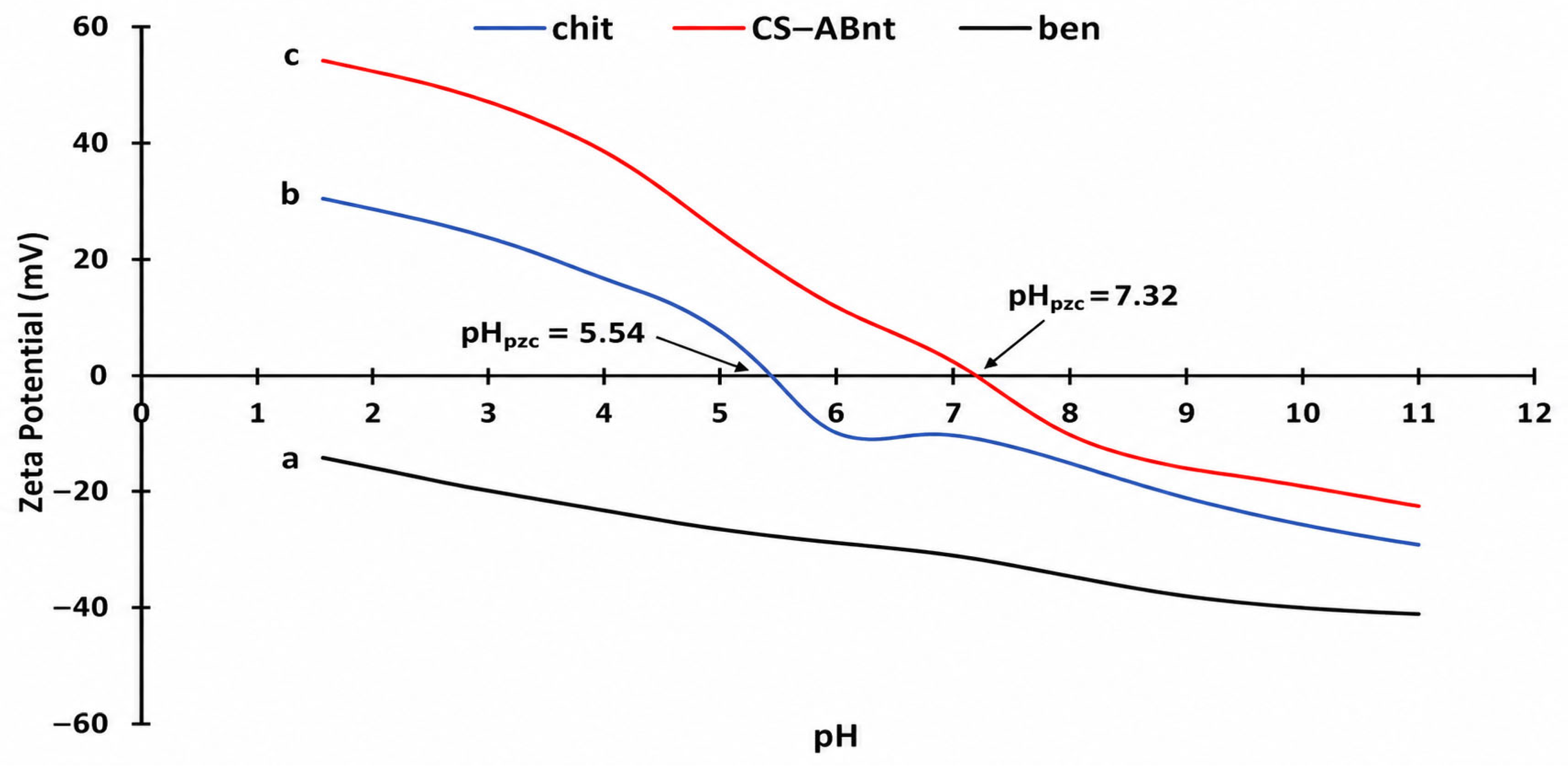
The variation in the zeta potential of bentonite, chitosan, and CS–ABnt as a function of pH (Figure 4) shows that bentonite exhibits a negative zeta potential at all pH values studied, ranging from pH 3 to pH 12. The measured values range from –10 mV at pH 3 to –48 mV at pH 12, with a regular decrease. This permanent negative charge is explained by the phyllosilicate structure of bentonite, in which isomorphic substitutions in the crystal structure (e.g., Mg2+ replacing Al3+) generate a permanent charge deficit, compensated by interlayer cations. In addition to this structural charge, the hydroxyl (OH) groups present at the edges of the layers (silanols Si-OH and aluminols Al-OH) can deprotonate as the pH increases, which further increases the negativity of the surface. Regarding chitosan (chit), it exhibits characteristic amphoteric behavior, with a positive zeta potential in an acidic medium (approximately +29 mV at pH 2) which gradually decreases until it reaches zero at the zero-charge point, located at pHpzc = 5.54. Above this pH, the surface becomes negative, reaching approximately −28 mV at pH 10. This behavior is explained by the coexistence of hydroxyl (-OH) and amino (-NH2) groups on the surface of chitosan. In an acidic environment, these amino groups are protonated to give -NH3+, which gives the substance its cationic character. As pH increases, these groups gradually deprotonate (-NH3+ → -NH2), and the hydroxyl groups begin to exude protons (-OH → -O−), leading to a reversal of charge on the surface at the apparent pKa of the amines, with a pHpzc value of 5.54. The CS-ABnt composite has the highest zeta potential across the acidic to neutral pH range, starting at +54 mV at pH 2 and gradually declining until reaching its isoelectric point at pHpzc = 7.32. In a basic environment, it becomes negative, with −22 mV at pH 10. The significant shift of pHpzc toward higher values compared to chitosan alone (+1.78 pH units) demonstrates the synergistic effect of the combination of chitosan and bentonite. Effectively, the incorporation of bentonite into the chitosan matrix increases the density of surface functional groups (-OH from the bentonite and -OH/-NH3+ from the chitosan), which increases the surface buffer capacity and retards overall deprotonation. The high positive charge in an acidic environment gives this composite an excellent affinity for anionic species, while its negative charge in a basic environment allows it to interact with cations.
Figure 4.
Zeta potential of (a) bentonite, (b) chitosan, and (c) CS–ABnt composite.
3.2. Adsorption Study
3.2.1. Effect of Initial pH
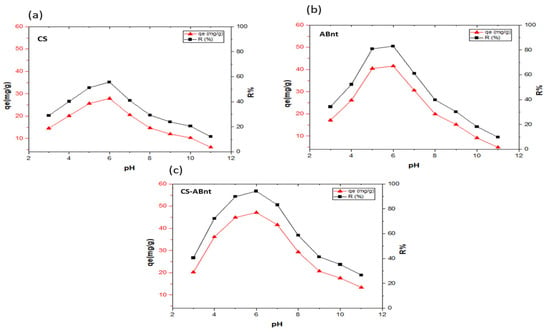
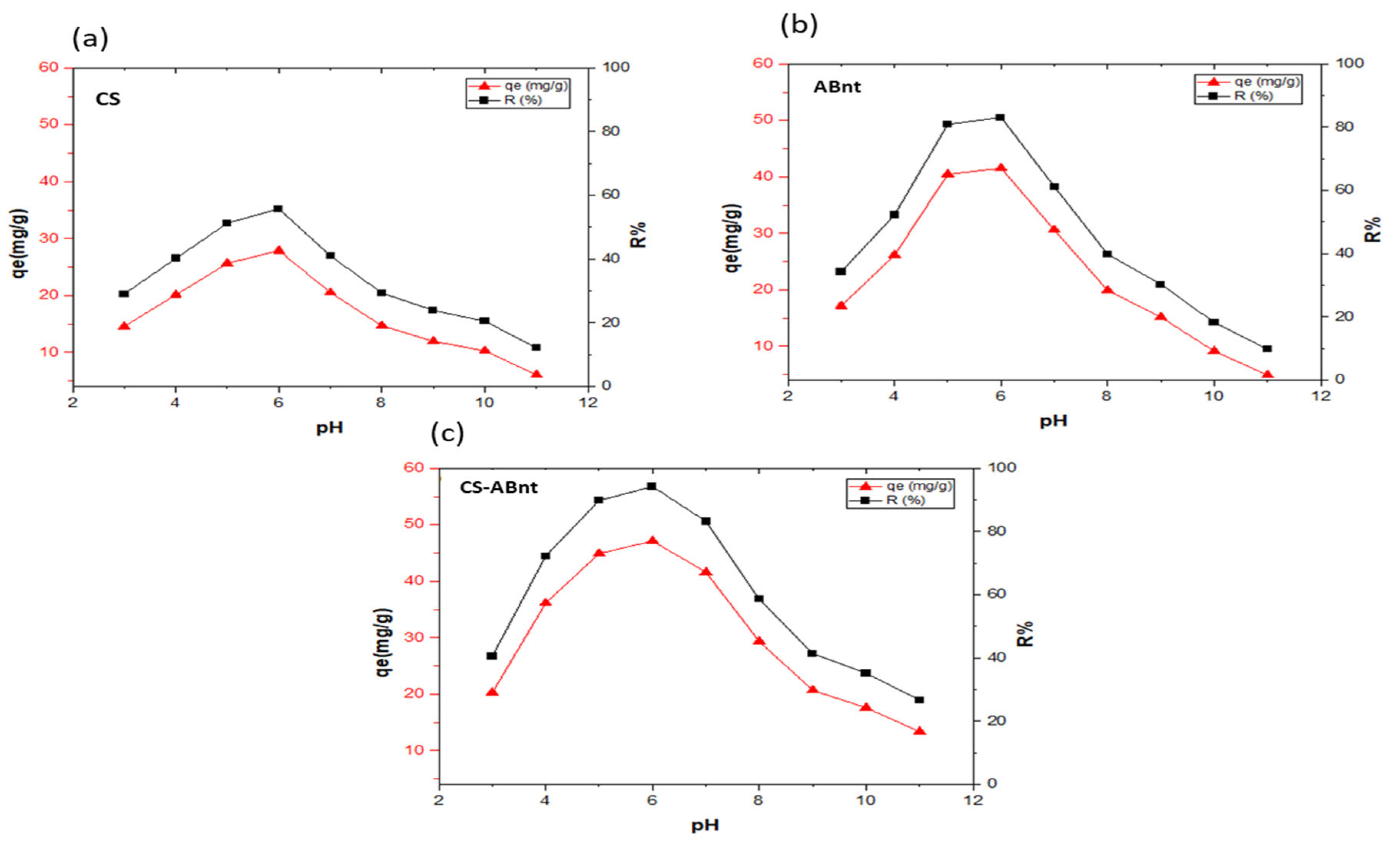
The study of the effect of pH on the adsorption capacity of tetracycline using chitosan, bentonite, and the CS-ABnt composite showed that the CS-ABnt composite is an optimized adsorbent for the removal of tetracycline from aqueous solution, and that its superior performance results directly from the chemical and electrostatic complementarity of its two components, as reported in Figure 5.
Figure 5.
Effects of initial solution pH on tetracycline adsorption by (a) chitosan (CS), (b) activated bentonite (ABnt), and (c) composite (CS-ABnt).
In terms of surface charge, the functionalization of activated bentonite with chitosan led to a significant shift in the zero-charge point from pH 5.54 for chitosan alone to pH 7.32 for the composite, indicating a densification of cationic functional groups on the surface of the material and an expanded electrostatic buffering capacity. This shift in charge can result in the positive charge range of the composite approaching neutrality, where tetracycline exists in its zwitterionic form TC0, which is the most adsorbable form for multiple mechanisms. For tetracycline specificity, the three dissociation constants (pKa1 = 3.3, pKa2 = 7.7, and pKa3 = 9.7) determine the four forms of tetracycline, and the distribution as a function of pH dictates the nature and intensity of interactions with the adsorbent surface. The zwitterionic TC0 form, between pH 3.3 and 7.7, has the highest adsorbable form and is the most adsorbable species due to the net zero charge that reduces electrostatic repulsion and the high functional density of non-electrostatic interactions. Surface charge and TC specification indicate that the pH at this point (pH 6) is optimal for a good adsorption rate. The combined chemical and electrostatic surface properties of the composite are consistent with several possible interaction mechanisms: electrostatic attraction, hydrogen bonding, and, to a lesser extent, hydrophobic interactions and cation-bridging (e.g., via residual Al3+ in the clay framework), which likely act together rather than through a single dominant pathway. The relative contribution of each mechanism cannot be precisely quantified from the present dataset, and this multi-mechanism picture should be regarded as the most plausible interpretation consistent with the pH, FTIR, and zeta-potential data collected, rather than as individually and independently demonstrated mechanisms. This unique combination allows CS-ABnt to provide a better adsorption rate, with 49.01 mg·g−1 and a retention rate of approximately 95% versus 40 mg·g−1 and 28 mg·g−1 for activated bentonite and chitosan, respectively. To wrap up, this study demonstrates that the design of a composite made by grafting chitosan onto activated bentonite may be an approach to developing high-performance adsorbents for antibiotics in solution. It combines the cation exchange capacity and large specific surface area of bentonite with the abundant amounts of amino and hydroxyl groups in chitosan, and thus increases the pH range beyond that of either material.
3.2.2. Effect of Adsorbent Dose
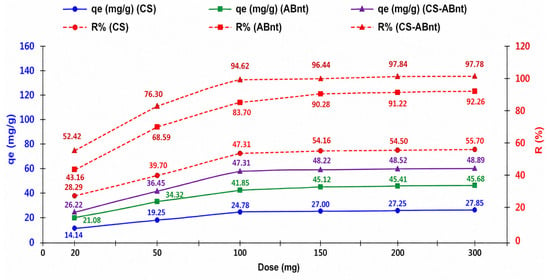
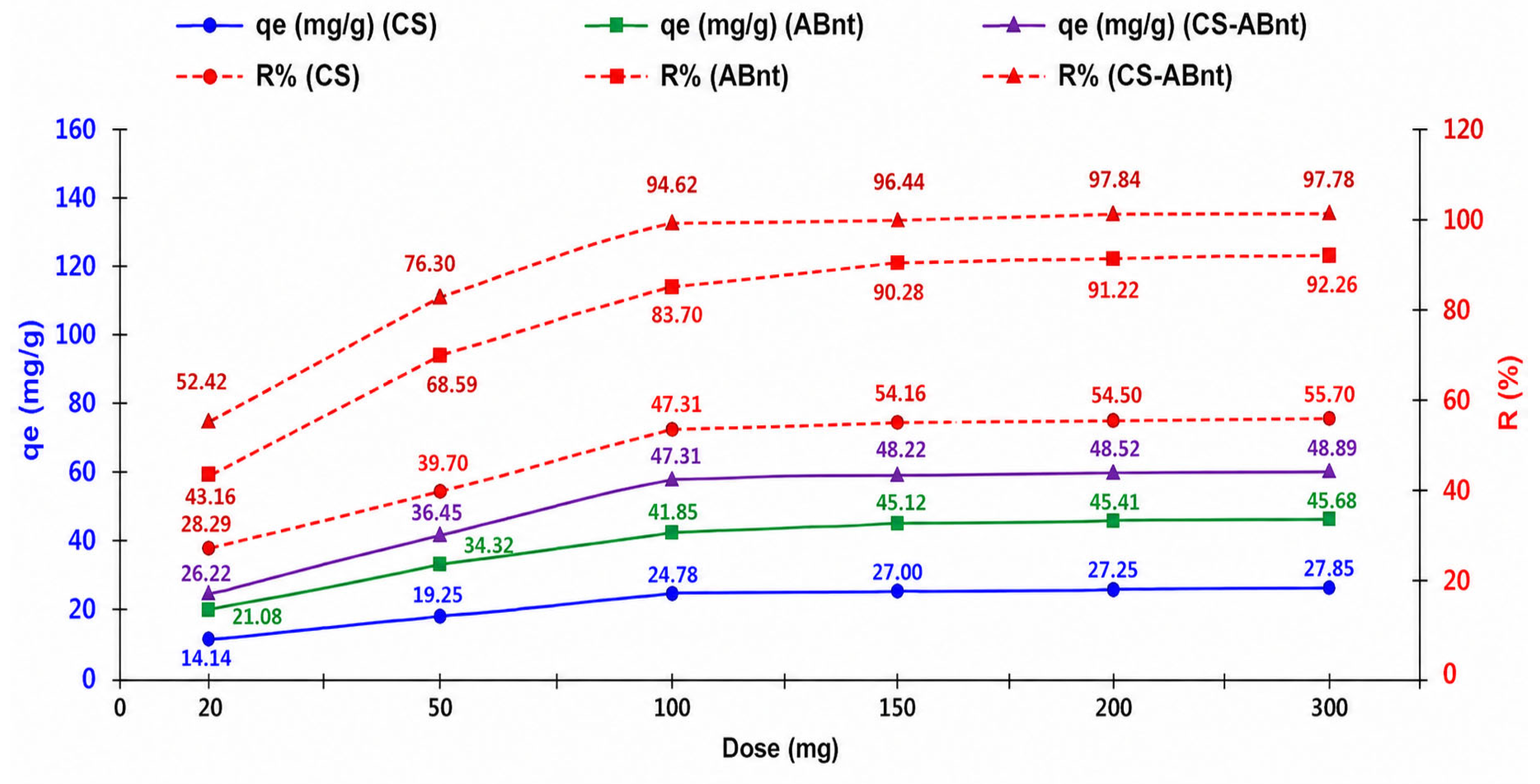
Figure 6 depicts the effect of adsorbent dose on the adsorption capacity (qe) and removal efficiency (R%) of chitosan (CS), activated bentonite (ABnt), and CS–ABnt as used for tetracycline removal. Both qe and R% increased significantly for all adsorbents as the adsorbent dose increased from 20 to 100 mg, indicating that more adsorption sites in the solution could be exploited. Above 100–150 mg, only slightly improved values were observed, and both parameters almost reached plateaus, implying that adsorption equilibrium had been reached and that most of the tetracycline molecules in the solution had already been captured. A rise in available sites outweighed the amount of residual adsorbate present in the solution, which resulted in little additional adsorption.
Figure 6.
Effect of adsorbent dose on adsorption capacity (qe) and removal efficiency (R%) of tetracycline by chitosan (CS), activated bentonite (ABnt), and their composite (CS-ABnt).
Chitosan presented the lowest adsorption values over the entire dose range (qe = 14.14; 27.85 mg.g−1) and the highest removal rates, ranging from 28.28 to 55.70%. This is due to the relatively small surface area of chitosan and the limited amino and hydroxyl groups available for tetracycline adsorption.
The adsorption of activated bentonite on chitosan was significantly greater than chitosan, with qe increasing from 21.08 to 45.88 mg.g−1 and the removal efficiency reaching 91.76% at the highest dose.
The acidic nature of bentonite increases its surface area, pores, and exchangeable sites, which permit tetracyclines to interact with it. The CS–ABnt composite performed best during the tested dose range. The adsorption capacity increased from 26.21 to 48.89 mg.g−1, while the removal efficiency reached 97.78%, exceeding those of both individual components. This marked difference reflects the complementary nature of the two components: chitosan alone offers a limited number of amine/hydroxyl binding sites and no significant porosity, while activated bentonite contributes a much larger specific surface area and cation-exchange capacity but has limited chemical affinity for the relatively hydrophobic tetracycline backbone. In the composite, the chitosan coating does not block the mineral’s active sites but instead adds a complementary set of chemical interactions (hydrogen bonding, electrostatic attraction, possible metal complexation) on top of the bentonite’s structural surface area, which explains why CS-ABnt consistently outperforms either individual component rather than showing additive or intermediate behavior.
The small increase in qe and R% above an adsorbent dose of about 100–150 mg indicates that this is the optimal dosage range for the conditions studied (50 mg L−1 TC, 100 mL solution). Increasing the adsorbent dose beyond this point will likely increase the material consumed but not significantly increase the tetracycline removal.
3.2.3. Effect of Adsorption Time
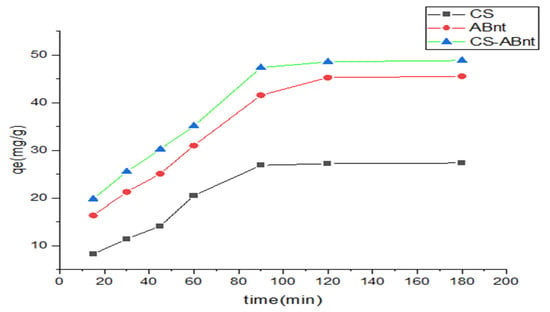
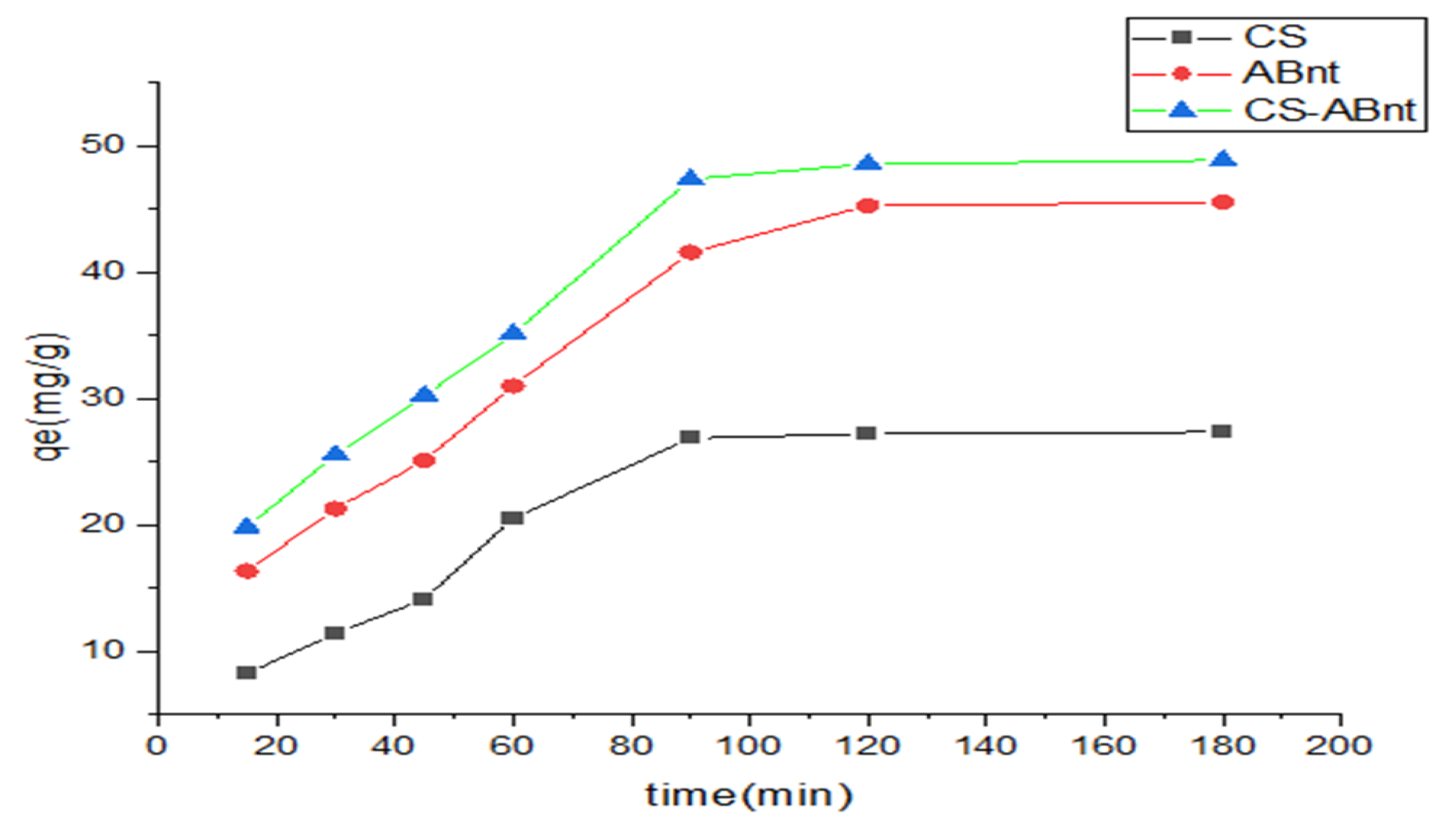
Figure 7 shows the effect of contact time on the adsorption capacity of tetracycline by chitosan (CS), activated bentonite (ABnt), and the mixture CS-ABnt. The curves indicate that tetracycline is adsorbed in all three materials at the same rate over time, with two phases. The first phase shows a rapid and nearly linear increase in the amount of tetracycline adsorbed within the first 60 to 90 min. This rapid initial phase is explained by the high availability of vacant active sites on the surface of the adsorbents, facilitating the capture of antibiotic molecules. In the second phase, when these adsorption sites become saturated and the attraction between adsorbed molecules and molecules in solution increases, the adsorption rate slows to the equilibrium point, which is reached after about 90 min for chitosan and the composite, and after about 120 min for activated bentonite. The overall performance of the three components is very similar. The CS-ABnt composite has the highest efficiency in adsorption, peaking at around 49 mg·g−1 at equilibrium. Activated bentonite is the second-best material, with a maximum capacity of approximately 45 mg·g−1, while chitosan alone has a maximum capacity of 27 mg·g−1. Our results indicate that the addition of chitosan and activated bentonite to form the CS-ABnt composite enhances the tetracycline removal capability over either compound alone.
Figure 7.
Effect of contact time on the adsorption of tetracycline by chitosan, activated bentonite, and their composite.
To further examine the rate-controlling steps of tetracycline adsorption, the intraparticle diffusion (Weber–Morris) model, qt = kid·t^0.5 + C, was applied to the kinetic data of CS, ABnt, and CS-ABnt (Table 1). For all three materials, the plot of qt versus t^0.5 is multilinear rather than a single line through the origin. The first, steeper segment (15–60 min) gave intraparticle diffusion rate constants (kid1) of 3.000, 3.662, and 3.917 mg g−1 min−0.5 for CS, ABnt, and CS-ABnt, respectively, reflecting the fast initial uptake driven by the high availability of external and near-surface active sites. The second, markedly flatter segment (90–180 min, approaching equilibrium) gave much lower rate constants (kid2) of 0.120, 0.912, and 0.355 mg g−1 min−0.5, respectively, corresponding to slower diffusion into less accessible internal sites as the readily available sites become saturated. Critically, none of the fitted lines pass through the origin (C ≠ 0 in all cases: −4.28 to 44.24 mg/g), indicating that intraparticle diffusion is involved in the adsorption process but is not the sole rate-limiting step; boundary-layer (film) diffusion also contributes to controlling the overall adsorption rate for all three adsorbents. The higher kid1 and larger initial intercept obtained for CS-ABnt compared with CS and ABnt individually are consistent with its greater density of readily accessible surface sites, resulting from the combination of chitosan’s amino/hydroxyl groups with the porous structure of activated bentonite.
Table 1.
Weber–Morris intraparticle diffusion parameters for tetracycline adsorption.
3.2.4. Temperature Effect
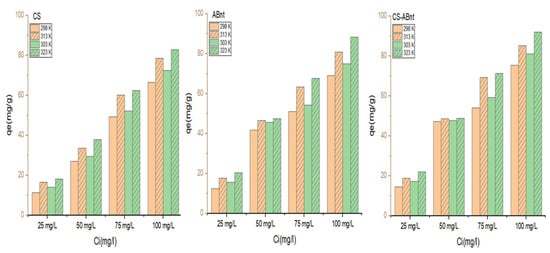
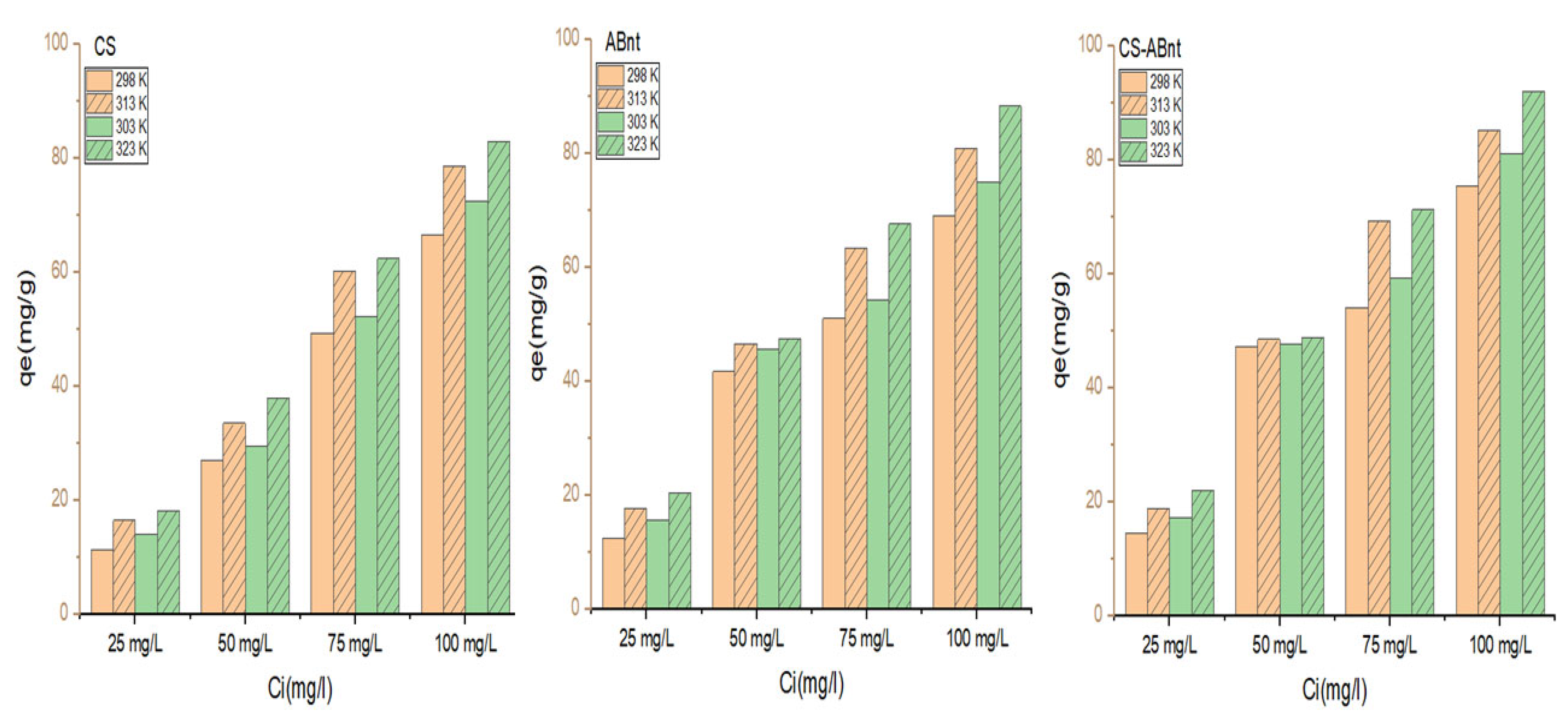
The adsorption capacity of tetracycline (Ci, ranging from 25 to 100 mg/L) by chitosan, activated bentonite, and their CS-ABnt composite was studied at four different temperatures (298 K, 303 K, 313 K, and 323 K); the results are presented in Figure 8.
Figure 8.
Temperature effect on adsorption of tetracycline by chitosan (CS), activated bentonite (ABnt), and their composite (CS-ABnt).
In general, the adsorption capacity of the three adsorbents studied increases gradually with the initial tetracycline concentration, with the lowest values recorded at 25 mg/L and the highest at 100 mg/L. This behavior is explained by the increase in the driving force of mass transfer as the concentration increases, which promotes contact between the tetracycline molecules and the active sites available on the surface of the adsorbents. Another interesting finding in this figure is that all three materials display a positive effect of temperature on their adsorption properties. On the one hand, CS demonstrated a high adsorption capacity at 25 mg/L, which was associated with 323 K, and a low adsorption potential at 298 K. According to the thermodynamic analysis, the adsorption is endothermic, suggesting that tetracycline and the material surface interact with each other and may increase the mobility of solute molecules and assist them in their dispersity to the adsorption site. On the other hand, chitosan alone (CS) can adsorb from 10 mg·g−1 at 25 mg/L at 298 K to 83 mg·g−1 at 100 mg/L and 323 K, indicating notable sensitivity to variations in temperature and concentration. Activated bentonite (ABnt) also showed similar adsorption to CS, but its qe value, particularly at high concentrations, indicates that it has a larger area and more active sites. The CS-ABnt composite exhibited the best adsorption behavior of the three materials, with qe values of about 92 mg·g−1 at 100 mg/L and 323 K. This indicates that temperature plays an important role in promoting tetracycline adsorption on the three materials tested, indicating that this process is endothermic. The CS-ABnt composite is the most effective adsorbent, combining the properties of both chitosan and activated bentonite, making it ideal for removing tetracycline from contaminated water.
3.2.5. Adsorption Isotherms
The results of the adsorption isotherms obtained for the three materials, CS, ABnt, and CS-ABnt, reveal distinct and complementary behaviors, providing a better understanding of the mechanisms involved, as well as an evaluation of the performance of the studied adsorbents. As reported in Table 2, a comparative analysis of the three models tested shows that the Langmuir model provides the best description of the adsorption process for all materials, with coefficients of determination R2 ranging from 0.9948 to 0.9980. This excellent fit is confirmed by the very good agreement between the theoretical maximum adsorption capacities and the measured experimental values: chitosan alone thus reaches 27.41 mg·g−1 according to the model, compared to 27.87 mg·g−1 observed experimentally; activated bentonite shows 39.74 mg·g−1 for a measured value of 41.54 mg·g−1, and the CS-ABnt composite shows 49.11 mg·g−1 theoretically versus 47.12 mg·g−1 obtained in practice. These results validate the hypothesis of adsorption occurring in a monolayer on homogeneous and independent sites. The favorable nature of the adsorption is also confirmed by the values of the separation factor RL, which are all between 0 and 1, with increasing favorability from CS to the CS-ABnt composite, which has the lowest RL value (0.372), indicating the strongest affinity for the adsorbate. This pattern is also reflected in the increase in the KL constant, which rises from 0.00543 for CS to 0.03373 for CS-ABnt, indicating an increasingly strong interaction between tetracycline and the adsorbents’ surface as the structural complexity of the adsorbent increases. The Freundlich model, although it provides a slightly poorer fit with R2 values ranging from 0.976 to 0.993, provides valuable information about the nature of the surfaces. The values of the 1/n parameter, which are all less than 1, confirm favorable adsorption accompanied by a certain degree of surface heterogeneity, which is more pronounced for the CS-ABnt composite, where the mixed structure naturally generates a greater diversity of active sites. Kf, an indicator of relative adsorption capacity, is elevated from 1.61 for CS to 5.62 for ABnt and then to 10.16 for CS-ABnt. The Temkin model does not seem well-suited to describe these systems because R2 is less than 0.816. But the parameter BT, which shows the heat of adsorption, is interesting since it rises from 28.56 J/mol for CS to 43.25 J/mol for ABnt and up to 104.12 J/mol for the composite. It indicates that the formation of CS-ABnt leads to much more energetic interactions at the surface of the composite than any of the other two materials. It has an adsorption rate of 94.24% and a capacity of 49.11 mg·g−1. This is significantly higher than activated bentonite alone (83.08%; 41.54 mg·g−1) and chitosan alone (55.74%; 27.87 mg·g−1) in combination. The amino and hydroxyl groups of chitosan, in combination with the large specific surface area and ion exchange properties of activated bentonite, generate a material with an adsorption rate greater than the combined properties of its individual components.
Table 2.
The adsorption isotherm parameters for tetracycline removal onto chitosan (CS), activated bentonite (ABnt), and their composite (CS-ABnt).
3.2.6. Adsorption Kinetics
Table 3 provides the kinetic parameters of adsorption for the three tested materials—CS (chitosan), ABnt (activated bentonite) and CS-ABnt (chitosan–bentonite composite)—using two kinetic models. As the experiment shows, the experimental adsorption capacity (qe, exp) increases as follows: CS, ABnt, CS-ABnt, with values of 28.46, 44, and 49.01 mg·g−1, which indicates that the combination of these two components enhances adsorption.
Table 3.
Kinetic parameters for the adsorption of tetracycline onto CS, ABnt, and CS-ABnt composite using pseudo-first-order and pseudo-second-order models.
The pseudo-first-order model results in the equivalent capacities (qe, cal) of 26.54, 43.15, and 46.52 mg·g−1 for CS, ABnt, and CS-ABnt, respectively, which are slightly lower than the experimental values, indicating that the model underestimates the actual adsorption capacity. The rate constants kl are 0.024, 0.031, and 0.038 min−1, reflecting the faster adsorption rates for the composite. The coefficients of determination R2 are 0.976, 0.994, and 0.978, indicating that the model fits well with the experimental data. The pseudo-second-order model reveals similar values of 30.34, 43.33, and 50.55 mg·g−1, comparable to the experimental values, but slightly higher for CS and CS-ABnt. The k2 constants are extremely low and nearly identical for CS and ABnt (0.0006 g mg−1 min−1), and slightly higher for CS-ABnt (0.0007 g mg−1 min−1). The R2 values are 0.989, 0.984, and 0.992, which are the highest values in the entire table. The results of the Elovich model confirm those of the two other models. In fact, the initial adsorption rate increases from CS (8.5 mg g−1 min−1) to ABnt (15.2 mg g−1 min−1) and finally to CS-ABnt (22.7 mg g−1 min−1). CS-ABnt exhibits the fastest and most efficient adsorption kinetics of the three materials. The constant β (energy of chemisorption and surface area) decreases in the same order (0.18, 0.12, and 0.10 g mg−1), showing that CS-ABnt has more active sites and a larger surface area, which leads to increased adsorption. The R2 coefficients of the Elovich model (0.971, 0.983, and 0.980) are slightly lower than those of the pseudo-second-order (PSO) model, suggesting that PSO remains the best-fitting model for describing the adsorption kinetics of these three materials. Nevertheless, the good fits obtained with the Elovich model confirm that the surface of the adsorbents is heterogeneous and that the adsorption mechanism involves chemisorption onto energetically non-equivalent sites. Based on these results, the pseudo-second-order model provides the best mathematical description of the adsorption kinetics for all three materials. While PSO fitting is often associated with chemisorption-type mechanisms in the literature, a good PSO fit alone does not constitute definitive proof of chemisorption, since this model can also describe adsorption controlled by other rate-limiting steps. Considered together with the Langmuir isotherm fit, the pHpzc/zwitterion correlation, and the positive ΔH° discussed below, a chemically mediated (rather than purely physical) adsorption mechanism remains the most consistent interpretation.
3.2.7. Thermodynamic Parameters
Table 4 presents the thermodynamic study of tetracycline adsorption by the three adsorbents: chitosan (CS), activated bentonite (ABnt), and a composite combining these two materials (CS-ABnt). The three adsorbents studied exhibit negative ΔG° values regardless of the temperature studied, confirming that the tetracycline adsorption process is spontaneous. Furthermore, as the temperature increases, ΔG° becomes more negative. ΔG° for chitosan alone increased from −0.39 kJ/mol at 298 K to −3.04 kJ/mol at 323 K; for activated bentonite, it went from −3.98 to −7.85 kJ/mol; and for the CS-ABnt composite, it increased from −7.04 to −9.88 kJ/mol. This shows that adsorption is more readily induced by increasing the temperature. The CS-ABnt composite had the highest number of negative ΔG° values, meaning its adsorption reaction occurs spontaneously and is the most favorable thermodynamically. This is consistent with the positive ΔH° of all adsorbents: 30.84 kJ/mol for CS, 37.56 kJ/mol for ABnt, and 28.03 kJ/mol for CS-ABnt. A positive ΔH° demonstrates that tetracycline adsorption is an endothermic process that requires thermal energy to occur. Heating the reaction medium raises the adsorption equilibrium toward the binding of tetracycline molecules onto the adsorbent surface. The normal entropies ΔS° are also positive for chitosan, 141.3 J/Kmol for bentonite and 117.6 J/Kmol for the composite, indicating an increase in the overall disorder of the system (solid/solution) during adsorption. Water molecules initially organized around the adsorption site or around the tetracycline in solution are released after the adsorption sites or around the tetracycline, thus increasing the molecular degrees of freedom and disorder. The positive entropy (ΔS°) obtained for all adsorbents indicates an increase in randomness at the solid–liquid interface during adsorption. This behavior is commonly attributed to the release of water molecules initially associated with the adsorbent surface and hydrated tetracycline molecules into the bulk solution as adsorption proceeds, thereby increasing the degrees of freedom of the system. Activated bentonite is the most strongly rated adsorbent with a ΔS° value of 141.3 J mol−1 K−1, indicating higher interfacial disorder in the adsorption process. Having a high ΔS° level helps promote spontaneity by the TΔS° term of the Gibbs free energy equation. The results confirm that tetracycline adsorption on CS, ABnt, and CS–ABnt is spontaneous and endothermic, with adsorption becoming more favorable as temperature increases. Of all the adsorbents tested, the composite CS–ABnt showed the most favorable behavior in terms of adsorption, with the highest number of negative ΔG° values. Thus, the composite CS–ABnt has the potential to become an effective adsorbent for the removal of tetracycline from water solutions, particularly at moderately high temperatures.
Table 4.
Thermodynamic parameters for the adsorption of tetracycline onto CS, ABnt, and CS-ABnt composite at different temperatures.
3.2.8. Comparative Thermodynamic Profiles of CS, ABnt and CS-ABnt for Tetracycline Removal
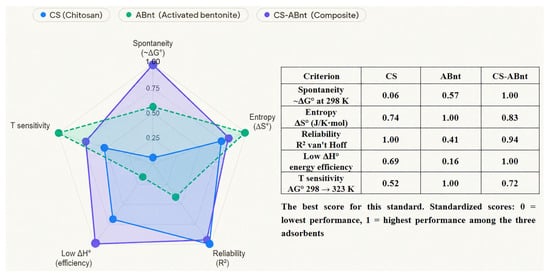
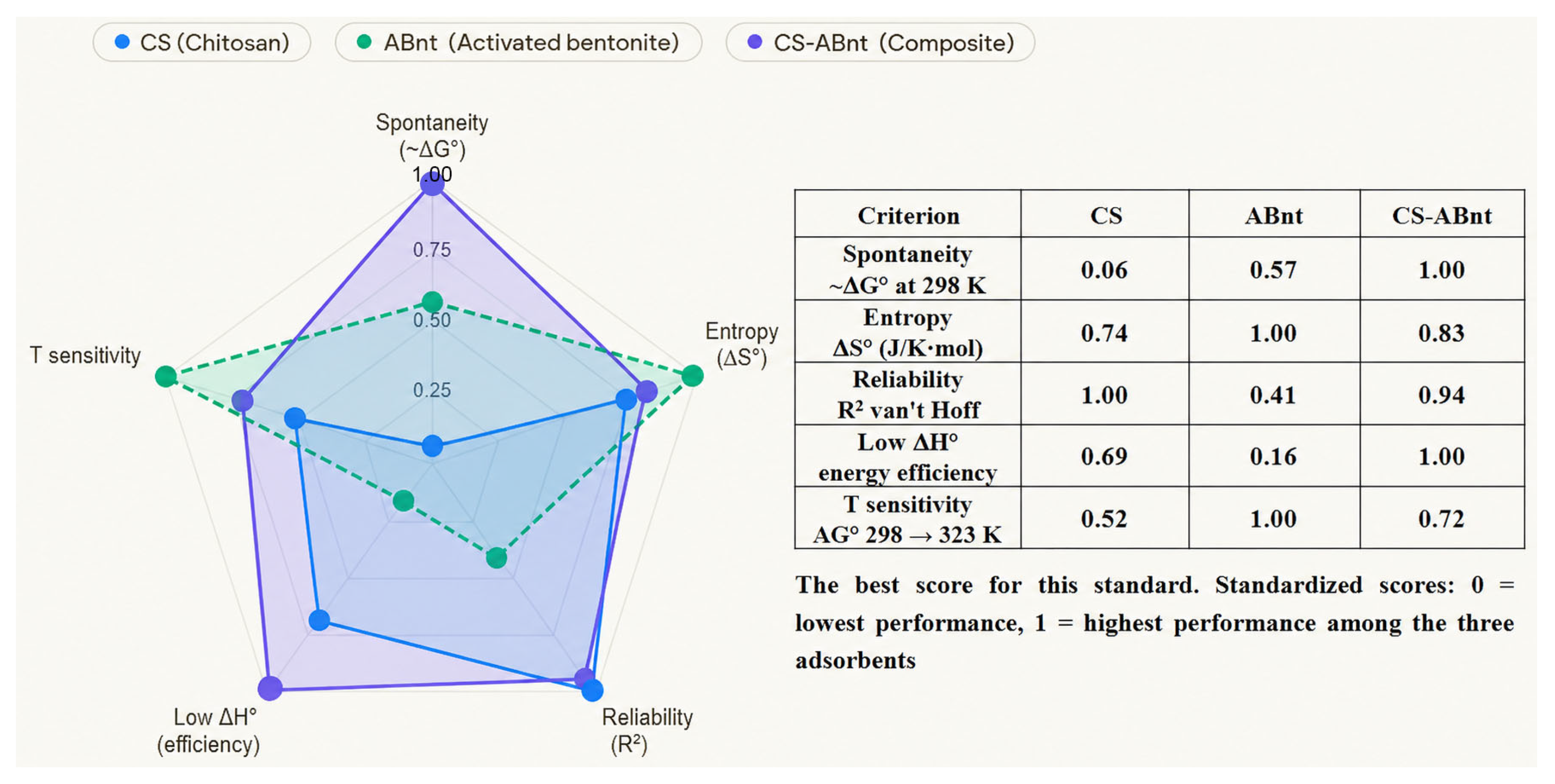
Analysis of the multi-criteria radar diagrams reported in Figure 9 reveals a clear hierarchy among the three studied adsorbents. An examination of these diagrams provides a distinct thermodynamic profile for each material.
Figure 9.
Multi-criteria assessment of tetracycline adsorption by CS, ABnt and CS-ABnt: spontaneity, entropy, reliability, energy efficiency and temperature sensitivity.
The chitosan alone (CS) exhibits a particularly unbalanced profile. Its statistical reliability is the best of the three systems, with a coefficient of determination R2 = 0.996, indicating near-perfect linearity of the van’t Hoff line, which means that the thermodynamic model used provides an excellent description of this material’s behavior across the entire temperature range studied. However, its spontaneity at 298 K is very low (ΔG° = −0.39 kJ/mol, normalized score of only 0.06), placing it far behind its competitors at room temperature. Its moderate enthalpy (30.84 kJ/mol, score 0.69) and intermediate thermal sensitivity (score 0.52) make it an adsorbent whose performance improves reasonably with heat, but without ever reaching the levels of the other two materials. Therefore, CS is a predictable and well-characterized material, but it is insufficient in terms of raw affinity for tetracycline at low temperatures.
Activated bentonite (ABnt) exhibits a very different star-shaped profile, characterized by two extreme peaks and two pronounced low points. It dominates in terms of entropy (ΔS° = 141.35 J/K·mol, score 1.00) and temperature sensitivity (score 1.00), giving it the highest rate of performance progress with T and the strongest entropic driving force. However, its high enthalpy (37.56 kJ/mol, score only 0.16) indicates that adsorption is energetically more costly, requiring more energy to desolvate the tetracycline molecules. Above all, its van’t Hoff reliability is significantly lower (R2 = 0.853, score 0.41), suggesting surface heterogeneity—likely linked to the coexistence of several types of active sites on the clay layers—making the thermodynamic behavior less linear and therefore less predictable. ABnt is a powerful but irregular material, highly effective at high temperatures, less reliable, and more energy-intensive compared to the composite. The CS-ABnt composite offers the most balanced and high-performance combination. Its radar profile is the broadest and most consistent of the three materials: it achieves the maximum score (1.00) for spontaneity and energy efficiency, a very high score for reliability (0.94) and entropy (0.83), and a moderate but solid thermal sensitivity (0.72). The CS-ABnt composite is not simply the result of combining the two components, but a new material in which the synergy between the functional groups of chitosan and the high surface area of bentonite creates more favorable adsorption conditions than either material alone. With CS-ABnt having the lowest enthalpy of the three adsorbents (28.03 kJ/mol), tetracycline molecules move into active sites more readily, while the ΔG° of −7.04 kJ/mol at 298 K confirms that adsorption is largely spontaneous even without heat. The radar map also demonstrates an important thermodynamic principle. In fact, the performance of an adsorbent cannot be reduced to a single parameter. CS stands out for its consistency but lacks potency; ABnt is highly effective, but its performance is inconsistent; CS-ABnt combines the advantages of both while minimizing their respective weak points, which makes it the most suitable candidate for a tetracycline removal application under real-world conditions.
3.2.9. Comparison of Adsorption Parameters for Tetracycline Removal Using Chitosan–Bentonite Composites
Table 5 presents a comparison of the adsorption performance of various adsorbents for the removal of tetracycline from aqueous solutions. As shown in Table 4, bentonite- and chitosan-based adsorbents were evaluated at 25 °C for the removal of tetracycline from an aqueous solution. The maximum adsorption capacities (qmax) range from 19.2 to 68.4 mg·g−1, with spherical forms generally exhibiting the best performance. However, our CS-ABnt composite yields results comparable to those of other adsorbents cited in the literature. In fact, our CS–ABnt composite in bead form exhibits a slightly higher capacity (49.01 mg·g−1), with a very short equilibrium time of 90 min and a wide optimal pH range (5–6). Furthermore, it follows a Langmuir model (homogeneous monolayer adsorption) and pseudo-second-order kinetics, indicating favorable chemical interactions. The synergy between chitosan and activated bentonite improves performance without the complexity or high cost associated with magnetic beads. This comparative study illustrates that the shift from ABnt powder (high-performance but difficult to use) towards CS–ABnt composite beads (equally fast, more efficient and also easier to separate) is a strong strategic progress towards real-life applicability. Overall, CS–ABnt beads are obviously the most promising kind of material as they display efficiency, speed and ease of use, establishing an excellent trade-off between reusability-limited powders and over-complicated magnetic systems. In terms of synthesis complexity, the CS–ABnt composite requires only a simple acid-activation step followed by ionotropic gelation, without the multi-step functionalization, suggesting a comparatively lower production cost and easier scale-up.
Table 5.
Comparative adsorption performance of chitosan–bentonite-based adsorbents for tetracycline removal from aqueous solutions.
4. Conclusions
This study reports on the synthesis of an innovative composite adsorbent, designated CS-ABnt, obtained by coating activated bentonite with chitosan in the form of beads, with the aim of removing tetracycline from aqueous effluents. EDX, FTIR, and zeta potential analyses clearly demonstrated the successful coating of the bentonite by chitosan, with a significant change in the elemental composition, surface functional groups, and electrostatic properties of the material. Evaluation of the composite’s adsorption performance with respect to tetracycline revealed excellent agreement with the Langmuir model, suggesting monolayer adsorption at energetically homogeneous sites, with a maximum capacity of 49.11 mg·g−1. Furthermore, the adjustment of kinetic data to the pseudo-second-order (PSO) model indicates that the adsorption process is limited by chemical interactions, typical of chemisorption. Thermodynamic analysis showed that adsorption is spontaneous (ΔG° < 0), endothermic (ΔH° > 0), and associated with an increase in disorder at the solid-liquid interface (ΔS° > 0), which is consistent with a chemical binding mechanism accompanied by the release of water molecules. Thanks to these properties, the CS-ABnt composite achieved a 95% removal efficiency for tetracycline at pH 6. All of these results demonstrate that the bentonite–chitosan composite is an effective and promising adsorbent for treating wastewater contaminated with tetracycline residues, with regeneration and multi-cycle reusability identified as key directions for future work to fully establish its practical sustainability.
Supplementary Materials
The following supporting information can be downloaded at https://www.mdpi.com/article/10.3390/su18168438/s1, including all experimental procedures and theoretical explanations. References [40,41,42,43,44,45,46,47,48,49,50] are cited in Supplementary Materials.
Author Contributions
Conceptualization, J.I.; methodology, J.I., FT and R.O.; software, J.I.; validation, J.I.; formal analysis, J.I. and F.T.; investigation, J.I.; resources, J.I.; data curation, F.T.; writing—original draft preparation, J.I., R.O. and F.T.; writing—review and editing, J.I.; visualization, J.I.; supervision, J.I.; project administration, J.I. and R.O. All authors have read and agreed to the published version of the manuscript.
Funding
This work was carried out with the support of the National Centre for Scientific and Technical Research (CNRST) as part of the “PhD – Associate Scholarship–Pass” Program.
Institutional Review Board Statement
Not applicable.
Informed Consent Statement
Not applicable.
Data Availability Statement
The data presented in this study are available on request from the corresponding author.
Conflicts of Interest
All chemicals were reagent grade (Aldrich Chemical Co.) and were used as purchased without further purification. The authors declare that the research was conducted in the absence of any commercial or financial relationships that could be construed as a potential conflict of interest.
References
- Guo, X.; Wu, Z.; Wang, Z.; Lin, F.; Li, P.; Liu, J. Preparation of Chitosan-Modified Bentonite and Its Adsorption Performance on Tetracycline. ACS Omega 2023, 8, 19455–19463. [Google Scholar] [CrossRef] [Scilit] [PubMed]
- Ahmad, F.; Zhu, D.; Sun, J. Environmental fate of tetracycline antibiotics: Degradation pathway mechanisms, challenges, and perspectives. Environ. Sci. Eur. 2021, 33, 64. [Google Scholar] [CrossRef] [Scilit]
- Cheng, X.; Jiang, D.; Zhu, W.; Xu, H.; Ling, Q.; Yang, J.; Wang, X.; Zhang, K.; Zheng, X.; He, S.; et al. Iron and Nitrogen Co-Doping Biochar for Simultaneous and Efficient Adsorption of Oxytetracycline and Norfloxacin from Wastewater. Ind. Crops Prod. 2025, 226, 120646. [Google Scholar] [CrossRef] [Scilit]
- Liu, Y.; Yu, H.; Xing, Y.; Zhao, Q.; Ashan, R.; Feng, B.; Tao, B.; Shangguan, Q.; Liu, Y.; Zhang, H.; et al. Ball-Milling-Assisted Fe3O4 Loadings of Rice Straw Biochar for Enhanced Tetracycline Adsorption in Aquatic Systems. Agronomy 2025, 15, 1987. [Google Scholar] [CrossRef] [Scilit]
- Liang, N.; Hu, X.; Zhang, X.; Li, W.; Guo, Z.; Huang, X.; Li, Z.; Zhang, R.; Shen, T.; Zou, X.; et al. Ratiometric Sensing for Ultratrace Tetracycline Using Electrochemically Active Metal–Organic Frameworks as Response Signals. J. Agric. Food Chem. 2023, 71, 7584–7592. [Google Scholar] [CrossRef] [Scilit] [PubMed]
- Ouyang, Q.; Liu, Y.; Chen, Q.; Guo, Z.; Zhao, J.; Li, H.; Hu, W. Rapid and specific sensing of tetracycline in food using a novel upconversion aptasensor. Food Control 2017, 81, 156–163. [Google Scholar] [CrossRef] [Scilit]
- Li, S.; Hofstra, N.; van de Schans, M.G.M.; Yang, J.; Li, Y.; Zhang, Q.; Ma, L.; Strokal, M.; Kroeze, C.; Chen, X.; et al. Riverine Antibiotics from Animal Production and Wastewater. Environ. Sci. Technol. Lett. 2023, 10, 1059–1067. [Google Scholar] [CrossRef] [Scilit]
- Obayomi, K.S.; Xie, Z.; Gray, S.R.; Zhang, J. Assessing the Performance of Different Treatment Methods in Removing Tetracycline from Wastewater: Efficiency and Cost Evaluation. Materials 2025, 18, 2134. [Google Scholar] [CrossRef] [Scilit] [PubMed]
- Ngoc, D.M.; Hieu, N.C.; Trung, N.H.; Chien, H.H.; Thi, N.Q.; Hai, N.D.; Chao, H.-P. Tetracycline Removal from Water by Adsorption on Hydrochar and Hydrochar-Derived Activated Carbon: Performance, Mechanism, and Cost Calculation. Sustainability 2023, 15, 4412. [Google Scholar] [CrossRef] [Scilit]
- Gopal, G.; Alex, S.A.; Chandrasekaran, N.; Mukherjee, A. A review on tetracycline removal from aqueous systems by advanced treatment techniques. RSC Adv. 2020, 10, 27081–27095. [Google Scholar] [CrossRef] [Scilit] [PubMed]
- Derkowski, A.; Zięba, A.; Dohrmann, R.; Kaufhold, S. Understanding Cation Exchange Capacity Measurement for Bentonite-Cement Reactions. Appl. Clay Sci. 2025, 276, 107938. [Google Scholar] [CrossRef] [Scilit]
- Bohác, P.; Delavernhe, L.; Zervas, E.; Königer, F.; Schuhmann, R.; Emmerich, K. Cation Exchange Capacity of Bentonite in a Saline Environment. Appl. Geochem. 2019, 101, 159–170. [Google Scholar] [CrossRef] [Scilit]
- Lu, M.; Wang, R.; Xue, Y.; Ren, L.; Chen, S.; Liu, J.; Mei, M.; Wang, T.; Li, J. Eco-friendly ceramsite from dredged sediment/biomass for Pb(II) removal: Process optimization and adsorption mechanistic insights. J. Environ. Chem. Eng. 2022, 10, 108939. [Google Scholar] [CrossRef] [Scilit]
- Perelomov, L.; Gertsen, M.; Mandzhieva, S.; Sychev, V.; Dudnikova, T.; Khaidanov, I.; Perelomova, I.; Minkina, T.; Atroshchenko, Y. Adsorption of Antibiotics by Natural Clay Minerals. Minerals 2025, 15, 733. [Google Scholar] [CrossRef] [Scilit]
- Babaei, F.; Foroutan, R.; Tutunchi, A.; Ahmadi, M.; Ramavandi, B. Efficient Removal of Tetracycline from Wastewater Using Chitosan-Based Aerogels Functionalized with Natural Zeolite, Fe3O4, and MOF-808. Carbohydr. Polym. Technol. Appl. 2025, 11, 100961. [Google Scholar] [CrossRef] [Scilit]
- Duong, H.V.; Chau, T.T.L.; Dang, N.T.T.; Vanterpool, F.; Salmerón-Sánchez, M.; Lizundia, E.; Tran, H.T.; Nguyen, L.V.; Nguyen, T.-D. Biocompatible Chitosan-Functionalized Upconverting Nanocomposites. ACS Omega 2018, 3, 86–95. [Google Scholar] [CrossRef] [Scilit] [PubMed]
- Lehocký, M. Environmental Applications of Chitosan Derivatives and Chitosan Composites. Polymers 2025, 17, 2583. [Google Scholar] [CrossRef] [Scilit] [PubMed]
- Atangana, E.; Ajiboye, T.O.; Mafolasire, A.A.; Ghosh, S.; Hakeem, B. Adsorption of Organic Pollutants from Wastewater Using Chitosan-Based Adsorbents. Polymers 2025, 17, 502. [Google Scholar] [CrossRef] [Scilit] [PubMed]
- Elashery, S.E.A.; El-Bouraie, M.M.; Abdelgawad, E.A.; Attia, N.F.; Mohamed, G.G. Adsorptive Performance of Bentonite-Chitosan Nanocomposite as a Dual Antibacterial and Reusable Adsorbent for Reactive Red 195 and Crystal Violet Removal: Kinetic and Thermodynamic Studies. Biomass Convers. Biorefin. 2025, 15, 2511–2524. [Google Scholar] [CrossRef] [Scilit]
- Rissouli, L.; Chabbi, M.; Berradi, M.; Eddaoukhi, A.; Chaer, I.; Znagui, F.; El Yacoubi, A.; El Bachiri, A.; Chafik, T.; Zantar, S.; et al. Chitosan-Bentonite Composite Adsorption of Herbicide Glyphosate from Water Solution. Environ. Monit. Assess. 2025, 197, 245. [Google Scholar] [CrossRef] [Scilit] [PubMed]
- Ma, J.; Lei, Y.; Khan, M.A.; Wang, F.; Chu, Y.; Lei, W.; Xia, M.; Zhu, S. Adsorption Properties, Kinetics and Thermodynamics of Tetracycline on Carboxymethyl-Chitosan Reformed Montmorillonite. Int. J. Biol. Macromol. 2019, 124, 557–567. [Google Scholar] [CrossRef] [Scilit] [PubMed]
- Guo, X.; Wu, Z.; Lu, Z.; Wang, Z.; Li, S.; Madhau, F.; Guo, T.; Huo, R. Preparation and Characterization of Chitosan-Modified Bentonite Hydrogels and Application for Tetracycline Adsorption from Aqueous Solution. Gels 2024, 10, 503. [Google Scholar] [CrossRef] [Scilit] [PubMed]
- Ahamad, T.; Naushad, M.; Al-Shahrani, T.; Al-hokbany, N.; Alshehri, S.M. Preparation of chitosan based magnetic nanocomposite for tetracycline adsorption: Kinetic and thermodynamic studies. Int. J. Biol. Macromol. 2020, 147, 258–267. [Google Scholar] [CrossRef] [Scilit] [PubMed]
- da Silva Bruckmann, F.; Schnorr, C.E.; da Rosa Salles, T.; Batista Nunes, F.; Baumann, L.; Müller, E.I.; Silva, L.F.O.; Dotto, G.L.; Rhoden, C.R.B. Highly Efficient Adsorption of Tetracycline Using Chitosan-Based Magnetic Adsorbent. Polymers 2022, 14, 4854. [Google Scholar] [CrossRef] [Scilit] [PubMed]
- Kayani, K.F. Tetracycline in the environment: Toxicity, uses, occurrence, detection, and removal by covalent organic frameworks—Recent advances and challenges. Sep. Purif. Technol. 2025, 364, 132418. [Google Scholar] [CrossRef] [Scilit]
- Majiya, H.; Clegg, F.; Sammon, C. Bentonite-Chitosan Composites or Beads for Lead (Pb) Adsorption: Design, Preparation, and Characterisation. Appl. Clay Sci. 2023, 246, 107180. [Google Scholar] [CrossRef] [Scilit]
- Biswas, S.; Fatema, J.; Debnath, T.; Rashid, T.U. Chitosan–Clay Composites for Wastewater Treatment: A State-of-the-Art Review. ACS EST Water 2021, 1, 1055–1085. [Google Scholar] [CrossRef] [Scilit]
- Abu Hasan, H.; Muhamad, M.H.; Budi Kurniawan, S.; Buhari, J.; Husain Abuzeyad, O. Managing Bisphenol A Contamination: Advances in Removal Technologies and Future Prospects. Water 2023, 15, 3573. [Google Scholar] [CrossRef] [Scilit]
- Rudovica, V.; Rotter, A.; Gaudêncio, S.P.; Novoveská, L.; Akgül, F.; Akslen-Hoel, L.K.; Alexandrino, D.A.M.; Anne, O.; Arbidans, L.; Atanassova, M. Valorization of Marine Waste: Use of Industrial By-Products and Beach Wrack Towards the Production of High Added-Value Products. Front. Mar. Sci. 2021, 8, 723333. [Google Scholar] [CrossRef] [Scilit]
- Kumari, H.; Sonia, S.; Suman; Ranga, R.; Chahal, S.; Devi, S.; Sharma, S.; Kumar, S.; Kumar, P.; Kumar, S.; et al. A Review on Photocatalysis Used For Wastewater Treatment: Dye Degradation. Water Air Soil Pollut. 2023, 234, 349. [Google Scholar] [CrossRef] [Scilit] [PubMed]
- Amangelsin, Y.; Semenova, Y.; Dadar, M.; Aljofan, M.; Bjørklund, G. The Impact of Tetracycline Pollution on the Aquatic Environment and Removal Strategies. Antibiotics 2023, 12, 440. [Google Scholar] [CrossRef] [Scilit] [PubMed]
- Jalloul, G.; Keniar, I.; Tehrani, A.; Boyadjian, C. Antibiotics Contaminated Irrigation Water: An Overview on Its Impact on Edible Crops and Visible Light Active Titania as Potential Photocatalysts for Irrigation Water Treatment. Front. Environ. Sci. 2021, 9, 767963. [Google Scholar] [CrossRef] [Scilit]
- Motshekga, S.C. The Significant Role of Acid Activation in Clay Modification: A Comparative Study of Activators for Bentonite. R. Soc. Open Sci. 2026, 13, 252106. [Google Scholar] [CrossRef] [Scilit]
- Taxiarchou, M.; Tsakiri, D.; Douni, I. The Impact of pH on the Pore and Structural Characteristics of Acid-Modified Bentonites in Oxalate Solutions. Minerals 2025, 15, 257. [Google Scholar] [CrossRef] [Scilit]
- Hijazi, A.; Mcheik, A.; Rammal, H.; Rammal, W.; Annan, H.; Toufaily, J.; Hamieh, T. Biosorption of Methylene Blue from Waste Water Using Lebanese Cymbopogon citratus (Citronnelle). Eur. Sci. J. 2015, 11, 293–308. [Google Scholar]
- Bouaziz, N.; Kouira, O.; Aouaini, F.; Bukhari, L.; Knani, S.; Znaidia, S.; Ben Lamine, A. Adsorption of Antibiotics by Bentonite-Chitosan Composite: Phenomenological Modeling and Physical Investigation of the Adsorption Process. Int. J. Biol. Macromol. 2023, 242, 125156. [Google Scholar] [CrossRef] [Scilit] [PubMed]
- Wang, Y.; Gong, S.; Li, Y.; Li, Z.; Fu, J. Adsorptive removal of tetracycline by sustainable ceramsite substrate from bentonite/red mud/pine sawdust. Sci. Rep. 2020, 10, 2960. [Google Scholar] [CrossRef] [Scilit] [PubMed]
- Pereira, A.; Freitas, A.; Silva, M.; Camara, A.; Moura, H.; Ballesteros-Plata, D.; Rodríguez-Castellón, E.; Carvalho, L. Efficient Removal of Tetracycline Hydrochloride via Adsorption onto Modified Bentonite: Kinetics and Equilibrium Studies. Appl. Sci. 2025, 15, 3372. [Google Scholar] [CrossRef] [Scilit]
- Nunes Filho, F.G.; Silva Filho, E.C.; Osajima, J.A.; De Melo Alves, A.P.; Fonseca, M.G. Adsorption of tetracycline using chitosan–alginate–bentonite composites. Appl. Clay Sci. 2023, 239, 106952. [Google Scholar] [CrossRef] [Scilit]
- Sowmya, A.; Meenakshi, S. A novel quaternized resin with acrylonitrile/divinylbenzene/vinylbenzyl chloride skeleton for the removal of nitrate and phosphate. Chem. Eng. J. 2014, 257, 45–55. [Google Scholar] [CrossRef] [Scilit]
- Barrow, N.J. The description of sorption curves. Eur. J. Soil Sci. 2008, 59, 900–910. [Google Scholar] [CrossRef] [Scilit]
- Zhang, H.; Zhang, F.; Huang, Q. Highly effective removal of malachite green from aqueous solution by hydrochar derived from phycocyanin-extracted algal bloom residues through hydrothermal carbonization. RSC Adv. 2017, 7, 5790–5799. [Google Scholar] [CrossRef] [Scilit]
- Freundlich, H.M.F. Over the adsorption in solution. J. Phys. Chem. 1906, 57, 385–471. [Google Scholar] [CrossRef] [Scilit]
- Tempkin, M.I.; Pyzhev, V. Kinetics of ammonia synthesis on promoted iron catalyst. Acta Phys. Chim. USSR 1940, 12, 327–356. [Google Scholar]
- Aharoni, C.; Ungarish, M. Kinetics of activated chemisorption. Part 2. Theoretical models. J. Chem. Soc. Faraday Trans. 1 1977, 73, 456–464. [Google Scholar] [CrossRef] [Scilit]
- Günay, A.; Arslankaya, E.; Tosun, I. Lead removal from aqueous solution by natural and pretreated clinoptilolite: Adsorption equilibrium and kinetics. J. Hazard. Mater. 2007, 146, 362–371. [Google Scholar] [CrossRef] [Scilit] [PubMed]
- Dabrowski, A. Adsorption—from theory to practice. Adv. Colloid Interface Sci. 2001, 93, 135–224. [Google Scholar] [CrossRef] [Scilit] [PubMed]
- Dubinin, M.M. The potential theory of adsorption of gases and vapors for adsorbents with energetically non-uniform surface. Chem. Rev. 1960, 60, 235–241. [Google Scholar] [CrossRef] [Scilit]
- Hobson, J.P. Physical adsorption isotherms extending from ultra-high vacuum to vapor pressure. J. Phys. Chem. 1969, 73, 2720–2727. [Google Scholar] [CrossRef] [Scilit]
- Tzabar, N.; ter Brake, H.J.M. Adsorption isotherms and Sips models of nitrogen, methane, ethane, and propane on commercial activated carbons and polyvinylidene chloride. Adsorption 2016, 22, 901–914. [Google Scholar] [CrossRef] [Scilit]

Disclaimer/Publisher’s Note: The statements, opinions and data contained in all publications are solely those of the individual author(s) and contributor(s) and not of MDPI and/or the editor(s). MDPI and/or the editor(s) disclaim responsibility for any injury to people or property resulting from any ideas, methods, instructions or products referred to in the content. |
© 2026 by the authors. Licensee MDPI, Basel, Switzerland. This article is an open access article distributed under the terms and conditions of the Creative Commons Attribution (CC BY) license.