


Abstract
The rapid growth of e-commerce has intensified last-mile delivery challenges in Thailand, where rising parcel volumes contribute to failed deliveries and increased carbon emissions. Smart parcel lockers offered a promising solution, though their adoption depends on consumer acceptance. However, existing research has not sufficiently examined how trialability, performance expectancy, and perceived risk operate alongside core TAM beliefs within an integrated framework, particularly in emerging markets. This study extends the Technology Acceptance Model (TAM) with constructs from Diffusion of Innovation (DOI) theory and the Unified Theory of Acceptance and Use of Technology (UTAUT) to examine the determinants of smart parcel locker adoption, incorporating trialability, performance expectancy, and perceived risk. A quantitative survey was conducted with 397 Thai consumers with prior online shopping and parcel delivery experience. Data were analyzed using covariance-based structural equation modeling (CB-SEM). The model explained 79.3%, 94.3%, and 82.7% of the variance in perceived ease of use, attitude, and intention. Trialability is the strongest predictor, working through perceived ease of use, while attitude and performance expectancy together drove intention. Contrary to traditional TAM, perceived usefulness did not significantly affect attitude, and perceived risk had no significant effect. These findings suggest that, for simple self-service delivery technologies, first-hand experience is more influential than emphasizing usefulness or safety concerns. This contributes to technology acceptance theory and offers practical guidance to increase smart parcel locker usage.
1. Introduction
The COVID-19 pandemic and technological advances have significantly changed consumer buying behavior towards online, driving the growth of the global e-commerce market. Thailand’s e-commerce market also experienced exponential expansion, making the country one of Southeast Asia’s largest e-commerce markets [1]. According to the Electronic Transactions Development Agency (ETDA) [2], Thailand’s e-commerce value reached THB 5.82 trillion in 2023 and was forecast to increase to approximately THB 6.13 trillion in 2024. Business-to-consumer (B2C) e-commerce alone accounted for nearly a half of the market value at THB 2.91 trillion in 2023 [2]. The expansion of the online market has driven demand for transportation and fulfillment services, raising Thailand’s transport-related e-commerce sector value at THB 559.35 billion in 2023 and forecasting it to reach THB 584.97 billion in 2024 [2].
Nonetheless, the surge of online transactions can be a double-edged sword, as increasing the number of packages delivered daily from online shopping puts more pressure on the logistics supply chain, particularly in the last mile of delivery. Thailand’s courier, express, and parcel market has expanded considerably, with annual parcel volume increasing from 329 million pieces in 2017 to more than 2.06 billion pieces in 2024 and estimated to reach 2.35 billion pieces in 2025 [3]. Last-mile delivery as the final stage of logistics is one of the crucial points in the logistics process. It is widely recognized for being the most complex, costly, and customer-sensitive stage. Inefficiencies at this point could lead to operational disadvantages for logistics providers. As parcel volume increases, logistics systems are faced with challenges from congestion, emissions, and last-mile inefficiencies [4]. Failed delivery attempts contribute to additional travel, higher operating costs and increased personnel workload in last-mile delivery [5]. Escudero-Santana et al. [6] also indicate that unsuccessful delivery attempts could lead to lower customer satisfaction. One unsuccessful delivery due to customer absence could contribute to higher re-delivery costs and time and high labor requirements.
Apart from economic relevance, these inefficiencies also carry environmental implications as repeated delivery attempts increase distribution vehicle mileage, fuel consumption, and the resulting carbon emissions in already congested urban areas. Cano et al. [4] identify last-mile delivery, urban logistics, emissions, traffic congestion, and alternative delivery systems as major concerns in sustainable e-commerce logistics. Hence, as the e-commerce market continues to grow, new innovative delivery methods that are more efficient, flexible, and sustainable are required as a solution.
To cope with these operational complexities, logistics firms have adopted Automated Parcel Lockers (APLs), alternatively referred as smart lockers, as another innovation in last-mile delivery. These smart lockers are self-service delivery stations that are placed secure and accessible locations, where customers can pick up or drop off the packages at their own time and convenience. Zhang and Demir [5] explain that smart lockers as innovative solutions have successfully integrated digital technology with parcel management and become an important solution for addressing delivery bottlenecks, personnel workload, and operational inefficiencies.
The innovation not only provides customers with flexibility in parcel collection, but it also improves operational efficiency for service providers by reducing unsuccessful home deliveries and lower delivery time and cost. Ranjbari et al. [7] provide field evidence that common-carrier parcel lockers can substantially reduce couriers’ in-building delivery time. Similarly, Mohri et al. [8] show that on-premises parcel lockers can benefit residents, carriers, and local governments through reduced failed deliveries, lower operational costs, improved parcel security, and reduced external costs.
In Thailand, the rapid expansion of e-commerce and parcel delivery provides favorable conditions for the development of alternative delivery services, yet conventional home delivery remains the dominant channel. Domestic courier companies are the most common delivery channel among Thais, accounting for approximately 33.30%, followed by Thailand Post at 24.77% and express messenger services at 17.63% [2]. Smart parcel-locker services have also entered the Thai market and are increasingly being introduced by established logistics providers. However, comprehensive national statistics concerning the total number of lockers, geographical coverage, deployment volume, and actual utilization remain publicly limited. Therefore, the market can be described as an emerging market.
Despite their multiple advantages, the successful implementation of smart lockers as an alternative delivery method depends on consumer acceptance and consumers’ willingness to switch from traditional home delivery to self-collection. Recognizing operational and environmental benefits does not automatically lead to adoption of the service. Research has shown that consumers frequently place greater importance on convenience, accessibility, cost, reliability, and delivery performance than on environmental benefits [9,10]. Consumers must be willing to adapt their familiar routines, travel to a location, interact with a self-service system, and retrieve parcels within the specified collection period. Therefore, the sustainability benefits of parcel lockers can only be realized when consumers are willing to use the service regularly.
Prior research has examined consumer acceptance of parcel lockers using different theoretical perspectives. Wang et al. [11] applied Diffusion of Innovation Theory and found that relative advantage, compatibility, trialability, and complexity influenced consumers’ attitudes and initial adoption of automated parcel stations. An et al. [12] integrated TAM with Protection Motivation Theory and found that perceived usefulness, perceived ease of use, service trust, innovativeness, protection motivation, and attitude influenced consumers’ intention to adopt parcel-locker services. Evidence from emerging Southeast Asian markets also suggests that adoption is shaped by context-specific factors. Tsai et al. [13] found that innovativeness, location convenience, and service convenience were influential, while Quan et al. [14] similarly reported that convenience, privacy and security, and reliability influenced Vietnamese consumers’ evaluation of smart-locker services. For Thailand, Tsai and Tiwasing [15] provided an important foundation by examining consumer intention to adopt smart lockers through a multi-theory perspective. Their study found that convenience, reliability, privacy security, compatibility, relative advantage, complexity, perceived behavioral control, and attitude influenced adoption intention.
The present study aims to examine several theoretical and empirical questions that remain unresolved. First, it is unclear in prior Thailand research whether trialability influences consumers’ perceptions of smart lockers. Second, relative effects of perceived usefulness and perceived ease of use on attitude remain unclear for simple, self-service contexts. Third, consumers may perceive parcel lockers as useful but may not intend to use them unless they expect the service to outperform conventional delivery. Lastly, the effect of perceived risk remains uncertain when parcel lockers are provided through established courier networks that consumers may already trust.
This study addresses these questions by incorporating the TAM framework with constructs from Diffusion of Innovation theory (DOI) and the Unified Theory of Acceptance and Use of Technology (UTAUT). It specifically examines trialability, performance expectancy, and perceived risk and whether these factors influence adoption. By using structural equation modeling (SEM), this study investigates these linkages and offers both theoretical and empirical insights into the circumstance where consumer acceptance of last-mile delivery technology may deviate from established adoption theory. The findings suggest direct implications for logistics providers to prioritize their investment between usability, effective communication, and risk-mitigation strategies as they transition toward more sustainable urban last-mile delivery.
This paper is organized into five sections. The Section 1 covers the research background. The review of literature and description of development are discussed in Section 2. Section 3 presents research methodology, while the results and discussions of the research are illustrated in Section 4. Lastly, Section 5 covers the conclusion, theoretical implications, managerial implications, and limitations of the research.
2. Literature Review
2.1. Smart Parcel Lockers in Last-Mile Delivery
Smart parcel lockers are self-service facilities that allow consumers to collect and return parcels from secure compartments. Logistics providers deliver parcels to lockers instead of individual addresses, and customers receive notification and access information for collection. Lockers are commonly located in residential buildings, shopping centers, transport hubs, and other accessible locations. This delivery model provides greater collection flexibility and reduces the need for couriers and recipients to be available at the same time. as the recipient for traditional home delivery. Cano et al. [4] identify parcel lockers as important sustainable last-mile alternatives as they support shipment consolidation, reduce failed deliveries, and lower transport-related externalities.
Early research on smart lockers was conducted mainly in developed economies and highlighted their operational benefits in several dimensions of last-mile delivery. In the United States, Ranjbari et al. [7] provided field evidence that locker systems have reduced the time couriers spend inside buildings during home delivery. In Australia, Mohri et al. [8] found that on-premises parcel lockers have shown potential for cost savings that benefit not only residents but also carriers and local governments. This indicates that the advantages of locker systems are shared across multiple stakeholders in the delivery chain. This body of work is consistent with the systematic review by Zhang and Demir [5], which confirms that parcel lockers have been widely studied in relation to cost reduction, operational efficiency, routing, location planning, parcel consolidation, and sustainability.
Nevertheless, operational and environmental advantages do not automatically translate into consumer acceptance, as consumers also actively evaluate whether the lockers offer them personal benefits. This suggests a significant gap between the value of a technology as shown in operational studies and the value as perceived by users. Vakulenko et al. [16] showed that parcel lockers generate functional, emotional, social, and financial value for customers. However, this value is fragile and may be undermined by inconvenience, confusion, additional cost, or unreliable service. Yuen et al. [17] also found that convenience, reliability, and privacy security influence intention through perceived value and transaction costs. Penagos et al. [18] identified convenience, efficiency, and compatibility with daily activities as important drivers of adoption. These findings suggest that consumer acceptance depends on perceived personal value, not only on operational efficiency.
Consumer perceptions also include ease of use, risk, trust, accessibility, and prior experience. Kurowski et al. [19] found that accessibility and network design influence consumers’ perception of the lockers, as walking or cycling was common for users. In addition, Vakulenko et al. [16] highlighted that unclear instructions, technical faults, inconvenience, and limited customer support may undermine the value of the service. Jang et al. [20] similarly found that consumers were more willing to adopt automated lockers when the systems were perceived as useful and easy to understand, while prior experience changed how consumers evaluated innovativeness, distrust, and service benefits. Dayal et al. [21] showed that perceived ease of use, risk, attitude, and travel-mode characteristics influenced adoption differently across consumer groups, demonstrating that ease of use includes both technological simplicity and physical accessibility. Risk is another concern in self-service delivery. Consumers may worry about parcel loss, theft, information leakage, system failure, delivery errors, or unclear compensation. Penagos et al. [18] found that these perceived threats reduced adoption intention, whereas An et al. [12] showed that service trust strengthened usefulness and ease-of-use perceptions. Trialability and innovativeness can help reduce this uncertainty. Wang et al. [11] found that trialability positively shaped attitudes toward automated parcel stations, while Yuen et al. [22] showed that it increased intention to use self-collection services. Rose et al. [23] further found that previous parcel-locker use consistently strengthened future intention, indicating that direct experience helps consumers form clearer evaluations of the service.
In emerging markets, Adoption conditions of smart locker may differ from those in mature parcel-delivery markets because of variation in infrastructure availability, consumer familiarity, service coverage, technological exposure, and perceived uncertainty. Evidence from a number of emerging markets consistently supports this pattern. In Colombia, Penagos et al. [18] found that consumers acknowledged the practical benefits of lockers, yet there was a limited understanding of the connection between this service and its environmental advantages. Dayal et al. [21] showed that usefulness, ease of use, risk, attitude, and mobility characteristics shaped parcel-locker adoption in India. In Vietnam, innovativeness, location convenience, and service convenience influenced intention to use automated delivery stations [13]. In Thailand, Tsai and Tiwasing [15] found several factors, including convenience, reliability, privacy security, compatibility, relative advantage, complexity, perceived behavioral control, and attitude, collectively influence the intention of Thai consumers to adopt smart lockers.
Despite growing evidence on parcel-locker adoption in emerging markets, several theoretical relationships remain insufficiently examined. Existing studies have largely assessed trialability as a direct determinant of attitude or behavioral intention rather than as an antecedent of perceived ease of use. Moreover, perceived usefulness and performance expectancy have often been examined in separate theoretical frameworks, leaving limited understanding of whether general perceptions of usefulness and expectations of specific delivery outcomes exert distinct influences on consumer acceptance. Similarly, perceived risk has commonly been linked directly to behavioral intention, while its influence on consumers’ overall attitudes toward smart lockers remains less established. These gaps are particularly relevant in Thailand, where existing research has identified multiple determinants of smart-locker adoption but has not examined these relationships within an integrated TAM-based framework [15]. Accordingly, this study integrates TAM with trialability from DOI, performance expectancy from UTAUT, and perceived risk to explain consumer acceptance of smart parcel lockers in Thailand.
2.2. Theoretical Background
The Technology Acceptance Model (TAM) is the classic framework introduced by Davis [24] that is widely used for explaining user acceptance of new technologies. TAM proposes two core constructs as fundamental determinants of technology acceptance, which are perceived usefulness and perceived ease of use. Perceived usefulness is defined as the extent to which a person believes that using a system enhances task performance, while perceived ease of use is defined as the extent to which using the system is perceived as effortless [24]. Both constructs significantly shape attitude and behavioral intention, which ultimately influence actual technology use or acceptance [24]. For smart lockers, consumers’ acceptance depends on whether they believe the service is useful and easy to operate. Klein and Popp [25] applied TAM to compare different delivery methods, including parcel lockers, and confirmed that perceived usefulness and perceived ease of use influence consumers’ attitudes and intention. Jang et al. [20] also demonstrated the relevance of both constructs to automated parcel locker adoption. Encarnación and Amaya [26] also used TAM to examine parcel locker adoption and confirmed that perceived ease of use and perceived usefulness support adoption while privacy and safety concerns act as negative factors. Therefore, TAM is particularly appropriate for examining smart-locker acceptance because consumers must evaluate both the functional usefulness of the service and the effort required to operate an unfamiliar self-service delivery technology.
Although TAM provides a strong theoretical framework, it may not fully explain consumers’ perceptions of parcel locker adoption, particularly in developing countries such as Thailand, where its core relationships do not always hold uniformly. Numerous studies have enhanced the model by incorporating additional factors to gain more understanding into consumers’ acceptance of smart lockers. An et al. [12] integrated Protection Motivation Theory with TAM and found that service trust and perceived innovativeness also affect consumers’ willingness to adopt parcel locker services. ElSemary et al. [27] combined TAM with the Theory of Planned Behavior (TPB) to examine consumers’ willingness to switch to smart lockers; however, attitude, which is one of the main TAM constructs, had an insignificant direct effect on switching intention, indicating that consumer behaviors in developing nations may not always follow the traditional TAM structure. Penagos et al. [18] extended TAM and found that convenience, ease of use, delivery speed, innovativeness, and environmental awareness jointly affect consumers’ willingness to adopt parcel lockers. Although TAM’s fundamental ideas received significant empirical backing, a more limited body of research indicates that this relationship may not be applicable in all contexts. Together, these studies indicate the context of developing countries; the fundamental pathways of the TAM are often enhanced and surpassed by contextual and individual factors that the original framework does not fully address.
Diffusion of Innovation Theory explains how new ideas, technologies, and practices spread through a social system over time [28]. The theory identifies five major innovation characteristics: relative advantage, compatibility, complexity, trialability, and observability. Relative advantage is conceptually related to perceived usefulness, whereas complexity is inversely related to perceived ease of use. Trialability, however, captures something that TAM does not explicitly address: the opportunity to experiment with an innovation before regular adoption. For smart lockers, hands-on experience can help consumers understand the notification, access, and retrieval processes before committing to continued use. DOI therefore complements TAM by explaining how pre-adoption experience shapes consumers’ beliefs.
The Unified Theory of Acceptance and Use of Technology was developed by Venkatesh et al. [29] by integrating eight major technology-acceptance models. UTAUT identifies performance expectancy, effort expectancy, social influence, and facilitating conditions as determinants of behavioral intention and use. This suggests that, in the case of a low-complexity service like parcel locker self-collection, there may be a need to rethink the traditional TAM structure. A possibility that this study directly investigates. The present study incorporates performance expectancy because consumers may evaluate smart lockers not only according to whether they are generally useful but also according to whether they are expected to produce better delivery outcomes. Performance expectancy therefore concerns anticipated improvements in delivery flexibility, reliability, accessibility, speed, and control. Cai et al. [30] found that performance expectancy influenced consumers’ attitudes toward logistics technologies, while attitude and habit shaped behavioral intention.
Perceived risk extends TAM by considering possible negative consequences associated with technology use. Featherman and Pavlou [31] defined perceived risk as the potential for loss arising from the use of an e-service and identified performance, financial, privacy, time, psychological, and social risk dimensions. For parcel lockers, consumers may perceive risks involving parcel loss, damage, privacy violations, system failure, delivery errors, or wasted collection time. Perceived risk is therefore relevant because consumers evaluate smart lockers not only through their expected utility but also through possible adverse outcomes. This is particularly important for unattended self-service systems, where users must trust both the technology and the logistics provider.
The integrated framework combines complementary rather than redundant mechanisms. TAM explains consumers’ general perceptions of usefulness and ease of use. DOI contributes trialability as a pre-adoption experience that may reduce uncertainty and facilitate learning. UTAUT contributes performance expectancy, which captures anticipated delivery outcomes relative to existing alternatives. Perceived-risk theory captures possible negative consequences that may weaken favorable evaluations. Together, these theories provide a more comprehensive explanation of how experiential, usability-related, functional, performance-based, attitudinal, and risk-related perceptions influence consumers’ intention to use smart parcel lockers.
2.3. Hypothesis Development
2.3.1. Trialability
Trialability, as defined by Rogers [28], is the extent to which an innovation can be experimented with before adoption. For smart lockers, hands-on experience is important because consumers may be unable to judge whether the system is easy to use, convenient, or dependable from a description alone. Direct interaction allows consumers to learn how to receive notifications, enter a PIN or scan a QR code, open the assigned compartment, and retrieve a parcel. This experience may reduce uncertainty and make the system appear easier to understand and operate.
Parcel-locker studies have commonly linked trialability to attitude or intention. Wang et al. [11] found that trialability positively influenced attitudes toward automated parcel stations, while Yuen et al. [22] showed that trialability increased intention to use self-collection services. Jang et al. [20] found that personal innovativeness increased perceived ease of use and that prior experience changed how consumers evaluated the technology. Rose et al. [23] similarly demonstrated that previous parcel-locker use strengthened future intention. Although these studies did not all test the proposed path directly, they establish the empirical plausibility that exposure and experimentation reduce uncertainty and improve consumers’ understanding of the service. Therefore:
H1.
Trialability positively influences perceived ease of use.
2.3.2. Perceived Ease of Use
According to TAM, ease of use and simplicity are directly associated with favorable attitudes toward technology [24]. When a system is easy to understand, access, and operate, it reduces psychological and practical barriers to adoption. This relationship carries particular importance for smart lockers because consumers generally complete the pickup process without direct staff assistance.
Klein and Popp [25] found that perceived ease of use positively influenced consumers’ attitudes toward parcel lockers. An et al. [12] also confirmed a positive effect of perceived ease of use on attitudes toward parcel-locker services. Dayal et al. [21] found that perceived ease of use was particularly important in shaping attitudes across different consumer mobility groups. Jang et al. [20] further showed that consumers demonstrated stronger adoption intentions when lockers were perceived as easy to understand and learn. Therefore:
H2.
Perceived ease of use positively influences attitude.
2.3.3. Perceived Usefulness
According to TAM, perceived usefulness is one of the main constructs influencing attitude toward technology acceptance [24]. Consumers are expected to develop favorable attitudes when they believe that using smart lockers will make parcel reception faster, more reliable, more flexible, or more convenient.
Klein and Popp [25] found that perceived usefulness positively influenced consumers’ attitudes toward parcel lockers. An et al. [12] similarly showed that usefulness strengthened attitudes toward parcel-locker services. Jang et al. [20] found that usefulness increased behavioral adoption, while Dayal et al. [21] identified perceived usefulness as an important determinant of parcel-locker acceptance across travel-mode groups. Yuen et al. [17] also showed that convenience, reliability, and privacy security create perceived value that supports intention to use. Therefore:
H3.
Perceived usefulness positively influences attitude.
2.3.4. Attitude
Attitude reflects consumers’ overall positive or negative evaluation of using smart parcel lockers. In TAM and related behavioral theories, consumers who hold favorable attitudes are expected to demonstrate stronger intention to use the service.
Wang et al. [11] found that attitude was the strongest predictor of initial adoption intention toward automated parcel stations. Tsai and Tiwasing [15] similarly showed that attitude significantly influenced Thai consumers’ intention to adopt smart lockers. An et al. [12] found that attitude strongly predicted adoption intention, while Dayal et al. [21] demonstrated a significant attitude–intention relationship across different consumer groups. Cai et al. [30], however, found that habit was more influential than attitude for smart-locker use, suggesting that the relationship may depend on prior experience and service maturity. Nevertheless, most direct empirical evidence supports the proposed relationship:
H4.
Attitude positively influences intention to use.
2.3.5. Performance Expectancy
Performance expectancy refers to the extent to which an individual believes that using a technology will help achieve desired outcomes [29]. Although it is conceptually related to perceived usefulness, the two constructs capture different evaluations. Perceived usefulness reflects the general belief that smart lockers are beneficial, whereas performance expectancy concerns whether they are expected to provide better outcomes than conventional home delivery in terms of flexibility, reliability, accessibility, speed, and control, which is modeled as a direct determinant of intention.
Cai et al. [30] found that performance expectancy positively influenced consumers’ evaluations of last-mile logistics technologies. Penagos et al. [18] showed that perceived benefits and expected delivery performance were important to parcel-locker adoption in Colombia. similarly showed that consumers’ evaluations of the functional benefits of automated parcel lockers were associated with stronger adoption intention. Tang et al. [32] further showed that time saving, reliability, convenience, and fault-handling capability improved satisfaction with smart lockers. Operational research also demonstrates the delivery outcomes on which these expectations may be based: Ranjbari et al. [7] found substantial reductions in in-building delivery time, while Mohri et al. [8] identified service-time and operational-cost benefits. Therefore:
H5.
Performance expectancy positively influences intention to use.
2.3.6. Perceived Risk
Featherman and Pavlou [31] argued that technology acceptance is influenced not only by expected utility but also by possible losses or negative outcomes. For parcel lockers, perceived risk may involve parcel loss, damage, information leakage, system malfunction, delivery mismatch, access failure, unclear compensation, or inadequate customer support.
Penagos et al. [18] found that privacy concerns, parcel loss, delivery delay, and locker malfunction negatively influenced adoption intention. Dayal et al. [21] showed that package loss, hacking, delivery mismatch, and technology reliability affected consumers’ evaluations of parcel lockers. Jang et al. [20] found that distrust arising from possible malfunction and unclear compensation reduced perceived usefulness and weakened adoption. Tang et al. [32] further showed that security, reliability, system faults, and complaint handling influenced consumers’ post-adoption satisfaction. However, An et al. [12] found that service trust strengthened perceptions of usefulness and ease of use, indicating that provider trust may reduce the importance of perceived risk. Based on perceived-risk theory and prior empirical evidence:
Although prior parcel-locker studies have more commonly modeled perceived risk as a direct antecedent of intention or related technology beliefs, their findings consistently indicate that anticipated loss and uncertainty weaken consumers’ evaluations of the service. The present study therefore examines whether these negative evaluations are reflected in consumers’ overall attitudes toward smart parcel lockers. Therefore:
H6.
Perceived risk negatively influences attitude.
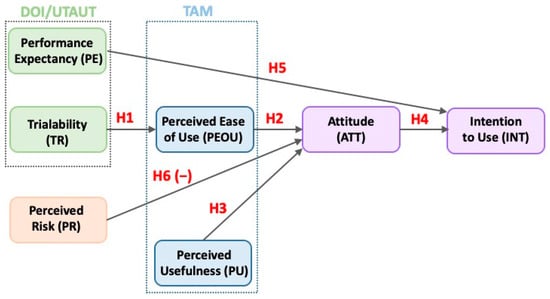
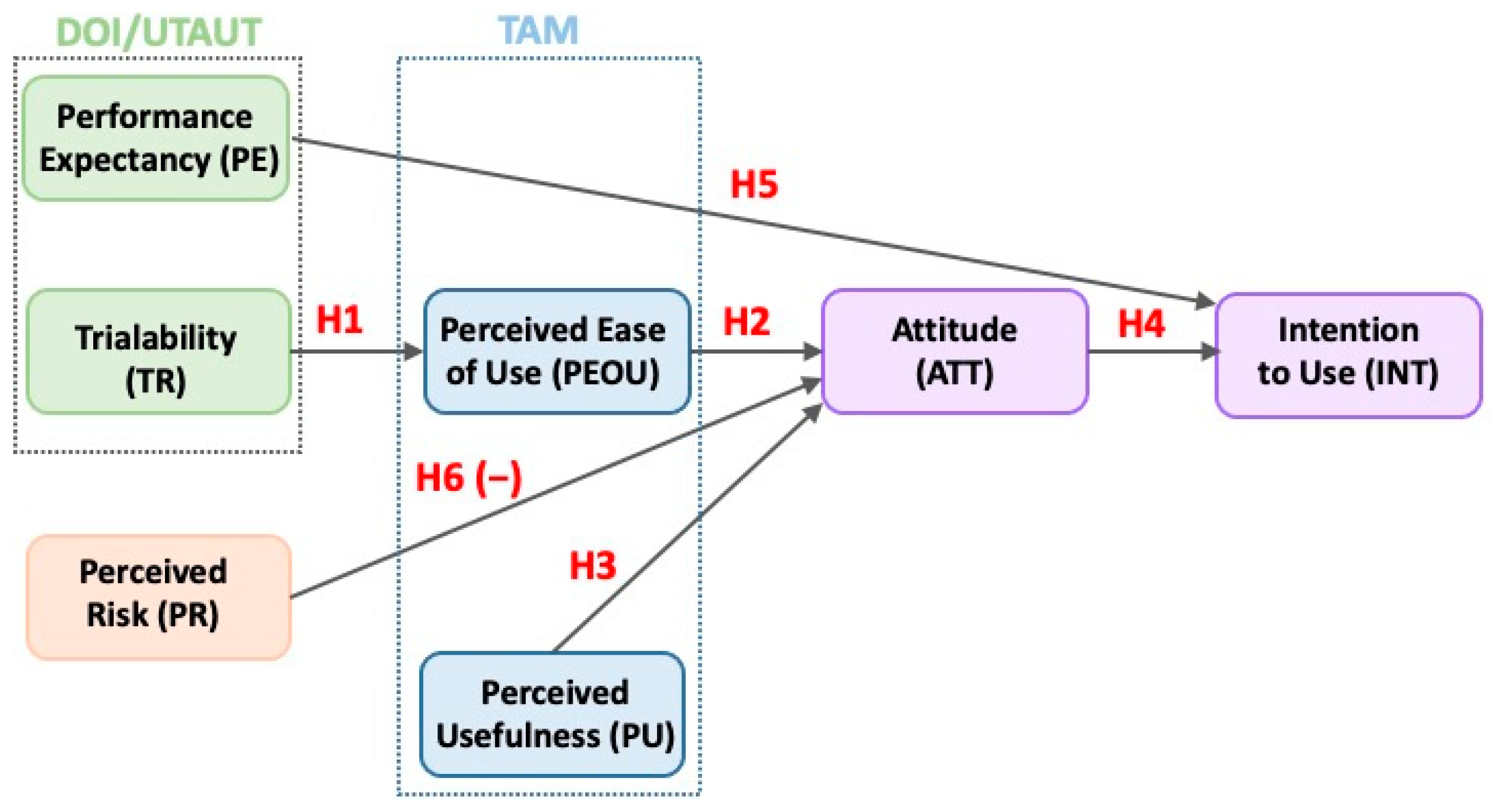
The six hypotheses developed in this section represent an integration of TAM, DOI, and UTAUT constructs, each contributing a distinct theoretical mechanism to explain how Thai consumers come to accept smart parcel lockers. Figure 1 illustrates the integrated set of relationships as a unified conceptual framework formed as a basis for the structural model tested in this study.
Figure 1.
Conceptual Framework.
3. Methodology
This study employed a quantitative research design using a survey-based approach. The details of the instrument development, data collecting, and analysis are described as follows.
3.1. Research Instrument
The structured questionnaire was prepared based on the Technology Acceptance Model (TAM), Diffusion of Innovation theory (DOI), and the Unified Theory of Acceptance and Use of Technology (UTAUT). The analysis covers perceived ease of use, perceived usefulness, performance expectancy, attitude, intention to use, and trialability. Furthermore, perceived risk was added based on the extended TAM. Responses to the model constructs were measured using a Likert scale ranging from 1 (strongly disagree) to 5 (strongly agree). The questionnaire was divided into two parts. The first part included questions about the measurement variables presented in Table 1. The second part focused on the respondents’ demographic characteristics, such as gender, age, and occupation.
Table 1.
Questionnaire Development.
The constructs were selected to reflect the adoption context of smart parcel locker ser-vices in Thailand. Perceived ease of use and perceived usefulness capture consumers’ evaluations of system simplicity and functional benefit, which is particularly relevant as Thai consumers prioritize convenience in service adoption. Trialability addresses early-stage experimentation among non-urban consumers who are less familiar with automated delivery technologies. Perceived risk captures concerns about parcel loss and security, which are critical issues in this context. Performance expectancy extends the model to reflect consumers’ outcome-based motivations.
3.2. Data Collection
This study was conducted in Thailand, one of Southeast Asia’s fastest-growing e-commerce markets, where consumer adoption of smart parcel locker services remains limited. The target population of the study was the Thai people who had ever bought anything through the online shopping platforms. The data were collected using a self-administered online questionnaire disseminated over social media sites such as Line, Facebook, and Instagram. The survey was launched during January and February 2026. Data collection proceeded in two stages. A pilot study of 30 responses was first gathered to assess the clarity and reliability of the instrument. The main data collection was then carried out in a single batch through the same social media channels until the required sample size was achieved. The study adopted purposive sampling as the sampling technique due to the need for participants to meet the criteria of eligibility [33]. To guarantee that only qualified respondents were included, a screening question was asked at the beginning of the survey. The screening question asked if the participants have experience with online shopping and parcel delivery services. Those that did not match this condition were omitted from analysis.
The minimum sample size for this investigation was calculated using Daniel Soper’s online a priori sample size calculator for structural equation models [34]. A recommended minimum sample size of 170 was determined using an estimated effect size of 0.30, a desired statistical power level of 0.80, seven latent variables, and 22 observable variables at a probability level of 0.05. However, for the purpose of having sufficient statistical power for the analysis, data were gathered from a total of 411 respondents. Multivariate outliers were identified using Mahalanobis distance (p < 0.001) and removed prior to analysis. After outlier and incomplete questionnaire removal, 397 valid responses were used for analysis, which was substantially higher than the minimal calculated requirement.
Table 2 presents the demographic characteristics of the sample. The sample was relatively evenly split in terms of gender, with 48.6% of the respondents being male and 49.6% being female. Small portion identified as LGBTQ+ (1.8%). Most of the respondents were in the age group of 18–25 years (41.3%), followed by more than 46 years (23.9%), 36–45 years (17.9%), and 26–35 years (16.9%). In terms of occupation, the majority were government employees and state enterprise workers (42.8%), followed by students (30.2%), self-employed (14.4%), and housewives and others (12.6%).
Table 2.
Demographic Characteristics of Respondents (n = 397).
3.3. Data Analysis
The data analysis was performed using covariance-based structural equation modeling (CB-SEM) with IBM SPSS Amos, version 22.0.0 to test the hypotheses and overall model fit. CB-SEM was used as it is appropriate for confirmatory research designs with reflective constructs, providing rigorous model fit evaluation and hypothesis testing. A two-stage analytical procedure was adopted. First, confirmatory factor analysis (CFA) was done to test the measurement model’s reliability and validity. Construct reliability was measured by composite reliability (CR) and Cronbach’s alpha. Convergent validity and discriminant validity were examined using the average variance extracted (AVE) and Fornell–Larcker criterion, respectively [35,36]. Once the measurement model had proved sufficient reliability and validity, the structural model was estimated to examine the hypothesized relationships among variables. The overall model fit was evaluated using several indices based on the recommendations of Hair et al. [36], Browne and Cudeck [37], Hu and Bentler [38].
4. Results and Discussion
4.1. Measurement Model Assessment
Prior to testing the structural model, a confirmatory factor analysis (CFA) was conducted using maximum likelihood estimation to assess the quality of the measurement model. The standardized loadings, Cronbach’s alpha, convergent validity, and construct reliability for all measurement items are presented in Table 3.
Table 3.
Construct Reliability and Validity.
The standardized factor loadings are presented in Table 3, which varied from 0.653 to 0.913. All the loadings were over the recommended value of 0.70 except for TR1 [36]. However, TR1 remained in the model since the construct of trialability had acceptable composite reliability (CR = 0.818) and average variance extracted (AVE = 0.607). Both are over the recommended criteria. Internal consistency reliability was tested using Cronbach’s alpha, with values ranging from 0.755 to 0.883 for all constructs. All values exceeded the threshold of 0.70 [36], confirming satisfactory internal consistency across all constructs. The upper bound of 0.883 remains well within an acceptable range, indicating that measurement indicators are sufficiently distinct and do not suffer from item redundancy, which is generally associated with values exceeding 0.95 [36]. The convergent validity was also confirmed as all the AVE values were above the 0.50 threshold. Discriminant validity was tested based on the Fornell–Larcker criterion [35] with the square root of the AVE for each construct being higher than the inter-construct correlations. Table 4 shows that discriminant validity was established. These results support the empirical distinctiveness of the constructs and the adequacy of the reliability and validity of the measurement model.
Table 4.
Discriminant Validity: Fornell–Larcker Criterion.
4.2. Structural Model and Hypothesis Testing Results
Following the measurement model assessment, model fit was examined before the analysis of relationships of the structural model. The proposed model showed strong fit for all indices [36,37,38] with several fit indices, including chi-square = 333.775, df = 173, relative chi-square = 1.929, GFI = 0.930, NFI = 0.947, CFI = 0.973, TLI = 0.965, RMSEA = 0.048, and RMR = 0.016.
The structural model exhibits a high explanatory power for all the endogenous constructs, with the coefficients of determination (R2) values of 0.793, 0.943, and 0.827 for perceived ease of use, attitude, and intention to use, respectively, indicating that the hypothesized antecedents account for a substantial proportion of variance in each outcome. Specifically, trialability explained 79.3% of the variance in ease-of-use perceptions, as indicated by an R2 of 0.793 for perceived ease of use. Attitude had the highest R2 value of 0.943, which means that perceived ease of use, perceived usefulness, and perceived risk together explain 94.3% of the variance in attitude, and this finding demonstrates the importance of ease-of-use perceptions in influencing users’ attitudes towards the adoption of smart lockers. Intention to use (INT) exhibited an R2 of 0.827, meaning that attitude and performance expectancy explain 82.7% of the variance in behavioral intention. In conclusion, the results show the strong predictive potential of the proposed model and provide a meaningful explanation of the intention to employ smart locker technology.
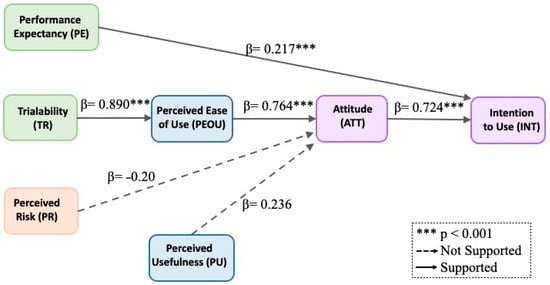
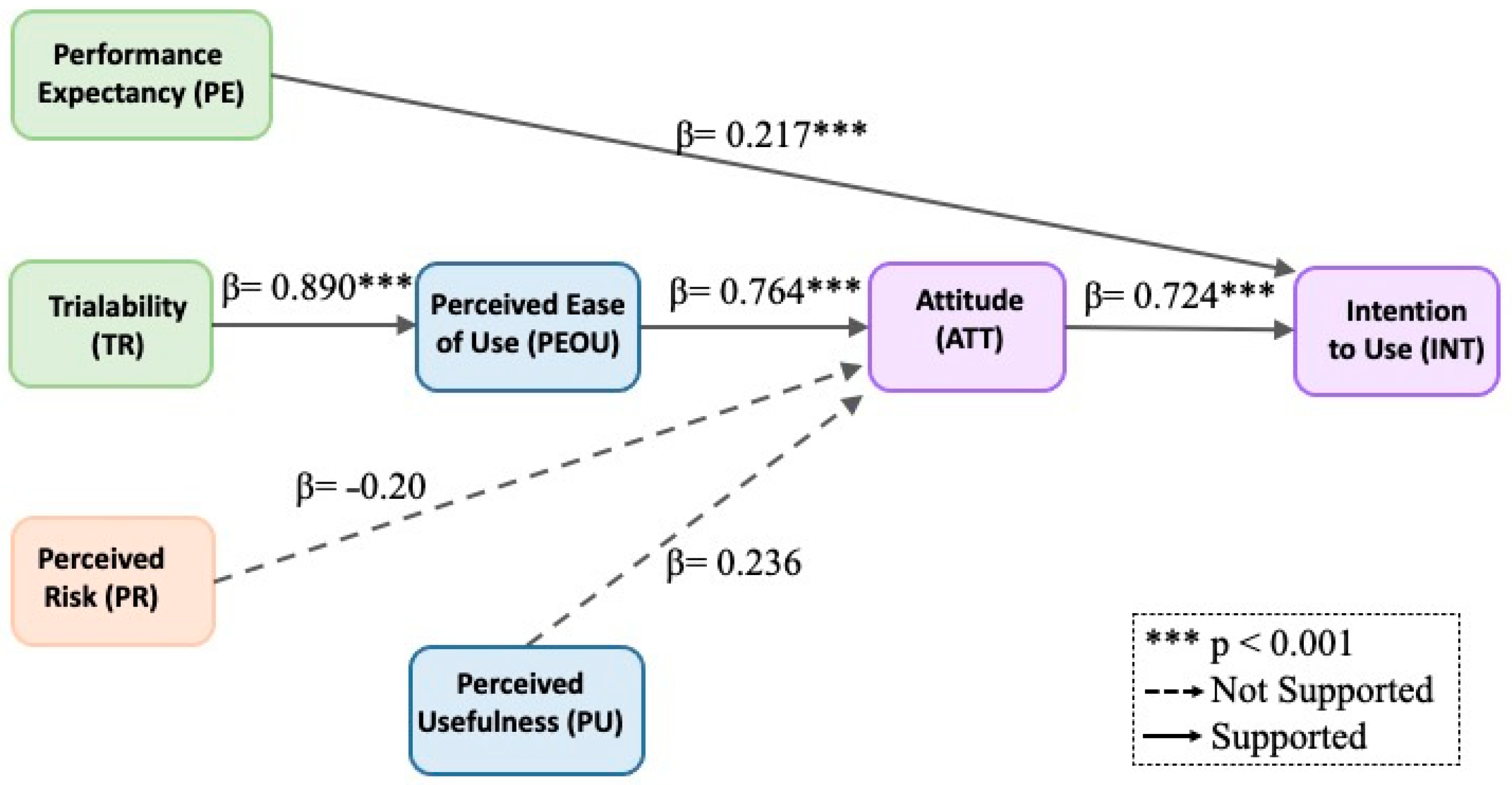
The structural model was then determined to test the six assumptions. An overview of the hypothesis testing results, including standardized coefficients (β), critical ratios, and p-values are shown in Table 5. The structural model with standardized path coefficients is illustrated in Figure 2.
Table 5.
Hypothesis Testing Results.
Figure 2.
Structural model with standardized path coefficients.
The results showed that H1, which proposes a positive effect of trialability on perceived ease of use, was supported (β = 0.890, p < 0.001). This suggests that the possibility of trying out smart lockers before adoption greatly boosts users’ perceptions of ease of use. H2, indicating the perceived ease of use to have a positive effect on attitude, was supported (β = 0.764, p < 0.001), thus confirming the importance of ease-of-use perceptions in shaping pleasant attitudes. H4, which proposed that attitude positively affects the intention to use, was supported (β = 0.724, p < 0.001). H5, which predicted that Performance expectancy would positively affect the intention to use, was also supported (β = 0.217, p < 0.001). H3, which predicted a positive effect of perceived usefulness on attitude, was not supported (β = 0.236, p = 0.064). Neither was H6, which predicted a negative effect of perceived risk on attitude (β = −0.020, p = 0.594).
4.3. Discussions
The pattern of results presented above is interpreted in light of the theoretical tensions raised in Section 2. The model is developed by integrating the Technology Acceptance Model [24], Diffusion of Innovation theory [28], and some components of the Unified Theory of Acceptance and Use of Technology [29]. The results demonstrate that four out of six hypotheses are significantly supported, which align with existing theory and previous empirical investigations on parcel locker acceptance. The four supported hypotheses are discussed first, followed by the two hypotheses that did not reach statistical significance, whose implications are considered in depth given the divergence from the theoretical tensions raised in Section 2. Hypothesis 1 (H1) specifically indicated that trialability had significantly and positively affected perceived ease of use with a standardized coefficient of β = 0.890. Therefore, trialability emerged as the strongest predictor in the model. This finding is in line with Rogers [28] proposition that trialability reduces uncertainty and lowers perceived complexity as well as consistent with Al-Rahmi et al. [39] who discovered within an integrated TAM–DOI framework that trialability significantly enhanced perceived ease of use. While previous research on smart lockers has focused on trialability as a direct driver of attitude and adoption intention [11,22], the results, however, suggest that the effect is mediated primarily through perceived ease of use as the trial experiences help users feel more comfortable with the technology, which shifts their attitudes toward adoption.
In addition, Hypothesis 2 (H2) revealed that perceived ease of use significantly and positively influences attitude toward parcel locker adoption (β = 0.764). This finding supports the original TAM formulation and aligns with subsequent extensions in the smart locker acceptance research [12,21,25] that suggest perceived ease of use as a direct impact on users’ attitudes regardless of their perceived functional outcomes. In other words, users are more likely to develop a favorable attitude toward parcel locker if they find it easy to operate regardless of whether they fully recognize its functional benefits. First-interaction experiences, therefore, appear to carry particular weight in shaping attitude, and service providers should ensure that smart lockers are intuitive and easy to use from the start, with clear instructions, accessible interfaces, and responsive notification systems that make the process as smooth as possible for users to avoid uncertainty during pick-up.
Furthermore, Hypothesis 4 (H4) demonstrates a strong positive effect of attitude on intention to use (β = 0.724), consistent with the main attitudinal pathway in TAM. Prior research on parcel locker acceptance echoes this pattern, for instance, Dayal et al. [21] who found that attitude plays a vital role in translating consumers’ evaluations of the lockers into intention to use, and Wang et al. [11], who found that attitude was the strongest predictor for initial adoption of automated lockers. Tsai and Tiwasing [15] similarly discovered that attitude had an influential impact on Thai consumers’ intention to use the smart lockers as last-mile delivery, while An et al. [12] found that positive consumer evaluations of a technology-based delivery service lead to stronger behavioral intention. This result supports the TAM’s attitude chain in the parcel lockers context, as it suggests that improving ease of use is more likely to generate favorable attitudes, which will lead to stronger adoption intentions.
Hypothesis 5 (H5) confirmed a significant positive effect of performance expectancy on intention to use (β = 0.217), consistent with UTAUT, where performance expectancy is the strongest predictor of behavioral intention in technology acceptance. Although the magnitude of this effect was relatively small compared to the attitudinal pathway in H4, it delivers a significant theoretical message. The intention to adopt is not based solely on the effect, as customers’ evaluation of expected delivery outcomes continues to have influence on behavioral intention even after accounting for attitudinal effects. This dimension is well-documented in prior parcel locker literature. For instance, Ranjbari et al. [7] provided field evidence that parcel lockers can objectively improve delivery reliability, which is that kind of tangible service gain that sustains performance perceptions over time. H4 and H5 together paint a coherent picture of smart locker adoption as a dual-process phenomenon, where consumers who feel positively toward the technology and simultaneously expect it to outperform conventional delivery are most likely to use it, highlighting the importance of service strategies that cultivate both attitudinal and performance-based motivations at the same time.
In contrast, two hypotheses that were not supported in this model are Hypothesis 3 and Hypothesis 6. Hypothesis 3 (H3) proposed a positive effect of perceived usefulness on attitude (β = 0.236) while Hypothesis 6 (H6) predicted a negative effect of perceived risk on attitude (β = −0.020). Both failed to reach statistical significance. While these findings diverge from mainstream TAM research, they offer meaningful insights into how smart locker adoption differs from other technology contexts.
The non-significant effect of perceived usefulness on attitude (H3) contrasts with prior studies [12,25]. However, this divergence can be explained by two factors. First, the high collinearity between perceived usefulness and perceived ease of use (r = 0.762) suggests that ease-of-use perceptions may have absorbed much of the variance that usefulness would otherwise explain. This is consistent with Davis [24], who acknowledged that perceived ease of use may function as an antecedent of usefulness rather than a parallel predictor. Second, when a technology supports a simple and routine task such as parcel pickup, users may not distinguish strongly between useful and easy to use. Dayal et al. [21] and Jang et al. [20] support this account, showing that perceived ease of use strongly influences both perceived usefulness and attitude, particularly in settings where the technology supports routine and low-effort interactions.
The non-significant effect of perceived risk on attitude (H6) similarly diverges from previous studies. However, this finding is consistent with Tsai and Tiwasing [15], who found that risk perceptions influenced behavioral control rather than attitude directly in a Thai smart locker context. Similarly, Dayal et al. [21] found that the influence of perceived risk differed across consumer groups, indicating that its effect on attitude may vary depending on the context and the characteristics of the sample. Consumers may treat security and reliability as baseline features rather than active concerns, as smart locker services are operated within established courier networks by trusted logistics providers. Research on blockchain-based smart lockers similarly shows that safety is not a major concern for users, while studies in supply chain and logistics settings suggest that adoption is shaped by perceived value, and service convenience than by risk alone [40,41]. Additionally, the predominantly younger sample (41.3% aged 18–25) may have contributed to lower risk sensitivity, as younger consumers tend to show greater tolerance for technology-related uncertainty [20].
In summary, these findings offer a direct answer to the boundary-condition question addressed earlier, as the classical TAM structure does not apply its traditional form for a simple, self-service technology in an emerging e-commerce market. Perceived ease of use is the dominating factor affecting attitude rather than perceived usefulness, and perceived risk does not have a negative effect as commonly reported elsewhere. This pattern fits Thailand’s profile as an emerging, infrastructure-dependent market where limited prior exposure to smart lockers is offset by trust in an already-established courier network. Therefore, it reshapes the relative weight of TAM’s main structures instead of just reproducing the original TAM form in a new setting.
5. Conclusions, Implications and Limitations
5.1. Conclusions
By integrating TAM, DOI, and UTAUT into a single framework, this study set out to test whether conventional technology-acceptance assumptions hold for a self-service delivery innovation in an emerging e-commerce market. As the discussion above demonstrates, we have found that they do so only partially. Using structural equation modeling with a sample of 397 respondents, the proposed model demonstrated strong explanatory power, accounting for 94.3% of the variance in attitude and 82.7% of the variance in intention to use, confirming its robustness as a predictive framework for smart locker acceptance.
Four of the six hypothesized relationships were supported. Trialability was found to be the strongest predictor in the model, significantly enhancing perceived ease of use, which subsequently has a strong direct effect on attitude. Attitude subsequently emerged as the primary driver of intention to use, confirming the attitudinal chain proposed by TAM. Performance expectancy also contributed independently to adoption intention, suggesting that users are motivated by both affective and instrumental considerations when deciding whether to adopt smart locker technology. Two hypotheses were not supported. The non-significant effect of perceived usefulness on attitude (β = 0.236, p = 0.064) is attributed to the dominant role of perceived ease of use, which appears to have absorbed much of the variance that perceived usefulness might otherwise explain—a suppression pattern consistent with the high correlation between the two constructs (r = 0.762). Similarly, perceived risk did not significantly influence attitude, suggesting that the visible security features embedded in smart locker systems are sufficient to neutralize risk concerns among users.
Beyond the implications for technology adoption, this paper reveals that consumer acceptance is an important behavioral prerequisite for the development of more sustainable last-mile delivery systems. Smart parcel lockers have been widely recognized for consolidating deliveries, reducing failed delivery attempts, relieving traffic congestion, and lowering carbon emissions from transport, but these environmental and operational benefits only occur if consumers are willing to adopt and use the technology regularly. These findings, therefore, suggest that fostering consumer acceptance is not only a marketing goal but also an important step in the transition towards more sustainable urban logistics.
5.2. Theoretical Implications
Overall, this study makes three contributions to the technology acceptance literature. First, it demonstrates that trialability is not only a useful addition to TAM but the strongest predictor in the model, extending DOI theory into a new and practically relevant context. This finding advances theoretical understanding by establishing consumer exposure to innovation as a critical antecedent of technology acceptance, particularly for unfamiliar self-service technologies in emerging markets. Second, and more fundamentally, it shows that TAM’s assumed balance between perceived usefulness and perceived ease of use does not hold when a technology is a simple, routine task. Perceived ease of use, not usefulness, emerges as the main belief that drives attitude, challenging the conventional assumption that these two contribute comparably across contexts. This establishes task simplicity as a meaningful boundary condition for TAM, suggesting that future researchers should explicitly test whether this balance shifts across technologies of varying complexity. Third, it shows that perceived risk, which is typically treated as a barrier in the adoption literature, doesn’t influence attitudes when people can see and trust the security measures provided. This reflects the importance of market-specific context in technology acceptance research. This finding indicates that perceived risk functions as an adoption barrier primarily in high-uncertainty contexts, rather than universally, adding nuance to how risk is theorized in extended TAMs.
Collectively, these contributions suggest that TAM is applicable in many situations, but it should not be treated as a fixed structure across technology contexts. The relative weight between the two main constructs varies depending on task simplicity, the degree of consumer exposure to the technology, and trust in the infrastructure. Therefore, future technology-acceptance research would benefit from treating these as boundary conditions to be tested explicitly, rather than assumptions to be taken for granted.
5.3. Managerial Implications
The findings present the following practical implications for smart locker service providers and policymakers. First, given that trialability was the strongest predictor in the model, service providers should make it easy for potential users to try smart lockers before committing to regular use. Simple initiatives such as demonstration booths, on-site assistance, and guided first-use programs can go a long way in building positive perceptions of the system. Second, since perceived ease of use plays an important role in shaping user attitudes, lockers that are operated with clear instructions, simple login steps, and helpful feedback are more likely to gain user trust and encourage adoption. Third, the marketing message should directly inform users of what they can gain, such as round-the-clock access, contactless pickup, and secure parcel storage. Finally, given that perceived risk had no significant effect on attitudes, heavy investment in security messaging is unlikely to yield substantial results. Where resources would be better spent would be in improving usability and expanding trial opportunities.
Based on the demographic profile of respondents, differentiated strategies may help strengthen adoption across consumer groups. Younger consumers are likely to respond well to digital trial initiatives such as first-use incentives and in-app guidance, while older consumers may benefit more from simple pickup processes and on-site instructions. Policymakers can also encourage adoption by facilitating the installation of smart lockers at transport hubs, residential developments, universities, and commercial centers as part of broader smart city and sustainable urban logistics initiatives. Increasing the accessibility and visibility of smart locker infrastructure can help drive greater consumer adoption while helping to build more resilient, efficient, and lower-carbon last-mile delivery systems.
5.4. Limitations and Future Research
This research has limitations worth acknowledging as follows. First, participants were screened for online shopping experience, not for having actually used a smart locker. Since trialability emerged as the strongest predictor in the model, some responses on ease of use may reflect expectation rather than experience. Additionally, prior smart locker usage experience was not captured as a variable in this study which prevents group comparison analysis between experienced and inexperienced users. Future research is therefore encouraged to incorporate prior usage experience as a grouping variable to test whether trialability’s influence holds or strengthens once exposure is genuine rather than anticipated.
Second, data were gathered through social media using purposive sampling, which likely skews the sample toward younger, more digitally active respondents; 41.3% of participants were aged 18–25. The sample’s regional distribution was not recorded either, and where someone lives likely shapes their familiarity with, and access to, smart lockers in the first place. Whether these findings hold as well in smaller towns or areas with fewer lockers remains an open question and one that future work with region-based sampling could answer.
Finally, the cross-sectional design captures intention, not behavior, and the two do not always align. Because all constructs were measured through the same self-reported questionnaire, some shared method variance also cannot be fully ruled out. Following consumers over time, from their first trial through repeated use, would offer more convincing evidence for the causal story this study proposes.
Beyond addressing the limitations above, future research may extend this framework in additional directions. First, replicating the model in other emerging markets in Southeast Asia would help to clarify whether the findings reflect a broader regional pattern or are specific only to Thailand. Second, researchers may consider adding constructs such as social influence or trust to explore whether the model performs consistently across different adoption stages and user groups.
Author Contributions
Conceptualization, P.C. and T.N.; methodology, P.C. and T.N.; software, P.C.; validation, P.C., T.N. and N.W.; formal analysis, P.C. and T.N.; investigation, P.C. and T.N.; resources, P.C. and T.N.; data curation, P.C. and T.N.; writing—original draft preparation, P.C. and T.N.; writing—review and editing, P.C., T.N., N.W. and G.P.M.K.T.; visualization, P.C. and T.N.; supervision, P.C. and T.N.; project administration, P.C. and T.N.; funding acquisition, not applicable. All authors have read and agreed to the published version of the manuscript.
Funding
This research received no external funding.
Institutional Review Board Statement
Ethical review and approval were waived for this study due to involving no intervention or procedures affecting participants’ physical or psychological well-being, and no personally identifiable information was collected, either directly or indirectly. Therefore, the study was exempt from ethical review in accordance with Item 3(3) of the Guidelines for Conducting Human Research in Behavioral Sciences, Social Sciences, and Humanities issued by the National Research Council of Thailand in 2021.
Informed Consent Statement
Informed consent was obtained from all subjects involved in this study.
Data Availability Statement
The data presented in this study are available on request from the corresponding author.
Acknowledgments
The authors used AI-assisted writing tools to support language editing and the drafting of selected passages in the conclusions and future research sections during manuscript preparation. All ideas, analyses, interpretations, and conclusions were developed by the authors. The final manuscript was thoroughly reviewed and approved by the authors, who take full responsibility for all content presented.
Conflicts of Interest
The authors declare no conflicts of interest.
Abbreviations
The following abbreviations are used in this manuscript:
| TAM | Technology Acceptance Model |
| DOI | Diffusion of Innovation Theory |
| UTAUT | The Unified Theory of Acceptance and Use of Technology |
References
- International Trade Administration. Thailand—Digital Economy. Available online: https://www.trade.gov/country-commercial-guides/thailand-digital-economy (accessed on 6 May 2026).
- Electronic Transactions Development Agency (ETDA). Value of E-Commerce Survey in Thailand 2024; Electronic Transactions Development Agency: Bangkok, Thailand, 2024; Available online: https://www.etda.or.th/ (accessed on 4 August 2026).
- Effigy Consulting. Courier, Express and Parcel (CEP) Market Volume in Thailand from 2017 to 2025 (in Million Pieces). Statista 2026. Available online: https://www.statista.com/statistics/1221305/thailand-courier-express-parcel-market-volume/ (accessed on 4 August 2026).
- Cano, J.A.; Londoño-Pineda, A.; Rodas, C. Sustainable logistics for e-commerce: A literature review and bibliometric analysis. Sustainability 2022, 14, 12247. [Google Scholar] [CrossRef] [Scilit]
- Zhang, Q.; Demir, E. Parcel locker solutions for last mile delivery: A systematic literature review and future research directions. Front. Future Transp. 2025, 6, 1654621. [Google Scholar] [CrossRef] [Scilit]
- Escudero-Santana, A.; Cortés-Muñoz, J.-C.; Lorenzo-Espejo, A.; Pegado-Bardayo, A. The impact of customer habit knowledge on last-mile logistics costs and satisfaction. Res. Transp. Econ. 2026, 117, 101777. [Google Scholar] [CrossRef] [Scilit]
- Ranjbari, A.; Diehl, C.; Dalla Chiara, G.; Goodchild, A. Do parcel lockers reduce delivery times? Evidence from the field. Transp. Res. Part E Logist. Transp. Rev. 2023, 172, 103070. [Google Scholar] [CrossRef] [Scilit]
- Mohri, S.S.; Nassir, N.; Thompson, R.G.; Ghaderi, H. Last-mile logistics with on-premises parcel lockers: Who are the real beneficiaries? Transp. Res. Part E Logist. Transp. Rev. 2024, 183, 103458. [Google Scholar] [CrossRef] [Scilit]
- Nogueira, G.P.M.; de Assis Rangel, J.J.; Shimoda, E. Sustainable last-mile distribution in B2C e-commerce: Do consumers really care? Clean. Respons. Consum. 2021, 3, 100021. [Google Scholar] [CrossRef] [Scilit]
- Moroz, M.; Polkowski, Z. The last mile issue and urban logistics: Choosing parcel machines in the context of the ecological attitudes of the Y generation consumers purchasing online. Transp. Res. Procedia 2016, 16, 378–393. [Google Scholar] [CrossRef] [Scilit]
- Wang, X.; Yuen, K.F.; Wong, Y.D.; Teo, C.C. An innovation diffusion perspective of e-consumers’ initial adoption of self-collection service via automated parcel station. Int. J. Logist. Manag. 2018, 29, 237–260. [Google Scholar] [CrossRef] [Scilit]
- An, H.S.; Park, A.; Song, J.M.; Chung, C. Consumers’ adoption of parcel locker service: Protection and technology perspectives. Cogent Bus. Manag. 2022, 9, 2144096. [Google Scholar] [CrossRef] [Scilit]
- Tsai, J.-F.; Ngo, H.-N.; Che, Z.-H.; Lin, M.-H. Sustainable solutions in e-commerce: An examination of customer acceptance of automated delivery stations in Vietnam. Sustainability 2024, 16, 4570. [Google Scholar] [CrossRef] [Scilit]
- Quan, N.H.; Binh, N.T.; Ly, B.T. Impact of smart locker use on customer satisfaction of online shoppers in Vietnam. Humanit. Soc. Sci. Commun. 2022, 9, 403. [Google Scholar] [CrossRef] [Scilit] [PubMed]
- Tsai, Y.-T.; Tiwasing, P. Customers’ intention to adopt smart lockers in last-mile delivery service: A multi-theory perspective. J. Retail. Consum. Serv. 2021, 61, 102514. [Google Scholar] [CrossRef] [Scilit]
- Vakulenko, Y.; Hellström, D.; Hjort, K. What’s in the parcel locker? Exploring customer value in e-commerce last mile delivery. J. Bus. Res. 2018, 88, 421–427. [Google Scholar] [CrossRef] [Scilit]
- Yuen, K.F.; Wang, X.; Ma, F.; Wong, Y.D. The determinants of customers’ intention to use smart lockers for last-mile deliveries. J. Retail. Consum. Serv. 2019, 49, 316–326. [Google Scholar] [CrossRef] [Scilit]
- Penagos, P.; Encarnación, T.; Gonzalez-Calderon, C.A. Drivers of consumers’ adoption of parcel lockers as an alternative last-mile delivery solution in emerging economies. Transp. Res. Interdiscip. Perspect. 2026, 36, 101866. [Google Scholar] [CrossRef] [Scilit]
- Kurowski, M.; Sobolewski, M.; Koszorek, M. Geometrical parcel locker network design with consideration of users’ preferences as a solution for sustainable last mile delivery. Sustainability 2023, 15, 15114. [Google Scholar] [CrossRef] [Scilit]
- Jang, S.; Hong, D.; Lee, C. Exploring the behavioral adoption of automated parcel locker systems under COVID-19. Transp. Policy 2024, 151, 1–11. [Google Scholar] [CrossRef] [Scilit]
- Dayal, E.; Khuntia, L.; Lakshay, L.; Buldeo Rai, H.; Pani, A. Behavioral intention to use parcel lockers in the last mile and underlying linkages with travel modal choice. Res. Transp. Econ. 2025, 111, 101568. [Google Scholar] [CrossRef] [Scilit]
- Yuen, K.F.; Wang, X.; Ng, L.T.W.; Wong, Y.D. An investigation of customers’ intention to use self-collection services for last-mile delivery. Transp. Policy 2018, 66, 1–8. [Google Scholar] [CrossRef] [Scilit]
- Rose, W.J.; Confente, I.; Peinkofer, S.T.; Russo, I. Unlocking the door: Information disclosure framing and consumer characteristics in parcel locker adoption. Int. J. Phys. Distrib. Logist. Manag. 2025, 55, 92–117. [Google Scholar] [CrossRef] [Scilit]
- Davis, F.D. Perceived usefulness, perceived ease of use, and user acceptance of information technology. MIS Q. 1989, 13, 319–340. [Google Scholar] [CrossRef] [Scilit] [PubMed]
- Klein, P.; Popp, B. Last-mile delivery methods in e-commerce: Does perceived sustainability matter for consumer acceptance and usage? Sustainability 2022, 14, 16437. [Google Scholar] [CrossRef] [Scilit]
- Encarnación, T.; Amaya, J. Determinants of parcel locker adoption for last-mile deliveries in urban and suburban areas. Transp. J. 2025, 64, e12031. [Google Scholar] [CrossRef] [Scilit]
- ElSemary, M.; Eman, N.; Deselnicu, D.C.; Haddad, S.S.G. An empirical study on the determinants of customers’ intentions to switch to smart lockers as a trending last-mile logistics channel. Logistics 2025, 9, 177. [Google Scholar] [CrossRef] [Scilit]
- Rogers, E.M. Diffusion of Innovations, 4th ed.; Free Press: New York, NY, USA, 1995. [Google Scholar]
- Venkatesh, V.; Morris, M.G.; Davis, G.B.; Davis, F.D. User acceptance of information technology: Toward a unified view. MIS Q. 2003, 27, 425–478. [Google Scholar] [CrossRef] [Scilit]
- Cai, L.; Yuen, K.F.; Xie, D.; Fang, M.; Wang, X. Consumer’s usage of logistics technologies: Integration of habit into the Unified Theory of Acceptance and Use of Technology. Technol. Soc. 2021, 67, 101789. [Google Scholar] [CrossRef] [Scilit]
- Featherman, M.S.; Pavlou, P.A. Predicting e-services adoption: A perceived risk facets perspective. Int. J. Hum.-Comput. Stud. 2003, 59, 451–474. [Google Scholar] [CrossRef] [Scilit]
- Tang, Y.M.; Chau, K.Y.; Xu, D.; Liu, X. Consumer perceptions to support IoT based smart parcel locker logistics in China. J. Retail. Consum. Serv. 2021, 62, 102659. [Google Scholar] [CrossRef] [Scilit]
- Campbell, S.; Greenwood, M.; Prior, S.; Shearer, T.; Walkem, K.; Young, S.; Bywaters, D.; Walker, K. Purposive sampling: Complex or simple? Research case examples. J. Res. Nurs. 2020, 25, 652–661. [Google Scholar] [CrossRef] [Scilit] [PubMed]
- Soper, D.S. A-Priori Sample Size Calculator for Structural Equation Models [Software]. Available online: https://www.danielsoper.com/statcalc/calculator.aspx?id=89 (accessed on 5 December 2025).
- Fornell, C.; Larcker, D.F. Evaluating structural equation models with unobservable variables and measurement error. J. Mark. Res. 1981, 18, 39–50. [Google Scholar] [CrossRef] [Scilit]
- Hair, J.F.; Black, W.C.; Babin, B.J.; Anderson, R.E. Multivariate Data Analysis, 8th ed.; Cengage: Andover, UK, 2019. [Google Scholar]
- Browne, M.W.; Cudeck, R. Alternative ways of assessing model fit. In Testing Structural Equation Models; Bollen, K.A., Long, J.S., Eds.; Sage Publications: Newbury Park, CA, USA, 1993; pp. 136–162. [Google Scholar]
- Hu, L.-T.; Bentler, P.M. Cutoff criteria for fit indexes in covariance structure analysis: Conventional criteria versus new alternatives. Struct. Equ. Model. 1999, 6, 1–55. [Google Scholar] [CrossRef] [Scilit]
- Al-Rahmi, W.M.; Yahaya, N.; Aldraiweesh, A.A.; Alamri, M.M.; Aljarboa, N.A.; Alturki, U.; Aljeraiwi, A.A. Integrating technology acceptance model with innovation diffusion theory: An empirical investigation on students’ intention to use e-learning systems. IEEE Access 2019, 7, 26797–26809. [Google Scholar] [CrossRef] [Scilit]
- Bangani, S.; Jokonya, O. Factors affecting the adoption of contactless technologies in supply chain and logistics. J. Transp. Supply Chain Manag. 2022, 16, a751. [Google Scholar] [CrossRef] [Scilit]
- Lian, J.-W.; Chen, C.-T.; Shen, L.-F.; Chen, H.-M. Understanding user acceptance of blockchain-based smart locker. Electron. Libr. 2020, 38, 353–366. [Google Scholar] [CrossRef] [Scilit]

Disclaimer/Publisher’s Note: The statements, opinions and data contained in all publications are solely those of the individual author(s) and contributor(s) and not of MDPI and/or the editor(s). MDPI and/or the editor(s) disclaim responsibility for any injury to people or property resulting from any ideas, methods, instructions or products referred to in the content. |
© 2026 by the authors. Licensee MDPI, Basel, Switzerland. This article is an open access article distributed under the terms and conditions of the Creative Commons Attribution (CC BY) license.