


Abstract
Tourist engagement has redirected tourism scholarship from static satisfaction evaluations toward the interactive, value-creating psychological processes that bind tourists to destinations. Focusing on low-carbon tourism, where success hinges on translating environmental awareness into sustained behavioral change, this study argues that whether experiences translate into engagement depends on the interplay between external social resources and internal personal resources. Drawing on Conservation of Resources (COR) Theory and Social Cognitive Theory (SCT), we examine the joint effects of tourist experience, social support, and self-efficacy using survey data from 206 adult tourists with low-carbon travel experience. The results reveal that the average, unconditional effect of experience on engagement was not statistically significant; experience is not inconsequential but conditional, its impact depending on the resources tourists bring to it. Social support negatively moderates the experience–engagement path, reflecting a resource-substitution mechanism whereby abundant external resources crowd out tourists’ direct psychological investment in the experience. This inhibitory pattern is conditional on self-efficacy: for tourists with strong efficacy beliefs, social support becomes a functional tool that works synergistically with the travel experience to elevate engagement. This moderated moderation forms a single conditional architecture that extends COR Theory and SCT by clarifying when internal and external resources substitute for or reinforce one another. In practice, the findings advocate for empowerment-based service design: cultivating mastery experiences and self-efficacy unlocks the positive potential of social support and deepens engagement in sustainable travel.
1. Introduction
Amid intensifying concern over global climate change and sustainable development, low-carbon tourism has emerged as a strategic priority for the tourism industry [1]. Unlike conventional tourism, which is oriented primarily toward hedonic consumption, low-carbon tourism asks travelers to shoulder tangible behavioral costs: curbing emissions, forgoing convenience, and enacting sustainable values throughout the journey. Recent scholarship has accordingly repositioned behavioral transformation, rather than momentary satisfaction, as the field’s primary objective. The central issue is whether tourists’ environmental awareness is converted into sustained, self-directed action [1,2]—a conversion that cannot be taken for granted, as the persistent attitude–behavior gap demonstrates [3]. Explaining how and when this transformation occurs requires a psychological mechanism that captures the depth of a tourist’s involvement, and tourist engagement serves as the key explanatory construct.
This mechanism is especially consequential in the context of low-carbon travel because the behavioral demands of sustainable travel differ fundamentally from those of general tourism. In general tourism, value accrues largely from passive, hedonic consumption, and a high-quality experience translates fairly directly into satisfaction and revisit intention. Low-carbon tourism, by contrast, is effortful and value-laden. It requires self-regulation, the internalization of environmental norms, and often personally costly pro-environmental behavior, so a pleasant experience alone is unlikely to guarantee deep involvement. Tourist engagement, defined as the intensity of an individual’s cognitive, emotional, and behavioral investment across the journey [4], is the mechanism through which experiential value is converted into the sustained behavioral commitment that low-carbon tourism demands.
Despite its importance, the experience–engagement relationship remains only partially understood. A substantial body of work, largely framed by the experience economy paradigm, has established that richer tourism experiences foster stronger engagement, modeled almost exclusively as a simple, direct main effect [5,6,7]. Three gaps follow. First, by treating the relationship as universal, prior research has rarely examined the boundary conditions that determine when experience actually converts into engagement. Second, where social factors are considered, social support has typically been cast as a uniformly positive resource [8,9]; its potential to weaken the experience–engagement link has been almost entirely overlooked. Third, these questions have seldom been posed in the low-carbon setting, where the interplay between external social and internal personal resources is theoretically most likely to matter. The present study addresses these gaps by recasting the experience–engagement relationship as a conditional one.
We anchor this conditional account in Conservation of Resources (COR) Theory [10,11]. From a COR perspective, engagement depends not on the experience in isolation but on how tourists deploy two categories of resources: external social resources (companionship, advice, and emotional care from fellow travelers and staff) and internal personal resources, most notably self-efficacy. Crucially, COR implies that these resources need not be additive: abundant external support may substitute for, and thereby crowd out, a tourist’s direct psychological investment in the experience, whereas the same support may be mobilized synergistically when the tourist commands sufficient internal resources to put it to use. COR supplies the organizing logic for H1 and H2, while Social Cognitive Theory’s account of self-efficacy [12] is the primary framework for the reversal predicted in H3; Social Support Theory and the experience economy are complementary perspectives developed in Section 2 and Section 3.
Building on this logic, we propose and test a conditional model of behavioral transformation in low-carbon tourism: a moderated moderation structure in which the translation of experience into engagement is jointly contingent on social support and self-efficacy.
Specifically, we expect social support to negatively moderate the experience–engagement link through a resource-substitution mechanism and self-efficacy to reverse this inhibitory boundary, transforming support from a substitute into a synergistic resource. This formulation reframes the question from whether experience matters to when and for whom it matters, foregrounding the study’s originality as an explanation of behavioral transformation rather than a replication of established main effects. The three hypotheses build on one another: each addresses the boundary condition left open by the previous one, leading to the three-way interaction that is the study’s focal contribution.
This study makes four contributions. (1) It reconceptualizes the experience–engagement relationship in low-carbon tourism from a universal direct effect into a conditional mechanism, explaining the inconsistent direct effects reported in prior experiential research. (2) It identifies a previously overlooked boundary condition, the negative resource-substitution moderation of social support, qualifying the common assumption that social support is uniformly beneficial. (3) It establishes tourist self-efficacy as the psychological lever that reverses this boundary, empirically validating a three-way (moderated moderation) synergy among experience, social support, and self-efficacy. (4) It extends COR Theory, in concert with Social Cognitive Theory, by specifying when internal and external resources substitute for versus reinforce one another and translates this into empowerment-based guidance for sustainable travel service design. The remainder of the paper reviews the literature, develops the hypotheses, describes the method, reports the findings, and closes with implications and directions for future research.
2. Literature Review
2.1. Tourist Experience
Tourist experience refers to an individual’s subjective evaluations and responses, spanning sensory, affective, cognitive, behavioral, relational, and spiritual dimensions, arising from interactions with tourism products and services across the journey [13], and it unfolds over the pre-tour, on-site, and post-tour phases [14]. Memorable tourism experiences (MTEs), significant events positively encoded in memory, underscore the importance of deep emotional and cognitive involvement during these interactions [15] and act as catalysts for value co-creation, with tourists actively shaping the meaning of their own journeys. Post-tour responses capture the evaluative aftermath of travel, including perceived value (the overall assessment of gains relative to what was expended), satisfaction (the emotional outcome of comparing pre-visit expectations with actual experiences), expectancy confirmation (the alignment between anticipated and realized performance), and trust (confidence in the reliability of the tourism provider) [7,16]. Vivid MTEs and positive emotional reflections strengthen destination image and nurture long-term loyalty behaviors such as recommendations and revisits. The quality of the on-site experience therefore remains a prerequisite for deep psychological and behavioral commitment.
2.2. Tourist Engagement
Tourist engagement is conceived as a multidimensional state that captures both the psychological bond between a tourist and a destination or activity and the tourist’s active behavioral participation [4,17]. It comprises cognitive (e.g., attention), affective (e.g., enthusiasm and dedication), and behavioral (e.g., vigor and social interaction) components and is best understood as a dynamic psychological state rather than a fixed trait [7]; indeed, its intensity and rhythm can vary with the tempo at which the journey itself unfolds [18]. Whereas satisfaction is a retrospective evaluation, engagement concerns how individuals proactively allocate personal resources (time, energy, and attention) to focal objects such as attractions, brands, or fellow travelers in the service of value co-creation [19,20]. This engaged state also operates as a pivotal mediating conduit linking the immediate travel experience to longer-term outcomes, including psychological well-being, satisfaction, and loyalty [21].
2.3. Social Support
Historically, Social Support Theory emerged to explain how external supportive resources (companionship, advice, and emotional care) generally foster positive individual behavior and well-being. Pioneering work by Cohen and Wills (1985) [9] distinguished the main effect of support on health from its buffering effect, which attenuates the impact of environmental stressors.
Definitionally, social support comprises the multifaceted resources supplied by a social network that lead individuals to believe they are cared for, valued, and embedded in a web of mutual communication [22]. It is commonly treated as a multidimensional construct spanning several functional domains: emotional support (empathy and care), esteem support (validation of self-worth), informational support (advice and guidance), and instrumental support (tangible or material assistance) [9]; in empirical work, it is most often assessed as the support an individual perceives to be available from that network [23]. In tourism, social support denotes the external resources a tourist can access through companions, fellow travelers, and service staff, which jointly shape the value co-creation process and the overall travel experience.
2.4. Tourist Self-Efficacy
Self-efficacy was introduced by Bandura [24] within the framework of Social Cognitive Theory and marked a decisive turn in psychological research toward the role of self-referent thought in human agency. Bandura (1977, 1986, 1997) [12,24,25] argued that such beliefs govern how people feel, think, motivate themselves, and act, determining both whether a task will even be attempted and how much effort will be sustained in the face of obstacles.
Self-efficacy denotes an individual’s subjective belief and confidence in their capacity to organize and execute the courses of action required to attain given outcomes. In tourism, tourist self-efficacy refers to a traveler’s confidence in successfully performing specific travel-related behaviors, such as low-carbon practices, and in overcoming situational challenges or obstacles encountered en route. This internal psychological resource operates as a cognitive filter through which environmental stimuli and social resources are appraised and put to use. Notably, efficacy beliefs formed through the successful performance of easier sustainable behaviors have been shown to spill over into more demanding pro-environmental action [26], underscoring their catalytic role in sustainable travel.
3. Hypotheses Development
3.1. Tourist Experience and Tourist Engagement
The link between tourist experience and engagement is rooted in the shift from passive consumption to active value co-creation. Tourist experience denotes the subjective, psychological, and cognitive responses of an individual to a destination’s attributes and activities [27]. In the experience economy framework [28], such experiences transcend mere service consumption, encompassing educational, esthetic, escapist, and entertainment realms that leave a durable internal impression on the individual. Tourist engagement, by contrast, is a multidimensional construct of cognitive, emotional, and behavioral investments [5]; unlike satisfaction, which serves as a post hoc evaluation, it denotes an ongoing state of involvement and the active deployment of personal resources (time, energy, and attention) both during and after the visit.
Service-Dominant (S-D) Logic offers the clearest account of the nexus between the two constructs [29,30]: value is always co-created, such that the destination supplies an experience platform while value materializes only through the tourist’s active resource integration and participation. A high-quality experience marked by sensory stimulation and emotional resonance induces a state of psychological immersion. Social exchange reasoning [31,32] then implies that the resulting sense of value-in-use invites reciprocity: to sustain this rewarding state, tourists intensify their engagement, migrating from passive observers to active co-creators [6].
The theoretical evidence thus converges on the view that immersive experiences supply the stimuli needed to generate both hedonic and eudaimonic value. This is especially pertinent in low-carbon tourism, where the behavioral outcome at stake is not mere enjoyment but effortful, potentially costly pro-environmental action; a rich experience may therefore be necessary but, on its own, insufficient to secure engagement. Based on these theoretical underpinnings, the following hypothesis is proposed:
Hypothesis 1.
Tourist experience is positively associated with tourist engagement.
3.2. The Moderating Role of Social Support
Our prediction of a negative moderating effect must first be reconciled with the literature that has predominantly reported positive effects of social support. The classic buffering hypothesis holds that support is most beneficial precisely when individuals confront stress or threat [9], and tourism studies report that social support and social interaction strengthen commitment, satisfaction, and value co-creation [8,33]. The buffering benefit, however, is contingent on a stressful, demanding appraisal of the situation. A low-carbon leisure trip is largely voluntary, positively toned, and self-paced, so acute stress is minimal; the marginal protective value of additional support is correspondingly small, whereas its capacity to substitute for the tourist’s own effortful engagement becomes salient. From a Conservation of Resources standpoint [10], when external resources are plentiful and the focal task is discretionary rather than threatening, support ceases to buffer. Instead, it crowds out personal resource investment: the same resource that buffers under stress substitutes under abundance, which reconciles our negative prediction with the positive findings of prior research.
Although tourist experiences are generally expected to nurture engagement, the strength of this link may be weakened when social support is plentiful. Three psychological mechanisms underpin this negative moderation. The first draws on Conservation of Resources (COR) Theory, which holds that individuals inherently strive to obtain, retain, and protect valued psychological resources [10,11]. Social support constitutes a rich reservoir of external resources (emotional comfort and instrumental assistance) that lowers the tourist’s reliance on the immediate experience of reaching an engaged state. In high-support environments, the social network serves as a substitute, satisfying the individual’s psychological needs and reducing the need for intense personal investment in the destination’s activities.
Second, a cognitive load reduction mechanism suggests that social support alters the depth of experiential processing. Tourists embedded in supportive networks share with, or offload onto, the group the cognitive work of navigating, interpreting, and validating the experience, a reallocation consistent with the broader phenomenon of cognitive offloading, in which people reduce internal processing demands by transferring work to external resources [34]. The experience thereby becomes less personally taxing—and correspondingly less decisive for engagement outcomes. Attention diverted from experiential stimuli toward maintaining social ties further dilutes the imprint of the experience on tourists’ overall commitment.
Third, social support supplies alternative sources of validation that compete with the tourist experience for psychological attention. When social influence and group interaction are strong, tourists can draw meaning and affirmation from their social relationships rather than solely from the experiential attributes of the destination [35].
These mechanisms do not operate indiscriminately; substitution becomes likely under three identifiable conditions. First, the focal task must be delegable, in the sense that one member of a travel party can perform it on behalf of the others. Second, support must arrive proactively rather than on demand, reaching the tourist before they have engaged with the task themselves. Third, traveling in a group diffuses personal accountability, so no individual needs to own the outcome. Low-carbon tourism satisfies all three. Concretely, a companion may plan the low-carbon transport and book the tickets; one member of the party may decide for everyone whether to take public transit or carry reusable tableware; a guide may interpret the destination’s environmental information on the tourist’s behalf; a fellow traveler may sort the group’s recyclables. In each case, the tourist obtains the outcome of the pro-environmental act without performing its cognitive and behavioral work—the appraisal, the trade-off, and the effortful enactment through which the experience would otherwise be internalized. What is bypassed is precisely the processing that converts a rich experience into personal commitment; the experience–engagement slope therefore flattens as support becomes more abundant [10].
In sum, this study posits that social support negatively moderates the “tourist experience–tourist engagement” path. Based on these arguments, the following hypothesis is proposed:
Hypothesis 2.
Social support negatively moderates the positive relationship between tourist experience and tourist engagement; specifically, the positive effect of experience on engagement is weaker when social support is high.
3.3. The Moderating Role of Tourist Self-Efficacy
Hypotheses 1 and 2 follow the resource-substitution logic of Conservation of Resources (COR) Theory; Hypothesis 3 takes Social Cognitive Theory (SCT) as its primary framework, with COR as a complementary perspective, because self-efficacy is a core SCT construct. Explaining Hypothesis 3 requires distinguishing two phenomena that operate at different levels. The first is the inhibition itself: when tourists’ internal resources are limited, they appraise abundant social support as a psychological crutch and lean on it, crowding out their own engagement (the resource-substitution mechanism underlying H2). The second is the reversal of that inhibition: high self-efficacy does not merely add a positive increment but changes the sign of social support’s moderating effect. A single additive logic cannot explain both phenomena; the reversal hinges on a qualitative shift in how the same external resource is appraised and used, and we therefore ground it in a distinct appraisal-and-mobilization process, elaborated below.
The moderating influence of social support is further contingent on the individual’s level of self-efficacy, representing a moderated moderation mechanism. Social Cognitive Theory explains why. In Bandura’s triadic account of agency, efficacy beliefs are the cognitive mechanism through which environmental resources are appraised and put to work [12,24,25]. Social support belongs to the environmental arm of that triad, so whether it substitutes for or amplifies the tourist’s own investment is settled by efficacy beliefs rather than by the amount of support available. Efficacious tourists construe support as an instrumental resource serving their own agency and reverse its inhibitory effect; less efficacious tourists construe the same support as a substitute for a capability they doubt they possess. Self-Determination Theory offers a complementary reading through the need for competence [33,36], but the mechanism tested here is social-cognitive.
Self-efficacy also augments the tourist’s psychological empowerment and resource utilization skills [37,38]. Tourists with strong self-belief are more adept at identifying and mobilizing particular facets of their social network (such as informational or instrumental support) to solve travel problems. Efficacious tourists harness these interactions to probe the destination more deeply, so that social interaction does not siphon attention away from the experience. Through this resource-transformation process, social support becomes a facilitator of deeper experiential processing, thereby reinforcing the experience–engagement link.
Finally, a proactive engagement and reciprocal exchange mechanism indicates that self-efficacy fuels active co-creation [39]. High-efficacy tourists are more likely to initiate meaningful social exchanges, creating a feedback loop in which social support and personal experience amplify one another, a pattern that complementary COR reasoning describes as a resource gain spiral [11]. When self-efficacy and social support are simultaneously high, their synergy magnifies the impact of the tourist experience on tourist engagement; high self-efficacy thus lifts the inhibitory boundary imposed by social support, yielding the highest levels of commitment.
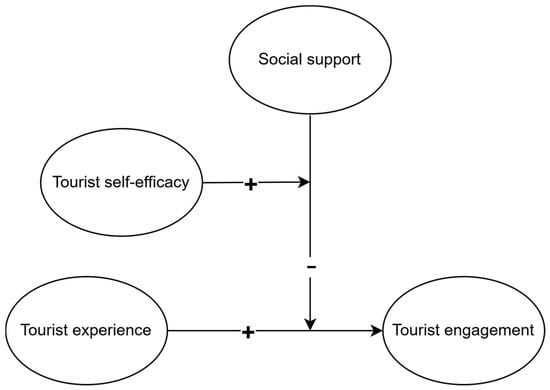
Concretely, this reversal unfolds as a sequential psychological process. High self-efficacy first alters appraisal: through the cognitive filter of competence beliefs [12,36], tourists reinterpret social support as an external resource available for their own purposes rather than a signal of inadequacy. This altered appraisal enables selective mobilization: efficacious tourists actively draw on task-relevant informational and instrumental support to probe the destination’s low-carbon offerings more deeply [37,38]. Mobilized in this way, support amplifies rather than dilutes the tourist’s cognitive and emotional investment, and the resulting engagement invites further reciprocal exchange, setting in motion a resource gain spiral [11,39]. Through this appraisal → mobilization → deepened-processing sequence, self-efficacy converts social support from an inhibitor into a synergistic facilitator—a conversion that is decisive in low-carbon tourism, where sustained engagement depends on tourists’ willingness to shoulder the behavioral costs of sustainability themselves. Based on these theoretical insights, the following hypothesis is proposed, and Figure 1 depicts the research framework.
Figure 1.
Research framework.
Hypothesis 3.
Tourist self-efficacy positively moderates the negative moderating effect of social support on the relationship between tourist experience and tourist engagement; specifically, high self-efficacy buffers and reverses the inhibitory effect of social support, leading to a synergistic enhancement of the experience–engagement link.
4. Methods
4.1. Sampling and Procedures
Data collection took place in late December 2025 in a relaxed social environment, with an accessible population of approximately 230 adult attendees. Before survey distribution, a purposive screening protocol was conducted to ensure that all participants had prior experience with low-carbon tourism. The questionnaires were then administered individually before the formal commencement of the social event.
The survey’s cover page explicitly stated that participation was entirely voluntary, with no penalty for declining. The structural nature of the social gathering ensured that guests faced no peer pressure or professional hierarchy from the researchers. Furthermore, to prevent any coercive or transactional influence on data integrity, small souvenirs (valued between NT$50 and NT$300) were distributed uniformly as post hoc tokens of appreciation only after the completed, fully anonymized questionnaires were collected, fully safeguarding participants’ rights and welfare. Of the 211 surveys retrieved, 5 were excluded for incomplete responses, yielding a final analytical sample of 206 valid questionnaires. We recognize that this data-collection setting may itself have introduced context effects, a potential measurement limitation we discuss in Section 6.4.
4.2. Sample Characteristics
A total of 206 valid samples were collected for this study, and the sample characteristics are summarized in Table 1. The majority of respondents were female (57.8%), and those aged 50 and over accounted for 47.5% of the sample. Regarding travel frequency, more than 80% of respondents reported an average of 1 to 5 trips per year (85.9%). Nearly half of the respondents traveled in groups of 3 to 4 people (47.1%). In addition, most respondents were married (64.1%), while 35.0% were single; in terms of education, 48.1% held a college or university degree, 26.7% a senior-high school qualification, and 25.2% a postgraduate degree.
Table 1.
Sample characteristics.
4.3. Measures
The research instrument measured four key constructs: tourist experience, tourist engagement, self-efficacy, and social support. All items were rated on a five-point Likert scale, ranging from 1 (“strongly disagree”) to 5 (“strongly agree”) and were contextualized for low-carbon tourism. Tourist experience is operationalized as the multidimensional internal response and holistic perception of the destination environment and activities. The tourist experience was assessed using a 12-item scale adapted from [16] encompassing sensory, affective, intellectual, and behavioral dimensions. Tourist engagement refers to the degree of a tourist’s cognitive, emotional, and behavioral involvement during the travel process, and was measured with a 12-item scale covering identification, attention, enthusiasm, absorption, and interaction [40]. Tourist self-efficacy is operationalized as an individual’s subjective belief and confidence in their capacity to successfully perform specific travel tasks and was evaluated using an 8-item scale adapted from the General Self-Efficacy Scale of Sherer et al. (1982) [41] to capture tourists’ perceived competence in executing low-carbon practices and overcoming situational obstacles. Finally, social support refers to the multifaceted supportive resources perceived by tourists from their social network. The social support scale was adapted from the Multidimensional Scale of Perceived Social Support (MSPSS; [23]), utilizing four items to represent emotional, esteem, informational, and instrumental support.
The five-point format minimizes cognitive and response burden in field administration and suits our comparatively older sample (47.5% of respondents were over 50), while remaining consistent with the response formats of the original validated scales; methodological evidence indicates that five-, seven-, and ten-point scales yield comparable reliability and validity [42]. All items were contextualized for low-carbon tourism: each generic scale stem was reworded to refer explicitly to the respondent’s low-carbon travel experience rather than to tourism in general. The complete list of items for all constructs is provided in Appendix A.
5. Results
5.1. Confirmatory Factor Analysis
Because all four constructs were measured with established, previously validated scales, a confirmatory factor-analytic approach was appropriate; the only exploratory step was a principal-component analysis used solely to rank item loadings for parcel construction, as detailed below.
This study employed confirmatory factor analysis to verify the construct validity of the measurements, including convergent and discriminant validity. Before the analysis, item parceling was applied to reduce random error and the number of parameters to be estimated. To enhance the tourist experience and engagement, the partial-aggregation method was used to parcel items while preserving the original scale dimensions. Specifically, the 12 items of tourist experience were parceled into four indicators: sensory, affective, intellectual, and behavioral; the 12 items of tourist engagement were parceled into five indicators: identification, attention, enthusiasm, absorption, and interaction. For self-efficacy, the partial-disaggregation method was used to parcel the original measurement items [43,44]. Following the item-to-construct balance principle [45], an exploratory factor analysis model was first estimated using the principal component method. Factor loadings of the first factor were ranked in descending order, and parcels were created by averaging the item with the highest loading with the item with the lowest loading, then averaging the second-highest with the second-lowest, and so forth. Through this process, the 8 self-efficacy items were combined into 4 parcels. Additionally, the 4 social support items were not parceled, and the original items were used directly in the confirmatory factor analysis.
This study performed confirmatory factor analysis using either parceled items (for tourist experience, tourist engagement, and self-efficacy) or original items (for social support). The model was estimated using the Maximum Likelihood Robust (MLR) estimator, which is robust to non-normality [46,47], and implemented via the lavaan package version 0.6-21 in R version 4.5.3 [48]. The scaling correction factor (SCF) in this study was 1.495, indicating a non-normal distribution of the observed data. This deviation from 1.0 justifies using the MLR estimator to adjust the original chi-square value and to provide more reliable parameter estimates and standard errors [49]. By effectively correcting for non-normality biases, this approach ensures that the goodness-of-fit indices accurately reflect the true model-data fit.
The analysis results yielded a robust chi-square value of 283.810 (df = 113, p < 0.001), a robust CFI of 0.938, a robust RMSEA of 0.105 (90% CI [0.090, 0.120]), and an SRMR of 0.036. As presented in Table 2, the composite reliability for all four constructs exceeded 0.9, and the average variance extracted (AVE) for each surpassed the recommended threshold of 0.5. Furthermore, all item factor loadings were highly significant (p < 0.001), demonstrating that the measures for the four constructs possess strong reliability and convergent validity [50].
Table 2.
Measurement model.
Although the robust RMSEA (0.105) exceeds the conventional 0.08 threshold, model fit is better judged from the full pattern of evidence than from any single cutoff. The comparative and residual-based indices indicate good fit (robust CFI = 0.938; SRMR = 0.036), and the psychometric coefficients are uniformly strong (all composite reliabilities > 0.9; all AVEs > 0.5; all loadings p < 0.001). Two features of the model account for the elevated RMSEA. First, RMSEA is a parsimony-adjusted index sensitive to model complexity and sample size; with a four-factor structure estimated on a comparatively small sample (N = 206), its point estimate is prone to upward bias even when the standardized residuals are small, as the low SRMR confirms. Second, the indicators in this model are highly reliable, with standardized factor loadings ranging from 0.80 to 0.95. As Lai and Green (2016) [51] demonstrated, when standardized loadings are high, CFI tends to indicate good fit whereas RMSEA becomes overly sensitive to minor, theoretically trivial residual dependencies; accordingly, when RMSEA and CFI disagree under conditions of high reliability, methodologists caution against rejecting a model based on RMSEA alone. Localized fit was also examined. Only one of the 136 standardized residuals exceeded 2.58 (think–sense, z = −3.31). The SRMR-based tests of exact and close fit were not rejected (p = 0.50 and p = 0.71), and the largest modification indices were residual covariances rather than cross-loadings; none was freed. Because parceling can in principle mask such problems, the model was re-estimated at the original item level. Removing the parcels did not improve fit: the robust RMSEA was 0.099 (90% CI [0.093, 0.106]) for the 36-item model and 0.086 (90% CI [0.079, 0.093]) once the scales’ facets were modeled explicitly. All 36 standardized loadings fell between 0.77 and 0.90, and the inter-construct correlations shifted by at most 0.021. Appendix B reports these analyses in full. On balance, the model demonstrates acceptable fit and sound psychometric quality.
Regarding discriminant validity, the square root of the average variance extracted (AVE) for each construct exceeded its correlations with any other constructs, confirming that the four constructs possess adequate discriminant validity [50] (Table 3).
Table 3.
Means, standard deviations, correlations and square root of AVEs.
5.2. Hypotheses Testing
This study used PROCESS for R, Version 5.0 [52], and Model 3 (moderated moderation) to test the three-way interaction. As shown in Table 4, the three-way interaction among tourist experience, social support, and self-efficacy on tourist engagement was positive and statistically significant (B = 0.075, p < 0.05), supporting Hypothesis 3. The two-way interaction between social support and self-efficacy was significantly negative (B = −0.416, p < 0.001). Similarly, the interaction between tourist experience and social support was significantly negative (B = −0.309, p < 0.05), providing support for Hypothesis 2. Regarding direct effects, social support had a significant positive impact on tourist engagement (B = 2.003, p < 0.001). However, the average (unconditional) effect of tourist experience on tourist engagement was not statistically significant (B = 0.279, p = 0.559); Hypothesis 1 was therefore not supported as an unconditional main effect. As the conditional analyses below show, this does not mean that experience is inconsequential—its effect emerges under specific configurations of social support and self-efficacy.
Table 4.
The three-way interaction of tourism experience, social support, and self-efficacy on tourist engagement.
Table 4 also reports the 95% confidence interval and Cohen’s f2 for every coefficient. The three-way interaction explained a significant increment in variance (ΔR2 = 0.009, F(1, 198) = 6.11, p = 0.014; f2 = 0.031), and the tourist experience × social support interaction was likewise significant (f2 = 0.024). Although these interaction effect sizes are small by Cohen’s (1988) [53] benchmarks, effects of this magnitude are typical for higher-order interactions in field data and remain theoretically meaningful; the practical importance lies in the fact that the direction of the experience–engagement relationship reverses across configurations of internal and external resources. A supplementary bootstrap analysis (5000 resamples, bias-corrected) reproduced the three-way interaction (H3). In contrast, the experience × social support interaction (H2), though statistically significant under normal-theory testing, was marginal under bootstrapping and should be interpreted with due caution. The three tests are cumulative rather than independent: H1 shows that no significant unconditional effect is observed, H2 identifies the suppressing boundary, and H3 locates the condition, self-efficacy, that reverses it.
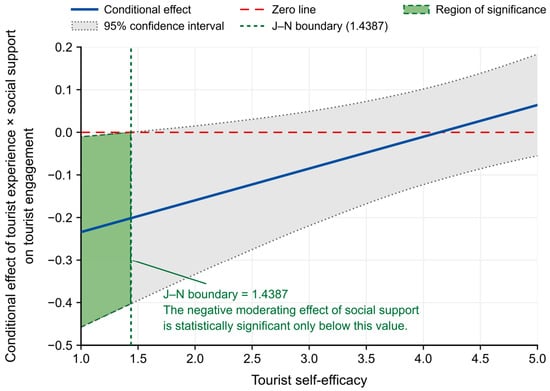
Figure 2 illustrates the influence of self-efficacy on the moderating effect of social support. According to the Johnson–Neyman (J-N) plot, the moderating effect of social support on the path from tourism experience to tourist engagement (Y-axis) shifts from negative to positive, as self-efficacy (X-axis) increases. When a tourist’s self-efficacy is below 1.4387, the shaded region of significance, which is the portion of the 95% confidence band lying entirely below the red dashed zero line, marks where the negative moderating effect proposed in Hypothesis 2 is statistically significant. Within this low self-efficacy range, social support acts as an inhibitor. Instead of serving as a resource gain, social support significantly suppresses the relationship between tourism experience and engagement. Once self-efficacy exceeds 1.4387, the confidence interval crosses the zero line, indicating that the moderating effect of social support is no longer statistically significant in this region.
Figure 2.
Johnson–Neyman plot: The moderating effect of social support across levels of self-efficacy.
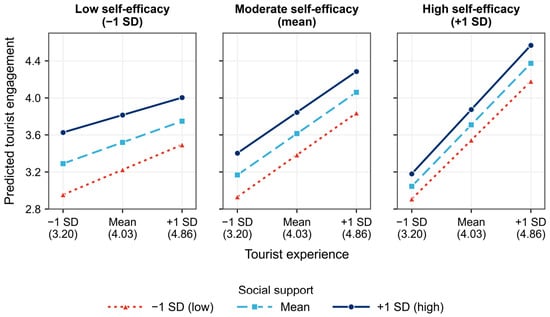
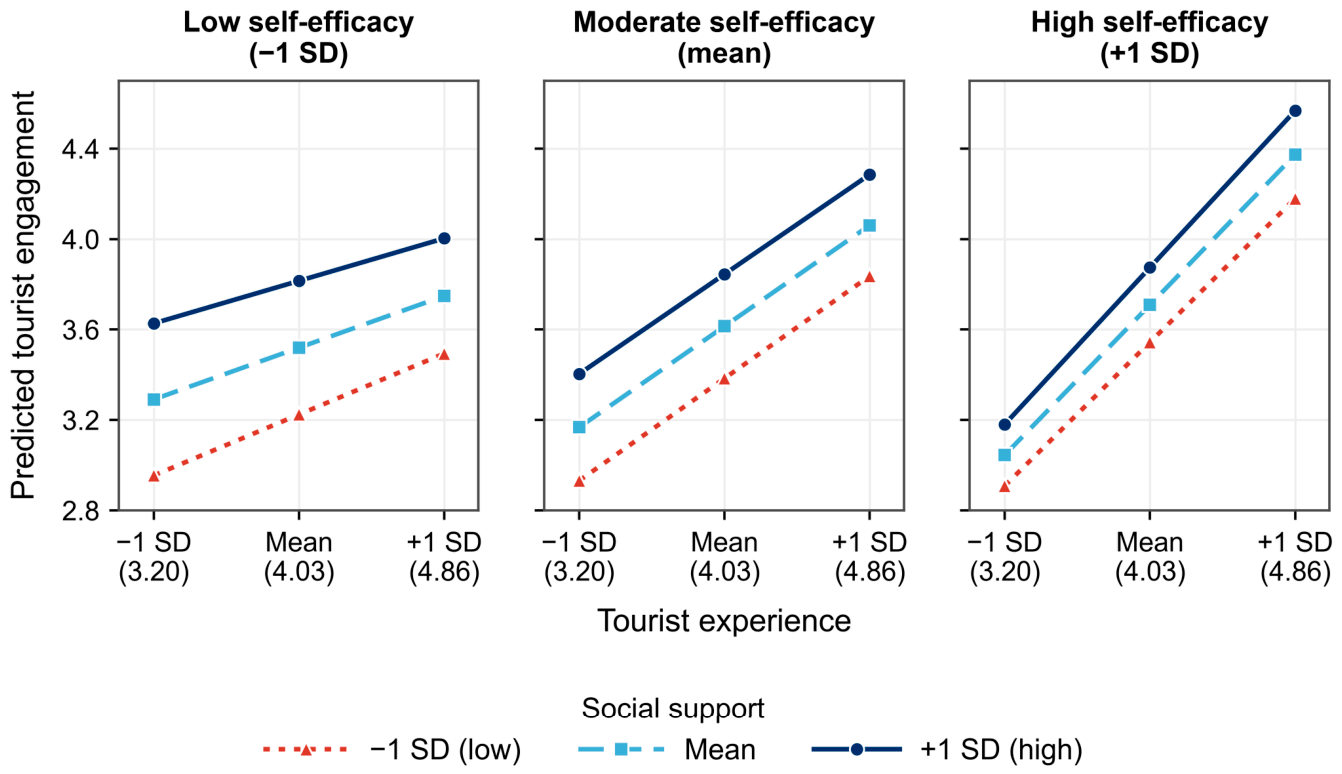
To clearly illustrate the three-way interaction of tourist experience × social support × self-efficacy on tourist engagement, this study plotted the effects of tourist experience on tourist engagement at three levels of social support and self-efficacy: one standard deviation below the mean (−1 SD), the mean, and one standard deviation above the mean (+1 SD). Figure 3 depicts conditional effects (the slope of tourist experience on engagement at particular combinations of social support and self-efficacy) rather than an unconditional direct relationship. Consistent with the regression results, in which the average effect of tourist experience was not statistically significant (B = 0.279, p = 0.559), the experience–engagement slope is not uniformly positive but varies markedly across conditions. For ease of interpretation, Figure 3 is presented as three separate panels corresponding to low (−1 SD), moderate (mean), and high (+1 SD) self-efficacy; within each panel, the contrast between high and low social support isolates how the experience–engagement slope shifts, so that the three-way interaction can be read one self-efficacy level at a time.
Figure 3.
The three-way interaction of tourism experience, social support, and self-efficacy on tourist engagement.
At a self-efficacy level of −1 SD, the slope of the red dotted line (low social support) is steeper than that of the dark blue solid line (high social support). When tourists lack self-confidence or intrinsic motivation, high levels of social support exert an inhibitory effect on the primary path (tourist experience → tourist engagement), further validating Hypothesis 2.
At the mean level of self-efficacy, the overall slopes are steeper than in the left plot, and the three lines appear to be parallel. As tourists’ internal resources (self-efficacy) reach an average level, the initial negative moderating effect of social support gradually dissipates. At this stage, varying degrees of social support are reflected in the overall level (intercept) of tourist engagement, rather than in the moderation of conversion efficiency (slope).
At a self-efficacy level of +1 SD, the three-way interaction is most pronounced. In contrast to the low and average self-efficacy conditions, a reverse trend emerges: the dark blue solid line (high social support) now exhibits the steepest slope and is positioned at the top of the chart. At this stage, self-efficacy and social support reinforce one another, not only offsetting the original inhibitory effect of social support but also transforming it into a compensatory resource. When tourists possess both high self-efficacy and high social support, they can most effectively convert their tourism experience into actual engagement, thereby maximizing the slope. This pattern supports Hypothesis 3 and highlights the critical importance of the collaborative effect between internal and external resources in promoting tourist engagement.
6. Discussion and Implications
6.1. Conclusions
This study examined how tourist experience, social support, and self-efficacy jointly determine tourist engagement in the context of low-carbon tourism. The empirical results support the following conclusions.
First, the tests of the primary hypotheses describe a single conditional mechanism. The nonsignificant average effect (H1) indicates that in low-carbon tourism, a rich experience does not convert into engagement uniformly across tourists. Social support, the resource most tourism research would prescribe, further weakens that conversion (H2). Whether it suppresses or amplifies the experience–engagement link then depends on the tourist’s self-efficacy (H3). The null main effect and the negative moderator therefore belong to one conditional architecture, in which experience converts into engagement only when internal resources are strong enough to turn external support from a substitute into a tool. It is this architecture, and not any individual coefficient, that governs when and for whom experience translates into engagement.
Second, two findings beyond the focal hypotheses warrant comment. Although social support acted as a negative moderator, it also exerted a significant, direct positive effect on tourist engagement. This dual role implies that social support confers an immediate sense of participation even as it distracts from the internalization of the travel experience. Tourist self-efficacy, by contrast, showed no significant direct effect on engagement, suggesting that in the low-carbon context its principal value lies not in driving engagement single-handedly but in its capacity to transform and integrate the other resources available to the tourist.
In conclusion, the success of low-carbon tourism appears to rest less on direct experiential or personal factors taken in isolation than on how tourists transform the resources available to them. High self-efficacy is the condition under which social support and on-site experience reinforce each other in raising tourist engagement.
6.2. Theoretical Implications
This study offers two principal theoretical contributions to research on low-carbon tourism and tourist behavior. First, it documents the inhibitory effect and resource-substitution mechanism of social support in low-carbon tourism, recasting the experience–engagement relationship in conditional terms. The study finds that the positive impact of experience is strongly suppressed by social support (H2), surfacing as a significant conditional effect. The abundance of external social resources in low-carbon travel, such as companionship or advice, can serve as a functional substitute, reducing the tourist’s need to derive psychological fulfillment solely from the destination’s activities. This finding extends Conservation of Resources (COR) Theory [10,11] by demonstrating that high social support can weaken the driving force of experience on engagement, offering an explanation for inconsistent findings in previous experiential studies. This pattern is not confined to the low-carbon setting. In a large-scale study of inbound tourists to Taiwan, the contribution of tourists’ own onsite experience to the destination image they formed was less than half as strong when a travel agency had arranged the trip as when they traveled independently (β = 0.144 vs. 0.375), while externally supplied information contributed correspondingly more (β = 0.236 vs. 0.067). The authors attribute this asymmetry to package tourists’ ability to ascribe outcomes to the agency rather than to themselves [54]. That the same displacement appears for a different outcome, a different moderator, and a different theoretical route strengthens the case that what social support substitutes for is the tourist’s own experiential work.
Second, the study identifies tourist self-efficacy as the condition that reverses the inhibitory boundary of social support through a moderated moderation mechanism. The three-way interaction among tourist experience, social support, and self-efficacy (H3) shows that the positive effect of experience on engagement emerges fully only when self-efficacy is taken into account. The reversal is a social-cognitive effect: efficacy beliefs govern how the environmental resource is appraised [12,24,25], enabling tourists to treat social support as a means of acting on their own instead of a substitute for doing so. COR contributes the complementary vocabulary of substitution and gain. For tourists with strong self-belief, the inhibitory boundary erected by social support is lifted and the interaction tips toward a synergistic enhancement of the experience–engagement link.
The absence of a significant average effect in our data, where earlier research reports that richer experiences reliably heighten engagement, reflects two differences. First, most prior evidence derives from general, hedonically oriented settings (creative tourism, heritage tourism, and repeat-visitation contexts [6,7,19]) in which the experience is the principal source of value, engagement carries little behavioral cost, and a good experience therefore translates almost mechanically into engagement; in low-carbon tourism the target behavior is effortful and the setting rich in competing external resources, so the direct path is conditional rather than absent. Second, many earlier studies modeled the relationship as a bivariate or simple mediating effect without moderators, so a single unconditional coefficient absorbed what our moderated-moderation model reveals to be offsetting conditional effects. The nonsignificant average effect is therefore consistent with prior findings but a more accurate representation of an inherently contingent relationship in the low-carbon context.
Interpreting these findings through concepts native to low-carbon tourism further clarifies the mechanism. Because pro-environmental action in travel is typically a higher-cost behavior, its enactment is governed less by momentary experiential pleasure than by whether tourists internalize environmental value and can self-regulate toward it—consistent with the low-cost/high-cost hypothesis [55] and with integrated accounts in which pro-environmental action depends on the interplay of values, situational factors, and self-regulatory goals [56]. In this light, the resource-substitution effect of social support (H2) reflects a displacement of self-regulatory effort: when the group assumes the cognitive and normative work of the trip, the individual’s internalization of environmental norms is bypassed, weakening the conversion of experience into engaged, norm-consistent action [57]. Conversely, the self-efficacy-driven reversal (H3) enables pro-environmental behavioral enactment: efficacious tourists convert both experience and social support into the self-regulated pursuit of environmental goals, thereby expressing internalized values rather than external compliance [2].
Further, these results delineate the boundary between the explanatory scope of traditional COR Theory and the extension proposed here. Classical COR explains how individuals conserve resources under demanding or threatening conditions, where resource loss produces strain and loss spirals [10,11]. The present study extends COR into a discretionary, low-stress leisure context. It specifies a mechanism classical COR does not address under resource abundance: external and internal resources need not accumulate additively. Still, they may substitute for or synergize with one another, with the direction of the effect set by the actor’s internal resources. The study thus shifts COR from a logic of resource conservation under threat to one of resource orchestration under abundance.
Finally, the direction of substitution, however, may depend on what is delegated. In a very different setting, that of students working in partnership with generative AI, the same kind of delegation, there studied as cognitive offloading, was associated with more, not less, transformative learning [58]. The tasks delegated there, such as summarizing, drafting and preliminary analysis, are instrumental to the learning outcome, and the capacity they release can be reinvested in the reflection that constitutes it. In low-carbon tourism, the relation is inverted. The acts a companion can take over, whether choosing the low-carbon option, interpreting environmental information, or performing the pro-environmental behavior itself, are not means to engagement but part of what engagement is: a tourist whose companion carries the reusable cup obtains the outcome without the enactment. We therefore offer, as an untested extension of these findings, the proposition that delegation of this kind, whether described as resource substitution or as cognitive offloading, is destructive when the delegated task is constitutive of the valued outcome and productive when it is merely instrumental to it. That difference also identifies what is distinctive about the present setting. A machine partner carries no obligation of reciprocity and no transfer of personal accountability; a travel companion carries both, and the third of the substitution conditions set out in Section 3.2 rests on exactly that. Where support comes from other people, accepting it incurs an implicit debt, and what is owed is owed to the relationship. A parallel distinction has recently been proposed for consumers’ climate engagement, where socially derived rewards are argued to foster engagement aimed at maintaining social ties, a form separable from the self-directed and competence-directed engagement that pro-environmental action also requires [59]. Whether the substitution observed here redirects effort toward the relationship rather than simply reducing it is the more specific question our findings raise.
6.3. Practical Implications
The findings yield actionable guidance for policymakers, tourism operators, and individual tourists seeking to deepen engagement in the low-carbon tourism sector. Two caveats frame what follows. Because social support also exerted a significant positive direct effect on engagement (Table 4), nothing below recommends reducing it; what the results speak to is how support is delivered and how much room tourists retain to act for themselves. Where a recommendation extends beyond the measured variables, we say so. First, for policy and destination management organizations (DMOs), the priority is to move from delivering general assistance to creating conditions in which tourists can act for themselves. Policies might prioritize digital self-service infrastructure, such as mobile applications for real-time carbon footprint tracking or interactive low-carbon navigation systems, that keep assistance available on the tourist’s own terms rather than substituting for the tourist’s own action. Destination marketing can likewise reframe its narrative from effortless convenience to achievement through sustainability, appealing to high-efficacy travelers eager to validate their environmental competence. Both proposals extend beyond the measured variables, since neither applications nor marketing narratives were tested here, and are offered as plausible ways to implement the supported principle that support should equip rather than replace the tourist.
Next, for tourism operators and service providers, the results argue for a service design built around tourist empowerment. Staff can be trained to deliver support on demand, responding when asked instead of anticipating, so that assistance reaches tourists without taking the task off their hands. To unlock the experience–engagement link, operators can embed mastery experiences, such as DIY low-carbon workshops or eco-certification tasks, into their itineraries. Because completing such tasks is the most powerful source of efficacy beliefs [25], and because efficacy gained on easier sustainable tasks spills over to more demanding ones [26], these activities equip tourists with the internal confidence to treat social resources as functional tools for deeper participation. The mastery-experience recommendation follows directly from the significant role of self-efficacy in reversing the inhibitory effect of social support (H3); the delivery principle rests on the substitution conditions set out in Section 3.2 and was not itself tested.
Finally, individual tourists can be encouraged to cultivate a proactive, co-creating mindset. Pre-trip learning that sharpens specific low-carbon travel skills raises the quality of the subsequent experience. During the trip, travelers may practice an active use of support, drawing on companions and staff for what they choose while keeping ownership of the low-carbon choices themselves. By treating social input as a practical resource for self-directed achievement, tourists can secure a deeper and more personal engagement with the environment. This guidance is grounded in the substitution effect of social support (H2) and its reversal under high self-efficacy (H3).
6.4. Limitations and Directions for Future Research
A primary limitation of this study is its reliance on retrospective self-reports of low-carbon tourist experience. Although the theoretical framework treats experience as a dynamic, sequential process spanning pre-tour, on-site, and post-tour phases, the cross-sectional design cannot capture real-time fluctuations in tourists’ emotional and cognitive states. Moreover, because data were collected at a wedding banquet, respondents’ evaluations of past low-carbon trips may have been colored by recall bias, the immediate social setting, or the “Peak-End Rule” [60]—potentially obscuring the authentic mechanisms of real-time engagement. To trace the causal evolution between tourist experience and engagement more precisely, future research may adopt the Experience Sampling Methodology (ESM) for longitudinal data collection. More specifically, the interval between respondents’ actual low-carbon trips and survey completion was not controlled, and neither the recency nor the intensity of those experiences was recorded, further compounding the concerns about retrospective recall noted above.
While the theoretical framework conceptualizes low-carbon tourist engagement as a multidimensional state encompassing cognitive (e.g., attention), emotional (e.g., enthusiasm), and behavioral (e.g., interaction) components, the empirical measurement chiefly captures the tourist’s psychological state and self-reported involvement during the trip. A significant limitation is that the study does not extend to spillover effects on the tourist’s daily life after the journey. Furthermore, the behavioral engagement assessed here concerns on-site interaction rather than quantified low-carbon mitigation actions, such as reductions in carbon emissions from transportation choices or waste management. The research thus offers a robust psychological model but lacks direct evidence of how these mental states translate into tangible environmental contributions. To bridge this gap, future work should broaden the behavioral domain of the engagement construct and align it with the wider framework of pro-environmental behavior (PEB) [2]. Integrating objective behavioral data, such as GPS-tracked transportation modes or digital carbon footprint logs, would permit calculation of the actual emission savings attributable to tourists’ choices.
Two further limitations concern sample representativeness and the survey context. First, the data were gathered from a single accessible group at a single social gathering through purposive sampling. However, all respondents had genuine low-carbon travel experience; convenience sampling from a single setting limits the external validity and generalizability of the findings. Future research should replicate the model with probability-based samples drawn from diverse destinations and more heterogeneous populations of actual low-carbon travelers. Second, because the questionnaire was administered within an active social gathering, the setting may have elevated positive affect or social desirability. We sought to mitigate this by using fully anonymous responses, an explicitly voluntary cover statement, and distributing tokens of appreciation only after the completed questionnaires had been collected; nonetheless, context-induced measurement bias cannot be entirely ruled out and should be addressed in future studies using more neutral administration settings.
Author Contributions
Conceptualization, C.-H.L.; Software, C.-H.L.; Formal analysis, C.-H.L.; Investigation, S.-M.W.; Resources, S.-M.W.; Data curation, C.-H.L.; Writing—original draft, C.-H.L.; Writing—review & editing, C.-H.L.; Supervision, C.-H.L.; Project administration, S.-M.W. All authors have read and agreed to the published version of the manuscript.
Funding
This research received no external funding.
Institutional Review Board Statement
Ethical review and approval were waived for this study by the Institutional Committee as per the Ministry of Health and Welfare (MOHW) decree, (Announcement No. 1010265075 [61]) under the Preamble and Article 1.
Informed Consent Statement
Informed consent for participation was obtained from all subjects involved in the study.
Data Availability Statement
The raw data supporting the conclusions of this article will be made available by the authors on request.
Conflicts of Interest
The authors declare no conflicts of interest.
Appendix A. Measurement Items
All multi-item constructs were measured on a five-point Likert scale (1 = strongly disagree, 5 = strongly agree) and were contextualized for low-carbon tourism.
- Tourist Experience (adapted from [16])
- A1. The low-carbon tour made me feel the comfort and purity of the natural environment.
- A2. The environment and atmosphere of the low-carbon tour gave me pleasant sensory feelings.
- A3. The low-carbon tour made me pleased with the visual scenery, air quality, and environmental quality.
- A4. Participating in the low-carbon tour made me feel relaxed and cheerful.
- A5. During the low-carbon tour, I developed positive emotional feelings toward environmental protection.
- A6. The low-carbon tour gave me a sense of inner ease and contentment.
- A7. The low-carbon tour prompted me to reflect on the environmental impact of my own travel behavior.
- A8. Through the low-carbon tour, I gained knowledge about low-carbon and sustainable travel.
- A9. The low-carbon tour led me to rethink whether my past travel practices were environmentally friendly.
- A10. During the low-carbon tour, I was willing to actively adopt environmentally friendly and carbon-reducing behaviors.
- A11. The low-carbon tour changed the way I actually behaved while traveling.
- A12. After the low-carbon tour, I became more willing to practice low-carbon behaviors in daily life.
- Tourist Engagement (adapted from [40])
- B1. I care about how others view green tourism.
- B2. When I hear others praise green tourism, I feel as if I am being praised myself.
- B3. I keep track of the latest news about low-carbon tourism.
- B4. I am interested in information about, or products related to, low-carbon tourism.
- B5. I like low-carbon tourism.
- B6. Anything related to low-carbon tourism can capture my attention.
- B7. Compared with other destinations, I prefer low-carbon tourism.
- B8. I feel reluctant to leave when on a low-carbon tour.
- B9. I feel that time flies during a low-carbon tour.
- B10. I follow low-carbon tourism on social media.
- B11. I share my low-carbon tourism experiences on social media.
- B12. I “like” low-carbon tourism posts on social media.
- Social Support (adapted from [23])
- C1. During travel, I can obtain emotional support from the people around me.
- C2. During travel, the people around me respect my ideas.
- C3. During travel, the people around me offer useful information or advice.
- C4. During travel, the people around me provide me with tangible support (e.g., equipment, finances).
- Tourist Self-Efficacy (adapted from [41])
- D1. I am confident that I can successfully complete the travel itinerary I have planned.
- D2. Even when difficulties arise during travel, I can resolve them appropriately.
- D3. I believe I can make travel decisions that suit me.
- D4. I can cope well even in unfamiliar travel environments.
- D5. I am capable of handling travel-related problems independently.
- D6. I feel confident about my performance during travel.
- D7. Compared with most people, I can complete travel-related activities effectively.
- D8. Even when travel conditions are unfavorable, I can still maintain good performance.
Appendix B. Measurement Model Diagnostics and Item-Level Comparison
Item parceling can in principle improve model fit or conceal problems at the item level. Three specifications were therefore estimated on the same data (N = 206) with the same estimator (MLR with robust standard errors): Model P is the parceled model reported in Section 5.1; Model A retains the four constructs but replaces the parcels with all 36 original items; Model B additionally represents the facets of the tourist experience and tourist engagement scales as first-order factors, with the two constructs as second-order factors—the structure that the parcels stand for.
Table A1.
Fit of the measurement model before and after parceling.
Removing the parcels did not improve fit. The robust RMSEA was 0.105 for the parceled model, 0.099 for the 36-item model, and 0.086 once the facets were modeled explicitly, so the parceled specification is the least favorable of the three on this index; the elevated value is therefore a property of the data rather than a consequence of parceling. RMSEA is scaled by the degrees of freedom, and the parceled model has 113 of them against 588 and 580, which is why the same amount of misfit registers as a larger value. The comparative indices move in the opposite direction (robust CFI = 0.938, 0.860, and 0.896), as expected of incremental indices when the number of indicators more than doubles, and SRMR stays at or below 0.051 throughout.
At the item level, all 36 standardized loadings lay between 0.77 and 0.90 and were significant at p < 0.001, with no negative residual variances (Table A2); composite reliability ranged from 0.90 to 0.97 and AVE from 0.69 to 0.74. Of the 15 largest modification indices in Model A, 14 were residual covariances between items of the same construct—mostly adjacent, similarly worded items—and only one crossed constructs (D5–C2, MI = 34.2). The largest modification index for a cross-loading was 17.4, with a standardized expected change of 0.28, well below the largest within-construct residual covariance (85.4). No item loaded substantively on a construct other than its own.
Table A2.
Item-level standardized factor loadings (Model A).
Most important for the substantive results, the inter-construct correlations were almost unaffected by parceling: the largest difference between the two solutions was 0.021 (Table A3), and the Fornell–Larcker criterion was satisfied in both, the square root of each AVE exceeding every correlation involving that construct.
Table A3.
Inter-construct correlations before and after parceling.
Finally, for the parceled model itself, only one of the 136 standardized residuals exceeded 2.58 and the next largest was 2.39; the ten largest modification indices were all residual covariances rather than cross-loadings. None was freed, because none is theoretically motivated and the residual evidence does not indicate substantive local misfit.
References
- Han, H. Consumer behavior and environmental sustainability in tourism and hospitality: A review of theories, concepts, and latest research. J. Sustain. Tour. 2021, 29, 1021–1042. [Google Scholar] [CrossRef] [Scilit]
- Steg, L.; Vlek, C. Encouraging pro-environmental behaviour: An integrative review and research agenda. J. Environ. Psychol. 2009, 29, 309–317. [Google Scholar] [CrossRef] [Scilit]
- Juvan, E.; Dolnicar, S. The attitude–behaviour gap in sustainable tourism. Ann. Tour. Res. 2014, 48, 76–95. [Google Scholar] [CrossRef] [Scilit]
- Huang, S.; Choi, H.S.C. Developing and validating a multidimensional tourist engagement scale (TES). Serv. Ind. J. 2019, 39, 469–497. [Google Scholar] [CrossRef] [Scilit]
- Brodie, R.J.; Hollebeek, L.D.; Jurić, B.; Ilić, A. Customer engagement: Conceptual domain, fundamental propositions, and implications for research. J. Serv. Res. 2011, 14, 252–271. [Google Scholar] [CrossRef] [Scilit]
- Huang, S.S.; Choi, H.S.C. Understanding the relationship between tourist experience, engagement and loyalty: A case of creative tourism in Korea. Int. J. Tour. Res. 2017, 19, 569–578. [Google Scholar] [CrossRef] [Scilit]
- Rather, R.A.; Hollebeek, L.D.; Rasoolimanesh, S.M. First-time versus repeat tourism customer engagement, experience, and value co-creation: An empirical investigation. J. Travel Res. 2022, 61, 549–564. [Google Scholar]
- Chung, N.; Tyan, I.; Chung, H. Social support and commitment within social networking site in tourist experience. Sustainability 2017, 9, 2102. [Google Scholar] [CrossRef] [Scilit]
- Cohen, S.; Wills, T.A. Stress, social support, and the buffering hypothesis. Psychol. Bull. 1985, 98, 310–357. [Google Scholar] [CrossRef]
- Hobfoll, S.E. Conservation of resources: A new attempt at conceptualizing stress. Am. Psychol. 1989, 44, 513–524. [Google Scholar] [CrossRef] [PubMed]
- Hobfoll, S.E.; Halbesleben, J.; Neveu, J.-P.; Westman, M. Conservation of resources in the organizational context: The reality of resources and their consequences. Annu. Rev. Organ. Psychol. Organ. Behav. 2018, 5, 103–128. [Google Scholar] [CrossRef] [Scilit]
- Bandura, A. Social Foundations of Thought and Action: A Social Cognitive Theory; Prentice-Hall: Upper Saddle River, NJ, USA, 1986. [Google Scholar]
- Ngwira, C.; Tung, V.W.S.; Tse, S.W.T. Extending the conceptualization of destination brand experiences. J. Travel Res. 2023, 62, 1605–1618. [Google Scholar]
- Kim, H.; So, K.K.F. Two decades of customer experience research in hospitality and tourism: A bibliometric analysis and thematic content analysis. Int. J. Hosp. Manag. 2022, 100, 103082. [Google Scholar] [CrossRef] [Scilit]
- Hosany, S.; Sthapit, E.; Björk, P. Memorable tourism experience: A review and research agenda. Psychol. Mark. 2022, 39, 1467–1486. [Google Scholar]
- Lin, C.-H.; Kuo, B.Z.-L. The behavioral consequences of tourist experience. Tour. Manag. Perspect. 2016, 18, 84–91. [Google Scholar] [CrossRef] [Scilit]
- So, K.K.F.; Li, J.; Kim, H. A decade of customer engagement research in hospitality and tourism: A systematic review and research agenda. J. Hosp. Tour. Res. 2020, 44, 178–200. [Google Scholar] [CrossRef] [Scilit]
- Li, C.; Yang, Y.; Zhang, H.; Zhang, Z. Fast or slow? Exploring tourists’ engagement inclination toward the pace of travel. Ann. Tour. Res. 2025, 111, 103931. [Google Scholar] [CrossRef] [Scilit]
- Bryce, D.; Murdy, S.; Alexander, M. Visitors’ engagement and authenticity: Japanese heritage consumption. Tour. Manag. 2015, 46, 571–581. [Google Scholar] [CrossRef] [Scilit]
- Wu, X.; Guo, G.; Luo, P. How can tourism be made engaging and meaningful? A measurement scale for ritual interaction. Ann. Tour. Res. 2024, 105, 103734. [Google Scholar]
- Abbas, J.; Zhang, Q.; Saleem, S.; Hussain, I.; Akram, S. From tourist experience to satisfaction and loyalty: Exploring the role of a sense of well-being. J. Destin. Mark. Manag. 2024, 31, 100844. [Google Scholar]
- Cobb, S. Social support as a moderator of life stress. Psychosom. Med. 1976, 38, 300–314. [Google Scholar] [CrossRef] [Scilit] [PubMed]
- Zimet, G.D.; Dahlem, N.W.; Zimet, S.G.; Farley, G.K. The Multidimensional Scale of Perceived Social Support. J. Personal. Assess. 1988, 52, 30–41. [Google Scholar] [CrossRef] [Scilit]
- Bandura, A. Self-efficacy: Toward a unifying theory of behavioral change. Psychol. Rev. 1977, 84, 191–215. [Google Scholar] [CrossRef] [PubMed]
- Bandura, A. Self-Efficacy: The Exercise of Control; W. H. Freeman: New York, NY, USA, 1997. [Google Scholar]
- Lauren, N.; Fielding, K.S.; Smith, L.; Louis, W.R. You did, so you can and you will: Self-efficacy as a mediator of spillover from easy to more difficult pro-environmental behaviour. J. Environ. Psychol. 2016, 48, 191–199. [Google Scholar] [CrossRef] [Scilit]
- Otto, J.E.; Ritchie, J.B. The service experience in tourism. Tour. Manag. 1996, 17, 165–174. [Google Scholar] [CrossRef] [Scilit]
- Pine, B.J.; Gilmore, J.H. Welcome to the experience economy. Harv. Bus. Rev. 1998, 76, 97–105. [Google Scholar] [PubMed]
- Hollebeek, L.D.; Srivastava, R.K.; Chen, T. S-D logic–informed customer engagement: Integrative framework, revised fundamental propositions, and application to CRM. J. Acad. Mark. Sci. 2019, 47, 161–185. [Google Scholar] [CrossRef] [Scilit]
- Vargo, S.L.; Lusch, R.F. Evolving to a new dominant logic for marketing. J. Mark. 2004, 68, 1–17. [Google Scholar] [CrossRef] [Scilit]
- Blau, P.M. Exchange and Power in Social Life; John Wiley & Sons: Hoboken, NJ, USA, 1964. [Google Scholar]
- Cropanzano, R.; Mitchell, M.S. Social exchange theory: An interdisciplinary review. J. Manag. 2005, 31, 874–900. [Google Scholar] [CrossRef] [Scilit]
- Lin, H.; Zhang, M.; Gursoy, D. Effects of tourist-to-tourist interactions on experience co-creation: A self-determination theory perspective. J. Travel Res. 2021, 61, 1105–1120. [Google Scholar] [CrossRef] [Scilit]
- Risko, E.F.; Gilbert, S.J. Cognitive offloading. Trends Cogn. Sci. 2016, 20, 676–688. [Google Scholar] [CrossRef] [Scilit] [PubMed]
- Sedera, D.; Lokuge, S.; Atapattu, M.; Gretzel, U. Likes—The key to my happiness: The moderating effect of social influence on travel experience. Inf. Manag. 2017, 54, 825–836. [Google Scholar] [CrossRef] [Scilit]
- Deci, E.L.; Ryan, R.M. The “what” and “why” of goal pursuits: Human needs and the self-determination of behavior. Psychol. Inq. 2000, 11, 227–268. [Google Scholar] [CrossRef] [Scilit]
- Boley, B.B.; Strzelecka, M.; Watson, A. Place distinctiveness, psychological empowerment, and support for tourism. Ann. Tour. Res. 2018, 70, 137–139. [Google Scholar] [CrossRef] [Scilit]
- Joo, D.; Woosnam, K.M.; Strzelecka, M.; Boley, B.B. Knowledge, empowerment, and action: Testing the empowerment theory in a tourism context. J. Sustain. Tour. 2019, 28, 69–85. [Google Scholar] [CrossRef] [Scilit]
- Kakoudakis, K.I.; McCabe, S.; Story, V. Social tourism and self-efficacy. Ann. Tour. Res. 2017, 65, 108–121. [Google Scholar] [CrossRef] [Scilit]
- So, K.K.F.; King, C.; Sparks, B. Customer engagement with tourism brands: Scale development and validation. J. Hosp. Tour. Res. 2014, 38, 304–329. [Google Scholar] [CrossRef] [Scilit]
- Sherer, M.; Maddux, J.E.; Mercandante, B.; Prentice-Dunn, S.; Jacobs, B.; Rogers, R.W. The Self-Efficacy Scale: Construction and Validation. Psychol. Rep. 1982, 51, 663–671. [Google Scholar] [CrossRef] [Scilit]
- Dawes, J. Do data characteristics change according to the number of scale points used? An experiment using 5-point, 7-point and 10-point scales. Int. J. Mark. Res. 2008, 50, 61–104. [Google Scholar] [CrossRef] [Scilit]
- Bagozzi, R.P.; Foxall, G.R. Construct validation of a measure of adaptive-innovative cognitive styles in consumption. Int. J. Res. Mark. 1996, 13, 201–213. [Google Scholar] [CrossRef] [Scilit]
- Bagozzi, R.P.; Heatherton, T.F. A general approach to representing multifaceted personality constructs: Application to state self-esteem. Struct. Equ. Model. 1994, 1, 35–67. [Google Scholar] [CrossRef] [Scilit]
- Little, T.D.; Cunningham, W.A.; Shahar, G.; Widaman, K.F. To parcel or not to parcel: Exploring the question, weighing the merits. Struct. Equ. Model. 2002, 9, 151–173. [Google Scholar] [CrossRef] [Scilit] [PubMed]
- Steenkamp, J.-B.E.M.; Maydeu-Olivares, A. Unrestricted factor analysis: A powerful alternative to confirmatory factor analysis. J. Acad. Mark. Sci. 2023, 51, 86–113. [Google Scholar] [CrossRef] [Scilit]
- Yuan, K.-H.; Bentler, P.M. Three likelihood-based methods for mean and covariance structure analysis with non-normal missing data. Sociol. Methodol. 2000, 30, 165–200. [Google Scholar] [CrossRef] [Scilit]
- Rosseel, Y. Lavaan: An R package for structural equation modeling. J. Stat. Softw. 2012, 48, 1–36. [Google Scholar]
- Satorra, A.; Bentler, P.M. A scaled difference chi-square test statistic for moment structure analysis. Psychometrika 2001, 66, 507–514. [Google Scholar] [CrossRef] [Scilit]
- Fornell, C.; Larcker, D.F. Evaluating structural equation models with unobservable variables and measurement error. J. Mark. Res. 1981, 18, 39–50. [Google Scholar] [CrossRef] [Scilit]
- Lai, K.; Green, S.B. The problem with having two watches: Assessment of fit when RMSEA and CFI disagree. Multivar. Behav. Res. 2016, 51, 220–239. [Google Scholar] [CrossRef] [Scilit] [PubMed]
- Hayes, A.F. Introduction to Mediation, Moderation, and Conditional Process Analysis: A Regression-Based Approach, 3rd ed.; Guilford Press: New York, NY, USA, 2022. [Google Scholar]
- Cohen, J. Statistical Power Analysis for the Behavioral Sciences, 2nd ed.; Lawrence Erlbaum Associates: Mahwah, NJ, USA, 1988. [Google Scholar]
- Lin, C.-H.; Kuo, B.Z.-L. The moderating effects of travel arrangement types on tourists’ formation of Taiwan’s unique image. Tour. Manag. 2018, 66, 233–243. [Google Scholar] [CrossRef] [Scilit]
- Diekmann, A.; Preisendörfer, P. Green and greenback: The behavioral effects of environmental attitudes in low-cost and high-cost situations. Ration. Soc. 2003, 15, 441–472. [Google Scholar] [CrossRef] [Scilit]
- Steg, L.; Bolderdijk, J.W.; Keizer, K.; Perlaviciute, G. An integrated framework for encouraging pro-environmental behaviour: The role of values, situational factors and goals. J. Environ. Psychol. 2014, 38, 104–115. [Google Scholar] [CrossRef] [Scilit]
- Stern, P.C. Toward a coherent theory of environmentally significant behavior. J. Soc. Issues 2000, 56, 407–424. [Google Scholar] [CrossRef] [Scilit]
- Wang, S.; Zhang, H. Pedagogical partnerships with generative AI in higher education: How dual cognitive pathways paradoxically enable transformative learning. Int. J. Educ. Technol. High. Educ. 2026, 23, 11. [Google Scholar] [CrossRef] [Scilit]
- Hollebeek, L.D.; Filieri, R.; Sprott, D.E. Fostering consumers’ climate (change) engagement. J. Bus. Res. 2026, 217, 116349. [Google Scholar] [CrossRef] [Scilit]
- Fredrickson, B.L.; Kahneman, D. Duration neglect in retrospective evaluations of affective episodes. J. Personal. Soc. Psychol. 1993, 65, 45–55. [Google Scholar] [CrossRef] [PubMed]
- Department of Health, Executive Yuan. Scope of Human Subjects Research Exempted from Institutional Review Board Review (Announcement No. 1010265075). R.O.C. (Taiwan). 5 July 2012. Available online: https://regulation.cde.org.tw/10254/4045/40872/ (accessed on 31 July 2026).

Disclaimer/Publisher’s Note: The statements, opinions and data contained in all publications are solely those of the individual author(s) and contributor(s) and not of MDPI and/or the editor(s). MDPI and/or the editor(s) disclaim responsibility for any injury to people or property resulting from any ideas, methods, instructions or products referred to in the content. |
© 2026 by the authors. Licensee MDPI, Basel, Switzerland. This article is an open access article distributed under the terms and conditions of the Creative Commons Attribution (CC BY) license.