


Abstract
Direct CO2 mineralization of carbide slag offers considerable potential for sustainable waste valorization, CO2 utilization, and high-value CaCO3 production, although associated Si-, Fe-, and Al-bearing impurities limit product quality. This study comparatively evaluated six process routes to determine how process sequence and separation-stream selection affect impurity partitioning and final product performance. The results suggest that calcination-induced phase reconstruction may improve the separability of impurity-bearing material, while hydrocyclone classification preferentially partitions impurity-rich particles toward the underflow. Relative to the calcined feed, the Si and Fe concentrations in the overflow decreased by 58.4% and 86.9%, respectively, and subsequent magnetic separation further reduced residual Fe. The preferred calcination–hydrocyclone overflow–magnetic separation–mineralization route omitted flotation and produced CaCO3 with a purity of 98.3%, a whiteness approaching 100%, and a total impurity content of 0.57%. These findings provide a process-sequence framework for balancing impurity removal, product quality, resource recovery, and environmental performance during the sustainable conversion of carbide slag into high-value CaCO3.
1. Introduction
Driven by demands for carbon reduction and solid waste minimization, CO2 mineralization of calcium-rich industrial solid wastes is an important route for carbon sequestration and resource recovery [1,2]. The global production of carbide slag, a bulk alkaline waste from acetylene-based PVC production, exceeds 40 million tons annually, most of which is stockpiled, occupying land and posing environmental risks [3,4,5]. Its high Ca(OH)2 content gives it strong potential for CO2 fixation and CaCO3 production; replacing limestone with carbide slag for CaO production could reduce CO2 emissions by about 20 million tons per year [6]. However, complex impurities such as Si, Fe, Al, and Mg still limit the stable production of CaCO3 with high purity and high whiteness [7,8].
This limitation reflects a broader scientific challenge in alkaline solid waste mineralization: impurity-bearing phases are often associated with reactive calcium phases, affecting their dissociation, migration, removal, and subsequent CaCO3 formation. Compared with indirect mineralization, which improves purity through calcium extraction but requires longer routes and leaching agents, direct mineralization is simpler and more efficient but is more sensitive to impurity interference. Li et al. obtained CaCO3 products with both purity and whiteness approaching 90%, providing a useful reference for further improving product quality through impurity regulation [3]. Therefore, regulating the migration and residual enrichment of Si, Fe, Al, and other impurities prior to direct mineralization is essential for establishing a simpler, lower-risk, and higher-value utilization pathway for carbide slag.
Previous studies have shown that impurities such as Si, Fe, Al, Mg, and native CaCO3 are frequently associated with carbide slag [9]. Fe2O3 has been demonstrated by Pan et al. to induce rod-like calcite formation by altering the local Ca2+/CO32− ratio and crystal growth mode through its hydrophilicity and negatively charged surface [10]. Ma et al. further found that colored impurities, including C and Fe2O3, seriously compromise product purity and whiteness [11]. These findings indicate that impurities not only affect the final composition of mineralized products, but may also regulate CaCO3 nucleation, growth, and morphology by changing the local ionic environment and crystal growth pathway [12,13]. However, previous studies have mainly focused on impurity effects or removal under individual treatment routes, while the evolution of impurity-bearing phases during sequential pretreatment and their transfer into the subsequent carbonation stage through overflow or underflow selection remain insufficiently understood. The mineral-phase mechanism linking impurity occurrence, phase dissociation, directional migration, and product quality is therefore still unclear, limiting mechanism-guided process design for direct carbide slag mineralization. Accordingly, the central scientific issue is to clarify how impurity occurrence states control phase dissociation and migration during coupled pretreatment and mineralization, and how these processes determine CaCO3 purity, whiteness, and morphological evolution.
Currently, investigations on CaCO3 preparation from carbide slag mineralization have predominantly focused on single parameters or single unit operations, such as liquid-to-solid ratio, gas velocity, mass transfer conditions, flotation, and magnetic separation, whereas the effect of process sequence under multi-unit coupling conditions remains insufficiently understood [14,15,16]. Ma et al. demonstrated that calcination followed by magnetic separation could reduce colored impurities and improve the purity and whiteness of carbonated products [11]. Ma et al. further combined calcination, cyclone classification, and magnetic separation to prepare high-purity CaCO3 from carbide slag [17]. These studies confirmed the effectiveness of specific treatment routes and provided an important foundation for subsequent process development. However, they did not systematically isolate process sequence and separation-stream selection as independent process-design variables within a unified experimental framework. In particular, the effects of selecting the hydrocyclone overflow rather than the underflow, changing the position of calcination relative to other separation operations, and retaining or omitting flotation have not been comparatively evaluated. Consequently, the relationship between process order, intermediate impurity partitioning, and final product quality remains incompletely understood.
Accordingly, the novelty of the present study does not lie in the individual application of calcination, hydrocyclone classification, flotation, magnetic separation, or carbonation. Instead, process sequence and separation-stream selection were treated as explicit process-design variables. Six deliberately contrasted routes were constructed to evaluate how operation order and the selection of hydrocyclone overflow or underflow affect impurity partitioning and the quality of the final CaCO3 product. The phase characteristics, particle-size distributions, and elemental compositions of intermediate products A–E were analyzed to connect calcination-induced phase reconstruction with subsequent hydrocyclone partitioning and magnetic removal of residual Fe-bearing material. Through this route-based comparison, the study proposes a staged impurity-regulation framework and identifies a simplified process sequence for producing CaCO3 with high purity and high whiteness from carbide slag.
2. Materials and Methods
2.1. Experimental Materials
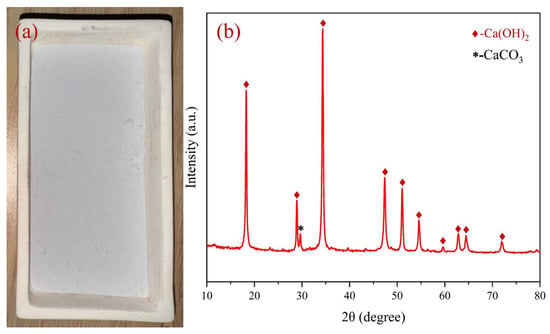
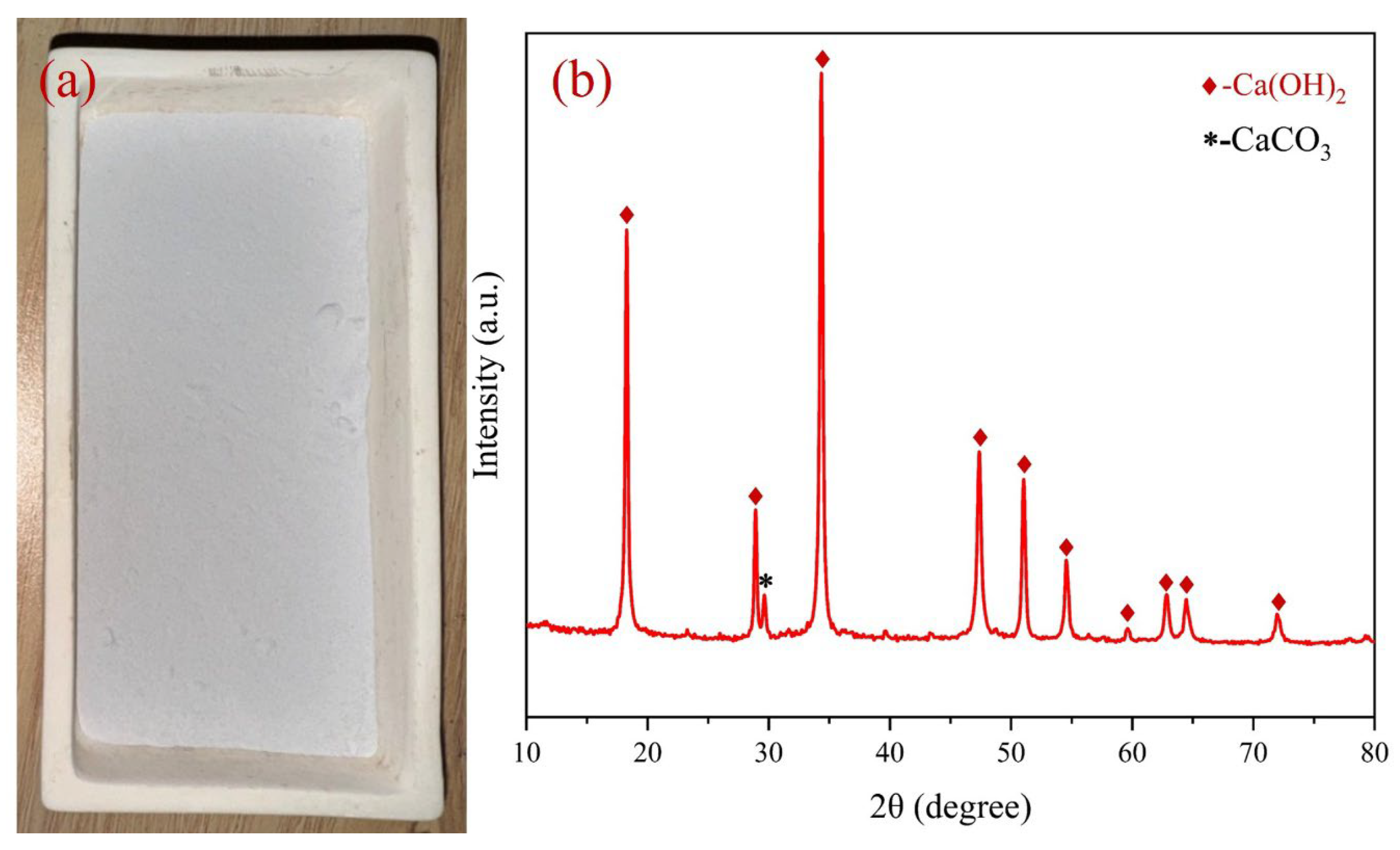
The carbide slag (CS) used in this study was obtained from a chemical plant in Changzhi, Shanxi Province, China. The slag was collected from a dry ground surface, and its physical appearance is shown in Figure 1a. High-purity CO2 gas with a purity of 99.99% was supplied from a gas cylinder. Deionized water was used in all experiments and was supplied by the laboratory. The whiteness value of the CS was measured to be 74. The chemical composition of the slag is listed in Table 1, and its XRD pattern is presented in Figure 1b.
Figure 1.
(a) Physical state of CS; (b) XRD diagram of CS.
Table 1.
Chemical composition of CS.
2.2. Process Route Design and Experimental Procedure
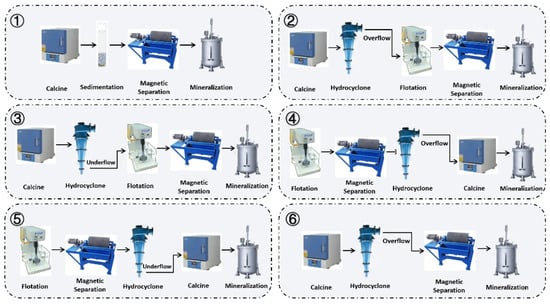
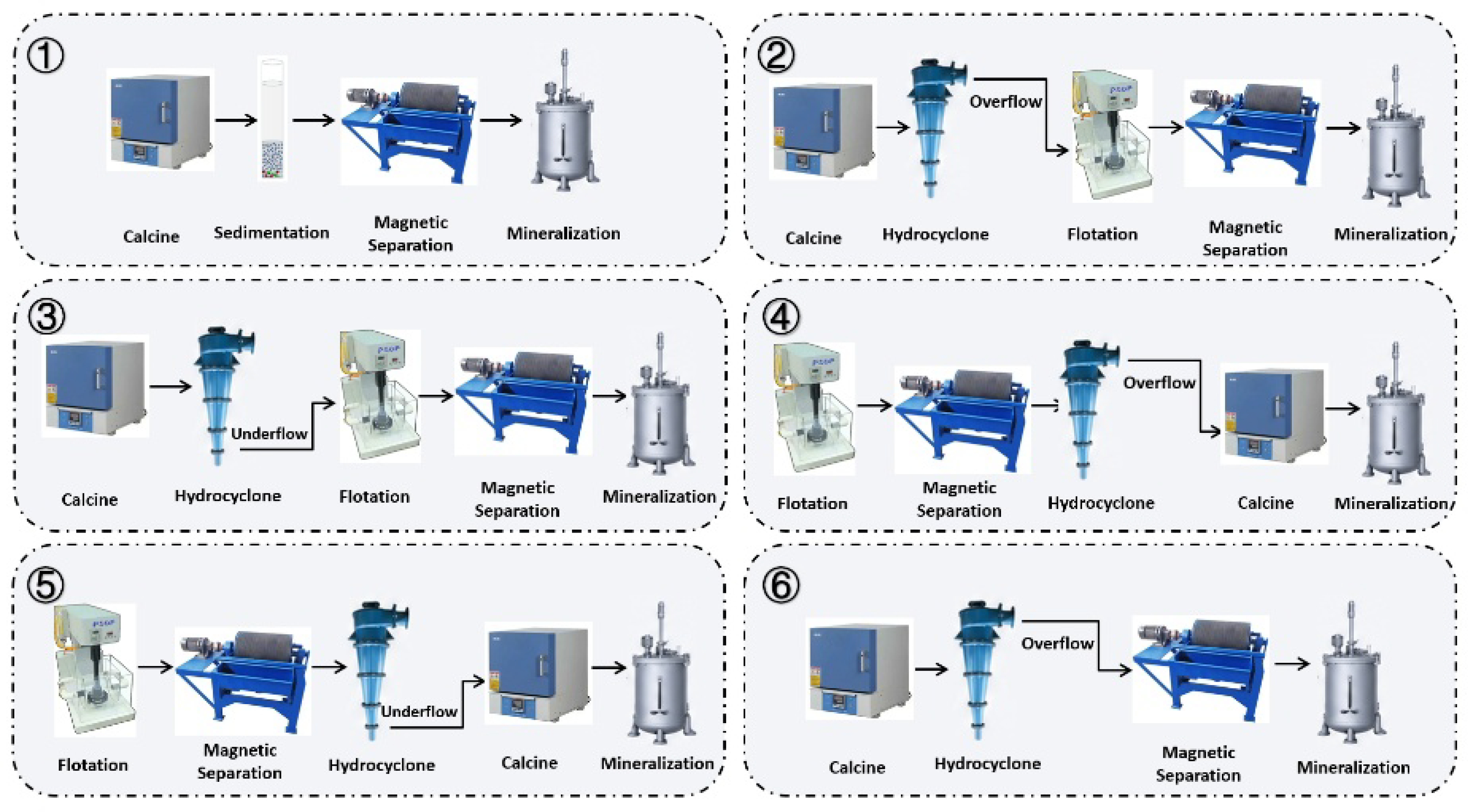
To investigate the effects of process sequence and separation-stream selection on impurity partitioning and the quality of mineralized products derived from CS, six contrasting process routes integrating calcination, sedimentation or hydrocyclone classification, flotation, magnetic separation, and CO2 mineralization were designed. Figure 2 provides a schematic overview of the six routes, while their operation sequences, the streams selected after each separation step, the principal operating conditions, and the corresponding final product codes are summarized in Table S1 in the Supplementary Materials. For the calcination treatment, 50.00 g of CS was placed in a crucible and calcined in a muffle furnace at 900 °C for 3 h [17]. For hydrocyclone classification, the product was slurried at a solid-to-liquid ratio of 1:20 and then classified in a hydrocyclone with a cone angle of 5.5° under a pressure of 0.78 MPa; the overflow and underflow fractions were collected separately. Flotation was conducted using an XFD III-1L flotation machine at a slurry concentration of 100 g/L, an impeller speed of 2000 r/min, a scraper speed of 40 r/min, and an aeration rate of 0.2 m3/h under the natural slurry pH. In the first reverse-flotation stage, sodium hexametaphosphate (400 g/t), lauric acid (50 g/t), and 2# oil (50 g/t) were sequentially added as the depressant, collector for silicate-bearing impurities, and frother, with conditioning times of 3, 3, and 1 min, respectively. In the subsequent decarbonization stage, kerosene (100 g/t) and 2# oil (50 g/t) were added as the collector for carbonaceous impurities and frother and conditioned for 3 and 1 min, respectively [15]. The froth was collected for 4 min as the impurity-rich tailings, while the material remaining in the cell was recovered as the concentrate. Sodium hexametaphosphate had a purity of ≥97%, and the other reagents had purities of ≥98%. Magnetic separation was performed using a magnetic rod with a magnetic flux density of ≥0.5 T, a diameter of 25 mm, and a length of 300 mm. For the mineralization reaction, the pretreated calcium-rich material was dispersed in deionized water at a solid-to-liquid ratio of 1:100 (g/mL). Carbonation was conducted at 25 °C in an open 250 mL beaker containing 200 mL of suspension under atmospheric pressure. High-purity CO2 (≥99.9 vol.%) was introduced at 300 mL/min under stirring at 900 r/min. The suspension pH decreased from approximately 13 to 7 within approximately 10 min, at which point the reaction was terminated [18]. The calcium carbonate product was subsequently obtained by filtration and drying. Three parallel samples were prepared for the final product of each route, which were coded as R1–R6 according to their corresponding process routes. Concurrently, the following intermediate products were collected to track the migration and enrichment behavior of impurities in different processes: the calcined product A, the hydrocyclone overflow product B, the hydrocyclone underflow product C, the overflow–flotation–magnetic separation product D, and the calcination–overflow–magnetic separation product E.
Figure 2.
Process flow diagram of the six CS treatment routes. The arrows indicate the sequential order of the unit operations: ① calcination → sedimentation → magnetic separation → CO2 mineralization; ② calcination → hydrocyclone classification → flotation → magnetic separation → CO2 mineralization; ③ calcination → hydrocyclone classification → flotation → magnetic separation → CO2 mineralization; ④ flotation → magnetic separation → hydrocyclone classification → calcination → CO2 mineralization; ⑤ flotation → magnetic separation → hydrocyclone classification → calcination → CO2 mineralization; ⑥ calcination → hydrocyclone classification → magnetic separation → CO2 mineralization.
2.3. Characterization and Test Methods
The particle-size distributions of CS were determined using LPSA (Mastersizer 3000, Malvern Panalytical, Malvern, UK). The S/L was 1/10, and the dispersing medium was aqueous ethanol. The chemical composition of CS was analyzed using XRF (Panalytical Axios, Malvern Panalytical, Almelo, The Netherlands). The mineral compositions of raw materials and products were obtained by XRD (D2 PHASER, Bruker AXS GmbH, Karlsruhe, Germany). The test conditions were as follows: the slit width was 0.38 mm, the diffraction angle was 10–80°, and the scanning rate was 0.02°/s. TGA (Setaram, Lyon, France) was used to analyze the thermal gravimetric characteristics of raw materials and products. The test conditions were as follows: an N2 atmosphere, the heating range was 20–1000 °C, and the heating rate was 10 °C/min. An FT-IR spectrometer (Perkin-Elmer Frontier, Waltham, MA, USA) was used for infrared spectrum analysis. Inductively coupled plasma optical emission spectrometry (ICP-OES, model Agilent 5800, Agilent Technologies, Inc., Santa Clara, CA, USA) was employed for quantitative elemental analysis of solid samples. Approximately 0.05 g of each sample (actual masses: 0.0462–0.0574 g) was digested in 9 mL of aqua regia and 1 mL of HF using a three-stage microwave program with final digestion at 200 °C for 40 min. The morphology and elemental composition of raw materials and products were observed via SEM-EDS (SEM, JSM-IT500HR, JEOL, Tokyo, Japan). EPMA was performed using an electron probe microanalyzer (JXA-8230, JEOL, Tokyo, Japan). The whiteness of the calcium carbonate product was measured using a whiteness meter (WSL-B, Shanghai Inesa Physical and Optical Instruments Co., Ltd., Shanghai, China) in accordance with the Chinese national standard GB/T 23774-2009 [19]. Before each measurement series, the instrument was zero-calibrated using the supplied black cylinder and calibrated using the instrument-matched standard white plate with a certified whiteness value of 95.9. Its purity was determined on a dry-mass basis via EDTA titration following the Chinese national standard GB/T 19281–2014 [20], with appropriate masking agents used to minimize interference from coexisting metal ions.
2.4. Calculation Methods
The impurity removal rate was calculated according to Equation (1):
where is the concentration reduction in impurity , and and are its contents in the reference material and the resulting product, respectively. The reference and resulting materials used for each calculation are specified when the corresponding results are discussed.
To quantitatively evaluate hydrocyclone separation, the solid yield of each hydrocyclone product was calculated using Equation (2):
The recovery of element to product was calculated using Equation (3):
The elemental mass closure was calculated as follows:
To account for deviations from complete elemental mass closure, the normalized distribution of element between the recovered overflow and underflow products was calculated using Equation (5):
where is the solid yield of product , is the recovery of element to product , is the mass closure of element , and is the normalized distribution of element to product . Here, , , and represent the dry masses of hydrocyclone feed A, overflow B, and underflow C, respectively; is the dry mass of product , where denotes overflow B or underflow C; and , , and are the mass fractions of element in the corresponding streams.
3. Results and Discussion
3.1. Occurrence States of Impurities and Calcination-Induced Dissociation Mechanism
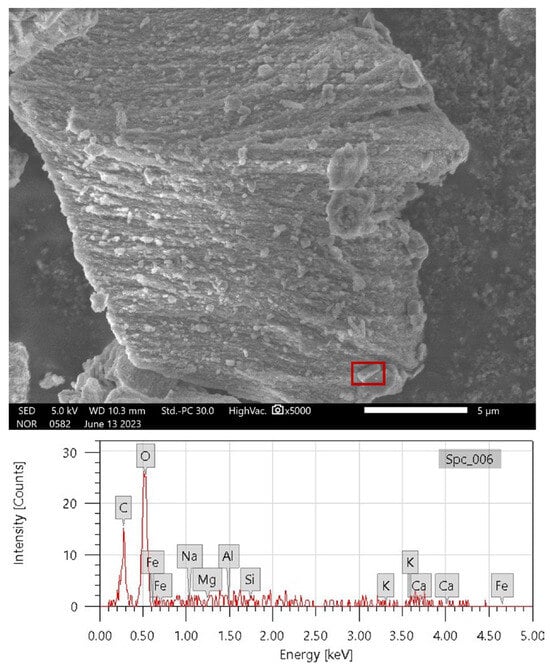
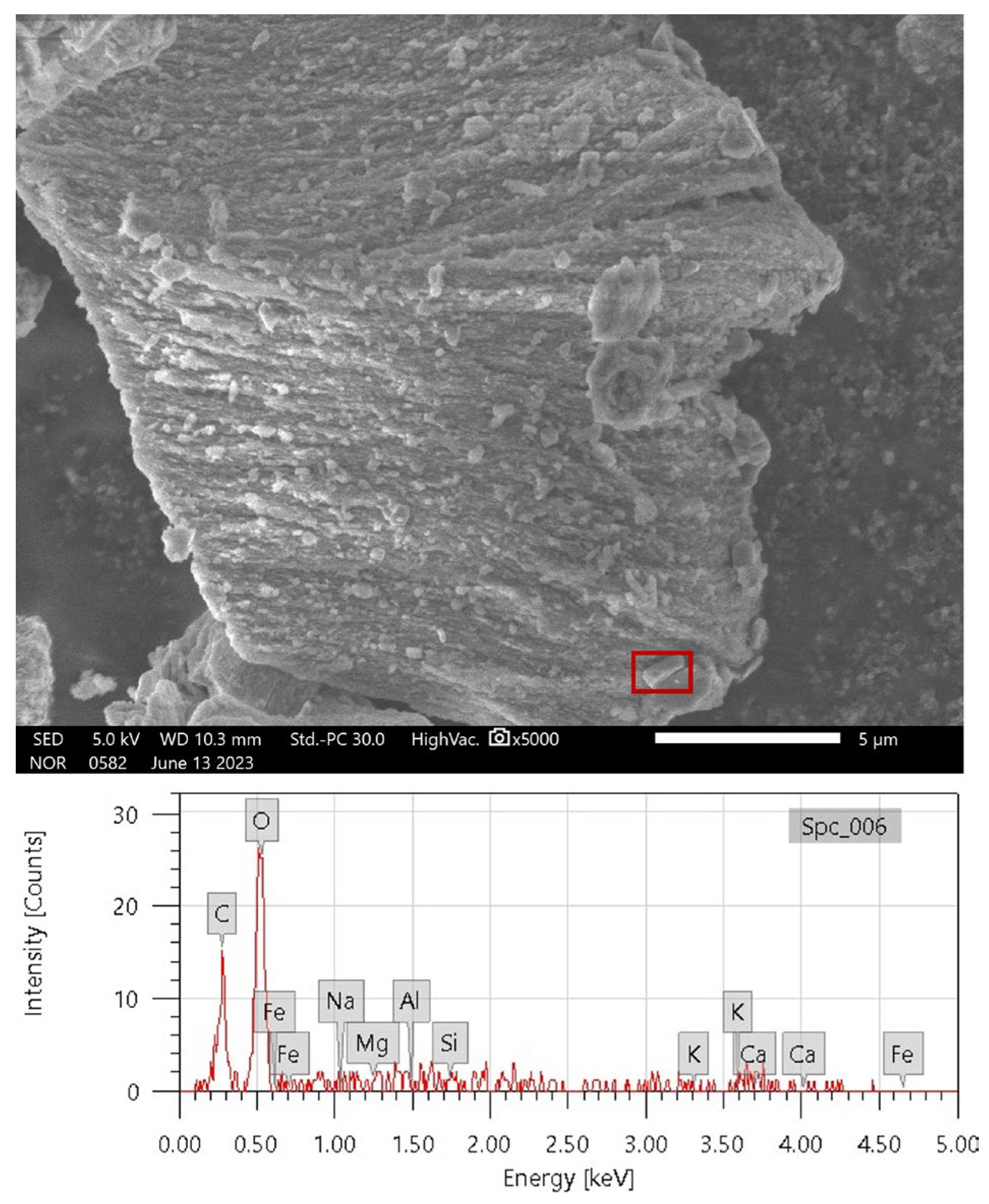
To clarify the occurrence characteristics of the major elements in CS, SEM-EDS analyses were conducted on the raw material. As shown in Figure 3, the Ca phase in the slag was predominantly distributed in a lamellar structure, accompanied by a minor number of rod-like particles and blocky carbonate phases. The EDS results revealed that the raw material was dominated by Ca, together with a small quantity of impurity elements such as Si, Al, Mg, and Fe. These results collectively suggest that the impurities in CS did not exist entirely as discrete particles; rather, at least part of them may have been agglomerated, encapsulated within, or associated with the dominant calcium phases to varying degrees, by which the difficulty in achieving efficient impurity removal through a single physical separation process was largely accounted for.
Figure 3.
SEM-EDS diagram of CS. The red box highlights the representative microscopic morphology of the carbide slag.
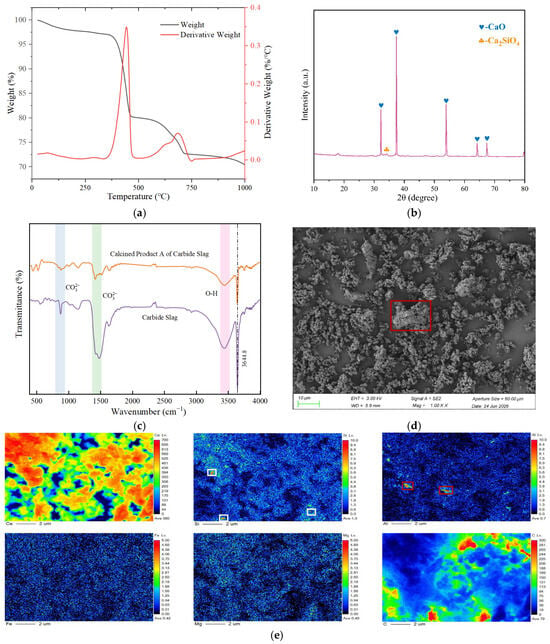
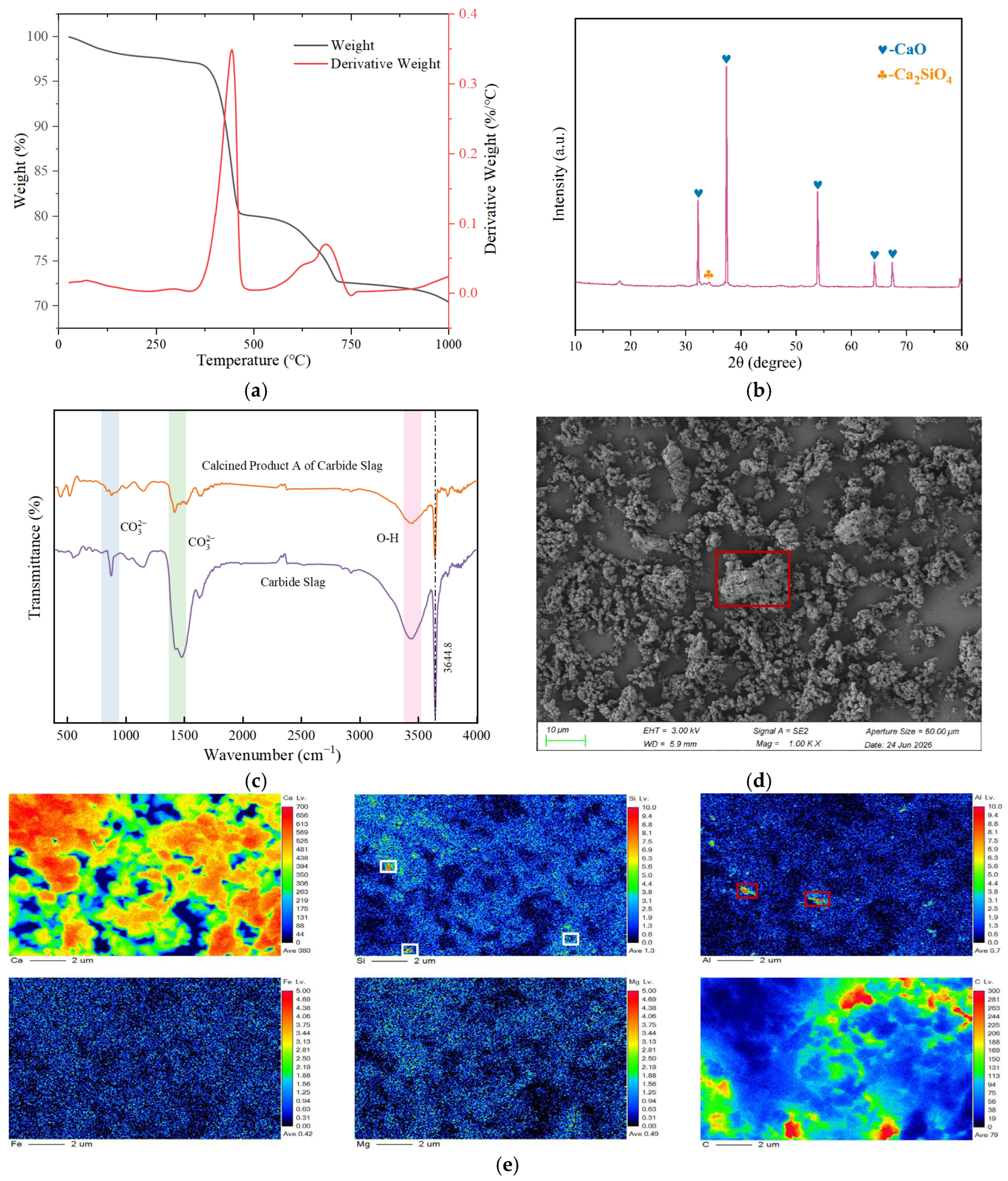
The TG-DTG results in Figure 4 indicate that CS mainly undergoes adsorbed water removal, dehydroxylation of Ca(OH)2, and decomposition of CaCO3 during heating. The XRD results qualitatively indicate marked transformations of the Ca(OH)2- and CaCO3-bearing phases after calcination, accompanied by the occurrence of prominent CaO reflections and newly detected Ca2SiO4. The changes in the hydroxyl and CO32− characteristic absorption bands in the FTIR spectra were further consistent with the dehydroxylation of Ca(OH)2 and carbonate decomposition. Representative SEM-EDS and EPMA observations after calcination show that irregular agglomerates remained in the calcined product, with Ca being broadly distributed, but exhibited localized enrichment or discrete distributions. These microscopic observations suggest that calcination did not directly achieve deep impurity removal; instead, they indicate calcination-induced transformation of the Ca-bearing phases and changes in the local occurrence and association through calcium phase transformation and silicon phase reconstruction.
Figure 4.
Characterization of raw and calcined CS: (a) TG-DTG curves of the CS; (b) XRD pattern of the calcined CS; (c) FTIR spectra of the raw and calcined CS; (d) SEM micrographs of calcined CS, with the red box highlighting its representative microscopic morphology; (e) EPMA elemental distribution maps of calcined CS, with the red and white boxes highlighting regions of local elemental aggregation.
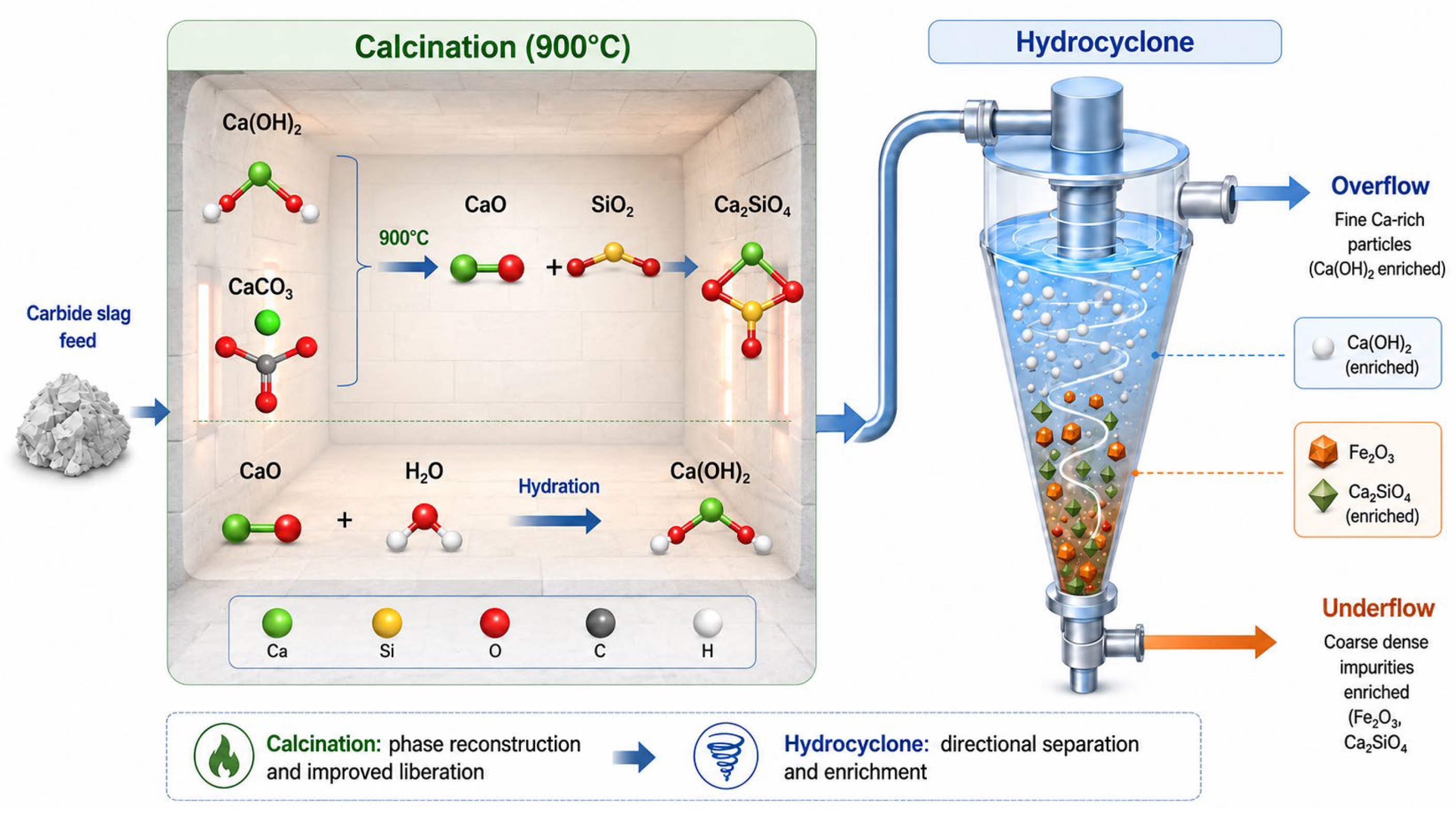
This heterogeneous distribution suggests that the separability of impurities in CS may not depend solely on their density or magnetic properties, but may also be affected by their association with calcium-rich phases. For Si, Al, and other impurities embedded in calcium-rich phases as fine composite particles, inclusions, or agglomerates, selective separation by a single physical separation method is difficult, even when differences in particle size or density exist before structural reconstruction. Therefore, the mechanistic role of calcination in this system should be understood as calcination-induced dissociation rather than direct impurity removal. The thermal decomposition of Ca(OH)2 and CaCO3 weakens the structural stability of the original calcium-rich agglomerates, while the conversion of siliceous fractions into Ca2SiO4 or silicate composite phases may alter the particle size, density, and interfacial properties of impurity-bearing phases. As a result, impurities may be partially transformed from an associated and embedded state into a more separable particulate state, thereby enhancing the differential migration between calcium-rich and impurity-rich phases in the subsequent hydrocyclone flow field [21,22]. The relevant reactions can be expressed as follows:
Ca(OH)2 → CaO + H2O
CaCO3 → CaO + CO2
2CaO + SiO2 → Ca2SiO4
3.2. Synergistic Regulation of Directed Impurity Partitioning via Hydrocyclone Classification and Magnetic Separation
Calcination-induced phase reconstruction may modify the particle size, effective density, and liberation state of calcium-rich and impurity-bearing phases, thereby creating conditions for their subsequent hydrocyclone separation. Unlike conventional screening based primarily on geometric particle size, hydrocyclone partitioning may be jointly influenced by particle size, effective density, phase composition, and agglomeration state. The XRD and SEM-EDS results suggest that calcination transformed part of the siliceous components into Ca2SiO4 or silicate composite phases and may have promoted the partial liberation of Si- and Fe-bearing particles from the calcium-rich matrix. During slurry conditioning, CaO was hydrated to form Ca(OH)2:
CaO + H2O → Ca(OH)2
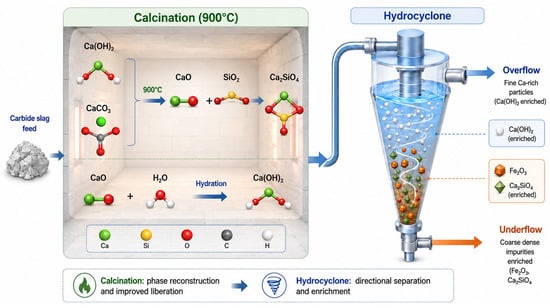
The relatively fine Ca-rich particles may preferentially report to the overflow, whereas some impurity-bearing particles may preferentially partition into the underflow under the centrifugal field. Figure 5 presents a conceptual interpretation integrating the XRD, SEM-EDS, particle-size distribution, and bulk compositional results rather than directly observed or quantitatively simulated particle trajectories. Accordingly, the illustrated particle paths represent proposed partitioning trends that are consistent with experimental evidence.
Figure 5.
Conceptual schematic of the proposed preferential partitioning of Ca-rich and impurity-bearing phases during the calcination–hydrocyclone treatment of CS.
The physical properties of the identified phases provide a possible basis for interpreting this partitioning behavior. Because the density difference between Ca(OH)2 and SiO2 is limited, siliceous impurities remaining in fine-grained or encapsulated forms may be difficult to separate directly [23,24,25,26]. The formation of Ca2SiO4 or other silicate composite phases during calcination may alter the effective density, particle size, and association state of the siliceous material. Iron-bearing phases, such as Fe2O3, may similarly exhibit a greater tendency to report to the underflow [27]. The current evidence does not permit the effects of particle size, effective density, phase composition, agglomeration, and interfacial properties to be distinguished quantitatively. These properties are therefore regarded as possible contributing factors rather than independently verified controlling mechanisms.
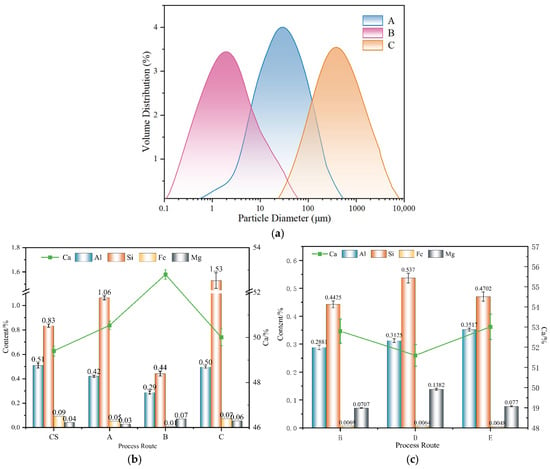
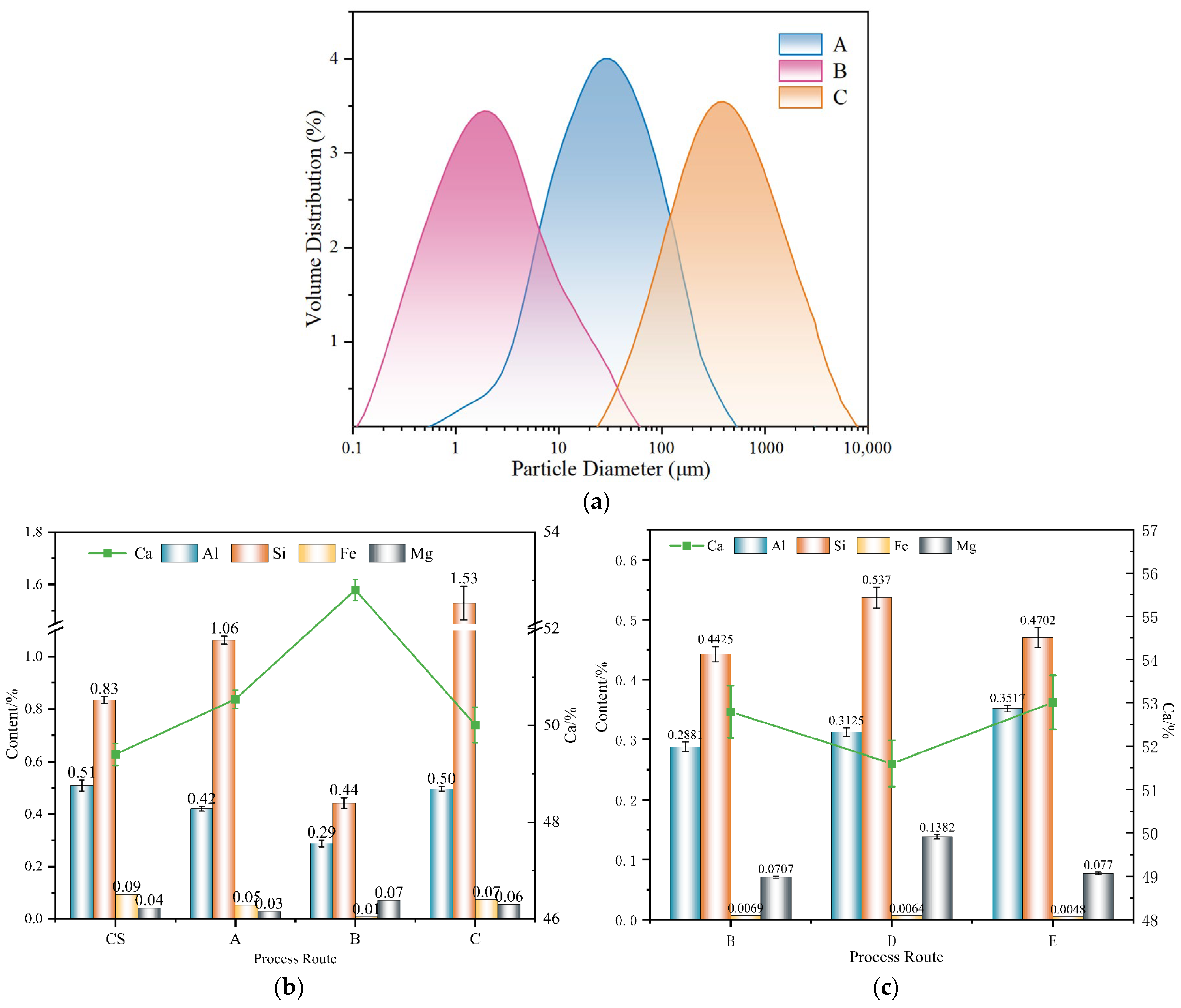
The particle-size distributions of samples A, B, and C are presented in Figure 6a. The D10, D50, and D90 values were 5.2, 27.6, and 129.0 μm for sample A; 0.4, 2.0, and 13.1 μm for sample B; and 89.8, 416.5, and 1740.6 μm for sample C, respectively. These results demonstrate that the characteristic particle sizes increased in the order B < A < C. The observations indicate size-dependent particle partitioning and are consistent with the preferential occurrence of calcium-rich fine particles in the overflow.
Figure 6.
Particle-size distributions and elemental contents of the raw material and intermediate products: (a) particle-size distributions; (b) variation in Ca and impurity contents; and (c) variation in Ca and impurity contents in products B, D, and E. Products A, B, and C represent the calcined product, hydrocyclone overflow product, and hydrocyclone underflow product, respectively; products D and E represent the overflow–flotation–magnetic separation product and the calcination–hydrocyclone overflow–magnetic separation product, respectively.
The dry mass distribution and elemental mass balances were further evaluated to quantify hydrocyclone performance (Table S2). From 100.0 g of A, 31.5 g of overflow B and 65.4 g of underflow C were recovered, corresponding to solid yields of 31.5% and 65.4%, respectively, with a solid mass closure of 96.9%. As shown in Figure 6b, the Ca content increased moderately from 50.5408% in feed A to 52.7964% in overflow B, whereas the Al, Si, and Fe contents decreased from 0.4210%, 1.0637%, and 0.0531% to 0.2881%, 0.4425%, and 0.0069%, respectively. However, only 32.9% of the feed Ca was recovered in the overflow, which was close to the overflow solid yield of 31.5%, suggesting only modest selective enrichment of Ca.
The overflow recoveries of Al, Si, and Fe were 21.6%, 13.1%, and 4.1%, respectively, all lower than the overflow solid yield. After normalization to the recovered overflow and underflow products, 78.2% of Al, 87.7% of Si, and 95.6% of Fe were distributed to the underflow, compared with 66.3% of Ca. These results suggest that the improved composition of the overflow arose mainly from the preferential partitioning of impurity-bearing material to the underflow rather than from strong selective recovery of Ca to the overflow. This interpretation is consistent with the finer particle-size distribution of overflow B and the coarse-particle enrichment of underflow C.
Although overflow collection improved precursor purity, only 32.9% of the feed Ca was recovered in this stream, whereas 64.7% was distributed to the underflow. Hydrocyclone classification under the tested conditions therefore involved a clear trade-off between impurity rejection and Ca recovery. Future investigations may explore multi-stage hydrocyclone classification, underflow reclassification, or stream recirculation as potential strategies for improving Ca recovery while maintaining impurity rejection.
Magnetic separation was subsequently applied as a polishing step for the residual Fe-bearing material in the hydrocyclone overflow. As shown in Figure 6c, the Fe content of product E was lower than that of overflow B. This compositional difference indicates that some residual Fe-bearing material may have been removed during magnetic separation. Because the preceding calcination and hydrocyclone steps had already reduced the impurity load of the overflow, the results are consistent with magnetic separation acting more selectively on the remaining Fe-bearing material in the calcium-rich precursor.
Overall, the characterization results support a sequential interpretation in which calcination-induced phase reconstruction may promote the liberation of calcium-rich and impurity-bearing phases, hydrocyclone classification preferentially partitions impurity-bearing material toward the underflow, and magnetic separation further reduces the residual Fe content of the overflow. The elemental recoveries and normalized distributions provide bulk evidence of hydrocyclone partitioning and complement the local SEM-EDS and EPMA observations.
3.3. Tailoring Impurity Partitioning Pathways via Process Sequence and Its Effect on Product Quality
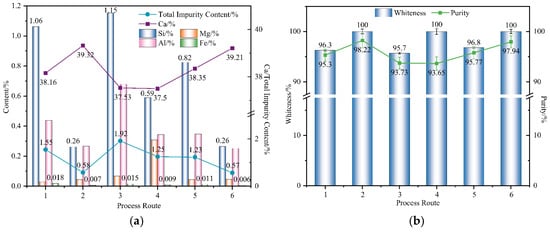
We now analyze how process sequence affects impurity partitioning (Si, Fe, and Al) by correlating the elemental composition, whiteness, and purity of the final products. Product quality among the six routes appears to hinge not only on the number of separation steps, but on the efficiency of impurity removal during pretreatment. Figure 7 compares the Ca content, impurity levels, whiteness, and purity across the six routes, revealing the effect of process sequence on final product quality.
Figure 7.
Effect of different process routes on product quality: (a) Ca and impurity content of the final products from different routes; (b) whiteness and purity of the final products from different routes.
In both Route 2 and Route 6, the hydrocyclone overflow was employed as the mineralization precursor, whereas in Route 3, the hydrocyclone underflow was selected to enter the subsequent flotation, magnetic separation, and mineralization processes. Therefore, the critical difference among the three routes is determined not by whether a hydrocyclone unit is used, but by which stream is chosen to proceed into the mineralization system after hydrocyclone classification. As discussed in Section 3.1, the entry of Si-, Fe-, and Al-rich fractions into the mineralization system may be substantially reduced when the overflow is selected, whereas the impurities that have been enriched in the hydrocyclone stage may be reintroduced into the subsequent reaction process when the underflow is taken. This difference in impurity partitioning pathways is clearly manifested in the final products. As shown in Figure 7a, the final products from Routes 2 and 6, both of which used the hydrocyclone overflow, exhibited lower residual Si contents. The detailed elemental compositions of the final products obtained from the six routes are provided in Table S3 in Supplementary Materials. In contrast, the highest residual Si content is observed in the product of Route 3, and it is accordingly suggested that the silica-rich components carried by the hydrocyclone underflow cannot be adequately removed even after subsequent flotation and magnetic separation treatments and are ultimately retained in the CaCO3 product. Consequently, the relatively poor product quality of Route 3 may be primarily attributed to the alteration of the impurity partitioning caused by underflow sampling, by which the already enriched Si-, Fe-, and Al-bearing fractions are subjected to a reflux input.
The difference between Route 1 and Route 6 indicates that the migration efficiency of silica-rich impurities is significantly affected by the classification method. In sedimentation, particle separation is mainly dependent on the gravity field; the separation intensity and classification precision of sedimentation are lower than those of the hydrocyclone centrifugal field, by which the effective separation of the silicate composite particles, Si-rich agglomerates, and insufficiently dissociated impurity particles formed after calcination is rendered difficult. As a result, some Si-rich fractions are entrained into the mineralization system together with the precursor. Therefore, a significantly higher Si content is exhibited in the final product of Route 1 than in that of the hydrocyclone overflow route, and a greater advantage is possessed by hydrocyclone classification in regulating the migration directions of the calcium-rich and impurity-rich phases.
Only small differences were observed in the Ca content, major impurity residues, whiteness, and purity between the final products of Route 2 and Route 6, by which it was indicated that after a low-impurity calcium-rich precursor had been formed by the hydrocyclone overflow, the migration pathways of impurities such as Si and Fe were not significantly altered by flotation. Since a substantial fraction of the Si- and Fe-rich material may have already been discharged via the hydrocyclone underflow, the further reduction in residual impurities that could be achieved by flotation was limited. Route 2 required an additional flotation step and the addition of sodium hexametaphosphate, lauric acid, kerosene, and 2# oil. A low total impurity content was still obtained in Route 6 without the introduction of flotation, and it was thus indicated that an effective graded impurity partitioning control pathway may have been established by the calcination–hydrocyclone overflow–magnetic separation sequence.
In terms of the influence of key impurities on product properties, the differentiation of product quality among different routes is caused primarily by Si and Fe. The foundation of product purity is determined by the retention of Si-rich particles in the hydrocyclone, while the whiteness of the product is further improved by the removal of residual Fe through the subsequent magnetic separation. Low Si and Fe residues are exhibited in Route 6, and a total impurity content of 0.57%, a whiteness of approximately 100% ± 1.2%, and a CaCO3 purity of 98.3% ± 1.45% (mean ± SD, n = 3) are achieved for the final product, indicating that the impurity partitioning pathway in this route is the most favorable for the formation of high-purity and high-whiteness CaCO3.
To further summarize the relationship between impurity partitioning direction and product response in different routes, the key process nodes, impurity partitioning directions, terminal residue characteristics, and mechanistic judgments of representative routes are summarized in Table 2.
Table 2.
Impurity partitioning pathways and terminal residual characteristics under different process routes.
In summary, it can be concluded that the differences in product quality induced by different process sequences are essentially attributed to the differences in the migration pathways of impurities such as Si, Fe, and Al. Through the hydrocyclone overflow, the calcium-rich fine particles are directed into the mineralization system, while the impurity-rich particles are discharged; by taking the underflow, the already enriched impurities are reintroduced into the subsequent mineralization process. The purity of the product is mainly affected by the terminal residue of Si, whereas the whiteness of the product is significantly influenced by the terminal residue of Fe. It is thus understood that the key to the preparation of high-quality CaCO3 from CS mineralization lies not in the simple addition of separation units, but rather in the impurity partitioning direction being controlled through a rational process sequence. Among the routes investigated, the synergistic effect of front-end dissociation, intermediate desilication, and terminal iron removal is achieved by the calcination–hydrocyclone overflow–magnetic separation–mineralization route, and a rational process pathway is thereby provided for the construction of a low-impurity calcium-rich precursor and the production of high-purity, high-whiteness CaCO3.
3.4. Validation of the Structure and Quality of Mineralized Products Under Impurity Partitioning Regulation
It was demonstrated by the preceding results that the migration pathways of impurities such as Si, Fe, and Al during the pretreatment process are altered by different process sequences, by which whether these impurities enter the subsequent mineralization system is further determined. In this section, the effect of impurity partitioning regulation on the structure and properties of the CaCO3 products is verified by examining the phase composition, micromorphology, and quality indicators of the final products.
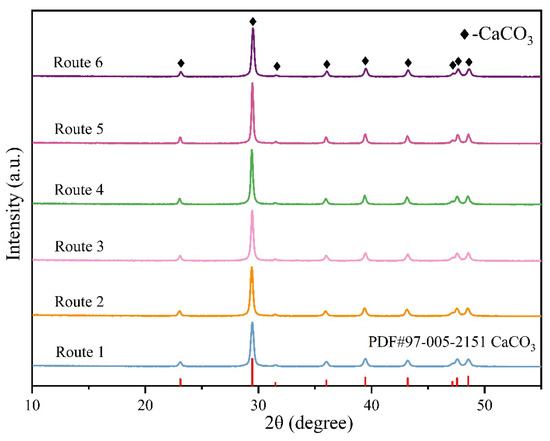
The XRD patterns of the final products obtained from the six process routes are presented in Figure 8. From these patterns, the main diffraction peaks of the products from each route were found to be consistent with calcite-type CaCO3, and it was thus indicated that the conversion of the Ca phase into CaCO3 was achieved under different process sequences, with the dominant crystalline form being essentially unaltered. Nevertheless, differences were still observed among the patterns of the various routes in terms of weak impurity peaks, background signals, and peak purity. For the product of Route 6, the characteristic peaks of calcite were relatively well-defined, and the contribution from impurity phases was weak; it was thereby indicated that the entry of Si-, Fe-, and Al-rich components into the mineralization system was effectively blocked by the calcination–hydrocyclone overflow–magnetic separation sequence, and the phase purity of the final product was consequently improved. In contrast, when the hydrocyclone underflow was adopted as the mineralization precursor in Route 3, the impurities that had been enriched in the underflow were reintroduced into the mineralization process, by which the retention of non-CaCO3 components was more likely to be induced.
Figure 8.
XRD patterns of the final products from the six process routes.
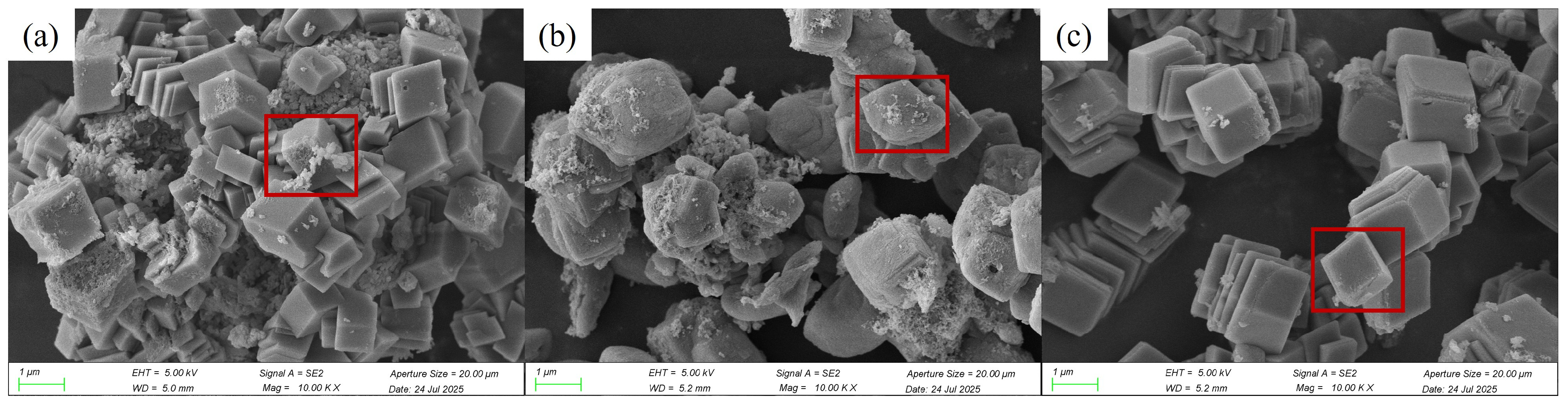
Representative local regions of the products obtained from different routes are highlighted by red boxes in Figure 9, allowing comparison of the agglomeration degree, surface attachment, and particle homogeneity of CaCO3 particles. The product from Route 2 showed a certain degree of particle accumulation and localized surface attachment, although its overall morphology was relatively similar to that of Route 6. In contrast, the product from Route 3 exhibited more irregular agglomeration and flake-like or massive attachments in the red boxed region, suggesting that Si-, Fe-, and Al-rich impurities enriched in the hydrocyclone underflow may have interfered with the homogeneous growth of CaCO3 particles during mineralization. The product from Route 6 showed a more uniform particle distribution and a lower degree of agglomeration in the red boxed region, indicating that the low-impurity Ca-rich precursor obtained through calcination, hydrocyclone overflow collection, and magnetic separation was more conducive to the formation of a homogeneous CaCO3 product.
Figure 9.
SEM micrographs of the final products from Route 2 (a), Route 3 (b), and Route 6 (c). The red boxes highlight the representative microscopic morphology of the final CaCO3 products.
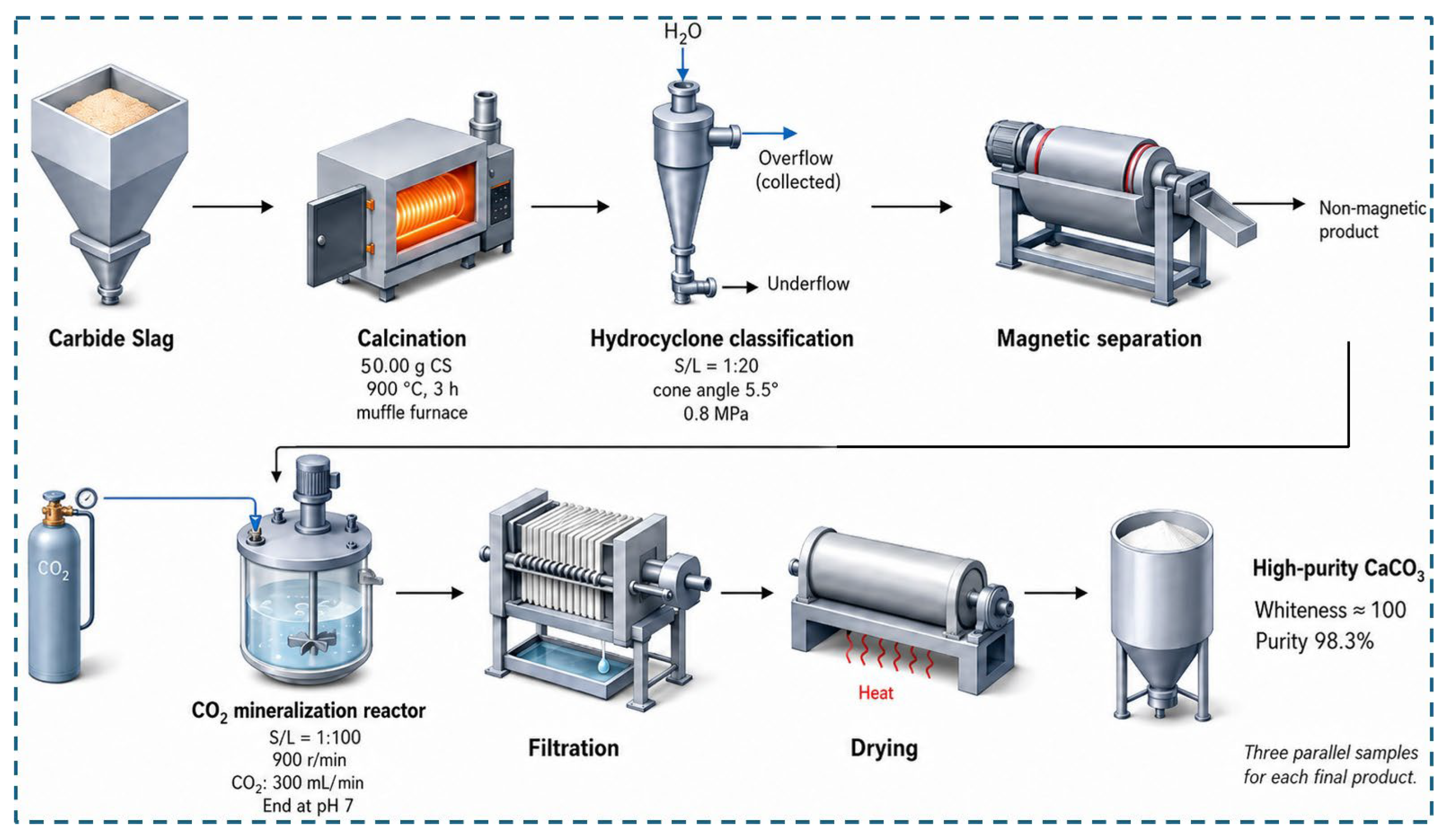
In summary, Route 6, consisting of calcination, hydrocyclone overflow collection, magnetic separation, and mineralization, was identified as the optimal route for achieving high product quality among the six routes investigated. To illustrate its process integration and product formation pathway, the optimized process flow is shown in Figure 10. The resulting product exhibited a total impurity content of only 0.57%, a whiteness close to 100%, and a CaCO3 purity of 98.3%, indicating that the controlled migration of Si-, Fe-, and Al-bearing impurities during pretreatment was ultimately translated into superior product quality. In terms of phase composition, the XRD pattern of the R6 product was dominated by the characteristic peaks of calcite-type CaCO3, with only weak peaks attributable to impurity phases, indicating high phase purity. Regarding microscopic morphology, the R6 product exhibited a more uniform particle distribution, less agglomeration, and fewer impurities attached to the particle surfaces, further suggesting that the low-impurity, calcium-rich precursor facilitated the homogeneous nucleation and growth of CaCO3. Overall, Route 6 achieved the best product quality among the investigated routes in terms of elemental composition, whiteness, CaCO3 purity, phase composition, and micromorphology, although further process optimization is required to improve overall Ca recovery. Estimated overall recoveries of Ca, Si, Fe, Al, and Mg from the calcined hydrocyclone feed to the final Route 6 product are summarized in Table S4; these values represent estimated overall recoveries. These findings verify the effectiveness of the sequential impurity-control pathway involving calcination-enhanced phase dissociation, hydrocyclone classification for desilication, and subsequent iron removal by magnetic separation.
Figure 10.
Flowchart of the optimized process.
A preliminary material-based carbon assessment was conducted for Route 6 using the measured product yield, CaCO3 purity, Ca content of the mineralization feed, calcination mass yield, and TG-derived CO2 release from native CaCO3 decomposition. The calculation methods, assumptions, and quantitative results are summarized in Table S5. The results indicate that most of the Ca recovered in the hydrocyclone overflow was converted into CaCO3 during mineralization. After accounting for the CO2 released through native CaCO3 decomposition during calcination, the process retained a positive direct CO2 uptake on a material-balance basis.
Compared with non-calcination direct mineralization, the present route requires greater energy input but promotes the liberation and subsequent separation of impurity-bearing phases, thereby improving product purity and whiteness. Compared with indirect mineralization based on acid, alkali, or ammonium-salt extraction, the physical purification sequence reduces chemical consumption and avoids the associated acidic or saline wastewater. Its environmental performance should therefore be interpreted as a trade-off among thermal energy demand, product quality, reagent consumption, wastewater generation, and calcium recovery.
4. Conclusions
To investigate impurity partitioning and the influence of process sequencing during the production of high-purity and high-whiteness CaCO3 through CO2 mineralization of carbide slag, six coupled pretreatment and mineralization routes were comparatively evaluated. The characterization results suggest that Si-, Fe-, Al-, and other impurity-bearing components occurred in association with, or were locally encapsulated within or agglomerated with, Ca-rich phases, which may limit their removal through a single physical separation step. Calcination induced substantial transformations of the original Ca-bearing phases, including the formation of CaO and calcium silicate phases. These changes may have altered the association state, particle size, effective density, and phase composition of the material, thereby contributing to its subsequent separation behavior during hydrocyclone classification.
Following calcination, hydrocyclone classification resulted in the preferential partitioning of finer, moderately Ca-enriched material into the overflow and impurity-bearing material into the underflow. The Si and Fe concentrations in the overflow decreased by 58.4% and 86.9%, respectively, relative to the hydrocyclone feed. This lower-impurity overflow may also have facilitated the subsequent magnetic removal of residual Fe-bearing material. These observations are consistent with the proposed separation interpretation, although the individual particle trajectories and controlling mechanisms were not directly determined. Among the six routes, the calcination–hydrocyclone overflow–magnetic separation–mineralization route produced CaCO3 containing 0.57% total impurities, with a whiteness approaching 100% ± 1.2% and a purity of 98.3% ± 1.45% (mean ± SD, n = 3). Based on 100.0 g of calcined feed before hydrocyclone classification, the estimated final-product mass yield, overall Ca recovery, and CaCO3 mass yield were 39.75%, 31.0%, and 39.08%, respectively, indicating a trade-off between product quality and Ca recovery under the present single-stage hydrocyclone conditions.
Route 6 should be regarded as the preferable laboratory-scale method in terms of product quality, chemical input, and process configuration within the scope of this study, rather than as a fully optimized industrial process. Further optimization should focus on improving calcium recovery and product yield while reducing energy and water requirements. Future investigations may combine multi-stage hydrocyclone separation or underflow recirculation with continuous inlet–outlet CO2 analysis and comprehensive life-cycle assessment to quantify the purity–recovery balance, carbon-mineralization performance, and environmental implications of the process more rigorously.
Supplementary Materials
The following supporting information can be downloaded at: https://www.mdpi.com/article/10.3390/su18168060/s1, Table S1: Summary of the operation sequences, selected streams, principal operating conditions, and final product codes for the six process routes; Table S2: Solid mass distribution and elemental partitioning during hydrocyclone classification; Table S3: Elemental compositions of the final CaCO3 products obtained from the six process routes; Table S4: Estimated overall elemental recoveries from the calcined hydrocyclone feed to the final product of Route 6; Table S5: Preliminary carbon-mineralization performance of Route 6 based on material-balance calculations.
Author Contributions
Conceptualization, H.C. and J.W.; methodology, J.W., W.X., Z.M., B.W. and X.L.; validation, J.W., H.C., W.X., Z.M., B.W. and X.L.; formal analysis, J.W.; investigation, J.W.; resources, H.C.; data curation, J.W.; writing—original draft preparation, J.W.; writing—review and editing, H.C.; visualization, J.W.; supervision, H.C.; project administration, H.C. All authors have read and agreed to the published version of the manuscript.
Funding
This research was funded by the National Key Research and Development Program of China (2022YFB4102100); the Key Research and Development Program of Changzhi City, Shanxi Province, China (2026-07); and the Cross-disciplinary Project of Shanxi University (2023).
Institutional Review Board Statement
Not applicable.
Informed Consent Statement
Not applicable.
Data Availability Statement
The original contributions presented in this study are included in the article. Further inquiries can be directed towards the corresponding author.
Conflicts of Interest
Author Xiaobing Li was employed by the company Shanxi Shanyu Calcium Industry Technology Co., Ltd. This employment had no influence on the study design, data analysis, results, or decision to publish the study. The remaining authors declare that the research was conducted in the absence of any commercial or financial relationships that could be construed as a potential conflict of interest.
References
- Sanna, A.; Uibu, M.; Caramanna, G.; Kuusik, R.; Maroto-Valer, M.M. A Review of Mineral Carbonation Technologies to Sequester CO2. Chem. Soc. Rev. 2014, 43, 8049–8080. [Google Scholar] [CrossRef] [Scilit] [PubMed]
- Gür, T.M. Carbon Dioxide Emissions, Capture, Storage and Utilization: Review of Materials, Processes and Technologies. Prog. Energy Combust. Sci. 2022, 89, 100965. [Google Scholar] [CrossRef] [Scilit]
- Li, W.; Huang, Y.; Wang, T.; Fang, M.; Li, Y. Preparation of Calcium Carbonate Nanoparticles from Waste Carbide Slag Based on CO2 Mineralization. J. Clean. Prod. 2022, 363, 132463. [Google Scholar] [CrossRef] [Scilit]
- Calcium Carbide—Market Share Analysis, Industry Trends & Statistics, Growth Forecasts (2026–2031). Available online: https://www.researchandmarkets.com/reports/4771917/calcium-carbide-market-share-analysis (accessed on 23 June 2026).
- Wang, S.; Lin, X.; Zhang, Y.; Wang, C. A Review of Utilizing Carbide Slag to Sequestrate Carbon Dioxide by Mineral Carbonation: Mechanisms, Processes, and Value-Added Products. Fuel 2025, 384, 134041. [Google Scholar] [CrossRef] [Scilit]
- Gong, X.; Zhang, T.; Zhang, J.; Wang, Z.; Liu, J.; Cao, J.; Wang, C. Recycling and Utilization of Calcium Carbide Slag—Current Status and New Opportunities. Renew. Sustain. Energy Rev. 2022, 159, 112133. [Google Scholar] [CrossRef] [Scilit]
- Gong, W.; Shen, P.; Tang, Y.; Wang, F. A Review in Calcium Carbide Slag Utilization for Carbonation: From Methods to Applications. Clean. Mater. 2026, 19, 100374. [Google Scholar] [CrossRef] [Scilit]
- Li, L.; Chen, J.; Lin, X.; Li, X.; Yan, J. Calcium-Based CO2 Indirect Mineralization of Alkaline Industrial Solid Wastes: State-of-the-Art Technologies. Renew. Sustain. Energy Rev. 2026, 226, 116467. [Google Scholar] [CrossRef] [Scilit]
- Cong, P.; Cheng, Y.; Ge, W.; Zhang, A. Mechanical, Microstructure and Reaction Process of Calcium Carbide Slag-Waste Red Brick Powder Based Alkali-Activated Materials (CWAAMs). J. Clean. Prod. 2022, 331, 129845. [Google Scholar] [CrossRef] [Scilit]
- Pan, Z.; Cao, C.; Wang, B.; Zhang, F.; Chen, L.; Zhao, J.; Zhang, Z.; Cheng, H. The Effects of Impurities in Carbide Slag on the Morphological Evolution of CaCO3 during Carbonation. J. Environ. Manag. 2024, 363, 121361. [Google Scholar] [CrossRef] [Scilit] [PubMed]
- Ma, J.; Chen, L.; Zhang, F.; Zhang, Y.; Lv, C.; Cui, J.; Zhou, X.; Guo, Y.; Pan, Z. Enhancing the Purity and Whiteness of Carbonated Products from Carbide Slag via Calcination and Magnetic Separation. Adv. Powder Technol. 2025, 36, 105063. [Google Scholar] [CrossRef] [Scilit]
- Ma, W.; Zhu, G.; Li, H.; Meng, Z.; Zhang, K.; Yan, K.; Yang, Y.; Li, Z.; Zhang, J.; Wang, C. Carbon Emission Free Preparation of Calcium Hydroxide with Calcium Carbide Slag (CCS) through Micro-Bubble Impurities Removal. J. Clean. Prod. 2023, 423, 138669. [Google Scholar] [CrossRef] [Scilit]
- Xu, R.; Zhu, F.; Zou, L.; Wang, S.; Liu, Y.; Hou, J.; Li, C.; Song, K.; Kong, L.; Cui, L.; et al. CO2 Mineralization by Typical Industrial Solid Wastes for Preparing Ultrafine CaCO3: A Review. Green Energy Environ. 2024, 9, 1679–1697. [Google Scholar] [CrossRef] [Scilit]
- Li, W.; Chen, G.; Zhang, F.; Sun, J. Direct Aqueous Mineral Carbonation of Carbide Slag in a Bubble Column Reactor under Ambient Conditions. Sep. Purif. Technol. 2023, 317, 123932. [Google Scholar] [CrossRef] [Scilit]
- Zhu, G.; Ma, W.; Zhang, K.; Li, H.; Meng, Z.; Yan, K.; Gui, X. Microbubble Enhanced Flotation Separation of Carbon-Silicon Impurities from Calcium Carbide Slag. Sep. Purif. Technol. 2025, 361, 131473. [Google Scholar] [CrossRef] [Scilit]
- Huang, J.; Long, F.; Liu, H.; Liu, J.; Wang, S.; Liu, J. Study on the Mechanism of Iron Removal by Magnetic Separation from Carbide Slag Based on Isa Mill Pretreatment. ACS Omega 2026, 11, 8722–8733. [Google Scholar] [CrossRef] [Scilit] [PubMed]
- Ma, Z.; Ning, W.; Cheng, H.; Wang, B. Preparation of High Purity CaCO3 by Carbonation of Carbide Slag after Physical Impurity Removal: Calcination, Cyclone and Magnetic Separation. J. CO2 Util. 2026, 105, 103329. [Google Scholar] [CrossRef] [Scilit]
- Pan, Z.; Chen, L.; Cao, C.; Zhang, F.; Zhang, H.; Guo, Y. Optimizing Carbonation Reaction Parameters of Calcium Carbide Slag in Acidic/Alkaline Environment Enhancing CO2 Mineralization Efficiency. Chem. Eng. J. 2024, 498, 155587. [Google Scholar] [CrossRef] [Scilit]
- GB/T 23774-2009; Inorganic Chemicas for Industrial Use—General Method for the Determination of Whiteness. Standards Press of China: Beijing, China, 2009.
- GB/T 19281-2014; Analytic Method for Calcium Carbonate. Standards Press of China: Beijing, China, 2014.
- Zhang, W.; Li, Y.; He, Z.; Ma, X.; Song, H. CO2 Capture by Carbide Slag Calcined under High-Concentration Steam and Energy Requirement in Calcium Looping Conditions. Appl. Energy 2017, 206, 869–878. [Google Scholar] [CrossRef] [Scilit]
- Zhang, S.; Yu, L.; Lv, Y.; Zeng, T.; Hou, H.; Lan, J. High Efficiency Selective Recovery of Al from High-Alumina Fly Ash by Multistage Activation and Carbonation on-Site Application Scale. Chem. Eng. J. 2025, 506, 160003. [Google Scholar] [CrossRef] [Scilit]
- PubChem Calcium Hydroxide. Available online: https://pubchem.ncbi.nlm.nih.gov/compound/6093208 (accessed on 22 June 2026).
- Madelung, O.; Rössler, U.; Schulz, M. Hematite (Alpha-Fe2O3): Melting Point, Density. In Non-Tetrahedrally Bonded Binary Compounds II; Landolt-Börnstein—Group III Condensed Matter; Springer: Berlin/Heidelberg, Germany, 2000; Volume 41D. [Google Scholar] [CrossRef] [Scilit]
- Jain, A.; Ong, S.P.; Hautier, G.; Chen, W.; Richards, W.D.; Dacek, S.; Cholia, S.; Gunter, D.; Skinner, D.; Ceder, G.; et al. Commentary: The Materials Project: A Materials Genome Approach to Accelerating Materials Innovation. APL Mater. 2013, 1, 011002. [Google Scholar] [CrossRef] [Scilit]
- Santi, G.; Favaro, G.; Corso, A.J.; Lubin, P.; Bazzan, M.; Ragazzoni, R.; Garoli, D.; Pelizzo, M.G. Multilayers for Directed Energy Accelerated Lightsails. Commun. Mater. 2022, 3, 16. [Google Scholar] [CrossRef] [Scilit]
- Li, F.; Liu, P.; Yang, X.; Zhang, Y. Numerical Simulation on the Effects of Different Inlet Pipe Structures on the Flow Field and Seperation Performance in a Hydrocyclone. Powder Technol. 2020, 373, 254–266. [Google Scholar] [CrossRef] [Scilit]

Disclaimer/Publisher’s Note: The statements, opinions and data contained in all publications are solely those of the individual author(s) and contributor(s) and not of MDPI and/or the editor(s). MDPI and/or the editor(s) disclaim responsibility for any injury to people or property resulting from any ideas, methods, instructions or products referred to in the content. |
© 2026 by the authors. Licensee MDPI, Basel, Switzerland. This article is an open access article distributed under the terms and conditions of the Creative Commons Attribution (CC BY) license.