Conceptualizing Digital Education for Sustainable and Equitable Face-to-Face Schooling: A Systematic Review

 ,
, 
 , , and
Abstract
1. Introduction
2. Materials and Methods
- -
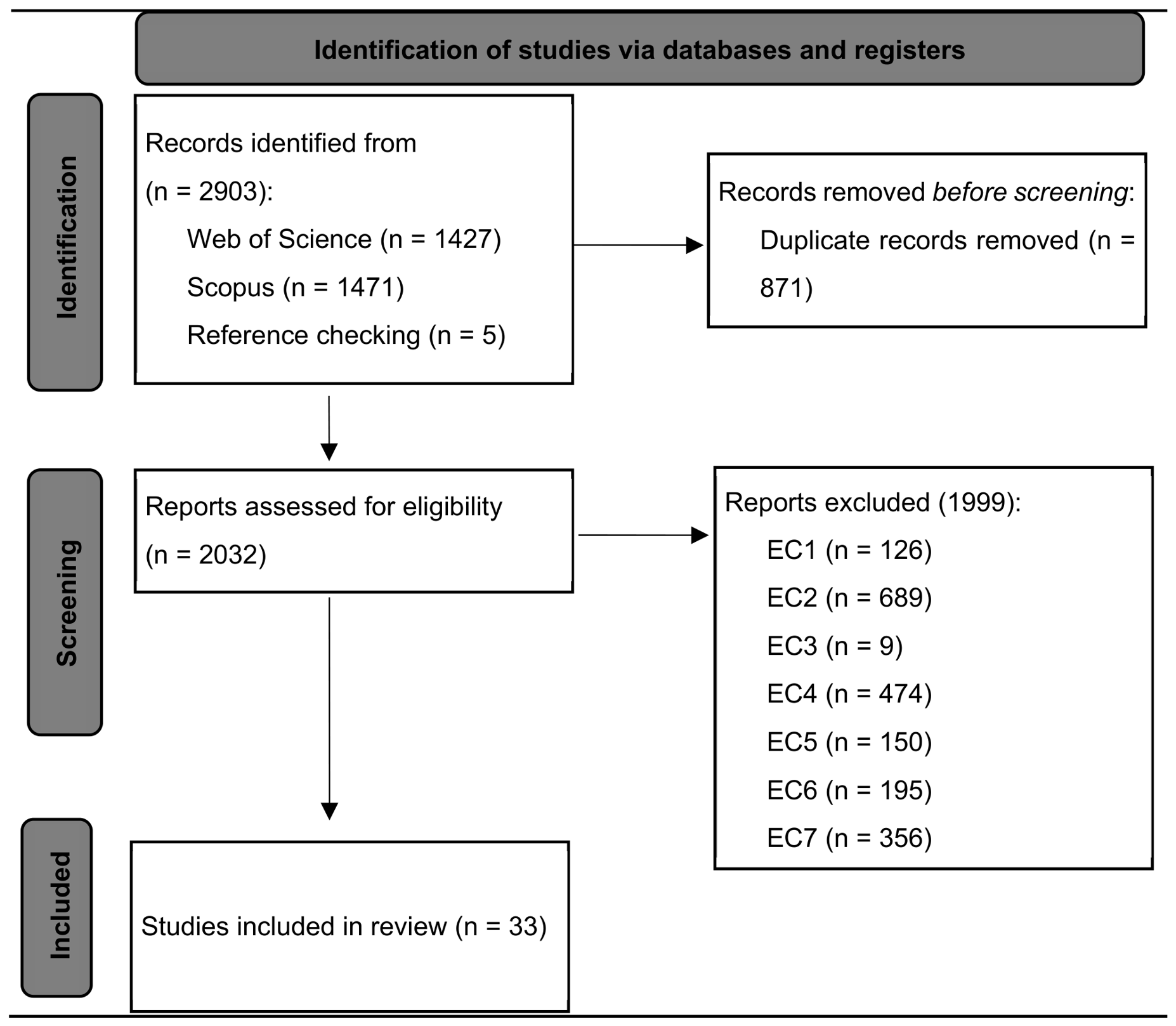
- Web of Science: (“digital education” (All Fields) and 2012-01-01/2025-06-30 (Publication Date) and Articles (Document Types) and English or Spanish (Languages)
- -
- Scopus: TITLE-ABS-KEY (“digital education”) AND PUBYEAR > 2011 AND (LIMIT-TO(DOCTYPE, “ar”)) AND(LIMIT-TO(LANGUAGE, “English”) OR LIMIT-TO (LANGUAGE, “Spanish”).
Data Extraction, Methodological Quality Appraisal, and Interrater Reliability
3. Results
3.1. General Description of the Studies
3.2. Definition of Digital Education
3.3. Effects on Student Motivation, Learning and Performance
3.3.1. Motivation
3.3.2. Skills Acquisition
3.3.3. Academic Performance
3.4. Challenges in the Use of DE in Compulsory Education Contexts
3.5. Contribution of DE to Sustainable and Equitable Schooling
4. Discussion
5. Limitations
6. Recommendations
7. Conclusions
Supplementary Materials
Author Contributions
Funding
Institutional Review Board Statement
Informed Consent Statement
Data Availability Statement
Conflicts of Interest
Abbreviations
| DE | Digital Education |
| DigCompEdu | European Framework for the Digital Competence of Educators |
| ICT | Information and Communication Technologies |
| PICOS | Participants, Intervention, Comparison, Outcomes, Study design |
| PRISMA | Preferred Reporting Items for Systematic Reviews and Meta-Analyses |
| SDG | Sustainable Development Goal |
| SDGs | Sustainable Development Goals |
| TPACK | Technological Pedagogical Content Knowledge |
References
- Santiago-Campión, R.; Nalda, F.; Celaya, L. Perceptions of School Leaders about the Use and Value of ICT for Educational Change and Innovation. Estud. Sobre Educ. 2016, 30, 145–174. [Google Scholar] [CrossRef][Green Version]
- UNESCO. Technology in Education: GEM Report 2023|Global Education Monitoring Report. Available online: https://www.unesco.org/gem-report/en/publication/technology-education (accessed on 8 August 2025).
- OECD. Digital Education Outlook. 2021. Available online: https://www.oecd.org/en/publications/oecd-digital-education-outlook-2021_589b283f-en.html (accessed on 8 August 2025).
- Koehler, M.J.; Mishra, P.; Kereluik, K.; Shin, T.S.; Graham, C.R. The Technological Pedagogical Content Knowledge Framework. In Handbook of Research on Educational Communications and Technology; Spector, J.M., Merill, M.D., Elen, J., Bishop, M.J., Eds.; Springer: New York, NY, USA, 2014; pp. 101–111. [Google Scholar]
- Bayne, S.; Gallagher, M. Near Future Teaching: Practice, Policy and Digital Education Futures. Policy Futures Educ. 2021, 19, 607–625. [Google Scholar] [CrossRef]
- Harju, V.; Koskinen, A.; Pehkonen, L. An Exploration of Longitudinal Studies of Digital Learning. Educ. Res. 2019, 61, 388–407. [Google Scholar] [CrossRef]
- Xie, K.; Hawk, N. Technology’s Role and Place in Student Learning: What We Have Learned from Research and Theories. In Technology in School Classrooms: How It Can Transform Teaching and Student Learning Today; Rowman & Littlefield: Lanham, MD, USA, 2017; pp. 1–17. ISBN 978-1-4758-3104-7. [Google Scholar]
- Zheng, B.; Warschauer, M.; Lin, C.-H.; Chang, C. Learning in One-to-One Laptop Environments: A Meta-Analysis and Research Synthesis. Rev. Educ. Res. 2016, 86, 1052–1084. [Google Scholar] [CrossRef]
- Troussas, C.; Krouska, A.; Sgouropoulou, C. Enriching Mobile Learning Software with Interactive Activities and Motivational Feedback for Advancing Users’ High-Level Cognitive Skills. Computers 2022, 11, 18. [Google Scholar] [CrossRef]
- Varier, D.; Dumke, E.K.; Abrams, L.M.; Conklin, S.B.; Barnes, J.S.; Hoover, N.R. Potential of One-to-One Technologies in the Classroom: Teachers and Students Weigh In. Educ. Technol. Res. Dev. 2017, 65, 967–992. [Google Scholar] [CrossRef]
- Panesi, S.; Bocconi, S.; Ferlino, L. Promoting Students’ Well-Being and Inclusion in Schools Through Digital Technologies: Perceptions of Students, Teachers, and School Leaders in Italy Expressed Through SELFIE Piloting Activities. Front. Psychol. 2020, 11, 1563. [Google Scholar] [CrossRef] [PubMed]
- Schröder, A.; Krüger, D. Social Innovation as a Driver for New Educational Practices: Modernising, Repairing and Transforming the Education System. Sustainability 2019, 11, 1070. [Google Scholar] [CrossRef]
- Gómez-Tone, H.C.; Martín-Gutiérrez, J.; Valencia-Anci, B.K. Augmented Reality-Based Training to Improve Spatial Skills and Academic Performance in Engineering Students. Digit. Educ. Rev. 2022, 41, 306–322. [Google Scholar] [CrossRef]
- Hawk, N.A.; Vongkulluksn, V.W.; Xie, K.; Bowman, M.A. Cognitive Tasks in the Core Content Areas: Factors That Influence Students’ Technology Use in High-School Classrooms. J. Comput. Assist. Learn. 2021, 37, 1077–1090. [Google Scholar] [CrossRef]
- Nikolopoulou, K.; Gialamas, V. ICT and Play in Preschool: Early Childhood Teachers’ Beliefs and Confidence. Int. J. Early Years Educ. 2015, 23, 409–425. [Google Scholar] [CrossRef]
- Auld, G.; Johnson, N.F. Teaching the “Other”: Curriculum “Outcomes” and Digital Technology in the Out-of-School Lives of Young People; Critical Perspectives on Technology and Education; Palgrave Macmillan: London, UK, 2015; ISBN 978-1-137-38545-1. [Google Scholar]
- Tallvid, M.; Lundin, J.; Svensson, L.; Lindstrom, B. Exploring the Relationship between Sanctioned and Unsanctioned Laptop Use in a 1:1 Classroom. Educ. Technol. Soc. 2015, 18, 237–249. [Google Scholar]
- Ferro, C.; Senra, A.I.M.; Martínez Senra, A.I.; Otero Neira, M.C. Ventajas Del Uso de Las TICs En El Proceso de Enseñanza-Aprendizaje Desde La Óptica de Los Docentes Universitarios Españoles. EDUTEC Rev. Electrón. Tecnol. Educ. 2009, 29, a119. [Google Scholar] [CrossRef]
- Garmendia, M.; Karrera, I.; Larrañaga, N.; Garitaonandia, C. The Role of School Mediation in the Development of Digital Skills among Spanish Minors. Prof. Inf. 2021, 30, 12. [Google Scholar] [CrossRef]
- OECD. Co-Ordinating the Use of Digital Tools at the School Level; OECD Education Working Papers, 344; OECD Publishing: Paris, France, 2026. [Google Scholar] [CrossRef]
- Bueno-Baquero, A.; González-Calero, J.A.; Del Olmo-Muñoz, J.; Sánchez Pérez, M.D.C. Bridging Digital Transitions: Teacher Digital Competence across Primary and Secondary Education. Educ. Inf. Technol. 2026, 31, 3097–3124. [Google Scholar] [CrossRef]
- Bekbenova, A.; Ilyassova, G.; Mukatayeva, Z.; Gavronskaya, Y.; Amangeldi, O.; Umirzakova, N. Pedagogical Bases of ICT Integration in Pre-Service Chemistry Teacher Education: University-School Bridge. Front. Educ. 2026, 11, 1729019. [Google Scholar] [CrossRef]
- Crompton, H.; Burke, D.; Lin, Y.C. Mobile Learning and Student Cognition: A Systematic Review of PK-12 Research Using Bloom’s Taxonomy. Br. J. Educ. Technol. 2019, 50, 684–701. [Google Scholar] [CrossRef]
- Keane, T.; Keane, W.F.; Blicblau, A.S. Beyond Traditional Literacy: Learning and Transformative Practices Using ICT. Educ. Inf. Technol. 2016, 21, 769–781. [Google Scholar] [CrossRef]
- Crook, S.J.; Sharma, M.D. Bloom-Ing Heck! The Activities of Australian Science Teachers and Students Two Years into a 1:1 Laptop Program across 14 High Schools. Int. J. Innov. Sci. Math. Educ. 2013, 21, 54–69. [Google Scholar]
- Rong, Q.M.; Lian, Q.; Tang, T.R. Research on the Influence of AI and VR Technology for Students’ Concentration and Creativity. Front. Psychol. 2022, 13, 767689. [Google Scholar] [CrossRef] [PubMed]
- Xia, Q.; Chiu, T.K.F.; Chai, C.S.; Xie, K. The Mediating Effects of Needs Satisfaction on the Relationships between Prior Knowledge and Self-Regulated Learning through Artificial Intelligence Chatbot. Br. J. Educ. Technol. 2023, 54, 967–986. [Google Scholar] [CrossRef]
- Castaño Muñoz, J.; Pokropek, A.; Garcia, L.W. For All Those Who Have, More Will Be Given? Evidence from the Adoption of the SELFIE Tool for the Digital Capacity of Schools in Spain. Br. J. Educ. Technol. 2022, 53, 1937–1955. [Google Scholar] [CrossRef]
- Guillén-Gámez, F.D.; Álvarez-García, F.J.; Rodríguez, I.M. Digital Tablets in the Music Classroom: A Study about the Academic Performance of Students in the BYOD Context. J. Music Technol. Educ. 2018, 11, 171–182. [Google Scholar] [CrossRef] [PubMed]
- Yarbro, J.; McKnight, K.; Elliott, S.; Kurz, A.; Wardlow, L. Digital Instructional Strategies and Their Role in Classroom Learning. J. Res. Technol. Educ. 2016, 48, 274–289. [Google Scholar] [CrossRef]
- UNESCO. Proportion of Schools with Access to Internet for Pedagogical Purposes; Institute for Statistics (UIS): Montreal, QC, Canada, 2023. [Google Scholar]
- Romero-Hall, E. Current Initiatives, Barriers, and Opportunities for Networked Learning in Latin America. Educ. Technol. Res. Dev. 2021, 69, 2267–2283. [Google Scholar] [CrossRef] [PubMed]
- United Nations. Transforming Our World: The 2030 Agenda for Sustainable Development; United Nations: New York, NY, USA, 2015. [Google Scholar]
- Page, M.J.; McKenzie, J.E.; Bossuyt, P.M.; Boutron, I.; Hoffmann, T.C.; Mulrow, C.D.; Shamseer, L.; Tetzlaff, J.M.; Akl, E.A.; Brennan, S.E.; et al. The PRISMA 2020 Statement: An Updated Guideline for Reporting Systematic Reviews. BMJ 2021, 372, n71. [Google Scholar] [CrossRef] [PubMed]
- Hong, Q.N.; Fàbregues, S.; Bartlett, G.; Boardman, F.; Cargo, M.; Dagenais, P.; Gagnon, M.-P.; Griffiths, F.; Nicolau, B.; O’Cathain, A.; et al. The Mixed Methods Appraisal Tool (MMAT) Version 2018 for Information Professionals and Researchers. Educ. Inf. 2018, 34, 285–291. [Google Scholar] [CrossRef]
- Cohen, J. A Coefficient of Agreement for Nominal Scales. Educ. Psychol. Meas. 1960, 20, 37–46. [Google Scholar] [CrossRef]
- IBM Corp. IBM SPSS Statistics for Windows, Version 27.0; IBM Corp.: Armonk, NY, USA, 2020.
- de Diezmas, E.N.M.; Manzano, P.D. PLEs in Primary School: The Learners’ Experience in The Piplep Project. Digit. Educ. Rev. 2016, 29, 45–61. [Google Scholar]
- Jeong, D.; Moon, H.; Jeong, S.; Moon, C. Digital Capital Accumulation in Schools, Teachers, and Students and Academic Achievement: Cross-Country Evidence from the PISA 2018. Int. J. Educ. Dev. 2024, 107, 103024. [Google Scholar] [CrossRef]
- Holguin-Alvarez, J.; Cruz-Montero, J.; Ruiz-Salazar, J.; Wong, R.; Merino-Flores, I. Dynamics, Strategies and Feedback Applied with Mixed Gamification: Do They Improve Poor School Cognitive Performance? Digit. Educ. Rev. 2024, 45, 179–190. [Google Scholar] [CrossRef]
- Sejdiu, S. Are Listening Skills Best Enhanced Through the Use of Multimedia Technology. Digit. Educ. Rev. 2017, 32, 60–72. [Google Scholar]
- Yan, D.; Li, G. A Heterogeneity Study on the Effect of Digital Education Technology on the Sustainability of Cognitive Ability for Middle School Students. Sustainability 2023, 15, 2784. [Google Scholar] [CrossRef]
- Álvarez-Herrero, J.F.; Hernández-Ortega, J. Didactic Itineraries with Smartphones to Promote Environmental Education and Digital Competence among Secondary School Students. Digit. Educ. Rev. 2021, 39, 319–335. [Google Scholar]
- Lee, H.; Kim, Y. Exploring the Effects of Computer and Smart Device-Assisted Learning on Students’ Achievements: Empirical Evidence from Korea. Sustainability 2023, 15, 13241. [Google Scholar] [CrossRef]
- Alabdulaziz, M.S.; Alhammadi, A.A. The Effectiveness of Digital Education Based on the Use of Infographic Technology and Its Impact on Developing Visual Thinking Skills and Mathematical Achievement among Middle School Students. Int. J. Inf. Educ. Technol. 2025, 15, 576–594. [Google Scholar] [CrossRef]
- Scippo, S.; Madiai, S.; Cuomo, S. Digital Tessellation for Geometry Learning in Primary School: A Quasi-Experimental Study. J. Inf. Technol. Educ. Res. 2025, 24, 009. [Google Scholar] [CrossRef] [PubMed]
- Preradovic, N.M.; Lesin, G.; Boras, D. Introduction of Digital Storytelling in Preschool Education: A Case Study from Croatia. Digit. Educ. Rev. 2016, 30, 94–105. [Google Scholar]
- Rajabion, L.; Wakil, K.; Badfar, A.; Nacini, S.M.; Zareie, B. A New Model for Assessing the Impact of ICT and Digital Knowledge on Students’ Thoughts and Beliefs. J. Eng. Des. Technol. 2019, 17, 943–959. [Google Scholar] [CrossRef]
- Slussareff, M.; Bohackova, P. Students as Game Designers vs. “Just” Players: Comparison of Two Different Approaches to Location-Based Games Implementation into School Curricula. Digit. Educ. Rev. 2016, 36, 284–297. [Google Scholar]
- Chust-Pérez, V.; Esteve-Faubel, R.; Fernández-Morante, M.; Esteve-Faubel, J. The Utilisation of the Flipgrid Application through Mobile Devices to Enhance Motivation and Oral Expression Skills in Secondary School Students Learning English as a Foreign Language. Pixel-Bit. Rev. Medios Educ. 2025, 73, 1. [Google Scholar] [CrossRef]
- Faria, C.; Guilherme, E.; Pintassilgo, J.; Mogarro, M.J.; Pinho, A.S.; Baptista, M.; Chagas, I.; Galvao, C. The Portuguese Maritime Voyages of Discovery: The Exploration of the History of a City with an App as an Educational Resource. Digit. Educ. Rev. 2019, 36, 85–99. [Google Scholar] [CrossRef]
- Selwyn, N.; Nemorin, S.; Bulfin, S.; Johnson, N.F. The “obvious” Stuff: Exploring the Mundane Realities of Students’ Digital Technology Use in School. Digit. Educ. Rev. 2020, 37, 1–14. [Google Scholar] [CrossRef]
- Castro-García, D.; Dussan, F.A.O.; Corredor, J. Technology for Communication and Problem Solving in the Classroom. Effects on Meaningful Learning. Digit. Educ. Rev. 2016, 30, 207–219. [Google Scholar]
- Abylkassymova, A.; Yessetov, Y.; Tuyakov, Y.; Ardabayeva, A. Teaching Geometry in School: Digital Resources to Develop Students’ Spatial Thinking. Int. J. Innov. Res. Sci. Stud. 2025, 8, 439–450. [Google Scholar] [CrossRef]
- Gigantesco, A.; Palumbo, G.; Zadworna-Cieslak, M.; Cascavilla, I.; Del Re, D.; Kossakowska, K.; Chrusciel, M.; Kelpsait, D.; Kuklinska, G.; Zaharieva, B.; et al. An International Study of Middle School Students’ Preferences about Digital Interactive Education Activities for Promoting Psychological Well-Being and Mental Health. Ann. dell’Ist. Super. Sanità 2019, 55, 108–117. [Google Scholar] [CrossRef] [PubMed]
- Kastner-Hauler, O.; Tengler, K.; Sabitzer, B.; Lavicza, Z. Combined Effects of Block-Based Programming and Physical Computing on Primary Students’ Computational Thinking Skills. Front. Psychol. 2022, 13, 875382. [Google Scholar] [CrossRef] [PubMed]
- Kerslake, L.; Hannam, J. Designing Media and Information Literacy Curricula in English Primary Schools: Children’s Perceptions of the Internet and Ability to Navigate Online Information. Ir. Educ. Stud. 2022, 41, 151–160. [Google Scholar] [CrossRef]
- Kuo, Y.S.; Wang, S.I.C.; Liu, E.Z.F. Peer Assessment Using One-to-One Tablets to Improve the English Oral Presentation of Fourth-Grade Students in Taiwan. Comput. Educ. Open 2025, 8, 100262. [Google Scholar] [CrossRef]
- Bicer, A.; Capraro, R.M. Longitudinal Effects of Technology Integration and Teacher Professional Development on Students’ Mathematics Achievement. Eurasia J. Math. Sci. Technol. Educ. 2017, 13, 815–833. [Google Scholar] [CrossRef]
- Crook, S.J.; Sharma, M.D.; Wilson, R. An Evaluation of the Impact of 1:1 Laptops on Student Attainment in Senior High School Sciences. Int. J. Sci. Educ. 2015, 37, 272–293. [Google Scholar] [CrossRef]
- Llorent-Vaquero, M.; De Pablos-Pons, J.; Velez, I. Digital Learning and Public Policy in Schools: A Transformative Paradigm for a Changing World. Policy Futures Educ. 2024, 22, 547–592. [Google Scholar] [CrossRef]
- Keane, T.; Keane, W. Achievements and Challenges: Implementing a 1:1 Program in a Secondary School. Educ. Inf. Technol. 2017, 22, 1025–1041. [Google Scholar] [CrossRef]
- García-Gil, M.A.; Fajardo-Bullón, F.; Felipe-Castaño, E. Analysis of Academic Performance and Mental Health of Secondary School Students by Access to Technological Resources. Educ. XX1 2022, 25, 243–270. [Google Scholar] [CrossRef]
- Janssen, K.C.; Phillipson, S. Are We Ready for BYOD?: An Analysis of the Implementation and Communication of BYOD Programs in Victorian Schools. Aust. Educ. Comput. 2015, 30, 54. [Google Scholar]
- Hromada, D.D. Digital Education: “Education-with”/”Education-about” Distinction and the Teleological Definition. Digit. Educ. 2021, 1–10. [Google Scholar] [CrossRef]


| Inclusion criteria (IC) |
|
| Exclusion criteria (EC) |
|
Disclaimer/Publisher’s Note: The statements, opinions and data contained in all publications are solely those of the individual author(s) and contributor(s) and not of MDPI and/or the editor(s). MDPI and/or the editor(s) disclaim responsibility for any injury to people or property resulting from any ideas, methods, instructions or products referred to in the content. |
© 2026 by the authors. Licensee MDPI, Basel, Switzerland. This article is an open access article distributed under the terms and conditions of the Creative Commons Attribution (CC BY) license.
Share and Cite
Martínez García, H.; Gómez-Cadiñanos, M.R.; García, T.; Areces, D.; Álvarez, A.I.; Rodríguez, C.; Núñez, J.C. Conceptualizing Digital Education for Sustainable and Equitable Face-to-Face Schooling: A Systematic Review. Sustainability 2026, 18, 7979. https://doi.org/10.3390/su18157979
Martínez García H, Gómez-Cadiñanos MR, García T, Areces D, Álvarez AI, Rodríguez C, Núñez JC. Conceptualizing Digital Education for Sustainable and Equitable Face-to-Face Schooling: A Systematic Review. Sustainability. 2026; 18(15):7979. https://doi.org/10.3390/su18157979
Chicago/Turabian StyleMartínez García, Héctor, Marta Rubio Gómez-Cadiñanos, Trinidad García, Débora Areces, Ana Isabel Álvarez, Celestino Rodríguez, and José Carlos Núñez. 2026. "Conceptualizing Digital Education for Sustainable and Equitable Face-to-Face Schooling: A Systematic Review" Sustainability 18, no. 15: 7979. https://doi.org/10.3390/su18157979
APA StyleMartínez García, H., Gómez-Cadiñanos, M. R., García, T., Areces, D., Álvarez, A. I., Rodríguez, C., & Núñez, J. C. (2026). Conceptualizing Digital Education for Sustainable and Equitable Face-to-Face Schooling: A Systematic Review. Sustainability, 18(15), 7979. https://doi.org/10.3390/su18157979