


Abstract
Forest-product certification now operates at the intersection of private sustainability governance, market access, and mandatory due diligence. This structured narrative review asks how Forest Stewardship Council (FSC) and Programme for the Endorsement of Forest Certification (PEFC) certification, together with the EU Deforestation Regulation (EUDR), affect competitiveness and the distribution of compliance costs in Polish business-to-business and export-oriented wood-product supply chains. A documented revision-stage search and screening procedure produced an evidence base of 55 peer-reviewed, regulatory, statistical, and sectoral sources. The analytical framework combines private-governance theory, stakeholder conflict analysis, and relationship marketing to examine information asymmetry, bargaining power, cost allocation, and market access. The Polish case is characterised by a large publicly owned forest resource, extensive but overlapping FSC and PEFC coverage, and strongly export-oriented downstream industries. Certification can reduce buyer verification costs, support supplier qualification, improve traceability, and protect access to demanding markets. However, fixed audit, documentation, digitalisation, and certified-material costs are borne disproportionately by small and medium-sized enterprises, especially where lead buyers do not share adaptation costs. EUDR strengthens these asymmetries because certified status can support, but does not replace, legal due diligence. The review contributes a governance-based explanation of why the same sustainability requirements can generate resilience and market access for digitally mature exporters while creating entry barriers, supplier exclusion, and concentration risks for smaller firms. Policy support should therefore combine clear demand signals, group certification, shared traceability infrastructure, advisory services, and buyer–supplier cost-sharing arrangements.
1. Introduction
The contemporary forest-products and wood-products market operates under strong environmental, regulatory, and commercial pressure. Demand for timber and wood-based products continues to grow across construction, furniture manufacturing, paper production, packaging, and other processing industries, while buyers and public authorities increasingly require evidence of legal origin, biodiversity safeguards, and long-term resource stewardship. Forest-management certification and chain-of-custody (CoC) certification have consequently become prominent private-governance mechanisms for communicating compliance with sustainable-sourcing standards [1,2,3].
Certification structures relationships among forest managers, processors, buyers, certification bodies, and public authorities. Its function is not limited to corporate image: in many business-to-business (B2B) supply chains, a recognised certificate is a supplier-qualification criterion for international retailers, industrial customers, contract markets, and selected public-procurement procedures. Certification should therefore be analysed as a market-governance rule that can reduce information asymmetry and reputational risk while simultaneously creating fixed compliance costs and entry thresholds [2,4].
Poland provides an analytically important case because it combines a large forest resource with an export-oriented wood-processing and furniture industry. Forests covered 9,283,800 ha in 2023, corresponding to 29.6% of the national territory; approximately 80.1% of forest area was publicly owned, and the State Forests National Forest Holding managed roughly three-quarters of the national forest area [5]. Certification coverage is extensive but institutionally uneven and overlapping. In 2025, FSC certification covered more than 3.4 million ha, approximately 37% of the national forest area, whereas PEFC covered about 7.25 million ha, approximately 78%. These percentages cannot be added because the same forest area may hold both certificates. Downstream export dependence is illustrated by furniture exports of EUR 13.6 billion in 2024, with Germany, the Czech Republic, and France accounting for 27.94%, 6.31%, and 6.14% of exports, respectively [5,6,7].
The existing literature establishes that certification may improve credibility, traceability, and market access, but it also documents audit costs, higher certified-material costs, uneven price premiums, and barriers for small producers [7,8,9,10,11,12,13,14,15]. Less attention has been paid to how voluntary certification and mandatory EUDR requirements interact to redistribute costs, information duties, and bargaining power within B2B supply chains. The Polish case adds value because the concentration of forest management, the coexistence of FSC and PEFC, the importance of export markets, and the prevalence of smaller processors create a distinctive governance configuration.
The study adopts an analytical review perspective and uses the logic of stakeholder conflict to explain why companies operating in the same industry and often in the same market differ in their willingness to certify. These differences arise not only from environmental awareness but also from cost structures, company size, customer profiles, export exposure, and access to certified raw materials [8,9].
This review therefore addresses four research questions: RQ1: Through which governance mechanisms do FSC, PEFC, and EUDR requirements affect market access and competitiveness? RQ2: How are certification and due-diligence costs allocated among forest managers, processors, lead buyers, and public authorities? RQ3: Why are the effects different for large exporters and small and medium-sized enterprises (SMEs) in Polish B2B supply chains? RQ4: What policy and inter-firm arrangements can reduce exclusion and concentration risks without weakening environmental integrity? The contribution is a conceptual model linking private certification, public regulation, relationship dependence, and firm-level competitiveness, supported by quantitative evidence from the Polish market.
2. Materials and Methods
This study is positioned as a structured narrative review rather than a formal systematic review or meta-analysis. The revision-stage evidence search was organised through three source channels: (i) peer-reviewed publications retrieved through Google Scholar and publisher databases, including ScienceDirect, SpringerLink, Wiley Online Library, and MDPI; (ii) official statistical and market sources, including Statistics Poland, the Forest Data Bank, and the Polish Investment and Trade Agency; and (iii) normative and regulatory documents issued by FSC, PEFC, the European Commission, and the European Union. Searches were updated in July 2026 and covered publications from 2000 to 2026, while earlier seminal works were retained for conflict analysis and relationship-marketing theory.
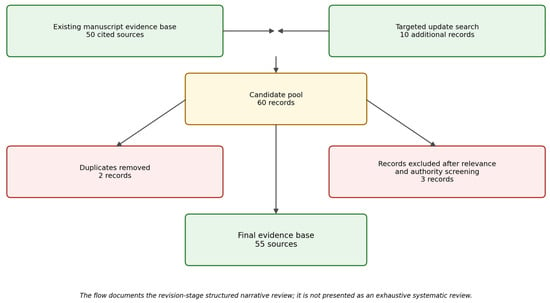
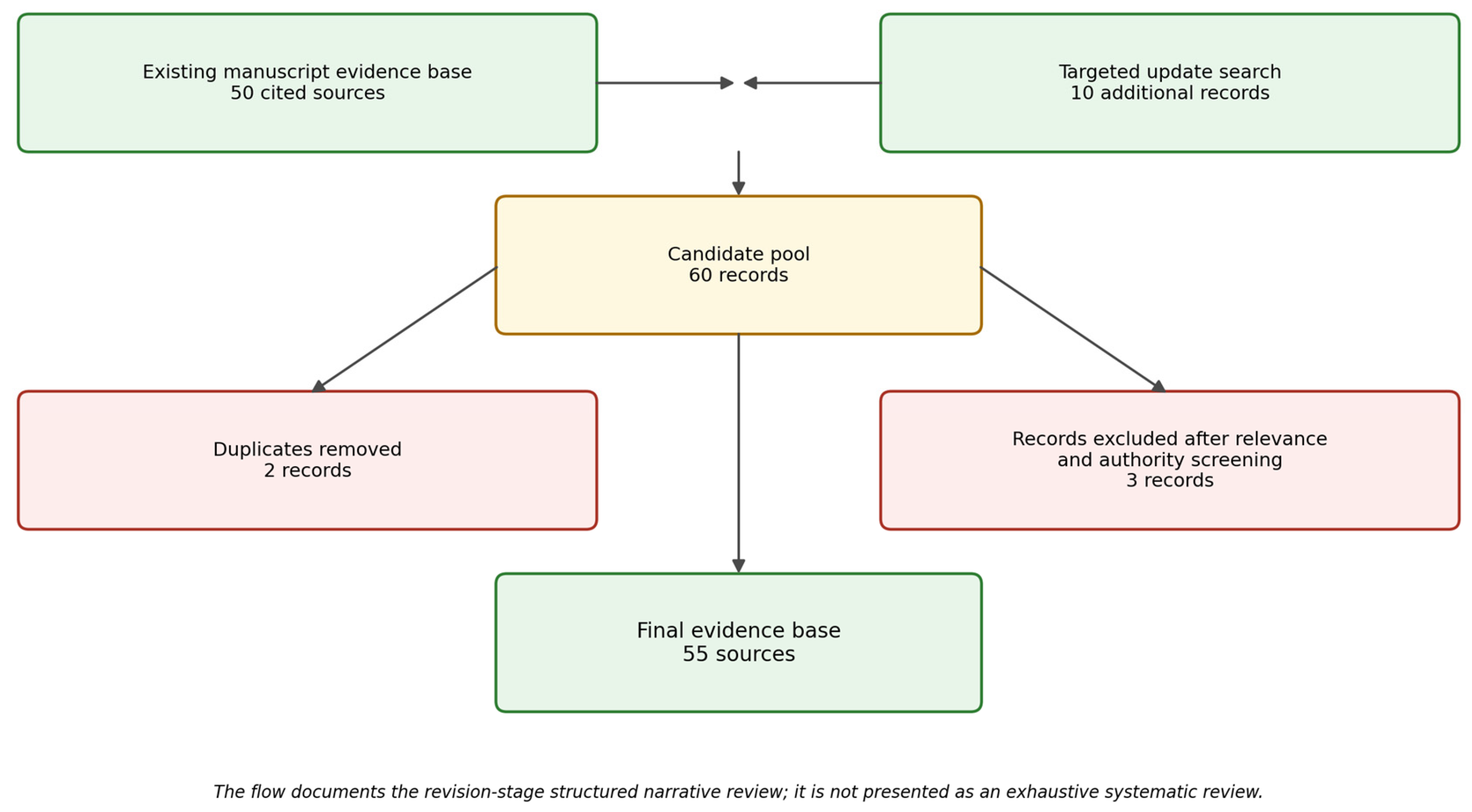
Search strings combined the terms ‘forest certification’, ‘FSC’, ‘PEFC’, ‘chain of custody’, ‘EUDR’, ‘due diligence’, ‘wood products’, ‘Poland’, ‘B2B’, ‘export’, ‘SME’, ‘competitiveness’, ‘compliance costs’, ‘bargaining power’, and ‘market access’. Sources were included when they provided empirical evidence, theoretical mechanisms, regulatory requirements, or authoritative market statistics directly relevant to forest certification, wood-product supply chains, or EUDR. Duplicate records, non-traceable promotional material, and publications without a clear governance, market, or supply-chain connection were excluded. The revision process started from the 50 sources cited in the original manuscript and identified 10 additional candidate records; after removal of two duplicates and exclusion of three records that did not meet the relevance or authority criteria, the final evidence base comprised 55 sources (Figure 1). This numerical flow documents the revision-stage update and should not be interpreted as a claim of exhaustive systematic coverage.
Figure 1.
Revision-stage source identification and screening workflow for the structured narrative review.
Evidence was extracted into a structured matrix containing source type, geographical scope, certification or regulatory instrument, stakeholder group, firm-size context, B2B or export relevance, cost mechanism, market-access effect, and reported sustainability implication. The synthesis explicitly separated general international mechanisms from Poland-specific evidence and applied three filters throughout Section 5, Section 6, Section 7, Section 8 and Section 9: B2B supply-chain position, export orientation, and SME exposure. Because the underlying studies use heterogeneous methods and outcome measures, the review does not calculate pooled effect sizes. Detailed limitations and priorities for future research are presented in Section 10.
Analytical Framework: Conflict Analysis and Relationship Marketing
Conflict analysis was operationalised through four complementary tools. First, a conflict profile identified the regulatory, market, and raw-material context. Second, conflict mapping located the principal actors and the direction of their dependencies. Third, an interest–influence matrix distinguished stakeholders with high rule-setting or purchasing power from actors that bear compliance costs but have limited negotiating capacity. Fourth, a conflict tree linked root causes—fixed audit costs, data asymmetry, certified-material scarcity, and buyer concentration—to immediate tensions and downstream outcomes such as supplier exclusion or market concentration [8,9].
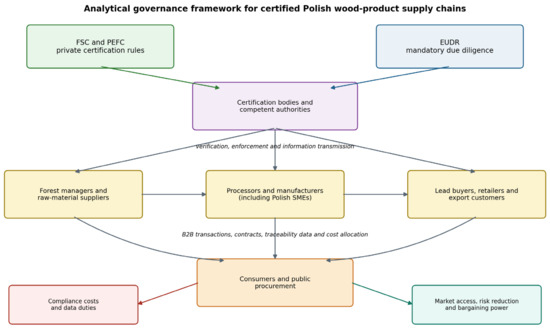
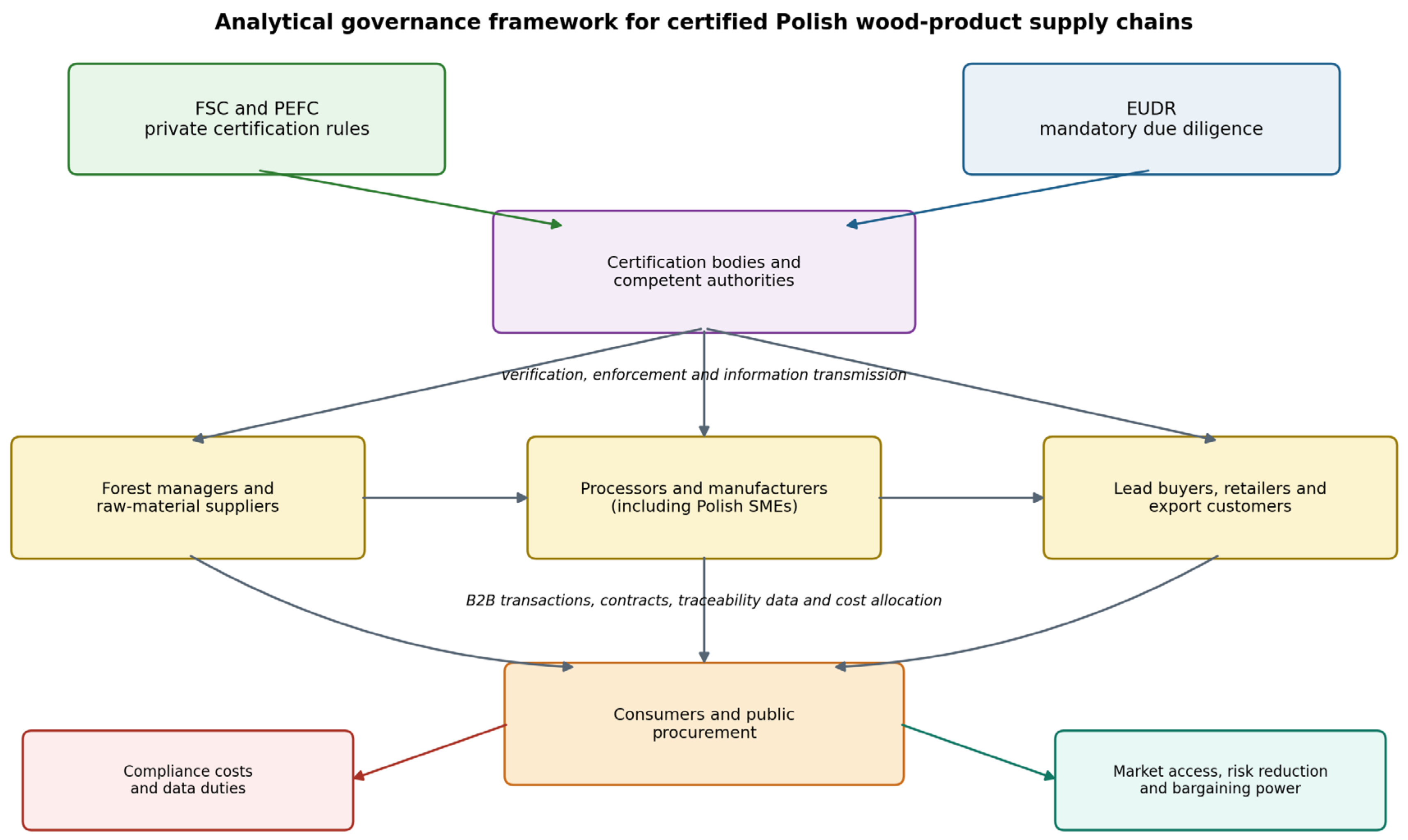
Relationship marketing was incorporated using the commitment–trust perspective. The analysis examined whether certification and EUDR improve trust through verified information, increase commitment through long-term contracts, or intensify dependence through switching costs and buyer-specific compliance requirements. These dimensions were combined with private-governance theory to explain how voluntary standards and mandatory regulation interact in multi-tier supply chains. Figure 2 presents the resulting governance framework.
Figure 2.
Governance framework integrating FSC and PEFC certification, EUDR requirements, supply-chain actors, cost allocation, and market outcomes.
3. Forest-Product Certification as an Instrument of Sustainable Development
Forest-management certification applies to the management unit, while CoC certification applies to organisations that process, trade, or transform forest-based material. This distinction is essential because a certified forest does not automatically make every downstream product eligible for a certified claim. CoC systems require documented control of purchases, processing, inventory, sales, and claims across the supply chain. Their value is therefore network-dependent: a downstream producer can maintain a certified claim only when upstream inputs and internal control systems satisfy the relevant rules [10,11,16,17,18,19,20,21].
The Forest Stewardship Council (FSC) and the Programme for the Endorsement of Forest Certification (PEFC) are the two principal global systems for forest-management and chain-of-custody certification. Both rely on independent third-party auditing, but they differ in governance architecture and standard setting. FSC operates through an international multi-stakeholder system with globally defined normative requirements, whereas PEFC functions as an umbrella that endorses national forest-certification schemes. These differences affect national adaptation and stakeholder participation, but they do not create a universal hierarchy of environmental or market value [21,22,23,24,25].
Certification performs environmental, informational, and commercial functions. It seeks to reduce the risk of irresponsible management and unverified origin, but its immediate market function is assurance: it lowers buyer verification costs and standardises communication across firms and jurisdictions. The strength of this function depends on audit quality, claim scope, and buyer recognition. Certification should therefore be treated as a risk-management instrument rather than as conclusive proof that every environmental outcome has improved [4,12,13,21,22].
Certification is neither uniformly pro-competitive nor uniformly restrictive. Empirical studies associate it with improved trade access, corporate credibility, and occasional price premiums [15,16,17,18]. Other studies report certification fees, documentation costs, higher input prices, and uneven recovery of expenditure, particularly among smaller firms [7,12,19,20]. The relevant analytical issue is therefore not whether certification is beneficial in the abstract, but which actor captures the benefit, which actor bears the cost, and under what contractual conditions the investment becomes economically sustainable.
At the managerial level, certification requires purchasing controls, supplier verification, material accounting, production-batch identification, claim approval, staff training, and audit preparation. Large firms can often integrate these tasks into existing quality, enterprise-resource-planning, and compliance systems. SMEs face a higher fixed cost per unit of output and may depend on external consultants or manual records. Group and multi-site certification can reduce some costs, but do not eliminate the need for reliable data and internal responsibility [11,12].
3.1. Comparison of FSC and PEFC Chain-of-Custody Requirements
Table 1 compares FSC and PEFC across the dimensions most relevant to B2B supply-chain governance. Both systems require third-party auditing, supplier control, transaction records, and material-balance verification. Differences in institutional design and national availability matter, but the commercial choice is usually determined by customer specification, certified-input availability, and the recognition of claims in the destination market.
Table 1.
Comparative governance and implementation characteristics of FSC and PEFC [20,21,22,23,24].
Both systems permit control approaches based on physical separation and accounting methods, subject to scheme-specific rules. Certificates are normally issued for multi-year cycles with annual surveillance. These arrangements create recurring rather than one-off costs, and the administrative burden increases with the number of suppliers, sites, product groups, and mixed material streams [21,22,23,24,25].
PEFC integrates a formal Due Diligence System for avoiding material from controversial sources, while FSC addresses unacceptable sources through Controlled Wood and associated risk-assessment requirements. The systems therefore use different normative structures to address comparable legality and sourcing risks. Neither system, however, automatically satisfies the product-specific geolocation, due-diligence-statement, and risk obligations imposed by EUDR [22,23,26,27,28,29].
Companies holding both certificates must prevent cross-scheme or unsupported claims and ensure consistency between input records, production calculations, and sales documentation. Dual certification may widen the potential customer base and input pool, but it can also duplicate audits, procedures, training, and claim-control tasks. For SMEs, the relevant comparison is therefore the total system cost relative to expected customer demand, not only the audit fee.
Claims that FSC is universally preferred by multinational companies or that PEFC is inherently dominant in Europe should be interpreted cautiously. Recognition is segment- and buyer-specific. FSC is frequently specified in global retail and brand procurement, whereas PEFC benefits from broad endorsement of national schemes and extensive European forest coverage. The evidence supports differentiated market recognition rather than an absolute ranking [21,22,23,24,25]. The Polish market illustrates the dynamic nature of certification coverage. FSC-certified forest area fell substantially after several regional directorates discontinued certification in 2022–2023, but subsequent re-entry increased coverage to more than 3.4 million ha by March 2025. PEFC certification covered approximately 7.25 million ha in September 2025. The two systems overlap, and coverage figures therefore indicate the availability of certified forest area under each scheme rather than mutually exclusive market shares. This volatility is commercially relevant because downstream manufacturers may retain CoC certification while facing changing access to certified domestic raw material.
3.2. EUDR and the Changing Role of Voluntary Certification
The EU Deforestation Regulation (EUDR) shifts deforestation-free sourcing from a predominantly voluntary assurance issue to a legal market-access condition. Operators must demonstrate that relevant products are deforestation-free, that wood products have not contributed to forest degradation after 31 December 2020, and that production complied with the legislation of the country of origin. The due-diligence process includes product and supplier information, plot geolocation, risk assessment, risk mitigation where necessary, and submission of a due-diligence statement [26,27,28,29].
The regulatory effect is distributional. Large firms with established enterprise systems, geospatial data capacity, dedicated compliance staff, and stable certified suppliers can convert EUDR readiness into a supplier-selection advantage. SMEs, firms using fragmented supplier networks, and suppliers from higher-risk or data-poor regions face higher adjustment costs and a greater probability of exclusion. Certification can reduce information gaps, but it cannot transfer legal responsibility away from the regulated operator [22,25,30,31,32,33].
FSC has developed an EUDR Regulatory Module and risk-assessment framework, while PEFC has adapted its due-diligence architecture and supporting guidance. These tools can reduce duplication by aligning internal procedures, risk documentation, and data transmission with regulatory requirements. Nevertheless, an FSC or PEFC claim is supporting evidence rather than a legal safe harbour [27,28,29].
EUDR may change both trade geography and bargaining relationships. Lead buyers may consolidate supplier lists around firms capable of transmitting reliable geolocation and risk data, thereby reducing buyer-side verification costs while shifting data-production costs upstream. This may strengthen compliant EU suppliers and digitally mature exporters, but it can also generate trade diversion, leakage, and concentration effects if smaller or higher-risk suppliers lose access without transition support [30,31,32,33].
4. Structural Conditions of the Polish Wood Products Market
The Polish wood-products market combines concentrated upstream forest management with a diverse downstream industrial base. Harvesting, primary processing, panel production, joinery, packaging, construction products, furniture manufacturing, trade, and logistics are closely connected. Certification withdrawal, raw-material allocation rules, or disruption in certified supply can therefore propagate rapidly through the chain [3,34,35]. Figure 2 maps these actors together with certification bodies, EUDR authorities, buyers, and consumers.
Three structural features shape the Polish case. First, a large share of downstream activity is B2B and contract-based, so supplier approval and documentation requirements are economically important. Second, strong price competition limits the ability of processors to pass audit and data costs to buyers. Third, export dependence exposes firms to destination-market requirements that may be stricter than those prevailing in local trade. The EUR 13.6 billion value of furniture exports in 2024 and the concentration of sales in European markets illustrate this exposure [35].
In this environment, forest-management certification and CoC certification perform different selective functions. Forest certification affects the domestic pool of eligible raw material, whereas CoC certification determines whether processors and traders can preserve and communicate certified claims. For export-oriented firms, the absence of the buyer-specified scheme may prevent entry to an approved-vendor list even when product quality and price are competitive. For locally oriented firms, the commercial return may be lower or more variable [15,16,17,36].
Buyer requirements differ by product segment, destination, brand policy, and risk tolerance. The business case for certification is strongest where certification is explicitly included in contracts, supplier scorecards, public procurement, or long-term sourcing programmes. It is weakest where customers value the claim but refuse a price premium, volume commitment, or shared implementation support. Certification profitability must therefore be assessed against the firm’s actual customer portfolio rather than against generic reputational benefits [13,37,38,39,40,41].
Table 2 summarises the quantitative conditions of the Polish market. The figures show extensive forest certification and strong export orientation, but they do not reveal how certification costs are distributed by firm size. Harmonised Polish statistics linking company size, certification status, audit expenditure, and export performance are not currently available; this evidence gap limits causal claims and motivates the firm-level research agenda proposed in Section 10. Table 3 then translates the governance framework into stakeholder objectives, benefits, risks, and bargaining leverage.
Table 2.
Selected structural and certification indicators for the Polish forest and wood-products market.
Table 3.
Stakeholder interests, compliance exposure, and bargaining leverage in certification and EUDR governance.
5. Stakeholder Conflicts, Cost Allocation, and Power Asymmetries
5.1. General Governance Mechanisms
Certification and EUDR compliance create a field of interdependent but unequal interests. Producers seek stable demand and recovery of compliance expenditure; buyers seek traceability and reputational protection at competitive prices; public authorities seek environmental integrity and enforceability; certification bodies protect assurance credibility. Conflict arises when one actor can impose requirements while another bears the associated fixed cost. The conflict map in Figure 2 and the stakeholder profile in Table 3 make this asymmetry explicit.
For producers, certification is an investment in market access, customer retention, and risk reduction. The expected return depends on contractual demand, input availability, and the possibility of recovering expenditure through price, volume, or relationship stability. Partial certification, restricted product scope, or delayed purchasing of certified material can therefore be rational responses to uncertain demand rather than evidence of opposition to sustainable development [15,19,20].
For buyers, certification and EUDR-ready data reduce search, verification, and reputational costs. Lead firms can specify the accepted scheme, digital format, audit evidence, and delivery conditions. Where many suppliers compete for a limited number of large buyers, this purchasing power allows compliance costs to be shifted upstream. Relationship marketing predicts more stable outcomes when requirements are accompanied by trust, information sharing, volume commitments, and joint problem solving [39,40].
Public administration influences cost distribution through enforcement design, procurement rules, guidance, interoperability standards, and support instruments. A purely formal increase in requirements can disproportionately burden smaller firms. Conversely, common data templates, training, group-certification support, and predictable procurement criteria can convert compliance from an isolated firm cost into shared sectoral infrastructure [1,7,12].
5.2. Polish B2B and Export-Oriented Supply Chains
In Polish B2B and export-oriented supply chains, four recurrent producer-buyer configurations can be distinguished (Table 4). The scenarios are filtered by three conditions: whether the customer contract requires a specific claim, whether the producer has stable access to eligible certified input, and whether the buyer recognises part of the implementation cost through price, volume, or contract duration. These conditions determine whether certification operates as an enabling capability or as an unrecovered entry cost.
Table 4.
Strategic producer-buyer scenarios in B2B and export-oriented certified supply chains.
The most stable configuration combines verified organisational controls, reliable certified input, and a buyer willing to recognise the added assurance through a higher price or longer contract. Instability occurs when a supplier holds a certificate but cannot secure eligible material, or when a buyer demands full conformity without sharing transition costs. In these cases, the supplier bears the financial risk while the buyer retains the option to switch suppliers [17,36,39,40,41].
Firm size changes the outcome. Large exporters can spread audit and digital-system costs over greater volumes, employ specialist staff, and negotiate directly with certification bodies and lead buyers. SMEs more often rely on manual data, external consultants, short contracts, and a limited supplier base. The same rule can therefore professionalise a large firm while excluding a technically capable smaller supplier. This creates a pathway from sustainability assurance to market concentration unless cost-sharing or collective implementation mechanisms are available [12,19,20].
6. Costs, Benefits, and Risks for Enterprises
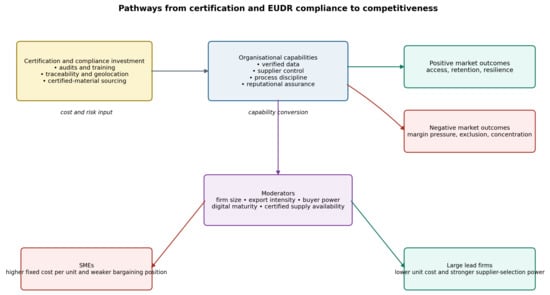
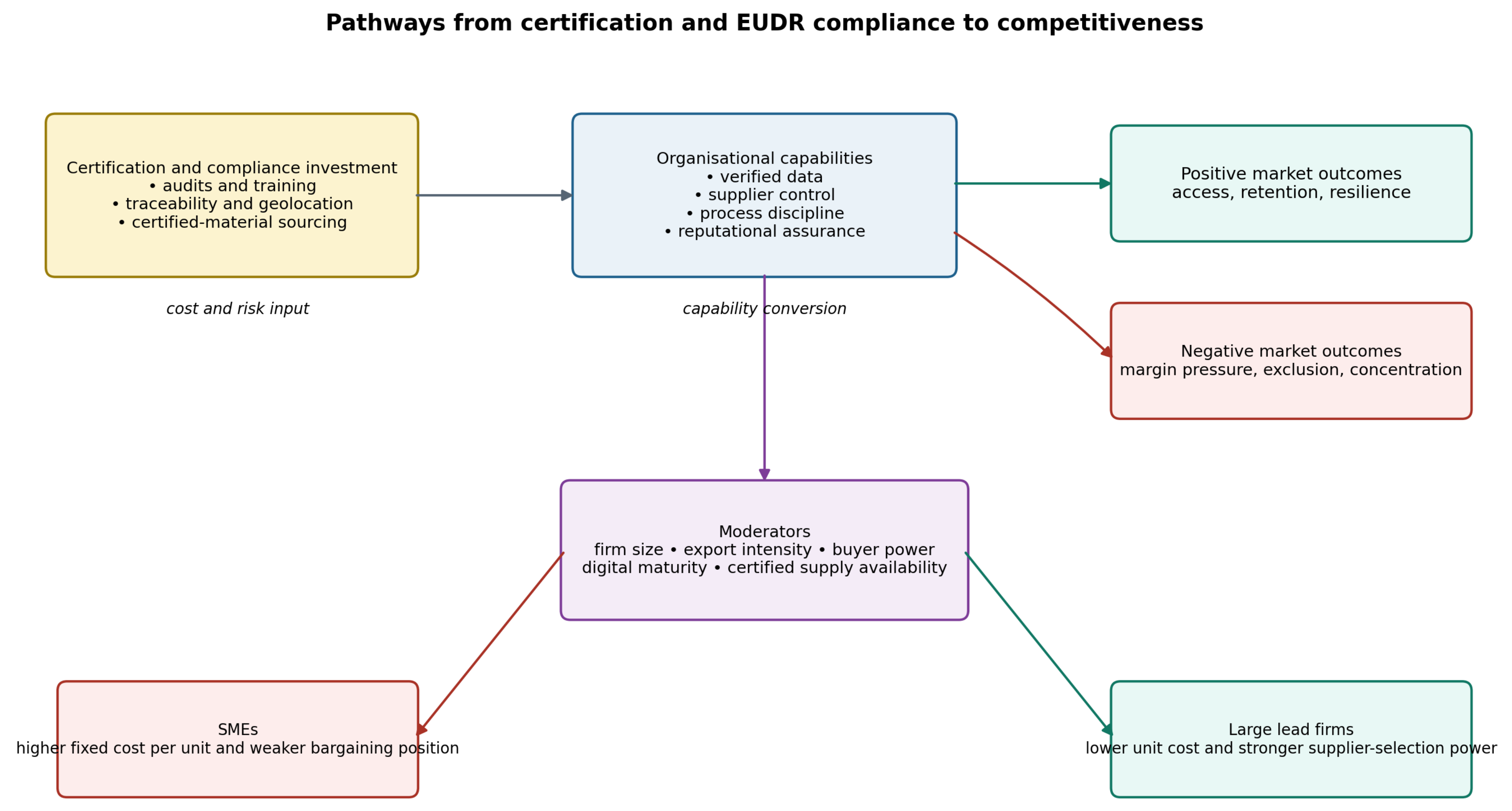
Certification profitability must include direct, indirect, recurring, and opportunity costs. Direct costs include audit fees, training, consultancy, software, and testing of control procedures. Indirect costs include staff time, supplier verification, production segregation, claim approval, and management attention. Opportunity costs arise when a firm rejects cheaper or more flexible material because it cannot support the required claim. These categories are shown on the input side of Figure 3 [11,12,15,16].
Figure 3.
Conceptual pathway from certification and EUDR compliance investment to organisational capabilities and positive or negative competitiveness outcomes.
Certified-material availability is particularly important in Poland because downstream CoC capacity can exceed the temporarily available domestic area under a buyer-specified scheme. A processor may therefore depend on a narrower supplier base, imported material, or dual certification. During periods of volatile timber prices, maintaining a certified product line can reduce purchasing flexibility and compress margins [7,15,16,17].
Demand risk arises when a certificate is treated as a prerequisite but not rewarded through a price premium, stable volume, or longer contract. The supplier then finances a buyer’s verification and reputational benefit without a corresponding revenue adjustment. This risk is acute for SMEs with limited customer portfolios and cash reserves, and it explains why certification may be retained only for selected products or customers [13,36,37,38].
Benefits are often defensive rather than immediately visible in accounting data. Certification may protect an existing customer, reduce the probability of exclusion from a tender, shorten supplier-qualification procedures, and improve readiness for sustainability reporting or EUDR. These retention and risk-avoidance effects can be economically material even when no explicit price premium is observed [39,40,41].
Certification can also create organisational capabilities: more reliable material accounting, clearer responsibilities, improved supplier records, and stronger internal process discipline. Figure 3 distinguishes these capabilities from the initial compliance expenditure and shows that competitiveness depends on whether the firm can convert them into market access, contract retention, and resilience.
The conversion is moderated by firm size, export intensity, buyer power, digital maturity, and the availability of certified inputs. Large lead firms and established exporters are more likely to capture positive returns, while smaller firms may experience margin pressure and exclusion. Certification should therefore be evaluated as a conditional capability rather than a universally profitable investment [15,16,17,36].
7. Certification, Competitiveness, and Trade
Certification affects competitiveness through eligibility, transaction costs, and risk. A certificate rarely creates advantage on its own, but it may determine whether a supplier can enter a customer’s qualification process. Commercial success still depends on price, quality, delivery reliability, innovation, and production capacity. Certification is therefore best understood as an enabling or excluding condition rather than a stand-alone source of superior performance [2,18,40,41,42,43].
In export-oriented and environmentally sensitive markets, verified claims can reduce repeated compliance enquiries and facilitate cross-border contracting. For Polish manufacturers serving European purchasing networks, this is strategically important because Germany, the Czech Republic, and France are major destinations for furniture exports [5]. The effect is strongest where buyers use certification consistently across contracts and supplier scorecards rather than requesting evidence ad hoc.
Certification and EUDR can also produce unintended structural effects. Fixed audit and data costs may exclude smaller suppliers, while lead buyers consolidate volumes among firms with advanced digital systems. This can increase traceability and standardisation but reduce supplier diversity and reinforce bargaining asymmetry. Environmental policy should therefore distinguish between rigorous assurance and unnecessarily duplicative administration [7,12,19,20].
Over the longer term, early investment in traceability can strengthen export resilience because European markets are moving toward more formalised environmental and due-diligence requirements. However, resilience at the firm level does not automatically imply inclusive or environmentally effective governance at the sector level. The distribution of costs and the credibility of assurance remain decisive [1,34].
The Polish market illustrates the dynamic nature of certification coverage. FSC-certified forest area fell substantially after several regional directorates discontinued certification in 2022–2023, but subsequent re-entry increased coverage to more than 3.4 million ha by March 2025 [5,14]. PEFC certification covered approximately 7.25 million ha in September 2025 [44]. The two systems overlap, and coverage figures therefore indicate the availability of certified forest area under each scheme rather than mutually exclusive market shares. This volatility is commercially relevant because downstream manufacturers may retain CoC certification while facing changing access to certified domestic raw material.
Environmental Effectiveness, Greenwashing, and Inclusion Risks
A certification label is evidence that specified management or CoC procedures were audited; it is not proof that every product has zero environmental impact or that certification caused all observed improvements. Impact studies show that outcomes depend on baseline governance, audit quality, enforcement, forest type, and the counterfactual against which certified performance is assessed [21,22]. Marketing claims that extend beyond the certified scope, omit the meaning of mixed or controlled inputs, or imply legal EUDR compliance solely from certification create a greenwashing risk.
Inclusion is equally important. Complex documentation and geolocation requirements may remove small suppliers from formal supply chains even when their material is legally and sustainably produced. Group certification, proportionate assurance, shared digital infrastructure, and buyer support can reduce this risk without lowering environmental requirements. Otherwise, private and public sustainability governance may improve control while simultaneously concentrating market power [12,21,22].
8. Policy and Managerial Directions for the Polish Wood Industry
Improving readiness requires coordinated action because individual SMEs cannot efficiently create every traceability, training, and interpretation resource independently. Public procurement can provide a durable demand signal when criteria are clear, scheme-neutral where legally appropriate, and linked to verified sourcing rather than generic environmental declarations. The policy instruments are summarised in Table 5 [1,6,7].
Table 5.
Instruments for reducing compliance asymmetry in the Polish certification and EUDR context.
Support should prioritise shared capability rather than only reimbursing audit fees. Relevant instruments include group certification, common EUDR data templates, sectoral help desks, training for supplier-risk assessment, interoperable geolocation tools, and temporary implementation finance. These measures lower fixed costs while preserving the substantive requirements of certification and due diligence [1,12].
Buyer–supplier cooperation is critical. Lead buyers should communicate claim and EUDR requirements early, avoid buyer-specific duplication where standard data are sufficient, and use longer contracts or cost-sharing where suppliers must make dedicated investments. Joint planning of certified-material volumes can reduce shortages and prevent a formal certificate from becoming commercially unusable [39,40].
Certification bodies and public authorities should distinguish clearly among forest-management certification, CoC certification, certified product claims, Controlled Wood or controlled sources, and EUDR legal compliance. This terminology reduces the risk that firms or consumers overinterpret a label and supports a more neutral academic and managerial assessment of certification [13,21,22,23,24,25,26,27,28,29].
At the company level, certification should be integrated with customer segmentation, purchasing strategy, digital traceability, and contract management. Before implementation, a firm should estimate scheme-specific demand, eligible material availability, fixed and recurring costs, buyer willingness to share costs, and the consequences of non-certification. Table 5 links each recommended instrument to the specific market failure or cost asymmetry it is intended to address [36,41,42,43,45].
9. EUDR as an Anti-Deforestation Instrument and Its Implications for the Wood Sector
Regulation (EU) 2023/1115 is a central element of EU policy to reduce deforestation and forest degradation associated with consumption and trade. It complements the 2019 Communication on forests, the European Green Deal, the EU Biodiversity Strategy for 2030, and the Farm to Fork Strategy [26,46,47,48]. For wood-sector firms, its significance lies not only in environmental objectives but also in the creation of a mandatory data and risk-governance architecture.
Deforestation is a systemic global problem linked to climate change, biodiversity loss, agricultural expansion, and international demand. Approximately 10% of global forest area was lost over the last three decades [28,49]. EUDR seeks to reduce the EU contribution to this pressure, but its effectiveness will depend on enforcement, risk benchmarking, data quality, and whether trade is redirected rather than transformed [30,31,32,33].
Operators placing relevant products on the EU market or exporting them must collect product, quantity, supplier, country-of-production, and plot-geolocation information; assess deforestation, degradation, and legality risk; mitigate non-negligible risk; and submit a due-diligence statement. Competent authorities are responsible for controls and enforcement [26,27,28]. These obligations apply to products and transactions, not merely to the possession of a certification label.
The Regulation entered into force on 29 June 2023, and its application dates were subsequently amended. Large and medium-sized operators, together with micro and small operators already covered by the EU Timber Regulation, are required to comply from 30 December 2026. Most other micro and small operators are required to comply from 30 June 2027 [27,28]. The transition period should be used to test data interoperability and supplier communication rather than treated solely as a postponement.
FSC and PEFC systems can support implementation by providing audited supplier controls, material accounting, risk procedures, and structured information exchange. FSC’s Regulatory Module and PEFC’s due-diligence architecture may reduce duplication, but neither creates automatic legal conformity. The operator must still evaluate whether the product-specific information and risk conclusion satisfy EUDR [27,28,29,50,51,52,53].
The distributional effects are uneven. Large exporters with integrated enterprise systems and established certified suppliers may benefit through faster qualification, lower marginal data costs, and the ability to consolidate supplier networks. SMEs and upstream suppliers with fragmented plots, manual records, or weak negotiating power may face higher per-transaction costs and delayed market access. Lead buyers may also gain bargaining power by defining accepted data formats and excluding suppliers unable to respond. Effective implementation therefore requires proportionate guidance, interoperable systems, and safeguards against unnecessary duplication while maintaining environmental integrity [30,31,32,33,44,52,53,54,55].
10. Limitations and Future Research
This study has five principal limitations. First, it is a structured narrative review and does not claim exhaustive systematic coverage or calculate pooled causal effects. Second, the evidence base combines heterogeneous case studies, trade analyses, standards, and regulatory documents. Third, Polish certification-area statistics are dynamic and FSC and PEFC areas overlap, preventing interpretation as mutually exclusive market shares. Fourth, harmonised firm-level data on certification costs, certified production shares, price premiums, and SME export performance are unavailable. Fifth, EUDR implementation is still evolving, so some organisational effects remain prospective.
Future research should therefore combine a representative survey of Polish wood-sector firms with firm-level certification and export data; compare certified and non-certified SMEs; measure direct and indirect compliance costs; examine buyer–supplier contract clauses and cost sharing; and conduct longitudinal analysis before and after EUDR application. Particular attention should be paid to whether digital traceability increases inclusion through shared infrastructure or accelerates supplier concentration.
11. Conclusions
The review asked how FSC and PEFC certification and EUDR requirements influence competitiveness and the distribution of compliance costs in Polish B2B and export-oriented wood-product supply chains. The evidence indicates that these instruments operate through four linked mechanisms: reduction of information asymmetry, supplier qualification and market access, allocation of fixed and recurring compliance costs, and changes in bargaining power.
The main finding is conditional rather than universal. Certification and EUDR readiness can strengthen credibility, traceability, contract retention, and export resilience when firms possess stable certified inputs, digital capability, and customers that provide clear demand or share adaptation costs. The same requirements can create margin pressure and exclusion for SMEs when fixed costs are high, eligible material is uncertain, and lead buyers transfer compliance duties upstream without contractual compensation.
The theoretical contribution is the integration of private certification, mandatory regulation, conflict analysis, and relationship marketing into one supply-chain governance framework. This framework explains why environmental assurance can simultaneously reduce buyer risk and intensify supplier dependence, and why firm size, export orientation, digital maturity, and buyer power moderate competitiveness outcomes.
For policy and practice, Poland should prioritise group certification, common EUDR data standards, shared digital tools, advisory support, predictable public procurement, certified-material planning, and longer buyer–supplier contracts with explicit cost-sharing provisions. These measures can protect environmental integrity while reducing unnecessary duplication and SME exclusion.
The conclusions remain subject to the evidence limitations identified in Section 10. Firm-level quantitative research is required to test the proposed pathways, estimate the economic effects of certification and EUDR, and determine whether the evolving governance system broadens sustainable market participation or reinforces concentration among dominant firms.
Author Contributions
Conceptualisation, A.G. and M.W.; methodology, A.G., K.M. and M.W.; validation, K.M. and M.W.; formal analysis, K.M. and M.W.; investigation, P.G. and A.G.; resources, A.G. and P.G.; data curation, M.W. and K.M.; writing—original draft preparation, A.G. and M.W.; writing—review and editing, K.M., P.G. and M.W.; visualisation, P.G.; supervision, M.W.; project administration, M.W.; funding acquisition, A.G. and P.G. All authors have read and agreed to the published version of the manuscript.
Funding
This research received no external funding.
Institutional Review Board Statement
Not applicable.
Informed Consent Statement
Not applicable.
Data Availability Statement
No new data were created or analysed in this review. Data sharing is not applicable to this article.
Acknowledgments
The authors reviewed and edited the output and take full responsibility for the content of the publication.
Conflicts of Interest
The authors declare no conflicts of interest.
Abbreviations
The following abbreviations are used in this manuscript:
| B2B | Business-to-business |
| CoC | Chain of Custody |
| DDS | Due Diligence System |
| EUDR | EU Deforestation Regulation |
| FSC | Forest Stewardship Council |
| PEFC | Programme for the Endorsement of Forest Certification |
| SME | Small and medium-sized enterprise |
| EO | Export-oriented |
| FM | Forest management |
References
- Food and Agriculture Organization of the United Nations. Global Forest Sector Outlook 2050: Assessing Future Demand and Sources of Timber for a Sustainable Economy; FAO Forestry Working Paper No. 31; FAO: Rome, Italy, 2022. [Google Scholar]
- Zhang, Y.; Song, W.; Li, N.; Yang, C. Effect of forest certification on international trade in forest products. Forests 2023, 14, 596. [Google Scholar]
- European Forest Institute. Forestry and Wood Industry in Europe; Bioregions Facility: Joensuu, Finland, 2023. [Google Scholar]
- Zhang, J.; Zhao, Z.; Zhao, W.; Tao, C.; Cheng, B. The Impact of Forest Certification on the Ternary Margins of China’s Forest Product Export. Forests 2022, 13, 1313. [Google Scholar] [CrossRef] [Scilit]
- Statistics Poland. Statistical Yearbook of Forestry 2024; Statistics Poland: Warsaw, Poland, 2024. Available online: https://stat.gov.pl/download/gfx/portalinformacyjny/en/defaultaktualnosci/3328/12/7/1/statistical_yearbook_of_forestry_2024_0612.pdf (accessed on 25 July 2026).
- Bank Pekao S.A.; Macroeconomic Analysis Department. The Wood-Sector Rollercoaster: Will the Excellent Performance of 2021 and the First Half of 2022 Be Followed by a Cyclical Downturn in Domestic Wood-Product Manufacturing? Bank Pekao S.A.: Warsaw, Poland, 2022. (In Polish) [Google Scholar]
- Czemko, B. Economic Analysis of the Potential Exclusion of 20% of Polish Forest Area from Harvesting, Including Options for Compensating Wood Shortages and Mitigating Other Adverse Effects; Polish Economic Chamber of the Wood Industry: Poznań, Poland, 2024. (In Polish) [Google Scholar]
- Fang, L.; Hipel, K.W.; Kilgour, D.M. Interactive Decision Making: The Graph Model for Conflict Resolution; Wiley: New York, NY, USA, 1993. [Google Scholar]
- Fraser, N.M.; Hipel, K.W. Conflict Analysis: Models and Resolutions; North-Holland: Amsterdam, The Netherlands, 1984. [Google Scholar]
- FSC Poland. FSC Forest Management Standard; FSC Poland: Warsaw, Poland, 2023. (In Polish) [Google Scholar]
- Lu, Y. Effects of Forest Certification on the Efficiency of Paper Products in China: An Analysis Based on Chain-of-Custody Certification. Master’s Thesis, Beijing Forestry University, Beijing, China, 2011. [Google Scholar]
- Flanagan, A.C.; Midgley, S.J.; Stevens, P.R.; McWhirter, L. Smallholder tree-farmers and forest certification in Southeast Asia: Alternative approaches to deliver more benefits to growers. Aust. For. 2020, 82, 18–28. [Google Scholar]
- Polonsky, M.J. An introduction to green marketing. Glob. Environ. Probl. Polic. 2008, 2, 1–10. [Google Scholar]
- FSC Poland. Status of Forest-Management Certification in Poland; FSC Poland: Warsaw, Poland, 2023. (In Polish) [Google Scholar]
- Wolff, S.; Schweinle, J. Effectiveness and Economic Viability of Forest Certification: A Systematic Review. Forests 2022, 13, 798. [Google Scholar] [CrossRef] [Scilit]
- Deniz, T.; Paletto, A.; Caliskan, A. Economic impact of FSC certification on timber prices: The case of Turkey. Forests 2023, 14, 1908. [Google Scholar]
- Klarić, K.; Pirc Barčić, A.; Basarac Sertić, M. Assessing the role of forest certification and macroeconomic indicators on Croatian wood exports to the EU: A panel-data approach. Forests 2023, 14, 1908. [Google Scholar]
- Dieter, M.; Englert, H. Competitiveness in the global forest industry sector: An empirical study with special emphasis on Germany. Eur. J. For. Res. 2007, 126, 401–412. [Google Scholar]
- Chen, J.; Wang, L.; Li, L.; Magalhães, J.; Song, W.; Lu, W.; Xiong, L.; Chang, W.-Y.; Sun, Y. Effect of Forest Certification on International Trade in Forest Products. Forests 2020, 11, 1270. [Google Scholar] [CrossRef] [Scilit]
- Wan, Z.; Liu, Y. Analysis of factors influencing forest certification of state-owned forestry enterprises in Heilongjiang Province. Issues For. Econ. 2012, 32, 377–381. [Google Scholar]
- Auld, G.; Gulbrandsen, L.H.; McDermott, C.L. Certification schemes and the impacts on forests and forestry. Annu. Rev. Environ. Resour. 2008, 33, 187–211. [Google Scholar] [CrossRef]
- Van der Ven, H.; Cashore, B. Forest certification: The challenge of measuring impacts. Curr. Opin. Environ. Sustain. 2018, 32, 104–111. [Google Scholar] [CrossRef] [Scilit]
- Gulbrandsen, L.H. Overlapping public and private governance: Can forest certification fill the gaps in the global forest regime? Glob. Environ. Politics 2004, 4, 75–99. [Google Scholar] [CrossRef] [Scilit]
- Gulbrandsen, L.H. Explaining different approaches to voluntary standards: A study of forest-certification choices in Norway and Sweden. J. Environ. Policy Plan. 2005, 7, 43–59. [Google Scholar] [CrossRef] [Scilit]
- Overdevest, C.; Zeitlin, J. Assembling an experimentalist regime: Transnational governance interactions in the forest sector. Regul. Gov. 2014, 8, 22–48. [Google Scholar] [CrossRef] [Scilit]
- European Parliament; Council of the European Union. Regulation (EU) 2023/1115 of 31 May 2023 on the Making Available on the Union Market and the Export from the Union of Certain Commodities and Products Associated with Deforestation and Forest Degradation and Repealing Regulation (EU) No 995/2010. Off. J. Eur. Union 2023, OJ L 150, 206–247. [Google Scholar]
- European Parliament; Council of the European Union. Regulation (EU) 2025/2650 of 19 December 2025 Amending Regulation (EU) 2023/1115 as Regards Certain Obligations of Operators and Traders. Off. J. Eur. Union 2025. Available online: https://eur-lex.europa.eu/legal-content/EN/TXT/PDF/?uri=CELEX:32025R2650 (accessed on 25 July 2026).
- European Commission. Regulation on Deforestation-Free Products. Available online: https://environment.ec.europa.eu/topics/forests/deforestation/regulation-deforestation-free-products_en (accessed on 15 July 2026).
- Forest Stewardship Council. FSC EUDR Offering: FSC Regulatory Module and Risk Assessment Framework. Available online: https://fsc.org/en/fsc-eudr-offering (accessed on 15 July 2026).
- Abrahão, V.; Trentini, F. Challenges and opportunities for Brazilian coffee cultivation arising from EU Regulation 2023/1115 (EUDR). Przegląd Prawa Rolnego 2025, 1, 103–122. [Google Scholar] [CrossRef] [Scilit]
- Berger, A.; Huber, J.; Palma, R. The European Union Deforestation Regulation: Implications for the global forest sector. For. Policy Econ. 2025, 162, 103462. [Google Scholar] [CrossRef] [Scilit]
- Elias, P.; Cammelli, F. Will the EU deforestation-free products regulation reduce tropical forest loss? Ecol. Econ. 2025, 219, 108389. [Google Scholar] [CrossRef] [Scilit]
- Elias, P.; Kharrat, M. Earth observation as an enabler for implementing the EU regulation on deforestation-free products. npj Clim. Action 2025, 4, 76. [Google Scholar] [CrossRef] [Scilit]
- Li, Y.; Mei, B.; Linhares-Juvenal, T. The economic contribution of the world’s forest sector. For. Policy Econ. 2019, 100, 236–253. [Google Scholar] [CrossRef] [Scilit]
- Peck, T.; Ottitsch, A. The European forest as a source of industrial raw materials. Land Use Policy 2000, 17, 209–219. [Google Scholar] [CrossRef] [Scilit]
- Onjewu, A.E.; Jafari-Sadeghi, V.; Kock, N.; Haddoud, M.Y.; Sakka, G. The catalyzing role of customer pressure on environmental initiatives and export intensity: A study of family firms. J. Bus. Res. 2023, 166, 114134. [Google Scholar] [CrossRef] [Scilit]
- Liu, R.; Li, X.; Zhang, Y. Analysis of consumers’ willingness to pay for wood-floor products with forest certification. Resour. Dev. Mark. 2016, 32, 453–458. [Google Scholar]
- Peattie, K.; Charter, M. Green marketing. In The Marketing Book; Baker, M.J., Hart, S., Eds.; Routledge: London, UK, 2012; pp. 756–786. [Google Scholar]
- Korhonen, J.; Toppinen, A.; Kuuluvainen, J.; Prestemon, J.P.; Cubbage, F. Recycling, certification, and international trade of paper and paperboard: Demand in Germany and the United States. For. Sci. 2017, 63, 449–458. [Google Scholar] [CrossRef] [Scilit]
- Morgan, R.M.; Hunt, S.D. The commitment-trust theory of relationship marketing. J. Mark. 1994, 58, 20–38. [Google Scholar] [CrossRef] [Scilit]
- Mitręga, M. Relationship Marketing: Theory and Practice, 4th ed.; CeDeWu: Warsaw, Poland, 2023. (In Polish) [Google Scholar]
- Yu, S.; Xiao, S. Forest certification and the wood-products market in China. For. Eng. 2004, 2, 6–8. [Google Scholar]
- Long, T.; Pan, H.; Dong, C.; Qin, T.; Ma, P. Exploring the competitive evolution of global wood forest-product trade based on complex network analysis. Phys. A 2019, 525, 1224–1232. [Google Scholar] [CrossRef] [Scilit]
- Forest Data Bank. Forests in Poland: Area, Forest Cover, and Ownership Structure; State Forests National Forest Holding: Warsaw, Poland, 2023. Available online: https://www4.bdl.lasy.gov.pl/portal/lasy-w-kraju-en (accessed on 25 July 2026).
- Niedzielska, A. Marketing in the context of sustainable enterprise development. Mark. Rynek 2014, 11, 213–219. (In Polish) [Google Scholar]
- European Commission. Stepping Up EU Action to Protect and Restore the World’s Forests; COM(2019) 352 Final; European Commission: Brussels, Belgium, 2019. [Google Scholar]
- European Commission. EU Biodiversity Strategy for 2030: Bringing Nature Back into Our Lives; European Commission: Brussels, Belgium, 2020. [Google Scholar]
- European Commission. A Farm to Fork Strategy for a Fair, Healthy and Environmentally-Friendly Food System; European Commission: Brussels, Belgium, 2020. [Google Scholar]
- Food and Agriculture Organization of the United Nations. Global Forest Resources Assessment 2020; FAO: Rome, Italy, 2020. [Google Scholar]
- Cicowiez, M.; Pierri, N. The European Union deforestation regulation: The impact on Argentina. Ecol. Econ. 2026, 223, 108836. [Google Scholar] [CrossRef] [Scilit]
- FSC Poland. Polish Consumers Want Environmentally Friendly Construction; FSC Poland: Warsaw, Poland, 2023. (In Polish) [Google Scholar]
- Grabs, J.; Garrett, R.D. Goal-Based Private Sustainability Governance and Its Paradoxes in the Indonesian Palm Oil Sector. J. Bus. Ethics 2023, 188, 467–507. [Google Scholar] [CrossRef] [Scilit] [PubMed]
- Polish Investment and Trade Agency. The Polish Furniture Sector: Export Performance and Main Markets, 2026; PAIH: Warsaw, Poland, 2026. [Google Scholar]
- PEFC International. PEFC Global Statistics, September 2025; PEFC International: Geneva, Switzerland, 2025. [Google Scholar]
- Forest Stewardship Council. Leveraging the Potential of FSC Certification in the Course of Forest Reform: Poland. FSC International, 31 March 2025. Available online: https://www.ua.fsc.org/ua-en/newsfeed/leveraging-the-potential-of-fsc-certification-in-the-course-of-forest-reform (accessed on 25 July 2026).

Disclaimer/Publisher’s Note: The statements, opinions and data contained in all publications are solely those of the individual author(s) and contributor(s) and not of MDPI and/or the editor(s). MDPI and/or the editor(s) disclaim responsibility for any injury to people or property resulting from any ideas, methods, instructions or products referred to in the content. |
© 2026 by the authors. Licensee MDPI, Basel, Switzerland. This article is an open access article distributed under the terms and conditions of the Creative Commons Attribution (CC BY) license.