


Abstract
Prolonged displacement can transform temporary settlements into enduring socio-spatial environments. This article examines selected dimensions of social sustainability in Antakya following the 2023 Kahramanmaraş earthquakes. It combines a visual content analysis of 169 publicly available Instagram images with a Q-methodology study involving 50 residents across 30 temporary settlement areas. Public representations foreground the built environment (97.4%), everyday experience (94.7%), and the reconstruction of place (86.8%), whereas historical continuity is less visible (28.9%). Four rotated factors explain 35.8% of the variance: cultural-symbolic continuity and collective place-making; functional domestic stabilisation and organised settlement life; integrated socio-spatial anchoring and service-supported belonging; and pragmatic shelter stabilisation under uncertainty. Place attachment is treated as a qualitative, interpretive diagnostic rather than as a direct measure of institutional performance. The findings indicate that residents preserve cultural identity, establish domestic routines, depend on integrated social and service infrastructure, or prioritise shelter adequacy while remaining selective about emotional investment. The study derives factor-specific implications for neighbourhood continuity, dwelling adaptation, social infrastructure, and credible transitions to permanent housing.
1. Introduction
Persistent displacement following major disasters presents a major challenge for sustainable urban recovery. Temporary settlements are typically framed as technical or humanitarian responses that bridge the period between emergency shelter and permanent housing. In many disaster contexts, however, they become prolonged living environments in which everyday routines, social relations, identities, and expectations for the future are reorganised under conditions of uncertainty [1,2,3,4]. When temporary settlements remain in use for months or years, they cannot be understood solely as shelter infrastructure. They become socio-spatial environments whose design, service provision, and communication practices can shape the adaptive capacity of displaced communities.
This challenge is directly connected to the sustainability agenda. SDG 11 calls for inclusive, safe, resilient, and sustainable cities and communities [1,5], while the Sendai Framework emphasises building back better and strengthening resilience through risk-informed recovery [1,6]. These objectives cannot be achieved through physical reconstruction alone. Sustainable recovery also requires social inclusion, spatial justice, institutional trust, continuity of social networks, and meaningful resident participation [7,8,9]. When recovery conditions fail to support these dimensions, prolonged temporariness may produce secondary social vulnerability, whereby uncertainty, dependency, and spatial rigidity erode community resilience even after the immediate physical hazard has passed [8,10,11,12].
This article conceptualises prolonged temporariness as a socio-spatial condition experienced through observable settlement characteristics, public communication about recovery, service provision, and uncertainty surrounding permanent housing. Rather than evaluating institutional performance, the study examines how residents interpret these conditions and express their interpretations through different forms of place attachment. Settlement morphology, access to services, information about future housing, and opportunities to adapt everyday spaces can influence whether residents re-establish routines, sustain social networks, and develop a viable sense of the future. Temporariness is therefore examined as a lived recovery condition rather than as a direct measure of governance.
Place attachment provides a sensitive lens through which to examine these dynamics. In ordinary settings, it is commonly understood as the emotional, cognitive, and behavioural bond that people form with places [13,14,15,16,17]. In post-disaster temporary settlements, however, attachment develops under conditions of loss, displacement, and uncertainty. It may be provisional, collective, strategic, or deliberately withheld. Examining attachment in these environments reveals more than residents’ feelings about temporary housing: it shows how they interpret recovery signals, assess the risks of investing in an uncertain place, and negotiate the relationship between survival, belonging, and future-oriented adaptation.
The empirical case is Antakya, Türkiye, following the 2023 Kahramanmaraş earthquakes. Antakya is analytically significant because of the scale of destruction, the city’s historical and cultural importance, and the persistence of temporary container and tent settlements. The study comprises two linked phases: a deductive visual content analysis of 169 Instagram images posted by institutional and individual accounts, and a Q-methodology study involving 50 residents across 30 temporary settlement areas. Together, the phases support a contrastive, interpretive comparison between public visual representations posted during the post-earthquake recovery period and resident subjectivities recorded in September 2025. They do not constitute a longitudinal or causal before-and-after design.
The article makes three contributions (Table 1). First, it conceptualises prolonged post-disaster temporariness through four observable dimensions: recovery narratives, settlement morphology, service infrastructure, and uncertainty about future housing. Second, it provides empirical support for treating place attachment as an interpretive diagnostic rather than as a comprehensive measure of social sustainability. Third, it translates four resident viewpoints into differentiated planning implications for temporary settlement management, including transparent spatial phasing, morphological flexibility, and factor-specific socio-spatial infrastructure. The framework presented in Table 1 was not specified as an a priori analytical model; it emerged as an interpretive synthesis of the visual content analysis, the Q-methodology findings, and the theoretical discussion of place attachment and sustainability.
Table 1.
Interpretive framework linking observable recovery conditions, resident attachment responses, and implications for social sustainability.
The framework distinguishes among three analytical levels: (1) physical and material recovery conditions, such as settlement layout, service provision, and housing uncertainty; (2) resident attachment responses, including place-making, personalisation, and strategic detachment; and (3) implications for social sustainability, including social capital, agency, service access, and long-term future prospects.
2. Literature Review
2.1. From Emergency Shelter to Adaptive Socio-Spatial Systems
Post-disaster housing scholarship has long distinguished among emergency shelter, temporary shelter, temporary housing, and permanent housing [2,18,19]. This typology remains useful because it differentiates survival-oriented shelter from more stable housing arrangements that support routine, privacy, and autonomy. Temporary shelter generally meets immediate needs during the acute emergency, whereas temporary housing refers to longer-term arrangements that may remain in use for months or years, including prefabricated units, containers, rental accommodation, and hosted arrangements [20,21,22,23].
A purely typological approach, however, can imply a linear transition from crisis to normality. Empirical evidence shows that temporary settlements often persist and become de facto urban environments in which social ties, informal economies, religious practices, children’s routines, and everyday forms of place-making are reconstructed [3,24,25,26]. These settings are not neutral containers. They mediate relationships among displaced populations, state institutions, and humanitarian organisations, while structuring the possibilities for autonomy, dependency, waiting, and belonging.
A sustainability-oriented perspective therefore requires a shift from a shelter-centred view to an understanding of temporary settlements as adaptive socio-spatial systems. Disaster-recovery scholarship demonstrates that these settlements are dynamic environments in which management arrangements and social infrastructure shape community resilience over time [27,28,29,30]. Studies of spatial morphology in other settlement contexts similarly show how layout, land-use patterns, and environmental configuration influence settlement performance [31,32,33]. The transition from shelter to a sustainable community is determined neither by time alone nor solely by the availability of permanent dwellings. It also depends on whether displaced residents can maintain social capital, exercise agency, and participate meaningfully in recovery.
2.2. Place Attachment, Social Sustainability and Adaptive Capacity
Place attachment refers to the affective, cognitive, and behavioural bonds that individuals and groups form with places [14,15,34,35]. Scannell and Gifford’s tripartite framework organises attachment across the dimensions of person, place, and psychological process [15], providing a useful structure for examining how attachment is formed, disrupted, and reworked. In disaster contexts, these bonds are especially complex because residents must negotiate the loss of former homes while inhabiting temporary spaces whose duration and future remain uncertain.
Within sustainability science, place attachment is important because it connects lived experience with social sustainability. Strong place bonds can support social cohesion, collective efficacy, environmental responsibility, and participation in planning [36,37,38,39]. Conversely, displacement, prolonged uncertainty, and the loss of spatial agency can weaken social capital and increase vulnerability [2,36,40,41,42,43]. This does not mean that attachment should always be maximised. In temporary settlements, strategic non-attachment may be a rational response to uncertain recovery conditions. Residents may avoid emotional investment not because they are apathetic, but because attachment to an impermanent setting can expose them to the risk of repeated loss.
Place attachment is therefore treated as an interpretive diagnostic rather than as a normative outcome. It can illuminate how residents experience the recovery environment and whether they perceive sufficient stability and agency to rebuild everyday life. Patterns of attachment, ambivalence, and detachment may reveal selected dimensions of social sustainability that aggregate physical indicators, such as the number of containers delivered or buildings reconstructed, cannot capture on their own.
2.3. Recovery Conditions, Uncertainty and Spatial Justice
The literature on recovery governance examines the institutional, regulatory, spatial, and communicative processes through which disaster recovery is organised [7,20,44,45]. These processes provide the theoretical context for the present study, but they are not measured directly. The empirical analysis instead focuses on observable conditions related to settlements, services, communication, and uncertainty, as experienced and interpreted by residents.
Within this literature, prolonged waiting may be shaped by institutional sequencing, eligibility rules, relocation decisions, and uneven access to information [15,19]. Residents encounter these broader recovery processes through concrete spatial and service conditions, including repetitive grid layouts, restrictions on modification, the distribution of communal spaces, the location of schools and clinics, and the presence or absence of support infrastructure. Such conditions can influence residents’ assessments of safety, dignity, and future prospects. The present study, however, does not attribute these conditions to specific institutions or evaluate governance performance.
Spatial justice is central to this theoretical context [46]. Post-disaster recovery can reproduce existing inequalities by distributing the burdens of displacement unevenly [9,11]. Some residents can mobilise social networks or personal resources to stabilise everyday life, whereas others remain dependent on basic services and uncertain timelines. Recovery planning must therefore address not only physical reconstruction but also the social and spatial conditions that enable adaptive capacity across different groups.
To integrate this theoretical context without overstating the empirical evidence, the study adopts a three-tiered interpretive pathway:
- (1)
- Observable recovery conditions: These comprise the material and communicative conditions encountered by residents, including settlement morphology (e.g., rigid versus flexible layouts), service provision (e.g., infrastructure, clinics, and schools), and communication and uncertainty (e.g., the clarity of timelines for future housing). They are analysed as observable recovery conditions rather than as independently measured governance inputs.
- (2)
- Resident agency and place attachment as a diagnostic filter: Place attachment is understood not as a passive psychological outcome but as a lens through which residents interpret recovery conditions. When those conditions support continuity and routine, residents may respond through cultural-symbolic continuity and collective place-making (Factor 1), functional domestic stabilisation and organised settlement life (Factor 2), or integrated socio-spatial anchoring and service-supported belonging (Factor 3). Under acute uncertainty, Factor 4 prioritises tangible shelter adequacy, serviceability, and immediate reconstruction, while symbolic and emotional investment remains selective.
- (3)
- Implications for social sustainability: The configurations expressed through place attachment are interpreted as suggestive of selected social-sustainability conditions rather than as direct measures of institutional reliability or performance. Configurations characterised by cultural continuity, domestic agency, and integrated socio-spatial support may indicate enabling recovery conditions. By contrast, pragmatic shelter stabilisation under uncertainty may reflect urgent material priorities, fragile expectations for the future, and selective attachment rather than apathy. Because the study does not directly examine policy documents, governance timelines, management rules, or governance actors, these relationships are treated as interpretive and diagnostic rather than causal or evaluative.
This analytical pathway should not be interpreted as an a priori operational model that guided the empirical coding. Rather, it provides a conceptual structure refined through iterative interpretation of the empirical findings and the relevant theoretical literature.
3. Materials and Methods
3.1. Research Context: Post-Earthquake Antakya
On 6 February 2023, two major earthquakes of Mw 7.7 and Mw 7.6 struck the Kahramanmaraş region of southern Türkiye, followed by a Mw 6.4 earthquake centred in Hatay on 20 February. Official figures indicate approximately 53,000 fatalities, more than 100,000 injuries, and the evacuation of around 450,000 people from the affected region [47]. Damage assessments covering more than 2.2 million buildings documented extensive structural losses [48].
Temporary container settlements became a central component of the shelter response. By 2024, approximately 675,000 people were accommodated in more than 211,000 container units across the affected provinces [49]. Antakya, the historic centre of Hatay Province, experienced exceptional destruction, with more than 51,000 buildings severely damaged or destroyed [50]. Approximately 91,000 survivors remained in 185 temporary settlement areas in and around Antakya [51].
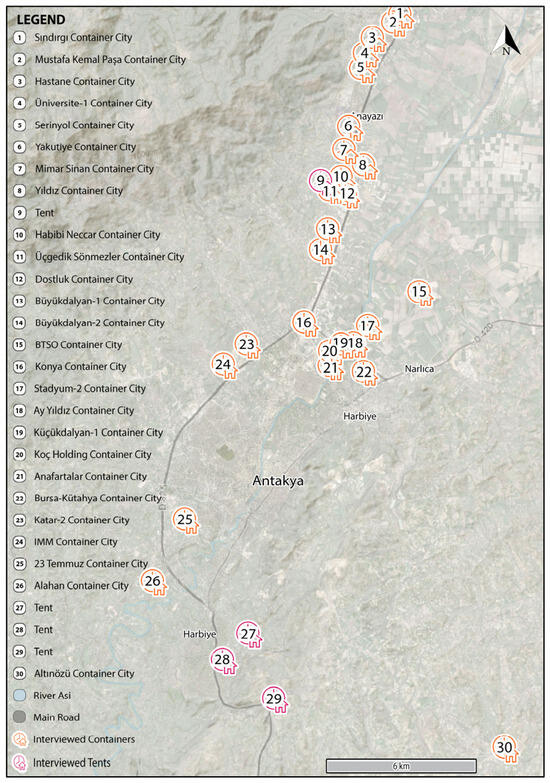
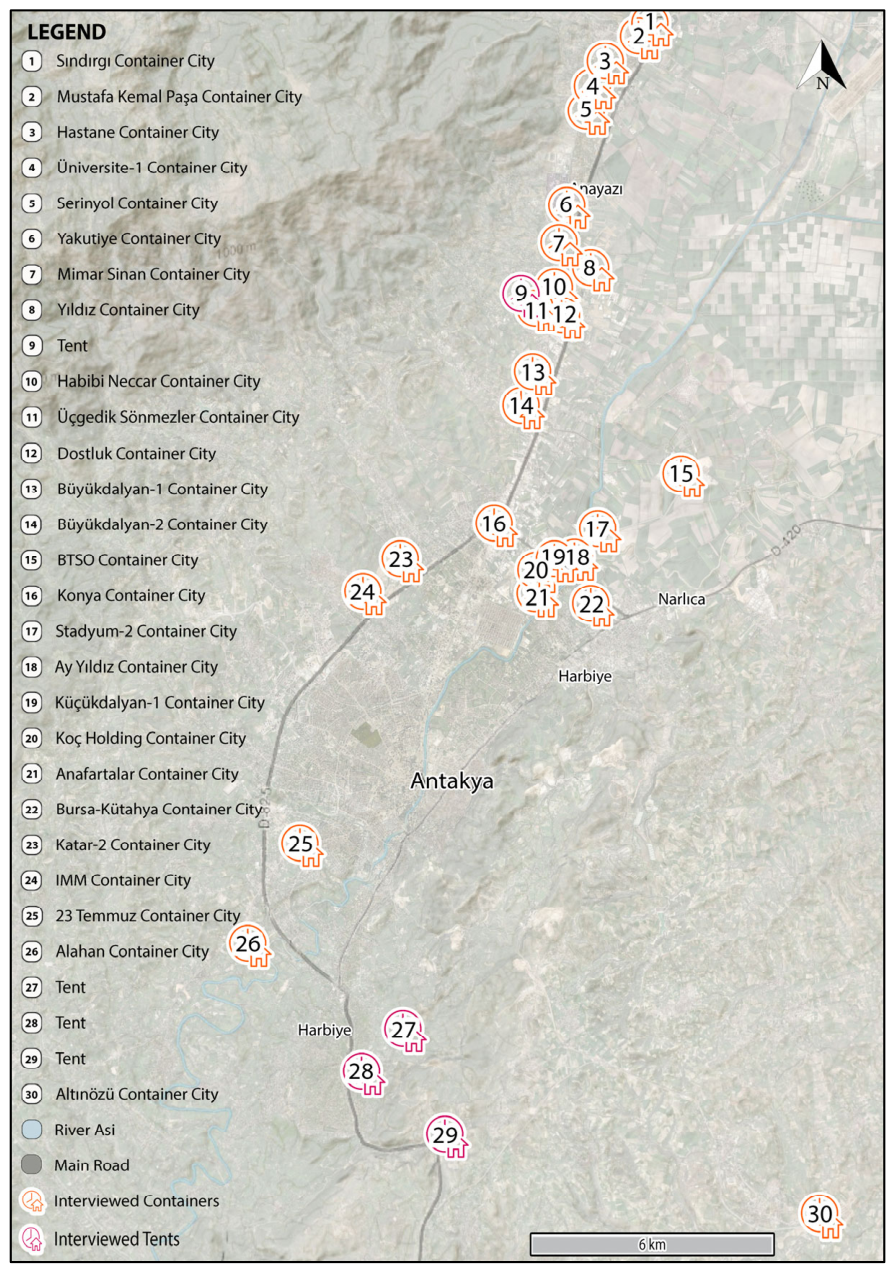
Antakya provides a critical case because of the duration of displacement, the scale of its temporary settlement system, and its historical and cultural significance. Fieldwork followed a corridor-based strategy informed by Lynch’s approach to urban legibility [52] and focused on the primary highway axis, which became a logistical and social backbone after the earthquake. The final analysis included 30 distinct temporary settlement areas: 26 container-based and four tent-based sites (Figure 1). This count resulted from a final audit in which duplicate or co-located site labels were consolidated and locations without both a completed resident Q-sort and an interview record were excluded.
Figure 1.
Locations of the temporary settlements included in the resident fieldwork in Antakya.
3.2. Research Design
The study adopts an interpretive mixed-methods design that combines deductive visual content analysis with participatory, subject-centred inquiry. Phase 1 examines public visual representations of recovery, while Phase 2 maps residents’ subjective experiences through Q-methodology. Integrating the two phases enables a contrastive interpretation of public visual representations and resident meanings. The design is not longitudinal, nor does it assume that Instagram narratives causally shaped subsequent resident experiences. Phase 1 defines the visual discourse universe, maps the frequency of visible place-attachment components, and informs the structured, compositionally balanced selection of the 36 photographs used in the Q-sort matrix.
The two empirical phases were intentionally linked rather than designed as independent sources of evidence. The Instagram corpus was used to map the public visual discourse surrounding post-disaster temporary settlements and identify a broad range of socio-spatial themes. These themes informed the Q-set by ensuring that the photographs represented the diversity of visual narratives circulating during the recovery period. The Q-methodology phase therefore does not independently validate the Instagram analysis. Instead, it examines how residents interpret, prioritise, negotiate, reinforce, or challenge meanings drawn from the same visual universe.
The two phases are temporally distinct as well as methodologically linked. Instagram images were drawn from posts published between 3 March 2023 and 5 June 2025, covering the post-earthquake recovery period. Resident Q-sorts and interviews were conducted in September 2025, by which time the temporary settlements had become prolonged living environments. The analysis therefore contrasts public visual representations posted during the recovery period with resident subjectivities recorded in September 2025. It is not framed as an early-versus-late, before-and-after, or causal comparison. The Instagram corpus was used only to describe public representations, define the visual discourse universe from which candidate Q-set images were selected, and provide a contrastive background for interpreting resident subjectivities.
3.3. Phase 1: Deductive Visual Content Analysis of Instagram Images
Instagram was selected because it is an image-based platform through which disaster response, humanitarian aid, reconstruction, and everyday life are made publicly visible [53,54]. Public visual narratives of recovery can shape perceptions of order, progress, and legitimacy, but the study does not treat them as direct evidence of governance performance. The analysis records which place-attachment components and recovery themes were visually foregrounded in public posts; it does not attempt to reconstruct the full discursive production of recovery through captions, audience responses, or platform interactions. Instagram is therefore treated not as a neutral archive of post-disaster life but as a platform whose affordances, communication practices, and visibility norms privilege some narratives while marginalising others.
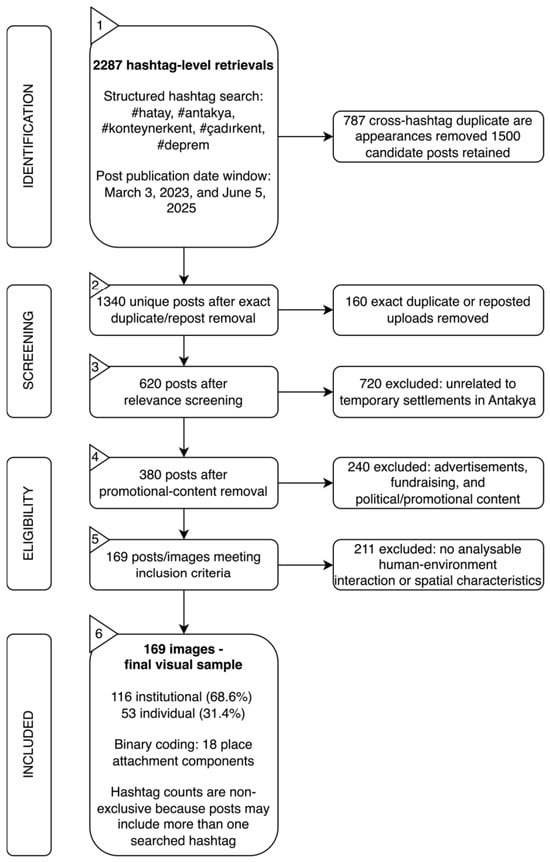
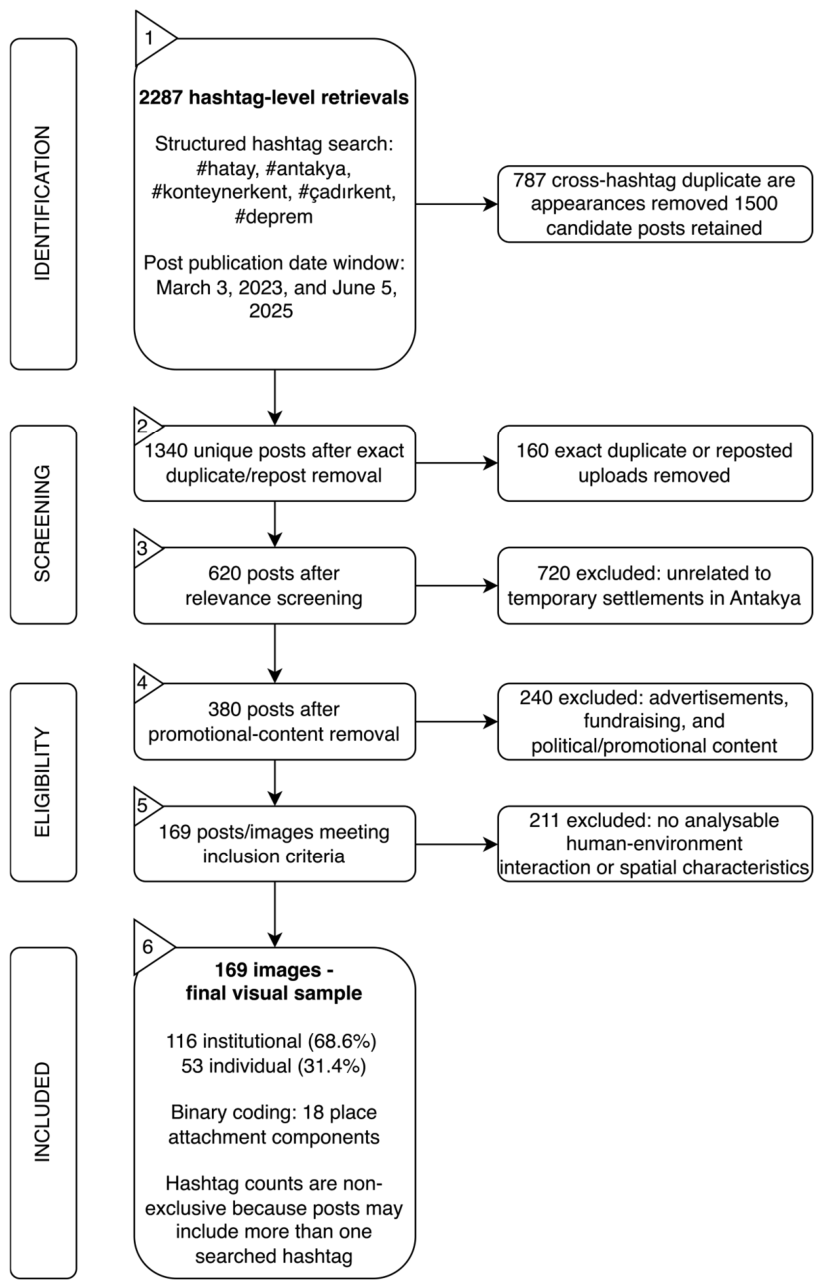
A purposive and documented sampling strategy identified 2287 hashtag-level retrievals from publicly accessible Instagram posts published between 3 March 2023 and 5 June 2025 and accessed through Google Chrome (Figure 2). Searches were conducted in Turkish using the predefined hashtags #hatay, #antakya, #konteynerkent, #çadırkent, and #deprem. Because the same post could appear under multiple hashtags, 787 cross-hashtag duplicate appearances were removed, leaving 1500 candidate posts. A further 160 exact duplicates and reposts were removed before relevance screening, leaving 1340 unique posts. Searches were conducted manually in repeated sessions using a consistent keyword order and publication-date window. To reduce personalisation effects, the browser cache was cleared, no user account was used, and the platform’s ‘Recent’ display was selected whenever available instead of engagement-based ranking. Retrieved posts were screened chronologically. Exclusion criteria covered content unrelated to temporary settlements in Antakya; advertisements, fundraising, and political or promotional posts; news items without relevant visual content; videos without analysable still images; and images that did not depict human-environment interaction or spatial characteristics. Institutional accounts included governmental, municipal, NGO, aid-agency, and corporate-relief accounts; individual accounts included residents, volunteers, journalists, and unaffiliated public users. The final corpus comprised 169 images, of which 116 came from institutional accounts (68.6%) and 53 from individual accounts (31.4%). The dates refer to the publication window of the posts; timestamps for individual search sessions were not retained as a separate audit field.
Figure 2.
Sampling and screening process for the Instagram corpus. Hashtag-level retrievals were non-unique because the same post could appear under more than one searched hashtag.
Institutional and individual accounts were retained within the same corpus but were not treated as equivalent image producers. They were analysed together because Phase 1 aimed to map the shared public visual repertoire surrounding temporary settlements rather than compare producer groups. Nevertheless, source type was recorded for every image, and the institutional-individual distribution is reported to make the composition of the corpus transparent. This decision is acknowledged as a limitation because the two account categories differ in institutional position, communicative purpose, and platform visibility (Table 2).
Table 2.
Illustrative examples from the visual content-analysis coding protocol.
Methodological separation was maintained between sampling and coding to reduce circularity. The sampling frame was first established through keyword, date, and location criteria; the 18 components derived from Scannell and Gifford’s place-attachment framework [15] were then applied only during coding. Frequency distributions therefore describe the visibility of components within the selected corpus and were not used to select only images that conformed to the framework. Searches were conducted manually in a cleared-browser environment, and the platform’s chronological ‘Recent’ display was used whenever available to limit personalisation and algorithmic curation. Residual effects of proprietary ranking and interface changes are acknowledged as limitations. Each component was coded as present or absent. For example, communal gatherings were coded as social bonding or experience, religious facilities as religious or social-symbolic meaning, customised thresholds as personalisation or agency, and historic urban symbols as historical continuity. Two researchers independently coded a random 10% subset of the images. Cohen’s kappa indicated high agreement (kappa = 0.86, p < 0.001), and discrepancies were resolved through discussion and consensus.
Digital-ethics procedures followed established guidelines for internet research [55]. Only publicly accessible posts were collected. Usernames, exact geolocations, and other directly identifying information were removed, and the images were treated as sensitive disaster-related data rather than as freely reusable illustrations.
3.4. Phase 2: Q-Methodology with Residents
Q-methodology was used to identify shared subjective viewpoints among residents [56,57]. It is well suited to complex and contested contexts because it seeks to map distinct configurations of meaning rather than estimate their prevalence in a population. This makes it particularly appropriate for post-disaster temporary settlements, where residents may express attachment, ambivalence, or detachment without these responses representing linear stages of recovery.
For analytical purposes, ‘place’ was operationalised at three interconnected spatial scales: (1) the dwelling scale, comprising the container or tent, its threshold, and associated semi-private spaces; (2) the settlement scale, including shared facilities, communal spaces, circulation patterns, and the overall layout; and (3) the city and memory scale, encompassing residents’ relationships with former neighbourhoods and Antakya’s pre-disaster urban identity. Participants evaluated the photographs in relation to their experience of temporary settlement life while considering these interconnected scales.
Drawing on Phase 1 and field observations, a Q-set of 36 photographs was constructed to represent the discourse universe while providing balanced coverage of the 18 place-attachment components. The Phase 1 frequency analysis identified dominant and marginal visual themes, while final selection combined three criteria: visibility in the Instagram corpus, theoretical coverage of the 18 components, and relevance to observations made during the September 2025 site visits. The Q-set did not reproduce the Phase 1 frequencies mechanically. Instead, it prevented highly visible themes, such as the built environment and everyday experience, from displacing less visible but theoretically important themes, such as historical continuity and uncertainty (Table S4 in Supplementary Materials). Because visual salience, emotional resonance, familiarity, and symbolic content can influence Q-sorting, captions and usernames were removed, all photographs were printed at the same size and presented in a consistent format, and their initial order was randomised for each participant. Participants were instructed to rank the photographs according to the socio-spatial meanings they conveyed rather than their attractiveness or photographic quality. Post-sort interviews explored the reasons for the highest and lowest rankings. These procedures helped distinguish socio-spatial interpretation from aesthetic preference, but they could not eliminate the effects of visual and symbolic qualities. Factor interpretation therefore drew on both the Q-sort configurations and participants’ qualitative explanations.
Fieldwork was conducted from 13 to 22 September 2025 across the 30 temporary settlement areas. Fifty participants were recruited purposively to capture variation in settlement type, duration of stay, age, gender, occupation, and previous neighbourhood. As detailed in Table S8a, the sample comprised 28 men (56%) and 22 women (44%). Participants were aged 18–25 years (6%), 26–35 years (22%), 36–45 years (26%), 46–55 years (28%), or 56 years and older (18%). Eighteen participants were employed in the public or private sector; 18 were self-employed, freelance workers, or labourers; 9 were homemakers; 3 were retired; and 2 were students. Displacement durations ranged from 0.25 to 30 months (mean = 19.6 months). Forty-one participants (82%) lived in formal container settlements, while nine (18%) lived in informal or tent-based settlements. In Q-methodology, the P-set is not intended to be statistically representative or to support population-level demographic correlations. Such analysis would also be underpowered here, given that only 24 of the 50 Q-sorts defined a single retained factor. Instead, Q-methodology identifies distinct, shared patterns of subjectivity within the participant group [58,59]. Socio-demographic characteristics and living conditions were used qualitatively to interpret how adaptive capacity may be distributed unevenly. Because most sites were represented by only one or two participants, claims about site-specific morphology or infrastructure are interpretive and illustrative rather than statistically representative. Local community leaders, including village and neighbourhood heads, were included as both disaster survivors and administrative intermediaries, offering insight into trust and community coordination.
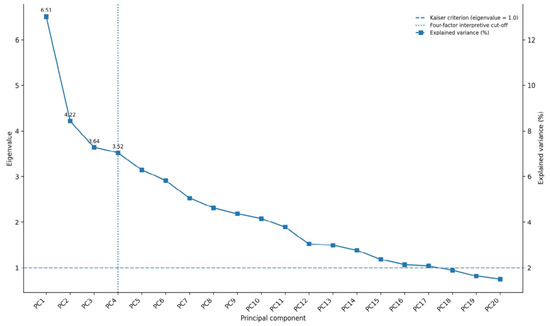
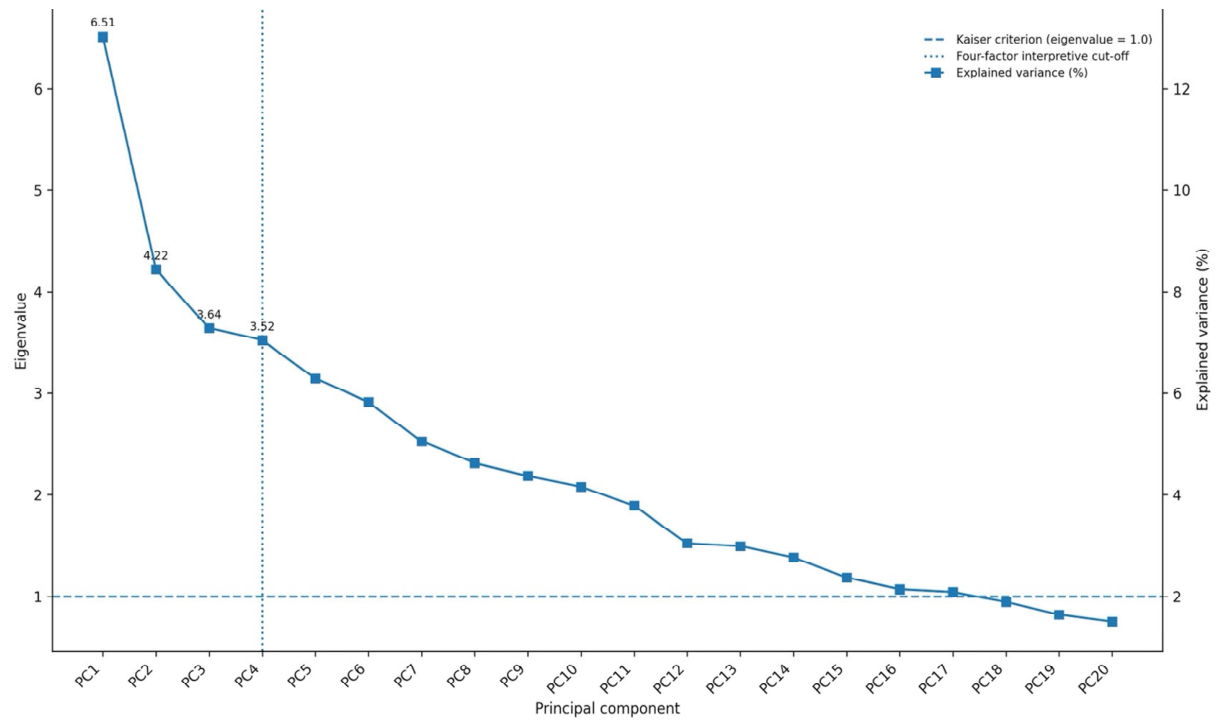
The by-person PCA of the 50 Q-sorts produced 17 components with eigenvalues above 1.0 (Figure 3), showing that the Kaiser criterion over-extracted components and was unsuitable as a standalone retention rule. Three-, four-, and five-factor solutions were examined. The four-factor solution was retained as the most parsimonious interpretive solution because it provided six defining Q-sorts per factor, low inter-factor correlations, and four coherent configurations in the post-sort accounts. The first four unrotated components accounted for 35.8% of the total variance. After Varimax rotation, the factor-specific shares were 11.3% for Factor 1, 7.7% for Factor 2, 8.3% for Factor 3, and 8.5% for Factor 4; rotation does not alter the total explained variance. The 35.8% total was obtained by rerunning the by-person PCA on the complete dataset of 50 Q-sorts and supersedes the previously reported value of 53.4%, which resulted from a reporting error. Because the five-factor solution was also statistically viable, the retained solution should be understood as an interpretive choice based on parsimony rather than as a uniquely determined statistical result. A manual significance threshold of an absolute loading of 0.43 or greater, approximately corresponding to p < 0.01 for 36 Q-set items, was applied. Q-sorts that loaded significantly on more than one factor were classified as confounded and excluded from factor-array construction. This procedure yielded 24 single-factor defining sorts, 3 confounded sorts, and 23 non-significant sorts. Negative defining sorts were retained through signed factor weights in calculating the factor arrays, but were treated as counter-poles and excluded from positive-pole demographic summaries. Table 3 presents the first 10 unrotated PCA components. Rotated factor characteristics, participant loadings, the comparison of three-, four-, and five-factor solutions, and the full factor arrays are provided in Supplementary Materials.
Figure 3.
Scree plot of the first 20 PCA components (Q-methodology, N = 50). Eigenvalues are shown on the left axis and the variance explained by each component (%) on the right. The horizontal dashed line marks the Kaiser criterion (eigenvalue = 1.0). Because 17 components exceeded this threshold, the vertical line at PC4 indicates the parsimonious interpretive solution retained for the article rather than a cut-off determined by the Kaiser criterion alone.
Table 3.
Eigenvalues and explained variance for the first 10 unrotated PCA components in the Q-methodology analysis.
In Q-methodology, factor interpretation depends primarily on the coherence and interpretability of the defining sorts rather than on the number of participants associated with each factor. Methodological guidance indicates that factors supported by five or more defining sorts can yield robust and meaningful interpretations when loadings are stable and the viewpoints are theoretically coherent [56,59].
3.5. Ethics, Consent and Positionality
Because the study involved disaster-affected residents, ethical safeguards were central to the research design. Verbal informed consent was obtained from all participants before the interviews. Written signatures were not requested because, in temporary post-disaster settlements, requests for signed documents could create discomfort or discourage participation. Before each interview, participants were informed of the study’s purpose, the voluntary nature of participation, their right to withdraw at any time without consequence, and the confidentiality of their responses. Interviews were conducted in a trauma-sensitive manner: participants were not pressured to recount traumatic experiences, and questions focused on spatial meanings, everyday practices, and recovery conditions. The Institutional Ethics Committee approved this consent procedure.
4. Findings
4.1. Public Visual Content: Orderly Recovery and the Marginalisation of Historical Continuity
The visual content analysis of 169 Instagram images revealed a process-oriented and predominantly optimistic representation of temporary settlements. Three components dominated the corpus: Built Environment (97.4%), Experience (94.7%), and Reconstruction of Place (86.8%). Historical continuity appeared in only 28.9% of the images. This imbalance suggests that public visual content foregrounded visible order, activity, and reconstruction while giving less prominence to Antakya’s historical and cultural identity. Because captions and audience responses were not analysed systematically, these findings are interpreted as patterns of visual representation rather than as a comprehensive discourse analysis.
Instagram images repeatedly depicted collective routines, children’s activities, beautification efforts, service provision, and visible reconstruction. They presented temporary settlements as liveable and progressively improving environments rather than primarily as spaces of unresolved loss. From the perspective of sustainable recovery, this pattern is ambivalent. It documents efforts to restore everyday life, but may also produce a homogeneous narrative of resilience that obscures uncertainty, unequal access to resources, and residents’ varied experiences of prolonged waiting.
Because the Q-set was deliberately derived from the visual discourse identified in Phase 1, the comparison examines how residents reinterpret a shared visual universe rather than contrasting two independent datasets. Its analytical value lies in identifying where resident subjectivities reinforce, negotiate, or diverge from public representations posted during the recovery period. The analysis neither separates an ‘early’ public narrative from a ‘later’ resident experience nor implies a causal sequence.
4.2. Resident Viewpoints: Four Socio-Spatial Configurations of Adaptive Response
The Q-methodology analysis yielded four distinct socio-spatial configurations. These are not stages in a linear recovery trajectory, population proportions, or an exhaustive account of resident subjectivities. Given the 24 single-factor defining sorts, 3 confounded sorts, and 23 non-significant sorts, the retained factors represent the clearest shared viewpoints within the P-set. In the post-sort interviews, participants consistently explained their rankings in relation to lived experience, memory, social relationships, safety, and expectations for the future, rather than solely in terms of the photographs’ aesthetic qualities.
The 24 defining sorts comprise only statistically significant, single-factor loadings used to construct the factor arrays. Participants with confounded or non-significant loadings were excluded from this construction. Each factor was defined by six Q-sorts. Signed factor weights were used in the calculations, meaning that a negative defining loading represents the counter-pole of the relevant factor. Participant 14 loaded negatively on Factor 2, Participant 7 on Factor 3, and Participant 3 on Factor 4 after Factor 4 was oriented so that its majority defining pole was positive. These participants were not combined with positive-pole participants in the demographic summaries. Because Q-methodology identifies shared patterns of subjectivity rather than population prevalence, interpretation focuses on the coherence of each viewpoint rather than the number of participants defining it.
4.2.1. Factor 1: Cultural-Symbolic Continuity and Collective Place-Making (11.3% Explained Variance)
Factor 1 constructs adaptive capacity through cultural and symbolic continuity combined with collective place-making (Table 4). The highest-ranked photographs depict a historic square, traditional graffiti, and a Turkish-flagged service container symbolising solidarity and local identity. The lowest-ranked photographs show aerial or wide-angle views of impersonal container landscapes and a health-support facility detached from a broader social context. This pattern suggests that service provision and physical order alone do not generate belonging; recovery becomes meaningful when residents can connect temporary environments with local identity, shared memory, and everyday social life.
Table 4.
Highest- and lowest-ranked photographs for Factor 1.
One participant explained: ‘This photograph symbolises that we have not lost everything; we can gather with neighbours and organise activities, which reminds us of our home’ (Participant 49, male, aged 55, teacher, Katar-2 Container City, duration: 24 months). Another resident emphasised the fragility of these emerging bonds: ‘We built a bond of trust with our neighbours here, we shared our pain. Now they want to send us to permanent housing estate apartments, but everyone is afraid… Maybe my closest neighbour will go to the other side of the city’ (Participant 28, male, aged 56, barber, Zübeyde Hanım Container City, duration: 30 months). All six defining sorts were located on the positive pole. They represented residents displaced for relatively long periods (mean = 22.0 months; range = 12–30 months), predominantly men (five of six), and included both tent and container residents. This viewpoint indicates that cultural symbols, shared spaces, and neighbourhood relationships can reinforce social capital, while relocation procedures that disperse established networks may threaten it.
4.2.2. Factor 2: Functional Domestic Stabilisation and Organised Settlement Life (7.7%)
Factor 2 expresses attachment through functional domestic stabilisation and organised settlement life (Table 5). Its highest-ranked photographs combine a customised container interior with visible settlement order, a symbol of solidarity, a grocery store, and completed rows of housing. The lowest-ranked images emphasise natural siting, abstract spatial legibility, and decorative personalisation without clear functional value. The configuration therefore distinguishes domestic adequacy and everyday serviceability from beautification that has limited practical relevance.
Table 5.
Highest- and lowest-ranked photographs for Factor 2.
One participant described the fragility of functional stabilisation: ‘These flowers, beautiful oleanders, were just tiny trees when we first planted them… But now, I have heard we will soon have to leave the containers, and I do not know what we will do… Our lives will be shattered all over again’ (Participant 21, male, aged 35, security worker, Mimar Sinan Container City, duration: 18 months). The positive pole comprised five residents, all living in formal container settlements, with a mean displacement duration of 19.2 months (range = 6–30 months); three were men and two were women. Participant 14 loaded negatively and was interpreted as the counter-pole rather than being included in this profile. His account—‘We were 16 people sharing a 25-square-metre temporary shelter… Privacy is just a thin metal sheet; there is no private life here’—illustrates the inverse position, in which overcrowding prevents functional stabilisation and personalisation. Factor 2 should therefore be understood as a viewpoint centred on workable domestic routines and organised everyday services, not as evidence that all container residents experience adequate privacy or autonomy.
4.2.3. Factor 3: Integrated Socio-Spatial Anchoring and Service-Supported Belonging (8.3%)
Factor 3 integrates domestic care, cultural legibility, communal interaction, and service support (Table 6). Its highest-ranked photographs depict a warmly personalised interior, safe and community-oriented reconstruction, a historic square, a health and psychosocial support centre, neighbours gathering, and informative cultural signs. Its lowest-ranked photographs show an engagement ceremony, aerial container views, a neglected sports field, and a generic natural setting. In this configuration, belonging is not anchored in a single facility; it emerges when domestic, social, cultural, and service infrastructures function as a coherent everyday environment.
Table 6.
Highest- and lowest-ranked photographs for Factor 3.
One participant stated: ‘Seeing children playing in the playground gives me hope; it is not just about survival’ (Participant 30, female, aged 36, public officer, Yakutiye Container City, duration: 30 months). Another described the limits of service-supported stability when environmental health was compromised: ‘They built a concrete batching plant right next to the containers. We breathe dust and asbestos day and night… Privacy is gone, but at least they should not take our health’ (Participant 36, female, aged 40, homemaker, Büyükdalyan Container City, duration: 30 months). The positive pole comprised five formal-container residents and had the longest mean displacement duration in the solution (25.2 months; range = 18–30 months); three were women and two were men. Participant 7 loaded negatively and was treated as the counter-pole rather than being included in the positive-pole demographic profile. The factor indicates that long-term stability depends on the integration of domestic care, social interaction, cultural continuity, safe infrastructure, and reliable services.
4.2.4. Factor 4: Pragmatic Shelter Stabilisation Under Uncertainty (8.5%)
Factor 4 represents pragmatic shelter stabilisation under uncertainty (Table 7). The positive pole ranks completed container housing, a customised interior, vegetation, a school, and safe reconstruction most highly, while placing historic symbolism and impersonal aerial or wide-angle container views at the negative end of the distribution. This configuration prioritises tangible shelter adequacy and immediate living conditions over symbolic representation. It therefore combines a demand for practical stabilisation with selective emotional investment in an environment that residents still understand as temporary.
Table 7.
Highest- and lowest-ranked photographs for Factor 4.
Residents on the positive pole repeatedly linked material inadequacy to the difficulty of regarding the settlement as home. One explained: ‘The containers are so close to each other that we can feel the shadow of anyone walking by. We covered the windows with paper and tape so people cannot look inside… There is no soundproofing; if someone coughs in the next container, it feels like they are inside ours. Privacy is gone, and people have become distant and distrustful of one another’ (Participant 6, male, aged 56 or older, freelance worker, tent settlement, duration: 4 months). Another stated: ‘They told us this was temporary, but it has turned into a permanent reality for nearly two years… Why should I plant flowers or invest in a sheet-metal box when I do not know where I will be tomorrow?’ (Participant 18, male, aged 48, retired, Bursa-Kütahya Container City, duration: 24 months). These accounts show that valuing tangible improvements does not necessarily imply deep emotional attachment. Residents may demand adequate shelter while remaining cautious about symbolic or long-term investment.
The positive pole comprised five participants (four men and one woman) with a mean displacement duration of 7.6 months (range = 2–24 months). Four had lived in temporary settings for five months or less, while one long-term resident showed that pragmatic stabilisation can also persist under prolonged uncertainty. They included a doctor, a freelance worker, a homemaker, a technician, and a retired worker. Participant 3 loaded negatively and was treated as the counter-pole; he was not included in the positive-pole demographic summary. Factor 4 therefore identifies a practical orientation towards shelter completion, domestic adequacy, vegetation, schools, and safe infrastructure, accompanied by selective attachment and a continuing demand for credible pathways to permanent housing.
4.3. Synthesis: Recovery, Attachment and Sustainability
Twenty-three participants did not load significantly on a single factor. Rather than treating this pattern solely as a statistical limitation, it may also reflect the heterogeneous and fluid character of post-disaster place attachment. Residents experiencing prolonged displacement may simultaneously express elements of several viewpoints or hold internally contradictory positions that no single factor can represent. The retained factors should therefore be understood as the clearest shared viewpoints rather than as an exhaustive account of resident experience. The four configurations describe different ways of stabilising everyday life: cultural-symbolic continuity and collective place-making (Factor 1), functional domestic stabilisation and organised settlement life (Factor 2), integrated socio-spatial anchoring and service-supported belonging (Factor 3), and pragmatic shelter stabilisation under uncertainty (Factor 4). These associations illuminate recovery-related conditions, but they do not establish institutional causality or evaluate governance performance.
These findings qualify homogeneous narratives of resilience. Public images may present temporary settlements as orderly and socially cohesive, whereas resident viewpoints reveal uneven experiences of security, agency, and predictability. Place attachment therefore functions as a partial interpretive lens on selected dimensions of social sustainability; it cannot replace direct evidence concerning equity, participation, service access, safety, or distributional justice.
5. Discussion
5.1. Place Attachment as a Qualitative Diagnostic of Sustainable Recovery Processes
The relationship between the two empirical phases is complementary rather than confirmatory. Phase 1 identifies publicly circulating visual narratives, while Phase 2 examines how disaster-affected residents assign meaning to photographs selected from the same visual discourse. The comparison therefore explores differences in interpretation within a shared representational field rather than convergence between independent datasets. In this context, place attachment in prolonged temporary settlements is treated as an interpretive diagnostic for selected dimensions of recovery. It is relational and emerges through interactions among spatial design, public communication, social networks, service access, and perceived future pathways. Institutional context is inferred cautiously from observable settlement conditions and resident interpretations rather than measured through policy documents or interviews with officials and managers.
The empirical findings were synthesised into an interpretive framework linking observable settlement conditions, resident attachment responses, and broader implications for social sustainability; they were not used to validate a predefined diagnostic model. This reconceptualisation contributes to sustainability research by connecting subjective experience with physical settlement conditions. Physical indicators remain important but are insufficient on their own. An orderly container settlement may still fail to support cultural continuity, domestic adequacy, or environmental health. Conversely, modest environments may support adaptive capacity when residents can preserve local identity, establish workable routines, access coherent social and service infrastructure, and obtain credible information about future housing.
Pragmatic shelter stabilisation, represented by Factor 4, resonates with research on secondary vulnerability, in which the burden of making temporary accommodation liveable may be shifted onto residents who are already vulnerable. In Antakya, residents prioritised completed units, domestic adequacy, vegetation, schools, and safe infrastructure while remaining cautious about symbolic or emotional investment. Selective attachment should therefore be understood as a rational response to material precarity and uncertain relocation pathways rather than as a deficit of resilience.
5.2. Prolonged Temporariness and Differentiated Adaptive Capacity
The viewpoints identified through Q-methodology show that post-disaster temporary settlements are not homogeneous and that adaptive capacity is unevenly distributed among displaced residents. The positive pole of Factor 4 was associated mainly with recent displacement: four of the five participants had lived in temporary accommodation for five months or less, although one had remained for 24 months (mean = 7.6 months). These residents prioritised immediate shelter completion and practical adequacy. By comparison, the positive poles of Factors 1, 2, and 3 had mean durations of 22.0, 19.2, and 25.2 months, respectively, and emphasised cultural continuity, organised domestic life, and integrated socio-spatial support. These configurations should not be interpreted as sequential stages, because displacement durations overlap and one long-term participant also defined Factor 4. Gender patterns were similarly suggestive rather than determinative: Factor 1 included five men and one woman; Factor 2, three men and two women; Factor 3, three women and two men; and Factor 4, four men and one woman. Negative defining sorts were treated as counter-poles and excluded from these summaries. The results point to differentiated needs arising at the intersection of displacement duration, household roles, shelter conditions, service access, and environmental health rather than to fixed demographic types.
The qualitative quotations presented alongside the factor arrays show that each viewpoint contains internal nuance and occasional ambivalence. Factor labels should therefore be understood as interpretive summaries of shared patterns, not as homogeneous or fixed resident identities. The relatively high proportion of non-significant sorts may reflect the socio-spatial complexity of prolonged displacement, as residents often negotiate multiple and shifting forms of attachment, uncertainty, trust, and adaptation simultaneously. Q-methodology identifies only viewpoints that emerge as statistically coherent shared perspectives. The negative defining sorts in Factors 2, 3, and 4 further demonstrate that a factor may contain an explicit counter-pole; these participants were not treated as members of the positive-pole demographic group. Taken together, the findings suggest that everyday stabilisation depends on uneven access to cultural continuity, domestic adequacy, coherent social and service infrastructure, safe material conditions, and credible information.
The temporal dimension remains important but requires cautious interpretation. Public visual content posted between 3 March 2023 and 5 June 2025 emphasised progress, order, and reconstruction, whereas resident subjectivities recorded in September 2025 highlighted the lived consequences of prolonged uncertainty. This is an interpretive contrast between public visual representation during the recovery period and resident subjectivities at the time of fieldwork, not an early-versus-late, before-and-after, or causal comparison.
5.3. Implications for SDG 11 and the Sendai Framework
The findings have implications for SDG 11 and the Sendai Framework. Inclusive, safe, resilient, and sustainable communities cannot be achieved through shelter delivery or reconstruction speed alone. Recovery systems must also maintain social capital, enable spatial agency, and communicate credible pathways to permanence. The Sendai principle of building back better should therefore encompass improvements in recovery processes as well as in physical infrastructure.
For sustainability-oriented planning, place attachment may serve as a supplementary interpretive diagnostic. Where attachment centres on cultural-symbolic continuity, relocation planning should protect social networks and local identity. Where residents prioritise functional domestic stabilisation, attention should be directed towards household adequacy and everyday services. Where belonging depends on integrated socio-spatial anchoring, environmental safety and reliable social infrastructure become central. Where residents pursue pragmatic shelter stabilisation, immediate material improvements should be accompanied by credible transition information so that practical adaptation does not become open-ended dependency.
5.4. Policy Implications for Sustainable Recovery Planning
First, recovery planning should adopt transparent spatial phasing. Open-ended temporariness weakens confidence in the future across all four viewpoints. Public authorities could communicate clear, regularly updated, and enforceable pathways from temporary to permanent housing, including relocation criteria, expected timelines, and contingency plans. In Antakya, residents who had established cultural and neighbourhood ties feared that random housing lotteries would disperse their networks. Collective or proximate relocation options could therefore allow self-identified container blocks or neighbour groups to seek nearby permanent housing. Residents oriented towards pragmatic shelter stabilisation also require clearly defined transition schedules and accessible administrative dialogue, so that urgent material improvements do not become substitutes for pathways to permanent housing (Table 8).
Table 8.
Factor-specific planning implications derived from the four Q-methodology viewpoints.
Second, temporary settlement planning should support functional domestic stabilisation without romanticising prolonged temporary housing. Safe, low-cost opportunities for interior adaptation, modular partitions, shaded thresholds, small gardens, and semi-private outdoor spaces can improve household adequacy. Everyday service nodes, including grocery stores and accessible communal facilities, should be planned alongside dwelling modifications. Fieldwork showed that residents covered windows to protect privacy, partitioned overcrowded units with blankets, and used small-scale planting to make daily life more manageable. Flexible spatial protocols should therefore permit safe modifications while addressing sanitation, thermal comfort, acoustic insulation, and overcrowding. These measures respond particularly to Factors 2 and 4, which prioritise workable domestic routines and tangible shelter quality.
Third, cultural and socio-spatial nodes should be treated as essential infrastructure rather than secondary amenities. Historic symbols, cultural squares, schools, clinics, religious spaces, children’s play areas, shaded gathering spaces, and clear local information systems support Factors 1 and 3 by connecting identity, social interaction, and service reliability. Their equitable distribution matters because social sustainability is weakened when some settlements receive coherent support while others remain isolated or exposed to environmental hazards. Planning guidelines should establish environmental buffer zones between temporary settlements and concrete batching plants or other hazardous recovery infrastructure. Communal and cultural spaces should also be co-designed with residents so that neighbourhood networks and local identity can be maintained through relocation.
Together, these recommendations shift recovery planning from a provision-oriented model towards an adaptive, resident-sensitive approach. The aim is neither to romanticise temporary settlements nor to encourage permanent displacement. It is to ensure that, for as long as temporariness persists, residents are not deprived of the social and spatial conditions required for dignity, adaptation, and future-oriented recovery.
5.5. Limitations and Future Research
The study has several limitations. The two empirical phases are analytically connected because the visual themes identified in the Instagram corpus informed the Q-set. The findings should therefore be understood as complementary perspectives within a shared research design rather than as mutually independent sources of evidence. Instagram images are not representative of all public narratives or resident experiences; they are visual artefacts shaped by platform visibility, communication practices, and user self-presentation. Although procedural steps were taken to reduce algorithmic personalisation, platform-induced visibility bias could not be eliminated because Instagram’s search interface is proprietary and subject to undocumented changes. The publication-date window and screening counts are documented, but timestamps for individual manual search sessions were not retained, limiting exact procedural replication.
Q-methodology identifies shared patterns of subjectivity rather than statistically generalisable population proportions. The retained factors should not, therefore, be interpreted as statistically representative resident groups. Because 50 participants were distributed across 30 sites, the analysis cannot support robust site-level claims about every settlement’s morphology or infrastructure. When photographs are used as Q-sort stimuli, visual salience, emotional resonance, prior familiarity, and symbolic content can influence sorting decisions. Post-sort interviews helped distinguish socio-spatial interpretation from aesthetic preference, but could not eliminate these influences. In addition, 23 participants did not define a retained factor and 3 had confounded loadings. The four-factor solution should therefore be understood as representing the clearest shared viewpoints rather than the full spectrum of resident subjectivities.
The study did not include interviews with government officials, settlement managers, or policy-makers. References to recovery governance therefore provide theoretical context, while empirical claims are confined to observable spatial, service, communicative, and uncertainty-related conditions and residents’ interpretations of them. The evidence should not be read as a direct evaluation of institutions, housing-allocation rules, management practices, or policy performance. Future research combining policy documents, administrative timelines, and interviews with institutional actors could examine the broader mechanisms discussed here more directly.
The temporal comparison between public visual content posted from 3 March 2023 to 5 June 2025 and resident subjectivities recorded in September 2025 is analytically useful. It nevertheless remains a contrast between public representation during the recovery period and resident experience at the time of fieldwork, not a direct before-and-after or causal design.
Future research should examine attachment configurations longitudinally. Repeated applications could investigate whether cultural-symbolic continuity, functional domestic stabilisation, integrated socio-spatial anchoring, and pragmatic shelter stabilisation change as residents move into permanent housing. Comparative studies across disaster contexts and governance regimes could also test whether selective attachment and material prioritisation recur under similar conditions of uncertainty. Because the framework was developed through interpretive synthesis rather than hypothesis testing, it should be regarded as a conceptual heuristic requiring validation through future comparative research. Further studies could integrate spatial mapping, administrative timelines, and participatory design evaluation to connect subjective diagnostics with planning interventions.
6. Conclusions
This article indicates that post-disaster temporary settlements are not merely short-term shelter environments. When displacement becomes prolonged, they develop into socio-spatial systems in which selected dimensions of social sustainability and adaptive capacity may be supported or eroded. The Antakya case shows that public visual representations of orderly recovery may differ from the heterogeneous ways in which residents experience and negotiate temporariness.
The four socio-spatial configurations identified through Q-methodology—cultural-symbolic continuity and collective place-making, functional domestic stabilisation and organised settlement life, integrated socio-spatial anchoring and service-supported belonging, and pragmatic shelter stabilisation under uncertainty—represent the clearest shared viewpoints within the P-set, not the full range or prevalence of resident subjectivities. They indicate that place attachment is neither uniform nor inherently positive. Instead, it functions as an interpretive diagnostic for selected recovery conditions, revealing how residents connect temporary environments with identity, establish workable routines, interpret social and service infrastructure, and allocate emotional investment under uncertainty.
The findings have an important implication for sustainable recovery planning: temporary settlements should be planned and managed as lived environments rather than merely as technical containers for displaced populations. The diagnostic value of place attachment lies in its sensitivity to selected aspects of observable settlement and recovery conditions, including social infrastructure, spatial agency, communication, and relocation uncertainty. It cannot replace direct measures of equity, participation, service access, or institutional accountability, but it can illuminate whether residents experience recovery as a process they can meaningfully inhabit. Transparent spatial phasing, safe morphological flexibility, and factor-specific socio-spatial infrastructure may help prevent secondary social vulnerability and align post-disaster recovery with SDG 11 and the Sendai Framework.
Supplementary Materials
The following supporting information can be downloaded at: https://www.mdpi.com/article/10.3390/su18157749/s1, Table S1: overview of supplementary contents; Table S2: Instagram sample, resident fieldwork and ethics metadata; Table S3: Visual content analysis coding protocol for place attachment components; Table S4: Q-set photograph catalogue and source provenance; Table S5: Q-method design and factor-solution diagnostics. Table S5a: Eigenvalues and explained variance for PCA components (first 10 components). Table S5b: Factor inter-correlation matrix. Table S5c: Composite reliability and standard error of factor scores. Table S5d: Comparison of alternative factor solutions; Table S6: highest- and lowest-ranked photographs by factor; Table S7: distinguishing and consensus photographs; Table S8: participant factor-loading matrix; Table S8a: complete socio-demographic and spatial profiles; Table S9: full factor arrays for all 36 photographs; Table S10: Instagram visual-sample metadata and coding summary; and Table S11: hashtag retrieval and screening summary; Figure S1: Q-set photograph contact sheet.
Author Contributions
Conceptualization, C.M.S. and A.A.G.; Methodology, C.M.S. and A.A.G.; Validation, A.A.G.; Formal analysis, C.M.S. and A.A.G.; Investigation, C.M.S. and A.A.G.; Data curation, C.M.S. and A.A.G.; Writing—original draft, C.M.S. and A.A.G.; Writing—review and editing, C.M.S. and A.A.G.; Visualization, C.M.S. and A.A.G.; Supervision, A.A.G.; Project administration, A.A.G. All authors have read and agreed to the published version of the manuscript.
Funding
This research was supported by the Scientific Research Projects Coordination Unit of Istanbul Technical University under Project Grant No. 2025-47213.
Institutional Review Board Statement
This study was derived from the thesis titled “Place Attachment in Temporary Spaces After Disaster-Driven Displacement” in the Urban and Regional Planning Doctorate Program at the Graduate School of Istanbul Technical University. The study was conducted in accordance with the Declaration of Helsinki and approved by the Istanbul Technical University Social and Human Sciences Human Research Ethics Committee (protocol code 2025-06-717; date of approval: 7 July 2025).
Informed Consent Statement
Verbal informed consent was obtained from all participants. Verbal rather than written consent was used because requesting signatures during face-to-face interviews in temporary post-disaster settlements could cause discomfort or discourage participation. Before each interview, participants were informed of the purpose of the study, the voluntary nature of participation, their right to withdraw at any time, and the confidentiality of their responses. The Institutional Ethics Committee approved this consent procedure.
Data Availability Statement
All anonymised analytical materials required to evaluate the study—including the coding protocol and summary, Q-set catalogue, factor-solution diagnostics, participant factor-loading matrix, full factor arrays, distinguishing and consensus photographs, and hashtag-screening summary—are provided in Supplementary Materials. Raw interview transcripts, identifiable resident data, and reusable copies of source images are not publicly available because of ethical and privacy restrictions.
Conflicts of Interest
The authors declare no conflicts of interest.
References
- UNDRR. Sendai Framework for Disaster Risk Reduction 2015–2030; United Nations Office for Disaster Risk Reduction: Geneva, Switzerland, 2015. [Google Scholar]
- Lizarralde, G.; Johnson, C.; Davidson, C. (Eds.) Rebuilding After Disasters: From Hazards to Resilience; Routledge: London, UK, 2009. [Google Scholar]
- Folke, C. Resilience: The emergence of a perspective for social–ecological systems analyses. Glob. Environ. Change 2006, 16, 253–267. [Google Scholar] [CrossRef] [Scilit]
- Aitsi-Selmi, A.; Egawa, S.; Purdy, H.; Wannous, C.; Murray, V. The Sendai Framework for disaster risk reduction: Renewing the global commitment to disaster risk reduction in development. Int. J. Disaster Risk Sci. 2015, 6, 164–176. [Google Scholar] [CrossRef] [Scilit]
- United Nations. Transforming Our World: The 2030 Agenda for Sustainable Development; UN Publishing: New York, NY, USA, 2015. [Google Scholar]
- Alexander, D. Confronting Catastrophe: New Perspectives on Natural Disasters; Oxford University Press: Oxford, UK, 2000. [Google Scholar]
- Quarantelli, E.L. General and particular observations on sheltering and housing in American disasters. Disasters 1982, 6, 277–281. [Google Scholar] [CrossRef] [Scilit]
- Davis, I. Shelter After Disaster; Oxford Polytechnic Press: Oxford, UK, 1978. [Google Scholar]
- Elkahlout, G.; Milton, S.; Hawa, R. Mud brick houses as a suitable alternative to emergency shelters for internally displaced persons (IDPs): Evidence from Northern Syria. Int. J. Disaster Resil. Built Environ. 2025, 16, 289–305. [Google Scholar] [CrossRef] [Scilit]
- Wisner, B.; Blaikie, P.; Cannon, T.; Davis, I. At Risk: Natural Hazards, People’s Vulnerability and Disasters, 2nd ed.; Routledge: London, UK, 2004. [Google Scholar]
- Kapucu, N. Culture of preparedness: Household disaster preparedness. Disaster Prev. Manag. 2008, 17, 526–535. [Google Scholar] [CrossRef] [Scilit]
- Anderson, B. Emergency futures: Exception, urgency, interval, hope. Sociol. Rev. 2017, 65, 463–477. [Google Scholar] [CrossRef] [Scilit]
- Dynes, R.R.; Quarantelli, E.L. Helping Behavior in Large-Scale Disasters: A Social Organizational Approach; Disaster Research Center, University of Delaware: Newark, DE, USA, 1977. Available online: https://udspace.udel.edu/items/93ddbdde-3805-46b0-957e-1571a3b4f203 (accessed on 10 July 2026).
- Levine, J.N.; Esnard, A.M.; Sapat, A. Population displacement and housing dilemmas due to catastrophic disasters. J. Plan. Lit. 2007, 22, 3–15. [Google Scholar] [CrossRef] [Scilit]
- Scannell, L.; Gifford, R. Defining place attachment: A tripartite organizing framework. J. Environ. Psychol. 2010, 30, 1–10. [Google Scholar] [CrossRef] [Scilit]
- Arlikatti, S.; Andrew, S.A.; Saitgalina, M. Temporary sheltering, psychological stress symptoms, and perceptions of recovery. Nat. Hazards Rev. 2015, 16, 04014027. [Google Scholar] [CrossRef] [Scilit]
- Brown, G.; Raymond, C.M. The relationship between place attachment and landscape values: Toward mapping place attachment. Appl. Geogr. 2007, 27, 89–111. [Google Scholar] [CrossRef] [Scilit]
- Oliver-Smith, A. Communities after catastrophe: Reconstructing the material, reconstituting the social. In Community Building in the 21st Century; Hyland, S.E., Ed.; School of American Research Press: Santa Fe, NM, USA, 2005; pp. 45–70. [Google Scholar]
- Quarantelli, E.L. Patterns of sheltering and housing in US disasters. Disaster Prev. Manag. 1995, 4, 43–53. [Google Scholar] [CrossRef] [Scilit]
- Spokane, A.R.; Mori, Y.; Martinez, F. Housing arrays following disasters: Social vulnerability considerations in designing transitional communities. Environ. Behav. 2013, 45, 887–911. [Google Scholar] [CrossRef] [Scilit]
- Cutter, S.L.; Barnes, L.; Berry, M.; Burton, C.; Evans, E.; Tate, E.; Webb, J. A place-based model for understanding community resilience to natural disasters. Glob. Environ. Change 2008, 18, 598–606. [Google Scholar] [CrossRef] [Scilit]
- Félix, D.; Branco, J.M.; Feio, A. Temporary housing after disasters: A state of the art review. Habitat Int. 2013, 40, 136–141. [Google Scholar] [CrossRef] [Scilit]
- Johnson, C. What is the big deal about temporary housing? Types of temporary accommodation after disasters: Example of the 1999 Turkish earthquakes. In Proceedings of the 9th Annual Conference of TIEMS Disaster Management; University of Waterloo: Waterloo, ON, Canada, 2002. [Google Scholar]
- Johnson, C. Impacts of prefabricated temporary housing after disasters: 1999 earthquakes in Turkey. Habitat Int. 2007, 31, 36–52. [Google Scholar] [CrossRef] [Scilit]
- Tierney, K.; Oliver-Smith, A. Social dimensions of disaster recovery. Int. J. Mass Emergencies Disasters 2012, 30, 123–146. [Google Scholar] [CrossRef] [Scilit]
- Byun, N.; Shon, D. Living place matters: The duplicity of shared housing in the young adults of South Korea. Front. Psychol. 2022, 13, 634905. [Google Scholar] [CrossRef] [Scilit] [PubMed]
- Drabek, T.E.; Key, W.H. Conquering Disaster: Family Recovery and Long-Term Consequences; Irvington Publishers: New York, NY, USA, 1984. [Google Scholar]
- Comfort, L.K. Risk, security, and disaster management. Annu. Rev. Political Sci. 2005, 8, 335–356. [Google Scholar] [CrossRef] [Scilit]
- Alshawawreh, L.; Pomponi, F.; D’Amico, B.; Snaddon, S.; Guthrie, P. Qualifying the sustainability of novel designs and existing solutions for post-disaster and post-conflict sheltering. Sustainability 2020, 12, 890. [Google Scholar] [CrossRef] [Scilit]
- Folke, C.; Carpenter, S.R.; Walker, B.; Scheffer, M.; Chapin, T.; Rockström, J. Resilience thinking: Integrating resilience, adaptability and transformability. Ecol. Soc. 2010, 15, 20. [Google Scholar] [CrossRef] [Scilit]
- Luo, Z.; Zheng, Y.; Zhou, S.; He, M.; Lin, Z. Multi-scale wind environment regulation and seasonal response mechanisms of traditional settlements in Nanxi River Basin. npj Herit. Sci. 2026. [Google Scholar] [CrossRef] [Scilit]
- Su, Z.; Zhao, X.; Li, Y. Micro-scale land-use functional patterns and driving mechanisms in historic districts: A multi-source GIS and interpretable machine learning approach. Front. Environ. Sci. 2026, 14, 1784087. [Google Scholar] [CrossRef] [Scilit]
- Chen, J.; Wang, H.; Liu, R. Urban form evolution and transformation of traditional water towns based on space syntax and GIS: Evidence from ancient Wenzhou city (16th to the 20th century). Front. Earth Sci. 2025, 13, 1520643. [Google Scholar] [CrossRef] [Scilit]
- Lewicka, M. Place attachment: How far have we come in the last 40 years? J. Environ. Psychol. 2011, 31, 207–230. [Google Scholar] [CrossRef] [Scilit]
- Manzo, L.C.; Devine-Wright, P. (Eds.) Place Attachment: Advances in Theory, Methods and Applications; Routledge: London, UK, 2014. [Google Scholar]
- Tapsell, S.M.; Tunstall, S.M. “I wish I’d never heard of Banbury”: The relationship between ‘place’ and the health impacts from flooding. Health Place 2008, 14, 133–154. [Google Scholar] [CrossRef] [Scilit] [PubMed]
- Finsterwalder, J.; Kuppelwieser, V.G.; de Villiers, M. Transformative places and the citizenship experience: A dynamic perspective of disasters, transitional servicescapes, and place attachment. J. Retail. Consum. Serv. 2024, 77, 103628. [Google Scholar] [CrossRef] [Scilit]
- Peacock, W.G.; Dash, N.; Zhang, Y. Sheltering and housing recovery following disaster. In Handbook of Disaster Research; Rodríguez, H., Quarantelli, E.L., Dynes, R.R., Eds.; Springer: New York, NY, USA, 2007; pp. 258–274. [Google Scholar]
- Dempsey, N.; Bramley, G.; Power, S.; Brown, C. The social dimension of sustainable development: Defining urban social sustainability. Sustain. Dev. 2011, 19, 289–300. [Google Scholar] [CrossRef] [Scilit]
- Agyeman, J.; Bullard, R.D.; Evans, B. (Eds.) Just Sustainabilities: Development in an Unequal World; MIT Press: Cambridge, MA, USA, 2003. [Google Scholar]
- Walker, B.; Salt, D. Resilience Thinking: Sustaining Ecosystems and People in a Changing World; Island Press: Washington, DC, USA, 2006. [Google Scholar]
- Oliver-Smith, A. Anthropological research on hazards and disasters. Annu. Rev. Anthropol. 1996, 25, 303–328. [Google Scholar] [CrossRef] [Scilit]
- Manzo, L.C. For better or worse: Exploring multiple dimensions of place meaning. J. Environ. Psychol. 2005, 25, 67–86. [Google Scholar] [CrossRef] [Scilit]
- Bolin, R.; Stanford, L. Shelter, housing and recovery: A comparison of U.S. Disasters. Disasters 1991, 15, 24–34. [Google Scholar] [CrossRef] [Scilit] [PubMed]
- Twigger-Ross, C.L.; Uzzell, D.L. Place and identity processes. J. Environ. Psychol. 1996, 16, 205–220. [Google Scholar] [CrossRef] [Scilit]
- Soja, E. Seeking Spatial Justice; University of Minnesota Press: Minneapolis, MN, USA, 2010. [Google Scholar]
- Disaster and Emergency Management Authority (AFAD). Earthquakes in Kahramanmaraş. Republic of Türkiye Ministry of Interior. 2023. Available online: https://www.afad.gov.tr (accessed on 10 July 2026).
- Presidency of Strategy and Budget (SBB). 2023 Kahramanmaraş and Hatay Earthquakes Report; Presidency of Strategy and Budget (SBB): Ankara, Türkiye, 2023. Available online: https://www.sbb.gov.tr/wp-content/uploads/2023/03/2023-Kahramanmaras-and-Hatay-Earthquakes-Report.pdf (accessed on 10 July 2026).
- Ministry of Environment, Urbanization and Climate Change (MoEUCC). Ministry Announcement on Post-Earthquake Damage Assessment; Ministry of Environment, Urbanization and Climate Change (MoEUCC): Ankara, Turkey, 2023. [Google Scholar]
- Collective Mindset-Antakya. Comprehensive Recovery for Antakya. Ortak Akıl Antakya Platformu. 2025. Available online: https://www.ortakakilantakya.com (accessed on 10 July 2026).
- Habitat Planning Master (HPM). Antakya-Defne Field Observation Report; Habitat Planning Master Türkiye: Istanbul, Türkiye, 2023. [Google Scholar]
- Lynch, K. The Image of the City; MIT Press: Cambridge, MA, USA, 1960. [Google Scholar]
- Highfield, T.; Leaver, T. Instagrammatics and digital methods: Studying visual social media, from selfies and GIFs to memes and emoji. Commun. Res. Pract. 2016, 2, 47–62. [Google Scholar] [CrossRef] [Scilit]
- Townsend, L.; Wallace, C. Social Media Research: A Guide to Ethics; University of Aberdeen: Aberdeen, UK, 2016. [Google Scholar]
- Franzke, A.S.; Bechmann, A.; Zimmer, M.; Ess, C. Association of Internet Researchers. Internet Research: Ethical Guidelines 3.0. 2020. Available online: https://aoir.org/reports/ethics3.pdf (accessed on 10 July 2026).
- Brown, S.R. Political Subjectivity: Applications of Q Methodology in Political Science; Yale University Press: New York, NY, USA, 1980. [Google Scholar]
- Akhtar-Danesh, N. Impact of factor rotation on Q-methodology analysis. PLoS ONE 2023, 18, e0290728. [Google Scholar] [CrossRef] [Scilit] [PubMed]
- Stephenson, W. The Study of Behavior: Q-Technique and Its Methodology; University of Chicago Press: Chicago, IL, USA, 1953. [Google Scholar]
- Watts, S.; Stenner, P. Doing Q Methodological Research: Theory, Method & Interpretation; SAGE Publications: London, UK, 2012. [Google Scholar]

Disclaimer/Publisher’s Note: The statements, opinions and data contained in all publications are solely those of the individual author(s) and contributor(s) and not of MDPI and/or the editor(s). MDPI and/or the editor(s) disclaim responsibility for any injury to people or property resulting from any ideas, methods, instructions or products referred to in the content. |
© 2026 by the authors. Licensee MDPI, Basel, Switzerland. This article is an open access article distributed under the terms and conditions of the Creative Commons Attribution (CC BY) license.