


Abstract
Artificial intelligence (AI) is increasingly integrated into corporate strategies and operations, attracting considerable scholarly and practical attention, as well as raising important questions about its implications for firms’ sustainable development. The emerging body of literature has largely focused on the association between AI adoption and firm profitability, overlooking its implications for sustainable corporate governance. To address this gap in the literature, this study develops a novel AI adoption index to examine whether the adoption of AI is associated with stronger environmental, social, and governance (ESG) engagement among Japanese firms. Based on Stakeholder Theory and the Resource-Based View, we find for our sample of 145 Japanese firms that a higher AI adoption rate positively correlates with a higher overall ESG engagement. Specifically, our findings indicate that, after robustness checks, AI adoption is associated with social engagement scores, but not with environmental or governance engagement scores.
1. Introduction
Artificial Intelligence (AI) is not new, but it has recently emerged as a technology that has received significant attention in both the popular press and academic research, and it is increasingly being used or considered for use by organizations [1,2]. While AI has gained popularity due to recent technological advances, the term itself encompasses multiple definitions that distinguish it from traditional information technologies. These definitions generally emphasize AI’s capability to simulate intelligent behavior. Accordingly, AI is commonly understood as a technology that enables computers and machines to replicate human capabilities such as learning, understanding, problem-solving, decision-making, creativity, and autonomy [1].
Although research on the organizational outcomes of AI adoption is still in its early stages, it has expanded rapidly and produced a diverse but often fragmented body of findings. Overall, existing studies suggest that AI adoption may generate substantial financial performance benefits through various mechanisms [2,3], including improved operational efficiency, better decision quality, faster innovation, and more personalized customer engagement [4,5,6,7,8,9]. For example, the use of AI-based automation in manufacturing processes is associated with enhanced operational efficiency [10] and productivity [7]. Further, AI-driven analysis of large-scale datasets is linked to firms’ capacity to identify market opportunities and develop innovative products and services, with potential implications for sales growth [11].
However, although technological advancements are often regarded as important contributors to addressing sustainability challenges such as climate change and social inequality, very little is known about the association between firms’ AI adoption and their environmental, social, and governance (ESG) engagement [12]. Most existing studies on AI adoption and ESG engagement focus solely on Chinese firms [12,13]. In these studies, measures of AI adoption are primarily based on word counts in annual reports or on patent data from the National Intellectual Property Administration database (referred to as CNINFO) for Chinese-listed A-share companies. For example, Tian et al. use both patent data from the CNINFO database and word counts from annual reports between 2007 and 2022, demonstrating that AI technologies among Chinese firms have become increasingly prevalent over time [12]. Li et al. document a significant association between AI capabilities and ESG engagement among Chinese firms [13]. The findings of Zhang and Yang also suggest a positive association between AI adoption and ESG engagement, based on their use of natural language processing techniques to identify and count AI-related keywords in Chinese firms’ documents [14].
While these studies offer valuable evidence on the potential role of AI adoption in sustainable development, they exhibit three limitations. First, all Chinese studies reviewed by the authors employ pooled datasets covering periods of ten years or longer. Such an approach may be less insightful in the context of AI research, as AI adoption has accelerated substantially in recent years. Consequently, estimates derived from long-term pooled data may obscure temporal heterogeneity and fail to adequately capture the evolving association of AI and ESG engagement. Second, the measures of AI adoption used in prior studies tend to be too narrow, as AI adoption relates to various activities concerning firms’ inputs, processes and outputs [2,15]. For example, patent data as measures of AI adoption do not indicate whether and how firms implement AI governance policies to ensure the ethical use of AI. Third, the findings of prior studies may lack generalizability to firms in other countries, as firms’ levels of ESG engagement and AI adoption may vary across different contexts. Although the benefits of AI adoption are often mentioned, scholars contend that these outcomes are rarely universal and depend significantly on cultural context. This observation points to a need for culturally sensitive organizational learning capabilities, employee trust in technology, and the effective integration of AI into existing workflows and organizational routines [16,17]. It therefore appears insightful to examine the association between AI adoption and ESG engagement in a different institutional context.
To shed light on the link between AI adoption and ESG engagement, this research investigates the Japanese context. Japanese firms are characterized by strong technological innovation capabilities, and many expect AI adoption to enhance their financial performance in the coming years [18]. For instance, the Japanese tech company Rakuten headquartered in Tokyo announced that the adoption of AI tools and services contributed 25.5 billion Yen (roughly USD 170 Mio.) to its profits in 2025 and expects further substantial increases in the coming years [19]. Similarly, the recent announcement of an expanded strategic AI collaboration between Fujitsu and NVIDIA to develop a full-stack AI infrastructure and industry-specific AI agent platforms in Japan led to a 10.4% increase in Fujitsu’s stock value [20].
In recent years, the Japanese government has undertaken an ambitious sustainability-driven transformation aimed at fostering long-term economic and societal value creation, thereby incentivizing firms to strengthen their sustainability-related practices. In this respect, firms are required to enhance their ESG engagement. For example, to contribute to the environment dimension, they are expected to engage with the Green Growth Strategy whereby Japan aims to achieve climate neutrality by 2050 [21]. Regarding the social dimension, it is hoped AI can help to alleviate problems caused by labor shortages due to Japan’s rapidly shrinking population by enhancing workplace productivity [22]. Finally, for the governance dimension, in 2015 Japan established a Corporate Governance Code (revised in 2021) aimed at promoting sustainability-oriented governance practices within firms [23].
However, this research goes far beyond the Japanese context. To the best of the authors’ knowledge, no comprehensive AI adoption index of firms has yet been developed that takes the use of AI across firms’ inputs, processes and outputs into account. Since AI adoption and ESG engagement may depend on contextual factors, and, further, given that AI technologies have rapidly advanced in recent years, we have restricted our analysis to recent data on Japanese firms for the year 2025. By focusing on AI adoption among Japanese firms, the overall objective of this study is to address the following two research questions. First, how is AI adoption associated with ESG engagement? Second, which dimension, social, environmental or governance, shows a stronger correlation with AI adoption?
To address these research questions, we base our analysis on Stakeholder Theory and the Resource-Based View (RBV) and construct a novel AI adoption index by leveraging ChatGPT to assess the extent of AI adoption by firms. This index encompasses four central dimensions of AI adoption: AI learning initiatives, AI partnerships, AI governance principles, and AI products/services offered. After computing an overall AI adoption score for our sample, we employ multiple ordinary least squares (OLS) regressions to examine, first, the association between AI adoption and ESG engagement and, second, its association with the environmental, social and governance sub-dimensions. Overall, the results indicate a positive and statistically significant association between AI adoption and ESG engagement. Furthermore, the results suggest that the association between AI adoption and ESG engagement is driven primarily by the social dimension.
The remainder of this paper is organized as follows. First, we review the literature on AI adoption through the lenses of Stakeholder Theory and the RBV. Building on these theoretical perspectives, we introduce the Japanese institutional environment, develop an input–process–output framework of AI adoption and construct a corresponding adoption index. We then derive a set of hypotheses based on this framework and, next, describe the research methodology and present the empirical results. Finally, we conclude with a discussion addressing the implications of this study’s findings as well as its limitations.
2. Literature and Hypothesis Development
2.1. Literature Review
2.1.1. AI and Stakeholder Theory
Our empirical analysis of the association between AI adoption and ESG engagement is grounded in Stakeholder Theory [24], which posits that firms create value by addressing the interests and expectations of multiple stakeholder groups. Recently, the adoption of AI has been discussed as a potential strategic tool within the context of Stakeholder Theory [13,14]. Stakeholder Theory has also been widely applied in research on corporate environmental and sustainability strategies, providing a foundational lens for understanding how firms shape their actions in response to stakeholder expectations [25,26].
This foundational framework is especially important for understanding how organizations adapt AI to their own purposes, as it highlights that they operate within a broader social and environmental context and depend on their stakeholders. Therefore, to ensure their own long-term survival, organizations must consider the interests of all stakeholders (e.g., employees, customers, suppliers, communities), rather than focusing solely on shareholders [24]. This consideration is particularly salient in Japan, where corporate responsibility toward employees, local communities, and society at large has long been viewed as a core element of a firm’s mission [27]. This collective corporate ethos reflects a stakeholder-oriented perspective, whereby firms are expected to balance the pursuit of profitability with their obligations to employees and society, thereby contributing to sustainable community development and broader social value creation [28]. With the growing importance of sustainable development, stakeholders increasingly expect organizations to manage their ESG engagement, which comprises environmental, social and governance dimensions. This should likewise hold true for Japanese organizations, given their long-standing tradition of emphasizing social responsibility. Hence, ESG engagement reflects an organization’s commitment to sustainable development in line with the expectations of its stakeholders. Likewise, organizations that prioritize ESG engagement are better equipped to identify risks and opportunities, thus enabling them to employ more effective strategic responses.
2.1.2. AI and Resource-Based View (RBV)
The adoption and deployment of AI within firms can also be examined through the lens of RBV [29,30]. This concept was developed in a groundbreaking study by Barney (1991) and explains how unique, valuable, and hard-to-imitate resources and capabilities drive sustainable competitive advantage [29]. AI capabilities, including machine learning algorithms and advanced data analytics systems, constitute strategic organizational resources that can fundamentally enhance operational efficiency and transform managerial decision-making processes [31]. According to RBV, the development and deployment of AI capabilities constitute strategic investments in valuable organizational resources that can enhance operational effectiveness and generate new sources of value. Through improvements in data processing, decision-making, and process optimization, AI can strengthen firms’ competitive positioning and performance. Tao et al. find that AI implementation is associated with significant improvements in firms’ performance across various ESG dimensions [32]. Therefore, AI should not be viewed solely as a tool for enhancing productivity and operational efficiency. Increasingly, it is recognized as a strategic capability that can support employees in advancing firms’ corporate sustainability objectives. In the environmental dimension, AI technologies may optimize energy use and reduce waste generation, thereby enhancing firms’ environmental performance. In the social dimension, a higher AI adoption rate may contribute to safer working environments and improved labor practices through risk prediction, continuous monitoring, and enhanced transparency across supply chains [31]. Consequently, the value-creating potential of AI extends beyond economic gains, as it can strengthen firms’ human resources and support the achievement of broader organizational objectives.
2.1.3. Japan’s Institutional Environment
The Japanese Commercial Code and its subsequent reforms shape the institutional environment within which corporate organization and decision-making occur. Although not directly concerned with digital technologies, this legal framework influences firms’ governance structures, strategic decision-making processes, and managerial discretion, thereby indirectly affecting their propensity to undertake transformative investments such as AI adoption. The October 1999 amendments expanded firms’ flexibility in corporate restructuring and organizational design, thereby providing managers with greater discretion in balancing the interests of shareholders and other stakeholders [33].
Introduced in 2014, the Stewardship Code aimed to strengthen the stewardship responsibilities of institutional investors by encouraging greater engagement between asset owners, asset managers, and investee companies. Through active monitoring, constructive dialogue, and responsible voting practices, the Code sought to enhance the medium- to long-term value of firms and improve returns for beneficiaries. This policy reflects the broader rationale underlying recent corporate governance reforms in Japan, which have been associated with higher levels of investment efficiency and increased equity valuations [34]. Furthermore, the Japanese Corporate Governance Code, first introduced in 2015 and subsequently revised in 2018 and 2021, encourages boards to prioritize sustainable corporate growth and long-term value creation over short-term performance objectives [33].
A central element of the Japanese Corporate Governance Code is the incorporation of the “comply or explain” principle, which had been extensively adopted in other developed economies before its implementation in Japan [34]. The 2018 revision further strengthened the Code’s focus on reducing cross-shareholdings, reflecting the view that such ownership arrangements can impede effective market discipline and weaken the monitoring function of external governance mechanisms.
The 2021 revision of the Corporate Governance Code required listed companies to strengthen board independence by increasing the proportion of independent directors [35]. This reform built upon governance initiatives, including the Action Program for Accelerating Corporate Governance Reform, which was established as a comprehensive framework to promote effective corporate governance practices and strengthen the monitoring and stewardship functions of boards and independent directors [35].
The newly implemented AI Governance Guidelines constitute Japan’s primary policy framework for the governance and regulation of AI. Developed by the Japanese government through agencies responsible for digital and industrial policy, the guidelines are built on principles for the responsible development, deployment, and management of AI systems. In particular, the guidelines emphasize AI risk management, transparency, accountability, human oversight, and the ethical and responsible implementation of AI technologies [36]. It should also be noted that, unlike the EU AI Act, Japan relies largely on a principles-based and soft-law approach rather than imposing a comprehensive legal framework governing all business AI systems [37].
2.2. Developing an AI Input–Process–Output Adoption Index
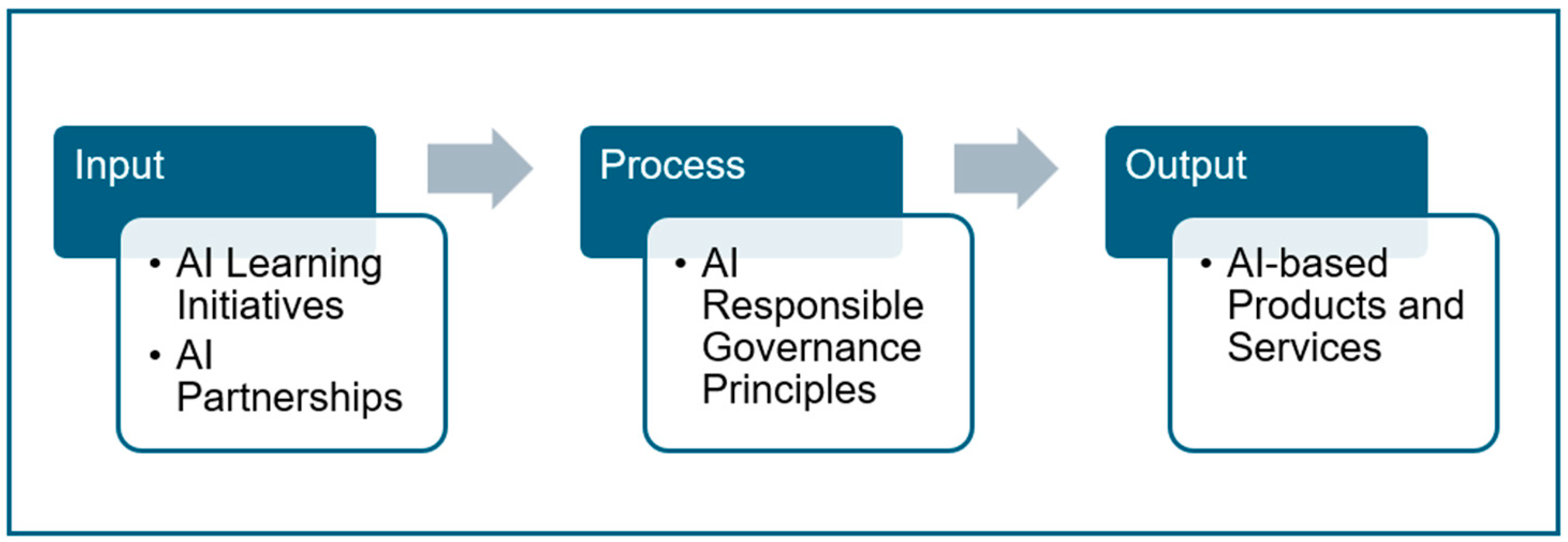
Prior research indicates that companies can adopt AI in a wide variety of ways [2,12,38]. However, no consensus yet exists regarding the meaning or operationalization of AI adoption in organizational contexts [38]. We employ the widely adopted input–process–output (IPO) framework to construct a novel AI adoption index. The IPO framework offers a structured model for analyzing how firms transform inputs (e.g., technical equipment, employee skills) through internal processes into outputs (e.g., products and services) [2,15]. Previous research suggests that AI adoption relates to this framework in four distinct ways, which are summarized and explained in Figure 1 below.
Figure 1.
Input–Process–Output Framework for AI Adoption. Source: Own elaboration.
Regarding AI input, prior research emphasizes the importance of managing internal capabilities [11], which are defined by Wamba-Taguimdje et al. as “the firm’s ability to create a bundle of organizational, personal, and AI resources for business value creation and capture” ([10], p. 1900). As the adoption of AI technologies often entails uncertainty and organizational change, companies typically implement AI learning initiatives to develop and enhance required workforce skills [1]. To apply the RBV to AI adoption, for example, by leveraging AI tools in marketing and sales activities, firms must train their employees to effectively utilize and interpret AI-generated customer data in ways that enhance value creation. Such AI learning initiatives not only promote internal skill development but also build employee trust by clarifying AI’s purpose and its implications for individual roles [1]. On the other hand, Stakeholder Theory can also be applied. Firms pursue strategic partnerships and collaborations with external stakeholders to develop and enhance their AI capabilities [1,2]. Such collaborations enable companies to access valuable resources (e.g., expertise and digital technologies) that would otherwise be inaccessible or difficult to develop internally. For instance, the Fujitsu–NVIDIA collaboration illustrates that strategic AI partnerships provide Fujitsu with access to NVIDIA’s leading AI expertise and technologies [39]. Another example by Magistretti et al. demonstrates how IBM successfully commercialized its AI platform, IBM Watson [40]. In this context, the company facilitated a high level of AI adoption through a range of external collaboration initiatives, including joint research with third parties, partnerships with universities, and so-called hackathons [40].
Regarding processes, research shows that firms use AI across a variety of business functions, including manufacturing [7], marketing [15] and human resource management [3,41]. For instance, Netflix utilizes AI to improve the quality of its video streams [1]. The importance of AI for each function depends on a firm’s industry and strategic priorities. However, all companies need formal AI governance practices to manage ethical and legal risks associated with AI adoption [2]. The term responsible AI has emerged in this context, which refers to the adoption of AI in line with principles of fairness, transparency and trust [42]. For instance, the implementation of formal AI standards can enhance transparency by clarifying how AI systems are deployed and used, as well as their inherent limitations. At the same time, establishing AI governance councils with representatives from a broad range of stakeholder groups can help to build trust and may support a stronger alignment across organizations [41].
Lastly, AI adoption is increasingly embedded in firms’ products and services and is positively associated with customer value creation [11]. Research indicates that AI can drive innovation by encouraging firms to introduce new AI-based products and services, or to extend existing products and services through the integration of AI functionalities [10,38]. AI-enhanced capabilities can elevate customer experiences through more personalized, timely, and responsive interactions. Moreover, by increasing switching costs through deeper user integration into a firm’s ecosystem, AI can improve customer retention and uncover new market opportunities. By identifying subtle patterns in customer behavior and demand signals that are difficult to detect using conventional analytical methods, AI enables firms to better anticipate market trends and strengthen their competitive edge [4,43]. To use IBM Watson as an example again, by leveraging AI technologies, the company created a new revenue stream [40].
2.3. Hypothesis Development
Prior research, which is mostly focused on Chinese firms, has highlighted an association between AI adoption and firms’ ESG outcomes [1]. For example, in a study focusing on firms’ AI capabilities measured using secondary AI patent data, Li et al. document a positive association between AI capabilities and ESG measures [13]. Similarly, having examined the relationship between market forces, measured by Tobin’s Q, and ESG performance in Chinese firms, Tian et al. find a strong association between AI adoption and corporate ESG performance using keyword frequency in annual reports [12]. Thus, against the backdrop of Chinese firms and the newly developed composite index capturing the four pillars of AI adoption outlined above, we posit a positive association between AI adoption and ESG engagement.
According to Stakeholder Theory, firms are expected to identify, prioritize, and respond to the needs and expectations of multiple stakeholders [24]. In this context, the use of AI systems is associated with real-time data collection and advanced analytics across diverse stakeholder groups, including customers, employees, regulators, and communities [44]. In that sense, AI adoption capabilities are associated with ESG engagement through the alignment of organizational strategies with stakeholder expectations and sustainability goals [45,46]. By enhancing the speed and accuracy of information processing, AI enables firms to respond more effectively to environmental and social expectations [47], thereby contributing to increased ESG engagement.
From an RBV perspective, AI adoption is viewed as a strategic organizational capability associated with firms’ information-processing capabilities, operational efficiency, and organizational learning. Firms can thus harness AI to strengthen their ability to identify, monitor, and respond to environmental, social, and governance-related issues. As a result, firms with higher levels of AI adoption are expected to exhibit greater ESG engagement.
Regarding the environmental dimension, AI enables companies to analyze large volumes of operational data to identify inefficient resource usage [12] and to optimize processes, thereby reducing energy consumption, pollution and waste [48]. With regard to the social dimension, AI adoption can positively correlate to the nature of jobs, the workplace and employees’ wellbeing [2]. For instance, the AI-driven automatization of repetitive tasks may enable employees to engage in more meaningful and creative jobs [10,15]. Human–AI collaboration is positively associated with creative performance and higher levels of creativity [49]. Also, AI engagement in terms of governance is associated with a stronger sense of community and shared purpose, alongside higher organizational morale, greater managerial commitment, and increased employee resilience [50]. Finally, AI adoption is associated with firms’ governance practices, including support for compliance with regulations and policies [10]. Against this backdrop, we posit the following association:
H1.
AI adoption is positively associated with ESG engagement.
As ESG engagement is a multifaceted outcome comprising three distinct sustainability dimensions, it is worthwhile examining the association between AI adoption and each of these dimensions individually. For example, AI has the potential to exert both positive and negative effects on organizations’ environmental performance. While greater digitalization may contribute to a reduction in firms’ environmental footprints, the magnitude and direction of this effect will vary from one context to another and may not always be beneficial. Specifically, the production, utilization, and disposal of AI-related assets can generate adverse environmental impacts [12]. Digitalization may, under certain circumstances, impede progress toward environmental sustainability due to technological and structural constraints, for example, through increased energy consumption and growing electronic waste [51,52]. A notable example is Microsoft, whose greenhouse gas emissions have risen by approximately 23% since 2020, partly attributable to the expansion of its data center infrastructure [53]. In sum, AI adoption is associated with both positive and negative environmental effects.
With respect to the social dimension, AI possesses the potential to improve workflow efficiency and overall organizational productivity. Qualitative studies provide substantial evidence for the beneficial effects of AI on employees and other stakeholders [1,2]. The integration of AI into organizational processes is associated with transparency and accountability, which are particularly relevant to social engagement [54,55]. Nevertheless, increased automation of processes driven by AI is also associated with reduced human interaction and potential workforce reductions, which may entail adverse social consequences [10]. In other words, AI adoption can be seen by the workforce as a threat or an opportunity, diminishing, complementing, or enhancing their agency [56]. Furthermore, while AI adoption offers considerable strategic benefits, it also generates ethical and legal challenges related to data security, privacy, and algorithmic fairness [2]. AI can enable firms to detect emerging risks, such as risks to labor conditions or the environment, through predictive analytics and continuous monitoring. This is associated with firms’ ability to anticipate and address stakeholder concerns proactively, particularly within the social rather than environmental dimension of ESG [57]. Accordingly, AI adoption is expected to be most beneficial in the realm of social engagement, as firms increasingly integrate stakeholder-related risk considerations into their decision-making processes. These issues have profound implications for employees, customers, and other stakeholders. Therefore, we hypothesize that AI adoption will be most strongly correlated with the social dimension of ESG.
Regarding the corporate governance dimension, and as illustrated by the Freeman–Friedman debate [24,58], managers who place greater emphasis on achieving higher corporate governance standards may enhance long-term firm value. However, shareholders’ profit-oriented focus may lead them to resist initiatives aimed at improving corporate governance structures due to higher associated costs. In line with prior research, the corporate governance dimension in ESG research appears to be relatively under-researched. Following earlier studies [59,60,61], we expect AI adoption to correlate most positively with the social dimension, and less so with the environmental and governance dimensions. Hence, we can state our hypothesis thus:
H2.
The level of AI adoption is more strongly associated with social engagement scores than with environmental or governance engagement scores.
3. Methodology
3.1. Firm Observations
The initial sample consisted of all 225 firms that were constituents of the Nikkei 225 index in 2025. We excluded banks and financial institutions, as their control variables differ from those of other industrial firms. Of the remaining 194 firms, we dropped 22 observations due to missing values for total assets, and a further 13 were lost due to missing dividend payout data. After excluding 14 additional observations with missing data on other variables, we arrived at a final sample of 145 firms. A list of all firms, along with their AI adoption and ESG engagement scores (as provided by Bloomberg), is presented in Supplementary S3.
3.2. AI Adoption Data Collection
To investigate whether and how AI adoption by Japanese firms is associated with their ESG engagement, we first quantified the firms’ level of AI adoption. To capture the multidimensional nature of AI adoption, we developed a novel composite AI adoption index (Supplementary S1). The index is theoretically grounded in the input–process–output (IPO) framework outlined above and consists of four distinct pillars: AI learning initiatives, AI partnerships, Public AI governance principles, and AI products/services offered. In the absence of established theoretical or empirical guidance for differential weighting of AI adoption dimensions, equal weighting is employed. This is a transparent and widely accepted approach in the construction of composite indicators [62]. In December 2025, we employed the generative AI system ChatGPT-5.5, which was available free of charge, to assess the level of AI adoption among the 145 firms in our sample. For this purpose, we manually entered the following prompt for each firm (e.g., Panasonic):
Build a simple AI adoption score for Panasonic (e.g., 0–100) using criteria: 1. AI partnerships, 2. AI products/services offered, 3. AI learning initiatives, 4. Public AI governance principles. Assign each criterion a weight of 25%.
Each criterion was scored from 0 to 25, and the scores were aggregated to calculate the composite AI adoption index. For instance, the AI adoption score for Panasonic, headquartered in Kadoma, Japan, was calculated as follows. In its first pillar (AI partnerships), Panasonic is actively forming strategic collaborations to embed advanced AI capabilities into its products and services. For example, Panasonic engaged in a global strategic partnership with Anthropic to integrate the Claude AI assistant into its products [63]. Furthermore, a collaboration with Alibaba on smart living AI platforms in China was initiated [64]. Overall, the AI Partnerships score was 21/25.
In its second pillar (AI products/services offered), Panasonic has integrated a range of AI-related offerings into its B2B and B2C solutions. For example, the company has developed various AI-based hardware and software applications, including energy storage systems for data centers and cybersecurity solutions [65]. Consequently, Panasonic was assigned a score of 19 out of 25 for AI products/services offered.
In its third pillar (AI learning initiatives), the firm has implemented a range of internal initiatives aimed at enhancing AI capabilities and upskilling employees. Notably, the development of an internal AI assistant named PX-AI, which is utilized by a substantial portion of the workforce, constitutes a key component of the company’s digital transformation and AI-related skill development efforts [66]. However, as Panasonic’s AI learning initiatives are lower than those of its close competitors, ChatGPT assigned a score of 16 out of 25.
Lastly, for the fourth pillar (Public AI governance principles), ChatGPT assigned a score of 20 out of 25 points due to Panasonic having developed and publicly disclosed its comprehensive AI governance frameworks and guidelines. Moreover, the firm established five core ethical principles for AI several years ago, along with an AI ethics committee, to ensure the responsible deployment of AI practices across all of its business functions [67].
Panasonic thus received an overall score of 77/100 points (compared to an average of 65.69) because the firm is actively adopting AI across its inputs, processes and outputs, including strategic partnerships, product development and internal governance. In sum, this index represents the firm’s overall level of AI adoption in 2025.
This procedure was repeated by the same person (one of this study’s co-authors), using exactly the same prompt, for all 145 firms in the sample; in other words, the only thing that changed each time was the name of the firm to which the procedure was applied. After all AI adoption scores were measured for the first time, a subset of firms was measured again on the same day by the same person, with no significant discrepancies having been observed, thus indicating test–retest stability.
3.3. ESG Engagement Score Data Collection
ESG engagement scores provide useful metrics for assessing the level of firms’ engagement in each of the three dimensions [68]. Further, they are also popular among researchers as a way of gauging firms’ accountability for their environmental and social impacts [69,70]. Also, Teti and Spiga state that the conceptual ambiguity and measurement challenges surrounding CSR have led firms to increasingly use ESG engagement scores as a quantitative tool to evaluate sustainability performance and the incorporation of responsible practices into corporate strategy [71]. The two databases most commonly employed in ESG analysis are LSEG and Bloomberg. Although a substantial body of research relies on LSEG data (formerly Refinitiv Eikon), this study employs ESG engagement scores from the Bloomberg database (2026). Whereas LSEG ESG measures are more closely aligned with self-reported and performance-oriented indicators, Bloomberg’s scoring methodology places greater emphasis on disclosure, assigning lower scores to firms that do not provide sufficient ESG information. Given that disclosure practices among Japanese listed firms are generally relatively extensive, Bloomberg data are deemed more appropriate for the purposes of this study. Nevertheless, both databases evaluate similar factors in constructing their ESG engagement scores.
The social score for Panasonic at Bloomberg, for example, is composed of five pillars: Social Supply Chain Management, Labor Employment Practices, Product Quality Management, Data Security & Customer Privacy, and Community Rights & Relations. This score reflects the extent to which the employer (Panasonic) treats its stakeholders, including its employees, favorably. At the time of data collection in March 2026, the overall score was rather low at 3.48. In contrast, the environmental dimension comprises a single category, Sustainable Product, which received a score of 7.34. The governance dimension, representing the third pillar of ESG engagement, is operationalized through four constituent measures: Board Composition, Executive Compensation, Shareholder Rights, and Audit. The composite governance score has a sample mean of 7.14 (see Supplementary S2).
3.4. Control Variables and Model
In order to account for firm size, profitability, shareholder orientation, and the role of intangible resources, we incorporated the following control variables into our analysis: total assets, net income, earnings per share (EPS), dividend payout ratio, and intangible assets. These variables may be independently associated with ESG engagement beyond AI adoption [12]. The data were obtained from the Nikkei NEEDS Financial QUEST database.
We applied the following model:
4. Results
4.1. Descriptive Statistics and Correlations
Table 1 presents the descriptive statistics of our variables.
Table 1.
Descriptive statistics.
The mean value for all ESG engagement scores is 4.67, with the highest being 7.55 (Yamaha Corp. from Hamamatsu, Japan) and the lowest 2.01 (Toho Co., Ltd. from Tokyo, Japan). The mean value of AI adoption is 65.69, indicating that many Japanese firms use AI to some extent in their inputs, processes and outputs. The highest level of AI adoption in our sample was presented by Nippon Telegraph & Telephone Corp (NTT) (93/100) from Tokyo, Japan, and the lowest by Fanuc Corp (14/100), headquartered in Yamanashi, Japan. Table 2 presents the correlations among the variables, showing strong intercorrelations between the three dimensions. Consequently, Hypothesis 2 is tested by examining the association of AI adoption with each engagement score dimension.
Table 2.
Correlation matrix.
Given the considerable variation observed in both the AI adoption and ESG engagement scores within the dataset, we conducted a multicollinearity diagnostic analysis. The results indicate that the highest variance inflation factor (VIF), observed for net income at 5.6, remains well below the conventional threshold of 10, suggesting that multicollinearity is not a concern in the present analysis [72].
4.2. OLS Regression Results
Table 3 presents the regression results. Regarding the control variables and as shown in Column 2, smaller firms are associated with higher ESG engagement scores, whereas firms with greater net income exhibit higher levels of ESG engagement. Turning to the main results, Column 3 (ESG engagement score) presents the association between AI adoption and the overall ESG engagement score, while Columns 4, 5 and 6 present the associations for the environmental (E), social (S), and governance (G) scores, respectively. The results for the overall ESG engagement score indicate that the coefficient of the AI adoption score is positive and statistically significant (β = 0.016, p < 0.05), providing support for Hypothesis 1.
Table 3.
Regression analysis.
The estimated coefficient implies that a one-standard-deviation increase in AI adoption is associated with an increase of approximately 0.235 ESG points (β × SD 0.016 × 14.67 = 0.235). It suggests that AI adoption is associated with a meaningful increase in ESG engagement, consistent with the view that associations between AI adoption and ESG outcomes unfold through organizational processes. In testing Hypothesis 2, only the social engagement score exhibits a positive and statistically significant association with AI adoption (β = 0.041, p < 0.001), whereas the environmental and governance engagement scores do not. Also, pairwise coefficient equality tests indicate that the S coefficient differs significantly from both the E coefficient (F = 15.857, p < 0.001) and the G coefficient (F = 11.528, p < 0.001), whereas the E and G coefficients do not differ significantly (F = 2.397, p = 0.122).
In economic terms, the estimated coefficient implies that a standard deviation increase of one in AI adoption is associated with an increase of approximately 0.601 points in the social engagement score (β × SD 0.041 × 14.67 = 0.601). Relative to the 0–10 scale, this effect is economically meaningful. Importantly, the magnitude is substantially larger than that observed for the overall ESG index, suggesting that AI adoption is more meaningful for the social dimension than the aggregate ESG measure or environmental and governance dimensions.
4.3. Robustness Tests
In order to examine the robustness of our results, we conducted a Wu–Hausman test to assess whether endogeneity materially affects the main estimates of the ESG and social engagement scores [73]. The Wu–Hausman tests indicated no statistically significant endogeneity for either the ESG score, F (1, 133) = 1.32, p = 0.253, or the social engagement score, F (1, 133) = 0.37, p = 0.543. Consequently, the null hypothesis of exogeneity could not be rejected for either variable, suggesting that OLS estimates are appropriate.
We further examined the robustness of the results for the social engagement score. In particular, we addressed concerns raised in the literature regarding the potential endogeneity of AI scores, as prior studies have argued that AI measures may not be exogenous in nature [31]. Potential sources of endogeneity can generally be classified into three categories: (1) inadequate measurement of key constructs, (2) unobserved heterogeneity arising from omitted variables, and (3) reverse causality between explanatory and outcome variables [74]. In our setting, measurement errors in the ESG and social engagement scores are unlikely to be a major concern, as these data were obtained from a widely recognized and extensively used database [61]. However, reverse causality remains a potential issue, even though AI adoption scores and ESG (social) engagement scores are measured with a one-year time lag [66]. Therefore, our analysis primarily focuses on addressing potential bias arising from unobserved heterogeneity and reverse causality.
Following prior ESG research [66,73], we used the industry mean score as an instrumental variable to address potential endogeneity concerns for social engagement scores. For this we conducted a two-stage least squares (2SLS) analysis [75], and as an instrumental variable we applied the Industry Average AI adoption score. This score may potentially influence AI scores, but not the social engagement dimension. As shown in Table 4, the industry average AI adoption score is positively and significantly associated with firm-level AI adoption in the first-stage regression (Column 1), indicating strong instrument relevance (β = 0.664, p < 0.001). This positive association suggests that firms operating in industries with greater AI adoption also exhibit higher firm-level AI adoption, conditional on firm characteristics. In other words, the highly significant first-stage relationship supports the relevance of the instrument.
Table 4.
Two-stage least squares test.
While we cannot fully rule out that other variables influence our results, this suggests that firms’ AI engagement deviates from industry-level benchmarks, consistent with heterogeneous responses to industry AI adoption. As shown in Table 4, the predicted AI adoption score in the second stage (Column 2) remains positive and statistically significant (β = 0.056, p < 0.05). Based on the main analysis and these robustness checks, the results indicate that AI adoption among Japanese firms is particularly positively correlated with their social engagement.
5. Discussion
Despite the emergence of several studies examining Chinese firms, the empirical literature provides only limited insights into the association between firm-level AI adoption and ESG engagement across other institutional and national contexts. Consequently, the generalizability of existing findings beyond China remains uncertain. By constructing a new AI adoption index comprising AI’s influence on firms’ inputs, processes and outputs, our analysis sheds new light both on current AI adoption practices among Japanese firms and on how AI uptake is associated with their ESG engagement. We find that firms with higher AI adoption levels also have higher ESG engagement scores. Specifically, AI adoption is more strongly correlated with social engagement scores than with environmental or governance scores. This result is consistent with earlier literature documenting strong commitment to social responsibility among Japanese corporations [28].
This study also contributes theoretical insights to Stakeholder Theory by suggesting that AI adoption may serve as an effective strategic tool for meeting stakeholder expectations regarding ESG engagement. Moreover, Stakeholder Theory emphasizes the interconnectedness of various actors, including employees, customers, suppliers, communities, and investors, which is particularly salient in the context of rapidly increasing digitalization [76]. While a positive association has already been suggested in previous research [12,13,14], this study contributes to our current understanding of AI and stakeholder theory in three ways. First, building on stakeholder theory, firms are expected to respond to the expectations of diverse stakeholder groups, including employees, customers, regulators, and local communities, with ESG engagement reflecting the extent of this alignment. AI adoption is associated with enhanced information-processing capabilities that may enable firms to better identify, monitor, and respond to stakeholder concerns, and thus higher levels of AI adoption are expected to be associated with higher ESG engagement. Second, this study advances the AI adoption literature by extending empirical inquiry beyond the Chinese context to Japan, thereby enhancing the cross-national generalizability of existing findings. Japan provides a compelling research setting given its distinctive socio-cultural emphasis on workplace harmony and collective coordination, alongside its prominent position as home to numerous globally recognized industry leaders. Third, we contend that AI adoption is a multifaceted variable, as it affects firms’ inputs, processes, and outputs. From a Stakeholder Theory perspective, these dimensions are associated with firms’ ability to respond to stakeholder expectations, as reflected in ESG engagement [2,15].
Our findings also align with RBV perspectives. From an inside-out perspective, AI adoption facilitates the development of unique internal capabilities that strengthen a firm’s competitive position. AI can contribute to the creation of such capabilities by enabling the development of embedded organizational resources, including specialized knowledge, data assets, and organizational learning routines.
The importance of leveraging internal organizational strengths was already emphasized by Miller et al., who argued that managers should focus on fostering collaboration and continuous learning [77]. Through these mechanisms, firms can transform internal capabilities into market value and superior performance. Importantly, sustained competitive advantage is unlikely to result from imitation alone; rather, it emerges from the development of original and distinctive capabilities that competitors cannot easily reproduce [77]. In this regard, AI can serve as a catalyst for capability development by enhancing organizational learning, knowledge creation, and innovation. In other words, when these capabilities are deeply integrated into organizational processes, they become increasingly difficult for competitors to replicate, thereby supporting the attainment of long-term competitive advantage [29,30]. Also, even if AI is accessible to other firms, the speed of adoption plays a major role in providing early-adopting companies with a competitive advantage [78].
Our research expands upon McGahan’s work on the emerging literature of “new stakeholder theory” through the integration of RBV perspectives [79]. Scholars following Stakeholder Theory argue that it is key stakeholders who are the core providers of firms’ strategic resources [80]; hence stakeholder management is the process whereby a firm seeks to attract investments from these resource providers by committing to sharing value with them, in such a way that will boost the firm’s overall value creation [81].
The findings of this study have important managerial and policy implications. In particular, the positive association between AI adoption and overall ESG engagement scores suggests that firms with higher levels of AI adoption tend to demonstrate greater managerial awareness of, and commitment to, robust governance practices. Managers may therefore view AI not only as a tool for improving operational efficiency but also as a means of enhancing ESG initiatives, particularly when related to the social dimension. The significant association observed for social scores, but not environmental or governance engagement scores, suggests that firms with higher levels of AI adoption tend to exhibit stronger social scores, which also encompass the labor and social supply-chain-related dimensions of ESG. Rather than being viewed as a threat, AI thus appears to be a supportive tool within firms. To maximize these benefits, AI adoption should be related to firms’ inputs, processes and outputs. Furthermore, policymakers are encouraged to promote AI adoption in firms. The findings suggest that AI adoption, when supported by responsible AI governance principles, may contribute to broader sustainable development outcomes. However, as our findings are based on the Japanese context, AI-related policy interventions should be tailored to the institutional context in which companies operate.
This study has several limitations. First, we constructed a novel composite AI adoption index by utilizing ChatGPT to assess the degree of firm-level AI adoption across four distinct pillars. While this approach represents an innovative methodological contribution, it should be regarded as a preliminary framework that may entail certain limitations. One limitation concerns the temporal stability of the findings. As AI adoption practices continue to evolve rapidly across organizations, the conditions under which firms utilize AI are likely to change substantially in the near future. Consequently, future studies may observe different patterns of AI adoption and organizational outcomes, potentially limiting the reproducibility of the present findings. Another potential limitation concerns the reliability of our AI adoption scores, which were measured by ChatGPT. To examine reliability, we conducted a robustness analysis by assessing interrater reliability based on a subset of 30 firms from our sample. Two raters used the same prompt independently. The comparison was performed on 18 June 2026 and revealed no statistically significant differences in the scores. The analysis yielded an intraclass correlation coefficient (ICC) of 0.877, indicating good agreement. This result suggests a high degree of consistency in the independent evaluations generated using ChatGPT. Nevertheless, given the nature of AI-based scoring, hallucinations and other forms of measurement error cannot be completely ruled out. Furthermore, AI-based scoring is inherently dependent on which version of an AI model is being used, as well as the information firms make publicly available about their AI adoption. As AI models such as ChatGPT continue to evolve, and due to the varying quality of firms’ AI-related disclosures, future applications of the same methodology may yield different AI adoption scores.
Second, we cautiously focused exclusively on a sample of 145 listed Japanese firms over a single year. Even though we acknowledge that replicating this study in Western contexts may present challenges, as Japanese managers may be more sensitive to the potential negative impacts concerning AI and sustainable issues [82,83], extending this analysis to Western firms remains warranted. The relatively stronger association observed between AI adoption and the social dimension may reflect a context-specific pattern among Japanese firms. Studies focused on other countries or industry-specific samples may provide additional explanatory power to the contingent conditions and potential moderating factors. In other words, since Japanese firms adopted AI earlier than their European counterparts, this study should therefore serve as a model for European firms’ AI adoption. Additionally, ESG (and especially the social) engagement score may be higher for employees in Japanese firms than in other national contexts, thus presenting another reason why this study is limited to Japanese firms.
Third, even if we show robust results for our social score, our analysis emphasizes correlation rather than causation. A further limitation concerns our study’s temporal design. Although a one-year lag was introduced between AI adoption (2025 data) and ESG engagement (2026 data), the data remain essentially cross-sectional, preventing definitive causal inferences regarding the direction of the relationship. In addition, the lack of longitudinal panel data precludes the use of firm or time fixed effects to control for unobserved heterogeneity. Consequently, the estimated relationships may be more vulnerable to omitted variable biases arising from unobserved firm-specific characteristics. Furthermore, future research could examine whether the association between AI adoption and ESG engagement varies across firm characteristics, industries, or governance environments, ideally using a larger sample with sufficient subgroup observations. Relatedly, studies employing dedicated mediator variables or qualitative methods such as interviews and case studies could help identify specific mechanisms through which AI adoption is associated with ESG engagement. Fourth, ESG data were sourced from the Bloomberg database, which, in contrast to LSEG, places greater emphasis on disclosure-related issues. This choice may limit the comparability of the findings with future studies that rely on LSEG data.
Supplementary Materials
The following supporting information can be downloaded at: https://www.mdpi.com/article/10.3390/su18157570/s1, Supplementary S1: Conceptualization of AI Adoption Dimensions; Supplementary S2: Bloomberg ESG engagement scores for Panasonic Corporation, 2026; Supplementary S3: AI adoption and ESG engagement scores for all 145 Firms.
Author Contributions
Conceptualization, R.B.; Methodology, R.B.; Validation, Y.Z.-Z.; Formal analysis, R.B.; Investigation, R.B., K.M. and Y.Z.-Z.; Resources, K.M. and Y.Z.-Z.; Writing—original draft, R.B.; Writing—review and editing, K.M. and Y.Z.-Z.; Visualization, K.M.; Project administration, Y.Z.-Z.; Funding acquisition, R.B. All authors have read and agreed to the published version of the manuscript.
Funding
This research was funded by Japan Society for the Promotion of Science grant number 24K00283.
Institutional Review Board Statement
Not applicable.
Informed Consent Statement
Not applicable.
Data Availability Statement
The original contributions presented in this study are included in the article. Further inquiries can be directed to the corresponding author.
Conflicts of Interest
The authors declare no conflicts of interest.
Abbreviations
| AI | Artificial intelligence |
| CNINFO | Chinese National Intellectual Property Administration database |
| EPS | earnings per share |
| ESG | environmental (E), social (S), and governance (G) |
| ICC | intraclass correlation coefficient |
| IPO | input–process–output framework |
| LSEG | London Stock Exchange Group (formerly Refinitiv Eikon) |
| OLS | ordinary least squares |
| RBV | Resource-Based View |
| 2SLS | two-stage least squares analysis |
| VIF | variance inflation factor |
References
- Enholm, I.M.; Papagiannidis, E.; Mikalef, P.; Krogstie, J. Artificial intelligence and business value: A literature review. Inf. Syst. Front. 2022, 24, 1709–1734. [Google Scholar] [CrossRef] [Scilit]
- Lee, M.C.; Scheepers, H.; Lui, A.K.; Ngai, E.W. The implementation of artificial intelligence in organizations: A systematic literature review. Inf. Manag. 2023, 60, 103816. [Google Scholar] [CrossRef] [Scilit]
- Yuan, Q.; Jin, Z.; Zha, D.; Dennis, C. Artificial Intelligence and Firm Performance: A Systematic Literature Review and Future Research. In Academy of Management Proceedings; Academy of Management: Valhalla, NY, USA, 2024; p. 18903. [Google Scholar]
- OECD. The Adoption of Artificial Intelligence in Firms: New Evidence for Policymaking; OECD Publishing: Paris, France, 2025. [Google Scholar] [CrossRef] [Scilit]
- Parteka, A.; Kordalska, A. Artificial intelligence and productivity: Global evidence from AI patent and bibliometric data. Technovation 2023, 125, 102764. [Google Scholar] [CrossRef] [Scilit]
- Tah, E. Effects of Artificial Intelligence Adoption on Organizational Success, Productivity, and Efficiency. Doctoral Dissertation, Middle Georgia State University, Macon, GA, USA, 2024. [Google Scholar]
- Czarnitzki, D.; Fernández, G.; Rammer, C. Artificial intelligence and firm-level productivity. J. Econ. Behav. Organ. 2023, 211, 188–205. [Google Scholar] [CrossRef] [Scilit]
- Fong, Y.M.; Sun, J.; Dai, B. How Does the Adoption of Artificial Intelligence Improve Financial Performance for Business-to-Business (B2B) Companies? In Proceedings of the Smart Sustainable Development Conference 2025 (SSD 2025), Auckland, New Zealand, 6–7 March 2025; Atlantis Press: Dordrecht, The Netherlands, 2025. [Google Scholar] [CrossRef] [Scilit] [PubMed]
- Sabri, M.F.; Trinugroho, I.; Magli, A.S.; Law, S.H.; Wahyono, B.; Ridhwan, M.M.; Septianto, F. Bridging digital capabilities and financial resilience: A comparative study of FinTech, AI literacy, and financial inclusion among households in Malaysia and Indonesia. J. Open Innov. Technol. Mark. Complex. 2026, 1, 100759. [Google Scholar] [CrossRef] [Scilit]
- Wamba-Taguimdje, S.L.; Fosso Wamba, S.; Kala Kamdjoug, J.R.; Tchatchouang Wanko, C.E. Influence of artificial intelligence (AI) on firm performance: The business value of AI-based transformation projects. Bus. Process Manag. J. 2020, 26, 1893–1924. [Google Scholar] [CrossRef] [Scilit]
- Mikalef, P.; Gupta, M. Artificial intelligence capability: Conceptualization, measurement calibration, and empirical study on its impact on organizational creativity and firm performance. Inf. Manag. 2021, 58, 103434. [Google Scholar] [CrossRef] [Scilit]
- Tian, H.; Wang, J.; Cai, Y. Artificial intelligence adoption and corporate ESG performance. Bus. Strategy Environ. 2025, 34, 8922–8945. [Google Scholar] [CrossRef] [Scilit]
- Li, J.; Wu, T.; Hu, B.; Pan, D.; Zhou, Y. Artificial intelligence and corporate ESG performance. Int. Rev. Financ. Anal. 2025, 102, 104036. [Google Scholar] [CrossRef] [Scilit]
- Zhang, C.; Yang, J. Artificial intelligence and corporate ESG performance. Int. Rev. Econ. Financ. 2024, 96, 103713. [Google Scholar] [CrossRef] [Scilit]
- Paschen, J.; Wilson, M.; Ferreira, J.J. Collaborative intelligence: How human and artificial intelligence create value along the B2B sales funnel. Bus. Horiz. 2020, 63, 403–414. [Google Scholar] [CrossRef] [Scilit]
- Choudhary, R.K.; Singh, A.; Singh, M. Ai adoption in HRM, organizational learning capability, technological trust, and organizational effectiveness. Acad. Mark. Stud. J. 2026, 30, 1–5. [Google Scholar] [CrossRef] [Scilit]
- Liu, C.L.; Zhang-Zhang, Y.; Ghauri, P.N. The influence of internet marketing capabilities on international market performance. Int. Mark. Rev. 2020, 37, 447–469. [Google Scholar] [CrossRef] [Scilit]
- Nikkei Asia. AI Boom and Price Hikes Lift 1 in 4 Japanese Profit Forecasts. Available online: https://asia.nikkei.com/business/business-trends/ai-boom-and-price-hikes-lift-1-in-4-japanese-profit-forecasts (accessed on 11 July 2026).
- Rakuten Group, Inc. Record-High Group Revenue and Full-Year Profitability in Mobile: Rakuten Announces FY2025 and Q4 Results. Available online: https://rakuten.today/blog/rakuten-announces-fy2025-and-q4-results.html (accessed on 11 July 2026).
- Simply Wall St. Why Fujitsu (TSE:6702) Is up 10.4% After Deepening Its AI Partnership with Nvidia. Available online: https://finance.yahoo.com/news/why-fujitsu-tse-6702-10-120310655.html (accessed on 11 July 2026).
- Ministry of Economy, Trade and Industry (METI). Overview of Japan’s Green Growth Strategy Through Achieving Carbon Neutrality in 2050. Available online: https://www.mofa.go.jp/files/100153688.pdf (accessed on 11 July 2026).
- Asao, K.; Seitani, H.; Stepanyan, A.; Xu, T. The Impact of Aging and AI on Japan’s Labor Market: Challenges and Opportunities; IMF Working Paper WP/25/184; International Monetary Fund: Washington, DC, USA, 2025; pp. 1–17. [Google Scholar] [CrossRef] [Scilit]
- Rahman, K.M.; Bremer, M. Effective Corporate Governance and Financial Reporting in Japan. Asian Acad. Manag. J. Account. Financ. 2016, 12, 93–122. [Google Scholar] [CrossRef]
- Freeman, R.E. Strategic Management: A Stakeholder Approach; Cambridge University Press: Cambridge, UK, 2010. [Google Scholar] [CrossRef] [Scilit]
- Saleem, F.; Zhang-Zhang, Y.; Malik, M.I.; Allui, A. Revisiting stakeholder theory and environmentalism: Evidence from an emerging economy. Sustainability 2020, 12, 8751. [Google Scholar] [CrossRef] [Scilit]
- Saleem, F.; Zhang-Zhang, Y.; Gopinath, C.; Malik, M.I. Antecedents of environmental strategies: A study of the manufacturing industry in Pakistan. Int. J. Emerg. Mark. 2023, 18, 3616–3639. [Google Scholar] [CrossRef] [Scilit]
- Yoshikawa, T.; Nippa, M.; Chua, G. Global shift towards stakeholder-oriented corporate governance? Evidence from the scholarly literature and future research opportunities. Multinatl. Bus. Rev. 2021, 29, 321–347. [Google Scholar] [CrossRef] [Scilit]
- Zhang-Zhang, Y.; Kikkawa, T. People Centric Innovation Ecosystem: Japanese Management and Practices; Cambridge University Press: Cambridge, UK, 2023. [Google Scholar]
- Barney, J. Firm resources and sustained competitive advantage. J. Manag. 1991, 17, 99–120. [Google Scholar] [CrossRef] [Scilit]
- Helfat, C.E.; Kaul, A.; Ketchen, D.J., Jr.; Barney, J.B.; Chatain, O.; Singh, H. Renewing the resource-based view: New contexts, new concepts, and new methods. Strateg. Manag. J. 2023, 44, 1357–1390. [Google Scholar] [CrossRef] [Scilit]
- Liu, Y.; Song, J.; Zhou, B.; Liu, J. Artificial intelligence applications and corporate ESG performance. Int. Rev. Econ. Financ. 2025, 104, 104559. [Google Scholar] [CrossRef] [Scilit]
- Tao, C.; Zheng, M.; Huang, R. AI implementation and corporate ESG performance: Evidence from SMPP adoption. Asia Pac. J. Account. Econ. 2025, 32, 797–826. [Google Scholar] [CrossRef] [Scilit]
- Tokyo Stock Exchange. Japan’s Corporate Governance Code: Seeking Sustainable Corporate Growth and Increased Corporate Value over the Mid- to Long-Term (Revised June 2021). Available online: https://www.jpx.co.jp/english/news/1020/b5b4pj0000046kxj-att/b5b4pj0000046l0c.pdf (accessed on 11 July 2026).
- Renou, T.; Carraz, R.; Burger-Helmchen, T. Japan’s corporate governance transformation: Convergence or reconfiguration? Adm. Sci. 2023, 13, 141. [Google Scholar] [CrossRef] [Scilit]
- Financial Services Agency. Updates on the Corporate Governance Reforms in Japan. Available online: https://www.fsa.go.jp/singi/japan_corporate_governance_forum/10.pdf (accessed on 11 July 2026).
- Ministry of Economy; Trade and Industry (METI) and Ministry of Internal Affairs and Communications (MIC). AI Guidelines for Business Ver. 1.0. Compiled. Available online: https://www.meti.go.jp/english/press/2024/0419_002.html (accessed on 11 July 2026).
- Jitsuzumi, T. Japan’s uniqueness on rulemaking of AI: An alternative for US and EU approaches. In Research Handbook on Digital Regulatory Agencies; Garcia-Murillo, M., MacInnes, I., Layton, R., Eds.; Edward Elgar Publishing: Cheltenham, UK, 2026; pp. 234–252. [Google Scholar] [CrossRef] [Scilit]
- Suárez Giri, F.; Sánchez Chaparro, T. Unveiling the blackbox within ESG ratings’ blackbox: Toward a framework for analyzing AI adoption and its impacts. Bus. Strategy Dev. 2024, 7, e70038. [Google Scholar] [CrossRef] [Scilit]
- Fujitsu. Fujitsu Expands Strategic Collaboration with NVIDIA to Deliver Full-Stack AI Infrastructure. Available online: https://global.fujitsu/en-global/pr/news/2025/10/03-01 (accessed on 11 July 2026).
- Magistretti, S.; Dell’Era, C.; Petruzzelli, A.M. How intelligent is Watson? Enabling digital transformation through artificial intelligence. Bus. Horiz. 2019, 62, 819–829. [Google Scholar] [CrossRef] [Scilit]
- Tambe, P.; Cappelli, P.; Yakubovich, V. Artificial intelligence in human resources management: Challenges and a path forward. Calif. Manag. Rev. 2019, 61, 15–42. [Google Scholar] [CrossRef] [Scilit]
- Batool, A.; Zowghi, D.; Bano, M. AI governance: A systematic literature review. AI Ethics 2025, 5, 3265–3279. [Google Scholar] [CrossRef] [Scilit]
- McKinsey & Company. Next Best Experience: How AI Can Power Every Customer Interaction; McKinsey Company: New York, NY, USA, 2025; Available online: https://www.mckinsey.com/capabilities/growth-marketing-and-sales/our-insights/next-best-experience-how-ai-can-power-every-customer-interaction (accessed on 11 July 2026).
- Freeman, R.E.; Phillips, R.; Sisodia, R. Tensions in stakeholder theory. Bus. Soc. 2020, 59, 213–231. [Google Scholar] [CrossRef] [Scilit]
- Aruwaji, M.A.; Swanepoel, M.J. The Impact of AI-Integrated ESG Reporting on Firm Valuation in Emerging Markets: A Multimodal Analytical Approach. J. Risk Financ. Manag. 2025, 18, 675. [Google Scholar] [CrossRef] [Scilit]
- Rane, N.; Choudhary, S.; Rane, J. Artificial intelligence for enhancing resilience. J. Appl. Artif. Intell. 2024, 5, 1–33. [Google Scholar] [CrossRef] [Scilit]
- Raisch, S.; Krakowski, S. Artificial intelligence and management: The automation–augmentation paradox. Acad. Manag. Rev. 2021, 46, 192–210. [Google Scholar] [CrossRef] [Scilit]
- Toniolo, K.; Masiero, E.; Massaro, M.; Bagnoli, C. Sustainable business models and artificial intelligence: Opportunities and challenges. In Knowledge, People, and Digital Transformation: Approaches for a Sustainable Future; Matos, F., Vairinhos, V., Salavisa, I., Edvinsson, L., Massaro, M., Eds.; Springer: Berlin/Heidelberg, Germany, 2020; pp. 103–117. [Google Scholar]
- Hitsuwari, J.; Ueda, Y.; Yun, W.; Nomura, M. Does human–AI collaboration lead to more creative art? Aesthetic evaluation of human-made and AI-generated haiku poetry. Comput. Hum. Behav. 2023, 139, 107502. [Google Scholar] [CrossRef] [Scilit]
- Filippelli, S.; Popescu, I.A.; Verteramo, S.; Tani, M.; Corvello, V. Generative AI and employee well-being: Exploring the emotional, social, and cognitive impacts of adoption. J. Innov. Knowl. 2026, 11, 100844. [Google Scholar] [CrossRef] [Scilit]
- UNCTAD. Digital Economy Report 2024: Shaping an Environmentally Sustainable and Inclusive Digital Future. Available online: https://unctad.org/system/files/official-document/der2024_en.pdf (accessed on 11 July 2026).
- Zhang-Zhang, Y.; Wong, C.Y.; Tang, C.-T. (Eds.) Sustainable Development: Economic, Social, and Environmental Dimensions and Paradoxes; Springer: Singapore, 2026. [Google Scholar]
- Microsoft. 2025 Environmental Sustainability Report. Available online: https://aka.ms/SustainabilityReport2025#page=01 (accessed on 11 July 2026).
- Shaban, O.S.; Omoush, A. AI-driven financial transparency and corporate governance: Enhancing accounting practices with evidence from Jordan. Sustainability 2025, 17, 3818. [Google Scholar] [CrossRef] [Scilit]
- Song, Y.; Qiu, X.; Liu, J. The impact of artificial intelligence adoption on organizational decision-making: An empirical study based on the technology acceptance model in business management. Systems 2025, 13, 683. [Google Scholar] [CrossRef] [Scilit]
- Scarbrough, H.; Chen, Y.; Patriotta, G. The AI of the beholder: Intra-professional sensemaking of an epistemic technology. J. Manag. Stud. 2025, 62, 1885–1913. [Google Scholar] [CrossRef] [Scilit]
- Mohliver, A.; Crilly, D.; Kaul, A. Corporate social counterpositioning: How attributes of social issues influence competitive response. Strateg. Manag. J. 2023, 44, 1199–1217. [Google Scholar] [CrossRef] [Scilit]
- Friedman, M. The Social Responsibility of Business is to Increase Its Profits. The New York Times Magazine, September 13th, 1970. In An Economist’s Protest: Columns on Political Economy; Friedman, M., Ed.; Thomas Horton & Daughters: Glen Ridge, NJ, USA, 1972; pp. 177–184. [Google Scholar]
- Gomes, M. Does CSR influence M&A target choices? Financ. Res. Lett. 2019, 30, 153–159. [Google Scholar] [CrossRef] [Scilit]
- Gomes, M.; Marsat, S. Does CSR impact premiums in M&A transactions? Financ. Res. Lett. 2018, 26, 71–80. [Google Scholar] [CrossRef] [Scilit]
- Laus, V.; Nirino, N.; Shini, M.; Salvi, A. Are deal premiums affected by ESG and financial distress? Int. Rev. Econ. Financ. 2025, 102, 104401. [Google Scholar] [CrossRef] [Scilit]
- OECD. Handbook on Constructing Composite Indicators: Methodology and User Guide; OECD Publishing: Paris, France, 2008. [Google Scholar] [CrossRef] [Scilit]
- Panasonic. AI wo Katsudo Shita Bijinesu no Henka wo Suishin Suru Goro-Baru Kigyou Seichou Initiatibu「Panasonic Go」wo CES 2025 Kinoto Supi-Chi de Hapyou. Available online: https://news.panasonic.com/jp/press/jn250108-5 (accessed on 11 July 2026).
- Alibaba. Panasonic Teams up with Alibaba Cloud to Power Smart Living with AI in China. Available online: https://www.alibabacloud.com/blog/panasonic-teams-up-with-alibaba-cloud-to-power-smart-living-with-ai-in-china_602276 (accessed on 11 July 2026).
- Panasonic. Panasonic Group to Showcase AI Driven Business Solutions and Innovations Under the Theme “The Future We Make” at CES 2026. Available online: https://news.panasonic.com/global/press/en251212-2 (accessed on 11 July 2026).
- Panasonic. AI Asisstanto Sa-Bisu「PX-AI」ni OpenAI (Beikoku) no Saishin Modelu「GPT-4」wo Dounyu~AIkinou Kyoka ni Yori, Jigyou no Kyousouryoku Kyoka. Available online: https://news.panasonic.com/jp/topics/205277 (accessed on 11 July 2026). (In Japanese)
- Panasonic. Panasonic Group Releases Ethics Principles for AI. Available online: https://news.panasonic.com/global/press/en220829-2 (accessed on 11 July 2026).
- Annesi, N.; Battaglia, M.; Ceglia, I.; Mercuri, F. Navigating paradoxes: Building a sustainable strategy for an integrated ESG corporate governance. Manag. Decis. 2025, 63, 531–559. [Google Scholar] [CrossRef] [Scilit]
- Agarwal, B.; Gautam, R.S.; Jain, P.; Rastogi, S.; Bhimavarapu, V.M.; Singh, S. Impact of environmental, social, and governance activities on the financial performance of Indian health care sector firms: Using competition as a moderator. J. Risk Financ. Manag. 2023, 16, 109. [Google Scholar] [CrossRef] [Scilit]
- De Giuli, M.E.; Grechi, D.; Tanda, A. What do we know about ESG and risk? A systematic and bibliometric review. Corp. Soc. Responsib. Environ. Manag. 2024, 31, 1096–1108. [Google Scholar] [CrossRef] [Scilit]
- Teti, E.; Spiga, L. The effect of environmental, social and governance score on operating performance after mergers and acquisitions. Bus. Strategy Environ. 2023, 32, 3165–3177. [Google Scholar] [CrossRef] [Scilit]
- Wooldridge, J.M. Introductory Econometrics: A Modern Approach, 6th ed.; Cengage Learning: Boston, MA, USA, 2016. [Google Scholar]
- Ozdemir, O.; Binesh, F.; Erkmen, E. The effect of target’s CSR performance on M&A deal premiums: A case for service firms. Rev. Manag. Sci. 2022, 16, 1001–1034. [Google Scholar] [CrossRef] [Scilit]
- Bascle, G. Controlling for endogeneity with instrumental variables in strategic management research. Strateg. Organ. 2008, 6, 285–327. [Google Scholar] [CrossRef] [Scilit]
- Zrigui, M.; Khanchel, I.; Lassoued, N. Does environmental, social and governance performance affect acquisition premium? Rev. Int. Bus. Strategy 2024, 34, 469–494. [Google Scholar] [CrossRef] [Scilit]
- Lu, Y.; Xu, C.; Zhu, B.; Sun, Y. Digitalization transformation and ESG performance: Evidence from China. Bus. Strategy Environ. 2024, 33, 352–368. [Google Scholar] [CrossRef] [Scilit]
- Miller, D.; Eisenstat, R.; Foote, N. Strategy from the inside out: Building capability-creating organizations. Calif. Manag. Rev. 2002, 44, 37–54. [Google Scholar] [CrossRef] [Scilit]
- Kumar, A.; Shankar, A.; Hollebeek, L.D.; Behl, A.; Lim, W.M. Generative artificial intelligence (GenAI) revolution: A deep dive into GenAI adoption. J. Bus. Res. 2025, 189, 115160. [Google Scholar] [CrossRef] [Scilit]
- McGahan, A.M. Integrating insights from the resource-based view of the firm into the new stakeholder theory. J. Manag. 2021, 47, 1734–1756. [Google Scholar] [CrossRef] [Scilit]
- Barney, J.B. Why resource-based theory’s model of profit appropriation must incorporate a stakeholder perspective. Strateg. Manag. J. 2018, 39, 3305–3325. [Google Scholar] [CrossRef] [Scilit]
- Klein, P.G.; Mahoney, J.T.; McGahan, A.M.; Pitelis, C.N. Organizational governance adaptation: Who is in, who is out, and who gets what. Acad. Manag. Rev. 2019, 44, 6–27. [Google Scholar] [CrossRef] [Scilit]
- Fujitani, R.; Hattori, M.; Yasuda, Y. Domestic and international effects of economic policy uncertainty on corporate investment and strategic cash holdings: Evidence from Japan. J. Jpn. Int. Econ. 2023, 69, 101272. [Google Scholar] [CrossRef] [Scilit]
- Shin, H.; Jo, Y.; Lee, S.; Park, J.; Cho, J.; Kim, H. ESG for sustainability in hospitality and tourism: A theoretical and practical review with a future research agenda. J. Travel Res. 2026, 65, 3–6. [Google Scholar] [CrossRef] [Scilit]

Disclaimer/Publisher’s Note: The statements, opinions and data contained in all publications are solely those of the individual author(s) and contributor(s) and not of MDPI and/or the editor(s). MDPI and/or the editor(s) disclaim responsibility for any injury to people or property resulting from any ideas, methods, instructions or products referred to in the content. |
© 2026 by the authors. Licensee MDPI, Basel, Switzerland. This article is an open access article distributed under the terms and conditions of the Creative Commons Attribution (CC BY) license.