


Abstract
The rise of artificial intelligence offers a critical opportunity to drive green innovation and advance sustainable development. However, the existing literature lacks sufficient systematic exploration of the relationship between the two from the resource allocation perspective. Taking initial application scenarios of artificial intelligence among Chinese enterprises as the research context, this paper employs a multiple mediation and threshold model to systematically examine its linear and nonlinear influencing mechanisms, so as to further enhance the green innovation-driven effect of artificial intelligence. The research findings show that (1) at the initial application stage, artificial intelligence can facilitate both substantive and strategic green innovation simultaneously, and such impacts present significant heterogeneity across industries and enterprise property rights. (2) Mechanism analysis verifies the existence of parallel and chain mediating effects of financing constraints, R&D investment, and labor force quality between artificial intelligence and green innovation. (3) The threshold effect test suggests that the impacts of artificial intelligence on green innovation and substantive green innovation feature a single threshold centered on corporate ESG performance, while no threshold effect is observed for strategic green innovation. This study provides a reliable theoretical and practical reference for enterprises to leverage artificial intelligence to advance green transformation and sustainable development.
1. Introduction
With the deep integration of global climate governance and digital technology, the Chinese economy is facing a dual reconfiguration of the sustainable development paradigm [1]. The carbon lock-in effect of traditional industrialization has exacerbated the contradiction between high-carbon path dependence and ecological carrying capacity, and it is urgent for enterprises to break through environmental constraints through green innovation (GIN). Drawing from a resource-based view (RBV) and GIN theory, GIN facilitates the integration of green resources to harmonize environmental protection with innovation-driven development, crucial for advancing green transformation and sustainable development. The swift advancement of artificial intelligence (AI) has altered the distribution of production factors, with many nations viewing it as a strategic asset to boost competitiveness [2,3]. China has introduced relevant policies to respond positively and has laid the foundation for empowering GIN with AI. However, current research has not systematically clarified the intrinsic relationship logic among AI, resource allocation, and GIN. It has overlooked the phased differences and contextual boundary conditions of the green empowerment brought about by AI, resulting in significant disputes over the effect of AI on GIN. Based on this, systematically exploring the transmission path and nonlinear constraints of AI on GIN is of great significance for China to promote green transformation driven by AI and provides useful insights for leveraging digital technology to achieve global environmental governance and sustainable development.
The interaction between AI technology paradigms and GIN has been widely examined amid global technological shifts and the pursuit of sustainable development goals. Research indicates that AI positively influences GIN from a technology empowerment perspective [4,5]. As Pudney et al. [6] pointed out, when dealing with AI, we should not only focus on its positive effects but also pay attention to its potential negative impacts. From the perspective of the entire technical application cycle, AI exhibits obvious heterogeneity in environmental costs and innovation constraints during different stages. In the long-term application phase, the large-scale deployment of AI hinges on energy-intensive computing infrastructure, which could escalate energy consumption and environmental pollution, drive up industrial energy use, and may even boost the expansion of high-energy-consuming industries, thereby hindering the GIN of enterprises [7]. In the initial application stage of AI, there are also significant transformation barriers that cannot be ignored. Studies on energy-intensive enterprises show that the high R&D investment, data security risks, and technical adaptation pressures accompanying the introduction of AI may occupy the resources for GIN of enterprises, increase the cost of green transformation, and thereby reduce the efficiency of GIN [8]. In conclusion, the impact of AI on GIN is not a simple, unidirectional, and steadily positive relationship. It not only tends to generate latent negative outcomes, such as energy consumption for computing power and pollutant emissions in the later application stage, but may also fail to deliver a positive enabling effect in the initial stage due to high transformation costs and technical adaptation challenges. Moreover, its overall effect is highly contingent on the specific application context and the resource endowments of enterprises. The existing literature still presents considerable controversies over its direction of influence and effect boundaries, which provide an important entry point for this study.
The existing literature generally holds that resource endowment is the core factor driving the development of GIN [9,10,11]. From this perspective, related studies have mostly focused on the initial stage of technology application and analyzed key resources, such as financing constraints, human capital, and R&D investment, when exploring the mediating mechanism between AI and GIN [12,13,14]. However, most of these studies have focused on a single transmission channel and lack systematic integration of multiple resource constraints. They have not yet fully depicted the complex relationship between AI and GIN from the perspective of resource allocation. Although China’s development of AI technology has ranked among the top globally, the application of AI in most enterprises is still in the initial exploration stage [15]. Accordingly, conducting research on the enabling effect of GIN by AI in its early stage is more relevant to reality. Current studies have recognized that even in the initial stage of application, the impact of AI may exhibit heterogeneity due to differences in scenarios. However, systematic analysis specifically tailored to specific contexts is still relatively weak. As a comprehensive indicator, ESG performance encompasses environmental responsibility, social accountability, and internal governance [16], systematically reflecting an enterprise’s capacity to allocate green resources, the driving forces of innovation in a long-term period, and its risk governance levels. Unlike single-dimensional indicators, such as digital capability or environmental regulation, ESG performance precisely aligns with the logic of resource allocation [17,18] and captures more comprehensively the thresholds and boundary conditions of AI-powered GIN, rendering it a more suitable threshold variable. Therefore, it is more suitable as a threshold variable. Existing studies have also shown that the ESG level of enterprises largely determines the allocation and utilization efficiency of GIN resources. Given this, this paper adopts the perspective of resource allocation, based on multiple mediation models, to explore the mediating mechanisms of AI on GIN, and further analyzes the nonlinear moderating effect of ESG performance, in order to enrich theoretical research in the field of AI and GIN.
From the perspective of resource allocation, this paper systematically examines the complex impacts of AI on GIN in the initial stage of AI adoption. The primary contribution lies in the innovative research perspective, which integrates the RBV and GIN theory to develop an analytical framework for examining the impacts of enterprise AI on GIN, focusing on resource allocation. At the same time, GIN is classified into substantive green innovation (SUGIN) and strategic green innovation (STGIN), and an analysis of the heterogeneity of industry and enterprise property rights is conducted to depict the relationship between the two in more detail. This paper employs a multiple mediation model to thoroughly analyze the parallel and chain mediating effects of financing constraints, R&D investment, and labor force quality, investigating the underlying mechanisms from a resource allocation perspective. Based on the Chinese context, this paper adopts ESG performance as the threshold variable and empirically examines its nonlinear moderating effect on the relationship between enterprise AI application and GIN, with a focus on resource allocation to further enrich contextual research in this field. The relevant findings not only correspond to the reality of digital green transformation among Chinese enterprises but also provide valuable references for studies and practices concerning AI-enabled GIN in other countries worldwide.
Arrangement of the remaining sections: Section 2 analyzes the existing literature and proposes hypotheses and a conceptual model. Section 3 provides the design of the research plan. Section 4 includes the empirical analysis. Section 5 includes the threshold effect analysis and discussion. Section 6 provides the conclusion.
2. Literature Review and Research Hypotheses
2.1. Literature Review
GIN helps achieve a win–win situation between economic development and environmental protection. As a transformative technology in the contemporary era, AI has prompted extensive academic research into its relationship with GIN.
Numerous scholars have demonstrated from multiple perspectives that AI significantly enhances GIN. At the baseline effect level, Su et al. [4] pointed out that AI is a strategic direction for high-tech enterprises to promote green radical innovation. Jorzik et al. [19] confirmed that it can promote environmental sustainability. Wang et al. [20] found that the spatial spillover effect of AI can enhance regional innovation collaboration. Dong et al. [5] indicated that it promotes GIN both in quantity and quality. However, not all studies support the view that AI has only a one-way positive impact on GIN. Pudney et al. [6] explicitly stated that when studying the impact of AI, a critical perspective should be adopted. One should not only focus on its positive effects but also fully consider the potential negative effects. Zhao and Li [8], based on the specific scenario of energy-intensive enterprises, pointed out that due to the high investment, data privacy risks, and technical adaptation pressures brought about by the application of AI technology, it may have an inhibitory effect on the efficiency of GIN. From the internal mechanism perspective, some enterprises, in their pursuit of short-term production efficiency, are prone to have insufficient R&D investment or imbalance in resource allocation, thereby leading to a deviation between R&D expenditure and the efficiency of GIN [8,21]. Chen et al. [7] confirmed that the impact of AI on green development shows a significant inverted U-shaped characteristic. Ke and Luo [22] also found that there is a clear inverted U-shaped relationship between the level of enterprise AI application and green total factor productivity. The above studies collectively suggest that the positive and negative effects of AI on GIN coexist. Specifically, AI exerts a predominantly positive facilitating effect in the early application stage, whereas its negative impacts gradually surface as the depth of application increases.
In terms of intermediary mechanisms, GIN theory points out that, compared with traditional innovation, GIN is characterized by high investment costs, long payback periods, and the superimposition of dual risks from the environment and the market. This attribute leads to resource constraints becoming the core problem hindering the development of enterprises’ GIN [9,10,11]. The rapid development of AI provides an important path to break through this bottleneck. Existing studies have mostly started from the positive promoting effects of AI, conducted analyses around the core obstacle of resource constraints, and confirmed that AI can indirectly drive GIN by optimizing resource allocation. Zhong and Song [12] pointed out that alleviating financing constraints and agency costs are key. Zhao et al. [13] verified the effect of alleviating financing constraints and strengthening R&D investment. Li et al. [14] emphasized the dual paths of enhancing human capital and reducing financial pressure. Lin and Zhu [23] confirmed the mediating effect of R&D investment.
Meanwhile, some studies have confirmed that even in the early stages of the application of AI, the positive empowerment effect on GIN is not absolutely guaranteed but rather highly dependent on specific circumstances. Whether it can unleash the benefits of GIN also depends on specific constraints. At the micro level, the nature of enterprise ownership, dynamic capability, green culture, and multi-dimensional intellectual capital all have regulatory effects on the relationship between the two [24,25,26,27]. At the macro level, a sustainable technological policy framework is an essential prerequisite for the positive effects of AI to be realized [28]. Overall, the relationship between AI and GIN is significantly constrained by the development stage of AI itself. Even during the positive effect stage of AI application, its role can only be effectively leveraged when supported by a favorable corporate governance environment and high-quality resource endowments. In the absence of effective institutional constraints and appropriate application scenarios, AI not only fails to facilitate GIN but also triggers many adverse issues, such as inefficient innovation, strategic greenwashing, and higher environmental costs. Therefore, it fully exemplifies the complexity and nonlinear features of the relationship between the two.
As a comprehensive indicator spanning the three dimensions of environment, society, and governance, corporate ESG performance has a pivotal bearing on resource allocation and risk constraints throughout the GIN process. Especially in the early stage of the development of AI, enterprises’ GIN is highly dependent on stable resource supply and a favorable governance environment. Lee and Raschke [29] found that enterprises with low ESG levels lack long-term green development constraints and are more prone to greenwashing behaviors. Chang and Wang [18] further supported this finding, stating that there is a significant positive correlation between an enterprise’s ESG performance and GIN. High-quality ESG performance can enhance the enterprise’s green resource reserve ability and external innovation resource attraction ability. For one thing, robust ESG performance helps to enhance stakeholder trust, reduce investor monitoring costs [17], and mitigate information asymmetry. For another, it enables enterprises to navigate various risks in digital transformation and green upgrading, ultimately enhancing the efficiency and success rate of GIN initiatives [30]. This implies that the ESG level of enterprises largely determines the resource allocation efficiency and governance support intensity in the process of AI empowering GIN. In other words, ESG performance of enterprises is likely to determine the resource allocation efficiency, innovation motivation, and risk management capabilities of AI-empowered GIN. More importantly, compared to single-dimensional contextual indicators, such as digital capabilities and environmental regulations, ESG performance encompasses environmental, social, and governance dimensions of endowment and can systematically reflect an enterprise’s resource reserve, allocation efficiency, and governance constraints from the perspective of resource allocation, thus being more suitable as a threshold variable for identifying structural differences in AI’s green empowerment. Existing studies have independently verified the correlations between ESG and AI or GIN. For instance, Liu et al. [31] found that the application of AI is significantly positively correlated with the ESG level of enterprises. Wu et al. [32] confirmed that ESG performance can effectively promote GIN by enterprises. However, unfortunately, few studies have incorporated the ESG performance context into the analytical framework of AI and GIN. Particularly, there is a lack of research that reveals the nonlinear restrictive effect of ESG performance on the relationship between the two from the perspective of thresholds.
In conclusion, although most scholars have affirmed the overall promoting effect of AI on GIN, the related research still has obvious limitations, especially in the Chinese context. On one hand, existing studies have mostly focused on the overall impact effect and lack sufficient attention to the phased characteristics and structural effects during the early stage of AI development. Currently, most enterprises in China are still in the initial exploration stage for the commercialization of AI and digital green transformation. Precisely identifying the GIN effect of the initial application of AI and clarifying its boundary have important theoretical value and practical significance for the transformation practices of enterprises in China and even the world. On the other hand, the discussion on the mediating mechanism in the existing literature is relatively scattered, mostly focusing on a single channel and lacking systematic integration of multiple resource factors, such as financing constraints, R&D investment, and labor force quality. The analysis of the chain linkage mechanism is particularly insufficient. More critically, although some studies have noticed that the relationship between the two may have nonlinear characteristics and the impact effect may be disconnected due to excessive focus on short-term benefits, they have not fully combined the important green development institutional and governance context of ESG performance to reveal the threshold conditions and applicable boundaries for the GIN effect of AI. As a result, it is difficult to explain the real contradiction of why AI is effective in some enterprises but ineffective or even has a negative effect in others. Based on the above analysis, this paper, taking into account the current situation, where the application of AI in most Chinese enterprises is still in its early stages, starts from the perspective of resource allocation, incorporates financing constraints, R&D investment, and labor force quality into a unified analytical framework, and constructs multiple intermediary models to systematically identify the parallel mechanisms and chain-like mediating effects of AI on GIN. At the same time, ESG performance is introduced as a threshold variable to empirically test the nonlinear relationship between the two, clarify the constraints and scope of action of AI in driving GIN, and provide a theoretical basis and empirical support for better releasing the incentive effect of AI on GIN. Furthermore, although this study takes Chinese enterprises as its research focus, the integration of AI and GIN represents a cutting-edge issue of global concern. Extensive research has also been conducted in this field in regions such as Europe and North America. Therefore, by investigating the early-stage application of AI, the mechanisms driving GIN, and its corresponding conditional constraints identified in this paper, not only satisfy the practical needs of China’s digital green transition but also offer useful theoretical insights and practical implications for other countries and economies undergoing digital transformation and pursuing sustainable development through AI.
2.2. Research Hypothesis
2.2.1. Benchmark Relationship
AI’s robust data processing and analysis abilities enable precise identification of crucial indicators like environmental factors and energy consumption [25], significantly influencing GIN development. On the basis of the RBV and GIN theory, GIN is typically beset by practical constraints, including resource mismatch, information asymmetry, and difficulties in integrating green knowledge. Nevertheless, the technical attributes of AI are able to alleviate these bottlenecks.
Specifically, from the perspective of resource utilization and production efficiency, GIN is typically characterized by high energy consumption, substantial trial-and-error costs, strong uncertainty, and complex process paths [33,34]. Enterprises often struggle to precisely identify the green transformation nodes and the resource inefficiency links. AI possesses powerful data mining and analysis capabilities, which can guide enterprises to optimize the direction of green technology investment [7] and promote the rapid collection and organization of process technology data. Subsequently, it can precisely identify high-energy consumption and waste-producing production links and optimize and restructure the production process [35], improving resource and energy utilization efficiency [27,36], effectively reducing the costs and risks of green technology research and application, and providing efficiency support for GIN. From the perspective of knowledge integration and innovation capability enhancement, GIN is relevant to the intersections of environmental, technological, and market knowledge [37,38], while fragmented green knowledge defies comprehensive identification. Ambiguous signals of green demand constitute a key impediment to innovation [39,40]. AI can accelerate information transmission and sharing, promote the collaborative integration of green resources and knowledge among entities, explore implicit green knowledge [41], and clearly capture consumers’ green preferences and potential demands, promoting the transformation of green knowledge and the alignment of market demands, and activating the GIN motivation of enterprises. From the perspective of external governance and resource acquisition, GIN has strong positive externalities. The green behaviors of enterprises are difficult to quantify, and there is information asymmetry in policy support and environmental regulation [42,43], resulting in insufficient external incentives for enterprises to carry out GIN. AI technology provides funds and technical resources, exerting an external spillover effect and supporting the GIN development of enterprises [44]. At the same time, the application of AI within enterprises enables government departments to accurately assess the status of green development and formulate effective regulatory measures and supportive strategies for GIN.
It is worth noting that the driving effect of AI on GIN is not a continuous and linear process. In the later stage of development, it may also bring about negative constraints. On one hand, AI computing relies on high-energy-consuming computing devices and data centers, which can lead to an increase in energy consumption and an increase in electronic waste. Moreover, data privacy protection may further increase system energy consumption and operating costs, which may have an adverse impact on green development [7]. On the other hand, if the absorption capacity of enterprises and the supporting mechanisms lag behind the iteration of AI technology, excessive investment may instead cause resource misallocation, scale inefficiency, and technical debt problems [22], ultimately weakening the efficiency of GIN. This means that the enabling effect of AI on GIN is not absolutely guaranteed. In cases of excessive technology investment, the absence of governance mechanisms, and an insufficient absorptive capacity of enterprises, AI not only fails to promote GIN but may even inhibit SUGIN and exacerbate environmental burdens.
Given that the commercialization of AI and the green digital transformation across most Chinese enterprises remain in the nascent stages, the adverse issues of current technological application, such as energy consumption and resource mismatch, have yet to fully manifest. The advantages of resource optimization, knowledge integration, and institutional empowerment of AI dominate, and overall, they have a positive promoting effect on the GIN of enterprises. However, the significant contextual constraints and stage differences cannot be ignored, which also provide an important research entry point for further exploring the nonlinear threshold relationship between the two in this article. Overall, the subsequent hypotheses are formulated:
Hypothesis 1 (H1).
In the early stage of AI application, enterprise AI can effectively promote GIN.
2.2.2. Intermediary Analysis
The theory of GIN states that financial support, R&D investment, and human capital are among the key resource elements for promoting GIN [14,45,46,47]. The RBV emphasizes that an enterprise’s competitive advantage in innovation does not stem from the simple addition of a single technology, but rather relies on scarce, heterogeneous, and irreplaceable resource allocation capabilities to achieve innovation breakthroughs [48]. GIN activities are generally faced with practical problems, such as insufficient resource supply, prominent information asymmetry, and low efficiency of factor allocation. Enterprises find it hard to effectively break through innovation constraints by relying on traditional factors of production alone, which in turn gives rise to the enduring realistic characteristics of GIN, such as high risk, high implementation difficulties, and lower efficiency in the application of research outcomes [9,10,11]. Consistent with the stage logic of Hypothesis 1, the resource reshaping effect of AI exhibits significant stage heterogeneity. In the incipient stage of AI application, enterprises primarily make up for their deficiencies via digital tools, while the negative problems, such as excessive energy consumption, technological redundancy, and resource mismatch, have not yet appeared [7,22]. Accordingly, AI can leverage its power as a core technological resource. By optimizing the efficiency of enterprise data processing and resource integration capabilities, it can improve the supply quality and allocation efficiency of core innovation resources, such as funds, research and development, and human resources, thereby providing a resource foundation for the enhancement of GIN capabilities.
Specifically, from the perspective of alleviating financing constraints, the long cycle and high uncertainty of GIN often lead to external financing premiums and information asymmetry problems, and insufficient resource supply is the key issue restricting its development [49]. Especially in the early AI deployment stage, enterprises focus on leveraging digital technology to address the resource shortcomings of GIN rather than blindly expanding technologies and making excessive investments. AI can break through the financing constraint dilemma in GIN from two dimensions: expanding financing channels and reducing financing costs. AI can improve the quality and timeliness of financial information, reduce information asymmetry between enterprises and investors in GIN, and offer enterprises additional financing options [12]. AI applications have transcended geographical limitations [50], lowering transaction and communication costs in cross-regional financing and enhancing financial support for GIN projects.
From the perspective of increasing R&D investment, GIN falls under high-investment iterative innovation. Stable, continuous, and targeted R&D capital investment is a necessary condition for breaking through the bottlenecks of green technologies. Different from problems such as excessive investment, resource misallocation, and technical redundancy that tend to occur in the later stage of AI applications, the initial intelligent investment behavior of enterprises is more rational and targeted. The application of AI has enhanced market competitiveness, thereby promoting investment in research and development. To maintain a competitive edge and seize the opportunity of GIN, enterprises need to strengthen the core position of research and development activities in their operations, and thereby increase investment in R&D in the field of the integration of AI and GIN. Increased R&D funding indirectly enhances enterprise governance structures and decision-making processes [51], creating a positive cycle of R&D investment–governance enhancement–innovation efficiency, thereby offering sustained R&D support for GIN.
From the perspective of improving the quality of the labor force, according to GIN theory, the iteration of green technologies is highly dependent on the knowledge absorption, technology transformation, and innovation integration capabilities of highly skilled talent. The structural shortage of human capital is the key bottleneck restricting enterprises’ advanced GIN. In the early AI deployment stage, the technological iteration has been smooth, and there have been no problems of technological disconnection or imbalance in the matching of talent. Its substitution of low-skilled labor and the leading effect on high-skilled talent could optimize the human capital structure of enterprises, make up for the shortage of intellectual resources for GIN [52], enhance the ability of enterprises to integrate green knowledge, carry out technological transformation and implement innovation, and strengthen the talent support conditions for GIN.
It is necessary to clarify that the aforementioned resource optimization allocation mechanism only dominates during the initial application stage of AI. As the technological investment deepens, issues such as the pressure on computing power and energy consumption, data governance costs, and the lag in enterprises’ absorption capabilities may gradually become prominent, resulting in inefficient resource allocation and weakening the effect of resource supplementation. Based on the actual situation of Chinese enterprises’ AI applications, this article only focuses on the dominant positive intermediary mechanism during the initial stage of AI application. The hypotheses are formulated accordingly:
Hypothesis 2 (H2).
In the early stage of AI application, AI alleviates financing constraints to promote GIN.
Hypothesis 3 (H3).
In the early stage of AI application, AI increases R&D investment to promote GIN.
Hypothesis 4 (H4).
In the early stage of AI application, AI enhances labor force quality to promote GIN.
In the initial application scenarios of enterprise AI, the three resource optimization paths of alleviating financing constraints, increasing R&D investment, and improving labor force quality are not independent and mutually exclusive. Instead, they rely on the internal logic of enterprise resource flow, factor matching, and innovation upgrading, forming a progressive effect of capital guarantee–R&D investment–human resource upgrading. The sequential feature of GIN factors determines that a single resource optimization is difficult to form a long-term innovation momentum. Only when resources are transmitted step-by-step and complementarily matched can the GIN predicament be continuously resolved. Considering the stage characteristics of efficient resource allocation and few negative interferences in the initial application of AI, a chain-like intermediary transmission mechanism can be further formed.
From the perspective of the chain path that alleviates financing constraints and thereby promotes R&D investment, enterprise GIN R&D has the characteristics of being high risk, high investment, and long cycle. Financing constraints are the core bottleneck restricting R&D investment. When enterprises are confronted with high financing constraints, it forces them to reduce capital investment and cease R&D activity investment. Simultaneously, enterprises may be more inclined towards short-term return projects, thereby suppressing the investment in high-risk and high-cost GIN R&D projects [53]. In the early stage of the application of AI, enterprises have leveraged their digital advantages to effectively alleviate information asymmetry, reduce financing costs, revitalize the enterprise’s capital flow, and provide stable financial support for research and development activities, thereby improving the drawbacks of enterprises reducing R&D investment due to high financing constraints, preferring short-term gains, and neglecting GIN R&D [53,54]. Adequate financial support can continuously motivate enterprises to increase green R&D investment, providing the core impetus for the iteration and innovation of green technologies, and forming a situation where the application of AI in the early stage alleviates financing constraints, thereby increasing R&D investment and providing favorable conditions for GIN.
From the perspective of the chain path of alleviating financing constraints and thereby improving the quality of the labor force, the introduction, cultivation, and retention of high-quality green talent require continuous financial support. In the initial phase of AI implementation, optimizing the allocation efficiency of enterprise funds, eliminating excessive investment and redundancy issues, and effectively alleviating financing constraints enable enterprises to have sufficient disposable funds, thereby enabling them to retain core technical talent through improving salary incentives and innovating welfare mechanisms, and thereby enhancing employees’ innovation enthusiasm and retention rate [14,55]. At the same time, with sufficient funds, enterprises can further expand the recruitment scale of high-end green talent, carry out specialized training, comprehensively optimize the enterprise’s labor force structure, and improve the quality of talent [14,56], making up for the shortage of intellectual resources for GIN and supporting the continuous advancement of GIN with the upgrading of human capital.
From the perspective of the chain path of enhancing R&D investment and thereby improving the quality of the labor force, the rational expansion of R&D investment driven by the initial application of AI can precisely match the GIN development needs of enterprises, significantly increasing the demand and attractiveness of enterprises for highly skilled green talent [57]. Continuous green R&D investment will force enterprises to establish specialized talent cultivation systems and conduct precise training, helping on-the-job employees enhance their capabilities in green technology research and application. At the same time, the regular R&D innovation atmosphere can strengthen the attractiveness for enterprise talent, continuously attracting high-quality external talent [58], further optimizing the quality of the workforce and providing a stable talent guarantee for the long-term implementation of GIN.
Based on the above chain-like transmission logic, in the initial phase of AI implementation, the three types of resource elements exhibit a feature of progressive interlocking and mutual reinforcement, forming a complete innovation-driven chain. In the initial stage of the application of AI, it first alleviates the financing constraints of enterprises, and sufficient fund support promotes the expansion and improvement of R&D investment. Continuous R&D investment further optimizes the labor force structure and enhances the quality of talent. Finally, through the chain-like synergy of multiple resource elements, the enterprise’s GIN ability is systematically enhanced. Overall, the subsequent hypotheses are formulated:
Hypothesis 5 (H5).
In the early stage of AI application, AI promotes GIN by first alleviating financing constraints and subsequently increasing R&D investment.
Hypothesis 6 (H6).
In the early stage of AI application, AI promotes GIN by first alleviating financing constraints and subsequently improving labor force quality.
Hypothesis 7 (H7).
In the early stage of AI application, AI promotes GIN by first increasing R&D investment and subsequently improving labor force quality.
Hypothesis 8 (H8).
In the early stage of AI application, AI promotes GIN through a chain mediation, in which AI sequentially alleviates financing constraints, increases R&D investment, and improves labor force quality.
2.2.3. Nonlinear Relation Analysis
The previous text explored the mediating role of resource allocation between AI and GIN. However, the relationship between the two is not simply linear. Its impact may vary depending on the context. Introducing nonlinear analysis can help further reveal the boundary constraints of the relationship between the two. Based on the previous research, it can be seen that the GIN empowerment effect of AI has obvious stage characteristics. The initial application of AI in enterprises mainly shows a positive resource deficiency effect. However, whether the technological advantages can be effectively implemented and empowered highly depends on the internal governance level and resource reception capacity of the enterprise. This also means that even in the early stage of AI adoption, there are key boundary constraints in the relationship. GIN theory emphasizes that environmental performance and efficient resource allocation are the core foundations of GIN iteration [59,60], while the RBV points out that the effective integration and utilization of heterogeneous resources is the key to the formation of an enterprise’s innovation advantage [48]. From the perspective of RBV and GIN theory, the effectiveness of an enterprise’s GIN does not depend only on the level of technological enabling, but also on the enterprise’s resource integration ability and green governance willingness. Single-dimensional factors, such as digital capabilities, innovation foundation, and external regulations, can only reflect the conditional advantages of an enterprise in a certain aspect and cannot fully depict the logic of the overall allocation of GIN resources. ESG, as a comprehensive indicator covering environment, society, and governance [16], can more comprehensively reflect an enterprise’s green resource reserves, resource allocation efficiency, and long-term green development orientation, which is highly consistent with the core research logic of resource allocation in this paper and can precisely identify the structural mutation boundaries of AI-enabled GIN. Therefore, this paper holds that the performance of an enterprise’s ESG should be regarded as a key threshold variable.
Specifically, AI, relying on precise data monitoring and intelligent analysis capabilities, identifies high-energy consumption and high-pollution production processes in enterprises [31,61], optimizes green production and environmental governance plans, and provides technical support for GIN upgrades. However, the effectiveness of this technology empowerment is not inherently established and is significantly constrained by the enterprise’s ESG governance level. It effectively overcomes the limitations of the previous single positive linear mechanism research. When ESG performance of enterprises is at a low level, the enterprise’s environmental governance system is incomplete, the green responsibility awareness is weak, and the green resource reserves are insufficient [29]. Even if AI technology is introduced, it is difficult to achieve precise matching between intelligent technologies and GIN demands. Technical resources are prone to being idle or mismatched, resulting in a significant weakening of the empowerment effect of AI on GIN, and even making it impossible to be manifested. More critically, in enterprises with weak ESG foundation conditions, blindly introducing AI could instead lead to ineffective technology investment and resource occupation, further exacerbating the imbalance in GIN resource allocation and making it difficult to generate substantive innovation benefits.
Correspondingly, in the early stage of enterprise AI application, before the negative drawbacks of the technology have become prominent, high ESG performance can fully activate the innovative empowerment value of AI. Enterprises with excellent ESG performance have a complete GIN system and governance mechanism, which can efficiently undertake the intelligent analysis, process optimization, and resource integration advantages of AI. Through technological iteration and optimization, they can continuously improve the quality of GIN. At the same time, good ESG performance can effectively release the green development signal of the enterprise, attract external green investment and high-quality innovation resources [18], and further amplify the positive empowerment effect of AI on GIN. In conclusion, the ESG level of enterprises constitutes an important threshold condition for the promoting effect of AI on GIN. Only by crossing certain governance level and resource undertaking capacity thresholds can the technological advantages of AI be effectively transformed into GIN performance.
Correspondingly, the hypothesis is formulated as follows:
Hypothesis 9 (H9).
In the early stage of AI application, the influence of AI on GIN exhibits a nonlinear pattern, with enterprise ESG performance serving as a threshold factor.
Building on this foundation, this study’s conceptual model is illustrated in Figure 1.
Figure 1.
Conceptual model.
3. Empirical Design
3.1. Research Data
This study selected Chinese A-share listed companies from 2016 to 2022 as the research sample. The selection of the research period takes into account the completeness of the data and the actual stage characteristics of China’s AI industry development, precisely matching the core research setting of the initial application scenarios of AI in this study. Since 2016, China’s AI technology has entered the stage of enterprise small-scale pilot implementation and lightweight application, with enterprise intelligent transformation mainly focusing on local adaptation and digital optimization and has not yet formed large-scale and high-intensity technological investment and full-scale transformation. Until 2022, enterprise intelligent transformation still mainly focused on local adaptation and mild digital optimization and had not yet shown large-scale and high-intensity technological investment and comprehensive intelligent transformation behaviors. Wang and Chen’s [15] statistics of the enterprise AI application data also indicated that, as of 2022, the AI application level of most domestic enterprises is still at a relatively low stage. Since 2023, generative large model technology has rapidly spread, and enterprise intelligent upgrading has entered the deep maturity stage. Computing power investment has significantly increased, technological iteration has accelerated, and negative issues, such as energy overload, technical redundancy, and resource mismatch, are likely to occur. Although most Chinese enterprises are still in the initial phase of AI implementation, to avoid the negative interference caused by a few leading enterprises entering the mature application stage of AI from 2023 and generating energy overload, technical redundancy, and resource mismatch, this study strictly set the research window period to 2022. Therefore, 2016–2022 is a typical initial application window period for AI in Chinese enterprises, which can effectively separate the negative interference of the deep application stage and accurately identify the positive empowerment mechanism of the initial application stage of AI for GIN. At the same time, the core variable data in this period are complete and have good continuity, which can fully guarantee the stability and reliability of the empirical results.
To maintain research accuracy, financial sector enterprises, those labeled ST and *ST, and samples with numerous missing variables were excluded. Green patent data were obtained from the State Intellectual Property Office, Sino-securities ESG data from the Wind China Financial Database (WIND), and other data were obtained from the China Stock Market & Accounting Research Database (CSMAR), enterprise annual reports, and the China Statistical Yearbook.
3.2. Variable Measurement
3.2.1. Dependent Variables
Green Innovation (GIN): This paper measures the level of enterprise GIN using green patents. This indicator is highly suitable for the research context of the initial application of AI.
Existing studies mainly quantify GIN from two dimensions: input and output. The input dimension mostly uses R&D expenditure as the proxy variable. However, considering the research context of this paper, the core of the initial application of AI is to optimize enterprise resource allocation and enable the implementation of GIN, rather than simply stimulating R&D investment. Meanwhile, the cost of GIN trial and error is high, and the conversion cycle is long. The investment indicator alone cannot accurately reflect the effectiveness of GIN enabled by AI, resulting in measurement errors. In contrast, patent data can precisely identify GIN achievements based on the final use of technology and directly reflect the implementation effect of green technology by enterprises [62]. It is also a commonly used measurement method in existing studies [63,64] and better aligns with the research topic of this paper. Thus, this article selects the output end green patent indicators to measure enterprise GIN.
Patent data are divided into application quantity and authorization quantity. The authorization quantity of patents has a significant time lag and cannot reflect the current innovation activities of enterprises. Hence, this paper selects the green patent application quantity to measure GIN and uses the green patent authorization quantity as a substitute indicator in the robustness test. At the same time, to achieve the detailed characterization of GIN, this paper further distinguishes patent types. Among them, green invention patents have stricter review and stronger technological innovation, and can more accurately reflect the SUGIN [65]. Green utility model patents focus on technological improvement and can reflect the STGIN.
To improve the right-skewed distribution feature of patent data and enhance data stability, this paper uniformly applies the natural logarithm of adding 1 to all green patent data. Finally, the total number of processed green patent applications is used to measure the GIN of enterprises, and the data of green invention patents and green utility model patents are used as proxy variables for SUGIN and STGIN, respectively.
3.2.2. Independent Variables
Artificial Intelligence (AI): This paper uses the word frequency statistics of enterprise annual report text to quantify the application level of AI, which can more accurately match the research logic of this paper to examine the initial application effect of AI from the perspective of resource allocation.
Existing studies mainly measure AI through three methods: questionnaire surveys, statistics of AI patents, and text dictionary analysis. Among them, the questionnaire survey method usually measures through setting relevant scales [66], which not only has a limited coverage of AI but is also susceptible to respondents’ cognitive biases and differences in professional backgrounds, making it difficult to ensure the authenticity and objectivity of the data. AI patents can reflect the technological research and development achievements, but they cannot reflect the actual deployment and operational application of AI within the enterprise, and the rapid technological iteration also makes patent statistics difficult to comprehensively cover various application scenarios. In contrast, the dictionary analysis method, based on annual report texts, is based on the objective disclosure of information, has a wider coverage, and stronger data reliability. The annual report of listed companies is a legal information disclosure document that fully presents the enterprise’s technology application, business layout, and development strategy, and has a high degree of authority, which can fully reflect the actual operational status of the enterprise [67]. Different from indicators such as patents or R&D expenditures that only reflect technological research or investment, the annual report text can directly capture the actual application and business practice of AI within the enterprise and thereby depict its real impact on resource allocation behaviors such as financing arrangements, R&D investment, and human capital. Given that this article explores the impact of the initial application of AI on GIN from the perspective of resource allocation, the core driving factor of the change in resource allocation efficiency is the actual operational deployment of AI rather than the simple technological output. Therefore, the text dictionary measurement method is more in line with the core mechanism of this article and can more reliably identify and capture the mediating effects and threshold effects related to resource allocation and ESG performance.
In terms of dictionary selection, Cheng and Yang [68] constructed an investment dictionary from the dimensions of AI software investment and hardware investment, focusing on measuring the scale of enterprises’ investment in AI and concentrating more on investment intensity rather than the actual application degree. This does not match the research context of this paper, which focuses on the initial application scenarios of AI and examines the effectiveness of resource allocation. In contrast, Yao et al. [69] constructed an AI dictionary, which covers 73 key terms, such as AI, image recognition, knowledge graph, business intelligence, Internet of Things, human–computer interaction, and data mining. This dictionary systematically covers multiple dimensions of enterprise intelligent transformation application scenarios and can comprehensively reflect the comprehensive application level of AI in enterprises. It has been widely adopted in related research [70] and possesses good scientificity and recognition. Based on this, this paper refers to this mature dictionary and uses text mining to statistically count the frequency of occurrence of relevant keywords in enterprise annual reports. To eliminate the right-skewed feature of the data and improve the stability of the regression, the total word frequency is incremented by 1 and then logarithmically processed to be used as a proxy variable for the level of enterprise AI application. This measurement method effectively avoids the subjective bias of questionnaire surveys and the scenario limitations of patent statistics and can accurately identify the resource allocation effect resulting from the actual deployment of AI, which is highly consistent with the research design and mechanism verification requirements of this paper.
3.2.3. Mediating Variables
Financing constraint (EFC): To measure the enterprise’s financing constraint, the ratio of financial expenses to total liabilities is used as a proxy.
R&D investment (RDI): Enterprise research and development expenses are adopted for measurement, with values standardized to eliminate dimensional influence.
Labor force quality (LFQ): It is quantified by the percentage of workers holding a bachelor’s degree or higher.
3.2.4. Threshold Variables
Enterprise ESG performance (ESG): Sino-securities ESG ratings have covered all A-share listed companies since 2009, with the rating levels increasing from 1 to 9. In this paper, the annual average score is used as the proxy variable for the ESG level of these enterprises.
3.2.5. Control Variables
Drawing from previous studies [71,72,73], the control variables include the age of the listed companies (age), dual roles of chairman and general manager (cgm), equity concentration (top), enterprise size (size), net profit to total assets ratio (roa), and cash holdings (cash).
3.3. Model Specification
3.3.1. Benchmark Model
Using panel data can better capture dynamic changes and individual differences, thereby enhancing the reliability of the estimation. The Hausman test (p = 0.000) indicates that the fixed effects model is appropriate.
Among them, DV represents the dependent variables, including green innovation (GIN), substantive green innovation (SUGIN), and strategic green innovation (STGIN), and i and t represent individuals and years. indi and yeart fixed effects are controlled, with as the error term. Enterprise-level robust standard errors are used to ensure reliability.
3.3.2. Mediating Effect Model
With reference to existing studies [74,75], the multiple mediation effects are adopted for the model:
Among them, financing constraint (EFC), R&D investment (RDI), and labor force quality (LFQ) are the mediating variables in this study, where the parallel mediation effect includes , , and , and the chain mediation effect includes , , , and .
3.3.3. Threshold Effect Model
A single threshold panel model is constructed based on the Hansen panel model [76].
The multi-threshold panel regression model is as follows:
Among them, with representing the threshold value in the model, I() is the characteristic function. Its value rule is as follows: 1 is taken when the conditions within the parentheses are met, and 0 is taken when they are not met.
4. Empirical Results
4.1. Descriptive Statistics Analysis
Table 1 presents the descriptive statistics of the variables, analyzed using Stata18 software. The enterprise green innovation variables GIN, SUGIN, and STGIN exhibit a significant right-skewed distribution, with mean values of 0.522, 0.376, and 0.300, respectively, and median values of 0. The data indicates that the majority of GIN, SUGIN, and STGIN enterprises remain in the early development stages, characterized by a concentration of zero values and significant dispersion. The average value of AI is 0.174, with a certain gap between the average and the maximum value. The median is 0, showing a polarization feature. Moreover, most enterprises are still in the initial exploration stage of AI. This provides evidence for the appropriateness of the research time window adopted in this paper.
Table 1.
Descriptive statistics.
4.2. Benchmark Regression Result
Formula (1) is applied to test the benchmark relationship between AI and GIN, with the results shown in Table 2. ψ(1) includes no control variables, while control variables are incorporated in ψ(2). The AI coefficients in both columns are significantly positive, indicating that during the early stage of AI adoption, enterprise AI can significantly promote the development of GIN. ψ(3) and ψ(4) present the regression outcomes for AI and SUGIN, both without and with the inclusion of control variables, respectively. The AI coefficients are significantly positive in both cases, indicating that the improvement of AI can promote SUGIN. ψ(5) and ψ(6) display the regression outcomes for AI and STGIN, both without and with the inclusion of control variables, respectively. The AI coefficients are significantly positive in both cases, indicating that AI can also enhance STGIN in enterprises. During the initial stage of AI application, as the introduction and application of AI deepen, its powerful data processing, analysis, and intelligent decision-making capabilities can effectively help enterprises identify GIN opportunities and optimize resource allocation, thereby significantly promoting the improvement of GIN. This promoting effect exists in both SUGIN and STGIN. Hypothesis 1 holds true.
Table 2.
Benchmark regression.
4.3. Endogenous Processing and Robustness Testing
To enhance the accuracy of the research results, the following steps were taken for the robustness test. First, the model is replaced with the Tobit model. Second, GIN, SUGIN, and STGIN are quantified by counting the granted green patents, green invention patents, and green utility model patents, respectively, and then the values are added plus 1 and logarithmically processed. Third, enterprises located in municipalities directly governed by the Central Government are excluded. Fourth, provincial GDP is added as a control variable. The results are presented in Table 3. All of the above tests prove the correctness of Hypothesis 1.
Table 3.
Endogenous processing.
Enterprises with a higher level of GIN and a stronger willingness to undergo green transformation are more likely to actively adopt AI technologies, which may lead to endogenous estimation bias. In this paper, the instrumental variable method and the system GMM dynamic panel model are used to alleviate the bidirectional causality and dynamic endogeneity problems and further verify the causal reliability of the core conclusions. The identification logic of the two methods has different focuses, complements each other, and can systematically solve the potential endogeneity bias in this paper.
First, this paper employs the instrumental variable method to alleviate the static reverse causality bias. To clearly identify the one-way enabling effect of AI on GIN and avoid the reverse interference where GIN advantages force enterprises to upgrade their intelligence, this paper selects two types of effective instrumental variables. The regression results are presented in Table 4. The first one is to use the lagged one-period AI as the instrumental variable (iv1). The lagged one-period AI level has exogenousity in time series and is not affected by the reverse influence of the current GIN level, which can effectively separate the bidirectional causal interference. Among them, ψ(1) presents the first-stage regression results. Meanwhile, the F-statistic in the first stage is significantly greater than the critical value, and the Cragg–Donald Wald and Kleibergen–Paap rk LM tests were all successfully passed, which proves that there was no problem of weak instruments or insufficient identification in the instrumental variables. ψ(2), ψ(3), and ψ(4), respectively, present the second-stage regression results for GIN, SUGIN, and STGIN. The results of the second-stage regression show that the coefficients of AI for GIN, SUGIN, and STGIN are all significantly positive, preliminarily ruling out the dominant bias of reverse causality.
Table 4.
Instrumental variables.
To further enhance the exogeneity of causal identification, this paper further selects the historical (in 1998) number of optical cable lines in each province as the instrumental variable (iv2). This historical infrastructure endowment has inherent exogenous characteristics in advance and will not be inversely affected by the current GIN behavior of enterprises, which meets the requirements of the exogeneity of the instrumental variable. This paper interacts it with the time trend term and standardizes it to adapt to the time dynamic characteristics of panel data. The results are shown in columns ψ(5)–ψ(8). The regression results show that the relevant tests are passed, and the core coefficient remains significantly positive, further confirming Hypothesis 1.
Second, in order to make up for the limitation that the traditional static instrumental variable cannot deal with dynamic endogeneity and path dependence, this paper further uses the system GMM model for testing. GIN has typical time accumulation characteristics. The current level of innovation is significantly influenced by the previous innovation foundation, presenting a dynamic path dependence issue. Relying solely on static instrumental variables is insufficient to eliminate such endogenous biases completely. The system GMM model, by introducing lagged terms of the explained variable, constructs a dynamic panel model, which can alleviate the endogeneity problems caused by omitted variables and reverse causality. The regression results are shown in Table 5. Among them, the p-values of the AR(1) test are all less than 0.1, rejecting the null hypothesis, indicating that there is first-order autocorrelation in the residual terms. The p-values of the AR(2) test are all greater than 0.1, accepting the null hypothesis, meaning that there is no second-order autocorrelation in the residual terms. The Hansen test p-values are all greater than 0.1, failing to reject the null hypothesis that the instrumental variables are effective, indicating that the selection of instrumental variables is reasonable. The above test results verify the rationality of the model setting. At the same time, the core coefficients are all significantly positive, once again proving that Hypothesis 1 still holds after considering the endogeneity issue.
Table 5.
SYS-GMM.
4.4. Heterogeneity Test Result
Table 6 presents the regression results for AI and GIN in different industries during the early AI deployment stage. AI’s impact on GIN differs by industry. AI significantly promotes GIN, SUGIN, and STGIN in manufacturing (C). In information transmission, software, and information technology services (I), AI notably improves GIN and SUGIN, though it does not have the same effect on STGIN. AI’s impact on GIN in other industries is minimal. This is because manufacturing is traditionally energy-intensive and high-emission, making GIN essential for survival. Firms leverage AI’s data analysis and modeling to overcome long R&D cycles and low success rates, advancing SUGIN. AI also enables data-driven improvements like process optimization, resource allocation, and real-time energy monitoring. These can boost STGIN even without core technological breakthroughs. AI enhances GIN and SUGIN in the software and IT services sector by minimizing energy consumption of digital infrastructure and facilitating green software. However, its intangible, asset-light model prevents AI from driving STGIN through process optimization, rendering this effect insignificant. In other industries, AI’s impact on GIN is minimal, primarily due to dispersed GIN demand and the imbalance between AI’s high costs and the industry’s low returns.
Table 6.
Heterogeneity: industry.
Table 7 presents the results of the initial application stage of AI, showing the returns of AI and GIN in both non-state-owned enterprises and state-owned enterprises. For both GIN and SUGIN, AI has a significant promoting effect on both types of enterprises, with a stronger promoting effect on the latter. As for STGIN, AI has a significant promoting effect on the former, but not on the latter. Analyzing the reasons, state-owned enterprises have a better resource foundation compared to non-state-owned enterprises and operate under the constraints of the established legislative framework and government policies. The decision-making process tends to give priority to overall goals such as macroeconomic growth and political stability, and is more willing to combine AI with SUGIN to achieve long-term strategic goals. Non-state-owned enterprises have greater decision-making autonomy compared to state-owned enterprises. The intrinsic drive for profit maximization and innovation enables enterprises to integrate AI into the strategic layout of GIN more rapidly and flexibly adjust operational processes to meet the demands of green development. Enterprises rapidly create green labels through STGIN driven by AI, forming an input–return cycle.
Table 7.
Heterogeneity: nature of enterprise property rights.
4.5. Intermediary Mechanism Tests Result
The results of the parallel and chain mediating effects of AI on GIN, SUGIN, and STGIN are shown in Table 8. The channel mechanism by which AI influences GIN: Firstly, the mediating effect on financing constraints. The parallel mediating effect of financing constraints is −0.0000126 and does not reach statistical significance. Hypothesis 2 is not supported. The mediating effects influencing R&D investment and labor force quality are 0.00168 and 0.000836, respectively. In addition, the chain mediating effect that affects labor force quality through R&D investment is very weak, at 0.0000785. However, all the above chain mediating effects passed the significance test. The cumulative mediating effect of financing constraints is 0.0026, representing about 1.61% of the total mediating effect. Hypotheses 5, 6, and 8 are verified. The analysis suggests that AI’s alleviation of financing constraints has not been effectively aligned with GIN. Limited financial support hinders the deep integration of AI and GIN, leading to an insignificant parallel path effect. Secondly, the role of R&D investment as a mediator. R&D investment has an independent mediating effect of 0.0851 and a chain mediating effect of 0.00396 through its impact on labor force quality. Both are statistically significant. The cumulative mediating effect of R&D investment is 0.08906, accounting for approximately 55.02% of the total mediating effect. Hypotheses 3 and 7 are verified. Finally, the mediating role of labor force quality. The quality of the labor force independently mediates with an effect size of 0.0702, representing about 43.37% of the overall mediating effect, thus confirming Hypothesis 4. For the regressions between AI and SUGIN and between AI and STGIN, both the parallel and chain mediation effects demonstrate consistent trends, with only minor differences in their specific values.
Table 8.
Mediating effects.
The analysis indicates that during the initial phase of AI implementation, among the factors influencing GIN through AI, R&D investment is the most important mediating variable, followed by labor force quality, with financing constraints having the least mediating effect.
5. Further Analysis
5.1. Threshold Effect Result
The earlier part of this paper demonstrated AI’s impact on GIN, SUGIN, and STGIN and incorporated heterogeneity analysis to elaborate on their interrelations. The multiple mediating effect elucidates the channels from a resource allocation perspective. This study explores the intricate relationship between AI and GIN during the early stage of AI adoption by using an enterprise’s ESG performance as a threshold variable, highlighting the nonlinear dynamics from a resource allocation perspective, given the close link between ESG performance and green resource utilization efficiency. This paper conducts an empirical analysis using the panel threshold model and verifies its validity through multiple threshold self-sampling methods during the inspection process. This study reveals that AI exhibits a single threshold feature for enterprise ESG performance in both GIN and SUGIN during the initial stage of AI application, whereas the threshold feature test for STGIN is unsuccessful. This may be because STGIN does not depend on advancements in core technologies. It can be achieved simply by optimizing existing processes through AI. The minimal reliance on resources allows enterprises to advance STGIN using AI, independent of their ESG performance, thereby avoiding any threshold effect.
Table 9 presents the regression results of the threshold effects of enterprise ESG performance on AI and GIN, as well as on SUGIN during the initial phase of AI implementation. Empirical data show that when ESG ≤ 5.25, although AI has a positive impact on GIN and SUGIN, it has not passed the statistical significance test. When ESG > 5.25, the positive influence of AI on GIN and SUGIN notably intensifies, with both effects being statistically significant. The enhancement of an enterprise’s ESG performance effectively stimulates AI’s incentive effect on GIN and SUGIN. When an enterprise’s ESG performance crosses a specific threshold, it indicates that it has reached a higher level in terms of the depth of its social responsibility practice and the efficiency of stakeholder collaboration. AI is poised to direct green resources towards high-value innovation areas, optimizing their allocation and facilitating the advancement of GIN and SUGIN. Parts of Hypothesis 9 are confirmed.
Table 9.
Threshold effect.
5.2. Discussion
Based on the RBV and GIN theory, this study systematically analyzes the complex relationship between the initial application of AI and GIN from the perspective of resource allocation. We analyze the direct impact mechanisms of the two, as well as their heterogeneity characteristics in terms of industry and property rights, and conducted multiple mediation path tests from the perspective of resource allocation. This study limits the research stage to early AI deployment, which is in line with the actual application situation of current Chinese enterprises and also responds to the research conclusions that have not yet reached consensus in the academic community. That is, most current studies affirm the promoting effect of AI application on GIN, but some of the literature also points out that there may be a crowding-out effect in the later stage of application deepening, and even some studies find that its effect often depends on specific situational conditions, even in the initial stage. Considering that ESG performance of enterprises is a comprehensive evaluation index covering the three dimensions of environment, society, and governance, it can more systematically reflect their green resource endowment, internal resource coordination ability, and long-term allocation efficiency. Compared to a single innovation indicator, it can more completely depict the resource support conditions required for GIN. Therefore, it is taken as a threshold variable to explore the nonlinear relationship between the two, providing a theoretical basis for effectively releasing the green growth effect of innovation-driven development. The research conclusions not only enrich the cross-disciplinary research in the field of technological innovation and sustainable development, but also provide a reference for formulating differentiated guiding policies.
AI in the initial application stage significantly promotes GIN, affecting both SUGIN and STGIN, consistent with Dong et al. [5], on quality and quantity. Diverging from Guo et al. [77], who found no significant STGIN effect, this study’s post-2016 sample captures the scale effects of AI in its initial application stage that enable policy and market signal use. Additional analysis reveals that the impact of AI in the initial stage on GIN varies based on industry and enterprise property rights, confirming the relationship’s heterogeneity across different contexts. Mediation analysis shows that R&D investment and labor force quality are significant parallel mediators, which is consistent with the existing literature [23,78]. The mediating role of financing constraints is not statistically significant. The possible reason is that although AI in the initial stage helps alleviate information asymmetry, the high-risk characteristics of green projects still deter external funds, resulting in the failure of financing constraints to effectively translate into GIN support. Additionally, there is a significant chain mediating effect among the three types of resources, revealing the internal mechanism of AI in the initial application stage driving GIN through resource combination and allocation, providing a new perspective for enterprises to optimize resource structure and strengthen green empowerment from AI in the initial stage.
This paper integrates heterogeneity analysis with established perspectives to explore the context-dependent and nonlinear relationship between AI and GIN during early AI deployment, particularly in terms of resource allocation. Compared with single-dimensional indicators, such as digital capability, environmental regulation, innovation capacity, or institutional quality, ESG performance can comprehensively cover the enterprise’s resource reserves, integration capabilities, and governance system advantages, and is more suitable for depicting the comprehensive contextual conditions of technology-enabled integrated scenarios. Using this threshold variable, it is possible to accurately identify the boundary constraints of the initial stage of AI enabling GIN, effectively compensating for the shortcomings of existing research that mainly focuses on linear relationships and neglects the regulation of comprehensive contexts. The results of the panel threshold model show that only when the ESG performance of the enterprise exceeds the threshold of 5.25 can the initial-stage application of AI significantly improve GIN and SUGIN. This conclusion is consistent with Lin and Zhu [23], who examined the AI innovation and development pilot policy, suggesting that ESG performance, environmental disclosure, and AI-related practices mutually reinforce each other to foster resource collaboration and green technology accumulation, supporting the green enabling value of early-stage AI. This study further confirms that the driving effect of the initial-stage AI on GIN is not uniformly stable but has significant contextual dependence. Its positive enabling effect can only be exerted under high-quality resources and governance conditions, effectively explaining the inconsistent conclusions in the academic community regarding the effect of AI enabling GIN.
In conclusion, based on the perspective of resource allocation, this paper systematically analyzes the mechanisms and boundary conditions of the impact of AI application in the initial stage on enterprises’ GIN. The research results confirmed that AI has a significant positive enabling effect on GIN in the initial application stage. Further analysis of the mechanisms and nonlinear relationships indicates that this green incentive effect is not a simple, single-line relationship. In terms of the action path, in the initial application stage of AI, it mainly builds a parallel and chain-composite intermediary system through three paths, financing constraints, R&D investment, and labor force quality, to jointly drive GIN development. It clarifies the internal mechanisms of how AI transmits enabling effects through multi-dimensional resource allocation to promote GIN. In terms of the action boundary, ESG performance of enterprises forms a key threshold constraint, clarifying the critical conditions for the effective release of the technological enabling effect, and revealing the contextual dependence characteristics of AI’s enabling effect on GIN in the initial application stage. From the perspective of resource allocation, this study makes up for the lack of discussion in the existing literature on the composite conduction path and nonlinear boundary conditions that enable GIN in the primary application stage of AI, and enriches the theoretical system of AI, empowering green transformation. It can be argued that this study is grounded in the local context of digital and green transformation among Chinese enterprises. The theoretical mechanisms and empirical results obtained not only present a novel resource allocation perspective for understanding the internal logic of digital technology-driven GIN at the initial stage but also provide important practical references for the Chinese government to promote AI empowerment and for enterprises to achieve targeted green transformation. Given that China’s current level of AI application ranks among the highest in the world, while many other countries remain in the early or initial phase of intelligent transformation, the conclusions of this paper can also offer practically and theoretically meaningful references for a wide range of countries and economies worldwide that are actively advancing AI-driven digital transformation and green low-carbon development, thereby possessing extensive international reference value.
6. Conclusions
6.1. Main Conclusions
The main conclusions are as follows:
- (1)
- In the early stage of AI adoption, AI exerts a significant promoting effect on GIN, including both SUGIN and STGIN. This promoting effect demonstrates heterogeneity across industries and the nature of enterprises’ property rights.
- (2)
- In the initial phase of AI implementation, AI influences GIN through financing constraints, R&D investment, and labor force quality, both in parallel and in a chain. R&D investment serves as the core pathway, followed by labor force quality, while financing constraints show the weakest effect, with its parallel mediating effect being statistically insignificant.
- (3)
- In the early AI deployment stage, AI’s impact on GIN and SUGIN exhibits a single ESG performance threshold, and the promoting effect becomes significant only when ESG > 5.25, whereas no such threshold is observed for STGIN.
6.2. Policy Recommendations
Based on the research conclusions, the following policies and recommendations are put forward:
- (1)
- Promote the precise integration of AI and GIN and implement differentiated incentive policies, based on the significant industry and property differences in the enabling effect of AI on enterprises’ GIN, and the conclusion that the overall enabling effect shows differentiated characteristics relying on enterprises’ ESG performance. The existing inclusive policies are difficult to implement with precision and urgently need to enhance resource utilization efficiency through differentiated policies. At the government level, implement differentiated strategies for enterprises of different industries and property types. Abandon the traditional model of establishing new funds and rely on the existing green industry support system for structural resource redistribution. Focus on supporting manufacturing, information transmission, and information technology services that utilize AI for substantive green technology research and development. For industries with less obvious enabling effects, abandon the all-encompassing support approach and adopt a light investment and scenario-based pilot mechanism. Once stable green benefits are formed, they should be included in regular support. For state-owned enterprises, add special assessment indicators, such as AI green resource allocation efficiency and technology sharing platform construction. For non-state-owned enterprises, incorporate the effectiveness of AI-GIN and resource optimization achievements into the credit enhancement basis. At the management level of enterprises, prioritize the deployment of AI applications in scenarios such as energy consumption monitoring and intelligent equipment operation and maintenance to avoid all-encompassing investment. At the same time, formulate tailor-made plans based on their own ESG levels. Enterprises with high ESG levels can directly promote the full-process intelligent green upgrade, while enterprises with low ESG levels can first enter low-cost scenarios, such as single-point process energy saving and resource recovery optimization, gradually improving the matching degree of technology and green business.
- (2)
- Optimize the resource allocation path based on AI and the improvement of the closed-loop linkage incentive mechanism of R&D–talent–financing. The existing policies for R&D, talent, and financial support are mostly implemented independently for every single element, which is difficult to adapt to the hierarchical transmission logic of GIN enabled by AI through R&D investment, labor force quality, financing constraints, and the chain-like intermediary system. Therefore, it is urgent to establish a linkage mechanism of R&D–talent–financing. At the government level, first, in the financial sector, break the single performance evaluation model and incorporate the R&D allocation efficiency and talent structure quality enabled by AI into the comprehensive assessment system of green credit. Give preferential credit to enterprises with excellent collaborative transformation effects in R&D and talent. Second, deeply link the R&D policies with the effectiveness of talent allocation. Abandon the uniform R&D expense additional deduction standard and differentiate the degree of preferential treatment based on the application level of AI, the output of GIN, and the allocation of composite talent for the enterprises. Focus on supporting innovative projects with a reasonable talent structure and efficient R&D resource utilization. Third, support the establishment of an AI-enabled GIN education–innovation platform jointly by enterprises, schools, and industries to cultivate specialized technical talent with comprehensive skills. Set up special funds for AI green technology research and development and research subsidies, and provide precise support for the advancement of cutting-edge green technology research and its transformation. At the management level of enterprises, additional special budgets for AI-GIN should be set up, and R&D funds should be tilted towards intelligent and low-carbon technologies. Establish a cross-departmental collaboration mechanism for digital talent and green R&D personnel internally, and regularly conduct training on AI enabling environmental protection. When financing, actively provide quantitative data, such as resource efficiency and emission reduction effects after AI empowerment, to financial institutions to improve the availability of green credit and avoid disconnection among R&D, talent, and funds.
- (3)
- Improve the ESG evaluation and incentive mechanism integrated with the dimension of AI. Incorporate the dynamic ESG data driven by AI into the regulatory and credit fast-track channels. Currently, AI has become the core driving force for enterprises’ green transformation. However, the existing ESG system does not cover the dimension of green empowerment using AI, making it difficult to distinguish the real GIN and formal compliance of enterprises in the context of digital transformation. Therefore, an incremental optimization of the existing ESG system is carried out. At the government level, new special disclosure indicators for AI green applications are added, quantifying their contributions to energy conservation, carbon reduction, resource optimization, and innovation. The actual effectiveness of AI green transformation is included in the core basis for policy evaluation, and classification rewards and regulatory rules are established. For enterprises that achieve SUGIN upgrades through AI, targeted incentives such as tax reduction, financial subsidies, and priority credit granting for green loans are given. For enterprises that engage in digital hype and conduct formal green compliance, they will be subject to environmental protection credit warnings, financing restrictions, and withdrawal from fiscal subsidies. At the management level of enterprises, an AI green benefit ledger should be established. Quarterly statistics should be made on the actual indicators, such as energy conservation, carbon reduction, resource utilization rate, etc., achieved by AI, and special disclosures should be made in the ESG report. At the same time, the application effectiveness of AI should be included in the departmental performance assessment, and the assessment weights should be reasonably determined based on the actual development of the enterprise.
6.3. Limitations and Future Research
- (1)
- Sample limitations. This study focuses on the initial stage of enterprise AI application, selecting the period from 2016 to 2022 as the research interval, which is in line with the development characteristics of China’s AI green transformation in its early stage. However, it cannot reflect the long-term impact laws of AI technology after it has entered the mature stage and fails to comprehensively depict the evolution characteristics of the GIN effect under the entire cycle of AI development. In the future, the sample time span could be further extended to conduct comparative tests to examine the differentiated impacts of AI at different development stages on GIN.
- (2)
- Limitations of the measurement method for AI. This paper measures the level of enterprise AI application using the word frequency method in annual reports. This method can objectively reflect the application scenarios of AI and meets the research needs of this paper, focusing on the initial application and resource allocation effect of AI. However, this method can only reflect the breadth of AI application and cannot effectively depict its technical depth, application quality, and functional heterogeneity. In the future, it is possible to combine multiple-dimensional data, such as patents and technological investment, to construct more refined measurement indicators for AI.
- (3)
- Limitations of the research framework. This study conducts its analysis solely within the Chinese institutional context, focusing on enterprises’ internal resource allocation and ESG performance. It does not involve cross-country comparisons, nor does it consider macro-level factors, such as external institutional environments and social networks across different economies, or the spatial spillover effects of AI and GIN. Future research may introduce spatial econometric models, conduct cross-country investigations, and incorporate broader international institutional scenarios to more systematically reveal the complex mechanisms through which AI influences GIN.
Author Contributions
Conceptualization, W.Z.; investigation, W.Z.; resources, W.Z. and J.G.; writing—review and editing, J.G.; supervision, J.G.; project administration, W.Z. and J.G.; funding acquisition, W.Z. and J.G.; writing—original draft, W.Z.; software, W.Z.; methodology, W.Z. and J.G. All authors have read and agreed to the published version of the manuscript.
Funding
This research was funded by the 2026 Doctoral Research Startup Program of Liaoning Natural Science Foundation (2026-BS-0407), the 2025 Basic Scientific Research Project of Liaoning Provincial Department of Education (LJ112510150008), and the 2025 Basic Scientific Research Project of Liaoning Provincial Department of Education (LJ112510150006).
Institutional Review Board Statement
Not applicable.
Informed Consent Statement
Not applicable.
Data Availability Statement
The data presented in this study are available on request from the corresponding author.
Acknowledgments
We are extremely grateful to the editors and anonymous reviewers for reviewing this study.
Conflicts of Interest
The authors declare no conflicts of interest.
References
- Bi, Q.; Feng, S.; Qu, T.L.; Ye, P.X.; Liu, Z.Y. Is the green innovation under the pressure of new environmental protection law of PRC substantive green innovation. Energy Policy 2024, 192, 114227. [Google Scholar] [CrossRef] [Scilit]
- Tian, H.N.; Zhao, L.Y.; Li, Y.F.; Wang, W. Can enterprise green technology innovation performance achieve “corner overtaking” by using artificial intelligence?—Evidence from Chinese manufacturing enterprises. Technol. Forecast. Soc. Change 2023, 194, 122732. [Google Scholar] [CrossRef] [Scilit]
- Jorzik, P.; Yigit, A.; Kanbach, D.K.; Kraus, S.; Dabic, M. Artificial Intelligence-Enabled Business Model Innovation: Competencies and Roles of Top Management. IEEE Trans. Eng. Manag. 2023, 71, 7044–7056. [Google Scholar] [CrossRef] [Scilit]
- Su, H.S.; Qu, X.T.; Tian, S.; Ma, Q.; Li, L.; Chen, Y. Artificial intelligence empowerment: The impact of research and development investment on green radical innovation in high-tech enterprises. Syst. Res. Behav. Sci. 2022, 39, 489–502. [Google Scholar] [CrossRef] [Scilit]
- Dong, X.; Zhou, N.; Zhao, X.M.; Yang, S.B. The impact of artificial intelligence on corporate green innovation: Can “increasing quantity” and “improving quality” go hand in hand? J. Environ. Manag. 2025, 376, 124439. [Google Scholar] [CrossRef] [Scilit] [PubMed]
- Pudney, S.; Mills, D.; Alaei, A.R.; Sellers, S.; Dvorak, J.; Potluka, O. Evaluation of artificial intelligence-enhanced critical infrastructure systems: A conceptual framework. Evaluation 2025, 31, 412–443. [Google Scholar] [CrossRef] [Scilit]
- Chen, M.Y.; Wang, S.T.; Wang, X.W. How Does Artificial Intelligence Impact Green Development? Evidence from China. Sustainability 2024, 16, 1260. [Google Scholar] [CrossRef] [Scilit]
- Zhao, X.F.; Li, S.J. Artificial intelligence and public environmental concern: Impacts on green innovation transformation in energy-intensive enterprises. Energy Policy 2025, 198, 114469. [Google Scholar] [CrossRef] [Scilit]
- Hu, G.Q.; Wang, X.Q.; Wang, Y. Can the green credit policy stimulate green innovation in heavily polluting enterprises? Evidence from a quasi-natural experiment in China. Energy Econ. 2021, 98, 105134. [Google Scholar] [CrossRef] [Scilit]
- Gu, W.T.; Yuan, W.Y. Research on the influence of chain shareholder network on enterprise green innovation. J. Bus. Res. 2024, 172, 114416. [Google Scholar] [CrossRef] [Scilit]
- Kong, T.; Sun, R.J.; Sun, G.L.; Song, Y.T. Effects of Digital Finance on Green Innovation considering Information Asymmetry: An Empirical Study Based on Chinese Listed Firms. Emerg. Mark. Financ. Trade 2022, 58, 4399–4411. [Google Scholar] [CrossRef] [Scilit]
- Zhong, K.; Song, L.R. Artificial intelligence adoption and corporate green innovation capability. Financ. Res. Lett. 2025, 72, 106480. [Google Scholar] [CrossRef] [Scilit]
- Zhao, M.T.; Fu, X.B.; Sun, J.; Wang, Z.Z.; Wang, H.J.; Lu, S.W.; Cui, L.B. Optimal strategy of artificial intelligence on low-carbon energy transformation: Perspective from enterprise green technology innovation efficiency. Energy 2025, 319, 135035. [Google Scholar] [CrossRef] [Scilit]
- Li, C.; Zhang, Y.; Liu, X.H.; Sun, J.W. Does artificial intelligence promote green technology innovation in the energy industry? Energy Econ. 2025, 144, 108402. [Google Scholar] [CrossRef] [Scilit]
- Wang, L.C.; Chen, Y.Z. Artificial intelligence and corporate investment efficiency: Evidence from China. Emerg. Mark. Rev. 2025, 68, 101314. [Google Scholar] [CrossRef] [Scilit]
- Gillan, S.L.; Koch, A.; Starks, L.T. Firms and social responsibility: A review of ESG and CSR research in corporate finance. J. Corp. Financ. 2021, 66, 101889. [Google Scholar] [CrossRef] [Scilit]
- Zhang, Z.H.; Hou, Y.F.; Li, Z.X.; Li, M.L. From symbolic to substantive green innovation: How does ESG ratings optimize corporate green innovation structure. Financ. Res. Lett. 2024, 63, 105401. [Google Scholar] [CrossRef] [Scilit]
- Chang, Y.J.; Wang, S. A study on the Impact of ESG rating on green technology innovation in enterprises: An empirical study based on informal environmental governance. J. Environ. Manag. 2024, 358, 120878. [Google Scholar] [CrossRef] [Scilit] [PubMed]
- Jorzik, P.; Antonio, J.L.; Kanbach, D.K.; Kallmuenzer, A.; Kraus, S. Sowing the seeds for sustainability: A business model innovation perspective on artificial intelligence in green technology startups. Technol. Forecast. Soc. Change 2024, 208, 123653. [Google Scholar] [CrossRef] [Scilit]
- Wang, Q.; Sun, T.T.; Li, R.R. Does artificial intelligence promote green innovation? An assessment based on direct, indirect, spillover, and heterogeneity effects. Energy Environ. 2025, 36, 1005–1037. [Google Scholar] [CrossRef] [Scilit]
- Lee, Y.S.; Kim, T.; Choi, S.; Kim, W. When does AI pay off? AI-adoption intensity, complementary investments, and R&D strategy. Technovation 2022, 118, 102590. [Google Scholar] [CrossRef] [Scilit]
- Ke, Y.; Luo, J.J. How does artificial intelligence affect firms’ green total factor productivity: Evidence from Chinese listed companies. Int. Rev. Econ. Financ. 2026, 106, 104981. [Google Scholar] [CrossRef] [Scilit]
- Lin, B.Q.; Zhu, Y.T. The impact of artificial intelligence policy on green innovation of firms. Energy Econ. 2025, 148, 108524. [Google Scholar] [CrossRef] [Scilit]
- Hussain, M.; Yang, S.H.; Maqsood, U.S.; Zahid, R.M.A. Tapping into the green potential: The power of artificial intelligence adoption in corporate green innovation drive. Bus. Strategy Environ. 2024, 33, 4375–4396. [Google Scholar] [CrossRef] [Scilit]
- Feng, F.F.; Li, J.J.; Zhang, F.; Sun, J.H. The impact of artificial intelligence on green innovation efficiency: Moderating role of dynamic capability. Int. Rev. Econ. Financ. 2024, 96, 103649. [Google Scholar] [CrossRef] [Scilit]
- Lin, J.B.; Zeng, Y.Y.; Wu, S.W.; Luo, X. How does artificial intelligence affect the environmental performance of organizations? The role of green innovation and green culture. Inf. Manag. 2024, 61, 103924. [Google Scholar] [CrossRef] [Scilit]
- Wang, J.; Wang, X.; Sun, F.; Li, X.Y. The Functional Mechanisms through Which Artificial Intelligence Influences the Innovation of Green Processes of Enterprises. Systems 2024, 12, 378. [Google Scholar] [CrossRef] [Scilit]
- Chun, Y.; Hwang, J. The Nexus of Artificial Intelligence and Green Innovation: A Cross-Density Analysis at the Country Level. J. Knowl. Econ. 2024, 16, 1688–1716. [Google Scholar] [CrossRef] [Scilit]
- Lee, M.T.; Raschke, R.L. Stakeholder legitimacy in firm greening and financial performance: What about greenwashing temptations? J. Bus. Res. 2023, 155, 113393. [Google Scholar] [CrossRef] [Scilit]
- Wang, J.X.; Ma, M.D.; Dong, T.Y.; Zhang, Z.Y. Do ESG ratings promote corporate green innovation? A quasi-natural experiment based on SynTao Green Finance’s ESG ratings. Int. Rev. Financ. Anal. 2023, 87, 102623. [Google Scholar] [CrossRef] [Scilit]
- Liu, X.K.; Ma, C.Q.; Ren, Y.S. How AI powers ESG performance in China’s digital frontier? Financ. Res. Lett. 2024, 70, 106324. [Google Scholar] [CrossRef] [Scilit]
- Wu, L.P.; Yi, X.C.; Hu, K.; Lyulyov, O.; Pimonenko, T. The effect of ESG performance on corporate green innovation. Bus. Process Manag. J. 2024, 31, 24–48. [Google Scholar] [CrossRef] [Scilit]
- Ma, C.J.; Peng, D.H. Government subsidies, environmental costs, and green innovation. Int. Rev. Econ. Financ. 2025, 101, 104237. [Google Scholar] [CrossRef] [Scilit]
- Abadzhiev, A.; Sukhov, A.; Sihvonen, A.; Johnson, M. Managing the complexity of green innovation. Eur. J. Innov. Manag. 2022, 25, 850–866. [Google Scholar] [CrossRef] [Scilit]
- Liu, X.Q.; Cifuentes-Faura, J.; Yang, X.D.; Pan, J.Y. The green innovation effect of industrial robot applications: Evidence from Chinese manufacturing companies. Technol. Forecast. Soc. Change 2025, 210, 123904. [Google Scholar] [CrossRef] [Scilit]
- He, X.X.; Ruan, J.J.; Bian, C.X. Development of artificial intelligence empowering green innovation: A case study of the Yangtze River Economic Belt. Environ. Dev. Sustain. 2025. early access. [Google Scholar] [CrossRef] [Scilit]
- Özbay, F. Green innovation for a sustainable environment: Modeling the new green knowledge production function for OECD countries. Nat. Resour. Forum. 2025, 49, 884–910. [Google Scholar] [CrossRef] [Scilit]
- Liu, Y.Y.; Chen, W.H.; He, X.Y. Substantive innovation or strategic catering: Capital market pressure and corporate green innovation structure. Int. Rev. Econ. Financ. 2025, 97, 103752. [Google Scholar] [CrossRef] [Scilit]
- Abdullah, M.; Zailani, S.; Iranmanesh, M.; Jayaraman, K. Barriers to green innovation initiatives among manufacturers: The Malaysian case. Rev. Manag. Sci. 2016, 10, 683–709. [Google Scholar] [CrossRef] [Scilit]
- Xu, R.M.; Xiong, W.; Dong, Q.; Xia, L.L. Research on the Impact of Supply Chain Green Strategic Alliances on Corporate Green Innovation. Sustainability 2026, 18, 2875. [Google Scholar] [CrossRef] [Scilit]
- Liang, P.; Sun, X.H.; Qi, L.Z. Does artificial intelligence technology enhance green transformation of enterprises: Based on green innovation perspective. Environ. Dev. Sustain. 2024, 26, 21651–21687. [Google Scholar] [CrossRef] [Scilit]
- Dong, H.H.; Tao, M.M.; Wang, J.D.; Baiocchi, G. How broadband infrastructure development impacts green innovation? A corporate financialization mediated perspective. Sustain. Dev. 2024, 32, 6881–6902. [Google Scholar] [CrossRef] [Scilit]
- Zhao, X.; Chen, X.Y.; Lee, C.C. Towards green transformation: Digital finance and green technology innovation in renewable energy enterprises. Renew. Energy 2026, 259, 125037. [Google Scholar] [CrossRef] [Scilit]
- Liu, X.Q.; Cifuentes-Faura, J.; Zhao, S.K.; Wang, L.; Yao, J. Impact of artificial intelligence technology applications on corporate energy consumption intensity. Gondwana Res. 2025, 138, 89–103. [Google Scholar] [CrossRef] [Scilit]
- Bai, R.; Lin, B.Q. Access to Credit and Green Innovation: Do Green Finance and Digitalization Levels Matter? J. Glob. Inf. Manag. 2022, 30, 1–21. [Google Scholar] [CrossRef] [Scilit]
- Abu Seman, N.A.; Govindan, K.; Mardani, A.; Zakuan, N.; Saman, M.Z.M.; Hooker, R.E.; Ozkul, S. The mediating effect of green innovation on the relationship between green supply chain management and environmental performance. J. Clean. Prod. 2019, 229, 115–127. [Google Scholar] [CrossRef] [Scilit]
- Xu, J.; Liu, F.; Shang, Y. R&D investment, ESG performance and green innovation performance: Evidence from China. Kybernetes 2021, 50, 737–756. [Google Scholar] [CrossRef] [Scilit]
- Jabbour, A.B.L.D.; Laguir, I.; Stekelorum, R.; Gupta, S. The nexus of artificial intelligence and sustainability performance: Unveiling the impact of supply chain transparency and customer pressure on ethical conduct. J. Environ. Manag. 2025, 379, 124847. [Google Scholar] [CrossRef] [Scilit] [PubMed]
- Zhang, K.X.; Liu, X.Y.; Hong, M. Discretionary Effort on Green Technology Innovation: How Chinese Enterprises Act when Facing Financing Constraints. PLoS ONE 2022, 16, e0261589. [Google Scholar] [CrossRef] [Scilit] [PubMed]
- Zhang, D.Y. The pathway to curb greenwashing in sustainable growth: The role of artificial intelligence. Energy Econ. 2024, 133, 107562. [Google Scholar] [CrossRef] [Scilit]
- Huang, Y.J.; Liu, S.C.; Gan, J.W.; Liu, B.L.; Wu, Y.X. How does the construction of new generation of national AI innovative development pilot zones drive enterprise ESG development? Empirical evidence from China. Energy Econ. 2024, 140, 108011. [Google Scholar] [CrossRef] [Scilit]
- Zhang, H.Y.; Ding, Y.B.; Niu, J.; Jung, S.M. How artificial intelligence affects international industrial transfer—Evidence from industrial robot application. J. Asian Econ. 2024, 95, 101815. [Google Scholar] [CrossRef] [Scilit]
- Li, J.Z. Analysis on the Relationship between Financing Constraints and Research and Development from the Perspective of the Location of Top Management Network. Discret. Dyn. Nat. Soc. 2022, 2022, 8690801. [Google Scholar] [CrossRef] [Scilit]
- Lei, H.; Gao, R.Y.; Ning, C.T.; Sun, G.L. Green finance and corporate green innovation. Financ. Res. Lett. 2025, 72, 106577. [Google Scholar] [CrossRef] [Scilit]
- Lian, Y.H.; Li, Y.Q.; Cao, H. How does corporate ESG performance affect sustainable development: A green innovation perspective. Front. Environ. Sci. 2023, 11, 1170582. [Google Scholar] [CrossRef] [Scilit]
- Li, X.; Liu, Z.D.; Ye, Y.W. Public data and corporate employment: Evidence from the launch of Chinese public data platform. Econ. Anal. Policy 2024, 84, 124–144. [Google Scholar] [CrossRef] [Scilit]
- Huang, Y.H.; Gao, Y.J. The impact of financial technology on employment: Protection or disruption? Int. Rev. Econ. Financ. 2024, 96, 103586. [Google Scholar] [CrossRef] [Scilit]
- Wang, X.J. Application of Internet of Things Technology to Promote High-Quality Development of Resource-Based City Industrial Transformation and Upgrading Demonstration Areas. Mob. Inf. Syst. 2022, 2022, 9263632. [Google Scholar] [CrossRef] [Scilit]
- Abbas, J.; Najam, H. Role of environmental decentralization, green human capital, and digital finance in firm green technological innovation for a sustainable society. Environ. Dev. Sustain. 2025, 27, 19763–19777. [Google Scholar] [CrossRef] [Scilit]
- Liu, M.; Huang, X.; Wang, P.C.; Liao, Y.T. Enterprise digitalization, organizational slack, and green innovation. Int. Rev. Econ. Financ. 2025, 103, 104443. [Google Scholar] [CrossRef] [Scilit]
- Li, S.Y.; Younas, M.W.; Maqsood, U.S.; Zahid, R.M.A. Impact of AI adoption on ESG performance: Evidence from Chinese firms. Energy Environ. 2024, 37, 2015–2052. [Google Scholar] [CrossRef] [Scilit]
- Brunel, C. Green innovation and green imports: Links between environmental policies, innovation, and production. J. Environ. Manag. 2019, 248, 109290. [Google Scholar] [CrossRef] [Scilit] [PubMed]
- Huang, J.C.; Ma, L. Substantive green innovation or symbolic green innovation: The impact of fintech on corporate green innovation. Financ. Res. Lett. 2024, 63, 105265. [Google Scholar] [CrossRef] [Scilit]
- Wang, T.; Liu, X.X.; Wang, H. Green bonds, financing constraints, and green innovation. J. Clean. Prod. 2022, 381, 135134. [Google Scholar] [CrossRef] [Scilit]
- Jin, L.L.; Li, J.C. Promotion pressure, environmental regulation intensity, and corporate green technological innovation. J. Innov. Knowl. 2026, 16, 101024. [Google Scholar] [CrossRef] [Scilit]
- Gao, Y.; Liu, S.Q.; Yang, L. Artificial intelligence and innovation capability: A dynamic capabilities perspective. Int. Rev. Econ. Financ. 2025, 98, 103923. [Google Scholar] [CrossRef] [Scilit]
- Che, S.; Liu, C.; Wang, J.; Wang, J. Can artificial intelligence drive enterprise green management innovation? A new perspective on harnessing intelligence. Technol. Soc. 2026, 85, 103156. [Google Scholar] [CrossRef] [Scilit]
- Cheng, Z.H.; Yang, G. The impact of artificial intelligence on corporate ESG greenwashing. Socio-Econ. Plan. Sci. 2026, 103, 102351. [Google Scholar] [CrossRef] [Scilit]
- Yao, J.Q.; Zhang, K.P.; Guo, L.P.; Feng, X. How Does Artificial Intelligence Improve Firm Productivity? Based on The Perspective of Labor Skill Structure Adjustment. Manag. World 2024, 40, 101–116+133+117–122. (In Chinese) [Google Scholar] [CrossRef]
- Chen, J.; Wang, N.; Lin, T.Z.; Liu, B.L.; Hu, J. Shock or Empowerment? Artificial Intelligence Technology and Corporate ESG Performance. Econ. Anal. Policy 2024, 83, 1080–1096. [Google Scholar] [CrossRef] [Scilit]
- Chi, Y.; Yang, Y.; Huang, W.L. Green leading institutions and corporate green innovation: Legitimacy or efficiency? Borsa Istanb. Rev. 2023, 23, 1414–1429. [Google Scholar] [CrossRef] [Scilit]
- Zhang, H.T.; Wang, B.X. Impacts of government ESG policies on corporate green innovation. Int. Rev. Econ. Financ. 2024, 94, 103383. [Google Scholar] [CrossRef] [Scilit]
- Zhu, Z.H.; Tan, Y.F. Can green industrial policy promote green innovation in heavily polluting enterprises? Evidence from China. Econ. Anal. Policy 2022, 74, 59–75. [Google Scholar] [CrossRef] [Scilit]
- Zhang, M.M.; Ge, Y.Q.; Liu, L.Y.; Zhou, D.Q. Impacts of carbon emission trading schemes on the development of renewable energy in China: Spatial spillover and mediation paths. Sustain. Prod. Consum. 2022, 32, 306–317. [Google Scholar] [CrossRef] [Scilit]
- Zhao, X.F.; Xu, S.; Jiang, T.; Liu, B.L. Digital economy’s impact on green innovation efficiency: Bottom-up or top-down? Clean Technol. Environ. Policy 2025, 27, 367–388. [Google Scholar] [CrossRef] [Scilit]
- Hansen, B.E. Threshold effects in non-dynamic panels: Estimation, testing, and inference. J. Econom. 1999, 93, 345–368. [Google Scholar] [CrossRef] [Scilit]
- Guo, L.H.; Pei, H.C.; Liu, Y.Z. Artificial intelligence and corporate green innovation: Evidence from China. Res. Int. Bus. Financ. 2025, 79, 103039. [Google Scholar] [CrossRef] [Scilit]
- Liu, Q.L.; Du, S.S.; Li, M. Green innovation perspective: Artificial intelligence and corporate green development. Int. Rev. Econ. Financ. 2025, 102, 104305. [Google Scholar] [CrossRef] [Scilit]
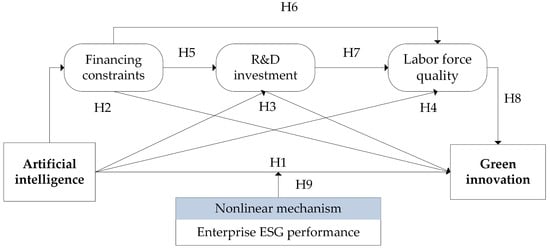
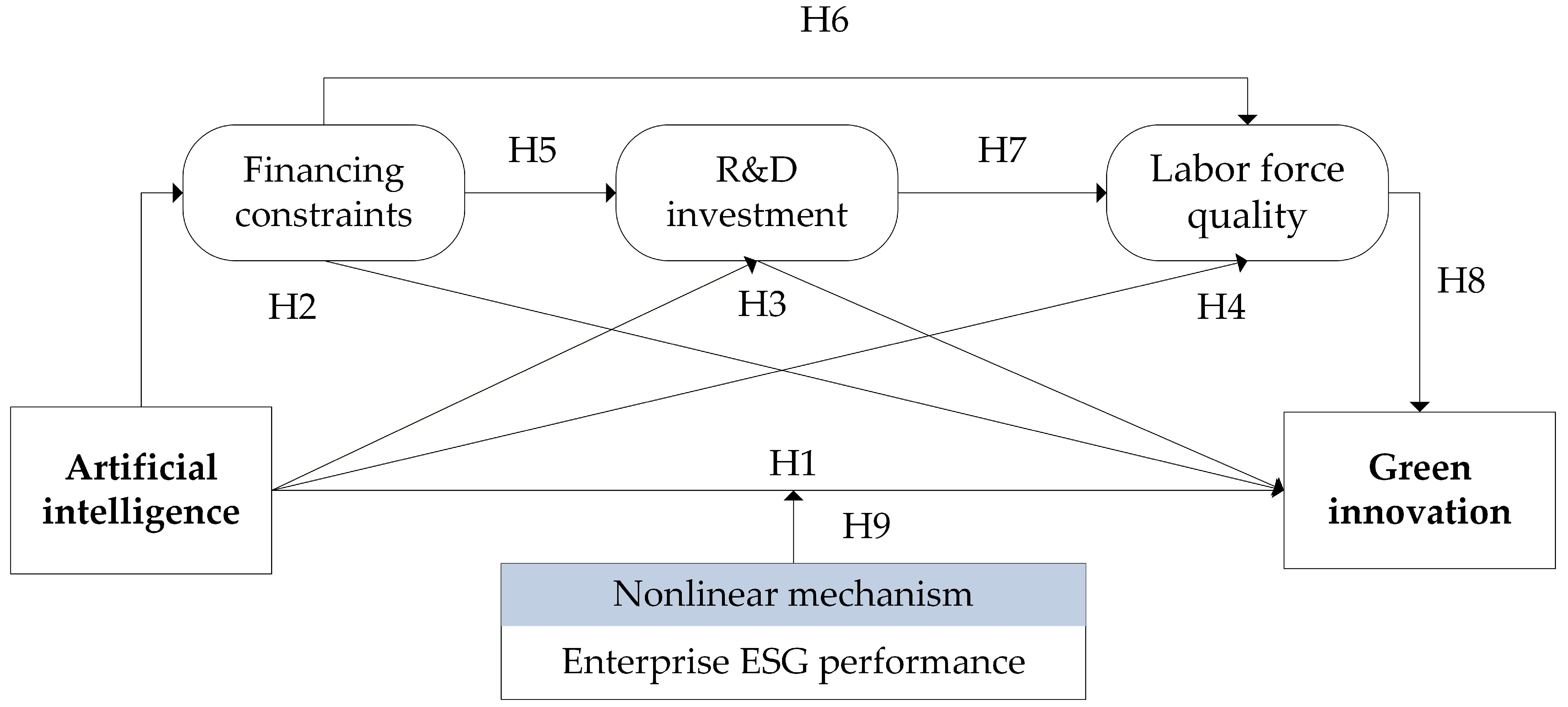

Disclaimer/Publisher’s Note: The statements, opinions and data contained in all publications are solely those of the individual author(s) and contributor(s) and not of MDPI and/or the editor(s). MDPI and/or the editor(s) disclaim responsibility for any injury to people or property resulting from any ideas, methods, instructions or products referred to in the content. |
© 2026 by the authors. Licensee MDPI, Basel, Switzerland. This article is an open access article distributed under the terms and conditions of the Creative Commons Attribution (CC BY) license.