


Abstract
Comprising the greatest proportion of stream networks, headwater streams provide critical ecosystem services to entire river networks by sustaining water quality and biodiversity as well as controlling floods and groundwater recharge. As such, they are important contributors to the environmental pillar of sustainability. Unfortunately, they are also among the most vulnerable ecosystems. In Appalachian headwater streams, larval salamanders represent a critical functional group because of their strong influence on ecosystem function. Wild pigs (Sus scrofa) rank among the most notorious invasive species, with widespread, negative impacts on native habitats and biodiversity. We tested the impacts of wallowing by wild pigs on the salamander larval community in Appalachian headwater streams in northeastern Georgia and found a significant drop in both numbers and diversity of larvae in wallows. Because downstream networks and the communities that depend upon them rely on healthy headwater streams, understanding exactly how the impairment of this functional group by wild pigs impacts energy flow, nutrient cycling, carbon sequestration, and water quality requires further investigation.
Keywords:
diversity; ecosystem; salamander; Plethodontidae; pairwise analysis; Appalachian Mountains 1. Introduction
Humans cannot depend solely on their own activities to ensure a safe and equitable future [1]. Such a future depends on a complex of factors that have been metaphorically described as the three pillars of sustainability: economic, social, and environmental [2]. Frequently pictured as a Venn diagram [2], these three pillars overlap and interact in a complex manner through a series of feedback loops [3,4] and tradeoffs [5,6] so that effects in one area can have profound repercussions for the others [7]. Specifically regarding the environmental pillar, there has been growing recognition not only of the biophysical foundation upon which human systems are built, but also the extended value of healthy natural systems as providers of natural capital and essential ecosystem services that support human societies and economies [8].
One of the focal points of the environmental pillar of sustainability is the critical value of biodiversity. The ecosystem services provided by nature depend directly on the diversity of the ecosystem’s living parts [9,10,11,12]. For example, food webs play an important role in carbon sequestration, which mitigates the effects of climate change [13,14,15,16]. The more complex the food web, the more likely it is to be able to sustain itself and continue to play this vital role [17].
Headwater streams represent an ecosystem characterized by such complex food webs, and due to their ubiquity and the ecosystem services they provide, are among the most important natural systems [18]. Likened to the fine branches of the human respiratory system, headwater streams undergird the health of entire river networks and are thus critical to sustaining an overall healthy landscape [18]. Comprising as much as three-quarters of river catchments [19], headwater streams provide valuable ecosystem services by protecting water quality [20], controlling surface flow and groundwater recharge [21], contributing organic matter for downstream food webs [22,23], and supporting high levels of biodiversity and endemism [24,25,26,27]. However, similarly to the tiny alveoli and bronchioles of a human lung, headwater streams are small and isolated and are thus highly vulnerable to degradation [28,29]. Unfortunately, a general lack of appreciation of their importance (e.g., the 2023 decision by the U.S. Supreme Court that removed their legal protection) only adds to their vulnerability [30].
Like other ecosystems, headwater streams are threatened by invasive species, which have long been recognized as threats to ecosystem integrity [31,32,33,34]. By damaging biodiversity and interrupting food webs, invasive species threaten a critical component of the environmental pillar of sustainability [35,36]. Wild pigs, also called feral swine (Sus scrofa), are among the most notorious invasive species across the globe [37], having negative impacts ranging from the disruption of native habitats [38] and the loss of biodiversity [37,38,39] to economic costs to agriculture as well as threats to water quality and human health [40,41,42,43,44]. One of the most important ecological effects results from the role of wild pigs as ecosystem engineers, whereby they change habitat characteristics through rooting and wallowing, thereby indirectly affecting resident organisms [40,45]. Wallowing in particular is a common behavior by which wild pigs root out a depression within a wet substrate in which individuals lie, wriggle, and coat themselves with mud for thermoregulation [46], although other functions such as scent-marking may be involved as well [47].
Small, isolated wetland habitats characterized by high levels of endemism are particularly vulnerable to disruption. Headwater streams clearly represent small, isolated systems with high levels of endemism [26]. They are thus highly vulnerable to degradation [27], including the destructive activities of wild pigs [44,48]. However, the effects of wild pigs on aquatic communities, including those occupying headwater streams, have been scarcely studied [45].
Major components of aquatic communities are amphibians, which include frogs, salamanders, and caecilians. As a taxonomic group, amphibians are themselves important in providing ecosystem services and thereby contribute to overall sustainability through direct or indirect impacts on biodiversity, ecosystem health, and human well-being [49]. Their place within food webs is particularly important [49,50,51]. Because of their dependence on cutaneous respiration and both aquatic and terrestrial habitats, amphibians face a myriad of threats, including invasive species [52]. They in fact represent the most endangered group of vertebrates [53] with more than 40% of the planet’s species in danger of extinction [51].
In headwater streams across the southern Appalachian Mountains of the U.S., larvae of lungless salamanders (family Plethodontidae) represent vital components because of their high density and productivity [54,55]. Aquatic salamander larvae are particularly important as mid-trophic-level predators, significantly affecting the structure of invertebrate communities [56] as well as energy flow and nutrient cycles within the stream ecosystem [57,58,59,60]. Because they feed on allochthonous food sources, they also contribute to energy and nutrient transfer across the aquatic–terrestrial interface [61]. Because of their ecological roles, plethodontid salamander larvae represent a critical functional group (sensu Brondel [62]) in headwater streams. Moreover, because larval plethodontids become semi-aquatic or terrestrial upon metamorphosis, they are necessary because as adults, they carry out these same functions in the surrounding riparian forest [63].
The direct impacts of wild pigs on salamanders have rarely been studied. Although wild pigs prey on amphibians, evidence suggests that wild pigs eat frogs more than they do salamanders [64,65]. Therefore, the more likely impact that wild pigs have on salamanders is from disruption of their habitat. Researchers have speculated that wild-pig activity has resulted in habitat changes that have contributed to declines in certain endangered salamander species [66,67,68]. However, we are aware of only a single study that showed a direct relationship between wild-pig activity and decline in salamander densities, and less than 5% of the salamanders observed in that study were larvae [69]. As a result, the effect of wild pigs on larval plethodontids, particularly in headwater streams, has gone virtually unstudied.
Wild pigs were first introduced into North America during the period of European exploration and colonization [70] with a long history in the southeastern U.S. [43,71]. They occur within the drainage basin of the Savannah River, which forms the boundary between the states of Georgia and South Carolina [72,73]. Among the tributaries of the Savannah River which supports populations of wild pigs is the Tugaloo River, which forms from the confluence of the Tallulah and Chattooga rivers along the boundary between northeastern Georgia and northwestern South Carolina. Small streams throughout the region are rich in plethodontid salamander diversity [74,75,76,77] and provide habitat for at least one species of conservation concern, the Patch-nosed Salamander, Urspelerpes brucei. Activity by wild pigs has been documented in headwater streams in the region, including in resident streams of U. brucei [78,79]. Because of the importance of larval-salamander communities to healthy streams and the potential threat of wild pigs, we tested whether wild-pig activity has a direct effect on the number and diversity of plethodontid larvae in headwater streams within the catchment of the Tugaloo River.
2. Materials and Methods
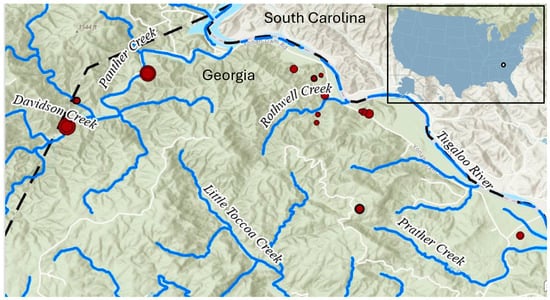
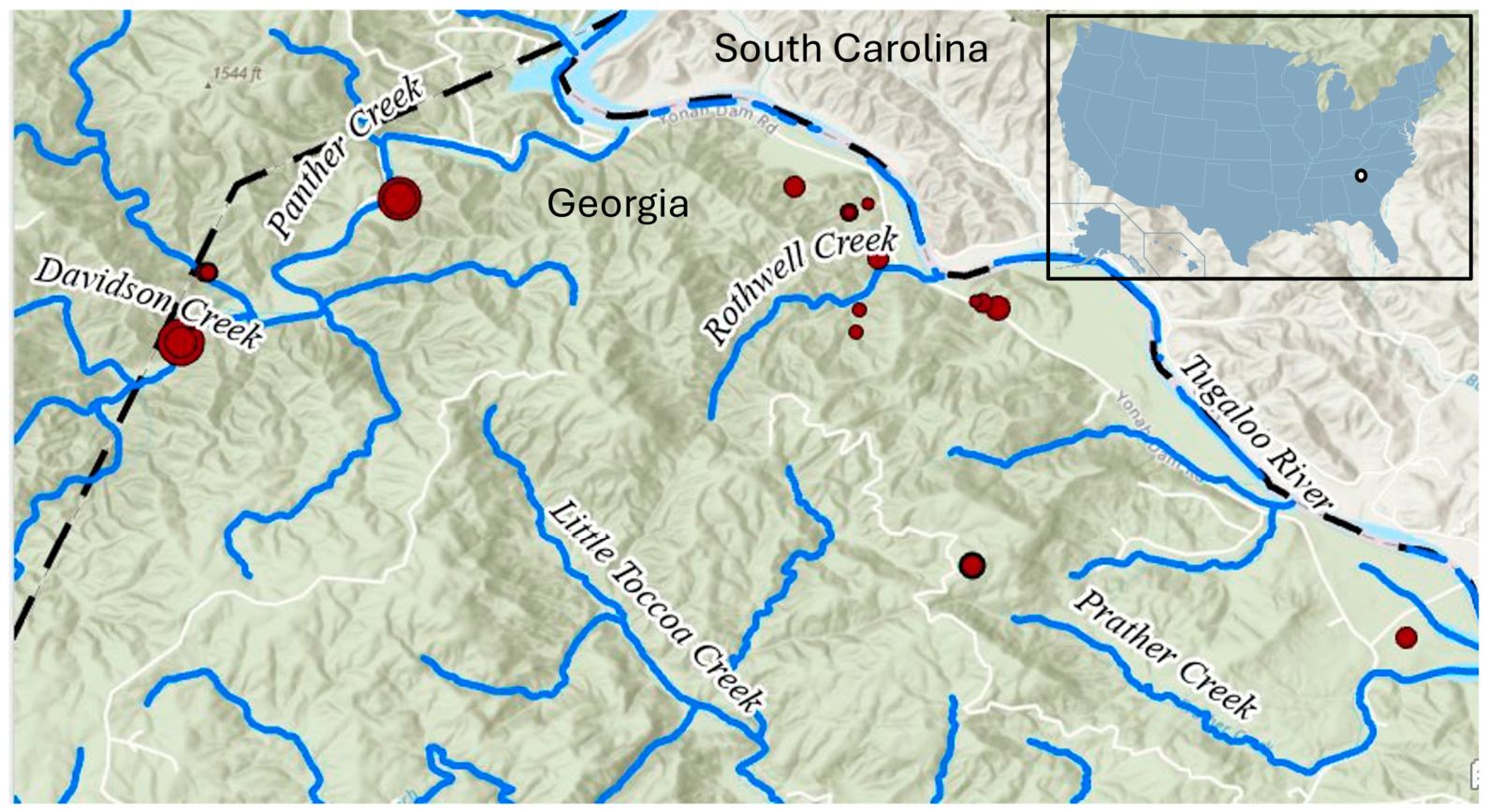
We collected data during late March and early April of 2026. We chose headwater streams that flow either directly or indirectly into the Tugaloo River in Stephens County, Georgia (Table 1; Figure 1). This area, though similar in elevation to the adjacent Piedmont ecoregion, is characterized by considerable topographic relief that creates montane microclimates and, as a result, is classified within the Blue Ridge ecoregion [80].
Table 1.
Locations of wallowing sites of wild pigs (Sus scrofa) in headwater streams in the Tugaloo River basin in Stephens County, Georgia, USA. Each location may have several wallowing sites, and each wallowing site may have more than one actual wallow.
Figure 1.
Map of wallowing sites of wild pigs (Sus scrofa) in northeastern Georgia, USA. Each dot represents one or more wallowing sites. Size of dots represents relative surface area occupied by wallows. Inset map of USA shows location as white dot. White lines represent roads, and blue ones represent waterways.
We focused on pig wallows because of the nature of stream disruption. To find wallows, we walked up every accessible small stream in the study area until we found signs of wild-pig activity. We identified wallows by a combination of traits: the presence of pugmarks; clear signs of rooting activity, either within or adjacent to the stream; and the distinctive oval-shaped, scooped-out, pig-size depression characteristic of wallows.
We considered several adjacent wallows to represent a single wallowing site but wallows that were at least 25 m apart to represent different sites. Using a 1 m2 quadrat made of polyvinyl chloride (PVC) pipe (Charlotte Pipe & Foundry, Charlotte, NC, USA), we estimated the area occupied by each wallowing site and then marked off a section of the same size of the nearest undamaged portion of stream as a control. While some inequality between wallow and control sites in terms of water volume may have existed because of differences in water depth caused by making the wallow, our approach accounted for the amount of stream affected by the wallow.
Prior to collection, we noted the condition of both wallow and control sites, specifically whether the water was visibly flowing (current) or not (pool). To avoid inter-investigator sampling variance, the same person (CDC) used a hand net to collect salamander larvae. All parts of both wallow and control sites were thoroughly searched with forcefully agitating, disruptive sweeps through and beneath silt, rocks, and plant roots. Searching continued until three thorough sweeps of the entire area no longer turned up salamanders. We identified each to species on site.
In two different cases, we could not identify larvae to species because of the presence of coexisting, cryptic species whose larvae are difficult or impossible to distinguish without genetic analysis. One case involved cryptic species of the genus Desmognathus, including the southern black-bellied salamander, D. amphileucus, and the dwarf black-bellied salamander, D. folkertsi [81]. The other involved Eurycea species, including the southern two-lined salamander, E. cirrigera, and the Blue Ridge two-lined salamander, E. wilderae [82]. We designated these larvae as Desmognathus sp. and Eurycea sp., respectively. We also recorded all other amphibians (i.e., metamorphosed salamanders, frogs, tadpoles) or amphibian eggs collected. Immediately following identification, we released all individuals back into their respective locations. All specimens were collected under permits issued by the state of Georgia (126977097) and the US Forest Service (CHA2316).
To test for a difference in the number of plethodontid larvae between wallows and controls, we used the Wilcoxon signed-rank test as a non-parametric, pairwise analysis for all comparisons. We chose a non-parametric analysis because our data were integers, and thus not normal, or because they failed a Shapiro–Wilk test of normality. To test for a difference in larval diversity, we used count data from sites in which there was at least one salamander in both wallow and control sites. Using an online calculator (https://www.omnicalculator.com/ecology/shannon-index; accessed 11 April 2026), we generated a Shannon Diversity Index [83], which is commonly used to measure species diversity in ecological systems [84]. We further tested for differences in species richness. To estimate the effect on standing stocks of nutrients within the streams, we used estimates of biomass (dry mass), total carbon (C), nitrogen (N), phosphorus (P), and calcium (Ca) for larvae of this suite of salamander species taken from Milanovich et al. [59]. We ran statistical analyses in JASP ver. 19.1, a free statistical software that runs on the R Studio platform version 4.1.3 [85].
3. Results
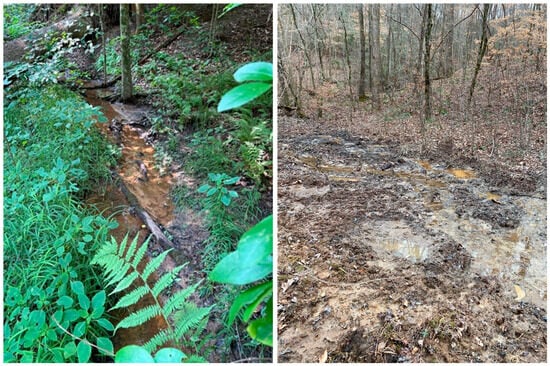
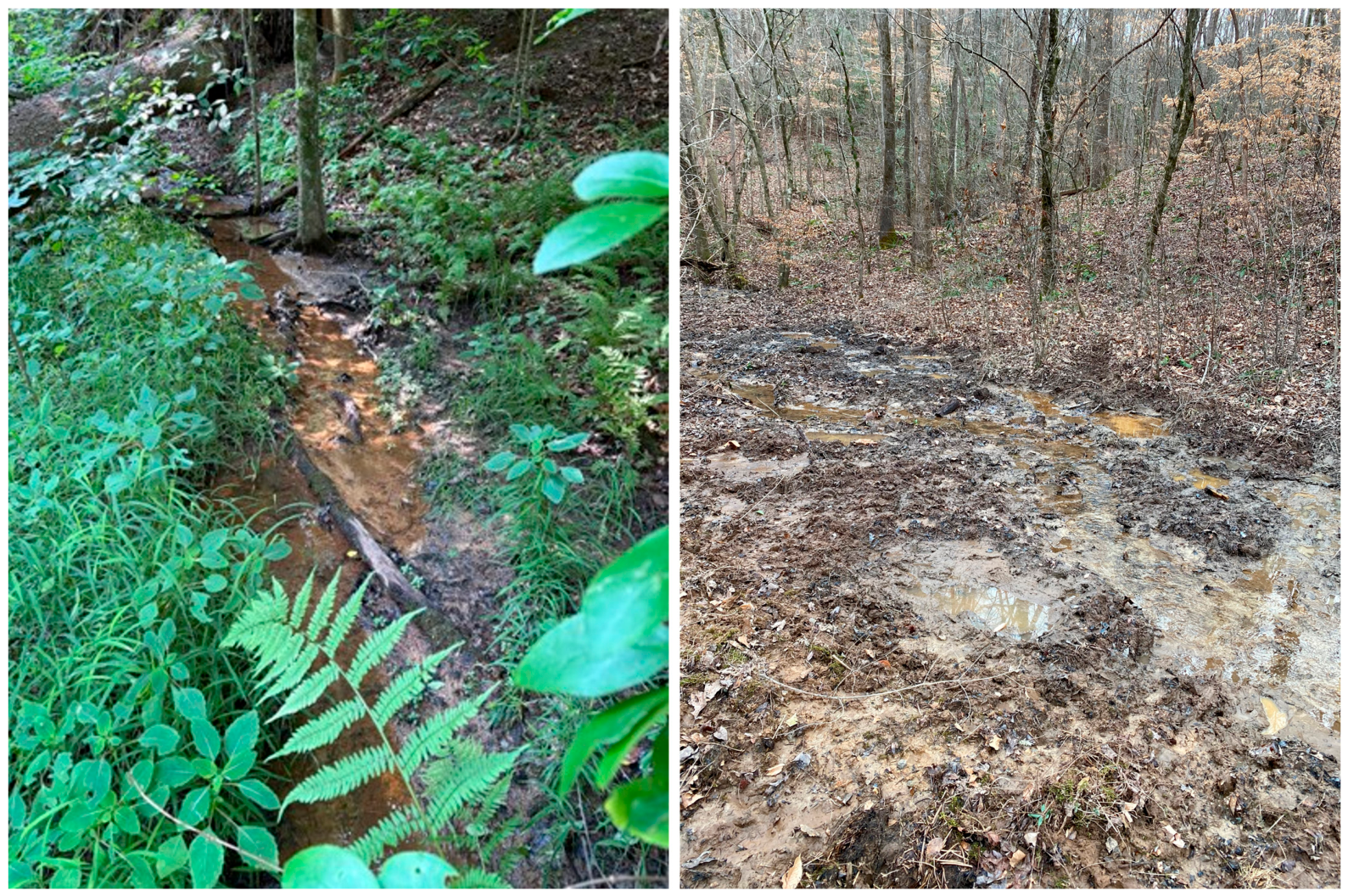
We found 32 sites wallowed by wild pigs. The measured area of wallows ranged from 0.5 to 6.5 m2 with a mean ± 1 standard error of 2.16 ± 0.28 m2. Of the 32 sites, 25 controls had currents whereas only seven were pools. Of the 25 controls with currents, 24 of the matching wallows were pools, although in three cases, a small portion of each wallowing area retained a current. Therefore, the main effect of activity by wild pigs on the habitat was to convert flowing streams with visible current into pools (Figure 2).
Figure 2.
Wallowing site (right) comprising multiple wallows made by wild pigs (Sus scrofa) in the Tugaloo River basin of northeastern Georgia, USA. The effect of wallowing was to convert a flowing headwater stream with a visible current into a series of pools. The photo on the (left) shows a portion (control) of the undamaged portion of the same stream. The two photos were taken in early (wallows) and late (control) spring, which accounts for the difference in vegetative growth.
Seventeen of the wallowing sites contained plethodontid larvae, including all three that had some visible current. We collected a total of 76 plethodontid larvae from wallows; the mean number of larvae was 2.34 ± 1.01 with a mean density of 1.35 ± 0.51 m−1. The predominant species were Pseudotriton ruber (red salamander; total n = 28, mean = 0.91 ± 0.69) and Eurycea sp. (total n = 30, mean = 1.47 ± 0.54). We also found egg masses of Ambystoma maculatum (spotted salamander) and Lithobates sylvaticus (wood frog), tadpoles of L. sylvaticus and Anaxyrus americanus (American toad), and a juvenile Lithobates catesbeianus (bullfrog) (Table 2). Four adult Acris crepitans (northern cricket frog) were seen sitting in or traveling through wallowed areas.
Table 2.
Amphibian species collected from wild pig (Sus scrofa) wallows and matching control areas in headwater streams in the drainage basin of the Tugaloo River in Stephens County, Georgia, USA. Desmognathus sp. = larvae of D. amphileucus or D. folkertsi; Eurycea sp. = larvae of E. cirrigera or E. wilderae.
We found plethodontid larvae in 26 of the control portions of the streams; of the six that did not have larvae, four were pools. The total number of plethodontid larvae was 178 with a mean of 5.59 ± 0.93 and a mean density of 3.59 ± 0.61 m−1. Species were predominantly P. ruber (total n = 34, mean = 1.06 ± 0.41), Eurycea sp. (total n = 104, mean = 3.56 ± 0.83), and Desmognathus sp. (total n = 19, mean = 0.75 ± 0.23). Other amphibians or amphibian products included egg masses of spotted salamanders and wood frogs in pools as well as four metamorphosed salamanders (Table 2).
Given that numbers of salamanders and species-richness data were integers and the Shannon Index values were not normally distributed (W = 0.8823; p < 0.001), the choice of Wilcoxon signed-ranked tests for analysis was appropriate. More larvae were in the wallows than in the matching controls in only two instances. We found the same number between wallow and matching control only when neither had salamanders. The Wilcoxon signed-rank test indicated a significantly greater number of plethodontid larvae in control portions of streams than in wallows (Z = −3.632; p < 0.001). Concomitant with the difference in salamander number, there was a considerable difference in nutrient standing stocks (Table 3).
Table 3.
Estimates of standing stocks in mg m−2 (mean ± 1 standard error) of biomass (dry mass) and major nutrients within larval plethodontid salamanders within headwater streams. Nutrient values per salamander were taken from Milanovich et al. [59].
We found three species of plethodontid larvae in wallows and five species in control portions of streams. In 17 of the 32 sites, there were plethodontid larvae in both wallows and the matching controls. The mean values of the generated Shannon Diversity Indices were 0.183 ± 0.072 for wallows and 0.411 ± 0.078 for matching controls. Because we did not distinguish between the larvae of D. folkertsi and D. amphileucus or between E. cirrigera and E. wilderae, these generated indices likely underestimated actual species diversity. The results of the Wilcoxon signed-rank test indicated that the difference in generated indices was significant (Z = −2.417; p = 0.017). There was also a difference in species richness (Z = −3.640; p < 0.001), with a greater number of species in control sites than in wallows (Table 4). The primary difference in species makeup was the absence of Desmognathus species in wallows.
Table 4.
Comparison of wallows and control sites in terms of numbers of species of plethodontid larvae. The list of species is given in Table 2.
4. Discussion
Headwater streams represent an important element of the natural environment that supports sustainability. Making up as much as 75% of river networks [18], they provide critical ecosystem services to downstream communities, including humans. Headwater streams ensure clean water [20] and protect against flooding while aiding in groundwater recharge [21]. In fact, it was the early recognition of the role of headwater streams in controlling downstream flooding that led to the passage of the Weeks Act of 1911 by the U.S. Congress. This landmark legislation enabled the federal government to purchase lands containing headwaters in the eastern U.S. [86] and set them aside as protected areas [87]. In addition, headwater streams are characterized by high levels of biodiversity and endemism [24,25,26,27], contributing to food webs downstream by providing organic matter [22,23] as carbon and other nutrients cycle downstream in a spiraling manner [88].
Critical to the function of headwater streams of the Appalachian Mountains of the eastern U.S. are the roles played by the salamander community. Salamanders replace fish as the dominant vertebrates in headwater systems [57]. Because salamanders occur in high densities in Appalachian headwaters, these organisms are highly productive [54,55]. The larval community in these streams can be relatively complex, consisting of five or more species [89] that interact in various ways, including competition and predation [90]. As mid-trophic-level predators, salamander larvae influence the structure of invertebrate communities [56]. As part of complex food webs, they help regulate energy flow and nutrient cycles [57,58,59,60]. Moreover, salamanders enable nutrient and energy transport between aquatic and terrestrial environments by feeding on allochthonous prey [61] and providing the source pool for adult salamanders that carry out ecological functions in streams, along the stream edge, and out in the riparian forest [91,92]. The biomass of salamanders in headwater streams sequesters considerable amounts of carbon, with estimates of salamanders in Appalachian streams often exceeding 10 g m−2 and with larvae making up the bulk of salamander biomass [57]. The uptake of nutrients by biotic components such as salamanders can shorten a nutrient spiral as these nutrients move downstream, which in turn raises productivity, mitigates downstream eutrophication, and supports biodiversity by giving a greater variety of organisms access to nutrients [88,93]. Salamander larvae further contribute to both biodiversity and nutrient cycling by serving as critical links in the life cycles of parasites [94,95], including within the streams of our study system [96]. Considering the importance of the larval salamander community, damage to this community necessarily impairs the function and sustainability of headwater streams.
We undertook the present study because the effect of wild pigs on aquatic communities, including headwater streams, has rarely been studied [45], although invasive species such as wild pigs have long been considered a threat to native biodiversity [97]. We acknowledge that the effects of pigs as well as the dynamics of salamander populations could possibly vary over time and that we only sampled during one season (spring) of one year. Even so, our data indicate a strong association between activity of wild pigs and both total numbers and diversity of salamanders. Although studies of the effects of wild pigs on aquatic biota are few, our results agree with other investigations that have shown a decline in salamanders [69], fish [98], and aquatic invertebrates [99]. These data also provide at least some support for speculation that wild pigs may have contributed to the decline of several additional salamander species [67,68].
The primary cause of salamander decline that we observed may have been the simple conversion of flowing water to pools, which was true in the vast number of our study streams. Because there were so few instances of control stream sections being pools in our dataset, we did not include flow as a separate variable in our analyses. Therefore, we could not test whether wallowing had an effect over and above that of simple habitat conversion. Even so, simple conversion of current to pool can have profound consequences for the larval salamander community. The reliance on currents by many plethodontid larvae was evident from the absence of any larvae from four of the six control sections without visible currents. In contrast, 24 of the 26 controls with currents had salamanders. Larvae of Appalachian species of Desmognathus, particularly those of D. amphileucus and D. folkertsi, rely almost completely on flowing water [77,100]. The total absence of Desmognathus from pig wallows explains in part the lower species diversity in those habitats. Larvae of E. wilderae also predominately occupy zones of flowing water [82]. Conversely, larvae of Pseudotriton ruber [75,77] and at least one of the Eurycea species (E. cirrigera) frequently occur in pools [82]. While our data indicate a negative impact of wallowing on salamander diversity, we likely underestimated the actual impact on diversity. Our inability to distinguish between the larvae of D. amphileucus and D. folkertsi and between those of E. wilderae and E. cirrigera strengthens the case that wild pigs cause a decline in salamander diversity.
Because salamander communities are also affected by additional environmental variables such as temperature, substrate composition, and dissolved oxygen, we cannot dismiss the possibility that wallowing affected some combination of these variables in a way that contributed to the decline in salamander numbers and diversity we observed. Along with flow rate, further specific testing could reveal the exact nature of the influence that wild pigs have. We also measured surface area rather than stream volume in our pairwise analysis. However, wallows were deeper than the matching control sites, indicating that fewer salamanders in wallows were not the result of less water. Regardless of the specific effect of any of these variables, our data demonstrate a strong association between salamander decline and pig wallowing.
Wild pigs likely have broader effects on the salamander fauna than our data show. For one, the isolated nature and small sizes of headwater streams mean that the amount of habitat available for salamander larvae is necessarily limited, a fact that renders these organisms particularly vulnerable to physical disturbance [26]. Stream reaches characterized by relatively low topographical relief tend to collect salamander larvae as a result of larval drift associated with current [89,101]. Because pig activity is negatively correlated with slope in small streams [69], areas of low relief are targeted by pigs for wallowing, which means that the wallowing does not affect salamanders randomly up and down the stream but differentially impacts areas where larvae are most abundant.
The decline in salamanders we found as a result of pig wallowing likely impacts ecosystem function, including downstream reaches, through its effect on nutrient cycling. In our study, we found that the reduction in salamander numbers in wallows resulted in an estimated 62% decline in standing stocks of major nutrients (Table 3). Such a drop could lengthen nutrient spirals, resulting in nutrients being washed more rapidly downstream rather than being taken up and stored temporarily as salamander tissue. Salamander larvae also significantly impact invertebrate communities [56] and play an important role in nutrient exchange across the terrestrial and aquatic boundary [61]. In addition, fecal contamination by pigs, whether wild or domestic, results in increased concentrations of nutrients, suspended solids, and fecal coliform bacteria [43,102], possibly impacting pH and levels of dissolved oxygen. The effects of these changes are not restricted to wallowing sites but are easily spread downstream. The presence of a healthy larval salamander community might help mitigate these effects by absorbing nutrients into the complex food web to which salamanders belong.
In addition, the role of salamander parasites on biodiversity and nutrient transfer is often overlooked [103]. For example, D. amphileucus and E. wilderae larvae act as important links in the complex life cycle of the trematode parasite Metagonimoides oregonensis [94,95], including in our study streams [96]. These salamanders serve as second intermediate hosts with high rates of infection and thereby provide a conduit for the free-swimming trematode larvae (cercariae) to eventually reach the definitive host, which is raccoons (Procyon lotor) or minks (Neogale vison) [94]. Because cercariae represent considerable sources of organic carbon in aquatic systems [103], the decline or loss of these salamander species represents an additional potential consequence for nutrient cycling in headwaters.
While there is a large body of literature on the effects of wild pigs on biodiversity and other focal points for sustainability, e.g., [37,38,39,40,41,42,43,44,45,104], a number of questions remain to be investigated regarding the full effects of their activities. For example, what is their effect on carbon cycling and sequestration, which have implications for climate change (e.g., [36])? How does the decrease in salamander number and diversity affect the overall food web of the streams and adjoining riparian zones? How do changes to the headstream food web affect energy flow, nutrient cycling, and carbon sequestration (e.g., [105]), particularly downstream? Does the complexity that salamanders contribute to the food web help mitigate the effects that wild pigs have on water quality by absorbing and storing nutrients?
By decreasing salamander number and diversity, wild pigs likely impair a critical functional group in Appalachian headwater streams. Because of the importance of these systems to the health of entire stream networks and the societies that depend upon them, the removal of wild pigs, though difficult [106,107,108], is necessary to fully support all three pillars of sustainability.
5. Conclusions
Headwater streams are critical suppliers of valuable ecosystem services to downstream consumers, thereby supporting the environmental pillar of sustainability. An important functional group in Appalachian headwater streams is the community of larval plethodontid salamanders, which serve as mid-trophic-level predators. Their roles in complex food webs and organic production enable carbon sequestration as well as nutrient cycling and energy flow within the stream and between the stream and the surrounding riparian forest.
We show that wild pigs, a notorious invasive species, negatively affect both numbers and diversity of salamanders in Appalachian headwater streams. Our results provide yet another reason for programs to control and eliminate this invasive species because of its detrimental impacts on natural habitats and biodiversity. However, many questions remain unanswered. In particular, there is need for further study on the effects of the impairment of this functional group, specifically on consequences for nutrient cycling and non-salamander biodiversity (e.g., parasites), because of the importance of these systems to sustaining native biodiversity and a healthy overall landscape.
Author Contributions
Conceptualization, C.D.C.; methodology, C.D.C. and E.M.; software, C.D.C.; validation, C.D.C. and E.M.; formal analysis, C.D.C.; investigation, C.D.C. and E.M.; resources, C.D.C.; data curation, C.D.C.; writing—original draft preparation, C.D.C.; writing—review and editing, E.M.; visualization, C.D.C.; supervision, C.D.C.; project administration, C.D.C. All authors have read and agreed to the published version of the manuscript.
Funding
This research received no external funding.
Institutional Review Board Statement
This study is waived for ethical review as Piedmont University is primarily a teaching institution and thus not required to have a formal review board for animal re-search by the School of Arts and Sciences and the Department of Natural Sciences.
Informed Consent Statement
Not applicable.
Data Availability Statement
The raw data supporting the conclusions of this article will be made available by the authors on request.
Acknowledgments
This study was completed under the auspices of the Piedmont University Natural Sciences Honors Program. We thank the Georgia Department of Natural Resources and the US Forest Service for issuing permits.
Conflicts of Interest
The authors declare no conflicts of interest.
Abbreviations
The following abbreviations are used in this manuscript:
| USA | United States of America |
| US | United States |
References
- Raworth, K. A Safe and Just Space for Humanity; Oxfam Discussion Paper; Oxfam International: Oxford, UK, 2012. [Google Scholar]
- Purvis, B.; Mao, Y.; Robinson, D. Three pillars of sustainability: In search of conceptual origins. Sustain. Sci. 2019, 14, 681–695. [Google Scholar]
- Dong, L.; Huang, Z. Some evidence and new insights for feedback loops of human-nature interactions from a holistic Earth perspective. J. Clean. Prod. 2023, 432, 139667. [Google Scholar] [CrossRef] [Scilit]
- Mastrangelo, M.; Cumming, G. Restoring stabilizing feedback loops for sustainability. One Earth 2024, 7, 794–805. [Google Scholar] [CrossRef] [Scilit]
- Cavender-Bares, J.; Polasky, S.; King, E.; Balvanera, P. A sustainability framework for assessing trade-offs in ecosystem services. Ecol. Soc. 2015, 20, 17. [Google Scholar] [CrossRef] [Scilit]
- Barbier, E.B.; Burgess, J.C. Sustainable development goal indicators: Analyzing trade-offs and complementarities. World Dev. 2019, 122, 295–305. [Google Scholar] [CrossRef] [Scilit]
- Pradhan, P.; Costa, L.; Rybski, D.; Lucht, W.; Kropp, J.P. A systematic study of sustainable development goal (SDG) interactions. Earth’s Future 2017, 5, 1169–1179. [Google Scholar] [CrossRef] [Scilit]
- Turner, R.K.; Daily, G.C. The ecosystem services framework and natural capital conservation. Environ. Resour. Econ. 2008, 39, 25–35. [Google Scholar]
- Thompson, R.M.; Brose, U.; Dunne, J.A.; Hall, R.O., Jr.; Hladyz, S.; Kitching, R.L.; Martinez, N.D.; Rantala, H.; Romanuk, T.N.; Stouffer, D.B.; et al. Food webs: Reconciling the structure and function of biodiversity. Trends Ecol. Evol. 2012, 27, 689–697. [Google Scholar] [CrossRef] [Scilit] [PubMed]
- Blicharska, M.; Smithers, R.J.; Mikusiński, G.; Rönnbäck, P.; Harrison, P.A.; Nilsson, M.; Sutherland, W.J. Biodiversity’s contributions to sustainable development. Nat. Sustain. 2019, 2, 1083–1093. [Google Scholar] [CrossRef] [Scilit]
- Niesembaum, R.A. The integration of conservation, biodiversity, and sustainability. Sustainability 2019, 11, 4676. [Google Scholar] [CrossRef] [Scilit]
- Hong, P.; Schmid, B.; De Laender, F.; Eisenhauer, N.; Zhang, X.; Chen, H.; Craven, D.; De Boeck, H.J.; Hautier, Y.; Petchey, O.L.; et al. Biodiversity promotes ecosystem functioning despite environmental change. Ecol. Lett. 2021, 25, 555–569. [Google Scholar] [CrossRef] [Scilit] [PubMed]
- Strickland, M.S.; Hawlena, D.; Reese, A.; Schmitz, O.J. Trophic cascade alters ecosystem carbon exchange. Proc. Natl. Acad. Sci. USA 2013, 110, 11035–11038. [Google Scholar] [CrossRef] [Scilit] [PubMed]
- Saba, G.K.; Burd, A.B.; Dunne, J.P.; Hernández-León, S.; Martin, A.H.; Rose, K.A.; Salisbury, J.; Steinberg, D.K.; Trueman, C.N.; Wilson, R.W.; et al. Toward a better understanding of fish-based contribution to ocean carbon flux. Limnol. Oceanogr. 2021, 66, 1639–1664. [Google Scholar] [CrossRef] [Scilit]
- Kang, H.C.; Jeong, H.J.; Ok, J.H.; Lim, A.S.; Lee, K.; You, J.H.; Park, S.A.; Eom, S.H.; Lee, S.Y.; Lee, K.H.; et al. Food web structure for high carbon retention in marine plankton communities. Sci. Adv. 2023, 9, eadk0842. [Google Scholar] [CrossRef] [Scilit] [PubMed]
- Schmitz, O.J.; Sylvén, M. Animating the carbon cycle: How wildlife conservation can be a key to mitigate climate change. Environment 2023, 65, 5–17. [Google Scholar] [CrossRef] [Scilit]
- Dunne, J.A.; Williams, R.J.; Martinez, N.D. Network structure and biodiversity loss in food webs: Robustness increases with connectance. Ecol. Lett. 2002, 5, 558–567. [Google Scholar] [CrossRef] [Scilit]
- Lowe, W.H.; Likens, G.E. Moving headwater streams to the head of the class. BioScience 2005, 55, 196–197. [Google Scholar] [CrossRef] [Scilit]
- Botter, G.; Barone, F.; Durighetto, N. Headwater streams control the non-perennial fraction of the global river network. Nat. Water 2026, 4, 25–35. [Google Scholar] [CrossRef] [Scilit] [PubMed]
- Alexander, R.B.; Boyer, E.W.; Smith, R.A.; Schwarz, G.E.; Moore, R.B. The role of headwater streams in downstream water quality. J. Am. Water Resour. Assoc. 2007, 43, 41–59. [Google Scholar] [CrossRef] [Scilit] [PubMed]
- Winter, T.C. The role of ground water in generating streamflow in headwater areas and in maintaining base flow. J. Am. Water Resour. Assoc. 2007, 43, 15–25. [Google Scholar] [CrossRef] [Scilit]
- MacDonald, L.E.; Coe, D. Influence of headwater streams on downstream reaches in forested areas. For. Sci. 2007, 53, 148–168. [Google Scholar] [CrossRef] [Scilit]
- Wohl, E. The significance of small streams. Front. Earth Sci. 2017, 11, 447–456. [Google Scholar] [CrossRef] [Scilit]
- Meyer, J.L.; Strayer, D.L.; Wallace, J.B.; Eggert, S.L.; Helfman, G.S.; Leonard, N.E. The contribution of headwater streams to biodiversity in river networks. J. Am. Water Resour. Assoc. 2007, 43, 86–103. [Google Scholar] [CrossRef] [Scilit]
- Clarke, A.; Mac Nally, R.; Bond, N.R.; Lake, P.S. Macroinvertebrate diversity in headwater streams: A review. Freshw. Biol. 2008, 53, 1707–1721. [Google Scholar] [CrossRef] [Scilit]
- Richardson, J.S. Biological diversity in headwater streams. Water 2019, 11, 366. [Google Scholar] [CrossRef] [Scilit]
- Finn, D.S.; Bonada, N.; Múrria, C.; Hughes, J.M. Small but mighty: Headwaters are vital to stream network biodiversity at two levels of organization. J. N. Am. Benthol. Soc. 2001, 30, 963–980. [Google Scholar]
- Richardson, J.S.; Dudgeon, D. Headwater stream ecosystems: An initial evaluation of their threat status. In Imperiled: The Encyclopedia of Conservation; Elsevier: Amsterdam, the Netherlands, 2022; Volume 2, pp. 479–484. [Google Scholar]
- Imberger, M.; Hatt, B.E.; Brown, S.; Burns, M.J.; Burrows, R.M.; Walsh, C.J. Headwater streams in an urbanizing world. Freshw. Sci. 2023, 42, 323–336. [Google Scholar] [CrossRef] [Scilit]
- Golden, H.E.; Christensen, J.R.; McMillan, H.K.; Kelleher, C.A.; Lane, C.R.; Husic, A.; Li, L.; Ward, A.S.; Hammond, J.; Seybold, E.C.; et al. Advancing the science of headwater streamflow for global water protection. Nat. Water 2025, 3, 16–26. [Google Scholar] [CrossRef] [Scilit] [PubMed]
- Mooney, H.A.; Hobbs, R.J. Invasive Species in a Changing World; Island Press: Washington, DC, USA, 2000. [Google Scholar]
- McNeely, J. Invasive species: A costly catastrophe for native biodiversity. Land Use Water Resour. Res. 2001, 1, 1–10. [Google Scholar]
- Pyšek, P.; Richardson, D.M. Invasive species, environmental change and management, and health. Annu. Rev. Environ. Resour. 2010, 35, 25–55. [Google Scholar] [CrossRef] [Scilit]
- Dueñas, M.; Ruffhead, H.J.; Wakefield, N.H.; Roberts, P.D.; Hemming, D.J.; Hilda Diaz-Soltero, H. The role played by invasive species in interactions with endangered and threatened species in the United States: A systematic review. Biodivers. Conserv. 2018, 27, 3171–3183. [Google Scholar] [CrossRef] [Scilit]
- Havel, J.E.; Kovalenko, K.E.; Thomaz, S.M.; Amalfitano, S.; Kats, L.B. Aquatic invasive species: Challenges for the future. Hydrobiologia 2015, 750, 147–170. [Google Scholar] [CrossRef] [Scilit] [PubMed]
- Honzák, M.; Roberts, G.; Cosentino, B.J.; Sexton, J.O.; McKenzie-McHarg, H.; Wilson, J.W.; Feng, M.; Thieme, A.; Hunka, N.; Will, D.J. Toward the quantification of the climate co-benefits of invasive mammal eradication on islands: A scalable framework for restoration monitoring. Environ. Res. Lett. 2024, 19, 114018. [Google Scholar] [CrossRef] [Scilit]
- Haines, A.M.; Costante, D.M.; Freed, C.; Achayaraj, G.; Bleyer, L.; Emeric, C.; Fenton, L.A.; Lielbriedis, L.; Ritter, E.; Salerni, G.I.; et al. The impact of invasive alien species on threatened and endangered species: A geographic perspective. Wildl. Soc. Bull. 2024, 48, e1552. [Google Scholar] [CrossRef] [Scilit]
- Engeman, R.M.; Stevens, A.; Allen, J.; Dunlap, J.; Daniel, M.; Teague, D.; Constantin, B. Feral swine management for conservation of an imperiled wetland habitat: Florida’s vanishing seepage slopes. Biol. Conserv. 2007, 134, 440–446. [Google Scholar] [CrossRef] [Scilit]
- McClure, M.L.; Burdett, C.L.; Farnsworth, M.L.; Steven, J.; Sweeney, S.J.; Miller, R.S. A globally-distributed alien invasive species poses risks to United States imperiled species. Sci. Rep. 2018, 8, 5331. [Google Scholar] [CrossRef] [Scilit] [PubMed]
- Risch, D.R.; Ringma, J.; Price, M.R. The global impact of wild pigs (Sus scrofa) on terrestrial biodiversity. Sci. Rep. 2021, 11, 13256. [Google Scholar] [CrossRef] [Scilit] [PubMed]
- McDonough, M.T.; Ditchkoff, S.S.; Smith, M.D.; Vercauteren, K.C. A review of the impacts of invasive wild pigs on native vertebrates. Mamm. Biol. 2022, 102, 279–290. [Google Scholar] [CrossRef] [Scilit]
- Bolds, S.A.; Lockaby, B.G.; Kalin, L.; Ditchkoff, S.S.; Smith, M.D.; VerCauteren, K.C. Wild pig removal reduces pathogenic bacteria in low-order streams. Biol. Invasions 2022, 24, 1453–1463. [Google Scholar] [CrossRef] [Scilit]
- Bradley, E.A.; Lockaby, B.G.; Madere, S.; Brown, V.; Steury, T. Large-scale assessment of the impacts of invasive wild pigs on water quality in freshwater streams. Sci. Rep. 2025, 15, 19055. [Google Scholar] [CrossRef] [Scilit] [PubMed]
- McKee, S.C.; Koppes, P.; Miller, R.S.; Selleck, M.; Shwiff, S.A. Wild pigs, wild costs: The economic consequences of wild pig invasions in the United States. Pest. Manag. Sci. 2026, 82, 900–910. [Google Scholar] [PubMed]
- Barrios-Garcia, M.N.; Ballari, S.A. Impact of wild boar (Sus scrofa) in its introduced and native range: A review. Biol. Invasions 2012, 14, 2283–2300. [Google Scholar] [CrossRef] [Scilit]
- Jensen, P. Behaviour of pigs. In The Ethology of Domestic Animals: An Introductory Text; Jensen, P., Ed.; CABI Publishing: Wallingford, UK, 2002; pp. 159–172. [Google Scholar]
- Bracke, M.B.M. Review of wallowing in pigs: Description of the behaviour and its motivational basis. Appl. Anim. Behav. Sci. 2011, 132, 1–13. [Google Scholar] [CrossRef] [Scilit]
- Engeman, R.M.; Laine, E.; Allen, J.; Preston, J.; Pizzolato, W.; Williams, B.; Kreider, A.S.; Teague, D. Invasive feral swine damage to globally imperiled steephead ravine habitats and influences from changes in population control effort, climate, and land use. Biodivers. Conserv. 2019, 28, 1109–1127. [Google Scholar] [CrossRef] [Scilit]
- Hocking, D.J.; Babbitt, K.J. Amphibian contributions to ecosystem services. Herpetol. Conserv. Biol. 2013, 9, 1−17. [Google Scholar]
- Verburg, P.; Kilham, S.S.; Pringle, C.M.; Lips, K.R.; Drake, D.L. A stable isotope study of a neotropical stream food web prior to the extirpation of its large amphibian community. J. Trop. Ecol. 2007, 23, 643–651. [Google Scholar] [CrossRef] [Scilit]
- Wickramasingha, B.; West, J.; Bellanthudawa, B.K.A.; Graziano, M.P.; Graziano, M.P.; Surasinghe, T.D. The multifaceted importance of amphibians: Ecological, biomedical, and socio-economic perspectives. Biology 2026, 15, 98. [Google Scholar] [CrossRef] [Scilit] [PubMed]
- Gibbons, J.W.; Scott, D.E.; Ryan, T.J.; Buhlmann, K.A.; Tuberville, T.D.; Metts, B.S.; Greene, J.L.; Mills, T.; Leiden, Y.; Poppy, S.; et al. The global decline of reptiles, déjà vu amphibians. BioScience 2000, 50, 653–666. [Google Scholar] [CrossRef] [Scilit]
- Catenazzi, A. State of the world’s amphibians. Annu. Rev. Environ. Resour. 2015, 40, 91–119. [Google Scholar] [CrossRef] [Scilit]
- Peterman, W.E.; Crawford, J.A.; Semlitsch, R.D. Productivity and significance of headwater streams: Population structure and biomass of the black-bellied salamander (Desmognathus quadramaculatus). Freshw. Biol. 2008, 53, 347–357. [Google Scholar]
- Trice, A.; Rosemond, A.D.; Maerz, J.C. Diet composition of two larval headwater stream salamanders and spatial distribution of prey. Freshw. Biol. 2015, 60, 2424–2434. [Google Scholar] [CrossRef] [Scilit]
- Keitzer, S.C.; Goforth, R.R. Salamander diversity alters stream macroinvertebrate community structure. Freshw. Biol. 2013, 58, 2114–2125. [Google Scholar] [CrossRef] [Scilit]
- Davic, R.D.; Welsh, H.H., Jr. On the ecological roles of salamanders. Annu. Rev. Ecol. Evol. Syst. 2004, 12, 405–434. [Google Scholar] [CrossRef] [Scilit]
- Keitzer, S.C.; Goforth, R.R. Spatial and seasonal variation in the ecological significance of nutrient recycling by larval salamanders in Appalachian headwater streams. Freshw. Sci. 2013, 32, 1136–1147. [Google Scholar] [CrossRef] [Scilit]
- Milanovich, J.R.; Hopton, M.E. Stoichiometry of excreta and excretion rates of a stream-dwelling plethodontid salamander. Copeia 2016, 104, 26–34. [Google Scholar] [CrossRef] [Scilit]
- Milanovich, J.R.; Maerz, J.C.; Rosemond, A.D. Stoichiometry and estimates of nutrient standing stocks of larval salamanders in Appalachian headwater streams. Freshw. Biol. 2015, 60, 1340–1353. [Google Scholar] [CrossRef] [Scilit]
- Sánchez-Hernández, J. Reciprocal role of salamanders in aquatic energy flow pathways. Diversity 2020, 12, 32. [Google Scholar] [CrossRef] [Scilit]
- Blondel, J. Guilds or functional groups: Does it matter? Oikos 2003, 100, 223–231. [Google Scholar] [CrossRef] [Scilit]
- Clipp, H.L.; Anderson, J.T. Environmental and anthropogenic factors Influencing salamanders in riparian forests: A review. Forests 2014, 5, 2679–2702. [Google Scholar] [CrossRef] [Scilit]
- Jolley, D.B.; Ditchkoff, S.S.; Sparklin, B.D.; Hanson, L.B.; Mitchell, M.S.; Grand, J.B. Estimate of herpetofauna depredation by a population of wild pigs. J. Mammal. 2010, 91, 519–524. [Google Scholar] [CrossRef] [Scilit]
- Canright, V.R.; Piaggio, A.J.; Chinn, S.M.; Giglio, R.M.; Craine, J.M.; Beasley, J.C. DNA metabarcoding reveals consumption of diverse community of amphibians by invasive wild pigs (Sus scrofa) in the southeastern United States. Sci. Rep. 2023, 13, 20889. [Google Scholar] [CrossRef] [Scilit] [PubMed]
- Means, D.B.; Travis, J. Declines in ravine-inhabiting dusky salamanders of the southeastern US Coastal Plain. Southeast. Nat. 2007, 6, 83–96. [Google Scholar] [CrossRef] [Scilit]
- Maerz, J.C.; Barrett, R.K.; Cecala, K.K.; Devore, J.L. Detecting enigmatic declines of a once common salamander in the Coastal Plain of Georgia. Southeast. Nat. 2015, 14, 771–784. [Google Scholar] [CrossRef] [Scilit]
- Jones, K.C.; Gorman, T.A.; Rincon, B.K.; Allen, J.; Haas, C.A. Feral swine Sus scrofa: A new threat to the remaining breeding wetlands of the vulnerable reticulated flatwoods salamander Ambystoma bishopi. Oryx 2018, 52, 669–676. [Google Scholar]
- Rossell, C.R. Description of rich montane seeps and effects of wild pigs on the plant and salamander assemblages. Am. Midl. Nat. 2016, 175, 139–154. [Google Scholar] [CrossRef] [Scilit]
- Mayer, J.J.; Beasley, J.C.; Boughton, R.K.; Ditchkoff, S.S. Wild pigs in southeastern North America. In Invasive Wild Pigs in North America: Ecology, Impacts, and Management; VerCauteren, K.C., Beasley, J.C., Ditchkoff, S.S., Mayer, J.J., Roloff, G.J., Strickland, B.K., Eds.; CRC Press: Boca Raton, FL, USA, 2020; pp. 369–402. [Google Scholar]
- Corn, J.L.; Jordan, T.R. Development of the national feral swine map, 1982–2016. Wildl. Soc. Bull. 2017, 41, 758–763. [Google Scholar] [CrossRef] [Scilit]
- Clontz, L.M.; Pepin, K.M.; VerCauteren, K.C.; Beasley, J.C. Behavioral state resource selection in invasive wild pigs in the Southeastern United States. Sci. Rep. 2021, 11, 6924. [Google Scholar] [CrossRef] [Scilit] [PubMed]
- Buchholtz, E.K.; Jamison, A.; Yarrow, G. Invasive wild pig movement and space use in a mixed-use forest landscape, South Carolina. Stacks J. 2025, 2025, 25014. [Google Scholar]
- Kozak, K.H.; Montanucci, R.R. Genetic variation across a contact zone between montane and lowland forms of the two-lined salamander (Eurycea bislineata) species complex: A test of species limits. Copeia 2001, 2001, 25–34. [Google Scholar] [CrossRef] [Scilit]
- Bruce, R.C. Ecological distribution of the salamanders Gyrinophilus and Pseudotriton in a southern Appalachian watershed. Herpetologica 2003, 59, 301–310. [Google Scholar] [CrossRef] [Scilit]
- Montanucci, R.R. A review of the amphibians of the Jim Timmerman Natural Resources Area, Oconee and Pickens counties, South Carolina. Southeast. Nat. 2006, 5, 1–58. [Google Scholar] [CrossRef] [Scilit]
- Camp, C.D.; Fortner, E.M. Differences in larval microhabitat between two cryptic, sympatric salamander species (Desmognathus folkertsi and D. amphileucus) in Northeastern Georgia, USA. Animals 2025, 15, 1479. [Google Scholar] [CrossRef] [Scilit] [PubMed]
- Camp, C.D.; Brock, T.L.; Pierson, T.W.; Milanovich, J.; Maerz, J.C. Life history and habitat of the rare Patch-nosed Salamander (Urspelerpes brucei). Herpetol. Conserv. Biol. 2018, 13, 609–616. [Google Scholar] [CrossRef] [Scilit]
- Anderson, C.N.; Pierson, T.W.; Kyle Barrett, K.; Bodinof Jachowski, C.M. A comparison of detection probabilities for the patch-nosed salamander (Urspelerpes brucei) using six survey methods. Wildl. Soc. Bull. 2025, 49, e1562. [Google Scholar]
- Edwards, L.; Ambrose, J.; Kirkman, L.K. The Natural Communities of Georgia; University of Georgia Press: Athens, GA, USA, 2013. [Google Scholar]
- Camp, C.; Barbour, M.; Wooten, J. Morphological differentiation between the larval forms of two cryptic species of dusky salamander (Desmognathus). Amphib.-Reptil. 2014, 35, 117–122. [Google Scholar] [CrossRef] [Scilit]
- Pierson, T.W.; Fitzpatrick, B.M.; Camp, C.D. Genetic data reveal fine-scale ecological segregation between larval plethodontid salamanders in replicate contact zones. Evol. Ecol. 2021, 35, 309–322. [Google Scholar] [CrossRef] [Scilit]
- Shannon, C.E. A mathematical theory of communication. Bell Syst. Tech. J. 1948, 27, 379–423. [Google Scholar] [CrossRef] [Scilit]
- Kunakh, O.M.; Volkova, A.M.; Tutova, G.F.; Zhukov, O.V. Diversity of diversity indices: Which diversity measure is better? Biosyst. Divers. 2023, 31, 131–146. [Google Scholar] [CrossRef] [Scilit]
- Love, J.; Selker, R.; Marsman, M.; Jamil, T.; Dropmann, D.; Verhagen, J.; Ly, A.; Gronau, Q.F.; Šmíra, M.; Epskamp, S.; et al. JASP: Graphical statistical software for common statistical designs. J. Stat. Softw. 2019, 88, 1–17. [Google Scholar] [CrossRef] [Scilit]
- Hanberry, B.B.; Warwick, J.A. Retrieving historical forest composition in the southern Appalachian region, United States. For. Ecol. Manag. 2025, 596, 123118. [Google Scholar] [CrossRef] [Scilit]
- Naughton-Treves, L.; Holland, M.B.; Brandon, K. The role of protected areas in conserving biodiversity and sustaining local livelihoods. Annu. Rev. Environ. Resour. 2005, 30, 219–252. [Google Scholar] [CrossRef] [Scilit]
- Ensign, S.H.; Doyle, M.W. Nutrient spiraling in streams and river networks. J. Geophys. Res. 2006, 111, G04009. [Google Scholar] [CrossRef] [Scilit]
- Bruce, R.C. Larval periods, population structure and the effects of stream drift in larvae of the salamanders Desmognathus quadramaculatus and Leurognathus marmoratus in a southern Appalachian stream. Copeia 1985, 1985, 847–854. [Google Scholar] [CrossRef] [Scilit]
- Bruce, R.C. Intraguild interactions and population regulation in plethodontid salamanders. Herpetol. Monogr. 2008, 22, 31–53. [Google Scholar] [CrossRef] [Scilit]
- Bruce, R.C. Community assembly in the salamander genus Desmognathus. Herpetol. Monogr. 2011, 25, 1–24. [Google Scholar] [CrossRef] [Scilit]
- Pierson, T.W.; Deitloff, J.; Sessions, S.K.; Kozak, K.H.; Fitzpatrick, B.M.; Brodie, E.D., III. Morphological polymorphism associated with alternative reproductive tactics in a plethodontid salamander. Am. Nat. 2019, 193, 608–618. [Google Scholar] [CrossRef] [Scilit] [PubMed]
- Newbold, J.D.; O’Neill, R.V.; Elwood, J.W.; Van Windle, W. Nutrient spiralling in streams: Implications for nutrient limitation and invertebrate activity. Am. Nat. 1982, 120, 628–652. [Google Scholar] [CrossRef] [Scilit]
- Belden, L.K.; Peterman, W.E.; Smith, S.A.; Brooks, L.R.; Benfield, E.F.; Black, W.P.; Yang, Z.; Wojdak, J.M. Metagonimoides oregonensis (Heterophyidae: Digenea) infection in pleurocerid snails and Desmognathus quadramaculatus salamander larvae in southern Appalachian streams. J. Parasitol. 2012, 98, 760–767. [Google Scholar] [CrossRef] [Scilit] [PubMed]
- Wyderko, J.A.; Benfield, E.F.; Maerz, J.C.; Cecala, K.C.; Belden, L.K. Variable infection of stream salamanders in the southern Appalachians by the trematode Metagonimoides oregonensis (family: Heterophyidae). Parasitol. Res. 2015, 114, 3159–3165. [Google Scholar] [CrossRef] [Scilit] [PubMed]
- Camp, C.D.; Jones, D.; Phillips, J.; Brock, T.L.; Wooten, J.A. Differential infection of two sympatric, cryptic species of Appalachian salamander (Genus Desmognathus) by the trematode Metagonimoides oregonensis. Comp. Parasitol. 2022, 88, 183–186. [Google Scholar] [CrossRef] [Scilit]
- Wilcove, D.S.; Rothstein, D.; Dubow, J.; Phillips, A.; Losos, E. Quantifying threats to imperiled species in the United States. Bioscience 1998, 48, 607–615. [Google Scholar] [CrossRef] [Scilit]
- Moreira, M.F.; Milhomens, L.B.S.; Uzeda, P.L.C.; Andrade, A.L.V.; Pompeu, P.S. The impacts of wild boars (Sus scrofa) on fish community and on instream physical habitat of two small streams in a protected area in Brazil. Neotrop. Ichthyol. 2024, 22, e240020. [Google Scholar] [CrossRef] [Scilit]
- Kaller, M.D.; Kelso, W.E. Swine activity alters invertebrate and microbial communities in a Coastal Plain watershed. Am. Midl. Nat. 2006, 156, 163–177. [Google Scholar] [CrossRef] [Scilit]
- Beachy, C.K. Community Ecology of Larval Plethodontid Salamanders: The Effect of Predation on Age and Size at Metamorphosis (Unpublished). Ph.D. Thesis, University of Southwestern Louisiana, Lafayette, LA, USA, 1992. [Google Scholar]
- Stoneburner, D.L. Salamander drift: Observations on the two-lined salamander (Eurycea bislineata). Freshw. Biol. 1978, 8, 291–293. [Google Scholar] [CrossRef] [Scilit]
- Bolds, S.A.; Lockaby, B.G.; Ditchkoff, S.S.; Smith, M.D.; VerCauteren, K.C. Impacts of a large invasive mammal on water quality in riparian ecosystems. J. Environ. Qual. 2021, 50, 441–453. [Google Scholar] [CrossRef] [Scilit] [PubMed]
- Schultz, B.; Koprivnikar, J. The contributions of a trematode parasite infectious stage to carbon cycling in a model freshwater system. Parasitol. Res. 2021, 120, 1743–1754. [Google Scholar] [CrossRef] [Scilit] [PubMed]
- McKee, A.M.; Bradley, P.M.; Shelley, D.; McCarthy, S.; Molina, M. Feral swine as sources of fecal contamination in recreational waters. Sci. Rep. 2021, 11, 4212. [Google Scholar] [CrossRef] [Scilit] [PubMed]
- Schlindler, D.E.; Carpenter, S.R.; Cole, J.J.; Kitchell, J.F.; Pace, M.L. Influence of food web structure on carbon exchange between lakes and the atmosphere. Science 1997, 277, 248–251. [Google Scholar] [CrossRef] [Scilit]
- Kilgo, J.C.; Vukovich, M.; Cox, K.J.; Larsen, M.; Mims, T.T.; Garabedian, J.E. Assessing whole-sounder removal versus traditional control for reducing invasive wild pig (Sus scrofa) populations. Pest. Manag. Sci. 2023, 79, 3033–3042. [Google Scholar] [CrossRef] [Scilit] [PubMed]
- Treichler, J.W.; VerCauteren, K.C.; Taylora, C.R.; Beasley, J.C. Changes in wild pig (Sus scrofa) relative abundance, crop damage, and environmental impacts in response to control efforts. Pest Manag. Sci. 2023, 79, 4765–4773. [Google Scholar] [CrossRef] [Scilit] [PubMed]
- Cukor, J.; Pařízková, M.; Rostislav, L.; Vacek, Z.; Skoták, V. Balancing effectiveness and ethics: Global systematic review of Sus scrofa population control methods. Animals 2026, 16, 1023. [Google Scholar] [CrossRef] [Scilit] [PubMed]

Disclaimer/Publisher’s Note: The statements, opinions and data contained in all publications are solely those of the individual author(s) and contributor(s) and not of MDPI and/or the editor(s). MDPI and/or the editor(s) disclaim responsibility for any injury to people or property resulting from any ideas, methods, instructions or products referred to in the content. |
© 2026 by the authors. Licensee MDPI, Basel, Switzerland. This article is an open access article distributed under the terms and conditions of the Creative Commons Attribution (CC BY) license.