Digital Technologies for Advancing Cycling Infrastructure: A Systematic Literature Review





Abstract
1. Introduction
2. Materials and Methods
2.1. A Conceptual Framework for Smart Cycling Infrastructure
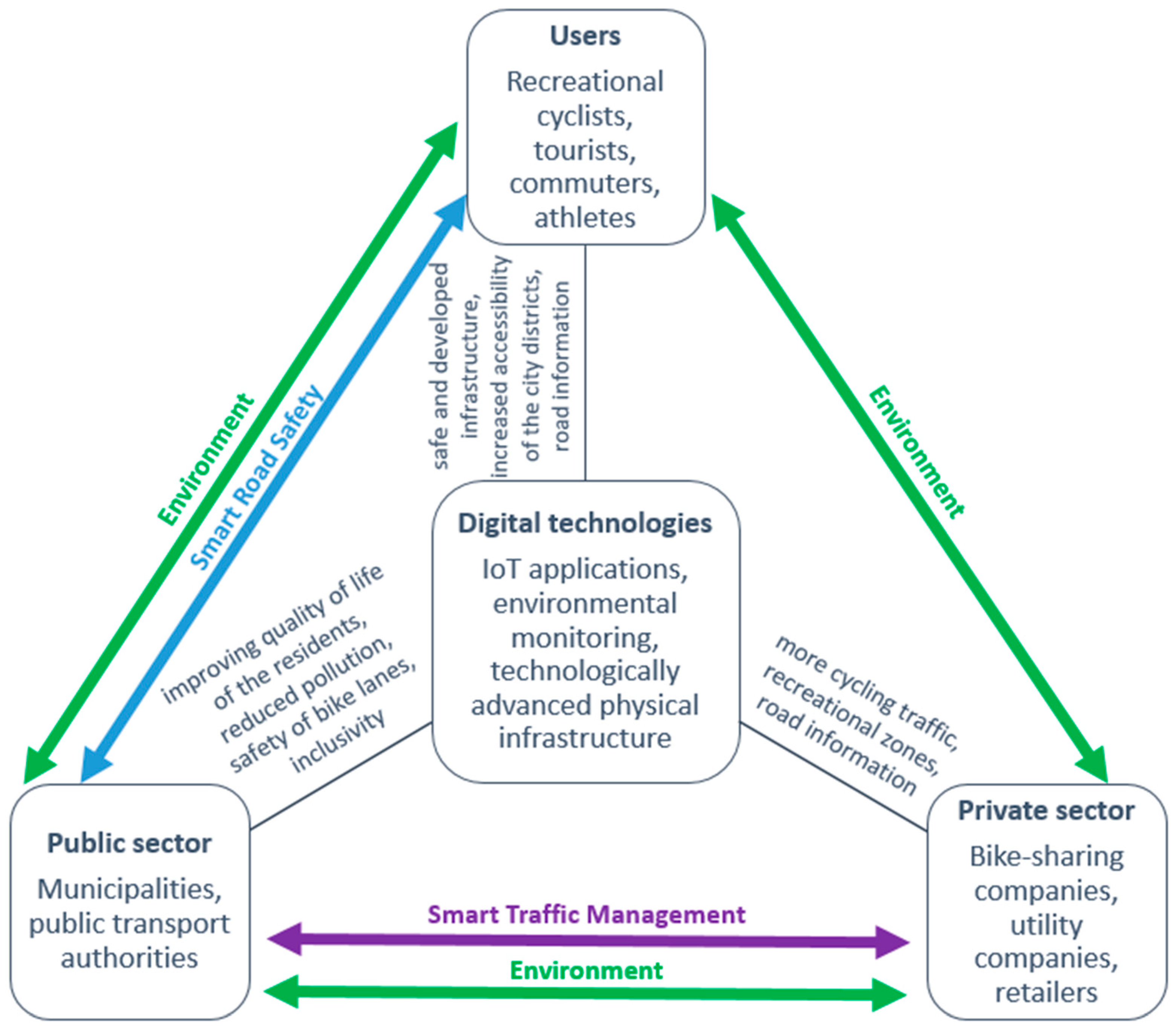
2.1.1. Digital Innovation in Cycling Infrastructure from Stakeholders’ Perspective
- Within the public sector group, municipalities and public transport agencies are identified in our research as the primary beneficiaries of cycling infrastructure development. They are interested in improving the quality of life, including enhanced urban accessibility, reduced environmental pollution, the promotion of healthy lifestyles among residents, the alleviation of traffic congestion, and increased urban attractiveness for cultural and creative human capital.
- The users group includes individuals who directly use cycling infrastructure. It comprises city residents and visitors who cycle for recreational purposes or to explore the city; residents who use bicycles for daily commuting; and athletes who may use urban cycling infrastructure to maintain their physical fitness. This stakeholder group is primarily interested in an extensive cycling network, safe infrastructure, and the availability of reliable route and traffic information.
- The private sector group includes bicycle-sharing companies, local retailers, and utility companies. These stakeholders (in particular bicycle-sharing operators and retailers) are interested in increasing the number of cycling infrastructure users. Utility companies (such as electricity and telecom providers), in turn, are directly involved in the construction and maintenance of the digital infrastructure.
2.1.2. Smart Urban Mobility and Digital Cycling Infrastructure
- “Smart Road Safety”—this dimension focuses on lowering the number of dangerous road conditions, as well as on the enhancement of the road users’ behavior, including observation of basic traffic rules, such as speeding, drunk driving, driving on pedestrian crossings, disregarding road signs, and other similar violations.
- “Smart Traffic Management”—this dimension primarily concerns traffic conditions, including road congestion for different modes of transport, average speed, and travel time, the key lever in this dimension is the data necessary for making informed management decisions;
- “Environment”—in this case, the topic is “air and noise pollution,” which, on one hand, can be considered the norm in large cities, but on the other hand, the use of new technologies can significantly reduce these negative consequences of urban mobility.
2.2. A Systematic Literature Review
- (1)
- In the first step, we have defined the research question and chosen the keywords and keyword combinations for the literature retrieval. The central keyword combinations applied for the present study were cycling infrastructure and smart mobility.
- (2)
- The literature was retrieved from the Scopus database, as it includes only high-quality articles that have undergone a peer review. Document types in the search were restricted to articles and the language was limited to English. A time range of 5 years was applied, so the documents consulted range from 2020 to 2025. This time frame was chosen as the academic literature shows that the COVID-19 pandemic stimulated the increasing use of the bicycles, especially in densely populated cities [52,53,54]. Moreover, the chosen time frame was determined by the rapidly evolving nature of digital technologies, especially the growing tendency to implement novel AI solutions and AI-related methods for smart city infrastructure development [55,56,57], allowing the study to identify the most recent trends in the area under investigation. The selected literature should be relevant to the aim of our study and highlight the role of digital technologies for cycling infrastructure stakeholders, or should explain the causal relationships between digital technologies and smart mobility dimensions.
- (3)
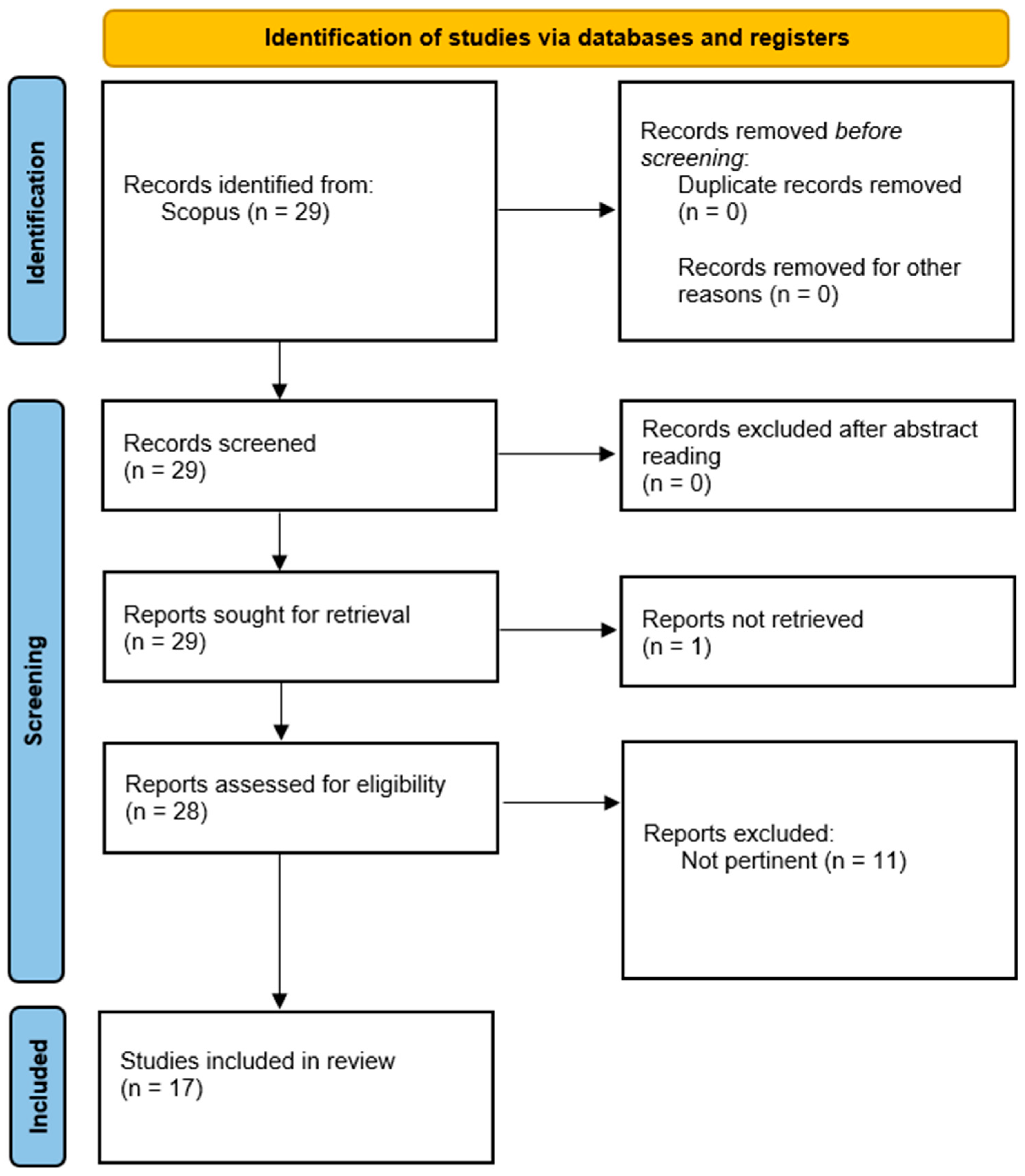
- Using the criteria identified at the second step of our research, we obtained a sample of the potentially relevant literature using a query (TITLE-ABS-KEY (cycling infrastructure) AND TITLE-ABS-KEY (smart mobility)) AND (LIMIT-TO (LANGUAGE, “English”)) AND (LIMIT-TO (DOCTYPE, “ar”)) AND PUBYEAR > 2019 AND PUBYEAR < 2026. In this early phase we identified 29 articles for further screening and analysis.
- (4)
- In the fourth step, we screened the identified academic literature. We started with reading the abstracts; after this step all the 29 articles were accepted for the further analysis. However, we were unable to download one article from the sample, so we proceeded with the careful reading of the remaining 28 documents. We then reviewed the full papers and excluded those that were not pertinent as they fell out of scope of our research or did not meet the inclusion criteria, thus obtaining the final sample of 17 articles. Table 1 shows a summary of the articles retrieved for the review, including the reference number, author, year, and country.
- (5)
- At the fifth stage we proceeded with the synthesis of the retrieved literature. At this stage, the authors of the study conducted a content analysis of the academic literature to determine whether it contains evidence on the role of digital technologies in creating value for the stakeholder groups discussed above and on the support these technologies offer to smart mobility dimensions, so the evidence on the two analytical dimensions derived from the conceptual framework developed in Section 2.1—stakeholder groups and smart mobility dimensions—are the outcomes sought from the retrieved studies. Data was extracted for the following variables: (1) type of digital technology discussed; (2) stakeholder groups addressed (users, public sector, private sector); and (3) smart mobility dimensions supported (smart road safety, smart traffic management, environment). Each included study was read in full by the authors and assigned to the relevant categories based on the primary focus of its findings. Studies that address several variables were coded accordingly.
- (6)
- The results of the SLR present a narrative synthesis due to the exploratory character of the research, and are tabulated and presented broken down by technology type and by the two analytical dimensions (stakeholder groups and smart mobility dimensions) as reflected in tables in the following section.

3. Results and Discussion
3.1. Digital Technologies for Users, Public Sector, and Private Sector
3.2. Digital Technologies for Road Safety, Traffic Management, and Environment
3.3. Summary of Results
4. Conclusions
Supplementary Materials
Author Contributions
Funding
Institutional Review Board Statement
Informed Consent Statement
Data Availability Statement
Conflicts of Interest
References
- Trencher, G. Towards the Smart City 2.0: Empirical Evidence of Using Smartness as a Tool for Tackling Social Challenges. Technol. Forecast. Soc. Change 2019, 142, 117–128. [Google Scholar] [CrossRef]
- United Nations. Transforming Our World: The 2030 Agenda for Sustainable Development. 2015. Available online: https://sdgs.un.org/sites/default/files/publications/21252030%20Agenda%20for%20Sustainable%20Development%20web.pdf (accessed on 30 December 2025).
- Giffinger, R.; Gudrun, H. Smart Cities Ranking: An Effective Instrument for the Positioning of the Cities? ACE Archit. City Environ. 2010, 4, 7–26. [Google Scholar] [CrossRef]
- Chourabi, H.; Nam, T.; Walker, S.; Gil-Garcia, J.R.; Mellouli, S.; Nahon, K.; Pardo, T.A.; Scholl, H.J. Understanding Smart Cities: An Integrative Framework. In Proceedings of the 2012 45th Hawaii International Conference on System Sciences, Maui, HI, USA, 4–7 January 2012; IEEE: New York, NY, USA, 2012; pp. 2289–2297. [Google Scholar]
- Gil-Garcia, J.R.; Pardo, T.A.; Nam, T. What Makes a City Smart? Identifying Core Components and Proposing an Integrative and Comprehensive Conceptualization. Inf. Polity 2015, 20, 61–87. [Google Scholar] [CrossRef]
- Van Der Hoogen, A.; Scholtz, B.; Calitz, A. A Smart City Stakeholder Classification Model. In Proceedings of the 2019 Conference on Information Communications Technology and Society (ICTAS), Durban, South Africa, 6–8 March 2019; IEEE: New York, NY, USA, 2019; pp. 1–6. [Google Scholar]
- Khamis, A. Smart Mobility Education and Capacity Building for Sustainable Development: A Review and Case Study. Sustainability 2025, 17, 7999. [Google Scholar] [CrossRef]
- European Commission. Shaping Europe’s Digital Future. Digitalising Transport—Towards Smart and Sustainable Mobility. Available online: https://digital-strategy.ec.europa.eu/en/policies/digitalisation-mobility (accessed on 30 December 2025).
- Sá, E.; Carvalho, A.; Silva, J.; Rezazadeh, A. A Delphi Study of Business Models for Cycling Urban Mobility Platforms. Res. Transp. Bus. Manag. 2022, 45, 100907. [Google Scholar] [CrossRef]
- Nikolaeva, A. Smart Cities and (Smart) Cycling: Exploring the Synergies in Copenhagen and Amsterdam. J. Urban Technol. 2024, 31, 29–49. [Google Scholar] [CrossRef]
- Aguilar, J.F.A.; Mendes, L. Smart Urban Mobility: Conceptual Analysis for Proposal Model. In Proceedings of the 2017 IEEE First Summer School on Smart Cities (S3C), Natal, Brazil, 6–11 August 2017; IEEE: New York, NY, USA, 2017; pp. 1–6. [Google Scholar]
- Chatziioannou, I.; Alvarez-Icaza, L.; Bakogiannis, E. A Structural Analysis Method for the Promotion of Mexico City’s Integral Plan of Mobility. Cogent Eng. 2020, 7, 1759395. [Google Scholar] [CrossRef]
- Albadrani, M.A. Enriching Urban Life with AI and Uncovering Creative Solutions: Enhancing Livability in Saudi Cities. Sustainability 2025, 17, 6603. [Google Scholar] [CrossRef]
- Baier, J.; Taminé, O. Automatic Surface Analysation of Bike Paths with Artificial Intelligence. gis.Science 2025, 1, 39–46. [Google Scholar] [CrossRef]
- Matthes, P.; Jeschor, D.; Springer, T. GeoAI-Powered Lane Matching for Bike Routes in GLOSA Apps. In Proceedings of the Proceedings of the 31st ACM International Conference on Advances in Geographic Information Systems, Hamburg Germany, 13–16 November 2023; ACM: New York, NY, USA, 2023; pp. 1–4. [Google Scholar]
- Azizi Soldouz, S.; Hellinga, B. Estimating Bicycle Volume Levels at Urban Intersections Using Large Language Models. Transp. Res. Rec. J. Transp. Res. Board 2026, 03611981251407921. [Google Scholar] [CrossRef]
- Antwi, R.B.; Lawson, P.L.; Kimollo, M.; Ozguven, E.E.; Moses, R.; Dulebenets, M.A.; Sando, T. Automated Detection of Pedestrian and Bicycle Lanes from High-Resolution Aerial Images by Integrating Image Processing and Artificial Intelligence (AI) Techniques. ISPRS Int. J. Geo-Inf. 2025, 14, 135. [Google Scholar] [CrossRef]
- Beura, S.K.; Bhuyan, P.K. Development of Artificial Intelligence-Based Bicycle Level of Service Models for Urban Street Segments. Int. J. Intell. Transp. Syst. Res. 2022, 20, 142–156. [Google Scholar] [CrossRef]
- Bouderbala, M.M.S.; Demirag, D.; Gambs, S. LoChain: A Decentralized and Privacy-Preserving Blockchain Protocol for Mobility Data Management. Int. Arch. Photogramm. Remote Sens. Spat. Inf. Sci. 2025, XLVIII-4/W16-2025, 17–24. [Google Scholar] [CrossRef]
- Nakamoto, S. Bitcoin: A Peer-to-Peer Electronic Cash System. Decentralized Business Review. 2008. Available online: https://bitcoin.org/bitcoin.pdf (accessed on 15 January 2026).
- Eswaran, M.; Inkulu, A.K.; Tamilarasan, K.; Bahubalendruni, M.V.A.R.; Jaideep, R.; Faris, M.S.; Jacob, N. Optimal Layout Planning for Human Robot Collaborative Assembly Systems and Visualization through Immersive Technologies. Expert Syst. Appl. 2024, 241, 122465. [Google Scholar] [CrossRef]
- Yee Peng, C.; Mohd Kamaruzaman, F.; Omar, M. Evaluating the Role of Augmented Reality in Enhancing Engagement and Learning in TVET Education: A Scoping Review. J. Appl. Sci. Eng. Technol. Educ. 2025, 7, 377–391. [Google Scholar] [CrossRef]
- Issenberg, B.; Ostergaard, D.; Matos, F.; Ingrassia, P.L.; Freeman, K.; Konge, L.; Sa-Couto, C.; Reedy, G.; The Utstein XR in Simulation Expert Group; Acharya, A.; et al. Setting a Research Agenda for the Use of Extended Reality in Healthcare Simulation: An Utstein Style Meeting. Adv. Simul. 2026, 11, 16. [Google Scholar] [CrossRef] [PubMed]
- Khademi, N.; Farajolahi, H.; Mazloum, S.; Bidgoli, M.A.; Ghorbanisharif, M. Exploring the Mediating Role of Competence in Cyclist Safety and Comfort: A Visuo-Haptic Virtual Reality (VR) Study. Saf. Sci. 2025, 191, 106937. [Google Scholar] [CrossRef]
- Schwarzkopf, M.; Dettmann, A.; Bullinger, A.C. What Turns a Bicycle Street into a Street for Cyclists? A Multimodal Study on Subjective Safety of Infrastructure Measures on Bicycle Streets Using an Approach in Virtual Reality. Traffic Saf. Res. 2024, 7, e000066. [Google Scholar] [CrossRef]
- Ramirez Juarez, R.N.; Grigolon, A.B.; Madureira, A.M. Cyclists’ Perception of Streetscape and Its Influence on Route Choice: A Pilot Study with a Mixed-Methods Approach. Transp. Res. Part F Traffic Psychol. Behav. 2023, 99, 374–388. [Google Scholar] [CrossRef]
- Bialkova, S.; Ettema, D.; Dijst, M. How Do Design Aspects Influence the Attractiveness of Cycling Streetscapes: Results of Virtual Reality Experiments in the Netherlands. Transp. Res. Part A Policy Pract. 2022, 162, 315–331. [Google Scholar] [CrossRef]
- Santos, P.; Clemente, V.; Gomes, A. Towards Safer Mobility in Cities and Communities: A Framework to Assist the Design Process of Cycling Warning Systems. In Human Dynamics and Design for the Development of Contemporary Societies, Proceedings of the 14th International Conference on Applied Human Factors and Ergonomics and the Affiliated Conferences, San Francisco, CA, USA, 20–24 July 2023; AHFE International: New York, NY, USA, 2023. [Google Scholar]
- Wang, Q. Intelligent Anti-Collision Algorithm of Electric Bicycle Helmet Based on Arduino and Sensor Data. In Proceedings of the 2024 3rd International Conference on Artificial Intelligence and Autonomous Robot Systems (AIARS), Bristol, UK, 29–31 July 2024; IEEE: New York, NY, USA, 2024; pp. 577–582. [Google Scholar]
- K, S.; D, R.; S, N.; C, S.; Chockalingam, A. Collision Prevention Technology in IoT Integrated Smart Bike Helmet. In Proceedings of the 2025 International Conference on Data Science, Agents & Artificial Intelligence (ICDSAAI), Chennai, India, 28–29 March 2025; IEEE: New York, NY, USA, 2025; pp. 1–5. [Google Scholar]
- Qiu, P.; Liu, X.; Wen, S.; Zhang, Y.; Winfree, K.N.; Ho, C.-H. The Development of an IoT Instrumented Bike: For Assessment of Road and Bike Trail Conditions. In Proceedings of the 2018 International Symposium in Sensing and Instrumentation in IoT Era (ISSI), Shanghai, China, 6–7 September 2018; IEEE: New York, NY, USA, 2018; pp. 1–6. [Google Scholar]
- Padmaja, P.; Sri, P.B.; Vikas, N.; Nithin, S.; Lakpathi, S. IOT Based Bike Transportation Safety System. In Proceedings of International Conference on Computer Science and Communication Engineering (ICCSCE 2025); Katiyar, J.K., Yellampalli, D.S.R., Chandra Mohan, D., Singh, K.K., Venkata Ramana, B., Dinesh Kumar, N., Eds.; Advances in Computer Science Research; Atlantis Press International B.V.: Dordrecht, The Netherlands, 2025; Volume 124, pp. 2348–2357. [Google Scholar]
- Freeman, R.E.; McVea, J. A Stakeholder Approach to Strategic Management. SSRN J. 2001. [Google Scholar] [CrossRef]
- Freeman, R.E.; Phillips, R.; Sisodia, R. Tensions in Stakeholder Theory. Bus. Soc. 2020, 59, 213–231. [Google Scholar] [CrossRef]
- Mahajan, R.; Lim, W.M.; Sareen, M.; Kumar, S.; Panwar, R. Stakeholder Theory. J. Bus. Res. 2023, 166, 114104. [Google Scholar] [CrossRef]
- Bowie, N.E. Stakeholder Theory: The State of the Art, R. Edward Freeman, Jeffrey S. Harrison, Andrew C. Wicks, Bidhan L. Parmar, and Simone de Colle (New York: Cambridge University Press, 2010). Bus. Ethics Q. 2012, 22, 179–185. [Google Scholar] [CrossRef]
- Gomes, R.C.; Lisboa, E.; Sarturi, G.; Mirapalheta, G. How Has Stakeholder Theory Served the Public Administration Literature? In Search of the Intellectual Structure of the Field. Public Manag. Rev. 2025, 27, 2076–2098. [Google Scholar] [CrossRef]
- Sarturi, G.; Barakat, S.R.; Gomes, R.C. Stakeholder Theory in the Public Sector Domain: A Bibliometric Analysis and Future Research Agenda. Rev. Policy Res. 2025, 42, 736–756. [Google Scholar] [CrossRef]
- Ratanaburi, N.; Alade, T.; Saçli, F. Effects of Stakeholder Participation on the Quality of Bicycle Infrastructure. A Case of Rattanakosin Bicycle Lane, Bangkok, Thailand. Case Stud. Transp. Policy 2021, 9, 637–650. [Google Scholar] [CrossRef]
- Cornet, Y.; Hook, H. Oxford Roundabout and the Art of Safety: Resistance to Cycling Infrastructure Intervention. In Transport Transitions: Advancing Sustainable and Inclusive Mobility; McNally, C., Carroll, P., Martinez-Pastor, B., Ghosh, B., Efthymiou, M., Valantasis-Kanellos, N., Eds.; Lecture Notes in Mobility; Springer Nature: Cham, Switzerland, 2026; pp. 22–27. [Google Scholar]
- Cheng, J.-H. Pedaling towards Net Zero: AI, Policy, and Incentives Drive a Cycling Revolution. Transp. Res. Interdiscip. Perspect. 2025, 34, 101783. [Google Scholar] [CrossRef]
- Csomós, G.; da Cunha, F.M. Surveying Public Perceptions of Urban Mobility in a Medium-Sized City in Brazil: A Case Study of Divinópolis. Bull. Geogr. Socio-Econ. Ser. 2026, 7–24. [Google Scholar] [CrossRef]
- Oliveira, F.; Nery, D.; Costa, D.G.; Silva, I.; Lima, L. A Survey of Technologies and Recent Developments for Sustainable Smart Cycling. Sustainability 2021, 13, 3422. [Google Scholar] [CrossRef]
- Meireles, M.; Ribeiro, P.J.G. Digital Platform/Mobile App to Boost Cycling for the Promotion of Sustainable Mobility in Mid-Sized Starter Cycling Cities. Sustainability 2020, 12, 2064. [Google Scholar] [CrossRef]
- Makahleh, H.Y.; Taamneh, M.M.; Dissanayake, D. Promoting Sustainable Transport: A Systematic Review of Walking and Cycling Adoption Using the COM-B Model. Future Transp. 2025, 5, 79. [Google Scholar] [CrossRef]
- Tranfield, D.; Denyer, D.; Smart, P. Towards a Methodology for Developing Evidence-Informed Management Knowledge by Means of Systematic Review. Br. J. Manag. 2003, 14, 207–222. [Google Scholar] [CrossRef]
- Page, M.J.; McKenzie, J.E.; Bossuyt, P.M.; Boutron, I.; Hoffmann, T.C.; Mulrow, C.D.; Shamseer, L.; Tetzlaff, J.M.; Akl, E.A.; Brennan, S.E.; et al. The PRISMA 2020 Statement: An Updated Guideline for Reporting Systematic Reviews. BMJ 2021, 372, n71. [Google Scholar] [CrossRef] [PubMed]
- Shamseer, L.; Moher, D.; Clarke, M.; Ghersi, D.; Liberati, A.; Petticrew, M.; Shekelle, P.; Stewart, L.A.; The PRISMA-P Group. Preferred Reporting Items for Systematic Review and Meta-Analysis Protocols (PRISMA-P) 2015: Elaboration and Explanation. BMJ 2015, 349, g7647. [Google Scholar] [CrossRef] [PubMed]
- Pollock, A.; Berge, E. How to do a systematic review. Int. J. Stroke 2018, 13, 138–156. [Google Scholar] [CrossRef] [PubMed]
- Alka, T.A.; Sreenivasan, A.; Suresh, M. Wheel of Change: A Systematic Literature Review on Innovation and Entrepreneurship in Micro Mobility Solutions. Transp. Econ. Manag. 2024, 2, 154–168. [Google Scholar] [CrossRef]
- Durach, C.F.; Kembro, J.; Wieland, A. A New Paradigm for Systematic Literature Reviews in Supply Chain Management. J. Supply Chain. Manag. 2017, 53, 67–85. [Google Scholar] [CrossRef]
- Chen, C.; Christoforou, Z.; Farhi, N. Reaction Times of Micromobility Users. Transp. Res. Part F Traffic Psychol. Behav. 2026, 116, 103441. [Google Scholar] [CrossRef]
- Christoforou, Z.; Psarrou Kalakoni, A.M.; Gioldasis, C. Mode Shifts from Public Transport to Bike-Sharing in the Era of COVID-19: Riding Back to Normality. J. Public Transp. 2023, 25, 100071. [Google Scholar] [CrossRef]
- Zheng, M.; Liu, F.; Wang, M. Assessing the COVID-19 Lockdown Impact on Global Air Quality: A Transportation Perspective. Atmosphere 2025, 16, 113. [Google Scholar] [CrossRef]
- Podda, A.S.; Carta, S.; Barra, S. Artificial Intelligence Methods for Smart Cities. Sensors 2024, 24, 2615. [Google Scholar] [CrossRef] [PubMed]
- Rane, N.; Mallick, S.K.; Rane, J. Machine Learning for Urban Resilience and Smart City Infrastructure Using Internet of Things and Spatiotemporal Analysis. SSRN J. 2025, 171–200. [Google Scholar] [CrossRef]
- Wei, Q. Navigating the Interplay of Cities and Artificial Intelligence: Innovation, Integration and Interpretation. Habitat Int. 2026, 171, 103782. [Google Scholar] [CrossRef]
- Costa, D.G.; Silva, I.; Medeiros, M.; Bittencourt, J.C.N.; Andrade, M. A Method to Promote Safe Cycling Powered by Large Language Models and AI Agents. MethodsX 2024, 13, 102880. [Google Scholar] [CrossRef] [PubMed]
- Ferreira, J.M.; Costa, D.G. Enhancing Cycling Safety in Smart Cities: A Data-Driven Embedded Risk Alert System. Smart Cities 2024, 7, 1992–2014. [Google Scholar] [CrossRef]
- Kazmi, S.M.A.; Khan, Z.; Khan, A.; Mazzara, M.; Masood Khattak, A. Leveraging Deep Reinforcement Learning and Healthcare Devices for Active Travelling in Smart Cities. IEEE Trans. Consum. Electron. 2025, 71, 4475–4486. [Google Scholar] [CrossRef]
- Manoj, V.; Sreedhar, M.; Sasidhar, R.; Kundala, P.K.Y.; Mouli, D.C.; Pilla, R. E-Bikes Unplugged: Exploring the Evolution and Environmental Benefits of Electric Cycling. Int. J. Adv. Appl. Sci. 2025, 14, 1295–1304. [Google Scholar] [CrossRef]
- Roslan, A.; Zulkiffli, N.S.M.; Hamidun, R.; Harun, N.Z.; Jamil, H.M.; Rahim, S.A.S.M.; Zulkipli, Z.H.; Alias, N.K.; Zakaria, N.M.; Kassim, K.A.A. Characteristic of Micro-Mobility Devices’ Users in Malaysia. Construction 2023, 3, 254–262. [Google Scholar] [CrossRef]
- Manca, F.; Daina, N.; Sivakumar, A.; Yi, J.W.X.; Zavistas, K.; Gemini, G.; Vegetti, I.; Dargan, L.; Marchet, F. Using Digital Social Market Applications to Incentivise Active Travel: Empirical Analysis of a Smart City Initiative. Sustain. Cities Soc. 2022, 77, 103595. [Google Scholar] [CrossRef]
- Kim, M.J.; Hall, C.M.; Chung, N.; Jo, Y.; Kim, J.S. Comparing Urban and Non-Urban Residents’ Sustainable Tourism Mobility. J. Smart Tour. 2024, 4, 35–46. [Google Scholar] [CrossRef]
- Wolniak, R.; Turoń, K. The Model of Relationships Between Benefits of Bike-Sharing and Infrastructure Assessment on Example of the Silesian Region in Poland. Appl. Syst. Innov. 2025, 8, 54. [Google Scholar] [CrossRef]
- Khajehpour, B.; Miremadi, I. Assessing Just Mobility Transitions in the Global South: The Case of Bicycle-Sharing in Iran. Energy Res. Soc. Sci. 2024, 110, 103435. [Google Scholar] [CrossRef]
- Nesmachnow, S.; Hipogrosso, S. Assessment of Sustainable Mobility Initiatives Developed in Montevideo, Uruguay. Urban Sci. 2024, 8, 52. [Google Scholar] [CrossRef]
- Li, W.; Wang, S.; Zhang, X.; Jia, Q.; Tian, Y. Understanding Intra-Urban Human Mobility through an Exploratory Spatiotemporal Analysis of Bike-Sharing Trajectories. Int. J. Geogr. Inf. Sci. 2020, 34, 2451–2474. [Google Scholar] [CrossRef]
- Pfaender, F.; Mahdjoub, M.; Ostrosi, E. A Data-Driven Framework for Sustainability and Ergonomic Design of Urban Cycling Networks in the Métropole Européenne de Lille. Sustainability 2025, 17, 9321. [Google Scholar] [CrossRef]
- Malik, F.A.; Dala, L.; Busawon, K. Real-Time Nanoscopic Rider Safety System for Smart and Green Mobility Based upon Varied Infrastructure Parameters. Future Internet 2022, 14, 9. [Google Scholar] [CrossRef]
- Oliveira, F.; Costa, D.G.; Duran-Faundez, C.; Dias, A. BikeWay: A Multi-Sensory Fuzzy-Based Quality Metric for Bike Paths and Tracks in Urban Areas. IEEE Access 2020, 8, 227313–227326. [Google Scholar] [CrossRef]
- Cafiso, S.; Pappalardo, G.; Stamatiadis, N. Observed Risk and User Perception of Road Infrastructure Safety Assessment for Cycling Mobility. Infrastructures 2021, 6, 154. [Google Scholar] [CrossRef]
- Fayyaz, M.; Fusco, G.; Colombaroni, C.; González-González, E.; Nogués, S. Optimizing Smart City Street Design with Interval-Fuzzy Multi-Criteria Decision Making and Game Theory for Autonomous Vehicles and Cyclists. Smart Cities 2024, 7, 3936–3961. [Google Scholar] [CrossRef]


| Ref. | Author(s) | Year | Country |
|---|---|---|---|
| [41] | Cheng | 2025 | Taiwan |
| [58] | Costa et al. | 2024 | Portugal, Brazil |
| [59] | Ferreira and Costa | 2024 | Portugal |
| [60] | Kazmi et al. | 2025 | United Kingdom, Russia, UAE |
| [61] | Manoj et al. | 2025 | India |
| [62] | Roslan et al. | 2023 | Malaysia |
| [63] | Manca et al. | 2022 | United Kingdom, Italy |
| [64] | Kim et al. | 2024 | Thailand, Republic of Korea, New Zealand, Finland, Sweden, South Africa, Malaysia |
| [65] | Wolniak andTuroń | 2025 | Poland |
| [66] | Khajehpour and Miremadi | 2024 | Iran |
| [67] | Nesmachnow and Hipogrosso | 2024 | Uruguay |
| [68] | Li et al. | 2020 | USA |
| [69] | Pfaender et al. | 2025 | China, France |
| [70] | Malik et al. | 2022 | United Kingdom |
| [71] | Oliveira et al. | 2020 | Brazil, Chile |
| [72] | Cafiso et al. | 2021 | Italy, USA |
| [73] | Fayyaz et al. | 2024 | Spain, Italy |
| Journal | ‘20 | ‘21 | ‘22 | ‘23 | ‘24 | ‘25 | Tot. |
|---|---|---|---|---|---|---|---|
| Applied System Innovation | 1 [65] | 1 | |||||
| Construction | 1 [62] | 1 | |||||
| Energy Research and Social Science | 1 [66] | 1 | |||||
| Future Internet | 1 [70] | 1 | |||||
| IEEE Access | 1 [71] | 1 | |||||
| IEEE Transactions on Consumer Electronics | 1 [60] | 1 | |||||
| Infrastructures | 1 [72] | 1 | |||||
| International Journal of Advances in Applied Sciences | 1 [61] | 1 | |||||
| International Journal of Geographical Information Science | 1 [68] | 1 | |||||
| Journal of Smart Tourism | 1 [64] | 1 | |||||
| MethodsX | 1 [58] | 1 | |||||
| Smart Cities | 2 [59,73] | 2 | |||||
| Sustainability (Switzerland) | 1 [69] | 1 | |||||
| Sustainable Cities and Society | 1 [63] | 1 | |||||
| Transportation Research Interdisciplinary Perspectives | 1 [41] | 1 | |||||
| Urban Science | 1 [67] | 1 | |||||
| Total | 2 | 1 | 2 | 1 | 6 | 5 | 17 |
| Technology | Users | Public Sector | Private Sector |
|---|---|---|---|
| AI & related technologies | Personalized cycling motivation [41] AI-powered information on risk alerts [58] Travel mode optimization through the analysis of wearables’ data [60] User-specific safety predictions [70] | Fostering “data-driven infrastructure planning” [41] Urban cycling safety planning [58] Embedded learning systems support safer infrastructure [70] | -- |
| IoT & related solutions | On-bike GPS safety alert system [60] Improved technological equipment of e-bikes [61] IoT-driven micro-mobility tracking [62] Real-time bike availability enhances bike-sharing users’ experience [65] GPS data addresses first-mile and last-mile problems in bike-sharing [69] Multi-sensory route quality selection tool [71] | GPS data employed for infrastructure planning decisions [68] Multi-sensory solution helps to identify cycling infrastructure improvement priorities [71] | Real-time monitoring and contactless payment for operational efficiency [65] IoT-powered fleet rebalancing and demand management [68] |
| GIS | -- | GIS-based cycling quality monitoring integrated into smart city ecosystem [59] Implementation of solutions with GIS integration supports sustainable development goals [69] | -- |
| Blockchain | -- | Blockchain technologies enable secure citizen data management across administrative levels [60] | -- |
| Mobile & dashboard applications | AI-driven dashboards promote cycling adoption [41] Apps collect data on travel modes, preferences and health metrics for route optimization [60] Mobile apps support informed sustainable travel choices [62,64] Gamified app rewards encourage cycling behavior [63] Real-time app updates reduce user confusion and improve their experience [65] | “Gamified urban networks” help city managers to motivate cycling habits among citizens [41] | -- |
| Technology | Smart Road Safety | Smart Traffic Management | Environment |
|---|---|---|---|
| AI & related technologies | AI-powered cycling risk assessment for urban paths [58] Neural network safety prediction by cyclist profile and infrastructure type [70] The study results highlight safety as a key priority for the cycling paths [73] | AI-powered dashboards support “data-driven infrastructure planning” [41] DRL-driven travel mode optimization reduces motorized traffic [60] | AI incentive framework supports urban net-zero goals [41] Emission minimization through intelligent travel mode selection [60] AI solutions help rout optimization and improve environmental performance [61] Proposed real-time learning system contributes to a greener mobility system [70] |
| IoT & related solutions | GPS integration provides real-time risk assessment and alerts [59] The developed prediction safety models define the riskiest age and gender groups [70] Multi-sensory route quality metric supports safer path selection [71] GNSS was employed to collect objective risk data [72] | E-bike adoption as an urban traffic congestion relief solution [61] IoT-enabled bike-sharing services reduce car dependence in urban environments [65] Dockless bike-sharing solves first- and last-mile problems [68] | E-bike adoption leads to the lowering of GHG emissions [61] Bike-sharing services contribute to reduced urban carbon footprint [65] |
| GIS | Implementation of GIS contributes to real-time risk assessment [59] | GIS techniques are the important source of data for urban mobility decision-making [59,69] | -- |
| Blockchain | -- | -- | -- |
| Mobile & dashboard applications | -- | Applications may ease travel mode selection and hence contribute to the traffic reduction [60] Novel solutions implemented through mobile apps help to address first- and last-mile problems [62] | App-tracked travel preferences enable emission-reducing route planning [60] Gamified app incentives accelerate cycling adoption and hence lead to the GHD emissions lowering [61] Digital app engagement positively correlated with sustainable travel choices [63] |
Disclaimer/Publisher’s Note: The statements, opinions and data contained in all publications are solely those of the individual author(s) and contributor(s) and not of MDPI and/or the editor(s). MDPI and/or the editor(s) disclaim responsibility for any injury to people or property resulting from any ideas, methods, instructions or products referred to in the content. |
© 2026 by the authors. Licensee MDPI, Basel, Switzerland. This article is an open access article distributed under the terms and conditions of the Creative Commons Attribution (CC BY) license.
Share and Cite
Bellini, F.; D’Ascenzo, F.; Gorelova, I.; Scalingi, A. Digital Technologies for Advancing Cycling Infrastructure: A Systematic Literature Review. Sustainability 2026, 18, 7259. https://doi.org/10.3390/su18147259
Bellini F, D’Ascenzo F, Gorelova I, Scalingi A. Digital Technologies for Advancing Cycling Infrastructure: A Systematic Literature Review. Sustainability. 2026; 18(14):7259. https://doi.org/10.3390/su18147259
Chicago/Turabian StyleBellini, Francesco, Fabrizio D’Ascenzo, Irina Gorelova, and Alessandra Scalingi. 2026. "Digital Technologies for Advancing Cycling Infrastructure: A Systematic Literature Review" Sustainability 18, no. 14: 7259. https://doi.org/10.3390/su18147259
APA StyleBellini, F., D’Ascenzo, F., Gorelova, I., & Scalingi, A. (2026). Digital Technologies for Advancing Cycling Infrastructure: A Systematic Literature Review. Sustainability, 18(14), 7259. https://doi.org/10.3390/su18147259