


Abstract
The North Sea is becoming a shared renewable energy space in which offshore wind deployment, grid planning, market operation and environmental governance increasingly cross borders. This article asks how wind-resource complementarity can inform legal and institutional design for cross-border offshore wind cooperation. It combines a five-year representative-point wind-resource screening analysis using NASA POWER hourly data from 2021 to 2025 with functional legal–institutional analysis. The empirical analysis covers seven offshore or near-offshore representative screening points, hub-height correction to 100 m and 150 m, a wind-power proxy and wind-power-density proxy, low-wind frequency and low-wind event duration, monthly and interannual variability, pairwise correlation, CWCI and weighting sensitivity. The representative-point results suggest a mean 100 m corrected wind-speed range of 8.52 to 9.88 m/s, 4 m/s low-wind frequencies of 8.69% to 12.64%, and a maximum 4 m/s low-wind event of 173.0 h at NO_SOUTH. The baseline CWCI screening identifies DK West–BE Coast, DK West–FR Channel and UK East–FR Channel as leading within-sample pairs. The legal analysis uses these results as screening evidence for questions of data compatibility, hub-height assumptions, low-wind consultation, hybrid offshore grid governance, market coordination, cumulative environmental assessment, investment regulatory space and crisis dispute prevention. The article proposes an operational five-pillar framework with institutions, instruments, implementation steps and compliance pathways. It should be read as an exploratory evidence-to-law screening analysis, not a definitive wind-resource assessment, turbine-output model, capacity-factor estimate or grid-dispatch simulation.
1. Introduction
The North Sea is moving from a conventional offshore energy basin toward a shared renewable energy space. Offshore wind farms, hybrid interconnectors, offshore hubs, hydrogen projects, grid corridors, environmental assessment procedures and marine spatial planning processes increasingly develop in the same maritime region. This transformation creates opportunities for decarbonization, but it also makes renewable electricity security more dependent on cross-border coordination than earlier nationally bounded energy planning. A large body of technical research has made this transition empirically visible. ERA5, bias-corrected reanalysis and high-resolution wind atlases have improved the assessment of wind-resource conditions and wind-power modeling [1,2,3]. Global wind-resource studies and climate-impact reviews further show that wind potential is spatially uneven, temporally variable and sensitive to methodological assumptions [4,5,6]. At the same time, energy-security scholarship has moved beyond the traditional focus on fuel supply and import dependence. Availability, affordability, accessibility, acceptability, resilience and institutional capacity have become central dimensions of energy security [7,8,9]. Renewable electricity adds another layer to this debate because security increasingly depends on forecasting, flexibility, grid capacity, market integration and regional coordination [10,11]. The geopolitics of renewable energy are therefore not simply a cleaner version of fossil-fuel geopolitics. It involves new forms of infrastructure dependence, cross-border flow management and institutional interdependence [12,13].
Existing studies provide important foundations, but they remain partly separated across disciplinary and policy fields. Power-system modeling shows that cooperation in highly renewable European electricity networks can reduce system costs and improve the use of variable resources [14,15,16]. Research on balancing-capacity markets similarly indicates that regional coordination can improve the operation of future electricity systems [17]. North Sea offshore grid studies have examined combined optimization of grid and generation investment, hybrid offshore assets and the need for adapted regulatory frameworks [18,19]. These works demonstrate that offshore wind development cannot be treated as a purely national generation issue. However, most of this literature is directed toward system optimization, infrastructure planning or regulatory design within energy markets. It does not fully explain how wind-resource complementarity should be translated into legal functions such as data duties, planning standards, capacity allocation, environmental assessment, investment-risk allocation and crisis consultation. A related body of marine governance research shows that offshore wind deployment must also be coordinated with marine spatial planning and competing sea uses [20,21]. Yet this literature often addresses spatial planning as a governance field in itself rather than as part of a broader legal framework for cross-border renewable electricity security.
The legal and environmental literature further reinforces the need for a more integrated approach. Ecosystem-based marine management, ecological cost–benefit analysis and biodiversity studies show that offshore renewable deployment may produce both environmental opportunities and cumulative risks [22,23,24]. cumulative-impact assessment research is particularly relevant because offshore wind projects can generate cross-border and multi-project ecological pressures that are difficult to capture through isolated project-level review [25]. Energy law and energy justice scholarship also show that the energy transition raises questions of distribution, procedure, recognition and regulatory design [26,27,28]. Investment-law research adds another layer because offshore wind projects require long-term capital stability while states must retain regulatory space for climate, environmental and energy-security measures [29,30]. Institutionally, the North Seas Energy Cooperation, the European Union offshore renewable strategy and the TEN-E framework provide important foundations for regional cooperation [31,32,33]. The revised TEN-E framework is especially relevant because it links energy infrastructure planning with decarbonization and cross-border coordination [34]. Marine spatial planning, environmental impact assessment and electricity-market rules also provide procedural and regulatory tools for offshore wind governance [35,36,37]. Electricity-market and Energy Union rules shape market access, network operation and governance coordination [38,39,40]. International law remains relevant through the law of the sea and regional environmental cooperation, including UNCLOS and OSPAR [41,42]. These instruments matter, but they do not yet form a unified framework for converting wind-resource complementarity into operational rules for data compatibility, hub-height assumptions, low-wind consultation, hybrid grid capacity allocation, cost–benefit sharing, cumulative environmental assessment, investment stability and dispute prevention. This is the complementarity governance gap addressed in this article.
This article asks how representative wind-resource evidence can help identify legal and institutional gaps in cross-border offshore wind cooperation in the North Sea, and how those gaps can be addressed through a regional governance framework. The argument is not that meteorological data directly create legal obligations. Rather, the article treats wind-resource complementarity as a fact–law translation problem. Resource-side evidence becomes legally relevant only when institutions can translate it into shared data standards, transparent planning assumptions, capacity and market rules, environmental safeguards, investment arrangements and crisis-consultation procedures. The article combines a five-year representative-point wind-resource screening analysis with functional legal–institutional analysis. The empirical component uses hourly data from 2021 to 2025, hub-height correction, wind-power proxy indicators, low-wind frequency and duration, pairwise correlation and CWCI sensitivity. These indicators are used as screening evidence rather than as a definitive offshore wind-resource assessment, turbine-output model, capacity-factor estimate or grid-dispatch simulation. The article makes three contributions. First, it conceptualizes wind-resource complementarity as a fact–law translation problem. Second, it identifies a complementarity governance gap in existing North Sea offshore wind governance, where resource assessment, infrastructure planning, environmental assessment, market coordination, investment protection and crisis governance are still treated too separately. Third, it develops an operational five-pillar legal framework linking joint data standards, offshore grid and market coordination, transboundary environmental assessment, investment protection with regulatory space, and energy-security crisis coordination or dispute prevention.
The remainder of the article proceeds as follows. Section 2 reviews the literature on wind-resource assessment, renewable energy security, North Sea offshore grids, environmental governance, investment protection and legal–institutional fragmentation. Section 3 explains the representative-point screening methodology, including data sources, hub-height correction, wind-resource proxies, low-wind event metrics and the CWCI sensitivity design. Section 4 reports the empirical screening results and clarifies their limits. Section 5 discusses how these findings translate into legal–institutional questions rather than direct legal obligations. Section 6 develops the operational five-pillar framework for cross-border offshore wind cooperation. Section 7 concludes by summarizing the empirical, theoretical and legal contributions, while identifying the limits of this exploratory evidence-to-law analysis and directions for future research.
2. Literature Review
2.1. Wind-Resource Assessment, Offshore Wind Potential and Complementarity
Wind-resource assessment has become increasingly data-driven. Reanalysis products, bias-corrected datasets and high-resolution wind atlases support regional and global analysis of wind potential, climatology and power-system implications [43,44]. These studies are essential for resource assessment and energy-system modeling, especially where wind variability, long-term climate patterns and spatial resolution affect planning assumptions.
Much of this literature focuses on wind potential, resource climatology, power-output simulation or system modeling. This article does not seek to replace ERA5 gridded assessment, mesoscale modeling or turbine power-curve analysis. It uses transparent and reproducible representative-point screening indicators to translate wind-resource patterns into legal and governance questions. The empirical component therefore uses a wind-power proxy and a wind-power-density proxy, not actual generation [45,46].
2.2. Renewable Energy Security and Cross-Border Electricity Interdependence
Energy security is commonly discussed through availability, affordability, accessibility and acceptability, as well as infrastructure adequacy, resilience and institutional capacity. Renewable electricity complicates these categories. A domestic wind project may reduce fossil-fuel import dependence while increasing dependence on forecasting, balancing, transmission, market coupling, flexible resources and regional coordination [47,48].
Power-system studies show that regional cooperation, transmission expansion and sector coupling can reduce balancing needs and improve the operation of highly renewable systems. These findings matter for law, but they do not by themselves provide legal–institutional design. They show why interdependence becomes important. They do not fully explain how legal rules should allocate data duties, grid capacity, costs, environmental responsibilities or crisis procedures [49].
2.3. North Sea Offshore Grids, Hybrid Assets and Regional Cooperation
The North Sea has become a central site for offshore grid planning, hybrid assets, interconnectors, energy islands, offshore bidding zones and market-coordination debates. EU offshore renewable policy, the TEN-E framework, electricity-market rules, ENTSO-E planning processes, national offshore strategies and the North Seas Energy Cooperation all shape this field [50,51].
The NSEC is an important regional cooperation platform, but it is mainly an intergovernmental and soft-law forum. It cannot by itself replace binding EU law, national implementation, regulatory decisions, TSO agreements or project-level permitting. Existing scholarship and policy debate addresses grid planning, hybrid asset regulation and market rules, but less often connects wind-resource complementarity evidence with legal obligations, planning standards, cost allocation and crisis coordination in one analytical frame [52].
2.4. Environmental, Spatial, Investment and Crisis-Governance Dimensions
Offshore wind cooperation is not only a grid question. It also concerns marine spatial planning, transboundary environmental assessment, strategic environmental assessment, public participation, OSPAR cooperation, cumulative ecological impacts, energy justice, investment protection, regulatory space and dispute prevention. These legal fields shape whether cross-border offshore wind can remain sustainable as deployment accelerates.
The difficulty is that these fields are often studied separately. Environmental assessment may focus on cumulative impacts and participation. Investment law may focus on stability and regulatory discretion. Electricity law may focus on market access and network planning. Crisis governance may focus on scarcity and emergency powers. Wind-resource complementarity cuts across these areas because it links resource variability, infrastructure dependence, environmental siting and regional allocation questions.
2.5. The Evidence-to-Law Gap in Existing Complementarity Research
The existing literature provides strong insights on wind-resource assessment, renewable energy security, offshore grid planning, market integration, environmental governance and investment protection. However, it rarely asks how wind-resource complementarity and low-wind event duration should be translated into a legal–institutional framework.
The gap is not the absence of legal rules. The gap is the fragmentation between resource evidence and legal functions. Existing regimes do not fully connect representative wind-resource evidence with data-sharing standards, hub-height assumptions, low-wind consultation, hybrid grid capacity allocation, cost–benefit distribution, cumulative environmental assessment, investment-risk allocation and crisis dispute prevention.
This is the complementarity governance gap addressed in this article. The following section therefore explains how the revised empirical design generates representative screening evidence for the subsequent legal–institutional analysis.
3. Data and Methodology
3.1. Study Area and Representative Point Selection
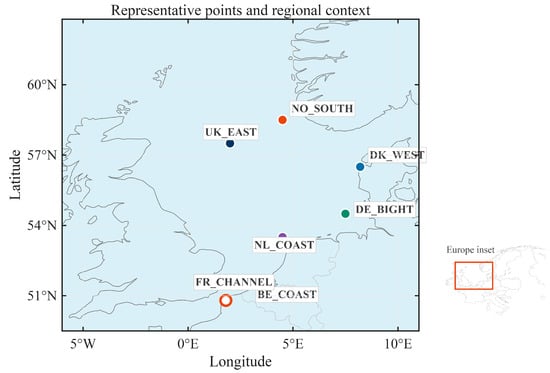
The revised empirical analysis focuses on the North Sea energy region and uses seven representative offshore or near-offshore screening points associated with the United Kingdom, Denmark, Germany, The Netherlands, Belgium, Norway and a France/Channel-connected comparison point. These locations are used for reproducible representative-point screening. They are not maritime boundary points, national offshore-zone averages or official offshore wind-zone centroids.
The France/Channel point is retained as a North Sea–Channel-connected comparison point. It is not treated as a core North Sea offshore-zone average. It provides a southern comparison point linked to the wider North Sea–Channel electricity and legal-energy system. The revised manuscript therefore avoids deriving a continuous North Sea wind-resource surface from seven points.
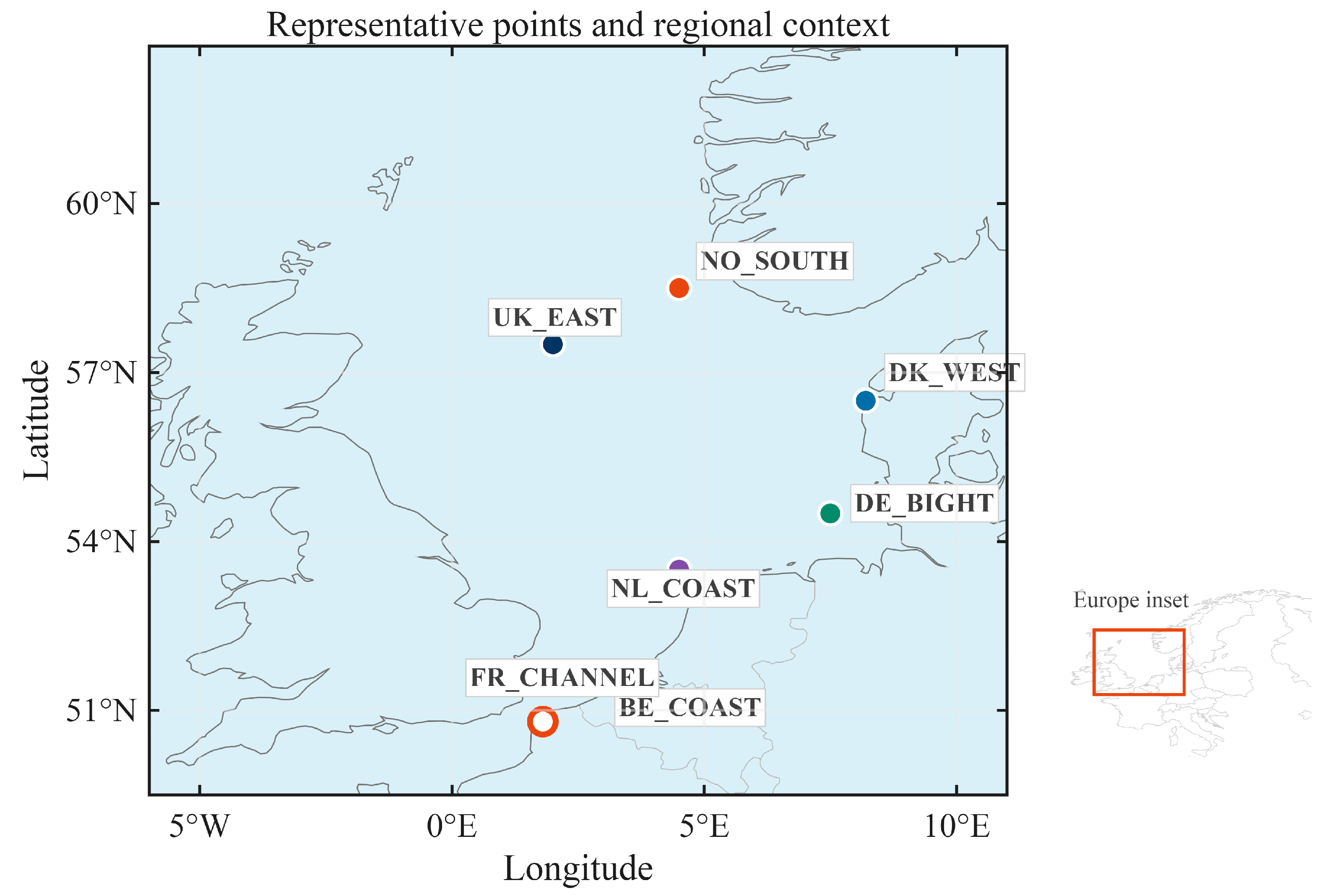
The point locations and regional context are shown in Figure 1, while the coordinates and selection rationale are reported in Table 1.
Figure 1.
Representative screening points and regional context in the North Sea and Channel-connected area.
Table 1.
Coordinates and selection rationale for representative screening points.
3.2. Data Sources and Temporal Coverage
The empirical dataset uses NASA POWER hourly point data from 1 January 2021 to 31 December 2025. The hourly series are treated in UTC. WS50M is used as the core wind-speed variable. WD50M, WS10M and RHOA are retained where available for interpretation and auxiliary calculations. Natural Earth geographic layers are used only for map context.
ERA5, the Global Wind Atlas and ENTSO-E data are identified as future validation or extension pathways. They are not used here to make additional numerical claims. Table 2 summarizes the data sources, variables and analytical functions used in the revised empirical analysis.
Table 2.
Data sources, variables and analytical functions used in the revised empirical analysis.
3.3. Hub-Height Correction and Wind-Resource Proxies
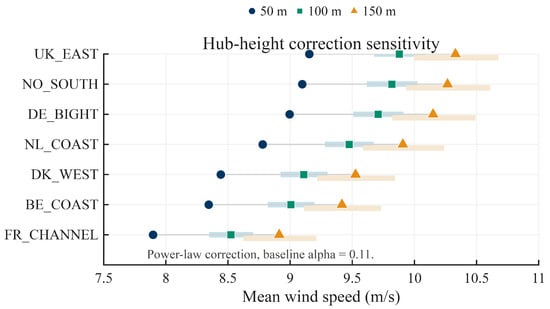
NASA POWER provides the core wind-speed variable at 50 m. Because modern offshore wind turbines often operate at hub heights above 100 m, the revised empirical design applies a power-law hub-height correction to 100 m and 150 m. The baseline shear exponent is , with and used for sensitivity analysis.
The revised analysis uses as a wind-power proxy and as a wind-power-density proxy. These quantities are resource-side screening indicators. They are not actual turbine-output, capacity-factor or grid-dispatch results.
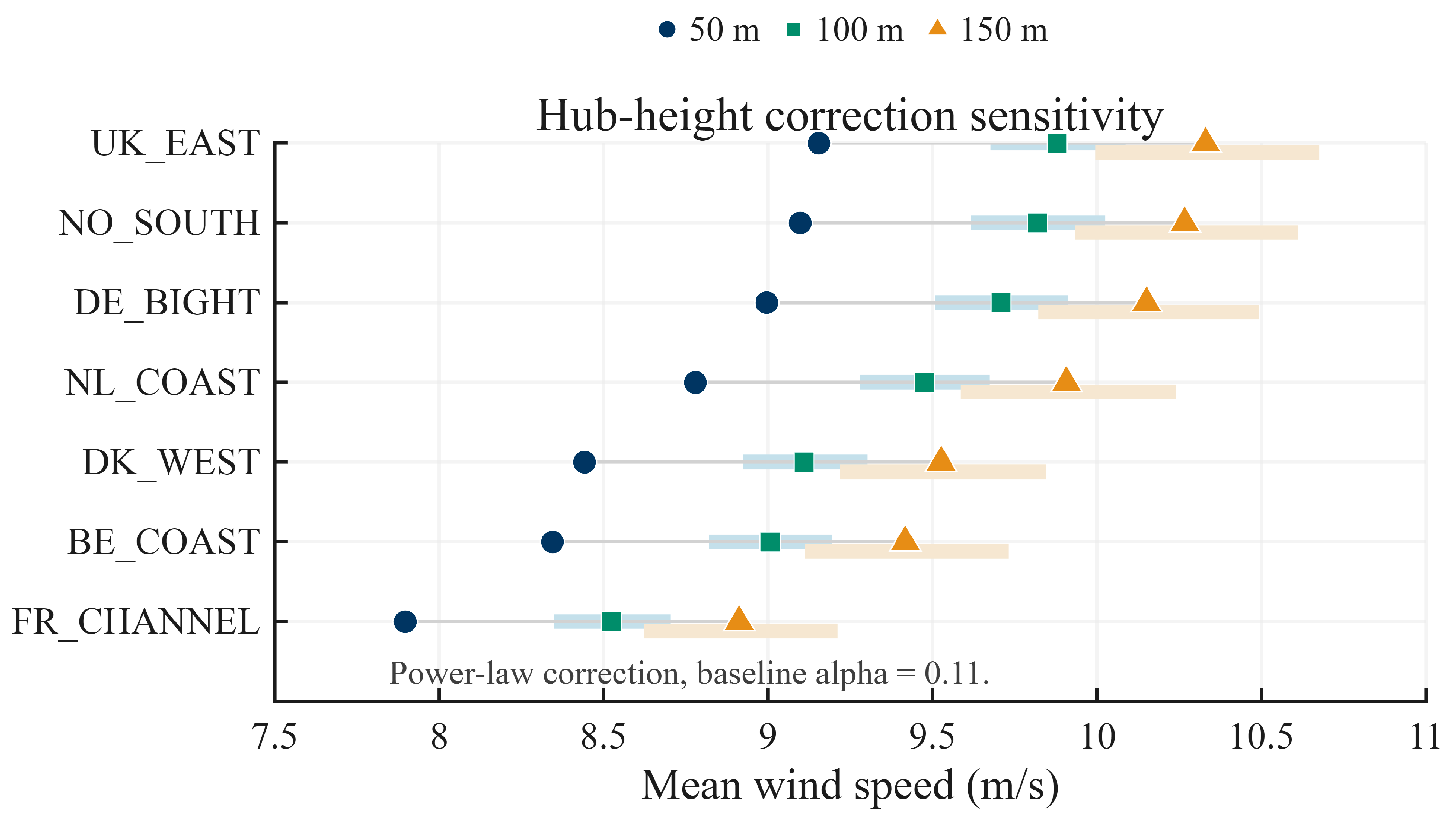
where RHOA is available, the corresponding air-density value is used for the WPD proxy. Otherwise, is used as a standard reference value. Figure 2 presents the hub-height correction and the robustness of wind-speed ranking across height assumptions.
Figure 2.
Hub-height correction sensitivity for mean wind speed at 50 m, 100 m and 150 m.
3.4. Definition and Calculation of Low-Wind Event Metrics
The original low-wind frequency screen is extended by adding event-duration metrics. The baseline low-wind threshold is 4 m/s. Thresholds of 3 m/s and 5 m/s are used for sensitivity. A low-wind event is defined as a consecutive hourly sequence below the selected threshold.
The reported indicators include low-wind frequency, number of low-wind events, mean event duration, median event duration, p95 duration and maximum event duration. These indicators identify resource-side exposure. They do not by themselves establish a system crisis or a legal duty to activate emergency coordination. Low-wind duration helps identify when resource-side variability may become relevant for adequacy planning and cross-border consultation.
3.5. Pairwise Correlation and CWCI Sensitivity
Pairwise correlation is calculated from the 100 m baseline-corrected wind-power proxy. The hourly site series are arranged as a time-by-site matrix and Pearson correlations are calculated for each pair. The Cross-Border Wind Complementarity Index, or CWCI, is used as a transparent within-sample screening indicator rather than an optimized planning metric.
The CWCI combines correlation complementarity, low-wind staggering and distance potential. Low-wind staggering measures the share of hours in which exactly one site in a pair is below the 4 m/s low-wind threshold. This definition distinguishes staggered low-wind exposure from simultaneous low-wind exposure. Distance potential is normalized using pairwise haversine distance. The fixed 900 km normalization is retained only as a sensitivity normalization where used in the sensitivity table.
In this expression, is correlation complementarity, is low-wind staggering and is distance potential. The weighting scenarios are Baseline (0.50, 0.30, 0.20), Equal (0.3333, 0.3333, 0.3334), Low-wind focused (0.30, 0.50, 0.20), Distance—light (0.50, 0.45, 0.05) and Distance—heavy (0.40, 0.30, 0.30). The correlation structure, baseline CWCI results and weighting sensitivity are reported in the empirical Section 4 The rank-sensitivity calculation also considers alternative distance normalization where available, so the reported top-five counts refer to sensitivity settings rather than only the five weighting schemes.
3.6. Functional Legal–Institutional Analysis
The legal analysis remains a functional doctrinal analysis, but it is now linked more explicitly to the empirical screening results. The empirical findings are translated into governance questions rather than direct legal obligations. Spatial dispersion points to data and planning standards. Temporal variability and low-wind event duration point to adequacy and coordination questions. Within-sample complementarity points to interconnection, market coordination and benefit allocation. Environmental pressure points to EIA, SEA and MSP, while infrastructure dependence points to investment and emergency governance.
This method is an exploratory evidence-to-law analysis. It does not treat the dataset as a legal trigger or as proof that a particular grid asset, market rule or crisis mechanism must be adopted.
4. Results
4.1. Five-Year Representative-Point Wind-Resource Screening
The five-year representative-point results suggest consistently wind-rich screening conditions across the sample, with a mean 100 m corrected wind speed of 9.36 m/s and a site-level range from 8.52 to 9.88 m/s. The highest 100 m mean wind speed in the sample is associated with UK_EAST, while the lowest is associated with FR_CHANNEL. These site-level results should be interpreted as screening evidence rather than national offshore-zone averages.
Table 3 reports the full five-year numerical screening results, including WS50M, baseline 100 m and 150 m corrected wind speed, the wind-power proxy, the wind-power-density proxy, monthly coefficient of variation and annual coefficient of variation.
Table 3.
Five-year representative-point wind-resource screening results.
4.2. Interannual Variability from 2021 to 2025
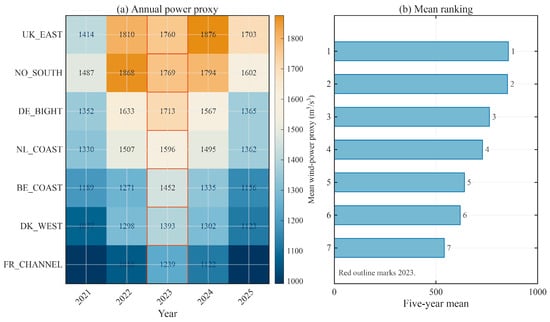
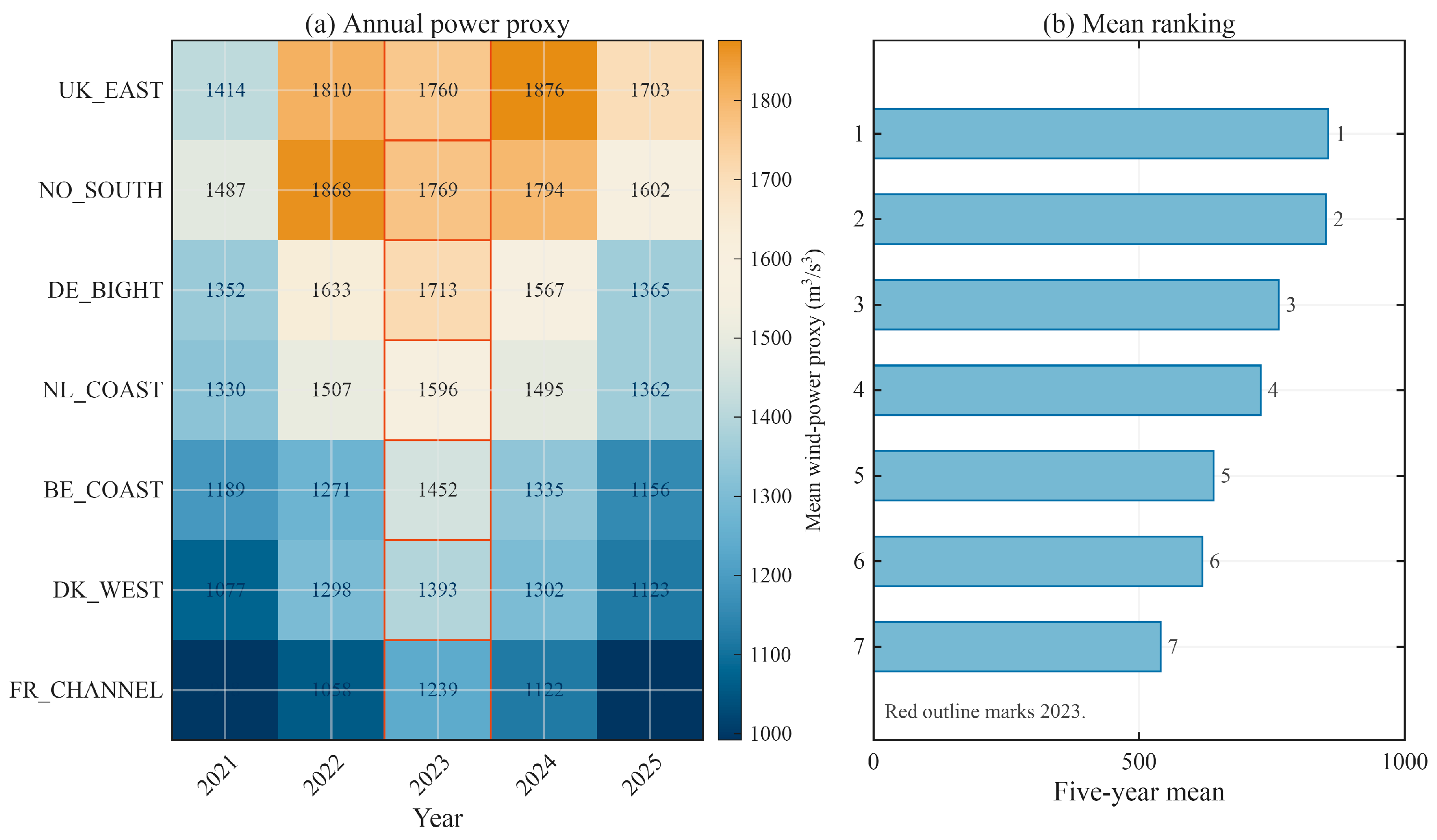
Figure 3 shows that the five-year dataset provides information that could not be captured by a single-year design. Across the representative points, the annual mean wind-power proxy varies across the five years, with the lowest sample-wide annual mean in 2021 and the highest in 2023. The orange boxes highlight the range of annual wind-power proxy values across the representative screening points. This confirms the need to treat a single year as an insufficient basis for general wind-resource inference.
Figure 3.
Interannual variability of the wind-power proxy across representative screening points from 2021 to 2025.
The revised results therefore use the five-year hourly dataset as the empirical basis and treat year-to-year variation as part of the screening evidence rather than as a secondary caveat.
4.3. Seasonal Variability and Low-Output Months
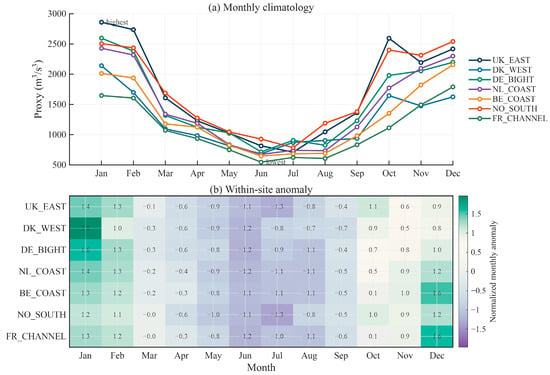
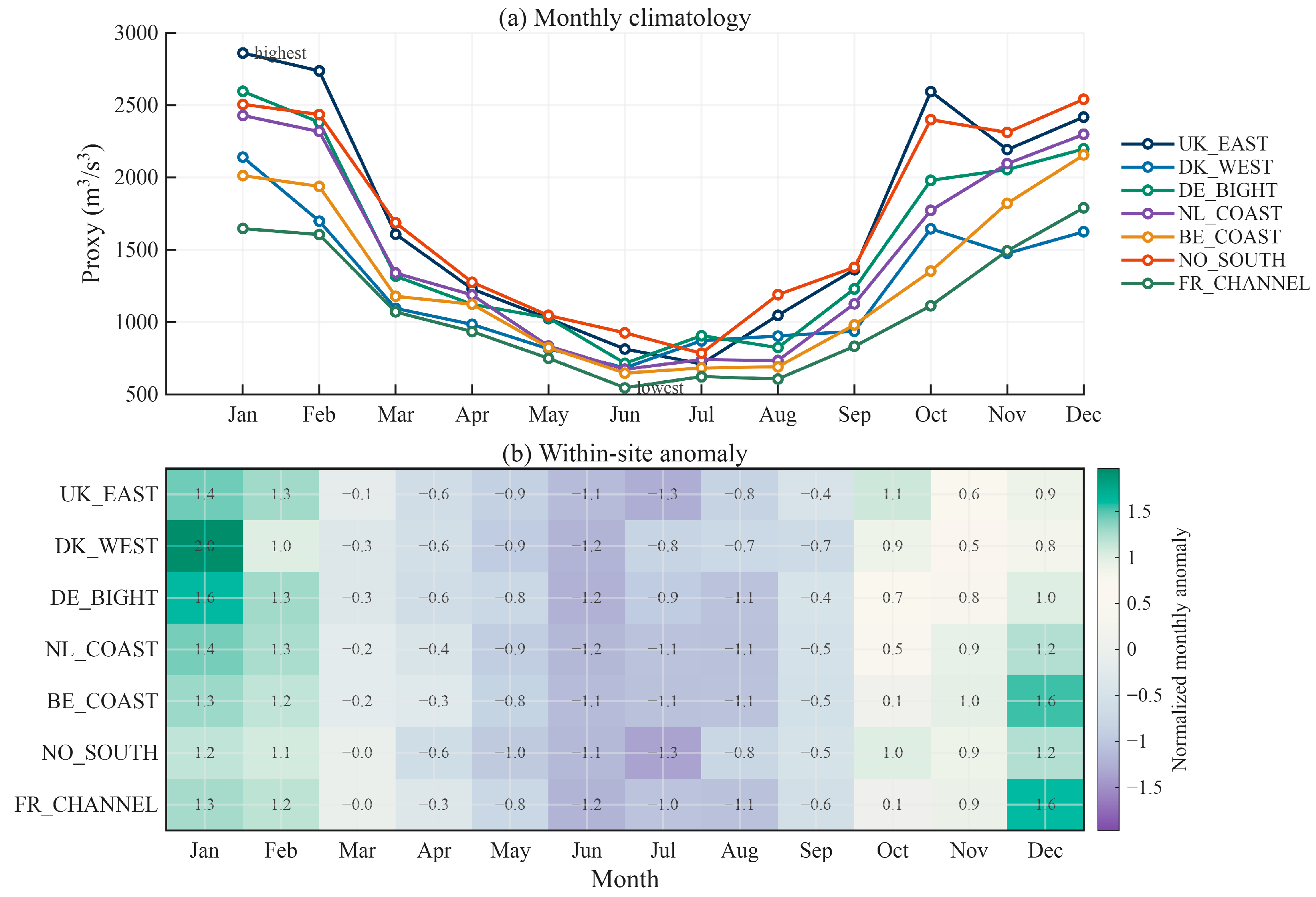
The five-year monthly aggregation in Figure 4 indicates seasonal concentration in the wind-power proxy. In the sample-wide monthly mean, January has the highest average wind-power proxy and June has the lowest. These patterns show why mean wind speed alone does not fully describe temporal concentration in a resource-side screening exercise.
Figure 4.
Seasonal variability and monthly anomalies of the wind-power proxy from the five-year hourly dataset.
The figure and the Monthly Variability sheet should be read as evidence of seasonal screening patterns, not as actual generation or market-output results.
4.4. Hub-Height Corrected Results
The hub-height correction increases the absolute wind-speed values relative to WS50M, as expected from the power-law transformation. The sensitivity results using alpha = 0.08, 0.11 and 0.14 show that the correction responds to the assumed shear exponent. Figure 4 reports the corrected 50 m, 100 m and 150 m comparison and the associated ranking robustness.
These results address the limitation of relying on 50 m data alone. They do not represent turbine-specific hub-height measurements or turbine-output modeling.
4.5. Low-Wind Frequency and Duration
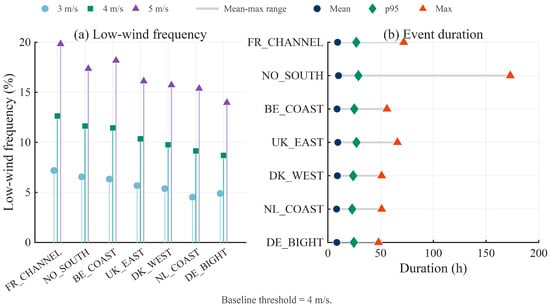
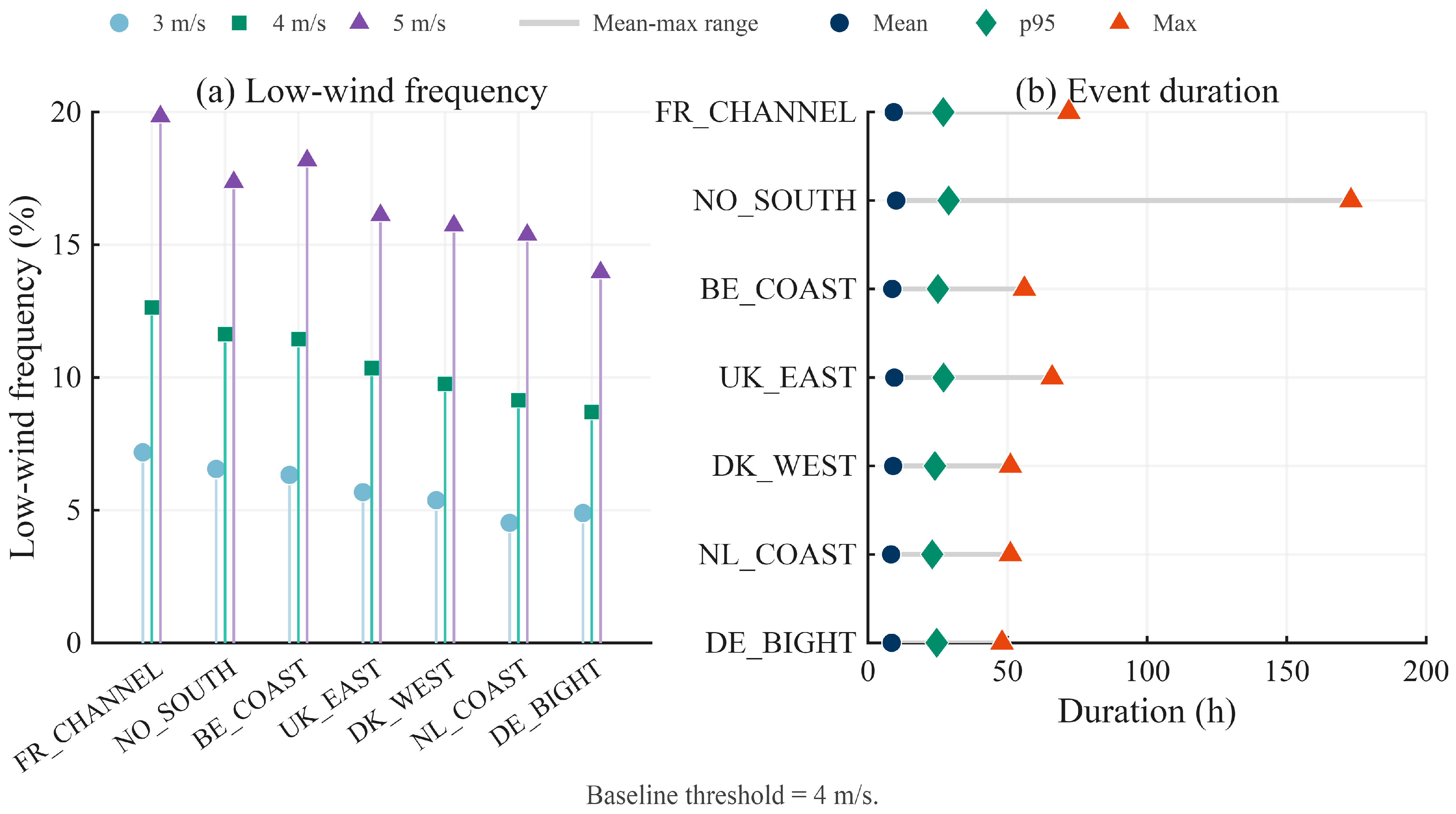
Figure 5 and Table 4 report low-wind frequency and event duration. Under the 4 m/s baseline threshold, low-wind frequency ranges from 8.69% to 12.64% across the representative points. The longest 4 m/s low-wind event in the Stage 1 table is 173.0 h at NO_SOUTH.
Figure 5.
Low-wind frequency and low-wind event duration under threshold sensitivity.
Table 4.
Low-wind frequency and event-duration indicators.
The 3 m/s and 5 m/s thresholds provide a sensitivity check. These metrics support resource-side risk identification, but they do not equal a complete energy-system crisis assessment. Low-wind duration helps identify when resource-side variability may become relevant for adequacy planning and cross-border consultation.
4.6. Pairwise Correlation and Baseline CWCI
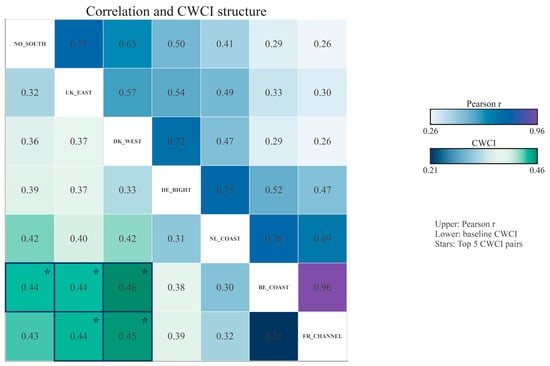
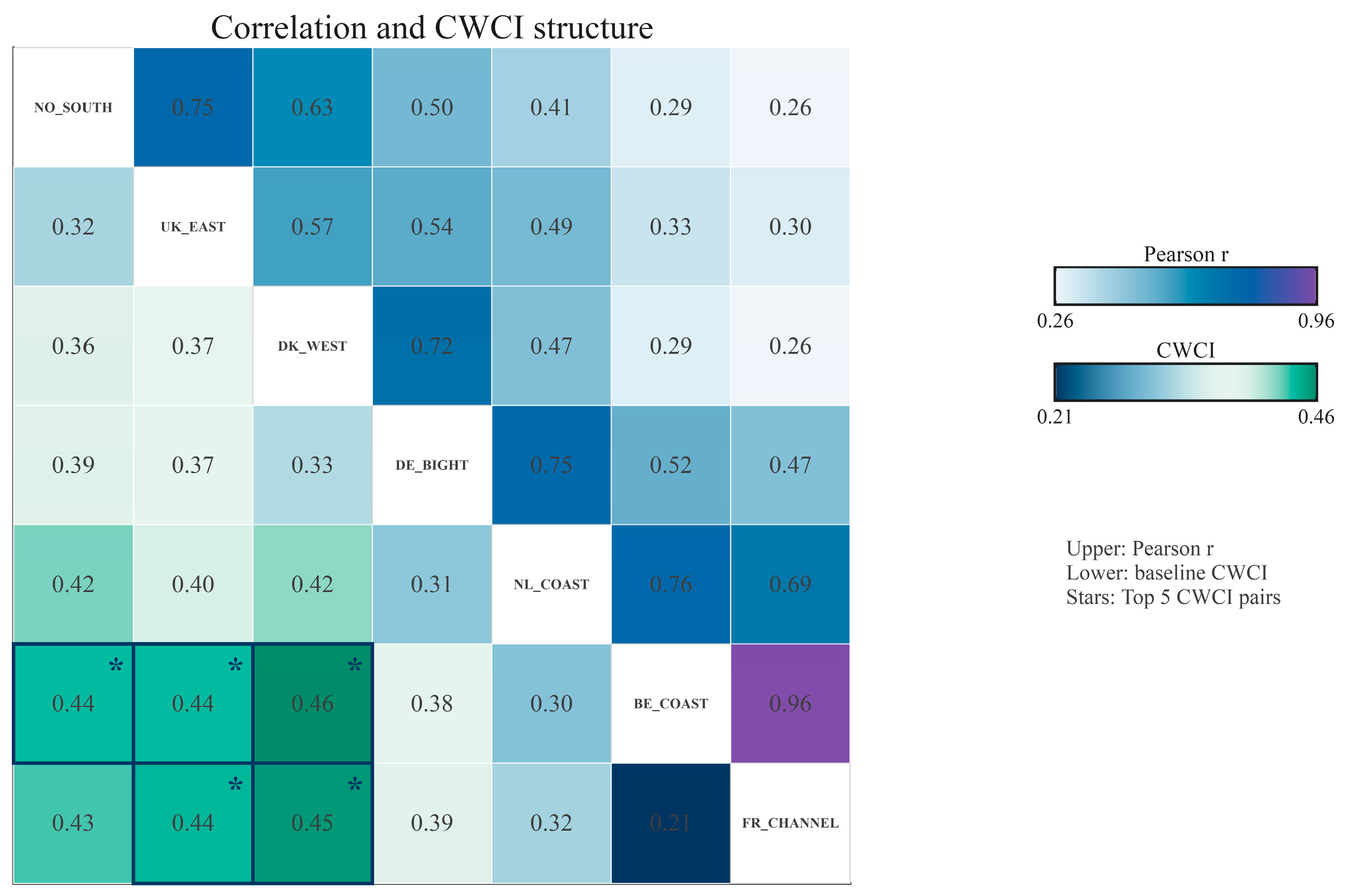
Figure 6 summarizes pairwise correlation and baseline CWCI structure. In Figure 6, the asterisk (*) marks the top five pairs under the baseline CWCI screening and does not indicate statistical significance. The lower pairwise correlations in the sample include DK_WEST–FR_CHANNEL (r = 0.258); FR_CHANNEL–NO_SOUTH (r = 0.259); BE_COAST–NO_SOUTH (r = 0.285). The higher pairwise correlations include BE_COAST–FR_CHANNEL (r = 0.963); BE_COAST–NL_COAST (r = 0.759); NO_SOUTH–UK_EAST (r = 0.755). Lower correlation can support within-sample complementarity interpretation, but it does not remove intermittency or prove a specific infrastructure need.
Figure 6.
Pairwise correlation and baseline CWCI structure among representative screening points.
In the baseline CWCI table, the leading within-sample pairs are DK_WEST–BE_COAST (CWCI = 0.460, rank 1); DK_WEST–FR_CHANNEL (CWCI = 0.454, rank 2); UK_EAST–FR_CHANNEL (CWCI = 0.440, rank 3). These values are relative indicators within the seven-point sample. They should not be interpreted as absolute engineering rankings or as proof that a particular interconnector should be built.
4.7. CWCI Weighting Sensitivity
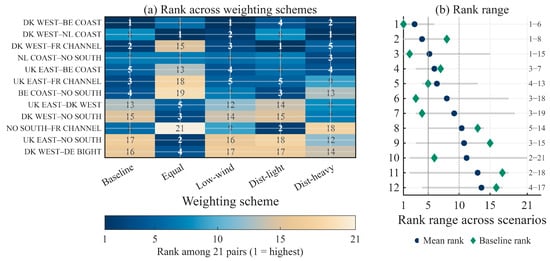
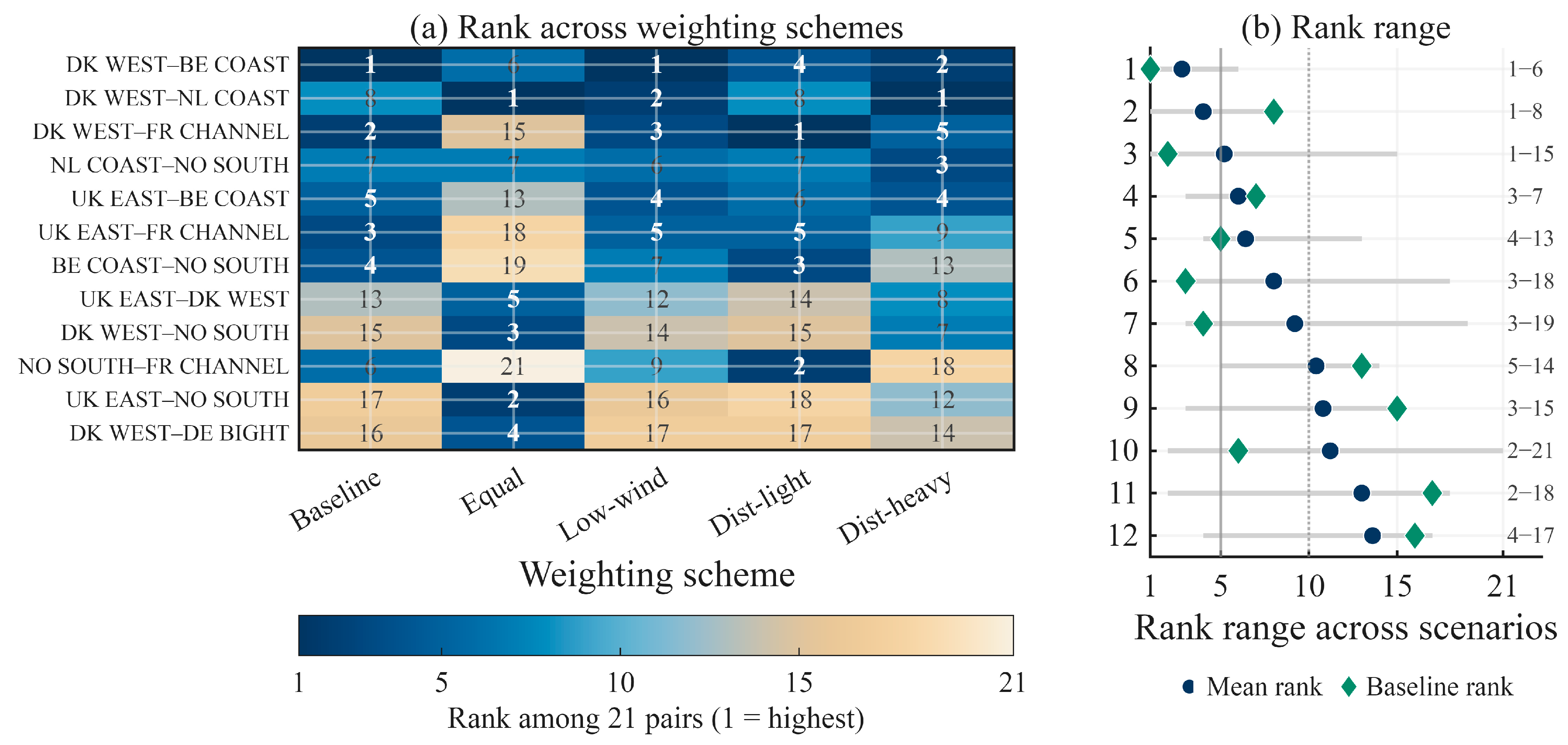
Figure 7 reports CWCI rank robustness under alternative weighting schemes. The rank matrix and rank-range panel show that several pairs remain near the top under multiple sensitivity settings, whereas others show wider rank ranges. The most consistently high-ranking pairs are summarized in Table 5. This pattern supports the use of CWCI as a screening indicator rather than an optimized metric.
Figure 7.
CWCI ranking robustness under alternative weighting schemes.
Table 5.
CWCI sensitivity summary across alternative weighting schemes.
All 21 pairs are ranked in the underlying sensitivity calculations. The displayed figure focuses on pairs entering the top ranks in at least one sensitivity setting or having a relatively strong average rank, while Table 5 summarizes the rank stability pattern.
4.8. Empirical Implications and Limits for Legal Analysis
The empirical results do not prove that any specific offshore grid asset should be built. They show why cross-border wind-resource evidence matters for legal questions of data compatibility, planning coordination, market rules, low-wind consultation, environmental assessment and dispute prevention.
The revised empirical analysis is an exploratory representative-point screening analysis. It is not a definitive gridded offshore wind-resource assessment, not a turbine-output model, not a capacity-factor model, and not a grid-dispatch model. These limits are important because the legal analysis in the following sections should use the empirical findings to identify governance questions rather than to derive definitive policy prescriptions.
5. Discussion
5.1. From Wind-Resource Evidence to Legal–Institutional Questions
The results in Section 4 should be read as representative-point screening evidence rather than as a direct mandate for particular grid assets, market rules or legal obligations. This article is an exploratory evidence-to-law screening analysis. It does not provide a definitive offshore wind-resource assessment, turbine-output model, capacity-factor estimate or grid-dispatch simulation. The empirical results help identify governance questions rather than determine legal obligations.
The fact–law translation problem is therefore central to the discussion. Spatial dispersion, interannual variability, seasonal fluctuation, low-wind event duration and CWCI sensitivity do not themselves answer legal questions. They show where legal and institutional arrangements may need shared assumptions, comparable data, coordinated planning, consultation triggers and dispute-prevention procedures. The representative-point results suggest within-sample patterns of variability and relative complementarity that are legally relevant only when interpreted through institutional functions.
This framing also limits the claims that can be drawn from the five-year screening period and seven representative locations. The findings indicate why resource-side variability matters for legal design, but they do not establish that any specific pair of states must build an interconnector, adopt a particular market design or accept a binding sharing obligation. Their contribution is to make the legal question more precise: how can cross-border governance make renewable variability usable without converting empirical indicators into automatic legal duties?
5.2. The Complementarity Governance Gap
The complementarity governance gap is not a claim that law is absent from offshore wind cooperation. The North Sea already contains overlapping regimes for electricity markets, infrastructure planning, environmental assessment, marine spatial planning, investment protection and emergency management. The NSEC, ENTSO-E, TEN-E, EU electricity rules, marine spatial planning, environmental impact assessment, OSPAR, UNCLOS, Espoo and Aarhus each provide foundations and boundaries for cooperation. The difficulty is that these instruments usually address separate functions rather than the full chain through which resource complementarity becomes operational.
Complementarity has no governance value unless legal and institutional arrangements can make it usable through shared data, compatible planning assumptions, capacity rules, environmental review, investment allocation and crisis consultation. For example, correlation and CWCI screening can help identify where coordination may be worth examining, but market rules, TSO agreements and regulatory decisions determine whether cross-border flexibility can actually be used. Similarly, low-wind event duration can inform preparedness discussions, but only emergency rules and consultation procedures determine how states should communicate before temporary measures affect neighboring systems.
The legal challenge is therefore connective. Existing mechanisms can manage many individual components, but they do not always provide a common institutional sequence from data, to planning, to permitting, to market operation, to crisis consultation. Section 6 responds to this gap by translating empirical categories into an operational five-pillar framework rather than a general call for cooperation.
5.3. Renewable Energy Security as Managed Interdependence
The renewable transition changes the meaning of energy security. Security is not only a matter of owning fuel or controlling domestic generation assets. For weather-dependent offshore wind, security also depends on forecasting, dispatch, interconnection, market rules, data transparency and crisis coordination. In this sense, renewable energy security is better understood as managed interdependence.
Low-wind duration and relative complementarity among representative points can indicate when regional coordination may be relevant, but they do not prove that a legal emergency exists. A prolonged low-wind event may be manageable under ordinary market conditions, or it may become more serious when combined with grid outages, cable failure, extreme weather, cyber incidents, demand peaks or market stress. Legal design should therefore treat resource-side indicators as early-warning inputs rather than as automatic triggers for emergency powers.
A regional framework should not deny national security-of-supply responsibilities. It should define how those responsibilities are coordinated when national measures affect cross-border electricity flows. This is where national energy-security interests and regional sharing can come into tension. The answer is not unconditional sharing, but a predictable process for information exchange, consultation, justification and ex post review when temporary measures are considered.
5.4. Implications for Legal Design
The empirical analysis points to several legal design functions. Spatial dispersion calls for data standards and planning compatibility. Hub-height assumptions require methodological transparency. Interannual and seasonal variability support adequacy planning and scenario disclosure. Low-wind duration can inform consultation triggers and early-warning indicators. Correlation and CWCI can be used as screening tools for grid and market coordination, without becoming optimization metrics. Environmental pressure requires cumulative assessment and marine spatial coordination. Investment dependence requires regulatory space and dispute prevention.
These links do not convert data into law. They identify the institutional tasks that legal instruments must perform if offshore wind complementarity is to support cross-border energy security. The next section therefore develops a modular governance framework that can be implemented through existing and incremental legal channels, including NSEC workstreams, EU regulatory instruments, national implementation, intergovernmental agreements, TSO agreements, regulator decisions, project permits, model clauses and soft-law guidance.
6. A Data-Driven International Legal Framework for Cross-Border Offshore Wind Cooperation
The five-pillar framework proposed here is not an abstract cooperation agenda. It is a response to the complementarity governance gap identified above. Nor does it require the creation of a new supranational energy agency. The NSEC is treated here as a soft-law coordination platform rather than as a body that can independently impose binding obligations. The proposal is a modular governance framework that can be implemented through NSEC workstreams, EU regulatory instruments, national implementation, intergovernmental agreements, TSO agreements, regulator decisions, project permits, model clauses and soft-law guidance.
Table 6 operationalizes the framework by linking each pillar to an existing legal or institutional basis, the governance gap it addresses, a proposed instrument, lead institutions, implementation steps and a compliance or enforcement pathway. The table is deliberately functional. It does not assert that empirical findings directly create legal obligations; instead, it shows how evidence can inform institutional design.
Table 6.
Operationalized five-pillar governance framework for cross-border offshore wind cooperation.
6.1. Pillar I: Joint Wind-Resource Data Sharing and Planning
The first pillar addresses the information base for cross-border cooperation. Existing sources such as NASA POWER, ERA5, Global Wind Atlas, ENTSO-E data, national datasets and NSEC data cooperation provide useful foundations. The governance gap lies in inconsistent temporal resolution, hub-height assumptions, low-wind event definitions, scenario disclosure and cross-border comparability. These differences can make planning assumptions difficult to compare even when states are examining the same sea basin.
A feasible response would be a North Sea Wind-Resource Data Protocol coordinated through the NSEC and implemented by national energy ministries, TSOs, regulators, meteorological agencies and ENTSO-E where relevant. The protocol could standardize metadata, disclose hub-height assumptions, define low-wind thresholds and duration metrics, publish comparable time-series formats and create an annual scenario review. Compliance would rely mainly on public reporting, peer review within the NSEC, data-audit checklists and links to project-permit data obligations where appropriate.
6.2. Pillar II: Offshore Grid Interconnection and Market Coordination
The second pillar concerns the rules that allow resource-side complementarity to become operational flexibility. EU electricity rules, TEN-E, ENTSO-E planning, national regulators and TSO agreements already provide a substantial basis. However, hybrid offshore assets create unresolved questions about asset classification, capacity allocation, congestion revenue, cost sharing, curtailment and balancing responsibilities. The empirical screening can indicate where coordination may be useful, but it does not determine which assets should be built.
A Regional Hybrid Offshore Asset Coordination Code, or a set of model regional guidelines, could clarify these issues before project-specific disputes arise. ACER, national regulatory authorities, TSOs, ENTSO-E and the NSEC as coordination platforms would each have distinct roles. Implementation could define asset classification, clarify capacity allocation under normal and stressed conditions, pre-agree congestion revenue use, coordinate cost–benefit allocation and align bidding-zone or market-coupling decisions. Compliance would depend on regulatory approval, TSO contractual obligations, ACER or national regulator review and periodic reporting.
6.3. Pillar III: Transboundary Environmental Assessment and Marine Spatial Coordination
The third pillar recognizes that environmental governance is a condition for sustainable deployment rather than an obstacle to it. UNCLOS environmental duties, Espoo, the SEA Protocol, Aarhus, EU EIA rules, the MSP Directive and OSPAR already support transboundary environmental cooperation. The governance gap is that project-level EIA may not adequately address cumulative effects, cross-border ecological pressure or conflicts among wind farms, fisheries, shipping, conservation and other sea uses.
A North Sea Cumulative Impact and MSP Coordination Protocol could connect environmental assessment with regional energy planning. National environmental authorities, marine spatial planning bodies, OSPAR and NSEC environmental workstreams where relevant could coordinate joint baseline data, cumulative-impact screening, early public participation, alignment between SEA, MSP and project EIA, and a cross-border consultation calendar. The compliance pathway would include reasoned responses to consultation, public participation records, independent scientific review and permit conditions.
6.4. Pillar IV: Investment Protection with Climate and Energy-Security Regulatory Space
The fourth pillar addresses the investment dimension of offshore wind cooperation without placing investment protection above public interests. Investment treaties, the Energy Charter Treaty context if retained, project contracts and EU investment or state-aid rules where relevant can support project stability. At the same time, climate policy, environmental protection, grid regulation and energy-security measures may require regulatory adaptation over a project’s lifetime.
Model Offshore Wind Investment and Regulatory-Space Clauses could reduce uncertainty by clarifying foreseeable regulatory change, climate and environmental exceptions, consultation before major regulatory changes, and the distinction between compensable commitments and legitimate non-discriminatory regulation. States, regulators, contracting authorities, investors and project companies would be the main actors. A compliance pathway could combine contractual review, consultation procedures, cooling-off periods, technical expert panels and mediation before arbitration.
6.5. Pillar V: Energy-Security Crisis Coordination and Dispute Prevention
The fifth pillar concerns situations in which ordinary coordination may be insufficient. EU electricity emergency and market rules where applicable, TSO operating protocols, national emergency powers and regional coordination practice provide relevant foundations. The governance gap is that cross-border coordination and temporary restriction rules may be unclear when prolonged low-wind conditions coincide with extreme weather, cable failure, cyber incidents or market stress.
A North Sea Renewable-Electricity Crisis Consultation Mechanism could define early-warning indicators, establish consultation triggers, require prior or immediate notification, activate a technical panel and record reasons for temporary measures. Low-wind duration can be one input for consultation triggers, not a standalone legal emergency. Compliance would rely on ex post review, public or regulator reporting, technical fact-finding and a dispute-prevention panel.
6.6. Managing National Energy-Security Interests and Regional Sharing
Cross-border cooperation cannot require states to sacrifice domestic security of supply unconditionally. It also cannot allow arbitrary closure of cross-border flows or unexplained departure from regional rules. A workable framework should distinguish normal, stressed and emergency conditions, with safeguards that become stricter as measures become more disruptive.
Under normal conditions, the default should be market-based capacity allocation, transparent data sharing, ordinary dispatch and market coupling, and regular planning coordination. Under stressed conditions, the framework should require heightened data reporting, early consultation, TSO coordination, discussion of temporary adjustments and a proportionality assessment before restrictions. Under emergency conditions, temporary derogations may be allowed, but only under necessity, proportionality, non-discrimination, time limitation, prior or immediate notification, reason-giving and ex post review.
This mechanism does not deny sovereignty or domestic energy-security responsibilities. It provides predictability and dispute prevention under interdependence. It also helps avoid two opposite risks: treating regional sharing as unconditional, and treating national emergency discretion as entirely insulated from cross-border consequences.
6.7. Implementation Pathways
Implementation can proceed in stages. In the short term, the NSEC could coordinate soft-law guidance, a shared data protocol, model clauses and a pilot consultation mechanism. In the medium term, the framework could be embedded in TSO agreements, regulatory decisions, project-permit conditions and regional cost–benefit methodology. In the long term, selected elements could be formalized through EU regulatory amendments, intergovernmental agreements or a regional crisis mechanism.
The NSEC can coordinate, convene and standardize soft-law templates, but binding implementation would require other legal channels. Those channels include EU law, national implementation, regulatory decisions, TSO agreements, project permits, intergovernmental agreements and contractual clauses. This division of roles is important because it makes the framework operational without overstating the NSEC’s legal authority.
7. Conclusions
This article examined how representative wind-resource evidence can inform legal and institutional design for cross-border offshore wind cooperation in the North Sea. It combined a five-year representative-point wind-resource screening analysis with functional legal–institutional analysis to study how complementarity can become a governance question rather than a purely meteorological observation.
The empirical findings are deliberately framed as representative-point screening results, not national-zone averages or a continuous North Sea wind-resource distribution. The analysis suggests a mean 100 m corrected wind-speed range of 8.52 to 9.88 m/s, 4 m/s low-wind frequencies of 8.69% to 12.64%, and a maximum 4 m/s low-wind event duration of 173.0 h at NO_SOUTH. The CWCI provides a within-sample screening indicator of relative complementarity and weighting sensitivity rather than an optimization metric.
The theoretical contribution is to connect wind-resource complementarity with the fact–law translation problem, the complementarity governance gap and managed interdependence. Resource-side variation can matter for law only when institutions translate it into compatible data practices, planning assumptions, market rules, environmental assessment, investment arrangements and crisis consultation procedures.
The legal contribution is an operational five-pillar framework covering joint wind-resource data sharing and planning, offshore grid interconnection and market coordination, transboundary environmental assessment and marine spatial coordination, investment protection with regulatory space, and energy-security crisis coordination and dispute prevention. Table 6 links each pillar to an existing basis, governance gap, proposed instrument, lead institutions, implementation steps and compliance pathway.
The NSEC can be useful as a soft-law coordination platform, but binding implementation would require EU law, national implementation, regulatory decisions, TSO agreements, project permits, intergovernmental agreements or contractual clauses. The proposed normal, stressed and emergency coordination mechanism can help manage the tension between national energy-security responsibilities and regional sharing expectations without treating either as absolute.
This study should be read as an exploratory evidence-to-law screening analysis rather than a definitive offshore wind-resource assessment, turbine-output model, capacity-factor estimate or grid-dispatch simulation. Future research should use gridded ERA5 data, official offshore wind-zone boundaries, turbine power curves, ENTSO-E load and cross-border flow data, and electricity-market simulations. Legal research should test the framework against specific EU implementing rules, intergovernmental agreements, project permits and contractual clauses.
Author Contributions
R.G.: Conceptualization, writing—original draft preparation, writing—review and editing, formal analysis, investigation, visualization; H.Y.: visualization, conceptualization, data curation, resources, writing—review and editing; J.L.: conceptualization, software, methodology. All authors have read and agreed to the published version of the manuscript.
Funding
This research received no external funding.
Institutional Review Board Statement
Not Applicable.
Informed Consent Statement
Not Applicable.
Data Availability Statement
The data presented in this study are available on request from the corresponding author.
Acknowledgments
The authors gratefully acknowledge NASA POWER and Natural Earth for providing open-access data resources used in this study.
Conflicts of Interest
The authors declare no conflicts of interest.
References
- Hersbach, H.; Bell, B.; Berrisford, P.; Hirahara, S.; Horányi, A.; Muñoz-Sabater, J.; Nicolas, J.; Peubey, C.; Radu, R.; Schepers, D.; et al. The ERA5 global reanalysis. Q. J. R. Meteorol. Soc. 2020, 146, 1999–2049. [Google Scholar] [CrossRef] [Scilit]
- Staffell, I.; Pfenninger, S. Using bias-corrected reanalysis to simulate current and future wind power output. Energy 2016, 114, 1224–1239. [Google Scholar] [CrossRef] [Scilit]
- Olauson, J. ERA5: The new champion of wind power modelling? Renew. Energy 2018, 126, 322–331. [Google Scholar] [CrossRef] [Scilit]
- Davis, N.N.; Badger, J.; Hahmann, A.N.; Hansen, B.O.; Mortensen, N.G.; Kelly, M.; Larsén, X.G.; Olsen, B.T.; Floors, R.; Lizcano, G.; et al. The Global Wind Atlas: A high-resolution dataset of climatologies and associated web-based application. Bull. Am. Meteorol. Soc. 2023, 104, E1507–E1525. [Google Scholar] [CrossRef] [Scilit]
- Archer, C.L.; Jacobson, M.Z. Evaluation of global wind power. J. Geophys. Res. Atmos. 2005, 110, D12110. [Google Scholar] [CrossRef] [Scilit]
- Pryor, S.C.; Barthelmie, R.J. Climate change impacts on wind energy: A review. Renew. Sustain. Energy Rev. 2010, 14, 430–437. [Google Scholar] [CrossRef] [Scilit]
- Sovacool, B.K.; Mukherjee, I. Conceptualizing and measuring energy security: A synthesized approach. Energy 2011, 36, 5343–5355. [Google Scholar] [CrossRef] [Scilit]
- Kruyt, B.; van Vuuren, D.P.; de Vries, H.J.M.; Groenenberg, H. Indicators for energy security. Energy Policy 2009, 37, 2166–2181. [Google Scholar] [CrossRef] [Scilit]
- Winzer, C. Conceptualizing energy security. Energy Policy 2012, 46, 36–48. [Google Scholar] [CrossRef] [Scilit]
- Ang, B.W.; Choong, W.L.; Ng, T.S. Energy security: Definitions, dimensions and indexes. Renew. Sustain. Energy Rev. 2015, 42, 1077–1093. [Google Scholar] [CrossRef] [Scilit]
- Cherp, A.; Jewell, J. The concept of energy security: Beyond the four As. Energy Policy 2014, 75, 415–421. [Google Scholar] [CrossRef] [Scilit]
- Overland, I. The geopolitics of renewable energy: Debunking four emerging myths. Energy Res. Soc. Sci. 2019, 49, 36–40. [Google Scholar] [CrossRef] [Scilit]
- Scholten, D.; Bosman, R. The geopolitics of renewables: Exploring the political implications of renewable energy systems. Technol. Forecast. Soc. Change 2016, 103, 273–283. [Google Scholar] [CrossRef] [Scilit]
- Schlachtberger, D.P.; Brown, T.; Schramm, S.; Greiner, M. The benefits of cooperation in a highly renewable European electricity network. Energy 2017, 134, 469–481. [Google Scholar] [CrossRef] [Scilit]
- Brown, T.; Schlachtberger, D.; Kies, A.; Schramm, S.; Greiner, M. Synergies of sector coupling and transmission reinforcement in a cost-optimised, highly renewable European energy system. Energy 2018, 160, 720–739. [Google Scholar] [CrossRef] [Scilit]
- Zappa, W.; Junginger, M.; van den Broek, M. Is a 100% renewable European power system feasible by 2050? Appl. Energy 2019, 233–234, 1027–1050. [Google Scholar] [CrossRef] [Scilit]
- Ihlemann, M.; van Stiphout, A.; Poncelet, K.; Delarue, E. Benefits of regional coordination of balancing capacity markets in future European electricity markets. Appl. Energy 2022, 314, 118874. [Google Scholar] [CrossRef] [Scilit]
- Koivisto, M.; Gea-Bermúdez, J.; Sørensen, P. North Sea offshore grid development: Combined optimisation of grid and generation investments towards 2050. IET Renew. Power Gener. 2020, 14, 1259–1267. [Google Scholar] [CrossRef] [Scilit]
- Meeus, L. Offshore grids for renewables: Do we need a particular regulatory framework? SSRN Electron. J. 2014. [Google Scholar] [CrossRef] [Scilit]
- Qiu, W.; Jones, P.J.S. The emerging policy landscape for marine spatial planning in Europe. Mar. Policy 2013, 39, 182–190. [Google Scholar] [CrossRef] [Scilit]
- Jay, S. Planners to the rescue: Spatial planning facilitating the development of offshore wind energy. Mar. Pollut. Bull. 2010, 60, 493–499. [Google Scholar] [CrossRef] [Scilit] [PubMed]
- Stelzenmüller, V.; Breen, P.; Stamford, T.; Thomsen, F.; Badalamenti, F.; Borja, Á.; Buhl-Mortensen, L.; Carlstöm, J.; D’aNna, G.; Dankers, N.; et al. Monitoring and evaluation of spatially managed areas: A generic framework for implementation of ecosystem-based marine management and its application. Mar. Policy 2013, 37, 149–164. [Google Scholar] [CrossRef] [Scilit]
- Snyder, B.; Kaiser, M.J. Ecological and economic cost-benefit analysis of offshore wind energy. Renew. Energy 2009, 34, 1567–1578. [Google Scholar] [CrossRef] [Scilit]
- Inger, R.; Attrill, M.J.; Bearhop, S.; Broderick, A.C.; Grecian, W.J.; Hodgson, D.J.; Mills, C.; Sheehan, E.; Votier, S.C.; Witt, M.J.; et al. Marine renewable energy: Potential benefits to biodiversity? An urgent call for research. J. Appl. Ecol. 2009, 46, 1145–1153. [Google Scholar] [CrossRef] [Scilit]
- Masden, E.A.; Fox, A.D.; Furness, R.W.; Bullman, R.; Haydon, D.T. Cumulative impact assessments and bird/wind farm interactions: Developing a conceptual framework. Environ. Impact Assess. Rev. 2010, 30, 1–7. [Google Scholar] [CrossRef] [Scilit]
- Heffron, R.J.; Talus, K. The development of energy law in the 21st century: A paradigm shift? J. World Energy Law Bus. 2016, 9, 189–202. [Google Scholar] [CrossRef] [Scilit]
- Jenkins, K.; McCauley, D.; Heffron, R.; Stephan, H.; Rehner, R. Energy justice: A conceptual review. Energy Res. Soc. Sci. 2016, 11, 174–182. [Google Scholar] [CrossRef] [Scilit]
- Sovacool, B.K.; Dworkin, M.H. Energy justice: Conceptual insights and practical applications. Appl. Energy 2015, 142, 435–444. [Google Scholar] [CrossRef] [Scilit]
- Tienhaara, K. Regulatory chill in a warming world: The threat to climate policy posed by investor-state dispute settlement. Transnatl. Environ. Law 2018, 7, 229–250. [Google Scholar] [CrossRef] [Scilit]
- Ritchie, H. Ocean zoning: Making marine management more effective. J. Environ. Policy Plan. 2011, 13, 317–319. [Google Scholar] [CrossRef] [Scilit]
- European Commission. North Seas Energy Cooperation. Available online: https://energy.ec.europa.eu/topics/infrastructure/high-level-groups/north-seas-energy-cooperation_en (accessed on 29 June 2026).
- European Commission. Offshore Renewable Energy. Available online: https://energy.ec.europa.eu/topics/renewable-energy/offshore-renewable-energy_en (accessed on 29 June 2026).
- European Commission. An EU Strategy to Harness the Potential of Offshore Renewable Energy for a Climate Neutral Future. Available online: https://eur-lex.europa.eu/legal-content/EN/TXT/?uri=COM:2020:741:FIN (accessed on 29 June 2026).
- European Union. Regulation (EU) 2022/869 on Guidelines for Trans-European Energy Infrastructure. Available online: https://eur-lex.europa.eu/eli/reg/2022/869/oj (accessed on 29 June 2026).
- European Union. Directive 2014/89/EU Establishing a Framework for Maritime Spatial Planning. Available online: https://eur-lex.europa.eu/eli/dir/2014/89/oj (accessed on 29 June 2026).
- European Union. Directive 2011/92/EU on Environmental Impact Assessment. Available online: https://eur-lex.europa.eu/eli/dir/2011/92/oj (accessed on 29 June 2026).
- European Union. Directive 2014/52/EU Amending the EIA Directive. Available online: https://eur-lex.europa.eu/eli/dir/2014/52/oj (accessed on 29 June 2026).
- European Union. Regulation (EU) 2019/943 on the Internal Market for Electricity. Available online: https://eur-lex.europa.eu/eli/reg/2019/943/oj (accessed on 29 June 2026).
- European Union. Directive (EU) 2019/944 on Common Rules for the Internal Market for Electricity. Available online: https://eur-lex.europa.eu/eli/dir/2019/944/oj (accessed on 29 June 2026).
- European Union. Regulation (EU) 2018/1999 on the Governance of the Energy Union and Climate Action. Available online: https://eur-lex.europa.eu/eli/reg/2018/1999/oj (accessed on 29 June 2026).
- United Nations. United Nations Convention on the Law of the Sea. Available online: https://www.un.org/depts/los/convention_agreements/convention_overview_convention.htm (accessed on 29 June 2026).
- OSPAR Commission. Offshore Renewables. Available online: https://www.ospar.org/work-areas/eiha/offshore-renewables (accessed on 29 June 2026).
- Grams, C.M.; Beerli, R.; Pfenninger, S.; Staffell, I.; Wernli, H. Balancing Europe’s wind-power output through spatial deployment informed by weather regimes. Nat. Clim. Change 2017, 7, 557–562. [Google Scholar] [CrossRef] [Scilit] [PubMed]
- Cannon, D.J.; Brayshaw, D.J.; Methven, J.; Coker, P.J.; Lenaghan, D. Using reanalysis data to quantify extreme wind power generation statistics: A 33 year case study in Great Britain. Renew. Energy 2015, 75, 767–778. [Google Scholar] [CrossRef] [Scilit]
- Bloomfield, H.C.; Brayshaw, D.J.; Shaffrey, L.C.; Coker, P.J.; Thornton, H.E. Quantifying the increasing sensitivity of power systems to climate variability. Environ. Res. Lett. 2016, 11, 124025. [Google Scholar] [CrossRef] [Scilit]
- Foley, A.M.; Leahy, P.G.; Marvuglia, A.; McKeogh, E.J. Current methods and advances in forecasting of wind power generation. Renew. Energy 2012, 37, 1–8. [Google Scholar] [CrossRef] [Scilit]
- Lund, H.; Østergaard, P.A.; Connolly, D.; Mathiesen, B.V. Smart energy and smart energy systems. Energy 2017, 137, 556–565. [Google Scholar] [CrossRef] [Scilit]
- Pfenninger, S.; Hawkes, A.; Keirstead, J. Energy systems modeling for twenty-first century energy challenges. Renew. Sustain. Energy Rev. 2014, 33, 74–86. [Google Scholar] [CrossRef] [Scilit]
- Newbery, D.; Strbac, G.; Viehoff, I. The benefits of integrating European electricity markets. Energy Policy 2016, 94, 253–263. [Google Scholar] [CrossRef] [Scilit]
- Nieuwenhout, C.T. Dividing the sea into small bidding zones? The legal challenges of connecting offshore wind farms to multiple countries. J. Energy Nat. Resour. Law 2022, 40, 315–335. [Google Scholar] [CrossRef] [Scilit]
- Jansen, M.; Duffy, C.; Green, T.C.; Staffell, I. Island in the sea: The prospects and impacts of an offshore wind power hub in the North Sea. Adv. Appl. Energy 2022, 6, 100090. [Google Scholar] [CrossRef] [Scilit]
- Wiegner, J.F.; Andreasson, L.M.; Kusters, J.E.H.; Nienhuis, R.M. Interdisciplinary perspectives on offshore energy system integration in the North Sea: A systematic literature review. Renew. Sustain. Energy Rev. 2024, 189, 113970. [Google Scholar] [CrossRef] [Scilit]

Disclaimer/Publisher’s Note: The statements, opinions and data contained in all publications are solely those of the individual author(s) and contributor(s) and not of MDPI and/or the editor(s). MDPI and/or the editor(s) disclaim responsibility for any injury to people or property resulting from any ideas, methods, instructions or products referred to in the content. |
© 2026 by the authors. Licensee MDPI, Basel, Switzerland. This article is an open access article distributed under the terms and conditions of the Creative Commons Attribution (CC BY) license.