1. Introduction
In recent years, urban streets have increasingly been understood not only as mobility corridors but also as everyday public spaces that support social interaction, local consumption, mental health, and inclusive public life [
1,
2]. This shift has been reinforced by post-pandemic street experiments and tactical urbanism practices, in which temporary and small-scale interventions have been used to test alternative uses of street space and support longer-term urban transformation [
3]. Within this context, streateries have become a prominent form of street-based spatial adaptation. In this study, streateries refer to outdoor commercial operating spaces formed by the extension of dining, café, retail, and other commercial activities toward street edges, pedestrian spaces, or semi-public building frontages. Through tables, chairs, plants, shading devices, lighting, fences, planter boxes, and other interface elements, streateries create transitional spaces between private business operations and public streets.
Streateries can activate street edges, enrich visual experience, increase opportunities for dwelling, and contribute to vibrant urban public life [
4,
5,
6,
7,
8]. However, they also introduce spatial and ethical tension. Because they occupy or reorganize pedestrian spaces that were originally open to the public, streateries may generate concerns about commercial occupation, reduced openness, limited shareability, and the implicit exclusion of non-consumers [
7,
9,
10]. Existing studies on outdoor dining and curbside cafés have shown that the reallocation of curbside or sidewalk space for commercial dining raises questions about public access, street management, and the balance between commercial use and the public value of street space [
11]. Therefore, streateries should not be understood merely as commercial facilities or streetscape beautification devices. Rather, they are micro-scale interfaces through which the relationship between public space and commercial space is negotiated.
Current streatery governance and design evaluation often focus on physical and managerial indicators, such as occupied area, pedestrian clearance, facility height, setback distance, operating time, sanitation, and operational order [
9,
11,
12,
13,
14,
15,
16]. In recent years, streatery governance in southern and eastern coastal Chinese cities has shifted from strict prohibition or informal tolerance toward conditional permission and standardized management. At the provincial level, consumption-stimulus policies in Zhejiang have encouraged large commercial enterprises to use their own sites for outdoor promotion and supported eligible street-front shops in conducting outdoor operations [
13]. At the municipal and local levels, cities such as Xiamen and Shenzhen have further incorporated outdoor commercial activities into consumption-space provision, designated operating areas, and street-level management [
14,
16]. More detailed local rules, such as the implementation rules for outdoor operations in Pinghu, specify external operation types, application procedures, operating time, operating areas, facility appearance, pedestrian circulation, fire safety, sanitation, and negative lists for prohibited occupation [
15]. These policy practices show that streatery governance has gradually moved toward a model of conditional openness and orderly management. However, existing policy tools still mainly focus on physical and managerial control, such as where streateries may be placed, how long they may operate, whether they obstruct pedestrian movement, and whether they meet safety, environmental, and filing requirements. They cannot fully explain why streatery interfaces with similar spatial occupation may produce different levels of public acceptance and psychological experience. Less attention has been paid to how different streatery interface forms shape pedestrians’ perceived spatial publicness, visual shareability, non-consumer experience, and emotional restoration. This gap provides the practical basis for examining streatery interface design from a public-experience-oriented perspective.
To address this issue, this study introduces perceived spatial publicness as a key explanatory concept. Perceived spatial publicness is not equivalent to legal ownership or a simple public–private binary. Rather, it refers to pedestrians’ subjective evaluation of whether a space appears open, shareable, non-exclusive, and respectful of their right to use and experience the street. Public space research has long emphasized that publicness is a multidimensional and continuous quality shaped by accessibility, openness, management control, inclusive use, and opportunities for social interaction [
17,
18,
19,
20,
21]. Studies on quasi-public and semi-public spaces further suggest that commercialized spaces are not necessarily devoid of publicness; their public value depends on the extent to which different users can access, perceive, and share their environmental and social benefits [
10,
19,
22].
In the context of streateries, interface elements such as fences, planter boxes, hedges, parasols, platforms, and seating layouts not only organize commercial operations but also convey social and territorial cues. Hard, continuous, and low-permeability boundaries may convey strong territorial control signals and increase pedestrians’ perception of exclusion or privatization [
17]. By contrast, low, permeable, and landscaped boundaries may function not only as spatial separators but also as visual and environmental buffers. Such elements can soften the visual impact of commercial occupation, maintain a certain degree of transparency, and improve the perceived integration between streatery spaces and the public street environment [
23,
24]. Therefore, streatery interface design should be understood not simply as a matter of physical enclosure, but as a socio-spatial medium that shapes pedestrians’ judgments of openness, shareability, and non-exclusivity.
In addition to publicness, streateries may also influence emotional restoration. Restorative Environment Theory suggests that environments with visual attraction, psychological distance, compatibility, and spatial coherence can support attentional recovery, emotional relaxation, and psychological restoration [
25]. Although restorative environment research has traditionally focused on natural environments, parks, and green spaces, recent studies have increasingly examined restorative experiences in urban built settings, streets, third places, and commercial service environments [
26,
27,
28,
29,
30]. In streatery spaces, plants, shading devices, seating arrangements, spatial layering, and interface order may contribute to visual comfort and restorative potential. Even when pedestrians do not enter or consume, they may still experience certain visual, atmospheric, or psychological benefits from the street interface. In particular, planted and shaded interface elements may enhance restorative experience by increasing visual attraction, environmental comfort, and the quality of soft fascination [
30,
31,
32,
33]. Related research on public urban spaces also suggests that mental health in pedestrian streets is strongly affected by micro-level environmental features, especially natural elements [
34]. Flexible permeable interfaces introduce natural elements and visual complexity without completely blocking the street interface, while hybrid covered interfaces may further provide a sense of shelter and spatial coherence. These design features suggest that the restorative potential of streateries may depend not only on the presence of greenery or seating, but also on how interface elements are organized and perceived within the broader street environment.
Moreover, environmental perception may serve as an intermediate psychological process linking physical spatial characteristics with users’ emotional and behavioral responses. Studies on urban perception have shown that people’s evaluations of the built environment are shaped by visual elements, spatial quality, and perceived environmental characteristics, which may further influence preference, comfort, and behavioral tendencies [
35,
36,
37]. In the context of streateries, this implies that emotional restoration may not be produced only by physical elements such as plants, shade, or seating. It may also be affected by whether pedestrians first perceive the streatery interface as public-oriented, shareable, and non-exclusive.
However, the relationship between streatery interface design, perceived spatial publicness, and emotional restoration remains insufficiently understood. Previous research has provided important insights into publicness, restorative environments, street vitality, and the management of commercialized public spaces, but three gaps remain. First, existing streatery and outdoor dining studies have mainly focused on policy management, spatial occupation, economic recovery, and street vitality, while less attention has been paid to how pedestrians and non-consumers perceive the public attributes of different streatery interfaces [
7,
8,
11]. Second, restorative environment studies have demonstrated the psychological benefits of natural and high-quality urban environments, but the restorative potential of commercialized street interfaces and their possible benefits for non-consumers remain underexplored [
26,
27,
28,
29,
30,
31]. Third, publicness studies often emphasize openness, accessibility, and management, yet in commercialized street spaces the relationship between physical openness and perceived publicness may not be linear. A completely boundaryless interface may not necessarily be perceived as more public if commercial furniture appears to directly intrude into pedestrian space, while flexible, permeable, or landscaped boundaries may soften commercial occupation and improve public perception. These issues indicate the need to examine perceived spatial publicness and emotional restoration within a unified empirical framework.
Based on these gaps, this study situates streatery interfaces within the framework of healthy, inclusive, and socially sustainable street design. Using commercial streets in southern Chinese cities as the research context, this study constructs standardized visual scenarios to compare four typical streatery interface types: boundaryless open, fully enclosed, flexible permeable, and hybrid covered interfaces. Through a scenario-based between-subjects experiment and questionnaire survey, this study examines how different interface types affect perceived spatial publicness and emotional restoration, and further tests whether perceived spatial publicness mediates the relationship between interface type and emotional restoration.
This study addresses the following research questions:
RQ1: Do different streatery interface types significantly affect perceived spatial publicness?
RQ2: Do different streatery interface types significantly affect emotional restoration?
RQ3: Does perceived spatial publicness mediate the relationship between streatery interface type and emotional restoration?
The contributions of this study are threefold. First, it provides empirical evidence for understanding streateries as micro-scale interfaces within commercialized public street environments, rather than merely as outdoor dining facilities or street management objects. Second, it operationalizes perceived spatial publicness as a measurable variable and examines how pedestrians evaluate openness, shareability, non-exclusivity, and public rights to street use in relation to streatery interface design. Third, this study integrates perceived spatial publicness and emotional restoration into a single empirical framework and provides initial empirical support for a perceptual-level emotional compensation mechanism. In this mechanism, perceived spatial publicness represents one empirically tested perceptual route through which streatery interface design may transform certain forms of commercial occupation into publicly shareable environmental and psychological benefits. Therefore, the emotional compensation mechanism proposed in this study should not be understood as a fully validated or complete pathway, but as a context-specific explanatory interpretation supported by the mediation effect of perceived spatial publicness. This pathway is not proposed as a complete governance theory, but as an empirically supported explanatory mechanism that advances understanding of publicness and restoration in commercialized street environments.
The remainder of this paper is structured as follows.
Section 2 introduces the research design, scenario construction, manipulation check, participant recruitment, variable measurement, and data analysis methods.
Section 3 reports the sample characteristics, measurement model testing, interface-type difference analysis, mediation analysis, and supplementary analysis of consumption experience.
Section 4 discusses the implications of the findings for perceived publicness, restorative experience, and streatery interface design, while clearly distinguishing empirically supported findings from broader design and governance considerations.
Section 5 summarizes the main conclusions, limitations, and future research directions.
2. Materials and Methods
2.1. Research Design and Theoretical Framework
This study adopted a research design combining a scenario-based experiment and questionnaire survey to examine the mechanisms through which different streatery interface types affect participants’ perceived spatial publicness and emotional restoration. Using commercial streets in southern Chinese cities as the experimental context, this study constructed standardized visual stimuli to compare four typical streatery interface types: boundaryless open, fully enclosed, flexible permeable, and hybrid covered interfaces.
The theoretical framework of this study is structured as “streatery interface type–perceived spatial publicness–emotional restoration benefits.” Streatery interface type serves as the independent variable, reflecting differences in boundary openness, visual permeability, natural elements, overhead coverings, and spatial enclosure. Perceived spatial publicness serves as the mediating variable, measuring participants’ subjective judgments of openness, shareability, non-exclusivity, and respect for public rights to street use. Emotional restoration serves as the dependent variable, evaluating psychological relaxation, attention restoration, and environmental comfort derived from streatery environments in street settings.
Streateries may appear as open structures equipped only with movable tables and chairs, or as enclosed structures with low fences, platforms, awnings, and other facilities [
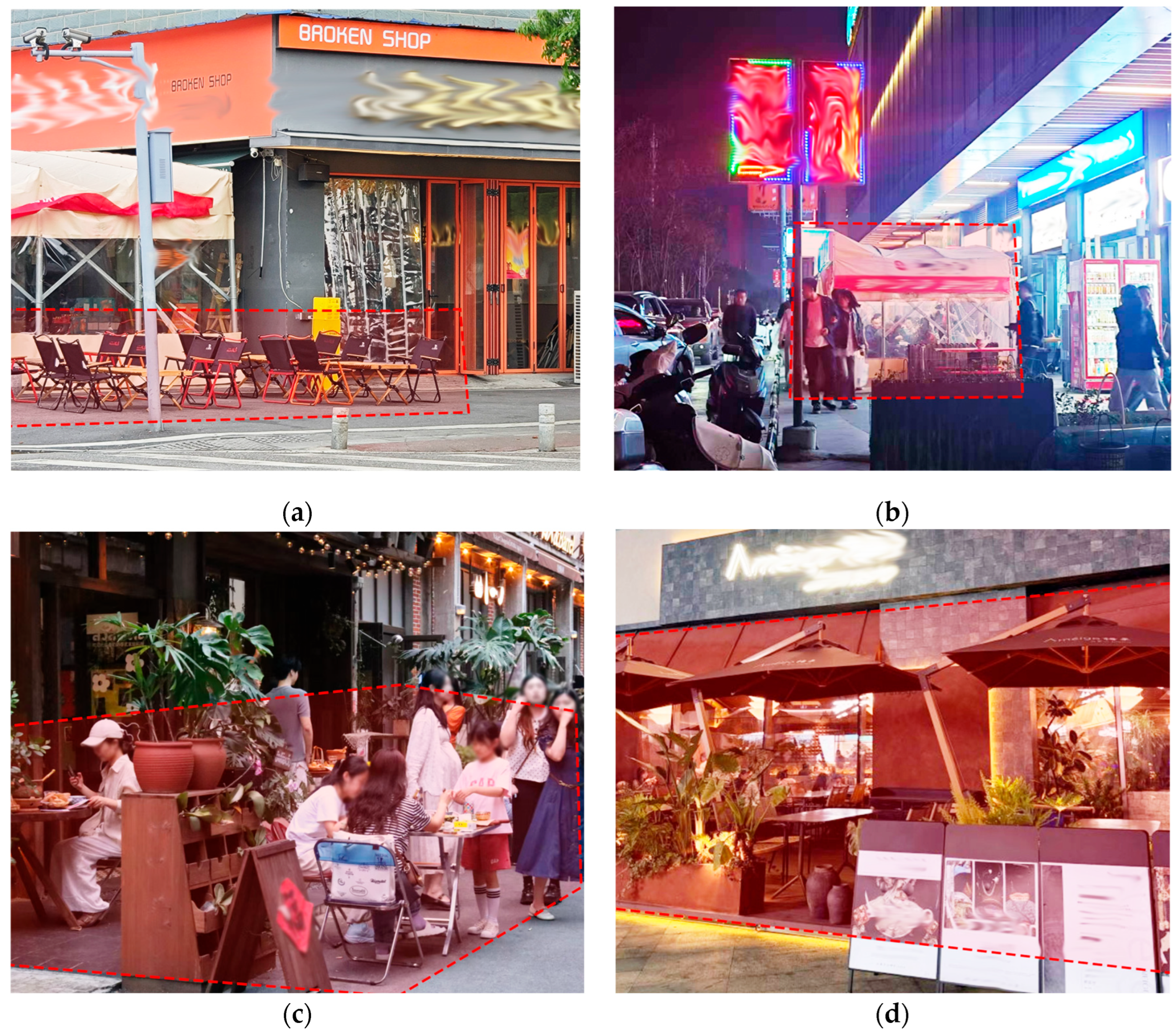
7]. Based on the theoretical analysis above, this study first reviewed streetscape cases of different streatery forms, including open streateries, fenced streateries, and street scenes with varying degrees of interface occupation. Their typical characteristics were summarized in terms of boundary openness, facility layout, pedestrian space, and interface accessibility. On this basis, streatery interfaces were classified into four types: Interface 1, boundaryless open; Interface 2, fully enclosed; Interface 3, flexible permeable; and Interface 4, hybrid covered.
Figure 1 presents the four streatery interface types identified from field observations.
Based on the theoretical framework and interface classification above, this study proposed the following hypotheses. Hard, continuous, and low-permeability boundaries may convey stronger territorial control signals, whereas boundaryless, flexible permeable, and hybrid covered interfaces may reduce exclusionary perceptions through openness, visual permeability, landscape treatment, and shelter [
17,
23,
24]. Therefore, the following hypothesis is proposed:
H1. Streatery interface type significantly affects participants’ perceived spatial publicness; specifically, compared with fully enclosed interfaces, boundaryless open, flexible permeable, and hybrid covered interfaces generate significantly higher levels of perceived spatial publicness.
In terms of emotional restoration, interface elements such as planting, visual permeability, spatial order, and overhead shelter may enhance visual comfort, soft fascination, and perceived environmental quality [
30,
32,
33,
38,
39]. Therefore, the following hypotheses are proposed:
H2. Streatery interface type significantly affects participants’ emotional restoration.
H2a. Interfaces containing natural and refuge-related elements, namely flexible permeable and hybrid covered interfaces, generate significantly higher emotional restoration benefits than interfaces without such elements, namely boundaryless open and fully enclosed interfaces.
H2b. Fully enclosed interfaces generate the lowest emotional restoration benefits.
Finally, perceived spatial publicness may serve as a psychological pathway through which interface design influences emotional restoration. When a streatery interface is perceived as open, shareable, and non-exclusive, its restorative qualities may be more positively experienced. Therefore, the following hypothesis is proposed:
H3. Perceived spatial publicness mediates the relationship between streatery interface type and emotional restoration benefits; specifically, flexible permeable and hybrid covered interfaces indirectly improve emotional restoration by enhancing participants’ perceived spatial publicness.
2.2. Scenario Construction and Visual Stimulus Design
This study used standardized static streetscape images as visual stimuli. The use of static images was appropriate for the present research because the main objective was to examine the perceptual effects of streatery interface form rather than the full range of dynamic street experiences. Compared with real-site observation or immersive simulation, static image-based experiments allow stricter control of non-target variables, such as street background, sidewalk width, building façade, tree arrangement, seating layout, viewing angle, and image format. By keeping these environmental factors constant and changing only the streatery interface type, this method helped to clarify the relationship between interface design and participants’ perceived spatial publicness and emotional restoration [
40,
41]. Nevertheless, static images cannot fully reproduce multisensory and behavioral street experiences, including sound, smell, temperature, pedestrian flow, traffic disturbance, and dynamic commercial activities. This limitation is further discussed in
Section 4.6.
To enhance the realism and comparability of the visual stimuli, this study constructed standardized three-dimensional street scenes using SketchUp 2021 (Trimble Inc., Westminster, CO, USA) based on actual streatery conditions and street-scale logic. Scene dimensions were parametrically controlled with reference to current Chinese urban planning and street design standards [
42]. Specifically, the distance from the building setback line to the motor-vehicle lane, the clear pedestrian width, the depth of the streatery area, the arrangement of tree pits, and the dimensions of street furniture and greening components were standardized across all scenarios. The main spatial parameters used for constructing the experimental scenes are summarized in
Table 1.
To simulate a pedestrian’s everyday walking perspective, the camera was set at an eye-level height of 1.6 m, approximating the average eye height of Chinese adults while walking. The focal length was set at 35 mm to approximate natural human visual perception and reduce spatial distortion caused by wide-angle views. Previous studies have suggested that eye-level visual simulation can enhance perceived realism and behavioral immersion in environmental perception experiments [
41].
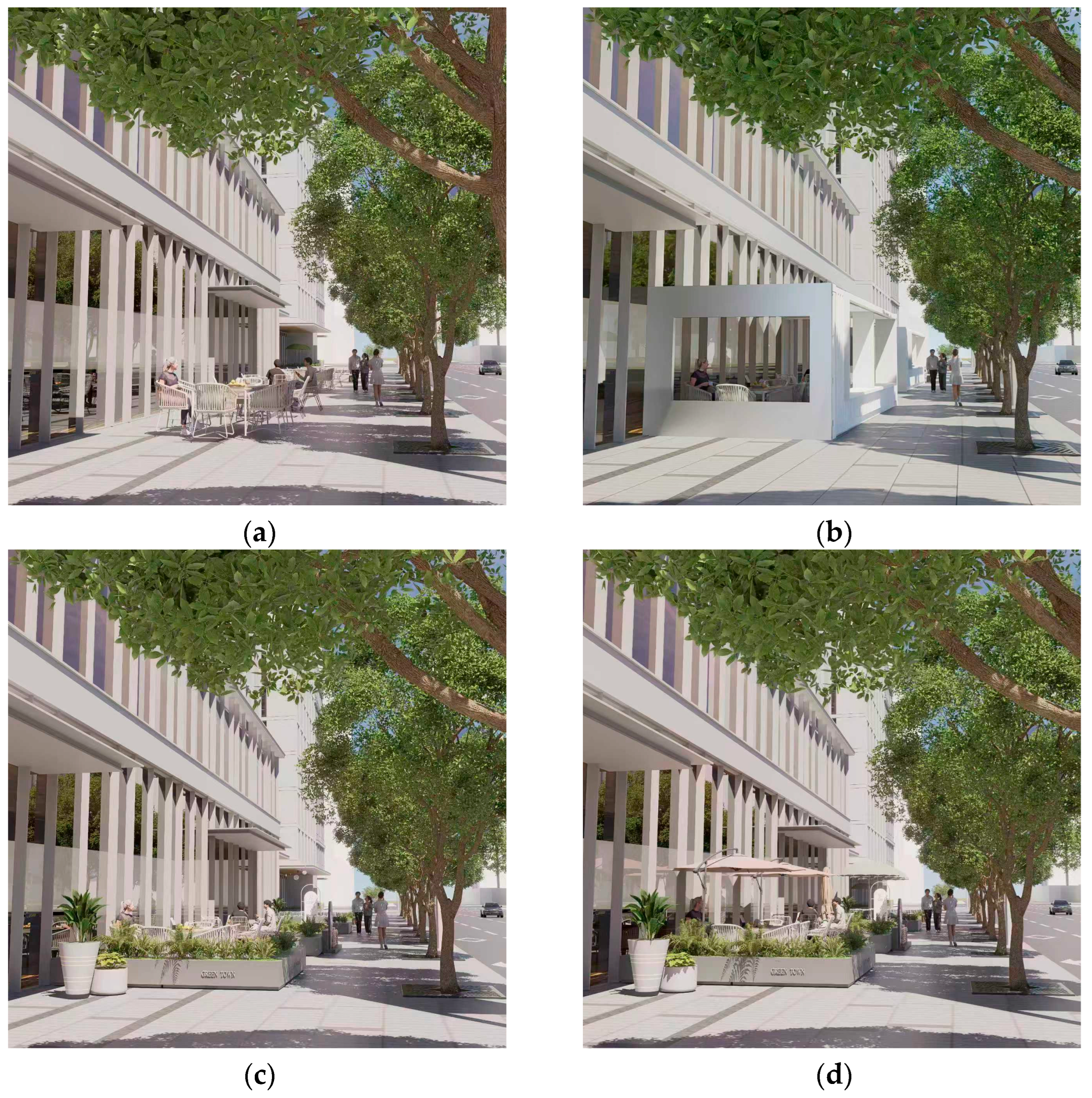
Based on the same street background, building façades, street-tree arrangement, pedestrian clearance, viewing height, focal length, and image ratio, this study generated four standardized visual stimuli by changing only the streatery interface type. The first type was the boundaryless open interface, which included only outdoor tables and chairs without obvious boundary elements. The second type was the fully enclosed interface, which used continuous fencing to create a strong spatial boundary. The third type was the flexible permeable interface, which used low planter boxes to form a soft boundary while maintaining visual permeability. The fourth type was the hybrid covered interface, which added overhead covering elements based on the flexible permeable boundary. The four standardized visual stimuli corresponding to the four streatery interface types are shown in
Figure 2.
2.3. Manipulation Check of Stimulus Materials
To verify whether the four visual stimuli effectively conveyed the intended interface attributes, a pre-test manipulation check was conducted before the formal experiment. A total of 29 participants was recruited for the pre-test. Following the same between-subjects logic as the formal experiment, each participant was randomly assigned to one of the four streatery interface scenarios and viewed only one image. This design avoided repeated comparison across scenarios and helped assess whether each interface type could be independently recognized.
After viewing the assigned image, participants evaluated the perceived attributes of the interface, including openness, enclosure, permeability, environmental integration, and overhead covering. These dimensions corresponded to the main visual differences among the four interface types: the absence or presence of boundary elements, the degree of physical enclosure, the permeability of the boundary, the integration of planting or landscape elements, and the existence of overhead shelter.
One-way ANOVA was used to compare the perceived interface attributes across the four experimental groups. When the assumption of homogeneity of variance was not met, Welch’s test was adopted as a robust alternative. The results showed significant between-group differences in the expected directions. Specifically, the boundaryless open interface received the highest score for perceived openness; the fully enclosed interface received the highest score for perceived enclosure; the flexible permeable and hybrid covered interfaces received higher scores for environmental integration; and the hybrid covered interface received the highest score for overhead covering. These results indicate that the four experimental stimuli were successfully distinguished by participants and were suitable for use in the formal experiment. The results of the manipulation check are presented in
Table 2.
2.4. Participant Recruitment and Experimental Procedure
To maintain contextual consistency, responses from IP addresses outside southern Chinese cities were excluded from the valid sample. This exclusion criterion helped reduce potential bias caused by respondents who lacked familiarity with the regional streatery context. However, it also means that the findings should be interpreted primarily in relation to southern Chinese urban contexts and should not be directly generalized to cities with different climates, street-use cultures, or streatery governance systems.
Before the formal survey, a feasibility pre-test was conducted to examine the clarity, comprehensibility, and procedural feasibility of the online questionnaire. The pre-test focused on whether participants could understand the scenario-viewing instructions, questionnaire items, and response procedure. The results indicated that the questionnaire was understandable to participants and suitable for use in the formal survey.
The online questionnaire was designed according to a between-subjects experimental procedure. After reading the study information and providing informed consent, each participant was randomly assigned to one of the four experimental scenarios: boundaryless open, fully enclosed, flexible permeable, or hybrid covered interface. Each participant viewed only one standardized image and then completed the questionnaire items measuring perceived spatial publicness and emotional restoration. Demographic information, including gender, age, income, occupation, and previous streatery consumption experience, was collected after the perceptual evaluation.
2.5. Variable Measurement and Questionnaire Design
The questionnaire consisted of three parts: demographic information, perceived spatial publicness, and emotional restoration. All perceptual items were measured using a five-point Likert scale, ranging from 1 = strongly disagree to 5 = strongly agree. Higher scores indicate stronger perceived spatial publicness and stronger emotional restoration. The full questionnaire items used for participant responses are provided in the
Supplementary Materials.
The first part collected participants’ demographic information, including gender, age, monthly income, occupation, and previous streatery consumption experience. Previous streatery consumption experience was included because it may influence whether participants perceive streateries as accessible, familiar, and publicly shareable spaces.
The second part measured perceived spatial publicness. This construct was developed with reference to publicness studies on accessibility, openness, management control, and inclusive use [
17,
18,
19,
20,
21], and was adapted to the specific context of streatery interfaces. In this study, perceived spatial publicness refers to participants’ subjective evaluation of whether a streatery interface appears open, visually shareable, non-exclusive, and respectful of the public right to use and experience the street. The scale included four items. PPS1 and PPS2 measured positive evaluations of publicness, including respect for public street-use rights and visual shareability. PPS3 and PPS4 measured perceived exclusion and commercial occupation and were reverse-coded before statistical analysis. After reverse coding, higher scores indicated stronger perceived spatial publicness.
Because perceived spatial publicness in streatery settings has not yet been established as a fully standardized measurement construct, the four-item scale used in this study should be understood as a context-specific and exploratory operationalization. The items were adapted from previous studies on publicness, accessibility, openness, management control, and inclusive use, and were further revised to fit the specific setting of streatery interface perception. Although this short scale allowed the study to capture the core dimensions of openness, visual shareability, non-exclusivity, and respect for public street-use rights, its limited number of items should be acknowledged. Future studies should further develop and validate this construct with expanded item pools, independent samples, and different urban and cultural contexts.
The third part measured emotional restoration. The items were adapted from the Chinese version of the Perceived Restorativeness Scale-11, which was revised from the original perceived restorativeness scale and has been used to assess restorative environmental experience [
43]. Although the original scale is grounded in Restorative Environment Theory [
25], it was adapted in this study to evaluate participants’ emotional restoration in response to streatery interface scenarios. The items reflected psychological relaxation, attentional recovery, environmental comfort, visual attraction, and compatibility with the street setting. Higher scores indicated stronger emotional restoration.
Overall, the questionnaire operationalized perceived spatial publicness through participants’ evaluations of openness, visual shareability, non-exclusivity, and respect for public street-use rights, while emotional restoration was operationalized through perceived relaxation, attentional recovery, environmental comfort, visual attraction, and compatibility. This structure allowed the study to examine both the social-perceptual and psychological-restorative effects of different streatery interface types.
2.6. Data Analysis Methods
IBM SPSS 26.0 (IBM Corp., Armonk, NY, USA) and PROCESS Macro for SPSS version 4.2 were used for statistical analysis. The analytical procedure included descriptive statistics, experimental group balance tests, common method bias testing, reliability and validity testing, correlation analysis, between-group difference tests, supplementary group comparison, and mediation analysis.
First, descriptive statistics were used to summarize participants’ demographic characteristics and the distribution of the main variables. Chi-square tests were conducted to examine whether the four experimental groups were balanced in terms of gender, age, monthly income, occupation, and previous streatery consumption experience. If a demographic variable showed significant differences across the four experimental groups, it was included as a control variable in the subsequent mediation model to reduce potential confounding effects.
Second, common method bias, reliability, and validity were tested. Because the data were collected from the same self-reported questionnaire, Harman’s single-factor test was conducted as a preliminary assessment of common method bias [
44]. Reliability was evaluated using Cronbach’s α. Construct validity was assessed using the Kaiser–Meyer–Olkin value, Bartlett’s test of sphericity, Composite Reliability, Average Variance Extracted, and the Heterotrait–Monotrait Ratio [
45,
46]. Descriptive statistics and Pearson correlation analysis were then used to examine the basic relationship between perceived spatial publicness and emotional restoration.
Third, the effects of streatery interface type on perceived spatial publicness and emotional restoration were examined. One-way ANOVA was first considered to test between-group differences among the four interface types. Because the homogeneity of variance test indicated that some variables did not meet the assumption of equal variances, Welch’s ANOVA was adopted as a robust test for statistical significance [
47]. For post hoc multiple comparisons, the Games–Howell method was used because it is suitable for unequal variances and unequal sample sizes [
48]. In addition to statistical significance, effect sizes were reported to assess the practical magnitude of the observed differences. Partial η
2 was used as a descriptive effect-size indicator for interface-type effects. Because statistical significance was interpreted based on Welch’s ANOVA under unequal variance conditions, partial η
2 was reported only as an indicator of the magnitude of group differences rather than as the basis for significance testing.
Fourth, independent-sample t-tests were conducted as a supplementary analysis to compare perceived spatial publicness and emotional restoration between participants with and without previous streatery consumption experience. Levene’s test was used to assess the homogeneity of variance assumption before interpreting the t-test results. Cohen’s d was calculated to evaluate the magnitude of the differences between the two groups.
Finally, PROCESS Macro Model 4 was used to test the mediating role of perceived spatial publicness between streatery interface type and emotional restoration [
49]. Interface type was treated as a categorical independent variable, with the boundaryless open interface as the reference group. Three dummy variables were created to compare the fully enclosed, flexible permeable, and hybrid covered interfaces with the reference group. Perceived spatial publicness was used as the mediating variable, and emotional restoration was used as the dependent variable. Based on the results of the experimental group balance test, age was included as a control variable in the mediation model. Bootstrap resampling was set to 5000. A mediating effect was considered significant when the 95% confidence interval of the indirect effect did not include zero. This procedure has been widely used in environmental psychology and built environment research to examine indirect psychological pathways between environmental characteristics and perceptual or behavioral outcomes [
50,
51].
Overall, the analytical procedure followed the logic of “measurement-quality testing–between-group difference testing–effect-size interpretation–mediation analysis,” allowing this study to examine not only whether different streatery interface types produced statistically significant differences, but also whether these differences were practically meaningful.
4. Discussion
4.1. Possible Public Spillover Potential of Emotional Restoration in Streatery Interfaces
This study found that prior streatery consumption experience significantly affected perceived spatial publicness, but did not significantly influence emotional restoration. This result suggests a dual perceptual pattern. On the one hand, perceived spatial publicness was shaped, to some extent, by participants’ previous consumption experience. On the other hand, emotional restoration evaluations did not show a significant difference between participants with and without prior streatery consumption experience.
Participants with previous consumption experience tended to report higher perceived spatial publicness. A plausible explanation is that prior experience of entering and using streatery spaces may reduce psychological distance and increase familiarity with their boundaries, facilities, and commercial operations. These participants may therefore be more likely to interpret streateries as approachable and shareable components of the street. By contrast, participants without such experience may be more sensitive to the commercial and territorial cues conveyed by seating, boundaries, and consumption-related arrangements.
However, the absence of a significant difference in emotional restoration between participants with and without prior consumption experience is theoretically meaningful. It indicates that emotional restoration evaluations were not strongly dependent on whether participants had previously entered or consumed in streatery spaces. This finding points to a perceptual spillover pattern: certain interface qualities, such as planting, shading, visual order, spatial comfort, and atmospheric appeal, can be visually accessed from the pedestrian realm and may generate a positive environmental experience for both consumers and non-consumers.
This finding helps refine the public value of streateries in commercialized street spaces. The social value of streateries does not lie only in serving consumers or enhancing commercial vitality, but also in whether their interface design can return perceivable environmental quality to the wider street public. In this sense, high-quality streatery interfaces may function as a form of public environmental reciprocity by transforming commercial occupation into visually shareable and psychologically restorative street experience. Nevertheless, because this study is based on self-reported perceptions of static images, this public spillover effect should be understood as a perceptual pattern identified in the experiment rather than a fully verified real-world behavioral effect. Future field studies, post-occupancy evaluations, and behavioral or physiological measurements are needed to further examine how such restorative spillover operates in everyday street environments.
4.2. Boundaryless Interfaces and the Nonlinear Logic of Perceived Spatial Publicness
Another important finding of this study is that participants’ evaluations of streatery interfaces did not follow a simple logic of maximizing physical openness. Although the boundaryless open interface received higher evaluations than the fully enclosed interface, its perceived spatial publicness and emotional restoration scores were still significantly lower than those of the flexible permeable and hybrid covered interfaces. This indicates that, in commercialized street spaces, greater physical openness does not necessarily lead to stronger perceived publicness or better emotional restoration.
Existing public space research often associates openness, accessibility, and permeability with stronger publicness. However, the results of this study suggest that this relationship may become more complex when a space contains explicit commercial functions and consumption-related cues. In the context of streateries, pedestrians’ judgments of publicness may depend not only on whether boundaries are physically absent, but also on how commercial facilities are visually organized, whether the space appears orderly, and whether the interface conveys welcoming or exclusionary social signals.
The relatively lower evaluation of the boundaryless open interface can be interpreted as the effect of unbuffered commercial exposure. Without landscaped buffers or spatial transitions, tables and chairs are directly exposed within the pedestrian environment and may appear as an immediate extension of commercial activity into public sidewalk space. As a result, participants did not necessarily interpret the absence of boundaries as stronger shareability. Instead, the lack of interface organization may have made commercial occupation more visually salient. This does not mean that openness is unimportant; rather, it suggests that in commercialized street spaces, openness needs to be combined with spatial order, visual comfort, and soft transitional elements in order to be perceived as public-oriented.
Therefore, the public acceptability of streatery interfaces should not be understood through a simple opposition between open and enclosed forms. The findings suggest a nonlinear relationship between boundary openness and perceived spatial publicness. Moderate boundary design may support more positive evaluations when it organizes commercial activity, softens territorial cues, and provides visually shareable environmental quality. In contrast, both excessive enclosure and the complete absence of spatial transition may reduce positive public evaluations in different ways.
4.3. Flexible and Hybrid Interfaces as Public-Experience-Oriented Boundary Design
Compared with the boundaryless open and fully enclosed interfaces, the flexible permeable and hybrid covered interfaces received higher evaluations in both perceived spatial publicness and emotional restoration. This finding is one of the key results of the study. It suggests that the public does not simply prefer maximum openness, nor does it necessarily reject all forms of boundary. Rather, participants responded more positively to boundary designs that combined spatial organization, visual permeability, landscape elements, and environmental comfort.
The flexible permeable interface introduced low planter boxes as boundary elements. Such boundaries did not fully separate the streatery from the public street, but created a soft spatial transition between commercial operation and pedestrian space. This type of interface may reduce the visual impact of commercial occupation by transforming the boundary from a hard territorial marker into a landscaped and permeable element. In this way, planting and low boundaries may help pedestrians perceive the streatery as a more integrated part of the streetscape rather than as a purely private commercial extension.
The hybrid covered interface further added overhead covering elements on the basis of flexible planted boundaries and received the highest evaluation among all experimental conditions. This result may be related to the combined effects of planting, visual permeability, spatial order, and a sense of shelter. Overhead coverings may enhance the perception of spatial integrity and comfort, while low and permeable planted boundaries maintain visual openness and reduce exclusionary signals. Together, these elements may create a micro-place that is more coherent, comfortable, and visually attractive.
These findings suggest that the role of streatery interface design is not limited to beautification or physical separation. Flexible and hybrid interfaces may transform the perceived meaning of commercial occupation by providing visible and shareable environmental qualities. Instead of being read merely as private extensions of commercial premises, streateries with planting, permeable boundaries, and overhead coverings may be more likely to be interpreted as organized, landscaped, and experientially enriched parts of the street environment. In this sense, public-experience-oriented boundary design may help balance commercial operation and public perception in socially sustainable street design.
4.4. Perceived Spatial Publicness as One Psychological Pathway Linking Interface Design and Emotional Restoration
The mediation analysis showed that perceived spatial publicness partially mediated the relationship between streatery interface type and emotional restoration. This result suggests that the restorative effects of streatery interfaces are not only associated with physical environmental features, such as plants, shading, visual permeability, and spatial hierarchy, but are also related to pedestrians’ subjective judgments of whether the space is open, shareable, and non-exclusive.
Specifically, flexible permeable and hybrid covered interfaces enhanced participants’ perceived spatial publicness through low boundaries, planting elements, visual permeability, and overhead shading, which in turn contributed to higher emotional restoration scores. By contrast, the fully enclosed interface reduced perceived spatial publicness through stronger boundary control and visual separation, thereby indirectly weakening emotional restoration. This finding indicates that interface design may influence emotional restoration partly by shaping pedestrians’ social cognition of spatial publicness.
Overall, the findings indicate that emotional restoration in streatery environments is shaped by the interaction between physical interface quality and socio-psychological evaluations of publicness. In commercialized street spaces, plants, shading, permeability, and spatial coherence may provide direct restorative cues, while perceived openness, shareability, and non-exclusivity may further strengthen the psychological conditions under which these cues are positively experienced. Therefore, perceived spatial publicness should be understood as an important but non-exhaustive perceptual mechanism linking streatery interface design with emotional restoration. Other environmental qualities, such as visual comfort, perceived order, landscape quality, shelter, and spatial coherence, may also contribute to the restorative effects of different interface types. This interpretation modestly extends restorative environment research by suggesting that, in semi-public and commercialized street settings, social perceptions of openness, shareability, and non-exclusivity may condition how people experience the restorative potential of streetscape environment.
4.5. Design Implications and Future Governance Considerations
The findings of this study provide several design implications for streatery interface design, but these implications should be understood primarily at the perceptual and interface-design level. Since the fully enclosed interface received the lowest evaluations in both perceived spatial publicness and emotional restoration, rigid and visually dominant enclosures should be avoided when streateries are located along pedestrian streets or semi-public frontages. By contrast, flexible permeable and hybrid covered interfaces performed better across both outcome variables, suggesting that streatery design should prioritize low, permeable, visually soft, and landscaped boundaries, such as planter boxes, low hedges, parasols, overhead coverings, and carefully organized seating layouts. These elements should not be treated merely as commercial decorations; rather, when basic pedestrian accessibility and safety requirements are maintained, they may help reduce perceived privatization and improve pedestrians’ evaluations of openness, shareability, and restorative quality.
At the governance level, the findings suggest that future streatery management may consider supplementing dimension-based control, such as occupied area, pedestrian clearance, and facility height, with public-experience-oriented criteria, including interface permeability, boundary softness, landscape integration, visual sharing, shelter comfort, and non-consumer experience. However, these governance implications should be interpreted with caution. Because this study is based on a scenario-based perception experiment using static images, it does not directly test real-world behavioral outcomes, physiological responses, or policy effectiveness. Therefore, the proposed emotional compensation pathway should be understood as an empirically supported perceptual-level mechanism based on perceived spatial publicness, rather than as a fully validated or complete explanatory pathway. Its application to real street management should be further examined through field studies, post-occupancy evaluation, public participation, and behavioral or physiological measurements.
4.6. Research Limitations and Future Directions
This study has several limitations. First, it adopted a static image-based scenario experiment. Although this approach helped control irrelevant variables and isolate the effects of streatery interface type, it could not fully reproduce the multisensory and dynamic experiences of real street environments, such as sound, smell, temperature, pedestrian density, traffic disturbance, service activities, and interactions with other users. In addition, the study relied on self-reported Likert-scale evaluations of perceived spatial publicness and emotional restoration. These subjective indicators are appropriate for examining perceptual responses, but they cannot directly capture objective behavioral or physiological outcomes, such as dwelling time, detour behavior, gaze duration, pedestrian conflicts, or actual use patterns. Moreover, although the perceived spatial publicness scale showed acceptable reliability and was suitable for the present analysis, it was based on a limited number of context-specific items and had an AVE value slightly below the conventional threshold. Future research should further validate this construct through expanded item development, confirmatory factor analysis, and cross-context psychometric testing. Future studies could combine static-image experiments with VR simulations, post-occupancy evaluations, field observations, eye-tracking, and behavioral or physiological measurements to further validate the findings in real-world settings.
Second, the sample was limited to participants from southern Chinese cities, where streatery practices are relatively mature and outdoor commercial activities are more compatible with the climate. This sampling strategy was consistent with the research context, but it may limit the transferability of the findings to other geographical, climatic, cultural, and regulatory contexts. Therefore, the findings should be interpreted primarily as evidence from southern Chinese commercial street contexts, and further comparative studies are needed before their applicability to other international streatery settings can be claimed. Moreover, because all four experimental scenarios included streatery facilities, this study can compare the relative differences among different streatery interface types, but cannot determine whether streateries as a whole improve or impair publicness and emotional restoration compared with streets without streateries. Future research should include a blank benchmark condition without streatery facilities and further examine differences among user groups in terms of consumption frequency, travel purpose, walking duration, age, and familiarity with local streets.
5. Conclusions
From the perspective of socially sustainable street design, this study examined how different streatery interface types influence participants’ perceived spatial publicness and emotional restoration in southern Chinese commercial street contexts. Based on a scenario-based experiment with 420 valid responses, four types of streatery interfaces were compared: boundaryless open, fully enclosed, flexible permeable, and hybrid covered interfaces. The study further tested whether perceived spatial publicness mediated the relationship between streatery interface type and emotional restoration.
The results show that streatery interface type significantly affected both perceived spatial publicness and emotional restoration. The hybrid covered and flexible permeable interfaces received the highest evaluations, the fully enclosed interface performed the weakest, and the boundaryless open interface was not necessarily the optimal solution. This finding suggests that, in the studied southern Chinese commercial street contexts, perceived publicness is not determined simply by maximum physical openness. Instead, low, permeable, flexible, and landscaped boundary interfaces may help reduce perceived privatization and make streatery spaces more likely to be perceived as open, shareable, and non-exclusive components of the street environment.
The mediation analysis further showed that perceived spatial publicness partially mediated the relationship between interface type and emotional restoration. This indicates that emotional restoration is shaped not only by physical environmental features, such as planting, shading, seating, and visual comfort, but also by pedestrians’ social cognition of openness, shareability, and non-exclusivity. Based on this finding, the study provides initial support for a perceptual-level emotional compensation mechanism. Specifically, perceived spatial publicness represents one empirically tested perceptual route through which high-quality streatery interfaces may partly offset negative perceptions of commercial occupation by offering shareable environmental and psychological benefits. Because the direct effects of interface type remained significant, and because this study tested only one mediating variable, this mechanism should be understood as a partial and perceptual-level explanation rather than a complete pathway. Its real-world applicability should be further validated through field studies, post-occupancy evaluations, VR simulations, and behavioral or physiological measurements.
These findings provide context-specific design implications for healthy, inclusive, and socially sustainable commercial streets in southern Chinese urban settings. In comparable contexts, streatery design should avoid rigid and visually oppressive enclosure, and should instead encourage low, permeable, flexible, landscaped, and appropriately sheltered interfaces that enhance visual sharing and non-consumer experience. Nevertheless, the applicability of these recommendations to other international contexts should be treated with caution. Since the research was based on self-reported perceptions of static images from a specific regional context, the findings need to be further validated through comparative field studies, post-occupancy evaluations, VR simulations, and behavioral or physiological measurements across different geographical, climatic, cultural, and regulatory settings.