Article

AI Use Quality and Sustainable Educational Equity: Evidence on the Socioeconomic Gap in Deep Learning Approach Among Chinese High School Students

1
Jing Hengyi School of Education, Hangzhou Normal University, Hangzhou 311121, China
2
Chinese Education Modernization Research Institute, Hangzhou Normal University, Hangzhou 311121, China
*
Author to whom correspondence should be addressed.
Sustainability 2026, 18(13), 6925; https://doi.org/10.3390/su18136925
Submission received: 26 May 2026 / Revised: 30 June 2026 / Accepted: 3 July 2026 / Published: 7 July 2026

Abstract

Sustainable educational equity, the principle behind United Nations Sustainable Development Goal 4, calls for ensuring that disadvantaged students benefit from emerging educational technologies rather than being pushed further behind. As AI learning tools become routine in secondary schools, whether they reduce or widen socioeconomic gaps in learning has become a pressing question for sustainable educational policy. Building on digital divide theory and the resource substitution hypothesis, we tested whether family socioeconomic status (SES) moderates the link between students’ AI use quality and deep learning approach—specifically, whether high-quality AI use is more strongly associated with deep learning approach for students from lower-SES backgrounds. Data came from 548 students at three public high schools in Hangzhou, China. AI use quality was operationalized as a three-part construct (seeking, evaluating, applying). Deep learning approach was measured with the deep approach subscale of the R-SPQ-2F. We tested moderation with hierarchical regression and probed the interaction with simple slopes. Two results stood out. First, both SES and AI use quality positively predicted deep learning approach. Family SES moderated the association between AI use quality and deep learning approach: the link between AI use quality and deep learning approach was stronger for low-SES students than for their higher-SES peers, and when AI use quality was high, the deep learning gap across SES levels was correspondingly narrower. The data support the equalizer hypothesis: high-quality AI use can narrow the SES-related gap in deep learning approach and serve as a lever for sustainable educational equity. Schools that want AI to advance equity should treat AI literacy as an instructional priority across subjects, not as something students are expected to figure out on their own.

1. Introduction

AI-powered educational applications, from conversational assistants to adaptive practice platforms, are increasingly embedded in the daily study routines of secondary school students. They provide personalized explanations, worked examples, practice recommendations, and writing feedback [1,2,3]. A recent meta-analysis of experimental studies found that ChatGPT-based interventions improved academic outcomes, learner motivation, and higher-order cognitive skills [2]. In China’s K-12 sector, locally developed AI tools, including Doubao, ERNIE Bot, and iFlytek Spark, are now used in both classroom teaching and after-school independent study, supported by national policies that promote AI literacy and the adoption of intelligent technologies in education [4,5].
As AI tools spread through secondary classrooms and self-study, a question that remains under-explored is whether students from low-SES families gain as much from them as their higher-SES peers. The question sits at the heart of sustainable educational equity: whether emerging technologies act as a lever for inclusive learning or as another channel through which existing advantages reproduce themselves. Two perspectives offer opposite predictions. The Matthew effect hypothesis [6,7] holds that students from higher-SES families, who already have more digital resources, parental guidance, and supplementary education, are better positioned to extract value from new technologies, so existing achievement gaps widen. Recent evidence from a digital divide perspective points the same way: SES is positively associated with AI literacy, and conventional digital inequalities persist and evolve in the era of generative AI [8]. The resource substitution hypothesis [9] and the equalizer perspective on digital technology [10,11] predict the opposite: technology can compensate for the resource gaps low-SES students face and narrow achievement gaps, because students with fewer existing supports stand to gain more when high-quality learning resources finally become accessible.
Prior work on this question has been limited in three ways. Prior research on digital divides in education has largely concentrated on whether students can access technology and how often they use it, with less attention to how students actually use digital tools to learn [11,12]. Existing AI-in-education research has mostly examined university students; high school students, who operate in a more structured and exam-oriented environment, have received less attention [1,13]. And studies linking SES to academic outcomes rarely look at the mechanisms through which technology use might moderate that link, especially in the context of emerging AI tools [14].
The present study addresses these gaps. We test whether and how family SES moderates the relationship between AI use quality and deep learning approach in Chinese high school students—that is, whether high-quality AI use is more strongly associated with the deep learning approach among students from lower-SES backgrounds. Deep learning approach, defined as a learning approach oriented toward understanding and meaning-seeking strategies [15], is consistently associated with higher academic achievement and stronger learning transfer [16,17]. We chose it as the outcome because it is theoretically sensitive to both resource availability and instructional support, which makes it well suited for capturing differences in learning processes across SES groups. Rather than treating AI use as a binary or unidimensional variable, we measured AI use quality as a three-part construct: seeking AI help, evaluating AI responses, and applying AI output. The measure was adapted from [18] the Self-Assessment Practice Scale and indexes the cognitive depth of students’ engagement with AI tools.
By bringing digital divide theory [11] together with the resource substitution hypothesis [9], we tested the prediction that AI use quality moderates the SES–deep learning approach association. The resource substitution argument is straightforward: a resource is more valuable to people who lack alternatives. Low-SES students typically have less access to private tutoring, parental academic guidance, and other supplementary resources, so AI tools may carry greater marginal value for them. If that logic holds, the positive association between AI use quality and deep learning approach should be stronger for low-SES students than for their higher-SES peers. Confirming this would provide direct evidence that high-quality AI use can partly offset the resource disadvantages associated with lower family SES.
This study offers three contributions. First, it extends the resource substitution hypothesis into research on AI-assisted learning, which gives a reason to expect uneven gains from AI tools across SES groups. Second, it measures AI use quality as a three-part construct (seeking, evaluating, applying) rather than as access or frequency. Third, it tests the equalizer prediction in a population that has received little attention so far: Chinese high school students.

2. Literature Review

2.1. SES and Academic Outcomes in the Chinese Context

The association between family SES and academic performance has been extensively examined in the literature [19]. A meta-analysis of nearly 200 studies reported a weak student-level correlation between SES and achievement [14] updated meta-analysis, covering work between 1990 and 2000, reported a medium-to-strong association. Both reviews noted, however, that the strength of the association varies with how SES is measured and with the educational context studied. In China, the gaokao system intensifies family investment in supplementary educational resources to keep children competitive. The shadow education industry, including private tutoring and supplementary classes, has therefore become a widely adopted form of academic support [20,21]. Access to these resources depends heavily on family income, so SES differences show up clearly in the breadth and quality of out-of-school support, and these resource gaps in turn translate into meaningful differences in learning processes and outcomes [22,23].
Among the learning processes that may be shaped by these resource gaps, the depth of students’ learning approach is of particular theoretical interest. Deep learning approach, as conceptualized by [15,22] refers to a learning approach characterized by the intention to understand material at a conceptual level, to relate ideas to one another, and to apply knowledge to new situations. This approach is distinguished from surface learning, which involves rote memorization and reproducing information without seeking meaning. Deep learning approach has been consistently associated with higher academic achievement, stronger conceptual understanding, and greater transfer of learning [16,17,20]. Students from more affluent families may be more inclined to adopt deep approaches, given their greater exposure to enriched learning environments, more parental intellectual stimulation, and more opportunities for exploratory learning [15].
Based on this literature, we propose:
H1. 
Family SES is positively associated with deep learning approach among Chinese high school students.

2.2. AI Use Quality and Deep Learning Approach

AI learning tools can support a deep learning approach in several ways. Meta-analytic evidence shows that AI chatbots can positively contribute to student learning outcomes at various educational levels [24]. Each dimension of AI use draws on different cognitive demands. Seeking AI help gives students explanations, examples, and alternative framings that can support conceptual understanding [1,25]. Evaluating AI responses requires comparing the AI output to one’s existing knowledge, which is a core feature of meaningful learning [26]. Applying AI output to one’s own work requires synthesis and self-regulation [18,27].
Just having AI, or using it often, does not guarantee these benefits. Research on technology-enhanced learning has shown again and again that learning outcomes depend on how students use the technology, not whether they use it [11,12]. Students who passively accept AI answers without critical evaluation are unlikely to gain the same cognitive benefits as students who seek targeted help, evaluate AI output, and thoughtfully apply it. The distinction between how much and how well students use technology aligns with what Hargittai [12] termed the second-level digital divide, which foregrounds variation in skills and usage patterns over mere access. For this reason, the present study uses AI use quality, not frequency, as the focal predictor.
We conceptualize AI use quality as a three-part construct that captures the cognitive depth of students’ engagement with AI tools. The conceptualization draws on [18]. Self-Assessment Practice Scale (SaPS), which separates self-assessment into four subscales: external feedback through monitoring, external feedback through inquiry, internal feedback, and self-reflection. We reorganized those actions into three dimensions specific to AI use: seeking AI help (asking for explanations and support), evaluating AI responses (judging accuracy and relevance), and applying AI output (folding AI output into the student’s own work). The three dimensions are intended to capture progressively deeper cognitive engagement.
H2. 
AI use quality is positively associated with deep learning approach.

2.3. Family SES as a Moderator of the AI Use Quality–Deep Learning Link

The central question of this study is whether family SES moderates the association between AI use quality and deep learning approach; specifically, whether the benefit of high-quality AI use differs across socioeconomic groups. Two competing perspectives offer divergent predictions.
The resource substitution hypothesis [9] is the main theoretical basis for the equalizer perspective. The hypothesis was originally proposed to explain how education differentially benefits health outcomes across social groups, and its core claim is simple: a given resource is more valuable for individuals who lack alternatives and less valuable for those who already have abundant resources. Applied to AI learning tools, the implication is that AI tools may functionally substitute for the educational resources higher-SES families more easily provide, such as private tutoring, parental academic guidance, and enrichment activities. A meta-analysis of 72 experimental and quasi-experimental studies confirms that educational technology has a small but significant positive effect on the achievement of less advantaged students, especially when interventions focus on computer-assisted learning rather than mere access [28]. For low-SES students, who lack these alternative supports, high-quality engagement with AI tools may be a uniquely valuable resource for deep learning approach. For high-SES students, who already have multiple channels of academic support, the marginal benefit of AI tools may be smaller.
Digital divide theory [11] helps locate where this compensatory function operates. Van Dijk’s framework identifies three layers of digital inequality: access to technology, the skills to use it, and the tangible outcomes that result. First-level access to AI tools has become increasingly universal, but second-level differences in how students use them remain critical. The present study focuses on this second-level divide, asking whether the quality of AI use, rather than mere access, differentially benefits students across SES groups. If the resource substitution logic holds, AI use quality should carry greater value for students who lack alternative high-quality learning resources.
Social cognitive theory points to a possible mechanism. Higher-SES students typically build stronger academic self-efficacy through richer mastery experiences and verbal persuasion from parents and tutors. AI tools can offer accessible mastery experiences, explanatory feedback, and chances for self-regulated practice. They could plausibly let low-SES students develop self-efficacy through alternative pathways and adopt deeper learning approaches that would otherwise be less accessible.
The Matthew effect hypothesis [6,7] predicts the opposite. From this view, high-SES students, with greater digital literacy, cultural capital, and family support, are better positioned to extract value from AI tools, so existing inequalities are amplified rather than narrowed. A cross-national analysis of PISA data found that ICT skills and access were generally more beneficial for students from advantaged family backgrounds, lending empirical support to the social reproduction perspective [29].
To adjudicate between these competing hypotheses, we propose:
H3 (Resource Substitution Hypothesis). 
Resource Substitution Hypothesis): Family SES moderates the association between AI use quality and deep learning approach, such that the positive association between AI use quality and deep learning approach is stronger for low-SES students than for high-SES students.

2.4. The Present Study

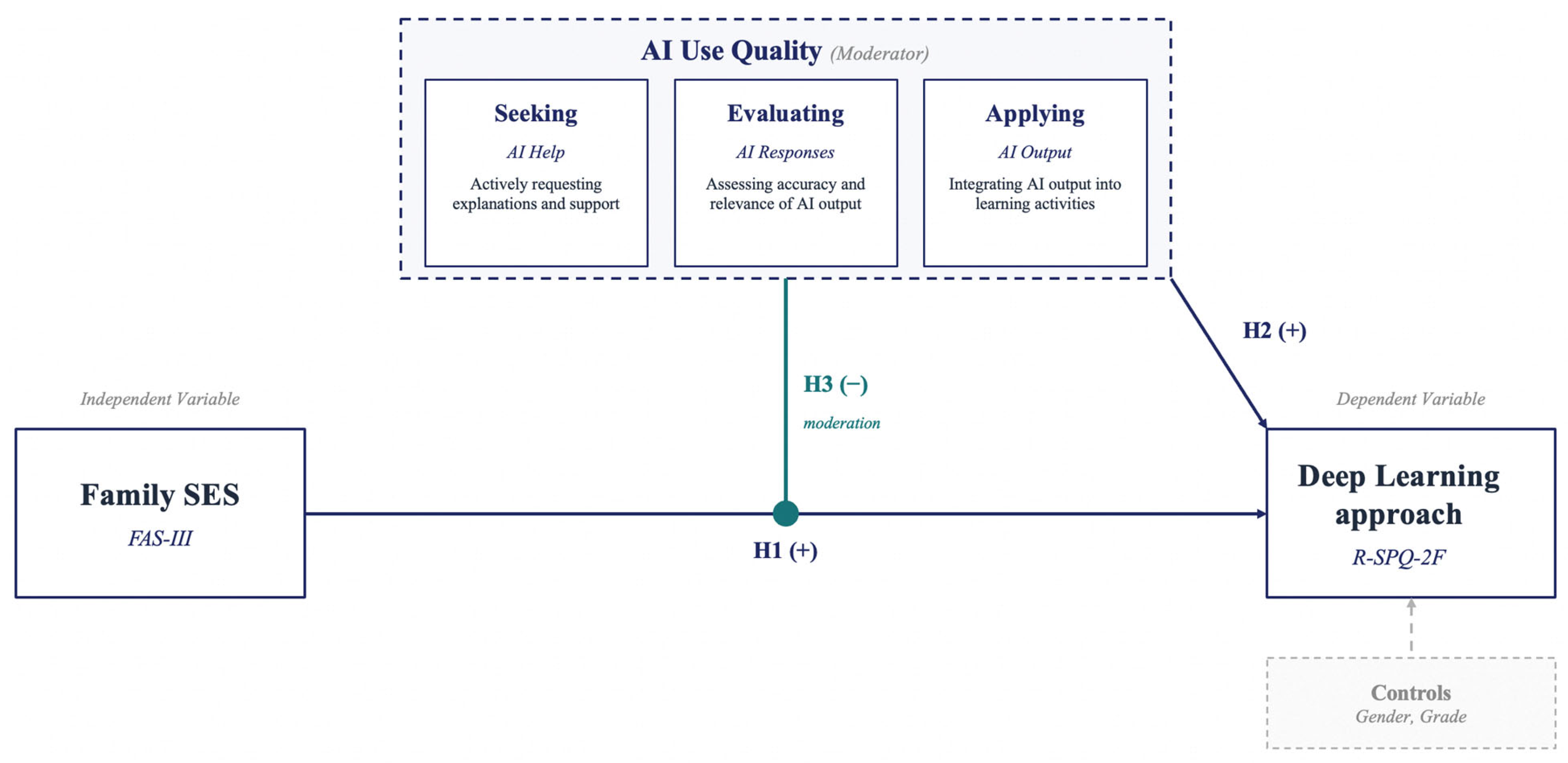
Figure 1 presents the conceptual model. Family SES and AI use quality each predict deep learning approach (H1, H2), and family SES moderates the AI use quality–deep learning approach association (H3). Gender and grade are included as control variables. We also conducted supplementary analyses to see whether the moderation effect held across the three individual dimensions of AI use quality (seeking, evaluating, and applying).

3. Method

3.1. Participants and Procedures

Participants were students from three public high schools in Hangzhou, China. All three schools were classified as provincial-level standardized high schools and were selected to ensure variation in student socioeconomic composition. A stratified approach was used to recruit participants from Grades 10 and 11, targeting a roughly even split between the two grade levels. Grade 12 students were excluded because their curriculum was almost entirely devoted to preparation for the gaokao, China’s high-stakes National College Entrance Examination, which largely determines students’ higher education placement and is a dominant source of academic pressure in secondary schooling. This intensive preparation schedule leaves little room for exploratory use of AI learning tools. All three schools had voluntarily incorporated locally developed AI tools (e.g., Doubao, ERNIE Bot, SparkDesk) into classroom teaching or after-school activities, without any compulsory curriculum mandate. This selection criterion ensured that respondents had sufficient experience with AI tools to answer the survey items meaningfully, though it also limits generalizability to students with prior AI exposure.
We distributed 580 questionnaires. After removing incomplete questionnaires (N = 14), responses showing uniform answer patterns across extended item sequences (N = 11), and responses from students who reported never having used any AI learning tool (N = 7), we retained 548 valid questionnaires, an effective response rate of 94.5%. All retained questionnaires were complete with no missing data. Excluding non-users was necessary because the AI-use quality items require actual experience with AI tools to be meaningfully answered; that exclusion also restricts generalization to students with at least some AI exposure. Because China’s education system follows a fixed age-grade structure, grade level serves as a reliable proxy for age; we therefore recorded grade rather than collecting age separately. Table 1 summarizes the demographic profile of the final sample.
Participants ranged from 15 to 17 years of age. Data were gathered over a two-week window within a regular academic term. The research team organized students to complete an online questionnaire on the Wenjuanxing platform in school computer rooms. Average completion time was about 10 to 15 min. To reduce common method bias, we put several procedural remedies in place: anonymity and confidentiality were emphasized on the first page, predictor and outcome measures were placed on different pages, and response directions were varied across measures. All valid respondents received stationery items as a token of appreciation. Ethical approval was granted by the researchers’ institutional review board and the administrations of the participating schools. Written informed consent was collected from each student and their parent or guardian.

3.2. Measures

All Likert-type items were rated on a 5-point scale; the FAS-III uses its own scoring system. To ensure cross-cultural appropriateness, all adapted scales went through a standard translation–back-translation procedure followed by expert panel review. The adaptation procedure was systematic. In the first phase, two bilingual researchers with training in educational psychology each produced an independent Chinese translation of all items. The two drafts were then compared, and any inconsistencies were resolved by joint discussion. Next, a third translator with no prior contact with the original instruments rendered the Chinese version back into English. The research team reviewed this back-translation alongside the source items and refined the phrasing where needed to ensure semantic equivalence. Finally, a six-member expert panel, comprising three scholars in psychometrics and educational measurement and three practicing high school teachers experienced in AI-integrated instruction, assessed every item for linguistic clarity, developmental fit for high school students, and alignment with the target construct. Wording was adjusted on the basis of their recommendations. The finalized questionnaire items are provided in the Supplementary Materials.
To verify that the adapted items retained their intended factor structure in the target population, the questionnaire was pilot-tested with 56 students at a public high school comparable in type and academic level to the main-study schools but not included in the final sample. Confirmatory factor analysis was performed on the pilot data. The three-factor model for AI use quality (seeking, evaluating, and applying) yielded acceptable fit indices (χ2/df = 1.78, CFI = 0.951, TLI = 0.940, RMSEA = 0.058, SRMR = 0.048), and the single-factor model for deep learning approach likewise met conventional thresholds (χ2/df = 1.92, CFI = 0.962, TLI = 0.948, RMSEA = 0.063, SRMR = 0.042).

3.2.1. Family Socioeconomic Status

Family SES was measured with the Family Affluence Scale III [30,31]. The FAS-III is a six-item self-report measure designed for adolescents and assesses family material wealth through questions about household possessions and resources. Total scores range from 0 to 13, with higher scores indicating greater family affluence. Full item content and scoring rules are reported in the Supporting Materials. We chose the FAS-III because it sidesteps the methodological problems of asking adolescents to report parental income or education directly, and it has been validated across multiple cultural contexts, including Chinese samples [30,31]. The FAS-III captures only the material dimension of SES, but its psychometric properties have been stable across diverse populations. For regression analyses, FAS-III total scores were standardized. The FAS-III uses a binary and ordinal categorical response format different from Likert-type scales, so we did not include it in the confirmatory factor analysis reported below.

3.2.2. AI Use Quality

AI use quality was measured with twelve items adapted from [18] Self-Assessment Practice Scale (SaPS). The original self-assessment context was modified to reflect AI learning tool use. The scale comprised three dimensions with four items each: seeking AI help, evaluating AI responses, and applying AI output. The original SaPS contains more items per dimension. We selected four items per dimension based on expert panel ratings of content relevance and factor loading strength from pilot testing, prioritizing items most applicable to the AI context while keeping respondent burden low. The full item set is reported in the Supporting Materials. For the main moderation analysis, we used the mean of all twelve items as a composite AI use quality score. Cronbach’s α was 0.832 for seeking, 0.824 for evaluating, and 0.830 for applying; for the overall twelve-item scale, α = 0.903. The CFA fit indices for the three-factor AI use quality model were χ2/df = 1.92, CFI = 0.976, TLI = 0.970, RMSEA = 0.041, and SRMR = 0.033.

3.2.3. Deep Learning Approach

Deep learning approach was measured with six items adapted from the deep approach subscale of the Revised Two-Factor Study Process Questionnaire [15]. The original deep approach subscale contains ten items spanning deep motive and deep strategy; the present study selected three motive items and three strategy items based on factor loading strength and content relevance established in prior Chinese adaptations [32]. The full item set is reported in the Supporting Materials. Cronbach’s alpha was 0.851. The single-factor CFA fit indices were χ2/df = 3.18, CFI = 0.0986, TLI = 0.972, RMSEA = 0.065, and SRMR = 0.024.

3.2.4. Control Variables

Gender (0 = female, 1 = male) and grade (0 = Grade 10, 1 = Grade 11) were included as control variables. Because all three participating schools had introduced AI learning tools on a voluntary basis and provided students with comparable access through school facilities, AI access was not included as a separate control variable.

3.3. Data Analysis

A priori power analysis was conducted using G*Power 3.1 [33] to determine the minimum sample size required to detect a small-to-medium moderation effect. For hierarchical linear regression with five predictors, a significance level of 0.05, power of 0.80, and an anticipated effect size of f2 = 0.03 (corresponding to ΔR2 ≈ 0.025 for the interaction term, based on typical interaction effect sizes in field studies [34]; the minimum required sample size was approximately 377. The present sample of 548 exceeded this threshold, providing adequate statistical power.
The analysis proceeded in four stages. First, we computed descriptive statistics, reliability (Cronbach’s α), and bivariate correlations. Confirmatory factor analysis (CFA) on the 18 Likert-type items (12 AI use quality + 6 deep learning approach) was used to examine the measurement model. We computed composite reliability (CR) and average variance extracted (AVE) following [35], and discriminant validity was examined by comparing the square root of AVE for each construct with its inter-construct correlations. Second, hierarchical regression analysis was used to test the main effects and moderation effect. In Step 1, control variables (gender and grade) were entered. In Step 2, the main predictors (SES and AI use quality) were added. In Step 3, the SES × AI use quality interaction term was added. All continuous predictors were standardized prior to creating the interaction term to reduce multicollinearity [36]. Variance inflation factor (VIF) values were examined for all models to verify the absence of problematic multicollinearity. Third, simple slope analysis was conducted to probe the significant interaction by estimating the effect of AI use quality on deep learning approach at ±1 SD of SES. Fourth, bias-corrected bootstrap estimation with 5000 resamples was used to construct 95% confidence intervals for the interaction effect. Supplementary dimension-specific moderation analyses were conducted to examine whether the moderation pattern held across the three individual dimensions of AI use quality.
Because all Likert-type variables were collected through self-report at a single time point, common method bias was examined by comparing a single-factor CFA model with the hypothesized measurement model [37].

4. Results

4.1. Common Method Bias Test

Because all Likert-type variables were collected through self-report at a single time point, we examined common method bias first. We compared a single-factor CFA model in which all 18 Likert-type items (12 AI use quality + 6 deep learning approach) loaded on one latent factor with the hypothesized four-factor model (seeking, evaluating, applying, deep learning approach). The FAS-III items were excluded from this analysis because they use a different response format. The single-factor model showed poor fit (χ2 = 3412.56, df = 135, χ2/df = 25.28, CFI = 0.498, TLI = 0.462, RMSEA = 0.136, SRMR = 0.119), whereas the four-factor model fit the data well (χ2 = 218.52, df = 129, χ2/df = 1.69, CFI = 0.978, TLI = 0.973, RMSEA = 0.036, SRMR = 0.031). The CFI difference of 0.480 far exceeded the conventional benchmark of 0.10 [38], suggesting that a single common factor is unlikely to account for the observed covariance structure. Together with the procedural remedies during data collection, these results indicate that common method bias is not a serious threat, although shared-method variance cannot be entirely ruled out.

4.2. Measurement Model

We estimated the four-factor CFA model (seeking, evaluating, applying, deep learning approach) to evaluate the measurement model. The model fit the data well (χ2 = 218.52, df = 129, χ2/df = 1.69, CFI = 0.978, TLI = 0.973, RMSEA = 0.036, SRMR = 0.031). Table 2 reports the standardized factor loadings, squared multiple correlations (SMC), composite reliability (CR), and average variance extracted (AVE) for each construct. All standardized loadings ranged from 0.69 to 0.84, exceeding the recommended threshold of 0.50; CR values ranged from 0.85 to 0.90, exceeding the 0.70 cutoff; and AVE values ranged from 0.59 to 0.61, exceeding the 0.50 cutoff [35]. As shown in Table 3 the square root of AVE for each construct exceeded all of its inter-construct correlations, supporting discriminant validity.

4.3. Descriptive Statistics and Correlations

Table 3 presents descriptive statistics and bivariate correlations for all study variables. All continuous variables had acceptable skewness (|skew| < 1) and kurtosis (|kurt| < 1), indicating approximate normality.
Family SES (FAS-III) was significantly and positively correlated with the deep learning approach (r = 0.290, p < 0.01), and AI use quality was also significantly and positively correlated with deep learning approach (r = 0.482, p < 0.01). The three AI use dimensions were highly intercorrelated (r = 0.0599–0.614), supporting their conceptualization as components of an overarching AI use quality construct while also suggesting that the dimensions share substantial common variance.

4.4. Hierarchical Regression Analysis

Table 4 presents the hierarchical regression results predicting deep learning approach. In Step 1, control variables (gender and grade) explained essentially no variance in deep learning approach (R2 = 0.001, F(2, 545) = 0.292, p = 0.747), so these demographic factors were not meaningfully associated with deep learning approach in this sample.
In Step 2, adding SES and AI use quality explained a substantial additional proportion of variance (ΔR2 = 0.266, p < 0.001). Both SES (B = 0.085, SE = 0.017, β = 0.188, t = 4.964, p < 0.001, 95% CI [0.051, 0.119]) and AI use quality (B = 0.198, SE = 0.017, β = 0.439, t = 11.589, p < 0.001, 95% CI [0.164, 0.232]) significantly predicted deep learning approach, supporting H1 and H2. All VIF values in Step 2 were below 1.07, indicating no multicollinearity concerns.
In Step 3, adding the interaction between family SES and AI use quality explained significant additional variance (ΔR2 = 0.031, p < 0.001). The interaction coefficient was negative and significant (B = −0.083, SE = 0.017, β = −0.177, t = −4.892, p < 0.001, 95% CI [−0.116, −0.049]), supporting the resource substitution hypothesis (H3): the association between AI use quality and deep learning approach was stronger among low-SES students (H3). The full model (Step 3) explained 29.8% of the variance in deep learning approach (Adjusted R2 = 0.291). All VIF values in Step 3 were below 1.07. The significance of the interaction was further confirmed by bias-corrected bootstrap estimation (95% CI [−0.118, −0.048]), with the confidence interval clearly excluding zero. The f2 effect size for the interaction was 0.044 (ΔR2/(1 − R2full) = 0.031/.702), which corresponds to a small-to-medium effect by conventional benchmarks (small = 0.02, medium = 0.15) [34]. The effect is modest in absolute terms, but interaction effects of this magnitude are typical in field-based educational research [34], and the practical significance of narrowing SES-based learning gaps makes the effect meaningful.

4.5. Simple Slope Analysis

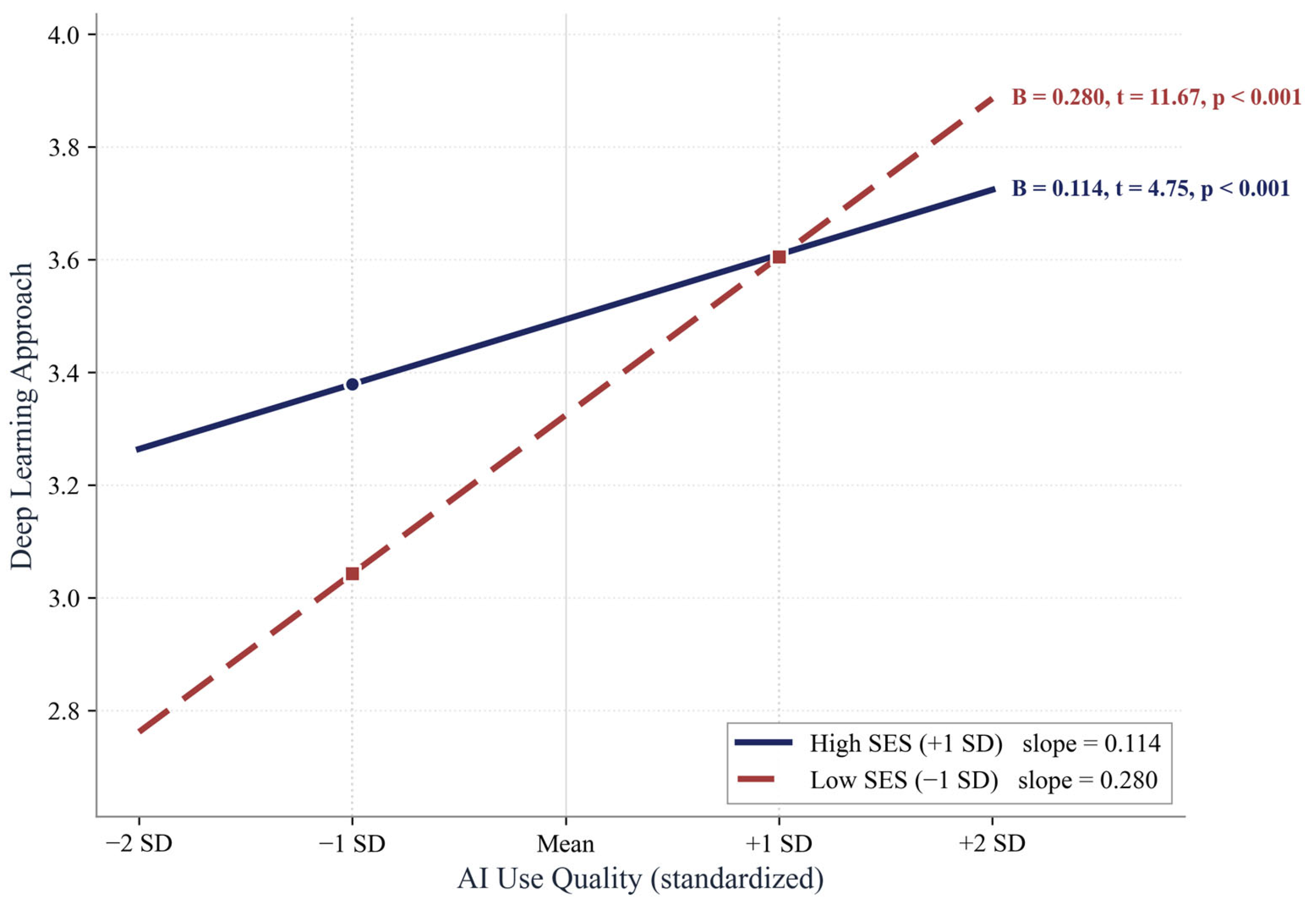
To probe the significant interaction, simple slope analysis was conducted at ±1 SD of SES (Figure 2). Both slopes were significant. The association between AI use quality and deep learning approach was substantially stronger for low-SES students (B = 0.280, SE = 0.024, t = 11.67, p < 0.001) than for high-SES students (B = 0.114, SE = 0.024, t = 4.75, p < 0.001). The slope for low-SES students was about 2.46 times that of their high-SES peers. AI use quality was therefore more strongly associated with deep learning approach among students from less affluent families.
This pattern is consistent with the equalizer hypothesis. When AI use quality was low, the gap in deep learning approach between high and low SES students was relatively large. As AI use quality increased, this gap narrowed because low-SES students showed a steeper association between AI use quality and deep learning approach.

4.6. Supplementary Analyses: Dimension-Specific Moderation

To check whether the moderation effect was consistent across the three dimensions of AI use quality, we estimated separate regression models using each dimension as the moderator. Table 5 presents the results.
All three interaction terms were statistically significant (p < 0.001), indicating that the equalizer pattern was not limited to a single dimension of AI use quality. The strongest moderation effect was for the applying dimension (β = −0.168, t = −4.407, p < 0.001), followed by seeking (β = −0.152, t = −4.053, p < 0.001) and evaluating (β = −0.143, t = −3.864, p < 0.001). We had initially expected seeking to be the dominant moderator, on the assumption that low-SES students would benefit most from simply having a willing tutor; the actual ranking pushed us toward a different reading. Active application of AI output to one’s own learning and proactive help-seeking appear to be the more important compensatory mechanisms for low-SES students.

5. Discussion

We tested whether family SES moderates the association between AI use quality and deep learning approach in Chinese high school students. The data support the resource substitution hypothesis. The interaction between family SES and AI use quality was significant and negative: the positive association between AI use quality and deep learning approach was substantially stronger for low-SES students than for their higher-SES peers. Simple slope analyses showed that AI use quality was about 2.5 times as strongly associated with deep learning approach for low-SES students as for high-SES students, and the same pattern held across all three dimensions of AI use quality.

5.1. The Equalizer Effect of AI Learning Tools

The SES-moderated pattern is the central finding. The resource substitution hypothesis [9] has been used in health and general education contexts, but its relevance to AI-assisted learning has remained largely untested. Our finding provides empirical support for that theoretical extension. When a resource substitutes for support that someone otherwise lacks, its value is greatest for those with the fewest alternatives. Low-SES students typically have less access to private tutoring, parental academic guidance, and enrichment activities. High-quality AI use may serve a compensatory role, providing explanations, worked examples, and feedback that are otherwise mainly available through resource-intensive channels. For higher-SES students, who already obtain such support through multiple pathways, the marginal contribution of AI tools is smaller. The data fit this logic: when low-SES students reported higher-quality AI tool use, the deep-learning gap between them and their higher-SES peers narrowed.
The finding is also consistent with the layered framework of digital divide theory [39]. Outcome-level inequalities (third-level divide) can be narrowed through differences in technology use quality (second-level divide) even when access (first-level divide) is held relatively constant. In our sample, all students had basic access to AI tools through their schools. The critical distinction lay not in whether students could use AI, but in how they used it. In contexts where access barriers have been largely removed, interventions targeting the quality of AI use may be a viable strategy for reducing SES-related learning disparities.
The equalizer pattern is especially relevant to the current Chinese context. The “double reduction” policy implemented in 2021 substantially curtailed the commercial tutoring industry, reducing a major channel through which higher-SES families had previously secured supplementary academic support [40]. This policy shift left a vacuum in after-school academic assistance that AI learning tools are well positioned to fill. In an education system where the gaokao remains the primary mechanism of social mobility, demand for individualized support has not diminished; it has shifted toward new channels. AI tools cost little, are always available, and can give personalized explanations. For low-SES students who may have fewer alternatives, the marginal value of these features could be comparatively greater. This reading is consistent with the stronger association observed in the simple slope analysis, though other explanations remain possible. Chinese high school students typically follow tightly structured daily schedules with limited time for autonomous, exploratory learning. Under those constraints, the quality rather than the quantity of AI use matters most. A student who uses AI for targeted conceptual clarification during brief self-study periods is more likely to benefit than one who uses it passively or indiscriminately.
The findings also point to a testable mechanism. Drawing on social cognitive theory [41], AI-mediated mastery experiences may represent an alternative pathway through which low-SES students build self-efficacy. When students seek help from AI and receive clear, targeted explanations, they may gradually develop a sense of competence, a core source of self-efficacy that has been linked to deeper learning engagement. In Chinese high schools, where class sizes typically range from 40 to 50 students and teachers cannot provide much individualized feedback, AI tools may be one of the few channels through which low-SES students can obtain the responsive, personalized academic support that supports building self-efficacy. We did not measure self-efficacy directly, so this mechanism remains a hypothesis. Future research could test it directly with moderated mediation designs.

5.2. Main Effects of SES and AI Use Quality

Both SES and AI use quality were significant predictors of deep learning approach. The standardized coefficient for AI use quality (β = 0.436, p < 0.001) was about twice that of SES (β = 0.193, p < 0.001). This matters in practice. SES is largely outside the reach of schools, but AI use quality is something schools can actively teach. The significant SES–deep-learning association is consistent with the literature documenting SES-related learning disparities [14,19]. In the Chinese context, this association probably reflects, in part, the widespread reliance on shadow education and the unequal ability of families with different economic means to access private tutoring and Supplementary Materials [20,22]. That AI use quality shows an even stronger association with deep learning approach suggests that cultivating students’ capacity for effective AI use can partly offset the educational advantages that higher SES confers. The finding is especially relevant in the Chinese high school context, where teacher-centered, lecture-based instruction remains common and class sizes of 40 to 50 students leave little room for individualized dialogue between teachers and students [42]. Under those conditions, AI tools may function as an on-demand supplement to classroom instruction, offering the kind of responsive, one-on-one explanatory interaction that the standard instructional format cannot easily provide. The fact that the quality of such interaction is more strongly linked to deep learning approach than family background is what gives AI literacy its leverage as an intervention target.

5.3. Dimension-Specific Patterns

The supplementary analyses showed that all three dimensions of AI use quality moderated the SES–deep-learning relationship, but with a notable rank order. Applying showed the strongest moderation effect (β = −0.168), followed by seeking (β = −0.152) and evaluating (β = −0.143). This hierarchy is itself informative. It suggests that the compensatory function of AI tools is most pronounced when students actively translate AI-generated information into their own learning, rather than passively receiving it. We had initially expected the seeking dimension to dominate, on the grounds that low-SES students might benefit most from simply having a willing source of help; the data pushed us toward a different reading. For low-SES students, who may have fewer models for how to integrate new information into existing knowledge structures, the act of applying AI output to one’s own work represents a critical step from receiving information to constructing knowledge. The strong moderation for seeking further indicates that proactively using AI for explanations and guidance constitutes a direct substitute for the personalized academic support available to higher-SES peers through tutors or knowledgeable family members. A feature of Chinese classroom culture may amplify this finding. Students in large classes are often reluctant to ask questions publicly for fear of losing face or being perceived as falling behind [43]. AI tools allow students to ask questions privately and repeatedly without social risk, lowering the psychological barrier to help-seeking. That barrier is likely highest for low-SES students who may feel more stigmatized by academic difficulties. The implication for instruction is clear: students should be trained to ask AI the right questions, and even more, to actively translate what they learn from AI into their own work.

5.4. Practical Implications

The findings carry several practical implications, particularly for the Chinese educational context. First, ensuring access to AI learning tools is necessary but not sufficient. Schools should invest in building students’ capacity for high-quality AI use, including the skills to formulate effective queries, evaluate AI responses, and meaningfully integrate AI output into learning activities. Recent frameworks for K-12 AI literacy emphasize that competency extends beyond technical knowledge to include confidence, ethical awareness, and self-reflective mindsets [44]. In the Chinese high school setting, where the curriculum is tightly structured around gaokao preparation, AI literacy instruction could be embedded within existing subject teaching rather than treated as a standalone course, for example, by training students to use AI for conceptual inquiry and self-checking during regular study sessions. Second, AI literacy instruction may be especially beneficial for students from lower-SES backgrounds, since the present data show a stronger association between AI use quality and deep learning approach for these students. In the post-“double reduction” landscape, with commercial tutoring options curtailed, schools bear a greater responsibility for ensuring that all students can access and effectively use the academic support resources available to them. Targeted AI literacy training for low-SES students may be a cost-effective way to partly compensate for the reduction in supplementary tutoring. Third, the compensatory potential of AI tools should not be taken for granted. Without deliberate instructional support, the Matthew effect remains a realistic risk, because higher-SES students may be better positioned to extract value from AI tools given their existing advantages in digital literacy and self-regulated learning. China’s national AI education initiatives, such as the integration of AI literacy into compulsory education curricula, provide a policy infrastructure for scaling such interventions, but the success of these initiatives will depend on whether they reach the students who need them most. These implications should be interpreted with caution given the cross-sectional design; intervention studies are needed to establish causal support.

6. Conclusions, Limitations, and Implications

6.1. Conclusions

We examined whether family SES moderates the association between AI use quality and deep learning approach among Chinese high school students, with implications for sustainable educational equity. The results supported the resource substitution hypothesis: the association between AI use quality and deep learning approach was stronger for low-SES students, and consequently, when AI use quality was high, the SES-based gap in deep learning approach was narrower. The effect was consistent across all three dimensions of AI use quality and was confirmed by bootstrap confidence intervals. AI learning tools have the potential to serve as compensatory resources for students from economically disadvantaged backgrounds, narrowing the SES-based gap in deep learning approach, provided that students engage with these tools in a deliberate and sophisticated way. In doing so, AI literacy education can become a sustainable lever for educational equity rather than another channel through which existing advantages are reproduced.

6.2. Limitations

This study has several limitations. The cross-sectional design precludes causal inference. Although the theoretical framework and the hypothesized direction of moderation are well grounded, the observed associations could reflect bidirectional influence or the operation of omitted variables; students who already adopt a deep approach to learning may also be more inclined to use AI tools in elaborate ways. Longitudinal or experimental designs are needed to confirm whether changes in AI use quality lead to changes in deep learning approach over time and whether this effect varies across SES groups. Relatedly, some interpretations offered in the Discussion, such as the suggestion that AI tools carry greater marginal value for low-SES students because these students lack alternative resources, go beyond what the cross-sectional data can establish. These interpretations are speculative and should be tested with longitudinal or quasi-experimental designs that can disentangle the proposed mechanisms.
A related concern is that all constructs were measured through self-report. Although procedural remedies were implemented and the common method bias test suggested that a dominant method factor was unlikely, self-report measures remain vulnerable to social desirability and retrospective bias. Future studies could supplement self-report data with objective indicators from AI platforms, such as query logs, session duration, and revision patterns.
The SES measure also has its own boundary. While well validated for adolescent populations, the FAS-III captures only the material dimension of SES and does not directly assess parental education or occupation. A more comprehensive SES measure incorporating cultural and social capital dimensions might reveal additional nuances in the moderation pattern.
Sampling further constrains generalizability. Participants came from three public high schools in Hangzhou that had already adopted AI tools, and students who had never used AI tools were excluded. These design choices ensured ecological validity but limited the populations to which the findings can be extended. Students in rural areas, private schools, or schools with less institutional support for AI integration, as well as students with no AI experience at all, may show different patterns, and replication across more diverse educational contexts is warranted.
Beyond these methodological caveats, the present design also left several analytical extensions for future work. Potential mediating mechanisms, such as academic self-efficacy or learning engagement, were not examined; moderated mediation models could identify the psychological pathways through which AI use quality differentially benefits low-SES students. Because only three schools were included, the data also did not support formal multilevel modeling, so school-level variables that may influence the SES × AI use quality interaction remain unexplored.

6.3. Concluding Remark

AI is now widespread in secondary schools, and whether it widens or narrows educational inequality has become one of the more pressing questions for sustainable educational equity. The Matthew and equalizer hypotheses have offered competing predictions for decades, but evidence on which pattern emerges with generative AI in secondary education has been thin. This study adds evidence from Chinese high school students, an under-studied group, and finds support for the equalizer reading. Among students who engaged with AI at higher cognitive depth, the SES-based gap in deep learning approach was meaningfully smaller, and low-SES students gained more from quality engagement than their higher-SES peers did. The pattern aligns with the spirit of SDG 4: equitable, inclusive, and quality education for all.
The result extends the resource substitution hypothesis into AI-mediated learning. When students engage with AI critically and apply its output deliberately, the tool can substitute for the kind of academic support that more affluent families pay for: tutoring, parental coaching, and enrichment activities. The multidimensional measure of AI use (seeking, evaluating, applying) was central to detecting this moderation. If the same data had been summarized only by access or frequency of use, the equalizer effect could easily have been missed.
The buffering documented here is conditional, not automatic. The relevant divide has shifted from access alone to the cognitive depth of engagement: who proactively seeks AI help, who evaluates AI responses critically, and who applies AI output back into their own learning. For policymakers and schools, this reframes the policy question. Closing the access gap is necessary but not sufficient. What schools also owe their students, especially those whose families cannot supplement classroom instruction, is explicit guidance in using AI as a deliberate cognitive partner rather than a shortcut to answers. Without such guidance, even universal AI access could leave existing inequalities intact or relocate them to a second-level digital divide.
In a system marked by intense academic competition and uneven family resources, AI may turn out to be one of the few educational resources whose marginal value is highest for students with the fewest alternatives. Whether that holds in real classrooms depends on whether schools treat AI literacy as an instructional priority across subjects, instead of leaving it to whatever students happen to absorb at home. For sustainable educational equity to take root in the AI era, this priority cannot remain rhetorical. The stakes are high enough to warrant serious, equity-focused attention.


Supplementary Materials

The following supporting information can be downloaded at: https://www.mdpi.com/article/10.3390/su18136925/s1, Table S1: Family Affluence Scale III Items; Table S2: AI Use Quality Items; Table S3: Deep Learning Items.

Author Contributions

Author Contributions: Conceptualization, Z.Z. and F.A.; methodology, Z.Z.; formal analysis, Z.Z.; investigation, Z.Z.; data curation, Z.Z.; writing—original draft preparation, Z.Z.; writing—review and editing, F.A.; visualization, Z.Z.; supervision, F.A.; project administration, F.A. All authors have read and agreed to the published version of the manuscript.

Funding

This research received no external funding.

Institutional Review Board Statement

The Ethics Committee of the Jing Hengyi School of Education, Hangzhou Normal University, has determined that this project involves minimal risk to participants. The study complies with the Declaration of Helsinki and is approved to proceed (protocol code 2022010 and approval date: 15 March 2025).

Informed Consent Statement

Informed consent was obtained from all individual participants included in the study.

Data Availability Statement

The data presented in this study are available on request from the corresponding author. The data are not publicly available due to privacy and ethical restrictions.

Conflicts of Interest

The authors declare no conflicts of interest.

References

  1. Chiu, T.K.F. The impact of Generative AI (GenAI) on practices, policies and research direction in education: A case of ChatGPT and Midjourney. Interact. Learn. Environ. 2024, 32, 6187–6203. [Google Scholar] [CrossRef] [Scilit]
  2. Deng, R.; Jiang, M.; Yu, X.; Lu, Y.; Liu, S. Does ChatGPT enhance student learning? A systematic review and meta-analysis of experimental studies. Comput. Educ. 2025, 227, 105224. [Google Scholar] [CrossRef] [Scilit]
  3. Lim, W.M.; Gunasekara, A.; Pallant, J.L.; Pallant, J.I.; Pechenkina, E. Generative AI and the future of education: Ragnarök or reformation? A paradoxical perspective from management educators. Int. J. Manag. Educ. 2023, 21, 100790. [Google Scholar] [CrossRef] [Scilit]
  4. Chai, C.S.; Wang, X.; Xu, C. An Extended Theory of Planned Behavior for the Modelling of Chinese Secondary School Students’ Intention to Learn Artificial Intelligence. Mathematics 2020, 8, 2089. [Google Scholar] [CrossRef] [Scilit]
  5. Ng, D.T.K.; Leung, J.K.L.; Chu, S.K.W.; Qiao, M.S. Conceptualizing AI literacy: An exploratory review. Comput. Educ. Artif. Intell. 2021, 2, 100041. [Google Scholar] [CrossRef] [Scilit]
  6. DiMaggio, P.; Hargittai, E. From the ’Digital Divide’ to ’Digital Inequality’: Studying Internet Use as Penetration Increases; Princeton University: Princeton, NJ, USA, 2001. [Google Scholar] [CrossRef] [Scilit]
  7. Merton, R.K. The Matthew Effect in Science: The reward and communication systems of science are considered. Science 1968, 159, 56–63. [Google Scholar] [CrossRef] [Scilit]
  8. Zhang, C.X.; Rice, R.E.; Wang, L.H. College students’ literacy, ChatGPT activities, educational outcomes, and trust from a digital divide perspective. New Media Soc. 2026, 28, 673–695. [Google Scholar] [CrossRef] [Scilit]
  9. Ross, C.E.; Mirowsky, J. Sex differences in the effect of education on depression: Resource multiplication or resource substitution? Soc. Sci. Med. 2006, 63, 1400–1413. [Google Scholar] [CrossRef] [Scilit] [PubMed]
  10. Warschauer, M.; Tate, T. Digital Divides and Social Inclusion. In Handbook of Writing, Literacies, and Education in Digital Cultures, 1st ed.; Mills, K.A., Stornaiuolo, A., Smith, A., Jessica Zacher, P., Eds.; Routledge: London, UK, 2017; pp. 63–75. [Google Scholar] [CrossRef] [Scilit]
  11. Van Dijk, J. The Deepening Divide: Inequality in the Information Society; SAGE Publications, Inc.: Thousand Oaks, CA, USA, 2005. [Google Scholar] [CrossRef] [Scilit]
  12. Hargittai, E. Second-Level Digital Divide: Differences in People’s Online Skills. First Monday 2002, 7, 1–20. [Google Scholar] [CrossRef] [Scilit]
  13. Strzelecki, A. To use or not to use ChatGPT in higher education? A study of students’ acceptance and use of technology. Interact. Learn. Environ. 2024, 32, 5142–5155. [Google Scholar] [CrossRef] [Scilit]
  14. Sirin, S.R. Socioeconomic Status and Academic Achievement: A Meta-Analytic Review of Research. Rev. Educ. Res. 2005, 75, 417–453. [Google Scholar] [CrossRef] [Scilit]
  15. Biggs, J.; Kember, D.; Leung, D.Y.P. The revised two-factor Study Process Questionnaire: R-SPQ-2F. Br. J. Educ. Psychol. 2001, 71, 133–149. [Google Scholar] [CrossRef] [Scilit] [PubMed]
  16. Entwistle, N.; Ramsden, P. Understanding Student Learning (Routledge Revivals); Routledge: London, UK, 2015. [Google Scholar]
  17. Marton, F.; Säaljö, R. On Qualitative Differences in Learning—II Outcome as A Function of the Learner’s Conception of the Task. Br. J. Educ. Psychol. 1976, 46, 115–127. [Google Scholar] [CrossRef] [Scilit]
  18. Yan, Z. The Self-assessment Practice Scale (SaPS) for Students: Development and Psychometric Studies. Asia-Pac. Educ. Res. 2018, 27, 123–135. [Google Scholar] [CrossRef] [Scilit]
  19. White, K.R. The relation between socioeconomic status and academic achievement. Psychol. Bull. 1982, 91, 461–481. [Google Scholar] [CrossRef]
  20. Bray, M.; Zhan, S.; Lykins, C.; Wang, D.; Kwo, O. Differentiated demand for private supplementary tutoring: Patterns and implications in Hong Kong secondary education. Econ. Educ. Rev. 2014, 38, 24–37. [Google Scholar] [CrossRef] [Scilit]
  21. Zhang, W.; Bray, M. Comparative research on shadow education: Achievements, challenges, and the agenda ahead. Eur. J. Educ. 2020, 55, 322–341. [Google Scholar] [CrossRef] [Scilit]
  22. Du, S. Shadow education in shadow: Parental education and children’s shadow education participation before and during COVID-19. Br. J. Sociol. Educ. 2024, 45, 420–439. [Google Scholar] [CrossRef] [Scilit]
  23. Liu, J. Does cram schooling matter? Who goes to cram schools? Evidence from Taiwan. Int. J. Educ. Dev. 2012, 32, 46–52. [Google Scholar] [CrossRef] [Scilit]
  24. Wu, R.; Yu, Z. Do AI chatbots improve students learning outcomes? Evidence from a meta-analysis. Br. J. Educ. Technol. 2024, 55, 10–33. [Google Scholar] [CrossRef] [Scilit]
  25. Ouyang, F.; Jiao, P. Artificial intelligence in education: The three paradigms. Comput. Educ. Artif. Intell. 2021, 2, 100020. [Google Scholar] [CrossRef] [Scilit]
  26. Hattie, J.; Timperley, H. The Power of Feedback. Rev. Educ. Res. 2007, 77, 81–112. [Google Scholar] [CrossRef] [Scilit]
  27. Yan, Z.; Brown, G.T.L. A cyclical self-assessment process: Towards a model of how students engage in self-assessment. Assess. Eval. High. Educ. 2017, 42, 1247–1262. [Google Scholar] [CrossRef] [Scilit]
  28. Di Pietro, G.; Castaño Muñoz, J. A meta-analysis on the effect of technology on the achievement of less advantaged students. Comput. Educ. 2025, 226, 105197. [Google Scholar] [CrossRef] [Scilit]
  29. Loh, R.S.M.; Kraaykamp, G.; Van Hek, M. Student ICT resources and intergenerational transmission of educational inequality: Testing implications of a reproduction and mobility perspective. Eur. Sociol. Rev. 2023, 39, 804–819. [Google Scholar] [CrossRef] [Scilit]
  30. Currie, C.; Molcho, M.; Boyce, W.; Holstein, B.; Torsheim, T.; Richter, M. Researching health inequalities in adolescents: The development of the Health Behaviour in School-Aged Children (HBSC) Family Affluence Scale. Soc. Sci. Med. 2008, 66, 1429–1436. [Google Scholar] [CrossRef] [Scilit] [PubMed]
  31. Torsheim, T.; Cavallo, F.; Levin, K.A.; Schnohr, C.; Mazur, J.; Niclasen, B.; Currie, C.; FAS Development Study Group. Psychometric Validation of the Revised Family Affluence Scale: A Latent Variable Approach. Child Indic. Res. 2016, 9, 771–784. [Google Scholar] [CrossRef] [Scilit] [PubMed]
  32. Zhang, L.-F. Does the big five predict learning approaches? Personal. Individ. Differ. 2003, 34, 1431–1446. [Google Scholar] [CrossRef] [Scilit]
  33. Faul, F.; Erdfelder, E.; Buchner, A.; Lang, A.-G. Statistical power analyses using G*Power 3.1: Tests for correlation and regression analyses. Behav. Res. Methods 2009, 41, 1149–1160. [Google Scholar] [CrossRef] [Scilit] [PubMed]
  34. Aguinis, H.; Beaty, J.C.; Boik, R.J.; Pierce, C.A. Effect Size and Power in Assessing Moderating Effects of Categorical Variables Using Multiple Regression: A 30-Year Review. J. Appl. Psychol. 2005, 90, 94–107. [Google Scholar] [CrossRef] [Scilit] [PubMed]
  35. Fornell, C.; Larcker, D.F. Evaluating Structural Equation Models with Unobservable Variables and Measurement Error. J. Mark. Res. 1981, 18, 39. [Google Scholar] [CrossRef] [Scilit]
  36. Sinacore, J.M. Multiple regression: Testing and interpreting interactions. Eval. Pract. 1993, 14, 167–168. [Google Scholar] [CrossRef] [Scilit]
  37. Podsakoff, P.M.; MacKenzie, S.B.; Lee, J.-Y.; Podsakoff, N.P. Common method biases in behavioral research: A critical review of the literature and recommended remedies. J. Appl. Psychol. 2003, 88, 879–903. [Google Scholar] [CrossRef] [Scilit] [PubMed]
  38. Cheung, G.W.; Rensvold, R.B. Evaluating Goodness-of-Fit Indexes for Testing Measurement Invariance. Struct. Equ. Model. A Multidiscip. J. 2002, 9, 233–255. [Google Scholar] [CrossRef] [Scilit] [PubMed]
  39. Scheerder, A.J.; Van Deursen, A.J.A.M.; Van Dijk, J.A.G.M. Taking advantage of the Internet: A qualitative analysis to explain why educational background is decisive in gaining positive outcomes. Poetics 2020, 80, 101426. [Google Scholar] [CrossRef] [Scilit]
  40. Xue, E.; Li, J. What is the value essence of “double reduction” (Shuang Jian) policy in China? A policy narrative perspective. Educ. Philos. Theory 2023, 55, 787–796. [Google Scholar] [CrossRef] [Scilit]
  41. Kleppang, A.L.; Steigen, A.M.; Finbråten, H.S. Explaining variance in self-efficacy among adolescents: The association between mastery experiences, social support, and self-efficacy. BMC Public Health 2023, 23, 1665. [Google Scholar] [CrossRef] [Scilit] [PubMed]
  42. Deng, L.; Wu, Y.; Chen, L.; Peng, Z. ‘Pursuing competencies’ or ’pursuing scores’? High school teachers’ perceptions and practices of competency-based education reform in China. Teach. Teach. Educ. 2024, 141, 104510. [Google Scholar] [CrossRef] [Scilit]
  43. Jin, L.; Cortazzi, M. Changing Practices in Chinese Cultures of Learning. Lang. Cult. Curric. 2006, 19, 5–20. [Google Scholar] [CrossRef] [Scilit]
  44. Chiu, T.K.F.; Ahmad, Z.; Ismailov, M.; Sanusi, I.T. What are artificial intelligence literacy and competency? A comprehensive framework to support them. Comput. Educ. Open 2024, 6, 100171. [Google Scholar] [CrossRef] [Scilit]
Figure 1. Hypothesized model.
Sustainability 18 06925 g001
Figure 2. Simple Slopes of AI Use Quality Predicting Deep learning approach at Low (−1 SD) and High (+1 SD) SES.
Sustainability 18 06925 g002
Table 1. Descriptive Statistics of the Sample (N = 548).
VariableCategoryFrequencyPercentage (%)
GenderMale28251.1
Female26648.5
Grade1027249.6
1127650.4
Table 2. Factor Loadings, Reliability, and Validity Indices.
FactorsItemsStd.SMCCRAVE
SASA10.7820.6120.8510.588
SA20.7620.581
SA30.7480.56
SA40.7740.599
EAEA10.7920.6270.8490.585
EA20.7680.59
EA30.7420.551
EA40.7560.572
AAAA10.8120.6590.8620.609
AA20.7740.599
AA30.7860.618
AA40.7480.56
DLADLA10.7380.5450.8960.59
DLA20.8180.669
DLA30.7560.572
DLA40.840.706
DLA50.7240.524
DLA60.6920.479
Note. SA = Seeking AI Help; EA = Evaluating AI Responses; AA = Applying AI Output; DLA = Deep Learning Approach. Std. = standardized factor loading; SMC = squared multiple correlation (Std.2); CR = composite reliability; AVE = average variance extracted. Recommended thresholds: Std. ≥ 0.50, CR ≥ 0.70, AVE ≥ 0.50. All factor loadings were significant at p < 0.001.
Table 3. Means, Standard Deviations, Correlations, and Discriminant Validity (N = 548).
VariableMSD123456
1. FAS-III7.531.97
2. SA3.50.660.209 **0.766
3. EA3.530.650.212 **0.609 **0.765
4. AA3.320.70.186 **0.614 **0.599 **0.780
5. AI use3.450.580.235 **0.860 **0.852 **0.865 **
6. DLA3.360.450.290 **0.416 **0.448 **0.380 **0.482 **0.768
Note. ** p < 0.01. The bold values on the diagonal are √AVE for each construct: 0.766 for SA, 0.765 for EA, 0.780 for AA, and 0.768 for DLA. Discriminant validity is supported when each √AVE exceeds the construct’s correlations with other constructs in the same row and column. FAS-III = Family Affluence Scale total; SA = seeking; EA = evaluating; AA = applying; AI use = composite AI use quality, computed as the mean of SA, EA, and AA, and therefore reported without a separate √AVE; DLA = deep learning approach.
Table 4. Hierarchical Regression Results Predicting Deep learning approach (N = 548).
PredictorStep 1Step 2Step 3
Bβ95% CIBβ95% CIBβ95% CI
Constant3.370 *** [3.293, 3.447]3.377 *** [3.312, 3.443]3.409 *** [3.344, 3.474]
Gender−0.021−0.023[−0.097, 0.055]−0.034−0.038[−0.100, 0.031]−0.039−0.043[−0.103, 0.025]
Grade−0.020−0.022[−0.097, 0.056]00[−0.065, 0.066]−0.011−0.013[−0.076, 0.053]
SES(z) 0.085 ***0.188[0.051, 0.119]0.087 ***0.193[0.054, 0.120]
AI use(z) 0.198 ***0.439[0.164, 0.232]0.197 ***0.436[0.164, 0.230]
SES × AI use −0.083 ***−0.177[−0.116, −0.049]
R20.0010.2670.298
Adj.R2−0.0030.2610.291
ΔR2 0.266 ***0.031 ***
f2(ΔR2) 0.044
F0.29249.219 ***45.930 ***
Note. *** p < 0.001. Gender: 0 = female, 1 = male. Grade: 0 = Grade 10, 1 = Grade 11. All VIF values < 1.07.
Table 5. Dimension-Specific Moderation Results.
DimensionB (Main)β (Main)B (Interaction)β (Interaction)SEtpR2 (Full)
Seeking0.1690.373−0.071−0.1520.017−4.053<0.0010.241
Evaluating0.1810.401−0.068−0.1430.018−3.864<0.0010.262
Applying0.1540.34−0.076−0.1680.017−4.407<0.0010.223
Disclaimer/Publisher’s Note: The statements, opinions and data contained in all publications are solely those of the individual author(s) and contributor(s) and not of MDPI and/or the editor(s). MDPI and/or the editor(s) disclaim responsibility for any injury to people or property resulting from any ideas, methods, instructions or products referred to in the content.