Review

Emotional Intelligence as a Driver of Pro-Environmental Behavior: A Conceptual Review for Climate Action


1
Department of GEPLI, Lumsa University, 00193 Rome, Italy
2
Department of Human Sciences, Lumsa University, 00193 Rome, Italy
*
Author to whom correspondence should be addressed.
Sustainability 2026, 18(13), 6904; https://doi.org/10.3390/su18136904
Submission received: 8 May 2026 / Revised: 14 June 2026 / Accepted: 22 June 2026 / Published: 7 July 2026
(This article belongs to the Special Issue Circular Economy and Green Technology for Sustainable Development)

Abstract

This paper examines whether the persistent difficulty in addressing the eco-social crisis may partly stem from an inadequate representation of human decision-making within mainstream economic models. Although pro-environmental behaviors (PEBs) and sustainable consumption are increasingly recognized as essential for sustainability transitions, neoclassical economics still largely relies on the homo oeconomicus paradigm, which assumes fully rational and utility-maximizing decision-making. Building on contributions from psychology, behavioral economics, neuroscience, and sustainability studies, this integrative narrative review examines how cognitive biases challenge the foundational assumptions of homo oeconomicus and explores the potential role of emotional intelligence in sustainability-related decision-making. Adopting the integrative narrative review approach, this paper integrates literature on (1) cognitive biases and bounded rationality; (2) emotional intelligence and judgment bias; and (3) emotional intelligence, pro-environmental behaviors, and sustainable consumption. The evidence reviewed suggests that sustainability-related decisions are strongly shaped by cognitive and emotional processes operating under uncertainty and socially embedded consumption patterns. Within this framework, EI may represent a psychological resource capable of influence of cognitive biases by supporting emotional regulation, impulse control, self-awareness, and long-term orientation. Overall, the paper proposes a conceptual framework linking cognitive biases, emotional intelligence, and sustainable behavior beyond the traditional homo oeconomicus paradigm.

1. Introduction

The contemporary world is marked by a profound contradiction. Over the last two centuries, economic growth and technological progress have substantially increased material well-being and life expectancy. At the same time, however, humanity is facing an escalating eco-social crisis characterized by climate change, environmental degradation, biodiversity loss, rising inequalities, and increasing social instability. These challenges threaten not only ecological systems but also long-term human well-being and social cohesion. In response, governments and international institutions have increasingly emphasized the need to accelerate the transition toward sustainable development (SD), as reflected in the 2030 Agenda for Sustainable Development (SD) and its 17 goals (SDGs) [1]. In particular, along SDG 12 of the Agenda, pro-environmental behaviors (PEBs) and sustainable consumption (SC) are widely viewed as key drivers of SD [2,3,4]. Several personal (e.g., positive attitudes on environmental protection, knowledge, values, perceived availability), social and contextual factors (e.g., living conditions, socio-economic properties, norms, policy programs, technology changes and business practices) relate to PEBs and SC [5,6]. Interestingly, personal factors emerge as most relevant for PEBs and SC, where evidence shows that nations’ SD rises if consumers adapt their choices to PEBs and SC [3,7,8,9,10]. Specifically, consumption can be viewed from two angles: (i) satisfaction-seeking orientation—the need to fulfill basic needs—and (ii) pleasure-seeking orientation—the fulfilling of desires and needs [11]. The latter stimulates the desire to possess even excessive and unnecessary goods [3]. SC keeps a balanced consumption oriented toward purchasing goods and services that satisfy basic needs [3]. Scholars and policymakers admit that tackling unsustainable individual consumption patterns is vital to achieving SD [12,13,14]. Along these lines, recent research emphasizes the role of mindfulness and responsibility in shaping SC sustainable consumption [13]. Nevertheless, despite that admission, little has been achieved to markedly curb unsustainable behavioral patterns [12]. Research on the antecedents of consumers’ behavior has mainly examined cognitive variables (e.g., personal moral philosophies, Machiavellianism, materialism, risk propensity, need for closure, religiosity, and attitude towards money and business) while neglecting affective factors [15,16,17]. Nevertheless, sustainability is primarily an ethical issue [18]. In turn, PEBs support SD not only through SC practices but, more broadly, by fostering a more sustainable individual profile. In this process, environmental identity plays a crucial role [8], encouraging individuals to reduce their negative environmental impacts and actively contribute to positive environmental outcomes [19,20].
Yet, despite growing scientific consensus and public awareness, progress toward sustainability targets remains insufficient. This persistent gap between environmental awareness and actual behavior suggests that technological innovation and rational policy instruments alone may not be sufficient to foster sustainable transitions. This issue raises broader questions regarding how human decision-making is conceptualized. Traditional neoclassical economics largely relies on the homo oeconomicus paradigm. However, extensive evidence from psychology, behavioral economics, and neuroscience has shown that human decision-making is systematically shaped by cognitive biases, heuristics, emotions, and social influences. In this context, EI may be a relevant yet underexplored factor in sustainability-related decision-making. Rather than viewing rationality and emotions as mutually exclusive dimensions, recent psychological and neuroscientific research increasingly suggests that effective decision-making depends on their interaction.
Building on this perspective, this paper develops an integrative narrative review aimed at examining the relationships between cognitive biases, EI, and sustainable behaviors. More specifically, the review addresses four main objectives: (1) to analyze how cognitive biases challenge the assumptions of the homo oeconomicus paradigm and contribute to unsustainable behaviors; (2) to examine whether EI may mitigate judgment biases and improve decision-making processes; (3) to explore the relationship between EI, PEBs, and SC; and (4) to propose a conceptual framework integrating emotional and cognitive dimensions within sustainability-related decision-making.
The paper contributes to the literature in two main ways. First, it systematically links cognitive biases to the foundational assumptions of the homo oeconomicus paradigm, providing a behavioral critique of traditional economic models within the context of sustainability. Second, it explores the potential role of EI as a debiasing mechanism that may help foster more sustainable decision-making, while recognizing the influence of broader socio-economic and contextual constraints. The remainder of the paper is organized as follows. Section 2 presents the methodology adopted for the integrative narrative review. Section 3 examines the limitations of the homo oeconomicus paradigm and the role of cognitive biases in decision-making. Section 4 explores the potential contribution of EI to debiasing processes. Section 5 reviews the literature on EI, PEBs, and SC. Section 6 discusses the theoretical implications of integrating EI into sustainability-related decision-making frameworks. Finally, Section 7 summarizes the main conclusions, limitations, and future research directions.

2. Methodology

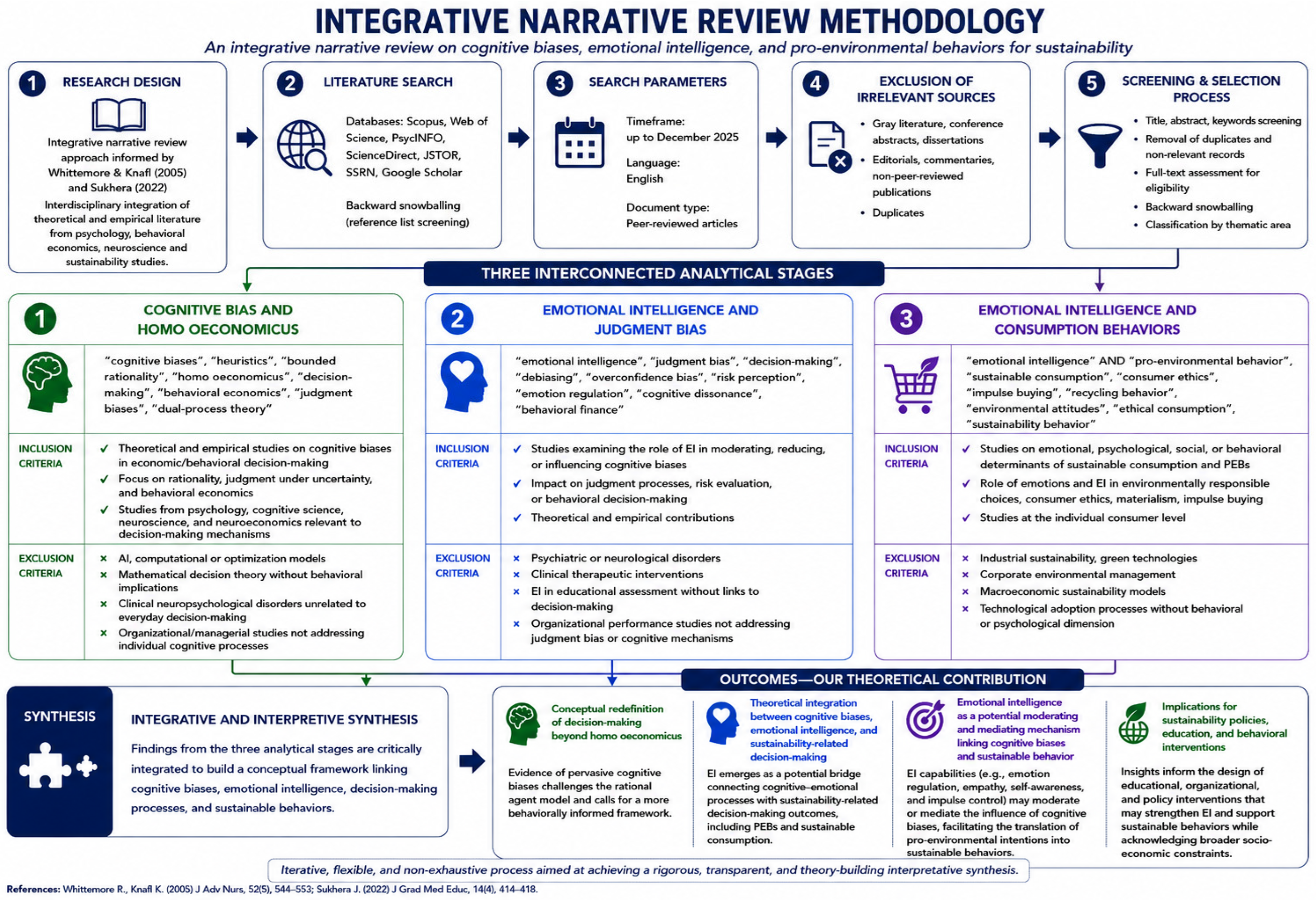
This study adopts an integrative narrative review approach to examine the relationships between cognitive biases, EI, and PEBs within the broader framework of SC and climate action. The review methodology was informed by the principles proposed by Whittemore and Knafl [21] and by recent contributions on rigorous narrative reviews emphasizing transparency, interpretative synthesis, and interdisciplinary integration [22].
Consistent with the aims of the paper, three interconnected analytical stages focused on: (1) cognitive biases and the homo oeconomicus paradigm; (2) EI and judgment bias; and (3) EI and SC behaviors. Given the conceptual and interdisciplinary nature of the topic, the review integrated theoretical and empirical contributions from psychology, behavioral economics, neuroscience, and sustainability studies.
A literature search was conducted using Scopus, Web of Science, PsycINFO, ScienceDirect, JSTOR, SSRN, and Google Scholar. The search included peer-reviewed English-language publications available up to December 2025. Additional studies were identified through backward snowballing procedures based on the reference lists of selected articles. Gray literature, dissertations, editorials, conference abstracts, and non-peer-reviewed publications were excluded. The first stage used combinations of the keywords “cognitive bias”, “heuristics”, “bounded rationality”, “homo oeconomicus”, “decision-making”, and “behavioral economics”, focusing on studies addressing cognitive biases in economic and behavioral decision-making. The second stage used combinations of “emotional intelligence”, “judgment bias”, “debiasing”, “risk perception”, “emotion regulation”, and “behavioral finance”, focusing on studies examining the role of EI in moderating cognitive biases and decision-making processes. The third stage used combinations of “emotional intelligence”, “pro-environmental behavior”, “sustainable consumption”, “consumer ethics”, and “impulse buying”, focusing on emotional and behavioral determinants of sustainable consumption and environmentally responsible behavior.
The literature selection process followed an iterative approach. Titles, abstracts, and keywords were initially screened to identify relevant studies, followed by full-text analyses aimed at assessing conceptual relevance and methodological consistency. Studies unrelated to human decision-making, sustainability-related behaviors, or emotional and cognitive processes were excluded. The final synthesis critically integrated findings across disciplines in order to develop a broader conceptual understanding of the role of emotional intelligence in mitigating cognitive biases and promoting sustainable behaviors. Figure 1 summarizes the methodological process adopted in this review.

3. The Concept of Homo Oeconomicus and Its Contradictions

The neoclassical approach that dominates economics and mainstream economic thinking has long been grounded in the idea of the homo oeconomicus: a rational individual maximizing utility and optimizing resources under conditions of scarcity [23]. In this framework, rationality is assumed to guide decision-making processes, while ethical, emotional, and social dimensions remain largely external to economic analysis. In depicting the homo oeconomicus, Mill [24] focused primarily on the economic motivations underlying human actions, portraying decision-makers as universal and context-independent agents.
Based on this representation, several influential theories of decision-making, including Rational Choice Theory and Expected Utility Theory, have been developed and refined over time [25]. However, growing evidence from psychology, behavioral economics, and neuroscience increasingly challenges the assumption that individuals make decisions through fully rational and unbiased processes [26,27,28].
When making decisions, individuals frequently rely on heuristics and cognitive shortcuts [28]. Moreover, judgments are strongly influenced by affective experiences and emotional states, which shape how information is perceived, interpreted, and evaluated [27]. Consequently, cognitive and emotional dimensions cannot be separated when analyzing human decision-making processes [29,30]. Behavioral economics and, more recently, neuroeconomics have progressively questioned the micro-foundations of neoclassical decision-making models by showing that human behavior systematically deviates from strict rationality [26].
Generally speaking, the homo oeconomicus paradigm rests on six foundational assumptions: (i) profit/utility maximization; (ii) flawless rationality; (iii) unlimited cognitive capacity; (iv) perfect information; (v) narrow self-interest; and (vi) preference consistency. Within this framework, individuals are expected to make coherent, informed, and utility-maximizing choices free from systematic distortions. Yet, psychological research suggests that decision-making is shaped by cognitive, emotional, motivational, and contextual factors that often produce biased judgments and inconsistent behaviors [29,30,31]. The critique of purely rational decision-making was first articulated by Simon’s concept [32] of bounded rationality, developed in opposition to the assumptions of expected utility theory [33]. According to Simon, individuals make decisions under cognitive and informational constraints and therefore rely on simplified strategies rather than exhaustive optimization processes [34,35]. Rationality is thus bounded by both internal limitations, such as limited cognitive processing capacity, and external constraints related to uncertainty and incomplete information Simon [35]. As a result, individuals often make decisions that are satisfactory rather than optimal. Simon’s critique laid the foundations of the so-called “old behavioral economics” [35].
Later, Tversky and Kahneman’s seminal work on heuristics and biases further demonstrated that human judgments systematically deviate from normative rational models [36]. Central to this perspective is the notion of heuristics, namely intuitive reasoning strategies that simplify information processing while increasing vulnerability to systematic errors [36]. This approach was further developed through dual-process theories distinguishing between two systems of thinking [37,38,39,40]. System 1 operates automatically, quickly, intuitively, and often emotionally, whereas System 2 involves slower, effortful, reflective, and rule-based reasoning. Although System 2 may occasionally correct intuitive responses, much of everyday decision-making appears to be dominated by System 1 processes [28,29,37].
Within this framework, cognitive biases can be understood as systematic and recurrent deviations from normatively rational decision-making [36,41]. These biases affect information processing, judgment under uncertainty, risk perception, intertemporal choices, and social behavior. According to Svenson, biases may emerge throughout all stages of the decision-making process, including problem formulation, evaluation of alternatives, and post-decision assessment [42].
Since the pioneering work of Tversky and Kahneman [36], more than 200 cognitive biases and related effects have been identified. Scholars have proposed different ways of categorizing them depending on cognitive processes, informational mechanisms, or contextual conditions [31,43,44]. Moreover, because individuals are embedded in social structures, institutions, and relational dynamics [45], cognitive biases also emerge within interpersonal and group contexts, often affecting sustainable behaviors and social coordination processes [46]. In addition, decision-making processes are influenced by emotions, age, experience, and motivational factors [27,47,48].
In Table 1, we classify the most common cognitive biases discussed in the literature and link them to the foundational assumptions of the homo oeconomicus paradigm. While some biases may simultaneously affect multiple dimensions, each bias was associated with the dimension considered most directly challenged for analytical clarity.
The growing evidence on cognitive biases suggests that human decision-making cannot be adequately explained through purely rationalistic models alone. Emotions are an indispensable part of human life; feelings affect personal choices or judgments [105,106], and emotional signals are treated as a source of information [107]. In this respect, the somatic marker hypothesis (SMH) proposed by Damasio provides a good model for conceptualizing how affective and emotional information can be incorporated into cognitive processes [108].
In sum, it is time to redefine homo oeconomicus, which often does not correspond to human beings functioning and behaving, being closer to the prototype of a psychopath [109], and a considerable threat to business ethics [110]. As stressed by Nelson, we are individuals in relationships [111]. It is meaningful to stress that cognitive biases also impact our relationality; think of the ingroup bias and its impact on group settings and polarization, as highlighted by Engler et al. [46]. Therefore, the evolution of the homo oeconomicus paradigm needs to take a step forward. Finally, interesting attempts to move beyond the homo oeconomicus paradigm have already emerged in the literature. Among them, Rotondi et al. proposed the notion of “persona economica,” emphasizing the relational and ethical dimensions of economic behavior [112].

4. Debiasing the Decision-Making Process: A Possible Role for Affective System and Emotional Intelligence

Tversky and Kahneman proposed that, under uncertainty, decisions are typically controlled by judgmental heuristics rather than laws of probability [36]. Generally, a heuristic can be described as an intuitive approach to decision-making that may offer expedience at the risk of cognitive error (bias).
As highlighted in Section 3, cognitive biases are systematic distortions of decision-making arising from heuristics used to simplify large quantities of data. Therefore, the question is as follows: what is the adaptive role of heuristics and cognitive biases? As Arkes argues, the costs and benefits of cognitive biases have to be viewed from an evolutionary perspective to better identify debiasing strategies [113]. He identifies three main categories of cognitive biases: strategy-based errors, associations-based errors, and psychophysicallybased errors.
All these errors reflect the advantage of choosing strategies, retrieving information from memory, and interpreting the context in which decisions or judgments are made quickly and effortlessly. The cost of these choices is the irrationality of the decision-making process.
How can we, then, improve the decision-making process? Contrasting results emerge about the efficacy of debiasing strategies. Research has shown that training in statistical and probabilistic reasoning and cognitive repair techniques reduces cognitive biases only slightly, particularly when procedures have to address situations encountered in natural settings [29]. In turn, limited success in using training to decrease decision biases led scientists and policymakers to focus on debiasing using incentives, information, and nudging to address biased judgments and decisions [114].
Research in the field has successfully collaborated with industry and governments to reduce waste and improve health and finance [48,115,116]. However, the systemic review by Beshears and Kosowsky reveals that nudging on various decision-making processes (e.g., economics and finance, environmental science, marketing, and consumer behavior) is limited when only information and incentives are available [117]. Indeed, more than 70% of the “nudge effect” involved the intuitive and irrational System 1, postulated by Kahneman, with a significant role played by arousing emotions [40]. In the following paragraphs we tentatively present a framework in which EI may explain how individuals cognitively manage the transition between emotionally driven System 1 activation and deliberative System 2 processing. Rather than eliminating emotional responses, EI may facilitate the accurate perception, interpretation, and regulation of negative somatic markers. In this sense, EI functions as a regulatory mechanism that determines whether emotionally salient signals become cognitively disruptive or are instead integrated into reflective planning processes. Accordingly, EI may help preserve deliberative reasoning under uncertainty conditions.

4.1. The Dual-Process Theory and the Contribution of Neuroscience in Understanding the Mechanisms of the Decision-Making Process

Referring again to Kahneman’s System 1 and System 2 approach, the work by neurologist Damasio on the SMH provides a neural basis for the interaction between emotion and cognition in decision-making [108]. By studying the behavior of patients with damage to the ventromedial prefrontal cortex, he demonstrated that the emotional information, generally provided as a result of the activity of the somatic marker, was essential for decision-making under uncertainty [118]. In brief, ventromedial patients could not integrate somatic signals from the emotional context with situational information [119]. In this case, the decision-making process can be driven exclusively by costs and benefits analysis, and despite having standard intellectual capacities, such as cognitive intelligence, memory, and language, they displayed decision-making deficits in everyday life [108,120]. The physiological signals (somatic markers) and related emotions associated with outcomes of past experiences modulate (bias) decision-making processes: if physiological signals and related emotions are positive, then the behavior is allowed; if emotions are negative, then the behavior is inhibited. This evidence and others lead to the idea that the SMH properly conceptualizes how affective and emotional information might be integrated with more rational cognitive processes, resembling the automatic affective evaluation of System 1 [121].
From an evolutionary perspective, Damasio’s SMH explains and predicts the adaptive role of body state detection and emotions in decision-making [118]. Emotions might have emerged when animals, moving from water to land, encountered more complex and unstable environments. To adapt to such environments, animals have evolved a mechanism to evaluate environmental characteristics in terms of the mental dimensions of physical pleasantness/unpleasantness rather than stimulus/response combinations. Thus, prototypes of emotions were somatic and physiological hedonic states, and their adaptive function was to make quick decisions based on hedonic value. Humans should have inherited such characteristics. Our bodily states associated with the detection of pleasant/unpleasant stimuli should work as cues for adaptive decision-making [122].
The discovery of the mirror neuron system in brain areas involved in emotion-based actions and decision-making further supports this hypothesis [123,124]. Mirror neurons were first discovered at the end of the past century by the Italian neurophysiologist Rizzolatti in the premotor cortex of macaque [125,126]. These neurons, involved in recognizing motor actions, are also present in humans (i.e., the mirror neuron system) and seem to be a key component of understanding others “from the inside.” In fact, a mirror neuron system has been discovered in the insula cortex that is activated both when humans feel an emotion (e.g., disgust) and when they observe others feeling the same emotion [127]. The insula is a sensory interoceptive cortex that integrates homeostatic, visceral, nociceptive, and somatosensory inputs [128]. Based on these sensory inputs, the insula generates a “feeling of the body” associated with empathy and mood stability, as well as in the execution of arm/hand gest. Interestingly, the mirror neuron system results as an automatic and effortless process [126] capable of preemptively identifying the intentions and affective states of others [129].
Evidence from these studies raises a further question on how our social activities are often inaccurate and irrational, grounded on biased reasoning and decisions, e.g., social biases [130]. Economic decision-making, for example, frequently occurs in the context of social interactions, and understanding the cognitive and affective processes that produce such biases may be relevant to designing effective strategies to improve the decision-making process.

4.2. Debiasing the Decision-Making Process: A Possible Role for Emotional Intelligence

Although it has roots in Thorndike’s “social intelligence” concept in the early 20th century, EI is a relatively new construct. Gardner spoke of “multiple intelligences” [131], while Mayer et al. introduced the term “emotional intelligence” [132]. Its definition is one’s awareness of one’s own and others’ emotions, ability to distinguish between them, and reflection ofthis on one’s behavior [133]. However, the concept was popularized by Goleman, who proposed a five-dimensional emotional intelligence model (empathy, motivation, self-regulation, self-awareness, and social skills) [134]. To be sure, research continues on the theory and measurement of EI, with several models and instruments to assess EI being developed [29].
In their original model of EI, Mayer and Salovey identified three major components: appraisal and expression of emotions, regulation of emotions, and utilization of emotions [133]. These three components were further divided into two branches: the self and the other. This division allows one to distinguish between recognizing and regulating one’s own emotions or the emotions of others. Such a model could embody several well-established constructs from emotions research. Appraising others’ emotions, for example, is an analog to the construct of empathy. Conceptually, Mayer et al.’s model defined EI as “the ability to recognize the meanings of emotion and their relationships, and to reason and problem-solve on the basis of them” [132].
Among the other models and approaches to studying EI developed later, Petrides and Furnham proposed the trait of emotional self-efficacy, in which EI is explained in terms of the tendency to behave autonomously [135]. In this model, EI is considered a personality dimension composed of fifteen emotion-related facets bundled into four factors: well-being, self-control, emotionality, and sociability [136].
On his part, Bar-On defined EI as “an array of non-cognitive capabilities, competencies, and skills that influence one’s ability to succeed in coping with environmental demands and pressures” [137]. In Bar-On’s model, EI is a mix of both competencies (abilities) and general dispositions (traits). In the later revision of his model, Bar-On recategorized EI components into constituent components (assertiveness, emotional self-awareness, empathy, flexibility, impulse control, interpersonal relationship, problem-solving, reality testing, self-regard, stress tolerance) and facilitators (self-actualization, independence, social responsibility, optimism, happiness) [138].
Apart from definitions and models of EI, here we are interested in investigating whether and how EI is involved in the decision-making process and, eventually, whether it may reduce the influence of emotionally driven biases on complex decision-making. We hypothesize that somatic emotional signals elicited during decision-making under conditions of uncertainty may bias cognitive processing toward greater reliance on System 1 mechanisms, thereby influencing decision-making through fast, automatic, and affectively driven evaluations while attenuating engagement in reflective System 2 reasoning. Individuals with higher EI may be better able to recognize the origin and informational value of these emotional signals while simultaneously regulating their intensity. This process may reduce emotional interference and preserve System 2 engagement, thereby enabling more adaptive long-term planning despite the presence of emotionally charged somatic markers.
This does not mean that the involvement of somatic emotional signals in the decision-making process is inherently maladaptive. In ecologically oriented laboratory paradigms, in which uncertainty and risk are typically simulated using gambling-based tasks such as the Iowa Gambling Task (IGT), the use of affective responses promotes adaptive behavior through the facilitation of learning. In the IGT participants have to choose cards from four decks (A, B, C, D). Decks A and B are “good” decks, while C and D are “bad” decks. Choosing from the good decks leads to a gain since the winnings are low, but the losses are smaller; choosing from bad decks leads to a loss since the possible winnings are high, but the losses are even greater. Patients with a damaged ventromedial prefrontal cortex failed in this task, choosing preferentially from bad decks. Interestingly, compared with normal subjects, these patients completely lacked the emotional anticipatory physiological signals (increase in the skin conductance response) while choosing from the bad desks, indicating the absence of the somatic marker in modulating the risky decision [119]. Similarly, normal subjects with higher physiological responses before choosing from disadvantageous decks are good performers, obtaining higher money gain [139]. However, there is evidence showing the association between EI and good performance in the IGT; the higher the participants’ EI level, the higher the number of advantageous choices in the gambling task, suggesting that high levels of EI in individuals may lead to a more fruitful use of mood/emotion as a source of information [140,141].
Results on the relationship between EI and decision-making under risk suggest that EI may be a viaticum for reducing the effect of cognitive biases and judgmental heuristics in decision-making [142].
Furthermore, we examined studies investigating the relationships both between overall EI and specific EI dimensions with distinct cognitive biases. This emerging body of evidence suggests that the debiasing effects of EI are not uniform but vary according to the emotional competency involved and the cognitive bias under consideration (Table 2). Buontempo and Brockner examined the relationship between the level of understanding emotions (a component of EI) and the ease of recall judgment bias (e.g., events that are more easily recalled from memory are thought to be more numerous or more likely to occur) [143]. By analyzing the behavior of both graduate students and employees of organizations in the U.S., they revealed that people who reported more ability to understand emotions were less susceptible to the ease of recall bias. As the authors suggest, individuals with high EI may be able to inhibit the perception of choice errors.
The debiasing effect of EI has been observed in studies in which participants were presented with a real-life investment situation. Im and Oh examined the relationships among overconfidence bias, positive emotional reactions, and strategies for regulating emotions after an investment gain, where overconfident investors pursue more risks in investment, being less accurate in making evaluations [149]. Results showed that more overconfident investors had inferior control over positive emotions and poor performance. In contrast, those who could regulate emotions by reinterpreting the situation (cognitive reappraisal) were less overconfident. On their part, Johnsi and Sunitha investigated the relationship between EI and several cognitive biases in investor decisions in Coimbatore City [145]. Among the dimensions of EI, they found that empathy is negatively associated with overconfidence and cognitive dissonance. In contrast, motivation and emotion management are negatively related to cognitive dissonance and locus of control, respectively. Similarly, Jamil and Bashir found that EI moderated the negative relationship between cognitive dissonance bias and investor’s decisions [146]. These results suggested that the individual’s ability to perceive, understand, and regulate different emotions has a positive impact on reducing cognitive dissonance, allowing investors to make more rational decisions. In turn, Chen et al. studied EI’s effect on commodity market investors’ decision-making process [147]. They found that EI significantly predicted optimism bias and risk perception. Furthermore, optimism bias and risk perception sequentially mediated the positive relationship between EI and decision-making. Investors with high EI could perceive risk and make better decisions. In a recent study, Gulzar and Ali investigated six cognitive biases (anchoring, availability, self-control, overconfidence, illusion of control, and representative prejudice) in active traders, finding that biases considerably influenced investment choices and that emotional regulation moderated this relationship [148]. While most evidence points to a debiasing effect, recent research suggests that this effect is not uniform across all EI dimensions. For instance, Annapurna and Basri found that self-awareness was associated with lower levels of overconfidence but higher levels of herding behavior, whereas self-regulation was linked to reduced herding tendencies but increased overconfidence among mutual fund investors [149].
Taken together, these findings suggest that the relationship between EI and cognitive biases cannot be fully understood through a simple one-to-one correspondence between individual emotional competencies and specific heuristics. Although different EI dimensions appear to be associated with distinct biases, these dimensions are unlikely to operate as isolated mechanisms. Rather, they may form a dynamically interacting system of psychological capabilities that jointly shape how individuals process emotionally salient information, evaluate uncertainty, and respond to environmental challenges. Although the literature does not yet provide direct empirical evidence on interactions among EI dimensions in sustainability-related decision-making, we tentatively advance this possibility as a theoretical proposition rather than as an empirically established mechanism. For instance, empathy and emotional awareness may increase sensitivity to environmental information and encourage individuals to consider perspectives, risks, and consequences that might otherwise be overlooked, thereby reducing biases such as overconfidence and cognitive dissonance. On the other hand, these same competencies may, under certain circumstances, foster excessive optimism, leading individuals to make suboptimal decisions. At the same time, emotion regulation and self-management may help individuals cognitively integrate these emotionally salient signals (i.e., somatic markers), preventing emotional reactions from becoming overwhelming and maintaining reflective processing under conditions of uncertainty. In this sense, the debiasing potential of empathy may partly depend on the presence of adequate regulatory capacities, while the effectiveness of emotion regulation may depend on the accurate recognition and appraisal of emotionally relevant cues.

5. Promoting Pro-Environmental Behaviors by Favoring Sustainable Consumption: A Possible Role for Emotional Intelligence

Understanding the drivers that alter human behavior and contribute to environmental problems [2] is crucial to motivating people to adopt more PEBs. Since these behaviors are embedded in habits and social norms, motivating people to adopt PEBs is a key challenge nowadays [4].
PEBs are complex, heterogeneous, multidimensional constructs that include public and private sphere behaviors [5]. They are oriented toward reducing personal negative impacts to affect the environment positively [19,20]. Recent psychometric advances have improved the measurement of PEBs, highlighting their cross-cultural and demographic invariance [150].
While agreeing on PEBs’ definition [151], scholars debate how they can be operationalized and evaluated [152]. Research on PEBs has been dominated by the use of self-report measures [2], which come with critical validity problems [153,154], and efforts to investigate PEBs via lab experiments to address these problems have been made with interesting results [154]. Nevertheless, research has not focused enough on the complexity underlying people’s pro-environmental decision-making [155]. Lucas et al. emphasize environmental behaviors as complex and non-linear [156]. Thus, the importance of adopting multi-leveled and multi-instrument integrated policies should be addressed [157].
Moreover, much effort has been devoted to identifying factors that can drive PEBs [20,158]. According to Blankenberg and Alhusen, possible determinants of PEBs can be classified into four major factors: Socio-demographic, Attitudinal, Habits, and Contextual [5]. Sawitri et al. highlight the importance of personal agency in engaging in PEBs [10]. Taken together, these findings highlight the complexity of PEBs, where individual, social, and contextual factors interact in non-linear ways.
Most existing theories treat cognitive and emotional factors separately [151], while efforts to integrate the framework should be pursued [4]. People seem more inclined to be engaged in PEBs when personal costs are low or environmental benefits are high [159]. However, in many cases, there is a misalignment between individual beliefs, interests, and choices. Therefore, we need to identify those elements that may help overcome this suboptimal outcome.
In this context, it seems to be plausible to hypothesize a relationship between PEBs and consumer behavior, intended as a concrete representation of expressed preferences for PEBs. In exploring this association, it is interesting to note that emotions can promote both PEBs and sustainable consumption [160].
More specifically, the link between EI, PEBs, and consumer behavior may be framed as a hypothesized socio-emotional pathway, rather than as a direct and deterministic relationship. PEBs refer to a broad set of actions aimed at reducing individuals’ negative environmental impact, whereas sustainable consumption represents one specific expression of PEBs in the consumer domain, including daily decisions about purchasing, using, and disposing of goods and services [5,19,20,160]. Through emotional awareness, emotion regulation, empathy, and impulse control, EI may help individuals deal with the emotional and cognitive tensions involved in sustainability-related choices [132,133,134,135,136,137,138], making it more likely that pro-environmental intentions are translated into sustainable consumer behavior.
Importantly, the relationship between EI, PEBs, and consumer behavior should not be conceptualized as universally effective across contexts. Rather, the influence of EI on PEBs and consumer behavior is likely to depend on both individual and structural boundary conditions.
At the individual level, higher EI may increase awareness of environmental threats and moral concern for ecological issues, but such heightened sensitivity may also expose individuals to climate-related distress, eco-anxiety, and emotional exhaustion. Consequently, the positive contribution of EI to PEBs may depend on whether emotional awareness is accompanied by sufficient regulatory capacities to transform environmental concern into adaptive coping and sustained action. Results from recent studies revealed that eco-anxiety may either promote or inhibit PEBs [161,162]. In particular, individuals reporting moderate levels of climate anxiety seem to be engaged in PEBs more frequently than those experiencing either low or high levels of climate anxiety [162]. Furthermore, the relationship between eco-anxiety and pro-environmental intentions appears to be moderated by individuals’ perceived capacity to influence outcomes through their actions, highlighting the role of self-efficacy and perceived control [161]. These findings can be interpreted within the framework of the SMH and dual-process theory. According to the SMH, climate-related information may elicit negative somatic markers in the form of fear, anxiety, distress, and/or concern, signaling the presence of a potentially significant environmental threat. Such emotional signals may serve an adaptive function by directing attention toward environmental problems and motivating behavioral responses. When these affective signals are moderate in intensity, they may provide useful information that supports engagement in reflective processing and promotes adaptive pro-environmental action. However, when climate-related anxiety becomes excessively intense, the associated somatic markers may generate feelings of helplessness, inefficacy, and loss of control. Under these conditions, emotional reactions may increasingly dominate cognitive processing, shifting decision-making toward fast, automatic, and affectively driven System 1 mechanisms while reducing the contribution of deliberative System 2 reasoning. Rather than motivating constructive action, highly intense eco-anxiety may therefore foster avoidance, disengagement, and eco-paralysis, ultimately reducing PEBs.
Notably, EI may influence somatic markers in both directions. While emotion-regulation abilities may attenuate maladaptive emotional responses, heightened empathy and emotional awareness may simultaneously increase emotional resonance with climate-related suffering. Under certain conditions, this increased resonance may strengthen rather than weaken negative somatic markers, potentially contributing to eco-anxiety, existential distress, or behavioral paralysis. Indirect pieces of evidence seem to support this view. In a recent systematic review, Niedzwiedz et al. revealed that women and girls exhibit a greater tendency for heightened eco-anxiety [163]. The authors envisaged that emotional expressiveness and empathy might partly account for women’s eco-anxiety increase. However, very recent results provide preliminary evidence that EI skill development can reduce climate distress and strengthen resilience amid ongoing climate stressors. Importantly, this perspective does not conceptualize eco-anxiety as a condition to be eliminated, but rather as an emotional response that can be recognized, shared, regulated, and transformed into constructive engagement through the development of specific EI competencies [164].
Therefore, EI may play a critical moderating role in this process. Individuals with higher EI may be better equipped to cope with climate-related distress because they possess more effective emotion-regulation capacities. When severe climate news evokes fear or helplessness, these individuals may be better able to recognize such emotions as affective signals generated by the appraisal of environmental risks, rather than interpreting them as evidence that future outcomes are beyond control or that personal actions are unlikely to make a meaningful difference. Through emotional understanding and regulation processes, high-EI individuals may reduce the intensity of negative somatic markers without suppressing their informational value. This interpretation is consistent with findings indicating that emotion-regulation strategies, such as positive reappraisal, have been associated with greater engagement in climate action, suggesting that the adaptive management of negative emotions may facilitate the translation of environmental concern into sustained PEBs [165]. Consequently, emotional information can be integrated into decision-making without overwhelming deliberative cognitive processes. In this way, EI may preserve engagement in System 2 reasoning, maintain perceived efficacy and long-term planning, and facilitate adaptive pro-environmental responses despite the presence of climate-related distress. From this perspective, EI may act as a psychological resource that prevents highly negative somatic markers from producing maladaptive behavioral outcomes, thereby shifting the balance from emotion-driven avoidance toward constructive environmental engagement.
However, EI dimensions may not always operate synergistically. Emotional awareness and social empathy may increase the salience of climate-related threats and strengthen negative somatic markers, whereas emotion regulation and self-management may attenuate their disruptive effects. Consequently, the influence of EI may depend on the dynamic balance among its constituent dimensions rather than on their simple additive accumulation. For example, individuals characterized by high empathy but relatively weak emotion-regulation capacities may experience amplified climate-related distress and eco-anxiety, whereas individuals combining high empathy with strong regulation skills may be more likely to transform environmental concern into sustained pro-environmental engagement.
At the structural level, the translation of pro-environmental intentions into behavior may be constrained by socioeconomic factors, including financial resources, accessibility of sustainable alternatives, institutional support, and prevailing social norms. Accordingly, EI should be understood not as a direct determinant of PEBs, but as a psychological resource whose effectiveness is dynamically moderated by emotional and contextual conditions. This perspective is consistent with broader views of environmental behavior as a multi-level process emerging from the interaction between individual capacities and environmental opportunities and constraints.
For instance, consumption is a social act, and consumers are social actors with social roles and self-images shaped by social information [166], conforming to social expectations and preferences [167]. Social interactions [168], social experiences, and collective participation affect consumers’ behavior [169,170] and self-identities [171]. On the other hand, the socioeconomic environment, with its social norms, institutions, and culture, shapes consumption practices [45]. This contextual dimension is particularly important when examining the potential effects of EI on sustainable consumption. Even when emotionally intelligent individuals possess strong pro-environmental motivations, the translation of these motivations into sustainable behaviors depends on the availability, affordability, and accessibility of sustainable alternatives. Structural constraints may not simply suppress pro-environmental behaviors (PEBs); rather, they may shape the forms through which environmental agency is expressed. Although direct evidence on the interplay between emotional intelligence (EI) and socioeconomic constraints in influencing sustainable behavior is currently lacking, existing research suggests that both socioeconomic conditions and contextual cost considerations can affect engagement in different types of environmental action [172,173]. For instance, subjective socioeconomic status has been linked to variations in pro-environmental behavior, while perceived costs may reduce individuals’ willingness to engage in environmentally beneficial actions. Together, these findings suggest that resource constraints may influence not only the overall level of environmental engagement but also the specific behaviors individuals are able to adopt. Building on this reasoning, it is plausible to hypothesize that under severe financial or infrastructural constraints, emotionally intelligent individuals may experience reduced opportunities to engage in resource-intensive forms of environmental action, such as green investments or sustainable mobility choices. Nevertheless, they may still be able to express environmental concern through lower-cost private-sphere behaviors, including waste reduction, energy conservation, and responsible consumption. In this sense, socioeconomic constraints should be regarded as key moderators of the EI–PEBs pathway rather than external factors operating independently from it. However, this proposition remains speculative and warrants direct empirical investigation.
The Theory of Reasoned Action [158] identifies two factors, individual attitudes and social norms, as the antecedents of behavior, while the Theory of Planned Behavior sees behaviors as dependent on three factors: one’s attitudes, one’s perceptions of societal pressure and control over the purchasing action. While these theories offer a possible foundation for understanding PEBs, their relationship with emotional factors remains less explored. However, Zollo has proposed a framework suggesting that consumption behaviors, including sustainable consumption, may be reinforced by emotional and intuitive information processing [174].
EI may play a role in shaping PEBs, and its relevance has also been observed both in adolescents and in adult populations [175]. Aziz et al. found that individuals with higher EI are more likely to voluntarily engage in eco-friendly behaviors [176]. This aligns with findings by Bissing-Olson et al. demonstrating that individuals who experience positive emotions, such as pride and hope, about environmental actions are more likely to develop sustainable pro-environmental habits [177]. Furthermore, research by Reser and Bradley suggests that unregulated environmental anxiety can lead to avoidance behaviors, further emphasizing the potential role of emotion regulation in helping environmental concern translate into constructive action rather than disengagement [178]. However, this relationship should not be interpreted as uniformly positive or automatic. A possible dark side of EI may emerge when its components are considered separately. Emotional awareness, empathy, and social sensitivity may increase individuals’ responsiveness to environmental degradation and climate-related threats. While this sensitivity can motivate pro-environmental engagement, it may also amplify emotional distress when environmental problems are perceived as large-scale, urgent, and difficult to control. In such cases, emotions such as anxiety, guilt, sadness, or perceived helplessness may become overwhelming and, if not adequately regulated, may result in emotional overload, avoidance, emotional burnout, or behavioral paralysis rather than greater environmental engagement. Recent evidence on climate change anxiety supports this ambivalent pattern, showing that climate-related distress may encourage PEBs while also being associated with reduced mental well-being and, under certain conditions, eco-paralysis [161,179]. Taken together, these findings suggest that the contribution of EI to PEBs may depend not only on emotional sensitivity, but also on individuals’ capacity to regulate climate-related distress. From this perspective, emotion regulation may be one pathway through which emotionally salient environmental information is transformed into adaptive coping rather than defensive avoidance.
In addition, EI has also been associated with sustainable decision-making, as well as consumption behaviors. Studies show that individuals with high EI exhibit stronger impulse control, which correlates with reduced materialistic tendencies and a preference for ethical purchasing decisions [180]. Abdollahi et al. demonstrated that emotionally intelligent individuals are more engaged in waste prevention behaviors [181], suggesting that EI may contribute to environmental responsibility and long-term sustainable consumer habits.
Ntanos et al. found that EI and willingness to invest in renewable energy sources are positively correlated [182]. Similarly, Argan et al. found that recycling behavior mediates the relationship between college students’ emotional intelligence and behavioral satisfaction [183]. Thus, it could be hypothesized that EI may contribute to the well-being associated with eco-friendly behavior. Empirical evidence supports the positive link between sustainable behavior and well-being. Welsch and Kühling found that individuals who engage in PEBs report higher life satisfaction, suggesting that sustainability-oriented choices benefit the planet and enhance personal well-being [184]. Even if they do not focus explicitly on emotional intelligence, their work highlights how pro-environmental behaviors can generate positive emotions contributing to well-being.
These findings also suggest that the relationship between EI and PEBs should be considered as potentially bidirectional rather than strictly unidirectional. While EI may facilitate pro-environmental engagement, sustained involvement in PEBs may, in turn, reinforce emotional and social capacities that overlap with core dimensions of EI. This reverse pathway is particularly relevant in light of eco-psychological research showing that repeated contact with nature and participation in collective environmental practices are associated with psychological well-being, perceived efficacy, social connectedness, and stronger connection with nature. For example, frequent exposure to natural environments has been linked to higher pro-environmental attitudes and behaviors [185], while nature connection has been associated with well-being, PEBs, and conservation volunteering [186]. Similarly, community gardening has been related to subjective well-being, stress reduction, resilience, and optimism [187], suggesting that collective environmental practices may provide emotionally restorative and socially meaningful experiences. Over time, such experiences may provide contexts in which empathy, emotional regulation, and social awareness are practiced and reinforced, thereby potentially contributing to the development of EI-related capacities. Accordingly, the EI–PEBs relationship may be better understood as a dynamic feedback loop, in which emotional competencies support pro-environmental action and repeated pro-environmental engagement may further strengthen the emotional and relational resources that maintain such action over time.
Within this reciprocal perspective, EI may support emotional regulation and intrinsic motivation for value-driven actions, while sustained sustainable consumption practices may reinforce the psychological benefits associated with pro-environmental engagement. Given that EI enhances emotional regulation and strengthens intrinsic motivation for value-driven actions, it could play a role in reinforcing the psychological benefits associated with sustainable consumption. The connection between EI, sustainability, and well-being is also evident in tourism. Emotional intelligence’s role in tourists’ eco-friendly choices indirectly supports this hypothesis. If tourists with higher levels of EI choose eco-friendly destinations, they derive greater satisfaction and well-being from behaving pro-environmentally [188]. In particular, Carrieri and Fermani investigated the contribution of EI to sustainable tourism choices. A survey was conducted to evaluate sustainable accommodation attitudes among tourists to study whether the EI score can help identify people who choose sustainable accommodations. The results showed that higher EI scores correspond to higher satisfaction scores for tourist destinations with high environmental sustainability characteristics. Thus, promoting EI can be considered a driver for tourists to behave sustainably [189].
The importance of promoting EI for sustainable behaviors clearly emerges from the awareness that adolescents’ behaviors are considered pivotal to fostering long-term changes in environmental consciousness and action [174,190,191].
Beyond influencing direct consumption behaviors, EI also shapes individuals’ responses to persuasive messaging. Studies suggest that individuals with higher EI are more likely to be influenced by emotionally framed sustainability campaigns [26,191,192]. Ahn observed that people with high levels of EI are more prone to be persuaded by positive emotion-evoking ads encouraging sustainable consumption [193]. Interestingly, those people with high EI who are susceptible to persuasion also showed high sustainable consumption-related outcomes [193]. EI-based interventions should therefore be understood as complementary to, rather than substitutes for, bias-oriented strategies that make sustainable choices more tangible, accessible, socially visible, and easier to adopt.
In light of the above-reported results, a role for EI in promoting sustainable consumption behaviors can be envisaged. Antinienè et al. found that training to improve participants’ ability to identify emotions and regulate emotional reactions diminishes consumer materialism [180]. It is worth noting that consumer materialism is strongly related to sustainability issues [194,195,196], suggesting that reducing it may be helpful for sustainability. EI fosters self-awareness and critical reflection, enabling consumers to navigate sustainability-related decisions more effectively and curb cognitive biases that may distort their perception of environmental impact.
Sustainable consumption avoids unnecessary purchases and satisfies basic needs through rational choices [3]; on the contrary, impulse buying is an impulsive action not supported by any decision to possess the product [197]. Studies have been interested in understanding the relationship between impulse buying and sustainable consumption to reduce the environmental impact of impulse buying [198]. In this regard, Nair and Das investigated the impact of EI on impulse buying behavior in women aged 18–65 by administering self-report questionnaires. Results showed that impulse buying behavior negatively correlated with EI [199]. This study has proven that EI is essential in reducing impulse buying. In Table 3, we show the effects of EI on consumption behavior.
The role of EI in consumer materialism opens up the question of the ethical implications of consumer behavior towards society and the environment. Muncy and Vitell define consumer ethics as “the moral principles and standards that guide the behavior of individuals and groups as they obtain, use, and dispose of goods and services” [200]. A key issue of interest in consumer ethics research is the antecedent factors influencing consumers’ ethical beliefs. In this regard, the role of emotions in consumers’ ethical decision-making has been studied [17,174,201]. In particular, Singh et al. examined emotions influencing consumer ethical judgments [202]. The results showed that fear leads to higher ethical judgments regarding the scenario of getting too much change in a restaurant. In the same vein, Escadas et al. analyzed the role of emotions as antecedents and outcomes of consumer ethical decision-making [203]. Results showed that positive emotions lead to more ethical consumer decisions and behaviors, which, in turn, will favor positive post-decision emotions, suggesting a “virtuous, ethical cycle” in which EI may support ethical consumer behavior, while repeated ethical choices may further reinforce EI-related capacities.
However, EI-informed sustainability policies also require ethical caution. Since such interventions may rely on emotional awareness, empathy, moral concern, or climate-related affect to encourage sustainable choices, they should be designed in ways that preserve individual autonomy, transparency, and freedom of choice. Emotional appeals aimed at promoting sustainable consumption should not exploit guilt, fear, or anxiety in a manipulative way, particularly when consumers differ in vulnerability, resources, and capacity to act. Rather than using EI merely as a tool to steer behavior, sustainability policies should use emotional competencies to empower individuals, strengthen reflective decision-making, and support informed, value-consistent choices. In this sense, EI-informed interventions should be transparent, proportionate, and responsibility-oriented, complementing broader structural measures rather than shifting the burden of sustainability entirely onto individual consumers [204,205,206]. The specific role of EI in ethical decision-making and sustainable consumption has been investigated for managers and employees [207,208].
In studying EI as an antecedent of consumer ethics for the first time, Chowdhury highlights the relationship between EI and consumer ethics [15]; the ability to assess and express one’s emotions is negatively correlated to the beliefs of benefitting or not from an illegal action, but also positively correlated to opposite belief such as “doing good”—pro-social actions and pro-environmental buying actions. EI is positively related to moral decision-making; other-focused emotions, e.g., empathy, compassion, etc., are essential for altruistic consumer behavior.
In addition, the relationship between EI and sustainable consumption should also be considered in light of socio-economic constraints. Even emotionally intelligent consumers may be unable to choose sustainable options when these are more expensive, less available, or less accessible. Therefore, EI should be viewed as a psychological resource that may facilitate sustainable choices under favorable conditions, rather than as a factor capable of overcoming structural barriers on its own.
Summing up, the literature reviewed suggests that EI may represent a psychological resource for understanding sustainable consumption and PEBs across different life stages. Its role in emotional awareness, emotion regulation, empathy, impulse control, and motivation may help explain how environmental concern can be translated into more sustainable choices. However, the evidence discussed also indicates that this relationship should not be interpreted as linear or deterministic. The effects of EI may depend on the balance between emotional sensitivity and regulation, on the possibility that repeated engagement in PEBs reinforces EI-related capacities over time, on the ethical design of EI-informed sustainability interventions, and on broader socio-economic and contextual conditions that enable or constrain sustainable choices. Future research should therefore further investigate how EI-focused education and workplace initiatives can support environmentally responsible choices while preserving autonomy, transparency, and attention to broader social and structural constraints.

6. Discussion: Closing the Gap—The Role of Emotional Intelligence in Mitigating Cognitive Biases and Promoting Pro-Environmental Behaviors

This paper reviewed the literature on cognitive biases, EI, PEBs, and sustainable consumption in order to explore how emotional and cognitive processes interact within sustainability-related decision-making. More specifically, the paper proposed a conceptual framework linking cognitive biases to the foundational assumptions of the homo oeconomicus paradigm and examining EI as a potential moderating mechanism capable of reducing the cognitive–emotional distortions that often prevent pro-environmental intentions from translating into sustainable behaviors. We also recognize that the effectiveness of EI is not unconditional but is shaped by emotional and structural factors that may facilitate or constrain sustainable action.
The limitations of the homo oeconomicus model become increasingly evident as behavioral sciences reveal the significant influence of cognitive and emotional factors on human decision-making [40,108,209]. From a behavioral economics perspective, consumers’ choices are not purely rational but are influenced by subconscious reinforcement mechanisms, habitual behaviors, and emotional conditioning [209]. Extensive research in psychology, neuroscience, and behavioral economics has shown that sustainability-related decisions are particularly vulnerable to these mechanisms [19,36,44,153,155]. Although many individuals express environmental concern, their actual behaviors often remain inconsistent with these values.
Several cognitive biases appear especially relevant in explaining this intention–behavior gap. Hyperbolic discounting favors immediate gratification over long-term environmental benefits [41,210], status quo bias reinforces resistance to behavioral change [97], and the availability heuristic distorts perceptions of environmental risks and costs [36]. Together, these mechanisms may contribute to behavioral inertia and unsustainable consumption patterns despite increasing awareness of environmental threats.
Within this framework, EI may represent an important psychological resource because it may shape how individuals process emotionally salient environmental information under uncertainty. Rather than eliminating cognitive biases altogether, EI may influence the regulation and cognitive integration of emotional responses associated with sustainability-related decisions. Individuals with higher EI generally exhibit greater emotional awareness, self-regulation, impulse control, and cognitive flexibility [15,211], which may facilitate more reflective processing and reduce the disruptive influence of emotionally driven biases. However, the influence of EI should not be viewed as “universally” effective. Rather, its capacity to facilitate sustainable behavior is likely to depend on both emotional and structural conditions that shape the translation of environmental concern into action. In this perspective, emotional burden (e.g., eco-anxiety, emotional overload, and feelings of helplessness) and socio-economic constraints should be carefully taken into account as they may strengthen, weaken, or even reverse the effectiveness of EI in promoting sustainable behaviors.
In this sense, EI should not be viewed as a substitute for established behavioral, nudging, and incentive-based interventions [31], but rather as a complementary mechanism that may enhance their effectiveness. By strengthening emotional competencies and reflective processing, EI may support strategies aimed at making sustainable choices more tangible, immediate, socially visible, and easier to adopt, thereby helping individuals translate pro-environmental intentions into more consistent sustainable behaviors. For instance, the self-regulation capacities associated with EI may help individuals tolerate short-term sacrifices in favor of long-term environmental goals, thereby potentially mitigating hyperbolic discounting [15,210]. Similarly, EI may support greater cognitive flexibility and emotional regulation in situations involving status quo bias, impulsive consumption, or socially reinforced unsustainable habits [211,212]. In the case of the availability heuristic, emotionally intelligent individuals may be better able to process emotionally framed environmental information without overreacting to immediate emotional salience [178,191,192,193,194].
Importantly, the role of EI should not be interpreted in deterministic terms. Emotional sensitivity toward environmental degradation may foster environmental concern and sustainable engagement, but it may also generate eco-anxiety, emotional overload, helplessness, or behavioral paralysis when emotional regulation capacities are insufficient. Consequently, emotional burden may represent a key boundary condition of the EI–PEBs relationship. While emotionally intelligent individuals may be better equipped to recognize, interpret, and regulate environmentally induced emotions, heightened emotional awareness may simultaneously increase exposure to distress associated with climate change and environmental degradation. Under conditions of effective emotional regulation, EI may facilitate adaptive coping, resilience, and sustained engagement in sustainable practices. Conversely, when environmental threats are perceived as overwhelming or uncontrollable, eco-anxiety and emotional exhaustion may attenuate or even inhibit the positive influence of EI on PEBs. Therefore, EI should not be conceptualized as a uniformly beneficial psychological resource, but as a multidimensional system whose constituent capabilities may simultaneously generate both adaptive and maladaptive responses depending on contextual and emotional conditions. In this sense, EI cannot be simply considered a direct facilitator of sustainable behavior, but rather a multidimensional psychological system whose behavioral consequences emerge from the interaction among its constituent dimensions and the emotional and contextual conditions in which environmental decisions are made. In this respect, EI may be particularly relevant not because it suppresses emotions, but because it may help transform emotionally salient environmental information into adaptive forms of coping and action.
The literature reviewed also suggests that individuals with higher EI may be more inclined toward sustainable lifestyles, ethical consumption, recycling behaviors, and reduced materialistic tendencies [3,181,182,199]. Emotional awareness and impulse control may therefore facilitate more consistent alignment between environmental values and actual consumption choices. At the same time, sustainable behaviors themselves may reinforce emotional and psychological resources associated with EI, including well-being, social connectedness, and emotional regulation [177,184,188]. Accordingly, the relationship between EI and PEBs may be dynamic and potentially reciprocal rather than strictly unidirectional since repeated engagement in sustainable practices may further strengthen emotional and relational capacities over time.
However, emotionally intelligent individuals may still face important socio-economic and structural barriers limiting sustainable choices. Environmentally friendly products and services are often more expensive, less accessible, or constrained by infrastructures and social systems that continue to incentivize unsustainable consumption. From this perspective, socio-economic factors should be conceptualized as key moderators of the relationship between EI and sustainable behaviors. Even when individuals possess high levels of emotional awareness, self-regulation, and pro-environmental motivation, structural constraints may prevent sustainable intentions from being translated into concrete actions. The availability of sustainable alternatives, economic affordability, institutional support, transportation systems, and broader market conditions may substantially influence whether emotionally motivated intentions can be enacted in practice. Therefore, the effectiveness of EI is likely to depend on the extent to which specific contexts provide resources and opportunities for sustainable action. In highly constrained environments, structural barriers may override the beneficial effects of EI, thereby contributing to the persistence of the intention–behavior gap despite strong environmental values and emotional competencies.
Consequently, EI should not be viewed as a substitute for structural sustainability policies, but rather as a complementary psychological resource that may facilitate sustainable choices under favorable socio-economic conditions.
This psychological interplay between EI, cognitive biases, and sustainable behaviors highlights the importance of integrating emotional and cognitive dimensions into sustainability research and policy design. Traditional approaches based exclusively on rational incentives or informational campaigns may be insufficient because sustainability-related decisions are deeply shaped by emotionally and socially embedded processes. In this sense, EI-informed interventions may complement existing sustainability strategies by strengthening reflective decision-making, emotional regulation, and long-term orientation while preserving transparency, autonomy, and freedom of choice.
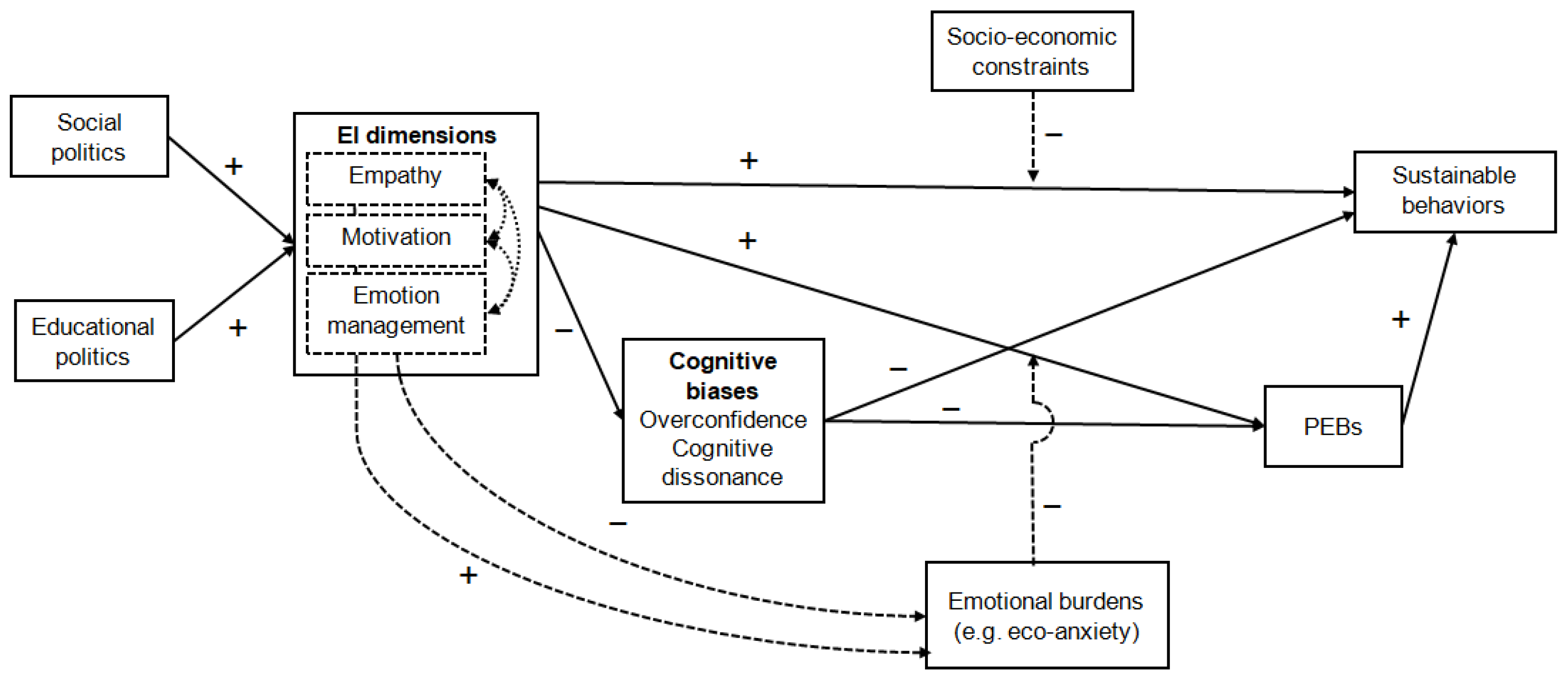
Overall, the evidence reviewed supports the idea that sustainability-related decision-making cannot be fully understood through purely rationalistic models of human behavior. The main contribution of this paper lies in proposing a conceptual framework in which EI may moderate the impact of cognitive biases on sustainability-related decision-making. The framework further identifies emotional burden (e.g., eco-anxiety) and socio-economic constraints as critical boundary conditions that may shape the effectiveness of this moderating role, thereby offering a novel explanation for the persistent gap between pro-environmental intentions and actual behavior. At the same time, the conceptual nature of the framework highlights the need for further empirical research capable of testing the dynamic relationships among EI, cognitive biases, socio-economic constraints, emotional burden, and sustainable behaviors across different social and cultural contexts.

7. Conclusions

Our review suggests that it is increasingly necessary to reconsider and integrate the traditional concept of homo oeconomicus, which often fails to reflect the complexity of actual human decision-making. Research in psychology, behavioral economics, and neuroscience has progressively challenged the idea that individuals behave as fully rational and utility-maximizing agents. On the one hand, cognitive biases systematically influence judgments, preferences, and behavioral outcomes. On the other hand, emotions play a central role in decision-making processes and therefore cannot be separated from economic and social behavior, particularly in areas such as consumption and sustainability-related choices. This issue appears especially relevant in the context of sustainable consumption and PEBs, where decisions are embedded within social relationships, emotional dynamics, habits, and institutional constraints [45,171]. The neoclassical representation of decision-makers as individuals capable of exhaustively evaluating costs and benefits under conditions of stable preferences and complete information appears increasingly insufficient for explaining sustainability-related behavior under uncertainty. Human decision-making often relies on heuristics and emotionally salient shortcuts that may facilitate rapid adaptive responses, but may also generate systematic distortions and behavioral inconsistencies [115,118]. The literature reviewed in this paper further suggests that sustainability-related decisions are particularly vulnerable to cognitive biases because they involve delayed rewards, uncertainty, emotionally charged information, and tensions between short-term individual interests and long-term collective goals. In this respect, biases such as hyperbolic discounting, status quo bias, availability heuristic, and impulsive consumption may contribute to the persistent gap between environmental concern and actual sustainable behavior [19,36,44,153,155].
Within this framework, the main contribution of this paper lies in proposing a conceptual model in which EI may moderate or mediate the influence of cognitive biases on sustainability-related decision-making. Rather than viewing emotions as purely disruptive or irrational elements, the literature reviewed suggests that emotional regulation, emotional awareness, empathy, and impulse control may help individuals cognitively integrate emotionally salient information more adaptively and reduce the impact of biases that hinder sustainable behavior.
Evidence from psychology and neuroscience further supports the importance of integrating emotional and cognitive dimensions in understanding decision-making processes [108,118]. Dual-process theories suggest that intuitive and emotionally driven System 1 processes often dominate decision-making under uncertainty, while reflective System 2 reasoning intervenes more selectively [36,40]. Similarly, the SMH highlights how emotional signals contribute to evaluating alternatives and guiding adaptive choices [108,118]. Taken together, these findings support the idea that sustainable decision-making cannot be fully understood through purely rationalistic models alone. The literature reviewed also indicates that EI may contribute to sustainable behavior through several interconnected mechanisms. Individuals with higher EI appear more capable of regulating impulsive reactions, managing emotionally salient information, and maintaining long-term orientation in decision-making [15,29,144]. Studies further suggest positive associations between EI and ethical consumption, reduced materialism, recycling behavior, sustainable tourism choices, and pro-environmental engagement [3,13,213,214]. At the same time, emotionally salient environmental threats may also generate eco-anxiety, emotional overload, or behavioral paralysis when emotional regulation capacities are insufficient. Therefore, EI should not be interpreted as a universal solution or as a uniformly beneficial psychological resource operating as independent mechanisms that mitigate specific cognitive biases in isolation. Rather, it should be understood as a multidimensional system whose constituent capabilities may simultaneously facilitate and constrain pro-environmental behavior depending on their interaction and on broader emotional, social, and contextual conditions. Emotional awareness may increase individuals’ sensitivity to environmental information and facilitate the recognition of emotionally salient cues. Empathy may further amplify the perceived relevance of environmental consequences by extending concern to affected communities, future generations, and non-human ecosystems. However, heightened emotional sensitivity alone does not necessarily promote adaptive behavior. Without adequate emotion-regulation and self-management capacities, increased awareness and empathic engagement may intensify distress, eco-anxiety, or feelings of helplessness. Conversely, emotion regulation and impulse control may help individuals cognitively integrate emotionally salient information, maintain perceived efficacy, and sustain reflective processing despite emotional discomfort. From this perspective, the behavioral effects of EI emerge not from the independent action of its dimensions, but from their dynamic interaction. Sustainability-related decisions may therefore reflect a continuous tension between emotional activation and emotional regulation, with different configurations of EI dimensions producing distinct behavioral outcomes.
Figure 2 synthesizes the conceptual framework proposed in this paper. The model suggests that educational and social policies may contribute to strengthening emotional intelligence, which in turn may reduce the influence of cognitive biases while supporting more sustainable forms of behavior. In this perspective, EI is conceptualized not as a substitute for structural sustainability policies, but as a complementary psychological mechanism potentially capable of facilitating the translation of environmental concern into sustainable behavior.
Importantly, socio-economic, cultural, and infrastructural conditions, together with the emotional burden associated with excessive eco-anxiety, may act as critical boundary conditions that shape the effectiveness of EI-oriented interventions and influence the translation of pro-environmental intentions into sustainable behaviors. While moderate levels of environmental concern may motivate engagement and sustainable action, excessive eco-anxiety may generate feelings of helplessness, emotional exhaustion, and behavioral paralysis. In such circumstances, even individuals with high levels of EI may struggle to translate environmental awareness into effective PEBs, particularly when perceived environmental threats exceed their coping resources. Even emotionally intelligent individuals may face significant barriers limiting sustainable choices, including economic constraints, limited access to sustainable products and services, and social systems that continue to incentivize unsustainable consumption patterns. Consequently, sustainability transitions cannot rely exclusively on individual psychological change, but require the integration of emotional, cognitive, institutional, and structural dimensions.
Finally, the conceptual framework proposed in this paper remains exploratory in nature. Although the evidence reviewed points toward meaningful relationships among EI, cognitive biases, and sustainable behaviors, empirical findings remain fragmented and heterogeneous. Future research should therefore further investigate the dynamic and potentially reciprocal relationships among emotional intelligence, cognitive biases, environmental emotions, socio-economic constraints, and sustainable behaviors across different cultural and social contexts.
Overall, this paper argues that integrating emotional and cognitive dimensions into sustainability research may contribute to a more realistic understanding of human decision-making and provide new perspectives for supporting sustainable behavioral transitions in practice.

Author Contributions

All authors contributed to the conceptualization of the article and bibliographic research. The first draft of the introduction and the economic sections were written by P.L. and G.F.; the sections on emotional intelligence and pro-environmental behavior were written by A.C., B.C. and M.C.; and the discussion was written by P.L. and B.C. All authors contributed to revising and editing the manuscript. All authors have read and agreed to the published version of the manuscript.

Funding

This work was supported by the Italian Ministry of University and Research, PRIN2022, project no. 2022W8PREB to B.C., A.C., G.F., and M.C., and PRIN2022 PNRR, project no. P2022NTXX5 to P.L.

Institutional Review Board Statement

Not applicable.

Informed Consent Statement

Not applicable.

Data Availability Statement

Data sharing is not applicable to this article as no datasets were generated or analyzed during the current study.

Conflicts of Interest

The authors declare no conflicts of interest.

References

  1. United Nations. Transforming Our World: The 2030 Agenda for Sustainable Development; United Nations: New York, NY, USA, 2015. [Google Scholar]
  2. Steg, L.; Vlek, C. Encouraging Pro-Environmental Behavior: An Integrative Review and Research Agenda. J. Environ. Psychol. 2009, 29, 309–317. [Google Scholar] [CrossRef] [Scilit]
  3. Quoquab, F.; Mohammad, J.; Sukari, N.N. A Multiple-Item Scale for Measuring “Sustainable Consumption Behavior” Construct: Development and Psychometric Evaluation. Asia Pac. J. Mark. Logist. 2019, 31, 791–816. [Google Scholar] [CrossRef] [Scilit]
  4. Valkengoed, A.M.; Abrahamse, W.; Steg, L. To Select Effective Interventions for Pro-Environmental Behavior Change, We Need to Consider Determinants of Behavior. Nat. Hum. Behav. 2022, 6, 1482–1492. [Google Scholar] [CrossRef] [Scilit] [PubMed]
  5. Blankenberg, A.K.; Alhusen, H. On the Determinants of pro-Environmental Behavior: A Literature Review and Guide for the Empirical Economist. Cege Discuss. Pap. 2019. [Google Scholar]
  6. Dzhengiz, T.; Niesten, E. Competences for Environmental Sustainability: A Systematic Review on the Impact of Absorptive Capacity and Capabilities. J. Bus. Ethics 2020, 162, 881–906. [Google Scholar] [CrossRef] [Scilit]
  7. Farr, D. Sustainable Nation: Urban Design Patterns for the Future; John Wiley & Sons: Hoboken, NJ, USA, 2018. [Google Scholar]
  8. Gatersleben, B.; Murtagh, N.; Cherry, M.; Watkins, M. Moral, Wasteful, Frugal, or Thrifty? Identifying Consumer Identities to Understand and Manage Pro-Environmental Behavior. Environ. Behav. 2019, 51, 24–49. [Google Scholar] [CrossRef] [Scilit]
  9. Hess, D.J. Sustainable Consumption, Energy and Failed Transitions: The Problem of Adaptation. In Sustainable Consumption; Cohen, M.J., Brown, H.S., Vergragt, P.J., Eds.; Edward Elgar Publishing: Cheltenham, UK, 2013; pp. 159–178. [Google Scholar]
  10. Sawitri, D.R.; Hadiyanto, H.; Hadi, S.P. Pro-Environmental Behavior from a SocialCognitive Theory Perspective. Procedia Environ. Sci. 2014, 23, 27–33. [Google Scholar] [CrossRef] [Scilit]
  11. Godazgar, H. Islam versus Consumerism and Postmodernism in the Context of Iran. Soc. Compass 2007, 54, 389–418. [Google Scholar] [CrossRef] [Scilit]
  12. Alfredsson, E.; Bengtsson, M.; Brown, H.S.; Isenhour, C.; Lorek, S.; Stevis, D.; Vergragt, P. Why Achieving the Paris Agreement Requires Reduced Overall Consumption and Production. Sustain. Sci. Pract. Policy 2018, 14, 1–5. [Google Scholar] [CrossRef] [Scilit]
  13. De, S.; Singh, P.; Ibrahim, M.; Dikkatwar, A.P.; Chaudhary, R. Mindful, Responsible, and Sustainable Consumption: A Hybrid Review of Evolving Research Trends. Discov. Sustain. 2025, 6, 512. [Google Scholar] [CrossRef] [Scilit]
  14. Rieckmann, M. Learning to Transform the World: Key Competencies in Education for Sustainable Development. In Issues and Trends in Education for Sustainable Development; Leicht, A., Heiss, J., Byun, W.J., Eds.; UNESCO: Paris, France, 2018; pp. 39–59. [Google Scholar]
  15. Chowdhury, R.M. Emotional Intelligence and Consumer Ethics: The Mediating Role of Personal Moral Philosophies. J. Bus. Ethics 2017, 142, 527–548. [Google Scholar] [CrossRef] [Scilit]
  16. Schneider, U.A.; Havlík, P.; Schmid, E.; Valin, H.; Mosnier, A.; Obersteiner, M.; Fritz, S. Impacts of Population Growth, Economic Development, and Technical Change on Global Food Production and Consumption. Agric. Syst. 2011, 104, 204–215. [Google Scholar] [CrossRef] [Scilit]
  17. Vitell, S.J.; King, R.A.; Singh, J.J. A Special Emphasis and Look at the Emotional Side of Ethical Decision-Making. AMS Rev. 2013, 3, 74–85. [Google Scholar] [CrossRef] [Scilit]
  18. Zagonari, F. Environmental Sustainability Is Not Worth Pursuing Unless It Is Achieved for Ethical Reasons. Palgrave Commun. 2020, 6, 108. [Google Scholar] [CrossRef] [Scilit]
  19. Kollmuss, A.; Agyeman, J. Mind the Gap: Why Do People Act Environmentally and What Are the Barriers to pro-Environmental Behavior? Environ. Educ. Res. 2002, 8, 239–260. [Google Scholar] [CrossRef] [Scilit]
  20. Stern, P.C. Psychology and the Science of Human-Environment Interactions. Am. Psychol. 2000, 55, 523. [Google Scholar] [CrossRef]
  21. Whittemore, R.; Knafl, K. The Integrative Review: Updated Methodology. J. Adv. Nurs. 2005, 52, 546–553. [Google Scholar] [CrossRef] [Scilit] [PubMed]
  22. Sukhera, J. Narrative Reviews: Flexible, Rigorous, and Practical. J. Grad. Med. Educ. 2022, 14, 414–417. [Google Scholar] [CrossRef] [Scilit] [PubMed]
  23. Robbins, L. Essay on the Nature and Significance of Economic Science, 3rd ed.; The Macmillan Press, Ltd.: London, UK, 1935. [Google Scholar]
  24. Mill, J.S. On the Definition of Political Economy, and on the Method of Investigation Proper to It. Lond. Westminst. Rev. 1836, 4, 120–164. [Google Scholar]
  25. Wheeler, G. Bounded Rationality. In The Stanford Encyclopedia of Philosophy; Zalta, E.N., Ed.; Stanford University: Stanford, CA, USA, 2018. [Google Scholar]
  26. Kidwell, B.; Lopez-Kidwell, V.; Blocker, C.; Mas, E.M. Birds of a Feather Feel Together: Emotional Ability Similarity in Consumer Interactions. J. Consum. Res. 2020, 47, 215–236. [Google Scholar] [CrossRef] [Scilit]
  27. Soltys, A.; Sokol-Gozdek, I.; Czerwonka, M.; Tyburski, E. Emotions in Decision Making. In Neuroeconomic and Behavioral Aspects of Decision Making; Nermend, K., Łatuszyńska, M., Eds.; Springer: Cham, Switzerland, 2017; pp. 35–47. [Google Scholar]
  28. Tyburski, E. Psychological Determinants of Decision Making. In Neuroeconomic and Behavioral Aspects of Decision Making; Nermend, K., Łatuszyńska, M., Eds.; Springer: Cham, Switzerland, 2017; pp. 19–34. [Google Scholar]
  29. Hersing, W.S. Managing Cognitive Bias in Safety Decision Making: Application of Emotional Intelligence Competencies. J. Space Saf. Eng. 2017, 4, 124–128. [Google Scholar] [CrossRef] [Scilit]
  30. Potemkowski, A. Neurobiology of Decision Making: Methodology in Decision-Making Research. Neuroanatomical and Neurobiochemical Fundamentals. In Neuroeconomic and Behavioral Aspects of Decision Making; Nermend, K., Łatuszyńska, M., Eds.; Springer: Berlin/Heidelberg, Germany, 2017. [Google Scholar]
  31. Korteling, J.; Paradies, G.L.; Sassen-van Meer, J.P. Cognitive Bias and How to Improve Sustainable Decision Making. Front. Psychol. 2023, 14, 1129835. [Google Scholar] [CrossRef] [Scilit] [PubMed]
  32. Simon, H.A. A Behavioral Model of Rational Choice. Q. J. Econ. 1955, 69, 99–118. [Google Scholar] [CrossRef] [Scilit]
  33. Neumann, J.; Morgenstern, O. Theory of Games and Economic Behavior; Princeton University Press: Princeton, NJ, USA, 1944. [Google Scholar]
  34. Simon, H.A. Theories of Bounded Rationality. In Decision and Organization; McGuire, C.B., Radner, R., Eds.; Elsevier: Amsterdam, The Netherlands, 1972; pp. 161–176. [Google Scholar]
  35. Simon, H.A. Rational Decision Making in Business Organizations. Am. Econ. Rev. 1979, 69, 493–513. [Google Scholar]
  36. Tversky, A.; Kahneman, D. Judgment under Uncertainty: Heuristics and Biases. Science 1974, 185, 1124–1131. [Google Scholar] [CrossRef] [Scilit] [PubMed]
  37. Evans, J.S.B. In Two Minds: Dual-Process Accounts of Reasoning. Trends Cogn. Sci. 2003, 7, 454–459. [Google Scholar] [CrossRef] [Scilit] [PubMed]
  38. Kahneman, D. Attention and Effort; Prentice-Hall Inc.: Englewood Cliffs, NJ, USA, 1973. [Google Scholar]
  39. Kahneman, D. Maps of Bounded Rationality: A Perspective on Intuitive Judgement and Choice. Am. Psychol. 2002, 58, 697–720. [Google Scholar] [CrossRef] [Scilit] [PubMed]
  40. Kahneman, D. Maps of Bounded Rationality: Psychology for Behavioral Economics. Am. Econ. Rev. 2003, 93, 1449–1475. [Google Scholar] [CrossRef] [Scilit]
  41. Rakitta, M.; Wernery, J. Cognitive Biases in Building Energy Decisions. Sustainability 2021, 13, 9960. [Google Scholar] [CrossRef] [Scilit]
  42. Svenson, O. Differentiation and Consolidation Theory of Human Decision Making: A Frame of Reference for Pre- and Post-Decision Processes. Acta Psychol. 1992, 80, 143–168. [Google Scholar] [CrossRef] [Scilit]
  43. Das, T.K.; Teng, B.S. Cognitive Biases and Strategic Decision Processes: An Integrative Perspective. J. Manag. Stud. 1999, 36, 757–778. [Google Scholar] [CrossRef] [Scilit]
  44. Teovanović, P.; Knežević, G.; Stankov, L. Individual Differences in Cognitive Biases: Evidence against One-Factor Theory of Rationality. Intelligence 2015, 50, 75–86. [Google Scholar] [CrossRef] [Scilit]
  45. Shaw, D.; Carrington, M.; Chatzidakis, A. (Eds.) Ethics and Morality in Consumption: Interdisciplinary Perspectives; Routledge: London, UK, 2016. [Google Scholar]
  46. Engler, J.O.; Abson, D.J.; Wehrden, H. Navigating Cognition Biases in the Search of Sustainability. Ambio 2018, 48, 605–618. [Google Scholar] [CrossRef] [Scilit] [PubMed]
  47. Andrade, E.B.; Ariely, D. The Enduring Impact of Transient Emotions on Decision Making. Organ. Behav. Hum. Decis. Process. 2009, 109, 1–8. [Google Scholar] [CrossRef] [Scilit]
  48. Schwarz, N. Emotion, Cognition, and Decision Making. Cogn. Emot. 2000, 14, 433–440. [Google Scholar] [CrossRef] [Scilit]
  49. Milkman, K.L.; Chugh, D.; Bazerman, M.H. How can decision making be improved? Persp. Psychol. Sc. 2009, 4, 379–383. [Google Scholar] [CrossRef] [Scilit] [PubMed]
  50. Finucane, M.L.; Alhakami, A.; Slovic, P.; Johnson, S.M. The affect heuristic in judgments of risks and benefits. J. Behav. Decis. Mak. 2000, 13, 1–17. [Google Scholar]
  51. Bazerman, M.H.; Tenbrunsel, A.E.; Wade-Benzoni, K.A. Negotiating with yourself and losing: Making decisions with competing internal preferences. Acad. Manag. Rev. 1998, 23, 225–241. [Google Scholar] [CrossRef] [Scilit]
  52. Zajonc, R.B. Feeling and thinking: Preferences need no inferences. Amer. Psychol. 1980, 35, 151–175. [Google Scholar] [CrossRef]
  53. Mazutis, D.; Eckardt, A. Sleepwalking into catastrophe: Cognitive biases and corporate climate change inertia. Calif. Manag. Rev. 2017, 59, 74–108. [Google Scholar] [CrossRef] [Scilit]
  54. Ariely, D.; Loewenstein, G.; Prelec, D. “Coherent arbitrariness”: Stable demand curves without stable preferences. Q. J. Econ. 2003, 118, 73–106. [Google Scholar] [CrossRef] [Scilit]
  55. Dlugosch, D.; Wang, M. Ambiguity, ambiguity aversion and foreign bias: New evidence from international panel data. J. Bank. Financ. 2022, 140, 106509. [Google Scholar] [CrossRef] [Scilit]
  56. Kocher, M.G.; Lahno, A.M.; Trautmann, S.T. Ambiguity aversion is not universal. Eur. Econ. Rev. 2018, 101, 268–283. [Google Scholar] [CrossRef] [Scilit]
  57. Fehr, E.; Herz, H.; Wilkening, T. The lure of authority: Motivation and incentive effects of power. Am. Econ. Rev. 2013, 103, 1325–1359. [Google Scholar] [CrossRef] [Scilit]
  58. Singh, R.; Ryvola, R. Cognitive Biases in Climate Risk Management; Red Cross Red Crescent Climate Centre: The Hague, The Netherlands; BRACED: London, UK, 2018; Volume 5. [Google Scholar]
  59. Bindra, S.; Sharma, D.; Parameswar, N.; Dhir, S.; Paul, J. Bandwagon effect revisited: A systematic review to develop future research agenda. J. Bus. Res. 2022, 143, 305–317. [Google Scholar] [CrossRef] [Scilit]
  60. Shin, H.; Hwang, J. Illusions of clustering: A systematic evaluation on the effects of clusters on regional economic performance in Korea. Internat. Reg. Sc. Rev. 2022, 45, 135–160. [Google Scholar] [CrossRef] [Scilit]
  61. Festinger, L. A Theory of Cognitive Dissonance; Stanford University Press: Redwood City, CA, USA, 1957. [Google Scholar]
  62. Newell, B.R.; Pitman, A.J. The psychology of global warming: Improving the fit between the science and the message. Bul. Amer. Meteorol. Soc. 2010, 91, 1003–1014. [Google Scholar] [CrossRef] [Scilit]
  63. Nebel, J.M. Status quo bias, rationality, and conservatism about value. Ethics 2015, 125, 449–476. [Google Scholar] [CrossRef] [Scilit] [PubMed]
  64. Luo, G.Y. Conservatism bias and asset price overreaction or underreaction to new information in the presence of strategic interaction. In Asset Price Response to New Information: The Effects of Conservatism Bias and Representativeness Heuristic; Springer: Berlin/Heidelberg, Germany, 2013; pp. 15–25. [Google Scholar] [CrossRef] [Scilit]
  65. Johnson, E.J.; Goldstein, D.G. Do defaults save lives? Science 2003, 302, 1338–1339. [Google Scholar] [CrossRef] [Scilit] [PubMed]
  66. Thaler, R.H.; Sunstein, C.R. Libertarian paternalism. Amer. Econ. Rev. 2003, 93, 175–179. [Google Scholar] [CrossRef] [Scilit]
  67. Thaler, R.H.; Sunstein, C.R. Nudge: Improving Decisions About Health, Wealth, and Happiness, revised and expanded ed.; Penguin Books: London, UK, 2009. [Google Scholar]
  68. Tversky, A.; Kahneman, D. The framing of decisions and the psychology of choice. Science 1981, 211, 453–458. [Google Scholar] [CrossRef] [Scilit] [PubMed]
  69. Chen, D.L.; Moskowitz, T.J.; Shue, K. Decision-making under the gambler’s fallacy: Evidence from asylum judges, loan officers, and baseball umpires. Q. J. Econ. 2016, 131, 1181–1242. [Google Scholar] [CrossRef] [Scilit]
  70. Thorndike, E.L. A constant error in psychological ratings. J. Appl. Psychol. 1920, 4, 25–29. [Google Scholar] [CrossRef] [Scilit]
  71. Brickman, P.; Campbell, D.T. Hedonic relativism and planning the good society. In Adaptation-Level Theory: A Symposium; Appley, M.H., Ed.; Academic Press: Cambridge, MA, USA, 1971; pp. 287–302. [Google Scholar]
  72. Dasgupta, P.; Maskin, E. Uncertainty and hyperbolic discounting. Amer. Econ. Rev. 2005, 95, 1290–1299. [Google Scholar] [CrossRef] [Scilit]
  73. Ajzen, I.; Brown, T.C.; Rosenthal, L.H. Information bias in contingent valuation: Effects of personal relevance, quality of information, and motivational orientation. J. Environ. Econ. Manag. 1996, 30, 43–57. [Google Scholar] [CrossRef] [Scilit]
  74. Capozza, D.; Brown, R. (Eds.) Social Identity Processes: Trends in Theory and Research; SAGE Publications: Thousand Oaks, CA, USA, 2000. [Google Scholar]
  75. Heine, S.J.; Lehman, D.R. Culture, dissonance, and self-affirmation. Personal. Soc. Psychol. Bull. 1997, 23, 389–400. [Google Scholar] [CrossRef] [Scilit]
  76. Tajfel, H. Experiments in intergroup discrimination. Sci. Amer. 1970, 223, 96–102. [Google Scholar] [CrossRef] [Scilit]
  77. Tajfel, H.; Billig, M.G.; Bundy, R.P.; Flament, C. Social categorization and intergroup behaviour. Eur. J. Soc. Psychol. 1971, 1, 149–178. [Google Scholar] [CrossRef] [Scilit]
  78. Schlösser, T.; Dunning, D.; Johnson, K.L.; Kruger, J. How unaware are the unskilled? Empirical tests of the “signal extraction” counterexplanation for the Dunning–Kruger effect in self-evaluation of performance. J. Econ. Psychol. 2013, 39, 85–100. [Google Scholar] [CrossRef] [Scilit]
  79. Kahneman, D.; Knetsch, J.L.; Thaler, R.H. Anomalies: The endowment effect, loss aversion, and status quo bias. J. Econ. Perspect. 1991, 5, 193–206. [Google Scholar] [CrossRef] [Scilit]
  80. Taleb, N.N. The Black Swan: The Impact of the Highly Improbable; Random House: Brooklyn, NY, USA, 2007. [Google Scholar]
  81. Sunstein, C.R. Probability neglect: Emotions, worst cases, and law. Yale Law J. 2002, 112, 61–107. [Google Scholar] [CrossRef] [Scilit] [PubMed]
  82. Monat, A.; Averill, J.R.; Lazarus, R.S. Anticipatory stress and coping reactions under various conditions of uncertainty. J. Person. Soc. Psychol. 1972, 24, 237–253. [Google Scholar] [CrossRef] [Scilit] [PubMed]
  83. Murata, A. Cultural difference and cognitive biases as a trigger of critical crashes or disasters: Evidence from case studies of human factors analysis. J. Behav. Brain Sci. 2017, 7, 399–415. [Google Scholar] [CrossRef]
  84. Murata, A.; Nakamura, T.; Karwowski, W. Influence of cognitive biases in distorting decision making and leading to critical unfavorable incidents. Safety 2015, 1, 44–58. [Google Scholar] [CrossRef] [Scilit]
  85. van Vugt, M.; Griskevicius, V.; Schultz, P.W. Naturally green: Harnessing stone age psychological biases to foster environmental behavior. Soc. Issues Policy Rev. 2014, 8, 1–32. [Google Scholar] [CrossRef] [Scilit]
  86. Wilson, M.; Daly, M. Do pretty women inspire men to discount the future? Proc. R. Soc. Lond. Ser. B Biol. Sci. 2004, 271, S177–S179. [Google Scholar] [CrossRef] [Scilit] [PubMed]
  87. Galai, D.; Sade, O. The “ostrich effect” and the relationship between the liquidity and the yields of financial assets. J. Bus. 2006, 79, 2741–2759. [Google Scholar] [CrossRef] [Scilit]
  88. Silver, N. The Signal and the Noise: Why So Many Predictions Fail—But Some Don’t; Penguin Press: New York, NY, USA, 2012. [Google Scholar]
  89. Lichtenstein, S.; Fischhoff, B.; Phillips, L.D. Calibration of probabilities: The state of the art to 1980. In Judgment Under Uncertainty: Heuristics and Biases; Kahneman, D., Slovic, P., Tversky, A., Eds.; Cambridge University Press: Cambridge, UK, 1982; pp. 306–334. [Google Scholar] [CrossRef] [Scilit]
  90. Nordgren, L.F.; van Harreveld, F.; van der Pligt, J. The restraint bias: How the illusion of self-restraint promotes impulsive behavior. Psychol. Sc. 2009, 20, 1523–1528. [Google Scholar] [CrossRef] [Scilit] [PubMed]
  91. Cassell, M.M.; Halperin, D.T.; Shelton, J.D.; Stanton, D. Risk compensation: The Achilles’ heel of innovations in HIV prevention? BMJ 2006, 332, 605–607. [Google Scholar] [CrossRef] [Scilit] [PubMed]
  92. Adams, J.; Hillman, M. The risk compensation theory and bicycle helmets. Inj. Prev. 2001, 7, 89–91. [Google Scholar] [CrossRef] [Scilit] [PubMed]
  93. Evans, W.N.; Graham, J.D. Risk reduction or risk compensation? The case of mandatory safety-belt use laws. J. Risk Uncertain. 1991, 4, 61–73. [Google Scholar] [CrossRef] [Scilit]
  94. Delaney, L.; Lades, L.K. Present bias and everyday self-control failures: A day reconstruction study. J. Behav. Decis. Mak. 2017, 30, 1157–1167. [Google Scholar] [CrossRef] [Scilit]
  95. Thaler, R.H.; Shefrin, H.M. An economic theory of self-control. J. Pol. Econ. 1981, 89, 392–406. [Google Scholar] [CrossRef] [Scilit] [PubMed]
  96. Garcia, S.M.; Song, H.; Tesser, A. Tainted recommendations: The social comparison bias. Organ. Behav. Hum. Decis. Process. 2010, 113, 97–101. [Google Scholar] [CrossRef] [Scilit]
  97. Samuelson, W.; Zeckhauser, R. Status quo bias in decision making. J. Risk Uncertain. 1988, 1, 7–59. [Google Scholar] [CrossRef] [Scilit]
  98. Janssen, M.A.; Scheffer, M. Overexploitation of renewable resources by ancient societies and the role of sunk-cost effects. Ecol. Soc. 2004, 9, 6. [Google Scholar] [CrossRef] [Scilit]
  99. Staw, B.M. Knee-deep in the big muddy: A study of escalating commitment to a chosen course of action. Organ. Behav. Hum. Perform. 1976, 16, 27–44. [Google Scholar] [CrossRef] [Scilit]
  100. Jost, J.T.; Banaji, M.R. The role of stereotyping in system-justification and the production of false consciousness. Br. J. Soc. Psychol. 1994, 33, 1–27. [Google Scholar] [CrossRef] [Scilit]
  101. Jost, J.T.; Banaji, M.R.; Nosek, B.A. A decade of system justification theory: Accumulated evidence of conscious and unconscious bolstering of the status quo. Political Psychol. 2004, 25, 881–919. [Google Scholar] [CrossRef] [Scilit]
  102. Rottenstreich, Y.; Hsee, C.K. Money, kisses, and electric shocks: On the affective psychology of risk. Psychol. Sci. 2001, 12, 185–190. [Google Scholar] [CrossRef] [Scilit] [PubMed]
  103. Baron, J.; Gowda, R.; Kunreuther, H. Attitudes toward managing hazardous waste: What should be cleaned up and who should pay for it? Risk Anal. 1993, 13, 183–192. [Google Scholar] [CrossRef] [Scilit]
  104. Viscusi, W.K.; Magat, W.A.; Huber, J. An investigation of the rationality of consumer valuations of multiple health risks. RAND J. Econ. 1987, 18, 465–479. [Google Scholar] [CrossRef] [Scilit]
  105. Dunning, D. A Newer Look: Motivated Social Cognition and the Schematic Representation of Social Concepts. Psychol. Inq. 2000, 10, 1–11. [Google Scholar] [CrossRef] [Scilit] [PubMed]
  106. Forgas, J.P. Mood and Judgment: The Affect Infusion Model (AIM). Psychol. Bull. 1995, 117, 39–66. [Google Scholar] [CrossRef] [PubMed]
  107. Schwarz, N. Feelings as Information: Informational and Motivational Functions of Affective States. In Handbook of Motivation and Cognition; Higgins, E.T., Sorrentino, R.M., Eds.; Guilford Press: New York, NY, USA, 1990; pp. 521–561. [Google Scholar]
  108. Damasio, R. Descartes’ Error: Emotion, Reason and the Human Brain; Grosset/Putnam Book: New York, NY, USA, 1994. [Google Scholar]
  109. Fuchs, F.; Lingnau, V. The Homo Economicus as a Prototype of a Psychopath? A Conceptual Analysis and Implications for Business Research and Teaching. J. Bus. Ethics 2024, 195, 763–777. [Google Scholar] [CrossRef] [Scilit]
  110. Boddy, C.R. Is the Only Rational Personality That of the Psychopath? Homo Economicus as The Most Serious Threat to Business Ethics Globally. Humanist. Manag. J. 2023, 8, 315–327. [Google Scholar] [CrossRef] [Scilit]
  111. Nelson, J.A. Getting Past ‘Rational Man/Emotional Woman’: Comments on Research Programs in Happiness Economics and Interpersonal Relations. Int. Rev. Econ. 2010, 57, 233–253. [Google Scholar] [CrossRef] [Scilit]
  112. Rotondi, V.; Bruni, L.; Crivelli, L.; Mancuso, S.; Santori, P. In Praise of the Persona Economica: Listening to Plants for a New Economic Paradigm. Humanit. Soc. Sci. Commun. 2022, 9, 288. [Google Scholar] [CrossRef] [Scilit]
  113. Arkes, H.R. Costs and Benefits of Judgment Errors: Implications for Debiasing. Psychol. Bull. 1991, 110, 486–498. [Google Scholar] [CrossRef]
  114. Morewedge, C.K.; Yoon, H.; Scopelliti, I.; Symborski, C.W.; Korris, J.H.; Kassam, K.S. Debiasing Decisions: Improved Decision Making with a Single Training Intervention. Policy Insights Behav. Brain Sci. 2015, 2, 129–140. [Google Scholar] [CrossRef] [Scilit]
  115. Chapman, C.S.; Gallivan, J.P.; Wood, D.K.; Milne, J.L.; Culham, J.C.; Goodale, M.A. Reaching for the Unknown: Multiple Target Encoding and Real-Time Decision-Making in a Rapid Reach Task. Cognition 2010, 116, 168–176. [Google Scholar] [CrossRef] [Scilit] [PubMed]
  116. Mellers, B.; Ungar, L.; Baron, J.; Ramos, J.; Gurcay, B.; Fincher, K.; Tetlock, P.E. Psychological Strategies for Winning a Geopolitical Forecasting Tournament. Psychol. Sci. 2014, 25, 1106–1115. [Google Scholar] [CrossRef] [Scilit] [PubMed]
  117. Beshears, J.; Kosowsky, H. Nudging: Progress to Date and Future Directions. Organ. Behav. Hum. Decis. Process. 2020, 161, 3–19. [Google Scholar] [CrossRef] [Scilit] [PubMed]
  118. Damasio, A.R. Towards a neuropathology of emotion and mood. Nature 1997, 386, 769–770. [Google Scholar] [CrossRef] [Scilit] [PubMed]
  119. Bechara, A.; Damasio, H.; Tranel, D.; Damasio, A.R. Deciding Advantageously before Knowing the Advantageous Strategy. Science 1997, 275, 1293–1295. [Google Scholar] [CrossRef] [Scilit] [PubMed]
  120. Bechara, A.; Damasio, A.R.; Damasio, H.; Anderson, S.W. Insensitivity to Future Consequences Following Damage to Human Prefrontal Cortex. Cognition 1994, 50, 7–15. [Google Scholar] [CrossRef] [Scilit] [PubMed]
  121. Yilmaz, S. The Relationship Between Emotional Intelligence and Decision-Making. Neuropsychiatr. Investig. 2023, 61, 117–121. [Google Scholar] [CrossRef] [Scilit]
  122. Ohira, H. The Somatic Marker Revisited: Brain and Body in Emotional Decision Making. Emot. Rev. 2010, 2, 245–249. [Google Scholar] [CrossRef] [Scilit]
  123. Di Cesare, S.; Silveri, F.; Sala, S.; Petti, L. Positive Impacts in Social Life Cycle Assessment: State of the Art and the Way Forward. Int. J. Life Cycle Assess. 2018, 23, 406–421. [Google Scholar] [CrossRef] [Scilit]
  124. Serra, D. Decision-Making: From Neuroscience to Neuroeconomics—An Overview. Theory Decis. 2021, 91, 1–80. [Google Scholar] [CrossRef] [Scilit]
  125. Gallese, V.; Fadiga, L.; Fogassi, L.; Rizzolatti, G. Action Recognition in the Premotor Cortex. Brain 1996, 119, 593–609. [Google Scholar] [CrossRef] [Scilit] [PubMed]
  126. Rizzolatti, G.; Fadiga, L.; Gallese, V.; Fogassi, L. Premotor Cortex and the Recognition of Motor Actions. Cogn. Brain Res. 1996, 3, 131–141. [Google Scholar] [CrossRef] [Scilit] [PubMed]
  127. Wicker, B.; Keysers, C.; Plailly, J.; Royet, J.P.; Gallese, V.; Rizzolatti, G. Both of Us Disgusted in My Insula: The Common Neural Basis of Seeing and Feeling Disgust. Neuron 2003, 40, 655–664. [Google Scholar] [CrossRef] [Scilit] [PubMed]
  128. Craig, A.D. How Do You Feel? Interoception: The Sense of the Physiological Condition of the Body. Nat. Rev. Neurosci. 2002, 3, 655–666. [Google Scholar] [CrossRef] [Scilit] [PubMed]
  129. Iacoboni, M.; Molnar-Szakacs, I.; Gallese, V.; Buccino, G.; Mazziotta, J.C.; Rizzolatti, G. Grasping the Intentions of Others with One’s Own Mirror Neuron System. PLoS Biol. 2005, 3, e79. [Google Scholar] [CrossRef] [Scilit] [PubMed]
  130. Kaneko, A.; Asaoka, Y.; Lee, Y.A.; Goto, Y. Cognitive and Affective Processes Associated with Social Biases. Int. J. Neuropsychopharmacol. 2021, 24, 645–655. [Google Scholar] [CrossRef] [Scilit] [PubMed]
  131. Gardner, H. Frames of Mind: A Theory of Multiple Intelligences; Basic Books: New York, NY, USA, 1983. [Google Scholar]
  132. Mayer, J.D.; Caruso, D.R.; Salovey, P. Emotional Intelligence Meets Traditional Standards for an Intelligence. Intelligence 1999, 27, 267–298. [Google Scholar] [CrossRef] [Scilit]
  133. Mayer, J.D.; Salovey, P. The intelligence of emotional intelligence. Intelligence 1993, 17, 433–442. [Google Scholar] [CrossRef] [Scilit]
  134. Goleman, D. Emotional Intelligence; Bantam Books: New York, NY, USA, 1995. [Google Scholar]
  135. Petrides, K.V.; Furnham, A. Trait Emotional Intelligence: Psychometric Investigation with Reference to Established Trait Taxonomies. Eur. J. Personal. 2001, 15, 425–448. [Google Scholar] [CrossRef] [Scilit]
  136. Petrides, K.V. Ability and Trait Emotional Intelligence. In The Wiley-Blackwell Handbook of Individual Differences; Chamorro-Premuzic, T., Furnham, A., von Stumm, S., Eds.; Wiley-Blackwell: Hoboken, NJ, USA, 2011; p. 658. [Google Scholar]
  137. Bar-On, R. The Emotional Quotient Inventory (EQ-i): A Test of Emotional Intelligence; Multi-Health Systems: Toronto, ON, USA, 1997. [Google Scholar]
  138. Bar-On, R. Emotional and Social Intelligence: Insights from the Emotional Quotient Inventory. In The Handbook of Emotional Intelligence: Theory, Development, Assessment, and Application at Home, School, and in the Workplace; Bar-On, R., Parker, J.D.A., Eds.; Jossey-Bass/Wiley: Hoboken, NJ, USA, 2000; pp. 363–388. [Google Scholar]
  139. Carter, S.; Pasqualini, M.C.S. Stronger Autonomic Response Accompanies Better Learning: A Test of Damasio’s Somatic Marker Hypothesis. Cogn. Emot. 2004, 18, 901–911. [Google Scholar] [CrossRef] [Scilit]
  140. Fiori, M. A New Look at Emotional Intelligence: A Dual-Process Framework. Personal. Soc. Psychol. Rev. 2009, 13, 21–44. [Google Scholar] [CrossRef] [Scilit] [PubMed]
  141. George, P.; Cosgrove, J.; Taylor, J.; Rao, N.; Marshall, T.; Ghose, S.S.; Patel, N.A. Antibullying Interventions in Schools: Assessing the Evidence Base. Psychiatr. Serv. 2024, 75, 908–920. [Google Scholar] [CrossRef] [Scilit] [PubMed]
  142. Gil, Y.; Garijo, D.; Khider, D.; Knoblock, C.A.; Ratnakar, V.; Osorio, M.; Shu, L. Artificial Intelligence for Modeling Complex Systems: Taming the Complexity of Expert Models to Improve Decision Making. ACM Trans. Interact. Intell. Syst. 2021, 11, 1–49. [Google Scholar] [CrossRef] [Scilit]
  143. Buontempo, G.; Brockner, J. Emotional Intelligence and the Ease of Recall Judgment Bias: The Mediating Effect of Private Self- Focused Attention. J. Appl. Soc. Psychol. 2008, 38, 159–172. [Google Scholar] [CrossRef] [Scilit]
  144. Johnsi, S.; Sunitha, K.A. Impact of Personality and Emotional Intelligence on Investor Behavior. J. Manag. 2019, 10, 21–29. [Google Scholar] [CrossRef] [Scilit]
  145. Jamil, N.; Bashir, T. Impact of Cognitive Dissonance Bias on Investors’ Decisions: Moderating Role of Emotional Intelligence. Pak. Soc. Sci. Rev. 2021, 5, 538–552. [Google Scholar] [CrossRef] [Scilit]
  146. Chen, C.; Ishfaq, M.; Ashraf, F.; Sarfaraz, A.; Wang, K. Mediating Role of Optimism Bias and Risk Perception between Emotional Intelligence and Decision-Making: A Serial Mediation Model. Front. Psychol. 2022, 13, 914649. [Google Scholar] [CrossRef] [Scilit] [PubMed]
  147. Gulzar, T.I.; Ali, N. The Influence of Behavioral Biases on Investment Decisions; Moderating Role of Emotional Stability. J. Dev. Soc. Sci. 2023, 4, 692–708. [Google Scholar] [CrossRef] [Scilit]
  148. Annapurna, R.; Basri, S. The Influence of Emotional Intelligence and Behavioural Biases on Mutual Fund Churning Frequency: Evidence from India. Acta Psychol. 2024, 248, 104426. [Google Scholar] [CrossRef] [Scilit] [PubMed]
  149. Im, M.; Oh, J. Effect of Emotion Regulation as a De-Biasing Mechanism on Overconfidence in Investment Behavior. J. Financ. Serv. Mark. 2016, 21, 209–225. [Google Scholar] [CrossRef] [Scilit]
  150. Wong, C.S.; Wo, T.L.; Wu, A.M.S. Validation of the Pro-Environmental Behavior (PEB) Scale in Malaysia: Assessing Cross-Age and Gender Invariance. Discov. Sustain. 2025, 6, 544. [Google Scholar] [CrossRef] [Scilit]
  151. Tian, H.; Liu, X. Pro-Environmental Behavior Research: Theoretical Progress and Future Directions. Int. J. Environ. Res. Public Health 2021, 19, 6721. [Google Scholar] [CrossRef] [Scilit] [PubMed]
  152. Larson, L.R.; Stedman, R.C.; Cooper, C.B.; Decker, D.J. Understanding the Multi-Dimensional Structure of pro-Environmental Behavior. J. Environ. Psychol. 2015, 43, 112–124. [Google Scholar] [CrossRef] [Scilit]
  153. Gifford, R. The Dragons of Inaction: Psychological Barriers That Limit Climate Change Mitigation and Adaptation. Am. Psychol. 2011, 66, 290–302. [Google Scholar] [CrossRef] [Scilit] [PubMed]
  154. Lange, F. Behavioral Paradigms for Studying Pro-Environmental Behavior: A Systematic Review. Behav. Res. Methods 2023, 55, 600–622. [Google Scholar] [CrossRef] [Scilit] [PubMed]
  155. Creutzig, F.; Roy, J.; Lamb, W.F.; Azevedo, I.M.L.; Bruin, W.; Dalkmann, H.; Edelenbosch, O.Y.; Geels, F.W.; Grubler, A.; Hepburn, C.; et al. Towards Demand-Side Solutions for Mitigating Climate Change. Nat. Clim. Change 2018, 8, 260–263. [Google Scholar] [CrossRef] [Scilit]
  156. Lucas, K.; Brooks, M.; Darnton, A.; Jones, J.E. Promoting Pro-Environmental Behavior: Existing Evidence and Policy Implications. Environ. Sci. Policy 2008, 11, 456–466. [Google Scholar] [CrossRef] [Scilit]
  157. Dioba, A.; Kroker, V.; Dewitte, S.; Lange, F. Barriers to Pro-Environmental Behavior Change: A Review of Qualitative Research. Sustainability 2023, 16, 8776. [Google Scholar] [CrossRef] [Scilit]
  158. Ajzen, I. The Theory of Planned Behavior. Organ. Behav. Hum. Decis. Process. 1991, 50, 179–211. [Google Scholar] [CrossRef] [Scilit]
  159. Wyss, A.M.; Knoch, D.; Berger, S. When and How Pro-Environmental Attitudes Turn into Behavior: The Role of Costs, Benefits, and Self-Control. J. Environ. Psychol. 2022, 79, 101748. [Google Scholar] [CrossRef] [Scilit]
  160. Rezvani, Z.; Jansson, J.; Bengtsson, M. Cause I’ll Feel Good! An Investigation into the Effects of Anticipated Emotions and Personal Moral Norms on Consumer Pro-Environmental Behavior. J. Promot. Manag. 2017, 23, 163–183. [Google Scholar] [CrossRef] [Scilit]
  161. Innocenti, M.; Perilli, A.; Santarelli, G.; Carluccio, N.; Zjalic, D.; Acquadro Maran, D.; Ciabini, L.; Cadeddu, C. How Does Climate Change Worry Influence the Relationship between Climate Change Anxiety and Eco-Paralysis? A Moderation Study. Climate 2023, 11, 190. [Google Scholar] [CrossRef] [Scilit]
  162. Coates, Z.; Kelly, M.; Brown, S. The Relationship between Climate Anxiety and Pro-Environment Behaviours. Sustainability 2024, 16, 5211. [Google Scholar] [CrossRef] [Scilit]
  163. Niedzwiedz, C.L.; Kankawale, S.M.; Katikireddi, S.V. A systematic review of social, political and geographic factors associated with eco-anxiety in children and young people. Nat. Ment. Health 2025, 3, 1579–1615. [Google Scholar] [CrossRef] [Scilit]
  164. Freedman, P.E.; Choi, D.Y.; Marczak, M.; Chisti, H.; Freedman, J.M. A climate of emotions pilot study reducing climate anxiety and strengthening resilience. Discov. Sustain. 2026, 7, 807. [Google Scholar] [CrossRef] [Scilit]
  165. Ortner, C.N.M.; Armstrong, M.; Ulmer, E.J. Emotion regulation, climate distress, and climate action in climate activist and student samples. Discov. Psychol. 2025, 5, 15. [Google Scholar] [CrossRef] [Scilit]
  166. Solomon, M.R. The Role of Products as Social Stimuli: A Symbolic Interactionism Perspective. J. Consum. Res. 1983, 10, 319–329. [Google Scholar] [CrossRef] [Scilit]
  167. Childers, T.L.; Rao, A.R. The Influence of Familial and Peer-Based Reference Groups on Consumer Decisions. J. Consum. Res. 1992, 19, 198–211. [Google Scholar] [CrossRef] [Scilit] [PubMed]
  168. Connolly, J.; Prothero, A. Green Consumption: Life-Politics, Risk and Contradictions. J. Consum. Cult. 2008, 8, 117–145. [Google Scholar] [CrossRef] [Scilit]
  169. Argo, J.J.; Dahl, D.W.; Manchanda, R.V. The Influence of a Mere Social Presence in a Retail Context. J. Consum. Res. 2005, 32, 207–212. [Google Scholar] [CrossRef] [Scilit]
  170. McFerran, B.; Dahl, D.; Firzsimons, G.J.; Morales, A.C. I’ll Have What She’s Having: Effects of Social Influence and Body Type on the Food Choices of Others. J. Consum. Res. 2010, 36, 915–929. [Google Scholar] [CrossRef] [Scilit] [PubMed]
  171. Cherrier, H. Ethical Consumption Practices: Co-production of Self-expression and Social Recognition. J. Consum. Behav. Int. Res. Rev. 2007, 6, 321–335. [Google Scholar] [CrossRef] [Scilit]
  172. Zhong, B.; Niu, N.; Li, J.; Wu, Y.; Fan, W. How Subjective Socioeconomic Status Influences Pro-Environmental Behavior: The Mediating Role of Sense of Control and Life History Strategy. Behav. Sci. 2024, 14, 591. [Google Scholar] [CrossRef] [Scilit] [PubMed]
  173. Tan, M.; Luo, X.; Li, J.; Zhang, G.; Zhong, Y. Emergency and costs effect pro-environmental behavior: An event-related potential (ERP) study. Curr. Psychol. 2024, 43, 19883–19893. [Google Scholar] [CrossRef] [Scilit]
  174. Zollo, L. The Consumers’ Emotional Dog Learns to Persuade Its Rational Tail: Toward a Social Intuitionist Framework of Ethical Consumption. J. Bus. Ethics 2021, 168, 295–313. [Google Scholar] [CrossRef] [Scilit]
  175. Lisboa, P.V.; Gómez-Román, C.; Guntín, L.; Monteiro, A.P. Pro-Environmental Behavior, Personality and Emotional Intelligence in Adolescents: A Systematic Review. Front. Psychol. 2024, 15, 1323098. [Google Scholar] [CrossRef] [Scilit] [PubMed]
  176. Aziz, F.; Md Rami, A.A.; Zaremohzzabieh, Z.; Ahari, S. Effects of Emotions and Ethics on Pro-Environmental Behavior of University Employees: A Model Based on the Theory of Planned Behavior. Sustainability 2021, 13, 7062. [Google Scholar] [CrossRef] [Scilit]
  177. Bissing-Olson, M.J.; Iyer, A.; Fielding, K.S.; Zacher, H. Relationships between Daily Affect and Pro-Environmental Behavior at Work: The Moderating Role of Pro-environmental Attitude. J. Organ. Behav. 2013, 34, 156–175. [Google Scholar] [CrossRef] [Scilit]
  178. Reser, J.P.; Bradley, G.L. Fear Appeals in Climate Change Communication. In Oxford Research Encyclopedia of Climate Science; Oxford University Press: New York, NY, USA, 2017. [Google Scholar] [CrossRef] [Scilit]
  179. Ogunbode, C.A.; Doran, R.; Hanss, D.; Ojala, M.; Salmela-Aro, K.; Van Den Broek, K.L.; Bhullar, N.; De Aquino, S.D.; Marot, T.A.; Schermer, J.A.; et al. Climate Anxiety, Wellbeing and Pro-Environmental Action: Correlates of Negative Emotional Responses to Climate Change in 32 Countries. J. Environ. Psychol. 2022, 84, 101887. [Google Scholar] [CrossRef] [Scilit]
  180. Antinienė, D.; Lekavičienė, R.; Rūtelionė, A.; Šeinauskienė, B. Emotional Intelligence Training as an Intervention to Diminish Consumer Materialism. Entrep. Sustain. Issues 2022, 10, 328–343. [Google Scholar] [CrossRef] [Scilit] [PubMed]
  181. Abdollahi, A.; Vakili Mobarakeh, M.R.; Karbalaei, S. Locus of Control, Hardiness, and Emotional Intelligence as Predictors of Waste Prevention Behaviors. Rom. J. Appl. Psychol. 2015, 17, 8–16. [Google Scholar]
  182. Ntanos, S.; Ntanos, G.; Chalikias, M. The Role of Emotional Intelligence as an Underlying Factor towards Social Acceptance of Green Investments. In Proceedings of the 8th International Conference on Information and Communication Technologies in Agriculture, Food and Environment, Chania, Greece, 21–24 September 2017. [Google Scholar]
  183. Argan, M.T.; Argan, M.; Dursun, M.T. The Effect of Emotional Intelligence on Behavioral Satisfaction: The Mediating Effect of Recycle Behavior. Present Environ. Sustain. Dev. 2022, 16, 97–113. [Google Scholar] [CrossRef] [Scilit]
  184. Welsch, H.; Kühling, J. Pro-Environmental Behavior and Rational Consumer Choice: Evidence from Surveys of Life Satisfaction. J. Econ. Psychol. 2010, 31, 405–420. [Google Scholar] [CrossRef] [Scilit]
  185. DeVille, N.V.; Tomasso, L.P.; Stoddard, O.P.; Wilt, G.E.; Horton, T.H.; Wolf, K.L.; Brymer, E.; Kahn, P.H., Jr.; James, P. Time Spent in Nature Is Associated with Increased Pro-Environmental Attitudes and Behaviors. Int. J. Environ. Res. Public Health 2021, 18, 7498. [Google Scholar] [CrossRef] [Scilit] [PubMed]
  186. Liu, Y.; Cleary, A.; Fielding, K.S.; Murray, Z.; Roiko, A. Nature Connection, Pro-Environmental Behaviours and Wellbeing: Understanding the Mediating Role of Nature Contact. Landsc. Urban Plan. 2022, 228, 104550. [Google Scholar] [CrossRef] [Scilit]
  187. Koay, W.I.; Dillon, D. Community Gardening: Stress, Well-Being, and Resilience Potentials. Int. J. Environ. Res. Public Health 2020, 17, 6740. [Google Scholar] [CrossRef] [Scilit] [PubMed]
  188. Carrieri, A.; Fermani, A. Sustainable Accommodation Choice in Tourism and Emotional Intelligence Connected: An Exploratory Study Looking for Evidence. Cogent Psychol. 2018, 5, 1485474. [Google Scholar] [CrossRef] [Scilit]
  189. Balundė, A.; Jovarauskaitė, L.; Poškus, M.S. Exploring Adolescents’ Waste Prevention via Value-Identity-Personal Norm and Comprehensive Action Determination Models. J. Environ. Psychol. 2020, 72, 101526. [Google Scholar] [CrossRef] [Scilit]
  190. Koessler, A.K.; Vorlaufer, T.; Fiebelkorn, F. Social Norms and Climate-Friendly Behavior of Adolescents. PLoS ONE 2022, 17, 0266847. [Google Scholar] [CrossRef] [Scilit] [PubMed]
  191. Hasford, J.; Hardesty, D.M.; Kidwell, B. More than a Feeling: Emotional Contagion Effects in Persuasive Communication. J. Mark. Res. 2015, 52, 836–847. [Google Scholar] [CrossRef] [Scilit]
  192. Wang, J.; Wu, L. The Impact of Emotions on the Intention of Sustainable Consumption Choices: Evidence from a Big City in an Emerging Country. J. Clean. Prod. 2016, 126, 325–336. [Google Scholar] [CrossRef] [Scilit]
  193. Ahn, H. Emotional Intelligence as a Personality Trait That Predicts Consumption Behavior: The Role of Consumer Emotional Intelligence in Persuasive Communication. Sustainability 2022, 14, 15461. [Google Scholar] [CrossRef] [Scilit]
  194. Huang, M.H.; Rust, R.T. Sustainability and Consumption. J. Acad. Mark. Sci. 2011, 39, 40–54. [Google Scholar] [CrossRef] [Scilit]
  195. York, R.; Clark, B. Critical Materialism: Science, Technology, and Environmental Sustainability. Sociol. Inq. 2010, 80, 475–499. [Google Scholar] [CrossRef] [Scilit] [PubMed]
  196. Minton, E.A.; Kahle, L.R.; Jiuan, T.S.; Tambyah, S.K. Addressing Criticisms of Global Religion Research: A Consumption-based Exploration of Status and Materialism, Sustainability, and Volunteering Behavior. J. Sci. Study Relig. 2016, 55, 365–383. [Google Scholar] [CrossRef] [Scilit]
  197. Zhang, L.; Shao, Z.; Li, X.; Feng, Y. Gamification and Online Impulse Buying: The Moderating Effect of Gender and Age. Int. J. Inf. Manag. 2021, 61, 102267. [Google Scholar] [CrossRef] [Scilit]
  198. Obukhovich, S.; Sipilä, J.; Tarkiainen, A. Strategies for Reducing the Environmental Impact of Impulse Buying. In Sustainable Marketing, Branding, and Reputation Management: Strategies for a Greener Future; Masengu, R., Bigirimana, S., Chiwaridzo, O., Bensson, R., Blossom, C., Eds.; IGI Global Scientific Publishing: Hershey, PA, USA, 2023; pp. 195–211. [Google Scholar]
  199. Nair, D.; Das, S. Impact of Emotional Intelligence on Impulse Buying and Product Value Proposition. Eur. J. Bus. Manag. 2015, 7, 165–172. [Google Scholar]
  200. Muncy, J.A.; Vitell, S.J. Consumer Ethics: An Investigation of the Ethical Beliefs of the Final Consumer. J. Bus. Res. 1992, 24, 297–311. [Google Scholar] [CrossRef] [Scilit]
  201. Hopkins, M.; Deepa, R. The Impact of Emotional Intelligence on Ethical Judgment. J. Manag. Dev. 2018, 37, 503–511. [Google Scholar] [CrossRef] [Scilit]
  202. Singh, J.J.; Garg, N.; Govind, R.; Vitell, S.J. Anger Strays, Fear Refrains: The Differential Effect of Negative Emotions on Consumers’ Ethical Judgments. J. Bus. Ethics 2018, 151, 235–248. [Google Scholar] [CrossRef] [Scilit]
  203. Escadas, M.; Jalali, M.S.; Farhangmehr, M. What Goes around Comes around: The Integrated Role of Emotions on Consumer Ethical Decision-making. J. Consum. Behav. 2020, 19, 409–422. [Google Scholar] [CrossRef] [Scilit]
  204. Schubert, C. Green Nudges: Do They Work? Are They Ethical? Ecol. Econ. 2017, 132, 329–342. [Google Scholar] [CrossRef] [Scilit]
  205. Hertwig, R.; Grüne-Yanoff, T. Nudging and Boosting: Steering or Empowering Good Decisions. Perspect. Psychol. Sci. 2017, 12, 973–986. [Google Scholar] [CrossRef] [Scilit] [PubMed]
  206. Michaelsen, P. Transparency and Nudging: An Overview and Methodological Critique of Empirical Investigations. Behav. Public Policy 2024, 8, 807–817. [Google Scholar] [CrossRef] [Scilit]
  207. Angelidis, J.; Ibrahim, N.A. The Impact of Emotional Intelligence on the Ethical Judgment of Managers. J. Bus. Ethics 2011, 99, 111–119. [Google Scholar] [CrossRef] [Scilit]
  208. Fu, W. The Impact of Emotional Intelligence, Organizational Commitment, and Job Satisfaction on Ethical Behavior of Chinese Employees. J. Bus. Ethics 2014, 122, 137–144. [Google Scholar] [CrossRef] [Scilit]
  209. DiClemente, D.F.; Hantula, D.A. Applied Behavioral Economics and Consumer Choice. J. Econ. Psychol. 2003, 24, 589–602. [Google Scholar] [CrossRef] [Scilit]
  210. Loewenstein, G. Hot-Cold Empathy Gaps and Medical Decision Making. Health Psychol. 2005, 24, S49–S56. [Google Scholar] [CrossRef] [Scilit] [PubMed]
  211. Kidwell, B.; Hardesty, D.M.; Childers, T.L. Consumer Emotional Intelligence: Conceptualization, Measurement, and the Prediction of Consumer Decision Making. J. Consum. Res. 2008, 35, 154–166. [Google Scholar] [CrossRef] [Scilit]
  212. Zeidner, M.; Roberts, R.D.; Matthews, G. Can Emotional Intelligence Be Schooled? A Critical Review. Educ. Psychol. 2002, 37, 215–231. [Google Scholar] [CrossRef] [Scilit] [PubMed]
  213. Aguilar-Luzón, M.C.; Calvo-Salguero, A.; Salinas, J.M. Beliefs and Environmental Behavior: The Moderating Effect of Emotional Intelligence. Scand. J. Psychol. 2014, 55, 619–629. [Google Scholar] [CrossRef] [Scilit] [PubMed]
  214. Kadic-Maglajlic, S.; Arslanagic-Kalajdzic, M.; Micevski, M.; Dlacic, J.; Zabkar, V. Being Engaged Is a Good Thing: Understanding Sustainable Consumption Behavior among Young Adults. J. Bus. Res. 2019, 104, 644–654. [Google Scholar] [CrossRef] [Scilit]
Figure 1. Description of methodology of integrative narrative review [21,22].
Sustainability 18 06904 g001
Figure 2. Conceptual framework diagram about the relationships among EI (emotional intelligence) dimensions, cognitive biases, PEBs (pro-environmental behaviors), and sustainable behaviors. Social and educational politics are considered antecedents of EI. Socio-economic constraints may moderate the relationship between EI and sustainable behaviors, while emotional burdens (e.g., eco-anxiety) may act as boundary conditions that shape the mediating mechanisms linking EI to PEBs.
Sustainability 18 06904 g002
Table 1. Main cognitive biases and their impact on homo oeconomicus’s decision-making.
AuthorsCognitive BiasDefinitionHomo Oeconomicus Dimension Impacted
[49,50,51,52]Affect HeuristicWhen making decisions, we rely on our emotions rather than concrete information.Unlimited Cognitive Capacity
[53,54]Anchoring BiasWe rely on the first piece of information we receive about a topic.Perfect Information
[55,56]Ambiguity BiasWe prefer options with a probability of a known favorable outcome over an option with an unknown outcome.Flawless Rationality
[57]Authority BiasWe are more influenced by the opinion of an authority figure (unrelated to its content).Unlimited Cognitive Capacity
[53,58]Availability BiasThe tendency to think that whatever is easiest for us to recall should provide the best context for future predictions.Flawless Rationality
[59]Bandwagon EffectThe tendency to adopt a specific behavior, belief, style, or attitude because others do it.Narrow Self-Interest
[60]Clustering IllusionThe tendency to perceive patterns or clusters in random data when no such pattern exists.Flawless Rationality
[61]Cognitive DissonanceThe tendency to seek consistency between beliefs, attitudes, and behaviors while reducing psychological discomfort caused by conflicting cognitions.Preference Consistency
[36,62]Confirmation BiasThe tendency to use information to confirm or support one’s prior beliefs or values.Perfect Information
[63,64]Conservatism BiasThe tendency to correct beliefs insufficiently when new evidence is presented.Flawless Rationality
[65,66,67]Default BiasThe tendency to prefer the default option to other available options.Preference Consistency
[68]Framing BiasThe tendency to make different decisions depending on how equivalent information is presented.Preference Consistency
[69]Gambler’s FallacyThe tendency to think that something has occurred several times before will happen less often in the future.Profit Maximization
[70]Halo EffectPositive impressions of people, companies, brands, and products in one area positively influence our feelings in another area, even if it has nothing to do with it.Unlimited Cognitive Capacity
[71]Hedonic Adaptation (Hedonic Treadmill) The tendency to rapidly return to a stable level of satisfaction despite positive or negative changes in life conditions or consumption.Profit Maximization
[72]Hyperbolic DiscountingThe tendency to prefer smaller immediate rewards over larger delayed rewards.Profit Maximization
[73]Information BiasThe tendency to selectively seek, gather, or interpret information.Perfect Information
[74,75,76,77]Ingroup–Outgroup BiasThe inclination to prefer one’s group over different groups.Narrow Self-Interest
[78]Knowledge Illusion(The Dunning–Kruger Effect) People without skills overestimate their abilities, and people with many skills underestimate them.Unlimited Cognitive Capacity
[79]Loss AversionThe inclination to prefer avoiding losses to acquiring equivalent gains; being more afraid of losing something than winning something.Profit Maximization
[80,81,82]Neglect of ProbabilityThe tendency to disregard probability when deciding under uncertainty; small risks can be entirely ignored or overestimated.Perfect Information
[83,84]Normalcy BiasWe tend to disbelieve or minimize threat warnings; we underestimate things that might come; sometimes, we do not even believe they will come.Perfect Information
[53,85,86]Optimism Bias(Positive outcome bias, wishful thinking) We overestimate the probability of experiencing positive events compared to adverse events.Unlimited Cognitive Capacity
[87]Ostrich EffectThe tendency to ignore negative things like feedback or criticism.Unlimited Cognitive Capacity
[88,89]Overconfidence BiasThe tendency to think we make better decisions than we actually do, especially if our self-confidence is high.Flawless Rationality
[90]Restraint BiasThe inclination to overestimate our ability to control impulsive behavior, e.g., we do not think we will get addicted to something.Narrow Self-Interest
[91,92,93]Risk Compensation(The Peltzman Effect) We tend to be more cautious when risk is high and less cautious when we feel confident and secure.Profit Maximization
[94,95]Self-Control BiasThe failure to pursue long-term interests because of a lack of self-discipline.Narrow Self-Interest
[96]Social Comparison BiasThe tendency to evaluate oneself and make decisions relative to others’ status, possessions, or behaviors.Narrow Self-Interest
[46,79,97]Status Quo BiasThe preference for the status quo, perceived as a reference point, and every change is perceived as a loss.Preference Consistency
[98,99]Sunk Cost Fallacy(Irrational escalation or Concorde Effect) The tendency to continue with something we have invested money, effort, or time into—even if the current costs outweigh the benefits.Profit Maximization
[100,101]System Justification BiasThe tendency to defend, legitimize, and preserve existing social, economic, or institutional arrangements.Flawless Rationality
[102,103,104]Zero-Risk BiasThe tendency to eliminate all current possibilities of risks even when alternatives may reduce more risks and may produce better results.Profit Maximization
Table 2. Effects of emotional intelligence (EI) on judgment bias.
Authors EI/EI DimensionsJudgment BiasEffects
[143]Understanding emotionsEase of Recall Judgment Bias
[144]EIHerding
Loss Aversion
Overconfidence
Anchoring
Asymmetric Information
Cognitive Dissonance
Mental Accounting
Status Quo
Sensation Seeking
Representativeness
Risk Perception
Illusion of Control


EmpathyOverconfidence
Cognitive Dissonance

Motivation/emotion managementCognitive Dissonance
Locus of Control

[145]Not specifiedCognitive Dissonance
[146]EIRisk Perception
Optimism Bias
[147]EIAnchoring
Availability
Self-Control
Overconfidence
Illusion of Control Representative
Prejudice


[148]Self-motivationHerding
Overconfidence
Disposition Effect


Self-awarenessHerding
Overconfidence
Disposition Effect


Self-regulationHerding
Overconfidence
Disposition Effect


↓: negative correlation with EI; ↑: positive correlation with EI; —: no correlation with EI.
Table 3. Emotional intelligence and consumption behaviors.
AuthorsConsumption BehaviorEmotional Intelligence Effects
[199]Impulse buyingGeneral domainImpulse buying behavior is negatively correlated with emotional intelligence.
[15]Consumer ethicsAppraise and recognize others’ emotionsThe ability to appraise and recognize others’ emotions is positively related to beliefs regarding both “doing-good” actions and pro-environmental buying actions.
[188]Tourism accommodationsGeneral domainSustainable accommodation choices are positively correlated with emotional intelligence.
[180]MaterialismIdentify their own emotions and regulate emotionsIdentifying their emotions and regulating emotional reactions can diminish consumer materialism.
[183]Recycle behaviorGeneral domainRecycle behavior is positively correlated with emotional intelligence.
[175]Pro-environmental behaviors (PEBs)Management and control of emotions Emotional management and control are the dimensions of emotional intelligence positively associated with PEBs.
Disclaimer/Publisher’s Note: The statements, opinions and data contained in all publications are solely those of the individual author(s) and contributor(s) and not of MDPI and/or the editor(s). MDPI and/or the editor(s) disclaim responsibility for any injury to people or property resulting from any ideas, methods, instructions or products referred to in the content.