


Abstract
Whether corporate digital spending can produce sustainability-related outcomes is still not well understood. Much of the existing discussion treats digital transformation as a broad strategic process, but firms make sustainability decisions through more concrete resource allocations, including investment in information systems, data infrastructure, and IT-based management tools. This study therefore focuses on IT investment and examines its relationship with corporate environmental, social, and governance (ESG) performance. Based on panel data for Chinese A-share listed firms from 2009 to 2024, we estimate fixed-effects models and further test the roles of technological spillovers, market competition, and ownership structure. The evidence indicates that firms with higher IT investment tend to report better ESG performance. This association remains significant when lagged IT investment is used, suggesting that the result is not merely driven by same-period correlation. Technological spillovers explain part of the relationship: IT investment appears to support ESG performance partly by improving technological learning, innovation diffusion, and knowledge accumulation. By contrast, market competition does not significantly change the IT investment–ESG relationship. Additional analysis shows that the positive effect is stronger in state-owned enterprises than in non-state-owned enterprises. The findings imply that IT investment can be viewed not only as a source of operational efficiency, but also as a digital resource that may strengthen firms’ capacity for sustainable governance.
1. Introduction
1.1. Research Background
Environmental, social, and governance (ESG) performance has become a widely used framework for evaluating corporate sustainability, long-term value creation, and non-financial risk management. Compared with traditional financial indicators, ESG captures how firms respond to environmental responsibilities, stakeholder expectations, and governance requirements. Existing research has shown that ESG is increasingly related to shareholder value, financing conditions, and capital market evaluation [1,2]. At the same time, ESG measurement is not always consistent. Berg et al. [3] document substantial divergence among ESG ratings, suggesting that ESG evaluation may vary with the scope of assessment, indicator selection, and weighting methods. This also means that ESG performance should not be treated only as an external rating outcome; it is closely related to firms’ internal resources, governance routines, and managerial capabilities.
Information technology (IT) investment and digital transformation provide an important perspective for understanding these internal drivers. IT investment changes how firms process information, coordinate resources, monitor risks, and organize managerial decisions. From a resource-based perspective, IT capability can serve as a strategic organizational resource when it is embedded in business processes and combined with managerial practices [4]. Recent studies on digital transformation further show that digital technologies reshape business models, organizational boundaries, and value creation processes [5,6]. For firms facing sustainability pressure, digital transformation is not only a technological upgrade. It may also support sustainability-oriented innovation by improving data connectivity, organizational learning, and collaborative practices, as emphasized by Robertsone and Lapiņa [7].
A growing body of empirical research has examined the relationship between digital transformation and corporate ESG performance. Liu and Jung [8], using evidence from Korea and China, find that digital transformation contributes to ESG management and corporate performance. Li and Zhang [9] show that digital transformation improves ESG performance in strategic emerging industries, with absorptive capacity acting as an important mediating channel. Lu et al. [10] provide evidence from Chinese listed firms that digitalization transformation can enhance ESG performance. Wang et al. [11] further find that digital transformation improves manufacturing firms’ ESG responsibility performance and that digital strategy may have a stronger role than digital technology itself. Similarly, Li et al. [12] show that digital transformation enhances corporate ESG performance and that environmental regulation strengthens this effect. Wu et al. [13] and Guo and Pang [14] also confirm the positive relationship between digital transformation and ESG performance in Chinese listed firms.
Although these studies provide useful evidence, two issues remain insufficiently addressed. First, much of the existing literature relies on broad measures of digital transformation, such as digital technology-related textual indicators, digital strategy descriptions, or comprehensive digitalization indices. These measures are valuable for capturing firms’ digital orientation, but they may not fully reflect firms’ actual resource allocation to information systems, digital infrastructure, data platforms, and intelligent management tools. IT investment is a more concrete and observable form of digital resource input. Examining IT investment therefore helps clarify whether firms’ actual digital spending and organizational resource allocation can be translated into ESG improvement.
Second, the mechanism linking digital resource input and ESG performance still requires further explanation. Existing studies mainly discuss channels such as absorptive capacity, environmental regulation, information transparency, green innovation, or media attention [9,12,14]. However, the role of technological spillovers has not received sufficient attention. IT investment may improve firms’ internal information-processing and governance capacity, but it may also generate knowledge diffusion, technological learning, supply chain collaboration, and innovation spillovers. Bloom et al. [15] show that technology spillovers can produce important external effects beyond individual firms, indicating that spillover mechanisms are crucial for understanding the broader consequences of technology investment. In the ESG context, IT investment may directly improve environmental monitoring, governance transparency, and stakeholder coordination; at the same time, it may indirectly enhance ESG performance by promoting technological spillovers.
China provides a suitable setting for examining this issue. Chinese listed firms have experienced rapid digital transformation while facing growing pressure to improve ESG disclosure and sustainable governance. Against this background, this study uses Chinese A-share listed companies to examine whether IT investment improves corporate ESG performance and whether technological spillovers serve as an important transmission mechanism. By shifting the focus from broad digital transformation to IT investment, and by introducing technological spillovers as a mechanism, this study contributes to the literature on digital transformation, corporate sustainability, and ESG performance. It also provides empirical evidence for understanding how digital resource allocation can be transformed into sustainable governance capability.
1.2. Research Significance
Examining the relationship between IT investment and ESG performance is meaningful because it connects two issues that are often discussed separately: firms’ digital resource allocation and their sustainable governance outcomes. Existing research has provided extensive evidence on the economic consequences of digital transformation, but the question of whether IT investment can generate non-financial governance value remains less fully answered.
1.2.1. Theoretical Significance
First, this study extends the discussion on the consequences of corporate digitalization from financial performance to ESG performance. Prior studies on IT investment have mainly examined productivity, cost reduction, innovation output, or firm value. These outcomes are important, but they do not fully reflect the broader governance effects of digital investment. ESG performance captures firms’ environmental management, social responsibility, and governance quality, and therefore provides a more comprehensive perspective for evaluating whether digital investment supports sustainable development. By linking IT investment with ESG performance, this study helps explain how digital resource allocation may contribute to corporate sustainability beyond conventional economic outcomes. This also helps distinguish IT investment from broader digital transformation indicators by emphasizing actual digital resource allocation rather than only firms’ strategic digital orientation [4,5,6].
Second, this study provides a mechanism-based explanation by introducing technological spillovers. IT investment is often treated as an internal efficiency-enhancing tool, but its influence may extend beyond firm boundaries through knowledge diffusion, technology imitation, collaborative innovation, and industry-level learning. By examining technological spillovers as a mediating mechanism, this study clarifies how IT investment may affect ESG performance not only through internal governance improvement, but also through broader technological learning and diffusion processes. This perspective enriches the theoretical understanding of how technological progress is translated into sustainable governance outcomes. Compared with mechanisms such as information transparency, environmental regulation, or green innovation, the technological spillover perspective highlights the diffusion and absorption of technological knowledge as a channel through which IT-related resources may affect ESG performance.
Third, this study adds an internal resource perspective to the literature on ESG determinants. Existing ESG studies often emphasize external institutional pressure, corporate governance structure, managerial characteristics, or industry conditions. These factors are important, but they do not fully explain why firms with different digital resource bases may differ in ESG performance. By incorporating IT investment into the ESG research framework, this study highlights the role of firm-level digital resource allocation in shaping ESG outcomes and offers a more micro-level explanation for corporate sustainability differences. In this sense, the study connects ESG performance with the resource-based view by treating IT-related investment as a firm-level resource that can support sustainable governance when embedded in organizational processes [4,16].
1.2.2. Practical Significance
From a managerial perspective, this study helps firms understand the broader value of IT investment. In the digital economy, firms increasingly invest in information systems, data platforms, and digital infrastructure. However, IT investment should not be viewed only as a tool for improving operational efficiency. If properly embedded in environmental monitoring, stakeholder communication, internal control, and information disclosure, IT investment may become a strategic resource for improving ESG performance. The findings of this study may therefore help firms align digital strategies with sustainability objectives. More specifically, firms may use IT-related investment to improve ESG data collection, environmental monitoring, internal control, and disclosure quality.
From a policy perspective, this study provides firm-level evidence for the coordinated development of the digital economy and sustainable governance. China is simultaneously promoting digital transformation and green development, but policymakers still need more micro-level evidence on how digital investment affects corporate sustainability. By examining the effect of IT investment on ESG performance and the mediating role of technological spillovers, this study offers empirical support for policies that encourage digital infrastructure investment, technology diffusion, and ESG governance improvement.
From an investment perspective, this study also provides useful information for capital market participants. As ESG factors become more important in investment decisions, investors need to understand whether firms’ digital investment has long-term sustainability value. The results of this study suggest that IT investment may signal not only digital transformation capacity, but also the potential to improve ESG performance through better governance, information processing, and technological spillovers.
1.3. Research Framework and Structure
This study combines firm-level IT investment data, technological spillovers, and market competition to investigate the mechanisms of ESG performance, distinguishing it from prior studies relying on broader digitalization indices. This study focuses on whether IT investment can improve corporate ESG performance and how this effect is generated. The analytical framework includes three parts: the direct effect of IT investment, the mediating role of technological spillovers, and the moderating role of market competition. In addition, robustness checks, alternative measurements, and additional analyses are included in the empirical analysis to ensure the validity and replicability of the results.
First, this study examines the direct relationship between IT investment and ESG performance. IT investment may improve firms’ information-processing efficiency, resource coordination, environmental monitoring, internal control, and disclosure transparency. These functions may help firms perform better in environmental management, social responsibility fulfillment, and corporate governance.
Second, technological spillovers are introduced as a mediating mechanism. IT investment may promote technology diffusion, knowledge sharing, organizational learning, and collaborative innovation. These spillover processes may further support ESG improvement by helping firms adopt more advanced technologies, management practices, and governance tools.
Third, market competition is incorporated as a moderating factor. Firms operating under different competitive conditions may differ in their incentives to use IT investment for long-term governance improvement. Therefore, this study examines whether market competition changes the relationship between IT investment and ESG performance. In addition, ownership heterogeneity is considered by comparing state-owned and non-state-owned enterprises.
Empirically, this study uses panel data from Chinese A-share listed firms from 2009 to 2024 and applies fixed-effects regression models. The analysis includes baseline regression, mediation testing, moderation testing, ownership heterogeneity analysis, and robustness checks using lagged IT investment.
The remainder of this paper is organized as follows. Section 2 develops the theoretical analysis and research hypotheses. Section 3 describes the research design, including sample selection, data sources, variable definitions, and model specification. Section 4 presents the empirical results. Section 5 concludes the study and discusses implications, limitations, and future research directions.
2. Theoretical Analysis and Research Hypotheses
2.1. IT Investment and Corporate ESG Performance
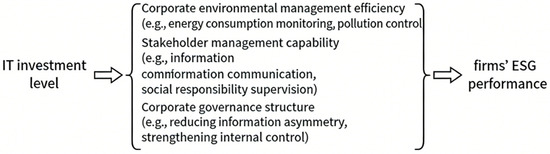
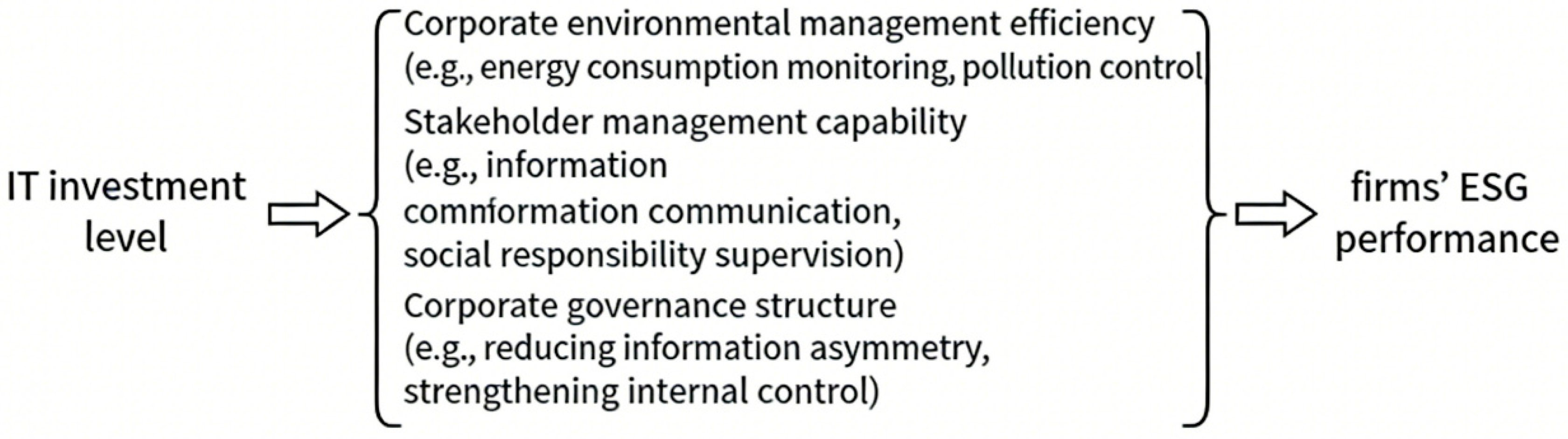
Information technology investment has gradually moved beyond the role of a purely operational tool. In many firms, IT systems are now involved in production monitoring, data storage, internal reporting, risk identification, stakeholder communication, and compliance management. These functions are closely related to ESG performance, because ESG improvement requires firms to process large amounts of environmental, social, and governance information in a timely and reliable manner. From a resource-based perspective, IT-related resources can create organizational value when they are embedded in firms’ management processes and combined with complementary capabilities. Therefore, the relationship between IT investment and ESG performance depends not only on the amount of digital input, but also on whether such input improves firms’ information processing, monitoring, coordination, and governance routines [4,16].
IT investment may first affect ESG performance by improving firms’ ability to collect and use information. Environmental management, for example, depends on continuous monitoring of energy consumption, pollutant emissions, production efficiency, and resource use. Without sufficient information systems, such data may remain fragmented across departments, making it difficult for managers to identify risks or take corrective actions. IT investment can reduce this fragmentation by linking production data, environmental data, and managerial decision-making. In this way, firms are better able to monitor environmental performance, optimize resource allocation, and reduce unnecessary waste.
IT investment may also support the social dimension of ESG. Firms need to manage relationships with employees, suppliers, customers, communities, and regulators. Digital systems can improve the traceability of supply chain activities, the timeliness of customer feedback, the standardization of product quality control, and the transparency of information disclosure. These improvements can reduce information asymmetry between firms and stakeholders and may encourage firms to respond more effectively to social responsibility requirements.
In terms of corporate governance, IT investment can strengthen internal control and improve information transparency. More developed information systems allow firms to standardize reporting procedures, detect abnormal transactions, improve risk management, and reduce managerial discretion in information disclosure. These functions may lower agency costs and governance risks. Since ESG evaluation increasingly emphasizes governance transparency, compliance, and risk control, IT investment can provide an important technological foundation for improving governance-related ESG performance.
Therefore, IT investment may enhance ESG performance through several connected channels: better environmental monitoring, more efficient stakeholder management, stronger internal control, and improved disclosure transparency. It is not only a tool for improving efficiency, but also a digital resource that can support sustainable governance. In this sense, IT investment may transform digital resources into ESG-related governance capability by reducing information asymmetry, strengthening internal control, and improving firms’ responsiveness to stakeholder and regulatory expectations.
Hypothesis 1 (H1).
Firms with higher levels of IT investment exhibit better ESG performance.
The proposed direct effect is illustrated in Figure 1.
Figure 1.
The impact of IT investment on ESG performance.
2.2. The Mediating Role of Technological Spillovers
The relationship between IT investment and ESG performance may not be limited to a direct internal governance effect. IT investment can also influence firms’ technological learning, innovation activities, and knowledge diffusion. These processes may generate technological spillovers, which provide an indirect channel through which IT investment affects ESG performance [15].
IT investment can strengthen firms’ ability to absorb and apply new technologies. When firms invest in information systems, data platforms, and digital infrastructure, they usually improve their capacity to collect technical information, coordinate innovation activities, and integrate external knowledge. This may reduce the cost of technological learning and increase the efficiency of innovation activities. As firms accumulate digital and technological experience, some of their practices may be diffused to other firms through supply chain cooperation, employee mobility, industry interaction, or imitation by peer firms. This process is also related to absorptive capacity: firms with stronger digital infrastructure may be better able to identify, assimilate, and apply external technological knowledge [17]. Thus, IT investment may not only generate internal technological learning, but also strengthen firms’ ability to benefit from external knowledge spillovers.
Technological spillovers may also arise from knowledge sharing and organizational learning. IT systems reduce the cost of information transmission within firms and across organizational boundaries. Internally, they make it easier for departments to share technical knowledge, management experience, and operational data. Externally, digital connections among firms, suppliers, and industrial networks may accelerate the diffusion of technological standards and management practices. These processes can strengthen technological spillovers at the firm, industry, and regional levels.
Such spillovers can contribute to ESG performance in several ways. In the environmental dimension, the diffusion of cleaner technologies, energy-saving methods, and monitoring tools can help firms reduce pollution and improve resource efficiency. In the social dimension, knowledge spillovers related to supply chain responsibility, product safety, and stakeholder communication may improve social responsibility practices. In the governance dimension, the spread of digital governance tools and internal control practices can enhance transparency and compliance. Therefore, technological spillovers may help transform IT investment into broader ESG improvement.
In this sense, IT investment may affect ESG performance through both a direct governance channel and an indirect spillover channel. If IT investment promotes technological spillovers, and technological spillovers further improve ESG performance, then technological spillovers can be regarded as a mediating mechanism. This mechanism emphasizes that the sustainability value of IT investment may arise not only from direct internal governance improvement, but also from the diffusion and absorption of technological knowledge.
Hypothesis 2 (H2).
Technological spillovers play a mediating role in the relationship between IT investment and corporate ESG performance.
The proposed mediating mechanism is illustrated in Figure 2.
Figure 2.
The mediating role of technological spillovers between IT investment and ESG performance.
2.3. The Moderating Role of Market Competition
The effect of IT investment on ESG performance may also depend on the market environment in which firms operate. Market competition affects firms’ strategic priorities, resource allocation, and incentives for governance improvement. Under different levels of competitive pressure, firms may use IT investment in different ways. Some firms may mainly use IT investment to reduce costs and improve short-term efficiency, whereas others may embed digital investment into longer-term governance and sustainability practices.
In more competitive markets, firms face stronger pressure to maintain efficiency, reputation, and market trust. They are also more likely to be compared by investors, customers, suppliers, and regulators. Under such conditions, weak ESG performance may damage legitimacy and competitiveness. Firms may therefore have stronger incentives to use IT systems to improve environmental monitoring, supply chain management, information disclosure, and internal control. In this case, market competition may strengthen the positive effect of IT investment on ESG performance.
Market competition may also influence the spillover process. Competitive industries usually involve more frequent technological imitation, learning, and managerial adjustment. Firms under competitive pressure may pay closer attention to technological practices adopted by leading firms and may be more willing to use IT investment to support innovation and governance improvement. As a result, the technological spillovers generated by IT investment may be more easily translated into ESG-related outcomes.
However, the effect of market competition is not necessarily simple. Excessive competition may also push firms to focus on short-term survival, cost reduction, and immediate financial returns. If this happens, IT investment may be used mainly for operational efficiency rather than ESG governance. Therefore, whether market competition strengthens the ESG effect of IT investment remains an empirical question. This ambiguity is particularly relevant in the Chinese market context, where competitive pressure, regulatory expectations, ownership structure, and local policy incentives may jointly shape firms’ ESG-related decisions.
Hypothesis 3 (H3).
Market competition strengthens the positive impact of IT investment on corporate ESG performance.
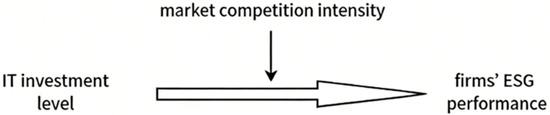
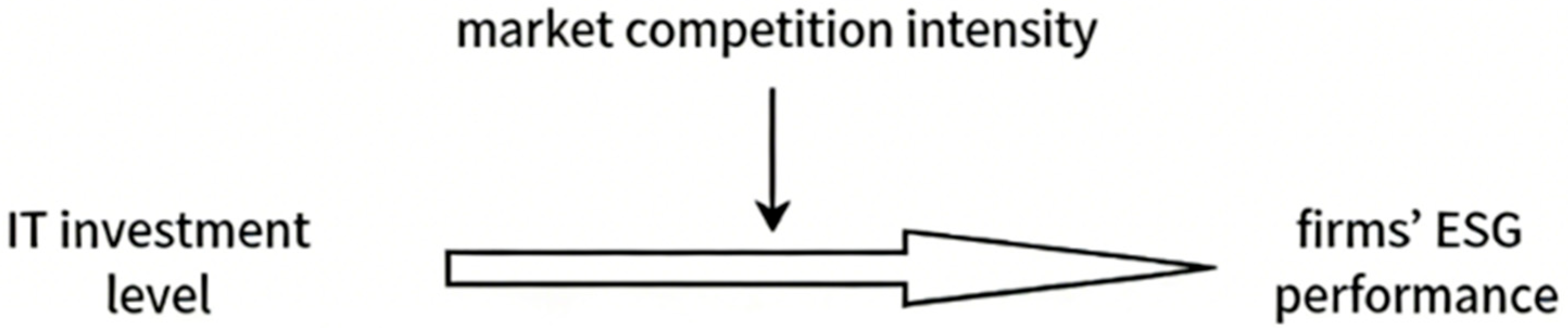
The proposed moderating mechanism is illustrated in Figure 3.
Figure 3.
The moderating role of market competition in the relationship between IT investment and ESG performance.
3. Research Design
3.1. Sample Selection and Data Sources
This study uses Chinese A-share listed firms from 2009 to 2024 as the research sample to examine the impact of corporate IT investment on ESG performance and its underlying mechanisms. The sample period is selected for two main reasons. First, since 2009, the development of digital infrastructure and the application of information technology in China have accelerated substantially, providing a suitable setting for examining the governance consequences of IT-related investment. Second, ESG evaluation and disclosure practices in China have gradually improved during this period, which makes it possible to construct a firm-year panel dataset for empirical analysis.
The sample is processed according to the following procedures. First, financial firms are excluded because their asset structure, regulatory environment, and business models differ substantially from those of non-financial firms. Second, firms designated as ST, *ST, or PT are excluded to avoid the influence of abnormal operating conditions, financial distress, and risk warning status. In the Chinese stock market, ST refers to “Special Treatment” firms with abnormal financial or operating conditions, while *ST indicates firms subject to delisting-risk warning. PT refers to firms subject to special transfer arrangements. Third, firm-year observations with missing values in key variables other than IT investment are removed. Fourth, to reduce the influence of extreme values, continuous variables are winsorized at the 1st and 99th percentiles. As an additional validity check, the baseline model is also examined without winsorization. In the non-winsorized specification, the coefficient of IT_Inv remains positive, although its statistical significance becomes weaker. This suggests that extreme observations may affect the precision of the estimate. Therefore, the 1% and 99% winsorized specification is retained as the baseline. After these procedures, an unbalanced panel dataset is obtained for empirical analysis.
The data used in this study are compiled from multiple sources. Corporate ESG performance is measured using Huazheng ESG rating data provided by Huazheng Index Information Service [18]. Financial characteristics, including firm size, leverage, profitability, and ownership structure, are obtained from the Wind database [19]. The technological spillover variable is constructed using patent-related data from CNRDS, which provides firm-level innovation and patent information for Chinese listed firms [20]. Market competition is measured by the Herfindahl–Hirschman Index (HHI), which is calculated based on firms’ operating revenue shares within the same industry-year. IT investment is proxied by an annual report-based text indicator that captures firms’ observable IT-related investment and digital transformation intensity.
For the IT investment variable, firm-year observations without identifiable IT investment records are coded as zero in the baseline specification, because IT_Inv is constructed to capture observable IT-related investment and digital resource allocation. In other words, when no identifiable IT-related investment information is reported or captured for a given firm-year observation, the baseline measure treats the firm as having no observable IT investment record. To address the possibility that non-observed IT investment records may not necessarily indicate zero actual IT investment, an additional robustness check is conducted using only firm-year observations with observable IT investment records. This additional test helps evaluate whether the baseline result is driven by the coding rule for non-observed IT investment records. Because the dataset is an unbalanced panel, the number of observations per firm varies across the sample period. This variation occurs because firms enter and exit the sample in different years and because some variables are not available for all firm-year observations. The unbalanced structure therefore reflects the listing history of firms, sample screening procedures, and variable availability.
3.2. Variable Definitions
To examine the impact of IT investment on corporate ESG performance and its underlying mechanisms, this study defines the main variables from five aspects: the dependent variable, the core explanatory variable, the mediating variable, the moderating variable, and control variables.
3.2.1. Dependent Variable
ESG Performance (ESG).
The dependent variable is corporate ESG performance, which reflects firms’ overall performance in environmental responsibility, social responsibility, and corporate governance. This study uses Huazheng ESG rating data to measure corporate ESG performance. The Huazheng ESG rating provides systematic evaluations of Chinese listed firms based on publicly available information and covers the environmental, social, and governance dimensions. A higher ESG value indicates better ESG performance.
3.2.2. Core Explanatory Variable
IT Investment (IT_Inv).
The core explanatory variable is IT investment. Because firm-level IT expenditure is not always disclosed as a standardized financial statement item, this study uses an annual report-based text indicator as a proxy for firms’ IT investment intensity and digital resource allocation. This indicator is constructed from firms’ annual report disclosures by identifying IT-related expressions associated with information systems, digital infrastructure, data platforms, intelligent management tools, and other digital technology applications. It captures the extent to which firms disclose observable IT-related investment and digital transformation activities in annual reports. A higher value indicates a higher level of observable IT-related investment and digital resource allocation.
3.2.3. Mediating Variable
Technological Spillovers (Tech_Spill).
The mediating variable is technological spillovers. This study uses the logarithm of the number of patent applications, ln(1 + Patent), as a proxy for technological spillovers. Patent-related data are obtained from CNRDS, which provides firm-level innovation and patent information for Chinese listed firms. Patent applications reflect observable technological innovation activities and potential knowledge diffusion. A higher value indicates stronger observable technological innovation and spillover potential.
3.2.4. Moderating Variable
Market Competition (HHI).
The moderating variable is market competition. This study uses the Herfindahl–Hirschman Index (HHI) to measure industry concentration. HHI is calculated based on firms’ operating revenue shares within the same industry-year. Specifically, for industry j in year t, HHI is calculated as follows [21]:
where denotes the operating revenue of firm in industry in year , and denotes the total operating revenue of all firms in the same industry-year.
A higher HHI indicates higher industry concentration and lower competitive intensity.
3.2.5. Control Variables
To control for other factors that may affect corporate ESG performance, the following control variables are included:
- (1)
- Firm Size (Size): measured as the natural logarithm of total assets at the end of the fiscal year, controlling for scale effects. Data are obtained from the Wind database.
- (2)
- Financial Leverage (Lev): measured as the ratio of total liabilities to total assets, capturing firms’ leverage levels. Data are obtained from the Wind database.
- (3)
- Profitability (ROA): measured as the ratio of net profit to total assets, controlling for firm operating performance. Data are obtained from the Wind database.
- (4)
- State Ownership (SOE): a dummy variable that equals 1 if the firm is state-owned and 0 otherwise. Data are obtained from the Wind database.
All variable definitions and measurements are summarized in Table 1.
Table 1.
Definition of Model Variables.
3.3. Model Specification
This study uses firm-level panel regression models to examine the relationship between IT investment and ESG performance. Firm fixed effects are included to control for time-invariant unobserved firm characteristics, such as corporate culture, industry position-related managerial routines, and long-term governance style. Year fixed effects are included to control for macroeconomic conditions, policy changes, and other time-specific shocks that affect all firms in a given year. Standard errors are clustered at the firm level to account for potential serial correlation and heteroskedasticity within firms over time. A fixed-effects specification is used as the main model because unobserved firm-level characteristics are likely to be correlated with both IT investment and ESG performance. In this context, the random-effects assumption that unobserved firm heterogeneity is uncorrelated with the explanatory variables is relatively strong.
- (1)
- Baseline Regression Model (Testing Hypothesis H1)
To examine whether IT investment is positively associated with corporate ESG performance, the following baseline regression model is specified:
where denotes the ESG performance of firm i in year t; represents the level of IT investment of firm i in year t; is a vector of control variables, including firm size, leverage, profitability, and state ownership; and denote firm fixed effects and year fixed effects, respectively; and is the random error term.
If the estimated coefficient is significantly positive, it indicates that IT investment significantly improves corporate ESG performance, thereby supporting Hypothesis H1.
- (2)
- Mediation Model (Testing Hypothesis H2)
Based on the baseline analysis, to further examine the mediating role of technological spillovers in the relationship between IT investment and ESG performance, the following mediation models are constructed:
where denotes the technological spillover effect variable of firm i in year t, and all other variables are defined as previously described.
This mediation framework tests the mediating role of technological spillovers through a two-step procedure. First, the significance of is examined to determine whether IT investment significantly affects technological spillovers.
Second, after is included in the ESG regression, the coefficient δ is used to test whether technological spillovers are associated with ESG performance. If and δ are statistically significant and the coefficient of declines in magnitude after is included, this indicates a partial mediating effect. In addition, Sobel and Bootstrap tests are used to further assess the statistical significance of the indirect effect [22,23].
In the Sobel test, the indirect effect is calculated as the product of the coefficient linking IT investment to technological spillovers and the coefficient linking technological spillovers to ESG performance. The Sobel statistic is calculated as follows:
where a and b denote the estimated coefficients of IT_Inv in the Tech_Spill regression and Tech_Spill in the ESG regression, respectively, and SE(a) and SE(b) are their standard errors. In addition, this study uses Bootstrap resampling with 500 replications to construct the 95% confidence interval of the indirect effect.
- (3)
- Moderation Model (Testing Hypothesis H3)
To investigate the moderating effect of market competition on the relationship between IT investment and ESG performance, the following moderation model is specified:
where denotes the level of industry concentration faced by firm i in year t. Since a higher indicates higher industry concentration and lower competitive intensity, the interaction term should be interpreted from the perspective of industry concentration. If is statistically significant, it indicates that industry concentration changes the relationship between IT investment and ESG performance. If is significantly negative, it would imply that stronger market competition strengthens the ESG effect of IT investment; if is significantly positive, it would imply that higher industry concentration strengthens this effect.
4. Empirical Results
4.1. Statistical Analysis
4.1.1. Descriptive Statistics
Table 2 presents the descriptive statistics for the main variables. The average ESG score is 73.21, with a standard deviation of 5.35. This indicates that ESG performance among Chinese listed firms is not extremely dispersed, but there is still sufficient variation across firms for empirical analysis. The minimum and maximum values, 36.62 and 100, also suggest that firms differ substantially in their sustainability-related practices.
Table 2.
Descriptive statistics of main variables.
The mean value of IT investment (IT_Inv) is 41.10, while the standard deviation is 56.64. The relatively large dispersion shows that firms differ considerably in their commitment to information technology. Some firms report little or no IT investment, whereas others have invested more heavily in information systems, digital infrastructure, and related management tools. This variation provides an empirical basis for examining whether IT investment is associated with ESG performance.
Technological spillovers (Tech_Spill) also vary greatly across firms. The mean value is 15.07, but the maximum value reaches 4087, indicating a right-skewed distribution. This pattern is consistent with the fact that innovation activity and knowledge diffusion are often concentrated in a relatively small group of firms with stronger technological capabilities.
The average HHI is 0.174, with a standard deviation of 0.150. This suggests that the sample covers industries with different degrees of market concentration and competitive intensity. Among the control variables, the average firm size is 22.20, the average leverage ratio is 0.414, and the mean ROA is 0.034. State-owned enterprises account for about one-third of the sample observations. Overall, the descriptive statistics indicate that the sample contains meaningful variation in digital investment, technological spillovers, industry structure, and firm characteristics.
4.1.2. Correlation Analysis
Table 3 reports the Pearson correlation coefficients. IT investment is positively correlated with ESG performance at the 1% significance level. This preliminary result is consistent with the expectation that firms with greater digital resource input tend to have better ESG outcomes. However, this pairwise correlation should be interpreted only as descriptive evidence, and causal inference requires the fixed-effects regressions reported below.
Table 3.
Pearson Correlation Coefficients among Main Variables.
Technological spillovers are also positively correlated with ESG performance. In addition, IT investment is positively correlated with technological spillovers, which is consistent with the mechanism proposed in this study: IT investment may support ESG improvement partly through technological learning and knowledge diffusion.
The signs of the control variables are broadly in line with economic intuition. Firm size and profitability are positively correlated with ESG performance, while leverage is negatively correlated with ESG performance. This suggests that larger and more profitable firms may have stronger resources to support ESG-related activities, whereas highly leveraged firms may face greater financial constraints.
The pairwise correlations among the explanatory variables do not indicate a serious multicollinearity concern. The largest absolute correlation coefficient among the main explanatory and control variables is 0.473 between Size and Lev, while the correlations between IT_Inv and other explanatory variables are relatively low. Therefore, the correlation results provide a preliminary basis for the subsequent regression analysis.
4.2. Baseline Regression Analysis
To test Hypothesis H1, which posits that higher levels of corporate IT investment are associated with better ESG performance, this study estimates the baseline regression model using a fixed effects approach. The regression results are reported in Table 4. The model treats firms as the panel units (Group variable: fid), with a total of 48,287 firm-year observations and 5231 individual firms. Standard errors are adjusted for clustering at the firm level (Std. err. adjusted for 5231 clusters in fid), and year fixed effects are included to control for time-specific shocks.
Table 4.
Baseline Regression Results.
Table 4 reports the baseline regression results. The coefficient of IT investment is positive and statistically significant at the 1% level after controlling for firm fixed effects, year fixed effects, and firm-level characteristics. This result supports Hypothesis 1 and indicates that firms with higher IT investment tend to achieve better ESG performance.
The result suggests that IT investment may have governance value beyond operational efficiency. Information systems, data platforms, and digital management tools can improve how firms collect information, monitor risks, coordinate resources, and disclose ESG-related information. These functions may help firms improve environmental management, stakeholder communication, internal control, and governance transparency.
The estimated coefficients of the control variables are generally consistent with expectations. Firm size is positively associated with ESG performance, suggesting that larger firms may have more resources and stronger external visibility. Leverage is negatively associated with ESG performance, which may reflect the pressure of debt obligations on sustainability-related investment. Profitability is positively related to ESG performance, implying that financially stronger firms are better positioned to support ESG activities. The coefficient of SOE is positive but not statistically significant in the baseline regression.
Overall, the baseline results provide initial evidence that IT investment is positively related to ESG performance after accounting for unobserved firm heterogeneity and year-specific shocks. The next step is to examine whether technological spillovers explain part of this relationship.
4.3. Mediation Effect of Technological Spillovers
After establishing the positive relationship between IT investment and ESG performance, this study further examines whether technological spillovers serve as a transmission channel. The underlying logic is that IT investment may first improve firms’ technological learning, innovation diffusion, and knowledge accumulation, and these spillover effects may then contribute to ESG improvement.
Following the standard stepwise mediation approach, three regressions are estimated. The first regression tests the direct effect of IT investment on ESG performance. The second regression examines whether IT investment is associated with technological spillovers. The third regression includes both IT investment and technological spillovers in the ESG model. If technological spillovers remain significantly related to ESG performance while the coefficient of IT investment declines in magnitude, this would suggest a partial mediation effect.
Table 5 reports the mediation test results. Column (1) confirms the positive effect of IT investment on ESG performance. Column (2) uses technological spillovers as the dependent variable. The coefficient of IT investment is positive and statistically significant, indicating that firms with higher IT investment tend to generate stronger technological spillover effects.
Table 5.
Mediation Effect Test Results.
Column (3) includes both IT investment and technological spillovers in the ESG regression. Technological spillovers have a positive and significant coefficient, while the coefficient of IT investment remains significant but becomes smaller than that in Column (1). This pattern indicates that technological spillovers partially mediate the relationship between IT investment and ESG performance.
This result is consistent with the mechanism proposed in this study. IT investment may improve ESG performance directly by strengthening internal information systems and governance capacity. At the same time, it may also support ESG improvement indirectly through technological learning, knowledge diffusion, and the adoption of more advanced management and environmental practices. Therefore, Hypothesis 2 is supported.
To further verify the mediation effect, this study conducts Sobel and Bootstrap tests. The Sobel test shows that the indirect effect is statistically significant (z = 2.27, p = 0.023). The Bootstrap test with 500 replications reports an indirect effect of 0.0004, with a 95% confidence interval of [0.00028, 0.00059]. Since the confidence interval does not include zero, the mediation effect is statistically supported. These results further confirm that technological spillovers are an important channel through which IT investment affects ESG performance.
4.4. Moderating Effect of Market Competition
The previous analysis shows that IT investment improves ESG performance and that technological spillovers partly explain this relationship. This section further examines whether the effect of IT investment varies across different market environments. Market competition may influence firms’ incentives to use IT investment for either short-term efficiency improvement or longer-term governance upgrading.
To test the moderating effect, the interaction term between IT investment and HHI is added to the baseline model. Since a higher HHI indicates greater industry concentration and lower competitive intensity, the interaction term should be interpreted in relation to industry concentration rather than competition intensity itself.
Table 6 reports the moderation test results. The coefficient of IT investment remains positive and statistically significant, indicating that the positive relationship between IT investment and ESG performance still holds after industry concentration and the interaction term are included.
Table 6.
Regression Results of the Moderating Effect (HHI).
The coefficient of HHI is significantly positive, suggesting that industry structure is associated with ESG performance. However, the interaction term between IT investment and HHI is not statistically significant. This means that industry concentration does not significantly change the effect of IT investment on ESG performance. Since HHI is inversely related to competitive intensity, the result also indicates that the expected moderating role of market competition is not supported. Therefore, Hypothesis 3 is not supported.
One possible explanation is that IT investment works mainly through firms’ internal digital governance capacity rather than through external competitive pressure. Information systems and digital infrastructure can improve monitoring, coordination, disclosure, and internal control across different types of industries. As a result, the ESG-related value of IT investment may remain relatively stable across competitive environments.
Another possible explanation is that market competition has mixed effects. Competitive pressure may encourage firms to improve governance and reputation, but it may also push firms to focus on cost reduction and short-term efficiency. These two effects may offset each other, leading to an insignificant moderating effect in the empirical results.
4.5. Heterogeneity Analysis Based on Ownership Structure
To further examine the heterogeneity in the impact of IT investment on corporate ESG performance, this study divides the full sample into state-owned enterprises (SOEs) and non-state-owned enterprises (non-SOEs) based on ownership structure. Fixed-effects regressions are conducted separately for each subsample, and interaction terms are introduced in the full-sample regression to formally test for differences in effects across ownership types. The regression results are presented in Table 7.
Table 7.
Results of Firm Heterogeneity Analysis.
Table 7 reports the heterogeneity analysis by ownership structure. The results indicate that the effect of IT investment differs between state-owned enterprises (SOEs) and non-state-owned enterprises (Non-SOEs). For state-owned enterprises, the coefficient is larger and more statistically significant, suggesting that IT investment has a stronger ESG-enhancing effect in state-owned firms. For non-state-owned enterprises, the coefficient is positive but not statistically significant, indicating that the ESG effect of IT investment is weaker in this subsample.
The interaction regression provides further evidence. The coefficient of the interaction term between IT investment and the state-owned enterprise dummy is positive and significant at the 1% level. This indicates that state ownership strengthens the marginal effect of IT investment on ESG performance.
This difference may be related to the institutional characteristics of state-owned enterprises. Compared with non-state-owned firms, state-owned enterprises usually face stronger policy expectations, closer regulatory oversight, and higher disclosure requirements. These conditions may encourage them to connect IT investment more directly with environmental monitoring, compliance management, internal control, and ESG disclosure.
For non-state-owned enterprises, IT investment may be used more often for operational efficiency, cost control, or market expansion. Financial constraints and short-term competitive pressure may also limit their ability to convert IT investment into ESG-related outcomes. Therefore, although IT investment is still positively related to ESG performance among non-state-owned firms, the effect is weaker than that observed among state-owned enterprises.
Overall, ownership structure shapes the ESG returns of IT investment. The results suggest that digital resources are more likely to produce sustainability-related benefits when firms face institutional incentives and governance pressure that support ESG improvement.
4.6. Robustness Checks Using Lagged IT Investment
To further mitigate potential concerns related to reverse causality, this study re-estimates the baseline model by incorporating the core explanatory variable—IT investment (IT_Inv)—with a one-period lag. The regression results are reported in Table 8.
Table 8.
Robustness Test Results Using Lagged IT Investment.
Table 8 reports the robustness check using one-period lagged IT investment. The coefficient of lagged IT investment remains positive and statistically significant at the 1% level. This indicates that prior IT investment is positively associated with current ESG performance.
Using lagged IT investment helps reduce concerns about reverse causality. If firms with better ESG performance simply invest more in IT during the same period, the contemporaneous regression may overstate the effect of IT investment. The lagged specification provides additional evidence that IT investment precedes subsequent ESG improvement.
The sign and significance of the coefficient are consistent with the baseline regression. This suggests that the main conclusion is robust. It also indicates that IT investment may have a persistent effect, which is reasonable because digital infrastructure, information systems, and governance capabilities usually take time to accumulate and influence ESG outcomes.
4.7. Robustness Analysis Based on Observable IT Investment Records
The baseline specification codes firm-year observations without identifiable IT investment records as zero. However, the absence of identifiable IT investment records may not necessarily indicate that actual IT investment is zero. To address this concern, this study further re-estimates the baseline model using only firm-year observations with observable IT investment records. The results are reported in Table 9.
Table 9.
Robustness Checks for IT Investment Measurement.
Table 9 reports the results of this additional robustness check. The coefficient of IT_Inv remains positive and statistically significant at the 1% level in the observable IT investment sample. This indicates that the baseline conclusion is not driven solely by coding non-observed IT investment records as zero.
4.8. Discussion
The empirical results provide several implications for understanding the relationship between IT investment and ESG performance. First, the positive coefficient of IT_Inv suggests that IT-related investment can support ESG improvement by strengthening firms’ information-processing capacity, internal control, monitoring systems, and disclosure transparency. This finding is consistent with the resource-based perspective, which argues that IT-related resources can generate organizational value when they are embedded in firms’ managerial and governance processes.
Second, the mediation results show that technological spillovers partially explain the relationship between IT investment and ESG performance. This indicates that the ESG effect of IT investment is not limited to internal governance improvement. IT-related investment may also promote technological learning, innovation diffusion, and knowledge accumulation, which can further support environmental management, social responsibility practices, and governance quality. At the same time, because patent-related indicators mainly capture observable innovation outputs, this mechanism should be interpreted as evidence of observable technological spillover potential rather than the full range of informal or tacit knowledge diffusion.
Third, the moderating effect of market competition is not supported. One possible reason is that IT investment may affect ESG performance mainly through internal digital governance capability rather than external competitive pressure. Another possible reason is that market competition may have mixed effects: it may encourage firms to improve reputation and governance, but it may also push them to prioritize cost reduction and short-term efficiency. These opposing forces may weaken the moderating role of market competition in the empirical results.
Finally, the ownership heterogeneity results suggest that the ESG effect of IT investment is stronger in state-owned enterprises. This may be related to the institutional environment in China [24]. Compared with non-state-owned enterprises, state-owned enterprises usually face stronger policy expectations, regulatory oversight, and disclosure pressure. These institutional conditions may make it easier for IT investment to be connected with environmental monitoring, compliance management, internal control, and ESG disclosure. Therefore, the findings should be understood in relation to the Chinese capital market and corporate governance context.
5. Conclusions and Policy Implications
5.1. Conclusions
Using panel data from Chinese A-share listed firms from 2009 to 2024, this study examines whether IT investment improves corporate ESG performance and further explores the roles of technological spillovers, market competition, and ownership structure. The empirical results provide several findings.
IT investment is positively associated with corporate ESG performance. After controlling for firm fixed effects, year fixed effects, and firm-level characteristics, the coefficient of IT investment remains significantly positive. The robustness test using lagged IT investment produces a consistent result, suggesting that the relationship is not only a contemporaneous correlation. Taken together, these findings indicate that IT investment may support ESG improvement by strengthening firms’ information-processing capacity, monitoring systems, internal control, and disclosure transparency. In addition, the coefficient remains positive and statistically significant when the model is re-estimated using only firm-year observations with observable IT investment records.
Technological spillovers partially explain how IT investment is related to ESG performance. The mediation results show that IT investment promotes technological spillovers, and technological spillovers are further associated with higher ESG performance. This means that the sustainability effect of IT investment is not limited to internal efficiency or governance improvement. It may also work through technological learning, knowledge diffusion, and innovation spillovers, which help firms improve environmental management, social responsibility practices, and governance quality.
The moderating effect of market competition is not statistically supported. The interaction term between IT investment and HHI is insignificant, indicating that industry concentration does not significantly change the relationship between IT investment and ESG performance. Since HHI is inversely related to competitive intensity, this result also suggests that the expected moderating role of market competition is not supported. This result suggests that the ESG-enhancing effect of IT investment may depend more on firms’ internal digital governance capacity than on short-term differences in competitive pressure.
Ownership structure matters. The positive effect of IT investment on ESG performance is stronger among state-owned enterprises than among non-state-owned enterprises. This may be because state-owned enterprises face stronger policy expectations, regulatory oversight, and disclosure requirements, which help them connect IT investment more directly with ESG-related governance practices. This finding should be understood in relation to the institutional environment and governance expectations faced by Chinese listed firms.
Overall, the evidence suggests that IT investment should not be understood only as an efficiency-oriented expenditure. When digital resources are embedded in information processing, monitoring, disclosure, internal control, and technological learning, they may become part of firms’ sustainable governance capability. These findings should be interpreted in the context of Chinese A-share listed firms and China’s institutional environment.
5.2. Policy Implications
The findings offer several implications for firms, policymakers, and investors.
For firms, IT investment should be integrated into ESG-related governance processes rather than treated only as a technical upgrade. Information systems, data platforms, and digital infrastructure can support environmental monitoring, stakeholder communication, compliance management, and disclosure quality. To realize these benefits, firms need to connect IT investment with ESG objectives at the strategy and management levels. For example, firms can use digital systems to collect environmental data, monitor supply chain responsibility, standardize internal reporting, and improve the traceability of ESG-related information.
For policymakers, digital economy policies and ESG governance policies should be coordinated more closely. Policies that encourage firms to invest in digital infrastructure, improve data governance, and promote technological diffusion may also contribute to corporate sustainability. In particular, policy support can help firms transform digital investment from isolated technical input into governance capability. Such support may include clearer ESG data standards, incentives for digital infrastructure investment, and mechanisms that encourage technology diffusion among firms.
The heterogeneous results also suggest that policy design should consider ownership differences. State-owned enterprises can play a demonstration role in digital governance and ESG disclosure. For non-state-owned enterprises, targeted support may be needed to reduce financial constraints, improve access to digital resources, and encourage the use of IT investment for long-term ESG improvement rather than only for cost reduction or operational efficiency.
For investors, IT investment may provide additional information for assessing firms’ long-term sustainability potential. Firms with stronger digital resource allocation may be better positioned to improve ESG performance through information systems, technological learning, and governance transparency. Therefore, IT investment can be considered together with traditional ESG indicators when evaluating firm value and sustainability risk. However, investors should interpret IT investment together with firms’ actual ESG disclosure quality and governance outcomes, rather than treating digital investment as a standalone signal.
5.3. Limitations and Future Research
This study has several limitations. First, IT investment is measured using an annual report-based text indicator, which may not fully capture the structure, quality, and application scenarios of firms’ digital investment. Future research may combine annual report text indicators with more detailed firm-level information on IT expenditure, digital infrastructure, and digital technology adoption. Second, technological spillovers are proxied by patent-related indicators, which may not fully reflect informal knowledge sharing, process innovation, or management-related technology diffusion. Future studies could use supply chain networks, regional innovation data, or inter-firm knowledge flows to provide a more comprehensive measurement.
Finally, this study focuses on Chinese A-share listed firms, and the findings should be interpreted in relation to China’s institutional and capital market environment. Although the use of lagged IT investment helps reduce reverse causality concerns, stronger causal identification is still needed. Future research may extend the analysis to cross-country samples and adopt instrumental variables, quasi-natural experiments, or policy shocks to provide stronger causal evidence.
Author Contributions
Conceptualization, Z.M. and F.C.; Methodology, Z.M.; Software, Z.M.; Validation, Z.M. and F.C.; Formal analysis, Z.M.; Investigation, Z.M.; Resources, Z.M.; Data curation, Z.M.; Writing—original draft, Z.M.; Writing—review & editing, Z.M. and F.C.; Visualization, Z.M.; Supervision, F.C.; Project administration, Z.M. All authors have read and agreed to the published version of the manuscript.
Funding
This research received no external funding.
Institutional Review Board Statement
Not applicable.
Informed Consent Statement
Not applicable.
Data Availability Statement
Restrictions apply to the availability of these data. The ESG rating data were obtained from Huazheng Index Information Service, financial and ownership data were obtained from the Wind database, and patent-related data were obtained from CNRDS. These data are available from the corresponding data providers with permission. Access to these third-party databases requires registration or subscription and is subject to database licensing restrictions; therefore, the raw database data are not publicly available. The annual-report-based text indicator used to proxy IT investment was constructed by the authors based on listed firms’ annual reports. The processed data supporting the findings of this study may be available from the corresponding author upon reasonable request, subject to the relevant data-use restrictions.
Conflicts of Interest
The authors declare no conflict of interest.
References
- Zumente, I.; Bistrova, J. ESG importance for long-term shareholder value creation: Literature vs. practice. J. Open Innov. Technol. Mark. Complex. 2021, 7, 127. [Google Scholar] [CrossRef] [Scilit]
- Houston, J.F.; Shan, H. Corporate ESG profiles and banking relationships. Rev. Financ. Stud. 2022, 35, 3373–3417. [Google Scholar] [CrossRef] [Scilit]
- Berg, F.; Kölbel, J.F.; Rigobon, R. Aggregate confusion: The divergence of ESG ratings. Rev. Financ. 2022, 26, 1315–1344. [Google Scholar] [CrossRef] [Scilit]
- Bharadwaj, A.S. A resource-based perspective on information technology capability and firm performance: An empirical investigation. MIS Q. 2000, 24, 169–196. [Google Scholar] [CrossRef] [Scilit]
- Verhoef, P.C.; Broekhuizen, T.; Bart, Y.; Bhattacharya, A.; Dong, J.Q.; Fabian, N.; Haenlein, M. Digital transformation: A multidisciplinary reflection and research agenda. J. Bus. Res. 2021, 122, 889–901. [Google Scholar] [CrossRef] [Scilit]
- Hanelt, A.; Bohnsack, R.; Marz, D.; Marante, C.A. A systematic review of the literature on digital transformation: Insights and implications for strategy and organizational change. J. Manag. Stud. 2021, 58, 1159–1197. [Google Scholar] [CrossRef] [Scilit]
- Robertsone, G.; Lapiņa, I. Digital transformation as a catalyst for sustainability and open innovation. J. Open Innov. Technol. Mark. Complex. 2023, 9, 100017. [Google Scholar] [CrossRef] [Scilit]
- Liu, H.; Jung, J.-S. Impact of digital transformation on ESG management and corporate performance: Focusing on the empirical comparison between Korea and China. Sustainability 2024, 16, 2817. [Google Scholar] [CrossRef] [Scilit]
- Li, W.; Zhang, M. Digital transformation, absorptive capacity and enterprise ESG performance: A case study of strategic emerging industries. Sustainability 2024, 16, 5018. [Google Scholar] [CrossRef] [Scilit]
- Lu, Y.; Xu, C.; Zhu, B.; Sun, Y. Digitalization transformation and ESG performance: Evidence from China. Bus. Strategy Environ. 2024, 33, 352–368. [Google Scholar] [CrossRef] [Scilit]
- Wang, H.; Jiao, S.; Bu, K.; Wang, Y.; Wang, Y. Digital transformation and manufacturing companies’ ESG responsibility performance. Financ. Res. Lett. 2023, 58, 104370. [Google Scholar] [CrossRef] [Scilit]
- Li, J.; Wu, T.; Liu, B.; Zhou, M. Can digital transformation enhance corporate ESG performance? The moderating role of dual environmental regulations. Financ. Res. Lett. 2024, 62, 105241. [Google Scholar] [CrossRef] [Scilit]
- Wu, X.; Li, L.; Liu, D.; Li, Q. Technology empowerment: Digital transformation and enterprise ESG performance—Evidence from China’s manufacturing sector. PLoS ONE 2024, 19, e0302029. [Google Scholar] [CrossRef] [Scilit] [PubMed]
- Guo, X.; Pang, W. The impact of digital transformation on corporate ESG performance. Financ. Res. Lett. 2025, 72, 106518. [Google Scholar] [CrossRef] [Scilit]
- Bloom, N.; Schankerman, M.; Van Reenen, J. Identifying technology spillovers and product market rivalry. Econometrica 2013, 81, 1347–1393. [Google Scholar] [CrossRef] [Scilit]
- Barney, J.B. Firm resources and sustained competitive advantage. J. Manag. 1991, 17, 99–120. [Google Scholar] [CrossRef] [Scilit]
- Cohen, W.M.; Levinthal, D.A. Absorptive capacity: A new perspective on learning and innovation. Adm. Sci. Q. 1990, 35, 128–152. [Google Scholar] [CrossRef] [Scilit]
- Huazheng Index Information Service. Stock ESG Rating Data. Available online: https://www.chindices.com/esg-data.html (accessed on 20 June 2026).
- Wind Information Co., Ltd. Wind Financial Terminal. Available online: https://www.wind.com.cn/ (accessed on 20 June 2026).
- Chinese Research Data Services Platform (CNRDS). About CNRDS. Available online: https://www.cnrds.com/Home/About (accessed on 20 June 2026).
- Hirschman, A.O. National Power and the Structure of Foreign Trade; University of California Press: Berkeley, CA, USA, 1945. [Google Scholar]
- Sobel, M.E. Asymptotic confidence intervals for indirect effects in structural equation models. Sociol. Methodol. 1982, 13, 290–312. [Google Scholar] [CrossRef] [Scilit]
- Efron, B.; Tibshirani, R.J. An Introduction to the Bootstrap; Chapman & Hall/CRC: New York, NY, USA, 1993. [Google Scholar]
- DiMaggio, P.J.; Powell, W.W. The iron cage revisited: Institutional isomorphism and collective rationality in organizational fields. Am. Sociol. Rev. 1983, 48, 147–160. [Google Scholar] [CrossRef] [Scilit]



Disclaimer/Publisher’s Note: The statements, opinions and data contained in all publications are solely those of the individual author(s) and contributor(s) and not of MDPI and/or the editor(s). MDPI and/or the editor(s) disclaim responsibility for any injury to people or property resulting from any ideas, methods, instructions or products referred to in the content. |
© 2026 by the authors. Licensee MDPI, Basel, Switzerland. This article is an open access article distributed under the terms and conditions of the Creative Commons Attribution (CC BY) license.