


Abstract
The sustainable valorization of spontaneous flora biomass for the recovery of high value-added phytochemicals represents a key opportunity within the circular bioeconomy, yet it remains constrained by the environmental limitations of conventional extraction solvents and the lack of data-driven optimization frameworks. In this study, Natural Deep Eutectic Solvents (NADES) composed of betaine and 1,3-propanediol were designed and applied as bio-based extraction media for the recovery of bioactive metabolites from Artemisia annua L. spontaneous biomass in the context of green extraction and sustainable resource utilization. Two liquid–solid extraction techniques, namely vortex-assisted extraction and ultrasound-assisted extraction, were evaluated. The influence of key process parameters, including the eutectic component molar ratio, water content, solid-to-liquid (S/L) ratio, extraction temperature, and extraction time, was systematically investigated. Results demonstrated that extraction efficiency was strongly dependent on both solvent composition and process conditions, with distinct optimum parameters for different phytochemical classes. Maximum total polyphenol content (52.08 mg GAE/mL) was achieved via ultrasound-assisted extraction at 20 °C for 15 min, using a 1:3 NADES ratio with 40% water dilution and S/L = 1:5, while the highest flavonoid yield (17.34 mg QE/mL) was obtained by vortex-assisted extraction for 45 min using a 1:6 NADES ratio under the same dilution and S/L conditions. To identify extraction conditions associated with improved process efficiency, a hybrid modeling approach combining deep neural networks with the Success-History-based Adaptive Differential Evolution (SHADE) algorithm was employed, enabling high-accuracy prediction of extraction performance across a broad parameter space. The proposed framework demonstrates the feasibility of integrating green solvent design with machine learning-driven process modeling for the efficient valorization of underutilized plant biomass, contributing to the development of resource-efficient, sustainable extraction protocols, consistent with principles of process intensification and resource-efficient extraction strategies.
1. Introduction
The growing interest in circular bioeconomy strategies has stimulated the search for renewable biomass resources and environmentally friendly extraction technologies. In this context, spontaneous flora (wild-growing plant species that are typically harvested without deliberate cultivation) represents an underexplored yet strategically relevant category of renewable biomass. Species such as Artemisia annua L. (A. annua) are characterized by rich phytochemical profiles, including sesquiterpene lactones, flavonoids, and essential oils, that have significant bioactive potential for pharmaceutical, nutraceutical, and cosmetic applications [1,2]. However, the systematic valorization of such species within a biorefinery-oriented approach remains limited, largely due to the absence of optimized, green, and scalable extraction methodologies.
Natural Deep Eutectic Solvents (NADESs) have emerged as a sustainable and environmentally friendly class of solvents, offering an effective alternative to conventional solvents and ionic liquids for the extraction of bioactive compounds from plant materials [3]. Formed by combining two or more naturally derived components (such as sugars, amino acids, organic acids, and other primary and secondary metabolites), generally recognized as safe (GRAS) ingredients, they maintain their liquid state at, or close to, room temperature due to strong hydrogen bonding interactions [4]. Their physicochemical properties, including polarity, viscosity, biodegradability, thermal stability, and solubilization capacity, can be finely tuned by altering component ratios or by introducing co-solvents such as water. This flexibility enables NADESs to dissolve a wide range of natural products, including both hydrophilic and hydrophobic substances: alkaloids, terpenoids, lignin derivatives, polysaccharides, peptides, lipids, and various phenolic compounds [5,6,7,8], often surpassing the solubilizing capabilities of conventional single-phase organic solvents. Among these, polyphenols and flavonoids are of particular interest due to their notable antioxidant, anti-inflammatory, and therapeutic properties [9,10].
Consequently, NADESs have been extensively applied in the extraction of these compounds from diverse matrices, including medicinal plants, agricultural residues, and food materials, with applications in the food, pharmaceutical, and cosmetic industries [11,12,13]. The use of NADES as extraction solvents for bioactive compounds from medicinal plants aligns with green chemistry principles, offering an environmentally responsible alternative to conventional synthetic solvents. Their inherent biocompatibility, low toxicity profile for both oral and dermal applications, and robust thermal stability position them as sustainable candidates for pharmaceutical and cosmeceutical formulations, where the growing demand for clean-label, eco-conscious formulations requires solvents that deliver both functional efficacy and skin compatibility without compromising ecological integrity [3,12,13].
Peng et al. demonstrated that a betaine–maleic acid (Bet-MA) NADES, selected using the COSMO-RS model, significantly enhanced polyphenol extraction from Moringa oleifera leaves, achieving yields 1.56 times higher than ethanol-based extraction [14]. Further optimization via ANN-GA resulted in a maximum polyphenol content of 44.19 ± 0.23 mg GAE/g d.w., with the extract showing strong antioxidant activity even at low concentrations [14]. Khalid et al. reported high extraction efficiency from chickpea (Cicer arietinum L.) sprouts using a citric acid–glycerol–water-based NADES, achieving a total polyphenol content (TPC) of 128.0 ± 0.2 mg GAE/100 g, total flavonoid content (TFC) of 38.61 ± 0.03 mg CE/100 g, and antioxidant activity of 2117 ± 1.8 µmol TE/100 g following ultrasound-assisted extraction [11]. Nelson et al. (2025) developed a sustainable microwave-assisted extraction (MAE) method using NADES for Amomum subulatum, where lactic acid–sucrose (Lact:Suc) and lactic acid–glucose (Lact:Gluc) systems outperformed ethanol, achieving, for Lac:Suc, a TPC of 48.99 ± 0.09 mg GAE/g and a TFC of 56.54 ± 1.98 mg QE/g [15]. Wang et al. (2025) reported that betaine–ethylene glycol (Bet–EG), an alcohol-based NADES, demonstrated superior extraction efficiency for both polyphenols and flavonoids from Artemisia ordosica compared to conventional solvents [3]. The Bet–EG extract exhibited not only the highest total phenolic (16.08 ± 0.40 mg GAE/g) and flavonoid content (25.61 ± 0.68 mg QE/g) but also excellent antioxidant capacity [3]. Ilić et al. (2025) explored the use of NADES combined with ultrasound-assisted extraction (UAE) to recover a broad spectrum of bioactives from hemp (Cannabis sativa L.) sprouts, including phenolics, flavonoids, carotenoids, and chlorophylls [16]. By optimizing extraction parameters such as temperature, liquid-to-solid ratio, and ultrasonic power, and employing both hydrophilic and hydrophobic NADES in sequential and simultaneous extraction modes, they achieved selective and efficient recovery [16]. Notably, the highest phenolic yield (10.65 mg GAE/g) was obtained using lactic acid:glucose followed by decanoic acid:menthol, while reversing the order maximized carotenoid and chlorophyll content [16]. These multi-phase, solvent-safe methods highlight the versatility of NADES in scalable, sustainable extraction processes applicable to the food, cosmetic, and pharmaceutical sectors.
Currently, the scientific literature on the use of NADES in extracting bioactive compounds from Artemisia annua (A. annua) is limited, with only a few direct studies, only one explicitly addresses the optimization of the solvent used: the study by Fan et al., which selected the ideal ratio between NADES components using COSMO-RS (Conductor-like Screening Model for Real Solvents) modeling [17]. All research identified so far has focused exclusively on the extraction of artemisinin, without evaluating the phenolic, flavonoid or antioxidant potential of the plant, which play an essential role in dermatological applications [17,18,19,20,21]. Furthermore, we have not identified any research in the literature that uses a NADES system based on betaine and 1,3-propanediol for the extraction of secondary metabolites from this plant.
The selection of the NADES composed of betaine as a hydrogen-bond acceptor and 1,3-propanediol as a hydrogen-bond donor was primarily guided by its full cosmetic acceptability, biocompatibility, and suitability for direct incorporation into dermato-cosmetic formulations [22,23]. Both components are non-toxic, biodegradable, and derived from renewable sources, ensuring environmental sustainability [24] and are permitted cosmetic ingredients under Regulation (EC) No 1223/2009, recognized by the Cosmetic Ingredient Review (CIR) Expert Panel and the COSMILE Europe database as safe and suitable for topical application, without specific concentration restrictions when used as functional excipients [25,26]. Betaine, a naturally occurring zwitterion found in plants such as sugar beets and spinach, is widely used in food, cosmetic, and pharmaceutical products due to its safety profile, while 1,3-propanediol is a food-grade solvent approved by regulatory authorities and known for its biocompatibility [27,28]. The concentration of plant extracts in cosmetic products is generally kept at relatively low levels and is determined on a case-by-case basis according to product type, safety evaluation, regulatory considerations, and intended cosmetic function [26,27,28]. Among the various green extraction technologies reported for polyphenol recovery, VAE and UAE were selected because they provide efficient process intensification while maintaining low energy requirements and high compatibility with viscous NADES media. Their simplicity, scalability, and suitability for industrial implementation make them particularly attractive within sustainable biorefinery concepts [29,30,31].
Recent advances in data-driven modeling have opened new opportunities for extraction system optimization without requiring multiple experiments (associated with classical response surface methodologies). Machine learning algorithms, and especially artificial neural networks, have demonstrated superior predictive performance in multi-parameter extraction optimization scenarios, enabling the identification of optimal operating conditions with high accuracy and limited experimental datasets. Integrating ML-based optimization into NADES extraction workflows represents an important step that is well-aligned with the broader goals of process intensification and resource efficiency associated within modern circular biorefinery strategies.
Thus, the present study aims to evaluate the innovative potential of betaine–1,3-propanediol NADES as a sustainable and efficient alternative for extracting polyphenolic compounds from A. annua L. spontaneous flora biomass, coupled with machine learning modeling to maximize extraction efficiency while minimizing resource consumption. Given that both eutectic components are approved cosmetic ingredients, the resulting extract is intended for incorporation into dermato-cosmetic emulsions. Building on this objective, the study investigates two environmentally friendly extraction techniques, vortex-assisted extraction (VAE) and ultrasound-assisted extraction (UAE), by examining the influence of key operational parameters such as temperature, eutectic component ratio, water content in the NADES, liquid–solid ratio, and extraction time. The experimental data were subsequently analyzed using dedicated modeling software, providing complementary insights to the empirical findings. The modeling was carried out using a hybrid approach that combined deep neural networks with the Success-History-based Adaptive Differential Evolution (SHADE) algorithm, enabling improved predictive accuracy across varying extraction conditions. The manuscript combines (i) sustainable extraction using NADES, (ii) machine learning-assisted optimization and prediction of extraction performance, and (iii) the valorization of spontaneous plant biomass aligned with the principles of a circular bioeconomy. To the best of our knowledge, this multidimensional integration has been scarcely explored in the current literature, particularly for underutilized spontaneous flora resources.
2. Materials and Methods
2.1. Materials
The plant material was represented by the aerial parts of the species Artemisia annua L., harvested on 12 August 2024, from the area of Popricani, Iași County, Romania, at approximately 47.29° N latitude and 27.50° E longitude. The plants were harvested from the spontaneous flora, in the pre-flowering stage, when the flower buds were well developed. The age of the plants was estimated at approximately 5 and a half months from emergence, based on the local vegetation period. This species is widely recognized for its elevated content of polyphenols and flavonoids, highly polar bioactive compounds with a pronounced affinity for solvents capable of forming multiple hydrogen bonds [32,33,34,35,36,37,38,39,40]. Following harvest, the plant material was cleaned manually, and the thick, fibrous stems were removed. Only the fine twigs with leaves and flower buds were kept for processing. The plant material used consisted of approximately 20% fine stems/twigs and 80% leaves and flower buds. Drying was carried out naturally, in the shade, in a room with natural ventilation, at a temperature of approximately 25 °C, for 10 days. After drying, the plant material was ground to obtain particles of approximately 1–3 mm and stored in hermetically sealed glass containers at 4 °C until extraction. The moisture content of the fresh plant material was determined using a Kern ADB 100-4 (KERN & SOHN GmbH, Balingen, Germany) thermobalance and an average plant sample of 1–2 g and was 84%.
As an extraction reagent, NADESs based on betaine (trimethyl glycine) (99.8% purity, purchased from Ellemental—Oradea, Romania) as a hydrogen-bond acceptor (HBA) and propanediol (1,3-propanediol) (99.8% purity, purchased from Ellemental—Oradea, Romania) as a hydrogen-bond donor (HBD) at molar ratios of 1:3; 1:4 and 1:6 were prepared.
2.2. Methods
2.2.1. Preparation of NADESs
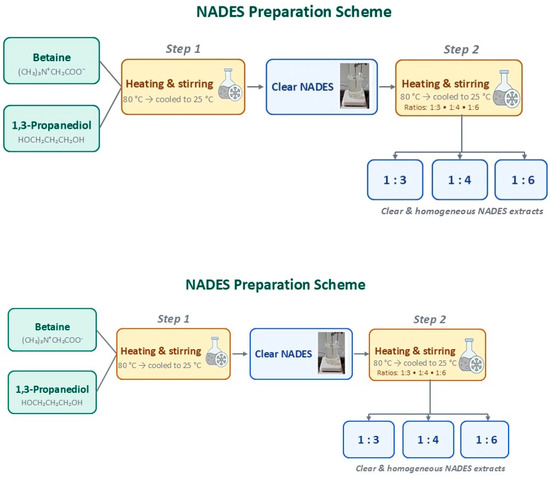
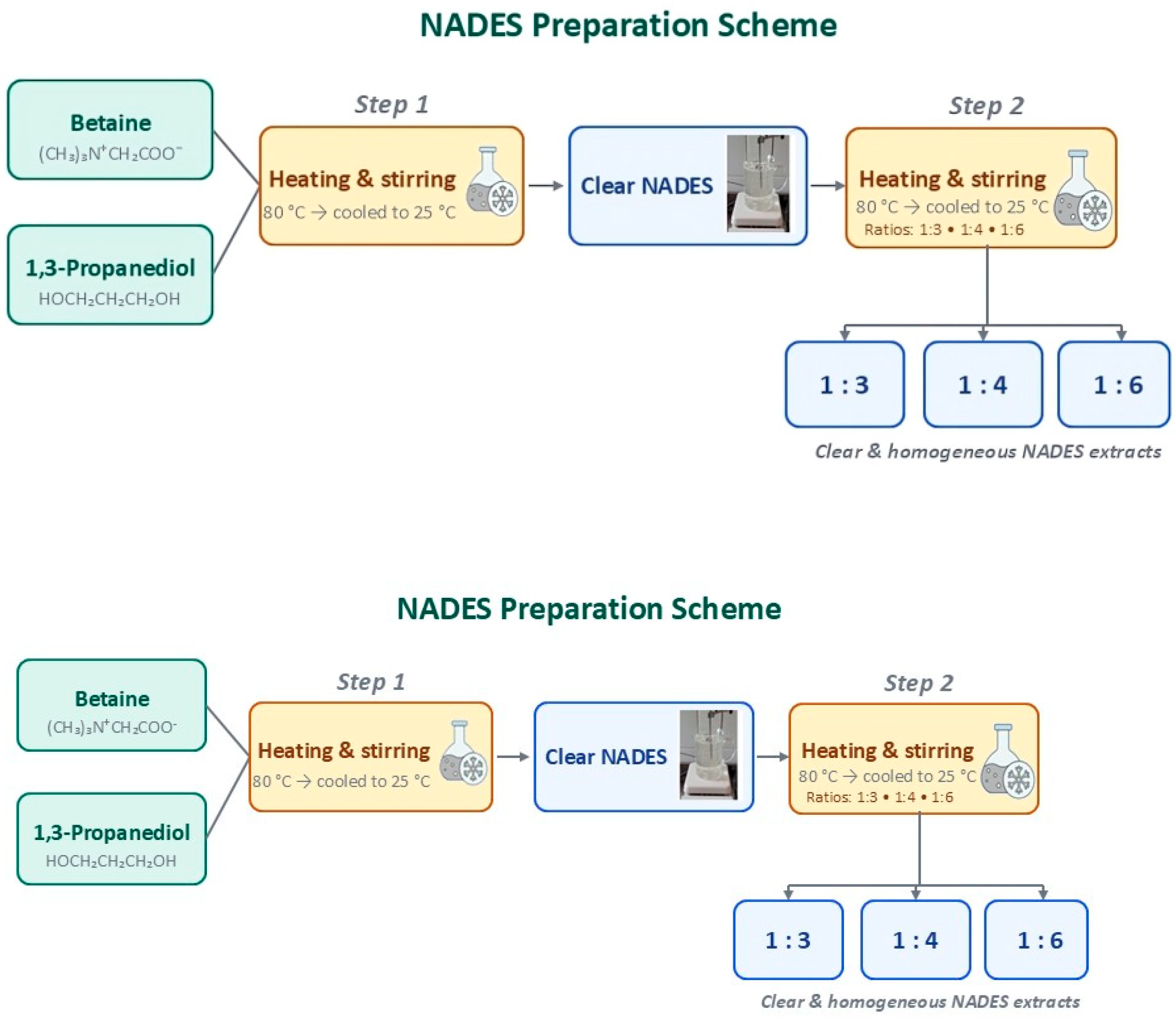
To produce a clear NADES mixture free of crystallization traces (Figure 1), repeated heating and cooling were used. Thus, first the mixture was heated to 80 °C with continuous stirring until a clear liquid formed, then cooled to 25 °C, and then the mixture was reheated to 80 °C with intermittent mixing and allowed to cool to an ambient temperature of 25 °C. The purpose of these sequential heating and cooling processes is to guarantee that the betaine is well dissolved in order to produce a homogenous mixture free of crystallization traces.
Figure 1.
The stages of obtaining the NADES mixtures.
2.2.2. Physicochemical Characterization of NADES
The density of the selected solvent was determined by measuring the mass of 1 mL of sample using a KERN ADB 100-4 analytical balance (KERN & SOHN GmbH, Balingen, Germany). The pH values were measured with a digital pH meter (Hanna Instruments, Jakarta, Indonesia), while the electrical conductivity of the NADES samples was determined using a portable conductivity meter (Hanna Instruments, Indonesia). A Ubbelohde viscometer (SI Analytics GmbH, Mainz, Germany) with a glass capillary was used to measure kinematic viscosities, with an error margin of ±0.004 mPa·s. The calibration of the viscometer was based on water values and standard methods accepted by the American Society for Testing and Materials (ASTM). To ensure accurate measurements, the viscometer was thoroughly cleaned using water and acetone, followed by air drying. The desired temperature stability during the measurement of efflux time was maintained via a transparent thermostat water bath (Koehler, KV3000, Koehler Instrument Company, Inc., Bohemia, NY, USA), with an accuracy of ±0.01 K. A stopwatch with an accuracy of ± 0.05 was used to measure the reflux time for the liquid. Depending on the expected viscosity of the mixture formed by the pure components involved, a certain capillary tube with a specific diameter was selected for the viscometer used, allowing various kinematic viscosity measurements. The accuracy of the determinations is estimated to be ±1.00%. All measurements were performed at atmospheric pressure and a temperature of 25 ± 0.5 °C.
2.2.3. Fourier-Transform Infrared Spectroscopy Characterization of NADES Before and After Extraction
The selected NADES samples were characterized by Fourier-transform infrared (FTIR) spectroscopy. FTIR spectra were recorded using a Thermo Nicolet IS50 spectrometer (Thermo Fisher Scientific Inc., Madison, WI, USA) equipped with ATR and ESP modules. Measurements were performed in real-time mode with a spectral resolution of 4 cm−1, an incident angle of 45°, and an acquisition time of 30 s. The spectra were collected over the range of 4000–600 cm−1 at room temperature.
2.2.4. Extraction Methods
To obtain vegetal extracts from the A. annua plant with the maximum content of active compounds, the following extraction techniques were used: UAE and VAE. The S/L ratio (1:5, 1:15, and 1:25), temperature (20 °C, 45 °C, and 60 °C), extraction solvent composition (betaine: propanediol = 1:3, 1:4, and 1:6), H2O content in NADES solvent (0, 10, 20 and 40%) and extraction time (15 min, 30 min, 45 min, and 60 min) were among the variables examined for their effects on the extraction process using NADESs. For VAE, a Vortex Mixer type of equipment, VELP Scientifica, Italy, was used, operated at 1200 rpm. Ultrasound-assisted extraction (UAE) was performed using an ultrasonic bath (Bandelin SONOREX SUPER RK 100 H, Bandelin Electronic, Berlin, Germany) operating at a fixed frequency of 35 kHz. The ultrasonic power was that provided by the manufacturer for the selected equipment, ensuring cavitational effects through acoustic energy transmission in the liquid medium: nominal ultrasonic power was 80 W, and ultrasonic peak power was 320 W. The extraction vessels were placed in a fixed position within the bath (with a volume of 2 L) to ensure consistent exposure conditions. No additional mechanical stirring was applied during sonication, as mixing and mass transfer enhancement were achieved exclusively through acoustic cavitation and microstreaming phenomena generated within the ultrasonic field. The extraction temperature was controlled using the integrated heating system of the ultrasonic bath to maintain constant operating conditions throughout the experiments.
2.2.5. Determination of Total Polyphenol Content (TPC) and Flavonoids (TFC)
The total polyphenol content (TPC) was ascertained using the Folin–Ciocalteu technique [34], and the results were presented as milligrams of gallic acid equivalent (GAE) per milliliter of extract (mg GAE/mL). There were two sets of analyses. Using the same traditional methods, the standard calibration curve was created for a range of gallic acid concentrations. For determinations, the Folin–Ciocalteu (98% purity) reagent purchased from Merck Co. (Darmstadt, Germany) was used, and the concentrations of polyphenols were determined spectrophotometrically using a Shimadzu UV-1280 UV-VIS Spectrophotometer (Shimadzu Corporation, Kyoto, Japan) at the maximum-colored complex wavelength of 765 nm. To account for potential interference from NADES components, a blank correction was applied using NADES solutions prepared under identical conditions but without plant material.
The amount of flavonoids (TFC) was determined using a 2% AlCl3 solution made in methanol and analyzed using a spectrophotometric-based technique [35], and the results were presented as milligrams of quercetin equivalent (QE) per milliliter of extract (mg QE/mL). For determinations, AlCl3 (98% purity) reagent purchased from Carl-Roth (Karlsruhe, Germany) was used, and the concentrations of flavonoids were determined spectrophotometrically using a Shimadzu UV-1280 UV-VIS Spectrophotometer (Shimadzu Corporation, Kyoto, Japan) at the maximum- wavelength of the colored complex of 510 nm. The total flavonoid content was calculated using the standard quercetin calibration curve (model selected due to its stability and representativeness of the flavonoid class) in the range of 0.05–1.2 mg/mL. The linear equation of the calibration curve is y = 0.0005x − 0.037, where y is the absorbance value measured at 510 nm and x is the quercetin concentration (mg quercetin equivalent (QE)/mL). The sample volume, according to the specificity of the apparatus used, was 2 mL, and if the absorbance value was greater than 1.0, the sample was diluted 1:10. It is noted that the viscosity of the NADES solvent did not affect the determinations.
2.2.6. Modeling and Optimization Strategy
To model the process, a combination of deep neural networks with the Success-History-based Adaptive Differential Evolution (SHADE) optimization algorithm was used. SHADE represents an advanced evolutionary optimization technique and operates as a population-based metaheuristic that maintains adaptive control parameter adaptation through a historical memory mechanism [36]. Since it is based on the Differential Evolution algorithm, it has four fundamental operations: initialization, mutation, crossover, and selection.
The distinctive feature of SHADE lies in its history-based parameter adaptation strategy, which utilizes memory archives MCr and MF to store successful crossover rates (Cr) and scaling factors (F). This approach enhances robustness compared to JADE [37] by maintaining a diverse set of historical parameter values rather than relying on a single adaptive parameter pair. In the initialization step, a set of potential solutions (also referred to as vectors or individuals) is generated based on random number generators, and MCr and MF are set to 0.5. The classical mutation step uses the current-to-pbest/1 strategy (Equation (1)),
where vi is the mutant vector, xi is the target individual, xpbest is randomly selected from the p best individuals, and and are randomly chosen from the current population, with r2 ≠ i and r2 ≠ r1. G indicates the generation number.
The crossover operation generates a trial vector by mixing the components from vi,G and the target vector. In the selection step, the trial vector competes with its parent through a greedy selection mechanism (Equation (2)),
where f(⋅) represents the objective function to be minimized. At the end of each generation, if successful parameter values exist, the memory cells are updated.
The SHADE algorithm is applied in two contexts: (i) for deep neural network topology and hyper-parameter optimization, and (ii) for process optimization (the identification of the best-suited conditions that lead to a maximization of the extracted content).
The deep neural network is represented by a sequential model, and the strategy belongs to the evolutionary neural network or neuro-evolution class [38]. The selection of DNNs is motivated by their performance in comparison with the traditional modeling strategies. Comparative studies demonstrate that NNs and DNNs exhibit superior efficiency and accuracy compared to response surface methodology, with higher prediction accuracy, good parallelization capability across multiple computational architectures, and superior generalization [39]. In this case, the network topology (layer depth, neuron counts, activation function), learning algorithms, and regularization parameters (dropout rates, L2 penalties) are optimized, thereby enhancing model performance while reducing manual design efforts. This hybrid approach treats DNN configurations as candidate solutions in SHADE’s population, evaluating them via fitness functions that balance accuracy, computational efficiency, and generalization, resulting in robust deep learning models.
The evaluation of the DNN models in terms of performance is determined based on the experimental data. Prior to model optimization, this data was processed to ensure its correctness and consistency. Since the number of experimental points is relatively low in comparison with the standard requirements of DNN determination, the data was augmented using classical regression. The points with similar values for three extraction parameters were grouped, and for the variation in the remaining two extraction parameters, a regression model based on the third-order polynomial relation was determined. This regression model is then used to generate new points in the experimental interval.
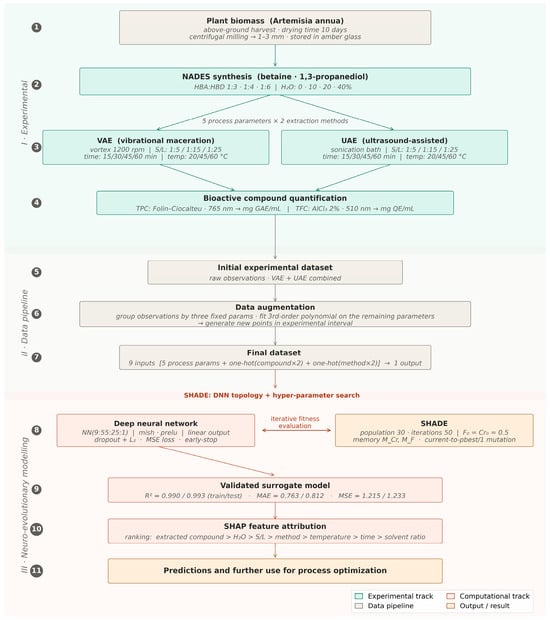
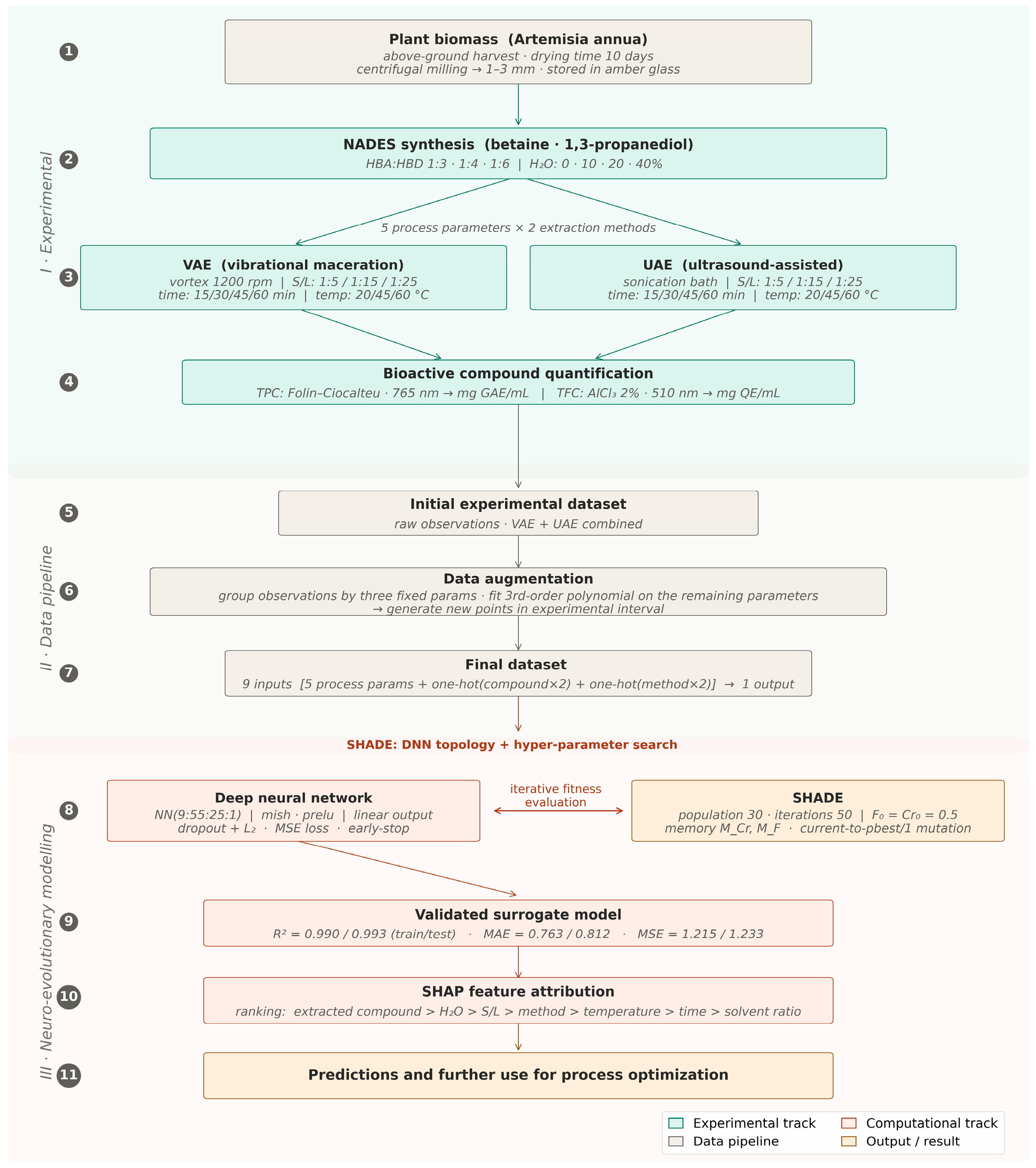
The schema of the overall modeling and optimization procedure in combination with the experimental setup is presented in Figure 2. The modeling procedure is implemented in Python 3.11.9 using Keras, Tensorflow, and Mealypy libraries.
Figure 2.
Scheme of the steps performed in this work.
3. Results and Discussion
The extraction results, quantified as total polyphenol and flavonoid content following the methodology previously established for other species studied, are presented in Figures below. The results obtained, TPC and TFC, respectively, were performed in triplicate; the standard deviation was computed for each case and is in the range of 0.5–5%. These figures highlight the variations caused by modifying the HBA/HBD ratio, which ranged from 1:3 to 1:6, and by testing other specific parameters: the plant-solvent ratio, the percentage of added water, extraction time, and temperature.
3.1. Determination of Total Polyphenol Content (TPC) in NADES Extracts from A. annua
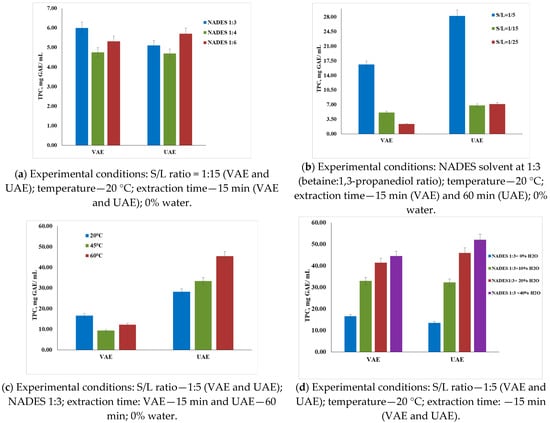
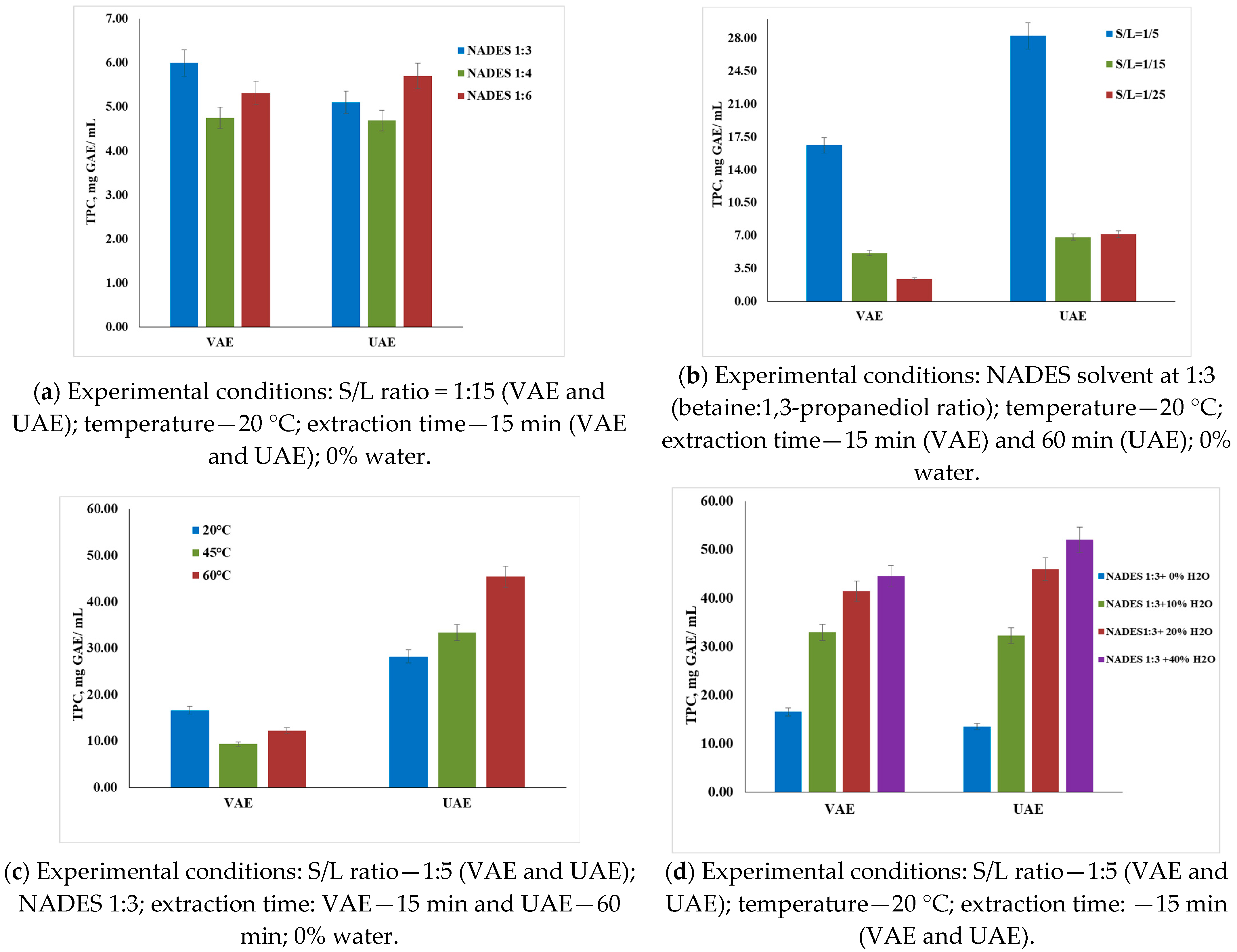
The total polyphenol content determinations (TPC, Figure 3) were carried out starting from the selected HBA/HBD molar ratio, followed by variation in the other parameters to assess their impact.
Figure 3.
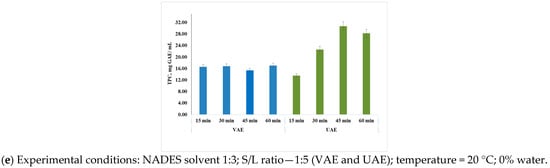
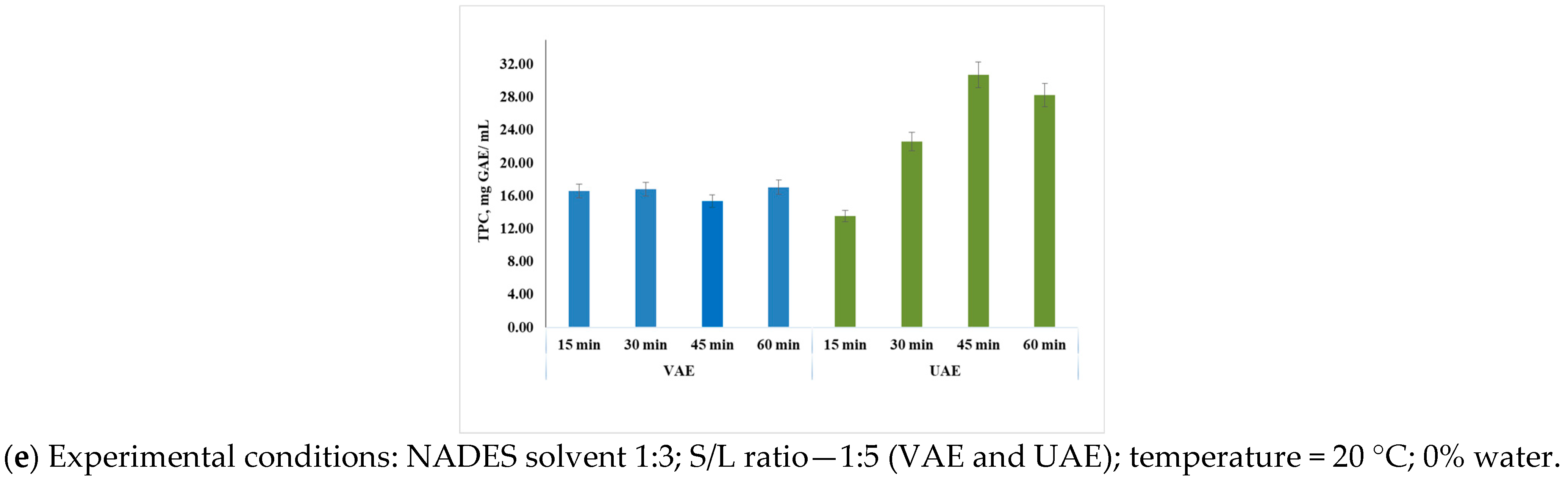
Total polyphenol content (TPC), depending on the tested parameters. (a) Influence of betaine:1,3-propanediol ratio (1:3, 1:4, 1:6); (b) Influence of solid/liquid ratio (S/L) (1:5, 1:15, 1:25); (c) Influence of extraction temperature (20 °C, 45 °C, 60 °C); (d) Influence of water addition (0%, 10%, 20%, 40%); (e) Influence of extraction time (15, 30, 45, 60 min); standard error (0.5–5)%.
It was observed that the extraction of polyphenols from A. annua was significantly influenced by the parameters considered, as follows:
- Molar ratio of HBA/HBD (Figure 3a): Testing three different ratios between betaine (HBA) and 1,3-propanediol (HBD) revealed the superiority of the 1:3 ratio with a maximum yield of 6.00 mg GAE/mL for VAE and of the 1:6 ratio with a maximum yield of 5.71 mg GAE/mL for UAE. At intermediate composition (1:4), a less favorable balance between solvent structuring and viscosity may limit solute mobility and solvent–matrix interactions, resulting in reduced extraction efficiency for both methods. At higher HBD content (1:6), the further decrease in viscosity and increased molecular mobility can enhance penetration into the plant matrix and improve solubilization of phenolic compounds. In the case of the UAE, the extraction mechanism is favored by increasing this ratio, as the enhanced cavitation facilitates the penetration of the solvent into plant matrices, thereby improving polyphenol release [40,41].
- Solid-to-liquid ratio (Figure 3b) of 1:5 resulted in the highest polyphenol content for both methods (16.61 mg GAE/mL for VAE and 28.24 mg GAE/mL for UAE), while higher ratios led to a decrease in measured TPC. This trend can be attributed to a combination of dilution effects (since TPC is expressed as concentration) and reduced effective solvent–solute interactions at higher S/L ratios. In addition, under UAE conditions, the system approaches a near-equilibrium state at intermediate ratios due to cavitation-enhanced mass transfer, such that further increases in solvent volume (up to 1:25) do not significantly enhance extraction of the readily accessible phenolic fraction, resulting in an apparent plateau in TPC values.
- Extraction temperature (Figure 3c): In the case of VAE, TPC values initially decrease from 16.61 mg GAE/mL to 9.33 mg GAE/mL at 45 °C, but subsequently increase to 12.24 mg GAE/mL at 60 °C. This evolution suggests the existence of a balance between facilitated diffusion at higher temperatures and partial degradation of heat-sensitive compounds in the medium range. Thus, VAE seems to benefit only moderately from the increase in temperature, and the observed variations indicate a more pronounced sensitivity to the thermal stability of polyphenols. In contrast, ultrasound treatment is strongly influenced by the increase in temperature, with a significant rise from 28.24 mg GAE/mL at 20 °C to 33.42 mg GAE/mL at 45 °C and reaching a maximum of 45.45 mg GAE/mL at 60 °C. The synergy between ultrasonic cavitation and high temperature may enhance structural disruption at the cellular level and the mobilization of compounds, leading to a more efficient transfer. An extraction temperature of 20 °C was selected as a representative mild and sustainable operating condition, in line with green extraction principles that prioritize reduced energy input and minimization of process intensity. This choice also helps to limit potential thermal degradation of heat-sensitive polyphenols and flavonoids, ensuring that the evaluated systems reflect stable and environmentally benign extraction conditions.
Table 1.
Physicochemical characterization of the relevant used NADES.
Figure 4.
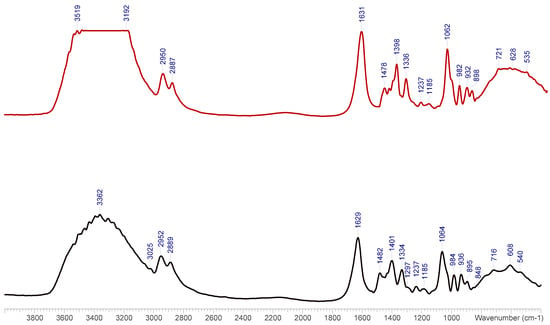
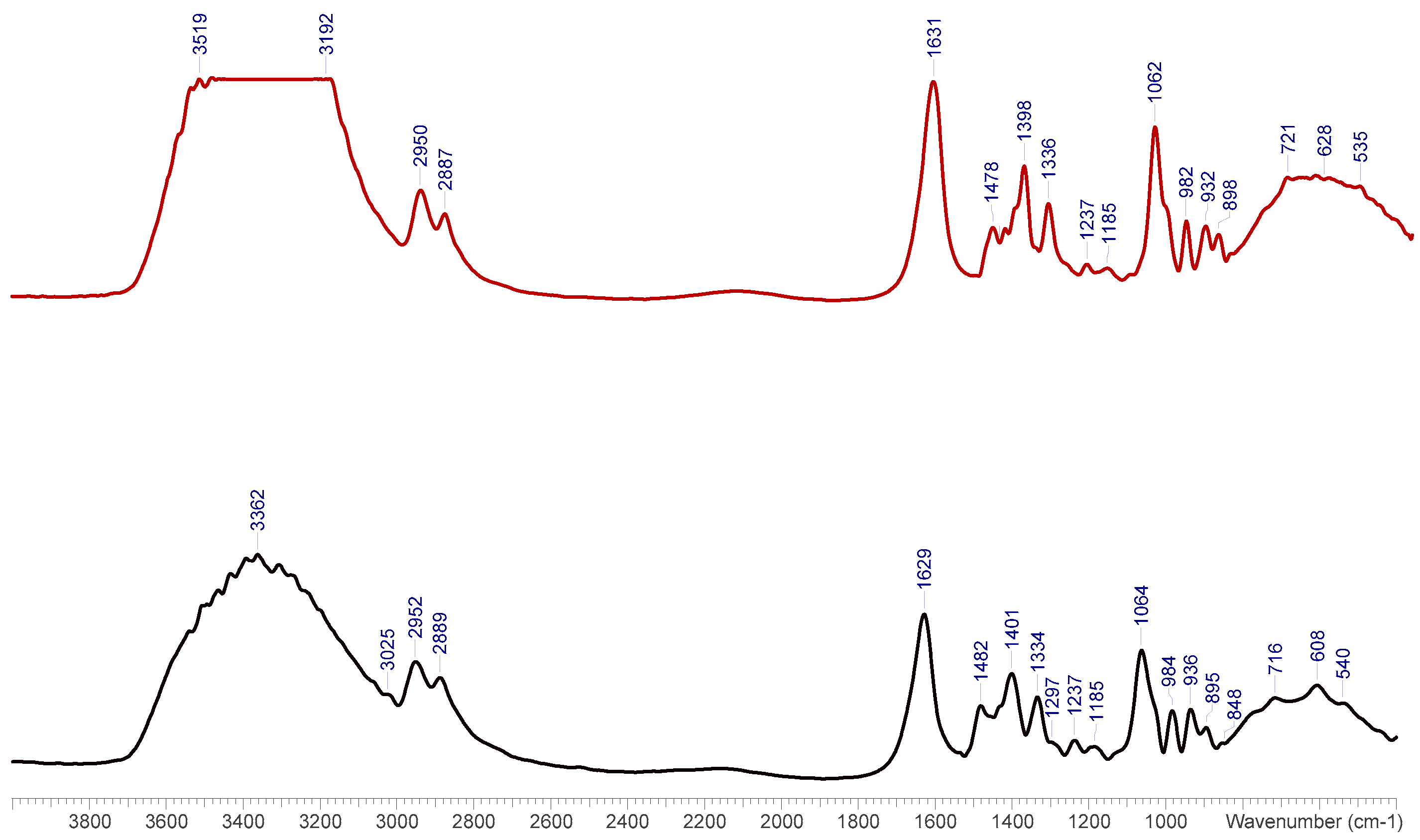
FTIR characterization of the relevant used NADES: blackline—NADES 1:3; red line—NADES 1:3 + 40% H2O.
The comparative study of the two FTIR spectra (Figure 4) led to the following observations regarding the main peaks:
- Peaks of 3300–3500 cm−1: O-H from water and alcoholic groups O–H stretch (intense and broad), confirming strong intermolecular hydrogen bonding characteristic of polyols. Higher detector saturation in case of the NADES 1:3 + 40% H2O spectra.
- Peaks of 1629–1630 cm−1: O–H bending vibration of co-absorbed/bound water molecule contamination or an unsaturated/alkene C=C trace.
- Peaks of 1482 cm−1: the aliphatic bending (scissoring) deformation of the propane carbon backbone. Possible overlapping with quaternary ammonium -N+(CH3)3.
- Peaks of 1401 cm−1 and 1334 cm−1: Aliphatic C–H bending (scissoring/wagging) coupled with in-plane O–H bending.
- Peaks of 1064 cm−1: C–O stretch (strong and sharp), highly characteristic of primary alcohols, the terminal hydroxyl structures.
- Peaks of 984 cm−1 to 848 cm−1: C–C stretching and skeletal fingerprint regions of the propane diol backbone.
For A. annua extracts, the presence of water had a positive impact on the efficiency of polyphenol extraction, the amount extracted increasing with the percentage of water added to the NADES solvent. The highest concentrations of polyphenols were obtained using NADES (1:3) with 40% H2O, both for VAE (44.62 mg GAE/mL) and for UAE (52.08 mg GAE/mL). This suggests that the presence of water improves the solubilization of the plant’s vegetal matrix to facilitate extraction. The presence of water influences the polarity of the phases involved in the extraction, facilitating the extraction of increased amounts of polyphenols. Also, the progressive increase in water suggests that its presence decreases the viscosity of NADES and improves the diffusion of phenolic compounds, without significantly compromising the specific HBA–HBD interactions responsible for their solubilization [27]. The range of 20–40% seems to be the most effective, indicating the achievement of a favorable balance between fluidization and preservation of the extractive properties of the solvent:
- Extraction time (Figure 3e): The extraction time influences the VAE and ultrasound extraction differently, reflecting the distinct mechanisms underlying each method. It is observed, in this case, that in the VAE the extraction time does not have a significant influence; on the other hand, it had a significant influence in the case of UAE. VAE relies on solid–liquid mass transfer enhanced by forced convection through vibrational agitation, which reduces the boundary layer thickness around plant particles, accelerating solute transfer and promoting rapid attainment of extraction equilibrium. Consequently, prolonged extraction times yield limited additional gains in TPC, as mass transfer resistance is substantially reduced at early process stages. UAE, by contrast, involves additional mechanisms: acoustic cavitation, microjet formation, and mechanical disruption of cell walls, which enhance solvent penetration and facilitate the release of intracellular phenolic compounds, making extraction time a more influential parameter for TPC recovery compared to VAE. The highest TPC (30.73 mg GAE/mL) was recorded at 45 min UAE, representing the peak value across all tested conditions for 0% water added. Shorter or longer durations resulted in notable decreases, likely due to extract instability or degradation of heat- and oxidation-sensitive compounds. In contrast, VAE showed relatively stable TPC values throughout the tested time range (15.37–17.07 mg GAE/mL), suggesting that extraction equilibrium is reached quickly and that prolonged extraction does not provide substantial additional benefits.
These findings highlight the critical importance of optimizing extraction parameters to maximize the yield of phenolic compounds from A. annua using betaine and 1,3-propanediol-based NADES. The most efficient extract (52.08 mg GAE/mL) was experimentally obtained following UAE under the following conditions: 15 min extraction at 20 °C, using a NADES with 40% H2O, at a molar ratio of 1:3 (HBA:HBD) and a solid–liquid ratio of 1:5. The extraction conditions of 15 min, 20 °C, 40% water, NADES dilution ratio of 1:3, and S/L ratio of 1:5 correspond to an experimentally tested extraction condition. The extract obtained under these conditions exhibited the highest performance among all the experimental conditions investigated in this study, as shown in Figure 3 and Figure 5. Given the significant influence of water content and extraction time observed, further systematic optimization studies are needed to refine these variables.
Figure 5.
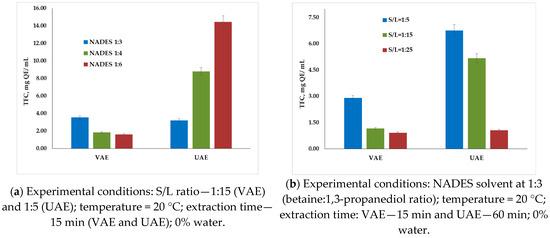
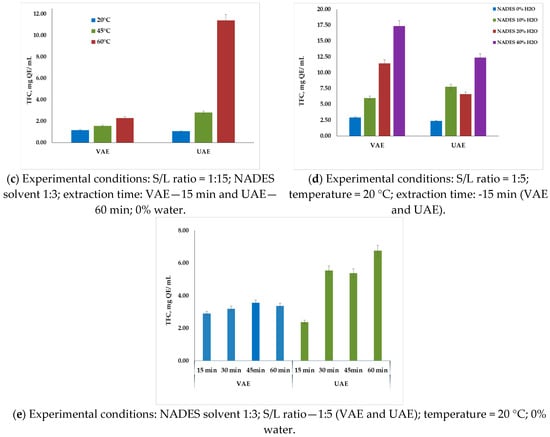
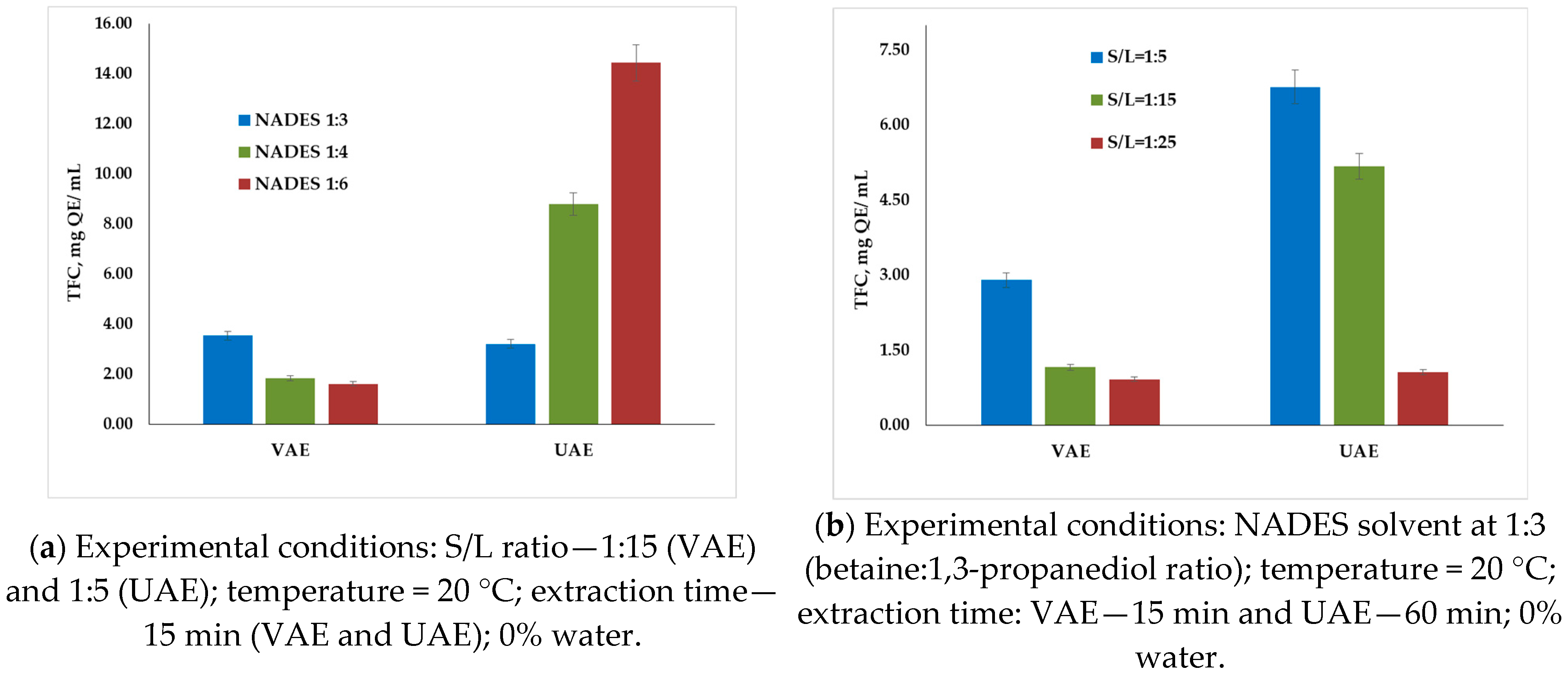
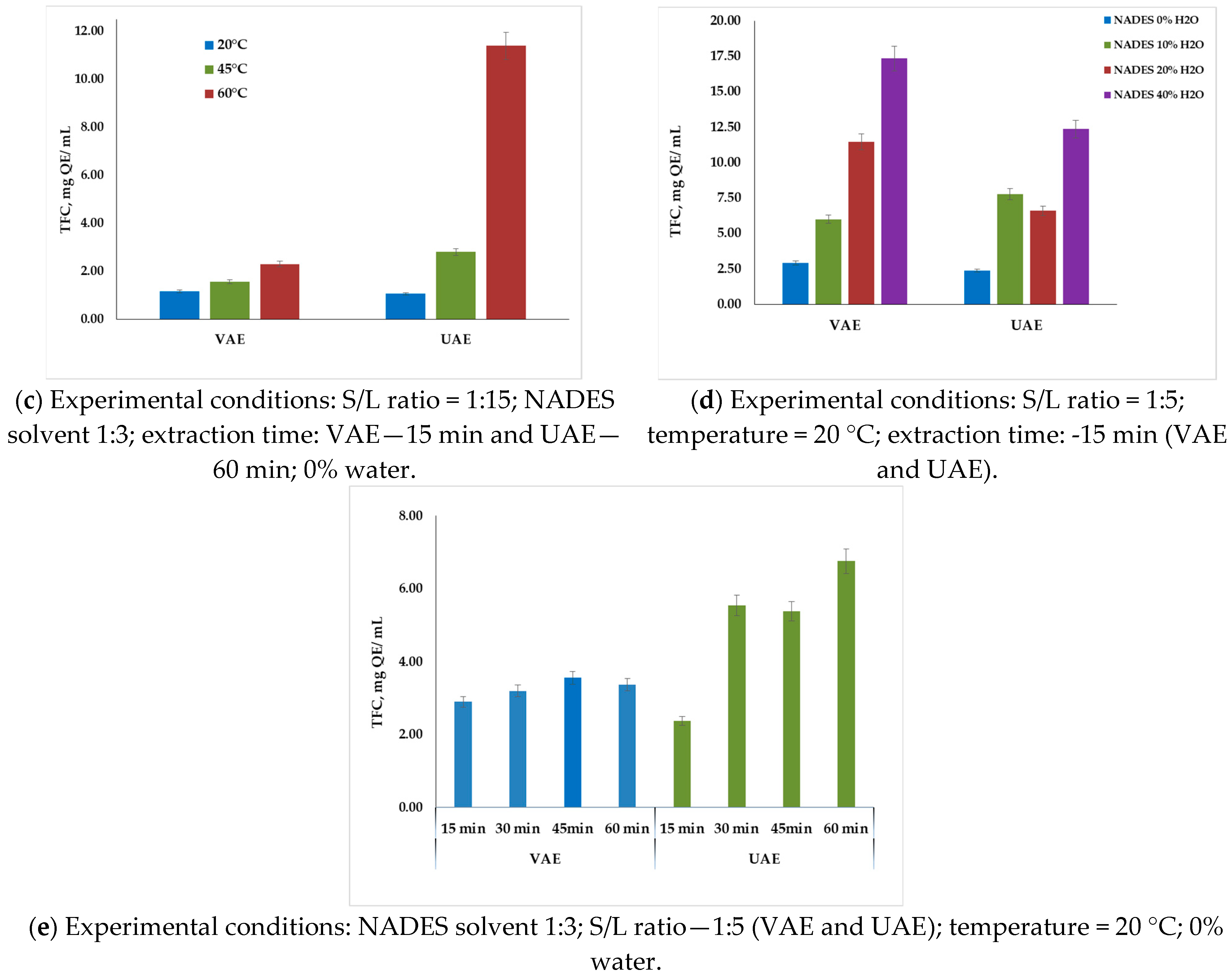
Total flavonoid content (TFC) (a) Influence of betaine:1,3-propanediol ratio (1:3, 1:4, 1:6); (b) Influence of solid/liquid ratio (S/L) (1:5, 1:15, 1:25); (c) Influence of extraction temperature (20 °C, 45 °C, 60 °C); (d) Influence of water addition (0%, 10%, 20%, 40%); (e) Influence of extraction time (15, 30, 45, 60 min), standard error (0.5–5)%.
3.2. Determination of Total Flavonoid Content (TFC) in NADES Extracts from A. annua
The determination of the total flavonoid content (TFC) allowed the evaluation of how the operational parameters selectively influence the extraction of this group of compounds. The values obtained are represented in Figure 5 and highlight the differences that occurred depending on the HBA/HBD ratio, as well as the other factors analyzed: S/L ratio, added water percentage, extraction time and temperature:
- Molar ratio HBA/HBD (Figure 5a). Three molar ratios between betaine (HBA) and 1,3-propanediol (HBD) were tested: 1:3, 1:4, and 1:6. The results indicate that the 1:6 ratio yielded the highest flavonoid concentrations, reaching 14.44 mg QE/mL for UAE, and the 1:3 ratio yielded the highest flavonoid concentrations of 3.54 mg QE/mL in the case of VAE. For UAE, increasing the HBD content appears to enhance flavonoid solubilization, likely by increasing the hydrogen-donor capacity of the NADES and thereby improving its affinity for the extracted compounds. In contrast, for VAE, higher HBD ratios did not further improve yields, suggesting that the extraction mechanism is less sensitive to HBD content.
- Solid-to-liquid ratio (S/L) (Figure 5b). The S/L ratio significantly influenced extraction efficiency, with a general decrease observed at more diluted ratios. For UAE, the highest flavonoid content (6.76 mg QE/mL) was achieved at a ratio of 1:5, with values steadily declining as the ratio increased. Similarly, in VAE, the maximum efficiency (2.90 mg QE/mL) was also recorded at 1:5, followed by notable decreases at higher ratios. These findings confirm that close contact between the solid phase and solvent is crucial for flavonoid extraction, while the enhanced dispersion induced by ultrasound significantly improves extraction efficiency at more concentrated ratios.
- Extraction temperature (Figure 5c). The flavonoids from A. annua exhibited a thermal behavior distinct from that of polyphenols. Both in VAE and UAE, the temperature of 60 °C yielded the best results (2.30 mg QE/mL and 11.40 mg QE/mL, respectively), indicating good thermal stability of these compounds within the NADES system used. The increase in temperature enhanced molecular mobility and reduced the viscosity of the NADES, thereby facilitating the release of flavonoids from the plant matrix. Compared to 20 °C, the extraction efficiency at 60 °C was nearly five times higher in the UAE.
- Water content in NADES (Figure 5d). The addition of water to the organic solvent system also significantly influenced the flavonoid extraction. The highest concentrations under the tested conditions were obtained in the presence of 40% water (17.34 mg QE/mL for VAE and 12.36 mg QE/mL for UAE). This finding suggests that, like polyphenols, flavonoids from A. annua exhibit an increased affinity for a slightly diluted system, where the NADES density is optimized for efficient solubilization. A moderate water addition likely enhances the hydrogen-bonding network while maintaining a polarity favorable for flavonoid extraction, in accord with other similar information [42,43,44].
- Extraction duration (Figure 5e). A similar pattern to polyphenol extraction is observed for flavonoids with respect to extraction time: its effect differs between methods, reflecting the underlying extraction mechanisms. For VAE, extraction time has little impact on flavonoid yield, whereas for UAE, it significantly influences the extraction efficiency. So, in the case of UAE, the flavonoid content progressively increased, reaching a maximum at 60 min (6.76 mg QE/mL). For VAE, values fluctuated between 2.90 and 3.56 mg QE/mL, with no significant differences observed after 45 min, indicating that extraction equilibrium was reached. The UAE, however, appears to promote a continuous and efficient mass transfer without significant degradation of compounds over the studied period.
The analysis of extraction parameters indicates that flavonoids from A. annua can be efficiently extracted using NADES (betaine–1,3-propanediol), particularly through UAE at moderately elevated temperatures and with an appropriate water content. However, the highest flavonoid concentration (17.34 mg QE/mL) was achieved by VAE using a NADES with a 1:6 ratio containing 40% water. Unlike polyphenols, flavonoids demonstrated greater thermal tolerance and a positive response to NADES dilution, suggesting different solubilization mechanisms and stability profiles.
3.3. Evaluation of NADES Extraction Efficiency for A. annua Compounds
The extraction of bioactive compounds from A. annua using NADES composed of betaine and 1,3-propanediol strongly depends on the nature of the target compounds. Phenolic compounds are extracted more efficiently under mild conditions with NADES diluted with water (40%). In contrast, flavonoids respond better to higher temperatures and the dilution of the NADES mixture with water, demonstrating greater tolerance and solubility.
Phenolic compounds showed a clear preference for a relatively dilute environment and a relatively balanced NADES hydrogen bond network, suggesting thermal sensitivity and a need for solvent stability. Under these conditions, the best extraction was obtained by UAE (15 min, 20 °C, NADES 1:3 diluted with 40% H2O, S/L ratio 1:5), where the cavitation process allowed for the rapid and controlled release of the compounds, reaching a maximum content of 52.08 mg GAE/mL.
The addition of water to the NADES solvent appeared to improve flavonoid extraction efficiency, presumably by partially disrupting the intermolecular network and increasing the overall polarity of the system, thereby promoting flavonoid solubilization [45]. Moreover, their thermal stability allowed them to withstand more intensive extraction processes without significant degradation. In this context, the most efficient extraction was achieved through VAE using NADES diluted with 40% water, reaching a concentration of 17.34 mg QE/mL (NADES 1:6 with 40% water, S/L = 1:5, 45 min), obtained via a mild method with high potential for sensitive applications such as cosmetics or pharmaceuticals.
The observed differences between phenolic compounds and flavonoids, despite both classes being phenolic in structure, emphasize the importance of refining extraction strategies according to the target compound profile. While phenolic compounds are susceptible to degradation during extraction, which may compromise their recovery as assessed by TPC, flavonoids demonstrated greater adaptability across a range of extraction conditions, though their yield remained dependent on solvent polarity. The results of this study thus demonstrate the potential of NADES as a sustainable and customizable extraction system capable of achieving superior performance compared to conventional solvents through careful tuning of physicochemical and technological parameters.
The upper limit of water content was set at 40% (w/w) in order to preserve the characteristic structure and physicochemical properties of the NADES system, which are essential for its intended dermato-cosmetic application. Although higher water fractions may further enhance extraction yields, such conditions would progressively shift the system toward conventional aqueous extraction, as NADES becomes increasingly diluted and transitions from a “water-in-DES” to a “DES-in-water” regime, ultimately losing its structured hydrogen-bond network while behaving as an aqueous electrolyte solution [45]. Intensive hydrogen-bonding interactions between the NADES components dominate at low water contents; however, progressive dilution with water leads to a gradual weakening of these interactions, which may largely disappear at water contents of approximately 50% (v/v), resulting in the loss of the characteristic NADES structure [46].
In the context of developing efficient and sustainable extraction systems for dermato-cosmetic or pharmaceutical applications, it is essential to compare the performance of conventional solvents with that of green alternatives such as NADES. Although ethanol remains the traditional solvent of choice for the extraction of polyphenols and flavonoids from plant species, due to its high extraction efficiency, favorable toxicological profile, and low cost, certain limitations associated with ethanol-based conventional methods have prompted the search for alternative solvent systems [47]. These limitations include the need for solvent removal and the challenges related to the direct incorporation of ethanol extracts into stable cosmetic emulsions. In this context, NADES offers a dual advantage: high extraction efficiency and the potential for direct integration of the resulting extracts into dermato-cosmetic formulations without additional purification steps [4,12]. Accordingly, in the case of A. annua, a comparison was conducted between the extraction outcomes obtained using a conventional hydroalcoholic method and those achieved with a betaine–1,3-propanediol-based NADES system (Table 2).
Table 2.
Total polyphenol and flavonoid content in the most efficient A. annua extracts, depending on the solvent used.
The results presented in Table 2 highlight significant differences in extraction efficiency depending on the solvent system and operational parameters, both in terms of TPC and TFC. Notably, the NADES-based system outperformed ethanol with clearly higher efficiency.
This superior performance can be attributed to the enhanced ability of NADES to interact with polar phenolic compounds such as caffeic, chlorogenic, ferulic, and rosmarinic acids, compounds previously reported in A. annua [49]. Within the NADES matrix, betaine acts as a strong HBA via its carboxylate group, while 1,3-propanediol serves as HBD through its hydroxyl groups. Together, they form an extensive hydrogen-bonding network with the hydroxyl groups of polyphenols, significantly enhancing their solubility compared to ethanol, which provides only a single hydroxyl group for interaction [50,51,52].
In addition, the use of ultrasound in the extraction process facilitated mechanical disruption of cell walls and accelerated mass transfer, thereby overcoming the diffusion barriers typically encountered during conventional ethanolic maceration.
Although an increasing number of studies have demonstrated superior extraction of polyphenols and flavonoids using NADES-based systems [53,54,55], no previous work, to the best of our knowledge, has specifically investigated the use of a betaine–1,3-propanediol NADES system for extracting bioactive compounds from A. annua.
These findings confirm that the superior performance of the NADES-based system is not only due to optimized conditions but also reflects the intrinsic effectiveness of the betaine–1,3-propanediol mixture in extracting polyphenolic and flavonoid compounds from A. annua, providing a reliable benchmark against conventional ethanol–water extraction.
3.4. Modeling of Extraction Processes
After the experimental results were gathered, processed, and augmented, the resulting dataset contained 200 points. This final dataset was used in the modeling phase, where the objective was to identify a suitable DNN that can capture the dynamics of the two extraction mechanisms for flavonoids and polyphenols in the context of the analyzed extraction conditions (solvent ratio, S/L ratio, extraction time, temperature, and water content). Thus, the DNN has nine features, of which five correspond to the extraction parameters and the other four represent a one-hot encoding for the extracted compound (flavonoids or polyphenols) and for the extraction type (VAE or UAE). The quantity of the extracted targeted compound represents the DNN output.
In order to determine the best-suited DNN model, the SHADE algorithm was applied for parameter optimization. The settings used for this algorithm are population size 30, maximum number of iterations 50, initial mutation rate 0.5, and initial recombination rate 0.5. The DNN parameters optimized by the SHADE algorithm are the number of hidden layers, the number of neurons, their activation type, and the dropout rate for each hidden layer, the optimizer that the DNN will use in the training phase, the learning rate, and the kernel regularization rate. The SHADE algorithm automatically selects the possible optimizers for the training phase from the following: sgd, adam, rmsprop, adamw, adagrad, nadam, adadelta. In terms of activation functions for the neurons in each hidden layer, the selection is performed from the following list: relu, leaky_relu, prelu, softplus, softsign, tanh, elu, swish, selu, mish. To ensure that overfitting is prevented, each hidden layer is followed by a dropout layer. For the output layer, the activation function is linear. The training is performed with an early stop that monitors the validation loss, with a patience of 15, a delta of 0.01, and the option to restore the best weights activated. The function loss is the mean squared error (MSE).
In terms of architecture limitations, the maximum number of hidden layers is set to five, with a maximum of 64, 64, 32, 32, and 16 hidden neurons, respectively. The results obtained indicated that the best model has two hidden layers with 55 (activation function: mish) and 25 (activation function: prerelu) neurons. This model will be further referred to as NN (9:55:25:1). The performance in the training and testing phase is centralized in Table 3.
Table 3.
Statistical indicators for NN (9:55:25:1).
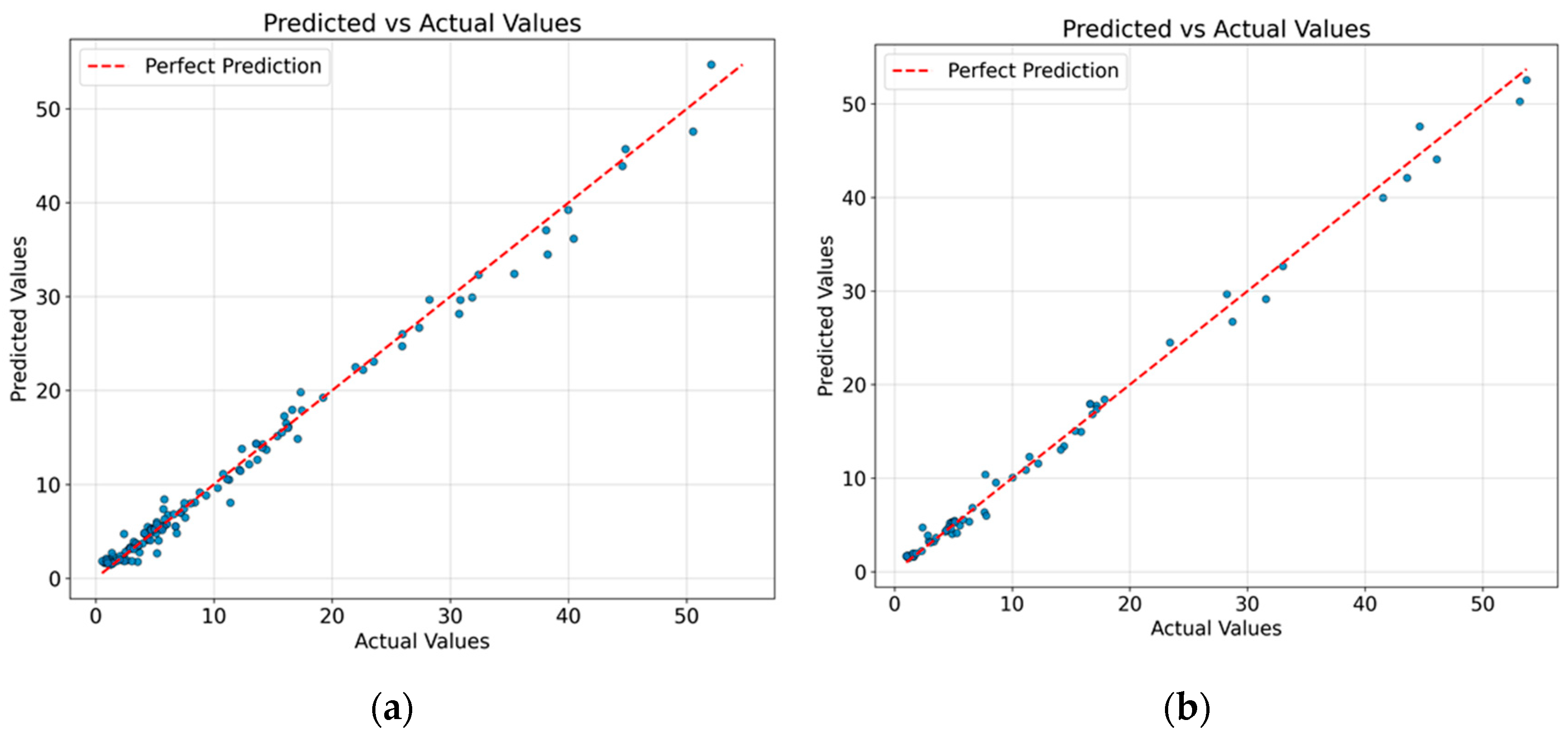
In Table 3, MAE measures the average magnitude of prediction errors, with the residuals varying between −3 and 4 for the training data and between −3 and 3 for the testing data. MAPE indicates the errors as percentages of actual value and is reported in the interval 0–1, with 1 indicating 100% error. The actual versus the predicted values are presented in Figure 6.
Figure 6.
Experimental vs. predicted in (a) training phase; (b) testing phase.
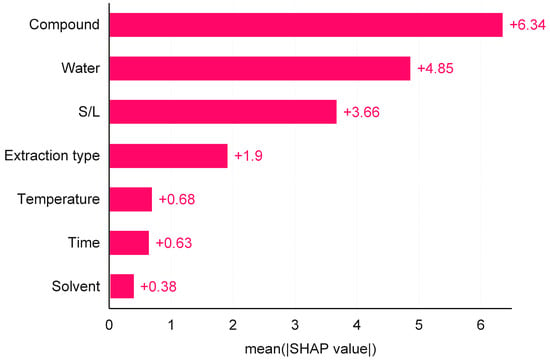
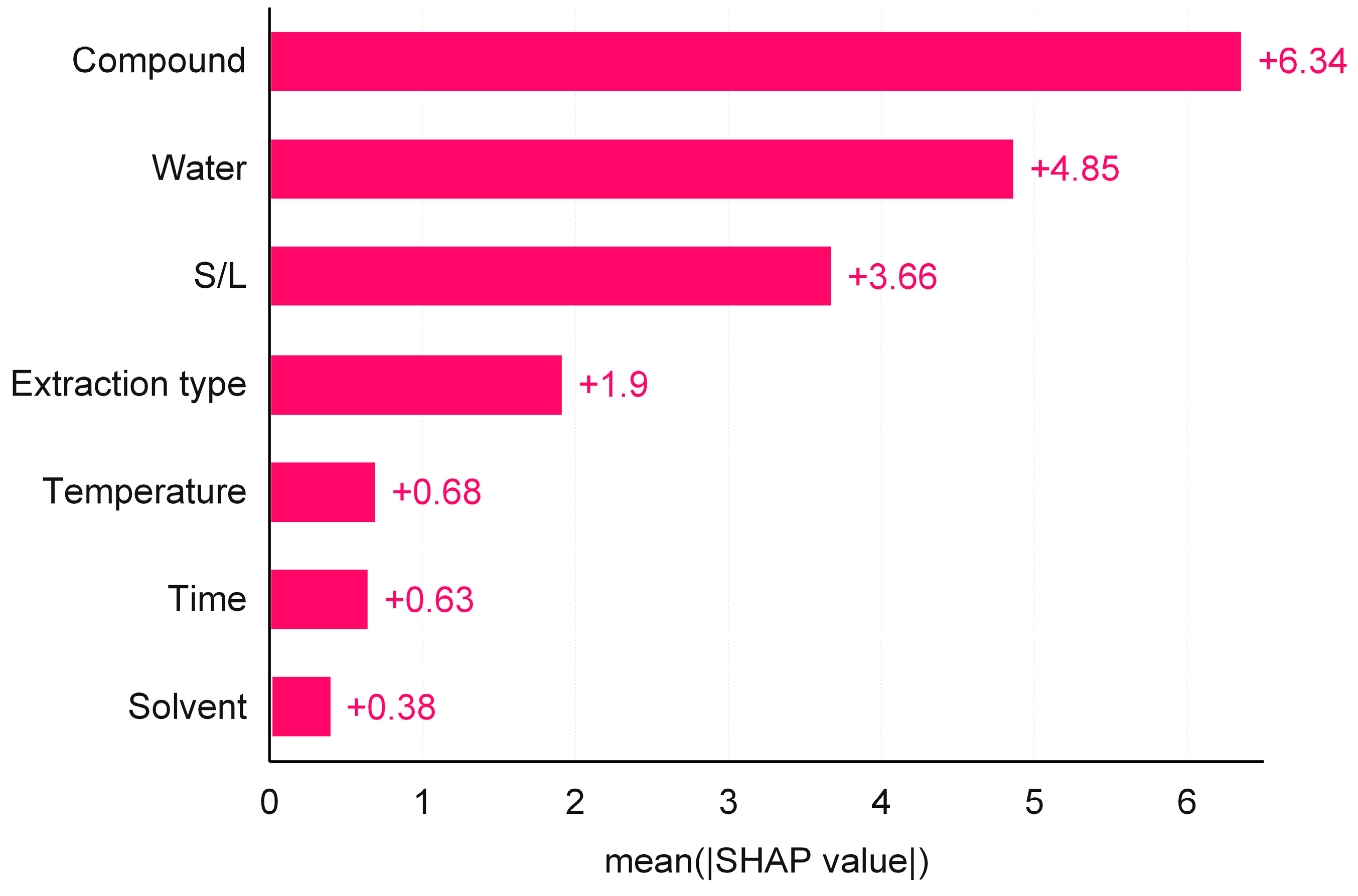
As it can be observed, the model captures well the entire process dynamically and can efficiently predict the extracted compound in multiple cases (polyphenols or flavonoids; VAE or UAE). In order to determine the impact of the process parameters, the SHAP values were computed (Figure 7). The highest value corresponds to the extracted compound, indicating that it is the most influential process parameter. The water content is the second most influential parameter; the overall data impact shows that higher values tend to have a positive effect on the output.
Figure 7.
SHAP values.
The S/L ratio is the third most influential process parameter. In this case, the general behavior tends to be positive (higher overall output) for lower values. However, distinct curves are observed in relation to the extraction type. For VAE, the output decreases as the S/L ratio increases, while for UAE, the output increases with the S/L ratio increase. The process parameters with the lowest impact are represented by the temperature, time and solvent ratio. For these three process parameters, while there are individual differences, the higher values tend to have a higher impact compared with the lowest values.
4. Conclusions
The results of this study show that, although hydroalcoholic methods remain an established standard, NADES systems, due to their flexibility and efficiency, can significantly surpass conventional performance. This extraction system provides not only higher yields but also the strategic advantage of producing extracts that may be directly incorporated into dermato-cosmetic formulations, which are compatible with current industry trends focused on sustainability, minimizing processing steps, and maximizing the utilization of bioactive compounds. From this perspective, NADES based on betaine and 1,3-propanediol diluted with 40% water emerges as a high-performance method for solid–liquid extraction from A. annua, with potential for application to other plant species with similar phytochemical profiles. Maximum total polyphenol content (52.08 mg GAE/mL) was achieved via ultrasound-assisted extraction at 20 °C for 15 min, using a 1:3 NADES ratio with 40% water dilution and S/L = 1:5, while the highest flavonoid yield (17.34 mg QE/mL) was obtained by vortex-assisted extraction for 45 min using a 1:6 NADES ratio under the same dilution and S/L conditions.
Although the results of the present study demonstrate the efficiency of NADES as green solvents for the extraction of polyphenols from A. annua, some limitations must be acknowledged. First, high viscosity represents one of the main operational constraints of NADES, potentially hindering extraction efficiency and mass transfer; although the addition of water can partially mitigate this effect, excessive dilution risks disrupting the supramolecular structure of NADES, thereby reducing extraction capacity. Second, the influence of NADES formulation on extract composition requires further investigation, as the qualitative profiles of the identified compounds vary depending on the plant matrix. The study evaluates the process through total phenolic content (TPC) and total flavonoid content (TFC) assays, which provide only global, non-selective indicators of phenolic and reducing capacity. Future studies will explore other cosmetic NADES mixtures to further optimize extraction efficiency and expand the applicability of this approach in dermato-cosmetic formulations.
Author Contributions
Conceptualization, D.S. and A.C.B.; methodology, D.S. and D.T.; software, D.S. and E.N.D.; validation, D.S., A.C.B. and E.N.D.; formal analysis, C.M. and E.N.D.; investigation, C.M., E.N.D. and D.T.; resources, D.S. and A.C.B.; data curation, E.N.D. and A.Z.-T.; writing—original draft preparation, D.S., A.C.B. and E.N.D.; writing—review and editing, D.S., A.C.B. and D.T.; visualization, C.M., A.Z.-T. and D.T.; supervision, D.S. and A.C.B. All authors have read and agreed to the published version of the manuscript.
Funding
This research received no external funding.
Institutional Review Board Statement
Not applicable.
Informed Consent Statement
Not applicable.
Data Availability Statement
The original contributions presented in this study are included in the article. Further inquiries can be directed to the corresponding authors.
Conflicts of Interest
The authors declare no conflicts of interest.
References
- Ferreira, J.F.; Luthria, D.L.; Sasaki, T.; Heyerick, A. Flavonoids from Artemisia annua L. as antioxidants and their potential synergism with artemisinin against malaria and cancer. Molecules 2010, 15, 3135–3170. [Google Scholar] [CrossRef] [Scilit] [PubMed]
- Brisibe, E.A.; Umoren, U.E.; Brisibe, F.; Magalhäes, P.M.; Ferreira, J.F.S.; Luthria, D.; Wu, X.; Prior, R.L. Nutritional characterisation and antioxidant capacity of different tissues of Artemisia annua L. Food Chem. 2009, 115, 1240–1246. [Google Scholar] [CrossRef] [Scilit]
- Wang, Y.; Pang, J.; Wu, Z.; Song, L.; Hong, H.; Xiao, B.; She, Z. Influence of natural deep eutectic solvents on Artemisia ordosica Krasch. Extraction: Compositional characterization, mechanism and biological activities. Microchem. J. 2025, 216, 114715. [Google Scholar] [CrossRef] [Scilit]
- Huang, M.M.; Yiin, C.L.; Lock, S.S.M.; Chin, B.L.F.; Othman, I.; Zauzi, N.S.B.A.; Chan, Y.H. Natural deep eutectic solvents (NADES) for sustainable extraction of bioactive compounds from medicinal plants: Recent advances, challenges, and future directions. J. Mol. Liq. 2025, 425, 127202. [Google Scholar] [CrossRef] [Scilit]
- Asritha, D.K.; Hamid; Shams, R.; Dash, K.K.; Panjabrao, A.S.; Farzeen, K.P. Green extraction of anthocyanins from fruits and by-products using deep eutectic solvents: A sustainable approach. Food Chem. Adv. 2025, 8, 101072. [Google Scholar] [CrossRef] [Scilit]
- Hernández-Corroto, E.; Olivares-Galván, S.; Marina, M.L.; García, M.C. Approaching the extraction of proteins from brewing wastes using deep eutectic solvents. LWT 2023, 189, 115470. [Google Scholar] [CrossRef] [Scilit]
- Raza, M.; Husain, A.; Jawaid, M.; Inayat, A.; Greish, Y.E.; Meraj, A.; Abu-Jdayil, B. Extraction and characterization of lignin from lignocellulose biomass using citric acid and fructose-based NADES. Int. J. Biol. Macromol. 2025, 321, 146497. [Google Scholar] [CrossRef] [Scilit] [PubMed]
- Morais, R.A.; Sousa, H.M.S.; Alves, L.R.P.; de Souza Martins, G.A. Emerging trends in the valorization of Brazilian native fruits and nuts: Innovative extraction technologies and green solvents for the recovery of lipids and bioactive compounds. Trends Food Sci. Technol. 2025, 164, 105238. [Google Scholar] [CrossRef] [Scilit]
- Ciupei, D.; Colişar, A.; Leopold, L.; Stănilă, A.; Diaconeasa, Z.M. Polyphenols: From Classification to Therapeutic Potential and Bioavailability. Foods 2024, 13, 4131. [Google Scholar] [CrossRef] [Scilit] [PubMed]
- Saad, A.M.; Mohammed, D.M.; Alkafaas, S.S.; Ghosh, S.; Negm, S.H.; Salem, H.M.; Fahmy, M.A.; Semary, H.E.; Ibrahim, E.H.; AbuQamar, S.F.; et al. Dietary polyphenols and human health: Sources, biological activities, nutritional and immunological aspects, and bioavailability—A comprehensive review. Front. Immunol. 2025, 16, 1653378. [Google Scholar] [CrossRef] [Scilit] [PubMed]
- Khalid, W.; Koraqi, H.; Benmebarek, I.E.; Alsulami, T.; Mugabi, R.; Nayik, G.A. Optimization of UAE-NADES green extraction of bioactive compounds from chickpea (Cicer arietinum L.) sprouts using simplex lattice mixture design methodology. Ultrason. Sonochem. 2025, 112, 107186. [Google Scholar] [CrossRef] [Scilit] [PubMed]
- Freitas, D.S.; Rocha, D.; Santos, J.; Noro, J.; Tavares, T.D.; Teixeira, M.O.; Araújo, D.; Castro, J.; Silva, S.; Ribeiro, A.; et al. Developing translucent emulsions using sustainable NADES-based extracts. J. Mol. Liq. 2024, 415, 126413. [Google Scholar] [CrossRef] [Scilit]
- Villa, C.; Caviglia, D.; Robustelli della Cuna, F.S.; Zuccari, G.; Russo, E. NaDES Application in Cosmetic and Pharmaceutical Fields: An Overview. Gels 2024, 10, 107. [Google Scholar] [CrossRef] [Scilit] [PubMed]
- Peng, W.; Wang, L.; Wang, X.; Wang, Y.; Wang, W.; Huang, J.; Zhou, R.; Chen, C.; Bo, R.; Liu, M.; et al. Efficient polyphenol extraction from Moringa oleifera Lam. leaves using natural deep eutectic solvents: COSMO-RS screening, ANN-GA optimization and antioxidant activity evaluation. LWT 2025, 223, 117687. [Google Scholar] [CrossRef] [Scilit]
- Nelson, A.R.L.E.; Venkatachalam, S. NADES-based microwave-assisted single-step extraction process for extracting bioactive compounds from Amomum subulatum Roxb.: A sustainable approach. Food Chem. 2025, 494, 146169. [Google Scholar]
- Ilić, N.Đ.; Stupar, A.; Matić, M.; Đerić, M.; Mišan, A.; Pojić, M.; Teslić, N.; Brunet, J.Č.; Mandić, A. Enhancing bioactive compound extraction from hemp sprouts: Synergistic effects of NADES and ultrasound. Ind. Crops Prod. 2025, 233, 121420. [Google Scholar] [CrossRef] [Scilit]
- Fan, C.; Shan, Y.; Wen, L.; Cao, X. Extraction of artemisinin using natural deep eutectic solvent selected by COSMO-RS. Sustain. Chem. Pharm. 2023, 33, 101096. [Google Scholar] [CrossRef] [Scilit]
- Cao, J.; Yang, M.; Cao, F.; Wang, J.; Su, E. Well-designed hydrophobic deep eutectic solvents as green and efficient media for the extraction of artemisinin from Artemisia annua leaves. ACS Sustain. Chem. Eng. 2017, 5, 3270–3278. [Google Scholar] [CrossRef] [Scilit]
- Wang, J.; Zhou, Y.; Wang, M.; Bi, W.; Li, H.; Chen, D.D.Y. High-throughput analysis for artemisinins with deep eutectic solvents mechanochemical extraction and direct analysis in real time mass spectrometry. Anal. Chem. 2018, 90, 3109–3117. [Google Scholar] [CrossRef] [Scilit] [PubMed]
- Pan, Z.; Bo, Y.; Liang, Y.; Lu, B.; Zhan, J.; Zhang, J.; Zhang, J. Intermolecular interactions in natural deep eutectic solvents and their effects on the ultrasound-assisted extraction of artemisinin from Artemisia annua. J. Mol. Liq. 2021, 326, 115283. [Google Scholar] [CrossRef] [Scilit]
- Banožić, M.; Wronska, A.W.; Jakovljević, K.M.; Aladić, K.; Jerković, I.; Jokić, S. Comparative evaluation of different extraction tecgniques for separation of Artemisin from Sweet Wormwood (Artemisia annua L.). Horticulturae 2023, 9, 629. [Google Scholar] [CrossRef] [Scilit]
- Benoit, C.; Charton, V.; Vogelgesang, B. The use of NADES to support innovation in the cosmetic industry. Adv. Bot. Res. 2021, 97, 309–332. [Google Scholar] [CrossRef] [Scilit]
- Liu, Y.; Friesen, J.B.; McAlpine, J.B.; Lankin, D.C.; Chen, S.-N.; Pauli, G.F. Natural Deep Eutectic Solvents: Properties, Applications and Perspectives. J. Nat. Prod. 2018, 81, 679–690. [Google Scholar] [CrossRef] [Scilit] [PubMed]
- Nam, Y.H.; Ahn, S.M.; Seo, G.J.; Kim, N.W.; Shin, S.W.; Nuankaew, W.; Murughanantham, N.; Pandian, S.; Hwang, J.S.; Hong, B.N.; et al. Optimization of NADES-based green extraction of ellagitannins from rambutan peel with enhanced antioxidant activity. Food Chem. 2025, 475, 143308. [Google Scholar] [CrossRef] [Scilit] [PubMed]
- Database-COSMILE Europe. Available online: https://cosmileeurope.eu/inci/ (accessed on 18 May 2026).
- Ferreira, I.J.; Paiva, A.; Diniz, M.; Duarte, A.R. Uncovering biodegradability and biocompatibility of betaine-based deep eutectic systems. Environ. Sci. Pollut. Res. 2023, 30, 40218–40229. [Google Scholar] [CrossRef] [Scilit]
- Fuad, F.M.; Nadzir, M.M. The formulation and physicochemical properties of betaine-based natural deep eutectic solvent. J. Mol. Liq. 2022, 360, 119392. [Google Scholar] [CrossRef] [Scilit]
- Younes, M.; Aggett, P.; Aguilar, F.; Crebelli, R.; Dusemund, B.; Lambré, C.; Filipič, M.; Frutos, M.J.; Galtier, P.; Gott, D.; et al. Re-evaluation of propane-1,2-diol (E 1520) as a food additive. EFSA J. 2018, 16, e05235. [Google Scholar] [CrossRef] [Scilit] [PubMed]
- Yenduri, S.; Venkatesh, K.G.; Prashant, K.N. Recent Advances in Extraction of Polyphenols by Advanced Extraction Methods. Phytochem. Anal. 2025, 36, 1875–1892. [Google Scholar] [CrossRef] [Scilit] [PubMed]
- Hu, X.; Sun, Y.; Wang, H.; Rahman, K.U.; Chen, Y.; Li, C.; Chi, X.; Cui, Z. Advances in polyphenol extraction: Green solvents, physical field-assisted technologies, and integration of LCA-TEA frameworks. Microchem. J. 2026, 227, 118602. [Google Scholar] [CrossRef] [Scilit]
- Iqbal, S.; Younas, U.; Chan, K.W.; Zia-Ul-Haq, M.; Ismail, M. Chemical composition of Artemisia annua L. leaves and antioxidant potential of extracts as a function of extraction solvents. Molecules 2012, 17, 6020–6032. [Google Scholar] [CrossRef] [Scilit] [PubMed]
- Chukwurah, P.N.; Brisibe, E.A.; Osuagwu, A.N.; Okoko, T. Protective capacity of Artemisia annua as a potent antioxidant remedy against free radical damage. Asian Pac. J. Trop. Biomed. 2014, 4, S92–S98. [Google Scholar] [CrossRef] [Scilit] [PubMed]
- Fu, C.; Zhang, K.; Wang, M.; Qiu, F. Multi-component pharmacokinetics assessment of Artemisia annua L. in rats based on LC-ESI-MS/MS quantification combined with molecular docking. Arab. J. Chem. 2022, 15, 104254. [Google Scholar]
- Pavun, L.; Đikanovic, P.; Jelikic-Stankov, M.; Đurdevic, D.; Uskokovic-Markovic, S. Determination of flavonoids and total polyphenol contents in commercial apple juices. Czech J. Food Sci. 2018, 36, 233–238. [Google Scholar] [CrossRef] [Scilit]
- Grochowski, D.M.; Uysal, S.; Aktumsek, A.; Granica, S.; Zengin, G.; Ceylan, R.; Locatelli, M.; Tomczyk, M. In vitro enzyme inhibitory properties, antioxidant activities, and phytochemical profile of Potentilla thuringiaca. Phytochem. Lett. 2017, 20, 365–372. [Google Scholar] [CrossRef] [Scilit]
- Tanabe, R.; Fukunaga, A. Success-history based parameter adaptation for Differential Evolution. In Proceedings of the IEEE Congress on Evolutionary Computation (CEC ‘13), Cancun, Mexico, 20–23 June 2013; Volume 2013, pp. 71–78. [Google Scholar]
- Zhang, J.Q.; Sanderson, A.C. JADE: Self-adaptive Differential Evolution with fast and reliable convergence performance. In Proceedings of the 2007 IEEE Congress on Evolutionary Computation, Singapore, 25–28 September 2007; pp. 2251–2258. [Google Scholar]
- Ma, Y.; Xie, Y. Evolutionary neural networks for deep learning: A review. Int. J. Mach. Learn. Cybern. 2022, 13, 3001–3018. [Google Scholar] [CrossRef] [Scilit]
- Subramani, V.; Tomer, V.; Balamurali, G.; Mansingh, P. Artificial Neural Network in Optimization of Bioactive Compound Extraction: Recent Trends and Performance Comparison with Response Surface Methodology. Anal. Sci. 2025, 41, 101–117. [Google Scholar] [PubMed]
- He, N.; Chen, Q.; Fan, J.; Song, F.; Dong, N. In-depth theoretical study on the structures of betaine-1,2-propanediol based deep eutectic solvents. J. Mol. Liq. 2023, 392, 123453. [Google Scholar]
- Zhang, Y.; Ouyang, X.; Meng, Y.; Zhang, L.; Yang, Y.; Chen, C.; Zhang, X.; Zhao, X.; He, X.; Wang, Y. Low-temperature ultrasonic-deep eutectic solvent extraction of ergothioneine from Pleurotus ostreatus: A sustainable new strategy. Food Chem. 2026, 514, 149058. [Google Scholar] [PubMed]
- Dai, Y.; Witkamp, G.J.; Verpoorte, R.; Choi, Y.H. Tailoring properties of natural deep eutectic solvents with water to facilitate their applications. Food Chem. 2015, 187, 14–19. [Google Scholar] [CrossRef] [Scilit] [PubMed]
- González-Laredo, R.F.; Sayago-Monreal, V.I.; Moreno-Jiménez, M.R.; Rocha-Guzmán, N.E.; Gallegos-Infante, J.A.; Landeros-Macías, L.F.; Rosales-Castro, M. Natural deep eutectic solvents (NaDES) as an emerging technology for the valorisation of natural products and agro-food residues: A review. Int. J. Food Sci. Technol. 2023, 58, 6660–6673. [Google Scholar] [CrossRef] [Scilit]
- Cannavacciuolo, C.; Pagliari, S.; Frigerio, J.; Giustra, C.M.; Labra, M.; Campone, L. Natural Deep Eutectic Solvents (NADESs) Combined with Sustainable Extraction Techniques: A Review of the Green Chemistry Approach in Food Analysis. Foods 2023, 12, 56. [Google Scholar] [CrossRef] [Scilit]
- Rozas, S.; Benito, C.; Alcalde, R.; Atilhan, M.; Aparicio, S. Insights on the water effect on deep eutectic solvents properties and structuring: The archetypical case of choline chloride+ ethylene glycol. J. Mol. Liq. 2021, 344, 117717. [Google Scholar] [CrossRef] [Scilit]
- Maxim, C.; Badeanu, M.; Turcov, D.; Suteu, D. Potential of Artemisia annua hydroalcoholic extracts in skin care and dermatocosmetic products. Not. Bot. Horti Agrobo. 2025, 53, 14788. [Google Scholar] [CrossRef] [Scilit]
- Ekiert, H.; Klimek-Szczykutowicz, M.; Rzepiela, A.; Klin, P.; Szopa, A. Artemisia species with high biological values as a potential source of medicinal and cosmetic raw materials. Molecules 2022, 27, 6427. [Google Scholar] [CrossRef] [Scilit] [PubMed]
- Petersen, M. Rosmarinic acid: New aspects. Phytochem. Rev. 2013, 12, 207–227. [Google Scholar] [CrossRef] [Scilit]
- Suberu, J.O.; Gorka, A.P.; Jacobs, L.; Roepe, P.D.; Sullivan, N.; Barker, G.C.; Lapkin, A.A. Anti-plasmodial polyvalent interactions in Artemisia annua L. aqueous extract–possible synergistic and resistance mechanisms. PLoS ONE 2013, 8, e80790. [Google Scholar] [CrossRef] [Scilit] [PubMed]
- Simanaviciute, D.; Klimaviciute, R.; Rutkaite, R. Equilibrium adsorption of caffeic, chlorogenic and rosmarinic acids on cationic cross-linked starch with quaternary ammonium groups. Int. J. Biol. Macromol. 2017, 95, 788–795. [Google Scholar] [CrossRef] [Scilit] [PubMed]
- Mazandarani, M.; Majidi, Z.; Zarghami-Moghaddam, P.; Abrodi, M.; Hemati, H.; Fathiazad, F. Essential oil composition, total phenol, flavonoid, anthocyanin and antioxidant activities in different parts of Artemisia annua L. in two localities (North of Iran). J. Med. Plants BY-Prod. 2012, 1, 13–21. [Google Scholar]
- Skarpalezos, D.; Detsi, A. Deep eutectic solvents as extraction media for valuable flavonoids from natural sources. Appl. Sci. 2019, 9, 4169. [Google Scholar] [CrossRef] [Scilit]
- Maxim, C.; Blaga, A.C.; Tataru-Farmus, R.E.; Suteu, D. Acmella oleracea Metabolite Extraction Using Natural Deep Eutectic Solvents. Processes 2024, 12, 1686. [Google Scholar] [CrossRef] [Scilit]
- Szopa, D.; Wróbel, P.; Witek-Krowiak, A. Enhancing polyphenol extraction efficiency: A systematic review on the optimization strategies with natural deep eutectic solvents. J. Mol. Liq. 2024, 404, 124902. [Google Scholar] [CrossRef] [Scilit]
- Wang, H.; Yang, H.; Nie, S.; Han, X.; Chang, Y.; Xu, J.; Nie, C.; Fu, Y. Efficient extraction of flavonoid compounds in sweet tea (Lithocarpus litseifolius (Hance) Chun) via ultrasonic-natural deep eutectic solvent composite approach based on machine learning. Ind. Crops Prod. 2024, 215, 118434. [Google Scholar] [CrossRef] [Scilit]

Disclaimer/Publisher’s Note: The statements, opinions and data contained in all publications are solely those of the individual author(s) and contributor(s) and not of MDPI and/or the editor(s). MDPI and/or the editor(s) disclaim responsibility for any injury to people or property resulting from any ideas, methods, instructions or products referred to in the content. |
© 2026 by the authors. Licensee MDPI, Basel, Switzerland. This article is an open access article distributed under the terms and conditions of the Creative Commons Attribution (CC BY) license.