Article

Can Rural Road Network Density Promote Inclusive Regional Growth? Evidence from China’s County-Level Panel Data

School of Economics and Management, Northeast Forestry University, Harbin 150040, China
*
Author to whom correspondence should be addressed.
Sustainability 2026, 18(13), 6811; https://doi.org/10.3390/su18136811 (registering DOI)
Submission received: 28 May 2026 / Revised: 22 June 2026 / Accepted: 29 June 2026 / Published: 4 July 2026

Abstract

Persistent urban–rural inequality remains a major challenge for sustainable regional development, especially in countries where rural communities still face limited access to markets, employment, and public services. This study examines whether rural road network density promotes inclusive regional growth in China. Using county-level panel data from 2013 to 2024, we construct an inclusive regional growth index that combines economic output, nighttime-light-measured economic activity, rural income, and the urban–rural income gap. rural road network density is measured by the length of county, township, and village roads per 100 square kilometers. Two-way fixed-effects models, mechanism tests, robustness checks, instrumental-variable estimation, and heterogeneity analysis are employed. The results show that rural road network density significantly improves inclusive regional growth. Dimensional analysis indicates that higher rural road network density increases real GDP per capita, strengthens nighttime-light-measured economic activity, raises rural income, and reduces the urban–rural income gap. Mechanism analysis shows that these effects operate through labor mobility, market access, and non-agricultural industrial development. The results remain robust to alternative road measures, lagged specifications, outlier treatment, sample restrictions, and instrumental-variable estimation. Heterogeneity analysis further shows that the effects are larger in central-western counties, low-accessibility counties, and less-developed counties. These findings suggest that rural road network density is not only a transport infrastructure indicator but also a key spatial condition for promoting sustainable and inclusive regional development.

1. Introduction

Sustainable regional development requires more than aggregate economic growth. It also requires a fairer spatial distribution of development opportunities, especially between urban and rural areas. In large developing economies, persistent urban–rural inequality can weaken the social inclusiveness of growth and limit the long-term sustainability of regional development. Inclusive growth therefore emphasizes whether disadvantaged groups and lagging regions can participate in and benefit from the growth process [1]. In China, the county is a key territorial unit linking villages, townships, county seats, and external markets. Understanding whether rural road network density can promote inclusive county-level development is therefore important for rural revitalization, balanced regional development, and sustainable territorial governance.
Rural roads are a fundamental form of spatial infrastructure. They connect rural households with labor markets, product markets, public services, and county-level industrial systems. By reducing travel time and transport costs, denser rural road networks may improve market access, facilitate non-farm employment, increase rural income, and strengthen the integration of rural communities into regional development networks. From a sustainability perspective, rural road network density is not merely a physical infrastructure indicator; it also reflects the extent to which rural communities are spatially connected to development opportunities.
Existing studies have shown that transport infrastructure and rural roads affect economic growth, poverty reduction, household income, and market integration. Early evidence from China shows that regional road development is associated with rural and urban poverty reduction [2]. Broader studies on transport infrastructure also show that roads can reshape market size, industrial location, and local economic outcomes [3,4]. More recent China-focused evidence further confirms that road construction is related to economic growth, rural household income, urban–rural income disparity, and regional inequality [5,6,7,8]. These findings provide an important basis for examining the development consequences of rural road network density.
However, several research gaps remain. First, many existing studies examine economic growth, poverty reduction, or income effects separately, while less attention has been paid to whether rural road network density promotes inclusive regional growth as an integrated outcome. Second, existing research often focuses on either economic performance or income inequality, but inclusive development requires considering both dimensions simultaneously. Third, the mechanisms through which rural road network density is transformed into inclusive growth remain insufficiently clarified, especially with respect to labor mobility, market access, and county-level industrial development. Finally, the distribution of benefits may differ across regions and counties, making it necessary to examine whether rural road network density is more strongly associated with inclusive growth in less-developed and low-accessibility areas.
This study asks whether rural road network density promotes inclusive regional growth in China and through which mechanisms this effect occurs. Using an annual county-level panel dataset from 2013 to 2024, we construct an inclusive regional growth index that combines economic output, nighttime-light-measured economic activity, rural income, and the urban–rural income gap. rural road network density is measured by the length of county, township, and village roads per 100 square kilometers. The empirical analysis uses two-way fixed-effects models, mechanism tests, robustness checks, instrumental-variable estimation, and heterogeneity analysis.
The results show that rural road network density significantly promotes inclusive regional growth. The dimensional analysis indicates that rural road network density increases real GDP per capita, nighttime-light intensity, and rural income, while reducing the urban–rural income gap. Mechanism tests show that rural road network density works through labor mobility, market access, and non-agricultural industrial development. These findings are consistent with recent evidence that transport development affects rural income, industrial integration, and inequality reduction in China [9,10,11]. The heterogeneity results further show that the estimated effects are larger in central-western counties, counties with lower initial road density, and counties with lower initial economic development.
This study contributes to the literature in three ways. First, it places rural road network density within an inclusive regional growth framework, extending previous studies that mainly focus on growth, poverty, or income effects. Second, it examines economic growth and social inclusiveness together by using a composite index and by separately testing the effects on economic output, rural income, and the urban–rural income gap. Third, it identifies labor mobility, market access, and non-agricultural industrial development as key channels, while also showing that rural road network density has larger estimated effects in counties facing stronger transport and development constraints. These contributions link rural transport infrastructure to the broader agenda of sustainable regional development.
The remainder of this paper is organized as follows. Section 2 reviews the literature and develops the research hypotheses. Section 3 describes the data, variable construction, and empirical methods. Section 4 reports the empirical results, including the baseline estimates, dimensional analysis, mechanism tests, robustness checks, instrumental-variable estimation, and heterogeneity analysis. Section 5 discusses the main findings, policy implications, and limitations. Section 6 concludes the paper.

2. Literature Review and Hypothesis Development

2.1. Rural Road Network Density and Sustainable Regional Development

Inclusive regional growth requires more than aggregate economic expansion. It emphasizes whether the growth process improves development opportunities for disadvantaged groups and lagging regions. In the rural development context, this means that infrastructure conditions should not only support local output but also enhance rural households’ access to markets, employment, public services, and industrial opportunities. The pro-poor growth literature highlights that growth becomes socially meaningful when lower-income groups are able to participate in and benefit from the growth process [1]. Therefore, rural road network density can be understood as a spatial infrastructure condition that may reshape the distribution of economic opportunities between urban and rural areas.
Transport infrastructure affects regional development by reducing spatial frictions. Roads shorten travel time, lower trade and logistics costs, and improve the connectivity between rural settlements, township centers, county seats, and external markets. For rural areas, where geographic isolation often constrains production choices and income opportunities, higher rural road network density can relax a fundamental development bottleneck. Earlier evidence from developing economies shows that rural road access improves market participation and local economic opportunities [12,13]. In China, infrastructure development has also been closely related to regional disparities and uneven spatial growth [14]. These findings suggest that rural road network density may play an important role in linking peripheral rural economies with broader regional development systems.
However, the sustainability implications of road infrastructure are not automatic. Large-scale transport infrastructure can create uneven spatial effects if better-connected areas capture most of the benefits while peripheral communities experience weaker gains. Evidence from China’s national trunk highway system indicates that transport integration may generate both market-expansion effects and competitive pressures on non-targeted peripheral counties [3]. This implies that the effect of rural roads should be examined not only in terms of economic growth, but also in terms of whether such growth is inclusive across urban and rural groups. Recent research on rural road construction and agricultural sustainability in China further indicates that rural roads are closely associated with sustainable agricultural development, although their effects may vary across regions and dimensions of sustainability [15].
Accordingly, this study defines rural road network density as the length of county, township, and village roads per 100 square kilometers of county land area. Inclusive regional growth is conceptualized as a development outcome that combines county-level economic growth with a reduction in urban–rural inequality. This conceptualization is consistent with the sustainability perspective because it links economic efficiency, social inclusion, and spatial coordination within a unified framework.

2.2. Rural Road Network Density and County-Level Economic Growth

A central channel through which rural road network density may affect regional development is county-level economic growth. Roads reduce the effective distance between producers, consumers, workers, and firms. By lowering transportation and transaction costs, denser road networks can expand market size, facilitate the movement of goods and labor, and stimulate local business activity. In the Chinese context, infrastructure development has long been regarded as one explanation for regional economic disparities [14]. More recent evidence shows that access to transportation infrastructure affects local economic outcomes in China, although the magnitude and form of these effects depend on the type of infrastructure and the spatial scale of analysis [4].
Rural roads are especially relevant for county-level growth because counties are the key administrative and economic units connecting rural communities with urban markets. Compared with national highways or intercity expressways, rural roads directly affect the daily mobility of rural residents, agricultural product circulation, local entrepreneurship, and the integration of villages into county-level markets. Fan and Chan-Kang [2] show that regional road development in China has important implications for both rural and urban poverty reduction. Qin and Zhang [16] further demonstrate that rural roads can promote agricultural specialization, suggesting that road access changes production choices by improving market connectivity.
Recent China-focused studies provide more direct evidence on the growth effects of rural roads. Zhou et al. [6] find that road construction contributes to economic growth and poverty alleviation in Chinese counties. Chen et al. [17] provide long-run evidence from rural China that road access promotes local economic growth, particularly through improved connectivity at the village level. From the perspective of firm and market efficiency, Wu et al. [18] show that road expansion in China can improve allocative efficiency and generate pro-competitive effects by lowering domestic trade costs. These studies imply that higher rural road network density may stimulate county-level economic activity through both household-side and firm-side channels.
Based on the above discussion, this study proposes the following hypothesis:
H1. 
rural road network density significantly promotes county-level economic growth.

2.3. Rural Road Network Density and Urban–Rural Inequality

While economic growth is important, the core question of this study is whether rural road network density promotes inclusive regional growth. This requires examining whether higher rural road network density reduces urban–rural inequality. Transport infrastructure may narrow the urban–rural gap by increasing rural households’ access to employment, markets, education, health services, and public resources. If rural residents gain better access to non-farm jobs and product markets, improved rural road conditions may raise rural income more strongly than urban income, thereby reducing income inequality.
Existing research provides mixed but generally supportive evidence. Li and DaCosta [19] examine the relationship between transportation and income inequality in China and show that transport development is closely associated with changes in the distribution of income. Lu et al. [5] provide municipal-level evidence that transport infrastructure can reduce urban–rural income disparity in China, with rural labor mobility serving as an important channel. Yuan et al. [8] further investigate the effect of urban–rural road construction on inequality and economic growth in China, showing that road construction may have a non-linear relationship with income inequality. These studies suggest that the inequality effect of roads depends on whether rural residents can effectively convert improved access into higher income opportunities.
At the household level, rural road access can directly affect income generation. Zhang et al. [7] show that village road paving increases rural household income in China. Lu et al. [20] also find heterogeneous income effects of road infrastructure among rural residents, indicating that the benefits of road access differ across household groups. Wang et al. [21] provide further evidence that rural infrastructural investment contributes to farmers’ income growth in China. These studies support the argument that higher rural road network density may improve rural income and thereby reduce the urban–rural income gap.
More recent policy-based evidence also points to the inclusive potential of rural roads. Ou et al. [11] examine the “Four Good Rural Roads” policy in China and find that rural roads can narrow regional income inequality through local industrial development and spatial spillover effects. This is highly relevant to the present study because it shifts the analytical focus from road construction alone to the broader question of whether rural road conditions promote inclusive regional development.
Therefore, this study proposes the following hypothesis:
H2. 
rural road network density significantly reduces urban–rural income inequality at the county level.

2.4. Mechanisms: Labor Reallocation, Market Access, and Rural Industrial Development

Rural road network density may promote inclusive regional growth through several mechanisms. The first mechanism concerns labor reallocation toward non-agricultural employment rather than directly observed labor mobility. Poor road access increases commuting costs, job-search costs, and barriers to accessing township, county, and urban labor markets. Denser rural road networks can reduce these barriers and create better conditions for rural workers to participate in secondary and tertiary employment. However, because county-level statistical yearbooks do not directly observe worker movement, commuting frequency, migration flows, or individual employment transitions, this study uses the share of employment in secondary and tertiary industries only as a proxy for the employment-structure dimension of this channel. Accordingly, the empirical mechanism should be interpreted as labor reallocation toward non-agricultural employment, not as direct evidence of labor mobility. Existing studies show that rural roads can affect labor allocation and local economic opportunities, while transport development can contribute to rural income through employment-related channels.
Accordingly, this study proposes:
H3a. 
Rural road network density promotes inclusive regional growth by facilitating labor reallocation toward secondary and tertiary employment and expanding non-agricultural employment opportunities.
The second mechanism is improved market accessibility. Rural roads reduce the cost of transporting agricultural inputs and outputs, expand the radius of market participation, and improve farmers’ bargaining position. Jacoby [12] shows that access to markets generates measurable benefits for rural households. Mu and van de Walle [13] demonstrate that rural roads promote local market development. In the agricultural sector, road access can also affect production choices and commercialization. Qin and Zhang [16] find that rural roads promote agricultural specialization in China, while Shamdasani [22] shows that rural road infrastructure can affect agricultural production. These findings suggest that higher rural road network density can strengthen the connection between rural producers and broader markets, thereby increasing rural income and supporting inclusive development.
Thus, this study proposes:
H3b. 
rural road network density promotes inclusive regional growth by improving rural market accessibility.
The third mechanism is rural industrial development. Rural roads not only improve agricultural market access but also support the development of processing, logistics, tourism, e-commerce, and service industries. By improving the circulation of goods, people, and information, denser rural road networks can strengthen the integration of agriculture with secondary and tertiary industries. This is particularly important in the Chinese county economy, where rural industrial integration has become a key pathway for rural revitalization. He et al. [10] show that transportation infrastructure promotes rural industry integration in China, with urbanization acting as a mediating channel. Wu et al. [18] also suggest that road expansion can improve market efficiency and competition, which may create favorable conditions for local industrial upgrading. In addition, Ou et al. [11] find that rural roads can reduce regional inequality partly through local industrial development.
Therefore, this study proposes:
H3c. 
rural road network density promotes inclusive regional growth by enhancing rural industrial integration and county-level industrial development.

2.5. Heterogeneous Effects Across Regions and Development Conditions

The effects of rural road network density are unlikely to be spatially uniform. Counties differ in their initial road density, economic development level, industrial structure, fiscal capacity, terrain conditions, and distance to major markets. These differences may shape both the marginal returns to rural road network density and the inclusiveness of its distributional effects. In areas where transport constraints are severe, higher rural road network density may generate stronger marginal benefits by relaxing a binding accessibility constraint. Conversely, in areas where basic connectivity is already sufficient, additional road density may yield weaker marginal gains.
Prior studies support this heterogeneous perspective. Fan and Chan-Kang [2] show that the poverty-reduction effects of road development differ between rural and urban areas. Faber [3] indicates that transport infrastructure may generate uneven effects across connected and peripheral regions. Banerjee et al. [4] also suggest that transportation access affects local economic outcomes in ways that depend on spatial and regional conditions. Recent China-focused studies provide further evidence of heterogeneity. Lu et al. [20] find that the income effects of road infrastructure vary across rural residents. Li et al. [9] show that the contribution of transport development to rural income differs by terrain, location, and poverty conditions. Ou et al. [11] also report heterogeneous effects of rural roads across regions and development contexts.
For this reason, the inclusive growth effect of rural road network density may be stronger in less-developed counties and in regions where weak initial transport accessibility limits market participation and income opportunities. However, such effects may also require complementary conditions, such as sufficient labor-market demand, industrial capacity, and local governance support. Therefore, heterogeneity analysis is essential for understanding when and where rural road network density can most effectively promote inclusive regional growth.
Based on the above discussion, this study proposes the following hypothesis:
H4. 
The inclusive regional growth effect of rural road network density is stronger in less-developed counties and regions with weaker initial transport accessibility.

3. Materials and Methods

3.1. Study Area, Sample, and Data Sources

This study uses an annual county-level panel dataset for mainland China from 2013 to 2024. The county is selected as the unit of analysis because rural roads mainly operate at the spatial scale connecting villages, townships, county seats, and external markets. The sample includes counties, county-level cities, autonomous counties, and banners. Municipal districts are excluded because their economic structure and road-network density differ substantially from those of rural county economies. Hong Kong, Macao, Taiwan, and Tibet are also excluded due to differences in statistical systems and data continuity. County administrative divisions are harmonized to the 2013 boundary; when county units are split, merged, or renamed, total variables are aggregated, per capita variables are recalculated, and ratio variables are reconstructed rather than mechanically averaged. We further harmonized county administrative units to the 2013 boundary. For county renaming or administrative-status changes without territorial changes, county units were matched using administrative codes and county names. For mergers, splits, or boundary adjustments, total variables such as GDP, population, fiscal expenditure, and rural road length were aggregated to the 2013-equivalent county unit whenever the correspondence could be clearly identified. Per capita variables were then recalculated from reconstructed totals and population, rather than mechanically averaged across affected units. Ratio variables, such as the urban–rural income gap or fiscal-expenditure ratios, were reconstructed from their underlying numerator and denominator whenever possible. County-year observations with boundary changes that could not be reliably harmonized to the 2013 boundary for all required variables were excluded from the final sample.
The final dataset is an unbalanced county-level panel. The unbalanced structure mainly arises from three sources. First, some county-level socioeconomic indicators are not continuously reported in all statistical yearbooks for every county-year observation. Second, rural road statistics, especially county-, township-, and village-road components, are not available for all counties in all years. Third, some counties experienced boundary adjustments, mergers, renaming, or changes in administrative status during the study period, and a small number of county-year observations could not be harmonized to the 2013 boundary with sufficient reliability for all required variables. We did not interpolate or impute the core dependent variable, the main road-density variable, or key control variables, because doing so could introduce artificial trends into county-level growth, income, and road-expansion patterns. Instead, county-year observations were retained only when the inclusive-growth indicators, rural road network density, and required control variables were simultaneously available. Therefore, the missingness primarily reflects source-specific reporting limitations and administrative-boundary harmonization issues rather than outcome-based sample selection.
County-level socioeconomic data are obtained from the China County Statistical Yearbook, the China Statistical Yearbook for Regional Economy, provincial statistical yearbooks, and municipal statistical yearbooks. Rural road data are collected from the China Transport Statistical Yearbook, provincial transport statistical yearbooks, and provincial statistical yearbooks. The core rural road variable is measured by completed rural road network density, including county roads, township roads, and village roads per 100 square kilometers. This variable captures the realized stock of rural road networks and is consistent with studies that measure road infrastructure conditions using road length, road access, or road expansion [2,8,17].
Nighttime-light data are obtained from the annual VIIRS Day/Night Band product and aggregated to the county-year level using county administrative boundaries. To construct nlit, negative radiance values were first set to zero at the pixel level. Pixel-level radiance values were then spatially matched to the harmonized county boundaries and averaged within each county-year unit. The nighttime-light variable was calculated as nlit i t = ln ( 1 + V I I R S ¯ i t ) , where V I I R S ¯ i t denotes the mean VIIRS radiance of county i in year t. No additional scaling, filtering, or constant adjustment was applied beyond the standard “one plus” logarithmic transformation. Therefore, zero is the theoretical lower bound of the raw log-transformed nighttime-light variable when county mean radiance equals zero. The continuous variables were winsorized at the 1st and 99th percentiles before descriptive statistics and regression estimation.
Missing values were handled at the county-year observation level. We did not interpolate or impute the core dependent variable, the main road-density variable, or key control variables, because doing so could introduce artificial trends into county-level growth, income, and road-expansion patterns. Instead, county-year observations were retained only when the inclusive-growth indicators, rural road network density, and required control variables were simultaneously available. For nighttime-light preprocessing, negative VIIRS radiance values were first set to zero at the pixel level. Annual VIIRS raster data were then spatially matched to the harmonized county-level polygons. Pixels outside county boundaries were excluded through polygon masking, and county-year mean radiance was calculated using the pixels falling within each county polygon. The nighttime-light variable was then constructed from the county-year mean radiance using the standard “one plus” logarithmic transformation.
Nighttime light is used as an additional proxy for local economic activity because satellite-observed luminosity has been widely used to supplement conventional economic statistics [23,24]. All monetary variables are converted into constant 2013 prices using provincial deflators. Continuous variables are winsorized at the 1st and 99th percentiles to reduce the influence of extreme observations.

3.2. Variable Definitions

All variable names are written in lowercase letters and contain no more than five letters. The dependent variable is irg, which denotes inclusive regional growth. It is constructed from four components: real GDP per capita and nighttime-light intensity for the growth dimension, and rural income and the urban–rural income gap for the inclusiveness dimension. This design follows the view that inclusive growth should capture both economic performance and the distribution of development benefits [1].
The core explanatory variable is road, defined as rural road network density. It is calculated as the natural logarithm of one plus rural road length per 100 square kilometers of county land area:
road i t = ln 1 + L i t county + L i t township + L i t village A i / 100 ,
where L i t county , L i t township , and  L i t village denote the lengths of county roads, township roads, and village roads in county i and year t, respectively, and  A i denotes county land area measured in square kilometers. A higher value of road indicates a denser realized rural road network within a county. This measure should be interpreted as an area-normalized indicator of the realized stock of rural road networks, rather than as a topography-adjusted measure of road adequacy. Mountainous counties may naturally have lower road density because road construction is more costly, technically more difficult, and constrained by terrain conditions. Therefore, lower road density in mountainous counties should not be mechanically interpreted as weaker infrastructure effort or lower road demand. In the two-way fixed-effects framework, time-invariant county characteristics, including stable topographic conditions, are absorbed by county fixed effects, so the baseline estimate is identified primarily from within-county changes in rural road network density over time. Nevertheless, because topography may affect the pace and marginal return of rural road expansion, cross-county comparisons of road-density levels should be interpreted with caution.
In this measure, county roads, township roads, and village roads are summed by physical length, and each kilometer contributes equally to the total rural road length. Therefore, the baseline road variable is an unweighted length-based density measure. It captures the realized stock and spatial density of rural road networks within a county, rather than a hierarchy-weighted or quality-adjusted measure of road capacity. The indicator does not assign different weights to county roads, township roads, and village roads according to road hierarchy, pavement quality, road width, traffic capacity, or functional classification. This construction is used because consistent hierarchy-weighted and quality-adjusted road information is not available for all counties and years in the national 2013–2024 panel. Conceptually, county roads, township roads, and village roads jointly form the rural road network: county roads mainly connect county seats and townships, township roads connect townships and villages, and village roads provide last-mile access within rural settlements. Accordingly, road should be interpreted as a broad measure of rural spatial connectivity, not as a direct measure of road service quality or transport capacity.
The mechanism variables are lab, mkt, and ind. The variable lab measures labor reallocation toward non-agricultural employment, calculated as the share of employment in secondary and tertiary industries. It captures the employment-structure dimension of the labor channel, but it does not directly measure worker movement, commuting behavior, migration flows, or individual labor-market transitions. Therefore, the interpretation of lab is limited to labor reallocation and non-agricultural employment rather than direct labor mobility. The variable mkt measures market access, calculated as the natural logarithm of real per capita retail sales of consumer goods. The variable ind measures industrial development, calculated as the natural logarithm of real non-agricultural value added per capita. These variables correspond to labor reallocation and non-agricultural employment, market access, and industrial development channels [9,10].
The control variables include urb, dens, fix, gov, edu, fin, and agr, capturing urbanization, population density, fixed asset investment, government expenditure, education expenditure, financial development, and agricultural dependence, respectively. The variable definitions are reported in Table 1.

3.3. Construction of the Inclusive Regional Growth Index

The main dependent variable, irg, is constructed to capture county-level growth that is both economically productive and socially inclusive. We select four indicators for three reasons. First, inclusive regional growth should contain a growth dimension. Real GDP per capita, pgdp, measures officially recorded economic output, while nighttime-light intensity, nlit, provides a satellite-based proxy for observed local economic activity. Using both indicators helps capture economic performance from complementary statistical and observational perspectives. Second, inclusive growth should capture whether rural residents benefit from development. Rural income, rinc, is therefore included because it directly reflects the income gains of rural households, who are the main group affected by rural road connectivity. Third, inclusive growth should reflect the distribution of development benefits between urban and rural residents. The urban–rural income gap, gap, is included as a negative indicator because a smaller gap indicates stronger inclusiveness. Together, these four indicators capture economic output, observed economic activity, rural income improvement, and urban–rural distributional inclusiveness.
These four indicators are selected to balance conceptual relevance, county-level data availability, and intertemporal comparability across the national sample from 2013 to 2024. They do not exhaust all possible dimensions of inclusive growth, such as health, education, ecological quality, or public-service accessibility. However, they provide a parsimonious and measurable framework that is closely aligned with the core focus of this study: whether rural road network density promotes county-level economic development, improves rural income, and narrows the urban–rural income gap. Therefore, irg combines four indicators: pgdp, nlit, rinc, and reverse-coded gap. The first two indicators measure county-level economic performance, while the last two measure the inclusiveness of growth.
The indicators pgdp, nlit, and rinc are treated as positive indicators because higher values represent stronger economic output, more intensive economic activity, and higher rural income. The indicator gap is treated as a negative indicator because a higher urban–rural income ratio indicates weaker inclusiveness. Before constructing the index, all four indicators are standardized over the full 2013–2024 sample to preserve intertemporal comparability. For a positive indicator, the standardized value is calculated as follows:
z i j t = x i j t min ( x j ) max ( x j ) min ( x j ) ,
where x i j t denotes indicator j for county i in year t. For the negative indicator gap, the standardized value is calculated as:
z i j t = max ( x j ) x i j t max ( x j ) min ( x j ) .
This study uses the entropy-weighting method to determine indicator weights. The entropy method assigns lower weight to indicators with limited variation and higher weight to indicators that provide more information. Its information-theoretic foundation follows the concept of entropy proposed by Shannon [25]. The proportion of county-year observation i t in indicator j is calculated as:
p i j t = z i j t + ϵ i t ( z i j t + ϵ ) ,
where ϵ = 0.0001 is added to avoid taking the logarithm of zero. The entropy value of indicator j is:
e j = 1 ln ( N ) i t p i j t ln ( p i j t ) ,
where N is the total number of county-year observations used in the index construction. The information redundancy and weight of indicator j are then calculated as:
d j = 1 e j ,
w j = d j j d j .
The inclusive regional growth index is finally constructed as:
i r g i t = j = 1 4 w j z i j t .
A higher value of irg indicates stronger inclusive regional growth, meaning that the county has stronger economic output, more intensive economic activity, higher rural income, and a smaller urban–rural income gap. The final entropy weights of the four indicators are reported in Appendix A Table A1. The weights are 23.54% for pgdp, 20.83% for nlit, 26.18% for rinc, and 29.45% for the reverse-coded gap. These weights help clarify the relative informational contribution of each component to the inclusive regional growth index. A larger entropy weight indicates that the corresponding indicator contains greater cross-county and intertemporal variation after standardization and therefore contributes more information to the composite index. Economically, the relatively high weights of the reverse-coded urban–rural income gap and rural income indicate that the inclusiveness dimension plays an important role in distinguishing inclusive regional growth across counties and years. In particular, the highest weight assigned to the reverse-coded gap suggests that differences in the urban–rural income gap are especially important for identifying variation in inclusive regional growth. However, these weights should not be interpreted as normative policy priorities, but as data-driven measures of relative variation and information content.
To examine whether the baseline results are driven by the inclusion of nighttime-light intensity, we also construct an alternative inclusive regional growth index that excludes nlit. This alternative index, denoted as irgn, is constructed from three indicators: real GDP per capita, rural income, and the reverse-coded urban–rural income gap. The same min–max standardization and entropy-weighting procedure is applied:
irgn i t = j { pgdp , rinc , gap } w j z i j t ,
where gap denotes the reverse-coded urban–rural income gap. A higher value of irgn indicates stronger inclusive regional growth measured without the nighttime-light component. This alternative index is used as a robustness check to assess whether the main conclusion is sensitive to the use of nighttime-light data.

3.4. Baseline Empirical Model

The baseline relationship between rural road network density and inclusive regional growth is estimated using a two-way fixed-effects model:
y i t = α + β r o a d i t + γ X i t + μ i + λ t + ε i t ,
where y i t denotes the outcome variable for county i in year t. The main dependent variable is irg. To examine different dimensions of inclusive growth, pgdp, nlit, and gap are also used as dependent variables. The coefficient of interest is β . A positive β for irg, pgdp, or nlit indicates a positive effect of rural road network density on inclusive growth or economic growth, whereas a negative β for gap indicates a narrowing of the urban–rural income gap.
The control vector X i t includes urb, dens, fix, gov, edu, fin, and agr. County fixed effects μ i control for time-invariant county characteristics, while year fixed effects λ t absorb common macroeconomic shocks and national policy trends. Standard errors are clustered at the county level to account for within-county serial correlation and heteroskedasticity [26,27].
This specification follows the empirical tradition of using panel variation in road construction or road access to estimate local economic and distributional effects [8,17]. It also builds on evidence that road construction in China is associated with economic growth, poverty reduction, rural income, and income distribution [5,6,7]. The present study extends this literature by using irg as the main outcome and by examining whether rural road network density jointly promotes growth and inclusiveness.

3.5. Mechanism Analysis

To examine how rural road network density affects inclusive regional growth, this study tests three mechanism channels: labor reallocation toward non-agricultural employment, market access, and industrial development. The first-step mechanism model is specified as:
m i t = α + θ r o a d i t + γ X i t + μ i + λ t + ε i t ,
where m i t represents lab, mkt, or ind. A positive and significant θ indicates that higher rural road network density improves the corresponding mechanism variable. For lab, the coefficient should be interpreted as evidence of a shift in county-level employment structure toward secondary and tertiary sectors, rather than as direct evidence of migration, commuting behavior, or worker movement.
The second-step model adds each mechanism variable to the inclusive-growth regression:
i r g i t = α + β r o a d i t + δ m i t + γ X i t + μ i + λ t + ε i t .
If road significantly affects the mechanism variable and the mechanism variable is positively associated with irg, the evidence supports the corresponding channel. The interpretation focuses on mechanism consistency rather than a mechanical decomposition of the total effect, because labor reallocation, market access, and industrial development may interact with each other. In particular, the lab channel is interpreted as an employment-structure channel, not as a direct labor-mobility measure.
Because labor reallocation, market access, and industrial development may be correlated with each other, we further estimate a joint mechanism specification in which lab, mkt, and ind are included simultaneously:
irg i t = α + β road i t + δ 1 lab i t + δ 2 mkt i t + δ 3 ind i t + γ X i t + μ i + λ t + ε i t .
Here, δ 1 , δ 2 , and  δ 3 capture the conditional associations of labor reallocation, market access, and industrial development with inclusive regional growth after the other mechanism variables are included. This joint specification helps assess the relative empirical relevance of the three proposed channels, although it should not be interpreted as a definitive causal ranking because the mechanism variables may still be jointly determined.
To further assess the statistical significance of the proposed mechanism pathways, we also conduct bootstrap indirect-effect tests. For each mechanism variable, the indirect effect is calculated as the product of the coefficient from the first-step regression of the mechanism variable on rural road network density and the coefficient of the mechanism variable in the inclusive-growth regression. Bootstrap confidence intervals are obtained by resampling county-level units to preserve within-county dependence. This procedure provides additional evidence on whether the indirect pathways through labor reallocation toward non-agricultural employment, market access, and industrial development are statistically distinguishable from zero. Nevertheless, the mechanism analysis is interpreted as channel-consistent evidence rather than as a definitive causal mediation decomposition, because the mechanism variables may themselves be jointly determined with inclusive regional growth.
The three mechanisms are grounded in prior evidence. Rural roads can reduce commuting costs and improve access to non-farm employment, which is consistent with evidence that transport development contributes to rural income through employment-related channels [9]. They can also reduce transport costs, expand market participation, and increase rural household income [7]. Finally, rural roads can support non-agricultural industrial development by facilitating the movement of goods, workers, and information; related studies show that transport infrastructure promotes rural industry integration and improves allocative efficiency [10,18].

3.6. Robustness Checks and Heterogeneity Analysis

Several robustness checks are conducted to assess the reliability of the baseline results. First, the dependent variable is replaced by the separate components of inclusive regional growth, including pgdp, nlit, and gap. Second, the core explanatory variable is replaced by rper, defined as rural road length per 10,000 residents. Third, road is replaced by lrod, the one-year lag of rural road network density. We interpret this lagged specification as a temporal-order robustness check rather than as a complete solution to reverse causality. It helps reduce purely contemporaneous simultaneity, but it cannot fully address the possibility that road investment decisions are correlated with persistent county-level development trajectories or anticipated future growth. Fourth, continuous variables are winsorized at the 1st and 99th percentiles. Finally, counties adjacent to provincial capitals and municipalities directly under the central government are excluded to reduce the influence of metropolitan spillovers.
Potential endogeneity is therefore further addressed using an instrumental-variable strategy. Reverse causality may arise because economically stronger counties have greater fiscal and administrative capacity to expand rural road infrastructure, while omitted local development strategies may simultaneously affect both road construction and inclusive growth. The instrument is sltr, defined as the interaction between county mean terrain slope slo and a linear time trend. The rationale is that terrain slope affects the cost and technical difficulty of rural road construction, while its interaction with a national time trend captures differential changes in rural road network density over time. After controlling for county fixed effects, year fixed effects, and time-varying socioeconomic controls, sltr is expected to affect inclusive regional growth mainly through rural road network density. This strategy is consistent with infrastructure studies that use geographic conditions and historical transport constraints for identification.
The exclusion restriction requires that, conditional on county fixed effects, year fixed effects, and time-varying controls, the slope–time interaction affects inclusive regional growth mainly through rural road network density rather than through other channels. We acknowledge that this assumption deserves careful discussion. Terrain slope itself is time-invariant and is absorbed by county fixed effects, while common national policy and macroeconomic trends are absorbed by year fixed effects. In addition, the control variables include agricultural dependence, urbanization, population density, fixed asset investment, government expenditure, education expenditure, and financial development, which help account for potential channels related to agricultural structure, population concentration, fiscal capacity, investment capacity, public services, and financial conditions. Therefore, the identifying variation comes from differential changes in rural road network density over time associated with terrain-related construction constraints, after accounting for these observed socioeconomic channels. Nevertheless, because the exclusion restriction cannot be directly tested, the instrumental-variable estimates are interpreted as complementary evidence rather than as definitive proof of causality.
The first-stage and second-stage models are specified as:
r o a d i t = α + ρ s l t r i t + γ X i t + μ i + λ t + u i t ,
y i t = α + β road ^ i t + γ X i t + μ i + λ t + ε i t .
The Kleibergen–Paap first-stage statistic is reported to evaluate instrument relevance.
As an additional robustness test for dynamic endogeneity, we estimate a dynamic panel system GMM model. Road construction and inclusive regional growth may be jointly determined over time because counties with stronger growth prospects may have greater fiscal and administrative capacity to expand rural road networks. In addition, inclusive regional growth may exhibit persistence, making it necessary to account for the lagged dependent variable. The dynamic specification is written as follows:
y i t = α y i , t 1 + β road i t + γ X i t + λ t + η i + ε i t ,
where y i t denotes inclusive regional growth or its component outcome, y i , t 1 is the lagged dependent variable, η i denotes county-specific unobserved heterogeneity, and  λ t denotes year effects. The system GMM estimator uses internal lag instruments to reduce concerns about reverse causality and omitted time-invariant county characteristics. To limit instrument proliferation, the instrument matrix is collapsed and the lag depth is restricted. We report the Arellano–Bond serial-correlation tests and the Hansen test of overidentifying restrictions to assess the validity of the dynamic panel specification.
To further account for spatial dependence, we add spatial econometric robustness checks. Rural roads may generate spatial spillovers because cross-county connectivity can affect neighboring counties through labor allocation, product-market integration, logistics networks, and regional industrial linkages. We therefore estimate three spatial panel models: the spatial autoregressive model (SAR), the spatial error model (SEM), and the spatial Durbin model (SDM). The spatial weight matrix is constructed based on county-level contiguity relationships and is row-standardized. The SAR model controls for spatial dependence in inclusive regional growth by including the spatially lagged dependent variable. The SEM model accounts for spatial correlation in unobserved shocks. The SDM model further includes spatially lagged explanatory variables and is therefore more flexible in capturing spillover effects from rural road network density and other county-level covariates.
Heterogeneity analysis is conducted across three dimensions. First, counties are divided into eastern and central-western groups using east. Second, counties are divided by initial road accessibility according to whether their 2013 road is below or above the sample median. Third, counties are divided by initial economic development according to whether their 2013 pgdp is below or above the sample median. These tests examine whether rural road network density has stronger inclusive-growth effects in regions with weaker initial transport conditions and lower development levels.
To further examine whether the stronger effects in less-developed and low-accessibility counties reflect diminishing marginal returns or a threshold effect, we estimate a panel threshold model. The threshold specification allows the marginal effect of rural road network density on inclusive regional growth to differ across road-density regimes:
irg i t = α + β 1 road i t I ( q i t c ) + β 2 road i t I ( q i t > c ) + γ X i t + μ i + λ t + ε i t .
Here, q i t is the threshold variable, c is the estimated threshold value, and  I ( · ) is an indicator function. We use rural road network density as the threshold variable because the question concerns whether road density itself has a nonlinear or threshold-type relationship with inclusive regional growth. If the coefficient were significant only above the threshold, the result would support a strict threshold-effect interpretation. If the coefficient is larger below the threshold but remains positive above the threshold, the result would be more consistent with diminishing marginal returns, suggesting that initially less-connected counties have greater room for improvement.

4. Empirical Results

4.1. Descriptive Statistics and Correlation Analysis

Table 2 reports the descriptive statistics for the main variables. The final sample contains 20,836 county-year observations from 2013 to 2024, indicating an unbalanced county-level panel. The mean value of irg is 0.284, with a standard deviation of 0.117, suggesting substantial variation in inclusive regional growth across counties. The average value of road is 3.824, and its standard deviation is 0.671, indicating clear cross-county differences in rural road network density. The mean value of gap is 2.456, showing that the urban–rural income gap remains a salient feature of county-level development.
The descriptive statistics also show meaningful variation in the mechanism and control variables. The mean values of lab, mkt, and ind are 0.612, 9.351, and 10.452, respectively, suggesting that counties differ considerably in labor mobility, market access, and non-agricultural industrial development. The control variables also display sufficient variation across counties and years. Overall, the sample provides an appropriate empirical basis for estimating the effect of rural road network density on inclusive regional growth.
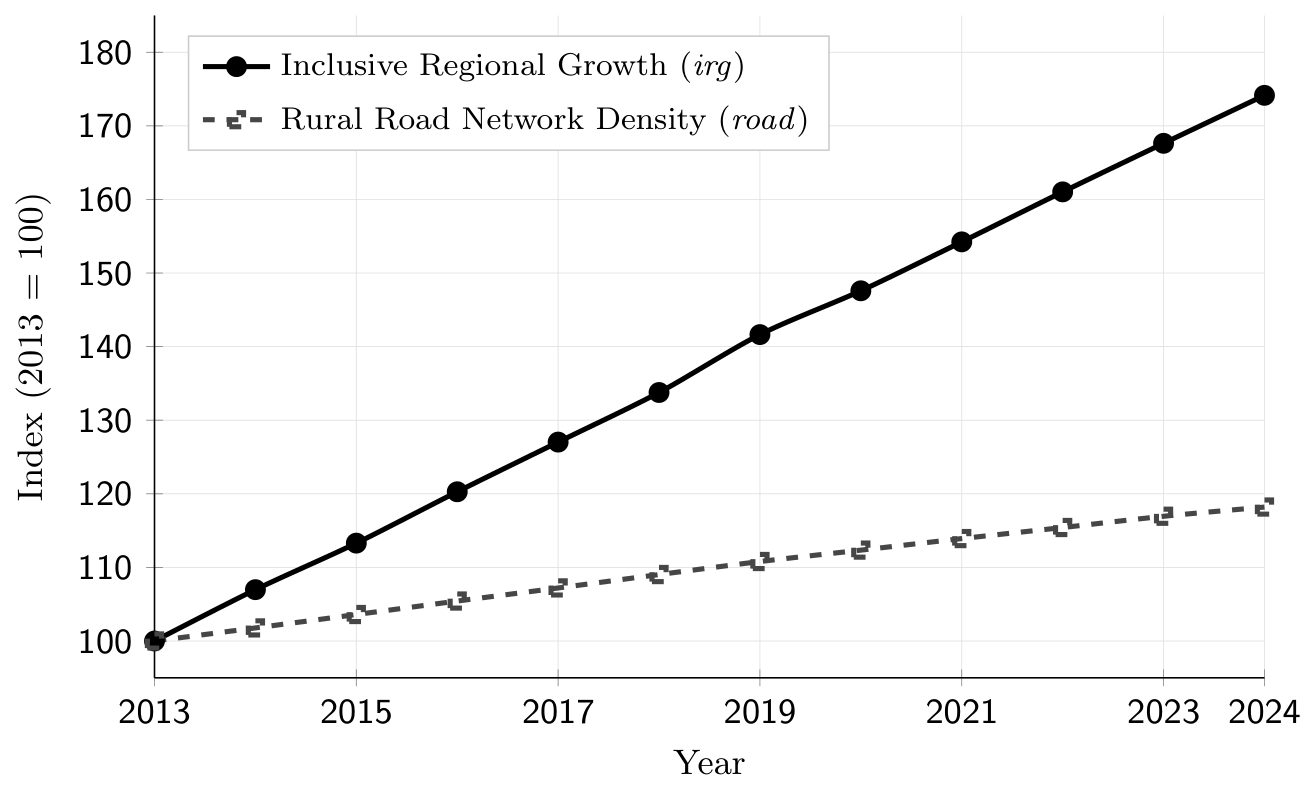
To provide a more intuitive description of the temporal evolution of the core variables, Figure 1 plots the annual sample averages of irg and road from 2013 to 2024. To make the two series directly comparable despite differences in units and scales, both variables are normalized to 2013 = 100. The figure shows that both inclusive regional growth and rural road network density exhibit upward trends during the sample period, although inclusive regional growth increases more rapidly than rural road network density.
Table 3 reports the multicollinearity diagnosis for the explanatory variables used in the baseline specification. The maximum VIF value is 2.53 for urb, followed by 2.21 for agr. Prior transportation and safety studies have commonly used VIF-based diagnostics to assess multicollinearity and have treated values above conventional thresholds, such as 7.5 or 10, as potential signals of problematic collinearity [28,29]. In this study, all VIF values are far below these commonly used thresholds, and the mean VIF is 1.70. In particular, the VIF value of the core explanatory variable road is only 1.15, indicating that rural road network density is not highly collinear with the control variables. These results suggest that multicollinearity is not a serious concern in the empirical analysis.

4.2. Baseline Effects of Rural Road Network Density on Inclusive Regional Growth

Table 4 reports the baseline effects of rural road network density on inclusive regional growth. Column (1) includes county fixed effects and year fixed effects only. The coefficient of road is 0.094 and is significant at the 1% level, indicating a positive association between rural road network density and irg. After adding the full set of control variables in Column (2), the coefficient decreases to 0.078 but remains statistically significant at the 1% level. Based on the standard deviation of road reported in Table 2, a one-standard-deviation increase in rural road network density is associated with an increase of approximately 0.052 in irg, which is economically meaningful relative to the sample mean of 0.284.
Column (3) further controls for province-specific linear time trends. The coefficient of road remains positive and significant, suggesting that the baseline result is not driven by differential provincial development trajectories. Column (4) uses a balanced panel sample, and the estimated coefficient is 0.082, again significant at the 1% level. This confirms that the main result is not sensitive to the unbalanced structure of the sample. Overall, the baseline results provide strong evidence that rural road network density promotes inclusive regional growth at the county level.
The control variables are generally consistent with expectations. Urbanization, fixed asset investment, education expenditure, and financial development are positively associated with irg, while agricultural dependence is negatively associated with irg. These results suggest that inclusive regional growth is shaped not only by rural road network density but also by broader socioeconomic and structural development conditions.

4.3. Growth and Inclusiveness Dimensions

The baseline results indicate that rural road network density increases the composite index of inclusive regional growth. To examine whether this effect is driven by economic growth, rural income improvement, or a reduction in the urban–rural income gap, Table 5 reports regressions using the four components of irg as dependent variables.
Columns (1) and (2) show that the coefficient of road is positive and statistically significant when the dependent variables are pgdp and nlit. Specifically, the coefficient is 0.114 for pgdp and 0.083 for nlit, both significant at the 1% level. These results indicate that higher rural road network density is associated with higher real GDP per capita and stronger nighttime-light-measured economic activity. Based on the standard deviation of road, a one-standard-deviation increase in rural road network density is associated with increases of approximately 0.076 in pgdp and 0.056 in nlit. These findings support Hypothesis 1, which predicts that rural road network density promotes county-level economic growth.
Columns (3) and (4) further examine the inclusiveness dimension. The coefficient of road is 0.065 and statistically significant when the dependent variable is rinc, indicating that higher rural road network density increases rural income. In contrast, the coefficient of road is -0.092 and significant at the 1% level when the dependent variable is gap. Since a higher value of gap indicates a wider urban–rural income gap, this negative coefficient suggests that rural road network density helps narrow urban–rural income inequality. Therefore, the results support Hypothesis 2.

4.4. Mechanism Analysis

This subsection examines whether labor reallocation toward non-agricultural employment, market access, and non-agricultural industrial development help explain the relationship between rural road network density and inclusive regional growth. The mechanism results are reported in the mechanism-analysis table. Columns (1)–(3) first test whether rural road network density affects the proposed mechanism variables, while Columns (4)–(6) add each mechanism variable to the inclusive-growth regression.
Columns (1)–(3) show that road is positively associated with all three mechanism variables. In Column (1), the coefficient of road is 0.034 and is significant at the 1% level, indicating that higher rural road network density increases lab. Because lab is measured as the share of employment in secondary and tertiary industries, this result should be interpreted as evidence that better rural road conditions are associated with labor reallocation toward non-agricultural employment, rather than as direct evidence of worker movement, commuting behavior, or migration. In Column (2), the coefficient of road is 0.061 and is significant at the 1% level, showing that higher rural road network density improves mkt. This result is consistent with the market-access mechanism, as rural roads reduce transport costs and strengthen connections between villages, townships, county seats, and consumer markets. In Column (3), road has a positive and significant coefficient of 0.042, indicating that higher rural road network density promotes ind, namely county-level non-agricultural industrial development. Columns (4)–(6) further show that the three mechanism variables are positively associated with irg. The coefficients of lab, mkt, and ind are 0.215, 0.142, and 0.118, respectively, and all are significant at the 1% level. After these mechanism variables are added, the coefficient of road remains positive and statistically significant, but its magnitude declines from 0.078 in the baseline model to 0.056, 0.048, and 0.051, respectively. This pattern suggests that labor reallocation toward non-agricultural employment, market access, and non-agricultural industrial development partially explain the inclusive-growth effect of rural road network density. The results support Hypotheses 3a–3c. Rural road network density promotes inclusive regional growth not only by improving physical connectivity, but also by supporting employment-structure adjustment toward non-agricultural sectors, strengthening market access, and expanding county-level non-agricultural economic activity.
Because the three mechanism variables may be correlated with each other, we further add a joint mechanism regression in Column (7) of Table 6. In this specification, lab, mkt, and ind are included simultaneously. The results show that all three mechanism variables remain positively associated with inclusive regional growth. Specifically, the coefficient of lab is 0.124 and significant at the 1% level, the coefficient of mkt is 0.083 and significant at the 1% level, and the coefficient of ind is 0.055 and significant at the 5% level. The coefficient of road remains positive and statistically significant, with a coefficient of 0.038. Compared with the separate mechanism regressions, the joint regression shows that the estimated coefficients of the three mechanism variables decline in magnitude but remain statistically significant, suggesting that each pathway provides distinct explanatory content after conditioning on the other two channels. These results indicate that labor reallocation toward non-agricultural employment, market access, and industrial development are all empirically relevant channels linking rural road network density to inclusive regional growth. Among the three variables, lab has the largest conditional coefficient, followed by mkt and ind. However, because the mechanism variables are measured on different scales and may still be jointly determined with inclusive regional growth, this comparison should be interpreted as relative empirical relevance rather than as a definitive causal ranking. Therefore, the mechanism results should still be understood as channel-consistent evidence rather than as a strict causal decomposition.
To further assess the statistical significance of the proposed pathways, we conduct bootstrap indirect-effect tests, and the results are reported in Appendix A Table A3. The estimated indirect effect through lab is 0.0073, with a bootstrap 95% confidence interval of [0.0028, 0.0135]. The estimated indirect effect through mkt is 0.0087, with a bootstrap 95% confidence interval of [0.0034, 0.0152]. The estimated indirect effect through ind is 0.0050, with a bootstrap 95% confidence interval of [0.0019, 0.0094]. Since the confidence intervals do not include zero, the bootstrap results provide additional support for the labor reallocation, market access, and industrial development pathways. At the same time, we interpret these results cautiously. The bootstrap indirect-effect test improves the statistical assessment of the proposed pathways, but it does not fully eliminate potential endogeneity of the mechanism variables. Labor reallocation, market access, and industrial development may themselves be affected by inclusive regional growth. Therefore, the mechanism analysis should be understood as evidence consistent with the proposed channels rather than as a strict causal decomposition of the total effect.

4.5. Robustness Checks and Endogeneity Tests

Table 7 reports a set of robustness checks. Column (1) replaces the baseline road-density measure with rper, which measures rural road length per 10,000 residents. The coefficient remains positive and significant at the 1% level, indicating that the main conclusion is not sensitive to the measurement of rural road network density. Column (2) uses lrod, the one-year lag of rural road network density, and the coefficient is still positive and significant. This result suggests that the association between rural road network density and inclusive regional growth is not limited to a purely contemporaneous relationship. However, we do not interpret the lagged specification as a sufficient solution to reverse causality, because road construction may reflect long-term development strategies and anticipated future growth. Columns (3) and (4) further examine whether the baseline result is affected by extreme values or metropolitan spillovers. After applying 1% and 99% winsorization, the coefficient of the road variable remains positive and significant. After excluding counties adjacent to provincial capitals and municipalities directly under the central government, the coefficient also remains positive and significant. These results show that the baseline finding is robust to alternative road measures, lagged specifications, outlier treatment, and sample exclusion. Nevertheless, because economically stronger counties may have greater capacity to finance and expand rural roads, potential reverse causality remains an important econometric concern. For this reason, the instrumental-variable analysis is used as the main endogeneity test rather than relying on the lagged road specification alone.
We further examine whether the baseline conclusion depends on the inclusion of nighttime-light intensity in the inclusive regional growth index. Nighttime-light data are useful for supplementing official economic statistics, but their measurement properties may differ between urban and rural areas. Therefore, we reconstruct an alternative inclusive regional growth index, irgn, using only real GDP per capita, rural income, and the reverse-coded urban–rural income gap. The results are reported in Table 7, Column (5). The coefficient of road remains positive and statistically significant, with a coefficient of 0.081, when irgn is used as the dependent variable. This finding indicates that the positive relationship between rural road network density and inclusive regional growth is not driven by the nighttime-light component of the baseline index.
We further estimate spatial econometric models to examine whether the baseline conclusion is affected by spatial dependence. The results are reported in Table 8. In the SAR specification, the coefficient of road is 0.0692 and remains statistically significant at the 1% level. In the SEM specification, the coefficient of road is 0.0743 and remains statistically significant at the 1% level. In the SDM specification, the coefficient of road is 0.0654 and remains statistically significant at the 1% level. The spatial lag parameters in the SAR and SDM models are 0.1935 and 0.1741, respectively, and both are significant at the 1% level. The spatial error parameter in the SEM model is 0.2148 and significant at the 1% level. These results confirm the presence of spatial dependence in county-level inclusive regional growth.
The decomposed effects further support the robustness of the main conclusion. The direct effects of road are 0.0718 in the SAR model, 0.0743 in the SEM model, and 0.0682 in the SDM model, all significant at the 1% level. The indirect effect is 0.0184 in the SAR model and 0.0315 in the SDM model, both significant at the 5% level. In the SDM specification, the spatially lagged road variable is also positive and significant, with a coefficient of 0.0213. These findings suggest that rural road network density not only promotes inclusive regional growth within the focal county but may also generate positive spillover effects on neighboring counties through cross-county connectivity. Overall, the SAR, SEM, and SDM results support the main conclusion that rural road network density promotes inclusive regional growth, even after accounting for spatial spillovers.
We further conduct a dynamic panel system GMM robustness test to account for persistence in inclusive regional growth and potential dynamic endogeneity. The results are reported in Appendix A Table A2. The coefficient of the lagged dependent variable is positive and statistically significant across all specifications, confirming the persistence of county-level inclusive regional growth, economic output, and the urban–rural income gap. More importantly, the coefficient of road remains positive and statistically significant for irg and pgdp, with coefficients of 0.0438 and 0.0573, respectively. The coefficient of road is −0.0492 when the dependent variable is gap, indicating that rural road network density continues to reduce the urban–rural income gap after dynamic endogeneity is considered. All three coefficients are significant at the 1% level.
The diagnostic tests support the validity of the dynamic panel specification. The AR(1) tests are significant, as expected in first-differenced residuals, while the AR(2) tests do not reject the null hypothesis of no second-order serial correlation. The AR(2) p-values are 0.318, 0.247, and 0.403 for irg, pgdp, and gap, respectively. The Hansen test also does not reject the validity of the instrument set, with p-values of 0.294, 0.381, and 0.216. To reduce instrument proliferation, the instrument matrix is collapsed and the lag depth is restricted; the number of instruments is 68, which is much smaller than the number of counties. Overall, the system GMM results provide additional evidence that rural road network density promotes inclusive regional growth after accounting for dynamic endogeneity.
Table 9 reports the instrumental-variable estimation results. Column (1) presents the first-stage regression. The coefficient of sltr is −0.018 and is significant at the 1% level. Since sltr is defined as the interaction between county mean terrain slope and a linear time trend, a one-unit increase in sltr represents a one-unit greater slope–time interaction. Economically, this means that steeper counties became increasingly exposed over time to terrain-related constraints on rural road expansion. The estimated first-stage coefficient of −0.018 indicates that, conditional on county fixed effects, year fixed effects, and time-varying controls, counties with stronger slope-related construction constraints experienced slower growth in rural road network density over time. This is consistent with the interpretation that terrain slope raises engineering difficulty and construction costs, thereby limiting the pace of rural road expansion.
To provide a more complete assessment of instrument relevance, we report not only the Kleibergen–Paap rk Wald F statistic, but also the first-stage R 2 , the partial R 2 of the excluded instrument, and Shea’s partial R 2 . The first-stage R 2 is 0.5937, indicating that the first-stage model explains a substantial share of the variation in rural road network density when fixed effects and controls are included. The partial R 2 of the excluded instrument is 0.0023, and Shea’s partial R 2 is also 0.0023, indicating that the excluded instrument provides modest but nonzero incremental explanatory power after accounting for county fixed effects, year fixed effects, and time-varying socioeconomic controls. The Kleibergen–Paap rk Wald F statistic is 34.62, which is above the conventional threshold of 10. Taken together, these diagnostics suggest that the instrument is statistically relevant, although the IV results should still be interpreted cautiously and as complementary evidence. Columns (2)–(4) report the second-stage results. The fitted value of rural road network density, road ^ , has a positive and statistically significant effect on irg, with a coefficient of 0.112. This estimate is larger than the baseline two-way fixed-effects estimate of 0.078. We interpret this difference cautiously. One possible explanation is that measurement error in county-level rural road statistics may attenuate the fixed-effects estimate, while the instrumental-variable approach partially corrects this attenuation by using terrain-induced variation in rural road expansion. Another possible explanation is that the IV estimate captures a local average treatment effect for counties whose rural road expansion is more strongly constrained by terrain conditions. These counties are likely to be relatively less connected and may experience larger marginal inclusive-growth gains from additional rural road density. Therefore, the IV estimate should not be interpreted simply as a uniformly larger average effect for all counties, but as complementary evidence based on exogenous terrain-related variation in road-density growth. The coefficient of road ^ is also positive and significant for pgdp, while it is negative and significant for gap. These results indicate that rural road network density promotes county-level economic growth and reduces the urban–rural income gap. Overall, the robustness checks and instrumental-variable estimates provide consistent evidence that the main findings are not driven by variable measurement, sample composition, extreme observations, or potential endogeneity.
Because the instrumental-variable model uses one excluded instrument for one endogenous variable, it is exactly identified. Therefore, a standard overidentification test is not applicable. We also do not use historical rural road networks as an additional instrument because consistent historical county-level rural road data harmonized to the 2013 county boundary are not available for the full national sample. For this reason, the revised manuscript focuses on strengthening the exclusion-restriction discussion and reporting additional first-stage diagnostics. The IV results should therefore be interpreted cautiously as complementary evidence based on terrain-related variation in rural road expansion.

4.6. Heterogeneity and Threshold Analysis

Table 10 reports the heterogeneous effects of rural road network density across different regional and development conditions. Columns (1) and (2) divide the sample into eastern counties and central-western counties. The coefficient of road is positive in both subsamples, but the estimated coefficient is larger in the central-western sample. Specifically, the coefficient is 0.038 in eastern counties and 0.095 in central-western counties. This pattern suggests that rural road network density generates larger inclusive-growth gains in regions where development constraints and transport bottlenecks are more binding.
Columns (3) and (4) divide counties according to their initial rural road network density in 2013. The coefficient of road is 0.104 for counties with low initial road, compared with 0.045 for counties with high initial road. This indicates that the marginal effect of rural road network density is larger in counties with weaker initial road accessibility. In other words, increasing rural road network density appears to be more valuable when the existing rural road network is relatively underdeveloped.
Columns (5) and (6) further divide the sample according to the initial level of economic development. The coefficient of road is 0.098 for counties with low initial pgdp, while it is 0.041 for counties with high initial pgdp. This result suggests that less-developed counties benefit more from rural road network density in terms of inclusive regional growth. Overall, the heterogeneity results are consistent with Hypothesis 4. rural road network density has larger estimated effects in central-western counties, low-accessibility counties, and less-developed counties, indicating that improving rural road conditions can serve as an important policy instrument for reducing spatial development disadvantages and promoting balanced regional development.
To further interpret the heterogeneity results, we estimate a panel threshold model using rural road network density as the threshold variable. The results are reported in Table 11. The estimated threshold value of road is 3.8164, and the bootstrap p-value for the threshold effect is 0.006, indicating statistically significant nonlinear threshold-type heterogeneity. When road is below the estimated threshold, the coefficient of road is 0.0962 and is statistically significant at the 1% level. When road is above the threshold, the coefficient is 0.0437 and is also statistically significant at the 1% level. These results indicate that rural road network density promotes inclusive regional growth in both regimes, but the estimated effect is much larger in the low-road-density regime. Therefore, the stronger effects found in central-western counties, low-accessibility counties, and less-developed counties are more consistent with diminishing marginal returns than with a strict activation-threshold effect. In other words, rural roads do not appear to promote inclusive growth only after reaching a minimum density level; rather, the marginal benefits are larger where initial road access is weaker and development constraints are more binding. This interpretation is consistent with the idea that underdeveloped and less-connected counties have more room to benefit from additional rural road connectivity.

5. Discussion

5.1. Main Findings

This study examines whether rural road network density promotes inclusive regional growth using county-level panel data from China. The empirical results show that rural road network density significantly increases the inclusive regional growth index. This finding is consistent with the broader transport-infrastructure literature, which emphasizes that roads reduce spatial frictions, improve market integration, and reshape local economic opportunities [3,4,30,31,32]. More importantly, this study shows that rural road network density is associated not only with economic expansion but also with social inclusiveness. The dimensional analysis indicates that higher rural road network density increases pgdp, nlit, and rinc, while reducing gap. This supports the interpretation that rural road network density contributes to inclusive regional growth rather than merely increasing aggregate output [1,8,11,17].
The mechanism results further show that rural road network density works through labor mobility, market access, and non-agricultural industrial development. These findings are consistent with the view that rural roads improve household and regional outcomes by reducing transport costs, expanding market participation, and changing local production structures [7,9,12,13,16]. The heterogeneity results also show that the estimated effects are larger in central-western counties, counties with weaker initial road accessibility, and counties with lower initial economic development. This pattern suggests that rural road network density has higher marginal value where transport bottlenecks and development disadvantages are more binding, which is consistent with recent evidence on heterogeneous road effects in China [10,20].

5.2. Policy Implications

The findings suggest that improving rural road network density should be understood as a spatial development policy rather than a narrow transport-construction objective. Rural roads can improve the accessibility of villages and townships, strengthen county-level market integration, and help rural residents participate more effectively in local development. Therefore, policy resources for rural road construction and maintenance should give priority to counties with weak initial road accessibility, lower economic development levels, and stronger urban–rural income gaps. This targeted approach is consistent with evidence that transport infrastructure can generate uneven spatial effects and that the welfare gains from infrastructure investment depend on where and how investment is allocated [5,33,34].
However, higher road density alone is not sufficient to guarantee inclusive growth. To transform road connectivity into development opportunities, rural road policy should be coordinated with policies that support non-farm employment, agricultural commercialization, logistics services, rural e-commerce, public-service access, and county-level industrial upgrading. Prior studies show that rural roads can affect poverty reduction, household income, agricultural production, and rural industrial integration, but these effects depend on whether improved access is connected to productive activities and market opportunities [6,10,21,22,35]. Therefore, a more effective rural-road policy should combine physical infrastructure with employment, industry, logistics, and public-service policies.
The policy implications should be translated into more specific implementation measures. First, priority support should be based on measurable accessibility and development indicators rather than broad regional categories alone. Local governments can identify priority counties by combining initial rural road network density, per capita income, distance to county seats, access to township markets, and the share of villages with all-weather road access. This would allow rural road investment to target counties where connectivity constraints are most binding. Second, rural road policy should shift from a simple expansion-oriented approach to a life-cycle management approach. In addition to new road construction, policy efforts should prioritize upgrading low-standard roads, improving all-weather accessibility, repairing damaged village roads, strengthening road safety facilities, and establishing stable maintenance funds. Third, rural road investment should be coordinated with county-level industrial and market systems. For example, new or upgraded rural roads should be connected with agricultural processing centers, wholesale markets, logistics parks, rural e-commerce service stations, cold-chain facilities, tourism routes, and township industrial platforms so that improved physical access can be converted into income-generating opportunities. Fourth, rural road planning should be linked with employment and public-service access. This includes improving commuting routes between villages, townships, and county seats, integrating rural passenger and freight services, and ensuring that road improvements reduce travel time to schools, health centers, markets, and employment locations. Finally, policy evaluation should move beyond road length alone and include indicators such as travel-time reduction, rural income growth, market-access improvement, maintenance quality, road safety, public-service accessibility, and ecological constraints. These more specific measures can help ensure that rural roads become an effective policy instrument for inclusive and sustainable regional development.
At the same time, rural road expansion should not be interpreted as an unconditional call for maximizing road density. From a sustainability perspective, road development may involve important environmental trade-offs. Road construction and increased traffic can contribute to land-use conversion, agricultural land fragmentation, habitat disturbance, runoff pollution, vehicle-related emissions, and ecological degradation [36,37,38]. Therefore, rural road policy should integrate inclusive-development objectives with ecological constraints. In practice, this means that road planning should avoid environmentally sensitive areas where possible, reduce unnecessary new road construction, prioritize upgrading, maintenance, safety improvement, and all-weather accessibility of existing rural roads, and coordinate transport investment with land-use planning, ecological-red-line protection, carbon-emission reduction, and environmental impact assessment. Such an approach can help ensure that rural roads support inclusive regional growth without undermining ecological sustainability.

5.3. Limitations

This study has several limitations. First, rural road network density captures the realized stock of county, township, and village roads, but it is not a topography-adjusted measure of road adequacy. Mountainous counties may naturally have lower road density because terrain conditions increase construction costs, raise engineering difficulty, and constrain feasible route layouts. Therefore, direct comparisons of road-density levels between plain counties and mountainous counties should be interpreted with caution. Although county fixed effects absorb time-invariant terrain conditions in the baseline model, the indicator still cannot fully reflect route sinuosity, effective accessible land area, road quality, maintenance conditions, surface type, traffic capacity, and seasonal accessibility. It also does not directly measure fiscal investment flows in rural roads. Second, the county-level panel design is suitable for identifying regional patterns, but it cannot directly observe household-level travel behavior, village-level road use, firm entry, or logistics costs. Although nighttime-light data help supplement official economic statistics, satellite luminosity is still an indirect measure of local economic activity and should be interpreted together with conventional socioeconomic indicators [23,24].
The rural road network density measure is based on the unweighted total length of county roads, township roads, and village roads. It does not distinguish the hierarchy, functional classification, pavement type, width, traffic capacity, maintenance quality, or all-weather accessibility of different road segments. Therefore, the measure captures the spatial extent of the rural road network but cannot fully represent road service quality or transport capacity. Future research could construct hierarchy-weighted or quality-adjusted road indicators if more detailed county-level road information becomes available.
In addition, although nighttime-light data provide a useful supplement to official economic statistics, they remain an indirect proxy for local economic activity. Their explanatory power may differ between urban and rural areas because rural areas generally have lower luminosity, and observed lights may partly reflect public facilities, infrastructure lighting, temporary activities, or other non-economic light sources. Therefore, nighttime-light intensity should not be interpreted as a complete measure of rural economic activity.
Future research can extend this study in several directions. First, village-level road-network data, household surveys, firm registration records, and logistics-flow data could be used to identify more micro-level mechanisms. Second, future studies could examine the quality and maintenance of rural roads, because the development effect of a road depends not only on whether it exists but also on whether it remains accessible, safe, and economically usable. Third, this study focuses primarily on the socioeconomic inclusiveness of rural road network density and does not directly evaluate environmental externalities. Therefore, the positive association between rural road network density and inclusive regional growth should not be interpreted as evidence that increasing road density is environmentally sustainable in all contexts. Road expansion may increase construction land use, fragment agricultural land and natural habitats, disturb ecosystems, increase traffic-related emissions, and generate other ecological costs. These environmental consequences are particularly relevant for Sustainability because sustainable regional development requires balancing economic inclusion, social equity, and ecological protection. Future research could combine county-level socioeconomic data with land-use change, habitat-fragmentation, carbon-emission, air-pollution, biodiversity, and ecological-quality indicators to evaluate the net sustainability effects of rural road expansion more comprehensively.

6. Conclusions

This study examined whether rural road network density promotes inclusive regional growth using county-level panel data from China between 2013 and 2024. The results show that rural road network density significantly improves the inclusive regional growth index. Further dimensional analysis indicates that higher rural road network density increases county-level economic output, strengthens nighttime-light-measured economic activity, raises rural income, and reduces the urban–rural income gap. Mechanism tests suggest that these effects operate through labor reallocation toward non-agricultural employment, market access, and non-agricultural industrial development. The results remain robust across alternative specifications and instrumental-variable estimation.
These findings indicate that rural road network density is not only a transport infrastructure indicator but also a spatial condition for sustainable and inclusive regional development. By improving rural connectivity and expanding access to employment, markets, and industrial opportunities, denser rural road networks can help reduce spatial development disadvantages and support rural revitalization. The stronger effects observed in central-western, low-accessibility, and less-developed counties further suggest that targeted improvement of rural road networks can contribute to more balanced territorial development and a more sustainable pattern of regional growth.

Author Contributions

Conceptualization, H.G. and G.T.; methodology, H.G.; software, H.G.; validation, H.G. and G.T.; formal analysis, H.G.; investigation, H.G.; resources, G.T.; data curation, H.G.; writing—original draft preparation, H.G.; writing—review and editing, H.G. and G.T.; visualization, H.G.; supervision, G.T.; project administration, G.T. All authors have read and agreed to the published version of the manuscript.

Funding

This research received no external funding.

Institutional Review Board Statement

Not applicable.

Informed Consent Statement

Not applicable.

Data Availability Statement

The data supporting the findings of this study are available within the article. The data presented in this study are available on request from the corresponding author.

Conflicts of Interest

The authors declare no conflicts of interest.

Appendix A. Additional Robustness Checks

Table A1. Entropy weights of inclusive regional growth indicators.
IndicatorDirectionEntropy Weight
pgdpPositive23.54%
nlitPositive20.83%
rincPositive26.18%
gapNegative, reverse-coded29.45%
Note: pgdp denotes real GDP per capita, nlit denotes nighttime-light intensity, rinc denotes rural income, and gap denotes the urban–rural income gap. The indicator gap is reverse-coded before index construction, so a higher standardized value indicates a smaller urban–rural income gap and stronger inclusiveness. Entropy weights are calculated using the standardized county-year observations in the baseline sample.
Table A2. Dynamic panel system GMM robustness checks.
irgpgdpgap
(1)(2)(3)
Lagged dependent variable0.6142 ***0.8105 ***0.7329 ***
(0.0235)(0.0164)(0.0219)
road0.0438 ***0.0573 ***−0.0492 ***
(0.0112)(0.0158)(0.0137)
ControlsYesYesYes
Year FEYesYesYes
Collapsed instrumentsYesYesYes
Restricted lag depthYesYesYes
Observations18,98418,98418,984
Number of counties173817381738
Number of instruments686868
AR(1) test, p-value0.0000.0000.000
AR(2) test, p-value0.3180.2470.403
Hansen test, p-value0.2940.3810.216
Note: The lagged dependent variable and road are treated as endogenous or predetermined variables and instrumented using internal lag instruments. The instrument matrix is collapsed and the lag depth is restricted to reduce instrument proliferation. Robust standard errors are reported in parentheses. *** denotes significance at the 1% level.
Table A3. Bootstrap indirect-effect tests.
Mechanism PathwayIndirect Effect95% CI Lower Bound95% CI Upper Bound
roadlabirg0.00730.00280.0135
roadmktirg0.00870.00340.0152
roadindirg0.00500.00190.0094
Note: Indirect effects are calculated as the product of the coefficient from the first-step regression of the mechanism variable on road and the coefficient of the mechanism variable in the inclusive-growth regression. Confidence intervals are obtained using bootstrap resampling at the county level with 1000 replications. lab denotes labor reallocation toward non-agricultural employment, mkt denotes market access, and ind denotes non-agricultural industrial development.

References

  1. Ravallion, M.; Chen, S. Measuring pro-poor growth. Econ. Lett. 2003, 78, 93–99. [Google Scholar] [CrossRef]
  2. Fan, S.; Chan-Kang, C. Regional road development, rural and urban poverty: Evidence from China. Transp. Policy 2008, 15, 305–314. [Google Scholar] [CrossRef]
  3. Faber, B. Trade integration, market size, and industrialization: Evidence from China’s National Trunk Highway System. Rev. Econ. Stud. 2014, 81, 1046–1070. [Google Scholar] [CrossRef]
  4. Banerjee, A.; Duflo, E.; Qian, N. On the road: Access to transportation infrastructure and economic growth in China. J. Dev. Econ. 2020, 145, 102442. [Google Scholar] [CrossRef]
  5. Lu, H.; Zhao, P.; Hu, H.; Zeng, L.; Wu, K.S.; Lv, D. Transport infrastructure and urban-rural income disparity: A municipal-level analysis in China. J. Transp. Geogr. 2022, 99, 103292. [Google Scholar] [CrossRef]
  6. Zhou, Y.; Tong, C.; Wang, Y. Road construction, economic growth, and poverty alleviation in China. Growth Chang. 2022, 53, 1306–1332. [Google Scholar] [CrossRef]
  7. Zhang, H.; Dong, W.; Fang, X. Road construction and rural household income: Empirical evidence from village road paving in China. Financ. Res. Lett. 2023, 51, 103460. [Google Scholar] [CrossRef]
  8. Yuan, L.; Li, H.; Jia, Z.; Xiong, Y.; Xu, L. Inequality and economic growth: The effect of urban-rural roads construction in China. J. Dev. Stud. 2025, 61, 272–293. [Google Scholar]
  9. Li, L.; Cai, J.; Chen, W. How does transport development contribute to rural income in China? Evidence from county-level analysis using structural equation model. Travel Behav. Soc. 2024, 34, 100708. [Google Scholar] [CrossRef]
  10. He, J.; Zhang, Z.; Tan, Z.; Zheng, S. Analyzing the transportation infrastructure–rural industry integration relationship in China. Chin. J. Popul. Resour. Environ. 2024, 22, 157–166. [Google Scholar] [CrossRef]
  11. Ou, L.; Wang, Z.; Lyu, Q.; Zheng, X. Rural roads in narrowing regional income inequality: A quasi-natural experiment from China. Transp. Policy 2026, 182, 104109. [Google Scholar] [CrossRef]
  12. Jacoby, H.G. Access to markets and the benefits of rural roads. Econ. J. 2000, 110, 713–737. [Google Scholar] [CrossRef]
  13. Mu, R.; van de Walle, D. Rural roads and local market development in Vietnam. J. Dev. Stud. 2011, 47, 709–734. [Google Scholar] [CrossRef]
  14. Démurger, S. Infrastructure development and economic growth: An explanation for regional disparities in China? J. Comp. Econ. 2001, 29, 95–117. [Google Scholar] [CrossRef]
  15. Zhou, Z.; Duan, J.; Li, W.; Geng, S. Can rural road construction promote the sustainable development of regional agriculture in China? Sustainability 2021, 13, 10882. [Google Scholar] [CrossRef]
  16. Qin, Y.; Zhang, X. The road to specialization in agricultural production: Evidence from rural China. World Dev. 2016, 77, 1–16. [Google Scholar] [CrossRef]
  17. Chen, W.; Chen, J.; Qiu, H.; Yu, J.; Chen, W.; Wang, X. Roads to growth: Evidence from rural China. J. Reg. Sci. 2026, 66, 542–562. [Google Scholar] [CrossRef]
  18. Wu, M.; Yu, L.; Zhang, J. Road expansion, allocative efficiency, and pro-competitive effect of transport infrastructure: Evidence from China. J. Dev. Econ. 2023, 162, 103050. [Google Scholar] [CrossRef]
  19. Li, Y.; DaCosta, M.N. Transportation and income inequality in China: 1978–2007. Transp. Res. Part A Policy Pract. 2013, 55, 56–71. [Google Scholar] [CrossRef]
  20. Lu, H.; Zhao, P.; Hu, H.; Yan, J.; Chen, X. Exploring the heterogeneous impact of road infrastructure on rural residents’ income: Evidence from nationwide panel data in China. Transp. Policy 2023, 134, 155–166. [Google Scholar] [CrossRef]
  21. Wang, L.; Zhang, F.; Wang, Z.; Tan, Q. The impact of rural infrastructural investment on farmers’ income growth in China. China Agric. Econ. Rev. 2022, 14, 202–219. [Google Scholar]
  22. Shamdasani, Y. Rural road infrastructure & agricultural production: Evidence from India. J. Dev. Econ. 2021, 152, 102686. [Google Scholar] [CrossRef]
  23. Chen, X.; Nordhaus, W.D. Using luminosity data as a proxy for economic statistics. Proc. Natl. Acad. Sci. USA 2011, 108, 8589–8594. [Google Scholar] [CrossRef] [PubMed]
  24. Henderson, J.V.; Storeygard, A.; Weil, D.N. Measuring economic growth from outer space. Am. Econ. Rev. 2012, 102, 994–1028. [Google Scholar] [CrossRef] [PubMed]
  25. Shannon, C.E. A mathematical theory of communication. Bell Syst. Tech. J. 1948, 27, 379–423. [Google Scholar] [CrossRef]
  26. Bertrand, M.; Duflo, E.; Mullainathan, S. How much should we trust differences-in-differences estimates? Q. J. Econ. 2004, 119, 249–275. [Google Scholar] [CrossRef]
  27. Cameron, A.C.; Miller, D.L. A practitioner’s guide to cluster-robust inference. J. Hum. Resour. 2015, 50, 317–372. [Google Scholar] [CrossRef]
  28. Jaber, A.; Csonka, B. Towards a Sustainable and Safe Future: Mapping Bike Accidents in Urbanized Context. Safety 2023, 9, 60. [Google Scholar] [CrossRef]
  29. Huang, Y.; Wang, X.; Patton, D. Examining Spatial Relationships between Crashes and the Built Environment: A Geographically Weighted Regression Approach. J. Transp. Geogr. 2018, 69, 221–233. [Google Scholar] [CrossRef]
  30. Roberts, M.; Deichmann, U.; Fingleton, B.; Shi, T. Evaluating China’s Road to Prosperity: A New Economic Geography Approach. Reg. Sci. Urban Econ. 2012, 42, 580–594. [Google Scholar] [CrossRef]
  31. Donaldson, D. Railroads of the Raj: Estimating the Impact of Transportation Infrastructure. Am. Econ. Rev. 2018, 108, 899–934. [Google Scholar] [CrossRef]
  32. Storeygard, A. Farther on down the Road: Transport Costs, Trade and Urban Growth in Sub-Saharan Africa. Rev. Econ. Stud. 2016, 83, 1263–1295. [Google Scholar] [CrossRef] [PubMed]
  33. Allen, T.; Arkolakis, C. The Welfare Effects of Transportation Infrastructure Improvements. Rev. Econ. Stud. 2022, 89, 2911–2957. [Google Scholar] [CrossRef]
  34. Baum-Snow, N.; Brandt, L.; Henderson, J.V.; Turner, M.A.; Zhang, Q. Roads, Railroads, and Decentralization of Chinese Cities. Rev. Econ. Stat. 2017, 99, 435–448. [Google Scholar] [CrossRef]
  35. Khandker, S.R.; Bakht, Z.; Koolwal, G.B. The Poverty Impact of Rural Roads: Evidence from Bangladesh. Econ. Dev. Cult. Chang. 2009, 57, 685–722. [Google Scholar] [CrossRef]
  36. Forman, R.T.T.; Alexander, L.E. Roads and Their Major Ecological Effects. Annu. Rev. Ecol. Syst. 1998, 29, 207–231. [Google Scholar] [CrossRef]
  37. Coffin, A.W. From Roadkill to Road Ecology: A Review of the Ecological Effects of Roads. J. Transp. Geogr. 2007, 15, 396–406. [Google Scholar] [CrossRef]
  38. Ibisch, P.L.; Hoffmann, M.T.; Kreft, S.; Pe’er, G.; Kati, V.; Biber-Freudenberger, L.; DellaSala, D.A.; Vale, M.M.; Hobson, P.R.; Selva, N. A Global Map of Roadless Areas and Their Conservation Status. Science 2016, 354, 1423–1427. [Google Scholar] [CrossRef] [PubMed]
Figure 1. Time trends of average inclusive regional growth and rural road network density, 2013–2024. Note: The figure plots the annual sample averages of irg and road. To facilitate visual comparison, both series are normalized to 2013 = 100. A higher indexed value indicates a higher sample average relative to the 2013 baseline.
Sustainability 18 06811 g001
Table 1. Variable definitions.
VariableMeaningMeasurementRole
irgInclusive regional growthEntropy-weighted index constructed from pgdp, nlit, rinc, and reverse-coded gapMain dependent variable
pgdpEconomic outputNatural logarithm of real GDP per capitaDependent variable
nlitNighttime lightNatural logarithm of one plus county mean VIIRS nighttime-light radianceDependent variable
rincRural incomeNatural logarithm of real rural per capita disposable incomeIndex component
gapUrban–rural income gapUrban per capita disposable income divided by rural per capita disposable incomeDependent variable
roadrural road network densityNatural logarithm of one plus rural road length per 100 square kilometersCore explanatory variable
rperRural road per capitaNatural logarithm of one plus rural road length per 10,000 residentsAlternative road variable
lrodLagged rural road network densityOne-year lag of roadRobustness variable
labLabor reallocation and non-agricultural employmentShare of employment in secondary and tertiary industriesMechanism variable
mktMarket accessNatural logarithm of real per capita retail sales of consumer goodsMechanism variable
indIndustrial developmentNatural logarithm of real secondary and tertiary industry value added per capitaMechanism variable
urbUrbanizationUrban population divided by total populationControl variable
densPopulation densityNatural logarithm of population per square kilometerControl variable
fixFixed asset investmentNatural logarithm of real fixed asset investment per capitaControl variable
govGovernment expenditureFiscal expenditure divided by GDPControl variable
eduEducation expenditureEducation expenditure divided by fiscal expenditureControl variable
finFinancial developmentFinancial institution loan balance divided by GDPControl variable
agrAgricultural dependencePrimary industry value added divided by GDPControl variable
sloTerrain slopeCounty mean terrain slope calculated from elevation dataInstrumental variable
sltrSlope trend instrumentInteraction between slo and a linear time trendInstrumental variable
eastEastern regionDummy variable equal to one for eastern counties and zero otherwiseGroup variable
Table 2. Descriptive statistics.
VariableObs.MeanStd. Dev.MinMax
irg20,8360.2840.1170.0310.812
pgdp20,83610.6830.6218.94212.356
nlit20,8361.4181.1540.0124.789
rinc20,8369.5370.4328.21510.824
gap20,8362.4560.5131.3414.127
road20,8363.8240.6711.0535.318
lab20,8360.6120.1840.1530.947
mkt20,8369.3510.5827.42611.163
ind20,83610.4520.6758.32112.284
urb20,8360.4730.1420.1260.865
dens20,8364.9351.2161.5427.821
fix20,83610.2140.7437.85112.148
gov20,8360.1860.0920.0510.673
edu20,8360.2040.0470.0820.356
fin20,8360.8150.4630.1983.421
agr20,8360.2390.1210.0190.676
Note: All monetary variables are measured in real terms with 2013 as the base year. Continuous variables are winsorized at the 1st and 99th percentiles. For nlit, the theoretical lower bound of the raw ln ( 1 + V I I R S ¯ ) transformation is zero, but the minimum value reported in this table refers to the observed lower bound in the winsorized final regression sample.
Table 3. Multicollinearity diagnosis.
VariableVIF1/VIF
urb2.530.395
agr2.210.452
dens1.870.535
gov1.740.575
fix1.460.685
fin1.380.725
edu1.290.775
road1.150.870
Mean VIF1.70
Table 4. Baseline effects of rural road network density on inclusive regional growth.
Dependent Variable: irg
(1)(2)(3)(4)
road0.094 ***0.078 ***0.056 **0.082 ***
(0.012)(0.011)(0.023)(0.013)
urb 0.045 **0.041 **0.048 **
(0.020)(0.019)(0.022)
dens 0.0140.0180.011
(0.015)(0.017)(0.014)
fix 0.036 ***0.029 **0.038 ***
(0.009)(0.013)(0.010)
gov −0.021−0.015−0.025
(0.029)(0.026)(0.031)
edu 0.096 **0.088 **0.102 **
(0.041)(0.038)(0.045)
fin 0.019 *0.021 *0.017 *
(0.011)(0.012)(0.010)
agr −0.053 **−0.046 **−0.058 **
(0.023)(0.021)(0.026)
ControlsNoYesYesYes
County FEYesYesYesYes
Year FEYesYesYesYes
Province trendNoNoYesNo
Observations20,83620,83620,83618,420
Adjusted R 2 0.4280.5640.5910.572
Note: Robust standard errors clustered at the county level are reported in parentheses. ***, **, and * denote significance at the 1%, 5%, and 10% levels, respectively. Column (4) reports the result using a balanced panel sample.
Table 5. Effects on growth and inclusiveness dimensions.
pgdpnlitrincgap
(1)(2)(3)(4)
road0.114 ***0.083 ***0.065 **−0.092 ***
(0.016)(0.021)(0.028)(0.024)
urb0.231 **0.176 **0.124 *−0.158 *
(0.102)(0.084)(0.071)(0.085)
dens0.0150.0220.0110.018
(0.012)(0.019)(0.014)(0.016)
fix0.052 ***0.038 **0.041 **−0.027
(0.014)(0.017)(0.019)(0.022)
gov0.0420.0350.0260.031
(0.033)(0.041)(0.035)(0.028)
edu0.165 **0.112 *0.147 **−0.183 **
(0.072)(0.061)(0.068)(0.076)
fin0.039 **0.031 **0.025 *−0.019
(0.018)(0.015)(0.014)(0.021)
agr−0.194 **−0.138 *0.0540.172 **
(0.081)(0.073)(0.045)(0.084)
County FEYesYesYesYes
Year FEYesYesYesYes
Observations20,83620,83620,83620,836
Adjusted R 2 0.6820.5140.6270.548
Note: Robust standard errors clustered at the county level are reported in parentheses. ***, **, and * denote significance at the 1%, 5%, and 10% levels, respectively.
Table 6. Mechanism analysis.
labmktindirgirgirgirg
(1)(2)(3)(4)(5)(6)(7)
road0.034 ***0.061 ***0.042 **0.056 **0.048 **0.051 **0.038 **
(0.009)(0.014)(0.018)(0.024)(0.021)(0.022)(0.015)
lab 0.215 *** 0.124 ***
(0.052) (0.041)
mkt 0.142 *** 0.083 ***
(0.031) (0.026)
ind 0.118 ***0.055 **
(0.027)(0.023)
ControlsYesYesYesYesYesYesYes
County FEYesYesYesYesYesYesYes
Year FEYesYesYesYesYesYesYes
Observations20,83620,83620,83620,83620,83620,83620,836
Adjusted R 2 0.6120.7350.5880.5930.6140.6070.638
Note: Columns (1)–(3) report first-step mechanism regressions. Columns (4)–(6) add each mechanism variable separately to the inclusive-growth regression. Column (7) includes lab, mkt, and ind simultaneously to compare their conditional associations with irg. Robust standard errors clustered at the county level are reported in parentheses. Controls include urb, dens, fix, gov, edu, fin, and agr. ***, ** denote significance at the 1%, 5% levels, respectively.
Table 7. Robustness checks.
Dependent Variable: irg/irgn
rperlrodWinsorizedExcluding Metroirgn
(1)(2)(3)(4)(5)
Road variable0.084 ***0.065 ***0.074 **0.068 **0.081 ***
(0.015)(0.012)(0.031)(0.027)(0.013)
ControlsYesYesYesYesYes
County FEYesYesYesYesYes
Year FEYesYesYesYesYes
Observations20,83618,98420,83617,04020,836
Adjusted R 2 0.5580.5610.5650.5420.553
Note: Columns (1)–(4) use the baseline irg as the dependent variable, while Column (5) uses irgn. Column (1) uses rper as the alternative road variable. Column (2) uses lrod, the one-year lag of rural road network density. Column (3) applies 1% and 99% winsorization. Column (4) excludes counties adjacent to provincial capitals and municipalities directly under the central government. Column (5) reconstructs the inclusive regional growth index, irgn, by excluding the nighttime-light indicator. Robust standard errors clustered at the county level are reported in parentheses. ***, ** denote significance at the 1%, 5% levels, respectively.
Table 8. Spatial econometric robustness checks.
SARSEMSDM
irgirgirg
(1)(2)(3)
road0.0692 ***0.0743 ***0.0654 ***
(0.0104)(0.0121)(0.0115)
Spatial lag parameter, ρ 0.1935 *** 0.1741 ***
(0.0142) (0.0156)
Spatial error parameter, λ 0.2148 ***
(0.0163)
Spatially lagged road 0.0213 **
(0.0089)
Direct effect of road0.0718 ***0.0743 ***0.0682 ***
Indirect effect of road0.0184 **0.00000.0315 **
Total effect of road0.0902 ***0.0743 ***0.0997 ***
ControlsYesYesYes
County FEYesYesYes
Year FEYesYesYes
Observations20,83620,83620,836
Note: The spatial weight matrix is constructed from county-level contiguity relationships and row-standardized. SAR denotes the spatial autoregressive model, SEM denotes the spatial error model, and SDM denotes the spatial Durbin model. Decomposed direct, indirect, and total effects are calculated using the partial derivative matrix method. Robust standard errors are reported in parentheses. ***, ** denote significance at the 1%, 5% levels, respectively.
Table 9. Instrumental-variable estimation.
First Stage Second Stage
road irgpgdpgap
(1) (2)(3)(4)
sltr−0.018 ***
(0.004)
road ^ 0.112 **0.154 **−0.136 **
(0.048)(0.065)(0.057)
ControlsYes YesYesYes
County FEYes YesYesYes
Year FEYes YesYesYes
Observations20,836 20,83620,83620,836
First-stage R 2 0.5937
Partial R 2 of excluded instrument0.0023
Shea’s partial R 2 0.0023
Kleibergen–Paap F34.62
Note: sltr is the interaction between county mean terrain slope and a linear time trend. Robust standard errors clustered at the county level are reported in parentheses. The first-stage R 2 , partial R 2 of the excluded instrument, Shea’s partial R 2 , and Kleibergen–Paap rk Wald F statistic are reported to assess instrument relevance. Because the model is exactly identified, an overidentification test is not reported. *** and ** denote significance at the 1% and 5% levels, respectively.
Table 10. Heterogeneous effects of rural road network density.
EastCentral-WestLow roadHigh roadLow pgdpHigh pgdp
(1)(2)(3)(4)(5)(6)
road0.038 *0.095 ***0.104 ***0.045 *0.098 ***0.041 *
(0.021)(0.015)(0.018)(0.024)(0.016)(0.022)
ControlsYesYesYesYesYesYes
County FEYesYesYesYesYesYes
Year FEYesYesYesYesYesYes
Observations675014,08610,41810,41810,41810,418
Adjusted R 2 0.6150.5340.5210.5880.5180.602
Note: The dependent variable is irg. Low and high initial road groups are defined by the sample median of road in 2013. Low and high initial pgdp groups are defined by the sample median of pgdp in 2013. Robust standard errors clustered at the county level are reported in parentheses. *** and * denote significance at the 1% and 10% levels, respectively.
Table 11. Threshold regression analysis.
Low-Road-Density RegimeHigh-Road-Density Regime
road it 3.8164 road it > 3.8164
road0.0962 ***0.0437 ***
(0.0125)(0.0108)
Estimated threshold c3.8164
Bootstrap p-value for threshold effect0.006
ControlsYesYes
County FEYesYes
Year FEYesYes
Observations20,836
Adjusted R 2 0.5824
Note: Rural road network density, road, is used as the threshold variable. The threshold value is estimated endogenously. Robust standard errors clustered at the county level are reported in parentheses. The bootstrap p-value tests the presence of a threshold effect using 300 replications. *** denotes significance at the 1% level.
Disclaimer/Publisher’s Note: The statements, opinions and data contained in all publications are solely those of the individual author(s) and contributor(s) and not of MDPI and/or the editor(s). MDPI and/or the editor(s) disclaim responsibility for any injury to people or property resulting from any ideas, methods, instructions or products referred to in the content.