


Abstract
Population aging represents one of the major demographic challenges of the 21st century, driving the need for strategies that promote active aging and overall well-being. In this context, tourism has been identified as a potentially relevant activity associated with quality of life in older age, as it integrates physical, psychological, and social components. The aim of this systematic review was to synthesize the scientific evidence published between 2015 and 2026 on the relationship between tourism participation and active aging in older adults (≥60 years). Following the PRISMA 2020 guidelines, a systematic search was conducted in Web of Science, Scopus, and PubMed, identifying 1187 records, of which 18 studies met the inclusion criteria. Overall, the evidence indicates associations between tourism participation and improvements in functional physical health, psychological well-being, and social participation, with no consistent evidence of adverse effects. As a theoretical contribution, the Tourism-Active Aging Multidimensional Model (TAMM) is proposed as a conceptual framework that integrates the key mechanisms identified in the literature into three interrelated dimensions, behavioral engagement, emotional processes, and social interaction, all of which are influenced by individual and contextual factors. The evidence obtained suggests potential of tourism as a complementary strategy to promote active aging.
1. Introduction
Population aging represents one of the most significant demographic phenomena of the 21st century [1]. International projections indicate that the number of individuals aged 65 and over will exceed 1.5 billion by 2050, posing substantial challenges for healthcare, social, and economic systems worldwide [1,2]. In this context, the concept of active aging has gained increasing relevance in both public policy and scientific research [3]. Active aging is defined as the process of optimizing opportunities for health, participation, and security in order to enhance quality of life as people age [2,4]. This approach acknowledges that health in older age depends not only on the absence of disease but also on the maintenance of physical functioning, emotional balance, and social participation in everyday life [5,6]. In this regard, promoting lifestyles that support multidimensional well-being has become a scientific and societal priority to address the challenges associated with population aging [7,8].
Well-being is widely conceptualized as a multidimensional construct integrating physical, psychological, and social domains, particularly relevant in later life due to retirement transitions, changes in social networks, and increased vulnerability to functional decline [2,9]. From a positive psychology perspective, well-being encompasses both hedonic components related to life satisfaction (e.g., happiness, joy, pleasure, and the absence of negative emotions) and eudaimonic dimensions associated with personal development and meaning in life (e.g., self-realization, purpose, and personal growth) [10,11,12]. In older adults, these indicators are particularly relevant due to age-related changes such as retirement, the loss of social networks, and the emergence of functional limitations [13,14]. Furthermore, recent studies have shown that factors such as social participation [15], maintenance of physical activity [16], lifelong learning [17], and social support [18] significantly contribute to well-being and quality of life in later life.
In recent years, tourism has increasingly been considered a potentially relevant avenue for promoting well-being and active aging among older adults [19,20]. Tourism represents an activity that combines recreational experiences, social interaction, and exposure to new cultural and natural environments [14,21]. From a psychological perspective, tourism experiences may be associated with positive emotions [22], enhance life satisfaction [23], and foster a sense of purpose in later life [24]. From a social standpoint, tourism facilitates interaction with family members, friends, and other individuals [25], which may help reduce social isolation and strengthen supportive social networks [26]. Finally, from a physical perspective, tourism activities involving mobility such as walking or outdoor recreational activities may contribute to the maintenance of physical functioning and overall health [27,28,29].
From a theoretical perspective, the effects of tourism on active aging can be understood through the progressive evolution of conceptual frameworks integrating functional, emotional, and motivational dimensions. The successful aging model proposed by Rowe and Kahn [5] and later expanded [30] established that quality of life in later life depends on the maintenance of functional capacity, a low probability of disease, and active engagement—dimensions that tourism may promote by combining physical activity, cognitive stimulation, and social interaction [7]. Subsequently, within positive psychology, the broaden-and-build theory introduced a shift in focus by positioning positive emotions as generative mechanisms that broaden cognitive and behavioral repertoires, thereby facilitating the accumulation of personal and social resources over time [31]. This perspective has been applied to the tourism context to explain how leisure experiences contribute to well-being and personal development [22,23]. More recently, self-determination theory has provided deeper insight into the underlying motivational mechanisms, demonstrating that optimal well-being is grounded in the satisfaction of basic psychological needs for autonomy, competence, and relatedness [32]. These needs may be supported in tourism contexts through voluntary participation, active engagement, and meaningful social interaction [33]. Taken together, these frameworks reflect a transition from outcome-oriented models to process-oriented approaches, enabling tourism to be conceptualized as a complex experiential context capable of supporting key psychological, social, and behavioral mechanisms involved in promoting active aging and well-being in later life. However, tourism differs from other forms of leisure in its unique capacity to simultaneously combine physical mobility, cognitive stimulation in novel environments, and intensive social interaction—dimensions that constitute core pillars of functional health [34].
Although empirical evidence suggests that tourism participation may promote active aging and well-being [19,20], the literature presents several limitations that warrant a rigorous synthesis. First, there is notable conceptual ambiguity [34], as terms such as well-being, happiness, quality of life, and life satisfaction are often used interchangeably despite referring to distinct constructs, thereby hindering the comparability of findings [22,23]. Additionally, substantial methodological heterogeneity exists in terms of samples, measures, and contexts, which reduces the consistency of results [7]. Furthermore, cross-sectional designs and correlational approaches predominate, limiting causal inference and the understanding of the long-term effects of tourism on health and well-being in later life [14,34]. Finally, there is a scarcity of recent systematic reviews specifically focused on older populations that simultaneously integrate the physical, psychological, and social effects of tourism. This gap hinders the development of a comprehensive and coherent understanding of the phenomenon and limits the translation of evidence into public policies and intervention strategies aimed at promoting active aging [7,14]. Previous reviews have examined the relationship between tourism, aging, and well-being, including seniors’ well-being in tourism [34], tourism and healthy aging from an interdisciplinary perspective [7], and healthy aging in the tourism industry [35]. However, these reviews mainly focused on general well-being, healthy aging, or broad tourism-related frameworks. The present review adds value by specifically synthesizing empirical evidence published between 2015 and 2026 on tourism participation and active aging in older adults, organizing the findings into physical, psychological, and social well-being domains.
In this context, a rigorous synthesis of the existing empirical evidence is needed to gain a deeper understanding of the relationship between tourism, active aging, and well-being. The aim of the present systematic review was to analyze the scientific evidence published between 2015 and 2026 on the relationship between participation in tourism activities and active aging in older adults, as well as to examine its association with indicators of physical, psychological, and social well-being. This study was guided by the following research question: What is the available scientific evidence on the relationship between participation in tourism activities and active aging in older adults, and how is such participation associated with indicators of physical, psychological, and social well-being? As a central theoretical contribution, this review proposes the Tourism-Active Aging Multidimensional Model (TAMM). This integrative conceptual model provides a framework for clarifying the mechanisms linking tourism participation to physical, psychological, and social outcomes through behavioral, emotional, and motivational processes. Therefore, this model explains how tourism may promote multidimensional well-being in later life. Overall, this approach offers a comprehensive perspective on the role of tourism as a key strategy for promoting active aging and overall well-being in older populations. It also enables the identification of major limitations in the current literature, the derivation of relevant practical implications, and the proposal of future research directions in this field.
2. Materials and Methods
This systematic review was conducted in accordance with the PRISMA 2020 guidelines [36] (Table S1: PRISMA 2020 checklist). To ensure transparency and reproducibility, an internal protocol for search design and analysis was developed. This protocol was publicly registered on the Open Science Framework (https://osf.io/kytdq, accessed on 10 April 2026) and was strictly followed throughout all stages of the study to minimize potential selection and reporting biases.
Within this framework, the research question, eligibility criteria, search strategy, and data analysis plan were defined prior to study implementation. Under this methodological structure, a systematic search was conducted across three electronic databases (PubMed, Scopus, and Web of Science). The same publication timeframe was applied consistently across all of the databases, from January 2015 to February 2026, to ensure comparability of the search results and avoid database-specific temporal discrepancies.
2.1. Search Strategy
The search strategy was structured around three main groups of descriptors: (1) tourism, (2) active aging and well-being, and (3) older adult populations. The search terms were adapted to the specific syntax and controlled vocabulary of each database. In addition, filters were applied to limit the results by language (English and Spanish), document type (original research articles), and publication period (2015–2026). Complementarily, a backward snowballing technique was employed by manually screening the reference lists of relevant systematic reviews to identify primary studies that may not have been captured in the initial electronic search. Furthermore, a citation tracking process was conducted using Google Scholar for selected key articles published between 2024 and February 2026, with the aim of identifying recent studies that might not yet be fully indexed in the consulted databases. Table 1 provides a detailed overview of the search terms used, the applied filtering criteria, and the number of records retrieved from each database after the screening process.
Table 1.
Search strategy in databases.
2.2. Inclusion and Exclusion Criteria
Eligibility criteria were defined a priori following the PICO framework (Population, Intervention, Comparator, Outcomes). Regarding the Population, studies were included if their samples primarily consisted of older adults, defined as individuals aged 60 years or older according to the criteria established by the World Health Organization [4]. Although the primary definition of the older population was established as individuals aged 60 years or older, studies including participants aged 55 years or older were retained only when the sample was explicitly framed as an older adult or senior population and when the study provided highly relevant evidence for the relationship between tourism participation, active aging, and well-being. This decision was adopted to avoid excluding relevant studies in the senior tourism literature, where the threshold of 55 years is sometimes used to define older or senior tourists. The Intervention of interest was participation in tourism-related activities or travel experiences for recreational, cultural, or leisure purposes. This included modalities such as cultural tourism, nature-based tourism, tourist routes, hiking, active tourism, and organized travel for older adults. With respect to the Comparator, studies with or without a comparison group were eligible. The Outcomes had to include at least one indicator related to active aging or well-being, encompassing physical (e.g., health status, physical activity, or functional capacity), psychological (e.g., well-being, life satisfaction, or mental health), or social dimensions (e.g., social interaction, community participation, or reduction in social isolation).
Studies were excluded if they included participants outside the older adult population or samples composed exclusively of clinical populations or individuals with specific medical conditions. Reviews, theoretical articles, editorials, book chapters, and the grey literature were also excluded. In addition, studies focusing on non-tourism-related mobility (e.g., work-related travel or daily commuting), as well as those examining recreational activities or exercise programs conducted outside a tourism context, were omitted. Finally, studies exclusively focused on tourism satisfaction or destination perception, without examining variables related to well-being or active aging, were also excluded.
2.3. Screening and Data Extraction Procedure
To ensure methodological rigor and minimize the risk of bias in study selection, three independent reviewers were involved in the search, eligibility assessment, and data extraction phases, working in parallel and in a coordinated manner. The same three reviewers participated independently in all phases of the review process, including title and abstract screening, full-text screening, data extraction, and methodological quality assessment. In the first stage, all records identified from the databases were imported into the reference management software Mendeley, which was used to organize references and remove duplicates. Subsequently, an initial screening of titles and abstracts was conducted to exclude studies that did not meet the predefined inclusion criteria. Articles that passed this stage were then assessed through full-text review to confirm their eligibility. In cases where discrepancies arose between reviewers, these were resolved through discussion and consensus during joint meetings. Likewise, any disagreement arising during data extraction or methodological quality assessment was discussed among the three reviewers and resolved by consensus.
The extracted data included the following variables: author and year of publication, country of study, methodological design, sample size, participant characteristics (age), type of tourism examined, variables related to active aging or well-being, measurement instruments used, and the statistical or qualitative analysis methods applied. Additionally, key indicators related to active aging and well-being dimensions were recorded, including physical health variables, psychological well-being, quality of life, social participation, and other relevant indicators for older populations. The collected information enabled a systematic characterization of the included studies and ensured consistency in the evidence synthesis process.
2.4. Methodological Quality Assessment and Level of Evidence
The present review was designed in accordance with the most recent methodological standards for conducting systematic reviews [37]. The quality of the included studies was assessed using predefined criteria, considering aspects such as study design, sample size, and clarity in the reporting of results. To reduce subjectivity in the evaluation process, a double-blind assessment procedure was implemented between reviewers, with particular attention paid to external validity and the control of confounding variables—critical factors given the predominantly observational nature of the included studies. The evaluation system was based on adaptations of previously validated approaches used in the recent literature ([38]; see Table 2), ensuring methodological consistency. Similar six-criterion scoring systems have also been used in previous systematic reviews published in peer-reviewed journals of international impact [39,40], supporting the suitability of this approach for summarizing the methodological quality of the included studies. Each criterion was scored according to the level of information provided: 2 (complete description), 1 (partial description), and 0 (absent or unclear information). The total score ranged from 0 to 12 points, allowing studies to be classified into three levels: high quality (HQ ≥ 9), moderate quality (MQ: 5–8), and low quality (LQ < 5).
Table 2.
Quality assessment of the studies included in the systematic review.
2.5. Theoretical Synthesis and Conceptual Model Development (TAMM)
Following data extraction and quality assessment, an inductive synthesis of the findings was conducted to develop the Tourism-Active Aging Multidimensional Model (TAMM). The model construction process was grounded in the principles of thematic synthesis [58] and followed three main phases: (1) identification of recurrent variables and emerging themes across primary studies; (2) organization of these themes into a hierarchical structure comprising determinants, mediating mechanisms, and outcomes; and (3) integration of these components into a process-based framework linking tourism experiences with the core pillars of active aging as defined by the World Health Organization [4].
This conceptual modeling approach enables a shift from descriptive synthesis to a theory-driven interpretation of underlying mechanisms [59]. The architecture of the TAMM not only systematizes the reported benefits but also proposes an evidence-informed explanatory framework, thereby strengthening the internal validity of the framework within the context of senior tourism. Finally, this tripartite categorization was adopted to address the conceptual heterogeneity identified in the literature, allowing for a coherent transition from input factors to final outcomes, in line with established health and well-being impact evaluation frameworks [60].
3. Results
3.1. Overall Results of the Study Selection Process and Characteristics of the Included Studies
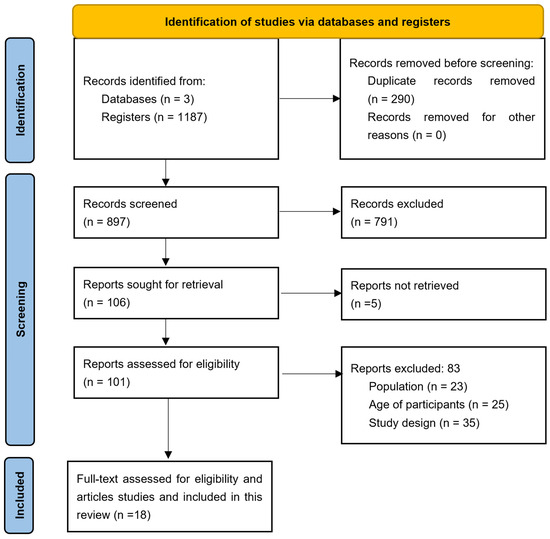
Figure 1 presents the PRISMA flow diagram corresponding to the study selection process. The initial search identified 1187 records, of which 290 were removed as duplicates, leaving 897 records for initial screening. Following the screening of titles and abstracts, 791 records were excluded for not meeting the eligibility criteria, resulting in 106 articles assessed for full-text review. Of these, five could not be retrieved. Ultimately, 101 studies were assessed for eligibility, with 83 articles excluded due to reasons related to population characteristics, participant age, or study design. Consequently, a total of 18 studies were included in the final synthesis.
Figure 1.
Flow of articles through the search process.
Methodologically, cross-sectional quantitative designs predominated (n = 11), reflecting a clear tendency in the literature to examine associations rather than causal relationships. These designs were employed in several studies exploring associations between tourism experiences and well-being or quality of life variables [24,41,45,47,48,50,51,52,55,56,57]. Qualitative studies (n = 3) based on in-depth interviews were also identified, focusing on understanding older adults’ experiences and perceptions of tourism [42,43,53]. Additionally, mixed-methods designs (n = 2) combining quantitative and qualitative approaches were included [49,54], along with one quasi-experimental intervention study evaluating tourism or recreational programs [46] and one longitudinal cohort study examining associations between tourism participation and long-term health outcomes or mortality [44].
The evidence encompassed approximately 34,000 older adults, generally aged between 55 and 85 years. This sample size provides a broad empirical base, although it is heterogeneous in terms of research contexts and study designs. Regarding geographical context, studies were distributed across different regions: (1) Europe (n = 7), including Spain [45,55,56], Belgium [50], Portugal [51], Poland [48], and the United Kingdom [53]; (2) Asia (n = 10), including China [42,43,44,52,54], South Korea [24], Japan [57], Taiwan [47,49], and Iran [41]; and (3) Eastern Europe (n = 1), represented by Ukraine [46]. Overall, a clear concentration of studies in Asia and Europe was observed, which may limit the generalizability of findings to other cultural contexts.
Regarding the types of tourism examined, studies addressed a variety of modalities, including wellness tourism in resorts or spas [41,47], subsidized social tourism for older adults [45,55], cultural and religious tourism [49], nature-based tourism and outdoor recreational activities [46], general leisure tourism or vacations [24,44,48,50,51,52,53,54,56,57], and tourism experiences involving social interaction, volunteering, or cultural exploration [42,43]. Overall, these findings reflect substantial heterogeneity in the tourism experiences analyzed, with a predominance of leisure- and well-being-oriented contexts. This suggests that the literature has primarily focused on recreational tourism settings rather than structured intervention-based approaches.
The dependent variables analyzed mainly included psychological well-being, life satisfaction, physical and mental health, quality of life, social participation, cognitive functioning, and mortality risk. These variables were assessed using a wide range of validated instruments and/or data collection methods, highlighting a lack of standardization in measurement within the tourism context. Specifically, instruments such as the SF-36 [46], SF-12 [45,55,56], SWLS [50,51], LSIA [46], PERMA-Profiler [51], MMSE [44], and survey methods such as PAPI and CAWI [48] were employed. Additionally, tourism-specific well-being scales [24,41,44,45,47,49,51,52,53,54,55,57] and semi-structured interviews [42,43,49] were also used.
3.2. Main Findings
The findings of the studies included in this review (see Table 3) are synthesized across three main analytical domains: (1) physical health and functional capacity, (2) psychological well-being and quality of life, and (3) social participation and dimensions related to active aging. This structure allows for a systematic synthesis of the evidence and facilitates the understanding of the key domains through which tourism is associated with active aging. Moreover, this tripartite framework provides the empirical foundation for the formalization of the TAMM, enabling the categorization of findings into activity drivers, mediating mechanisms, and multidimensional health outcomes. Overall, none of the included studies explicitly reported adverse effects associated with tourism participation. However, this finding should be interpreted with caution, since the absence of reported negative effects does not necessarily imply that such effects were absent. Rather, potential adverse outcomes may not have been systematically assessed in the included studies, particularly given the predominance of observational designs and the methodological heterogeneity of the available evidence.
Table 3.
Specific characteristics of the analyzed studies.
3.2.1. Physical Health and Functional Capacity
Overall, the evidence consistently indicates that tourism participation is associated with improvements in physical functioning, perceived health, and mobility among older adults [45,55,56], as well as reductions in physical symptoms related to stress or bodily discomfort [49,55]. Notably, perceived health showed strong associations (β = 0.78, R2 = 0.603 [45]). However, the magnitude of these effects varies across studies depending on the type of tourism activity and participant characteristics. More specifically, improvements have been documented in functional capacity and mobility [45,55,57], as well as higher levels of autonomy in activities of daily living among older adults who participate in travel or tourism programs. These individuals exhibit a significantly lower likelihood of experiencing self-care limitations (87.3% vs. 70.4%, p < 0.001) [56]. Furthermore, certain forms of active tourism or tourism experiences involving movement and engagement in recreational activities have been linked to increases in physical activity (with improvements of up to +14.4 ± 1.8 points in the physical dimension of the SF-36; Hakman et al., [46]), muscle strength, and balance [42,46], as well as cardiovascular health [42]. These factors are widely recognized as essential for maintaining functional capacity in later life [42,46,55,56]. Finally, some studies also highlight that tourism participation may be associated with broader indicators of healthy aging, including better overall physical health [45,49,55,56] and increased longevity, with evidence of up to a 27% reduction in adjusted mortality risk (aHR = 0.73, p < 0.001 [44]; aHR ≈ 0.63 [54]).
Within the TAMM framework, these findings support the “Behavioral Engagement” node, suggesting that incidental mobility and physical participation inherent to travel act as primary drivers through which tourism experiences translate into physiological and functional benefits.
3.2.2. Psychological Well-Being and Quality of Life
A substantial portion of the empirical evidence focuses on the relationship between tourism experiences and subjective well-being. Overall, studies consistently report positive associations between tourism participation and life satisfaction, psychological well-being, and quality of life, suggesting a cross-cutting effect of tourism across multiple well-being dimensions. Several quantitative studies have shown that participation in travel is associated with higher levels of life satisfaction [24,47,51,52], psychological well-being [48,50,51], and quality of life [24,52] among older adults. For instance, the study by Mélon et al. [50], conducted with 4130 older adults, found that individuals engaged in tourism activities reported significantly higher levels of well-being compared to non-tourists (F(1, 4015) = 123.94, p < 0.001, ηp2 = 0.03), even after controlling for comorbidities and socioeconomic status. In the same study, travel frequency (β = 0.13, p < 0.001), social activities during holidays (β = 0.06, p < 0.001), cognitive activities (β = 0.04, p < 0.01), and perceived health benefits (β = 0.12, p < 0.001) were identified as significant predictors of well-being.
Similarly, studies based on structural equation modeling demonstrated that satisfaction with the tourism experience and perceived travel value were positively associated with life satisfaction and quality of life in older adults. Pan et al. [52] reported that tourism satisfaction was associated with life satisfaction (β = 0.491, p < 0.001). Moreover, research focused on wellness tourism in resorts or spa settings showed that health-oriented tourism experiences were associated with overall well-being [41] and life satisfaction [41,47], with the model proposed by Azimi et al. [41] explaining up to 65.3% of the variance in perceived well-being (R2 = 0.653). This explanatory capacity supports the “Emotional Processes” component within the TAMM framework, in which satisfaction with the tourism experience and perceived travel value may represent potential mediating processes associated with quality of life and life satisfaction.
3.2.3. Social Participation and Active Aging
Qualitative studies indicate that tourism experiences may be associated with social interaction [42,53], lifelong learning [42], and the maintenance of active lifestyles—findings supported by in-depth thematic analyses based on interviews lasting up to 90 min [53]. These aspects are widely recognized as fundamental to healthy aging. The study by Chen and Kuok [42] concluded that tourism experiences were associated with improvements in emotional well-being, reductions in loneliness, and cognitive stimulation through interaction with new environments and people. Additionally, specific benefits were identified in spiritual health through activities such as volunteering and cultural visits. Furthermore, the sharing of tourism-related memories has been described as a potential mechanism of self-efficacy, potentially enhancing individuals’ perceptions of their own aging process [43]. This subjective sense of well-being is also reflected in cross-sectional studies, where 77% of participants directly associated travel with their personal happiness (M = 4.17) [48]. Finally, tourism participation appears to be associated with the development of a sense of purpose and meaning in life [42,51]. Cohort studies suggest that this active lifestyle is associated with favorable outcomes, including a 36% reduction in mortality risk (aHR ≈ 0.634) [54]. These psychological and social associations appear particularly relevant when tourism incorporates cultural, spiritual, or community-based components, which have also been reported to be significantly associated with revisit intentions (r = 0.670, p < 0.01) [49]. This body of evidence supports the “Social Interaction” axis of the TAMM framework, suggesting that reductions in loneliness and the construction of a sense of purpose through travel are essential mechanisms linking tourism participation to active and socially integrated aging.
3.3. Formalization of the Tourism-Active Aging Multidimensional Model (TAMM)
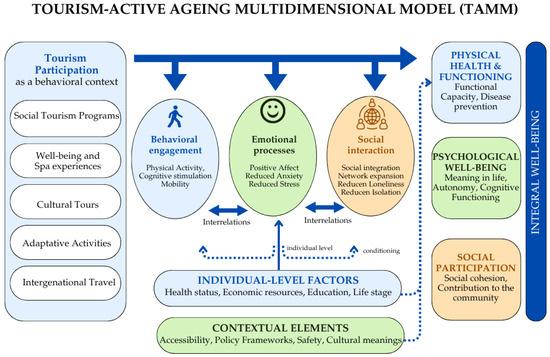
Based on the inductive synthesis of the quantitative and qualitative evidence analyzed, this review formalizes the TAMM (Figure 2). The model is not conceived as a static structure, but rather as a dynamic systems architecture grounded in process-based logic, organizing the findings into three interconnected hierarchical levels: (1) antecedent determinants (individual and contextual), (2) behavioral mediation vectors, and (3) multidimensional health and well-being outcomes. The theoretical justification of the TAMM lies in moving beyond the paradigm of tourism as mere aesthetic consumption, positioning it instead as an “enriched environment” [61]. Within this framework, and in contrast to earlier models of successful aging that prioritize the absence of disease [30], the TAMM integrates behavioral engagement not simply as a recreational activity, but as a critical driver of functional mobility and neuroplasticity [62]. This component is hypothesized to represent a central element of the model, suggesting that movement across unfamiliar environments may require continuous sensory and motor adaptation.
Figure 2.
Tourism-Active Aging Multidimensional Model (TAMM): A process-based framework linking tourism participation to physical, psychological, and social outcomes. The model illustrates the proposed pathway of influence from participation to holistic well-being, highlighting the mediating mechanisms and the determining factors at the individual and structural levels.
This structure is partially supported by the available longitudinal evidence, where cohort studies have identified associations between tourism participation and reduced mortality among older adults, with estimated reductions ranging from 27% [44] to 36% [54]. However, given the predominance of observational designs in the literature, these findings should be interpreted in terms of association rather than causality. Within this context, the TAMM conceptualizes tourism as a participatory environment capable of activating a system of interrelated processes structured around three core pathways: physical stimulation through movement (biological pathway) [27], affective regulation derived from leisure experiences (psychological pathway) [63], and the strengthening of relational capital (social pathway) [25]. The empirical basis of each TAMM component was derived from recurrent patterns identified across the included studies rather than from a one-to-one correspondence between individual studies and isolated model elements. The behavioral engagement component is supported by studies reporting associations between tourism participation and physical functioning, mobility, physical activity, functional capacity, and perceived physical health [45,46,55,56]. The emotional processes component is grounded in studies linking tourism experiences with life satisfaction, perceived enjoyment, travel satisfaction, psychological well-being, and quality of life [24,41,47,50,51,52]. Finally, the social interaction component is supported by qualitative and quantitative evidence indicating that tourism participation may be associated with social participation, reduced loneliness, sharing of travel memories, cultural engagement, and a greater sense of purpose in later life [42,43,49,53,54].
As illustrated in Figure 2, these mechanisms do not operate independently but interact dynamically with one another and are modulated by individual-level and contextual factors. This processual flow is linked to multidimensional outcomes in physical health, psychological well-being, and social participation, forming a biopsychosocial framework consistent with the principles of active aging as defined by the World Health Organization [4]. Overall, the model provides an integrative structure that facilitates the interpretation of patterns observed in the literature and offers a foundation for future research aimed at deepening the understanding of underlying mechanisms and their potential application in evidence-based interventions.
4. Discussion
The findings of this systematic review provide a robust basis for supporting the notion that tourism participation constitutes a relevant factor associated with healthy aging, largely transcending its traditional conception as a purely recreational or leisure activity. The synthesized evidence suggests that tourism operates as a multidimensional biopsychosocial context with meaningful implications for longevity and the preservation of functional capacity in later life. Within the framework of the Tourism-Active Aging Multidimensional Model (TAMM), proposed in this review as a conceptual contribution, it is posited that the benefits derived from travel are not direct effects, but rather the result of a triple mediation process involving behavioral engagement, the activation of emotional processes, and social interaction. By integrating individual and structural determinants into a process-based framework, the TAMM enables a nuanced understanding of the complexity of tourism experiences and explains how these are translated into tangible health and well-being outcomes. This theoretical perspective serves as the backbone for the detailed analysis presented below. The findings of this review should also be interpreted in light of the substantial heterogeneity of the included studies. The evidence came from different countries and cultural contexts, included diverse forms of tourism, applied different age thresholds to define older adults, and used a wide range of instruments to assess well-being and active aging outcomes. This methodological and contextual variability limits the direct comparability of results and reduces the generalizability of the conclusions. Therefore, the findings should be understood as indicative of potential associations between tourism participation and active aging, rather than as uniform effects applicable to all older populations or tourism contexts.
4.1. Tourism as a Driver of Active Aging
Rather than an isolated leisure activity, the studies included in this review allow tourism to be interpreted as a participatory context that may foster core processes of active aging. Overall, the evidence suggests a consistent—albeit predominantly associative—pattern in which travel is linked to higher levels of engagement in meaningful activities, maintenance of mobility, and preservation of autonomy in later life [24,45,53,54]. From this perspective, tourism should not be understood solely in terms of biomedical outcomes, but rather in its capacity to position older adults in an active role involving decision-making, planning, and participation beyond the domestic environment, aligning with contemporary active aging frameworks [7,64]. In this sense, tourism can be conceptualized as a complex behavioral context, functioning as an integrative mechanism that simultaneously combines activity, social interaction, and cognitive stimulation within the aging process.
The findings further support this interpretation by showing that tourism participation is associated with active lifestyles that extend beyond the duration of the trip itself [65]. Additionally, variables such as travel frequency, level of engagement in the experience, and post-trip sharing of tourism-related experiences appear to prolong these effects, fostering continuity of interests, orientation toward new goals, and more positive self-perceptions of the aging process [42,43,52]. Similarly, some studies indicate that tourism experiences enable older adults to maintain active lifestyles and develop a stronger sense of purpose in the post-retirement stage [35,66]. However, it is essential to differentiate between levels of available evidence: while some longitudinal and cohort studies suggest more robust associations between tourism participation and long-term health trajectories [44,54], the predominance of cross-sectional designs substantially limits causal inference and increases the risk of bias due to uncontrolled variables, thus requiring cautious interpretation of the findings.
Finally, the results highlight the need to avoid an idealized view of tourism as a universal resource for active aging. The review shows that its potential depends on unequal access conditions and actual capacity for participation, as factors such as advanced age, health status, and economic constraints continue to act as significant barriers [48,67]. Therefore, rather than acting as a direct determinant, tourism appears to function as a behavioral facilitator, allowing it to be conceptualized as a context-dependent phenomenon shaped by the interaction between individual resources and structural opportunities. This perspective positions tourism as a space where mobility, autonomy, and social engagement converge, aligning with active aging models while avoiding the attribution of a generalized causal effect [33].
4.2. Health and Psychological Benefits of Tourism Participation
The results of this review reveal a consistent pattern of association between participation in tourism activities and various indicators of physical health and psychological well-being among older adults. With regard to physical health, several studies show that individuals who engage in travel report higher levels of perceived health, greater functional capacity, and better scores in physical dimensions of quality of life compared to those who do not travel [45,55,56]. These findings support the “Behavioral Engagement” node proposed in the TAMM, suggesting that incidental physical activity and cognitive stimulation act as key drivers of the observed benefits. This pattern is further reinforced by evidence from quasi-experimental studies, which indicates that structured tourism programs—particularly those integrating physical activity and recreation—may contribute to improvements in functional capacity, physical fitness, and cognitive functioning, suggesting that tourism could operate as a non-pharmacological intervention in later life [46]. Within this framework, the literature highlights that certain tourism modalities involve meaningful levels of incidental physical activity (e.g., walking or movement in open environments), as well as exposure to natural settings, both of which have been associated with the maintenance of mobility and additional physical health benefits in adult and older populations [27,68]. Moreover, although more limited, longitudinal evidence suggests that tourism participation is associated with lower mortality and more favorable long-term health trajectories, indicating that tourism may function as an accumulative protective factor [44,54]. However, the predominantly observational nature of the available studies requires that these findings be interpreted in terms of association rather than causality.
In the psychological domain, the evidence is particularly consistent. Multiple quantitative studies show that tourism participation is associated with higher levels of life satisfaction, subjective well-being, and quality of life among older adults, especially when tourism experiences are perceived as satisfying and meaningful [24,41,47,50,51,52]. From a positive psychology perspective, these findings can be interpreted considering that well-being integrates both hedonic components, linked to happiness and life satisfaction, and eudaimonic dimensions related to personal development and meaning in life [10,11]. Within this framework, the positive emotions generated through tourism not only represent immediate outcomes but, in line with the broaden-and-build theory [31], may expand cognitive repertoires and facilitate the accumulation of personal resources over time.
Convergently, studies focusing on wellness tourism indicate that experiences oriented toward health, rest, and recovery may explain a substantial proportion of variance in well-being and life satisfaction, reinforcing the role of tourism as a facilitator of positive emotional states [41,47]. It is plausible that these benefits are mediated by the satisfaction of basic psychological needs for autonomy, competence, and relatedness, which are considered essential for optimal functioning and well-being [32]. This theoretical framework further supports the interpretation of tourism as a context that facilitates both hedonic and eudaimonic well-being in later life.
Finally, qualitative evidence provides deeper insight into the underlying mechanisms, showing that tourism experiences can generate positive emotions, reduce loneliness, and promote cognitive stimulation through exposure to new environments and situations [42,53]. Moreover, the sharing and recollection of travel experiences have been associated with improvements in self-efficacy, personal identity, and attitudes toward aging, suggesting that the psychological benefits of tourism may extend beyond the travel experience itself [43]. Taken together, these findings support the interpretation of tourism as an experiential context that may contribute to both physical and psychological well-being in later life, although with varying levels of empirical robustness depending on the type of outcome examined and largely conditioned by the quality, frequency, and characteristics of tourism experiences.
4.3. Tourism, Social Participation, and the Growing Importance of Senior Tourism in Aging Societies
Beyond its effects on individual health and well-being, the findings of this review indicate that tourism constitutes a privileged context for social participation in later life. This is particularly relevant given that aging is often associated with changes in social networks such as retirement or the loss of close relationships, which may increase the risk of social isolation and loneliness [13]. The studies analyzed show that tourism experiences facilitate interaction with family members, friends, and other travelers, promoting both the maintenance and expansion of social networks, as well as the continuity of social roles in later life [42,53,57]. In this way, tourism operates not only as a leisure activity but also as a relational space that contributes to the reconstruction of social identities in older age [63,69]. Furthermore, participation in travel is associated with more diverse forms of social interaction, including engagement with new cultural environments and the formation of interpersonal connections beyond one’s habitual context. This reinforces its role as a catalyst for social integration in later life [25,26], positioning tourism as a potential mechanism that not only facilitates interaction but also contributes to the reconstruction of social identities in advanced stages of the life course. This dynamic aligns with the “Social Interaction” component described in the TAMM framework, where the travel experience mitigates isolation through the rebuilding of relational networks and the social capitalization of lived experiences.
Qualitative evidence further enriches this perspective by showing that tourism fosters processes of exchange, learning, and social recognition. In particular, the social capitalization of travel experiences through sharing them with others has been associated with strengthened communicative bonds and enhanced personal identity [43]. Complementarily, studies on cultural, religious, and community-based tourism suggest that such experiences can foster a sense of belonging, connection to cultural values, and participation in meaningful collective practices, thereby contributing to more active and socially integrated forms of aging [49,54]. These findings indicate that tourism not only facilitates social interaction but also operates as a mechanism that integrates participation, identity, and social continuity in later life.
At a macro-structural level, the findings also reflect the growing prominence of senior tourism within aging societies. Tourism participation among older adults has implications that extend beyond the individual level, representing an emerging phenomenon with social and structural repercussions linked to changes in lifestyles, leisure expectations, and consumption patterns within this population group [48,56]. Several studies have highlighted that older adults exhibit specific characteristics as tourists, including greater time availability, travel motivations related to well-being and learning, and a preference for cultural or nature-based experiences [70,71]. These characteristics have driven the development of tourism products tailored to this segment, such as wellness tourism, cultural tourism, and social tourism programs [72]. However, this expansion is not evenly distributed, as inequalities in access to tourism persist due to factors such as health status, economic resources, and functional limitations, which condition the actual capacity for participation among certain subgroups of older adults [48]. In this context, the development of social tourism programs emerges as a key public policy tool to promote inclusion [73] and expand participation opportunities in later life [74], as evidenced by studies on subsidized programs that report positive effects on social integration and well-being [45,55]. Taken together, these findings support the interpretation of senior tourism not merely as a leisure practice, but as an increasingly important component of social participation in aging societies, with implications at both individual and collective levels.
4.4. Senior Tourism: Practical Implications and Opportunities Within the Silver Economy
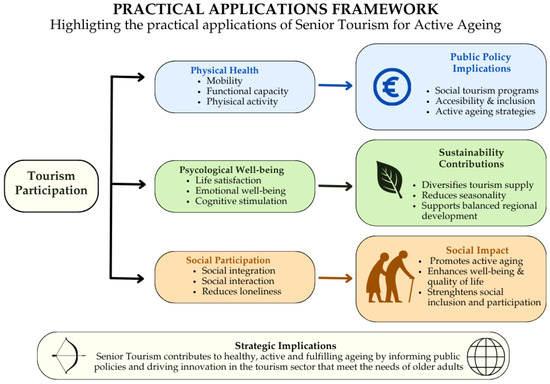
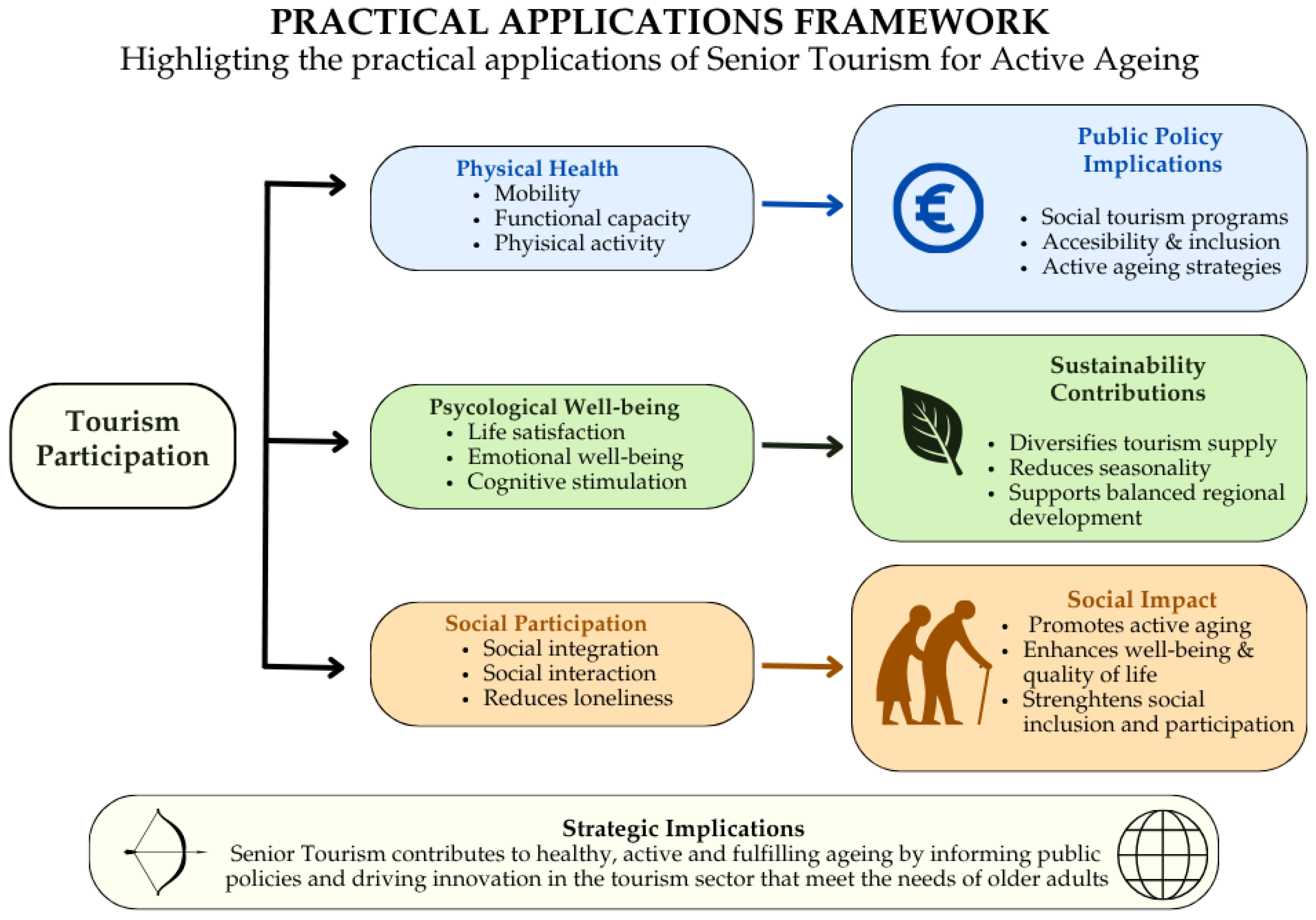
The findings of this review allow for the identification of relevant applied implications for both public policy design and the strategic planning of the tourism sector in response to the inevitable structural changes driven by demographic aging. As summarized in Figure 3, participation in tourism activities is consistently associated with benefits in perceived health, psychological well-being, and social participation, particularly within the context of social tourism programs and structured experiences targeted at older adults [45,55,56].
Figure 3.
Practical implications of senior tourism for active aging: pathways from tourism participation to policy and industry applications.
Under this premise, tourism represents a potentially strategic tool for promoting active aging, provided that accessibility is ensured. Accordingly, public policies should be oriented toward reducing economic, functional, and mobility-related barriers, with a particular focus on groups with lower socioeconomic status or at higher risk of social isolation, where tourism may play a critical role as a vector of inclusion and social activation [48,53,75].
From a supply management perspective, the findings suggest that senior tourism requires a differentiated approach that acknowledges the intrinsic heterogeneity of this segment [76]. The evidence indicates that the success of these experiences does not rely on a single typology, but rather on the synergistic convergence of physical accessibility, perceived safety, social interaction, and meaningful cultural content [42,46,47,49]. In operational terms, this implies a shift toward “age-friendly” tourism models that integrate accessible infrastructures, safe environments, appropriate activity pacing, and experiences that simultaneously promote physical, cognitive, and social stimulation [74]. Rather than isolated adaptations, these findings point to the need to incorporate aging as a structural criterion in the design of tourism products [72]. This need for intervention reinforces the relevance of the “Contextual Elements” defined in the TAMM framework, highlighting that accessibility and regulatory environments are critical determinants in ensuring that the potential of tourism translates into real and equitable well-being outcomes.
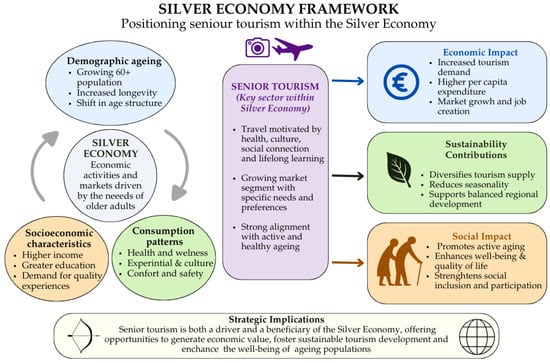
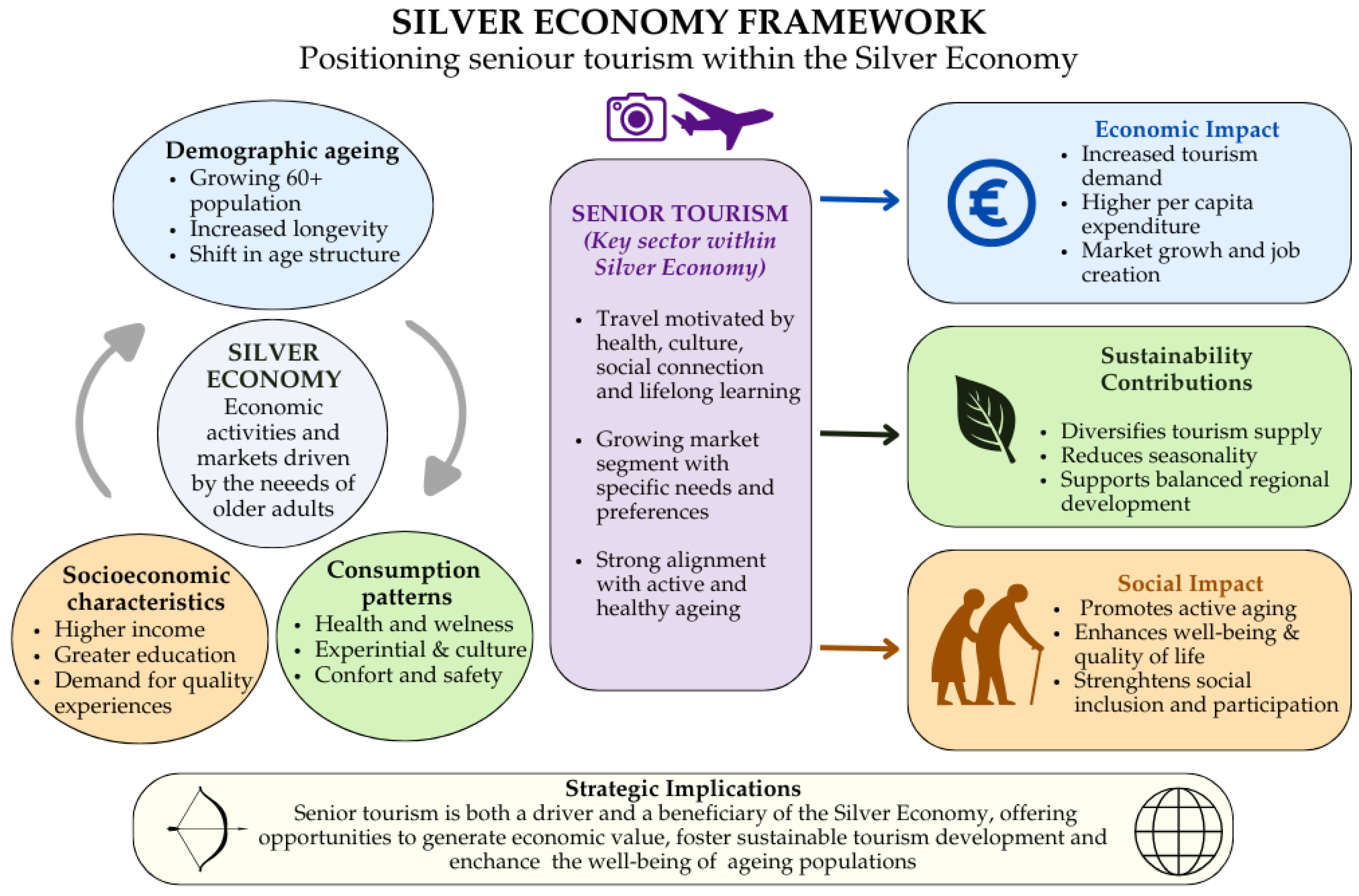
From a macroeconomic perspective, these findings are particularly relevant within the framework of the Silver Economy, understood as the set of economic activities linked to the needs, preferences, and consumption patterns of older adults [77]. In the tourism sector, this trend is driving the development of products and services tailored to senior travelers, including accessible destinations, wellness programs, cultural tourism, and intergenerational experiences [28,78]. The consolidation of this group as a strategic segment is not only driven by demographic volume but also by the evolving profile of newer cohorts, characterized by higher educational levels and more sophisticated leisure expectations [74,79]. In this context, senior tourism represents not only an opportunity for sectoral growth but also a key element in enhancing sustainability, as it contributes to demand deseasonalization and the diversification of tourism offerings across destinations [80,81,82]. Ultimately, the development of senior tourism should be understood as a multidimensional strategy capable of generating simultaneous returns at individual, social, and economic levels, coherently aligning demographic drivers with market opportunities (Figure 4).
Figure 4.
Senior tourism within the silver economy: demographic drivers, market opportunities, and socioeconomic contributions.
4.5. Limitations, Strengths, and Future Directions
Despite the relevance of the findings, this review presents several limitations that should be acknowledged. First, the substantial methodological heterogeneity of the included studies hinders direct comparison of results, particularly due to the predominance of cross-sectional designs and the widespread use of self-reported measures. This limits causal inference regarding the relationship between tourism participation and well-being indicators and may introduce self-selection bias, as individuals with better health are more likely to engage in tourism activities. Additionally, the geographical asymmetry of the evidence (largely concentrated in Europe and Asia) may restrict the external validity of the findings across other cultural contexts, while the number of studies employing longitudinal or experimental designs remains limited.
Nevertheless, this review presents several important strengths. The process was conducted in strict accordance with the PRISMA 2020 guidelines, ensuring transparency and methodological rigor in the selection and synthesis of evidence. Furthermore, the study stands out for integrating multidisciplinary perspectives, providing a holistic understanding of the senior tourism phenomenon.
With regard to future research, it is essential to move toward longitudinal and experimental designs that allow for the evaluation of the impact of specific tourism interventions on health outcomes. In addition, further research should prioritize the analysis of moderating variables such as socioeconomic status, gender, prior health status, and type of tourism experience in order to identify the specific mechanisms through which tourism operates as an effective resource for well-being. Ultimately, advancing toward mixed-methods approaches that combine objective health metrics with in-depth analysis of older adults’ narratives would enable a more comprehensive understanding of the complexity of tourism experiences in later life.
5. Conclusions
Overall, the evidence synthesized in this systematic review consistently indicates that tourism participation is positively associated with active aging, with significant benefits for functional health, psychological well-being, life satisfaction, and social cohesion. These findings allow for a shift beyond the traditional view of tourism as a purely recreational activity, enabling its conceptualization as a complex and multidimensional experiential context. Within this framework, the main contribution of this study is the proposal of the Tourism-Active Aging Multidimensional Model (TAMM), a theoretical framework that systematizes how travel supports the preservation of autonomy, cognitive stimulation, and social integration, acting as a potential facilitator of active lifestyles in later life.
However, the strength of the evidence is uneven, with greater consistency observed in subjective well-being indicators compared to biomedical physical outcomes. This distinction, together with the predominance of observational designs, requires cautious interpretation of causal mechanisms. Despite these limitations, this review contributes to the systematic integration of active aging dimensions within the tourism field, providing a structured framework that positions tourism as a strategic public health resource.
From an applied perspective, the findings reinforce the need to institutionalize policies that ensure access to safe, accessible, and meaningful tourism experiences. The development of programs tailored to the heterogeneity of older populations not only responds to market demand but also represents a potential strategy associated with quality of life in aging societies. Ultimately, the transition toward longitudinal and experimental designs, as well as the incorporation of moderating factors, will be essential to consolidate tourism as an evidence-informed strategy within contemporary models of healthy aging. In this regard, tourism should not be understood as a universal intervention, but rather as a contextual facilitator whose impact depends on individual characteristics and access conditions.
Supplementary Materials
The following supporting information can be downloaded at https://www.mdpi.com/article/10.3390/su18136774/s1, Table S1: PRISMA 2020 checklist [36].
Author Contributions
Conceptualization, E.M.-R., V.L., N.L. and J.I.P.-F.; methodology, E.M.-R. and J.I.P.-F.; software, E.M.-R. and J.I.P.-F.; validation, E.M.-R., J.I.P.-F. and V.L.; formal analysis, E.M.-R.; investigation, E.M.-R., V.L., N.L. and J.I.P.-F.; resources, V.L.; data curation, E.M.-R. and J.I.P.-F.; writing—original draft preparation, E.M.-R. and J.I.P.-F.; writing—review and editing, V.L. and N.L.; visualization, E.M.-R. and J.I.P.-F.; supervision, V.L.; project administration, E.M.-R.; funding acquisition, V.L. and N.L. All authors have read and agreed to the published version of the manuscript.
Funding
This research was funded by the Sport Physical Activity and Health Research & Innovation Center (SPRINT), Portugal (FCT Fundação para a Ciência e a Tecnologia—UID/06185/2025; UID/PRR/06185/2025; UID/PRR2/06185/2025).
Institutional Review Board Statement
Not applicable.
Informed Consent Statement
Not applicable.
Data Availability Statement
No new primary data were generated in this study. The data extracted and analyzed in this systematic review are derived from previously published studies and are included in the article. Further inquiries can be directed to the corresponding author.
Acknowledgments
The authors would like to thank the Laboratory of Analysis and Innovation in Tourism (LAInnTUR) at the University of Jaén, the Sport Physical Activity and Health Research & Innovation Center (SPRINT) at the Instituto Politécnico de Beja (Portugal). During the preparation of this manuscript, the authors used ChatGPT (GPT-5.5 Thinking) exclusively to assist in the development of the manuscript structure and to enhance language clarity. All scientific content, data selection, and interpretation of the results were carried out entirely by the authors. The authors critically reviewed all outputs and assume full responsibility for the final published content.
Conflicts of Interest
The author declares no conflicts of interest.
References
- United Nations Department of Economic and Social Affairs. Leaving No One Behind in an Ageing World: World Social Report 2023; United Nations: New York, NY, USA, 2023. [Google Scholar] [CrossRef] [Scilit]
- Rudnicka, E.; Napierała, P.; Podfigurna, A.; Męczekalski, B.; Smolarczyk, R.; Grymowicz, M. The World Health Organization (WHO) Approach to Healthy Ageing. Maturitas 2020, 139, 6–11. [Google Scholar] [CrossRef] [Scilit] [PubMed]
- Duru, P.; Öztürk, Ş. Trends in Research on the Concept of Active Ageing: A Bibliometric Analysis. Turk. J. Public Health 2024, 22, 243–254. [Google Scholar] [CrossRef] [Scilit]
- World Health Organization. Active Ageing: A Policy Framework; World Health Organization: Geneva, Switzerland, 2002; Available online: https://iris.who.int/handle/10665/67215 (accessed on 23 February 2026).
- Rowe, J.W.; Kahn, R.L. Human Aging: Usual and Successful. Science 1987, 237, 143–149. [Google Scholar] [CrossRef] [Scilit] [PubMed]
- Susanti, I.; Latuperissa, G.R.; Soulissa, F.F.; Fauziah, A.; Sukartini, T.; Indarwati, R.; Aris, A. The Factors Associated with Successful Aging in Elderly: A Systematic Review. J. Ners 2020, 15, 230–237. [Google Scholar] [CrossRef] [Scilit]
- Hu, F.; Wen, J.; Phau, I.; Ying, T.; Aston, J.; Wang, W. The Role of Tourism in Healthy Aging: An Interdisciplinary Literature Review and Conceptual Model. J. Hosp. Tour. Manag. 2023, 56, 356–366. [Google Scholar] [CrossRef] [Scilit]
- Beard, J.R.; Officer, A.; de Carvalho, I.A.; Sadana, R.; Pot, A.M.; Michel, J.-P.; Lloyd-Sherlock, P.; Epping-Jordan, J.E.; Peeters, G.M.E.E.; Mahanani, W.R.; et al. The World Report on Ageing and Health: A Policy Framework for Healthy Ageing. Lancet 2016, 387, 2145–2154. [Google Scholar] [CrossRef] [Scilit] [PubMed]
- Steptoe, A.; Deaton, A.; Stone, A.A. Subjective Wellbeing, Health, and Ageing. Lancet 2015, 385, 640–648. [Google Scholar] [CrossRef] [Scilit] [PubMed]
- Diener, E. Subjective Well-Being. Psychol. Bull. 1984, 95, 542–575. [Google Scholar] [CrossRef]
- Fusi, G.; Palmiero, M.; Lavolpe, S.; Colautti, L.; Crepaldi, M.; Antonietti, A.; Di Domenico, A.; Colombo, B.; Di Crosta, A.; La Malva, P.; et al. Aging and Psychological Well-Being: The Possible Role of Inhibition Skills. Healthcare 2022, 10, 1477. [Google Scholar] [CrossRef] [Scilit] [PubMed]
- Vada, S.; Prentice, C.; Scott, N.; Hsiao, A. Positive Psychology and Tourist Well-Being: A Systematic Literature Review. Tour. Manag. Perspect. 2020, 33, 100631. [Google Scholar] [CrossRef] [Scilit]
- Boyes, M. Outdoor Adventure and Successful Ageing. Ageing Soc. 2013, 33, 644–665. [Google Scholar] [CrossRef] [Scilit]
- Balderas-Cejudo, A.; Patterson, I. Tourism as a Means of Happiness and Subjective Well-Being for Older Travelers. Anduli Rev. Andal. Cienc. Soc. 2023, 23, 19–33. [Google Scholar] [CrossRef] [Scilit]
- Angelsen, A.; Nakrem, S.; Zotcheva, E.; Strand, B.H.; Strand, L.B. Health-Promoting Behaviors in Older Adulthood and Intrinsic Capacity 10 Years Later: The HUNT Study. BMC Public Health 2024, 24, 284. [Google Scholar] [CrossRef] [Scilit] [PubMed]
- Sun, F.; Norman, I.J.; While, A.E. Physical Activity in Older People: A Systematic Review. BMC Public Health 2013, 13, 449. [Google Scholar] [CrossRef] [Scilit] [PubMed]
- Narushima, M.; Liu, J.; Diestelkamp, N. Lifelong Learning in Active Ageing Discourse: Its Conserving Effect on Wellbeing, Health and Vulnerability. Ageing Soc. 2018, 38, 651–675. [Google Scholar] [CrossRef] [Scilit] [PubMed]
- Bakhshandeh Bavarsad, M.; Stephens, C. Social Network Type Contributes to Purpose in Life among Older People, Mediated by Social Support. Eur. J. Ageing 2024, 21, 5. [Google Scholar] [CrossRef] [Scilit] [PubMed]
- Lee, T.J. The Role of Tourism in Healthy Aging: Interdisciplinary Perspectives on Well-Being, Accessibility and Their Policy Implications. Asia Pac. J. Mark. Logist. 2026, 38, 126–147. [Google Scholar] [CrossRef] [Scilit]
- Maia, R.; Duque, E.; Durán Vázquez, J.F. Reinventing Aging through Quality Tourism. Sustainability 2025, 17, 9659. [Google Scholar] [CrossRef] [Scilit]
- Godovykh, M.; Tasci, A.D.A. Customer Experience in Tourism: A Review of Definitions, Components and Measurements. Tour. Manag. Perspect. 2020, 35, 100694. [Google Scholar] [CrossRef] [Scilit]
- Filep, S.; Deery, M. Towards a Picture of Tourists’ Happiness. Tour. Anal. 2010, 15, 399–410. [Google Scholar] [CrossRef] [Scilit]
- Uysal, M.; Sirgy, M.J.; Woo, E.; Kim, H. Quality of Life (QOL) and Well-Being Research in Tourism. Tour. Manag. 2016, 53, 244–261. [Google Scholar] [CrossRef] [Scilit]
- Kim, H.; Woo, E.; Uysal, M. Tourism Experience and Quality of Life among Elderly Tourists. Tour. Manag. 2015, 46, 465–476. [Google Scholar] [CrossRef] [Scilit]
- Wang, Q.; Hung, K.; Liu, C. Tourist Experience and Well-Being of Chinese Elderly Tourists through Intergenerational Interaction with Their Adult Children. J. Hosp. Tour. Manag. 2023, 57, 18–28. [Google Scholar] [CrossRef] [Scilit]
- Otoo, F.E.; Kim, S. Analysis of Studies on the Travel Motivations of Senior Tourists from 1980 to 2017: Progress and Future Directions. Curr. Issues Tour. 2018, 23, 393–417. [Google Scholar] [CrossRef] [Scilit]
- Buckley, R. Nature Tourism and Mental Health: Parks, Happiness, and Causation. J. Sustain. Tour. 2020, 28, 1409–1424. [Google Scholar] [CrossRef] [Scilit]
- Fan, Y.; Goh, E.; Isa, S.M.; Yang, S. 30 Years of Healthy Ageing Research in Tourism and Hospitality: Research Trends and Implications for Future Research. Serv. Ind. J. 2024, 1–38. [Google Scholar] [CrossRef] [Scilit]
- Martínez-Redecillas, E.; Moral-García, J.E.; Casado-Montilla, J.; Solas-Martínez, J.L. Impact of Active Tourism on Physical Activity in Children and Adolescents: A Systematic Review (2015–2025). World 2026, 7, 31. [Google Scholar] [CrossRef] [Scilit]
- Rowe, J.W.; Kahn, R.L. Successful Aging. Gerontologist 1997, 37, 433–440. [Google Scholar] [CrossRef] [Scilit] [PubMed]
- Fredrickson, B.L. The Role of Positive Emotions in Positive Psychology: The Broaden-and-Build Theory of Positive Emotions. Am. Psychol. 2001, 56, 218–226. [Google Scholar] [CrossRef] [PubMed]
- Ryan, R.M.; Deci, E.L. Self-Determination Theory: Basic Psychological Needs in Motivation, Development, and Wellness; The Guilford Press: New York, NY, USA, 2017. [Google Scholar] [CrossRef] [Scilit]
- Chen, C.-C.; Petrick, J.F. Health and Wellness Benefits of Travel Experiences: A Literature Review. J. Travel Res. 2013, 52, 709–719. [Google Scholar] [CrossRef] [Scilit]
- Chang, L.; Moyle, B.D.; Dupre, K.; Filep, S.; Vada, S. Progress in Research on Seniors’ Well-Being in Tourism: A Systematic Review. Tour. Manag. Perspect. 2022, 44, 101040. [Google Scholar] [CrossRef] [Scilit]
- Güçlü Nergiz, H.; Toker, F. Healthy Aging in the Tourism Industry: A Systematic Literature Review. SAGE Open 2025, 15, 21582440251379664. [Google Scholar] [CrossRef] [Scilit]
- Page, M.J.; McKenzie, J.E.; Bossuyt, P.M.; Boutron, I.; Hoffmann, T.C.; Mulrow, C.D.; Shamseer, L.; Tetzlaff, J.M.; Akl, E.A.; Brennan, S.E.; et al. The PRISMA 2020 Statement: An Updated Guideline for Reporting Systematic Reviews. BMJ 2021, 372, n71. [Google Scholar] [CrossRef] [Scilit] [PubMed]
- Lan, H.; Yu, X.; Wang, Z.; Wang, P.; Sun, Y.; Wang, Z.; Su, R.; Wang, L.; Zhao, J.; Hu, Y.; et al. How about the Evidence Assessment Tools Used in Education and Management Systematic Reviews? Front. Med. 2023, 10, 1160289. [Google Scholar] [CrossRef] [Scilit] [PubMed]
- Rusillo-Magdaleno, A.; Moral-García, J.E.; Brandão-Loureiro, V.; Martínez-López, E.J. Influence and Relationship of Physical Activity before, during and after the School Day on Bullying and Cyberbullying in Young People: A Systematic Review. Educ. Sci. 2024, 14, 1094. [Google Scholar] [CrossRef] [Scilit]
- Ruiz-Ariza, A.; Grao-Cruces, A.; Marques de Loureiro, N.E.; Martínez-López, E.J. Influence of Physical Fitness on Cognitive and Academic Performance in Adolescents: A Systematic Review from 2005–2015. Int. Rev. Sport Exerc. Psychol. 2017, 10, 108–133. [Google Scholar] [CrossRef] [Scilit]
- Suárez-Manzano, S.; Ruiz-Ariza, A.; de Loureiro, N.E.M.; Martínez-López, E.J. Effects of Physical Activity on Cognition, Behavior, and Motor Skills in Youth with Autism Spectrum Disorder: A Systematic Review of Intervention Studies. Behav. Sci. 2024, 14, 330. [Google Scholar] [CrossRef] [Scilit] [PubMed]
- Azimi, A.; Moradi, E.; Yousefi, B.; Hassani, Z. Bridging Theory and Practice in Healthy Aging: The Role of Wellness Tourism in Shaping Psychosocial Outcomes. Acta Psychol. 2025, 257, 105062. [Google Scholar] [CrossRef] [Scilit] [PubMed]
- Chen, S.X.; Kuok, H.H. Tourism Experiences and Healthy Aging: Extending the Successful Aging Model. Asia Pac. J. Mark. Logist. 2026, 38, 29–46. [Google Scholar] [CrossRef] [Scilit]
- Chen, Y.; Huang, J.; Yao, Y. Travel Sharing Capitalization: How Travel Sharing Benefits Senior Tourists? J. Vacat. Mark. 2025. [Google Scholar] [CrossRef] [Scilit]
- Du, M.; Tao, L.; Liu, M.; Liu, J. Tourism Experiences and the Lower Risk of Mortality in the Chinese Elderly: A National Cohort Study. BMC Public Health 2021, 21, 996. [Google Scholar] [CrossRef] [Scilit] [PubMed]
- Garcés Ferrer, J.; Ferri Sanz, M.; Durá Ferrandis, E.; McCabe, S.; Sánchez García, J. Social Tourism and Healthy Ageing. Int. J. Tour. Res. 2016, 18, 297–307. [Google Scholar] [CrossRef] [Scilit]
- Hakman, A.; Andrieieva, O.; Balatska, L.; Filak, F.; Filak, Y.; Tivelik, M.; Bezverkhnia, H.; Tsybulska, V.; Koshura, A.; Savchuk, S.; et al. The Health Impact of Tourism on the Psychophysical State of Elderly Individuals. J. Sport Health Res. 2024, 16, 31–42. [Google Scholar] [CrossRef] [Scilit]
- Kan, T.; Ku, E.C.S.; Sun, W.C.W.; Lai, T.C.; Hsu, P.Y.; Hsu, S. Wellness Tourism Enhances Elderly Life Satisfaction. J. Qual. Assur. Hosp. Tour. 2023, 24, 402–428. [Google Scholar] [CrossRef] [Scilit]
- Łapko, A.; Hącia, E.; Łapko, P. Determinants of Seniors’ Participation in Tourism: Psychological and Organisational Perspective in the Context of Sustainable Tourism. Sustainability 2026, 18, 259. [Google Scholar] [CrossRef] [Scilit]
- Lin, H.-H.; Chang, K.-H.; Tseng, C.-H.; Lee, Y.-S.; Hung, C.-H. Can the Development of Religious and Cultural Tourism Build a Sustainable and Friendly Life and Leisure Environment for the Elderly and Promote Physical and Mental Health? Int. J. Environ. Res. Public Health 2021, 18, 11989. [Google Scholar] [CrossRef] [Scilit] [PubMed]
- Mélon, M.; Agrigoroaei, S.; Diekmann, A.; Luminet, O. The Holiday-Related Predictors of Wellbeing in Seniors. J. Policy Res. Tour. Leis. Events 2018, 10, 221–240. [Google Scholar] [CrossRef] [Scilit]
- Mendes, J.; Medeiros, T.; Silva, O.; Tomás, L.; Silva, L.; Ferreira, J.A. PERMA Model of Well-Being Applied to Portuguese Senior Tourists: A Confirmatory Factor Analysis. Sustainability 2022, 14, 7538. [Google Scholar] [CrossRef] [Scilit]
- Pan, Y.; Fu, X.; Wang, Y. How Does Travel Link to Life Satisfaction for Senior Tourists? J. Hosp. Tour. Manag. 2020, 45, 234–244. [Google Scholar] [CrossRef] [Scilit]
- Patterson, I.; Balderas-Cejudo, A.; Pegg, S. Tourism Preferences of Seniors and Their Impact on Healthy Ageing. Anatolia 2021, 32, 553–564. [Google Scholar] [CrossRef] [Scilit]
- Qiao, G.; Ding, L.; Xiang, K.; Prideaux, B.; Xu, J. Understanding the Value of Tourism to Seniors’ Health and Positive Aging. Int. J. Environ. Res. Public Health 2022, 19, 1476. [Google Scholar] [CrossRef] [Scilit] [PubMed]
- Ruiz-Moreno, C.; Picón-Berjoyo, A.; Rodríguez-Serrano, M.Á.; Domínguez-CC, M. The Impact of Tourism on Senior Well-Being: A Study of IMSERSO Programmes. J. Tour. Sustain. Well-Being 2024, 12, 167–187. [Google Scholar] [CrossRef]
- Vega-Vázquez, M.; Rodríguez-Serrano, M.Á.; Castellanos-Verdugo, M.; Oviedo-García, M.Á. The Impact of Tourism on Active and Healthy Ageing: Health-Related Quality of Life. J. Policy Res. Tour. Leis. Events 2021, 13, 349–373. [Google Scholar] [CrossRef] [Scilit]
- Zhang, L.; Zhang, J. Impacts of Leisure and Tourism on the Elderly’s Quality of Life in Intimacy: A Comparative Study in Japan. Sustainability 2018, 10, 4861. [Google Scholar] [CrossRef] [Scilit]
- Thomas, J.; Harden, A. Methods for the Thematic Synthesis of Qualitative Research in Systematic Reviews. BMC Med. Res. Methodol. 2008, 8, 45. [Google Scholar] [CrossRef] [Scilit] [PubMed]
- Booth, A.; Papaioannou, D.; Sutton, A. Systematic Approaches to a Successful Literature Review; Sage Publications: London, UK, 2012. [Google Scholar]
- Nutbeam, D. Evaluating Health Promotion—Progress, Problems and Solutions. Health Promot. Int. 1998, 13, 27–44. [Google Scholar] [CrossRef] [Scilit]
- Burzynska, A.Z.; Malinin, L.H. Enriched Environments for Healthy Aging: Qualities of Seniors Housing Designs Promoting Brain and Cognitive Health. Sr. Hous. Care J. 2017, 25, 15–29. [Google Scholar]
- Balietti, M.; Conti, F. Environmental Enrichment and the Aging Brain: Is It Time for Standardization? Neurosci. Biobehav. Rev. 2022, 139, 104728. [Google Scholar] [CrossRef] [Scilit] [PubMed]
- Patterson, I.; Balderas-Cejudo, A. Older Travellers as a Critical Sector of the Tourism Industry, Now and in the Future: Overcoming Myths and Stereotypes. Eur. J. Tour. Hosp. Recreat. 2025, 15, 81–90. [Google Scholar] [CrossRef] [Scilit]
- Álvarez-García, J.; Durán-Sánchez, A.; del Río-Rama, M.d.l.C.; García-Vélez, D.F. Active Ageing: Mapping of Scientific Coverage. Int. J. Environ. Res. Public Health 2018, 15, 2727. [Google Scholar] [CrossRef] [Scilit] [PubMed]
- Morgan, N.; Pritchard, A.; Sedgley, D. Social Tourism and Well-Being in Later Life. Ann. Tour. Res. 2015, 52, 1–15. [Google Scholar] [CrossRef] [Scilit]
- An, J.; Payne, L.L.; Lee, M.; Janke, M.C. Understanding Boredom and Leisure in Later Life: A Systematic Review. Innov. Aging 2023, 7, igad109. [Google Scholar] [CrossRef] [Scilit] [PubMed]
- Lewis, C.; D’Alessandro, S. Understanding Why: Push-Factors That Drive Rural Tourism amongst Senior Travellers. Tour. Manag. Perspect. 2019, 32, 100574. [Google Scholar] [CrossRef] [Scilit]
- Bahrevar, V.; Zanjari, N.; Hosseini, S.; Fattahi Ardakani, M.; Kazemi, S. The Role of Tourism in Enhancing Domains of Health for Seniors: A Scoping Review. Med. J. Islam. Repub. Iran. 2025, 39, 40. [Google Scholar] [CrossRef] [Scilit] [PubMed]
- Stankov, U.; Gretzel, U.; Vujičić, M.D.; Pavluković, V.; Jovanović, T.; Solarević, M.; Cimbaljević, M. The Pandemic of Loneliness: Designing Smart Tourism for Combating Loneliness. Inf. Technol. Tour. 2022, 24, 439–455. [Google Scholar] [CrossRef] [Scilit]
- Alén, E.; Nicolau, J.L.; Losada, N.; Domínguez, T. Determinant Factors of Senior Tourists’ Length of Stay. Ann. Tour. Res. 2014, 49, 19–32. [Google Scholar] [CrossRef] [Scilit]
- Rico, P.; Cabrer-Borrás, B.; Morillas-Jurado, F. Seasonality in Tourism: Do Senior Programs Mitigate It? Mathematics 2021, 9, 2003. [Google Scholar] [CrossRef] [Scilit]
- Sedgley, D.; Haven-Tang, C.; Espeso-Molinero, P. Social Tourism & Older People: The IMSERSO Initiative. J. Policy Res. Tour. Leis. Events 2018, 10, 286–304. [Google Scholar] [CrossRef] [Scilit]
- Hartman, S. Adaptive Tourism Areas in Times of Change. Ann. Tour. Res. 2020, 83, 102987. [Google Scholar] [CrossRef] [Scilit] [PubMed]
- Minnaert, L.; Maitland, R.; Miller, G. What Is Social Tourism? Curr. Issues Tour. 2011, 14, 403–415. [Google Scholar] [CrossRef] [Scilit]
- Konstantopoulou, C.; Varelas, S.; Liargovas, P. Well-Being and Tourism: A Systematic Literature Review. Economies 2024, 12, 281. [Google Scholar] [CrossRef] [Scilit]
- Buzulukova, E.; Lobova, E. Stimulating the Growth of “Silver” Tourism through the Development of Relationships and the Creation of Targeted Communications with Travellers. Popul. Econ. 2023, 7, 103–123. [Google Scholar] [CrossRef] [Scilit]
- Klimczuk, A. The Silver Economy as a Constructive Response in Public Policy on Aging. In Strategic Approach to Aging Population: Experiences and Challenges; Bojanić, I.B., Erceg, A., Eds.; J.J. Strossmayer University of Osijek: Osijek, Croatia, 2021; pp. 19–35. [Google Scholar] [CrossRef] [Scilit]
- Stončikaitė, I. Baby-Boomers Hitting the Road: The Paradoxes of Senior Leisure Tourism. J. Tour. Cult. Change 2022, 20, 335–347. [Google Scholar] [CrossRef] [Scilit]
- Lipp, B.; Peine, A. Ageing as a Driver of Progressive Politics? What the European Silver Economy Teaches Us about the Co-Constitution of Ageing and Innovation. Ageing Soc. 2024, 44, 1481–1493. [Google Scholar] [CrossRef] [Scilit]
- Pak, T.-Y. Old-Age Income Security and Tourism Demand: A Quasi-Experimental Study. J. Travel Res. 2020, 59, 1298–1315. [Google Scholar] [CrossRef] [Scilit]
- Eusébio, C.; Carneiro, M.; Kastenholz, E.; Alvelos, H. The Impact of Social Tourism for Seniors on the Economic Development of Tourism Destinations. Eur. J. Tour. Res. 2016, 12, 5–24. [Google Scholar] [CrossRef] [Scilit]
- Tzouganatou, S.G. The Ageing Population of the European Union: Challenges and Prospects. HAPSc Policy Briefs Ser. 2022, 3, 206–214. [Google Scholar] [CrossRef] [Scilit]

Disclaimer/Publisher’s Note: The statements, opinions and data contained in all publications are solely those of the individual author(s) and contributor(s) and not of MDPI and/or the editor(s). MDPI and/or the editor(s) disclaim responsibility for any injury to people or property resulting from any ideas, methods, instructions or products referred to in the content. |
© 2026 by the authors. Licensee MDPI, Basel, Switzerland. This article is an open access article distributed under the terms and conditions of the Creative Commons Attribution (CC BY) license.