


Abstract
CO2/N2-enhanced coalbed methane recovery (ECBM) offers a potential route to improve coalbed methane production, reduce CH4 emissions, and couple gas drainage with low-carbon coal development. However, the relative roles of adsorption-controlled replacement and pressure-driven displacement under deep stress conditions remain insufficiently resolved. Here, CO2 and N2 injection experiments were conducted under different vertical stresses to quantify the evolution of gas flow, breakthrough time, increase in coal gas content, replacement–displacement ratios, and injection efficiency. Increasing stress compressed the pore–fracture network, reduced gas transport capacity, and delayed breakthrough of the injected gas. CO2, because of its strong adsorption affinity, remained dominated by replacement throughout the injection process. Higher stress enhanced CO2 retention in coal and therefore its potential storage capacity, but it also weakened sustained CH4 recovery by restricting transport. In contrast, N2, which adsorbs weakly, rapidly shifted to displacement-dominated recovery after breakthrough. Although high stress delayed the formation of connected displacement pathways, N2 maintained high injection efficiency. These results show that stress controls the dominant ECBM mechanism by regulating adsorption retention, seepage transport, and displacement outflow. The findings provide a mechanistic basis for selecting injection gases and designing low-carbon ECBM strategies in deep coal seams.
1. Introduction
The efficient development of coalbed methane (CBM) and the coordinated control of mine gas emissions are increasingly important for safer and lower-carbon coal resource utilization. CBM is composed mainly of CH4; it is both a valuable unconventional gas resource and a major contributor to mine safety risks and greenhouse gas emissions when released directly. Improving CBM recovery can therefore reduce gas-related hazards while limiting CH4 emissions during coal production [1,2].
As shallow coal resources are depleted, coal mining is progressively moving to deeper seams, where high in situ stress, high gas content, and low permeability are common. Under high stress, coal pores and fractures are compressed or closed, restricting gas-flow pathways and reducing the efficiency of conventional negative-pressure drainage. Technologies that can enhance gas recovery under deep-seam conditions are therefore needed [3].
Enhanced coalbed methane recovery (ECBM) promotes CH4 desorption and migration by injecting external gases into coal seams. CO2 has a strong adsorption affinity for coal and can preferentially occupy adsorption sites, thereby replacing adsorbed CH4 while providing a potential pathway for CO2 retention and storage. N2 is more weakly adsorbed and more readily migrates through pore–fracture networks; its contribution to CH4 recovery is therefore mainly associated with pressure-driven displacement. These contrasting gas properties imply different low-carbon utilization pathways: CO2 injection emphasizes combined CH4 recovery and CO2 storage, whereas N2 injection emphasizes rapid pressure-driven gas drainage [4,5].
CH4 production during ECBM is not controlled by a single mechanism. Replacement arises primarily from competitive adsorption between the injected gas and CH4 on coal-matrix adsorption sites, whereas displacement is driven mainly by the pressure gradient created by gas injection, which transports free CH4 and continuously desorbed CH4 toward the outlet. As injection proceeds, the relative contribution of replacement and displacement evolves with gas type, permeability, adsorption retention, and stress state. In deep coal seams, stress-induced pore and fracture compression can alter connectivity and transport pathways, thereby modifying breakthrough behavior, adsorption retention, and the transition between replacement- and displacement-dominated regimes [6,7].
Previous CO2/N2-ECBM studies have provided important evidence on adsorption selectivity, permeability evolution, CH4 production, and gas breakthrough. Nevertheless, the existing interpretations can be grouped into two competing mechanism models. The replacement model emphasizes preferential adsorption of the injected gas, especially CO2, and treats CH4 production as a consequence of competitive adsorption and desorption. The displacement model emphasizes pressure transmission, fracture-flow connectivity, and mobilization of free or continuously desorbed CH4. These two models are often discussed separately, which leads to contradictory engineering expectations: CO2 should enhance CH4 recovery because of its stronger affinity for coal, yet CO2-induced swelling and stress-dependent permeability reduction may suppress injectivity; N2 has a weaker adsorption capacity, yet its high mobility may generate a stronger pressure-displacement effect. Therefore, the key scientific problem is not whether stress affects ECBM, but how stress shifts the balance between adsorption-controlled replacement and pressure-controlled displacement [8,9,10].
Compared with previous work, the quantitative contribution of this study lies in separating the retained and outflowing fractions of the injected source gas through material balance, calculating instantaneous and cumulative replacement/displacement ratios, and identifying the dynamic transition using the dimensionless criterion ΠRD = /. This framework allows CO2 and N2 to be compared under identical stress-controlled boundary conditions and provides a measurable threshold for distinguishing replacement-dominated and displacement-dominated regimes. The present work, therefore, does not claim that stress-dependent ECBM has never been studied; rather, it focuses on quantifying how stress changes the relative dominance of the two mechanisms and the associated gas-utilization efficiency.
Beyond CH4 recovery, CO2-ECBM is also relevant to geological carbon sequestration in deep, unmineable coal seams, because preferential CO2 adsorption can couple methane displacement with subsurface carbon storage. These coupled processes are therefore important not only for gas-production engineering but also for reservoir engineering and reservoir science [11,12,13]. A comparison of representative CO2/N2-ECBM studies and the quantitative focus of the present work is provided in Table 1.
Table 1.
Comparison of representative CO2/N2-ECBM studies and the present quantitative focus.
On this basis, the research gap is defined as follows: existing studies have clarified many individual controls, but they rarely provide a unified material-balance metric for determining the relative percentage contribution of replacement and displacement during the same injection process. In addition, the transition threshold between the two regimes and the engineering consequences of the CO2/N2 contrast under stress remain insufficiently quantified.
2. Materials and Methods
2.1. Experimental Samples
Anthracite from the No. 21 coal seam of Huatai Coal Mine in the Zhengzhou mining area was used. Fresh outcrop coal blocks were immediately sealed and transported to the laboratory. Sample preparation and characterization followed relevant Chinese national and industry standards, including MT/T 752-1997 [14], GB/T 212-2008 [15], GB/T 217-2008 [16], and GB/T 6949-2010 [17]. The raw coal was crushed and sieved to 60–80 mesh. The sieved material was dried at 105 °C for more than 8 h and then cooled to room temperature before use. The coal chamber measured 300 mm × 300 mm × 400 mm (length × width × height). The sample was prepared by layered loading and compaction, with each layer 100 mm thick. Vertical stresses of 1.25 MPa and 12 MPa were applied during the experiments. This preparation method allowed the gas-injection tests to be conducted under controllable and repeatable laboratory boundary conditions. However, it should be noted that the reconstituted specimen cannot fully preserve the primary cleat orientation, natural fracture connectivity, bedding structure, and heterogeneity of intact coal cores. Therefore, the present results are more directly applicable to fragmented soft coal, tectonically deformed coal, and mining-disturbed coal zones, rather than to intact coal seams with well-preserved natural fracture networks. In addition, the two selected stress levels were designed to represent contrasting low- and high-stress conditions. They were not intended to establish a complete stress-gradient relationship. Accordingly, the stress-response trends identified in this study should be interpreted as comparative responses between two boundary states. The two selected stress levels were intended to represent contrasting shallow- and deep-seam stress conditions, rather than to construct a complete stress-gradient series. In this design, 1.25 MPa served as a low-stress reference, while 12 MPa represented a high-stress state, enabling a focused comparison of stress-controlled ECBM mechanisms under low- and high-stress conditions. Basic coal properties are listed in Table 2. Here, Mad denotes air-dried moisture, Aad denotes ash yield, and Vad denotes volatile matter measured at 900 ± 10 °C on an air-dried basis.
Table 2.
Basic Parameters of the Coal Sample.
2.2. Experimental System
To improve reproducibility, the flow meter, gas chromatograph, and stress-loading system were calibrated before each experimental series. The flow meter was subjected to zero and span verification; the gas chromatograph was calibrated using standard gas mixtures before sample analysis; and the stress-loading system was checked through preloading and pressure-holding verification to ensure stable stress application throughout the tests.
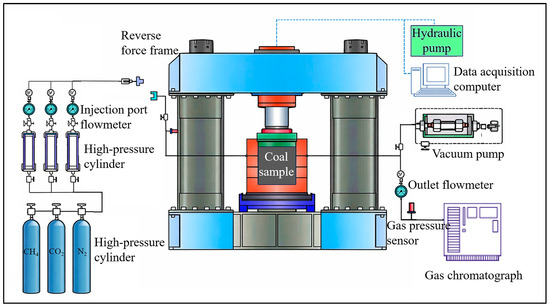
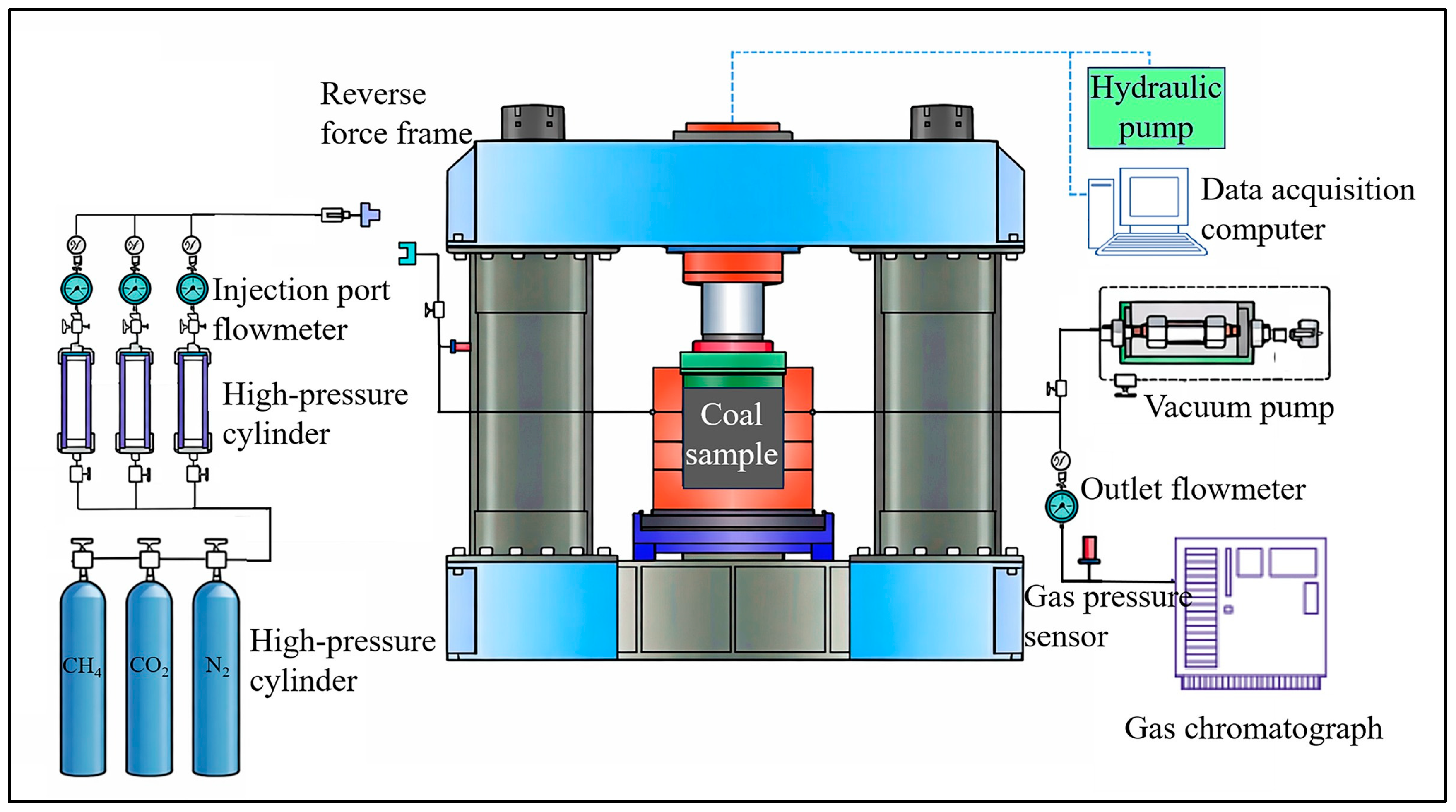
The physical simulation system consisted of a stress-loading module, a coal-sample chamber, a vacuum module, a gas-injection module, a flow-monitoring module, and a gas-concentration monitoring module. A schematic of the system is shown in Figure 1.
Figure 1.
Schematic of the coal-seam gas-injection simulation system.
2.3. Experimental Procedure
CO2 and N2 injection experiments were conducted independently. Before each test, the system was evacuated and re-established to the same CH4 equilibrium state to eliminate cross-gas interference. The uncertainty in the experimental results mainly arises from flow rate measurement, gas-composition analysis, and pressure control. Before each experimental series, the flow meter was checked by zero and span verification, the gas chromatograph was calibrated using standard gas mixtures, and the pressure-control system was verified through pressure-holding tests. All experiments were carried out under stable laboratory temperature conditions, and temperature fluctuation during testing was minimal; therefore, the influence of temperature changes is not considered in the research process. During testing, the laboratory temperature was maintained at 25 ± 1 °C. Temperature was recorded throughout the tests to confirm that no obvious thermal fluctuations occurred during adsorption equilibrium or gas injection.
- (1)
- The system was first checked for airtightness. After evacuation, CH4 was introduced until the adsorption equilibrium was reached at 0.7 MPa. In this study, CH4 adsorption equilibrium was defined as the condition in which the pressure change in the closed coal chamber was less than 0.01 MPa within 48 h.
- (2)
- High-pressure freeCH4 in the chamber was pre-drained until the pressure near the outlet decreased to approximately 0.1 MPa.
- (3)
- CO2 or N2 was injected at an injection pressure of 0.6 MPa to displace CH4. During injection, inlet and outlet flow rates, pressure, gas concentration, and ambient parameters were monitored.
- (4)
- Gas samples were collected by isolated sampling and analyzed using gas chromatography. Because the rate of concentration change and the minimum chromatographic analysis interval varied during the tests, gas sampling was non-uniform in time.
3. Experimental Results
3.1. Effect of Stress on Gas Flow Rate
Inlet and outlet flow rates are key kinetic indicators of source-gas transport, seepage-channel evolution, and CH4 production during CO2/N2-ECBM. The inlet flow rate reflects how readily the injected gas enters the coal at a prescribed injection pressure and is therefore related to coal permeability and injectivity. The outlet flow rate integrates gas migration within the coal, CH4 desorption and release, pressure-driven outflow, and the connectivity of the pore–fracture network. For deep coal seams, increasing stress compresses pores and closes fractures, reducing effective flow channels and altering the advance of the injected gas as well as the transition between replacement and displacement. Flow rate analysis under different stresses can therefore clarify how stress regulates CO2- and N2-assisted CH4 recovery [18].
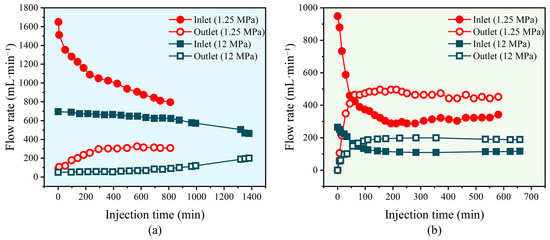
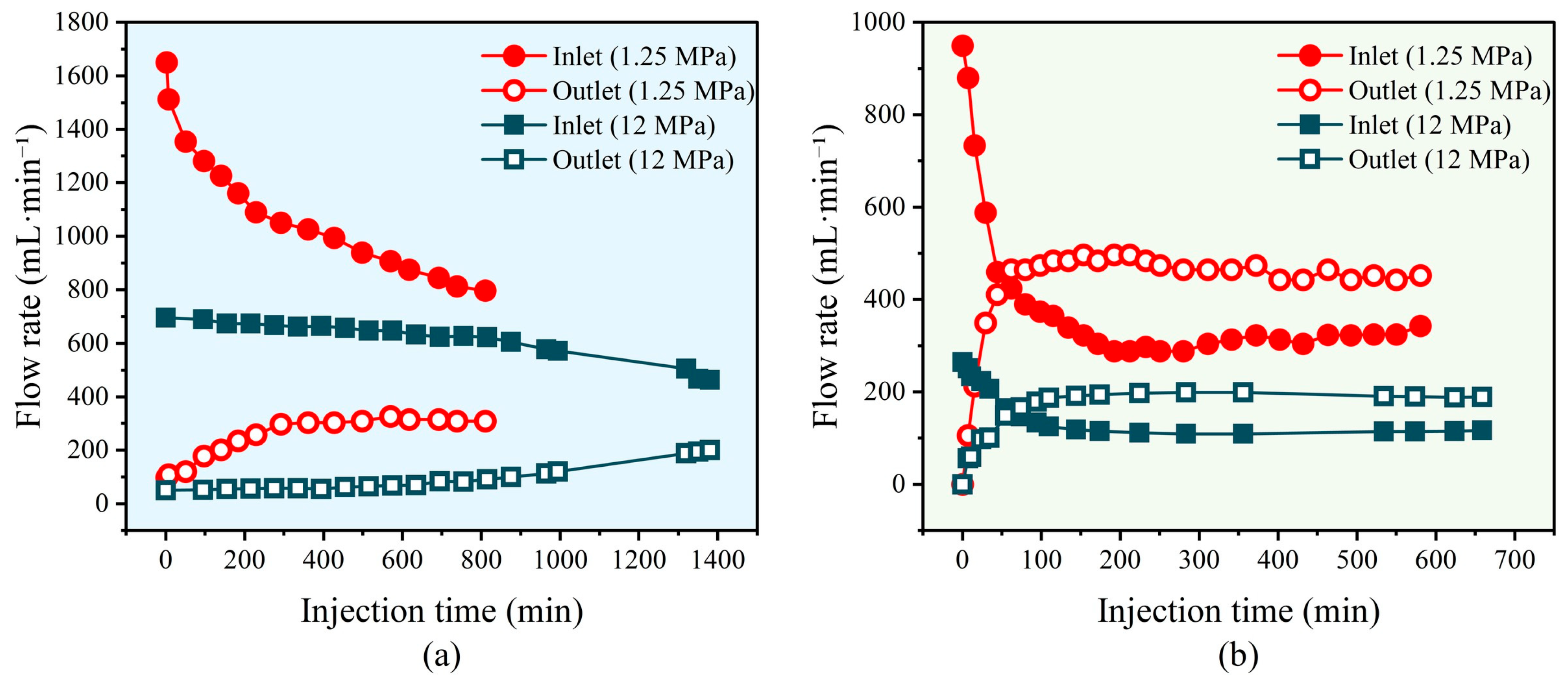
Under CO2 injection (Figure 2a), increasing stress markedly reduced both inlet and outlet flow rates. At 1.25 MPa, the inlet flow rate was initially high and then decreased with injection time. This behavior indicates that the pressure difference between the chamber inlet and the coal interior was large at the beginning, allowing CO2 to enter rapidly. As CO2 migrated and participated in adsorption replacement, the internal pressure increased, the inlet pressure difference decreased, and the inlet flow rate declined. The outlet flow rate increased from a low initial level and then approached a quasi-stable state, indicating progressive CO2 advance, CH4 desorption, and outlet discharge.
Figure 2.
Effect of stress on inlet and outlet flow rates during gas injection: (a) CO2 injection; (b) N2 injection.
At 12 MPa, the CO2 inlet flow rate was much lower and decreased only slowly with time, whereas the outlet flow rate remained low for an extended period and increased only in the late stage. High stress compressed the pore–fracture structure, reduced channel connectivity and effective permeability, and restricted CO2 injection and migration. In addition, strongly adsorbed CO2 can induce coal-matrix swelling. Under high stress, this adsorption-induced swelling likely further narrows fractures, increases flow resistance, and delays gas outflow. CO2 injection under high stress, therefore, exhibits pronounced transport limitation and delayed discharge.
For N2 injection (Figure 2b), stress also strongly affected the inlet and outlet flow. At 1.25 MPa, the inlet flow rate was high initially and declined rapidly, whereas the outlet flow rate increased quickly to a relatively high level. Because N2 is weakly adsorbed, it mainly migrates through connected pores and fractures and rapidly establishes a pressure-displacement pathway. At 12 MPa, both the inlet and outlet flow rates were reduced. The outlet flow rate increased with time, but its stable value remained much lower than that under low stress. Thus, high stress weakened both the rapid advance of N2 and the seepage discharge of CH4.
Overall, increasing stress reduced inlet and outlet flow rates during both CO2 and N2 injection, demonstrating stress-induced degradation of coal permeability and inhibition of source-gas entry and CH4 discharge. The gas-type difference is important: N2 flow is governed mainly by fracture-controlled seepage, whereas CO2 flow is affected by the combined effects of channel compression, competitive adsorption, and adsorption-induced swelling. Consequently, the reduction in flow and the delay in migration are more pronounced for CO2 under high stress.
3.2. Effect of Stress on Outlet Gas Concentration and Breakthrough Time
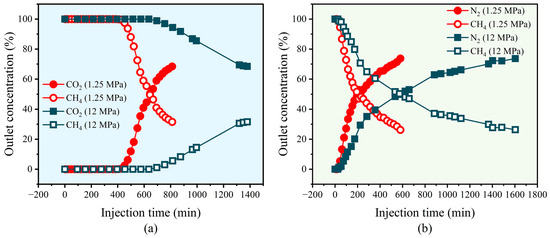
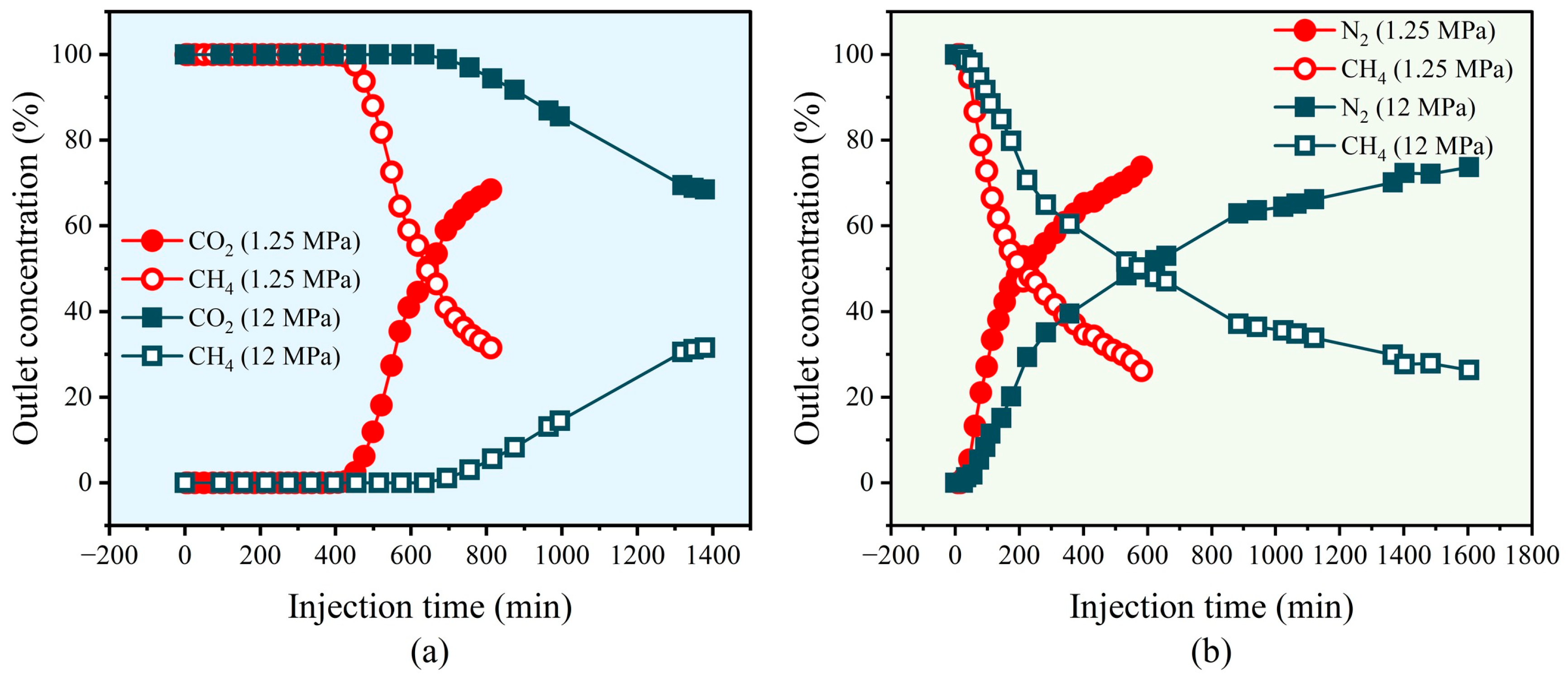
Outlet gas concentration and breakthrough time are direct indicators of gas migration, CH4 production, and the replacement–displacement transition during CO2/N2-ECBM. The outlet concentration records the advance of the injected gas within the coal and the production response of CH4 after replacement or displacement. Breakthrough time marks the first arrival of the injected gas at the outlet and is therefore a key point for identifying the formation of a connected seepage pathway and the strengthening of displacement. In deep coal seams, higher stress compresses pore–fracture structures and reduces transport-path connectivity, thereby modifying diffusion, adsorption, and seepage of the injected gas [19,20].
Figure 3 and Table 3 show that increasing stress substantially delayed breakthrough and modified the evolution of the outlet concentration. For CO2 injection, increasing stress from 1.25 MPa to 12 MPa prolonged the breakthrough from 405 min to 675 min, a delay of 270 min. At 1.25 MPa, CO2 began to break through after approximately 405 min, after which the outlet CO2 concentration increased rapidly while the CH4 concentration decreased. This indicates the gradual formation of an effective flow pathway and the combined contribution of competitive adsorption and pressure-driven transport to CH4 release.
Figure 3.
Effect of stress on outlet gas concentration changes: (a) CO2 injection; (b) N2 injection.
Table 3.
Breakthrough time of injected gases under different stresses.
At 12 MPa, the outlet CO2 concentration remained low until approximately 675 min and then increased more slowly than under low stress. The corresponding decrease in CH4 concentration was also smaller, and CH4 remained relatively high in the late stage. These results indicate that high stress restricts CO2 migration pathways, reduces the rate of CO2 advance, delays breakthrough, and suppresses CH4 desorption and discharge.
The pronounced delay of CO2 breakthrough under 12 MPa suggests that, in deep coal seams, field implementation may require higher sustained injection pressure, longer injection duration, reduced well spacing, or permeability-enhancement measures to establish effective sweep and reservoir contact. However, any increase in injection intensity should be balanced against injectivity loss associated with fracture compression and adsorption-induced swelling. Therefore, the present laboratory results are used here to provide qualitative design implications rather than direct field-scale values.
Stress also delayed N2 breakthrough, but the magnitude of the delay was much smaller. When stress increased from 1.25 MPa to 12 MPa, N2 breakthrough time increased from 15 min to 25 min. This 10 min delay indicates that N2 migrates much faster than CO2 and can penetrate the coal within a short period. At 1.25 MPa, N2 broke through in the early injection stage, and the outlet N2 concentration increased rapidly while the CH4 concentration decreased sharply. This behavior confirms that N2-assisted CH4 recovery is dominated by pressure-gradient-driven displacement soon after injection begins. At 12 MPa, the increase in N2 concentration was slower, but the system still showed rapid breakthrough and sustained N2 enrichment at the outlet.
A direct comparison highlights the different stress responses of the two gases. Under the same stress, the CO2 breakthrough occurred much later than the N2 breakthrough: 405 min versus 15 min at 1.25 MPa, and 675 min versus 25 min at 12 MPa. CO2 migration is therefore not governed by pressure gradient alone; it is strongly affected by competitive adsorption and stress-induced transport restriction. CO2 preferentially adsorbs on the coal matrix and replaces adsorbed CH4, producing a pronounced adsorption-retardation effect during migration. N2, by contrast, is weakly adsorbed and more readily migrates through the pore–fracture network, leading to shorter breakthrough times and faster concentration increases.
From the perspective of the replacement–displacement transition, delayed breakthrough means delayed formation and strengthening of displacement. Before the breakthrough, the injected gas mainly diffuses, adsorbs, and replaces CH4 within the coal. After the breakthrough, the increasing outlet concentration indicates progressive connection of the gas pathway and a stronger pressure-displacement contribution. Stress, therefore, shifts the transition from replacement control toward displacement control to later times. In N2 systems, this delay mainly reflects the hindered development of pressure-displacement pathways. In CO2 systems, it reflects the combined effects of stress compression, strong adsorption retention, and possible adsorption-induced swelling.
3.3. Effect of Stress on the Increase in Coal Gas Content
Coal gas content is the total amount of gas stored per unit mass or volume of coal and is a key measure of coal adsorption and storage capacity. It generally comprises adsorbed gas, free gas, and dissolved gas. In CBM adsorption and replacement studies, coal gas content usually refers to the combined amount of adsorbed and free gas. The increase in coal gas content during injection denotes the incremental gas stored in the coal relative to the preceding time interval and reflects the combined effects of injected-gas adsorption, retention, seepage, and CH4 release. In the injection-displacement experiments, this increase was determined by material balance:
where denotes the increase in gas content within the coal body per unit time (mL); denotes the volume of gas injected per unit time (mL); and denotes the volume of mixed gas discharged per unit time (mL).
Unlike outlet flow rate or outlet concentration, the increase in coal gas content provides a material-balance perspective on how much injected gas is retained in the coal and how much CH4 is released. Stress-dependent changes in this parameter, therefore, help identify how stress regulates adsorption, retention, seepage transport, and the replacement–displacement transition.
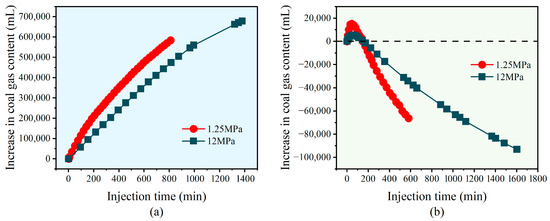
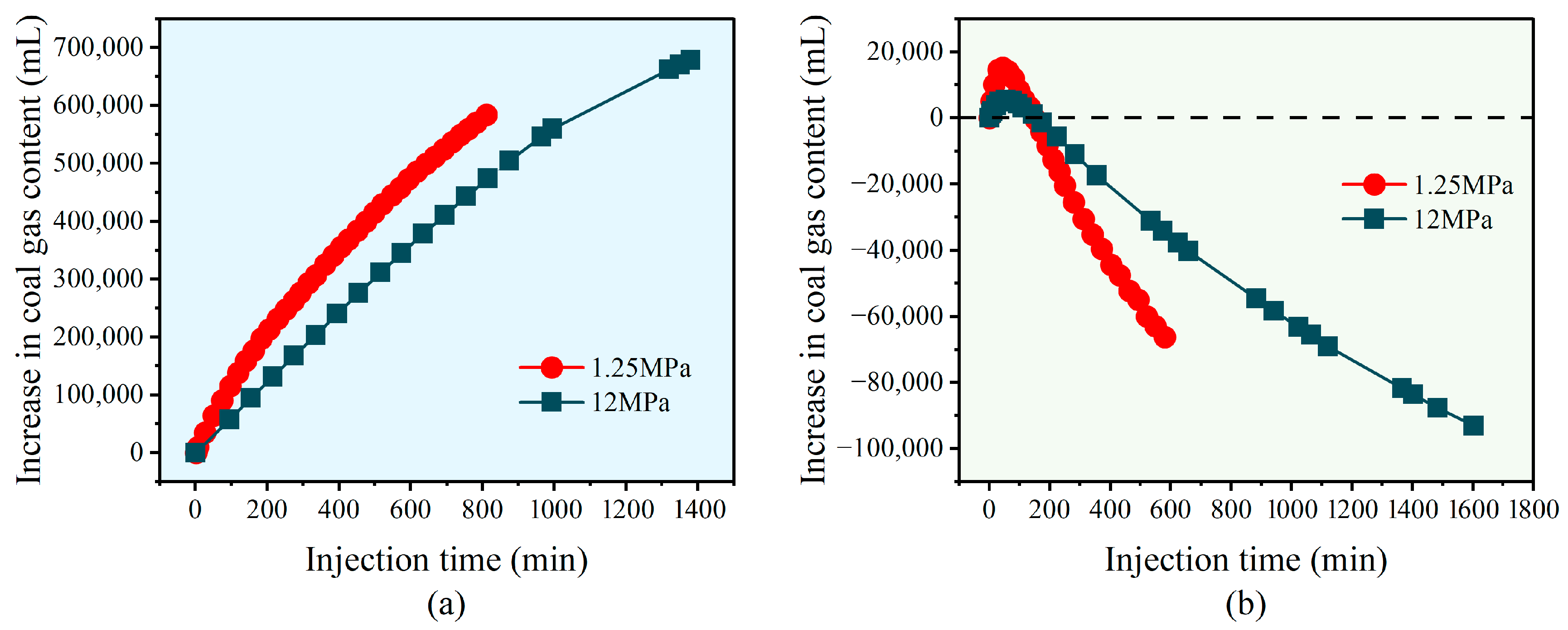
During CO2 injection (Figure 4a), the increase in coal gas content rose continuously with injection time under both stress conditions. This positive growth indicates that, after entering the coal, CO2 not only migrated by pressure-driven seepage but also was substantially adsorbed on the coal matrix, increasing the internal gas inventory. Compared with 1.25 MPa, the growth rate at 12 MPa was slower, but the final increase in coal gas content was higher.
Figure 4.
Effect of stress on the increase in coal gas content during gas injection: (a) CO2 injection; (b) N2 injection.
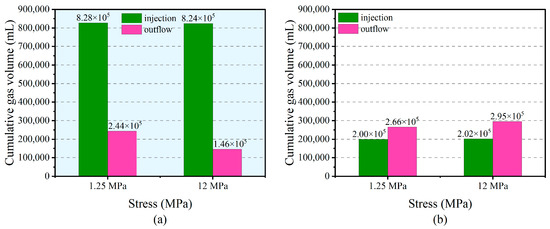
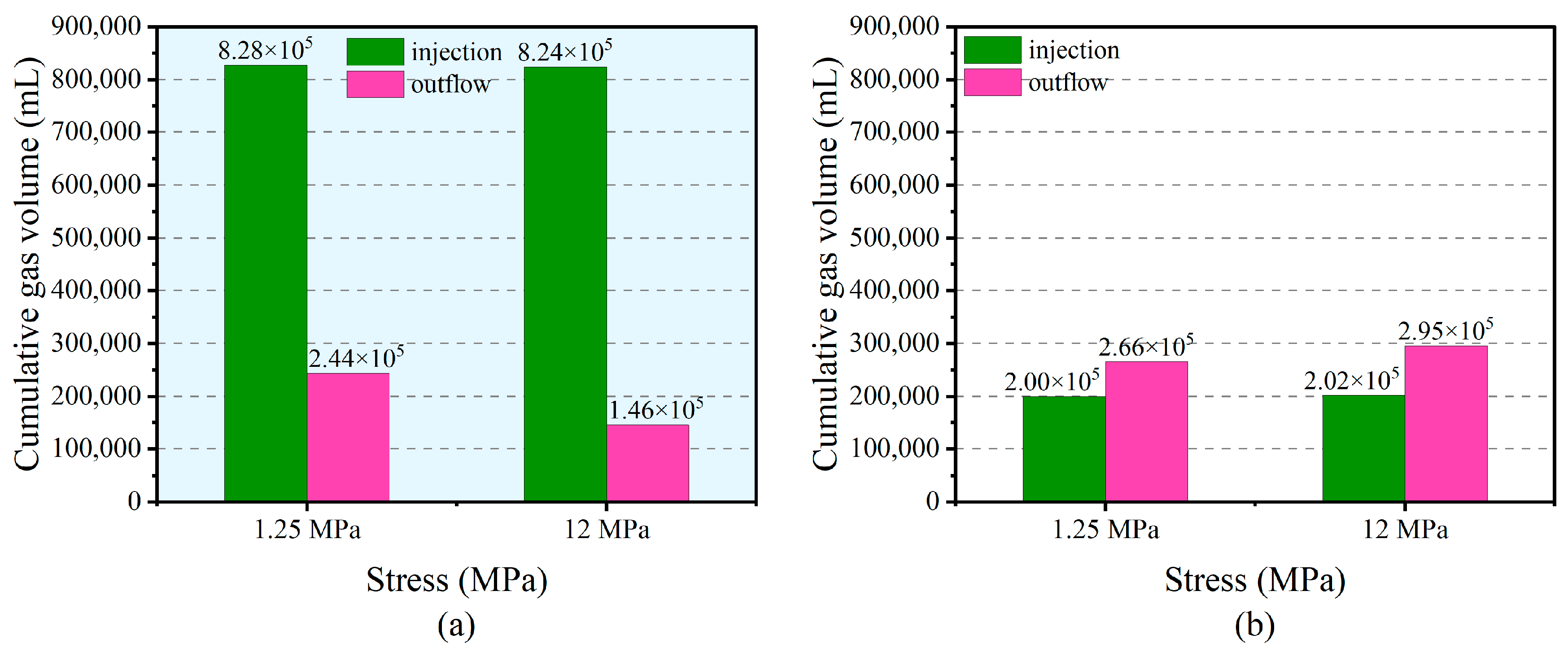
Figure 5 shows that when stress increased from 1.25 MPa to 12 MPa during CO2 injection, the cumulative injected volume changed only slightly, from 827,516 mL to 824,219 mL. In contrast, cumulative outflow decreased markedly from 243,675 mL to 145,585 mL. The resulting net gas increase in coal rose from approximately 583,841 mL to 678,634 mL, an increase of about 16.2%. Thus, high stress restricted rapid CO2 outflow, prolonged CO2 residence in the coal, and enhanced adsorption retention, even though fracture compression reduced the migration rate.
Figure 5.
Effect of stress on cumulative injection and outflow volumes: (a) CO2 injection; (b) N2 injection.
Mechanistically, CO2 has a strong adsorption affinity for coal. It competes with CH4 for adsorption sites, releases adsorbed CH4, and is itself preferentially retained by the coal matrix. At low stress, better fracture connectivity allows earlier CO2 seepage breakthrough, so more injected gas leaves with the mixed outflow and less remains in the coal. At high stress, fracture closure and lower permeability restrict CO2 discharge, allowing more CO2 to remain in the coal and participate in adsorption. Stress, therefore, has a dual effect on CO2-ECBM: it weakens seepage transport but strengthens adsorption retention, leading to a higher cumulative gas content in the coal [21].
N2 injection exhibited a distinct “increase–decrease–negative” trend (Figure 4b). At the beginning of the injection, N2 entered the pore–fracture system and produced a brief increase in coal gas content. As the injection proceeded, however, weakly adsorbed N2 could not maintain substantial matrix retention. The process became dominated by pressure-driven entrainment of CH4 and disturbance of adsorption equilibrium. Continuous CH4 desorption and outflow eventually caused the total outflow volume to exceed the injected N2 volume, so the net increase in coal gas content became negative.
For N2 injection (Figure 5b), increasing stress from 1.25 MPa to 12 MPa slightly increased cumulative injected volume from 199,682 mL to 202,252 mL, while cumulative outflow increased from 265,911 mL to 295,295 mL. The net gas increase, therefore, decreased from approximately −66,229 mL to −93,043 mL. Although high stress compressed fractures and reduced permeability, it also slowed the rapid N2 throughflow and increased the contact time between N2 and coal. This longer residence time allowed for more complete pressure-driven CH4 release, producing a stronger reduction in coal gas content. To further quantify the influence of stress on CO2 and N2 injection behavior, the stress responses of key variables, including flow characteristics, breakthrough time, gas production, and injection efficiency, are summarized in Table 4.
Table 4.
Quantitative stress response of key variables in CO2 and N2 injection.
These results indicate that stress regulates coal gas content mainly by controlling the pore–fracture architecture. CO2 injection under high stress increases the coal gas inventory because adsorption retention dominates, whereas N2 injection produces a low or negative coal gas content increase because displacement-driven CH4 removal dominates. The divergent stress responses of coal gas content reveal the mechanistic contrast between strongly adsorbed and weakly adsorbed injection gases during the replacement–displacement transition.
4. Discussion
4.1. Stress-Controlled Transition Between Replacement and Displacement
During CO2/N2-ECBM, injected gas promotes CH4 production through coupled adsorption competition, desorption, and seepage rather than through a single process. Stress is a fundamental control on deep coal seams because it compresses pores and fractures, modifies channel connectivity, and regulates gas migration rates. Quantifying the dynamic transition between replacement and displacement under different stresses is therefore essential for identifying the dominant recovery mechanism and for optimizing ECBM parameters for different injected gases [22].
The stress effect can be separated into two coupled structural levels. At the fracture scale, stress closure reduces fracture aperture and connectivity, which directly lowers permeability, slows pressure transmission, decreases inlet/outlet flow rates, and delays breakthrough. This contribution is mainly reflected in the flow rate curves and the evolution of the outlet concentration. At the matrix scale, stress compression can narrow matrix pores, particularly micropores and transition pores, thereby increasing diffusion resistance and slowing the exchange between adsorbed CH4 and free gas. This contribution is more closely related to the delayed desorption response, the increase in coal gas content, and the persistence of replacement-dominated behavior. Because the present experiment did not directly measure pore-size distribution or diffusion coefficients under stress, the relative contribution of matrix-pore compression is interpreted qualitatively, whereas the fracture-permeability contribution is constrained by the measured flow and breakthrough responses.
Before the injected gas breaks through the coal chamber, the injected gas remains within the coal. In this stage, the injected gas disturbs the pre-established CH4 adsorption equilibrium through concentration and partial-pressure differences. According to Dalton’s law of partial pressures, the fraction of injected gas that replaces CH4 and remains adsorbed on or retained in the coal matrix provides a basis for quantifying replacement. As adsorption sites become progressively occupied and injection continues, the flow rate tends to stabilize, and CH4 continues to desorb. A small fraction of the injected gas remains in the coal and occupies newly available adsorption sites, whereas the remaining fraction migrates through the coal and carries desorbed CH4 out of the chamber. Following Fick’s first law and Darcy’s law, the dilution and entrainment caused by high-pressure gas flow are attributed to displacement. Accordingly, the fraction of injected gas discharged with the outlet flow provides a basis for quantifying displacement.
The instantaneous replacement ratio and instantaneous displacement ratio were defined as follows:
where is the instantaneous replacement ratio (%), is the volume of injected source gas retained in the coal during a time interval (mL), is the injected source-gas volume during the same interval (mL), is the instantaneous displacement ratio (%), and is the volume of injected source gas leaving the coal during that interval (mL).
The cumulative replacement and displacement ratios describe the integrated contribution of the two mechanisms over the entire injection process:
where is the cumulative replacement ratio (%), is the cumulative displacement ratio (%), is the cumulative retained source-gas volume (mL), is the cumulative outflowing source-gas volume (mL), and is the cumulative injected source-gas volume (mL).
To strengthen the quantitative interpretation, the transition index was defined as ΠRD = /. The percentage contribution of each mechanism can therefore be expressed directly by Rr and Rd at each time interval or cumulatively over the injection period. To avoid purely qualitative statements such as “replacement dominated” or “displacement dominated”, the transition threshold was identified by ΠRD = / = 1, namely = = 50%. A value of ΠRD below unity indicates that CH4 recovery is mainly produced by adsorption-controlled replacement, whereas a value above unity indicates that pressure-controlled displacement has become the dominant contributor.
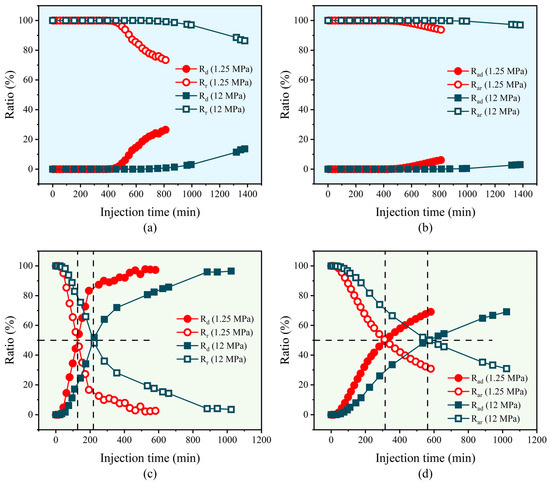
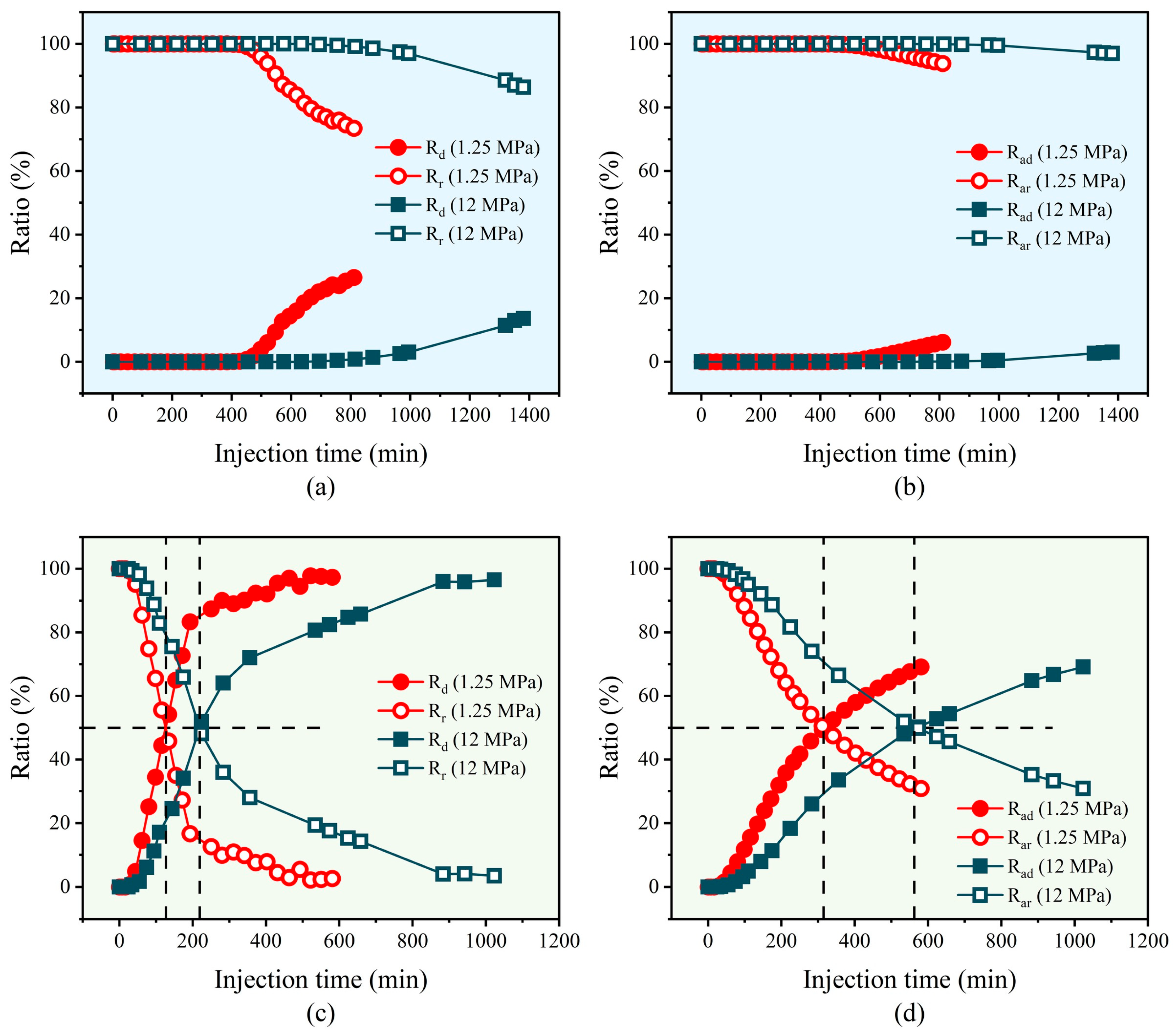
Figure 6a shows the evolution of instantaneous replacement and displacement ratios during CO2 injection. Under both 1.25 MPa and 12 MPa, the displacement ratio never exceeded the replacement ratio, indicating that CO2-ECBM remained replacement-dominated throughout the test. Stress mainly delayed the development of displacement.
Figure 6.
Effect of stress on the dynamic transition between replacement and displacement: (a,b) CO2 injection; (c,d) N2 injection.
In the initial stage, the instantaneous replacement ratio was 100%, and the instantaneous displacement ratio was 0% under both stresses. CO2 had not yet formed a connected seepage pathway and was retained within the coal. Because CO2 has a stronger adsorption affinity for coal than CH4, it preferentially occupied adsorption sites and released adsorbed CH4. CH4 production in this stage was therefore controlled by competitive adsorption replacement, with no effective displacement contribution.
After CO2 advanced through the sample and began to break through, the instantaneous displacement ratio increased, and the replacement ratio decreased. Part of the injected CO2 migrated through fracture pathways and entrained CH4 while replacement continued in the matrix. Nevertheless, the replacement ratio remained much higher than the displacement ratio, showing that replacement remained the dominant mechanism.
At 12 MPa, the instantaneous replacement ratio remained close to 100% for a longer period and decreased only slowly in the late stage. High stress compressed fractures reduced effective connectivity and suppressed pressure transmission and seepage advance. Adsorption-induced coal-matrix swelling associated with CO2 may further narrow fracture space, favoring CO2 retention and adsorption replacement over displacement. The CO2 system, therefore, exhibited sustained replacement dominance and delayed displacement development [23,24,25].
The cumulative ratios in Figure 6b further confirm this behavior. Under both stresses, the cumulative replacement ratio remained far above the cumulative displacement ratio. At low stress, the cumulative displacement ratio increased slightly in the late stage, indicating a limited supplementary contribution of displacement as CO2 migrated. At high stress, cumulative displacement increased even less, and cumulative replacement remained near the dominant level, confirming that stress suppressed the seepage-displacement contribution of CO2.
N2 injection showed a different pattern (Figure 6c). The N2 system displayed a clear transition from replacement dominance to displacement dominance, and this transition was more sensitive to stress. In the initial stage, before the N2 breakthrough, the instantaneous replacement ratio was 100%, and the displacement ratio was 0%. Because N2 adsorbs much more weakly than CO2 [26,27,28], its competitive adsorption contribution was limited and short-lived.
After N2 breakthrough, the system entered a stage of rapid replacement attenuation and rapid displacement growth. Weak adsorption limited N2 retention in the matrix, while its greater mobility allowed it to migrate through fracture pathways and drive CH4 out under the pressure gradient. At 1.25 MPa, the displacement ratio increased quickly, and the replacement ratio declined rapidly, indicating an early shift from replacement control to displacement control.
In the late stage, the instantaneous displacement ratio exceeded the replacement ratio. At 1.25 MPa, displacement approached near-complete dominance because connected fractures enabled effective N2 throughflow and pressure-driven CH4 transport. At 12 MPa, N2 still completed the transition to displacement dominance, but the transition point shifted to later times. High stress closed fractures, compressed pores, and lowered permeability, thereby slowing N2 advance and pressure transmission. Stress thus delayed but did not prevent displacement dominance in the N2 system. The cumulative ratios in Figure 6d show the same behavior at the whole-process scale: N2-ECBM eventually became displacement dominated, but higher stress shifted the cumulative transition to later times.
Together, Figure 6a–d reveal a gas-type-dependent transition pathway. CO2, as a strongly adsorbed gas, fully occupies adsorption sites and competes strongly with CH4; even after breakthrough, replacement remains the dominant contribution. Increasing stress further restricts CO2 migration through fracture compression and adsorption-related swelling, suppressing displacement. N2, by contrast, cannot sustain strong replacement because of its weak adsorption. It exhibits only a brief replacement-dominated stage before mobile N2 flows through fractures and displaces CH4 under a pressure gradient. High stress delays the establishment of this displacement pathway but does not alter the late-stage dominance of displacement [29,30]. Thus, stress-controlled replacement–displacement transition is gas-type specific: CO2 follows a sustained replacement-dominated pathway, whereas N2 follows a replacement-to-displacement transition pathway.
Using the ΠRD criterion, CO2 did not reach the transition threshold within the tested period under either stress level; thus, its displacement contribution remained secondary even after breakthrough. For N2, ΠRD exceeded unity after breakthrough, indicating a measurable transition from a short replacement stage to a displacement-dominated stage. High stress shifted this transition to a later injection time by delaying flow path connection and pressure transmission.
4.2. Stress Response and Mechanism of Replacement–Displacement Efficiency
The preceding section quantified how stress controls the dominant relationship and transition between replacement and displacement. This transition also determines how effectively the injected gas contributes to CH4 recovery. Replacement efficiency, displacement efficiency, and total injection efficiency were therefore analyzed to evaluate the utilization of the injected gas and to clarify the different stress responses of strongly and weakly adsorbed gases.
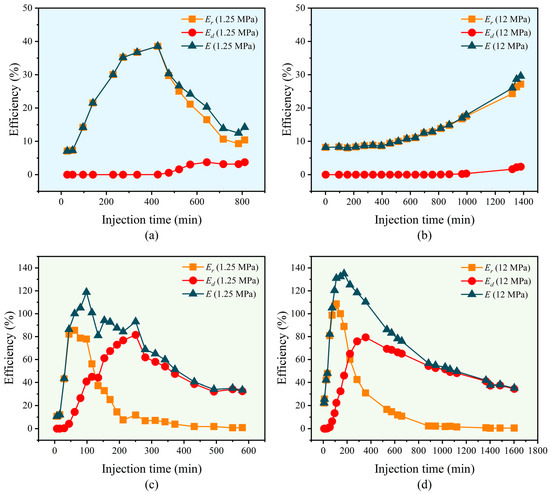
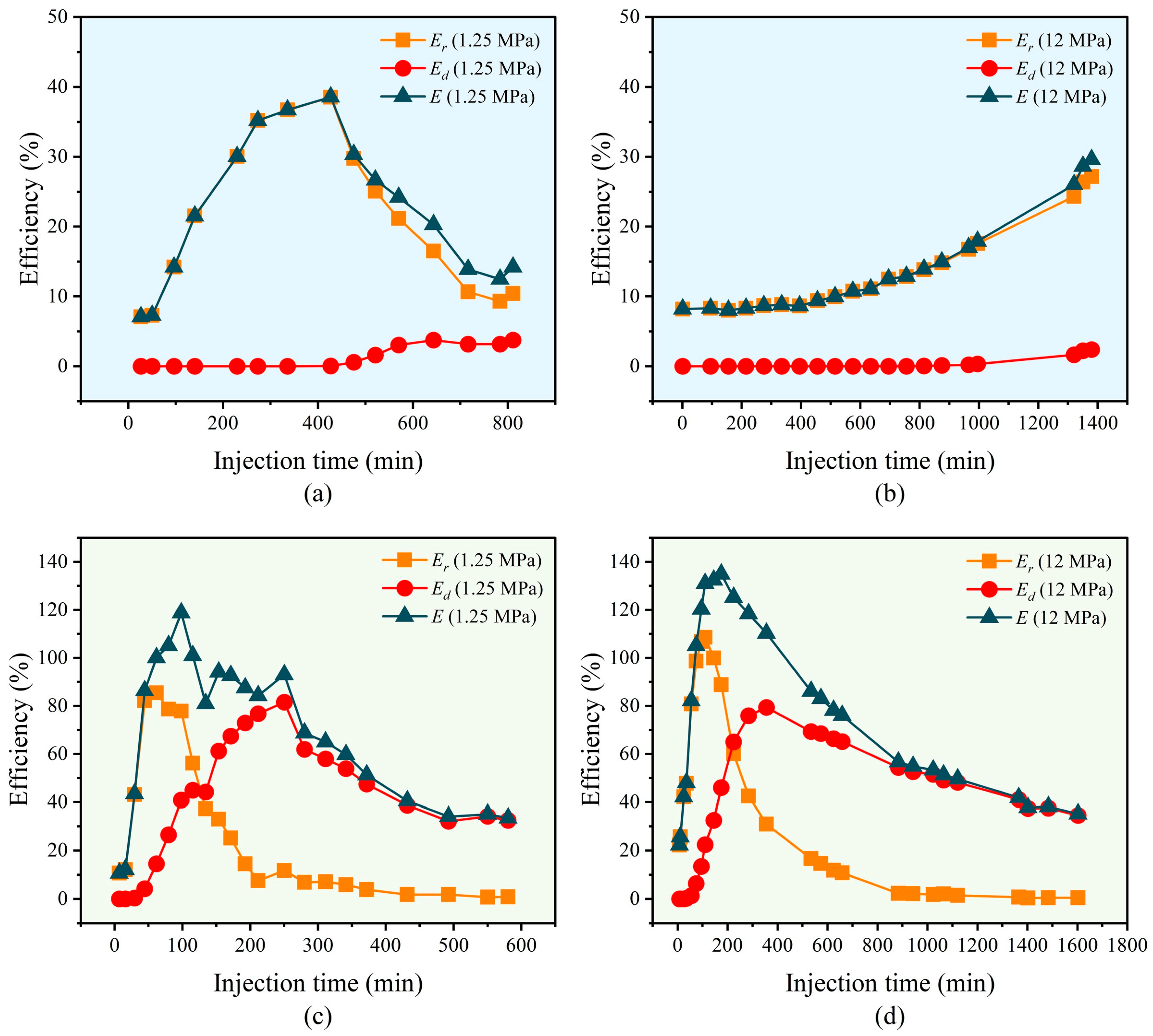
Replacement efficiency was defined as the ratio of CH4 produced by replacement to the injected source-gas volume within a time interval. Displacement efficiency was defined as the ratio of CH4 produced by displacement to the injected source-gas volume. Total injection efficiency was defined as the ratio of the total outflowing CH4 volume to the injected source-gas volume:
where is the replacement efficiency (%), is the CH4 volume produced by replacement during a time interval (mL), is the displacement efficiency (%), is the CH4 volume produced by displacement during that interval (mL), is the total injection efficiency (%), is the total outflowing CH4 volume (mL), and is the injected source-gas volume (mL).
Figure 7a,b shows that, during CO2 injection, replacement efficiency was consistently much higher than displacement efficiency. CH4 recovery in the CO2 system was therefore controlled mainly by adsorption replacement. At 1.25 MPa, replacement efficiency and total injection efficiency first increased and then decreased with time. In the early stage, CO2 preferentially occupied adsorption sites and promoted the desorption of adsorbed CH4, leading to a rapid increase in replacement efficiency. As the injection continued, the amount of readily replaceable CH4 decreased, and part of the CO2 began to break through and discharge, causing replacement efficiency and total efficiency to decline. Displacement efficiency remained low throughout and increased only slightly in the late stage, confirming the limited contribution of pressure-driven displacement for CO2 [31].
Figure 7.
Effects of stress on replacement efficiency, displacement efficiency, and total injection efficiency: (a,b) CO2 injection; (c,d) N2 injection.
At 12 MPa, CO2 replacement efficiency and total injection efficiency increased more slowly, while displacement efficiency remained low. High stress compressed pores and fractures, reduced flow-channel connectivity, and increased CO2 transport resistance, limiting both the effective diffusion range and the breakthrough process. Strong adsorption also promoted CO2 retention and could induce matrix swelling [32,33], further reducing seepage space. Increasing stress therefore restricted pressure-driven displacement and weakened the sustained ability of CO2 to promote CH4 production.
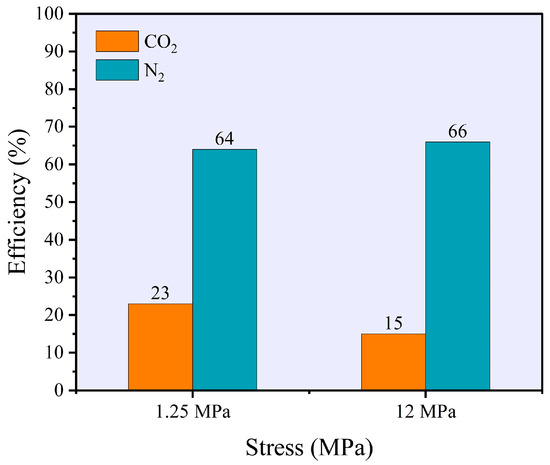
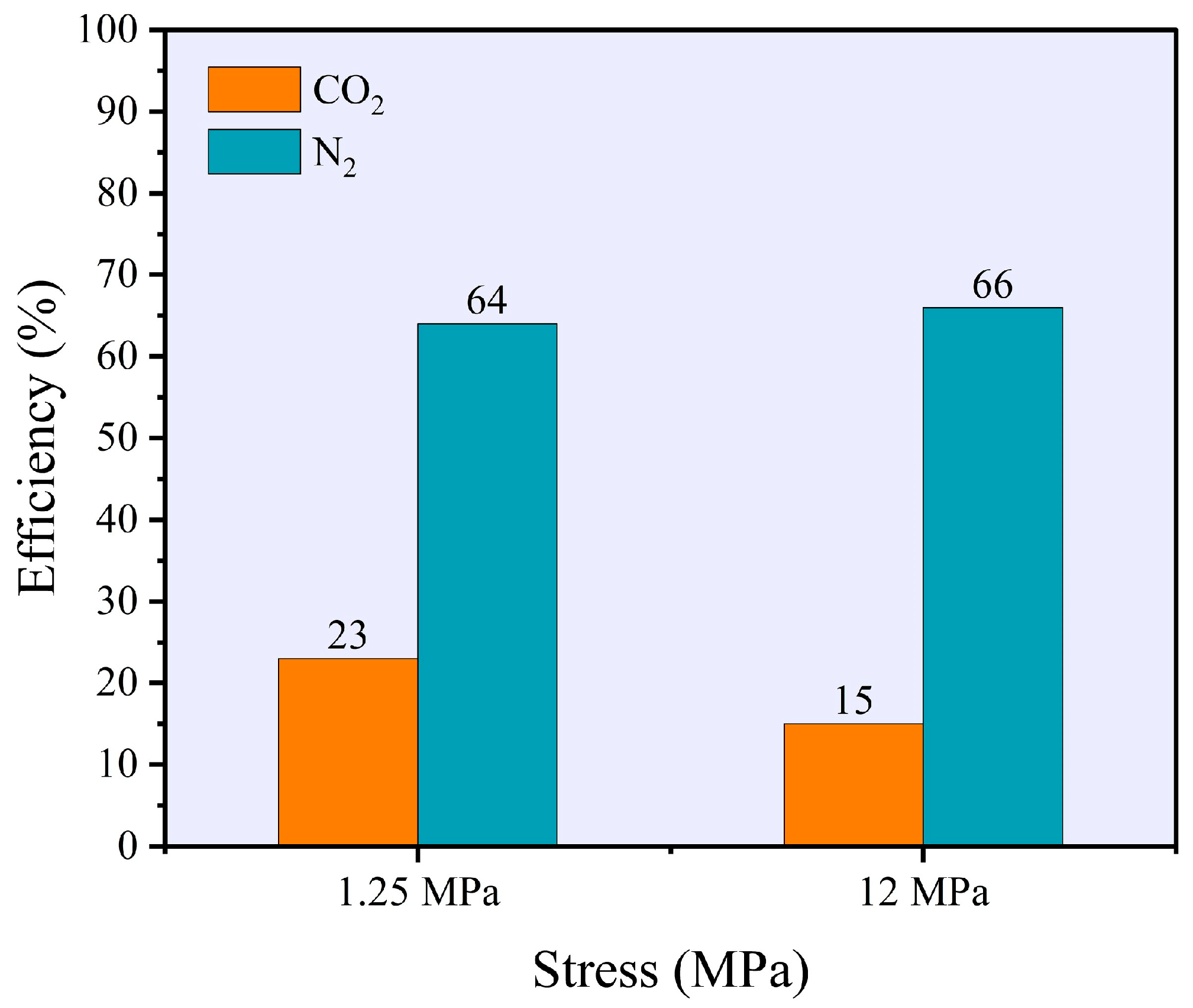
As shown in Figure 8, the final CO2 injection efficiency decreased from 23% at 1.25 MPa to 15% at 12 MPa, demonstrating a clear stress-induced inhibition of CO2-assisted CH4 recovery.
Figure 8.
Final injection efficiencies of CO2 and N2 under different stresses at the end of injection.
N2 injection exhibited a contrasting efficiency response. Figure 7c,d show that N2 replacement efficiency increased rapidly at the beginning and then declined quickly, whereas displacement efficiency increased and became the main contributor. Because N2 adsorbs weakly, it cannot remain on adsorption sites for long periods; its CH4 recovery effect is controlled mainly by gas migration and free-gas discharge under a pressure gradient. At 1.25 MPa, relatively open seepage channels allowed N2 to break through quickly, and the recovery process shifted from limited initial replacement to pressure-driven displacement dominance.
At 12 MPa, high stress compressed pores and fractures and reduced permeability, but it did not substantially reduce final N2 injection efficiency. Because N2 is weakly adsorbed, it produces little adsorption, retention, or matrix swelling. Moreover, the slower throughflow under higher stress extended the residence time of N2 in the coal, allowing more complete contact with CH4 and sustained pressure-driven displacement. Final N2 injection efficiency increased slightly from 64% at 1.25 MPa to 66% at 12 MPa (Figure 8), indicating that N2 can maintain high CH4-recovery efficiency under high stress.
These efficiency results show that stress affects CO2 and N2 through different mechanisms. In the CO2 system, stress-induced pore–fracture compression and adsorption-related swelling restrict migration and reduce sustained recovery, causing injection efficiency to decrease. In the N2 system, weak adsorption and limited swelling allow the process to remain displacement-controlled; the longer gas residence time under high stress can improve injected-gas utilization. CO2-assisted CH4 recovery is therefore adsorption-replacement dominated and stress sensitive, whereas N2-assisted CH4 recovery is pressure-displacement dominated and less adversely affected by stress.
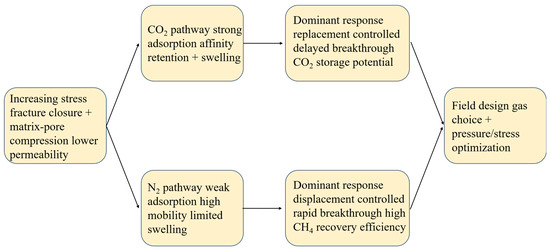
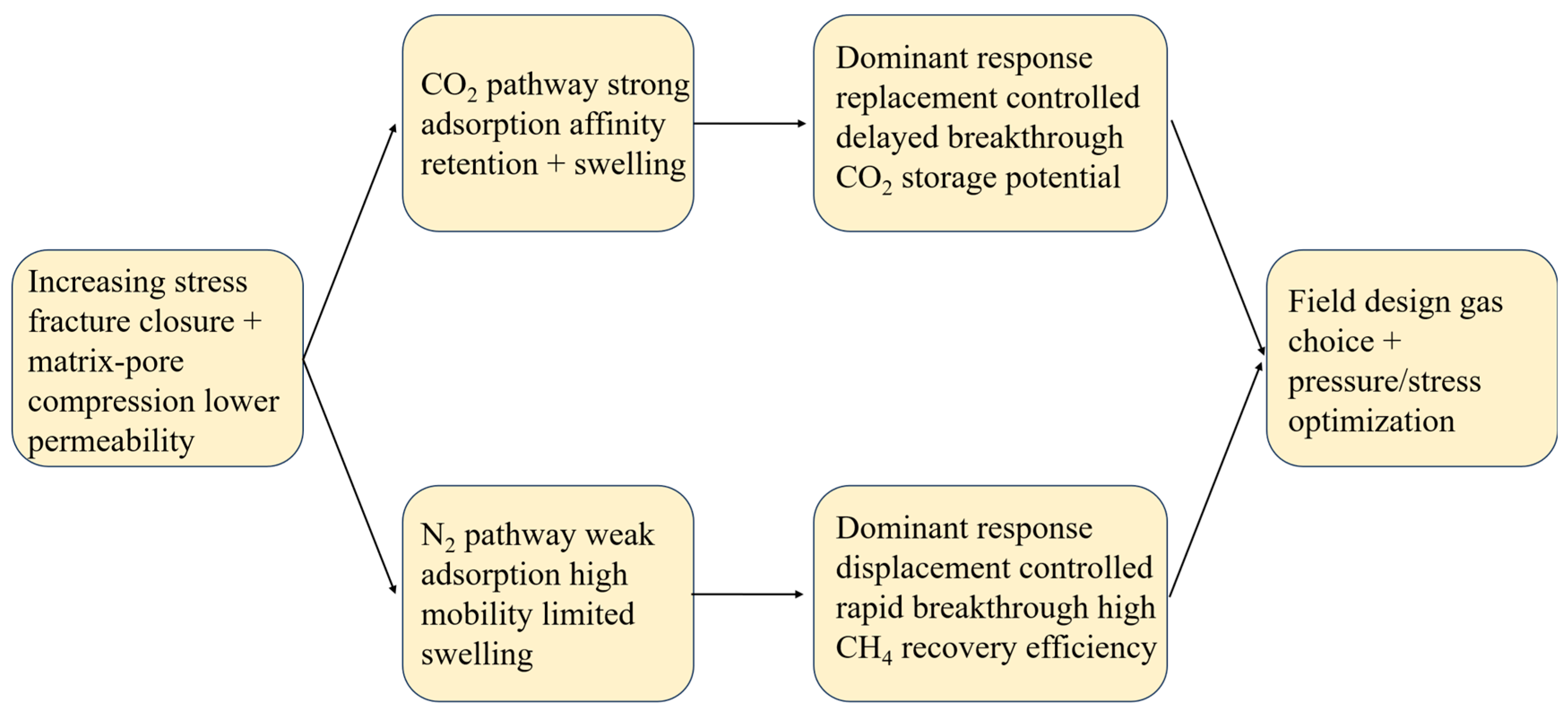
The CO2 results indicate a clear trade-off between CH4 recovery and storage potential under high stress. When stress increased from 1.25 MPa to 12 MPa, the net gas retained in the coal increased from approximately 583,841 mL to 678,634 mL, whereas the final injection efficiency decreased from 23% to 15%. This suggests that high-stress conditions favor CO2 retention and potential sequestration but penalize short-term methane recovery. Under in situ conditions, long-term storage stability may benefit from strong adsorption retention, whereas swelling-induced permeability loss and stress-related compaction may gradually reduce injectivity and effective sweep. Based on the above results, the stress-regulated replacement–displacement transition during CO2/N2-ECBM is conceptually summarized in Figure 9. To further clarify the gas-specific response under stress-controlled ECBM conditions, the performance characteristics of CO2 and N2 injection are summarized and compared in Table 5.
Figure 9.
Conceptual synthesis of the stress-regulated replacement–displacement transition during CO2/N2-ECBM.
Table 5.
Summary comparison of CO2 and N2 performance for stress-controlled ECBM.
The higher overall efficiency of N2 mainly arises from its weaker adsorption and lower swelling tendency. A larger fraction of injected N2 remains mobile within the pore–fracture network and contributes directly to pressure-driven transport of CH4 toward the outlet. In contrast, a substantial portion of injected CO2 is retained in the coal matrix, and part of the injection effect is consumed by adsorption retention and swelling rather than sustained CH4-producing throughput, resulting in lower short-term overall efficiency. For deep, high-stress coal seams, CO2 injection must account for permeability loss caused by compaction and swelling, whereas N2 injection can better exploit pressure-displacement advantages to maintain high recovery efficiency.
4.3. Stress-Response Scaling and Numerical Comparison
To provide a quantitative model beyond the conceptual comparison, the stress response of representative variables was described by a normalized power-law form:
where Y is a measured response variable, σ is the applied vertical stress, σ0 = 1.25 MPa is the low-stress reference, and β is a stress-sensitivity exponent. For the present two-stress-level dataset, β was calculated by:
Y(σ)/Y(σ0) = (σ/σ0)β,
β = ln[Y(12 MPa)/Y(1.25 MPa)]/ln(12/1.25).
This expression provides an empirical scaling relation for interpolation between the tested stress states and for comparing the stress sensitivity of CO2 and N2 pathways.
Table 6 shows that CO2 and N2 have different stress-response signatures. The negative β values for CO2 cumulative outflow (−0.228) and final efficiency (−0.189) indicate that higher stress suppresses CO2 transport and CH4-producing throughput. By contrast, N2 shows a very small positive β for final efficiency (+0.014), meaning that the final N2 utilization efficiency was nearly insensitive to the tested stress increase. The positive β of CO2 retained gas (+0.067) supports the interpretation that high stress favors CO2 residence and storage potential, whereas the larger positive β for the magnitude of N2 net gas decrease (+0.150) indicates stronger pressure-driven CH4 removal under the high-stress test. These numerical results support the mechanism classification derived from ΠRD: CO2 follows a retention-dominated replacement pathway, whereas N2 follows a mobile displacement pathway after early breakthrough.
Table 6.
Numerical stress-sensitivity comparison based on empirical power-law scaling.
5. Conclusions
This study examined stress-controlled CO2 and N2 injection for CH4 recovery using physical simulation experiments and quantified the dynamic partitioning between adsorption-controlled replacement and pressure-controlled displacement. The main conclusions are as follows:
- (1)
- Increasing stress compressed the pore–fracture structure, weakened gas seepage capacity, reduced inlet and outlet flow rates, and delayed injected-gas breakthrough. CO2 breakthrough time increased from 405 min to 675 min, whereas N2 breakthrough time increased from 15 min to 25 min. The absolute breakthrough delay of CO2 was much larger, confirming that CO2 migration is more strongly controlled by adsorption retention, swelling-related flow resistance, and stress compaction.
- (2)
- Coal gas-content evolution revealed opposite gas-utilization pathways. Under CO2 injection, the net gas retained in the coal increased from approximately 583,841 mL to 678,634 mL as stress increased, indicating enhanced CO2 retention and storage potential. Under N2 injection, the net gas balance became more negative, from approximately −66,229 mL to −93,043 mL, indicating stronger pressure-driven CH4 removal.
- (3)
- The ΠRD = criterion clarified the transition threshold between replacement and displacement. CO2 did not reach ΠRD = 1 within the tested period and therefore remained replacement dominated. N2 exceeded this threshold after breakthrough and shifted to displacement dominance; higher stress delayed but did not prevent this transition.
- (4)
- The final injection efficiency reflected the recovery–storage trade-off. CO2 efficiency decreased from 23% to 15% under higher stress because pore–fracture compression and adsorption-induced swelling restricted sustained CH4-producing flow. N2 efficiency remained high, increasing slightly from 64% to 66%, because weak adsorption and limited swelling allowed pressure displacement to remain effective.
- (5)
- For engineering design, CO2 is more suitable for storage-oriented ECBM, where long residence time and retention are required, whereas N2 is more suitable for rapid drainage-oriented ECBM. Injection pressure, well spacing, and injection duration should be adjusted according to stress regime, breakthrough time, outlet gas composition, and the ΠRD transition state.
The present conclusions are subject to several methodological limitations. First, the experiments were conducted using reconstituted coal rather than intact cores, so the effects of primary cleats, bedding, and natural fracture networks were not fully reproduced. Second, only two stress levels were considered, and the results therefore describe the contrast between low- and high-stress boundary conditions rather than a continuous stress-scaling relationship. Third, replicate tests and direct pore-structure/permeability measurements under stress were not included in the present experimental design. Therefore, the reported replacement–displacement ratios, breakthrough times, and injection efficiencies should be regarded as apparent values under the present controlled laboratory conditions. Future work should include intact-coal experiments, multi-level stress loading, repeated tests, direct permeability and pore-structure monitoring, and field-pilot validation.
Author Contributions
D.W. is responsible for experimental analysis and writing the paper. H.Y. supervised the research and proposed research directions. L.C., Z.H., W.S., K.Z. and S.X. helped write this paper. All authors have read and agreed to the published version of the manuscript.
Funding
This work was supported by the National Natural Science Foundation of China (Grant Nos. 52074104 and 52074107) and the Natural Science Foundation of Henan Province (Grant No. 252300420030).
Institutional Review Board Statement
Not applicable.
Informed Consent Statement
Not applicable.
Data Availability Statement
The data that support the findings of this study are available from the corresponding author upon reasonable request.
Acknowledgments
The authors extend their gratitude to Henan Polytechnic University, Jiaozuo, China, for its continuous support.
Conflicts of Interest
The authors declare no conflicts of interest.
References
- Fan, C.J.; Yang, L.; Sun, H.; Luo, M.; Zhou, L.; Yang, Z.; Li, S. Recent advances and perspectives of CO2-enhanced coalbed methane: Experimental, modeling, and technological development. Energy Fuels 2023, 37, 3371–3412. [Google Scholar] [CrossRef] [Scilit]
- Jiang, L.L.; Chen, Z.X.; Ali, S.M.F.; Zhang, J.; Chen, Y.; Chen, S. Storing carbon dioxide in deep unmineable coal seams for centuries following underground coal gasification. J. Clean. Prod. 2022, 378, 134565. [Google Scholar] [CrossRef] [Scilit]
- Tian, J.W.; Liu, J.S.; Elsworth, D.; Leong, Y.-K.; Li, W. An effective stress-dependent dual-fractal permeability model for coal considering multiple flow mechanisms. Fuel 2023, 334, 126800. [Google Scholar] [CrossRef] [Scilit]
- Ren, J.G.; Niu, Q.H.; Wang, Z.Z.; Wang, W.; Yuan, W.; Weng, H.; Sun, H.; Li, Y.; Du, Z. CO2 adsorption/desorption, induced deformation behavior, and permeability characteristics of different rank coals: Application for CO2-enhanced coalbed methane recovery. Energy Fuels 2022, 36, 5709–5722. [Google Scholar] [CrossRef] [Scilit]
- Wang, Z.Z.; Fu, X.H.; Pan, J.N.; Deng, Z. Effect of N2/CO2 injection and alternate injection on volume swelling/shrinkage strain of coal. Energy 2023, 275, 127377. [Google Scholar] [CrossRef] [Scilit]
- Li, Z.W.; Hu, H.Q.; Wang, Y.J.; Gao, Y.; Yan, F.; Bai, Y.; Yu, H. Molecular simulation of CO2/N2 injection on CH4 adsorption and diffusion. Sci. Rep. 2024, 14, 20777. [Google Scholar] [CrossRef] [Scilit] [PubMed]
- Wang, L.; Deng, Z.L.; Wang, X.L.; Wang, Z.; Hu, L.; Zhao, P. Mechanisms of methane displacement by CO2/N2 injection in tectonic coal under different gas-driving modes. Nat. Resour. Res. 2024, 33, 405–420. [Google Scholar] [CrossRef] [Scilit]
- Bai, G.; Su, J.; Zhang, Z.G.; Lan, A.; Zhou, X.; Gao, F.; Zhou, J. Effect of CO2 injection on CH4 desorption rate in poor permeability coal seams: An experimental study. Energy 2022, 238, 121674. [Google Scholar] [CrossRef] [Scilit]
- Yang, X.; Wang, G.D.; Du, F.; Jin, L.; Gong, H. N2 injection to enhance coal seam gas drainage (N2-ECGD): Insights from underground field trial investigation. Energy 2022, 239, 122247. [Google Scholar] [CrossRef] [Scilit]
- Su, E.L.; Wei, J.Q.; Chen, H.D.; Chen, X.; Liang, Y.; Zou, Q.; Zhu, X. Effect of CO2 injection on coalbed permeability based on a thermal-hydraulic-mechanical coupling model. Energy Fuels 2024, 38, 11078–11092. [Google Scholar] [CrossRef] [Scilit]
- Li, Q.; Li, Q.; Wang, F.; Wu, J.; Wang, Y.; Jin, J. Effects of geological and fluid characteristics on the injection filtration of hydraulic fracturing fluid in the wellbores of shale reservoirs: Numerical analysis and mechanism determination. Processes 2025, 13, 1747. [Google Scholar] [CrossRef] [Scilit]
- Li, Q.; You, D.; Li, Q.; Wang, F.; Wang, Y.; Yang, Y. Analysis of sedimentation behavior and influencing factors of solid particles in CO2 fracturing fluid. Processes 2025, 13, 4049. [Google Scholar] [CrossRef] [Scilit]
- Li, Q.; Li, Q.; Wu, J.; He, K.; Xia, Y.; Liu, J.; Wang, F.; Cheng, Y. Wellhead Stability During Development Process of Hydrate Reservoir in the Northern South China Sea: Sensitivity Analysis. Processes 2025, 13, 1630. [Google Scholar] [CrossRef] [Scilit]
- MT/T 752-1997; Determination Method of Methane Adsorption Capacity in Coal (High Pressure Capacity Method). Ministry of Coal Industry of the People’s Republic of China: Beijing, China; Standards Press of China: Beijing, China, 1998.
- GB/T 212-2008; Proximate Analysis of Coal. General Administration of Quality Supervision, Inspection and Quarantine of the People’s Republic of China: Beijing, China; Standardization Administration of the People’s Republic of China: Beijing, China; Standards Press of China: Beijing, China, 2008.
- GB/T 217-2008; Determination Method of True Relative Density of Coal. General Administration of Quality Supervision, Inspection and Quarantine of the People’s Republic of China: Beijing, China; Standardization Administration of the People’s Republic of China: Beijing, China; Standards Press of China: Beijing, China, 2008.
- GB/T 6949-2010; Determination Method of Apparent Relative Density of Coal. General Administration of Quality Supervision, Inspection and Quarantine of the People’s Republic of China: Beijing, China; Standardization Administration of the People’s Republic of China: Beijing, China; Standards Press of China: Beijing, China, 2011.
- Chen, L.W.; Wang, L.; Yang, T.H.; Yang, H.M. Deformation and swelling of coal induced from competitive adsorption of CH4/CO2/N2. Fuel 2021, 286, 119356. [Google Scholar] [CrossRef] [Scilit]
- Long, H.; Lin, H.F.; Yan, M.; Bai, Y.; Tong, X.; Kong, X.-G.; Li, S.-G. Adsorption and diffusion characteristics of CH4, CO2, and N2 in micropores and mesopores of bituminous coal: Molecular dynamics. Fuel 2021, 292, 120268. [Google Scholar] [CrossRef] [Scilit]
- Long, H.; Lin, H.F.; Yan, M.; Chang, P.; Li, S.G.; Bai, Y. Molecular simulation of the competitive adsorption characteristics of CH4, CO2, N2, and multicomponent gases in coal. Powder Technol. 2021, 385, 348–356. [Google Scholar] [CrossRef] [Scilit]
- Wei, M.Y.; Liu, J.S.; Liu, Y.K.; Liu, Z.-H.; Elsworth, D. Effect of adsorption-induced matrix swelling on coal permeability evolution of micro-fracture with the real geometry. Pet. Sci. 2021, 18, 1143–1152. [Google Scholar] [CrossRef] [Scilit]
- Zhou, K.; Yang, H.M.; Guan, J.F.; Zheng, H. Study on the response characteristics of the pressure and temperature fields of source gas injection under loading conditions. ACS Omega 2022, 7, 32313–32321. [Google Scholar] [CrossRef] [Scilit] [PubMed]
- Wang, H.C.; Li, Y.D.; Pan, J.N.; Wang, Z.Z.; Li, M.; Cheng, N.N.; Niu, Y.B. Micromechanical response of multiphase CO2 injected into high-rank coal fractures via nanoindentation. Phys. Fluids 2025, 37, 042018. [Google Scholar] [CrossRef] [Scilit]
- Skoczylas, N.; Kudasik, M.; Pajdak, A.; Braga, L.T.P. Study of CO2/CH4 exchange sorption in coal under confining pressure conditions. Int. J. Greenh. Gas Control 2023, 124, 103845. [Google Scholar] [CrossRef] [Scilit]
- Mwakipunda, G.C.; Wang, Y.T.; Mgimba, M.M.; Ngata, M.R.; Alhassan, J.; Mkono, C.N.; Yu, L. Recent advances in carbon dioxide sequestration in deep unmineable coal seams using CO2-ECBM technology: Experimental studies, simulation, and field applications. Energy Fuels 2023, 37, 17161–17186. [Google Scholar] [CrossRef] [Scilit]
- Cui, X.J.; Bustin, R.M.; Dipple, G. Selective transport of CO2, CH4, and N2 in coals: Insights from modeling of experimental gas adsorption data. Fuel 2004, 83, 293–303. [Google Scholar] [CrossRef] [Scilit]
- Ji, P.F.; Lin, H.F.; Kong, X.G.; Li, S.G.; Cai, Y.C.; Wang, R.Z.; Tian, Y.; Zhao, T.S. Experimental study on enhanced coal seam gas extraction by uniform pressure/pulse pressure N2 injection. Fuel 2023, 351, 128988. [Google Scholar] [CrossRef] [Scilit]
- Zhu, H.Q.; Wang, W.; Huo, Y.J.; He, X.; Zhao, H.R.; Wang, H.R. Molecular simulation study on adsorption and diffusion behaviors of CO2/N2 in lignite. ACS Omega 2020, 5, 29416–29426. [Google Scholar] [CrossRef] [Scilit] [PubMed]
- He, Y.H.; Li, X.J.; Xie, H.G.; Li, X.X.; Xia, T.; Chen, S.K. Dynamics change of coal methane adsorption/desorption and permeability under temperature and stress conditions. Phys. Fluids 2025, 37, 016605. [Google Scholar] [CrossRef] [Scilit]
- Kiyama, T.; Nishimoto, S.; Fujioka, M.; Xue, Z.Q.; Ishijima, Y.; Pan, Z.J.; Connell, L.D. Coal swelling strain and permeability change with injecting liquid/supercritical CO2 and N2 at stress-constrained conditions. Int. J. Coal Geol. 2011, 85, 56–64. [Google Scholar] [CrossRef] [Scilit]
- Li, Z.B.; Fan, Z.C.; Wang, H.; Wang, S.R.; Li, C. Mechanism of pore pressure and adsorption swelling effect on permeability during geological storage of carbon dioxide in coal seams. Fuel 2025, 381, 133437. [Google Scholar] [CrossRef] [Scilit]
- Mazumder, S.; Wolf, K.H. Differential swelling and permeability change of coal in response to CO2 injection for ECBM. Int. J. Coal Geol. 2008, 74, 123–138. [Google Scholar] [CrossRef] [Scilit]
- Ranathunga, A.S.; Perera, M.S.A.; Ranjith, P.G.; Rathnaweera, T.D.; Zhang, X.G. Effect of coal rank on CO2 adsorption-induced coal matrix swelling with different CO2 properties and reservoir depths. Energy Fuels 2017, 31, 5297–5305. [Google Scholar] [CrossRef] [Scilit]

Disclaimer/Publisher’s Note: The statements, opinions and data contained in all publications are solely those of the individual author(s) and contributor(s) and not of MDPI and/or the editor(s). MDPI and/or the editor(s) disclaim responsibility for any injury to people or property resulting from any ideas, methods, instructions or products referred to in the content. |
© 2026 by the authors. Licensee MDPI, Basel, Switzerland. This article is an open access article distributed under the terms and conditions of the Creative Commons Attribution (CC BY) license.