


Abstract
Lead-bearing dusts from metallurgical processes are hazardous secondary resources due to their complex composition and toxicity. At the same time, their high lead content makes them a promising feedstock for resource recovery. This study proposes an energy-efficient electrosmelting approach based on the partial substitution of sodium carbonate with calcium-rich industrial waste (sugar-industry defecate). Thermodynamic analysis and equilibrium modeling of the Pb–Sb–Fe–Na–Ca–Si–S–Cl–As system were performed in the temperature range of 200–1200 °C using Outotec HSC Chemistry. The results indicate that under equilibrium conditions approximately 90–95% of lead is concentrated in the metallic phase (~56 kg from ~60 kg in the feed), while antimony is co-recovered (~1.9–2.0 kg). The slag is dominated by calcium silicates, primarily Ca2SiO4, confirming the important role of CaO in slag formation and impurity fixation. Chlorine is predominantly bound as NaCl and partially as CaCl2, while sulfur is distributed between Na2S and Na2SO4. A significant portion of arsenic is predicted to be retained in the slag as calcium and sodium arsenates (Ca3(AsO4)2 and Na3AsO4), whereas its volatilization is thermodynamically negligible under equilibrium conditions. Preliminary experimental results are generally consistent with the thermodynamic predictions and confirm the feasibility of partially replacing Na2CO3 with sugar-industry defecate. The proposed approach contributes to reducing the consumption of conventional fluxes and promotes the utilization of industrial waste within a circular-economy framework.
1. Introduction
1.1. Lead-Containing Dusts and the Relevance of Their Recycling
Lead-containing dusts are fine-dispersed solid materials formed during high-temperature, mechanical, and electrochemical processing of lead-bearing raw materials. Their particle size typically ranges from fractions of a micron to several tens of micrometers, while their chemical composition is complex and highly variable. According to literature data [1,2,3], the lead content in such wastes ranges from 5 to 60% and depends on the characteristics of non-ferrous metallurgical processes. The main sources of dust formation are pyrometallurgical units, including shaft, reverberatory, and rotary furnaces, as well as fluidized-bed systems, where reduction, evaporation, and oxidation of lead compounds occur during roasting and smelting [1,3,4].
These formation conditions determine the specific physicochemical properties of the dust and the complexity of its processing. A key feature is the presence of volatile lead compounds capable of transferring into the gas phase at elevated temperatures, increasing the load on gas-cleaning systems and contributing to secondary environmental pollution. In addition, phase heterogeneity, associated with the coexistence of crystalline and amorphous components and the presence of toxic elements (Cd, As, Zn, Sb, Cl), complicates metal recovery and causes equipment corrosion [5]. Significant amounts of dust are also generated during the recycling of spent lead–acid batteries, where crushing and processing of lead paste result in particles composed mainly of PbSO4, PbO, PbO2 and chloride compounds [6,7,8,9].
Due to these characteristics, lead-containing dusts pose a serious environmental hazard. Lead and its compounds are highly toxic and mobile, causing neurotoxic effects and disorders of the hematopoietic system, as confirmed by environmental risk assessments [10]. According to the World Health Organization (WHO), lead exposure causes more than one million premature deaths annually, while metallurgical wastes remain a major source of environmental contamination, particularly in developing countries [11]. As a result, environmental regulations are becoming increasingly stringent, requiring mandatory processing of dusts containing more than 0.1% lead and limiting their disposal [12].
At the same time, lead-containing dusts represent a valuable secondary resource. Their high metal content enables efficient recovery and return of valuable components to the production cycle, reducing both resource consumption and environmental impact [7,8,10]. The relevance of this issue is further supported by the growing share of secondary lead production: according to Shanghai Metals Market (SMM), global output of secondary refined lead exceeds 8.3 million tons, accounting for about 66% of total supply [13].
Considering the toxicity, complex composition, and environmental risks associated with lead-containing dusts, the development of efficient and environmentally safe processing technologies remains a priority in modern metallurgy [14].
1.2. Current Processing Methods and Defecate as a Secondary Flux
Increasing environmental requirements and international legal regulations, including the Basel Convention on the Control of Transboundary Movements of Hazardous Wastes and Their Disposal and the European Waste Framework Directive (2008/98/EC), encourage the development of sustainable technologies for recycling metallurgical waste and recovering valuable metals from secondary resources [15,16].
In industrial and research practice, hydrometallurgical [17,18,19,20,21,22,23,24,25,26], hydroelectrometallurgical [8,27,28], combined [6,29,30], and pyrometallurgical [30,31,32,33,34,35] methods are used for the processing of lead-containing wastes.
Hydrometallurgical processes enable selective recovery of target components with lower energy consumption compared to pyrometallurgy [17]. Their efficiency depends on raw material composition, the presence of toxic elements (As, Cd, Zn, Sb, Cl), and process conditions such as pH and temperature. Acidic leaching systems, particularly sulfuric acid, are widely used for the treatment of PbO- and PbO2-containing materials [18,19,20]. However, the low solubility of PbSO4 limits lead extraction and requires additional processing steps or complexing agents. Chloride systems provide high extraction efficiency for lead and zinc [21,22], but are associated with corrosion issues and reduced selectivity in complex systems. Alkaline media, especially NaOH solutions, allow for the selective removal of impurities while retaining lead in the solid phase, simplifying further processing [23,24,25,26].
Hydroelectrometallurgical approaches combine leaching with electrowinning and have been successfully applied to various lead-containing wastes [8,27,28]. Combined hydro–pyrometallurgical routes offer a compromise between selectivity and process stability, enabling efficient recovery of lead and associated metals [6,29,30,31].
Despite these advantages, pyrometallurgical methods remain dominant due to their high productivity, technological simplicity, and suitability for large-scale processing of complex multicomponent materials [32,33]. Industrial applications, such as the Isasmelt-based processing of lead–acid batteries at Britannia Refined Metals (UK), confirm their effectiveness [34]. Various pyrometallurgical approaches have been proposed for lead recovery from industrial dusts. For example, NaOH-assisted reduction of SKS dust achieved 87% Pb and 96.5% Sb recovery [35], while stepwise extraction using FeS2 and Na2CO3 enabled high recovery of Pb, Bi, and Zn [36]. Processing of EAF dust with Na2CO3 at 1450 °C ensured recovery of Zn, Pb, and Fe above 89–99% [37]. Low-temperature alkaline smelting of lead–acid batteries allows lead recovery above 98% at 1050 °C [38]. Electric smelting of copper smelter dusts with sodium-containing additives enables one-stage separation of metal and slag products [39,40,41].
However, despite the wide range of available approaches, these methods often suffer from high-energy consumption, complex process schemes, limited selectivity, or environmental constraints, which restrict their large-scale application.
In many pyrometallurgical processes [36,39,40,41], sodium carbonate (Na2CO3) plays a key role in facilitating metal reduction and slag formation. Therefore, the possibility of its partial replacement with industrial waste materials is of considerable interest. One such material is sugar industry defecate—a lime-carbonate residue formed during juice purification, generated in amounts of 20–30 kg per ton of processed sugar beet [42].
The composition of defecate depends on raw materials and process conditions, with typical values presented in Table 1. In many regions, particularly in post-Soviet countries, large volumes of defecate are stockpiled due to the lack of effective utilization technologies, leading to environmental problems such as soil and water contamination and land degradation [42]. At the same time, successful industrial practices demonstrate its reuse, for example, by British Sugar (UK), where defecate has been applied as a soil conditioner for decades [43].
Table 1.
Average chemical composition of sugar industry defecate.
Recent studies have highlighted the important role of calcium-containing phases in the stabilization and immobilization of potentially hazardous elements in Ca–Al–Si-rich waste utilization systems. Investigations of slag- and fly ash-based geopolymer materials have shown that CaO/Al2O3 and SiO2/Al2O3 ratios significantly influence phase formation, stabilization mechanisms, and the fixation of hazardous components. In addition, modeling studies suggest that calcium incorporation may affect the structure and stability of aluminosilicate binding phases. Although these systems differ from high-temperature metallurgical processes, they similarly demonstrate the important role of calcium-containing phases in the formation of stable silicate and aluminosilicate matrices capable of immobilizing impurity and potentially hazardous elements [44,45,46].
Defecate is also used in cement production [47,48,49], wastewater treatment [50,51,52], and adsorption processes [53]. However, its application in metallurgical processes remains limited.
Due to its high CaCO3 content, defecate can act as a secondary flux, partially replacing conventional materials and improving slag formation and impurity binding. Previous studies have demonstrated its effectiveness in enhancing arsenic and sulfur removal [54], reducing dust formation [55], and improving purification during processing of lead-containing systems [56].
Despite numerous studies on the processing of lead-containing dusts, the phase behavior of chlorine- and arsenic-containing compounds in multicomponent Pb–Na–Ca systems remains insufficiently understood, particularly under reducing conditions, and requires further investigation. In addition, the effect of calcium-containing industrial wastes, such as defecate, on phase distribution and immobilization of hazardous elements has not been systematically investigated.
Unlike previous studies, the present work combines thermodynamic modeling with experimental verification to evaluate the feasibility of partially replacing sodium carbonate with sugar industry defecate during the electrosmelting of lead-bearing dusts. Particular attention is given to the phase distribution of lead, antimony, arsenic, sulfur, and chlorine, as well as to the immobilization of hazardous elements in slag products.
1.3. Objective of the Study
The present study aims to investigate the effect of partial replacement of sodium carbonate with sugar industry defecate on phase formation, element distribution, and recovery efficiency during electrosmelting of lead-containing dusts.
Our previous studies have shown that lead recovery during the processing of dust-like wastes proceeds most efficiently with the use of sodium carbonate in the presence of a reducing agent [39,40,41]. The combined use of defecate and sodium carbonate becomes particularly effective under specific smelting conditions, including elevated temperature and the formation of a reducing atmosphere. Defecate, serving as a source of calcium oxide, promotes the binding of sulfur and impurity components into the slag phase and the formation of thermodynamically stable calcium compounds. This creates favorable conditions for the intensification of reduction processes and improves the recovery of lead and antimony.
The use of defecate as a technogenic calcium-containing material is consistent with the principles of sustainable development and circular economy, ensuring reduced consumption of conventional fluxes and lowering the environmental impact associated with the processing of lead-bearing dusts. These considerations formed the basis for further thermodynamic analysis and experimental verification of the effectiveness of this sugar industry waste in electric smelting processes.
2. Materials and Methods
2.1. Experimental Samples and Reagents
Representative samples of lead-bearing dust used in this study were collected at a lead–acid battery plant using multiple splitting and thorough homogenization to ensure material representativeness. Sampling was carried out over a 14-day period, and sample preparation included successive coning and quartering followed by subdivision to obtain a homogeneous fraction. The particle size was below 50 μm, allowing for chemical and spectroscopic analyses to be performed without additional mechanical treatment.
For the experiments, analytical-grade reagents were used, including anhydrous sodium carbonate, silicon dioxide (SiO2), iron chips of technical purity, and BAU-A activated carbon as a reducing agent. Sugar industry defecate, used for partial replacement of soda ash, was collected at a sugar plant, which was then dried and sieved to obtain a homogeneous fraction.
The initial dust samples were analyzed for elemental composition in duplicate, and the final composition was calculated as the average of the two measurements to improve data reliability for thermodynamic modeling and experimental studies.
Sample collection, homogenization, quartering, and preparation procedures were carried out according to generally accepted laboratory practices for representative sampling of fine particulate materials. Analytical measurements were performed following standard operating procedures and the recommendations provided by the instrument manufacturers. All analytical measurements were conducted in the accredited laboratories of the Mining and Metallurgical Engineering Center of Satbayev University in accordance with internal quality assurance and quality control (QA/QC) procedures. The laboratory quality system complies with the requirements of ISO/IEC 17025:2019 for the competence of testing and calibration laboratories, and analytical quality is further supported through participation in proficiency-testing programs in accordance with ISO/IEC 17043:2025 [57,58].
2.2. Analytical and Experimental Methods
The elemental (chemical) and phase composition, as well as the microstructure of lead-bearing dust, auxiliary components, and electric smelting products (crude lead and slag melt), were determined using a set of analytical methods. Quantitative determination of elemental composition was performed by atomic absorption spectrophotometry with a graphite furnace (Perkin Elmer 5100, PerkinElmer Inc., Waltham, MA, USA).
IR spectroscopy was applied to characterize the complex and partially amorphous phase composition of the lead-bearing dust. IR spectra were recorded using an FT/IR-6X Fourier-transform infrared spectrometer (JASCO Corporation, Tokyo, Japan) in the range of 4000–400 cm−1 with a resolution of 4 cm−1. The samples were prepared as KBr pellets with sample-to-KBr ratios of 1:100 and 1:200. Spectral processing and phase identification were performed using Spectra Manager Ver. 2.5 software and the KnowItAll Version 23.1 database.
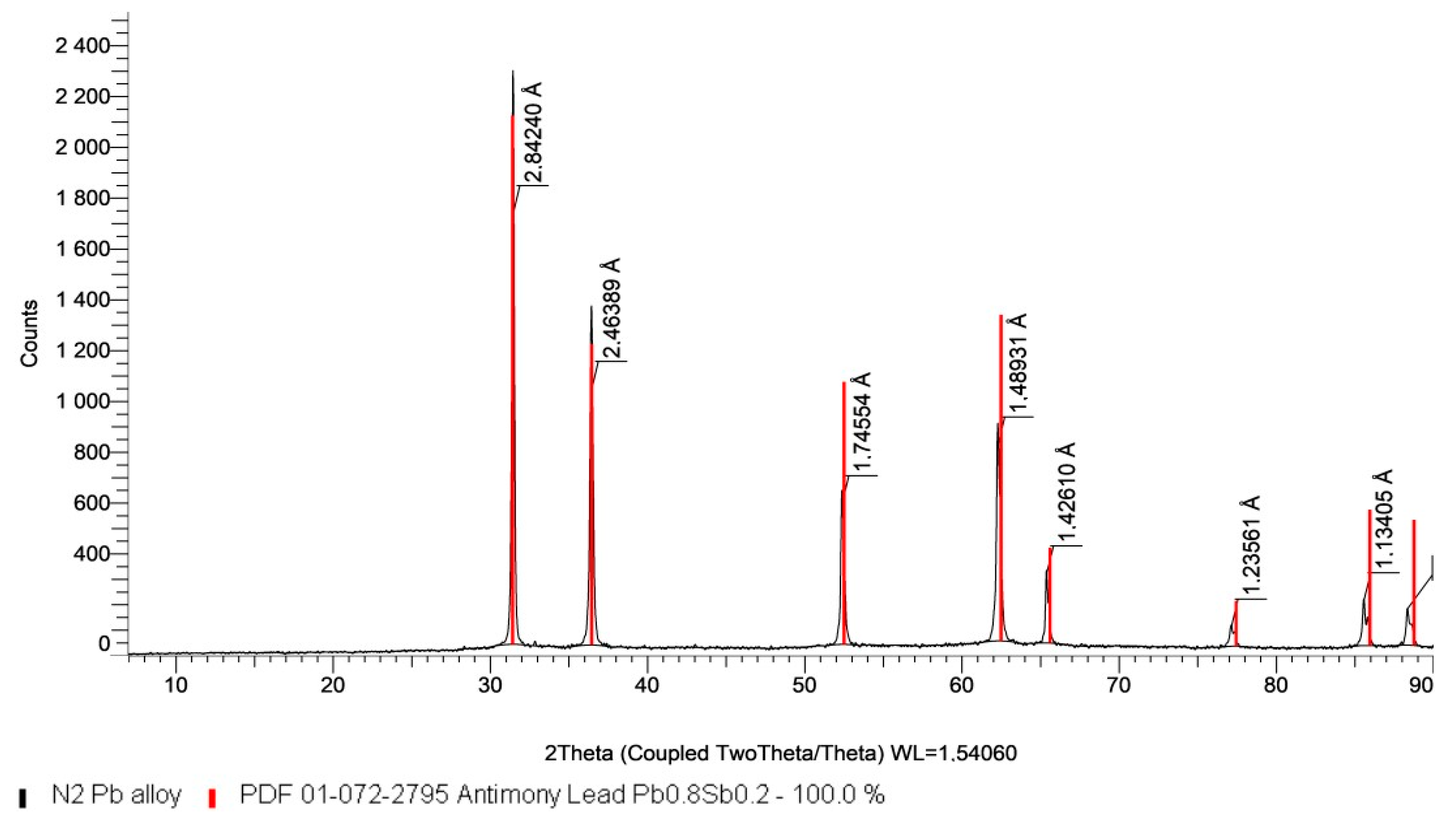
The phase composition of the crude lead obtained after electrosmelting was analyzed by X-ray diffraction (XRD) using Cu Kα radiation (λ = 1.5406 Å) over a 2θ range of 10–90°. Phase identification was carried out using the PDF database (ICDD).
The microstructure and local elemental composition of the samples were studied using scanning electron microscopy with energy-dispersive analysis (SEM-EDS, JED-2300, JEOL Ltd., Tokyo, Japan). The following parameters were used for EDS analysis: spectrum acquisition time—82 s; total counts—175,511; average count rate—2131 cps.
The thermodynamic analysis of possible reactions between components of lead-bearing dust and fluxing additives during electric smelting was carried out using the licensed software Outotec HSC Chemistry v. 8.1.5, employing the Reaction Equations module to evaluate the values of ΔG, ΔH, ΔS, and equilibrium constants.
Thermodynamic modeling of phase equilibria was performed using the Equilibrium Compositions module, taking into account the phase composition of the lead-bearing dust and other charge components. The equilibrium composition was calculated based on the initial composition of all components, assuming unit activity of all substances. This simplification is commonly used in equilibrium thermodynamic calculations and allows for the evaluation of the principal thermodynamic trends in complex multicomponent systems. However, real slag–metal–gas systems may exhibit non-ideal behavior, particularly in the presence of Na-, Ca-, Cl-, and S-bearing species. Therefore, the calculated phase distributions should be interpreted as equilibrium estimates rather than exact representations of industrial smelting systems. Calculations were carried out stepwise with a temperature increment sufficient to analyze phase transformations within the selected temperature range.
Electric smelting experiments were carried out in a high-temperature tubular furnace (Nabertherm RHTV 50/150/16/P570, Nabertherm GmbH, Lilienthal, Germany). The charge, consisting of lead-bearing dust, fluxing components, and a reducing agent, was thoroughly mixed and placed in a corundum crucible (500 mL, thermal resistance up to 1600–1750 °C). The crucible was positioned in the furnace working zone and heated to the required temperature. Temperature control was performed using a built-in P570 controller, and the holding time varied from 15 to 40 min depending on the selected regime.
The smelting products, including dust and gaseous emissions, were captured using dust-collection devices and absorption columns, enabling subsequent analysis and preventing laboratory contamination. After completion of the experiment, the crucible was removed from the furnace, and the cooled smelting products—crude lead and slag—were weighed and sent for chemical and mineralogical analysis.
3. Results and Discussion
3.1. Characterization of Raw Materials
The chemical and phase composition of battery production dust was investigated to assess its metallurgical value and determine the occurrence forms of major and impurity elements. The results of elemental analysis are presented in Table 2.
Table 2.
Composition of battery production dust.
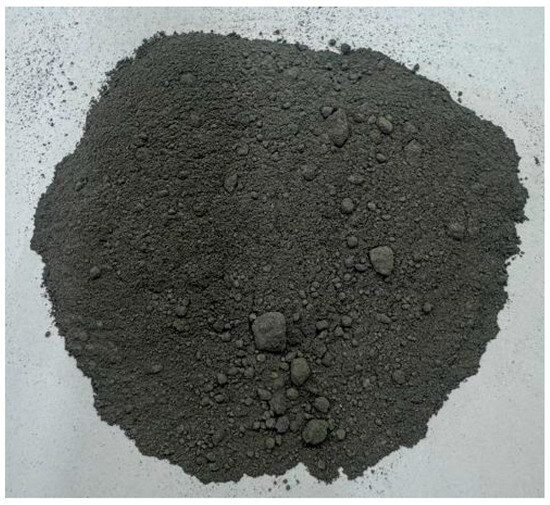
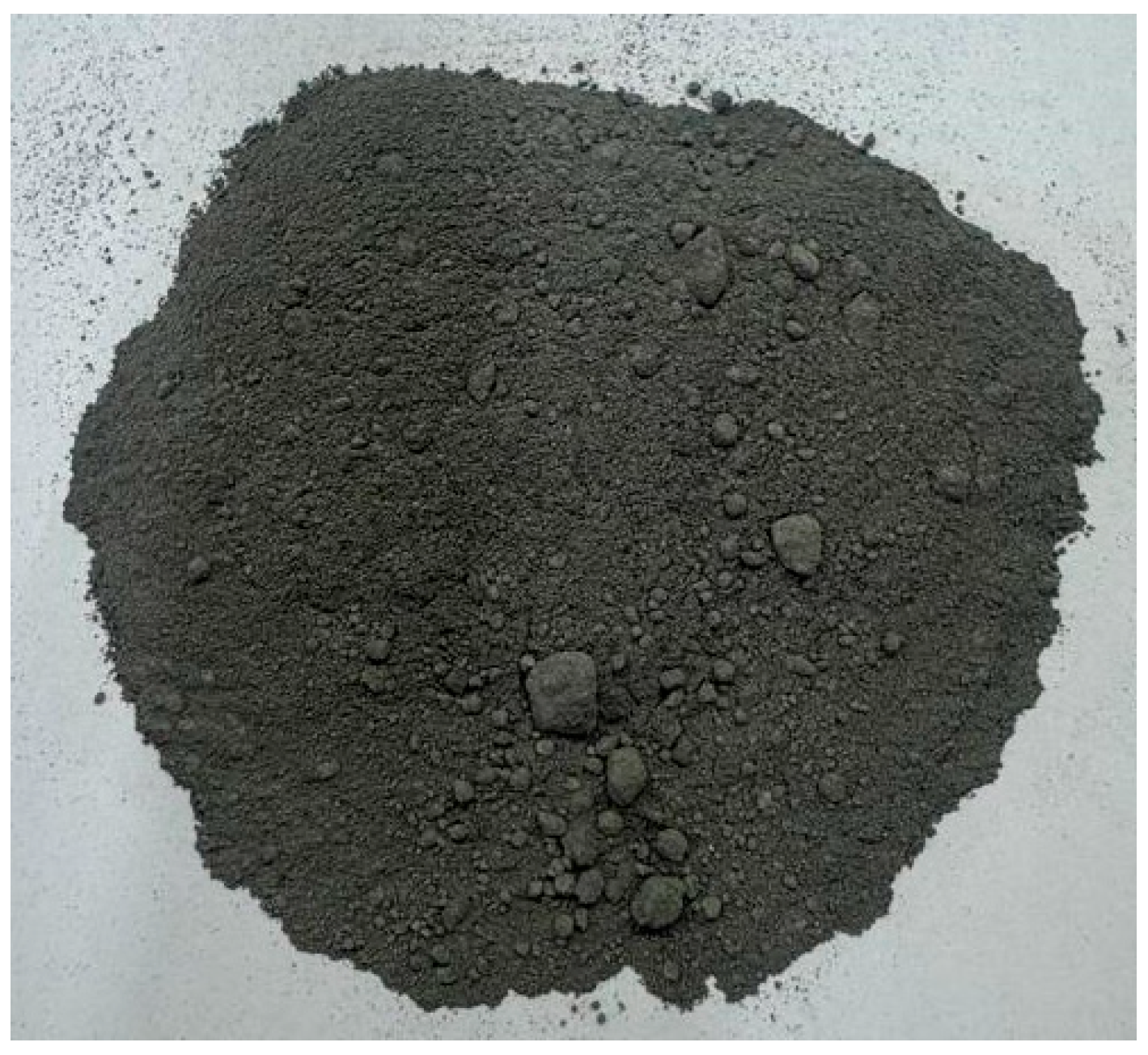
The dust is characterized by a high lead content (60.07 wt.%), indicating its significant potential as a secondary lead raw material. The presence of oxygen, sulfur and chlorine suggests that lead is predominantly present in oxide, sulfate, and chloride forms. Impurity elements, including antimony, iron, and arsenic, are typical of battery materials and influence both phase formation and metal recovery during processing. The appearance of the dust (Figure 1) shows a fine dark-gray powder with a tendency toward agglomeration. Such morphology is characteristic of dust formed in gas-cleaning systems and is associated with the presence of finely dispersed oxide, sulfate, and chloride phases.
Figure 1.
Appearance of lead-bearing dust from battery production.
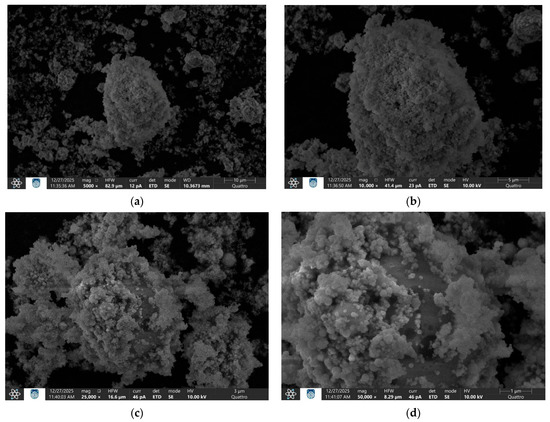
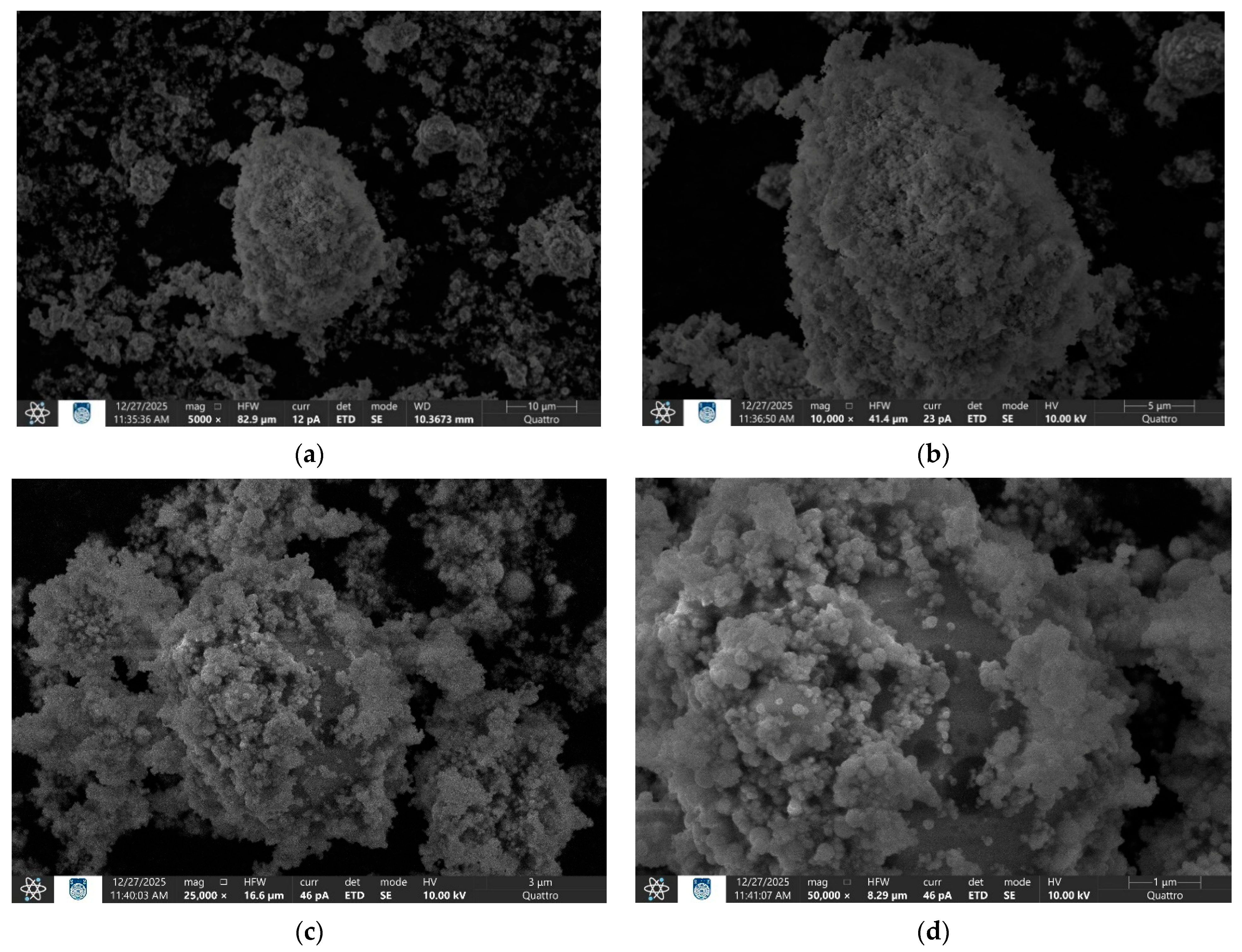
SEM analysis (Figure 2a–d) revealed pronounced morphological heterogeneity of the dust particles.
Figure 2.
Morphology of lead-bearing dust according to SEM data at different magnifications: (a) general morphology of irregular agglomerates; (b) cluster-like aggregates composed of submicron particles (10,000×); (c) multilevel agglomeration with spherical and pseudospherical particles (25,000×); (d) primary particles and porous aggregate structure at high magnification.
At low magnification (Figure 2a), irregular agglomerates up to 10–15 μm in size are observed, formed from finer particles with a developed porous structure. At higher magnification (Figure 2b), the agglomerates consist of loosely packed submicron primary particles forming cluster-like structures, indicating a high degree of dispersion.
At 25,000× magnification (Figure 2c), multilevel agglomeration is observed, with spherical and pseudospherical particles forming fractal-like aggregates. The presence of smooth spherules indicates partial melting and condensation of vapor-phase species. At even higher magnification (Figure 2d), primary particles of approximately 0.05–0.2 μm are identified, forming porous aggregates with a highly developed surface.
Such morphology indicates that dust formation occurs predominantly via a condensation–coagulation mechanism. In the high-temperature zone, lead and associated elements evaporate, followed by condensation and nucleation of spherical particles in the gas phase. Subsequent collisions and coagulation result in the formation of porous agglomerates. The presence of smooth spherical particles suggests a droplet–condensation mechanism, while the loose structure reflects aerosol agglomeration during cooling.
The observed morphological features also provide insight into the probable phase composition of the dust. Porous agglomerates are associated with lead sulfate (PbSO4), formed through the interaction of lead oxides with sulfur dioxide and oxygen during cooling (Figure 2b). Spherical particles are characteristic of co-condensation of Pb–Sb oxide vapors, while smooth spherules may also correspond to condensed lead chloride species (PbCl2), which are known to be present in the gas phase of metallurgical processes.
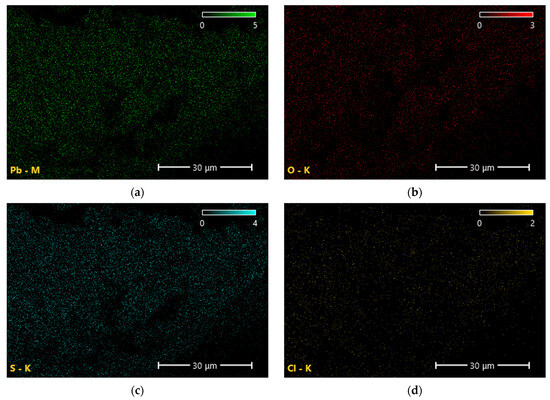
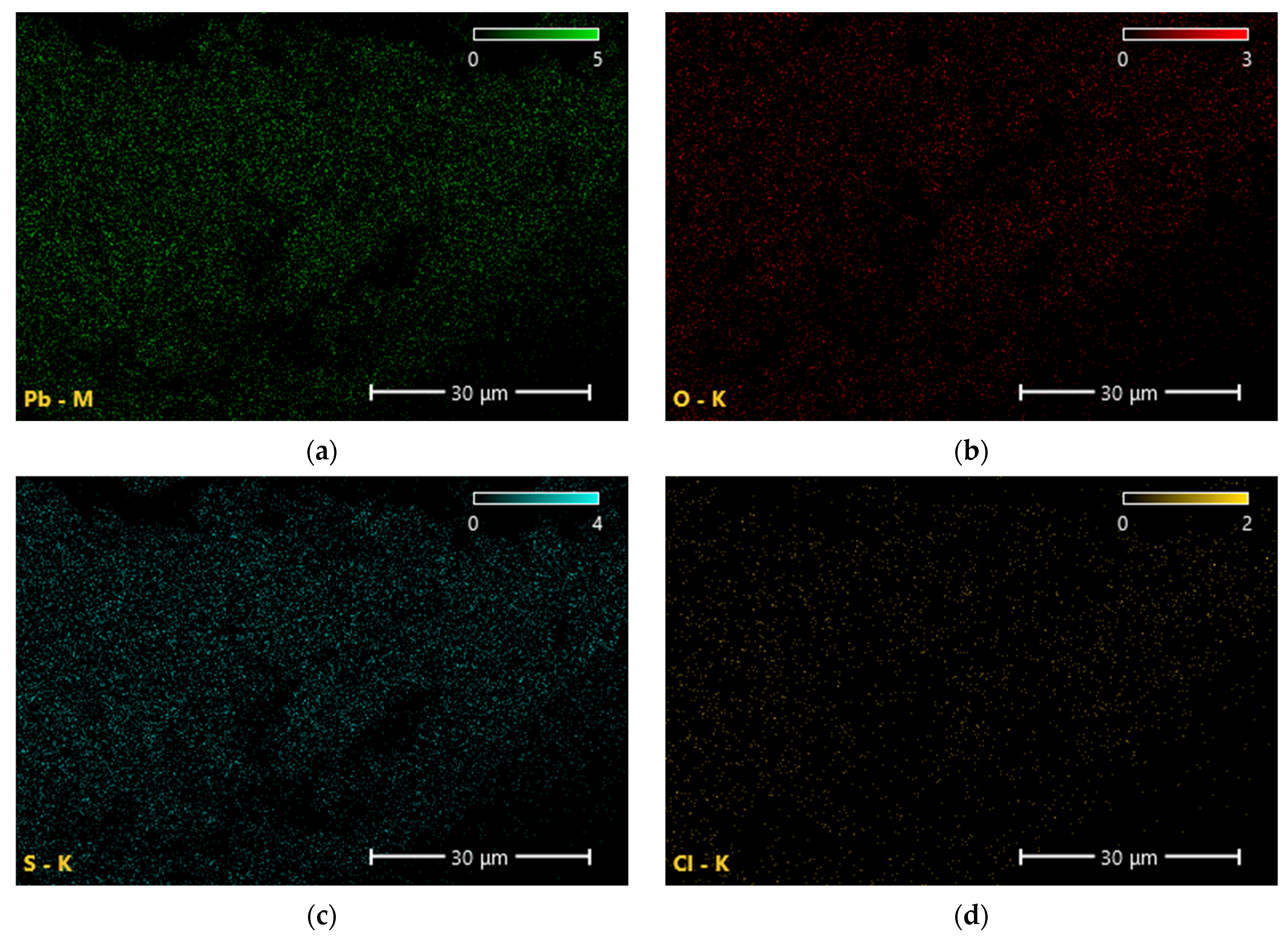
Elemental mapping (Figure 3) confirms the heterogeneous distribution of components within the particles. Lead is unevenly distributed and shows strong spatial correlation with oxygen and sulfur, indicating its presence in oxide and sulfate forms. Chlorine is localized in specific regions, suggesting the formation of lead oxychloride phases. The observed spatial association of Pb with O and S supports the predominance of lead oxide and sulfate phases identified by IR spectroscopy and subsequently included in the rational composition of the dust (Table 3). Similarly, the localized distribution of chlorine is consistent with the presence of lead oxychloride species, which play an important role in predicting chlorine behavior during thermodynamic modeling.
Figure 3.
Elemental distribution maps of major and impurity elements in particles of lead-bearing dust: (a) Pb; (b) O; (c) S; (d) Cl.
Table 3.
Calculated rational composition of battery production dust.
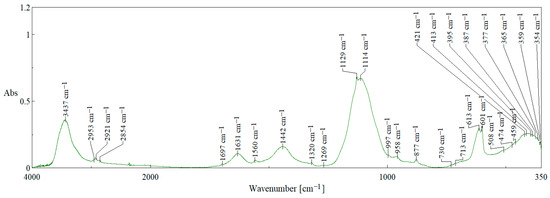
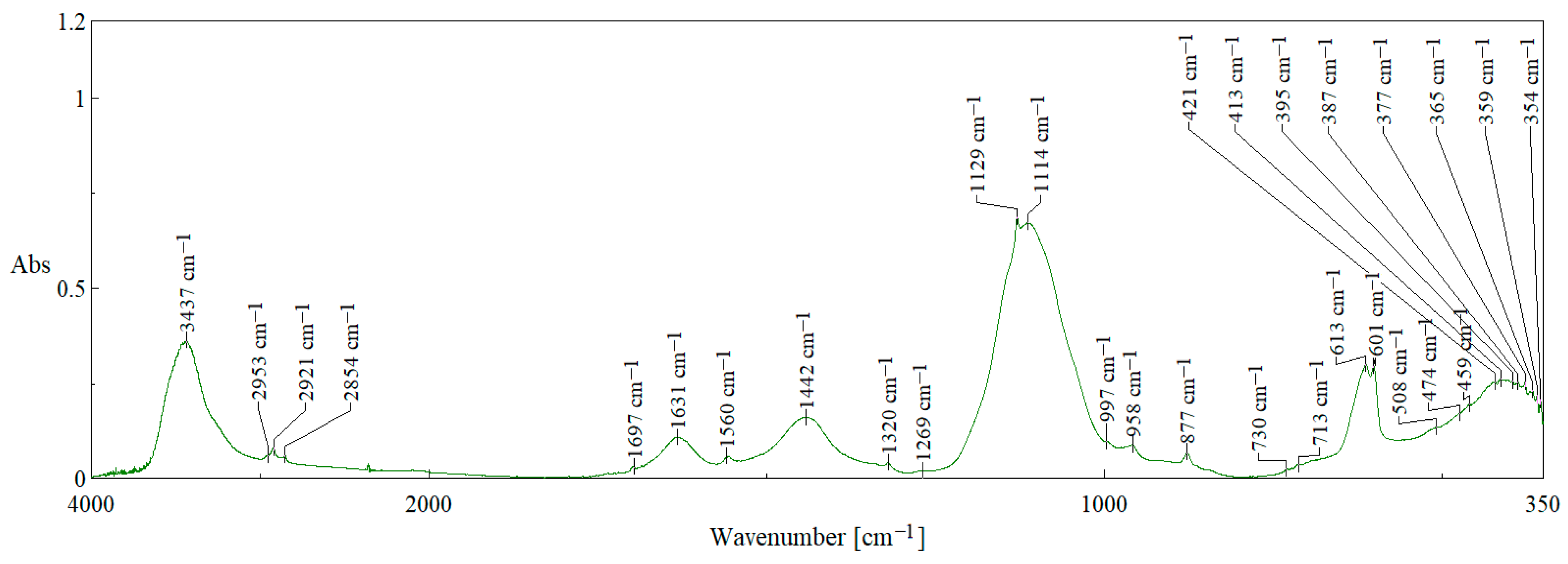
IR spectroscopy (Figure 4) was used to refine the phase composition of the dust. Intense absorption bands at 1114, 958, 613, and 601 cm−1 correspond to vibrations of the SO42− group, confirming the presence of lead sulfate. The simultaneous presence of sulfate and Pb–O vibrations indicates the formation of basic lead sulfate (PbO·PbSO4).
Figure 4.
IR spectrum of lead-bearing dust.
In the region of 500–350 cm−1, bands corresponding to Pb–O vibrations are observed, indicating the presence of PbO2 (plattnerite) and PbO polymorphs (massicot and litharge). The possible presence of PbO·PbCl2 is suggested by Pb–Cl vibrations, although these signals partially overlap with those of oxide phases.
Bands at 413, 387, and 377 cm−1 correspond to Sb–S vibrations and the [SbS4]3− group, indicating the presence of antimony sulfosalts (FeSb2S4). The band at 877 cm−1 is attributed to [AsO4]3− vibrations. Weak bands in the regions 2950–2850 and 1695–730 cm−1 correspond to minor organic impurities, while bands at 3437 and 1631 cm−1 are associated with adsorbed moisture.
The combined results of chemical analysis (Table 2), SEM observations (Figure 2), EDS mapping (Figure 3), and IR spectroscopy (Figure 4) provide a consistent description of the dust composition and were used as the basis for calculating its rational composition and for subsequent thermodynamic modeling. The agreement between the IR spectral features and the SEM-EDS observations provides additional support for the proposed rational phase composition. In particular, the identification of sulfate-, oxide-, oxychloride-, and arsenate-containing phases justifies their inclusion in the thermodynamic model and serves as an experimental basis for predicting their behavior during electric smelting.
Table 3 presents the calculated rational composition of the dust and the molar fractions of components used in subsequent thermodynamic modeling. These data form the basis for predicting phase transformations and evaluating the behavior of key elements during electric smelting.
Analysis of the rational composition shows that lead is predominantly present in the form of oxides, sulfates, and oxychlorides, with PbO2 and PbO∙PbSO4 being the major phases. The presence of PbO·PbCl2 indicates the significant role of chlorine in phase formation, while Na2SO4 reflects the interaction of sodium compounds with sulfur species. Minor components, including As2O3, FeSb2S4, and Pb3(AsO4)2, represent impurity phases that may influence both slag formation and element distribution.
Such phase composition suggests that, under reducing conditions, lead can be effectively recovered from oxide and sulfate phases, while chlorine and sulfur are expected to be partially transferred to the slag phase in the form of stable compounds.
The results of the chemical analysis of sugar industry defecate are presented in Table 4. The material is mainly composed of CaO and CO2, indicating that calcium is predominantly present in the form of CaCO3. The presence of MgO and minor impurities suggests a multicomponent nature of the material, which may influence its behavior during smelting.
Table 4.
Composition of sugar industry defecate (mass fractions of oxides and corresponding elements).
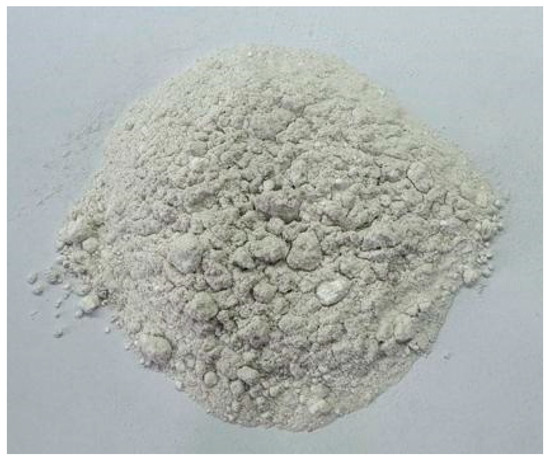
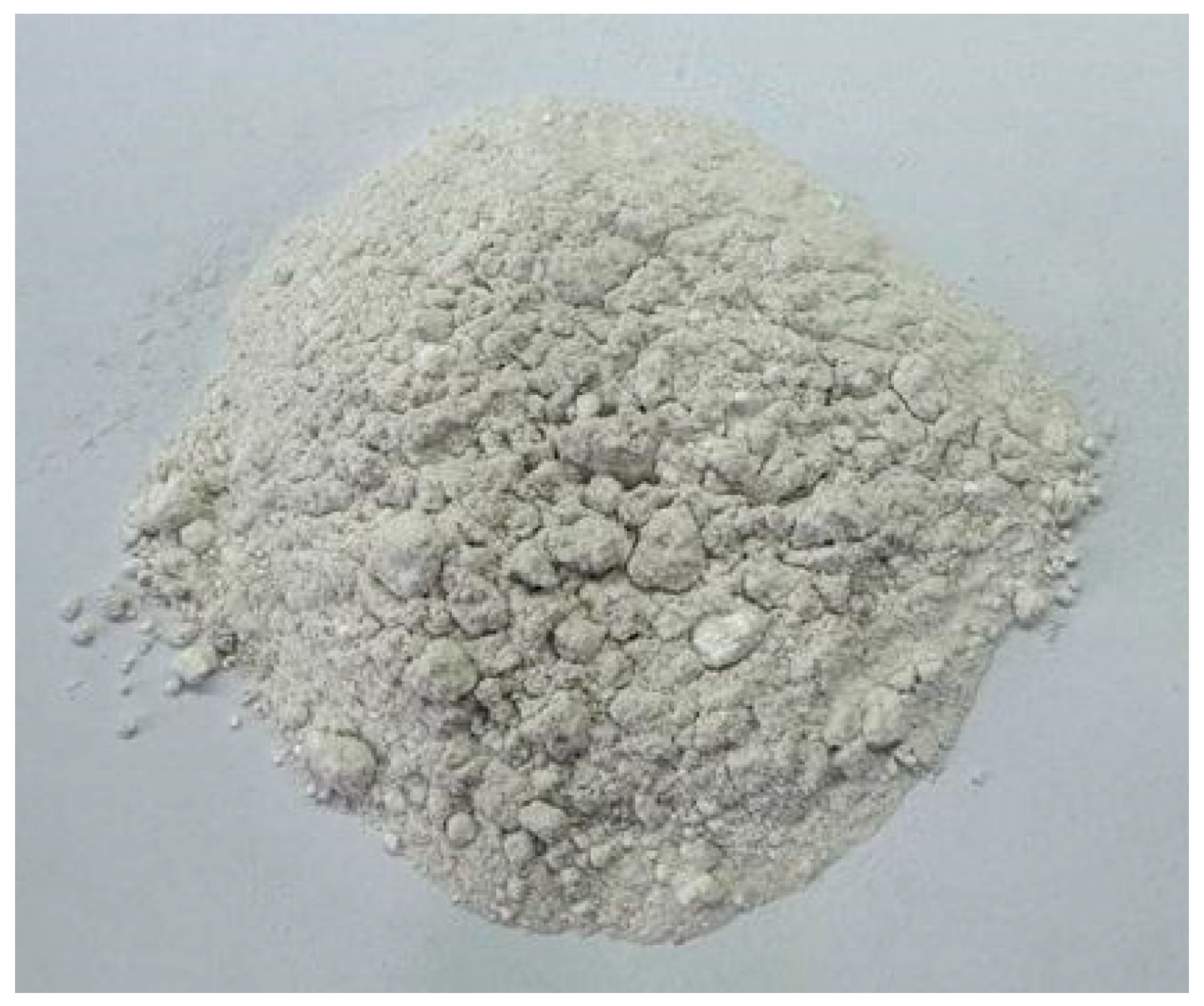
The appearance of defecate (Figure 5) shows a fine grayish-white powder with a loose structure, typical of lime-carbonate industrial residues.
Figure 5.
Appearance of sugar industry defecate.
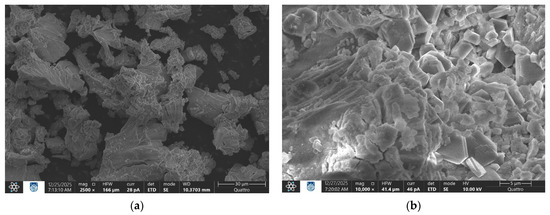
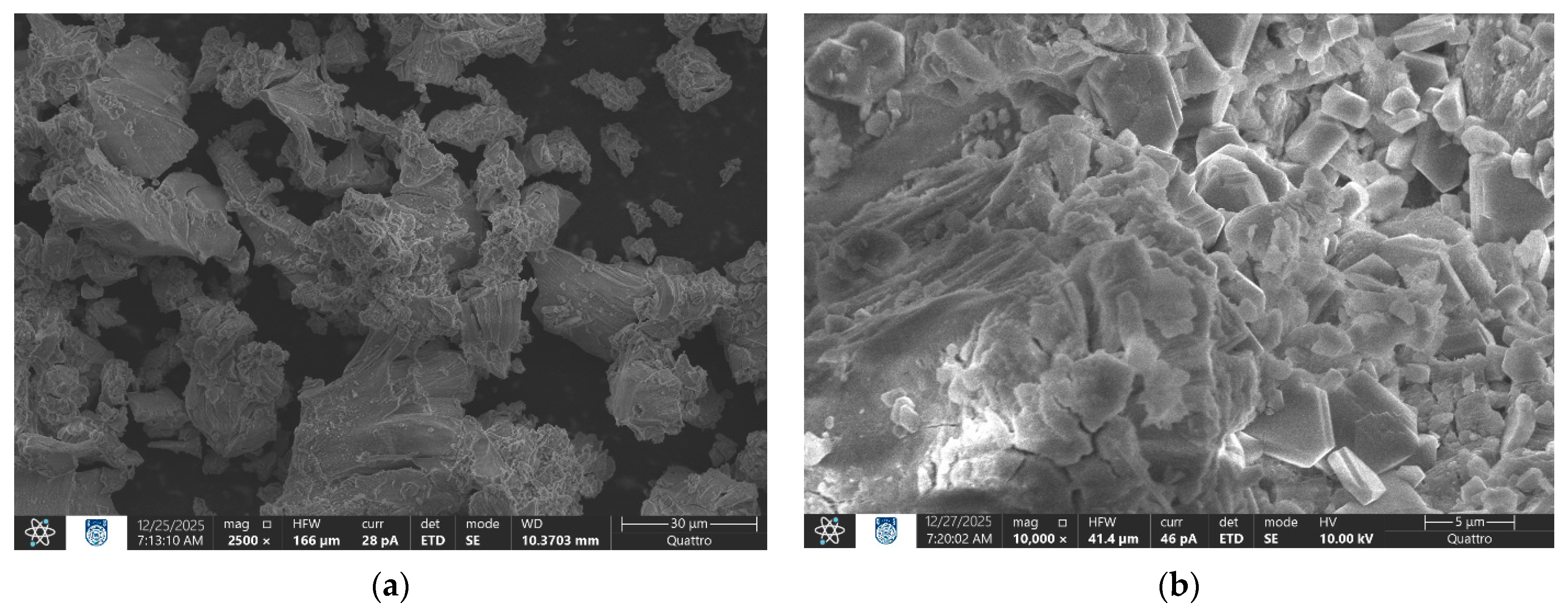
SEM analysis (Figure 6a,b) indicates that defecate consists of agglomerated calcium carbonate (CaCO3) particles with predominantly rhombohedral and plate-like morphology characteristic of calcite. At low magnification (Figure 6a), loose aggregates tens of micrometers in size are observed, combining dense and porous regions. At higher magnification (Figure 6b), individual crystals and fragments become distinguishable, indicating morphological heterogeneity.
Figure 6.
Morphology of sugar industry defecate according to SEM data at different magnifications: (a) general morphology of agglomerated CaCO3 particles (×2500); (b) morphology of individual crystals and particle fragments (×10,000).
Such morphology is associated with the presence of finely dispersed CaCO3 and organic residues acting as natural binders. The layered surface and the presence of micropores result in a high specific surface area, which enhances reactivity and promotes interaction with impurity elements during smelting.
In the subsequent thermodynamic analysis, not only the rational composition of lead-bearing dust and defecate was considered, but also auxiliary charge components, including sodium carbonate, silicon dioxide, iron, and carbon. These components ensure the occurrence of reduction reactions, slag formation, and immobilization of impurity elements such as sulfur, arsenic, and chlorine.
Although these materials were not subjected to detailed characterization due to their analytical-grade purity, their chemical nature and functional role were taken into account in the modeling-phase transformations occurring during electric smelting.
3.2. Thermodynamic Perspective on Phase Transformations During Electro-Smelt of Lead-Containing Dust
During the electric smelting of lead-bearing dust in a reducing atmosphere, a complex set of reduction and slag-forming reactions occurs, determining the phase composition of the final products. Oxide, sulfate, and chloride compounds of lead are reduced with the formation of crude lead, into which antimony contained in the initial dust also transfers:
PbO + C → Pb + CO
PbO2 + 2C → Pb + 2CO
PbSO4 + 2C → Pb + 2CO + SO2
PbO∙PbSO4 + Na2CO3 + 3C → 2Pb + Na2S + 4CO2
PbCl2 + Na2CO3 → PbO + 2NaCl + CO2
2PbCl2 + 2Na2CO3 + C → 2Pb + 4NaCl + 3CO2
PbCl2 + CaO → PbO + CaCl2
PbCl2 + CaCO3 + 2C → Pb + CaCl2 + 3CO
PbCl2·PbO + CaO + 2C → 2Pb + CaCl2 + 2CO
Sb2O3 + 3C → 2Sb + 3CO
The interaction of FeSb2S4 with calcium oxide leads to the decomposition of the sulfoantimonide mineral with the formation of iron and antimony oxides. At the same time, calcium participates in sulfur fixation and stabilization of the slag phase, preventing its transfer into the metallic phase:
FeSb2S4 + 4CaO → FeO + Sb2O3 + 4CaS
Sodium- and calcium-containing components of the charge play a key role in controlling the phase and chemical state of the system. The initial dust contains Na2SO4, which, during electric smelting, transfers to the slag phase and participates in sulfur binding—partly in the form of sulfate (Na2SO4) and, upon reduction by carbon, in the form of sulfide (Na2S), thereby promoting the removal of sulfur from the metallic phase.
Na2SO4 + 2C → Na2S + 2CO2
At the same time, sodium oxide reacts with silica, forming a silicate slag:
Na2O + SiO2 → Na2SiO3
Calcium-containing fluxes form silicate slags (CaSiO3, Ca2SiO4, CaFeSiO4) and arsenate compounds (Ca3(AsO4)2), and may also potentially form calcium chlorides and sulfates (CaCl2, CaSO4), which thermodynamically allow calcium to participate in dechlorination processes and sulfur fixation.
CaO + PbSO4 → CaSO4 + PbO
2CaO + 2SO2 + O2 → 2CaSO4
2CaO + SiO2 → Ca2SiO4
CaO + FeO + SiO2 → CaFeSiO4
CaO + SiO2 → CaSiO3
The combined action of sodium and calcium contributes to the stabilization of the slag phase, a reduction in the content of harmful impurities in crude lead, and an increase in metal recovery, ensuring a thermodynamically favorable distribution of components among the phases—crude metal, slag, and gas phase.
Silicon oxide present in the charge reacts with lead and iron oxides to form slag silicates:
2PbO + SiO2 → Pb2SiO4
2FeO + SiO2 → Fe2SiO4
Arsenic can be distributed between condensed and gaseous phases. In the condensed phase, it may be present in the form of calcium and sodium arsenates as well as iron arsenide, whereas under certain conditions, part of the arsenic may occur in the gas phase as arsenic trioxide (As2O3).
As2O3 + O2 → As2O5
3CaO + As2O5 → Ca3(AsO4)2
3Na2O + As2O5 → 2Na3AsO4
Pb3(AsO4)2 + 3CaO → Ca3(AsO4)2 + 3PbO
Pb3(AsO4)2 + C → 3PbO + As2O3(g) + CO2
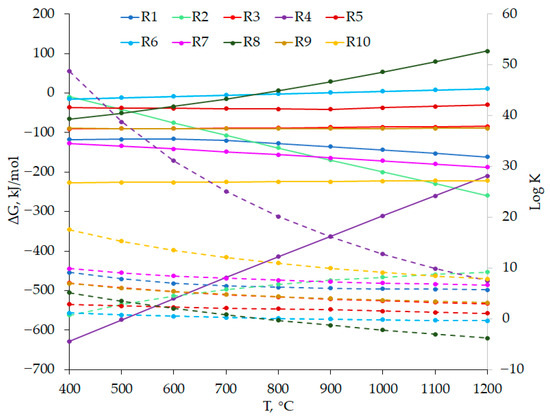
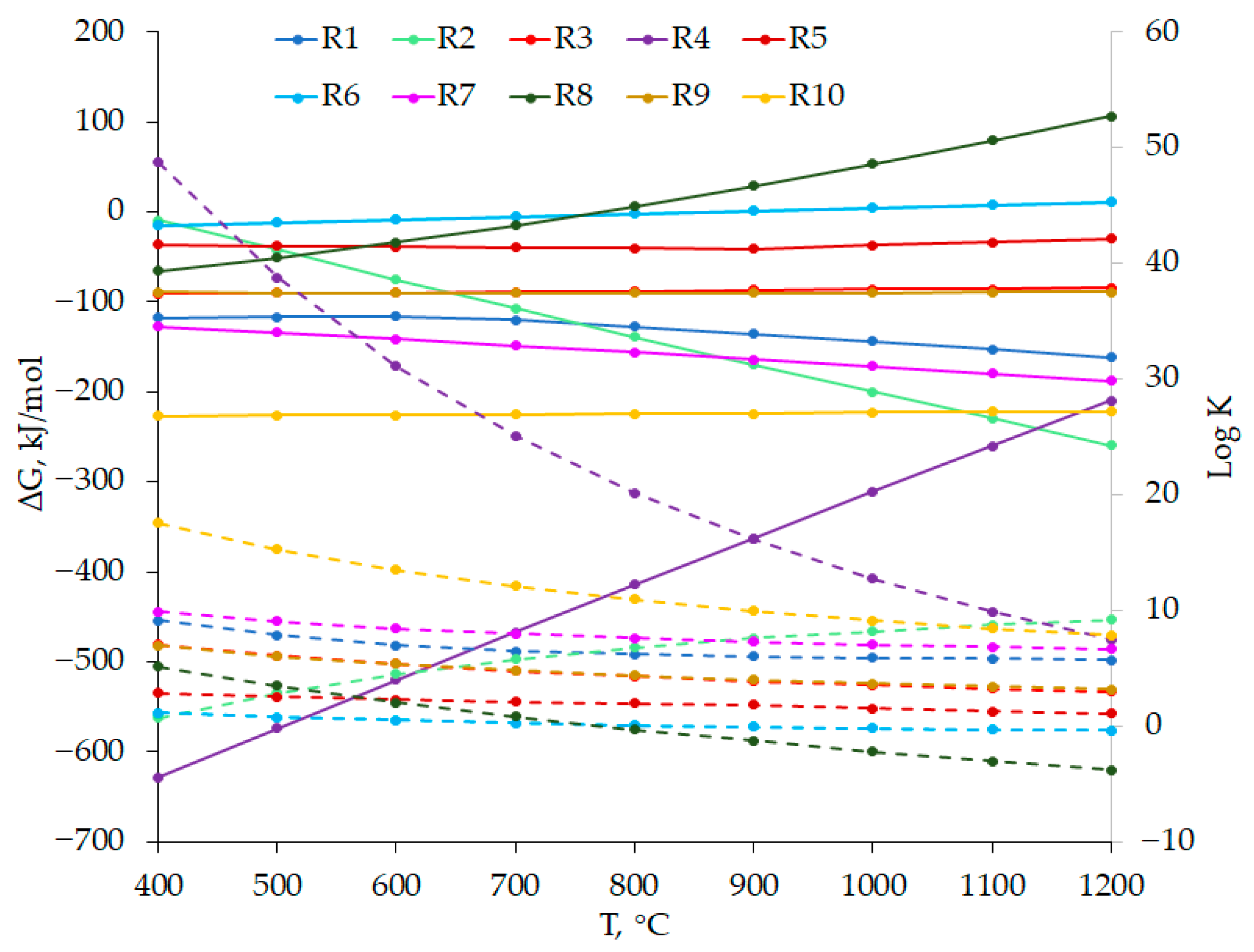
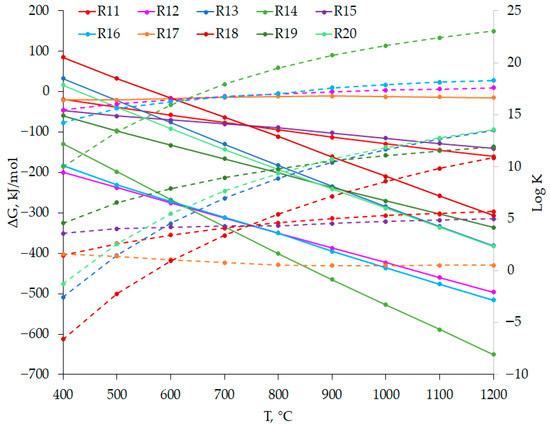
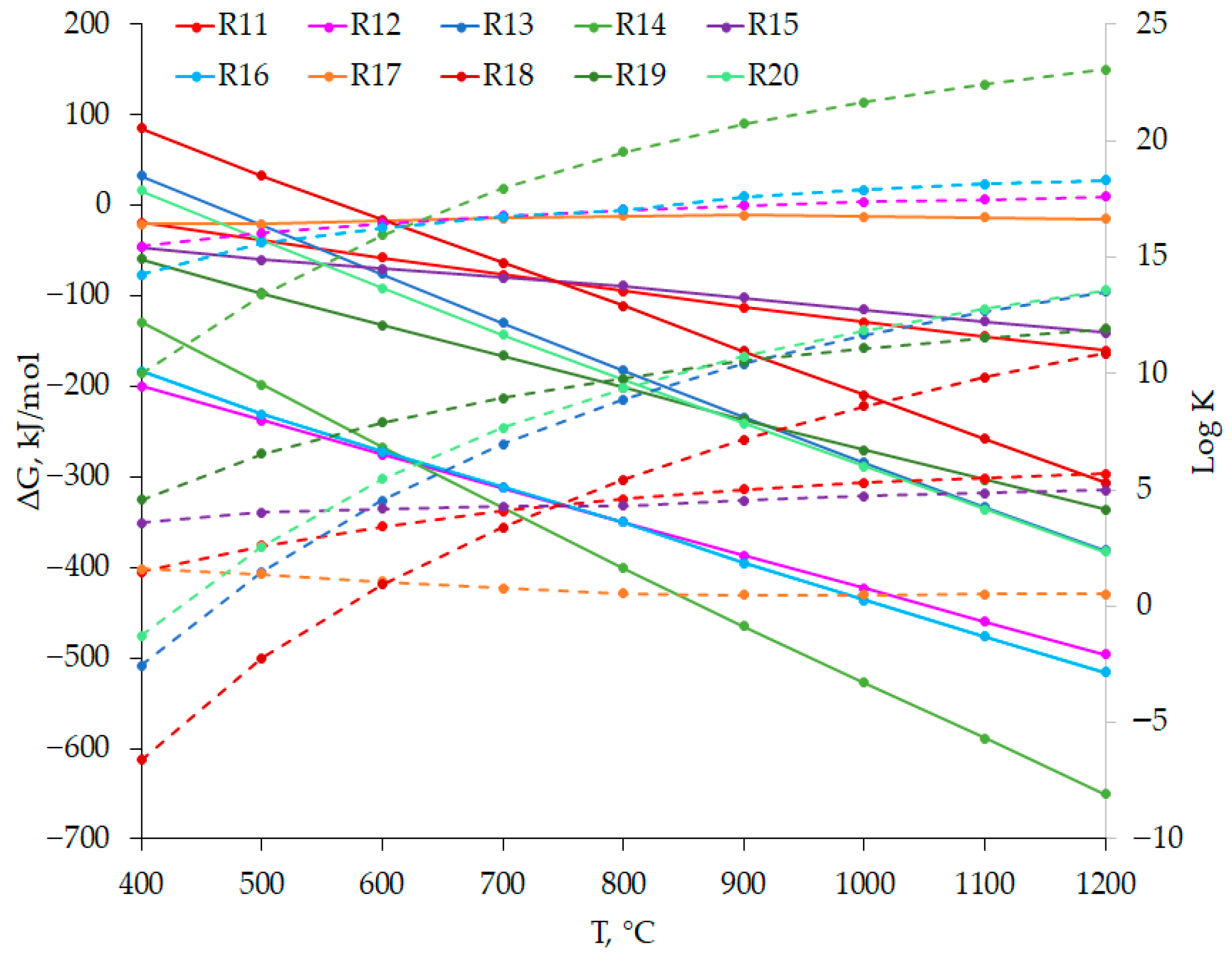
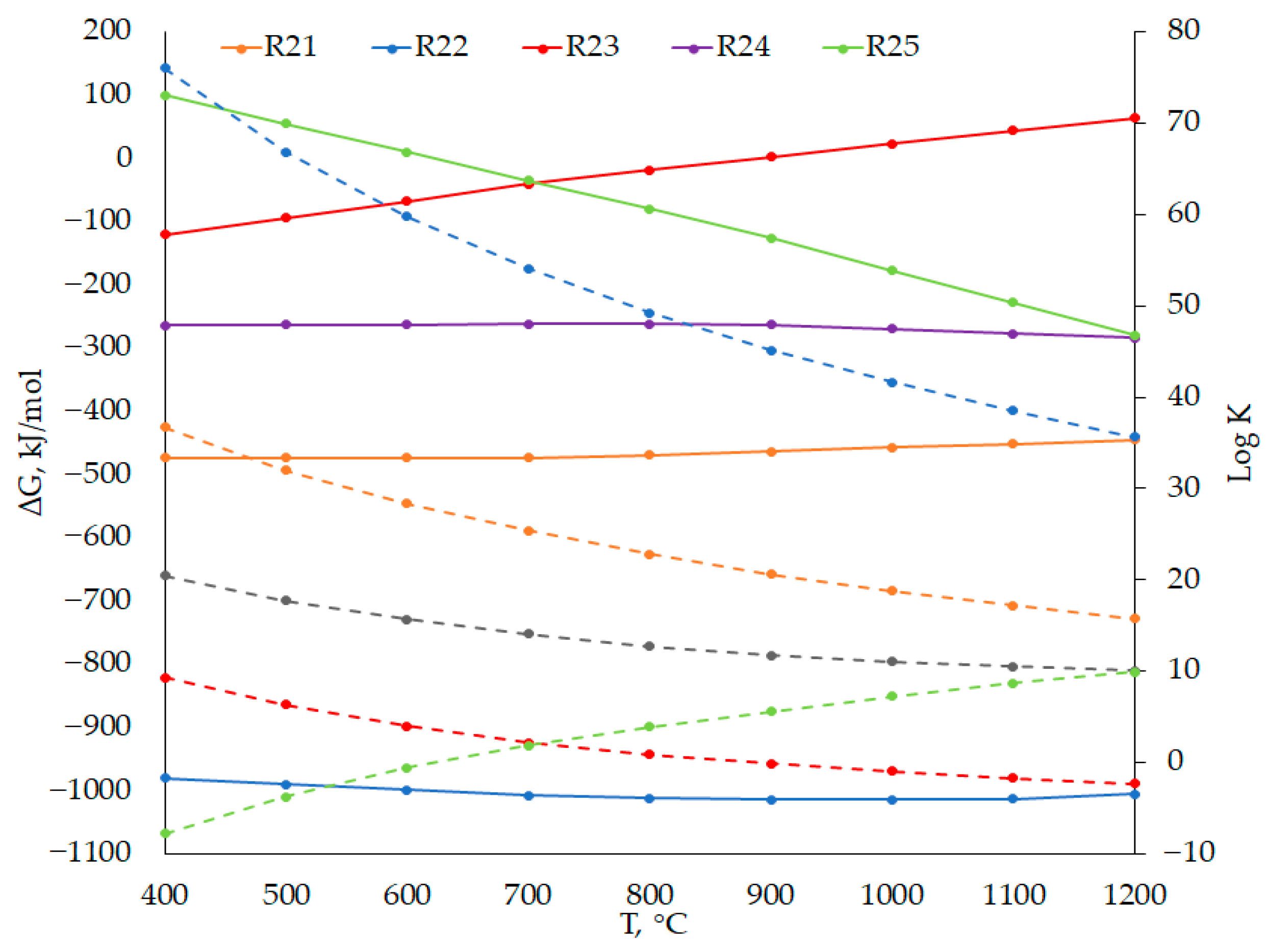
To confirm the proposed mechanism and evaluate the direction of chemical transformations of lead and its compounds, a thermodynamic calculation of possible electric smelting reactions was performed. The calculation results are presented in Figure 7, Figure 8 and Figure 9. The graphs show the change in Gibbs free energy (ΔG, kJ/mol) on the left axis and the logarithm of the equilibrium constant (log K), calculated from ΔG, on the right axis. This approach makes it possible to simultaneously assess the thermodynamic feasibility of reactions and the degree of their shift toward product formation.
Figure 7.
Thermodynamic characteristics of reduction reactions of lead and antimony compounds. Solid lines—ΔG; dashed lines—log K.
Figure 8.
Temperature dependence of ΔG and log K for slag-forming and sulfur-binding reactions. Solid lines—ΔG; dashed lines—log K.
Figure 9.
Thermodynamic characteristics of formation and decomposition reactions of arsenate compounds. Solid lines—ΔG; dashed lines—log K.
The reduction reactions of lead from its oxide, sulfate, and chloride compounds are characterized by negative Gibbs free energy values and an increase in the equilibrium constant with rising temperature, indicating a shift in equilibrium toward products and a high thermodynamic probability of lead reduction by carbon in the temperature range of 400–1200 °C (Figure 7). The reduction of lead oxides, as well as complex compounds such as PbO·PbSO4 (reactions 1–4), demonstrates particularly high thermodynamic stability.
The interaction of lead chloride with calcium compounds is characterized by negative ΔG values at relatively low temperatures, but the thermodynamic advantage of the reaction decreases with increasing temperature (reactions 7–9). This indicates that chlorine binding in the form of CaCl2 is thermodynamically feasible, although its extent may depend on the melt composition and competing reactions involving sodium.
It should be noted that thermodynamic calculations provide information on the feasibility and equilibrium direction of the reactions but do not allow for the estimation of reaction rates or process duration. According to the calculated Gibbs free energy values and equilibrium constants, the most favorable conditions for lead reduction are observed in the temperature range of approximately 800–1200 °C. The actual duration of the process is governed by kinetic factors and must be determined experimentally.
Antimony oxide (Sb2O3), present in the initial dust or formed during the decomposition of complex sulfide compounds (e.g., FeSb2S4) in interaction with CaO (reaction 11), is effectively reduced to the metallic state in a reducing atmosphere at temperatures above 500–600 °C. Increasing temperature leads to a significant increase in the equilibrium constant of reaction 10, resulting in the transfer of antimony to the lead phase (Figure 7).
The analysis of slag-forming reactions shows that the formation of calcium and sodium silicates (CaSiO3, Ca2SiO4, Na2SiO3), as well as arsenates (Ca3(AsO4)2, Na3AsO4), is accompanied by negative ΔG values and high equilibrium constants throughout the investigated temperature range (Figure 8 and Figure 9). This indicates the high thermodynamic stability of these compounds and their potential role in slag phase formation.
The formation of lead and iron silicates (Pb2SiO4, Fe2SiO4), as well as calcium ferrosilicate (CaFeSiO4), is more likely in the lower temperature region (Figure 8); with increasing temperature, the thermodynamic probability of their formation decreases, indicating a redistribution of components between phases during system heating.
The interaction of CaO with PbSO4 is thermodynamically more probable at lower temperatures, whereas the stability of CaSO4 decreases with increasing temperature. At the same time, the reaction of SO2 binding by calcium oxide in the presence of oxygen is characterized by strongly negative ΔG values, indicating the fundamental possibility of sulfur fixation in the form of calcium sulfate under oxidizing conditions (Figure 8).
The reduction of lead arsenate Pb3(AsO4)2 by carbon becomes thermodynamically probable at temperatures above 700 °C. Under these conditions, part of arsenic may transfer to the gas phase in the form of As2O3, which should be taken into account when analyzing element distribution and controlling gaseous emissions (Figure 9).
Thus, the analysis of individual reactions shows that the reduction of lead and antimony, as well as the formation of calcium and sodium silicate, arsenate, chloride, and sulfate compounds, is thermodynamically feasible under electric smelting conditions. However, this approach is based on the consideration of isolated reactions and does not account for the mutual influence of components in a real multicomponent system containing Pb–Sb–Fe–Na–Ca–Si–S–Cl–As.
Under conditions of the simultaneous presence of Na2CO3 and CaO, the distribution of sulfur, chlorine, and arsenic is determined by the comparative thermodynamic stability of possible compounds, their activities in the melt, and competition between sodium- and calcium-containing phases. Therefore, to correctly evaluate the phase composition and quantitative distribution of elements among the metallic, slag, and gas phases, it is necessary to perform thermodynamic equilibrium modeling of a multicomponent system.
Therefore, to correctly evaluate the phase composition and quantitative distribution of elements among the metallic, slag, and gas phases, it is necessary to perform thermodynamic equilibrium modeling of a multicomponent system.
It should be noted that the thermodynamic equilibrium model represents an idealized limiting state of the system. Under real smelting conditions, the distribution of elements between the metallic, slag, and gas phases may be affected by kinetic limitations, incomplete reactions, mass-transfer restrictions, slag viscosity, particle size, mixing conditions, the duration of holding at the target temperature, and incomplete separation of metallic and slag phases. Therefore, the calculated equilibrium phase composition should be interpreted as a thermodynamic prediction of the most favorable phase distribution rather than an exact representation of the real process. These factors may explain the differences between the modeled equilibrium distribution and the experimentally observed recoveries.
3.3. Thermodynamic Modeling of Phase Equilibria During Electrosmelting
After performing the thermodynamic analysis of key reduction and slag-forming reactions, which made it possible to determine the direction and thermodynamic feasibility of the processes, the next stage involved phase equilibrium modeling. The purpose of the modeling was to quantitatively determine the composition of the metallic, slag, and gas phases at different temperatures and charge component ratios. Such a combination of approaches—first qualitative thermodynamic analysis, followed by quantitative phase modeling—provides a comprehensive understanding of the mechanisms involved in the processing of lead-bearing dust with fluxing additives and substantiates the optimal conditions for electric smelting.
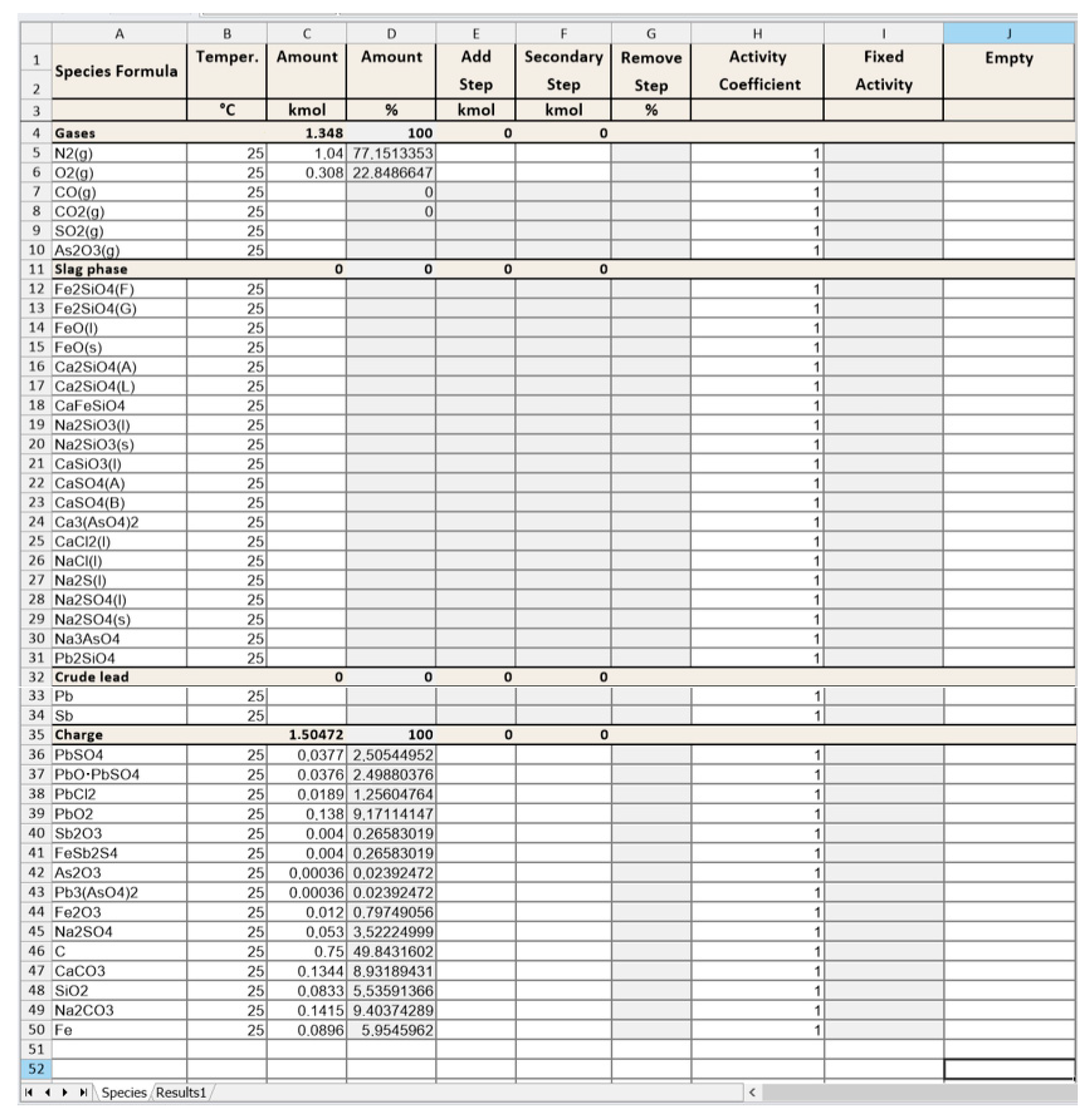
For modeling, the initial phases of the system were defined as a solid phase, represented by a mixture of lead-bearing dust with fluxing components and a reducing agent, and a gas phase represented by air. During the processing of lead-bearing dust, the optimal amount of soda ash in the charge is 30–40% of the dust mass [37]. In the present study, the mass of lead-bearing dust was taken as 100% (100 g), and the amounts of fluxing and reducing additives were calculated as percentages of its mass. The charge composition was selected as follows: lead-bearing dust—100 g (100%); soda ash (Na2CO3)—15 g (15% of dust mass); sugar industry defecate—15 g (15% of dust mass); reducing agent (activated carbon)—9 g (9%); silicon oxide (SiO2)—5 g (5%); iron chips—5 g (5%). The mass of defecate was chosen as 15% of the dust mass. Based on the CaO content in defecate (Table 4), the amount of calcium carbonate was calculated using the stoichiometric relationship between CaO and CaCO3 (molar masses 56 and 100, respectively). As a result, the actual mass of CaCO3 introduced into the charge via defecate was 13.44 g, and this value was used in the modeling. The total fraction of soda ash and defecate in the charge was 30% of the dust mass, which corresponds to the optimal range. The equilibrium phase composition calculations were carried out in the temperature range of 200–1200 °C.
In the GEM (Equilibrium Compositions) module, a table of input data for thermodynamic modeling was prepared, as shown in Figure 10. The figure represents a screenshot of the software interface of Outotec HSC Chemistry v. 8.1.5; therefore, the empty columns visible in the figure are part of the program interface and do not indicate missing input data.
Figure 10.
Initial data in the GEM module for calculating equilibrium phase compositions.
In the thermodynamic modeling of equilibrium phase relationships during the electric smelting of lead-bearing dust with soda ash and defecate, all potential phases described in Section 3.1 were taken into account in the calculations.
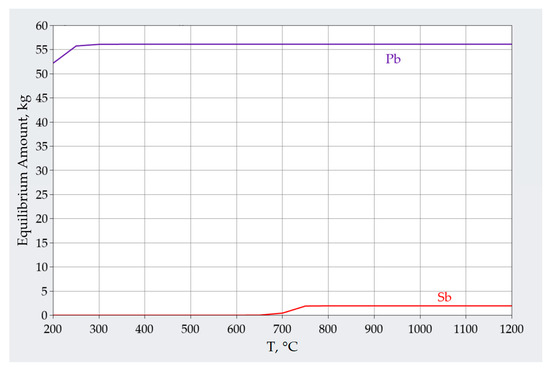
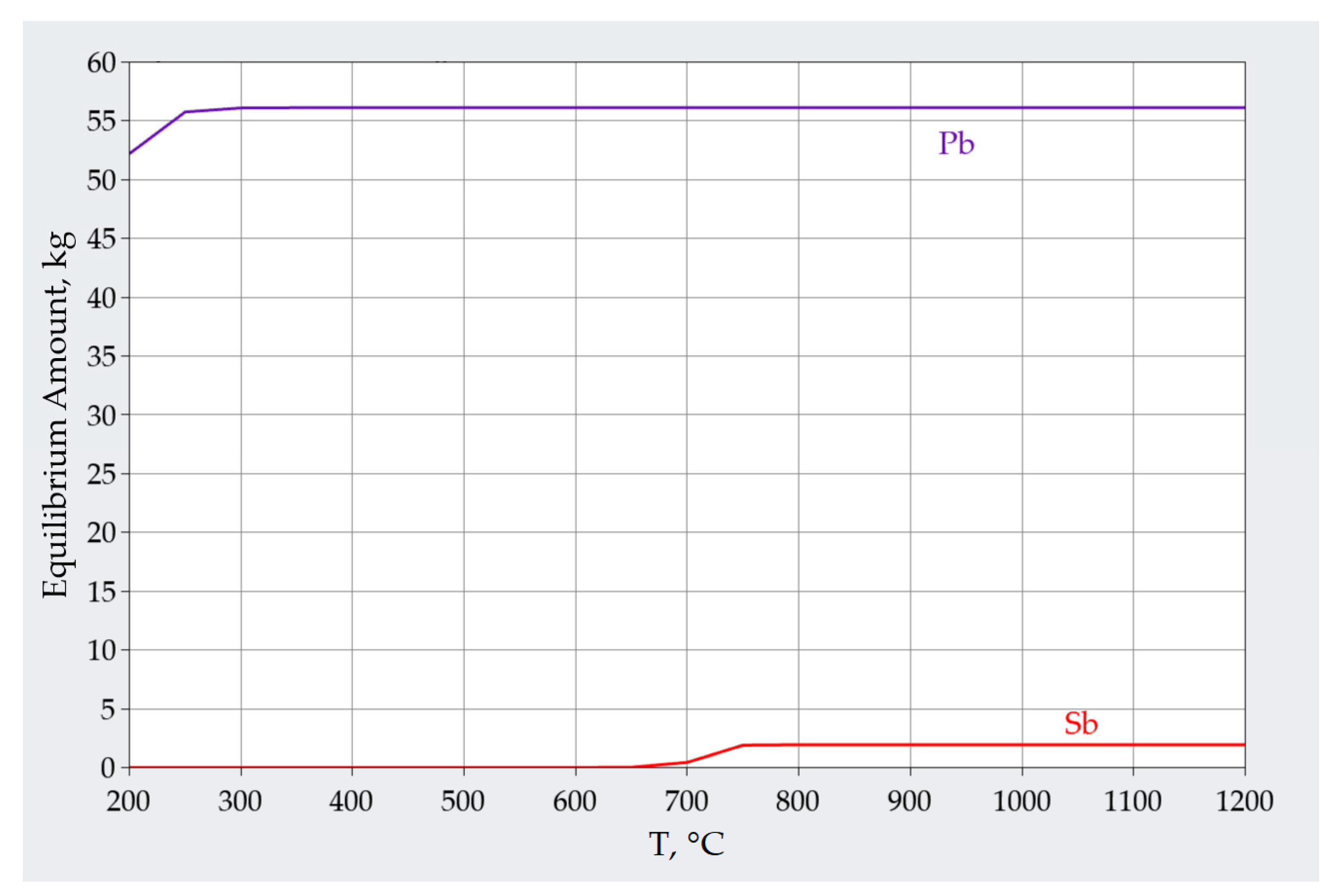
During the processing of battery production dust, the technological objective of smelting is to concentrate lead and antimony in crude metal, while all other components are transferred to the slag phase. This approach ensures the formation of a stable lead–antimony alloy, which can subsequently be used, for example, in battery production. Both modeling results and experimental data show that throughout the temperature range of approximately 350–1200 °C, lead remains the dominant component of the metallic phase, and antimony is consistently incorporated into this phase (Figure 11).
Figure 11.
Curves of equilibrium metallic phase composition as a function of temperature.
Figure 11 shows the curves describing changes in the equilibrium composition of the metallic phase, calculated per 100 kg of initial lead dust, as a function of temperature. The formation of crude lead begins with increasing temperature and is accompanied by a gradual increase in the mass of the metallic phase. As illustrated in Figure 11, the principal component of the crude metal is lead (Pb). Its mass rapidly reaches approximately 52.2 kg at the initial stage of formation (200 °C) and gradually increases to about 56.1 kg at higher temperatures (≥300–400 °C), indicating the formation of a stable metallic matrix. The initial lead content in 100 kg of dust was approximately 60.07 kg, which is in good agreement with the calculated values.
Antimony, which is a typical impurity in battery-production dust, predominantly transfers into crude lead. At the early stages, its mass is extremely small (~1.2∙10−9 kg at 200 °C) and remains nearly unchanged up to temperatures of about 400–500 °C. With further temperature increase, the mass of Sb gradually rises, reaching a maximum of approximately 1.95 kg at the high-temperature stage (≥800 °C), which reflects the redistribution of the impurity from the initial dust (100 kg of dust contained ~1.97 kg Sb).
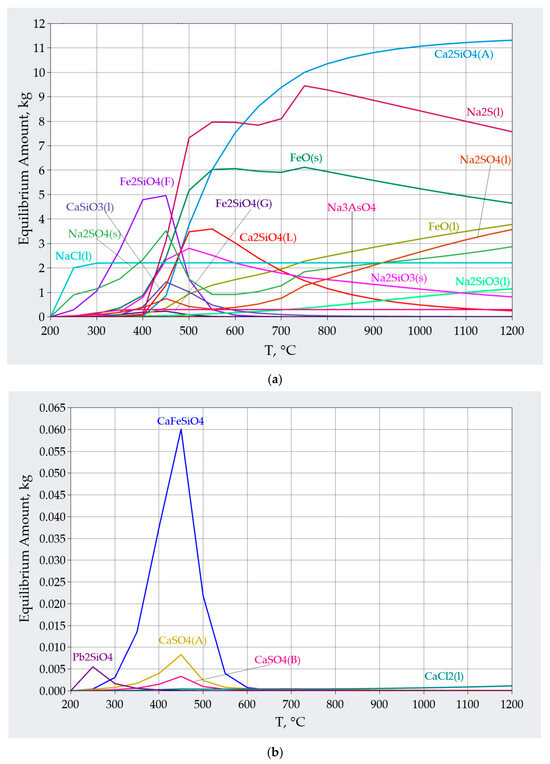
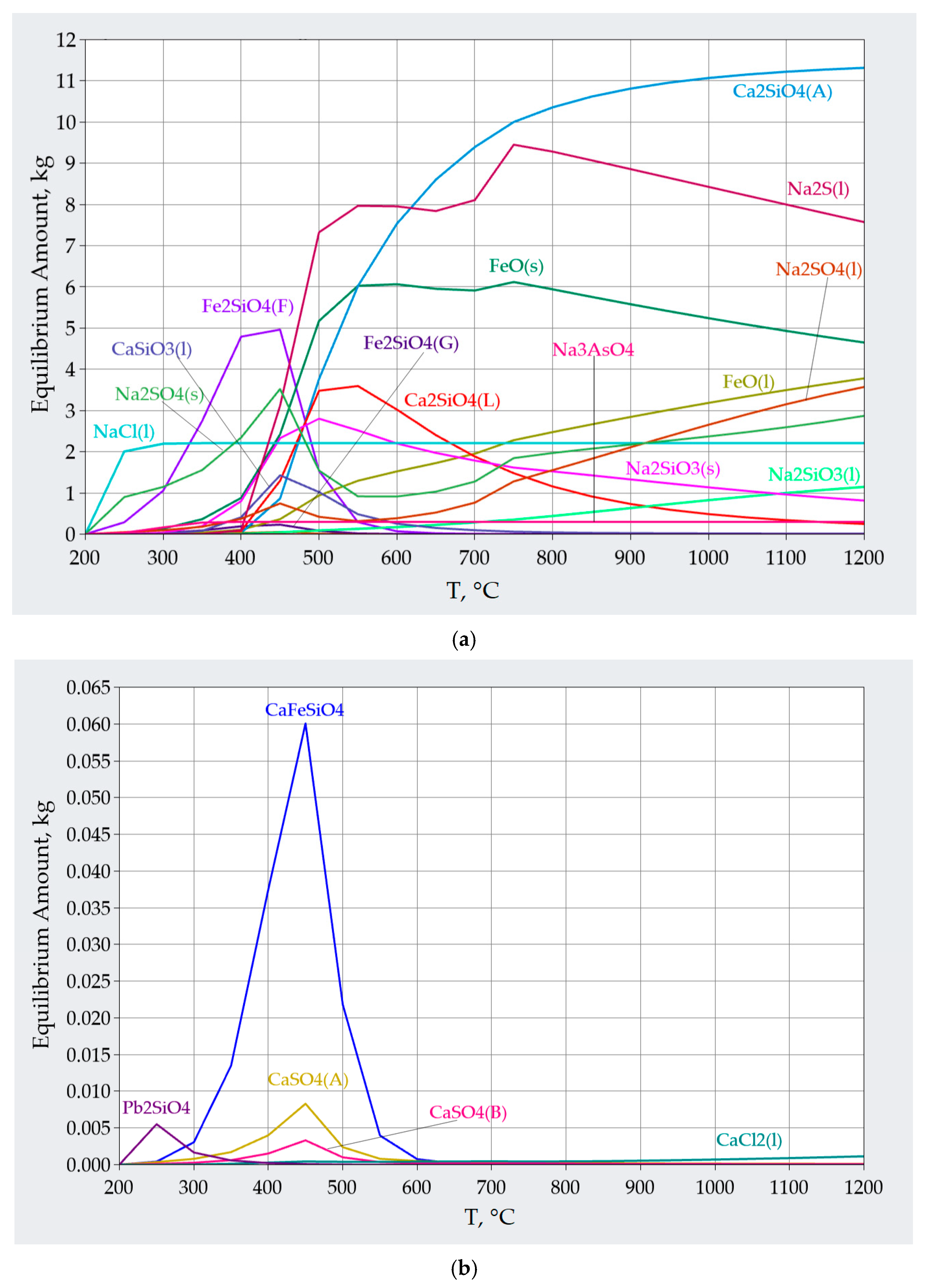
The change in the equilibrium composition of the slag phase in the temperature range of 200–1200 °C was studied using a thermodynamically equilibrated system with 20 components, including solid and liquid phases (Figure 12a,b). In Figure 12b, the ordinate axis is presented in the range from 0.000 to 0.065 kg, which makes it possible to trace variations in the equilibrium compositions of the slag phase at low concentrations of compounds.
Figure 12.
Curves of equilibrium slag-phase composition as a function of temperature. (a) temperature-dependent changes in the major slag-forming phases. (b) temperature-dependent changes in minor and trace phases shown on an enlarged concentration scale.
At low temperatures, particularly at 300 °C, the main silicate component of the slag is iron silicate Fe2SiO4 (F + G), with a total mass of about 1.08 kg. During this period, the mass of liquid phases is minimal, while sodium salts such as NaCl and Na2SO4 (s) constitute a significant fraction of the system, with masses of approximately 2.19 kg and 1.15 kg, respectively. As the temperature increases to 400 °C, the mass of Fe2SiO4 rises to 4.98 kg, indicating high thermodynamic stability of the iron-silicate phase at the initial stage of slag formation. At the same time, calcium-containing silicates, including Ca2SiO4 and CaSiO3, are present in small amounts and do not significantly affect the structure of the slag matrix.
With the transition to the intermediate temperature range of 500–700 °C, a substantial restructuring of the phase composition occurs. The mass of Fe2SiO4 sharply decreases from 4.98 kg to 1.62 kg at 500 °C and further declines to less than 0.01 kg at 700 °C. Simultaneously, intensive formation of calcium orthosilicate Ca2SiO4 takes place, with its mass increasing from 3.76 kg at 500 °C to 9.39 kg at 700 °C, making it the dominant silicate phase in the system. The liquid phase FeO (l) increases from 0.94 kg to 1.95 kg, reflecting the redistribution of iron into the oxide liquid phase. The liquid form of Na2S shows a sharp increase, rising from 7.32 kg at 500 °C to 8.10 kg at 700 °C, indicating the predominance of reducing conditions in the system. Meanwhile, the total mass of Na2SO4 (l + s) increases moderately, reflecting partial oxidation of sulfur during the formation of the liquid phase.
In the high-temperature region of 800–1200 °C, the main solid component of the slag is Ca2SiO4, whose mass steadily increases from 10.36 kg at 800 °C to 11.32 kg at 1200 °C. The formation of calcium silicate phases, particularly Ca2SiO4, is also important from a technological perspective. The conversion of silica into calcium silicates may contribute to an increase in slag basicity and promote the development of a stable silicate matrix. The predominance of Ca2SiO4 at elevated temperatures is expected to facilitate slag melting and improve metal–slag separation. More efficient separation of the metallic and slag phases may reduce the mechanical entrainment of lead droplets into the slag and contribute to higher metal recovery. Therefore, the formation of calcium silicate phases is favorable not only from a thermodynamic standpoint but also with respect to practical smelting performance. The mass of calcium metasilicate CaSiO3 (l) remains relatively low (0.042–0.018 kg), confirming its minor role in the formation of the primary slag structure. Iron silicate Fe2SiO4 almost completely disappears, whereas liquid FeO (l) increases from 2.48 kg at 800 °C to 3.78 kg at 1200 °C. The total mass of liquid phases, including FeO (l), Ca2SiO4 (l), CaSiO3 (l), Na2SiO3 (l), NaCl (l), Na2S (l), Na2SO4 (l), and CaCl2 (l), steadily increases with temperature, reflecting the thermodynamic tendency toward melting of the silicate matrix and incorporation of dissolved components into the liquid phase.
Analysis of sulfur distribution shows pronounced redistribution between sulfide and sulfate forms of sodium. The mass of Na2S (l) reaches a maximum of 9.4 kg at 750 °C and then gradually decreases to 7.57 kg at 1200 °C, whereas the total mass of Na2SO4 (l + s) increases from 3.52 kg to 6.44 kg. The degree of desulfurization, defined as the ratio of Na2S mass to the total mass of sodium-bearing sulfur compounds, reaches a maximum of about 0.7–0.75 at 700–800 °C and decreases to approximately 0.54 at 1200 °C, reflecting a shift in the thermodynamic equilibrium of sulfur toward more oxidized forms with increasing temperature. The mass of NaCl remains nearly constant (~2.21 kg), indicating high thermodynamic stability of the chlorine-containing phase in the high-temperature slag.
According to the equilibrium calculations, arsenic is preferentially associated with Na3AsO4 (~0.299 kg) throughout the investigated temperature range, indicating a thermodynamic tendency toward stabilization in condensed arsenate-containing phases.
Figure 12b presents phases with extremely low concentrations that require separate consideration. Calcium chloride CaCl2 stabilizes at approximately 3.3∙10–5–2.8∙10–4 kg in the temperature range of 300–400 °C and remains nearly unchanged upon further heating, indicating high thermodynamic stability of the chloride phase within the slag matrix. Lead in the slag phase is stabilized in the form of orthosilicate Pb2SiO4 at low temperatures (300–400 °C), where its mass reaches about 1.0∙10−3 kg. With increasing temperature, however, its mass decreases sharply, becoming practically negligible (<1.3∙10−6 kg) at T ≥ 600 °C. This behavior reflects the extremely limited thermodynamic stability of lead in the silicate matrix and its tendency to redistribute into other phases of the system. Calcium sulfate, represented by CaSO4 (A) and CaSO4 (B), shows a stable but limited presence in the slag matrix. The mass of CaSO4 (A) varies from ~7.8∙10−4 kg at 400 °C to ~1.16∙10−4 kg at 1200 °C, whereas CaSO4 (B) changes from ~2.5∙10−3 kg to ~6.7∙10−5 kg over the same temperature range. Calcium arsenate, Ca3(AsO4)2, remains at an extremely low concentration throughout the investigated temperature range. Its calculated mass decreases from 3.95∙10−7 kg at 300 °C to 2.47∙10−14 kg at 1200 °C, indicating that only a negligible fraction of arsenic is associated with calcium arsenate under equilibrium conditions. The compound CaFeSiO4 exhibits a narrow temperature stability range: its mass reaches approximately 2.8∙10−3 kg at 300 °C and 3.43∙10−2 kg at 400 °C, after which it rapidly decreases to 6.86∙ 10−4 kg at 600 °C and becomes practically negligible (<10−5 kg) at temperatures above 700 °C. These values confirm the intermediate nature of this compound in the slag system. Thus, although present in minor quantities, these trace compounds reflect subtle thermodynamic changes and redistribution of components during slag-matrix formation.
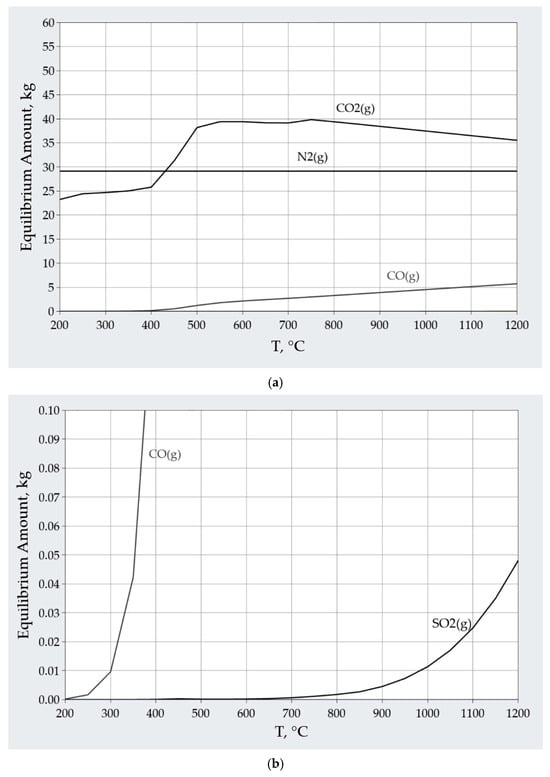
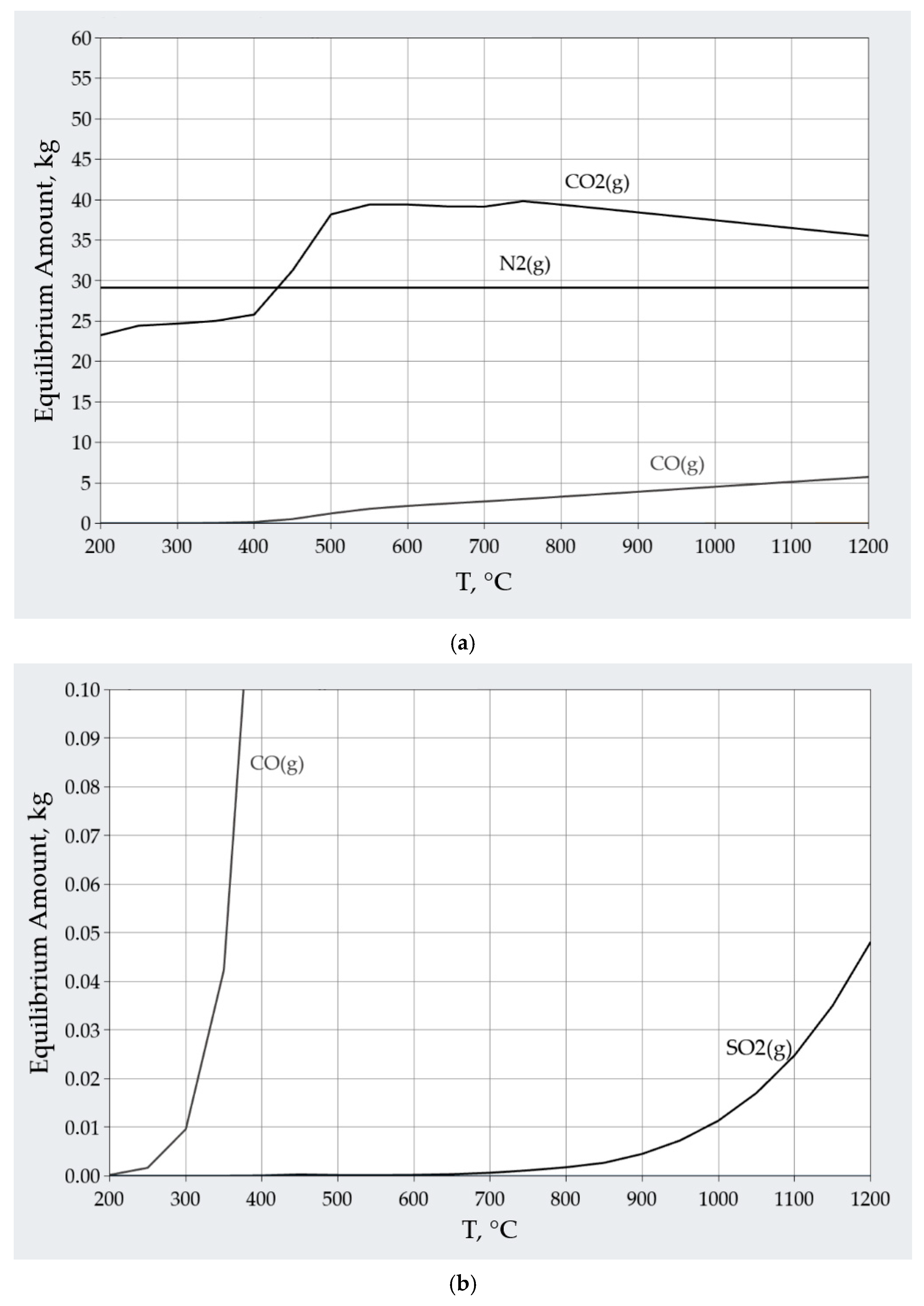
Figure 13a,b present the curves of equilibrium gas-phase composition, calculated per 100 kg of initial lead-bearing dust, as a function of temperature. In Figure 13b, the ordinate axis is shown in the range from 0.0 to 0.1 kg, which makes it possible to trace changes in the equilibrium composition of sulfur dioxide (SO2). According to the thermodynamic equilibrium calculations, the amount of arsenic trioxide (As2O3) remained negligible throughout the investigated temperature range. For this reason, the corresponding data are presented separately in Table 5.
Figure 13.
Curves of equilibrium gas-phase composition as a function of temperature. (a) temperature-dependent changes in the major gas-phase components. (b) temperature-dependent changes in minor gas-phase components shown on an enlarged concentration scale.
Table 5.
Variation in the equilibrium content of As2O3 in the gas phase as a function of temperature.
As can be seen from the presented data, the gas phase forms already at low temperatures, and its composition changes significantly as the system is heated. At low temperatures (200 °C), the gas phase is composed predominantly of carbon dioxide (CO2) with a mass of ~23.26 kg, whereas carbon monoxide (CO) is present in extremely small amounts (~1.90∙10−4 kg), reflecting the dominance of oxidizing processes and decomposition of carbonate components in the charge. The masses of sulfur dioxide (SO2) and arsenic oxide (As2O3) at this stage are negligible (~6.41∙10−10 kg and 1.19∙10−24 kg, respectively). With increasing temperature to 300–400 °C, a significant increase in CO content is observed, from 9.60∙10−3 kg to 0.154 kg, indicating activation of carbon-involving reduction processes. In parallel, CO2 gradually increases to 24.68–25.80 kg, reflecting continued carbonate decomposition and partial carbon gasification. In this temperature interval, sulfur dioxide shows moderate growth (6.41∙10−7–6.41∙10−5 kg), whereas As2O3 remains at extremely low levels (~10−18–10−16 kg). In the intermediate temperature range (500–700 °C), intensive formation of CO occurs, with its mass increasing from 1.22 kg to 2.70 kg, reflecting the predominance of a reducing atmosphere. Carbon dioxide reaches maximum values (~38.19–39.39 kg) due to decomposition of carbonate components of soda ash and defecate, as well as partial carbon gasification. At the same time, the mass of SO2 increases to 0.000634 kg, indicating the onset of thermally activated oxidation of sulfur-containing components, while the amount of As2O3 remains extremely small (~1.74∙10−17 kg). Upon transition to the high-temperature region (800–1200 °C), the mass of CO continues to increase from 3.29 kg to 5.72 kg, reflecting ongoing carbon gasification and intensification of reduction processes. Carbon dioxide gradually decreases from 39.39 kg to 35.54 kg as it participates in reduction and gasification reactions. At the same time, sulfur dioxide shows a sharp increase from 0.00177 kg to 0.04816 kg, confirming intense thermally activated oxidation of sulfur present in the initial lead-bearing dust. The mass of As2O3 remains extremely low (~10−17 kg), indicating that volatilization of arsenic as As2O3 is not favored under the equilibrium conditions of the model. The thermodynamic calculations predict preferential binding of arsenic in stable arsenate-containing condensed phases. It should be noted, however, that these results correspond to ideal equilibrium conditions and do not account for kinetic effects, dust entrainment, or gas–solid mass-transfer phenomena that may affect arsenic distribution under real smelting conditions. Thus, the gas phase is formed mainly by carbon and sulfur oxides, whereas the predicted distribution of arsenic should be interpreted as a thermodynamic equilibrium estimate.
Quantitative data from phase-equilibrium modeling confirm the conclusions of the thermodynamic analysis: the reduction of lead and antimony to metallic form and the formation of a slag phase containing silicates, sulfides, and arsenates proceed with high thermodynamic probability, ensuring efficient redistribution of charge components among the intermediate products of electric smelting. The gas phase consists mainly of CO, CO2, and SO2, whose masses increase with temperature, while the thermodynamic model predicts stabilization of arsenic in condensed arsenate-containing phases and only negligible amounts of As2O3 in the gas phase. The obtained results confirm the possibility of using defecate as a partial substitute for soda ash, providing stabilization of the slag phase and removal of impurities without reducing the extraction degree of lead and antimony.
3.4. Verification of Thermodynamic Modeling Results
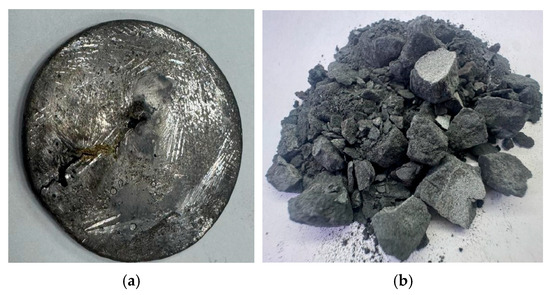
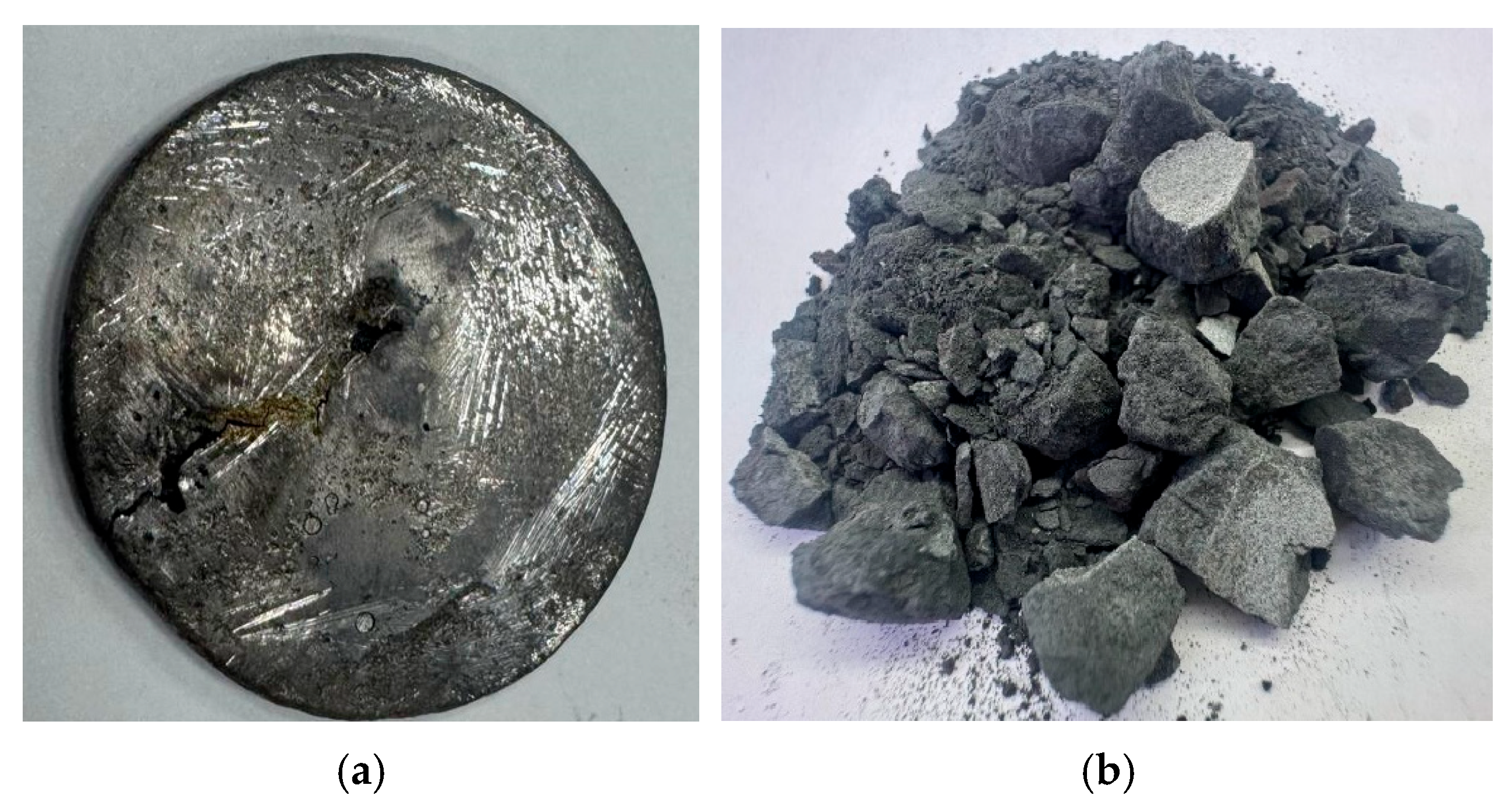
To verify the reliability of the thermodynamic modeling results, laboratory smelting experiments of lead-bearing dust were carried out using the specified fluxes and reducing agents. The experimental conditions included different smelting temperatures, holding times, and charge compositions selected based on previous studies and developed technological approaches [39,40], enabling comparison of the obtained data on element distribution among the metallic, slag, and gas phases with the predictions of the thermodynamic model. Experimental data on the content and recovery of the main elements in the smelting products are presented in Table 6. Samples of crude lead and slag obtained during smelting of the charge at 1200 °C are shown in Figure 14.
Table 6.
Experimental data on element content and recovery during smelting of lead-bearing dust.
Figure 14.
Appearance of crude lead (a) and slag (b) obtained during smelting of a lead-bearing charge at 1200 °C.
To evaluate the agreement between thermodynamic equilibrium modeling and laboratory smelting results, a comparison of the predicted and experimentally determined distribution of the principal elements was performed for the smelting conditions of 1200 °C and 30 min. The results are summarized in Table 7.
Table 7.
Comparison of thermodynamic modeling predictions and experimental recoveries of the main elements during electrosmelting of lead-bearing dust at 1200 °C.
The comparison demonstrates generally good agreement between thermodynamic predictions and experimental results regarding the distribution of Pb, Sb, Fe, Na, S, and Cl. In all cases, the model predicts the preferential transfer of lead and antimony to the metallic phase and the accumulation of iron, sodium, sulfur, and chlorine in the slag phase. The largest discrepancy is observed for arsenic. While thermodynamic equilibrium calculations predict nearly complete stabilization of arsenic in condensed arsenate-containing phases, the experimental results indicate that only 46.7% of arsenic is retained in slag. This difference may be attributed to kinetic limitations, dust entrainment, incomplete phase separation, and other non-equilibrium phenomena that are not considered in the equilibrium model.
Analysis of element content and recovery in the smelting products showed that the distribution of metals and impurities between crude lead and slag changes significantly depending on the smelting temperature and holding time of the melt.
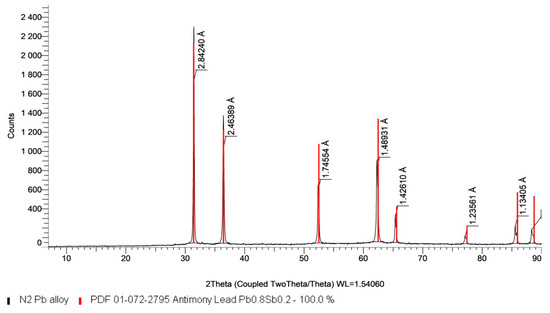
Crude lead concentrates the main metal and valuable impurities (Pb, Sb), which is confirmed by X-ray diffraction analysis (Figure 15), whereas the slag accumulates iron and volatile/alkali elements, which is important for subsequent processing and utilization of by-products, particularly lead-bearing dust. An increase in temperature and holding time (from 1000 °C, 15 min to 1200 °C, 30 min) leads to higher recovery of lead (from 85.2% to 96.7%) and antimony (from 78.5% to 90.2%), while simultaneously reducing their content in the slag to minimal values. Iron completely transfers to the slag at both temperatures, confirming its strong fixation in the slag phase. Arsenic is partially retained in the slag (~44–47%), while only trace amounts are detected in crude lead. This indicates that a significant fraction of arsenic may be distributed outside the analyzed condensed products, most likely through dust entrainment and other process-related losses. Since the off-gas stream and collected dust products were not quantitatively analyzed in the present study, the distribution of the remaining arsenic could not be determined with certainty. Therefore, a complete arsenic mass balance requires additional investigation involving analysis of gas-cleaning and dust-collection products. Alkali and volatile elements (Na, S, Cl) are actively fixed in the slag, indicating their high chemical stability in the slag phase.
Figure 15.
X-ray diffraction pattern of crude lead obtained after electrosmelting.
The observed increase in lead and antimony recovery with increasing smelting temperature and holding time is consistent with previously reported studies on the pyrometallurgical treatment of lead-bearing materials. Chen et al. [35] demonstrated that increasing smelting temperature significantly improved the recovery of lead and iron from metallurgical dusts due to enhanced reduction reactions and improved phase separation. Similarly, Li et al. [36] reported lead recoveries exceeding 98% during the smelting of spent lead–acid battery materials at elevated temperatures. Earlier investigations on the electrosmelting of lead-containing dusts also confirmed that higher temperatures promote the transfer of lead into the metallic phase and improve the separation of impurity elements between crude lead and slag [37,38,39]. The complete transfer of iron into the slag phase and the preferential concentration of sodium, sulfur, and chlorine in slag observed in the present study are therefore in good agreement with previously reported thermodynamic and experimental observations.
Preliminary experiments showed that a portion of soda ash required for efficient extraction of lead and antimony from lead-bearing dust can be successfully replaced with an industrial waste material, specifically defecate. This approach not only reduces the consumption of primary raw materials but also enables the use of sugar-industry waste as a functional flux while maintaining high metal-recovery efficiency and improving the utilization of by-products. To determine the optimal ratio of soda ash to defecate, as well as other auxiliary components, further studies using a mathematical design of experiments are planned, which will significantly reduce the number of laboratory trials required. Future studies will also include a detailed arsenic mass-balance assessment involving quantitative analysis of off-gas and dust-capture products. In addition, future work will consider replacing silica and iron chips with another industrial waste material—reinforced-concrete scrap containing 8–12% metallic iron and 44–47% SiO2—thereby providing additional cost reduction and expanding the resource base for smelting operations.
4. Conclusions
The present study demonstrates the feasibility of sustainable processing of lead-bearing dusts through partial substitution of sodium carbonate with calcium-rich industrial waste (sugar-industry defecate) during electric smelting.
The combined use of thermodynamic modeling and experimental validation enabled a comprehensive analysis of phase transformations and element distribution in the multicomponent Pb–Sb–Fe–Na–Ca–Si–S–Cl–As system. The results show that lead is predominantly recovered into the metallic phase, while antimony is co-extracted, confirming favorable thermodynamic conditions for metal reduction under the investigated smelting regimes.
Thermodynamic analysis revealed that sodium and calcium compounds play a key role in controlling impurity behavior. Sulfur and chlorine are effectively transferred to the slag phase through the formation of stable sulfides, sulfates, and chlorides, while arsenic is immobilized in thermodynamically stable arsenates with negligible volatilization. These results are in good agreement with experimental observations and confirm the reliability of the modeling approach.
The slag phase is mainly composed of calcium silicates (primarily Ca2SiO4), indicating the dominant role of calcium in slag formation and stabilization. The introduction of defecate enhances slag basicity and promotes the binding of hazardous elements, thereby reducing their transfer to the gas phase.
Experimental results confirm that increasing the smelting temperature significantly improves metal recovery, with lead extraction reaching up to 96.7% and antimony recovery up to 90.2%. X-ray diffraction analysis of crude lead confirms the preferential transfer of Pb and Sb into the metallic phase predicted by thermodynamic modeling. The formation of a Pb–Sb solid solution indicates effective reduction of lead compounds, co-extraction of antimony, and efficient separation of the metallic and slag phases under the investigated smelting conditions.
The partial replacement of sodium carbonate with defecate reduces the consumption of conventional fluxes and enables the utilization of industrial waste, contributing to resource conservation and waste minimization. The obtained results indicate that calcium-containing industrial wastes may be considered as promising alternative fluxing materials for lead-bearing dust processing.
Overall, the results demonstrate the thermodynamic feasibility of partial sodium carbonate replacement by sugar-industry defecate and provide experimental evidence supporting this approach under laboratory conditions. The findings may serve as a basis for further investigations aimed at process optimization, scale-up studies, and assessment of the practical applicability of calcium-containing industrial wastes in non-ferrous metallurgy.
Author Contributions
Conceptualization, G.M. and B.B.; methodology, Y.T. and A.D.; software, M.S. and S.J.; validation, G.K., A.I. and Y.T.; formal analysis, Y.T. and M.S.; investigation, A.D., M.S. and S.J.; resources, A.I. and G.K.; data curation, S.J. and M.S.; writing—original draft preparation, G.M., B.B. and A.D.; writing—review and editing, Y.T., G.K. and S.J.; visualization, M.S., S.J. and G.K.; supervision, B.B. and G.M.; project administration, G.M.; funding acquisition, G.M. All authors have read and agreed to the published version of the manuscript.
Funding
This research is funded within the framework of grant funding of the Science Committee of the Ministry of Science and Higher Education of the Republic of Kazakhstan for 2025–2027, Grant No. AP26198395 “Development of energy-saving and import-exempt innovative technology for the integrated processing of lead-containing waste and secondary raw materials with the replacement of scarce reaction-fluxing components with industrial waste”.
Institutional Review Board Statement
Not applicable.
Informed Consent Statement
Not applicable.
Data Availability Statement
The original contributions presented in the study are included in the article. Further inquiries can be directed to the corresponding authors.
Conflicts of Interest
The authors declare no conflicts of interest.
References
- Czaplicka, M.; Buzek, L. Lead Speciation in the Dusts Emitted from Non-Ferrous Metallurgy Processes. Water Air Soil Pollut. 2011, 218, 157–163. [Google Scholar] [CrossRef] [Scilit] [PubMed]
- Batonneau, Y.; Bremard, C.; Gengembre, L.; Laureyns, J.; Le Maguer, A.; Le Maguer, D.; Perdrix, E.; Sobanska, S. Speciation of PM10 Sources of Airborne Nonferrous Metals within the 3-km Zone of Lead/Zinc Smelters. Environ. Sci. Technol. 2004, 38, 5281–5289. [Google Scholar] [CrossRef] [Scilit] [PubMed]
- Orac, D.; Laubertova, M.; Piroskova, J.; Klein, D.; Bures, R.; Klimko, J. Characterization of Dusts from Secondary Copper Production. J. Min. Metall. Sect. B Metall. 2020, 56, 221–228. [Google Scholar] [CrossRef] [Scilit]
- Madej, P.; Prajsnar, R. Modelling the Melting of “Shaft Sludge” from Shaft Furnace Dust Removal in a Short Rotary Kiln. Sci. Rep. 2025, 15, 28079. [Google Scholar] [CrossRef] [Scilit] [PubMed]
- Gao, W.-Y.; Wu, K.-K.; Chen, T.; Li, W.-C.; Chen, H.-R.; Chen, Y.-R.; Wu, H.; Zhu, F.; Li, H.-D.; Wu, C.; et al. Heavy Metal(loid)s Transformation in Dust at a Lead Smelting Site. J. Cent. South Univ. 2024, 31, 1036–1049. [Google Scholar] [CrossRef] [Scilit]
- Ye, L.; Song, S.; Yang, S.; Chen, Y.; Liu, S. The Recovery of Valuable Components from Secondary Lead Dust by a Multi-Step Hydrometallurgical Process. Hydrometallurgy 2023, 222, 106186. [Google Scholar] [CrossRef] [Scilit]
- Chen, T.T.; Dutrizac, J.E. The Mineralogical Characterization of Lead-Acid Battery Paste. Hydrometallurgy 1996, 40, 223–245. [Google Scholar] [CrossRef] [Scilit]
- Xing, P.; Wang, C.; Wang, L.; Ma, B.; Chen, Y. Hydrometallurgical Recovery of Lead from Spent Lead–Acid Battery Paste via Leaching and Electrowinning in Chloride Solution. Hydrometallurgy 2019, 189, 105134. [Google Scholar] [CrossRef] [Scilit]
- Ma, Y.; Qiu, K. Recovery of Lead from Lead Paste in Spent Lead Acid Battery by Hydrometallurgical Desulfurization and Vacuum Thermal Reduction. Waste Manag. 2015, 40, 151–156. [Google Scholar] [CrossRef] [Scilit] [PubMed]
- Afsara, S. A Review on Recycling Technologies and Product Life Cycle Issues of Zinc and Lead. In PbZn 2020: 9th International Symposium on Lead and Zinc Processing; Siegmund, A., Alam, S., Grogan, J., Kerney, U., Shibata, E., Eds.; Springer: Cham, Switzerland, 2020. [Google Scholar] [CrossRef] [Scilit]
- World Health Organization. Lead Poisoning and Health. Available online: https://www.who.int/news-room/fact-sheets/detail/lead-poisoning-and-health (accessed on 3 March 2026).
- European Commission. Proposal for a Regulation on Waste Shipments—Revision of the Waste Shipment Regulation (EU 2021/1840). Available online: https://environment.ec.europa.eu/topics/waste-and-recycling/waste-shipments_en (accessed on 3 March 2026).
- SMM. Asia Dominates Global Secondary Lead Production, Africa to Become Fastest Growing Emerging Market. Shanghai Metals Market News, 27 January 2026. Available online: https://news.metal.com/newscontent/103739802-smm-analysis-asia-dominates-global-secondary-lead-production-africa-to-become-fastest-growing-emerging-emmarketem (accessed on 5 March 2026).
- Zhang, W.; Yang, J.; Wu, X.; Hu, Y.; Yu, W.; Wang, J.; Dong, J.; Li, M.; Liang, S.; Hu, J.; et al. A Critical Review on Secondary Lead Recycling Technology and Its Prospect. Renew. Sustain. Energy Rev. 2016, 61, 108–122. [Google Scholar] [CrossRef] [Scilit]
- Basel Convention on the Control of Transboundary Movements of Hazardous Wastes and Their Disposal; United Nations Environment Programme (UNEP): Geneva, Switzerland, 1989; Available online: https://www.basel.int/TheConvention/Overview/TextoftheConvention/tabid/1275/Default.aspx (accessed on 7 June 2026).
- European Parliament and Council. Directive 2008/98/EC of 19 November 2008 on Waste and Repealing Certain Directives. Off. J. Eur. Union 2008, L312, 3–30. [Google Scholar]
- Agrawal, A.; Sahu, K.K.; Pandey, B.D. Recent Trends and Current Practices for Secondary Processing of Zinc and Lead. Part I: Lead Recovery from Secondary Sources. Waste Manag. Res. 2004, 22, 240–247. [Google Scholar] [CrossRef] [Scilit] [PubMed]
- Orac, D.; Klimko, J.; Klein, D.; Piroskova, J.; Liptai, P.; Vindt, T.; Miškufova, A. Hydrometallurgical Recycling of Copper Anode Furnace Dust for a Complete Recovery of Metal Values. Metals 2022, 12, 36. [Google Scholar] [CrossRef] [Scilit]
- Marchenko, N.V.; Kovtun, O.N. Development of a Technology for Processing Fine Dust from Copper Smelters. Tsvetnye Met. 2020, 8, 45–52. [Google Scholar] [CrossRef] [Scilit]
- Isabaev, S.M.; Kuzgibekova, H.M.; Zikanova, T.A.; Zhinova, E.V. Complex Hydrometallurgical Processing of Lead–Arsenic-Containing Dusts from Copper Production. Tsvetnye Met. 2017, 8, 33–40. [Google Scholar] [CrossRef] [Scilit]
- Leclerc, N.; Meux, E.; Lecuire, J.-M. Hydrometallurgical Recovery of Zinc and Lead from Electric Arc Furnace Dust Using Mononitrilotriacetate Anion and Hexahydrated Ferric Chloride. J. Hazard. Mater. 2002, 91, 257–270. [Google Scholar] [CrossRef] [Scilit] [PubMed]
- Vivar, Y.; Velásquez-Yévenes, L.; Vargas, C. Sustainable Recovery of Lead from Secondary Waste in Chloride Medium: A Review. Minerals 2025, 15, 244. [Google Scholar] [CrossRef] [Scilit]
- Liu, W.; Li, Z.; Han, J.; Li, W.; Wang, X.; Wang, N.; Qin, W. Selective Separation of Arsenic from Lead Smelter Flue Dust by Alkaline Pressure Oxidative Leaching. Minerals 2019, 9, 308. [Google Scholar] [CrossRef] [Scilit]
- Piroskova, J.; Laubertova, M.; Miskufova, A.; Orac, D. Hydrometallurgical Treatment of Copper Shaft Furnace Dust for Lead Recovery. World Metall. Erzmetall 2018, 71, 37–42. [Google Scholar]
- Laubertova, M.; Sisol, M.; Briancin, J.; Trpcevska, J.; Ruzickova, M. Recovery of Valuable Materials Based on Pb and Zn in the Hydrometallurgical Processing of Copper Shaft Furnace Dust. Materials 2025, 18, 1935. [Google Scholar] [CrossRef] [Scilit] [PubMed]
- Yu, W.; Zhang, P.; Yang, J.; Li, M.; Hu, Y.; Liang, S.; Wang, J.; Li, S.; Xiao, K.; Hou, H.; et al. A Low-Emission Strategy to Recover Lead Compound Products Directly from Spent Lead-Acid Battery Paste: Key Issue of Impurities Removal. J. Clean. Prod. 2019, 210, 1534–1544. [Google Scholar] [CrossRef] [Scilit]
- Chen, C.-S.; Shih, Y.-J.; Huang, Y.-H. Recovery of Lead from Smelting Fly Ash of Waste Lead-Acid Battery by Leaching and Electrowinning. Waste Manag. 2016, 52, 212–220. [Google Scholar] [CrossRef] [Scilit] [PubMed]
- Sergeeva, Y.F.; Mamyachenkov, S.V.; Sergeev, V.A.; Karelov, S.V.; Gallyamova, N.R. Hydrometallurgical Technology for Processing Fine Dusts from Copper Smelting Using a Complexing Reagent. Tsvetnye Met. 2013, 8, 79–83. [Google Scholar]
- Antipov, N.I.; Maslov, V.I.; Litvinov, V.P. Combined Scheme for Processing Fine Converter Dust from Copper Smelting Production. Non-Ferr. Met. 1983, 12, 12. [Google Scholar]
- Lucheva, B.; Iliev, P.; Kolev, D. Hydro-Pyrometallurgical Treatment of Copper Converter Flue Dust. J. Chem. Technol. Metall. 2017, 52, 320–325. [Google Scholar]
- Grudinsky, P.I.; Dyubanov, V.G.; Kozlov, P.A. Copper Smelter Dust Is a Promising Material for the Recovery of Nonferrous Metals by the Waelz Process. Inorg. Mater. Appl. Res. 2019, 10, 496–501. [Google Scholar] [CrossRef] [Scilit]
- Lin, X.; Peng, Z.; Yan, J.; Li, Z.; Hwang, J.-Y.; Zhang, Y.; Li, G.; Jiang, T. Pyrometallurgical Recycling of Electric Arc Furnace Dust. J. Clean. Prod. 2017, 149, 1079–1100. [Google Scholar] [CrossRef] [Scilit]
- Wang, J.; Zhang, Y.; Cui, K.; Fu, T.; Gao, J.; Hussain, S.; AlGarni, T.S. Pyrometallurgical Recovery of Zinc and Valuable Metals from Electric Arc Furnace Dust—A Review. J. Clean. Prod. 2021, 298, 126788. [Google Scholar] [CrossRef] [Scilit]
- Ramus, K.; Hawkins, P. Lead/Acid Battery Recycling and the New Isasmelt Process. J. Power Sources 1993, 42, 299–313. [Google Scholar] [CrossRef] [Scilit]
- Liu, J.; Huang, S.; Chen, K.; Li, J.; Wang, T.; Mei, M. Recovering Metallic Pb Directly from Lead Smelting Dust by NaOH-Carbon Roasting Process. J. Mater. Res. Technol. 2020, 9, 2744–2753. [Google Scholar] [CrossRef] [Scilit]
- He, J.; Li, L.; Xiao, Y.; Lei, Y.; Li, F. Staged Separation and Recovery of As, Pb, Bi, and Zn from Lead Smelting Dusts. Sep. Purif. Technol. 2025, 354, 129163. [Google Scholar] [CrossRef] [Scilit]
- Li, C.; Liu, W.; Jiao, F.; Yang, C.; Li, G.; Liu, S.; Qin, W. Separation and Recovery of Zinc, Lead and Iron from Electric Arc Furnace Dust by Low Temperature Smelting. Sep. Purif. Technol. 2023, 312, 123355. [Google Scholar] [CrossRef] [Scilit]
- Li, W.; Zhang, W.; Luo, L.; Xie, X. Recycling Lead from Waste Lead-Acid Batteries by the Combination of Low Temperature Alkaline and Bath Smelting. Sep. Purif. Technol. 2023, 310, 123156. [Google Scholar] [CrossRef] [Scilit]
- Moldabayeva, G.Z.; Akilbekova, S.K.; Mamyrbayeva, K.K.; Mishra, B. Electrosmelting of Lead-Containing Dusts from Copper Smelters. J. Sustain. Metall. 2015, 1, 286–296. [Google Scholar] [CrossRef] [Scilit]
- Polyvyannyy, I.R.; Kobzhasov, A.K.; Moldabayeva, G.Z.; Polyvyannyy, V.I. Method for Processing Lead-, Cadmium-, and Rhenium-Containing Converter Dusts from Copper Production. Patent of the Republic of Kazakhstan No. 16461, 15 November 2005. Bulletin No. 11. [Google Scholar]
- Kobzhasov, A.K.; Moldabayeva, G.Z.; Polyvyannyy, V.I.; Rakhimbaev, B.S. Combined Method for Joint Processing of Lead-, Cadmium-, and Rhenium-Containing Converter Dusts and Sludges from Copper Smelting Production. Patent of the Republic of Kazakhstan No. 17765, 15 September 2006. Bulletin No. 9. [Google Scholar]
- Masharipova, S. Application of Defecation Lime from Sugar Industry in Uzbekistan. Master’s Thesis, Royal Institute of Technology, Stockholm, Sweden, 2006. Available online: https://api.semanticscholar.org/CorpusID:107714420 (accessed on 5 January 2026).
- British Sugar Company. Official Website. Available online: http://www.britishsugar.co.uk/ (accessed on 8 April 2026).
- Cui, Y.; Chen, S.; Li, L.; Wang, X.; Liu, J. Atomistic Insights into the Hydration Behavior of N-A-S-H Gel via Ca2+ Substitution: A Molecular Dynamics Simulation Study. J. Non-Cryst. Solids 2026, 673, 123892. [Google Scholar] [CrossRef] [Scilit]
- Luo, B.; Su, Y.; Ding, X.; Chen, Y.; Liu, C. Modulation of Initial CaO/Al2O3 and SiO2/Al2O3 Ratios on the Properties of Slag/Fly Ash-Based Geopolymer Stabilized Clay: Synergistic Effects and Stabilization Mechanism. Mater. Today Commun. 2025, 47, 113295. [Google Scholar] [CrossRef] [Scilit]
- Luo, B.; Su, Y.; Hu, X.; Chen, Z.; Chen, Y.; Ding, X. Strength Behavior and Microscopic Mechanisms of Geopolymer-Stabilized Waste Clays Considering Clay Mineralogy. J. Clean. Prod. 2025, 530, 146877. [Google Scholar] [CrossRef] [Scilit]
- Khaydarov, R.A.; Korshunov, A.N. Ceramic Composition for the Production of Building Bricks. Patent No. 2291132, 2007. Available online: https://www.freepatent.ru/patents/2291132 (accessed on 5 January 2026).
- Tereshin, V.N. Construction Materials Using Lime Waste from the Sugar Industry. Ph.D. Thesis, Novosibirsk State Agrarian University, Novosibirsk, Russia, 2004; pp. 20–27. Available online: https://www.dissercat.com/content/stroitelnye-materialy-s-ispolzovaniem-izvestkovykh-otkhodov-sakharnogo-proizvodstva (accessed on 5 January 2026).
- Katulskaya, A.S.; Parfenova, L.M. Comparative Analysis of the Use of Industrial Waste as Modifiers of Gypsum Binders. Vestn. Polotsk. Gos. Univ. Ser. F 2019, 38–43. [Google Scholar]
- Sverguzova, Z.A.; Tarasova, G.I.; Sverguzova, S.V.; Blagadyreva, A.M. Filtering Material for Wastewater Treatment. Russian Federation Patent RU 2380137 C1, 27 January 2010. Available online: https://www.freepatent.ru/patents/2380137 (accessed on 5 January 2026).
- Eremeeva, Y.N.; Kolpakova, V.P. Production Wastes Used in Physicochemical Treatment of Industrial Wastewater at Non-Ferrous Metallurgy Enterprises. Vestn. VKGTU 2007, 4, 93–96. [Google Scholar]
- Salikhanova, D.S.; Azimova, D.A. Wastewater Treatment Based on Defecate. Int. Conf. 2023, 1, 389–391. [Google Scholar]
- Khudoyberdiev, F.I.; Umirov, F.E.; Eshmurodova, M.S.; Ravshanova, O.A. Study of the Physicochemical Properties of Defecate as a Promising Secondary Raw Material for Building Materials and Chemicals. Univers. Chem. Biol. 2022, 9, 29–34. [Google Scholar]
- Lerman, B.D.; Omarova, N.S. Industrial Testing of Reductive Electric Smelting of Gold–Arsenic Concentrates from the Akbakai Mining and Processing Plant. Gorn. Zh. Kazakhstana 2008, 3, 33–35. [Google Scholar]
- Lata, V.A.; Sokolovskaya, L.V.; Khegay, L.D.; Masevich, V.I.; Alekseev, S.O. Method for Preparing Metallurgical Charge for Smelting. Patent of the Republic of Kazakhstan No. 918, 15 June 1994. Bulletin No. 2. [Google Scholar]
- Utepov, D.K.; Sagitov, A.O.; Erezhepov, A.E. Method for Processing Lead-Containing Dust to Obtain a Mixture of Copper and Zinc Sulfates. Innovative Patent of the Republic of Kazakhstan No. 28219, 17 March 2014. Bulletin No. 3. [Google Scholar]
- ISO/IEC 17025-2019; General Requirements for the Competence of Testing and Calibration Laboratories. International Organization for Standardization: Geneva, Switzerland, 2019. Available online: https://new-shop.ksm.kz/catalog/document/70358/ (accessed on 24 November 2025).
- ISO/IEC 17043-2025; Conformity Assessment—General Requirements for the Competence of Proficiency Testing Providers. International Organization for Standardization: Geneva, Switzerland, 2025. Available online: https://new-shop.ksm.kz/catalog/document/76771/ (accessed on 24 November 2025).

Disclaimer/Publisher’s Note: The statements, opinions and data contained in all publications are solely those of the individual author(s) and contributor(s) and not of MDPI and/or the editor(s). MDPI and/or the editor(s) disclaim responsibility for any injury to people or property resulting from any ideas, methods, instructions or products referred to in the content. |
© 2026 by the authors. Licensee MDPI, Basel, Switzerland. This article is an open access article distributed under the terms and conditions of the Creative Commons Attribution (CC BY) license.