


Abstract
The study evaluated 6 mm pellets derived from whole hemp plants (Cannabis sativa L., cv. Futura 75) to assess their potential as a solid biofuel. The pellets had a low moisture content of 6.3–7.0% on an analytical basis, which is favorable for storage and combustion. Ash content was approximately 4.0–4.3%, while gross calorific values ranged from 17.3 MJ·kg−1 as received to 19.4 MJ·kg−1 on a dry ash-free basis. The net calorific values ranged from 16.1 to 17.5 MJ·kg−1. Based on the elemental analysis, the carbon content was 46.8–49.4%, the hydrogen content was 5.5%, the nitrogen content was 0.68–0.73%, and the sulfur content was 0.05%. Compared with many agricultural biomass fuels, hemp pellets contained relatively low sulfur and moderate nitrogen contents. Hemp pellets from whole plants show favorable physicochemical properties, making them a viable renewable solid biofuel resource.
1. Introduction
Biomass is increasingly recognized as a key renewable energy resource due to its carbon neutrality and wide availability from agricultural and marginal lands. The potential of vineyard biomass for methane fermentation was demonstrated by Klimek et al. (2022) [1], and the efficiency of agricultural biogas production using hydrodynamic mixing systems was analyzed by Klimek et al. (2021) [2]. The use of agrarian biogas pellets as fertilizers has been reported in the literature [3], while Walowski (2024) [4] highlighted the advanced process modeling of polydisperse substrate flow in fermenters. A comprehensive outlook on the potential of industrial hemp for bioenergy in Canada was also presented by Parvez et al. (2021) [5], and the paradigm shift toward sustainable bioenergy and advanced hemp-based products was discussed [6].
Industrial hemp (Cannabis sativa L.) has increasingly attracted attention as a versatile feedstock. Its multifunctional character for sustainable applications has been emphasized in the literature [7,8], and early industrial perspectives were described by Ranalli and Venturi (2004) [9]. The Polish contribution to global hemp cultivation was reviewed [10], while its role in restoring post-mining soils was demonstrated by Pudełko et al. (2022) [11]. The feasibility of hemp biomass in energy applications has been confirmed [12,13], and its potential for adaptation to marginal lands has been explored [14]. Further advances have been reported on water productivity under dry conditions [15], frost-retting effects [16], and the cultivation of bast fibers [17]. Overall, hemp raw material can be identified as a sustainable resource for environmental remediation, bioenergy, textiles, and composites.
Numerous studies have reported that hemp biomass is suitable for producing solid biofuels. For example, the potential of agricultural and forest biomass, including hemp, as feedstock for solid biofuels was analyzed [18]. Experiments on fibrous plant preparation and pellet quality parameters were carried out by Streikus et al. (2017) [19], while boiler efficiency during combustion of hemp-based pellets was examined by Szyszlak et al. (2011) [20]. More recently, the efficiency and emissions of a pellet boiler using multiple pellet types have been assessed in the literature [21]. The influence of wood species on pellet quality has also been investigated [18,22], providing useful benchmarks for hemp-based fuels. The utilization of waste hemp straw for pellet production was highlighted in [13]. Hemp is classified as biomass with versatile applications, as confirmed in the literature [7,8,9,10,17,23,24]. It is also suitable for producing energy through straw or briquettes [12].
The potential of using hemp straw of the Henola variety for solid biofuel production, in terms of cellulose, hemicellulose, calorific value, and heat of combustion [13]. Unlike conventional wood pellets, hemp-derived fuels can be produced from biomass cultivated on degraded, polluted, or marginal soils, such as lignite post-mining sites [25], petroleum-contaminated areas [26], and low-fertility fields. Hemp biomass can therefore be obtained from areas that are less suitable for food production, while its deep root system may improve soil structure and nutrient cycling [14,27]. Biomass grown under such conditions can be used for pellet production [12] without competing for arable land. The deep penetration of hemp roots promotes soil oxygenation, water retention, and mineral uptake from deeper layers, further strengthening its agronomic value [14].
Pelletized biomass enables automatic fuel feeding in modern boilers, supporting the replacement of fossil-fuel systems (coal, fuel oil, gas) with automated solid biofuel combustion. In addition to briquettes, pellets are a common form of solid biofuel [28], enabling automatic dosing in boilers specifically designed for this fuel type [20,21]. This approach allows for replacing fossil-fuel boilers with automated biomass systems. Pellet fuel quality depends critically on moisture, ash, elemental composition, and calorific properties, which must comply with EN ISO 17225-6 standards for non-woody grade pellets [29]. The heat yield in such boilers is strongly influenced by the humidity and type of biomass [21]. While pellets from various biomasses, including wood, agricultural residues, and hemp straw, have been characterized in [18,22,28], comprehensive data on pellets from whole hemp plants (stems, leaves, inflorescences) of the Futura 75 variety remain limited.
In addition to the basic physicochemical analyses, the soluble organic fraction of hemp biomass was examined using HPLC. Soluble carbohydrates and phenolic compounds were analyzed as supplementary indicators of biomass composition. Olejar and Kinney (2021) [30] conclude that HPLC-based profiling is essential for understanding how hemp biomass transforms into bioactive and oxygenated compounds. This approach provided additional information on the chemical profile of whole-plant hemp material and may be useful for future studies on bioenergy and biorefinery applications.
The objective of this study was to evaluate the physicochemical and energetic properties of pellets produced from whole-plant hemp (Cannabis sativa L. cv. Futura 75). Attention was paid to moisture content, ash content, calorific value, and elemental composition, as these parameters are key indicators of biomass fuel quality. They influence energy yield, storage stability, ash-related operational issues, and the potential formation of gaseous emissions during thermal conversion. Although hemp biomass has been investigated previously [18,22], available studies primarily focus on hemp straw, stem fractions, or general non-woody biomass pellets. In contrast, comprehensive data on pellets produced from whole-plant hemp biomass, including stems, leaves, and inflorescences, remain limited. This is an important research gap because the inclusion of all aboveground plant fractions may affect moisture content, ash content, elemental composition, and calorific properties compared with pellets produced only from straw or stems. Therefore, this study aimed to provide a comprehensive characterization of whole-plant hemp pellets and compare their properties with those reported for other biomass fuels.
2. Materials and Methods
2.1. Material Properties
2.1.1. Raw Material Cultivation Conditions
The cultivation conditions of industrial hemp (Cannabis sativa L. cv. Futura 75) were included to determine a complete overview of measured material properties. The origin and cultivation background of the hemp feedstock are equally essential for interpreting the obtained results. The growth and chemical composition of hemp biomass are influenced by both genetic and environmental factors, including cultivar characteristics (genetic background), soil characteristics, nutrient availability, and climatic conditions during the growing season. These environmental factors influence the plant’s physiological development, mineral uptake, and energy potential, ultimately affecting the quality and combustion behavior of the produced pellets. Therefore, documenting these parameters provides the necessary context for evaluating the physicochemical characteristics of hemp-based biofuels and allows meaningful comparison with other biomass studies conducted under different environmental or agronomic conditions.
The raw material cultivation was carried out on a 16-hectare experimental site located in Falenty, Mazowsze Voivodeship, Poland (52°10′ N, 20°58′ E; 106 m a.s.l.). The area is characterized by light to medium-textured sandy loam soils typical of regional agricultural conditions. The topsoil contained from 1.5% to 2.5% organic matter, indicating moderate fertility. At the beginning of the growing season, the available mineral nitrogen (Nmin) content ranged from 20 to 60 kg·ha−1, while total nitrogen in the 0–30 cm soil layer varied between 0.05% and 0.15% of the dry mass (DM). Chemical analysis showed medium to high levels of macronutrients, with phosphorus (P2O5) ranging from 20 to 50 mg·kg−1, potassium (K2O) from 80 to 120 mg·kg−1, magnesium from 40 to 60 mg·kg−1, and calcium from 800 to 1600 mg·kg−1, the latter reflecting previous liming of the field. The soil reaction was slightly acidic to near-neutral, with pH values ranging from 5.5 to 6.8 due to the liming history [15]. The soil’s physicochemical properties provided favorable agrochemical conditions for hemp growth, ensuring uniform plant development and stable biomass yields. The soil’s water-holding capacity to a depth of 0.6 m was 130–160 m−1.
2.1.2. Physical Material Characteristic
To ensure consistency and comparability of the analytical results obtained, a standardized experimental notation system was established before the measurements. The purpose of this system is to develop a unified framework for reporting data that are highly sensitive to the sample’s moisture and ash content. Variations in drying conditions or analytical methods often lead to discrepancies in biomass characterization; therefore, adopting precise terminology minimizes this uncertainty and enhances reproducibility. According to the established convention, the analyzed material is described using four standardized conditions: ar (as received, original moisture), ad (air-dried, ambient moisture), d (dry, 0% moisture), and daf (dry, ash-free). Applying this system allows for direct comparison of results across studies. It ensures the transparent interpretation of both physical and chemical parameters, such as calorific value, elemental composition, and ash content.
Moisture and ash contents were determined in accordance with relevant ISO standards to ensure analytical reliability. Moisture was measured in accordance with PN-EN ISO 18134-3:2015-11 [31] by drying representative samples in a controlled oven until a constant mass was achieved. Both analytical (Mad) and as-received (Mar) values were reported to reflect the material’s storage stability and its actual combustion behavior under practical conditions. Ash content was determined according to PN-EN ISO 18122:2016-01 [32] by complete combustion of homogenized subsamples in a muffle furnace at 550 ± 10 °C. Results were expressed on an analytical, working, and dry basis, allowing meaningful comparisons with other herbaceous and woody fuels. Although ash content is commonly used as a fuel-quality indicator, slagging and fouling tendencies depend not only on total ash content but also on ash chemical composition.
2.1.3. Growing Season and Agronomy
The field experiment was conducted to evaluate the growth performance and yield of hemp under controlled fertilization conditions without the use of plant protection agents. Sowing was performed on 4 May 2022, following the last spring frost, and harvesting took place between 1 and 5 October 2022, resulting in a growing period of approximately six months. Harvesting was carried out at the stage of physiological maturity, as indicated by field observations of advanced senescence symptoms, including leaf yellowing and drying of aboveground plant tissues. Seeds supplied by the Institute of Natural Fibers and Medicinal Plants (NRI) were sown at a rate of 60 kg ha−1. Fertilization consisted of the application of POLIFOSKA 6 at 500 kg ha−1, which provided 30 kg N, 100 kg P2O5, 150 kg K2O, and 35 kg S per hectare, supplemented with 200 kg ha−1 of urea contributing an additional 92 kg N ha−1, giving a total nitrogen input of 122 kg ha−1 [28]. Owing to the natural resistance and fungicidal properties of hemp [33,34,35,36], no herbicides or pesticides were applied during the cultivation period. The fresh biomass yield reached 20 t ha−1, and the average plant height at harvest was 3.15 m, with a moisture content of 76%. Meteorological data, including monthly rainfall and temperature during the growing season, were obtained from the Warszawa-Okęcie meteorological station (52°10′ N, 20°58′ E; 106 m a.s.l.). Comparative data on rainfall and temperature for 2022, along with long-term averages from IMGW [37], are provided in Table 1.
Table 1.
Monthly rainfall and temperature for 2022 vs. long-term normals and percentage (or absolute) change at Warsaw-Okęcie station.
The 2022 growing season was characterized by average precipitation and air temperatures compared to long-term climatic norms. In 2022, the total annual rainfall recorded at the Warsaw-Okęcie meteorological station reached 460 mm, representing 84% of the long-term normal value of 550 mm, as calculated for the reference period of 1991–2020. This indicates a rainfall deficit of approximately 90 mm for the year. Precipitation varied considerably among months, with markedly lower values in March (6% of the long-term average) and in June, August, and November (52%, 49%, and 42%, respectively). In contrast, above-average precipitation occurred in February, April, and December, each reaching approximately 133% of the multi-year mean. Despite temporary surpluses during some months, the overall rainfall in 2022 remained below the climatic norm, and the year can be classified as relatively dry. The mean annual air temperature was 10 °C, exceeding the long-term average of 9 °C by 1 °C, corresponding to an increase of approximately 11% compared to the 1991–2020 mean. The most pronounced positive temperature anomalies occurred in February, January, August, and October, when air temperatures were 3.8, 2.6, 2.9, and 2.5 °C higher than the multi-year mean, respectively. Cooler-than-average conditions were recorded only in April, September, and May, with temperatures 2.0, 1.5, and 0.1 °C below the long-term mean. Overall, 2022 was a warm year, with most months showing a positive thermal anomaly. The table presents monthly rainfall and air temperature data for 2022, compared with long-term averages for 1991–2020, with deviations expressed as percentages or absolute values.
2.2. Chemical Material Characteristic
2.2.1. Soluble Carbohydrates Determination
The soluble carbohydrates in biomass samples were determined using High-Performance Liquid Chromatography (HPLC) with refractive index detection. This analytical technique enables precise, selective quantification of low-molecular-weight sugars commonly found in lignocellulosic biomass. Before chromatographic analysis, the biomass samples were prepared according to a standardized extraction protocol to ensure analytical reproducibility. A representative amount of 4 g of the raw material was mixed with ethanol and brought to a final volume of 100 mL to ensure consistent extraction across all sample conditions. The resulting suspension was homogenized and then carefully filtered through 0.22 µm nylon syringe filters (0.25 mm diameter) to remove any suspended solids and prevent contamination of the column and detector during analysis. This procedure provides an extract suitable for direct chromatographic injection, with analyte concentrations expressed in milligrams per liter (mg/L) or parts per million (ppm), depending on calibration and reporting requirements.
Chromatographic analysis was performed using a Waters 600E pump, a Waters 717 autosampler, and a Waters 2414 refractive index detector (Waters Corp., Milford, MA, USA). Data acquisition and peak integration were carried out using Empower v.1.0 software. A Waters NH2 amino column, with dimensions of 250 × 4.6 mm and a five μm particle size, was used to separate mono- and disaccharides efficiently. The mobile phase consisted of deionized water and acetonitrile in a 70:30 (v/v) ratio, delivered at a flow rate of 1.0 mL·min−1. The column temperature was maintained at 22–25 °C, and the injection volume was 10 μL. Calibration curves were prepared using standard solutions of glucose, fructose, and sucrose over a relevant concentration range and evaluated using Empower software.
Calibration ranges, limits of detection (LOD), limits of quantification (LOQ), and recovery values were determined for carbohydrate standards. The calibration curves showed satisfactory linearity (R2 > 0.99). The LOD and LOQ were estimated using signal-to-noise ratios of 3:1 and 10:1, respectively. Recovery was assessed by spiking hemp biomass extracts with known concentrations of carbohydrate standards before filtration and chromatographic analysis. The results obtained in mg·L−1 were converted to mg·g−1 dry matter using the extraction volume, sample mass, and dry matter content of the biomass. Peak areas were quantified in triplicate (n = 3), and soluble carbohydrate content was calculated based on chromatographic peak area, expressed as mg·L−1 (ppm) or converted to mg·g−1 dry matter, depending on analytical requirements.
2.2.2. Total Phenolic Compounds Determination
The composition of phenolic compounds in hemp biomass was determined both qualitatively and quantitatively. The analyses were performed using a high-performance liquid chromatography system (Agilent 1200, Agilent Technologies, Waldbronn, Germany) equipped with a diode-array detector and operated under reversed-phase conditions. Data acquisition and peak processing were conducted using OpenLab CDS to ensure precise integration and consistent peak identification. For extraction, 5 g of finely ground hemp was transferred to an extraction vessel, and methanol was added to a final volume of 100 mL. This solvent-to-solid ratio provided efficient recovery of phenolic compounds. The mixture was thoroughly homogenized and then sonicated for 30 min at 22–25 °C to improve compound solubility. After sonication, the extracts were centrifuged at 10,000× g for 10 min to remove insoluble residues. The resulting supernatants were then filtered through 0.22 μm nylon syringe filters to eliminate any remaining particulates before chromatographic analysis.
Chromatographic separation was performed on a C18 reversed-phase column with dimensions of 250 × 4.6 mm and a five μm particle size. The mobile phase consisted of two solvents: an aqueous solution of 1% formic acid in distilled water (H2O) and 19% acetonitrile (CH3CN). The flow rate was maintained at 1.0 mL/min, the column temperature at 30 °C, and the injection volume at 10 μL. Detection was performed at 280 nm, enabling the simultaneous determination of phenolic acids and flavonoids. Individual phenolic compounds were identified by comparing their retention times and UV–Vis spectra with those of authentic standards, including chlorogenic acid, ferulic acid, catechin, and quercetin. Quantification was performed using calibration curves.
Calibration ranges, limits of detection (LOD), limits of quantification (LOQ), and recovery values were determined for phenolic standards. The calibration curves showed satisfactory linearity (R2 > 0.99). The LOD and LOQ were estimated using signal-to-noise ratios of 3:1 and 10:1, respectively. Recovery was assessed by spiking hemp biomass extracts with known amounts of phenolic standards before chromatographic analysis. The results obtained in mg·L−1 were converted to mg·g−1 dry matter using the extraction volume, sample mass, and dry matter content of the biomass. These validation parameters confirmed the suitability of the HPLC-DAD method for qualitative and semi-quantitative characterization of phenolic compounds in hemp biomass. All analyses were carried out in triplicate to ensure analytical precision and reproducibility. The method provides high stability, resolution, and sensitivity, making it well-suited for profiling phenolic compounds in lignocellulosic biomass and enabling reliable comparisons with other energy crops.
2.2.3. Ultimate Analysis: Carbon, Hydrogen, Nitrogen, and Sulfur
Sulfur content (Sad, Sar, Sd): Total sulfur was analyzed by high-temperature combustion in an infrared CHNS analyzer (LECO S632, LECO Corporation, St. Joseph, MI, USA), in accordance with PN-EN ISO 16994:2016-10 [38]. Results were expressed on analytical, working, and dry bases. Sulfur content was determined as an important fuel-quality parameter. However, actual SO2 emissions depend on combustion technology and operating conditions. Hydrogen content was measured using the same CHNS analysis method, as specified in PN-EN ISO 16948:2015-07 [39]. The value is reported on a dry basis, as hydrogen significantly influences net calorific value, water vapor formation during combustion, and carbon content (Cad, Car, Cd). Carbon was analyzed according to PN-EN ISO 16948:2015-07 [39], using elemental analysis by combustion in oxygen followed by infrared detection. Results were expressed on an analytical, working, and dry basis, reflecting the fuel’s energy density. Nitrogen content (Nad, Nar, Nd). It was measured in accordance with PN-EN ISO 16948:2015-07 [39]. We took this approach to maintain methodological consistency while also capturing differences between the analytical, as-received, and dry states. Reporting the results in this way allows for a more complete characterization of fuel composition. However, actual NOx emissions depend on combustion technology and operating conditions.
2.3. Pellet Characteristics
2.3.1. Physical Pellet Properties
Dried whole-plant hemp (<3 mm) was ground (Bühler MF204) and dried (Andritz SLG dryer) to ~10% moisture (75 °C). The material was steam-plasticized (1.5–2 bar, 70–75 °C, 20–30 s) and then pelletized using an Andritz CP225 ring-die pellet mill (die channel diameter 6 mm, channel length 100 mm). The operating pressure range (30–60 MPa) and pelletization temperature (80–90 °C) were based on the manufacturer’s technical specifications for the equipment. The die had a channel diameter of 6 mm and a channel length of 100 mm. Pellets are cooled (<40 °C) in a counterflow cooler and de-dustified by a cyclone. Bulk density was 272 kg m−3, where feedstock cellulose was 48.9% ± 0.807%. The measured bulk density (272 kg m−3) was lower than typical values reported for commercial wood pellets. This can be explained by whole-plant hemp biomass, including stems, leaves, and inflorescences, which differs substantially from homogeneous woody feedstocks. The fibrous structure and lower particle packing efficiency of hemp biomass contribute to pellets with lower bulk density. Therefore, the observed value reflects the specific characteristics of the feedstock rather than a limitation of the pelletization process itself. Pellet samples (<10 mm) were collected in accordance with PN-EN ISO 18135:2017 “Solid biofuels—Sampling” [40]. From each ≤ 40 t batch, 10 primary increments were taken uniformly (front/middle/back; surface/intermediate/bottom) using a lance sampler. Increments were combined and reduced (Gilson SP-300 riffle splitter; PN-EN ISO 14780:2017-07 “Sample preparation” [41]) to 500–1000 g laboratory samples, which were labeled and stored dry.
2.3.2. Calorific Properties
The gross heat of combustion (qgr, v) was determined according to PN-EN ISO 18125:2017-07 [42] using an isoperibol oxygen bomb calorimeter (Parr 6200, Parr Instrument Company, Moline, IL, USA). Pellet samples were ground, homogenized, and pressed into tablets before analysis. Each sample was combusted in a high-pressure oxygen atmosphere (30 bar), and the calorimeter was calibrated with benzoic acid as a certified reference. Results were calculated and expressed on four bases: analytical (qgr, v, ad), as-received (qgr, v, ar), dry (qgr, v, d), and dry ash-free (qgr, v, daf). Reporting values on multiple bases provides a comprehensive view of the energetic properties of hemp biomass, enabling a meaningful comparison with other solid biofuels. The net calorific value was derived from the gross heat of combustion, corrected for the latent heat of vaporization of water, in accordance with PN-EN ISO 18125:2017-07 [42]. Reporting values for both as-received and dry states enables the assessment of the effective energy yield under practical boiler conditions.
All analyses were carried out in triplicate using the laboratory facilities available at Cannabotanique Sp. z o.o. Measurement uncertainty (k = 2, 95% C.L.). The key properties of the biomass were identified through standard testing techniques that have been applied for years in the PN-EN ISO standards system. These standards come from international sources (ISO—International Organization for Standardization, CEN—European Committee for Standardization), and they have been implemented with the legal system in Poland, also thanks to the Polish Committee for Standardization (PKN). The purpose of these standards is to ensure methodological consistency and comparability of results among laboratories worldwide, rather than at a specific geographical location. Consequently, unambiguous analytical methods must be constantly applied within biomass energy research. Instruments and standards are summarized in Table 2.
Table 2.
Analytical methods and instrumentation.
An overview of individual names, along with the related criteria and measurement tools, was presented. The measurements include Moisture, Ash, Calorific, and Sulfur content and elemental analysis (C, H, N, O). Each parameter is specified by the PN-EN ISO standard dedicated to the method used to determine biofuel properties, which ensures conformity of results with the requirements for biofuel quality reporting and their comparison with international publications.
2.4. Data Analysis
To ensure analytical reproducibility and minimize the influence of random experimental variability, analyses were performed in triplicate, and mean values with standard deviations were presented. Because individual measurements are dispersed around the mean, results are reported as mean ± standard deviation. The data were checked for consistency and plausibility before statistical analysis. An analysis of the data was performed with Statistica 13.3 (TIBCO Software Inc., Palo Alto, CA, USA). The analysis of variance (ANOVA) was performed at the 0.05 significance level. When significant differences between groups were observed, Duncan’s multiple-range post hoc test was used to identify homogeneous groups. Because all analyses were performed in triplicate (n = 3), the statistical power was limited. Therefore, non-significant results should be interpreted as indicating no detectable differences under the present experimental conditions rather than definitive evidence of equivalence.
3. Results and Discussion
3.1. Chemical Composition of Whole-Plant Hemp Biomass
3.1.1. Elemental Composition
Elemental composition is a key parameter for assessing the quality of solid biofuels. Carbon and hydrogen are directly related to the energy content of biomass, whereas nitrogen and sulfur are associated with the potential for gaseous emissions during combustion. Therefore, the elemental composition of whole-plant hemp pellets was analyzed and compared with literature data for selected biomass fuels.
The elemental profile of the pellets reflects the plant biology and the conditions under which it was grown. Carbon and hydrogen are the main contributors to energy yield, while nitrogen and sulfur are associated with the potential for gaseous emissions during combustion. In the analysis below, we compare our values with reference data for other solid biofuels to provide a balanced view of hemp’s energy potential and environmental implications. The elemental composition of hemp pellets provides additional data regarding their combustion characteristics and environmental performance. Carbon content ranged from 46.8% (as received) to 49.4% (dry basis), while hydrogen was 5.51%, nitrogen 0.68–0.73%, and sulfur consistently low at 0.05%. These values indicate a biomass fuel with moderate energy density and relatively low concentrations of pollutant-forming elements.
In comparison to other biomass fuels, hemp shows slightly reduced carbon and hydrogen composition compared to wood pellets (≈51.9–54.2% C; 6.02–6.15% H) [18,22], but is very similar to that of straw pellets (47.7% C; 6.42% H). This reflects the explanation for why hemp’s calorific value is also marginally lower than that of high-density woody biomass but comparable to that of most agricultural residues. Significantly, hemp’s nitrogen content (≈0.7%) is within that of straw pellets (≈1.0%), but higher than the very low concentration of woody biomass (0.09–0.19%) [18,43]. Despite this, the nitrogen content remains within the range reported for many agricultural biomass fuels. However, the relationship between fuel nitrogen content and actual NOx emissions depends on combustion technology and operating conditions and requires dedicated combustion testing.
The sulfur content was 0.05%, exceeding typical values reported for wood pellets (0.008–0.013%). However, sulfur content alone does not determine SO2 emissions, which also depend on combustion conditions and fuel characteristics. Streikus et al. [19] reported broader ranges of 0.01–0.5% S and 0.6–1.2% N across hemp varieties, confirming that growing conditions and plant fraction used (stalks vs. whole plants) largely control these levels. The replicability of the present results suggests reasonable control over raw material quality and minimal contamination with soil or external minerals. From a practical perspective, the elemental composition of hemp pellets indicates a moderate energy value and relatively low sulfur and nitrogen concentrations compared with many agricultural biomass fuels. These characteristics suggest that hemp pellets may be considered a potential feedstock for bioenergy applications; however, dedicated combustion and emission studies are required to verify their operational and environmental performance.
3.1.2. Soluble Carbohydrate Content
To characterize the chemical and energetic properties of biomass, soluble carbohydrates were measured to assess the presence of low-molecular-weight sugars. Considering the advanced maturity and lignocellulosic composition of the analyzed material, only trace or undetectable levels of soluble sugars should be present. To confirm this assumption and validate the method’s analytical selectivity, high-performance liquid chromatography with refractive index detection (HPLC-RI) was used. To ensure accuracy, a standard mixture of fructose, glucose, sucrose, and maltose was used to establish retention times. There were no peaks in any of the biomass extracts corresponding to these sugars, concluding that soluble carbohydrates were either absent or below the detection threshold.
Based on the composition of hemp biomass harvested at a mature growth stage, there are no soluble sugars. The easily metabolizable monosaccharides are depleted mainly at this stage since they are converted into polysaccharides, primarily cellulose and hemicellulose. Consequently, the material’s biochemical profile is dominated by complex carbohydrate chains, which determine its mechanical and thermal stability rather than its hydrolytic reactivity. The negligible soluble sugar fraction is also an insignificant part of the total organic matter and energy yield of other lignified herbaceous feedstocks. In contrast, phenolic compounds are present at measurable levels and play a more significant role in chemical reactivity and oxidative stability.
3.1.3. Phenolic Content
The analysis of phenolic compounds was included as a supplementary characterization of the chemical composition of whole-plant hemp biomass. Phytochemical analysis of lignocellulosic materials may reveal additional information about plant biomass aromatic fractions through phenolic compounds. To identify selected low-molecular-weight phenolic compounds in hemp pellets and to support their broader physicochemical characterization, HPLC-DAD analysis was performed.
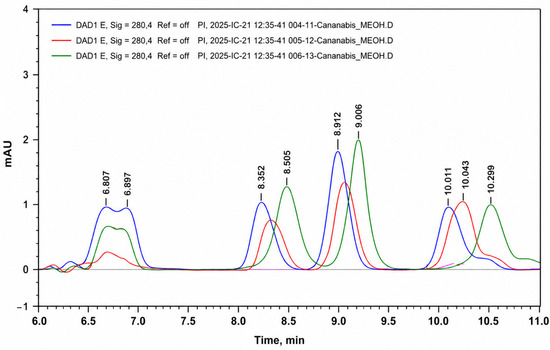
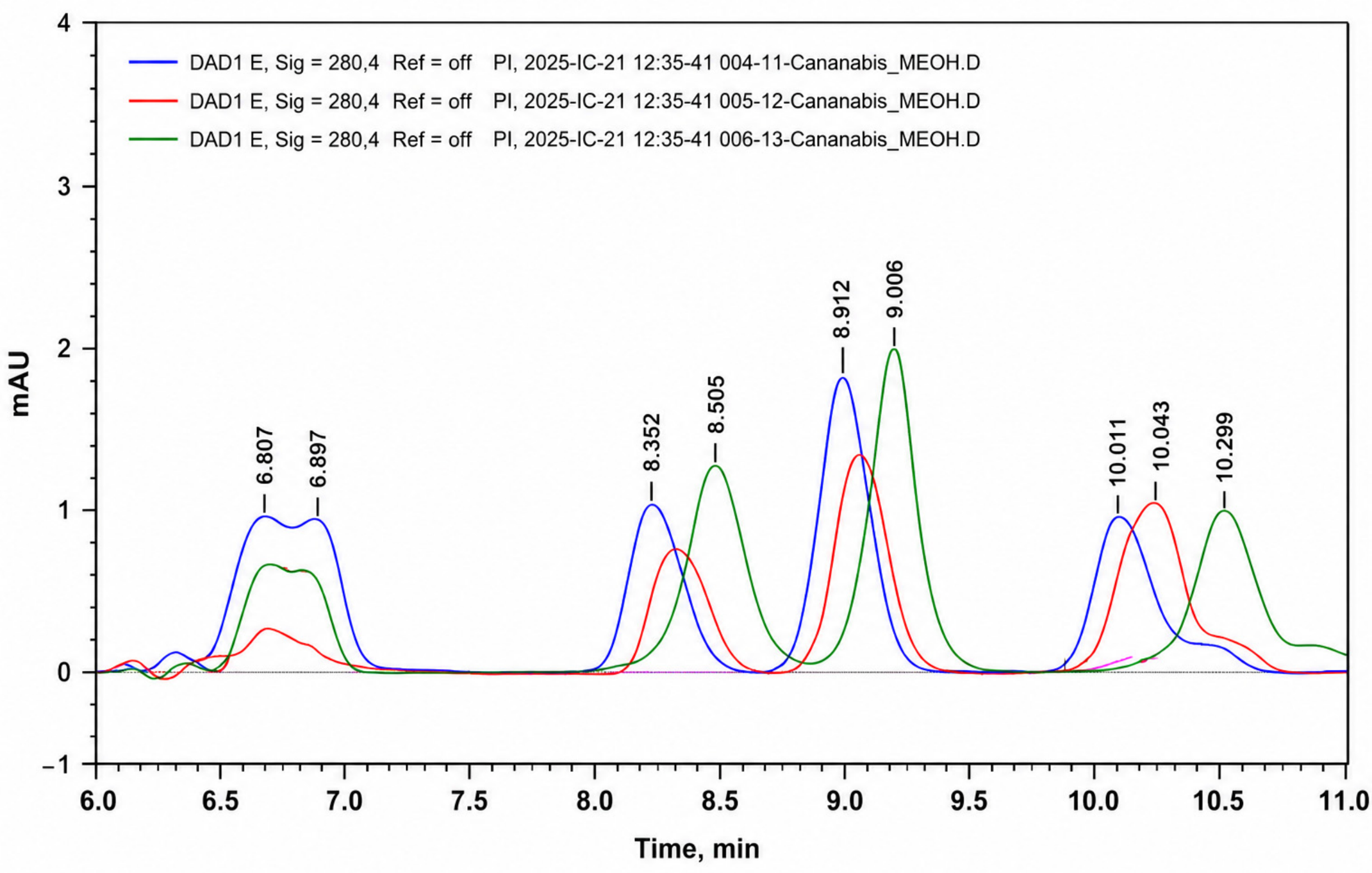
The methanolic extracts of the biomass were analyzed by high-performance liquid chromatography coupled with diode-array detection (HPLC-DAD), an analytical method capable of separating and detecting individual phenolic compounds. Based on the retention profiles recorded at 280 nm, phenolic materials with low molecular weight can be distinguished from lignocellulosic materials by several distinct peaks. The antioxidant capacity and structural rigidity of the plant matrix are typically attributed to these compounds. The dominant peaks showing specific aromatic structures associated with the phenolic fractions of hemp biomass (λ = 280 nm) are presented in Figure 1.
Figure 1.
Representative HPLC-DAD chromatogram of phenolic compounds extracted from hemp biomass.
The chromatography results were interpreted based on retention behavior and UV absorbance measurements. In hemp and other herbaceous species, chlorogenic or gallic acid, both hydroxybenzoic acid derivatives, was tentatively assigned to the earliest-eluting peak observed at 6.8–6.9 min. According to chromatographic analysis, the peak between 8.5 and 8.7 min corresponds to catechin, a flavan-3-ol. A structurally related hydroxycinnamic acid derivative eluted near 10.0 to 10.2 min after ferulic acid. Because phenolic compounds possess aromatic and antioxidant properties, they can provide useful information about the chemical composition of biomass. In the present study, the analysis of phenolic compounds was performed as a supplementary characterization of hemp biomass. Since combustion, pyrolysis, and char formation were not directly investigated, the results should be interpreted primarily in terms of biomass composition rather than thermochemical performance.
Several phenolic constituents have been detected in hemp material, serving as structural stabilizers and antioxidants to provide chemical stability during high-temperature processing. Among the tested samples, phenolic acids and flavonoids accumulate in greater amounts in inflorescence- and leaf-rich fractions than in stem-dominated fractions. Previous studies have associated photosynthetically active hemp tissues with high antioxidant activity and phenolic accumulation. Based on the retention time agreement, UV spectral characteristics, and consistency probability values are calculated. Although individual peaks in hemp biomass cannot be definitively identified, they provide insight into the potential influence of the phenolic fraction on energy conversion. Similar distributions of phenolic compounds have been reported in previous studies on mature lignocellulosic biomass and agricultural residues. The relatively balanced distribution of low-molecular-weight phenolics observed in the analyzed hemp biomass suggests that no single phenolic compound dominated the detected phenolic fraction. Therefore, the obtained profile provides supplementary information on the chemical composition of whole-plant hemp biomass intended for energy applications. The summary of the chromatographic analysis results, along with an estimate of the confidence level in compound identification, is presented in Table 3.
Table 3.
The summary of the chromatographic analysis results and an estimate of the level of confidence in compound identification.
The analysis of chromatographic and spectroscopic results led to the assignment of probability values to each compound, expressing the level of analytical confidence associated with a tentative identification. Total phenolics were estimated at approximately 0.7–1.4 mg·g−1 of dry matter. The slightly lower certainty for the early-eluting peak was due to overlaps in retention characteristics between gallic acid and chlorogenic acid. According to previously reported profiles, hemp biomass at the mature stage contained chlorogenic, ferulic, and catechin derivatives, which are common low-molecular-weight aromatic constituents. The chemical composition of hemp biomass can be further elucidated by the detected phenolic compounds. The direct impact of these compounds on thermochemical conversion processes, fuel stability, and overall fuel performance nevertheless requires further study.
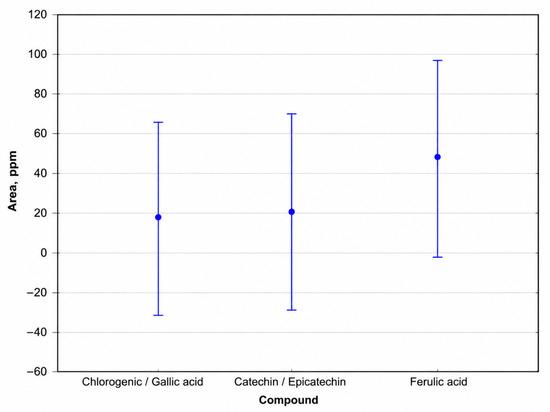
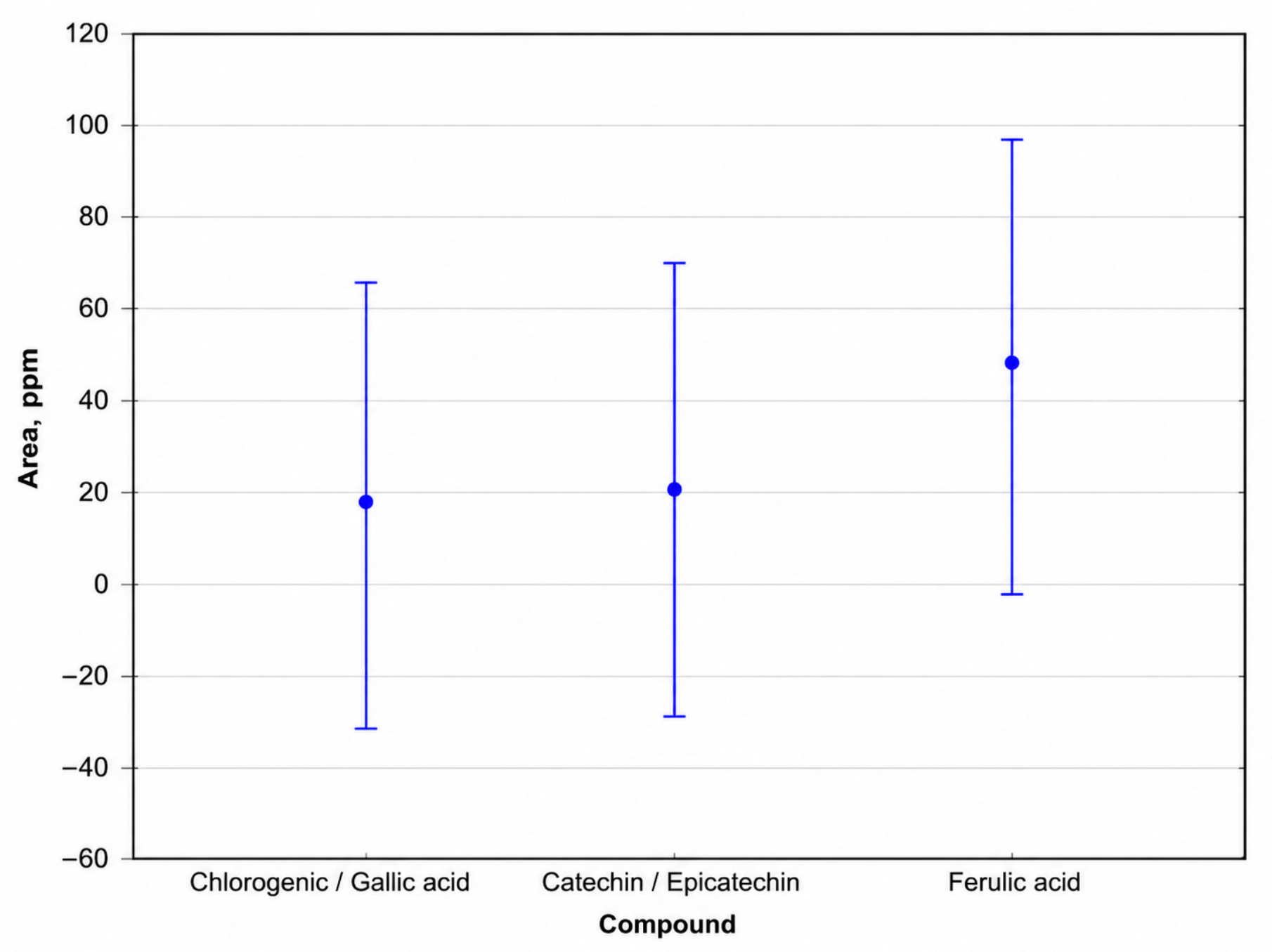
To determine whether the identified phenolic compounds differed in relative abundance, the chromatographic peak areas, expressed in ppm, were analyzed using one-way analysis of variance (ANOVA). This analysis was conducted to assess whether any individual phenolic constituent occurred at a statistically higher concentration or whether all compounds were present at comparable levels. The results showed that the mean chromatographic peak areas of chlorogenic/gallic acid (17.31 ppm), catechin/epicatechin (20.60 ppm), and ferulic acid (47.60 ppm) were not statistically different. Although ferulic acid exhibited a clearly higher average peak area than catechin/epicatechin and chlorogenic/gallic acid, the analysis of variance yielded a low F value of 0.69, indicating that the variability between compounds was small relative to the variability within groups. This interpretation is supported by the high p-value of 0.54, which exceeds the adopted significance threshold and confirms the absence of statistically significant differences among the compounds. The lack of differentiation was further corroborated by Duncan’s multiple range post hoc test at α = 0.05, which classified all analyzed phenolic compounds into a single homogeneous group. None of the phenolic constituents can be considered quantitatively dominant, indicating a balanced distribution of low-molecular-weight phenolics within the hemp biomass, as presented in Figure 2.
Figure 2.
Statistical comparison of chromatographic peak areas of the detected phenolic compounds. Mean values with variability ranges are shown for chlorogenic/gallic acid, catechin/epicatechin, and ferulic acid.
Based on the absence of statistically significant differences among the detected phenolic compounds, the phenolic fraction can be considered relatively homogeneous. A balanced phenolic composition may contribute to more consistent chemical behavior of biomass during storage and thermochemical processing, although the present study did not directly examine combustion, pyrolysis, or fuel aging processes. Therefore, dedicated studies are required to verify potential relationships between phenolic composition and fuel performance. The chromatographic data were further analyzed to determine the average retention times of the identified phenolic compounds and to quantitatively evaluate peak areas. The observed chromatographic peaks were analyzed to determine whether they represented distinct chemical entities or partially overlapping signals. Statistically significant differences between the compounds were revealed by one-way analysis of variance (ANOVA) applied to the average retention times, confirming a clear chromatographic separation. Multiple range post hoc analysis (α = 0.05) classified chlorogenic/gallic acid (6.88 min), catechin/epicatechin (8.70 min), and ferulic acid (10.36 min) into separate homogeneous groups. It appears that their retention times did not overlap. The results indicate that the detected phenolic compounds are chromatographically well resolved and that each peak corresponds to a distinct low-molecular-weight component, demonstrating the reliability of compound discrimination in the HPLC-DAD method.
3.1.4. Material Moisture Content
The moisture content of hemp biomass samples varied from 6.5 to 8.7%, depending on the storage and drying conditions. Specifically, the samples exhibited moisture levels of 7.2 ± 0.1% and 8.1 ± 0.2%, respectively. These results indicate that the lignocellulosic materials intended for energy conversion were adequately prepared and processed, confirming the effectiveness of the applied conditioning procedures. Proper drying of biomass is crucial for accurately quantifying organic fractions and optimizing combustion or pyrolysis performance, as excessive residual moisture can negatively impact these processes. Although moisture content does not directly correlate with the soluble fractions determined by HPLC, it can indirectly affect extraction efficiency and compound stability. Higher water content may promote the hydrolysis of certain soluble carbohydrates, while excessive drying can lead to partial degradation of phenolic compounds. Therefore, maintaining precise control over moisture levels is critical to ensure analytical consistency and obtain a reliable assessment of the biomass chemical composition.
Maintaining a low moisture content, preferably below 10%, is also a key factor in thermochemical processes such as combustion or pyrolysis, as it directly affects energy efficiency and heat balance. Since part of the supplied energy is consumed in water evaporation rather than in converting organic matter into energy, elevated moisture levels reduce the material’s overall calorific value. The measured values, ranging from 6.5 to 8.7%, confirm that all analyzed hemp samples met the required standards for energetic utilization. This demonstrates that the material was sufficiently dried, ensuring efficient energy recovery, reduced thermal losses, and consistent performance in potential industrial applications related to bioenergy production.
3.2. Physicochemical Properties of Whole-Plant Hemp Pellets
The mean values and expanded uncertainties (k = 2) for all measured parameters of whole-plant hemp pellets are summarized in Table 4. To provide a comprehensive description, proximate and ultimate analyses are included in the dataset, along with calorimetric properties. It allows for evaluating the energy value of the material on the one hand and taking into consideration its chemical composition and burn quality on the other. The same parameters are obtained when expressed in different bases (analytical, as received, dry, and dry ash-free), allowing for direct comparison with data from the international literature and energy balances. In addition, the display of measurement uncertainties provides transparency and reliability, emphasizing the reproducibility of results gained from standardized laboratory tests. These values serve as the starting point for further discussion about hemp pellets as a biofuel and their potential use in accordance with normative quality criteria.
Table 4.
Test results for individual features.
The presentation of standard deviations and expanded uncertainties provides information on the reliability and reproducibility of the reported data. Expanded uncertainty corresponds to k = 2 (approximately a 95% confidence level). By quantifying the extent of scatter present for every measured parameter, a judgment can be made not only for the mean values, but also for the confidence with which they represent the true hemp pellet properties. This approach enhances the transparency of the dataset and enables meaningful comparison with literature data, where differences are within or beyond the quoted uncertainty ranges. Additionally, uncertainties reported alongside standard deviations help comply with international standards and test standards, allowing hemp pellet characterization to be used for both scientific discussion and actual application, e.g., in fuel certification or energy balance calculations.
As can be seen from Table 4, most of the parameters have low relative Standard Deviation (SD) values, typically within a few percent (e.g., total moisture Mar: 7.0 ± 0.9%, SD = 0.45), which is evidence of the good reproducibility of the laboratory tests. More uncertain values are obtained for calorimetric properties (e.g., q9r, v, ar: 17,291 ± 344 kJ·kg−1, SD = 172), which is to be expected since these measurements are sensitive to test conditions. This comprehensive reporting of uncertainty and SD renders the results internationally comparable in a transparent manner and applicable in a consistent manner to quality assessment as well as energy balance studies of biomass.
3.2.1. Moisture Content
Moisture content of whole-plant hemp pellets ranged from 6.3% in analytical samples to 7.0% in working samples, indicating relatively low water content compared to many agricultural residues. The ash content was moderate at approximately 4%, lower than that of straw pellets (11.3%) but higher than that of cereal grains, such as wheat or oats. Gross heat of combustion surpassed 18.5 MJ·kg−1 (on the dry basis) with the corresponding net calorific values of approximately 16–17 MJ·kg−1, indicating energy values comparable to those reported for sunflower husk and energy willow biomass, and above the common cereal straw.
The comparison dataset demonstrates that hemp pellets exhibit energy characteristics comparable to those of other biomass fuels: although their net calorific value is slightly lower than that of coal or rapeseed pellets, hemp pellets exhibit ash content, heating value, and moisture content comparable to those of other agricultural biomass fuels. These results indicate that hemp pellets have physicochemical properties comparable to several agricultural biomass fuels currently used for energy production. The physicochemical characteristics of some standard biomass pellets and eco-peat coal are presented in Table 5.
Table 5.
Comparison of physicochemical properties of whole-plant hemp pellets and selected agricultural biomass fuels.
The moisture content of hemp pellets (6.3–7.0%) is in the most appropriate range for solid biofuels and very close to that of energy willow (6.48%) and pine sawdust (≈6.3%). These are by far smaller than in most agricultural residues, such as barley (11.8%), wheat (12.1%), or maize (14.2%), and significantly smaller than hay (18.9%). Low water content favors storage stability, transport efficiency, and combustion quality by reducing microbial degradation, excessive water transport, and ignition problems. Literature confirms this trend: Stolarski et al. [18] and Kocyba and Szczepański [43] indicated between 6 and almost 10%, depending on drying conditions, while Streikus et al. [19] recorded 7.3% for Finola to 9.98% for Felina 32. These differences imply that hemp variety and the parameters of the drying process significantly influence the final moisture content of pellets, yet, on average, hemp achieves moisture contents as low as those of most commonly applied biomass. The low moisture content of whole-plant hemp pellets may enhance storage stability and reduce energy losses associated with evaporation during combustion. Many agricultural biomass fuels are difficult to handle, store, and use efficiently in automated heating systems due to their properties.
3.2.2. Combustion Heat
The combustion heat of whole-plant hemp pellets demonstrates their energy-rich potential. Gross heat of combustion ranged from 17,291 kJ·kg−1 (as received) to 18,592 kJ·kg−1 (dry basis), while the corresponding net calorific values ranged from 16,074 to 17,457 kJ·kg−1. The gross calorific values (HHV) came close to 19,421 kJ·kg−1 (dry, ash-free). These findings confirm that hemp pellets have an energy content comparable to or higher than that of most common agricultural biomasses.
Compared to other biofuels, hemp pellets are favorable to phacelia (17,462 kJ·kg−1) and sunflower husk pellets (18,892 kJ·kg−1) according to measurements by Kocyba and Szczepański [43]. They are more energy-dense than less energy-dense feedstocks, such as maize pellets (15,909 kJ·kg−1), and highlight hemp’s energy density advantage. At the same time, hemp is slightly lower than that for oak sawdust pellets (20,100 kJ·kg−1) [18] or eco-pea coal (26,977 kJ·kg−1), as would be expected for woody biomass and fossil fuels, which contain higher carbon content and lower mineral fractions.
Stolarski et al. [18] also reported 17,700 kJ·kg−1 for energy willow, placing hemp pellets in an extremely close-together energy group and increasing their prospects as a renewable option for co-firing. Gross heating values >19 MJ·kg−1 (daf basis) indicate the premium inherent energy content of hemp biomass after ash and moisture correction.
Operationally, these calorific characteristics manifest in the capability of hemp pellets to compete with the efficiency and stability of combustion of other non-wood biomass fuels. Their calorific profile shows promise not only for small-scale domestic heating but also for co-firing in larger energy contexts, when combined with their moderate ash content and low sulfur and nitrogen concentrations. This renders hemp pellets a viable renewable fuel source, offering energy yield and feasible technical performance. Based on the measured combustion heat values, hemp pellets can serve as a domestic and industrial alternative to conventional agricultural biomass fuels. The energy performance of these boilers is sufficient to support independent combustion and cofiring with biomass.
3.2.3. Calorific Value
The net calorific values (NCVs) of the hemp pellets ranged from 16,074 kJ·kg−1 (calculated) to 17,457 kJ·kg−1 (dry matter basis). All the above confirm that the energy yield of hemp pellets is steady and competitive, positioning them firmly among familiar agricultural and woody biomass fuels.
A direct comparison finds that hemp pellets are slightly more energy-rich than oat straw (15,373 kJ·kg−1) and energetic willow (15,670 kJ·kg−1), two of the best-quoted reference biofuels used in European conditions. They also match well with 17,000 kJ·kg−1 of Stolarski et al. [18] for hemp pellets and within the narrow range of 17,370–17,440 kJ·kg−1 reported by Streikus et al. (2017) [19] across different forms of hemp. This parity between studies further establishes hemp’s reliability as a predictable energy crop, less subject to wild fluctuations than most crop residues.
Compared to higher-value fuels such as rapeseed (≈23,600 kJ·kg−1) or eco-pea coal (25,700 kJ·kg−1), hemp pellets contain a naturally lower energy value per unit mass, but this is compensated by their renewable, lower sulfur and nitrogen contents, and lower environmental footprint.
Technically, calorific values of 16–17.5 MJ·kg−1 are sufficient to achieve good combustion efficiency in household boilers and industrial co-firing. Coupled with the comparatively low moisture and decent ash content, these values indicate that hemp pellets exhibit physicochemical properties comparable to those of conventional biomass fuels, while offering the added sustainability advantages of a non-food, multi-purpose crop. The energy value of whole-plant hemp pellets is comparable to that of cereal-based biomass fuels. In regional bioenergy supply chains, this combination could make them more attractive as renewable feedstocks.
3.2.4. Ash Content
The ash content of hemp pellets was 4.0% (as received/determined) and 4.3% (dry basis). These findings position hemp as a fuel with moderate ash content, with practical implications for combustion efficiency and maintenance. In direct comparison with other biomass fuels, the results are comparable to those of mustard (4.09%), sunflower husk (4.1%), and oat straw (4.99%), again positioning hemp midway between low-ash cereals and high-ash agricultural residues.
Cereal pellets, such as wheat (1.7%), oat (1.9%), or maize (1.7%), contain considerably lower ash contents, implying a lower slagging and fouling risk, but also a lower mineral nutrient recycling potential from ash residues. Straw pellets (11.3%) and hay (7.7%) have considerably higher ash contents, which can lead to operational difficulties in boilers due to slagging and sintering, and to higher ash disposal costs. In this context, hemp’s 4% ash can be understood as a compromise between its technical applicability and its nutrient-rich properties, which can be recycled in agriculture.
Literature data also illustrate this variability: Stolarski et al. (2010) [18] determined 2.8% ash in hemp-straw pellets, whereas a broader range from 0.4% in oak sawdust to 11.3% in straw is given. Streikus et al. (2017) [19] found 3.3–6.57% ash in fiber hemp varieties, and Roman and Grzegorzewska (2024) [44] found 3.61% ± 0.21% in hemp material of similar composition. These results confirm that ash content is primarily determined by biomass botanical origin and growth conditions, as well as by pelleting technology and the level of non-plant impurities (soil, dust, and mineral fractions).
From an application point of view, the observed ash contents of hemp pellets suggest manageable boiler operation without indicating an elevated risk of slagging, although dedicated ash fusion analyses would be required for confirmation. This positions hemp pellets competitively with high-ash wastes, such as straw, and aligns them with a range of conventional biomass fuels currently used in power generation. Moderate ash content contributes to acceptable boiler maintenance requirements and stable operation. The use of hemp pellets can therefore serve as an attractive alternative to several agricultural residues with high ash content.
4. Conclusions
The results of this study indicate that 6 mm whole-plant hemp pellets exhibit physicochemical properties comparable to several agricultural biomass fuels used for energy production. The pellets showed low moisture content, moderate ash content, and net calorific values ranging from 16.1 to 17.5 MJ·kg−1. It appears that the low sulfur and nitrogen contents indicate a potentially favorable emission profile; however, direct combustion and emissions tests may be required to confirm this. The obtained results support the potential use of whole-plant hemp pellets as a non-woody biomass fuel. Future studies should include combustion performance, emission measurements, ash-melting behavior, and mechanical durability before practical implementation can be fully assessed.
A limitation of the present study is that pellet quality parameters related to handling and storage performance, such as mechanical durability, fines content, and water resistance, were not evaluated. Although the study focused on the physicochemical and energetic properties of whole-plant hemp pellets, these parameters are important for assessing fuel quality under practical operating conditions. Therefore, future research should include durability testing, fines determination, water resistance assessment, and combustion performance evaluation to provide a more comprehensive characterization of hemp pellets.
5. Implications for Practice and Sustainable Development
According to the results obtained in this study, whole-plant hemp pellets can practically and sustainably replace conventional solid biofuels in both domestic and industrial energy systems. Their relatively high calorific value, low moisture content, and moderate ash content indicate their suitability for use in automated pellet boilers and co-firing technologies, without requiring major modifications to existing biomass combustion infrastructure. Owing to the low sulfur and moderate nitrogen content, hemp pellets exhibit physicochemical properties that are comparable to those of other biomass fuels used for energy production. Actual SO2 and NOx emissions require verification under specific combustion conditions. A practical advantage of using hemp biomass is the diversification of raw material sources for pellet production, which may reduce reliance on woody biomass that is becoming increasingly scarce in many European regions. Hemp cultivation is characterized by rapid growth, low pesticide requirements, and the ability to grow on marginal or degraded soils, including post-industrial and post-mining areas. As a result, bioenergy can be produced locally without directly competing with food production. The use of whole-plant biomass, including stems, leaves, and inflorescences, also supports zero-waste agriculture and improves overall material efficiency.
The findings further contribute to the broader goals of sustainable development and the circular bioeconomy. Hemp-based pellets may support the decarbonization of the heating sector by partially replacing fossil fuels and reducing greenhouse gas emissions. In addition, ash generated during combustion contains mineral components that can potentially be recycled as soil amendments, thereby supporting nutrient circulation, reducing waste generation, and contributing to closed-loop resource management. Hemp biomass can therefore be integrated into renewable energy systems that promote resource efficiency, environmental restoration, and climate neutrality.
The study also highlights the importance of standardized physicochemical characterization of non-woody biomass fuels according to EN ISO standards. The use of harmonized analytical approaches improves comparability between studies and may facilitate the future certification and commercialization of hemp-derived solid biofuels. Further research should focus on long-term combustion performance, ash melting behavior, life-cycle assessment (LCA), emission profiles under industrial conditions, and economic evaluations of hemp pellet production chains. In this context, hemp biomass may support sustainable energy policies and regional bioeconomy frameworks, provided that further technical, environmental, and economic validation is carried out.
Author Contributions
Conceptualization, M.H., K.R. and W.J.W.; methodology, M.H.; software, K.R.; validation, M.H., K.R., and M.N.; formal analysis, M.H. and W.J.W.; investigation, M.H. and K.R.; resources, M.H.; data curation, K.R. and W.J.W.; writing—original draft preparation, K.R.; writing—review and editing, M.H. and W.J.W.; visualization, K.R. and W.J.W.; supervision, M.H. All authors have read and agreed to the published version of the manuscript.
Funding
This research received no external funding.
Institutional Review Board Statement
Not applicable.
Informed Consent Statement
Not applicable.
Data Availability Statement
The original contributions presented in this study are included in the article. Further inquiries can be directed to the corresponding authors.
Conflicts of Interest
Mr. Mariusz Nazaruk is affiliated with Cannabotanique Sp. z o.o., Warszawa, Poland. The remaining authors declare that the research was conducted in the absence of any commercial or financial relationships that could be construed as a potential conflict of interest.
References
- Klimek, K.E.; Wrzesińska-Jedrusiak, E.; Kapłan, M.; Łaska-Zieja, B. Management of Biomass of Selected Grape Leaves Varieties in the Process of Methane Fermentation. J. Water Land Dev. 2022, 55, 17–27. [Google Scholar] [CrossRef] [Scilit]
- Klimek, K.; Kapłan, M.; Syrotyuk, S.; Konieczny, R.; Anders, D.; Dybek, B.; Karwacka, A.; Wałowski, G. Production of Agricultural Biogas with the Use of a Hydrodynamic Mixing System of a Polydisperse Substrate in a Reactor with an Adhesive Bed. Energies 2021, 14, 3538. [Google Scholar] [CrossRef] [Scilit]
- Skibko, Z.; Romaniuk, W.; Borusiewicz, A.; Porwisiak, H.; Lisowski, J. Use of Pellets from Agricultural Biogas Plants in Fertilisation of Oxytrees in Podlasie, Poland. J. Water Land Dev. 2021, 51, 124–128. [Google Scholar] [CrossRef] [Scilit]
- Walowski, G. Assessment of Polydisperse Substrate Flow in a Fermentor for Computational Fluid Dynamics Modelling. J. Water Land Dev. 2021, 1–7. [Google Scholar] [CrossRef] [Scilit]
- Parvez, A.; Lewis, J.; Afzal, M. Potential of Industrial Hemp (Cannabis sativa L.) for Bioenergy Production in Canada: Status, Challenges and Outlook. Renew. Sustain. Energy Rev. 2021, 141, 110784. [Google Scholar] [CrossRef] [Scilit]
- Brar, K.K.; Raheja, Y.; Chadha, B.S.; Magdouli, S.; Brar, S.K.; Yang, Y.-H.; Bhatia, S.K.; Koubaa, A. A Paradigm Shift towards Production of Sustainable Bioenergy and Advanced Products from Cannabis/Hemp Biomass in Canada. Biomass Convers. Biorefin. 2024, 14, 3161–3182. [Google Scholar]
- Nath, M. Benefits of Cultivating Industrial Hemp (Cannabis sativa ssp. Sativa)—A Versatile Plant for a Sustainable Future. Chem. Proc. 2021, 10, 14. [Google Scholar] [CrossRef] [Scilit]
- Yano, H.; Fu, W. Hemp: A Sustainable Plant with High Industrial Value in Food Processing. Foods 2023, 12, 651. [Google Scholar] [CrossRef] [Scilit] [PubMed]
- Ranalli, P.; Venturi, G. Hemp as a Raw Material for Industrial Applications. Euphytica 2004, 140, 1–6. [Google Scholar] [CrossRef] [Scilit]
- Poniatowska, J.; Wielgus, K.; Szalata, M.; Ozarowski, M.; Panasiewicz, K. Contribution of Polish Agrotechnical Studies on Cannabis sativa L. to the Global Industrial Hemp Cultivation and Processing Economy. Herba Pol. 2019, 65, 37–50. [Google Scholar] [CrossRef] [Scilit]
- Pudelko, K.; Kolodziej, J.; Mankowski, J. Restoration of Minesoil Organic Matter by Cultivation of Fiber Hemp (Cannabis sativa L.) on Lignite Post-Mining Areas. Ind. Crop. Prod. 2021, 171, 113921. [Google Scholar] [CrossRef] [Scilit]
- Kraszkiewicz, A.; Kachel, M.; Parafiniuk, S.; Zajac, G.; Niedziółka, I.; Sprawka, M. Assessment of the Possibility of Using Hemp Biomass (Cannabis sativa L.) for Energy Purposes: A Case Study. Appl. Sci. 2019, 9, 4437. [Google Scholar] [CrossRef] [Scilit]
- Frankowski, J.; Sieracka, D. Possibilities for Using Waste Hemp Straw for Solid Biofuel Production. Environ. Sci. Proc. 2021, 9, 18. [Google Scholar] [CrossRef] [Scilit]
- Blandiniers, H.; Amaducci, S. Adapting the Cultivation of Industrial Hemp (Cannabis sativa L.) to Marginal Lands: A Review. GCB Bioenergy 2022, 14, 1004–1022. [Google Scholar] [CrossRef] [Scilit]
- Drastig, K.; Flemming, I.; Gusovius, H.-J.; Herppich, W.B. Study of Water Productivity of Industrial Hemp under Hot and Dry Conditions in Brandenburg (Germany) in the Year 2018. Water 2020, 12, 2982. [Google Scholar] [CrossRef] [Scilit]
- Marrot, L.; Alao, P.F.; Mikli, V.; Kers, J. Properties of Frost-Retted Hemp Fibers for the Reinforcement of Composites. J. Nat. Fibers 2022, 19, 16017–16028. [Google Scholar] [CrossRef] [Scilit]
- Horne, M.R.L. Bast Fibres: Hemp Cultivation and Production. In Handbook of Natural Fibres; Elsevier: Amsterdam, The Netherlands, 2012; Volume 1, pp. 114–145. [Google Scholar] [CrossRef] [Scilit]
- Stolarski, M.; Graban, Ł.; Szczukowski, S.; Tworkowski, J. Agricultural and Forest Biomass as Feedstock in the Manufacture of Solid Biofuels. Pol. J. Agron. 2010, 2, 67–72. [Google Scholar]
- Streikus, D.; Jasinskas, A.; Kucinskas, V.; Masek, J. Research in Fibrous Plant Preparation for Pressed Solid Biofuel and Determination of Pellet Indicators. In Proceedings of the 16th International Scientific Conference Engineering for Rural Development, Jelgava, Latvia, 24–26 May 2017; Volume 16, pp. 680–686. [Google Scholar]
- Szyszlak-Bargłowicz, J.; Zając, G.; Słowik, T. Badania energetyczne kotła przy spalaniu peletów ze ślazowca pensylwańskiego. Autobusy—Tech. Eksploat. Syst. Transp. 2011, 12, 425–430. [Google Scholar]
- Jach-Nocoń, M.; Pełka, G.; Luboń, W.; Mirowski, T.; Nocoń, A.; Pachytel, P. An Assessment of the Efficiency and Emissions of a Pellet Boiler Combusting Multiple Pellet Types. Energies 2021, 14, 4465. [Google Scholar] [CrossRef] [Scilit]
- Stolarski, M.J.; Stachowicz, P.; Dudziec, P. Wood Pellet Quality Depending on Dendromass Species. Renew. Energy 2022, 199, 498–508. [Google Scholar] [CrossRef] [Scilit]
- Ahmed, A.T.M.F.; Islam, M.Z.; Mahmud, M.S.; Sarker, M.E.; Islam, M.R. Hemp as a Potential Raw Material toward a Sustainable World: A Review. Heliyon 2022, 8, e08753. [Google Scholar] [CrossRef] [Scilit] [PubMed]
- Shi, Z.; Yue, L.; Wang, X.; Lei, X.; Sun, T.; Li, Q.; Guo, H.; Yang, W. 3D Mesoporous Hemp-Activated Carbon/Ni3S2 in Preparation of a Binder-Free Ni Foam for a High Performance All-Solid-State Asymmetric Supercapacitor. J. Alloys Compd. 2019, 791, 665–673. [Google Scholar] [CrossRef] [Scilit]
- Sunoj Valiaparambil Sebastian, J.; Dong, X.; Trostle, C.; Pham, H.; Joshi, M.V.; Jessup, R.W.; Burow, M.D.; Provin, T.L. Hemp Agronomy: Current Advances, Questions, Challenges, and Opportunities. Agronomy 2023, 13, 475. [Google Scholar] [CrossRef] [Scilit]
- Timofeeva, S.S.; Gorlenko, N.V.; Timofeev, S.S. Possibility of Ecological Remediation of Oil Production Territories with the Use of Industrial Hemp. In IOP Conference Series: Materials Science and Engineering; IOP Publishing Ltd.: Bristol, UK, 2020; Volume 962. [Google Scholar]
- Khan, B.A.; Warner, P.; Wang, H. Antibacterial Properties of Hemp and Other Natural Fibre Plants: A Review. Bioresources 2014, 2, 3642–3659. [Google Scholar] [CrossRef] [Scilit]
- Woo, D.G.; Kim, S.H.; Kim, T.H. Solid Fuel Characteristics of Pellets Comprising Spent Coffee Grounds and Wood Powder. Energies 2021, 14, 371. [Google Scholar] [CrossRef] [Scilit]
- ISO 17225-6:2021; Solid Biofuels—Fuel Specifications and Classes—Part 6: Graded Non-Woody Pellets. International Organization for Standardization: Geneva, Switzerland, 2021.
- Olejar, K.J.; Kinney, C.A. Evaluation of Thermo-Chemical Conversion Temperatures of Cannabinoid Acids in Hemp (Cannabis sativa L.) Biomass by Pressurized Liquid Extraction. J. Cannabis Res. 2021, 3, 40. [Google Scholar] [CrossRef] [Scilit] [PubMed]
- PN-EN ISO 18134-3:2015-11; Solid Biofuels—Determination of Moisture Content (Mad, Mar). Polish Committee for Standardization: Warsaw, Poland, 2015.
- PN-EN ISO 18122:2016-01; Solid Biofuels—Determination of Ash Content. Polish Committee for Standardization: Warsaw, Poland, 2016.
- Chang, L.; Duan, W.; Huang, S.; Chen, A.; Li, J.; Tang, H.; Pan, G.; Deng, Y.; Zhao, L.; Li, D. Improved Antibacterial Activity of Hemp Fibre by Covalent Grafting of Quaternary Ammonium Groups. R. Soc. Open Sci. 2021, 8, 201904. [Google Scholar] [CrossRef] [Scilit] [PubMed]
- Stasiłowicz-Krzemień, A.; Szymanowska, D.; Szulc, P.; Cielecka-Piontek, J. Antimicrobial, Probiotic, and Immunomodulatory Potential of Cannabis sativa Extract and Delivery Systems. Antibiotics 2024, 13, 369. [Google Scholar] [CrossRef] [Scilit] [PubMed]
- Lakatos, M.; Apori, S.O.; Dunne, J.; Tian, F. The Biological Activity of Tea Tree Oil and Hemp Seed Oil. Appl. Microbiol. 2022, 2, 534–543. [Google Scholar] [CrossRef] [Scilit]
- Roman, K. The Estimation of the Possibility of Bioethanol Production from Hemp Cellulose Using the HWE Method. Energies 2025, 18, 1441. [Google Scholar] [CrossRef] [Scilit]
- Szokalska, A. Rocznik Meteorologiczny 2022; Instytut Meteorologii i Gospodarki Wodnej—Państwowy Instytut Badawczy (IMGW-PIB): Warszawa, Poland, 2023. [Google Scholar]
- PN-EN ISO 16994:2016-10; Solid Biofuels—Determination of Total Sulphur Content. Polish Committee for Standardization: Warsaw, Poland, 2016.
- PN-EN ISO 16948:2015-07; Solid Biofuels—Determination of Elemental Composition (C, H, N). Polish Committee for Standardization: Warsaw, Poland, 2015.
- PN-EN ISO 18135:2017; Solid Biofuels—Sampling. Polish Committee for Standardization: Warsaw, Poland, 2017.
- PN-EN ISO 14780:2017-07; Solid Biofuels—Sample Preparation. Polish Committee for Standardization: Warsaw, Poland, 2017.
- PN-EN ISO 18125:2017-07; Solid Biofuels—Determination of Calorific Value. Polish Committee for Standardization: Warsaw, Poland, 2017.
- Kocyba, M.; Szczepański, K. Analiza Porównawcza Przydatności Energetycznej Wybranych Gatunków Biomasy (Comparative Analysis of the Energy Suitability of Selected Biomass Species). Rynek Energii 2018, 3, 1–14. [Google Scholar]
- Roman, K.; Grzegorzewska, E. The Comparison of Physical and Chemical Properties of Pellets and Briquettes from Hemp (Cannabis sativa L.). Energies 2024, 17, 2210. [Google Scholar] [CrossRef] [Scilit]

Disclaimer/Publisher’s Note: The statements, opinions and data contained in all publications are solely those of the individual author(s) and contributor(s) and not of MDPI and/or the editor(s). MDPI and/or the editor(s) disclaim responsibility for any injury to people or property resulting from any ideas, methods, instructions or products referred to in the content. |
© 2026 by the authors. Licensee MDPI, Basel, Switzerland. This article is an open access article distributed under the terms and conditions of the Creative Commons Attribution (CC BY) license.