Article

Strategic Focus or Accountability Evasion? Reinterpreting SDGs Selectivity in University Sustainability Reporting

by
Khaled Hamden Alshammari
1,* and
Ibrahim Abdulrahman Alhanaya
2
1
Department of Accounting, College of Business, Jouf University, Sakakah 72388, Saudi Arabia
2
Department of Accounting, College of Business Administration in Hawtat Bani Tamim, Prince Sattam Bin Abdulaziz University, Al Kharj 11942, Saudi Arabia
*
Author to whom correspondence should be addressed.
Sustainability 2026, 18(13), 6621; https://doi.org/10.3390/su18136621
Submission received: 8 May 2026 / Revised: 22 June 2026 / Accepted: 25 June 2026 / Published: 30 June 2026

Abstract

Selective Sustainable Development Goal (SDG) disclosure is frequently interpreted as evidence of weak university accountability. This research advances a different position. It argues that the problem is not selectivity itself, but unexplained selectivity. In plural-mission institutions, no university can give equal depth to every SDG without risking superficiality. Selectivity preserves accountability when priorities are publicly justified, mission-linked, evidence-supported, and explicit about what remains underdeveloped. It erodes accountability when curated visibility replaces public account-giving. Drawing on structured document analysis of 107 university SDG and sustainability disclosures from Europe, Asia–Pacific, North America, Latin America, Africa and the Middle East, published between 2019 and 2024, independently coded by two researchers (Cohen’s kappa = 0.81) and scored through the SDG Disclosure Review-Readiness Index (SDG-DRRI), the research shows that moderately selective documents (n = 18) achieved the highest mean score, outperforming both broad reporting (n = 34) and highly selective reporting (n = 55). This research contributes a new distinction between accountability-preserving and accountability-eroding selectivity, showing why disclosure breadth alone is an inadequate proxy for accountability quality. It advances sustainability accounting and higher education reporting debates by reframing SDG selectivity as a conditional accountability phenomenon: legitimate when publicly justified, problematic when it narrows responsibility without explanation.

1. Introduction

University sustainability reporting has become a standard feature of higher education [1]. Institutions publish SDG reports, sustainability reports, ESG updates, climate roadmaps, annual impact summaries, ranking-facing profiles, strategy documents, and hybrid packages combining several of these forms. This expansion has shifted the analytical question. The sector has moved beyond whether universities disclose at all; the harder question now concerns how they disclose, what they foreground, and on what grounds those choices should be judged.
Growth in reporting volume is not growth in accountability. Universities can publish more and still explain less, producing richer metrics and denser SDG mapping without giving a clearer public account of priorities, omissions, and trade-offs. Bebbington and Larrinaga [1] argue that accounting becomes meaningful for sustainable development only when it does more than display concern, and Bebbington and Unerman [2] extend the point to the SDGs by warning that organisational engagement requires more than symbolic attachment. Adams and Abhayawansa [3] sharpen the concern by showing how SDG engagement can devolve into SDG washing when disclosure substitutes for substantive transformation.
Research gap. Previous studies have documented uneven SDG coverage, impression-management risks, SDG-washing, and variation in university sustainability reporting. However, the literature often treats selectivity as a reporting weakness, without distinguishing justified strategic prioritisation from opaque omission. The unresolved gap is, therefore, conceptual and evaluative. Existing work explains that university SDG disclosure is selective, but it does not yet provide a clear criterion for judging when selectivity preserves accountability and when it erodes it.
Research question and goal. The research addresses one research question: when does selectivity in university SDG disclosure function as a legitimate form of strategic focus, and when does it become accountability erosion? The research goal is to reinterpret SDG selectivity in university sustainability reporting by distinguishing accountability-preserving selectivity from accountability-eroding selectivity and by examining how these forms are reflected in SDG-DRRI disclosure quality scores.
Methodological orientation. To answer this question, the research uses a structured qualitative-comparative document analysis of 107 university-linked sustainability and SDG disclosures published between 2019 and 2024. The sample covers universities from Europe, Asia–Pacific, North America, Latin America, Africa and the Middle East and combines documents identified through THE Impact Rankings, the GRI Sustainability Disclosure Database and institutional website searches. The unit of analysis is the disclosure document, not the university as a whole.
This research, therefore, asks a direct question: when does selectivity in university SDG disclosure function as a legitimate form of strategic focus, and when does it become accountability erosion? The question remains important because university SDG reporting is shaped both by visibility systems such as THE Impact Rankings [4] and by whole-institution sustainability guidance [5,6,7].
The dominant tendency in the literature has been to regard selectivity as a weakness. Corporate disclosure research shows that organisations under scrutiny often disclose what is benign and defensible while muting material that is harder to justify [8,9]. University reporting is vulnerable to the same logic, and Bellucci et al. [10] document how impression management techniques migrate into higher education disclosure. Yet the field has often stopped short. If selectivity is condemned in undifferentiated terms, the possibility that some selectivity is not only legitimate but necessary disappears. Universities are plural-mission institutions whose sustainability profile is distributed across teaching, research, operations, governance, and partnerships. A demand for perfectly even disclosure across all 17 SDGs can therefore become unrealistic and institutionally inappropriate.
The more useful contrast is not selective versus broad reporting. It is justified prioritisation versus opaque omission. A university may focus on a subset of SDGs and still remain accountable if it explains why, links its focus to mission and capability, identifies what remains underdeveloped, and shows how less developed goals are being handled. Another university may also focus on a subset but do so by foregrounding reputationally attractive themes and leaving uninterpreted areas absent. The empirical pattern examined here supports that distinction. Within the corpus, the moderately selective group outperformed both broad and highly selective reporting on the overall SDG-DRRI score and on review readiness, with the largest gap between moderately and highly selective documents. Full results are reported in Section 5.
The research makes three contributions. First, it reframes SDG selectivity as a conditional accountability phenomenon rather than a reporting defect. Second, it introduces the distinction between accountability-preserving and accountability-eroding selectivity, thereby shifting attention from disclosure breadth to the public justification of prioritisation and omission. Third, it provides empirical evidence from 107 university sustainability disclosures showing that moderate, justified selectivity was associated with stronger review-readiness than either broad but weakly prioritised reporting or narrow, poorly justified reporting within the purposive corpus examined here.
The rest of the research proceeds through the literature review in Section 2, theoretical framing in Section 3, methodology in Section 4, results and discussion in Section 5, and conclusion in Section 6.

2. Literature Review

2.1. Reporting Growth Versus Accountability Function

University sustainability reporting has expanded steadily, but the field remains fragmented in themes, methods, and conceptual anchors [11,12,13,14]. Recent evidence further shows that university reporting practices differ in their drivers, standardisation, international reporting patterns, and online presentation across higher education systems [15,16,17,18]. Ceulemans et al. [11] identified early on a problem that later studies have confirmed rather than resolved: reporting growth does not by itself establish what a high-quality university sustainability report should be, what work it should do, or how its quality should be judged. Ceulemans et al. [19] argue that reporting in higher education should be understood as part of organisational change rather than as communication alone. Di Tullio et al. [20], likewise, suggest that the institutionalisation of sustainability in universities is increasingly visible in strategic planning but is not evenly translated into mature public account-giving, while recent work on institutional isomorphism shows how sustainability-oriented activities can become standardised without necessarily resolving accountability depth [21].
The higher education sustainability assessment literature reinforces the point. Findler et al. [22] argue that universities generate sustainable development impacts across multiple domains and stakeholder relationships, which complicates both assessment and communication. Moggi [23] shows that disclosure is shaped by unresolved questions about framework fit, especially the suitability of importing GRI-derived logics into higher education. Bellucci et al. [10] add that sustainability disclosure in higher education is frequently shaped by impression management strategies rather than substantive accountability intent. The cumulative picture is one in which reporting volume increases faster than explanatory discipline. The sector has become more communicatively active, but this activity does not settle whether its disclosures function as credible accountability devices.

2.2. Selectivity, Impression Management, and Justified Prioritisation

Selectivity has become one of the most recurrent but least differentiated features of sustainability reporting. In university studies, it appears either as uneven SDG engagement, certain goals repeatedly highlighted while others remain marginal, or indirectly through critiques of incompleteness, performance-oriented SDG reporting and symbolic reporting [13,24,25,26,27]. The literature often moves too quickly from observed unevenness to the judgment that selectivity is itself the flaw, rarely specifying whether the problem lies in the focus itself or in the absence of an explicit and defensible basis for focus.
Impression management research sharpens this diagnosis. Merkl-Davies and Brennan [9] show that discretionary disclosure choices frequently manage reader inferences rather than inform them, producing strategic textual patterns such as thematic emphasis on favourable outcomes and rhetorical obscuration of weaker performance. Bellucci et al. [10] document analogous patterns in university sustainability communication, where visual design, narrative framing and case-research selection amplify favourable themes while marginalising less legible ones. Impression management does not render selectivity automatically suspect, but it requires analysts to ask whether the observed selectivity is accompanied by an explanatory apparatus that distinguishes defensible prioritisation from reader management.
Universities are not equally positioned across all SDGs. Ruiz-Mallén and Heras [28] show that higher education institutions approach Agenda 2030 through institution-specific pathways shaped by mission, capabilities, and local context, and Findler et al. [22] emphasise that universities affect sustainable development through combinations of education, research, operations, outreach, and governance. Once this plurality is acknowledged, some degree of prioritisation becomes inevitable, and selective emphasis is not automatically suspect. The analytical task is to judge the terms on which it is made visible.
Rankings sharpen the problem. Buckner and Zhang [4] show that sustainability rankings can function as vehicles for global recognition, as well as normative instruments, and Adams and Abhayawansa [3] demonstrate that SDG-oriented disclosure is especially prone to drift from substantive accountability when external visibility incentives outweigh internal governance reasoning (see also [29,30]). Related work shows that rankings may shape organisational-level SDG implementation and can blur the boundary between SDG enhancement and institutional promotion [31,32,33]. Once rankings enter the picture, selective emphasis reflects a dual logic: genuine prioritisation on the one hand and external legibility on the other. What the literature documents is unevenness, visibility pressures, and reporting differentiation; what it does not yet supply is a sufficiently discriminating criterion for distinguishing selective emphasis that remains accountable from selective emphasis that does not.

2.3. Materiality, Double Materiality and Legitimacy-Driven Visibility

Selectivity needs to be read through the two literatures often discussed separately: materiality and legitimacy. Materiality suggests that not every issue should receive equal reporting depth. Legitimacy theory suggests that organisations highlight what is socially resonant or reputationally advantageous. Bebbington and Unerman [2] refuse both extremes, treating the SDGs as a holistic agenda while acknowledging that organisations will often focus on goals closest to their operations. Selectivity is thus neither inherently defective nor automatically defensible; its status depends on whether prioritisation remains accountable to the interdependencies and exclusions it obscures.
The materiality concept itself has evolved in ways that bear directly on university SDG disclosure. Three variants are relevant. Financial materiality, rooted in investor-facing reporting, treats sustainability issues as material insofar as they affect enterprise value. Impact materiality, developed within the GRI tradition, treats issues as material when organisational activities produce significant social or environmental effects. Double materiality, now formalised in the European Sustainability Reporting Standards (ESRS) under CSRD, integrates both perspectives [3]. For universities, not primarily investor-facing but generating large and distributed societal impacts, impact materiality and double materiality are the more directly relevant frames. Impact-material prioritisation would emphasise SDGs where institutional activities generate the most significant societal effects; legitimacy-driven prioritisation would emphasise SDGs that maximise external visibility. These logics may coincide, but when they diverge, the accountability consequences of selectivity diverge with them.
Legitimacy theory complicates the picture. Legitimacy is a generalised perception that an entity’s actions are desirable within socially constructed norms [34], and disclosure practices often function as legitimacy work [35]. Organisational fields also generate isomorphic pressures toward shared practices [36]. Applied to universities, SDG reporting is shaped as much by external expectations and visibility cultures as by internally grounded priority setting. Climate action, partnerships, student well-being, and educational contribution are highly legible, normatively attractive themes; their repeated prominence partly reflects legitimacy value, as well as institutional materiality.
The greenwashing and SDG-washing literature makes the stakes explicit [3,8,37]. Organisations may foreground visible virtue while muting areas where evidence is weaker or responsibility is harder to narrate. Universities are particularly exposed because they are expected not simply to perform well but to embody public purpose, which creates fertile conditions for legitimacy-driven visibility management. Bebbington, Russell and Thomson [38] sharpen the point from within the accounting literature by arguing that sustainable development cannot be reduced to a reporting surface detached from the tensions organisations must navigate in practice. The analytical task, therefore, shifts: the question is not whether a report is selective, but whether its selectivity is publicly reasoned in a way that keeps the institution answerable for what is foregrounded, what is backgrounded, and what remains outside the frame.

2.4. Plural-Mission Institutions and Limits of Crude Breadth Metrics

Universities cannot be judged by crude breadth metrics alone. A breadth metric can indicate how widely a report distributes attention across goals; it cannot reveal whether the resulting disclosure is strategically coherent, evidence-bearing, or accountability-enhancing. A university may mention many SDGs while offering little clarity about which areas are most developed, who governs them, or what remains weak; another may concentrate on fewer goals yet provide a much more disciplined account of institutional responsibility. Stakeholder theory [39,40] reinforces the point that universities answer to a differentiated set of stakeholders, students, staff, funders, regulators, local communities, partners, alumni, and civil society, whose claims carry different combinations of legitimacy, power, and urgency. Institutions cannot treat all goals with equal evidence depth given this heterogeneity, and engagement with the SDGs must grapple with interdependence without collapsing into symmetric treatment [2,22,28].
Whole-institution sustainability discourse does not eliminate the problem. UNESCO’s education for a sustainable development agenda [5,6] and the Sustainable Development Solutions Network’s Voluntary University Review proposal [7] call for integrated institutional responsibility rather than isolated sustainability activity, a point also reflected in recent work on the challenges and opportunities of embedding sustainability across higher education institutions [41,42]. However, integration is not the same as symmetry. A whole-institution approach requires that sustainability responsibility be embedded across functions, governance, and strategy; it does not require that every report devote equal space to every SDG regardless of institutional materiality, evidence maturity, or implementation stage. The field has often slipped between these two ideas, rightly criticising narrow and symbolic reporting, rightly calling for whole-institution thinking, but inadequately theorising the possibility that accountable reporting may involve selective depth within an explicitly wider frame of responsibility.
The student-facing dimension of SDG reporting also matters because universities are not only institutional reporters but educational environments in which students encounter, interpret and act on the SDGs. Student-oriented SDG initiatives and responsible-management education resources emphasise that the goals must be translated into learning, participation and student agency rather than treated only as institutional branding [43,44]. This reinforces the research’s concern with accountability: selective SDG reporting is more defensible when it helps stakeholders, including students, understand institutional priorities and gaps.
The literature explains disclosure growth, symbolic communication, and legitimacy management, and it explains why sustainability frameworks travel unevenly across institutions. What it does not explain with enough precision is when university SDGs selectivity reflects strategic discipline and when it functions as institutional accountability erosion. This unresolved distinction is the problem this research takes up (Table 1).

3. Theoretical Framing

The theoretical framing rests on five connected ideas: legitimacy, selective disclosure and impression management, institutional accountability, stakeholder heterogeneity, and materiality within a whole-institution sustainability logic. Legitimacy theory identifies the pressures that shape selective emphasis. Selective disclosure and impression management research characterise the observable patterns those pressures produce; accountability supplies the evaluative standard against which such patterns are judged. Stakeholder theory specifies to whom universities are answerable, and materiality within a whole-institution frame specifies when unequal treatment remains defensible.
Legitimacy theory explains why some SDGs are repeatedly foregrounded and others muted. Universities operate under particularly strong moralised expectations of public contribution, and sustainability reporting becomes an arena in which institutional virtue is narrated and defended. Suchman’s [34] distinction between legitimacy as strategic management and legitimacy as institutional embeddedness is useful because university SDG reporting often reflects both logics at once. Selective disclosure and impression management research extend this. Organisations under pressure do not merely disclose more, they disclose unevenly in ways that preserve favourable visibility and mute uncomfortable material [8,10].
Legitimacy theory alone, however, leads us to treat all selectivity as suspect. Materiality provides the counterweight. Serious reporting cannot assign equal depth to every issue, and prioritisation without justification would be indiscriminate. In higher education, materiality is not simple because universities are plural-mission institutions with heterogeneous stakeholders. Still, the core insight holds: the question is not whether focus exists but whether its basis is publicly visible and, following the double-materiality logic formalised in CSRD-linked frameworks, whether prioritisation reflects the institution’s significant impacts rather than only its reputational salience. Stakeholder theory [39,40] adds that universities owe accounts to multiple stakeholder groups whose informational needs and legitimacy claims differ; selective emphasis that privileges externally legible stakeholders while muting claims of less powerful ones is a recognisable accountability failure, even when the surface presentation is sophisticated.
Institutional accountability provides the decisive normative lens. Following Gray et al. [45], Messner [46] and Roberts [47], accountability is not exhausted by disclosure volume or symbolic alignment. Messner [46] argues that accountability demands are always bounded; no actor can give an exhaustive account of themselves. Meanwhile, Roberts [47] distinguishes individualising accountability, which can degenerate into performative self-presentation, from socialising accountability, which retains the reflective, dialogical dimension of giving an account to others. For SDG disclosure, this means accountability is not satisfied by greater disclosure volume alone; it is satisfied by disclosure that renders responsibility intelligible, acknowledges its own boundedness, and sustains dialogue with stakeholders rather than replacing it with curated self-description. A complementary reading draws on agency theory and public accountability scholarship [46,47,48]. Accountability-eroding selectivity is problematic not only because it may support legitimacy management, but because it leaves key principals and public audiences with an incomplete basis on which to evaluate institutional responsibility.
Whole-institution sustainability logic provides the benchmark for that defensibility. It does not demand narrative symmetry; it demands that universities show how focal areas connect to broader institutional responsibilities and to the interdependence of the SDGs themselves [2]. The same surface feature, concentration on a subset of SDGs, may therefore preserve accountability or corrode it, depending on how priorities, evidence, governance, and absence are publicly articulated. Selectivity is, therefore, read as an accountability issue shaped by the quality of public justification, not merely as a quantitative pattern of emphasis.

Research Propositions and Analytical Model

This research uses a stratified-purposive corpus; the hypotheses are treated as corpus-based analytical expectations rather than population-level causal claims. They are nevertheless tested more directly than in the previous version through descriptive class comparisons, regression-based association tests, and bootstrapped mediation analysis.
The revised analytical model specifies a three-part pathway. SDG selectivity is the independent variable (X), operationalised through three document classes: highly selective, moderately selective, and broad or relatively balanced. Public justification quality is the mediator (M), operationalised through a Public Justification Index derived from the independently coded Strategic Alignment, Governance and Accountability, and Metrics and Evidence dimensions. Accountability-oriented review readiness is the dependent variable (Y), operationalised primarily through Review Readiness and tested again with an adjusted accountability-quality outcome combining SDG Coverage and Balance with Review Readiness. The model, therefore, tests whether selectivity is associated with the accountability quality directly or indirectly through the quality of public reasoning attached to selective emphasis [49] (Table 2).

4. Methodology

4.1. Research Design

The research uses a structured qualitative-comparative document analysis built on a scored corpus of university sustainability disclosures. The broader project from which the corpus derives developed and applied the SDG Disclosure Review-Readiness Index (SDG-DRRI) to assess whether university-linked sustainability documents function as plausible building blocks for a Voluntary University Review (VUR)-style institutional account [7]. The present research asks the same research question stated in the Introduction: when does selectivity in university SDG disclosure function as a legitimate form of strategic focus, and when does it become accountability erosion? In the broader project, selectivity was one component of disclosure review-readiness. Here, it is re-theorised as the central accountability problem. The design is, therefore, secondary in the dataset but independent in conceptual purpose.
The analysis concerns public disclosure architecture, not actual sustainability performance. A strong report is not proof of strong sustainability performance, and a weak report is not proof of poor performance. The evidence supports interpretive inference about the structure and legibility of public account-giving, not causal claims about internal motives. A reflexivity statement on researcher positionality is incorporated into Section 4.6, consistent with established practice in interpretive document analysis [50].

4.2. Sampling Frame and Document Selection

The empirical corpus comprised 107 university-linked documents. Sampling was stratified-purposive rather than probabilistic, drawing on three overlapping frames to capture diversity of institutional type, regional context, and disclosure maturity: the Times Higher Education Impact Rankings (2022 and 2023 editions); the GRI Sustainability Disclosure Database; and universities not represented in the first two frames but identified through institutional website searches. Inclusion required that a document be publicly accessible, attributable to a university or university-affiliated unit, and contain substantive sustainability or SDG content rather than incidental mention only. Where a university produced multiple qualifying documents, each was retained as a separate unit of analysis because the corpus was designed to capture the disclosure ecology encountered by external readers rather than to represent universities as institutions.
The corpus reflected genuine heterogeneity of reporting form and institutional context. The average document length was 55.6 pages (median 38, range 4–492). The geographic distribution was Europe 48.6% (n = 52), Asia–Pacific 19.6% (n = 21), North America 16.8% (n = 18), Latin America 7.5% (n = 8), Africa 4.7% (n = 5), and the Middle East 2.8% (n = 3). The documents were published between 2019 and 2024, with 71.0% published in 2021 or later. The distribution is not claimed to be globally representative; it reflects the relative density of publicly available English-language university SDG disclosure during the sampling window, and claims should be read within that scope. Table 3 provides a compact profile of the corpus, while Appendix C expands the university list with country/territory and regional identifiers.
The Appendix B has also been expanded to identify the university, country/territory, region and number of reports analysed. The document remains the unit of analysis because several universities produced more than one qualifying disclosure during the sampling window. Where multiple documents were available, they were retained separately to preserve the reporting ecology encountered by external readers.

4.3. Analytical Basis: The SDG-Drri

The SDG-DRRI assessed each document across five dimensions: Strategic Alignment, Governance and Accountability, Metrics and Evidence, SDGs Coverage and Balance, and Review Readiness. Indicators were scored on a 0–2 scale, yielding a maximum raw score of 52 and a normalised score out of 100. The five dimensions capture more than sustainability language. Strategic Alignment examines whether sustainability and the SDGs are integrated into institutional strategy. Governance and Accountability considers whether responsibility is visibly assigned. Metrics and Evidence address the density and quality of verifiable support. SDGs Coverage and Balance evaluate breadth and distribution, and Review Readiness examines whether the document functions as a coherent, gap-aware institutional account rather than a loose collection of initiatives.
The instrument was developed through four stages: (a) an initial indicator pool derived from established frameworks (GRI Universal and Topic Standards; STARS; THE Impact Rankings; ISO 26000 [51]; VUR guidance adapted by SDSN [7]); (b) reduction and restructuring through iterative mapping against accountability criteria derived from [2,44,45,46]; (c) content-validity review by a four-member expert panel (two higher education sustainability practitioners and two academic researchers), whose comments produced targeted revisions to indicator wording and scoring rubrics; and (d) pilot testing on 15 documents not subsequently included in the analytical sample, which sharpened anchor descriptors and refined the inter-coder protocol described in Section 4.4. The full dimensions and indicators are in Appendix A; the codebook summary is in Appendix B.
The overall corpus mean was 70.9 (median 78.8), with 74 documents classified as high readiness, 19 as moderate, and 14 as low in the broader scoring structure. For this research, the key point is the SDG-DRRI that provides a disciplined scoring basis through which different patterns of selectivity can be compared across accountability-relevant dimensions rather than judged by breadth alone.
A potential circularity concern deserves explicit attention: the SDG-DRRI dimensions could appear to partially operationalise the same distinction the research draws between accountability-preserving and accountability-eroding selectivity. Two design features mitigate this. First, the selectivity classification used here (Section 4.4) draws only on coverage breadth and the concentration of substantive emphasis; it does not incorporate Strategic Alignment, Governance and Accountability, or Review Readiness scores, which remain independent outcome variables. Second, the sensitivity analysis reported in Section 5.1 shows the directional pattern of the results that hold when Strategic Alignment, the dimension most conceptually proximate to “prioritisation rationale”, is excluded from the composite score. The conceptual distinction is, therefore, operationalised through, rather than smuggled into, the SDG-DRRI.

4.4. Selectivity Classification Logic and Inter-Coder Procedure

Documents were grouped into three selectivity classes, highly selective, moderately selective, and broad or relatively balanced (Table 4), through a rule-guided reading of two features: breadth of SDG coverage (the number of SDGs receiving substantive rather than passing treatment) and concentration of top-goal emphasis (the degree to which narrative depth, evidential support, and thematic space clustered around a narrow subset). The thresholds were used as heuristic cut-offs rather than natural categories: highly selective documents concentrated substantive treatment on roughly one to four SDGs, moderately selective documents clustered around approximately five to eight SDGs while keeping the wider agenda visible, and broad or relatively balanced documents extended substantive treatment across nine or more SDGs with no single dominant cluster. The logic follows the structure of the 17-goal SDG framework: one to four goals indicates a narrow cluster, five to eight indicates selective depth across a meaningful minority of the agenda, and nine or more indicates majority coverage. Classification rested on substantive discussion, evidential support, and thematic space allocation rather than SDG naming alone, so icon-based mention was not treated as equivalent to reporting depth. Because any cut-off in interpretive document analysis retains judgement, borderline cases were resolved through dual coding, anchor questions, and conservative classification, and this limitation is acknowledged in Section 6.
To address the risks of single-coder interpretive work, classification and SDG-DRRI scoring were conducted independently by two researchers, both of whom completed the pilot phase described in Section 4.3 before independent coding began. The coders worked from a shared codebook (Appendix B) specifying anchor descriptors for each indicator and each selectivity class. Inter-coder agreement was computed after independent coding. Cohen’s kappa was 0.81 for selectivity classification and 0.76 for indicator-level SDG-DRRI scoring, both in the range conventionally described as substantial to near-perfect agreement [52]. Disagreements were resolved through structured consensus discussion against the anchor descriptors. Where residual disagreement persisted, the more conservative classification was adopted (closer to broad coverage), so as not to inflate the moderate-selectivity group around which the research’s central empirical claim turns. Borderline documents were re-read by both coders against anchor questions: Does the document explain its prioritisation? Does it acknowledge less developed areas? Is narrative depth proportionate to evidential support?
Table 5 makes explicit the evaluative basis used throughout the analysis. It separates the descriptive fact of selectivity from the accountability question of whether the focus is publicly reasoned, evidentially supported, and bounded by acknowledgement of what remains outside the focal frame.

4.5. Comparative and Mediation Analytical Procedure:

The comparative procedure first compared the distribution of documents across selectivity classes and then examined the mean normalised SDG-DRRI scores, standard deviations, medians, interquartile ranges, pairwise effect sizes (Cohen’s d), and bootstrap percentile confidence intervals with 10,000 resamples. Because the corpus is stratified-purposive rather than probabilistic, the tests are interpreted as corpus-based statistical evidence rather than as population-level causal inference [53].
All statistical analyses were conducted in Python 3.13.5 using pandas 2.2.3 for data handling, scipy 1.17.0 for normality tests, statsmodels 0.14.6 for ordinary least squares regression, and custom bootstrap routines based on 10,000 resamples for mediation effects and confidence intervals.
The regression and mediation analysis used highly selective documents as the reference category and created two dummy contrasts: Moderately selective_i and Broad_i. The main mediator was the Public Justification Index (PJI), calculated as the average of Strategic Alignment, Governance and Accountability, and Metrics and Evidence after rescaling each dimension to 0–100. Review Readiness (RR), also rescaled to 0–100, was the primary dependent variable. Total SDG-DRRI was not used as the main dependent variable in the mediation test because it shares components with the PJI and would raise a circularity concern.
The following equations specify the tested models:
mediator model: PJI_i = alpha0 + a1(Moderately selective_i) + a2(Broad_i) + e_i.
total-effect model: RR_i = gamma0 + c1(Moderately selective_i) + c2(Broad_i) + e_i.
direct-effect outcome model: RR_i = beta0 + c’1(Moderately selective_i) + c’2(Broad_i) + b(PJI_i) + e_i.
indirect effect for each selectivity contrast: a_k × b.
robustness outcome: Adjusted accountability quality_i = delta0 + c’1(Moderately selective_i) + c’2(Broad_i) + b(PJI_i) + e_i.
Normality was assessed using the Shapiro–Wilk and Kolmogorov–Smirnov tests for the main continuous variables and for model residuals. Because several variables are bounded index scores and the corpus is purposively assembled, normality was not assumed. The mediation analysis, therefore, relies on bootstrap confidence intervals, which are appropriate for indirect effects and reduce dependence on normal-theory assumptions.

4.6. Reliability Safeguards and Methodological Limits

The research supports interpretive inference rather than causal proof. Selectivity is interpreted through visible textual and structural evidence. The analysis asks what the document makes possible for an external reader to understand, not what the institution may privately have intended. The dual-coder design and substantial inter-coder agreement (Section 4.4) address a recurring weakness in interpretive sustainability reporting research. The heterogeneity of the corpus is both a strength and a limitation. It captures the reporting ecology universities use, but not every document is directly comparable as if it were a single annual sustainability report. Care was taken to distinguish substantive SDGs treatment from symbolic mention, visual branding, or icon-based mapping unsupported by narrative or evidence. A more systematic treatment of the research limitations is provided in Section 6.
Interpretive document analysis is shaped by the researcher positionality. Both coders approached the corpus from a higher education sustainability governance perspective, with prior engagement in SDGs implementation, voluntary reporting frameworks, and university sustainability strategy. This background sharpens familiarity with institutional vocabulary and typical rhetorical moves of sustainability reporting, but also carries interpretive dispositions. Both coders are likely to be attentive to governance and accountability architecture and potentially less attentive to purely pedagogical or research-content dimensions. To mitigate these dispositions, the SDG-DRRI was designed to separate account-giving architecture from content-specific sustainability claims; codebook anchors were refined in response to pilot-phase disagreements; and the consensus protocol described in Section 4.4 provided an explicit check against individual interpretive drift. No financial or institutional conflicts of interest arise in relation to any of the universities whose documents appear in the corpus.

5. Results and Discussion

5.1. The Empirical Pattern: Selectivity Classes and Comparative Performance

Selective reporting is the dominant pattern in this corpus: 55 of 107 documents (51.4%) were classified as highly selective, 18 (16.8%) as moderately selective, and 34 (31.8%) as broad or relatively balanced. Selectivity should, therefore, be treated as a structural feature of the reporting ecology rather than as an occasional deviation. Within this corpus, moderate selectivity was associated with a stronger accountability architecture, where prioritisation remained visible, evidence-backed, and publicly bounded.
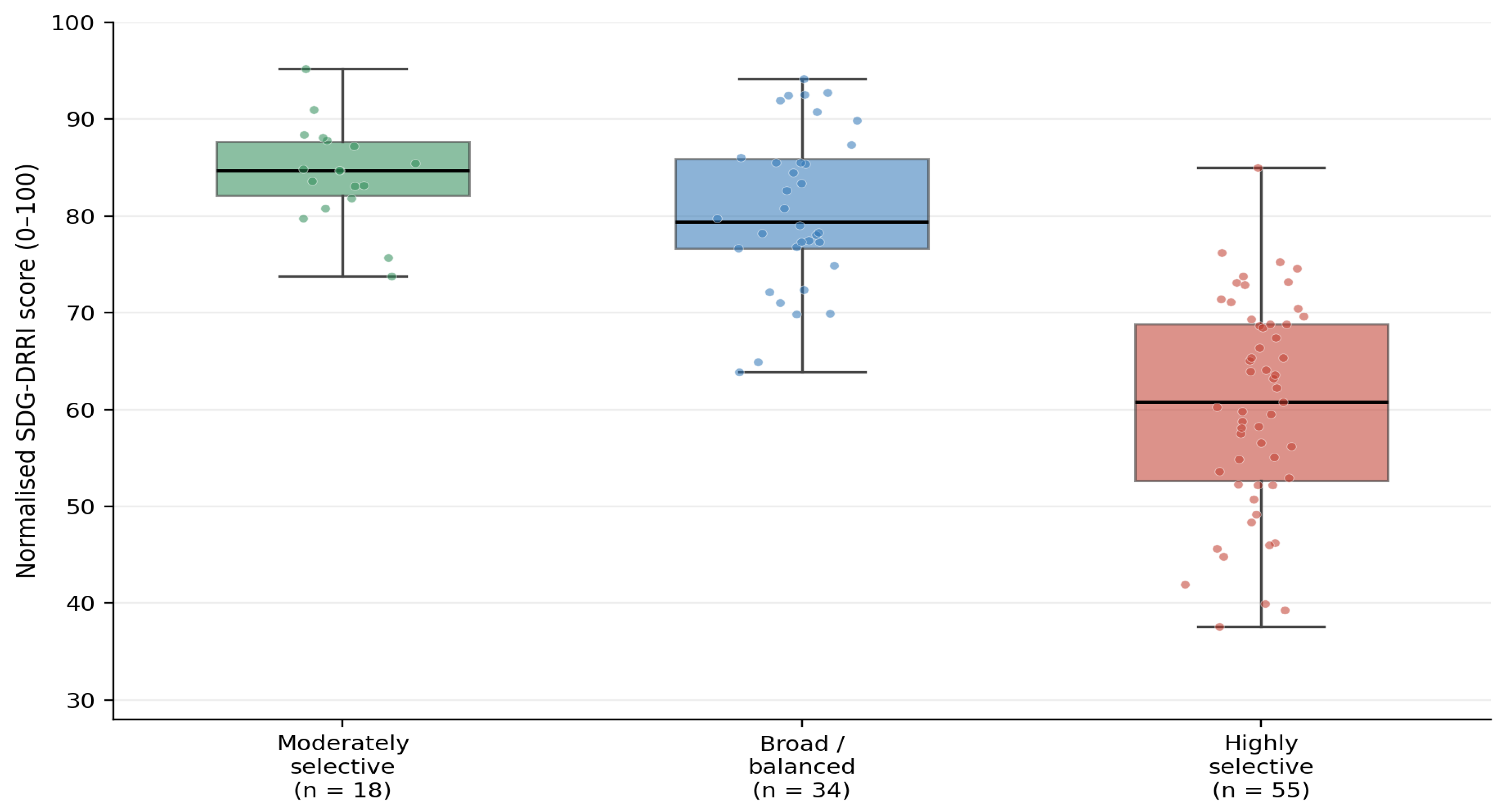
The strongest disclosure profile belonged to the moderately selective group, not the broad group. On the overall normalised SDG-DRRI score, moderately selective documents averaged 84.4 (SD = 6.2, 95% bootstrap CI [81.7, 87.1]), compared with 80.7 (SD = 8.4, CI [77.9, 83.5]) for broad documents and 60.5 (SD = 11.8, CI [57.4, 63.6]) for highly selective documents. Pairwise effect sizes were large to very large: Cohen’s d = 2.43 between moderately and highly selective documents, d = 1.82 between broad and highly selective, and d = 0.52 between moderately selective and broad. Review Readiness confirmed the same hierarchy: 7.7 out of 10 for moderately selective, 7.0 for broad, and 5.6 for highly selective documents. This dimension matters most directly to the research’s argument because it captures whether a document functions as a coherent, gap-aware institutional review. The broad group performed best only on SDG Coverage and Balance (7.9 vs. 7.4 and 4.6), which is unsurprising. A more evenly distributed report should score better on breadth. The crucial point is that broadness, by itself, does not secure the strongest overall accountability architecture.
The sensitivity analysis suggests that this observed association is not an artefact of conceptual overlap between selectivity and Strategic Alignment. When the composite SDG-DRRI score is recomputed excluding Strategic Alignment, the class ordering is preserved: moderately selective 82.9, broad 80.1, and highly selective 62.1. The gap between moderately and highly selective documents narrows modestly but remains large (d = 2.03). The ordering of Review Readiness is unaffected, since it is computed independently of Strategic Alignment.
Table 6 scores are normalised SDG-DRRI scores out of 100. Percentile statistics are reported to show distribution within each selectivity class and to avoid over-reading mean differences, particularly given the smaller moderately selective group (n = 18). Mean class differences on Review Readiness (moderately selective 7.7, broad 7.0, highly selective 5.6, out of 10) and SDG Coverage and Balance (7.4, 7.9, 4.6) are reported in the text. Pairwise Cohen’s d on the composite score was moderately vs. highly selective = 2.43 (very large); broad vs. highly selective = 1.82 (large); moderately vs. broad = 0.52 (medium).
Figure 1 displays the distributional pattern: the moderately selective group leads in terms of central tendency, while the highly selective group shows both the lowest mean and the widest spread toward low scores. The interquartile range of the moderately selective group remains comparatively high relative to the highly selective group, indicating the observed pattern that is a directional tendency within the corpus rather than an artefact of isolated outliers.
The research does not claim universal superiority for moderate selectivity. The narrower claim is that, within this corpus, moderate selectivity was associated with a stronger accountability architecture when it was accompanied by explicit justification, evidence, governance ownership, and acknowledgement of limits. Highly selective reporting remained consistently weaker on accountability-relevant dimensions, especially when narrow focus was not publicly explained.

5.2. Disentangling Selectivity from Document Genre

A central interpretive concern is whether the observed differences reflect reporting strategy or simply document genre. A climate action plan is expected to be narrower than a whole-institution report, classifying both through the same selectivity lens risks misreading scope-limited documents as accountability failures. The documents were, therefore, cross-tabulated against four genre categories: whole-institution sustainability or SDG reports, strategic and institutional plans, thematic or single-issue reports (climate plans, biodiversity strategies, partnership reports), and ranking-facing or promotional documents (Table 7).
Two observations matter. First, thematic and ranking-facing documents are concentrated in the highly selective class: of 55 highly selective documents, 35 (63.6%) are either thematic or ranking-facing, and only 11 (20.0%) are whole-institution reports. Second, a sub-analysis restricted to whole-institution sustainability or SDG reports (n = 54) preserves the central pattern: moderately selective 85.1 (n = 15), broad 81.2 (n = 28), and highly selective 65.3 (n = 11), with d = 2.47 between moderately and highly selective. The accountability-eroding pattern is most clearly visible in highly selective whole-institution reports, documents that present themselves as institutional accounts yet concentrate substantive treatment on a handful of goals. Thematic and ranking-facing documents remain genre-bounded objects whose selectivity is by design; they become an accountability concern only when allowed to stand publicly in place of a wider institutional account.

5.3. Anonymised Case Vignettes: Three Forms of Selectivity

Three anonymised case vignettes illustrate how the conceptual distinction manifests in practice. Institutional and country identifiers are withheld, and short illustrative phrases are lightly anonymised or paraphrased to preserve confidentiality while retaining the disclosure logic observed in the original documents. All descriptive features are drawn from the documents as they appear publicly. The cases are compact examples of how similar levels of selectivity can carry different accountability implications depending on whether the prioritisation is publicly justified and bounded.

5.3.1. Case A: Accountability-Preserving Selectivity

Document A is a 46-page whole-institution SDGs report from a European research-intensive university. It treats six SDGs in substantive depth (SDGs 3, 4, 9, 11, 13, 17) while grouping the remaining goals into an explicitly declared “emerging areas” section that acknowledges uneven indicator development and commits to a pathway for future reporting. The report opens with a two-page prioritisation statement linking the six focal goals to regional role, research strengths, and operational footprint. Governance ownership is assigned to named committees for each focal goal, and each claim is supported by quantitative indicators with year-on-year comparison. Document A scored 91 on the SDG-DRRI and 9.0 on Review Readiness. Its strength is not comprehensiveness but the legibility of its reasoning; focus functions here as strategic discipline.

5.3.2. Case B: Accountability-Eroding Selectivity

Document B is a 14-page ranking-facing SDGs profile from a large multi-campus university, aligned to the goals most prominent in its ranking submission. It treats three SDGs in substantive depth (SDGs 4, 13, 17) through case studies and success-framed narratives, while the remaining 14 SDGs appear only as icons with one-sentence activity descriptions not tied to governance, evidence, or review processes. No prioritisation rationale is offered; no limitations are acknowledged; no omissions are interpreted. Document B scored 52 on the SDG-DRRI and 4.1 on Review Readiness. Its selectivity is not a scope-bounded thematic choice because the document presents itself as the university’s SDGs account: focus does not discipline the disclosure but narrows what the institution agrees to be answerable for.

5.3.3. Case C: Broad but Loosely Reasoned (Accountability Flat)

Document C is an 88-page annual sustainability update from a comprehensive public university that addresses 14 of the 17 SDGs with at least some substantive treatment. Each SDG receives a sub-section of similar length and tone, with modest evidential support and governance described only at an institutional-level abstraction. The relationships between goals are not interpreted, and the report does not differentiate areas of strength from areas of early-stage development. Bounded-scope formulations appear elsewhere in the same institution’s reporting ecosystem but not in the main SDG document. Document C scored 78 on the SDG-DRRI and 7.4 on Review Readiness. It substantially outperforms Document B but illustrates why breadth is not a sufficient proxy for accountability. The reader can see what the university is doing but cannot easily see which obligations are treated as the most significant. Broad reporting of this kind is not accountability-eroding in the way Document B is; it is accountability-flat, leaving institutional judgement less legible than it could be.
Read together, the three cases show why the accountability question turns on justification rather than breadth. Appendix A is narrower than Appendix C on SDG Coverage and Balance but stronger on accountability architecture; Appendix B is narrower still and lacks the explanatory apparatus that would make its narrowing defensible.

5.4. Why Moderate Selectivity Can Preserve Accountability

Moderate selectivity may strengthen accountability for three reasons. The first is coherence. Attempts to give every SDG-similar narrative depth can produce long but weakly prioritised reports in which everything matters, and institutional judgement disappears behind surface comprehensiveness. Moderate selectivity concentrates disclosure enough to produce coherence without erasing the wider institutional landscape. Accountability is not only about coverage; it is about intelligibility. Readers need to see what the institution treats as primary, why, and how the chosen priorities relate to the wider field. Case A exemplifies this coherence effect.
The second reason is evidential density. Accountability is served not by naming goals but by supporting claims, assigning responsibility, and linking priorities to evidence. Moderate selectivity can enable a report to concentrate depth where the institution can show what it is doing, who is responsible, what data exist, how progress is assessed, and where limits remain. A report that names fifteen or seventeen SDGs but supports them unevenly creates a broader rhetorical field while weakening accountability, whereas a moderately selective report can preserve strategic discipline by concentrating the evidence where explanatory substance exists.
The third reason is strategic candour. A university that openly prioritises some goals can remain accountable if it explains to the reader why those goals are central and how less developed areas are situated. The explanation may relate to mission, regional role, evidence maturity, capability, regulatory context, or staged implementation; what matters is that it is public. In stronger moderately selective documents, prioritisation was typically accompanied by an explicit rationale together with acknowledgement that other SDG areas were still emerging or not yet reported at the same depth. Concentration did not erase the wider agenda; it organised it.

5.5. Why Highly Selective Reporting Tends to Erode Accountability

The weakness of the highly selective group does not appear only on breadth-sensitive indicators. It appears in the architecture of the account itself. Three patterns are visible for the descriptive features of the documents, not inferences about institutional motivation.
The first is thematic asymmetry consistent with reputational filtering. Reports are weighted toward SDGs that are easy to communicate positively, such as education, partnerships, campus well-being, biodiversity, climate, and externally celebrated projects. Their prominence is not itself evidence of evasion. The problem begins when prominence is not accompanied by an interpretation of why other responsibilities receive less attention. A university can legitimately foreground its strengths. It cannot legitimately present those strengths as if they were the whole of its sustainability account unless it also interprets what lies outside them. This pattern is consistent with the impression management dynamics documented by [9,10].
The second is displaced materiality. Highly selective reports may present prominent goals as if they were self-evidently the most material. In some cases, this may be so. However, when no prioritisation logic is provided, the distinction between institutional materiality and communication convenience becomes impossible to assess from the outside. What looks like a focused strategy may in fact reflect visibility management shaped by the attractiveness or benchmarking ability of certain themes. The double-materiality framing is practically useful here. The absence of any explicit materiality reasoning is itself a disclosure choice with accountability consequences.
The third is fragmentation that functions as a focus. Some highly selective documents are narrow because they are thematic roadmaps, unit-specific reports, or limited-scope publications rather than whole-institution accounts. This is not inherently illegitimate; a climate plan is appropriately narrow in scope. The problem arises when such documents stand publicly for the institution’s wider sustainability account without an accompanying synthesis. The genre-controlled analysis in Section 5.2 shows the accountability-eroding pattern that is most pronounced in highly selective whole-institution reports and in ranking-facing documents, whose public framing implies wider coverage than the disclosure delivers. The low Review Readiness score of the highly selective group (5.6) confirms that the issue is not only limited coverage but also reduced capacity to function as an institutional review. Once selectivity becomes excessively narrow and insufficiently justified, the document cannot sustain the accountability work that the institution may appear to be asking of it.

5.6. Building the Conceptual Distinction

Accountability-preserving selectivity occurs when a university focuses on a subset of SDGs but makes the logic of that focus visible. The report explains why goals are prioritised, links them to mission and context, identifies governance ownership, supports claims with evidence, and acknowledges less developed areas. Such reports do not pretend that all SDGs receive equal depth. They show how unequal depth fits within a defensible institutional account. Selectivity functions as a strategic focus rather than an unexplained narrowing (Case A).
Accountability-eroding selectivity occurs when a university also focuses on a subset, but without sufficient explanation. The report foregrounds visible strengths, attractive themes, or benchmark-friendly categories while leaving omitted areas uninterpreted. Priorities are asserted rather than justified, and the report functions more as curated communication than as public accountability. Selectivity is no longer a disciplined narrowing of attention but a public narrowing of responsibility without accompanying explanation (Case B).
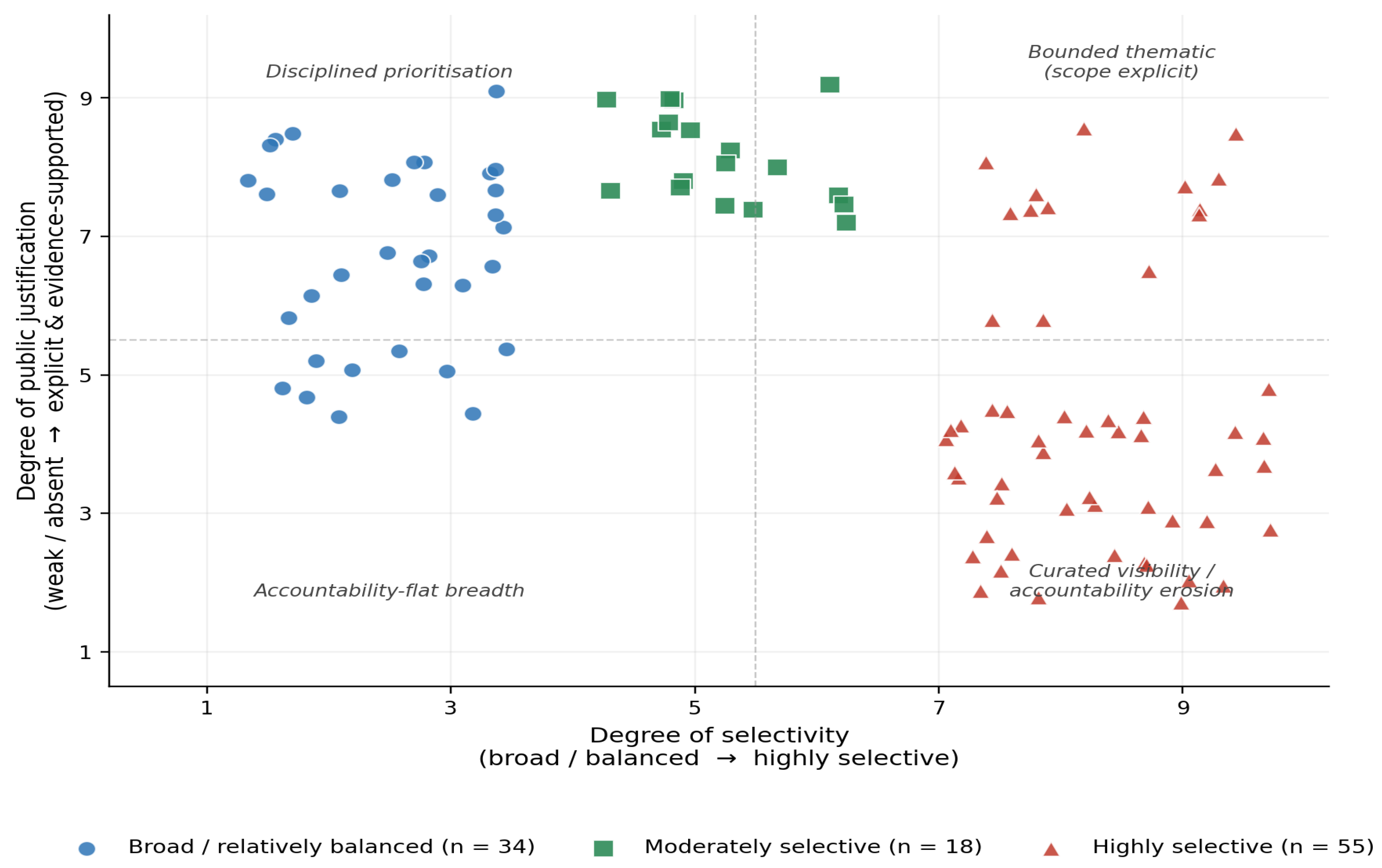
Figure 2 plots all 107 documents against two analytically separate dimensions, namely degree of selectivity and degree of public justification, as a corpus-level visualisation of the interpretive space the research develops. Narrowness alone does not determine accountability outcome. Documents with similar levels of selectivity diverge sharply according to whether the prioritisation is publicly reasoned, bounded, and evidentially supported. The figure strengthens the research’s central claim. The accountability outcome is not reducible to breadth. Selectivity becomes an accountability problem, not as a matter of narrowing per se, but when narrowing ceases to be publicly interpreted. This distinction is more useful than the older contrast between selective and broad reporting because it recognises that accountability depends on legibility, not on crude symmetry, and it avoids the opposite mistake of treating all selective emphasis as strategically mature. The same surface feature, selective emphasis, can accompany two very different accountability outcomes, depending on whether the reporting architecture around it supplies reasoning and acknowledges absence. Materiality can justify selectivity; legitimacy can distort it. The public difference lies in the structure of the account.
Each point in Figure 2 represents one document. The horizontal axis operationalises the degree of selectivity using the three-class coding described in Section 4.4, with lower values indicating broad or relatively balanced coverage and higher values indicating a highly selective concentration. The vertical axis operationalises public justification using the criteria in Table 5: prioritisation rationale, treatment of omissions, evidence and ownership, and whole-institution linkage. The dotted lines indicate interpretive thresholds separating weaker from stronger public justification and broader from narrower disclosure concentration. The quadrant labels are interpretive aids rather than formal classificatory rules.

5.7. Assessment of Research Hypotheses and Mediation Model:

The revised tests address the reviewer’s concern that Figure 2 alone was not sufficient to validate the analytical model. The section now reports the model equations, model-fit statistics, regression coefficients, normality tests, and mediation effects. Highly selective documents are the reference category in all regression models.
The scientific basis for the statement that breadth alone is insufficient comes from a cross-dimensional comparison rather than from a rhetorical interpretation. The broad or relatively balanced group scored highest only on the SDG Coverage and Balance (7.9/10), which is the dimension most directly linked to breadth. However, the moderately selective group scored higher on the overall SDG-DRRI (84.4 versus 80.7) and on Review Readiness (7.7/10 versus 7.0/10). If breadth were an adequate proxy for accountability-oriented disclosure quality, the broad or relatively balanced group should have been the strongest on the overall accountability-quality and review-readiness outcomes. It was not. The conclusion is, therefore, limited and empirical: breadth matters for coverage, but it is not sufficient on its own to explain accountability-oriented disclosure quality.
Table 8, Table 9 and Table 10 summarize the regression models used to evaluate the study hypotheses and mediation effects. These tables provide the model specifications, goodness-of-fit statistics, and regression estimates for the total-effect, mediator, direct-effect, and robustness analyses.
The normality tests show that several raw index variables were not normally distributed, which is expected for bounded scoring variables. The main outcome model residuals were normally distributed according to both tests, but because not all assumptions were uniformly satisfied, the mediation analysis was interpreted using bootstrap confidence intervals rather than relying only on normal-theory inference (Table 11).
Table 12 reports the direct, indirect, total, and robustness effects estimated in the mediation analysis, providing evidence on the magnitude and significance of the proposed mediation pathways.
H1 is, therefore, supported in a limited statistical sense. Moderate selectivity was associated with a higher overall SDG-DRRI and Review Readiness than broad/balanced reporting, even though the broad/balanced group performed best on the breadth-specific SDG Coverage and Balance dimension. This pattern is the empirical basis for concluding that breadth alone is not a sufficient proxy for accountability-oriented disclosure quality.
H2 is supported by the total-effect model and the class comparisons. Moderately selective documents had a 21.04-point higher Review Readiness score than highly selective documents (p = 0.0009), while broad/balanced documents had a 13.82-point higher score than highly selective documents (p = 0.0061). These results align with the qualitative interpretation that highly selective documents become weakest when a narrow focus is not accompanied by a prioritisation rationale, treatment of omissions, and whole-institution linkage.
H3 is supported by the outcome model. The PJI coefficient was positive and large (B = 0.90, t = 15.38, p < 0.001), indicating that a one-point increase in public justification quality was associated with a 0.90-point increase in Review Readiness on the 0–100 scale after retaining selectivity-class contrasts.
H4 is supported by the mediation model. The total effects of moderately selective and broad/balanced reporting on Review Readiness became statistically indistinguishable from zero after PJI was included, while both indirect effects remained positive and significant. This shows that selectivity class relates to review readiness primarily through the quality of public justification rather than through breadth or selectivity alone.
Taken together, the revised statistical evidence strengthens rather than replaces the qualitative interpretation. Figure 2 remains useful as a visual representation of the model, but H4 is now assessed through regression models, normality tests, direct and indirect effects, and bootstrap confidence intervals. The findings should still be read cautiously because the corpus is purposive and document-level; the analysis supports an indirect association in the public disclosure architecture rather than causal claims about institutional behaviour.
These findings refine earlier studies on university sustainability reporting and SDG disclosure. Prior research has shown that universities increasingly report on sustainability while remaining uneven in framework use, evidence quality and strategic integration [11,12,14,20,23]. The present research concurs with that diagnosis but adds that unevenness should not be judged only by SDG count. It also extends impression-management and SDG-washing research [3,8,9,10,37] by showing that the key accountability issue is not selective emphasis alone but selective emphasis without public reasoning. Finally, it complements work on THE Impact Rankings and ranking-facing SDG implementation [4,29,30,31,32,33] by showing how external legibility may interact with internal prioritisation in shaping the public disclosure profile.
The research extends the literature in three ways. First, for selective disclosure and impression management research and for university sustainability reporting scholarship [8,14,23], it refines the dominant binary reading. In the university SDGs context, selectivity is not uniformly pathological; it becomes pathological when it is opaque. The distinction between accountability-preserving and accountability-eroding selectivity sharpens the terms on which selective disclosure should be judged by adding a normative and interpretive criterion, public justification of focus and absence, rather than remaining content with the descriptive observation that reports are uneven.
Second, the findings extend institutional accountability and stakeholder-oriented debates. Accountability in university sustainability reporting cannot be read off from disclosure volume, SDGs count, or thematic spread alone; it depends on whether prioritisation is made legible and whether omissions are interpreted. For Messner [46] and Roberts [47], account-giving is bounded and dialogical: unexplained absence is part of the accountability problem because it withholds precisely the reflective material that allows stakeholders to interrogate institutional choices. Stakeholder-theoretic readings [39,40] reinforce the point: selective emphasis that privileges highly legible stakeholder audiences without justifying the relative weighting of less powerful stakeholder claims is a recognisable accountability failure. The claim is strongest within the corpus examined; whether it extends to other sectors or later reporting cycles is an empirical question for future research.
Third, the analysis offers a more practicable interpretation of whole-institution sustainability language. Whole-institution accountability does not require equal narrative weight for every SDG; it requires that selective depth be situated within an explicitly wider account of institutional responsibility. Selective reporting and whole-institution accountability are, therefore, compatible when the report makes their relationship explicit. The emerging Voluntary University Review architecture [7] provides an institutional vehicle for such articulation without demanding artificial symmetry across the SDGs.
Universities do not need to eliminate selectivity; they need to discipline it. Five editorial and governance requirements follow directly from the conceptual distinction. Reports should state explicit prioritisation logic, why certain SDGs are prioritised (mission, regional role, impact profile, data maturity, institutional capability, strategic stage, or stakeholder salience), and should make clear which materiality logic (impact, financial, or double materiality) underpins that reasoning. As Case A demonstrates, a two-page prioritisation statement can transform a selective report from curatorial artefact into defensible institutional account.
Reports should acknowledge less developed and less visible SDGs. Full parity of treatment is not required; interpretive honesty is. Readers should be able to see which areas are emerging, weakly measured, or outside current evidence maturity. A brief note on underdeveloped areas, data limitations, or staged implementation can significantly strengthen accountability, and its omission is rarely a technical inevitability but an editorial choice. Reports should also link focus to evidence and ownership. If a report foregrounds climate, partnerships, or educational inclusion, it should show who governs those areas, what evidence supports the claims, and how progress and limitations are reviewed. Strategic emphasis without responsibility and evidence quickly becomes visibility management.
Reports should connect focused reporting to whole-institution responsibility, stating, in effect, that these are the areas this report treats most deeply, and this is how they relate to wider sustainability obligations. This prevents selective depth from being mistaken for selective erasure. Finally, institutions should resist allowing thematic documents to substitute silently for institutional accounts. A climate roadmap, partnership report, or operations update may be valuable, but it should not stand alone as if it represented the whole sustainability profile unless the document explicitly states its scope and is accompanied by a broader synthesis. Accountability does not require exhaustive sameness; it requires disclosed reasoning.


6. Conclusions

This research examined when selectivity in university SDG disclosure functions as a legitimate strategic focus and when it becomes institutional accountability erosion. The answer is narrower than either a defence of focus or a defence of breadth. Selectivity is legitimate when the report publicly justifies its prioritisation, links focus to mission, capability, context, and evidence, assigns ownership, and acknowledges less developed areas. It erodes accountability when visibility substitutes for public account-giving. The decisive difference is not selective versus broad disclosure but justified prioritisation versus opaque omission. Within the corpus, the moderately selective group (n = 18) outperformed both broad (n = 34) and highly selective (n = 55) groups on the overall SDG-DRRI and on Review Readiness, with a very large effect size between moderately and highly selective documents (d = 2.43). The sensitivity analysis excluding Strategic Alignment and the genre-controlled sub-analysis restricted to whole-institution reports both preserved the central pattern. The mediation analysis sharpened this conclusion by showing that public justification carries the relationship between selectivity class and accountability-oriented review readiness within the corpus.
This research provides the evaluative language needed for that judgement. By distinguishing accountability-preserving from accountability-eroding selectivity, it reinterprets selectivity as a reporting pattern whose normative status depends on the quality of public justification. This distinction sharpens selective disclosure and impression management research, university sustainability reporting scholarship, institutional accountability debates, stakeholder-theoretic readings, and whole-institution sustainability discussions. The research does not oppose selectivity. Universities are plural-mission institutions with uneven capacities, differentiated contexts, and staged implementation pathways, and serious reporting will almost always involve prioritisation. The problem begins only when prioritisation is hidden behind celebratory visibility or left without explanatory boundaries.
One of the valuable practical implications of this research is that universities do not need to report on all SDGs with equal depth. They do need to explain why they report unevenly, acknowledge underdeveloped areas, link focus to evidence and governance, make the underlying materiality logic explicit, and articulate the relationship between thematic emphasis and wider institutional responsibility. These are achievable editorial and governance improvements that do not require perfect data systems before they begin; they require stronger public reasoning.
Future studies should test the selectivity–public justification–review readiness pathway in larger and probabilistic samples, including non-English and non-ranked universities. Longitudinal designs could examine whether repeated reporting cycles, external assurance, CSRD/ESRS-style double-materiality expectations or VUR adoption move institutions from accountability-eroding toward accountability-preserving selectivity. Mixed-method work could pair document scoring with interviews of sustainability officers, ranking teams and governance committees to examine how prioritisation decisions are made internally. Further studies could also compare alternative operationalisations of selectivity, including continuous concentration indices, and test whether the same mediation pattern appears outside higher education.
Five limitations bound the research’s claims. First, the sampling is purposive rather than probabilistic, and the corpus is weighted toward English-language disclosure from universities listed in THE Impact Rankings or the GRI Sustainability Disclosure Database. Extension to non-English, non-ranked, or privately governed systems requires separate empirical work. Second, despite the dual-coder design and substantial inter-coder agreement, interpretive residue remains; classification of borderline cases required judgment, even when guided by anchors. Third, the cut-off values used to distinguish highly selective, moderately selective and broad/balanced documents are heuristic thresholds based on the 17-goal SDG architecture rather than universal natural categories; future research could test alternative thresholds or use continuous measures of disclosure concentration. Fourth, the analysis examines public disclosure architecture rather than internal sustainability performance or institutional intention. Fifth, the observed association between moderate selectivity and stronger review readiness should not be interpreted causally or generalised globally without further research.

Author Contributions

Conceptualization, K.H.A.; Methodology, I.A.A.; Software, I.A.A.; Formal analysis, I.A.A.; Data curation, I.A.A.; Writing—review and editing, K.H.A.; Visualization, I.A.A.; Project administration, K.H.A. All authors have read and agreed to the published version of the manuscript.

Funding

This research received no external funding.

Institutional Review Board Statement

Not applicable.

Informed Consent Statement

Not applicable.

Data Availability Statement

The original contributions presented in this study are included in the article. Further inquiries can be directed to the corresponding author.

Conflicts of Interest

The authors declare no conflicts of interest.

Appendix A. SDG-DRRI Dimensions and Indicator Structure

The SDG Disclosure Review-Readiness Index consists of 26 indicators organised across five dimensions. Each indicator is scored on a 0–2 scale: 0 indicates the feature is absent or addressed only symbolically; 1 indicates partial or uneven treatment; 2 indicates substantive, evidence-supported treatment. The maximum raw score is 52, normalised to a score out of 100. Full anchor descriptors and scoring examples are held in the project codebook (see Appendix B).
Table A1. SDG-DRRI dimensions and indicator structure.
DimensionIndicators (n)Illustrative Indicator Themes
Strategic Alignment5Integration of SDGs into institutional strategy; prioritisation rationale; mission-SDG linkage; materiality logic; stakeholder-salience articulation.
Governance and Accountability5Named governance structures for sustainability; assignment of SDG-specific ownership; leadership sign-off; internal review mechanisms; stakeholder involvement in governance.
Metrics and Evidence6Quantitative indicators per focal SDG; year-on-year comparison; data sourcing and boundaries; methodological transparency; external assurance; acknowledgement of evidential limits.
SDG Coverage and Balance5Breadth of SDGs receiving substantive treatment; balance across social, environmental, and economic dimensions; treatment of interdependencies; handling of trade-offs; visibility of less developed SDGs.
Review Readiness5Coherence as institutional account; explicit acknowledgement of gaps; forward commitments; responsiveness to prior-cycle disclosures; alignment with VUR-compatible reporting architecture.

Appendix B. Inter-Coder Codebook Summary

The codebook used by both coders specifies, for each of the 26 indicators, (a) the construct the indicator captures; (b) anchor descriptors for scores 0, 1, and 2; (c) illustrative positive and negative examples drawn from the pilot phase; and (d) decision rules for borderline cases. For selectivity classification, the codebook specifies orienting the breadth thresholds (1–4 SDGs, 5–8 SDGs, and 9+ SDGs), concentration indicators (proportion of narrative depth and evidential support clustered in the top three SDGs), and the anchor questions used for borderline re-assignment: Does the document explain its prioritisation? Does it acknowledge less developed areas? Is narrative depth proportionate to evidential support? Inter-coder agreement was computed after independent coding of the full analytical sample; disagreements were resolved through consensus discussion against the anchor descriptors. Conservative reassignment rules applied where residual disagreement persisted, with borderline cases assigned to the class closer to broad coverage so as not to inflate the moderate-selectivity group.

Appendix C. Research Sample: University, Country/Territory and Region

Table A2 expands the sample list to include country/territory and region. Report-level metadata, including document title, document year, document type, source frame and URL/document identifier, are retained in the project codebook.
Table A2. Research sample: university, country/territory, region, and reports analysed.
No.University NameCountry/TerritoryRegionReports Analysed
1Western Sydney UniversityAustraliaAsia–Pacific1
2University of ManchesterUnited KingdomEurope2
3Kyungpook National University (KNU)South KoreaAsia–Pacific1
4Griffith UniversityAustraliaAsia–Pacific1
5University of TasmaniaAustraliaAsia–Pacific2
6Arizona State University (Tempe)United StatesNorth America2
7Queen’s UniversityCanadaNorth America1
8University of AlbertaCanadaNorth America1
9Aalborg UniversityDenmarkEurope2
10Universitas AirlanggaIndonesiaAsia–Pacific1
11UNSW SydneyAustraliaAsia–Pacific1
12University of GlasgowUnited KingdomEurope1
13Pusan National UniversitySouth KoreaAsia–Pacific2
14McMaster UniversityCanadaNorth America1
15National Taiwan University (NTU)TaiwanAsia–Pacific1
16Universiti Sains MalaysiaMalaysiaAsia–Pacific2
17University of VictoriaCanadaNorth America1
18Western UniversityCanadaNorth America1
19Kyung Hee UniversitySouth KoreaAsia–Pacific1
20The Hong Kong University of Science and TechnologyHong Kong SARAsia–Pacific1
21Flinders UniversityAustraliaAsia–Pacific1
22Yonsei University (Seoul campus)South KoreaAsia–Pacific1
23Institut AgroFranceEurope1
24University of JohannesburgSouth AfricaAfrica2
25Central Queensland UniversityAustraliaAsia–Pacific1
26King Fahd University of Petroleum and MineralsSaudi ArabiaMiddle East1
27University of MalayaMalaysiaAsia–Pacific2
28University of AucklandNew ZealandAsia–Pacific3
29University of ExeterUnited KingdomEurope1
30University of IndonesiaIndonesiaAsia–Pacific1
31National Cheng Kung University (NCKU)TaiwanAsia–Pacific2
32University of WollongongAustraliaAsia–Pacific1
33University of Technology SydneyAustraliaAsia–Pacific1
34Durham UniversityUnited KingdomEurope1
35Simon Fraser UniversityCanadaNorth America1
36Swansea UniversityUnited KingdomEurope1
37Abdullah Gül UniversityTürkiyeEurope1
38York UniversityCanadaNorth America1
39University of NewcastleAustraliaAsia–Pacific1
40King Faisal UniversitySaudi ArabiaMiddle East1
41Amrita Vishwa VidyapeethamIndiaAsia–Pacific2
42National Yang Ming Chiao Tung UniversityTaiwanAsia–Pacific1
43Near East UniversityCyprusEurope2
44Chiang Mai UniversityThailandAsia–Pacific1
45Chulalongkorn UniversityThailandAsia–Pacific1
46Hanyang UniversitySouth KoreaAsia–Pacific2
47Hokkaido UniversityJapanAsia–Pacific1
48Istanbul Technical UniversityTürkiyeEurope1
49Lovely Professional UniversityIndiaAsia–Pacific1
50Macquarie UniversityAustraliaAsia–Pacific1
51University of ReadingUnited KingdomEurope1
52Université LavalCanadaNorth America2
53Northumbria UniversityUnited KingdomEurope1
54Universiti Kebangsaan MalaysiaMalaysiaAsia–Pacific1
55Université de MontréalCanadaNorth America1
56JSS Academy of Higher Education and ResearchIndiaAsia–Pacific1
57RMIT UniversityAustraliaAsia–Pacific1
58The Hong Kong Polytechnic UniversityHong Kong SARAsia–Pacific1
59Bahçeşehir UniversityTürkiyeEurope1
60Bournemouth UniversityUnited KingdomEurope1
61Michigan State UniversityUnited StatesNorth America1
62University of CanterburyNew ZealandAsia–Pacific1
63University of PretoriaSouth AfricaAfrica1
64Bangor UniversityUnited KingdomEurope2
65Mahidol UniversityThailandAsia–Pacific1
66Penn State (Main campus)United StatesNorth America1
67Thammasat UniversityThailandAsia–Pacific1
68University of GalwayIrelandEurope1
69Hong Kong Baptist UniversityHong Kong SARAsia–Pacific1
70IMT AtlantiqueFranceEurope1
71Florida International UniversityUnited StatesNorth America2
72Korea UniversitySouth KoreaAsia–Pacific1
73The Chinese University of Hong KongHong Kong SARAsia–Pacific1
74University of EdinburghUnited KingdomEurope1
75University of LeedsUnited KingdomEurope1
76University of LimerickIrelandEurope1
77National Yunlin University of Science and TechnologyTaiwanAsia–Pacific2
78University of StrathclydeUnited KingdomEurope2
79Queen’s University BelfastUnited KingdomEurope2
80University of CoimbraPortugalEurope1
81Sunway UniversityMalaysiaAsia–Pacific1
82An-Najah National UniversityPalestineMiddle East2
83Universitas Gadjah MadaIndonesiaAsia–Pacific1
84Afe Babalola UniversityNigeriaAfrica1
85Massey UniversityNew ZealandAsia–Pacific1
86University of AberdeenUnited KingdomEurope1
87University of PlymouthUnited KingdomEurope2
88Dalhousie UniversityCanadaNorth America1
89University of LiverpoolUnited KingdomEurope1
90Al Ain UniversityUnited Arab EmiratesMiddle East2
91King Abdullah University of Science and Technology (KAUST)Saudi ArabiaMiddle East1
92Lakehead UniversityCanadaNorth America1
93Université Catholique de LouvainBelgiumEurope1
94University of BucharestRomaniaEurope2
95Walailak UniversityThailandAsia–Pacific1
96Middle East Technical UniversityTürkiyeEurope1
97Shoolini University of Biotechnology and Management SciencesIndiaAsia–Pacific2
98Chonnam National UniversitySouth KoreaAsia–Pacific1
99Lancaster UniversityUnited KingdomEurope1
100Nottingham Trent UniversityUnited KingdomEurope2
101Prince Mohammad Bin Fahd UniversitySaudi ArabiaMiddle East1
102Ajou UniversitySouth KoreaAsia–Pacific1
103Al-Ahliyya Amman UniversityJordanMiddle East1
104Anna UniversityIndiaAsia–Pacific1
105Arab Academy for Science, Technology and Maritime TransportEgyptMiddle East2
106Asian Institute of TechnologyThailandAsia–Pacific1
107Ateneo de Manila UniversityPhilippinesAsia–Pacific1

References

  1. Bebbington, J.; Larrinaga, C. Accounting and sustainable development: An exploration. Account. Organ. Soc. 2014, 39, 395–413. [Google Scholar] [CrossRef]
  2. Bebbington, J.; Unerman, J. Achieving the United Nations Sustainable Development Goals: An enabling role for accounting research. Account. Audit. Account. J. 2018, 31, 2–24. [Google Scholar]
  3. Adams, C.A.; Abhayawansa, S. Connecting the COVID-19 pandemic, environmental, social and governance (ESG) investing and calls for harmonisation of sustainability reporting. Crit. Perspect. Account. 2022, 82, 102309. [Google Scholar]
  4. Buckner, E.; Zhang, Y. Sustainability rankings in higher education: “The right thing to do” or the pursuit of global recognition? High. Educ. 2025, 91, 1775–1791. [Google Scholar] [CrossRef]
  5. UNESCO. Education for Sustainable Development: A Roadmap; UNESCO: Paris, France, 2020. [Google Scholar]
  6. UNESCO IESALC. The Contribution of Higher Education to the SDGs; UNESCO International Institute for Higher Education in Latin America and the Caribbean: Caracas, Venezuela, 2024. [Google Scholar]
  7. Sustainable Development Solutions Network. Accelerating Education for the SDGs in Universities: A Guide for Universities, Colleges, and Tertiary and Higher Education Institutions; SDSN: New York, NY, USA, 2020. [Google Scholar]
  8. Marquis, C.; Toffel, M.W.; Zhou, Y. Scrutiny, norms, and selective disclosure: A global research of greenwashing. Organ. Sci. 2016, 27, 483–504. [Google Scholar]
  9. Merkl-Davies, D.M.; Brennan, N.M. Discretionary disclosure strategies in corporate narratives: Incremental information or impression management? J. Account. Lit. 2007, 26, 116–196. [Google Scholar]
  10. Bellucci, M.; Simoni, L.; Acuti, D.; Manetti, G. Stakeholder engagement and dialogic accounting: Empirical evidence in sustainability reporting. Account. Audit. Account. J. 2021, 34, 1421–1450. [Google Scholar]
  11. Ceulemans, K.; Lozano, R.; Alonso-Almeida, M. Sustainability reporting in higher education: A comprehensive review of the recent literature and paths for further research. J. Clean. Prod. 2015, 106, 127–143. [Google Scholar] [CrossRef]
  12. Abello-Romero, J.; Mancilla, C.; Restrepo, K.; Sáez, W.; Durán-Seguel, I.; Ganga-Contreras, F. Sustainability reporting in the university context: A review and analysis of the literature. Sustainability 2024, 16, 10888. [Google Scholar] [CrossRef]
  13. Da Rosa, F.S.; Boscarioli, C.; de Freitas Zara, K.R. A systematic review of the trends and patterns of sustainability reporting in universities. Int. J. Sustain. High. Educ. 2024, 25, 556–579. [Google Scholar]
  14. Brescia, V.; Coronella, L.; Mechelli, A.; Secinaro, S. Sustainability reporting in higher education: A systematic review and bibliometric analysis for strategic decision-making. Bus. Ethics Environ. Responsib. 2025, 35, 2512–2529. [Google Scholar] [CrossRef]
  15. Blasco, N.; Brusca, I.; Labrador, M. Drivers for Universities’ Contribution to the Sustainable Development Goals: An Analysis of Spanish Public Universities. Sustainability 2021, 13, 89. [Google Scholar] [CrossRef]
  16. Leal Filho, W.; Coronado-Marín, A.; Salvia, A.L.; Silva, F.F.; Wolf, F.; LeVasseur, T.; Kirrane, M.J.; Doni, F.; Paço, A.; Blicharska, M.; et al. International Trends and Practices on Sustainability Reporting in Higher Education Institutions. Sustainability 2022, 14, 12238. [Google Scholar] [CrossRef]
  17. Hamilton, S.N.; Waters, R.D. Mainstreaming Standardized Sustainability Reporting: Comparing Fortune 50 Corporations’ and U.S. News & World Report’s Top 50 Global Universities’ Sustainability Reports. Sustainability 2022, 14, 3442. [Google Scholar] [CrossRef]
  18. Sun, Y.; Zhao, D.; Cao, Y.; Xu, C. New Trends in Sustainability Reporting: Exploring the Online Sustainability Reporting Practices by Irish Universities. J. Innov. Knowl. 2024, 9, 100529. [Google Scholar] [CrossRef]
  19. Ceulemans, K.; Molderez, I.; Van Liedekerke, L. Sustainability reporting in higher education: Interconnecting the reporting process and organisational change management for sustainability. Sustainability 2015, 7, 8881–8903. [Google Scholar] [CrossRef]
  20. Di Tullio, P.; Rea, M.A. Institutionalisation of sustainability in universities: Insights from strategic planning and sustainability reporting practices in Italian universities. Meditari Account. Res. 2025, 33, 338–368. [Google Scholar] [CrossRef]
  21. Zdonek, I.; Zdonek, D.; Król, K.; Halva, J. Sustainability-Oriented Higher Education Activities: Insights from Institutional Isomorphism Perspective. Sustainability 2025, 17, 11034. [Google Scholar] [CrossRef]
  22. Findler, F.; Schönherr, N.; Lozano, R.; Reider, D.; Martinuzzi, A. The impacts of higher education institutions on sustainable development: A review and conceptualization. Int. J. Sustain. High. Educ. 2019, 20, 23–38. [Google Scholar]
  23. Moggi, S. Sustainability reporting, universities and global reporting initiative applicability: A still open issue. Sustain. Account. Manag. Policy J. 2023, 14, 699–742. [Google Scholar] [CrossRef]
  24. Sepasi, S.; Rahdari, A.; Rexhepi, G. Sustainability disclosure in higher education. Int. J. Sustain. High. Educ. 2019, 20, 1143–1163. [Google Scholar] [CrossRef]
  25. Nicolò, G.; Aversano, N.; Sannino, G.; Polcini, P.T. Online sustainability disclosure practices in the university context. The role of the board of directors. Corp. Gov. 2023, 23, 800–826. [Google Scholar]
  26. Sari, M.P.; Faisal, F.; Harto, P. The determinants of higher education institutions’ sustainability reporting. Cogent Bus. Manag. 2023, 10, 2286668. [Google Scholar] [CrossRef]
  27. Fiorani, G.; Di Gerio, C. Reporting University Performance through the Sustainable Development Goals of the 2030 Agenda: Lessons Learned from Italian Case Research. Sustainability 2022, 14, 9006. [Google Scholar] [CrossRef]
  28. Ruiz-Mallén, I.; Heras, M. What sustainability? Higher education institutions’ pathways to reach the Agenda 2030 goals. Sustainability 2020, 12, 1290. [Google Scholar] [CrossRef]
  29. Romero, S.; Ruiz-Blanco, S.; Fernández-Feijóo, B. Sustainability Reporting and Stakeholder Engagement in Spain: Different Instruments, Different Quality. Bus. Strategy Environ. 2019, 28, 221–232. [Google Scholar] [CrossRef]
  30. De la Poza, E.; Merello, P.; Barberá, A.; Celani, A. Universities’ Reporting on SDGs: Using THE Impact Rankings to Model and Measure Their Contribution to Sustainability. Sustainability 2021, 13, 2038. [Google Scholar] [CrossRef]
  31. Alhanaya, I.; Belal, A.; Gebreiter, F. Rankings and the Organizational-Level Implementation of UN Sustainable Development Goals (SDGs): A Case Study. Financ. Account. Manag. 2025, 41, 334–345. [Google Scholar] [CrossRef]
  32. Bautista-Puig, N.; Orduña-Malea, E.; Perez-Esparrells, C. Enhancing Sustainable Development Goals or Promoting Universities? An Analysis of the Times Higher Education Impact Rankings. Int. J. Sustain. High. Educ. 2022, 23, 211–231. [Google Scholar] [CrossRef]
  33. Urbano, V.M.; Arena, M.; Azzone, G.; Mayeres, M. Sustainable Development in Higher Education: An In-Depth Analysis of Times Higher Education Impact Rankings. J. Clean. Prod. 2025, 501, 145302. [Google Scholar] [CrossRef]
  34. Suchman, M.C. Managing legitimacy: Strategic and institutional approaches. Acad. Manag. Rev. 1995, 20, 571–610. [Google Scholar] [CrossRef]
  35. Deegan, C. Introduction: The legitimising effect of social and environmental disclosures: A theoretical foundation. Account. Audit. Account. J. 2002, 15, 282–311. [Google Scholar]
  36. DiMaggio, P.J.; Powell, W.W. The iron cage revisited: Institutional isomorphism and collective rationality in organizational fields. Am. Sociol. Rev. 1983, 48, 147–160. [Google Scholar] [CrossRef]
  37. Del Río, C.; González-Álvarez, K.; López-Arceiz, F.J. Examining greenwashing and SDG-washing: An analysis of corporate engagement with the SDGs. Sustain. Account. Manag. Policy J. 2024, 15, 412–456. [Google Scholar]
  38. Bebbington, J.; Russell, S.; Thomson, I. Accounting and sustainable development: Reflections and propositions. Crit. Perspect. Account. 2017, 48, 21–34. [Google Scholar] [CrossRef]
  39. Freeman, R.E. Strategic Management: A Stakeholder Approach; Pitman: Boston, MA, USA, 1984. [Google Scholar]
  40. Mitchell, R.K.; Agle, B.R.; Wood, D.J. Toward a theory of stakeholder identification and salience: Defining the principle of who and what really counts. Acad. Manag. Rev. 1997, 22, 853–886. [Google Scholar] [CrossRef]
  41. Abo-Khalil, A.G. Integrating Sustainability into Higher Education: Challenges and Opportunities for Universities Worldwide. Heliyon 2024, 10, e29946. [Google Scholar] [CrossRef] [PubMed]
  42. Alhanaya, I.A.; Alshammari, K.H. Why globally urgent sustainable development goals (SDGs) remain underrepresented in universities. Sustainability 2026, 18, 4945. [Google Scholar] [CrossRef]
  43. SDSN Youth. SDG Students Program. Available online: https://www.sdsnyouth.org/teams/students-team (accessed on 1 June 2026).
  44. Principles for Responsible Management Education (PRME). The SDGs. Available online: https://www.unprme.org/the-sdgs/ (accessed on 1 June 2026).
  45. Gray, R.; Owen, D.; Adams, C. Accounting and Accountability: Changes and Challenges in Corporate Social and Environmental Reporting; Prentice Hall: London, UK, 1996. [Google Scholar]
  46. Messner, M. The limits of accountability. Account. Organ. Soc. 2009, 34, 918–938. [Google Scholar] [CrossRef]
  47. Roberts, J. No one is perfect: The limits of transparency and an ethic for “intelligent” accountability. Account. Organ. Soc. 2009, 34, 957–970. [Google Scholar] [CrossRef]
  48. Jensen, M.C.; Meckling, W.H. Theory of the firm: Managerial behavior, agency costs and ownership structure. J. Financ. Econ. 1976, 3, 305–360. [Google Scholar] [CrossRef]
  49. Bovens, M. Analysing and assessing accountability: A conceptual framework. Eur. Law J. 2007, 13, 447–468. [Google Scholar] [CrossRef]
  50. Bowen, G.A. Document analysis as a qualitative research method. Qual. Res. J. 2009, 9, 27–40. [Google Scholar] [CrossRef]
  51. ISO 26000:2010; Guidance on Social Responsibility. International Organization for Standardization: Geneva, Switzerland, 2010.
  52. Landis, J.R.; Koch, G.G. The measurement of observer agreement for categorical data. Biometrics 1977, 33, 159–174. [Google Scholar] [CrossRef] [PubMed]
  53. Hayes, A.F. Introduction to Mediation, Moderation, and Conditional Process Analysis: A Regression-Based Approach, 3rd ed.; Guilford Press: New York, NY, USA, 2022. [Google Scholar]
Figure 1. Box plots of SDG-DRRI scores by selectivity class.
Sustainability 18 06621 g001
Figure 2. Corpus distribution of university disclosure documents by degree of selectivity and degree of public justification. Note: Blue circles represent broad/relatively balanced documents (n = 34), green squares represent moderately selective documents (n = 18), and red triangles represent highly selective documents (n = 55). The x-axis captures disclosure concentration from broad/balanced to highly selective; the y-axis captures weak/absent to explicit/evidence-supported public justification.
Sustainability 18 06621 g002
Table 1. Key concepts used in the research.
ConceptMeaning in This Research
SDG selectivityUneven substantive treatment of the Sustainable Development Goals within a university disclosure document; icon-based mentions alone are not treated as substantive coverage.
Accountability-preserving selectivitySelective SDG focus that is publicly justified, mission-linked, evidence-supported, connected to governance ownership, and explicit about less developed areas.
Accountability-eroding selectivitySelective SDG focus that foregrounds visible strengths or ranking-facing themes while leaving non-focal SDGs and omissions unexplained.
Public justificationThe explanation of why some SDGs receive greater depth, how the prioritisation links to materiality, mission, capability or stakeholder salience, and how non-focal areas are treated.
Review readinessThe extent to which a disclosure document can function as a coherent, gap-aware Voluntary University Review-style institutional account.
Accountability-flat breadthBroad SDG coverage that avoids narrow omission but provides weak prioritisation logic, limited governance ownership, or insufficient interpretation of strengths and gaps.
Table 2. Research propositions and analytical model.
PropositionStatementBasis for Assessment
H1Moderately selective disclosure is expected to perform as well as or better than broad or relatively balanced disclosure on accountability-oriented disclosure quality and review readiness, despite lower SDG coverage breadth.Comparison of moderately selective and broad/balanced reports on normalised SDG-DRRI scores, SDG Coverage and Balance, and Review Readiness.
H2Selectivity class is expected to be associated with accountability-oriented disclosure quality, such that moderately selective documents will outperform highly selective documents, while highly selective documents will exhibit the weakest review readiness.Mean differences, bootstrap confidence intervals, effect sizes, genre-controlled comparison, and accountability-eroding case evidence.
H3Public justification quality is expected to be positively associated with accountability-oriented review readiness.Regression of Review Readiness on the Public Justification Index, with selectivity-class contrasts retained in the model.
H4Public justification quality is expected to mediate the relationship between SDG selectivity and accountability-oriented review readiness.Regression-based bootstrapped mediation analysis with 10,000 resamples; robustness check using adjusted accountability quality.
Table 3. Corpus composition by region, publication period, and document type.
Corpus FeatureCategoryn%
RegionEurope5248.6
RegionAsia–Pacific2119.6
RegionNorth America1816.8
RegionLatin America87.5
RegionAfrica54.7
RegionMiddle East32.8
Publication period2019–20203129.0
Publication period2021–20247671.0
Document typeWhole-institution sustainability/SDG report5450.5
Document typeStrategic plan/institutional roadmap1514.0
Document typeThematic/single-issue report2422.4
Document typeRanking-facing/promotional document1413.1
Table 4. Operational basis for selectivity classification.
Selectivity ClassCoverage PatternConcentration PatternTypical Reporting Profile
Highly selectiveSubstantive treatment limited to a narrow set of SDGs (approx. 1–4)Strong clustering of narrative depth and evidence around a small subset of goalsSuccess-oriented or thematic focus with little interpretation of omissions
Moderately selectiveClear priority areas (approx. 5–8 SDGs), but wider agenda remains visibleConcentration around focal goals without erasing broader institutional responsibilitiesFocused but publicly justified reporting with acknowledgement of less developed areas
Broad/relatively balancedSubstantive treatment distributed across 9+ SDGsNo overwhelming concentration on a narrow clusterMore even SDG coverage, though not necessarily stronger prioritisation logic
Table 5. Indicators of public justification distinguishing accountability-preserving from accountability-eroding selectivity.
CriterionAccountability-Preserving EvidenceAccountability-Eroding Evidence
Prioritisation rationaleExplains why focal SDGs were selected and links them to mission, context, materiality, or capability.Lists or foregrounds focal SDGs without explaining why these goals, and not others, receive substantive attention.
Treatment of omissionsAcknowledges emerging, weakly measured, or less developed SDG areas and explains their status.Leaves non-focal SDGs uninterpreted, invisible, or reduced to icons and isolated examples.
Evidence and ownershipLinks priority areas to indicators, time-series evidence, responsible committees, or named governance processes.Relies on success stories, promotional claims, or broad commitments without visible evidence or ownership.
Whole-institution linkageSituates selective depth within a wider account of institutional sustainability responsibility.Allows a narrow thematic or ranking-facing profile to stand in place of a wider institutional account.
Table 6. Distribution of SDG-DRRI scores by selectivity class: mean, median, interquartile spread, and range (n = 107).
Selectivity ClassnMean/100MedianP25P75MinMax
Moderately selective1884.484.782.187.773.895.2
Broad/relatively balanced3480.779.476.785.963.994.2
Highly selective5560.560.852.668.837.685.0
Table 7. Distribution of document genres across selectivity classes.
Document GenreHighly SelectiveModerately
Selective
Broad/BalancedTotal
Whole-institution sustainability/SDG report11152854
Strategic plan/institutional roadmap92415
Thematic/single-issue report221124
Ranking-facing/promotional document130114
Total551834107
Table 8. Regression model equations used for hypothesis testing and mediation analysis.
ModelEquationPurpose
M1: Total-effect modelRR_i = gamma0 + c1(Moderately selective_i) + c2(Broad_i) + e_iTests the total association between selectivity class and review readiness.
M2: Mediator modelPJI_i = alpha0 + a1(Moderately selective_i) + a2(Broad_i) + e_iTests whether selectivity class is associated with public justification quality.
M3: Direct-effect outcome modelRR_i = beta0 + c’1(Moderately selective_i) + c’2(Broad_i) + b(PJI_i) + e_iTests the direct effects of selectivity after adding the mediator.
M4: Robustness modelAdjusted quality_i = delta0 + c’1(Moderately selective_i) + c’2(Broad_i) + b(PJI_i) + e_iChecks whether the mediation pattern remains when the outcome excludes PJI components.
Indirect effecta_k × bEstimates the mediated effect for each selectivity contrast.
Table 9. Model fit statistics for regression models.
ModelDependent VariableR2Adjusted R2F Statisticp Value
M1 Total effectReview Readiness0.1270.110F(2104) = 7.550.0009
M2 MediatorPublic Justification Index0.1930.178F(2104) = 12.45<0.001
M3 Direct-effect outcomeReview Readiness0.7350.727F(3103) = 95.24<0.001
M4 RobustnessAdjusted accountability quality0.8700.866F(3103) = 229.14<0.001
Table 10. Regression coefficients for total, mediator, direct-effect, and robustness models.
ModelPredictorBSEStd. Betatp95% CI
M1 Total effectIntercept56.183.05-18.41<0.001[50.13, 62.23]
M1 Total effectModerately selective21.046.150.3303.420.0009[8.85, 33.23]
M1 Total effectBroad/balanced13.824.940.2702.800.0061[4.03, 23.61]
M2 MediatorIntercept65.932.83-23.26<0.001[60.31, 71.55]
M2 MediatorModerately selective22.535.710.3653.950.0001[11.21, 33.85]
M2 MediatorBroad/balanced18.874.590.3814.120.0001[9.78, 27.97]
M3 Direct outcomeIntercept−3.064.21-−0.730.4682[−11.41, 5.28]
M3 Direct outcomeModerately selective0.803.650.0130.220.8275[−6.44, 8.03]
M3 Direct outcomeBroad/balanced−3.142.95−0.061−1.070.2887[−8.99, 2.70]
M3 Direct outcomePJI0.900.060.86815.38<0.001[0.78, 1.01]
M4 RobustnessModerately selective7.022.440.1152.870.0050[2.17, 11.87]
M4 RobustnessBroad/balanced6.611.980.1353.340.0012[2.69, 10.52]
M4 RobustnessPJI0.850.040.85821.67<0.001[0.77, 0.93]
Table 11. Normality tests for main variables and model residuals.
Variable or ResidualShapiro-Wilk WpKolmogorov-Smirnov DpInterpretation
SDG-DRRI total score0.829<0.0010.2020.0003Non-normal raw index score
Public Justification Index0.807<0.0010.2090.0001Non-normal raw index score
Review Readiness0.927<0.0010.1580.0086Non-normal bounded outcome
Adjusted accountability quality0.874<0.0010.2040.0002Non-normal bounded outcome
M1 residuals0.9630.00430.0980.2381Mixed normality evidence
M2 residuals0.931<0.0010.1390.0295Residual normality not fully supported
M3 residuals0.9850.25960.0530.9112Residual normality supported
M4 residuals0.9700.01570.0880.3578Mixed normality evidence
Table 12. Direct, indirect, total and robustness effects in the mediation analysis.
Path/EffectEstimateBootstrap SEt or p95% CIInterpretation
a path: Moderate → PJI22.534.29p < 0.001[14.42, 31.12]Moderate reports show higher public justification than highly selective reports.
a path: Broad → PJI18.874.13p < 0.001[10.88, 27.12]Broad/balanced reports show higher public justification than highly selective reports.
b path: PJI → RR 0.900.05p < 0.001[0.79, 1.00]Higher public justification predicts stronger review readiness.
Total effect: Moderate → RR21.045.34p = 0.0002[10.21, 31.39]Moderate reports have higher review readiness before adding PJI.
Total effect: Broad → RR13.824.63p = 0.0020[4.68, 23.03]Broad/balanced reports have higher review readiness before adding PJI.
Direct effect: Moderate → RR|PJI0.803.69p = 0.822[−6.51, 8.04]Direct effect becomes non-significant after adding PJI.
Direct effect: Broad → RR|PJI−3.143.04p = 0.307[−9.02, 2.91]Direct effect becomes non-significant after adding PJI.
Indirect effect: Moderate → PJI → RR20.243.97p < 0.001[12.65, 28.33]Mediation supported; about 96% of the total effect is carried through PJI.
Indirect effect: Broad → PJI → RR16.963.80p < 0.001[9.70, 24.63]Mediation supported; indirect effect dominates the relationship.
Robustness: Moderate → PJI → adjusted quality19.123.71p < 0.001[12.04, 26.62]Indirect effect remains significant with adjusted outcome.
Robustness: Broad → PJI → adjusted quality16.023.58p < 0.001[9.14, 23.19]Indirect effect remains significant with adjusted outcome.
Disclaimer/Publisher’s Note: The statements, opinions and data contained in all publications are solely those of the individual author(s) and contributor(s) and not of MDPI and/or the editor(s). MDPI and/or the editor(s) disclaim responsibility for any injury to people or property resulting from any ideas, methods, instructions or products referred to in the content.