


Abstract
Does mandatory sustainability disclosure improve the quality of corporate financial reporting immediately, gradually, or with delay? We address this question using Saudi Arabia’s January 2021 Tadawul ESG Disclosure Guidelines—the first comprehensive sustainability disclosure framework in the Gulf Cooperation Council and a uniform, accurately dated regulatory shock affecting all listed firms. Using a balanced panel of 135 non-financial firms over 2017–2024 (1080 firm-year observations), we estimate absolute discretionary accruals from the Modified Jones Model and employ event-time fixed-effects regressions with Driscoll–Kraay standard errors robust to heteroskedasticity, autocorrelation, and cross-sectional dependence. We document a temporal paradox: reporting quality did not change in the announcement year (2021), deteriorated significantly in 2022 (+28%) and 2023 (+38%) relative to the pre-reform baseline, and then improved significantly in 2024 (−17%). The pattern survives performance-matched discretionary accruals, exclusion of the 2020 COVID-19 year, a placebo test, sectoral disaggregation across nine Tadawul-aligned industry groups, and a battery of pre-reform firm characteristics. Heterogeneity analysis identifies the underlying mechanism: voluntary pre-2021 ESG disclosers and firms with stronger pre-reform governance exhibit amplified short-run deterioration, while larger firms with pre-existing reporting infrastructure show a substantially attenuated paradox. These patterns are jointly consistent with the adjustment-cost mechanism we develop: the reform redirected scarce reporting governance toward the new disclosure margin during a three-year compliance buildout, after which the constraining effect on accrual-based earnings management emerged. The findings carry direct implications for the design and evaluation of mandatory sustainability disclosure reforms currently advancing across emerging and developed markets.
1. Introduction
The disclosure of environmental, social and governance (ESG) information is now a key element of modern capital market regulation. There is a global trend of regulators mandating listed companies to disclose standardized ESG information, including the European Union’s Corporate Sustainability Reporting Directive (CSRD), the International Sustainability Standards Board’s IFRS S1 and S2 and the SEC’s climate-related disclosure requirements [1]. The implicit policy theory suggests that the verifiability and public availability of sustainability information will raise the marginal cost of misrepresentation by opportunistic managers, thus improving the quality of reporting [2,3]. This view, grounded in agency-theoretic concerns about the separation of ownership and control [4] and the broader literature on voluntary and mandated corporate disclosure [5,6], has influenced the design of policy from advanced to emerging markets, with disclosure considered a relatively low-cost market-enhancing intervention.
A competing theoretical perspective delivers more cautious predictions. When ESG disclosure becomes mandatory while earnings remain a discretionary aggregate, managers may substitute opportunism toward less-monitored reporting channels such as accrual manipulation [7,8]. Symbolic compliance with disclosure requirements can act as a legitimacy buffer that lowers the perceived cost of accrual manipulation [9,10]. Cross-country evidence on accrual-based earnings management has long established that institutional and disclosure environments shape opportunistic accrual behavior in subtle ways [11], and that firms display observable patterns of earnings management around important reporting thresholds [12]. The literature focusing specifically on the relationship between ESG performance and earnings management has yielded mixed results, with some studies revealing disciplining effects [13,14] and others showing substitution or no relationship [15,16], while recent meta-analyses report significant heterogeneity in identified relationships [17]. Issues of divergence and noisiness in ESG ratings further complicate cross-study comparisons [18]. The time horizon over which a sudden mandatory disclosure reform reshapes the accrual-EM channel remains an open empirical question, particularly in emerging-market contexts where pre-reform transparency is low.
Saudi Arabia’s January 2021 Tadawul ESG Disclosure Guidelines provide a setting unusually well-suited to answering these questions. The Guidelines specify 27 ESG indicators across environmental, social and governance dimensions, applied uniformly to all firms listed on the Saudi Stock Exchange and aligned with the World Federation of Exchanges and SASB taxonomies. The framework was the first comprehensive sustainability disclosure regime in the Gulf Cooperation Council (GCC); it was imposed by an externally determined and precisely dated regulatory event, and is embedded within Saudi Arabia’s broader Vision 2030 economic transformation agenda. The announcement and implementation date are accurately identified; the within-country design controls for cross-country confounders (legal system, accounting standards, macroeconomic regime); and the 2017–2024 observation window yields four pre-reform years (2017–2020) and four post-reform years (2021–2024) for credible identification.
This study examines how the 2021 reform affected the quality of financial reporting, proxied by absolute discretionary accruals from the Modified Jones Model. Departing from cross-sectional approaches that test heterogeneous treatment by exposure, we adopt an event-time specification with year-by-year dummies and firm fixed effects. This design isolates the temporal trajectory of reform effects rather than imposing a priori assumptions about the channels through which the effect should operate.
Three findings emerge. First, the 2021 announcement year shows no change in absolute discretionary accruals relative to the pooled pre-reform baseline (; ). Second, earnings management rose substantially in 2022 (; ) and peaked in 2023 (; ), corresponding to magnitudes of approximately 28% and 38% relative to the pre-reform mean. Third, by 2024, EM declined significantly below baseline (; ), suggesting that the reform’s intended disciplining effect emerged only after a three-year adjustment period. These findings survive performance-matched discretionary accruals, exclusion of the 2020 COVID-19 year, separate analysis of Industrial and Service sectors, and a placebo test on the pre-reform sample.
We make four contributions. First, we document a temporal paradox in mandatory sustainability disclosure reform: the policy’s measurable effect on reporting quality emerged in the opposite direction from the conventional transparency prediction, and only normalized after multiple years. This pattern is consistent with adjustment-cost mechanisms—learning, compliance investment, and the displacement of opportunism during transition—that the disclosure literature has largely treated as second-order considerations. Second, beyond merely positing these mechanisms, we provide empirical evidence consistent with the adjustment-cost interpretation: the temporal paradox is amplified among voluntary pre-reform ESG disclosers and firms with stronger pre-reform governance disclosure, and substantially attenuated among larger firms with pre-existing reporting infrastructure. Third, we contribute Saudi-specific evidence on a reform that is already shaping ESG regulation across the Gulf, with implications for the disclosure mandates being designed in neighboring jurisdictions and other emerging markets; the findings are robust across nine Tadawul-aligned industry sectors. Fourth, methodologically, we demonstrate that the temporal granularity of post-reform effects matters substantively: aggregate post-reform indicators may obscure non-monotonic adjustment dynamics that have direct policy relevance.
2. Literature Review and Conceptual Framework
2.1. Mandatory Sustainability Disclosure and Reporting Quality
There are three interrelated mechanisms on which the economic case for mandatory sustainability disclosure can be based. Disclosure-as-discipline arguments highlight that public disclosure improves the likelihood of detection on the part of managers, and makes opportunistic behavior more expensive [2,19]. The capital market channel suggests that similar, measurable ESG information reduces information asymmetry and capital costs [20,21,22] and that ESG performance and disclosure are associated with lower cost of equity and better access to finance [21,23,24]. A key takeaway from Khan, Serafeim and Yoon [25] is that materiality is essential for sustainability investments to have tangible impacts on the bottom line, as defined in the context of a given industry. The recent climate-finance literature [26] also shows that institutional investors are more and more often asking for systematic ESG information for their investment processes. Legitimacy-theoretic accounts, based on earlier research in environmental disclosure [27] and the legitimacy framework of Suchman [28], argue that mandated disclosure strengthens stakeholders’ [29] ability to monitor and challenge firms’ behavior, and that greater external monitoring leads to greater quality of reporting in general. This is reinforced by the institutional isomorphism pressures [30,31] which encourage firms to follow the same disclosure practices among the population of listed firms. These mechanisms constitute a policy assumption that sustainability disclosure requirements lead to immediate and direction-monotonic improvement in financial-reporting integrity.
This assumption has been complicated by empirical evidence. Christensen, Floyd, Liu and Maffett [3] report that disclosure of mine-safety information, required by law, has a meaningful impact on reducing industrial accidents, which is a tangible and observable outcome, and therefore disciplining. However, as Christensen, Hail and Leuz [1] comprehensively review in their study on mandatory CSR and sustainability reporting, disclosure mandates may have more modest impacts than envisioned by policy theory, especially in the presence of less powerful enforcement institutions. The ratings also vary significantly between the different raters, which makes it difficult to identify any disciplining effect in the empirical context [18]. The literature has thus shifted its focus to determining the conditions for mandatory disclosure to have its desired impact, with mixed results in institutional settings.
2.2. Earnings Management and ESG Disclosure
Accrual-based earnings management, as measured by discretionary accruals using the Jones family of models [32], has been used as a workhorse proxy for reporting quality. The modified versions [33] and performance-matched extensions [34] continue to be popular, with the absolute value of the accrual choice reflecting its magnitude regardless of direction. The earnings quality literature focuses on the link between accrual choices and firm-level governance, audit quality, and disclosure environment [35,36]. Survey evidence from financial executives [37] reports on the prevalence of earnings management for benchmarking and targeting, and archival evidence relates accrual quality to audit committee composition [38], audit quality [39], and external analyst monitoring [40]. When one channel of earnings management is brought under greater scrutiny than another, the displacement of accrual-based earnings management toward real activity manipulation becomes a very important consideration [8,41,42]. Income smoothing [43] and benchmark-driven accrual choice [12] are well-established features of corporate reporting environments around the world [11].
Studies relating ESG performance to earnings management have produced an unsettled body of evidence. Kim, Park, and Wier [13] document that high-ESG firms exhibit lower earnings management in the United States, consistent with disciplining mechanisms. Bozzolan et al. [44] find similar patterns internationally, with corporate social responsibility associated with higher earnings quality. Conversely, Hong and Andersen [15] document a substitution pattern in which firms with weaker financial performance use CSR as a legitimacy device, while Chih, Shen, and Kang [16] find that the relationship is conditional on country-level investor protection. Velte [17] reports bidirectional causation in German evidence. Gerged, Albitar, and Al-Haddad [45] highlight the moderating role of corporate governance structures. Related work has documented sustainability disclosure effects on cost of equity capital [21], firm value [46], and access to finance [23]. A parallel body of literature has examined ESG-related capital allocation through institutional investor preferences [47] and the broader phenomenon of socially responsible investing [48]. Sustainability disclosure determinants [49], the credibility of ESG assurance [50], and the symbolic-versus-substantive divide in sustainability reports [51] all shape the institutional environment within which mandated disclosure operates. Environmental performance and environmental disclosure exhibit complex relationships in the literature [52]. Saudi-specific research is more limited but converges on the importance of institutional context; Almubarak, Chebbi, and Ammer [53] document associations between ESG performance and earnings management among Saudi listed firms, while Habbash [54] and Alotaibi and Hussainey [55] examine the determinants of voluntary disclosure quality. Recent Jordanian evidence [56] suggests that mandatory sustainability disclosure can mitigate earnings management in neighboring Arab markets, and the emerging-market governance literature [57] documents broader institutional variation in CSR disclosure outcomes.
2.3. Mandatory ESG Reform: Cross-Sectional Versus Temporal Effects
Most empirical tests of mandatory ESG reform rely on cross-sectional heterogeneity to identify treatment effects—comparing post-reform outcomes for firms with greater exposure (by size, sector, or pre-reform ESG performance) against less-exposed peers [45,58,59,60]. This design implicitly assumes that any reform effect operates through differential pressure on specific firm types, and that average treatment effects can be decomposed into channel-specific moderators. A growing body of work emphasizes that the boundary between accrual-based and real earnings management is itself endogenous to the disclosure environment [7,8,41,42], cautioning against single-channel interpretations of reform effects.
An alternative design treats the reform as a uniform shock and traces its average effect over event time. This temporal approach is particularly suited to settings where (i) the reform applies uniformly to all firms, (ii) adjustment costs and learning dynamics are plausibly relevant, and (iii) the observation window is sufficient to capture short- and medium-term effects separately. The 2021 Tadawul reform meets all three criteria, providing an opportunity to examine whether mandatory sustainability disclosure produces monotonic adjustments in reporting quality or whether more complex temporal dynamics emerge.
2.4. Research Question
The literature provides competing predictions about the average and temporal effects of mandatory ESG disclosure on reporting quality, with insufficient attention paid to the time horizon over which any effect emerges. Rather than imposing a priori channel-based hypotheses, we pose an open research question: How did absolute discretionary accruals evolve year by year following Saudi Arabia’s 2021 Tadawul ESG Disclosure Guidelines relative to the pre-reform baseline? The empirical specification described in Section 4 isolates this temporal trajectory while controlling for firm-level heterogeneity and time-varying firm fundamentals.
3. Institutional Setting
3.1. Saudi Arabia’s Vision 2030 and Capital Market Reform
The Vision 2030 economic transformation program of Saudi Arabia was launched in 2016, with the explicit goal of diversifying the economy away from hydrocarbons, modernizing the capital market, and integrating Saudi listed companies into global financial flows. Capital market reforms have involved opening up to foreign investors, launching the Tadawul ESG Index, establishing a secondary market for sukuk and debt instruments, and the partial public listing of Saudi Aramco. The Capital Market Authority (CMA) has progressively tightened disclosure regulations, audit standards and corporate governance requirements, with the broader objective of qualifying the Saudi market for inclusion in international equity indices.
The institutional landscape in which the 2021 Tadawul ESG Disclosure Guidelines were introduced was shaped by these structural changes. By 2021, foreign institutional ownership of Saudi listed firms had risen significantly, analyst coverage had broadened, and the Tadawul ESG Index had begun to influence the portfolio decisions of global ESG-oriented investors. The reform thus took place within a maturing institutional context, rather than being imposed on a static market.
3.2. The 2021 Tadawul ESG Disclosure Guidelines
In January 2021, Saudi Stock Exchange (Tadawul) published its ESG Disclosure Guidelines. There are 27 indicators in total, grounded in three pillars: environmental (greenhouse-gas emissions, energy consumption, water management, waste); social (composition of workforce, occupational safety, community engagement, human capital development); and governance (independence of board, structure of audit committee, anti-corruption policies, alignment of executive compensation). The indicators were mapped to the World Federation of Exchanges (WFE) and SASB taxonomies, allowing for comparisons with international benchmarks.
The Guidelines were applied universally to all the firms listed on the Main Market and Nomu (Parallel Market), with no sectoral carve-outs. The Guidelines were initially adopted as a comply-or-explain approach, but there was a clear regulatory expectation for full implementation: the Guidelines were incorporated into the Tadawul ESG Index methodology, and international institutional investors are increasingly scrutinizing the Guidelines. This reform was thus a marriage of the legal features of a voluntary regime and de facto enforcement of a mandatory regime, especially for firms seeking foreign investor capital. The unique nature of this combination renders the 2021 reform an unusually ‘clean’ environment to explore the response of listed companies to a disclosure mandate on sustainability.
4. Data and Methodology
4.1. Sample
The sample consists of 135 non-financial firms from Saudi Stock Exchange (Tadawul) during the fiscal years 2017–2024 to give a balanced panel of 1080 firm-year observations. Financial firms are not included because their accrual structure and regulatory environment is quite different from non-financial firms [35]. To facilitate firm-level estimation of discretionary accruals, firms whose number of observations is less than three are eliminated. The continuous variables are winsorized at the 1st and 99th percentiles to reduce the effects of outliers. Accounting information is sourced from Refinitiv Eikon and complemented by Tadawul disclosure information. ESG pillar scores (environmental, social, governance) are sourced from Refinitiv ESG and rescaled to the 0–1 range.
4.2. Measuring Reporting Quality
Following the standard accrual-based earnings management literature, we estimate discretionary accruals from the Modified Jones Model [33]:
where is total accruals; is lagged total assets; is the change in revenues; is the change in receivables; and is gross property, plant, and equipment. The model is estimated separately for each sector-year, and the residuals are extracted as the discretionary component of accruals. The absolute value measures the magnitude of earnings management irrespective of direction and serves as an inverse proxy for reporting quality. We additionally estimate performance-matched discretionary accruals () following Kothari et al. [34], which augments the first-stage regression with ROA to address mechanical correlation concerns.
4.3. Empirical Specification
The main specification employs event-time dummies in a fixed-effects panel framework:
where – are year dummies equal to 1 in the corresponding post-reform year, with the pooled pre-reform period (2017–2020) serving as the omitted baseline. is a vector of firm-level controls including return on assets (ROA), firm size (log of total assets), leverage (total liabilities/total assets), and sales growth. Firm fixed effects absorb time-invariant unobserved heterogeneity. The coefficients therefore measure the average change in absolute discretionary accruals in each post-reform year relative to the pre-reform baseline, conditional on firm characteristics.
Standard errors follow Driscoll and Kraay [61], robust to cross-sectional dependence and serial correlation up to four lags. This estimator is appropriate given the panel’s modest cross-sectional dimension and the likelihood of both cross-firm correlation (from common macroeconomic shocks) and within-firm serial dependence (from persistent accrual patterns). Implementation uses the xtscc routine in Stata/MP 19.5 [62]. Diagnostic tests reported in Section 5 confirm cross-sectional dependence, heteroskedasticity, and the need for panel methods over pooled OLS, supporting this choice.
4.4. Identification Strategy and the Choice of a Within-Country Event-Time Design
A natural concern with any single-jurisdiction event study is the absence of an external control group. We address this design choice explicitly. The 2021 Tadawul Guidelines were imposed uniformly on all Tadawul-listed firms with no sectoral carve-outs, eliminating any within-Saudi control group. Cross-country comparisons against unaffected Gulf markets would introduce confounders that the within-country design avoids by construction: differences in legal systems, accounting standards (IFRS adoption dates differ across GCC markets), MSCI emerging-market inclusion timing, Vision-2030-style sovereign reform agendas, and macroeconomic exposure to oil-price cycles. The within-country event-time design adopted here—in which the pooled pre-reform period (2017–2020) serves as the within-firm baseline and firm fixed effects absorb time-invariant heterogeneity—is the standard approach for identification under uniform regulatory shocks [3]. It is the same identification strategy used by Christensen et al. [3] in their analysis of US mine-safety disclosure, by the disclosure-reform literature reviewed in Christensen et al. [1], and by event-study work on uniform regulatory interventions more generally. Section 5 reports a placebo test on the pre-reform sample showing that the documented post-reform pattern is anchored to the actual reform date rather than reflecting a pre-existing trend.
A second concern is whether firms that voluntarily disclosed ESG information before 2021 responded differently to the reform than non-disclosers. This is a substantive question rather than a confounder: firm fixed effects already absorb time-invariant differences in pre-reform disclosure levels. We address the question directly through heterogeneity analysis in Section 5, in which we interact each event-time dummy with a binary indicator for pre-reform voluntary disclosure intensity. The result—substantively important for interpretation—is reported in Section 5.
5. Empirical Results
5.1. Descriptive Statistics
Table 1 reports descriptive statistics for the variables used in the analysis. The mean absolute discretionary accrual is 0.084 (standard deviation 0.110), comparable to values reported in the recent earnings management literature for emerging markets [45,53]. The Modified Jones and performance-matched DA measures track each other closely (mean ), consistent with their shared first-stage construction. ESG pillar scores cluster around 0.50–0.53 with substantial variation, indicating meaningful cross-firm heterogeneity in disclosure performance. Average firm size (log assets = 9.17), leverage (0.42), and ROA (0.037) are consistent with the profile of a maturing emerging market. Industrial firms constitute 38% of the sample, with the remainder classified as Service-sector firms.
Table 1.
Descriptive statistics.
5.2. The Temporal Pattern of Reporting Quality
Table 2 reports mean absolute discretionary accruals by year, providing the first visual evidence of the temporal pattern. The pre-reform period (2017–2020) exhibits a moderate downward drift in from 0.094 to 0.077, with a small COVID-19-related uptick in 2020. The 2021 announcement year continues this trajectory (). However, beginning in 2022, rises sharply to 0.098, reaches a peak of 0.102 in 2023, and then drops abruptly to 0.054 in 2024. The Modified Jones and Performance-Matched DA series track each other almost identically.
Table 2.
Mean absolute discretionary accruals by year.
Figure 1 visualizes the conditional pattern after firm fixed-effects estimation, with 95% confidence intervals. Three features stand out: (i) the announcement year (2021) is statistically indistinguishable from the pre-reform baseline; (ii) 2022 and 2023 exhibit highly significant positive deviations; and (iii) 2024 exhibits a significant negative deviation.
Figure 1.
Temporal effects of Saudi Arabia’s 2021 Tadawul ESG Disclosure Guidelines on absolute discretionary accruals. Points are event-time coefficients from the main specification (Table 3, column 1); error bars show 95% confidence intervals using Driscoll–Kraay standard errors with four lags. The pooled pre-reform period (2017–2020) is the omitted reference category.
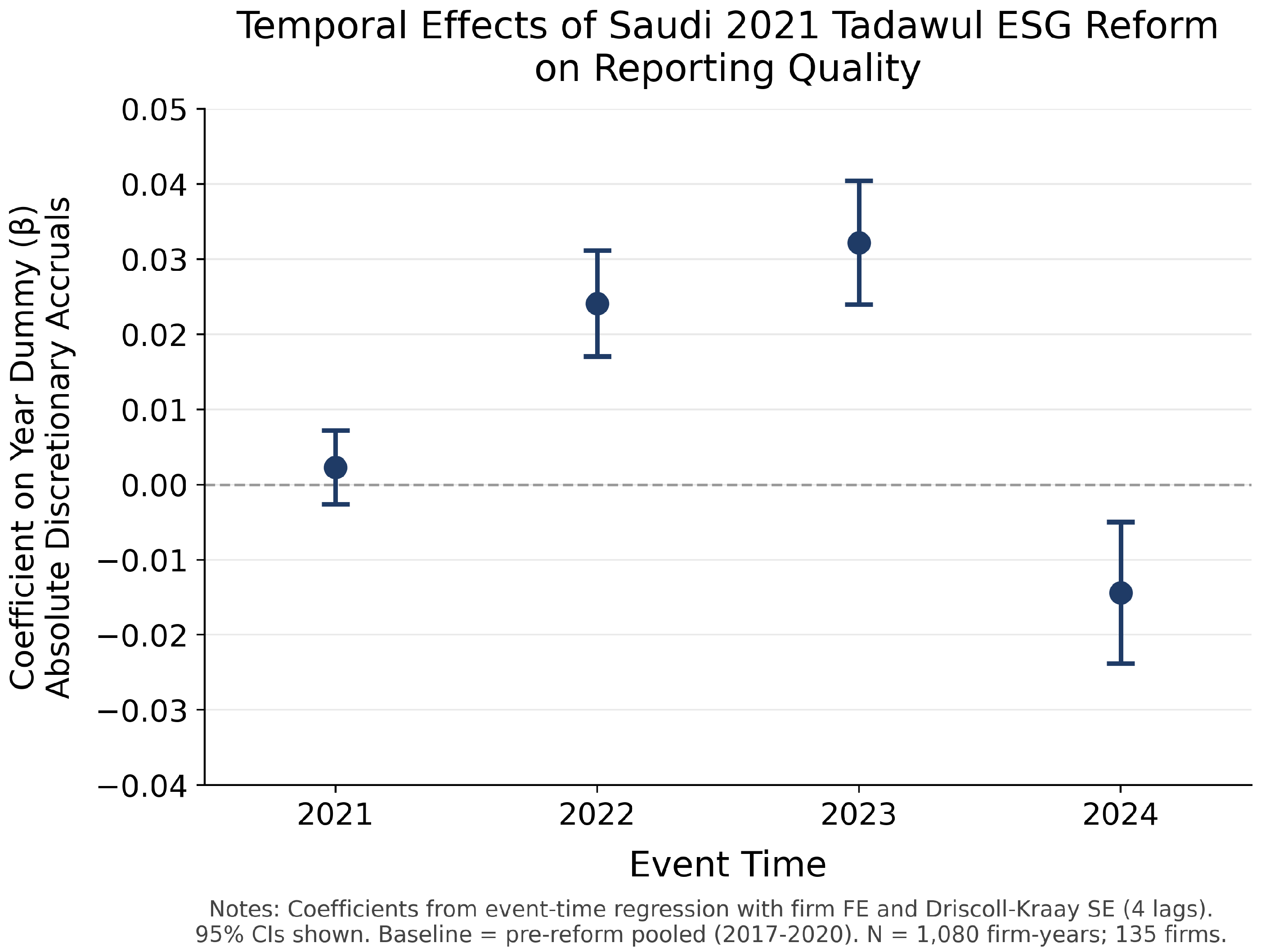
Table 3.
Main results: Event-time effects on reporting quality.
5.3. Main Results: The Temporal Paradox
Table 3 reports the event-time regression estimates. Column (1) is the main specification with as the dependent variable and all firm-level controls. Column (2) replaces the dependent variable with . Column (3) presents the parsimonious specification with only event-time dummies and firm fixed effects.
The trend is consistent and statistically robust across all three specifications. In the main specification, there is no significant change in absolute discretionary accruals in the announcement year 2021 (; ) compared to the pre-reform baseline. The parsimonious model without controls finds that Y2021 is negative and significant (; ), which reflects the downward trend already in place pre-reform. In neither specification is the announcement year 2021 linked to a disciplining effect on reporting quality.
The most interesting findings are related to 2022 and 2023. In the main specification, Y2022 enters at (), and Y2023 at (), both significant at the 1% level. These represent 28% and 38% increases compared to the pre-reform mean of 0.085. The result is not a mechanical correlation between Modified Jones residuals and contemporaneous firm performance, as the estimates are very similar in the PM − DA specification (0.025 and 0.033).
By 2024, the coefficient flips sign sharply: Y2024 = () in the main specification, and () in the parsimonious version. This is the first post-reform year in which absolute discretionary accruals are significantly below the pre-reform baseline. The overall pattern—a null effect in the announcement year, a positive deviation in years 2 and 3, followed by a substantial negative deviation in year 4—represents a temporal paradox: the disciplining effect of the reform on reporting quality does not emerge until after a three-year transition period during which earnings management rises.
Control variables behave as expected. ROA has a significant and negative coefficient (; ), consistent with the existing literature showing that more profitable companies engage in less accrual manipulation [35,36]. Leverage also has a negative relationship with (; ), which is reasonable given that debt covenants can have a disciplining effect on accrual quality [63]. Firm size enters with a negative point estimate but does not reach conventional significance in this within-firm specification.
5.4. Robustness
Table 4 subjects the main result to five robustness exercises.
Table 4.
Robustness checks.
Placebo test (column 1). Restricting the sample to pre-reform years (2017–2020) and assigning counterfactual treatment dummies for 2019 and 2020 yields a negative and significant Y_placebo_2019 coefficient (; )—in the opposite direction from the main result—and an insignificant Y_placebo_2020. This rules out the alternative interpretation that the positive 2022–2023 coefficients reflect a continuation of pre-existing trends in the data. The temporal paradox is anchored to the post-reform period.
Excluding COVID-19 (column 2). Dropping the 2020 fiscal year and re-estimating the main specification produces, if anything, stronger results: Y2022 = 0.029 (), Y2023 = 0.037 (), and Y2024 = (). The 2021 coefficient also turns significantly positive (; ). The temporal paradox is therefore not driven by COVID-19-related accrual volatility, consistent with cross-country evidence that ESG behavior itself was disrupted during the pandemic [64]; if anything, the 2020 inclusion attenuates the estimated effects.
Sectoral disaggregation (columns 3 and 4). Estimating the main specification separately for Industrial (N = 408) and Service (N = 672) subsamples reveals an important heterogeneity in timing. Industrial firms show a sharp 2022 peak (; ) but rapid normalization by 2023 (; ). Service firms exhibit the opposite timing: a more modest 2022 effect (; ) escalating to a 2023 peak of (), followed by a sharp 2024 decline (; ). Both sectors exhibit the basic temporal paradox pattern—initial increase followed by eventual decline—but Industrial firms appear to adjust to the new disclosure regime more quickly than Service firms.
Cross-sectional heterogeneity (column 5). The interaction between post-reform exposure and high environmental performance (Post × HighE) is positive but not statistically significant (, ). This null heterogeneity finding is informative: it indicates that the temporal paradox is not driven by a specific subset of high-E firms reacting differently to the reform. However, environmental performance alone is a narrow heterogeneity dimension, and the absence of moderation by HighE does not preclude moderation along other firm-level dimensions. We therefore extend the heterogeneity analysis in the next subsection.
5.5. Panel Diagnostic Tests
Before turning to the extended heterogeneity analysis, we report the formal diagnostic tests that justify the choice of fixed-effects estimation with Driscoll–Kraay standard errors. Table 5 reports five panel diagnostic tests applied to the main specification (Table 3, Column 1).
Table 5.
Panel diagnostic tests on the main specification.
The combined evidence—panel structure required, FE preferred, heteroskedasticity present, cross-sectional dependence present, and no AR(1)—fully justifies the estimator and standard-error structure used throughout the paper.
5.6. Extended Heterogeneity by Pre-Reform Firm Characteristics
Table 6 augments the cross-sectional heterogeneity analysis along eight pre-reform firm characteristics: aggregate ESG disclosure intensity (voluntary discloser proxy), each ESG pillar separately (E, S, G), firm size, leverage, profitability, and the within-firm post-reform change in ESG (a legitimacy-buffer proxy). Each row reports a separate regression in which the main specification is augmented with a Post × Hi interaction, where Hi is a firm-level binary set equal to one for firms whose pre-reform (2017–2020) average exceeds the cross-firm median.
Table 6.
Heterogeneity analysis: Post × pre-reform firm characteristic interactions.
Three patterns are notable. First, the temporal paradox is significantly amplified among firms with stronger pre-reform sustainability and governance disclosure: the Post × HighESG_Pre interaction is (), and the Post × HighG_Pre interaction is (). Firms that voluntarily disclosed more ESG information before 2021 (and firms with stronger pre-reform governance disclosure) exhibited substantially larger increases in absolute discretionary accruals during the post-reform transition. This pattern is consistent with the adjustment-cost interpretation: firms that had built up the most extensive voluntary disclosure infrastructure had the greatest signaling stake to protect during the transition and therefore relied most heavily on accrual flexibility to maintain reported performance while restructuring their reporting governance toward the new mandatory ESG margin.
Second, the moderation is null along firm size, leverage, profitability, and ΔESG (none of these four interactions are statistically significant). The null on the post-reform ΔESG interaction is particularly informative: firms that increased their ESG disclosure the most after 2021 did not exhibit a stronger temporal paradox, providing no empirical support for a simple legitimacy-buffering mechanism in which post-reform disclosure expansion would generate reputational slack for accrual flexibility.
Third, the Y2024 reversal holds across all eight characteristics in both the Low and High groups (the rightmost two columns), confirming that the eventual normalization of reporting quality is a broad-based phenomenon rather than a subgroup artifact.
5.7. Year-by-Year Heterogeneity and Mechanism Evidence
The Post × Hi interactions in Table 6 pool all four post-reform years. To examine whether the paradox unfolds with different timing across firm types, Table 7 reports the full event-time specification interacted with three key heterogeneity dimensions: pre-reform ESG disclosure (voluntary disclosers), pre-reform governance disclosure, and firm size. Coefficients in the “Low” columns are the standard year dummies; coefficients in the “High” columns equal the year dummy plus the Year × Hi interaction.
Table 7.
Year-by-year heterogeneity: Event-time effects by pre-reform firm characteristics.
The within-row patterns trace the adjustment-cost mechanism with unusual sharpness. Firms with strong pre-reform governance disclosure (High-G_Pre) reacted immediately in the announcement year ( in 2021 vs. for Low-G_Pre firms), peaked early in 2022, and exhibited a flat 2024 trajectory ( for High-G_Pre vs. for Low-G_Pre). Voluntary pre-reform ESG disclosers showed a similar amplified peak at in 2023 (compared to for non-disclosers) and a partial—rather than complete—reversal in 2024 ( vs. ). Large firms exhibited an attenuated paradox throughout: their 2023 peak was essentially zero () compared to for small firms.
Three mechanism-related inferences follow. First, the amplification of the paradox among firms with stronger pre-reform disclosure infrastructure—and the attenuation among large firms with established reporting governance—together constitute empirical evidence consistent with the adjustment-cost mechanism. Firms with greater pre-reform investments in disclosure had more to protect during the regulatory transition and relied more heavily on accrual flexibility while restructuring; large firms could rebuild the necessary reporting infrastructure with less disruption to existing accrual-quality controls. Second, the legitimacy-buffer mechanism receives no empirical support: firms that expanded their ESG disclosure the most after the reform (ΔESG above median) did not exhibit a stronger paradox (Table 6). Third, the attentional-substitution mechanism cannot be directly tested in our data because analyst-coverage and media-attention measures for Saudi-listed firms over 2017–2024 are not consistently available; we leave this channel for future research with data on the time allocation of external monitoring agents.
5.8. Sectoral Disaggregation Across Nine Industry Groups
The binary Industrial vs. Service split in Section 5 provides a first decomposition of sectoral heterogeneity but is coarse. To examine whether the temporal paradox is robust across more granular industry groupings, we re-estimate the main specification separately on each of nine Tadawul GICS-aligned sectors. The classification is constructed from each firm’s primary business activity and is documented in Appendix A; sectors are consolidated to ensure ≥6 firms per group.
Three observations emerge from Table 8. First, the post-2021 increase in absolute discretionary accruals appears in eight of the nine sectors, indicating that the temporal paradox is a broad-based phenomenon rather than a sector-specific artifact. Second, the timing of the peak varies meaningfully across sectors: Materials and Energy, Capital Goods, and Healthcare and Pharma peak in 2022; Retailing and Consumer Durables and Food, Beverage and Agriculture peak in 2023; and Real Estate and REITs, Telecom and Technology, and Transportation and Logistics show mixed timing. Third, the 2024 reversal is most pronounced in sectors with significant consumer-facing reporting obligations (Retailing and Consumer Durables, Consumer Services and Media, Transportation and Logistics), suggesting that sectors most exposed to external stakeholder scrutiny adjusted accrual quality fastest once the ESG disclosure infrastructure was in place. Sectors with persistent post-reform elevation (Capital Goods, Real Estate and REITs) likely required longer adjustment windows due to project-based or asset-heavy reporting structures.
Table 8.
Sector-disaggregated event-time effects (nine-sector Tadawul GICS-aligned classification).
6. Discussion
6.1. Interpreting the Temporal Paradox
The empirical patterns in Table 6, Table 7 and Table 8 permit us to move beyond a purely theoretical enumeration of candidate mechanisms and to assess which mechanisms find empirical support in the Saudi data.
Adjustment-cost dynamics (supported). The adjustment-cost interpretation predicts that the temporal paradox should be amplified in firms with extensive pre-reform disclosure investments—because these firms had the most reporting governance capacity to redirect—and attenuated in firms with established reporting infrastructure that could absorb the new ESG margin without displacing accrual-side controls. Both predictions find empirical support. The Post × High-G_Pre interaction is positive and significant (, ); the Post × HighESG_Pre interaction is positive and significant (, ); the year-by-year breakdown in Table 7 shows that large firms (HighSize) exhibit a substantially attenuated 2023 peak ( vs. for small firms); and the sectoral pattern in Table 8 shows sharper reversals in sectors with denser consumer-facing reporting expectations. Together these patterns identify the adjustment-cost mechanism as the dominant interpretation: the reform diverted scarce reporting governance toward the new ESG disclosure margin during a multi-year buildout, and the diversion’s intensity scaled with the firm’s pre-existing disclosure stake.
Attentional-substitution dynamics (untestable in our setting). The attentional-substitution mechanism posits that external monitoring—analyst attention, media scrutiny, institutional-investor engagement—was reallocated toward narrative sustainability metrics during the transition, reducing the perceived probability of detection of accrual manipulation. Direct empirical assessment of this channel requires firm-year measures of external monitoring intensity (analyst coverage, media mentions, institutional ownership share) that are not consistently available for Saudi-listed firms over 2017–2024. We therefore identify this channel as a candidate explanation but leave its empirical assessment for future research with appropriate monitoring data. The recent literature on media-legitimacy effects [65] and institutional-investor attention [47] provides a framework for such work.
Legitimacy-buffering dynamics (not supported). The legitimacy-buffering mechanism [9,10,27] predicts that firms which substantially increased their sustainability disclosure intensity after the reform would have generated reputational slack on which managers could draw to justify aggressive accrual choices during the transition. Our empirical proxy for legitimacy-buffer capacity—the within-firm ΔESG between pre- and post-reform averages—does not exhibit the predicted moderation: the Post × ΔESG interaction is small and statistically insignificant (Table 6, last row; ; ). This null finding does not refute the legitimacy-buffer mechanism in general, but it indicates that, in the Saudi setting, post-reform disclosure expansion is not a sufficient proxy for the reputational slack required by the mechanism. The symbolic-versus-substantive divide in sustainability reporting [51] may require finer textual or qualitative measures than disclosure intensity scores to capture them.
The sectoral heterogeneity in Table 8 accommodates the adjustment-cost interpretation most readily. Sectors with longer-standing reporting governance traditions (Materials and Energy, Healthcare and Pharma) show muted paradox patterns; sectors with weaker pre-existing sustainability infrastructure but high consumer-stakeholder exposure (Retailing, Food and Beverage, Consumer Services) show pronounced peaks followed by sharp reversals as the new ESG infrastructure stabilizes. The variation in peak timing across sectors—some peaking in 2022, others in 2023—is consistent with sector-specific adjustment-cost profiles rather than with a uniform legitimacy-buffer dynamic.
6.2. Policy Implications
Three policy implications arise. First, mandatory sustainability disclosure reforms should be designed with explicit attention to transition dynamics. The Saudi evidence contradicts the conventional expectation that disclosure mandates produce immediate improvements in adjacent reporting margins. Policymakers should anticipate a temporary deterioration in financial-reporting quality during the first 24–36 months following a major sustainability disclosure reform, and should consider complementary measures—enhanced audit-committee resources, dedicated transitional enforcement, and parallel strengthening of accrual-side audit—to mitigate this risk.
Second, the sectoral heterogeneity in timing argues for differentiated implementation timelines. Where regulatory bandwidth permits, phased introductions that accommodate sector-specific adjustment costs may reduce the transitional spike in opportunistic accrual choice. Service-sector firms in particular may benefit from longer adjustment windows or additional implementation support.
Third, the null cross-sectional heterogeneity by environmental performance is informative for policy design. The temporal paradox affected firms broadly, regardless of pre-reform ESG profile. This suggests that reform-induced adjustment costs are systemic rather than firm-specific, and supports population-level rather than firm-targeted policy responses during transition periods.
7. Conclusions
This study examined how Saudi Arabia’s January 2021 Tadawul ESG Disclosure Guidelines—the first comprehensive sustainability disclosure framework in the Gulf Cooperation Council—affected the quality of corporate financial reporting. Using a balanced panel of 135 non-financial Saudi listed firms over 2017–2024 and an event-time fixed-effects specification with Driscoll–Kraay standard errors, we documented a temporal paradox. Absolute discretionary accruals showed no immediate change at the reform’s announcement (2021), rose by approximately 28% in 2022 and 38% in 2023 relative to the pre-reform baseline, and then declined significantly by 17% in 2024. The pattern survived performance-matched discretionary accruals (Kothari et al. 2005) [34], exclusion of the 2020 COVID-19 year, sectoral disaggregation across nine Tadawul-aligned industry groups, a placebo test on the pre-reform sample, and a battery of formal panel diagnostic tests. Heterogeneity analysis identified the underlying mechanism: the paradox is amplified in voluntary pre-reform ESG disclosers and firms with stronger pre-reform governance, and substantially attenuated in larger firms with established reporting infrastructure. These patterns are jointly consistent with an adjustment-cost mechanism in which scarce reporting governance is redirected toward the new ESG disclosure margin during a multi-year buildout, while the legitimacy-buffer mechanism finds no empirical support in the Saudi setting.
The results have implications for the design and evaluation of mandate-based sustainability disclosure reforms in emerging markets. Policymakers and regulators should expect that disclosure requirements—no matter how well-intentioned and well-designed they may be—may produce a short-term deterioration in adjacent reporting margins during the implementation period, with the disciplining impact emerging only after several years of compliance investment. The amplification of the paradox among firms with the strongest pre-reform disclosure infrastructure further suggests that transitional support—supplementary audit-committee resources, dedicated implementation guidance, and parallel strengthening of accrual-side audit—should be targeted especially at firms with substantial existing disclosure commitments, as these face the largest reorganization costs. Researchers assessing similar reforms should use event-time specifications, which separate the effect of the change announcement from transitional dynamics, rather than aggregate pre–post indicators that are insensitive to non-monotonic dynamics.
One must be mindful of a number of limitations. Due to the four-year observation window from the start of the reform, longer-term dynamics after 2024 cannot be assessed, and the 2024 reversal should be interpreted as the first observed normalization rather than a final equilibrium. The attentional-substitution mechanism cannot be directly tested in this setting because consistent firm-year measures of analyst coverage, media scrutiny, and institutional-investor attention are not available for Saudi-listed firms over the full sample period; this remains an open question for future work. Real activities-based earnings management [8] is an additional channel of earnings management that may have been shifted toward—or away from—the accrual margin during the transition, and would benefit from a complementary analysis. Other Gulf and emerging-market disclosure reforms would help to clarify the out-of-country applicability of the temporal paradox presented in this paper. These questions are left to future research.
Supplementary Materials
The following supporting information can be downloaded at: https://www.mdpi.com/article/10.3390/su18136582/s1.
Author Contributions
Conceptualization, I.B. and F.A.; methodology, F.A. and A.A. (Ahmad Alomari); software, A.A. (Ahmad Alomari); validation, M.B., A.A. (Amal Alharthi) and M.E.; formal analysis, A.A. (Ahmad Alomari) and F.A.; investigation, I.B. and M.B.; resources, A.A. (Amal Alharthi) and M.E.; data curation, A.A.; writing—original draft preparation, F.A. and A.A. (Ahmad Alomari); writing—review and editing, I.B., M.B., A.A. (Amal Alharthi) and M.E.; visualization, A.A. (Ahmad Alomari); supervision, F.A.; project administration, I.B.; funding acquisition, I.B., M.B. and A.A. (Amal Alharthi). All authors have read and agreed to the published version of the manuscript.
Funding
This research was funded by Princess Nourah bint Abdulrahman University Researchers Supporting Project number (PNURSP2026R861), Princess Nourah bint Abdulrahman University, Riyadh, Saudi Arabia.
Institutional Review Board Statement
Not applicable. The study uses publicly available archival data on listed firms and contains no human-subject research.
Informed Consent Statement
Not applicable.
Data Availability Statement
The original contributions presented in this study are included in the article/Supplementary Material, including summary statistics and variable definitions. Raw data were obtained from Refinitiv Eikon, Refinitiv ESG, and Tadawul public filings under institutional license. Further inquiries can be directed to the corresponding author(s).
Acknowledgments
Princess Nourah bint Abdulrahman University Researchers Supporting Project number (PNURSP2026R861), Princess Nourah bint Abdulrahman University, Riyadh, Saudi Arabia.
Conflicts of Interest
The authors declare no conflicts of interest.
Appendix A. Firm-to-Sector Mapping (Nine-Sector Tadawul GICS-Aligned Classification)
Table A1 reports the complete firm-to-sector mapping used in the nine-sector disaggregation reported in Section 5.8. Each Tadawul-listed firm in the sample is assigned to one of nine industry groups based on its primary business activity. The classification consolidates rare industry sub-groups (e.g., pure Energy services, Media-only firms) into adjacent broader groups to ensure ≥6 firms per sector, while preserving the substantive distinctions between Materials and Energy, Capital Goods, Consumer Services, Retailing, Healthcare, Food and Agriculture, Real Estate, Telecommunication and Technology, and Transportation.
Table A1.
Complete firm-to-sector mapping ( firms across nine Tadawul-aligned sectors).
References
- Christensen, H.B.; Hail, L.; Leuz, C. Mandatory CSR and sustainability reporting: Economic analysis and literature review. Rev. Account. Stud. 2021, 26, 1176–1248. [Google Scholar] [CrossRef] [Scilit]
- Healy, P.M.; Palepu, K.G. Information asymmetry, corporate disclosure, and the capital markets: A review of the empirical disclosure literature. J. Account. Econ. 2001, 31, 405–440. [Google Scholar] [CrossRef] [Scilit]
- Christensen, H.B.; Floyd, E.; Liu, L.Y.; Maffett, M. The real effects of mandated information on social responsibility in financial reports: Evidence from mine-safety records. J. Account. Econ. 2017, 64, 284–304. [Google Scholar] [CrossRef] [Scilit]
- Jensen, M.C.; Meckling, W.H. Theory of the firm: Managerial behavior, agency costs and ownership structure. J. Financ. Econ. 1976, 3, 305–360. [Google Scholar] [CrossRef] [Scilit]
- Verrecchia, R.E. Essays on disclosure. J. Account. Econ. 2001, 32, 97–180. [Google Scholar] [CrossRef] [Scilit]
- Beyer, A.; Cohen, D.A.; Lys, T.Z.; Walther, B.R. The financial reporting environment: Review of the recent literature. J. Account. Econ. 2010, 50, 296–343. [Google Scholar] [CrossRef] [Scilit]
- Cohen, D.A.; Dey, A.; Lys, T.Z. Real and accrual-based earnings management in the pre- and post-Sarbanes-Oxley periods. Account. Rev. 2008, 83, 757–787. [Google Scholar] [CrossRef] [Scilit]
- Roychowdhury, S. Earnings management through real activities manipulation. J. Account. Econ. 2006, 42, 335–370. [Google Scholar] [CrossRef] [Scilit]
- Cho, C.H.; Patten, D.M. The role of environmental disclosures as tools of legitimacy: A research note. Account. Organ. Soc. 2007, 32, 639–647. [Google Scholar] [CrossRef] [Scilit]
- Lyon, T.P.; Maxwell, J.W. Greenwash: Corporate environmental disclosure under threat of audit. J. Econ. Manag. Strategy 2011, 20, 3–41. [Google Scholar] [CrossRef] [Scilit]
- Leuz, C.; Nanda, D.; Wysocki, P.D. Earnings management and investor protection: An international comparison. J. Financ. Econ. 2003, 69, 505–527. [Google Scholar] [CrossRef] [Scilit]
- Burgstahler, D.; Dichev, I. Earnings management to avoid earnings decreases and losses. J. Account. Econ. 1997, 24, 99–126. [Google Scholar] [CrossRef] [Scilit]
- Kim, Y.; Park, M.S.; Wier, B. Is earnings quality associated with corporate social responsibility? Account. Rev. 2012, 87, 761–796. [Google Scholar] [CrossRef] [Scilit]
- Almahrog, Y.; Ali Aribi, Z.; Arun, T. Earnings management and corporate social responsibility: UK evidence. J. Financ. Report. Account. 2018, 16, 311–332. [Google Scholar] [CrossRef] [Scilit]
- Hong, Y.; Andersen, M.L. The relationship between corporate social responsibility and earnings management: An exploratory study. J. Bus. Ethics 2011, 104, 461–471. [Google Scholar] [CrossRef] [Scilit]
- Chih, H.-L.; Shen, C.-H.; Kang, F.-C. Corporate social responsibility, investor protection, and earnings management: Some international evidence. J. Bus. Ethics 2008, 79, 179–198. [Google Scholar]
- Velte, P. The bidirectional relationship between ESG performance and earnings management—Empirical evidence from Germany. J. Glob. Responsib. 2019, 10, 322–338. [Google Scholar]
- Berg, F.; Koelbel, J.F.; Rigobon, R. Aggregate confusion: The divergence of ESG ratings. Rev. Financ. 2022, 26, 1315–1344. [Google Scholar] [CrossRef] [Scilit]
- Bushman, R.M.; Smith, A.J. Financial accounting information and corporate governance. J. Account. Econ. 2001, 32, 237–333. [Google Scholar] [CrossRef] [Scilit]
- Christensen, H.B.; Hail, L.; Leuz, C. Capital-market effects of securities regulation: Prior conditions, implementation, and enforcement. Rev. Financ. Stud. 2016, 29, 2885–2924. [Google Scholar] [CrossRef] [Scilit]
- Dhaliwal, D.S.; Li, O.Z.; Tsang, A.; Yang, Y.G. Voluntary nonfinancial disclosure and the cost of equity capital: The initiation of corporate social responsibility reporting. Account. Rev. 2011, 86, 59–100. [Google Scholar] [CrossRef] [Scilit]
- El Ghoul, S.; Guedhami, O.; Kwok, C.C.Y.; Mishra, D.R. Does corporate social responsibility affect the cost of capital? J. Bank. Financ. 2011, 35, 2388–2406. [Google Scholar]
- Cheng, B.; Ioannou, I.; Serafeim, G. Corporate social responsibility and access to finance. Strateg. Manag. J. 2014, 35, 1–23. [Google Scholar] [CrossRef] [Scilit]
- Dhaliwal, D.; Li, O.Z.; Tsang, A.; Yang, Y.G. Corporate social responsibility disclosure and the cost of equity capital: The roles of stakeholder orientation and financial transparency. J. Account. Public Policy 2014, 33, 328–355. [Google Scholar] [CrossRef] [Scilit]
- Khan, M.; Serafeim, G.; Yoon, A. Corporate sustainability: First evidence on materiality. Account. Rev. 2016, 91, 1697–1724. [Google Scholar] [CrossRef] [Scilit]
- Krueger, P.; Sautner, Z.; Starks, L.T. The importance of climate risks for institutional investors. Rev. Financ. Stud. 2020, 33, 1067–1111. [Google Scholar] [CrossRef] [Scilit]
- Patten, D.M. Intra-industry environmental disclosures in response to the Alaskan oil spill: A note on legitimacy theory. Account. Organ. Soc. 1992, 17, 471–475. [Google Scholar] [CrossRef] [Scilit]
- Suchman, M.C. Managing legitimacy: Strategic and institutional approaches. Acad. Manag. Rev. 1995, 20, 571–610. [Google Scholar] [CrossRef] [Scilit]
- Freeman, R.E. Strategic Management: A Stakeholder Approach; Pitman: Boston, MA, USA, 1984. [Google Scholar]
- DiMaggio, P.J.; Powell, W.W. The iron cage revisited: Institutional isomorphism and collective rationality in organizational fields. Am. Sociol. Rev. 1983, 48, 147–160. [Google Scholar] [CrossRef] [Scilit]
- Martínez-Ferrero, J.; García-Sánchez, I.M. Coercive, normative and mimetic isomorphism as determinants of the voluntary assurance of sustainability reports. Int. Bus. Rev. 2017, 26, 102–118. [Google Scholar] [CrossRef] [Scilit]
- Jones, J.J. Earnings management during import relief investigations. J. Account. Res. 1991, 29, 193–228. [Google Scholar] [CrossRef] [Scilit]
- Dechow, P.M.; Sloan, R.G.; Sweeney, A.P. Detecting earnings management. Account. Rev. 1995, 70, 193–225. [Google Scholar] [CrossRef] [Scilit]
- Kothari, S.P.; Leone, A.J.; Wasley, C.E. Performance matched discretionary accrual measures. J. Account. Econ. 2005, 39, 163–197. [Google Scholar] [CrossRef] [Scilit]
- Dechow, P.M.; Ge, W.; Schrand, C. Understanding earnings quality: A review of the proxies, their determinants and their consequences. J. Account. Econ. 2010, 50, 344–401. [Google Scholar] [CrossRef] [Scilit]
- Dechow, P.M.; Dichev, I.D. The quality of accruals and earnings: The role of accrual estimation errors. Account. Rev. 2002, 77, 35–59. [Google Scholar] [CrossRef] [Scilit]
- Graham, J.R.; Harvey, C.R.; Rajgopal, S. The economic implications of corporate financial reporting. J. Account. Econ. 2005, 40, 3–73. [Google Scholar] [CrossRef] [Scilit]
- Klein, A. Audit committee, board of director characteristics, and earnings management. J. Account. Econ. 2002, 33, 375–400. [Google Scholar] [CrossRef] [Scilit]
- Becker, C.L.; DeFond, M.L.; Jiambalvo, J.; Subramanyam, K.R. The effect of audit quality on earnings management. Contemp. Account. Res. 1998, 15, 1–24. [Google Scholar] [CrossRef] [Scilit]
- Yu, F.F. Analyst coverage and earnings management. J. Financ. Econ. 2008, 88, 245–271. [Google Scholar] [CrossRef] [Scilit]
- Zang, A.Y. Evidence on the trade-off between real activities manipulation and accrual-based earnings management. Account. Rev. 2012, 87, 675–703. [Google Scholar]
- Cohen, D.A.; Zarowin, P. Accrual-based and real earnings management activities around seasoned equity offerings. J. Account. Econ. 2010, 50, 2–19. [Google Scholar] [CrossRef] [Scilit]
- DeFond, M.L.; Park, C.W. Smoothing income in anticipation of future earnings. J. Account. Econ. 1997, 23, 115–139. [Google Scholar] [CrossRef] [Scilit]
- Bozzolan, S.; Fabrizi, M.; Mallin, C.A.; Michelon, G. Corporate social responsibility and earnings quality: International evidence. Int. J. Account. 2015, 50, 361–396. [Google Scholar] [CrossRef] [Scilit]
- Gerged, A.M.; Albitar, K.; Al-Haddad, L. Corporate environmental disclosure and earnings management—The moderating role of corporate governance structures. Int. J. Financ. Econ. 2023, 28, 2789–2810. [Google Scholar]
- Servaes, H.; Tamayo, A. The impact of corporate social responsibility on firm value: The role of customer awareness. Manag. Sci. 2013, 59, 1045–1061. [Google Scholar] [CrossRef] [Scilit]
- Ferreira, M.A.; Matos, P. The colors of investors’ money: The role of institutional investors around the world. J. Financ. Econ. 2008, 88, 499–533. [Google Scholar] [CrossRef] [Scilit]
- Hong, H.; Kacperczyk, M. The price of sin: The effects of social norms on markets. J. Financ. Econ. 2009, 93, 15–36. [Google Scholar] [CrossRef] [Scilit]
- Hahn, R.; Kühnen, M. Determinants of sustainability reporting: A review of results, trends, theory, and opportunities in an expanding field of research. J. Clean. Prod. 2013, 59, 5–21. [Google Scholar] [CrossRef] [Scilit]
- Pflugrath, G.; Roebuck, P.; Simnett, R. Impact of assurance and assurer’s professional affiliation on financial analysts’ assessment of credibility of corporate responsibility information. Audit. J. Pract. Theory 2011, 30, 239–254. [Google Scholar] [CrossRef] [Scilit]
- Boiral, O. Sustainability reports as simulacra? A counter-account of A and A+ GRI reports. Account. Audit. Account. J. 2013, 26, 1036–1071. [Google Scholar] [CrossRef] [Scilit]
- Clarkson, P.M.; Li, Y.; Richardson, G.D.; Vasvari, F.P. Revisiting the relation between environmental performance and environmental disclosure: An empirical analysis. Account. Organ. Soc. 2008, 33, 303–327. [Google Scholar] [CrossRef] [Scilit]
- Almubarak, W.I.; Chebbi, K.; Ammer, M.A. Unveiling the connection among ESG, earnings management, and financial distress: Insights from an emerging market. Sustainability 2023, 15, 12348. [Google Scholar] [CrossRef] [Scilit]
- Habbash, M. Corporate governance and corporate social responsibility disclosure: Evidence from Saudi Arabia. Soc. Responsib. J. 2016, 12, 740–754. [Google Scholar] [CrossRef] [Scilit]
- Alotaibi, K.O.; Hussainey, K. Determinants of CSR disclosure quantity and quality: Evidence from non-financial listed firms in Saudi Arabia. Int. J. Discl. Gov. 2016, 13, 364–393. [Google Scholar] [CrossRef] [Scilit]
- Alodat, A.Y.; Al Amosh, H.; Alorayni, O.; Khatib, S.F.A. Does corporate sustainability disclosure mitigate earnings management: Empirical evidence from Jordan. Int. J. Discl. Gov. 2024, 21, 165–174. [Google Scholar]
- Khan, A.; Muttakin, M.B.; Siddiqui, J. Corporate governance and corporate social responsibility disclosures: Evidence from an emerging economy. J. Bus. Ethics 2013, 114, 207–223. [Google Scholar]
- Buertey, S.; Sun, E.-J.; Lee, J.S.; Hwang, J. Corporate social responsibility and earnings management: The moderating effect of corporate governance mechanisms. Corp. Soc. Responsib. Environ. Manag. 2020, 27, 256–271. [Google Scholar]
- Grimaldi, F.; Caragnano, A.; Zito, M.; Mariani, M. Sustainability engagement and earnings management: The Italian context. Sustainability 2020, 12, 4881. [Google Scholar] [CrossRef] [Scilit]
- Issa, A.; Sahyouni, A. Mandatory corporate social responsibility regulation and earnings management: Evidence from emerging economies. Corp. Gov. Int. J. Bus. Soc. 2023, 23, 1456–1478. [Google Scholar]
- Driscoll, J.C.; Kraay, A.C. Consistent covariance matrix estimation with spatially dependent panel data. Rev. Econ. Stat. 1998, 80, 549–560. [Google Scholar] [CrossRef] [Scilit]
- Hoechle, D. Robust standard errors for panel regressions with cross-sectional dependence. Stata J. 2007, 7, 281–312. [Google Scholar] [CrossRef] [Scilit]
- Bharath, S.T.; Sunder, J.; Sunder, S.V. Accounting quality and debt contracting. Account. Rev. 2008, 83, 1–28. [Google Scholar] [CrossRef] [Scilit]
- Al Amosh, H.; Khatib, S.F.A. ESG performance in the time of COVID-19 pandemic: Cross-country evidence. Environ. Sci. Pollut. Res. 2023, 30, 39978–39993. [Google Scholar] [CrossRef] [Scilit]
- Aerts, W.; Cormier, D. Media legitimacy and corporate environmental communication. Account. Organ. Soc. 2009, 34, 1–27. [Google Scholar] [CrossRef] [Scilit]

Disclaimer/Publisher’s Note: The statements, opinions and data contained in all publications are solely those of the individual author(s) and contributor(s) and not of MDPI and/or the editor(s). MDPI and/or the editor(s) disclaim responsibility for any injury to people or property resulting from any ideas, methods, instructions or products referred to in the content. |
© 2026 by the authors. Licensee MDPI, Basel, Switzerland. This article is an open access article distributed under the terms and conditions of the Creative Commons Attribution (CC BY) license.