


Abstract
This research investigates how green entrepreneurship, green innovation, and domestic credit to the private sector, contribute to environmental sustainability in Turkey from 1990 to 2022. Environmental sustainability is proxied by ecological footprint. The methods used include Wavelet Quantile Regression (WQR) and Wavelet Quantile Correlation (WQC). This research also ascertained if interacting domestic credit and green entrepreneurship and domestic credit and green innovation could contribute to environmental sustainability using the Multivariate Wavelet Quantile Regression (MWQR) approach. The WQR and WQC outcomes confirm the following: (1) green entrepreneurship reduces ecological footprint across all quantiles and periods; (2) green innovation reduces ecological footprint in the short and medium term, while in the long term, it increases ecological footprint; (3) domestic credit increases ecological footprint across all quantiles and periods. The MWQR results confirm that domestic credit and green entrepreneurship interaction reduces ecological footprint, while domestic credit and green innovation interaction reduces ecological footprint in the short term. Policies are recommended for implementation.
1. Introduction
In recent times, one of the crucial topics being continually discussed is environmental sustainability. Environmental sustainability is of great concern because the way natural resources are being used or consumed is pressuring the ecosystem. Ref. [1] opined that research on methods to attain ecological sustainability has increased due to the growing effects of global economic activity on climate change. Environmental sustainability can be defined as meeting the needs of the present generation without jeopardizing the future generation from meeting their own needs [2,3]. If economic activities are being carried out in a way that depletes the quality of the environment, then it means that ecological damage is occurring.
According to [3], the primary causes of ecological damage are waste from industrial processes, emissions from cars, and overdependence on fossils. All of these causes can be linked to established procedures and the kinds of goods and services created by entrepreneurs, although the government and consumers also play crucial roles. It is important to mention that entrepreneurs play a very important role in society. According to [4], entrepreneurs are civic and political players who contribute to the development of political change. Ref. [5] also argued that entrepreneurs are needed both inside and outside the company, creating a variety of unique, crucial, and challenging duties to launch and run enterprises, as well as oversee projects and human teams. Contrary to popular opinion, entrepreneurial endeavors prioritize human values and ethical attitudes in addition to making money [6].
Aside from the general role of entrepreneurs in society, their business activities or decisions can have an impact on the environment. Ref. [7] stated that one of the most popular topics in ongoing studies is the entrepreneurship and environment nexus. Entrepreneurs are the main players in the growth of businesses and the advocates of entrepreneurship. The objective and necessity of the present day is to establish businesses with green and sustainable development. Entrepreneurship is crucial to this process. In addition to actively guiding businesses to engage in activities like technical green innovation and foreign investment, entrepreneurship helps businesses adjust to changes in the market and promotes their practices in ecological governance and innovation to improve the quality of the environment. Furthermore, entrepreneurs may take advantage of opportunities available and boost investment in corporate efforts to protect the environment and lower pollution because they are fully aware of emerging production trends and the potential for sustainable green products and technology. This leads us to the concept called green entrepreneurship, which is sometimes referred to as sustainable or environmental entrepreneurship.
Green entrepreneurship is the term used to describe the beginning of environmentally friendly projects, either for financial gain or for environmental responsibility [8]. Ref. [9] emphasized the importance of building the green entrepreneurial ecosystem in Turkey. The study further stated that in Turkey’s entrepreneurial ecosystem, several non-governmental organizations and structural funders support entrepreneurs in addition to establishing a range of groups and networks. The law provides incentives for entrepreneurial activity, including tax exemptions and rebates. Support from regional development organizations is crucial for entrepreneurship as well. Local entrepreneurs and green companies may benefit from this help. However, a number of factors, including the creation of sufficient details on GENT and the attainment of the appropriate levels of regulation, prevented GENT from reaching the intended level in the nation.
Environmental sustainability is also affected by other factors, such as green innovation and domestic credit to the private sector. Many market opportunities are brought about by innovation, which also increases the efficiency of resources to lower prices and encourages environmentally friendly activities [10]. It lowers costs in comparison to competitors and provides a long-term competitive advantage based on enhanced products and processes [8]. In terms of domestic credit to the private sector, the use of funds by firms to produce goods and services will be dependent on their organizational motives and economic conditions. If firms are trying to survive, they will be more concerned about making a profit, rather than paying attention to the environmental implications of their decisions.
Thus, this research investigates the impact of green entrepreneurship (GENT), green innovation (GRIN), and domestic credit to the private sector (DOMC) on environmental sustainability (ECOL) in Turkey. This research further ascertained whether the interaction of DOMC, GENT, and GRIN can drive ecological sustainability.
Based on the discussions above, the gaps and contributions of this research are identified. Just like other studies [11,12], this study employed ECOL as a proxy for ecological sustainability. ECOL is an important proxy for ecological sustainability because it captures the environmental pressure of human activities from different dimensions, such as the use of energy, land use, resource consumption, and the absorption of waste. This is more holistic compared to the metric of CO2 emissions used by the following studies [13,14]. Secondly, it is observed that very few studies have empirically examined how GENT fosters a green environment, particularly in a country like Turkey. Other studies have focused on reviews and theoretical expository [9,15]. Thirdly, diverse studies have investigated how GRIN and DOMC affect the environment. However, to the author’s knowledge, these existing studies lack the innovation of interacting the DOMC with GRIN and GENT. This is one of the major contributions of this study. Fourthly, the methodological techniques used in this research (WQR, WQC, MWQR) are innovative and non-parametric in nature, which can capture the non-linearity between the investigated variables. Other studies have employed methods such as ARDL, DOLS, FMOLS, and CCR. Lastly, this research will be crucial for the Turkish government and other important stakeholders to come up with and implement policies that will encourage GENT and ecological sustainability concurrently. Although Turkey continues to move towards its achievement of a net-zero emission by 2053, the country still has ecological challenges such as water pollution, air pollution, and industrial emissions, amongst others. That is why it is crucial to continue to investigate the drivers of ecological sustainability in Turkey.
2. Literature Review
2.1. Green Entrepreneurship and Environmental Sustainability
Ref. [16] established that GENT drives GRIN and contributes positively to the performance of the environment. In Indonesia, using Structural Equation Modelling (SEM), Ref. [17] argued that GRIN and entrepreneurship greatly improve MSMEs’ ecological viability by encouraging efficient use of resources and carbon-neutral operations. Within the Green SMEs framework, environmentally friendly business practices promote environmental protection and lower operating costs, creating a model that incorporates ecological principles into commercial operations. Encouraging green behaviors, providing training for sustainable approaches, and fostering GRIN are some of the policy ideas. These actions are essential for improving MSME sustainability and resilience, while furthering environmental objectives. Ref. [18] suggested that top management’s ecological commitment, regulations, and demand from consumers for environmentally friendly goods all have a positive impact on GENT. The study further discovered that businesses could concurrently attain greater monetary and ecological benefits by investing in these innovations. Additionally, it was verified that the company’s assessment of the significance of stakeholder expectations and the connection between GENT and performance are influenced by the commitment to sustainability of senior management. In Oman, Ref. [19] stated that businesses must implement creative strategies to achieve GENT in order to safeguard the environment and promote ecologically responsible solutions that would serve as catalysts for attaining sustainability. By decreasing the use of resources through recycling, reuse, and resource reduction to lessen reliance on raw materials, it can bring about societal change. The results indicate that GENT and innovation are critical to achieving long-term sustainability objectives. Creating eco-friendly practices and investigating possibilities for resilient communities, it will guide management in protecting the environment and the planet. Ref. [15] identified some key drivers of entrepreneurship, and they include technology, organizational, commercial, social, and government policy. In addition, the outcomes of GENT were stated as technological, environmental, commercial, and economic. In 11 Asian economies, Ref. [12] stated that GENT benefits the environment. According to the study, encouraging green entrepreneurs can boost employment, economic expansion, and well-being in society, resulting in a more resilient and environmentally friendly future for everybody. From the above discussion, the hypothesis of this research is as follows:
H1:
GENT will drive environmental sustainability positively. The positive transmission mechanism of GENT on the environment can occur through the adoption of clean energy.
2.2. Green Innovation and Environmental Sustainability
In BRICS economies, Ref. [14] noted that GRIN reduces CO2 emissions. The findings also demonstrate reciprocal causal relationships between GRIN and CO2 emissions. In Saudi Arabia, Ref. [20] established that GRIN has a positive association with ecological sustainability. Ref. [21] also affirmed the same relationship for the Pakistani economy. They also emphasized the importance of ecological awareness. According to the findings of the augmented ARDL analysis, presented by [22], Pakistan’s ecological sustainability is greatly enhanced by green growth and GRIN. The study further argued that GRIN could drive ecological degradation. In Vietnam, using 400 manufacturing SMEs as a case study, Ref. [23] discovered a significant positive link between GRIN and financial and environmental success. Ref. [24] re-emphasized that studies being carried out highlight that the most effective way to carry out the responsible use of resources and lessen ecological deterioration is through GRIN. For G20 economies, using the CS-ARDL approach, the study also confirmed that GRIN is crucial to maintaining these chosen nations’ ecological circumstances. Ref. [25] also ascertained that GRIN improves the quality of the environment in developing economies. In Turkey, Ref. [26] established that GRIN and clean energy reduce CO2 emissions.
H2:
GRIN can have a positive or negative impact on the environment. The positive impact on environmental sustainability can be transmitted through the adoption of ecologically friendly technologies. However, the negative impact can occur through the Rebound Effect Theory.
2.3. Domestic Credit and Environmental Sustainability
Ref. [27] noted that ecological quality is improved by the growth of the financial sector. In Turkey, using the ARDL, DOLS, FMOLS, and CCR techniques, Refs. [28,29] found that DOMC reduces the quality of the environment. Ref. [30] found that each unit rise in financial development has a beneficial relationship with the ecological sustainability in EU economies. The study further stated that financial reforms are one way that Turkish officials might use to reduce CO2 emissions. Policymakers can concentrate on raising the ratio for CO2 reduction because the Turkish banking industry has a low penetration ratio. Furthermore, these studies found a negative association [3,11,31]. On the other hand, Ref. [32] argued that the presence of financial progress in a country could drive the generation of waste, and this can degrade the environment. Ref. [33] also stated that DOMC contributes to environmental degradation in EU economies. In Iceland, Ref. [34] stated that although financial development has a favorable long-term impact on CO2 emissions, it has a negative short-term and medium-term impact across a range of quantiles. Based on these discussions, the hypothesis is stated below:
H3:
DOMC can have a positive or negative impact on the environment. The positive impact can occur by providing financial resources that enable firms to invest in green technologies, energy-efficient production processes, and ecological sustainability projects.
The aforementioned discussions reveal a number of gaps. (1) ARDL, FMOLS, and DOLS are among the techniques employed in the studies under discussion. The WQR, WQC, and MWQR were employed in this study. These techniques improve the outcomes and are non-parametric in nature. This is a contribution to existing studies. Second, this study examined how GENT and GRIN contribute to ecological sustainability by interacting them with the DOMC variable.
3. Theoretical Framework, Data, and Methodology
3.1. Theoretical Framework
Using the Natural Resource-Based View (NBV), businesses look for opportunities to improve the performance of the environment and develop competitive advantages that are sustainable in a highly volatile world [35,36]. By seizing eco-friendly opportunities while advancing their operations, GENT primarily highlighted such ecological actions [37]. To fulfil external environmental duties, this study saw GENT as dynamic vigilance. These obligations are typically determined by three different criteria: sustainable development, product stewardship, and pollution reduction [36,38]. As regards the GRIN and environmental sustainability nexus, ref. [20] discussed the Innovation Diffusion Theory (IDT). The theory states that significant changes in organizational and societal norms may result from the broad adoption of GRIN as a subset of innovations [39]. Essentially, as green ideas spread throughout industries, they all work together to improve ecological sustainability [13]. According to the Environmental Sustainability Theory (EST), an organization’s overall commitment to ecological sustainability is strongly aligned with GRIN, which fosters a culture of sustainability-oriented innovation. Furthermore, Studies have revealed a connection between ecological health and financial progress [40]. Financial development and ecological harm can occur through three different pathways [41]. First, development draws in foreign capital, which fuels economic expansion. The ecology deteriorates as a result of this growth’s increased energy consumption [42]. Second, consumers have access to more loans when financial markets are doing well. For instance, more borrowers can obtain credit when lending rates are lower. As a result, more energy-intensive products are produced and consumed, which raises pollution levels [43]. Third, financial development boosts investment, which raises energy use. The primary cause of ecological degradation is energy generation [44]. This study also uses the Rebound Effect Theory (RET), which emphasizes that GRIN can cause ecological damage in the long run. The integration of these theories suggests a process that is dynamic. Pressure on the environment creates the need for sustainable development (EST); firms then develop ecological capabilities and invest in technologies that are cleaner to gain a competitive edge (NBV); green technology and practices spread through learning and adoption mechanisms (IDT); the long-run effectiveness of these innovations may be moderated by behavioral and economic responses that increase resource use (RET). Together, these theoretical perspectives provide a framework that is comprehensive for examining the determinants of ecological quality.
3.2. Data
The data employed is from 1990 to 2022. The variables used include ecological footprint, green entrepreneurship, green innovation, and domestic credit to the private sector. Environmental sustainability is proxied by ecological footprint. Green entrepreneurship, proxied by renewable energy consumption, has been employed by the studies of [12,45]. It is important to state that renewable energy consumption is not a direct measure of green entrepreneurship, but rather a proxy for renewable energy-based transition dynamics within the economy. In addition, based on the data period, it is essential to expand and document the historical periodization of Turkey’s ecological and economic expansion trajectory. The 1990s encompassed early environmental regulatory reforms and economic liberalizations [46]. In the 2000s, institutional strengthening and EU harmonization efforts occurred [47]. From 2010 to 2016, the expansion of clean energy and green investment initiatives progressed, and from 2017 to 2022, the acceleration of clean energy deployment, climate commitments, and green transformation policies was evident [29]. The variables used in this research can be seen in Table 1.
Table 1.
Variables employed.
3.3. Methodology
This study uses a quantitative framework to analyze the relationship between the dependent variable, Y, and a series of explanatory variables. The study focuses on specialized wavelet-based tools, including Wavelet Quantile Regression (WQR), Wavelet Quantile Correlation (WQC), and Multivariate Wavelet Quantile Regression (MWQR). These techniques estimate the heterogeneous relationships of the variables being considered at multiple quantiles and frequency ranges. Wavelet approaches provide estimates of varying effects of the dependent variables at different time horizons (short, medium, long-term) and quantify the effects of the explanatory variables at different time horizons (short, medium, long-term), thus overcoming the limitation of traditional regression, which primarily focuses on estimating the mean effects. The wavelet framework is being used across various disciplines because variables in such systems are nonlinear, asymmetric, and time–frequency dependent [51,52]. Wavelet-based tools are also useful for having the insight to identify structural breaks, shocks, persistence, and the relationships in the system that other traditional econometric methods cannot identify.
3.3.1. Wavelet Quantile Regression (WQR)
The WQR approach integrates quantile regression with wavelet decomposition [53,54]. This method gives insights into the effects that the independent variables have on various quantiles of the dependent variable, identifying this effect at multiple scales. Quantile regression, unlike ordinary least squares, measures the effect of independent variables throughout the entire distribution of the dependent variable. This regression technique is key because many economic variables have asymmetric and heterogeneous relationships. The quantile regression analysis is defined as follows:
where
- denotes the conditional quantile of ;
- represents the quantile level ;
- is the quantile-specific intercept;
- measures the effect of explanatory variables across different quantiles.
The WQR method assesses the varying effects of independent variables at the lower, median, and upper ranges of the dependent variable. Lower quantiles represent the generally adverse conditions and lower outliers for the distributions of the variable, while upper quantiles represent the generally expansionary and higher outlier conditions for the distributions of the variable. The quantile regression estimator is given by the following function, as proposed by [55]:
where the quantile loss function is defined as follows:
3.3.2. Wavelet Quantile Correlation (WQC)
WQC is utilized to study the dependence relationships of variables at various quantiles and scale domains. The method gives a better correlation structure in comparison to other correlation methods, as it deals with nonlinear and asymmetric relationships. The WQC coefficient is represented as follows:
where
- denotes quantile covariance;
- and denote quantile variances;
- represents the quantile correlation coefficient.
The method enables the study to examine the relationships of variables in accordance with changing market conditions and different scale domains. The method is particularly valuable for identifying hidden co-movements and asymmetric dependence structures.
3.3.3. Multivariate Wavelet Quantile Regression (MWQR)
The WQR model is extended by the addition of Multivariate WQR by incorporating multiple explanatory variables simultaneously. The method evaluates the joint impact of explanatory variables on the conditional distribution of the dependent variable across different frequencies. The MWQR model is defined by the following:
where:
- measures the quantile-specific effect of each explanatory variable,
- All other variables retain their previous definitions.
The multivariate structure optimizes estimation by minimizing the interactions among explanatory variables. Additionally, the method provides relatively robust results pertaining to the significance of the variables at different quantiles and scale domains.
3.3.4. Justification for the Methods
There are several reasons to support the selection of WQR, WQC, and MWQR. Firstly, these methods can identify nonlinear and asymmetric relationships between variables. Secondly, wavelet decomposition can differentiate between short-run and long-run dynamics. Thirdly, quantile-based approaches reveal more information than mean-based estimators do. Fourthly, these techniques are unyielding to the presence of outliers, abrupt changes, and non-normal distributions. This selection has been increasingly implemented in most recent empirical studies in the following research domains: sustainability, energy economics, financial development, and macroeconomic analysis [52]. In summary, given the annual frequency of the dataset, the wavelet scales are interpreted as follows: short-term fluctuations correspond to periods of 2–4 years, medium-term fluctuations correspond to 4–8 years, and long-term fluctuations correspond to periods exceeding 8 years. This classification enables the assessment of dynamic relationships across different temporal horizons and facilitates the interpretation of short-run and long-run co-movements among the variables.
4. Results and Discussion
4.1. Preliminary Investigations
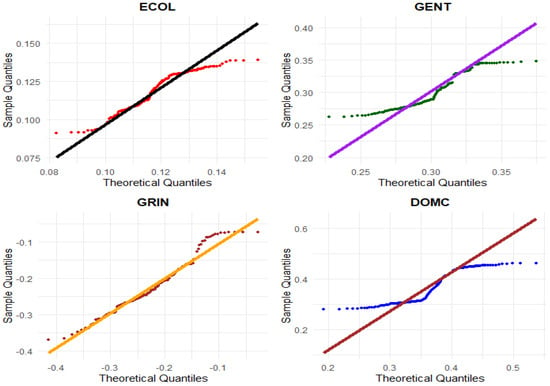
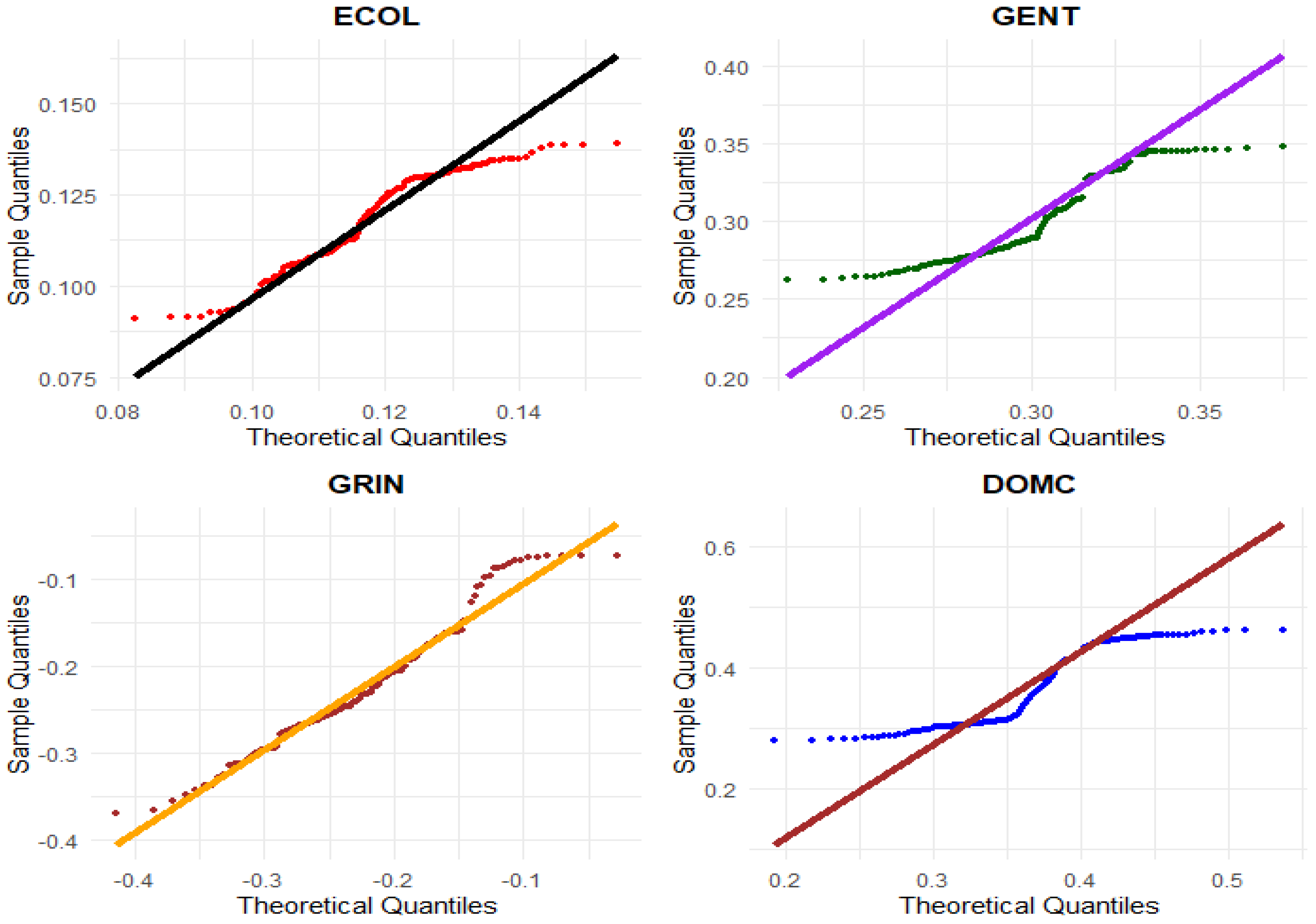
The descriptive statistics in Table 2 show that ECOL is negatively skewed, while GENT, GRIN, and DOMC are positively skewed. In addition, all the variables are platykurtic because they are less than 3. Furthermore, ECOL, GENT, and DOMC exhibit non-normality characteristics because the p-values of the Jarque–Bera are less than 5%. However, GRIN shows a normal distribution because the p-value is greater than 5%. This research further carried out the QQ plots in Figure 1 to ascertain if the variables are normally distributed. In the graphs, it is evident that the points do not follow a straight line, which confirms that the variables are not normally distributed.
Table 2.
Descriptive statistics.
Figure 1.
QQ plots.
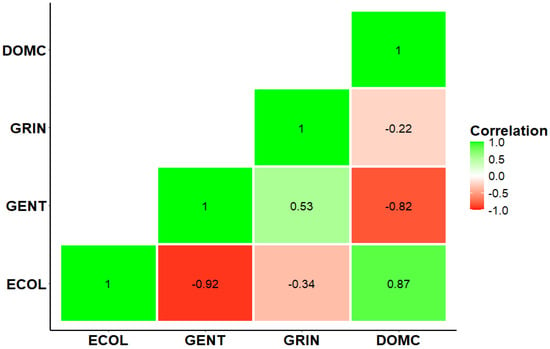
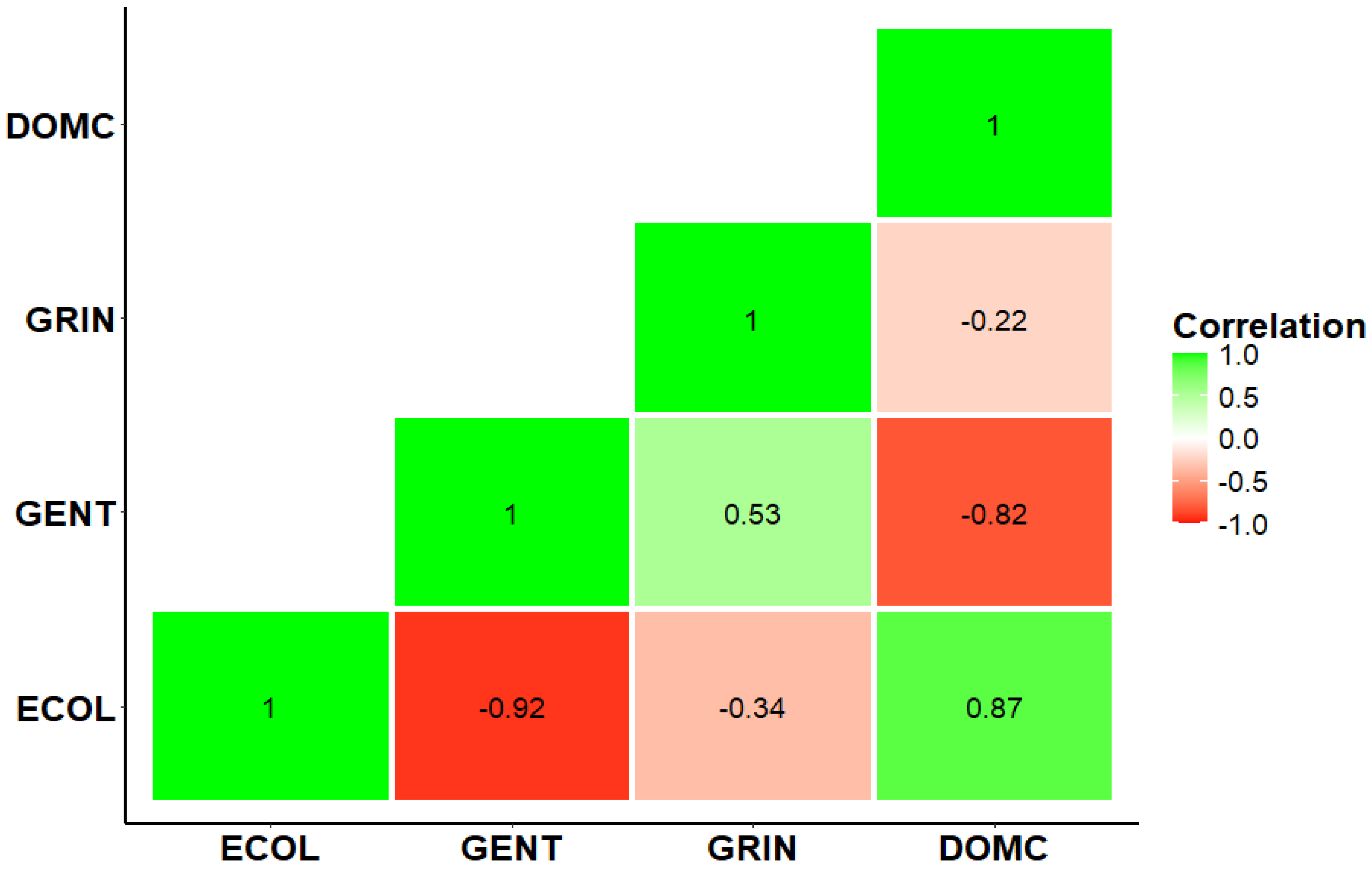
Furthermore, the BDS test in Table 3 confirms the presence of non-linearity in each of the variables significant at 1%. The presence of non-linearity is one of the criteria for using the WQR, WQC, and MWQR. Furthermore, the correlation matrix as presented in Figure 2 shows that GENT has a negative relationship with ECOL, GRIN has a negative relationship with ECOL, and DOMC has a positive relationship with ECOL.
Table 3.
BDS test.
Figure 2.
Correlation matrix.
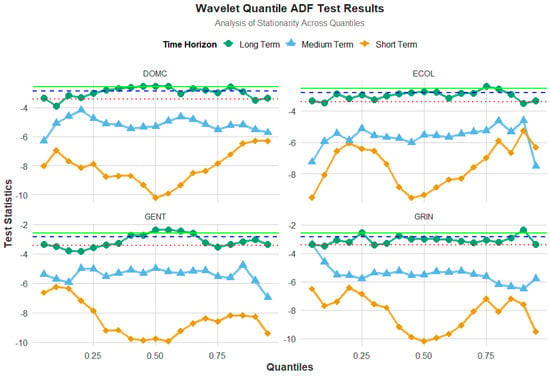
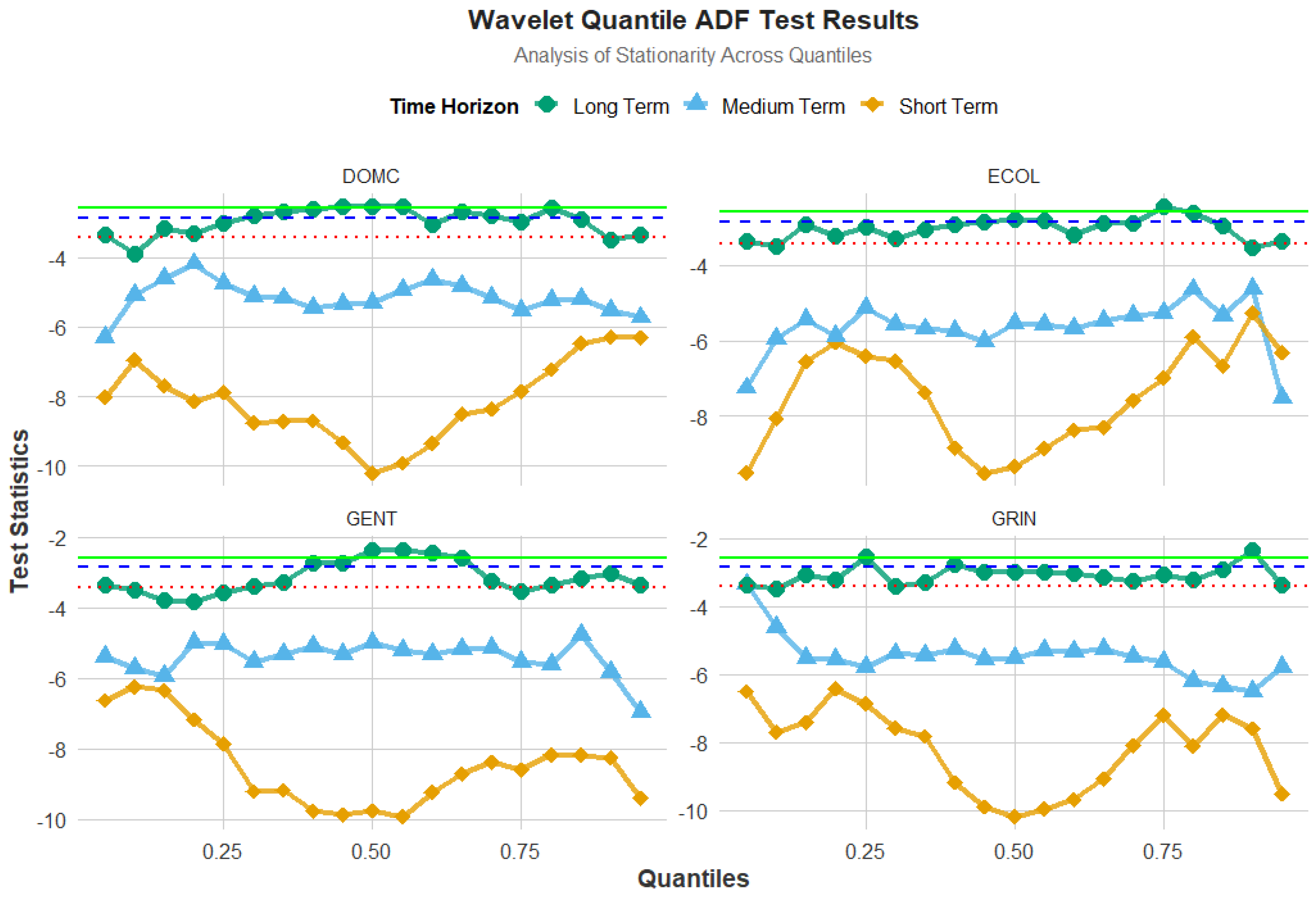
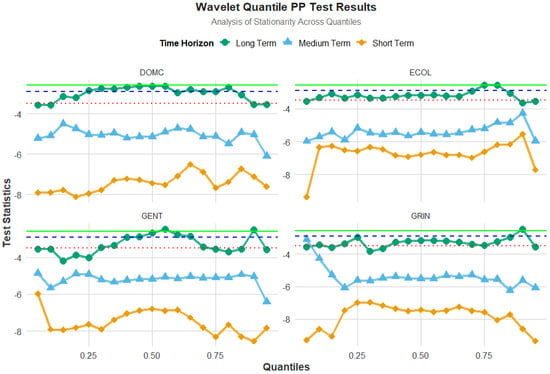
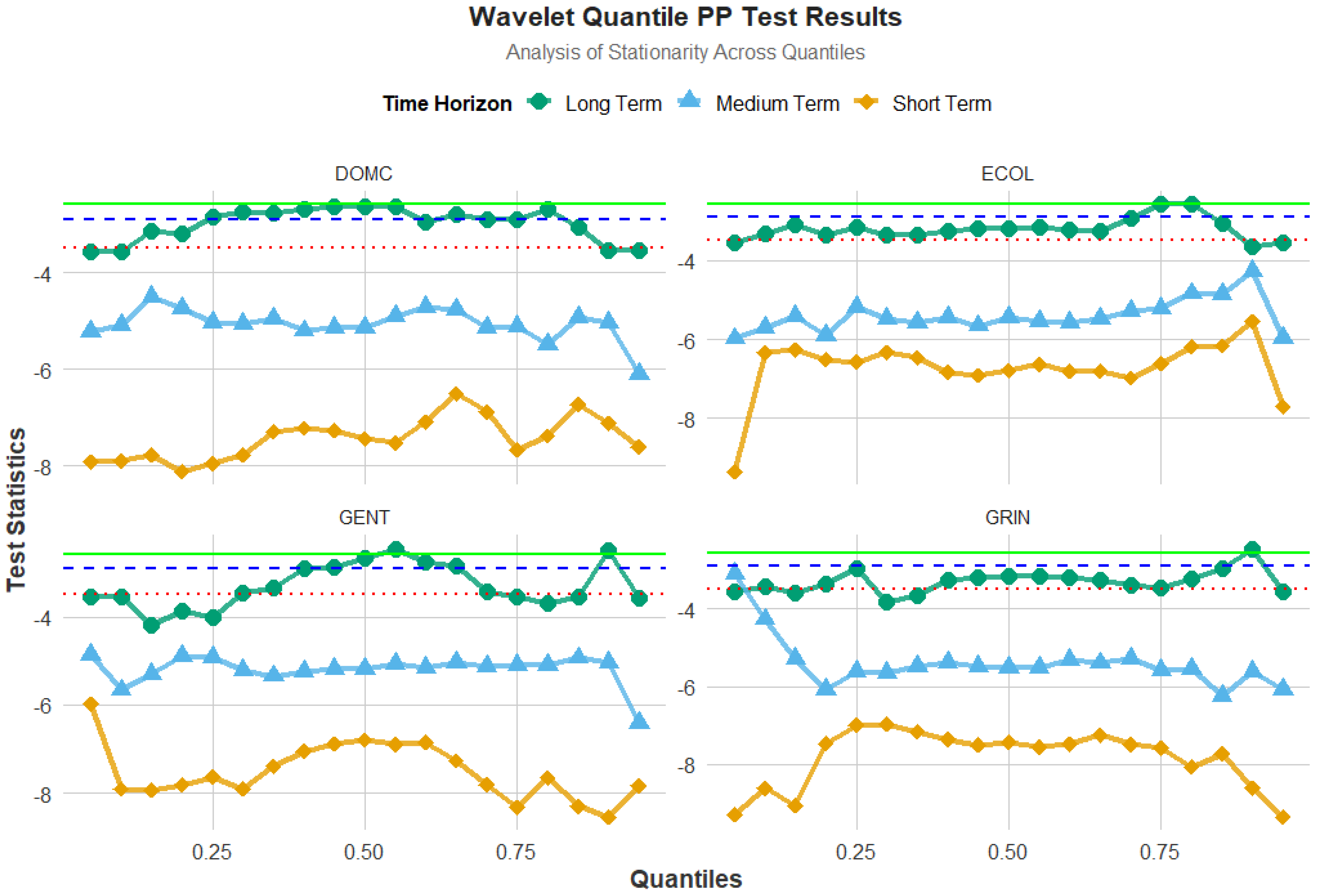
As adopted by [56], the WQADF and WQPP are employed to test for the stationarity of the variables over short, medium, and long term. The null hypothesis of non-stationarity is rejected if the test statistic falls below the critical value lines (1%, 5%, and 10%). This implies that the series is stationary at the relevant quantile and time horizon. The WQADF and WQPP results are displayed in Figure 3 and Figure 4. In the long-run, we confirmed both stationarity and non-stationarity at specific quantiles. Nonetheless, there is reliable confirmation of stationarity for the variables under study across all quantiles and in the medium- and short-term timeframes.
Figure 3.
WQADF unit root test.
Figure 4.
WQPP unit root test.
4.2. WQR
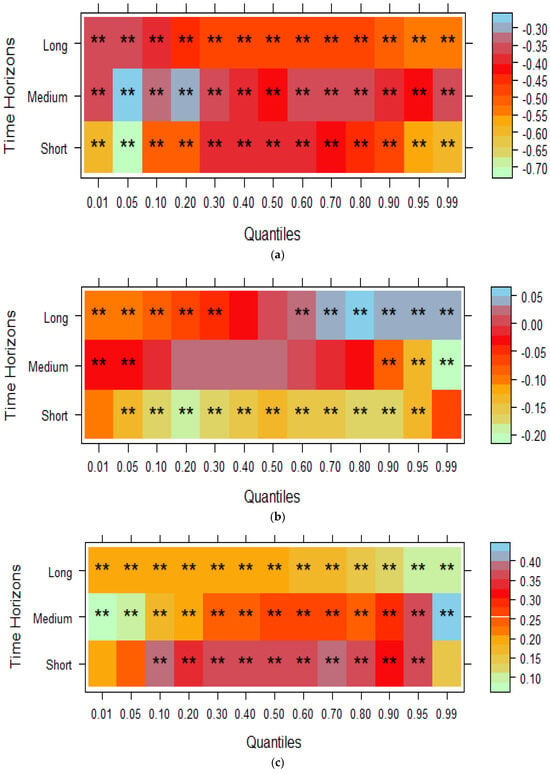
Figure 5a–c shows the WQR results between GENT, GRIN, DOMC, and ECOL. In Figure 5a, it is evident that there is a negative relationship between GENT and ECOL. This implies that GENT contributes to ecological sustainability. In the short term, the relationship is moderately strong from 0.30 to 0.90 quantiles, while in the 0.01, 0.05, 0.95 and 0.99 quantiles, the relationship is much weaker. In the medium term, the relationship is very strong in the 0.05 and 0.20 quantiles. The long-term also shows moderately strong relationships across all quantiles.
Figure 5.
(a–c) Wavelet Quantile Regression (WQR). (a) The impact of GENT on ECOL; (b) The impact of GRIN on ECOL; (c) The impact of DOMC on ECOL. Note: ** indicates 5% significance level.
In Figure 5b, the relationship between GRIN and ECOL is heterogeneous. In the short term, the relationship is negative across all quantiles, showing a predominantly weak relationship. However, in the 0.99 quantile, the negative relationship is strong. In the medium term, there is evidence of positive and negative outcomes. From 0.20 to 0.50 quantiles, the link between GRIN and ECOL is positive. This means that GRIN can also drive ecological degradation. In the long term, the positive association between GRIN and ECOL can be seen from 0.50 to 0.99 quantiles. More specifically, between 0.70 and 0.99, the positive impact is very strong.
In Figure 5c, the association between DOMC and ECOL is positive across all quantiles and time horizons. The short term outcome shows evidence of a moderately strong relationship between DOMC and ECOL. The medium term shows evidence of weak, moderately strong, and very strong relationships. The weak relationship is seen from 0.01 to 0.05 quantiles, while the strong relationship is observed in the 0.99 quantile. The long-term outcome shows weak and moderately strong associations.
4.3. WQC
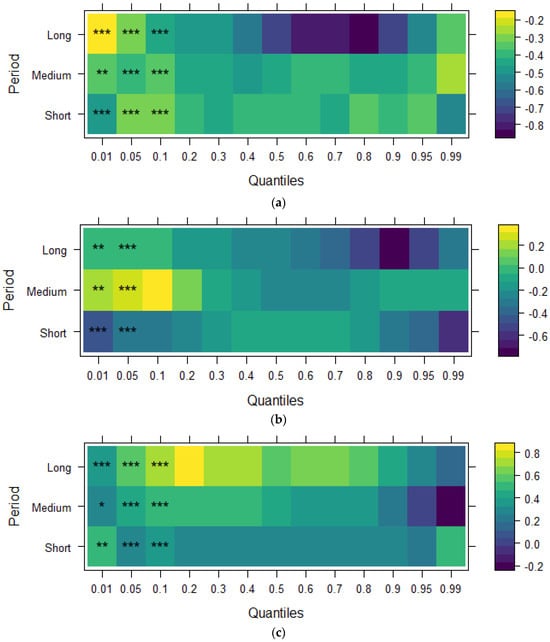
Figure 6a–c shows the WQC outcomes between GENT, GRIN, DOMC, and ECOL. Figure 6a shows that GENT has a negative correlation with ECOL, confirming that GENT contributes to the sustainability of the environment. Across all quantiles and periods, the relationship is strong, except in the long run, where the relationship is quite weak between the 0.6 and 0.9 quantiles. In Figure 6b, the link between GRIN and ECOL is heterogeneous across various quantiles and periods. In the short and long term, the association is predominantly negative, while in the medium term, from the 0.01 to 0.2 quantiles, the link is positive. As for Figure 6c, the result confirms that the association between DOMC and ECOL is predominantly positive across all quantiles and periods. However, in the medium term, there is evidence of a strong negative correlation between DOMC and ECOL at the 0.99 quantile.
Figure 6.
(a–c) Wavelet Quantile Correlation (WQC). (a) The impact of GENT on ECOL; (b) The impact of GRIN on ECOL; (c) The impact of DOMC on ECOL. Note: *, **, and *** indicate 10%, 5%, and 1% significance levels, respectively.
4.4. MWQR
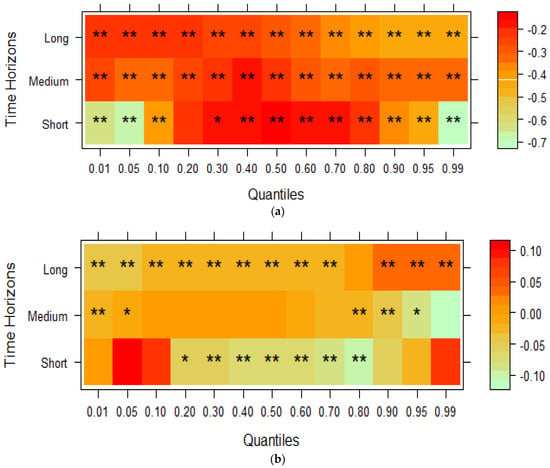
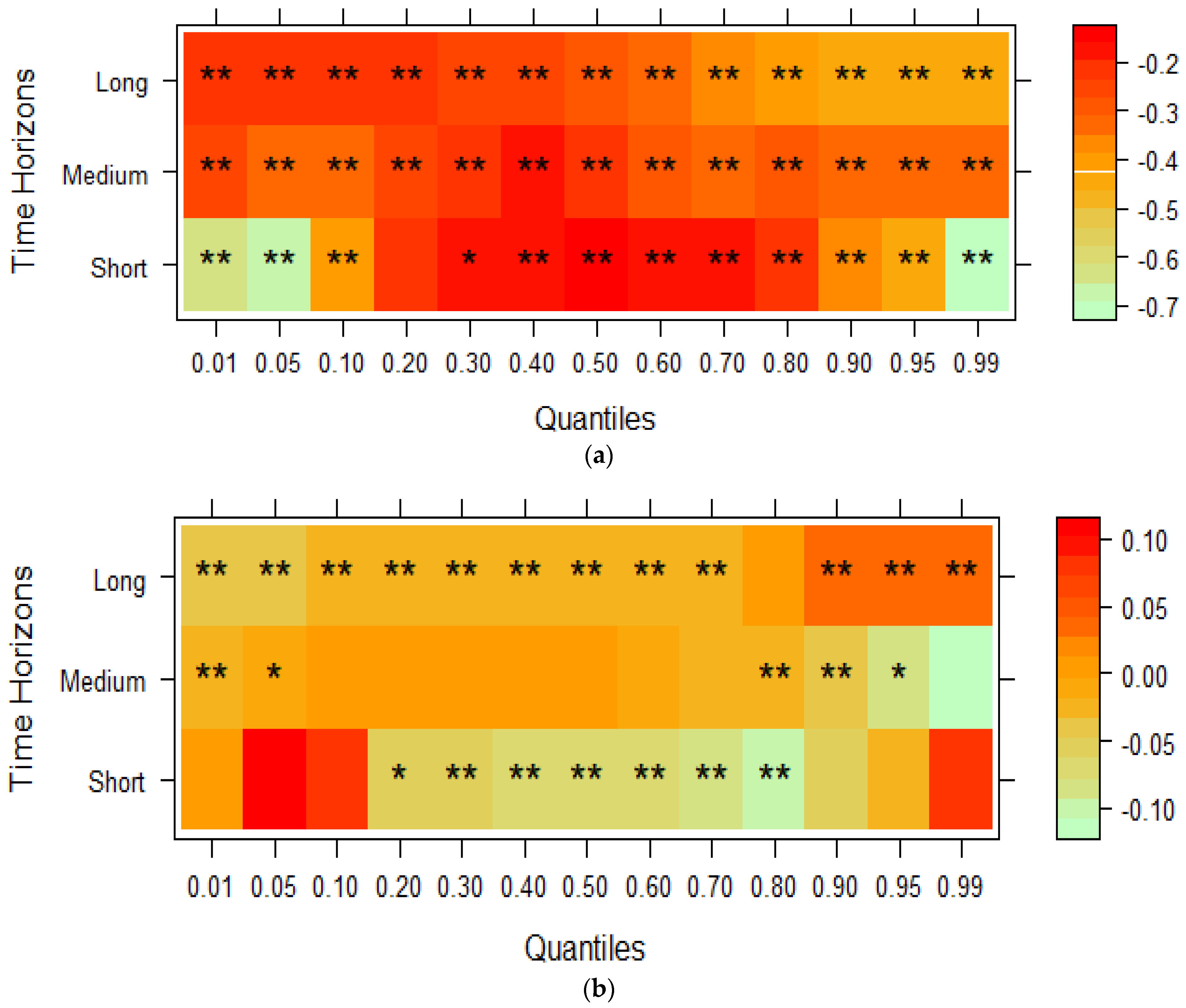
Figure 7a,b shows the interaction between DOMC, GENT, and GRIN. In Figure 7a, the interaction between DOMC and GENT reduces ECOL in the short, medium, and long term. This means that green entrepreneurs having access to funds contributes to environmental sustainability. The interaction is very strong across all periods and quantiles, except in the short-term (0.01, 0.05, and 0.99) quantiles, where the association is weak. In Figure 7b, the interaction between DOMC and GRIN produces heterogeneous outcomes in the short, medium, and long term. In the short term, the impact is very strong at the 0.05, 0.10, and 0.99 quantiles. The impact in the medium term is predominantly neutral. However, at the 0.99 quantile, a strong negative impact is observed. In the long term, a moderately strong positive association is seen at the 0.90, 0.95, and 0.99 quantiles.
Figure 7.
(a,b): Multivariate Wavelet quantile Correlation (MWQR). (a): ; (b): Note: * and ** indicate 10% and 5% significance levels, respectively.
4.5. Discussion
The empirical research confirms that GENT exerts a statistically significant negative effect on ECOL across all quantiles and time horizons. This means that the ecological benefits of GENT are robust across the entire distribution of ECOL and remain stable over time. This assertion is consistent with the environmental and entrepreneurship literature. Ref. [57] opined that green entrepreneurs create and capitalize on opportunities that are sustainable. This enables them to create environmentally friendly goods and services that benefit the environment and its users. In Turkey, Ref. [58] argued that in order to preserve the environment and guarantee its sustainability, GENT, which greatly contributes to the development of a sustainable economy, seeks to create green jobs and balance the economy and ecology. Just as entrepreneurship helps the economy to grow and develop, GENT drives the sustainability of the environment. According to [59], if properly implemented, the GENT concept has the potential to reduce the likelihood of environmental incidents in our society. In summary, in Turkey, GENT drives the sustainability of the environment because of the (1) adoption of environmentally friendly production processes and technologies; (2) innovation in sustainable business models; (3) greater environmental awareness and diffusion of sustainable values in the society (green values); (4) policy support (e.g., green finance) and institutional alignment with sustainability goals; (5) structural transformation of the economy towards the development of clean energy sectors. The positive association between GENT and the sustainability of the environment is further supported by [19] for Oman, Ref. [12] for selected Asian economies, and [17] for Indonesia.
Secondly, GRIN reduces ECOL in the short and medium term, while in the long term, it contributes to ecological degradation. The interplay of many economic factors that develop over time can help explain this result. GRIN tends to produce a technique effect in the short and medium term, which lowers resource intensity, increases energy efficiency, and decreases emissions. ECOL declines because of businesses adopting greener technologies, optimizing input use, and adhering to environmental regulations. The direct goal of GRIN is reflected in this instant benefit. The beneficial impact of GRIN on the environment is supported by [23,25,26]. However, over time, the rebound effect—which is connected to the Jevons Paradox—may outweigh these advantages. This implies that larger levels of productivity and consumption might be encouraged as GRIN increases efficiency and lowers production costs. Reduced resource costs encourage businesses to expand production and consumers to raise demand, which may result in increased resource consumption overall. As a result, ECOL starts to increase, and the initial environmental improvements are diminished. This assertion is supported by [22], who argued that GRIN can also drive ecological degradation.
Thirdly, it was ascertained that DOMC increases ECOL across the majority of the quantiles and periods. This is because convenient access to financing increases the production and consumption activities of people and enterprises, driving environmental damage. People are able to make their purchases, which can drive ecological degradation. Firms expand production, invest in machines, and scale up operations, which can also degrade the environment. In Turkey, much of this business expansion has been concentrated on sectors that rely heavily on fossils. Thus, higher availability of credit to these private sectors leads to a greater consumption of energy, and consequently leads to a higher ECOL. This means that the allocation of credit is not always geared towards environmentally friendly investments. Financial institutions might favor short-term gains over long-term sustainability, channeling funds into investments with high returns but greater ecological costs. Thus, driving ecological degradation. Lastly, if regulatory factors are weak, enforced poorly, or inconsistent, firms will prioritize profitability above ecological progress because they know the penalty for doing so is minimal. This aligns with the research of [28,32,34], and opposed to the studies of [3,11,31].
Fourth, the interaction between DOMC and GENT lowers ECOL. This means that green entrepreneurs’ access to funding benefits the environment by allowing them to innovate, conduct R and D, and develop environmentally friendly goods that tackle environmental issues. Furthermore, the interaction of DOMC and GRIN decreases ECOL in the short run while worsening the environment in the medium and long term, validating the previously reported rebound effect.
In summary, because Turkey is a country that is highly dependent on fossils, the country’s ecological problems motivate green entrepreneurs to design products, services, and processes that can solve these problems. More specifically, one important factor that can facilitate this positive transition is the country’s developing institutional strength, which encompasses ecological regulation and green finance mechanisms, which facilitate the growth and diffusion of green entrepreneurial activities. It is also important to state that the various degrees of strength across frequencies in the short, medium, and long term can be ascribed to some bottlenecks faced by the Turkish economy, such as developing a green finance ecosystem and liquidity constraints of the SMEs.
5. Conclusions, Policy Recommendations, and Research Limitations
5.1. Conclusions
This research investigates how green entrepreneurship (GENT), green innovation (GRIN), and access to finance, proxied by domestic credit to the private sector (DOMC), contribute to environmental sustainability in Turkey, from 1990 to 2022. Environmental sustainability is proxied by ecological footprint (ECOL). The methods used include Wavelet Quantile Regression (WQR) and Wavelet Quantile Correlation (WQC). In addition, this study also added an interaction variable of DOMC on GENT and GRIN to ascertain if environmental sustainability can occur, using the Multivariate Wavelet Quantile Regression (MWQR). The WQR and WQC outcomes confirm that GENT reduces ECOL across all quantiles and periods; GRIN reduces ECOL in the short and medium term, while in the long term, it increases ECOL, and DOMC increases ECOL across all quantiles and periods. The MWQR demonstrates that the interaction of GENT and DOMC spurs environmental sustainability, while the interaction of GRIN and DOMC reduces ECOL in the short-term, but it becomes positive in the medium and long term.
5.2. Policy Recommendations
Strengthening of financial support mechanisms: One of the ways GENT can continue to drive ecological sustainability is for the government or concerned stakeholders to introduce targeted subsidies, low-interest green loans, and tax incentives. This will empower the green entrepreneurs to overcome initial high costs and longer payback periods. This will reduce financial constraints and encourage start-ups to enter environmentally friendly sectors such as clean energy, etc. The Turkish government can also introduce a mandatory credit allocation guideline for commercial banks to ensure that financial resources are directed towards ecological sustainability projects. This is a government-led policy design and incentive-based framework. In terms of financial sector intervention, a favorable interest rate should be applied to verified green investment projects, while a higher capital requirement or lending restrictions should be applied to carbon-intensive sectors. In terms of firm-level responsibilities, a mandatory ESG disclosure requirement should be enforced to improve transparency in ecological performance. Secondly, to reduce the rebound effect of GRIN in Turkey, the government should implement policies that will limit overconsumption on both the demand and supply sides. This is a dual-policy framework. Policies such as carbon pricing, higher charges for excessive energy use, and promoting responsible consumer behavior. More specifically, monetizing the carbon footprint through carbon trading can create economic incentives for reducing emissions, although its effectiveness depends on the balance between supply and demand in the market, as well as regulatory measures. Lastly, if DOMC is harming the quality of the environment, then it means financial resources are moving towards pollution-intensive activities rather than sustainable ones. Therefore, a key solution is to promote green finance by directing credit toward environmentally friendly projects through incentives, such as lower interest rates, green bonds, etc. In conclusion, the combination of these policies will move Turkey towards achieving its net-zero emissions goal of 2053. It is also important to note that innovation has a role to play in facilitating ecological sustainability in Turkey by facilitating the development and adoption of cleaner production processes, energy-efficient technologies, and clean energy solutions. In Turkey, innovation has been supported through clean energy incentive schemes such as Renewable Energy Resource Areas (YEKA), Renewable Energy Sources Support Mechanisms (YEKDEM), and R and D support for clean energy activities. These measures have contributed to clean energy use, energy efficiency improvements, and the adoption of ecologically friendly practices, thereby helping to reduce carbon emissions and ecological degradation.
5.3. Research Limitations and Directions for Future Research
Despite the theoretical and methodological contributions of this study, several limitations should be acknowledged. First, this research employed domestic credit to the private sector (DOMC) as a proxy for financial development. Although this variable captures an important dimension of financial intermediation, it may not fully reflect the multidimensional nature of financial development. Future studies may therefore consider utilizing a comprehensive financial development index that incorporates various dimensions of the financial system, including financial institutions, financial markets, access, efficiency, and depth, in order to provide a broader understanding of the finance–environment nexus.
Second, environmental sustainability was proxied by the ecological footprint (ECOL), which offers a comprehensive measure of environmental pressure arising from human activities. Nevertheless, future research may employ alternative indicators of environmental sustainability, such as the load capacity factor, environmental quality index, or carbon efficiency indicators, to provide additional insights into the ecological consequences of green entrepreneurship and green innovation. In particular, the load capacity factor may offer a more balanced perspective by simultaneously capturing the demand and supply dimensions of ecological systems.
Furthermore, this study focused exclusively on Turkey, which may limit the generalizability of the findings to other economies with different institutional, financial, and environmental structures. Future research could extend the analysis to panel data settings involving emerging or developed economies to provide comparative evidence and improve external validity.
Lastly, although the wavelet quantile-based approaches employed in this study effectively capture nonlinearities, asymmetries, and time–frequency dynamics, future studies may complement these techniques with alternative advanced econometric methods, such as quantile connectedness approaches, machine learning frameworks, or spatial econometric models, to further explore the complex interactions among green entrepreneurship, green innovation, financial development, and environmental sustainability. Furthermore, other metrics of green entrepreneurship (green entrepreneurship activity index), green innovation (R&D intensity, green patent grants, and technology commercialization rate), and domestic credit (green credit and brown credit) should be employed by other studies. As a control variable, institutional quality can also be included. In addition, other metrics of environmental sustainability (environmental performance index (EPI)) and CO2 emissions should be employed. In addition, a provincial-level analysis across the region of Turkey can be employed in further studies. Lastly, accounting for shocks in the model, such as the COVID-19 shocks, will make further studies more robust.
Author Contributions
Software, K.I.; Formal analysis, N.A.; Data curation, K.I.; Writing – original draft, N.A.; Supervision, A.K.; Project administration, A.K. All authors have read and agreed to the published version of the manuscript.
Funding
This research received no external funding.
Institutional Review Board Statement
Not applicable.
Informed Consent Statement
Not applicable.
Data Availability Statement
Data will be made available upon request to the corresponding author.
Conflicts of Interest
The authors declare no conflicts of interest.
Abbreviations
| ARDL | Autoregressive Distributed Lag |
| CCR | Canonical Cointegration Regression |
| DOLS | Dynamic Ordinary Least Squares |
| DOMC | Domestic Credit |
| FMOLS | Fully Modified Ordinary Least Squares |
| GENT | Green Entrepreneurship |
| GRIN | Green Innovation |
| MWQR | Multivariate Wavelet Quantile Regression |
| WQC | Wavelet Quantile Correlation |
| WQR | Wavelet Quantile Regression |
References
- Bisiriyu, S.O.; Malik, M.H. “Less Talk, More Action for the Climate: Reimagining Environmental Sustainability in Africa”—The Role of Environmental Tax, Globalization, and Clean Energy. Nat. Resour. Forum 2026, in press. [Google Scholar] [CrossRef] [Scilit]
- UN. Agenda 21: The United Nations Programme of Action from Rio; UN: New York, NY, USA, 1992. [Google Scholar]
- Xu, B.; Li, S.; Afzal, A.; Mirza, N.; Zhang, M. The impact of financial development on environmental sustainability: A European perspective. Resour. Policy 2022, 78, 102814. [Google Scholar] [CrossRef] [Scilit]
- Veleva, V. The role of entrepreneurs in advancing sustainable lifestyles: Challenges, impacts, and future opportunities. J. Clean. Prod. 2021, 283, 124658. [Google Scholar] [CrossRef] [Scilit] [PubMed]
- González-Rodríguez, M.R.; Díaz-Fernández, M.C.; Simonetti, B. The social, economic and environmental dimensions of corporate social responsibility: The role played by consumers and potential entrepreneurs. Int. Bus. Rev. 2015, 24, 836–848. [Google Scholar] [CrossRef] [Scilit]
- Fassin, Y.; Van Rossem, A.; Buelens, M. Small-Business Owner-Managers’ Perceptions of Business Ethics and CSR-Related Concepts. J. Bus. Ethics 2011, 98, 425–453. [Google Scholar] [CrossRef] [Scilit]
- Gu, W.; Zheng, X. An empirical study on the impact of sustainable entrepreneurship: Based on the environmental Kuznets model. J. Bus. Res. 2021, 123, 613–624. [Google Scholar] [CrossRef] [Scilit]
- Lodhi, R.N.; Asif, M.; Abdikarimova, A.; Shahzad, M.F. Impact of innovation and sustainability on green entrepreneurship: A bibliometric exploration. Environ. Dev. Sustain. 2024, 28, 1369–1394. [Google Scholar] [CrossRef] [Scilit]
- Uslu, Y.D.; Hancıoğlu, Y.; Demir, E. Applicability to Green Entrepreneurship in Turkey: A Situation Analysis. Procedia—Social. Behav. Sci. 2015, 195, 1238–1245. [Google Scholar] [CrossRef] [Scilit]
- Zhang, X.; Teng, X.; Le, Y.; Li, Y. Strategic orientations and responsible innovation in SMEs: The moderating effects of environmental turbulence. Bus. Strat. Environ. 2023, 32, 2522–2539. [Google Scholar] [CrossRef] [Scilit]
- Godil, D.I.; Sharif, A.; Rafique, S.; Jermsittiparsert, K. The asymmetric effect of tourism, financial development, and globalization on ecological footprint in Turkey. Environ. Sci. Pollut. Res. 2020, 27, 40109–40120. [Google Scholar] [CrossRef] [Scilit] [PubMed]
- Shivani; Sharma, S.; Singh, S. Exploring the nexus of green entrepreneurship and environment quality in selected Asian economies. Manag. Environ. Qual. Int. J. 2025, 36, 380–405. [Google Scholar] [CrossRef] [Scilit]
- Abbasi, K.R.; Shahbaz, M.; Zhang, J.; Irfan, M.; Alvarado, R. Analyze the environmental sustainability factors of China: The role of fossil fuel energy and renewable energy. Renew. Energy 2022, 187, 390–402. [Google Scholar] [CrossRef] [Scilit]
- Ali, N.; Phoungthong, K.; Techato, K.; Ali, W.; Abbas, S.; Dhanraj, J.A.; Khan, A. FDI, Green Innovation and Environmental Quality Nexus: New Insights from BRICS Economies. Sustainability 2022, 14, 2181. [Google Scholar] [CrossRef] [Scilit]
- Singh, H.; Kumar, P.; Dana, L.P. The green entrepreneurship landscape: Drivers, outcomes, and future directions. Int. Entrep. Manag. J. 2025, 21, 80. [Google Scholar] [CrossRef] [Scilit]
- Makhloufi, L.; Laghouag, A.A.; Meirun, T.; Belaid, F. Impact of green entrepreneurship orientation on environmental performance: The natural resource-based view and environmental policy perspective. Bus. Strat. Environ. 2022, 31, 425–444. [Google Scholar] [CrossRef] [Scilit]
- Reniati, R.; Faisal, F. Development of green SMEs: Integrating green entrepreneurship and innovation for environmental sustainability. IOP Conf. Ser. Earth Environ. Sci. 2024, 1419, 012055. [Google Scholar] [CrossRef] [Scilit]
- Carchano, M.; Cardebat, J.-M.; Gonzalez, A.; Carrasco, I. Moving toward environmental sustainability through green entrepreneurship: Assessing the moderating role of managerial environmental commitment. Int. Entrep. Manag. J. 2024, 20, 2209–2240. [Google Scholar] [CrossRef] [Scilit]
- Ansari, M.S.A. Innovation, and green entrepreneurship are catalysts for sustainability in Oman. Clean. Waste Syst. 2025, 11, 100281. [Google Scholar] [CrossRef] [Scilit]
- Alshammari, K.H.; Alshammari, A.F. Green Innovation and Its Effects on Innovation Climate and Environmental Sustainability: The Moderating Influence of Green Abilities and Strategies. Sustainability 2023, 15, 15898. [Google Scholar] [CrossRef] [Scilit]
- Cheng, C.; Ahmad, S.F.; Irshad, M.; Alsanie, G.; Khan, Y.; Ahmad (Ayassrah), A.Y.A.B.; Aleemi, A.R. Impact of Green Process Innovation and Productivity on Sustainability: The Moderating Role of Environmental Awareness. Sustainability 2023, 15, 12945. [Google Scholar] [CrossRef] [Scilit]
- Lin, B.; Ullah, S. Towards the goal of going green: Do green growth and innovation matter for environmental sustainability in Pakistan. Energy 2023, 285, 129263. [Google Scholar] [CrossRef] [Scilit]
- Ha, N.M.; Nguyen, P.A.; Luan, N.V.; Tam, N.M. Impact of green innovation on environmental performance and financial performance. Environ. Dev. Sustain. 2023, 26, 17083–17104. [Google Scholar] [CrossRef] [Scilit]
- Aneja, R.; Yadav, M.; Gupta, S. The dynamic impact assessment of clean energy and green innovation in realizing environmental sustainability of G-20. Sustain. Dev. 2024, 32, 2454–2473. [Google Scholar] [CrossRef] [Scilit]
- Kharb, R.; Saini, N.; Kumar, D. Driving environmental sustainability in emerging economies: The nexus of green finance, foreign direct investment, financial development, and green technology innovation. Bus. Strat. Dev. 2024, 7, e70008. [Google Scholar] [CrossRef] [Scilit]
- Shan, S.; Genç, S.Y.; Kamran, H.W.; Dinca, G. Role of green technology innovation and renewable energy in carbon neutrality: A sustainable investigation from Turkey. J. Environ. Manag. 2021, 294, 113004. [Google Scholar] [CrossRef] [Scilit] [PubMed]
- Dar, J.A.; Asif, M. Does financial development improve environmental quality in Turkey? An application of endogenous structural breaks based cointegration approach. Manag. Environ. Qual. Int. J. 2018, 29, 368–384. [Google Scholar] [CrossRef] [Scilit]
- Rjoub, H.; Odugbesan, J.A.; Adebayo, T.S.; Wong, W.-K. Sustainability of the Moderating Role of Financial Development in the Determinants of Environmental Degradation: Evidence from Turkey. Sustainability 2021, 13, 1844. [Google Scholar] [CrossRef] [Scilit]
- Erat, S.; Telli, A.; Ozkendir, O.M.; Demir, B. Turkey’s energy transition from fossil-based to renewable up to 2030: Milestones, challenges and opportunities. Clean Technol. Environ. Policy 2021, 23, 401–412. [Google Scholar]
- Yıldırım, F.; Ünlü, U.; Kuloğlu, A.; Çıtak, Ö. Modeling and Analysis of the Impact of Quality Growth and Financial Development on Environmental Sustainability: Evidence from EU Countries. Sustainability 2025, 17, 774. [Google Scholar] [CrossRef] [Scilit]
- Shahbaz, M.; Dogan, M.; Akkus, H.T.; Gursoy, S. The effect of financial development and economic growth on ecological footprint: Evidence from top 10 emitter countries. Environ. Sci. Pollut. Res. 2023, 30, 73518–73533. [Google Scholar] [CrossRef] [Scilit] [PubMed]
- Chen, S.; Elheddad, M.; Sharma, N.; Lau, C.K.M. Impact of Financial Development on the Circular Economy: Empirical Evidence From the European Union. Bus. Strat. Environ. 2026, 35, 251–263. [Google Scholar] [CrossRef] [Scilit]
- Zhou, D.; Obobisa, E.S.; Ayamba, E.C. Achieving carbon neutrality goal in European countries: The role of green technology innovation, renewable energy, and financial development. Environ. Dev. Sustain. 2024, 28, 1671–1701. [Google Scholar] [CrossRef] [Scilit]
- Somoye, O.A.; Ayobamiji, A.A. Can energy intensity, clean energy utilization, economic expansion, and financial development contribute to ecological progress in Iceland? A quantile-on-quantile KRLS analysis. Nat. Resour. Forum 2026, 50, 64–83. [Google Scholar] [CrossRef] [Scilit]
- Hart, S.L. A Natural-Resource-Based View of the Firm. Acad. Manag. Rev. 1995, 20, 986. [Google Scholar] [CrossRef] [Scilit]
- Rehman, S.U.; Kraus, S.; Shah, S.A.; Khanin, D.; Mahto, R.V. Analyzing the relationship between green innovation and environmental performance in large manufacturing firms. Technol. Forecast. Social. Change 2021, 163, 120481. [Google Scholar] [CrossRef] [Scilit]
- Jiang, W.; Chai, H.; Shao, J.; Feng, T. Green entrepreneurial orientation for enhancing firm performance: A dynamic capability perspective. J. Clean. Prod. 2018, 198, 1311–1323. [Google Scholar] [CrossRef] [Scilit]
- Hart, S.L.; Dowell, G. Invited Editorial: A Natural-Resource-Based View of the Firm: Fifteen Years After. J. Manag. 2011, 37, 1464–1479. [Google Scholar] [CrossRef] [Scilit]
- Ho, J.C. Disruptive innovation from the perspective of innovation diffusion theory. Technol. Anal. Strateg. Manag. 2022, 34, 363–376. [Google Scholar] [CrossRef] [Scilit]
- Shahbaz, M.; Destek, M.A.; Dong, K.; Jiao, Z. Time-varying impact of financial development on carbon emissions in G-7 countries: Evidence from the long history. Technol. Forecast. Social. Change 2021, 171, 120966. [Google Scholar] [CrossRef] [Scilit]
- Zhang, Y.-J. The impact of financial development on carbon emissions: An empirical analysis in China. Energy Policy 2011, 39, 2197–2203. [Google Scholar] [CrossRef] [Scilit]
- Shahbaz, M.; Nasir, M.A.; Roubaud, D. Environmental degradation in France: The effects of FDI, financial development, and energy innovations. Energy Econ. 2018, 74, 843–857. [Google Scholar] [CrossRef] [Scilit]
- Agbloyor, E.K.; Gyeke-Dako, A.; Kuipo, R.; Abor, J.Y. Foreign Direct Investment and Economic Growth in SSA: The Role of Institutions. Thunderbird Int. Bus. Rev. 2016, 58, 479–497. [Google Scholar] [CrossRef] [Scilit]
- Marrasso, E.; Roselli, C.; Sasso, M. Electric efficiency indicators and carbon dioxide emission factors for power generation by fossil and renewable energy sources on hourly basis. Energy Convers. Manag. 2019, 196, 1369–1384. [Google Scholar] [CrossRef] [Scilit]
- Sun, H.; Pofoura, A.K.; Adjei Mensah, I.; Li, L.; Mohsin, M. The role of environmental entrepreneurship for sustainable development: Evidence from 35 countries in Sub-Saharan Africa. Sci. Total Environ. 2020, 741, 140132. [Google Scholar] [CrossRef] [Scilit] [PubMed]
- Boratav, K.; Yeldan, A.E.; Köse, A.H. Turkey: Globalization, distribution and social policy, 1980–1998. In External Liberalization, Economic Performance and Social Policy; Oxford Academic: New York, NY, USA, 2001. [Google Scholar]
- Tocci, N. Turkey and the European Union. In The Routledge Handbook of Modern Turkey; Routledge: London, UK, 2013; pp. 237–245. [Google Scholar]
- Global Footprint Network. Ecological Footprint. 2026. Available online: https://data.footprintnetwork.org/#/countryTrends?cn=223&type=BCpc,EFCpc (accessed on 1 January 2026).
- World Bank. World Bank Open Data. 2026. Available online: https://data.worldbank.org/ (accessed on 1 January 2026).
- OECD. Patents—Environment-Related Technologies. 2026. Available online: https://data-explorer.oecd.org/vis?lc=en&tm=DF_PAT_IND&pg=0&snb=1&vw=tb&df[ds]=dsDisseminateFinalDMZ&df[id]=DSD_PAT_IND%40DF_PAT_IND&df[ag]=OECD.ENV.EPI&df[vs]=&pd=1990%2C2022&dq=TUR.A....&ly[rw]=TYPE%2CTECH&ly[cl]=TIME_PERIOD&to[TIME_PERIOD]=false (accessed on 1 January 2026).
- Adebayo, T.S.; Rjoub, H.; Akadiri, S.S.; Oladipupo, S.D.; Sharif, A.; Adeshola, I. The role of economic complexity in the environmental Kuznets curve of MINT economies: Evidence from method of moments quantile regression. Environ. Sci. Pollut. Res. 2022, 29, 24248–24260. [Google Scholar]
- Adebayo, T.S.; Ağa, M.; Kartal, M.T. Analyzing the co-movement between CO2 emissions and disaggregated nonrenewable and renewable energy consumption in BRICS: Evidence through the lens of wavelet coherence. Environ. Sci. Pollut. Res. 2023, 30, 38921–38938. [Google Scholar] [CrossRef] [Scilit] [PubMed]
- Adebayo, T.S.; Özkan, O.; Uzun Ozsahin, D.; Eweade, B.S.; Gyamfi, B.A. Exploring the role of ICT adoption technologies and renewable energy consumption in achieving a sustainable environment in the United States: An SDGs-based policy framework. Environ. Sci. Eur. 2025, 37, 20. [Google Scholar] [CrossRef] [Scilit]
- Percival, D.B.; Walden, A.T. Wavelet Methods for Time Series Analysis; Cambridge University Press: Cambridge, UK, 2000; Volume 4. [Google Scholar]
- Koenker, R.; Bassett, G. Regression Quantiles. Econometrica 1978, 46, 33. [Google Scholar] [CrossRef] [Scilit]
- Adebayo, T.S.; Olanrewaju, V.O.; Uzun, B. Do energy patents and energy prices drive the shift toward sustainable energy sources? A wavelet quantile-based analysis. Geosci. Front. 2025, 16, 102101. [Google Scholar] [CrossRef] [Scilit]
- Neumann, T. Impact of green entrepreneurship on sustainable development: An ex-post empirical analysis. J. Clean. Prod. 2022, 377, 134317. [Google Scholar] [CrossRef] [Scilit]
- Turna, E. Green Entrepreneurship as a Driving Force for the Green Economy: A Case Study on Green Entrepreneurship in Istanbul. Master’s Thesis, Istanbul Technical University, Istanbul, Türkiye, 2023. [Google Scholar]
- Muo, I.; Azeez, A.A. Green Entrepreneurship: Literature Review and Agenda for Future Research. Int. J. Entrep. Knowl. 2019, 7, 17–29. [Google Scholar] [CrossRef]

Disclaimer/Publisher’s Note: The statements, opinions and data contained in all publications are solely those of the individual author(s) and contributor(s) and not of MDPI and/or the editor(s). MDPI and/or the editor(s) disclaim responsibility for any injury to people or property resulting from any ideas, methods, instructions or products referred to in the content. |
© 2026 by the authors. Licensee MDPI, Basel, Switzerland. This article is an open access article distributed under the terms and conditions of the Creative Commons Attribution (CC BY) license.