


Abstract
Currently, East Asia, especially South Korea, is facing social problems such as population decline and regional inequality. To address these challenges, tourism has been leveraged as a means of economic revitalization, especially in fishing villages that are economically disadvantaged. This study examined the authentic food experiences of tourists who visited fishing villages. Tourists’ food experiences, dimensions of destination food image, and destination loyalty were assessed. In September 2024, 448 responses from Korean tourists were collected and analyzed using confirmatory factor analysis and structural equation modeling to test 15 hypotheses. Local food authenticity showed a significant effect on all dimensions of destination food image. Of the five dimensions of destination food image in this study, food taste, health and hygiene, and unique cultural experiences significantly influenced destination loyalty. In addition, geographic differences moderated the relationship between local marine food authenticity and the perceived food image of the destination. Tourists in the southern coastal regions reported the highest destination food image ratings, driven by authentic local cuisine, while those in the western regions reported the lowest. This study offers both practical and theoretical implications related to sustainable coastal tourism.
1. Introduction
Several countries in Europe and Asia are experiencing population decline and regional imbalances. In Nordic countries in Europe and in South Korea and Japan, these issues are prevalent, particularly in fishing villages and rural areas. In South Korean coastal regions, the rate of population decline is 2.5 times higher than in rural areas, and these regions represent only 0.2% of the country’s total population [1]. Additionally, coastal regions face significant aging populations, with the disappearance of fishing villages becoming a pressing social issue. This challenge can be seen in different locations, such as many Swedish coastal communities, which have few or no fishing boats remaining [2]. Fishing communities often embody rich cultural traditions, and the departure of the last fisherman can strip these communities of their heritage and identity, diminishing their appeal to tourists [3]. Due to such circumstances, such a setting serves as an important area for further study. Tourism revitalization in coastal fishing communities may serve to allow them to become more resilient and sustainable, thereby enabling economic and social improvement for those communities [4].
Tourists are often drawn to destinations for their distinctive culture and history. Access to traditional coastal landscapes such as active fishing, fresh-caught marine products, and cuisine specializing in fish and seafood contributes to creating authentic fishery experiences and fostering a vibrant culture [5]. Thus, preserving the fishing traditions in coastal areas or seeking to revitalize them can be developed into a sustainable tourism product. Local food plays a pivotal role in providing tourists with distinctive experiences, allowing them to appreciate local culture through dining [6]. Fresh-caught marine products and cuisine specializing in fish and seafood are considered major attractions that draw tourists to coastal destinations [7]. Moreover, sustainable tourism increasingly emphasizes local food consumption, which enhances tourist experiences by reflecting community life and culture [8]. Authentic experiences can be a key motivator for tourists seeking cultural authenticity [9]. Food authenticity may be defined as the observation of originality of foods that are identifiable with a tourism destination [10]. In coastal destination contexts, it can include locally sourced ingredients and traditional preparation methods. The authentic nature of local foods can increase visitation from tourists to specific destinations [11]. Coastal tourism describes tourism that involves marine-related activities [12]. As with other types of sustainable activities, environmental, social, and economic aspects of the destination may be influenced by coastal tourism sites with significant fishing communities. Understanding tourists’ experiences with authentic local cuisine in coastal regions is therefore essential for promoting sustainable coastal tourism in such destinations.
While coastal tourism has been widely studied, much of the focus has been on topics like coastal tourism motivation [12,13], experiencescape for coastal tourism [14], and promoting coastal regions through heritage [7]. Moreover, while recent research has examined the image of local cuisine [15] and the overall image of coastal tourism destinations in general [16], tourists’ experiences with local cuisine specializing in fish and seafood, particularly in terms of authenticity and its impact on coastal destination food image, remain underexplored. Prior studies have examined food authenticity and general destination image in tourism destinations. These constructs are rarely examined together in food tourism contexts. General destination image research has focused on areas such as the development of destination image, alignment of image and perceptions, and travel behavior outcomes [17]. General destination image has been examined in relation to food preferences and intentions [6]. A recent study by Gupta and Sharma [18] identified food authenticity as being important to the gastronomic image of international tourists visiting Fiji. In a recent literature review of gastronomy tourism and destination image, it can be noted that food authenticity has not been directly used to assess the destination image of tourists [19].
This study addresses this gap by evaluating tourists’ experiences with authentic local food and its influence on the food image of coastal destinations, considering that they serve cuisines specializing in fish and seafood. The connection between food authenticity and food destination image dimensions in such settings is in need of further examination given the sustainability implications this may have. This study examined specific research questions: Does food authenticity influence destination food image dimensions (i.e., restaurant service, food taste, health and hygiene, variety and table manners, and unique cultural experience)? Do destination food image dimensions influence loyalty? Do geographic differences moderate the relationship between perceived local food authenticity and destination food image dimensions? This study serves to advance sustainability due to furthering understanding of tourists’ food experience and because local food use in coastal fishing destination communities can further environmental conservation practices [4]. Likewise, the successful revitalization of fishing communities through sustainable tourism can serve to enhance ecosystem resilience in the near future. The Korean context of this study is informative from a global perspective due to the scale of decline experienced in coastal fishing destinations. As a response to this challenge, local governments across South Korea are leveraging tourism to breathe new life into fishing villages and support economic and social development. Proposed initiatives include promoting marine leisure sports, establishing marine therapy centers, creating national marine ecological parks, improving beach cleanliness, and offering high-quality cuisine specializing in fish and [1]. The success of these policies in relation to tourism and sustainability can be informative to other locations globally who are experiencing similar challenges. The findings aim to provide practical and academic insights for shaping coastal tourism strategies and developing sustainable tourism policies. By understanding tourists’ perceptions of local food and coastal destinations’ food image, this research seeks to support the sustainable growth of coastal tourism.
2. Literature Review
2.1. Local Food Authenticity
Authenticity is associated with the genuineness, sincerity, or honesty of an object [20]. In tourism research, MacCannell [21] first introduced the concept of authenticity through the theory of staged authenticity. This theory views authenticity as a distinctive attribute of tourists, with obtaining authentic experiences considered a fundamental goal. Through authentic experiences, individuals express their feelings and gain knowledge about a particular object [22]. While there have been different perspectives of authenticity explored in the literature such as objective authenticity [21] and constructive authenticity [23], existential authenticity is closely connected with personal experiences, psychological constructs, and connections or attachments that emerge from direct involvement [24].
Authenticity has been applied recently in coastal tourism and food tourism settings. Su et al. [25] explored how authenticity and perceived value affect loyalty within coastal tourism, focusing on the Zhoushan Archipelago in Southeast China. Their findings indicated that both object-based and intrapersonal authenticity had significant impacts on perceived value and loyalty, whereas interpersonal authenticity did not have a notable effect on these variables. Zhang et al. [10] examined the effect of food authenticity on quality attributes such as service, physical environment and food among Chinese tourists. Their findings confirmed that food authenticity positively influenced all quality attribute dimensions. Both studies noted the relevance of food authenticity to sustainability outcomes in tourism settings [10,25]. In a more recent study, Li et al. [26] found a significant link between food authenticity, sensory appeal, and tourists’ overall experience.
2.2. Destination Food Image
An image refers to a set of impressions, beliefs, and ideas that individuals associate with an object [27]. In tourism, a destination image represents the overall perception tourists form through information, emotions, and experiences [28]. Even without direct visitation, exposure to information shapes these images, and pre-existing perceptions influence how individuals gather additional details. Visiting a destination may subsequently refine tourists’ preferences. Tourism destination images can be categorized into those influencing destination selection and those shaping attitudes post-visit [29]. Researchers commonly examine these images through two dimensions: cognitive and affective. A cognitive image represents tourists’ knowledge and perceptions of a destination, whereas an affective image refers to their emotional reactions to its characteristics [30].
The literature extensively addresses destination image, often integrating diverse perspectives. In a review of recent destination image research, Wang et al. [17] noted that specific aspects of destination image have received much attention. These include cognitive and affective image, perceived or projected image, and travel related outcome behaviors that result from image perceptions [17]. Destination image has also been examined from the perspective of food tourism. In a review of this area of study, it was revealed that the majority of studies examined do not apply theory to the research [19]. However, it was noted that destination food image is important for the sustainability of such tourism destinations [19]. Research specifically focusing on destination food image remains limited [31]. Seo et al. [6] investigated general destination image and analyzed food images at destinations, dividing them into cognitive and affective components, both positively affected tourists’ preferences for destination foods. Promsivapallop and Kannaovakun [31] examined the food image of Thai destinations among Chinese and Australian tourists, identifying five dimensions including variety/eating manners, health and hygiene, restaurant service, unique cultural experiences, and food taste. Research by de Lima Pereira et al. [16] explored how personal value theory influenced tourists’ overall general destination image of coastal tourism destinations. Kaur and Kaur [15] explored the cuisine image of the state of Punjab in India, highlighting five dimensions: sensory appeal, affective image, culinary heritage, gastronomic offerings and physical well-being. As the setting of this study is coastal tourism destinations, the destination food image theoretical framework developed by Promsivapallop and Kannaovakun [31] was adapted for this study. It was developed to assess tourists’ food experiences in Thailand, a known coastal tourism destination.
2.3. Destination Loyalty
Loyalty describes the recurrence of support for a product or service wherein continued purchase behavior is displayed [32]. Loyalty has been studied from three different perspectives: attitudinal, behavioral, and complex loyalty. Attitudinal loyalty reflects a consumer’s commitment to continuously and repeatedly purchase a product or service, emphasizing repurchase intentions. Behavioral loyalty is reflected in actions such as giving recommendations. Complex loyalty combines these two aspects, encompassing both behavioral and attitudinal loyalty [33]. In the tourism literature, loyalty is commonly evaluated using two key indicators: intention to revisit and recommendation intention. Both of these perspectives are included in this study. Zhang et al. [10] examined the loyalty of local food in Shunde County, a well-known marine tourism destination in China, using three items related to revisit intention and recommendations. In that study, food quality, physical environment, and satisfaction all influenced loyalty. Su et al. [25] investigated tourists’ loyalty in Zhoushan, China, employing the concept of complex loyalty, also measured through three items focusing on revisit intention and recommendations. Authenticity dimensions and perceived value influenced loyalty in that study. In food-oriented research, connections between sustainability and loyalty outcomes have been noted [34,35]. Although loyalty has received increasing scholarly attention, it remains insufficiently examined within coastal tourism. Expanding research across diverse destination contexts, especially regarding local food consumption, can enhance our understanding of tourist loyalty in coastal regions.
2.4. Hypotheses
2.4.1. Perceived Local Food Authenticity and Destination Food Image
A strong desire for authenticity motivates tourists to engage more actively in tourism activities. Consequently, perceived authenticity aligns with tourists’ expectations, contributing to the formation of a favorable destination image [36]. Lu et al. [36] demonstrated that authenticity significantly influences destination image, as shown in the case of Kitchi Bay, a historic district in China. Carreira et al. [37] identified a strong and positive relationship between authenticity and the destination image of UNESCO World Heritage Sites. More recently, Atasoy and Eren [38] confirmed a significant effect of authenticity on the destination image among tourists visiting Beypazarı. Researchers have also suggested that authentic experiences contribute to fostering an understanding and identification with local culture [39]. Naoi [40] emphasized that authenticity plays an important role in shaping tourists’ overall evaluations, suggesting it serves as an antecedent to a positive destination image [22,37,40].
The destination food image theoretical framework by Promsivapallop and Kannaovakun [31] includes five dimensions: variety/eating manners, health and hygiene, restaurant service, unique cultural experiences, and food taste. These dimensions of destination food image have been connected with perceived local food authenticity in prior research. Local food authenticity was found to influence service quality and food quality perceptions among Chinese food tourists [10]. Eck et al. [41] also found that perceived food authenticity influenced perceived restaurant quality. Kuo and Helm [42] noted that perceived authenticity can influence perceived taste in a study of traditional foods in Taiwan. A qualitative study by Autio et al. [43] noted the importance of authentic foods in relation to health and hygiene issues for consumers. Zhang et al. [10] found that food authenticity influenced food quality, which included considerations pertaining to food display and variety. The connection between perceived food authenticity and variety appears not to have been empirically tested directly in prior studies. Authenticity in food contexts has been found to impact food tourists’ experiences [44]. Perceived authenticity was found to influence foreign tourists’ experiences in a food tourism study [45]. Drawing on previous research findings, five hypotheses were proposed.
H1.
Perceived local food authenticity will have a positive effect on restaurant service.
H2.
Perceived local food authenticity will have a positive effect on seafood taste.
H3.
Perceived local food authenticity will have a positive effect on health and hygiene.
H4.
Perceived local food authenticity will have a positive effect on variety and table manners.
H5.
Perceived local food authenticity will have a positive effect on unique cultural experience.
2.4.2. Destination Food Image of Tourists and Destination Loyalty
Studies in tourism have indicated that travelers’ intentions are strongly shaped by their perceptions of a destination [6,37]. Seo et al. [6] identified destination image as an antecedent variable of behavioral intention in the context of food tourism in South Korea. Similarly, Carreira et al. [37] and Folgado-Fernández et al. [46] confirmed the strong effect of destination image on destination loyalty. Moreover, factors such as a restaurant’s physical environment, service quality, price, food taste, and the healthiness of the food have been found to positively and directly influence satisfaction and behavioral intentions [47,48].
Service has been found to significantly influence loyalty in research conducted about food services [49]. Food quality was found to positively influence loyalty in prior food tourism research [10]. Zhang et al. [50] found that hygiene perceptions of tourists can influence loyalty in a food tourism study. Variety and appearance have been found to influence loyalty in food tourism settings [49]. Experience attributes were found to influence loyalty in previous food tourism research [44]. Similarly, Omar et al. [51] noted that tourists’ food culture experiences resulted in loyalty. Based on the above findings, subsequent hypotheses were proposed.
H6.
Restaurant service will have a positive effect on destination loyalty.
H7.
Food taste will have a positive effect on destination loyalty.
H8.
Health and hygiene will have a positive effect on destination loyalty.
H9.
Variety and table manners will have a positive effect on destination loyalty.
H10.
Unique cultural experience will have a positive effect on destination loyalty.
2.4.3. Moderating Effects of Geographic Differences Concerning Tourists’ Perceived Food Authenticity and Destination Food Image
Tourists are often drawn to regional specialties because local foods are associated with preserving regional traditions and supporting the local economy [31]. Sims [52] reported that over 60% of respondents tried local foods or drinks because they were considered local and offered something different, providing a sense of the place and its people. The perceived authenticity of food aligns with tourists’ expectations, contributing to the creation of a favorable destination image [36]. Local food and beverages help distinguish tourist destinations and develop competitive advantages by reflecting a region’s unique identity [53]. Local foods are distinct and difficult to replicate elsewhere; tourists are motivated to visit coastal regions specifically to experience unique local food offerings [54].
Tourists have been found to have different perceptions of foods at tourist destinations depending on their cultural background [45]. Authenticity attributes can influence outcome perceptions among tourists based on their experiences and these can differ depending on tourists’ backgrounds [55]. Seeking authenticity can moderate the authenticity and experience connection in food tourism contexts [56]. This study hypothesizes that coastal region differences (East, West, and South) significantly moderate the relationship between tourists’ authentic seafood consumption experiences and their perceptions of the overall destination image. Specifically, tourists visiting different coastal regions (i.e., East, West, and South) may perceive seafood authenticity differently due to regional differences in seafood preparation, cultural contexts, and local dining traditions. These regional characteristics are likely to influence how tourists form destination food image, as the culinary experiences in each region offer unique sensory, cultural, and emotional cues. Thus, how much tourists focus on food authenticity when forming destination food image may depend on the destination’s geographic location. This moderating role of geographical differences is crucial to understanding how localized authentic food experiences impact the broader destination image and subsequently influence tourists’ loyalty to the destination. Based on this information, the study puts forward the following hypotheses:
H11a.
Geographic differences moderate the relationship between perceived local food authenticity and restaurant service.
H11b.
Geographic differences moderate the relationship between perceived local food authenticity and seafood taste.
H11c.
Geographic differences moderate the relationship between perceived local food authenticity and health and hygiene.
H11d.
Geographic differences moderate the relationship between perceived local food authenticity and variety and table manners.
H11e.
Geographic differences moderate the relationship between perceived local food authenticity and unique cultural experience.
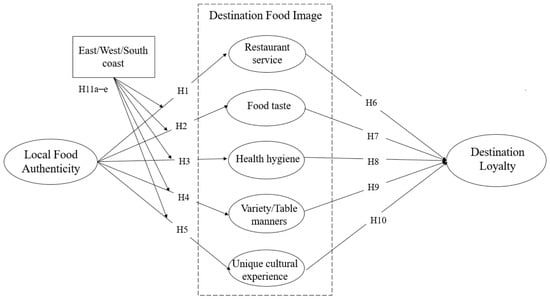
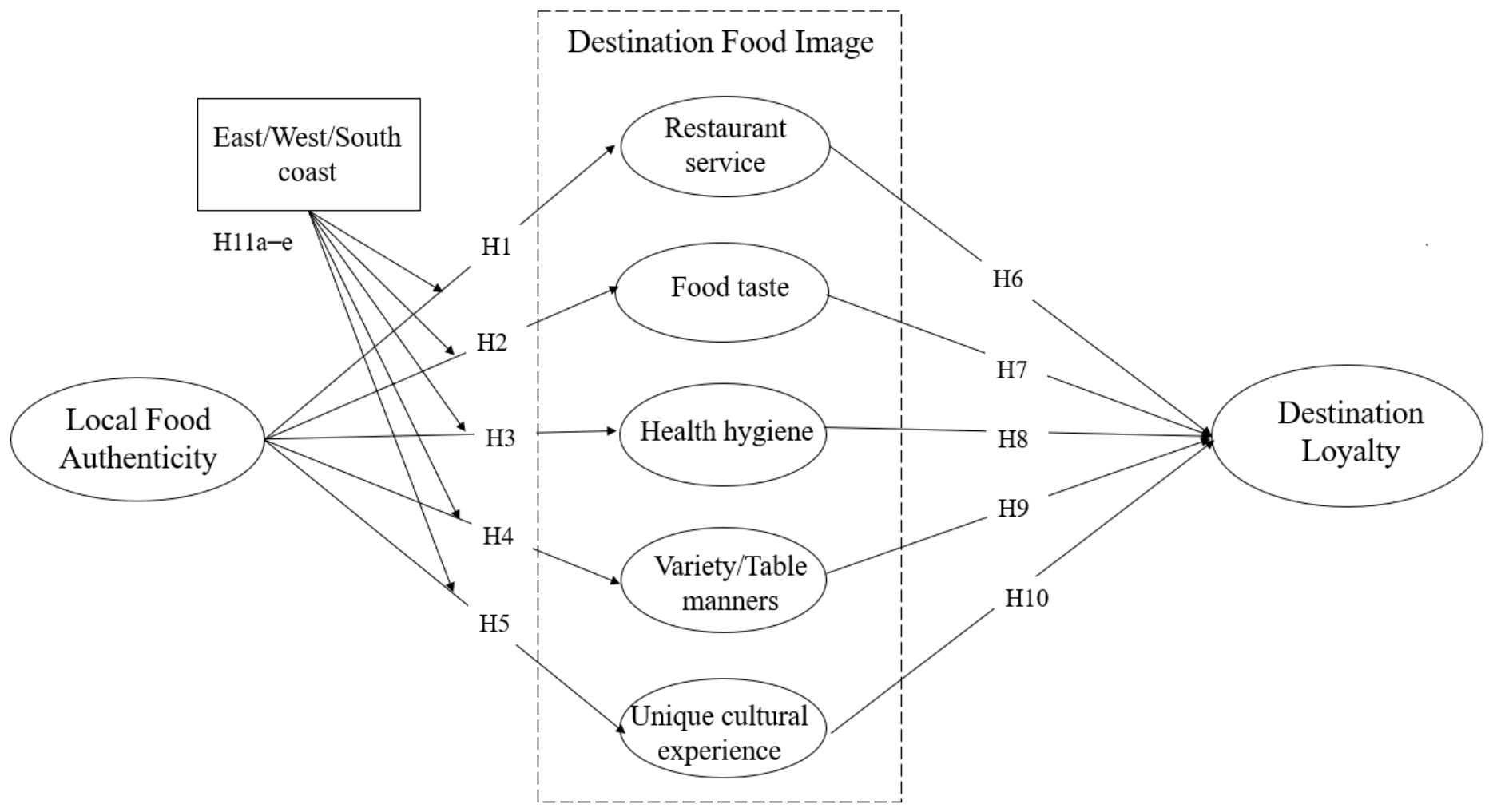
The research model for this study, developed from the above hypotheses, is illustrated in Figure 1.
Figure 1.
Proposed Conceptual Model.
3. Methodology
3.1. Study Site and Characteristics of Coastal Regions
South Korea’s geographical identity is closely tied to the “sea,” as the country is bordered by water on three sides, while the north remains landlocked. Each sea surrounding the Korean Peninsula exhibits unique characteristics and supports distinct marine ecosystems. On the east, the sea is known for its suitability for surfing, shallow waters, and strong waves. It supports diverse marine life influenced by seasonal turbulence, with representative products including pollack, cod, squid, mackerel, oysters, and kelp [57]. Gangwon Province, located on the east coast, is a popular coastal tourism destination [58]. On the west, the sea features extensive tidal flats and waters tinged yellow by sediment from China’s Yellow River. It is rich in marine resources such as yellow croaker, abalone, cockles, prawns, seaweed, and sea salt, and it leads in the production of abalone and gizzard shad [57].
The South Sea is notable for its year-round turbulence, fostering aquaculture and fisheries. This region boasts numerous islands and picturesque coastal scenery, making it a popular resort destination. Its favorable conditions for aquatic growth have supported thriving fish farms, particularly South Gyeongsang Province, which accounts for 23% of the nation’s aquaculture [57]. Busan and Jeju, located in the southern region, are major tourist attractions [58]. Each region’s culinary traditions reflect these marine specialties, offering unique and authentic local seafood dishes that enhance coastal tourism experiences.
3.2. Sampling and Data Collection
The questionnaire was first developed in English and then translated into Korean by a bilingual researcher. Linguistic validation was conducted by a panel of five native Korean speakers, comprising two professors and three graduate students. Their feedback informed revisions, after which the questionnaire was pilot tested with 20 South Korean adults to verify its clarity and accuracy. Based on the pilot test feedback, minor linguistic revisions were made to the Korean version of the questionnaire, mainly associated with sentence endings and wording adjustments to improve readability and ensure natural expressions in Korean. No substantive changes to the content or meaning of the measurement items were made. The questionnaire was then finalized for data collection. Mbrain (Seoul, Republic of Korea) is one of the largest online survey companies in South Korea and maintains a nationwide panel with diverse demographic characteristics. To improve data quality and reduce self-selection bias, screening questions were employed and only respondents who had visited a coastal destination and consumed local seafood cuisine within the previous year were eligible to participate.
The study targeted Korean tourists aged 18 years or older who resided in South Korea and had visited a coastal tourism destination within the past year. Prior to participation, informed consent was provided to panel members together with the survey questionnaire and an explanation of the study purpose which included the voluntary nature of participation. This information was made available to all individuals who accessed the survey link. The finalized online questionnaire was distributed through Mbrain, which disseminated the survey link to its registered panel members. Only respondents who answered affirmatively to a screening question about having previously traveled to a coastal destination and consumed local seafood cuisine were allowed to proceed with the survey. Respondents were instructed to recall their most recent visit to a coastal tourism destination and evaluate the authenticity and image of the local seafood cuisine they consumed during that trip.
The survey was administered over a three-day period starting on 2 September 2024, resulting in 450 completed responses. All collected responses were initially reviewed for completeness and missing data. Incentives were provided only to participants who demonstrated sincere and attentive responses, so the survey achieved a 100% completion rate. In the process of the data screening process, two outliers were identified and excluded, leaving 448 valid responses for further analysis. A commonly accepted guideline for determining sample size suggests that the number of cases should range from 5 to 20 times the number of estimated parameters. Given that this study included 72 measurement items, a minimum sample size of 360 respondents was considered appropriate. Furthermore, previous research has recommended at least 150 participants for Structural Equation Modeling (SEM) analysis [59]. Therefore, the final sample size of 448 respondents was regarded as adequate for conducting the analysis.
3.3. Research Design
All measurement items employed in this study were adapted from previous research, as validity and reliability were demonstrated in prior research. The questionnaire was organized into four sections. Firstly, the perceived authenticity construct centered on existential authenticity and was conceptualized as tourists’ perceptions that the local seafood cuisine genuinely reflected the culinary traditions, culture, and characteristics of the destination. Following Zhang et al. [10], authenticity was initially measured using 12 items assessing the extent to which local seafood cuisine was perceived as traditional, locally representative, culturally meaningful, and reflective of regional food culture (e.g., “The historical story described makes people feel authentic”, “Tasting in the local area makes people feel authentic”). The second section evaluated destination food image which was defined as the sum of tourists’ beliefs, attitudes, and feelings toward local cuisine they consumed at coastal tourism destination [60]. It was measured using 26 items sourced from previous studies [31,61] (e.g., “Local cuisine is rich in flavors”, “Local cuisine is unique”). The third section measured tourists’ destination loyalty which is conceptualized as tourists’ intentions to re-visit the destination or recommend the destination to others (e.g., “I intend to revisit the coastal destination again”, “I would like to recommend the coastal destination to others”). The loyalty measurement scale consisted of four items that were adapted from Chen and Huang [62] and Žabkar et al. [63]. All items were rated on a five-point Likert scale ranging from 1 (strongly disagree) to 5 (strongly agree). The final section collected demographic information including age, income, gender, employment status, education level, and place of residence.
3.4. Data Analysis
The raw construct data used in this analysis are included as a supplemental file (see Supplementary Material information at the end of the paper). The Statistical Package for the Social Sciences (SPSS) was utilized to conduct descriptive and inferential analyses on the participant data. Confirmatory Factor Analysis (CFA) was performed using AMOS 28 to evaluate the reliability and validity of the measurement model. Subsequently, AMOS 28 was further employed to examine the ten hypotheses through Structural Equation Modeling (SEM).
4. Findings
Table 1 presented the demographic information of the participants. As shown in Table 1, more than half of the respondents (67.2%) were female, and approximately 58% were married. The majority of respondents were between their 30 s and 50 s and about 74% held university degree. The respondents’ income ranged from $2001 to $6000, with about half of them (50.7%) working as office workers. About 43.5% of respondents reported visiting coastal destinations more than five times, mostly accompanied by family (57.8%) or friends and colleagues (32.8%). About half of the respondents (49.6%) received travel information about coastal destinations via the internet, while 19.2% used social media to obtain this information.
Table 1.
Respondents profile.
4.1. Confirmatory Factor Analysis
Self-reported data may be vulnerable to common method bias (CMB). Thus, common method variance (CMV) was examined before evaluating the measurement constructs [64]. An exploratory factor analysis (EFA) was conducted using SPSS 28.0 to evaluate CMV. A single-factor test on all 47 items showed that the largest variance explained by one factor was 39.54%, which is below the 50% cutoff. Additionally, variance inflation factor (VIF) values were examined to evaluate the potential issue of multicollinearity. All VIF values ranged from 2.07 to 2.78, which were below the recommended cutoff value of 5.0 suggested by Hair et al. [65]. Therefore, the results indicated that multicollinearity was not a significant concern in the structural model estimation. In addition, a common latent factor (CLF) approach was conducted in AMOS by allowing all latent constructs to load onto a single method factor. The differences in standardized factor loadings between the original CFA model and the common-factor model ranged from 0.018 to 0.223. Although two loyalty items slightly exceeded the recommended threshold of 0.20 [65], the majority of items remained below this criterion. Moreover, the observed differences were generally small. Together with the results of Harman’s single-factor test and VIF analysis, these findings suggest that common method variance was unlikely to substantially affect the results of this study.
The factorial validity and reliability of the constructs were then tested using Confirmatory Factor Analysis (CFA), with results shown in Table 2. Factor loadings ranged from 0.60 to 0.86, all significant at p < 0.001. Some factor loadings were relatively low from items of restaurant service (0.60, 0.65, and 0.68), as they were slightly below the ideal threshold of 0.70. However, all loadings exceeded the minimum acceptable level of 0.60 [66], and contributed to satisfactory construct reliability and convergent validity. Therefore, these items were retained to preserve the conceptual breadth of the constructs. Average Variance Extracted (AVE) values ranged between 0.51 and 0.73, while Composite Reliability (CR) values ranged from 0.78 to 0.92, surpassing the recommended thresholds of 0.50 for AVE and 0.70 for CR [67].
Table 2.
Confirmatory factor analysis.
To assess discriminant validity, the square roots of the AVEs were compared to the inter-construct correlations. As detailed in Table 3, all correlations were lower than the corresponding AVE square roots, confirming discriminant validity [66]. The measurement model demonstrated a good fit based on several indices: χ2(404) = 825.63, p < 0.05; Incremental Fit Index (IFI) = 0.95; Goodness of Fit Index (GFI) = 0.89; Comparative Fit Index (CFI) = 0.95; Tucker–Lewis Index (TLI) = 0.95; Normed Fit Index (NFI) = 0.91; and Root Mean Square Residual (RMR) = 0.03. These results indicate a strong model fit for the data.
Table 3.
Criterial for validity assessment and correlations among factors.
4.2. Testing of Hypotheses
4.2.1. Structural Model Testing
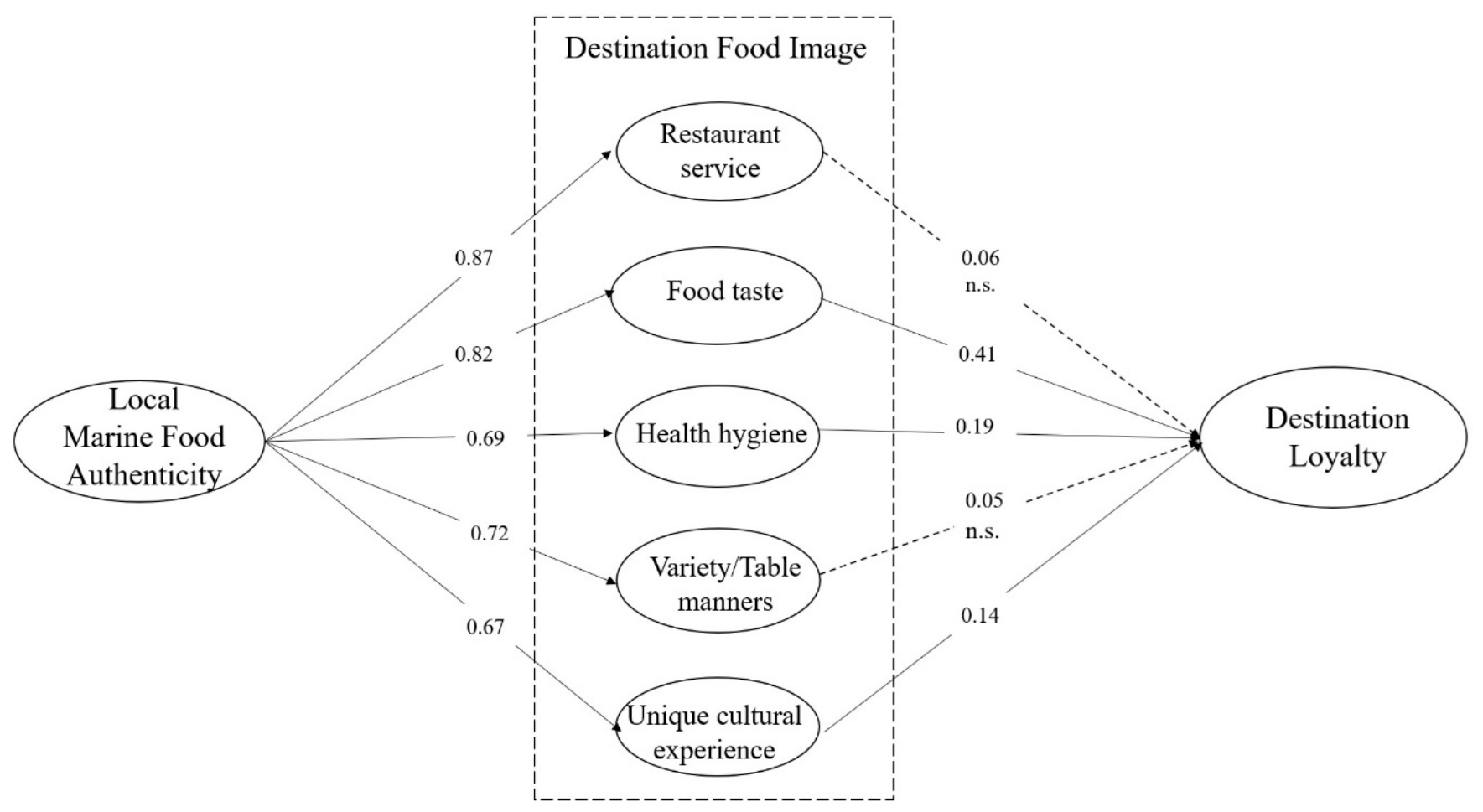
Structural Equation Modeling (SEM) was conducted to test the hypotheses of this study, focusing on the impact of perceived local food authenticity and destination food image on destination loyalty. The measurement model showed a good overall fit, indicated by the following indices: χ2 = 736.24; degrees of freedom (df) = 375; p < 0.001; Comparative Fit Index (CFI) = 0.96; Goodness of Fit Index (GFI) = 0.90; Incremental Fit Index (IFI) = 0.96; Tucker–Lewis Index (TLI) = 0.95; Normed Fit Index (NFI) = 0.92; and Root Mean Square Residual (RMR) = 0.04. Although the proposed model demonstrated satisfactory fit indices, alternative model specifications may also explain the relationships among authenticity, destination food image, and loyalty. Therefore, the findings should be interpreted within the context of the proposed theoretical framework rather than as the only possible representation of these relationships. The findings from the structural model analysis are summarized in Table 4. A positive relationship between local food authenticity and various dimensions of the destination food image was found, which in turn positively influenced destination loyalty, as detailed in Table 4. Specifically, food authenticity exerted a strong positive influence on restaurant service (β = 0.87, t = 11.25) and food taste (β = 0.82, t = 14.61). It also positively influenced health and hygiene ( = 0.69, t = 11.51), variety and table manners ( = 0.72, t = 12.08) and unique cultural experience ( = 0.67, t = 11.69). Furthermore, food taste ( = 0.41, t = 5.88) positively influenced destination loyalty. Both health and hygiene ( = 0.19, t = 3.48) and unique cultural experience ( = 0.14, t = 2.47) also positively contributed to destination loyalty for the food experience. However, restaurant service and variety and table manners did not significantly impact destination loyalty. As a result, hypotheses H1 to H10 were generally supported, with the exceptions of H6 and H9, which were not confirmed.
Table 4.
Standardized regression weights for the structural model.
Furthermore, the squared multiple correlations (SMCs), which is equivalent to values, representing the proportion of variance explained in the dependent variables, ranged from 0.44 to 0.75. Specifically, the values were as follows: restaurant service (SMC = 0.75), food taste (SMC = 0.67), health and hygiene (SMC = 0.47), variety and table manners (SMC = 0.51), unique cultural experience (SMC = 0.44), and destination loyalty (SMC = 0.50). Ultimately, the variance explained in destination loyalty for food experience by destination image factors is relatively robust.
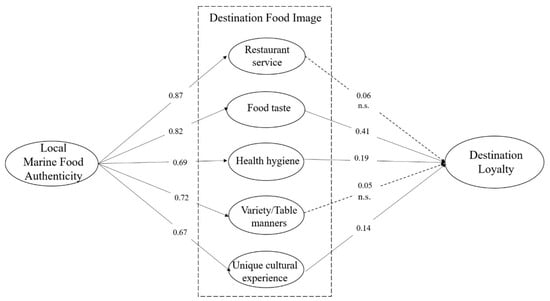
The final structural model with standardized path coefficients is presented in Figure 2. The results indicated that local food authenticity positively influenced all dimensions of destination food image, whereas destination loyalty was predicted by food taste, health and hygiene, and unique cultural experience.
Figure 2.
Final Structural Model with Standardized Path Coefficients. Note: n.s. = not statistically significant.
4.2.2. Moderating Effect of Geographical Differences
For hypotheses H11a–H11e, the moderating effect of geographic differences on the relationship between perceived local food authenticity and destination food image was tested, using the multi-group SEM in AMOS 28. The dataset was divided into three geographic groups: East coast (n = 173), West coast (n = 66), and South coast (n = 209). Although the sample sizes were sufficient for multi-group analysis, the West coast group was noticeably smaller than the other two groups. Therefore, the results should be interpreted with some caution when comparing the magnitude of path coefficients across regions.
The multi-group comparison test was conducted in two stages. Initially, structural parameters were set to be equal across groups, resulting in an estimated covariance matrix and a combined chi-square (x2) statistic. In the second stage, these equality constraints were lifted, producing a new chi-square value with more degrees of freedom. The difference between the two chi-square values was then examined to assess moderation effects. A significant change in chi-square, usually a reduction, suggests the existence of a moderating effect [68]. Table 5 illustrates the results, revealing significant differences among the three groups in the relations between local food authenticity and destination food image (/df = 12.85/10, p < 0.05). Tourists visiting south coastal regions perceived the highest levels across all dimensions of destination food image due to the authentic local food they consumed, compared to those visiting east and west regions. Specifically, the south group rated restaurant service (11a = 0.86; p < 0.001) and food taste (11b = 0.73; p < 0.001) the highest. They also perceived superior health and hygiene (11c = 0.63; p < 0.001), variety/table manners (11d = 0.76; p < 0.001), and unique cultural experiences (11e = 0.62; p < 0.001). These findings highlight the significant influence of geographic differences on the perception of authentic local food. However, given the relatively small size of the West coast group (n = 66), the regional moderation results should be interpreted with caution. The smaller subgroup may have reduced statistical power, increasing the likelihood that some non-significant paths in the West group reflect insufficient sample size rather than the absence of substantive relationships. In addition, parameter estimates for the West group may be less stable than those for the East and South groups. Therefore, the observed weaker effects in the West group should be considered preliminary and require validation with a more balanced regional sample.
Table 5.
Moderation analysis.
5. Discussion
This study empirically examined the structural relationships among local food authenticity, five dimensions of the destination’s local food image, and destination loyalty. It also explored how geographical differences moderate the relationship between local food authenticity and the destination’s local food image. Eleven hypotheses, based on the proposed conceptual framework, were tested using a two-step CFA-SEM approach [59].
The findings revealed a strong positive link between local food authenticity and restaurant service, providing a positive answer to the first research question. This positive relationship aligns with previous studies [69]. The more tourists perceive the local food they consume as unique, the more they associate the restaurant’s atmosphere or environment with uniqueness. Overall perceptions of restaurant service quality can be enhanced by local food authenticity. The tangible appearance of restaurant staff and the physical environment of the restaurant play a crucial role in shaping tourists’ perceptions of authenticity [70].
Food taste was most strongly influenced by local food authenticity, followed by variety and table manners. This suggests that as tourists perceive coastal area foods as authentic, the better they perceive food taste and variety, findings consistent with previous studies [10,71]. Authenticity is closely tied to food flavor, encompassing ingredients, cooking aromas, and traditional recipes, serving to enhance key attributes such as taste, nutritional value, aroma, and freshness as has been found in previous studies [10,71].
This study confirmed that local food authenticity is closely associated with unique cultural experiences. Authentic food experiences are often intertwined with storytelling, heritage, and local customs, enriching tourists’ understanding of local culture. In South Korea’s coastal tourism destinations, tourists can experience freshly prepared seafood caught by “haenyeo” and served at local seaside restaurants. Haenyeo, who are female free divers, are inscribed on the United Nations Educational, Scientific and Cultural Organization (UNESCO) Intangible Cultural Heritage list [72]. Through these authentic experiences, tourists can consume fresh local seafood and gain meaningful insights into the maritime lifestyle, traditions, and cultural identity of coastal communities while supporting the sustainable development of these communities. Coastal destinations especially in South Korea are now facing challenges such as population decline, aging populations, and the gradual disappearance of traditional fishing cultures [72]. For example, Jeju Haenyeo culture is threatened by an aging population of Haenyeo, emphasizing the need for its preservation. By creating demand for authentic local seafood, food tourism can generate economic opportunities for local fishermen and vendors while preserving fishing traditions and cultural heritage that might otherwise be lost. This finding concerning the importance of local food authenticity provides support for what previous studies in East Asia suggested, that authentic local food experiences enable tourists to connect more deeply with local culture and heritage [10,73].
Regarding the relationships between destination food image dimensions and destination loyalty, health and hygiene, food taste, and unique cultural experiences significantly influenced destination loyalty. This answered the second research question. Among these dimensions, food taste appeared to play the most crucial role. This suggests that tourists visiting coastal destinations are motivated by the experiential and symbolic values embedded in local seafood cuisine, including freshness, local identity, cultural atmosphere, and authenticity. These findings align with prior studies indicating that memorable gastronomic experiences strengthen tourists’ emotional attachment and loyalty toward coastal destinations [47,48].
In contrast, restaurant service and variety/table manners did not significantly influence destination loyalty. One possible explanation is that restaurant service represents a functional attribute that tourists generally expect regardless of destination. Similarly, while food variety and table manners contribute to overall dining experiences, they may be less distinctive than destination-specific attributes such as authentic local seafood and cultural experiences when forming destination loyalty. Overall, the study findings suggest that tourists form stronger connections with coastal tourism destinations through authentic and culturally meaningful food experiences rather than through standardized restaurant-related attributes [31].
Although the proposed model explained 50% of the variance in destination loyalty, a substantial proportion of variance remained unexplained. This indicates that destination loyalty is influenced by a variety of cognitive, emotional, and experiential factors such as emotional solidarity [74], satisfaction [9], memorable tourism experiences [75], and place attachment [76]. Therefore, future studies should incorporate these additional constructs for a more comprehensive understanding of tourists’ loyalty factors toward coastal destinations.
The moderating role of geographic differences was confirmed, answering the third research question. Tourists visiting the southern coastal regions reported the highest levels across all dimensions of destination food image associated with authentic local food experiences. This finding is not entirely surprising given that seafood tourism has historically been concentrated in the southern coastal region as it is home to prominent destinations such as Busan, Tongyeong, Yeosu, and Geoje. These destinations offer diverse seafood-related attractions (seafood markets, fishing villages, seafood restaurants, and festivals), allowing tourists to engage deeply with local culinary traditions. For example, Busan welcomed approximately 2.93 million international tourists in 2024, the highest level recorded in the past decade [77]. The findings also suggest that authentic seafood experiences in southern coastal destinations extend beyond food consumption itself as tourists are often exposed to local fishing traditions, maritime lifestyles, and cultural heritage, all of which contribute to more immersive and meaningful tourism experiences.
In contrast, tourists visiting Western coastal destinations reported comparatively lower levels in the relationship between local food authenticity and destination food image. Although Western coastal destinations such as Boryeong and Taean possess valuable marine resources, tourism development in these areas has traditionally focused more on ecological and nature-based tourism than on seafood-centered tourism experiences. Consequently, authentic local seafood may play a relatively less prominent role in shaping tourists’ destination food image in Western coastal destinations. These findings suggest that regional tourism characteristics influence the extent to which authentic local food experiences contribute to destination food image formation and highlight the importance of considering geographic differences when examining food tourism experiences in coastal destinations.
6. Implications and Limitations
6.1. Theoretical Implications
Firstly, this study aimed to evaluate tourists’ experiences with local cuisine, particularly fish and seafood, in coastal areas. While research on food tourism often explores motivations and satisfaction, studies focusing on culinary experiences in coastal destinations are scarce. This research addresses that gap by examining tourists’ food experiences in a coastal tourism context.
Secondly, research on destination image has long been central to tourism studies, typically focusing on general perceptions of destinations. However, this study used a specialized scale to explore food as a key component of coastal destination image, emphasizing the variety of dishes derived from abundant marine resources. The adapted destination food image scale [31], with its five dimensions of health and hygiene, variety/table manners, food taste, restaurant service, and unique cultural experiences proved reliable and valid.
Thirdly, the findings revealed that local food authenticity had the strongest influence on all dimensions of destination food image. However, in forming destination loyalty, restaurant service and variety/table manners showed no significant effects. This could be because tourists in well-developed coastal destinations view high-quality restaurant service as a baseline expectation, prioritizing factors like taste and health over service. Additionally, coastal areas may face lower service expectations due to their overall development level. Future research should further explore these dynamics.
Fourthly, this study incorporated geographic differences into the exploration of authentic food experiences. This represents a contribution to the food tourism literature as previous studies that examined concepts such as food authenticity and destination image have viewed settings from a homogenous perspective. By examining regional differences within a country through a comparison of three coastal regions in South Korea, this study demonstrated that the influence food authenticity has on tourists’ destination food image varies due to the geographic context. Notably, tourists who visited the Western coastal destinations shared lower evaluations of destination food image compared with visitors to the East Coast and South Coast. This suggests that tourism characteristics vary by region and have a relevant role to play in shaping tourists’ perceptions of food experiences. Thus, future research can explore geographic contexts in relation to formation of food tourism experiences. This study also highlighted regional differences concerning tourism development in coastal regions and this has implications pertaining to sustainable management of coastal tourism destinations.
Lastly, this research contributed to the sustainable tourism literature by expanding understanding of food authenticity in tourism contexts. Prior research has focused on food experiences in relation to satisfaction and tourists’ behavioral intentions. This study served to highlight how this is related to formation of food destination image which connects with issues such as coastal cultural heritage and sustainability. In the context of South Korea’s coastal destinations, authentic food experiences are linked to local fishing practices and cultural assets. The importance of authentic local food in relation to tourists’ destination food image formation and destination loyalty, this study highlights the relevance of food tourism in relation to cultural preservation, enhancement of coastal fishing communities, and sustainability of coastal regions.
6.2. Practical Implications
The current study also offers valuable insights for destination managers in coastal areas regarding food marketing and management strategies. Firstly, given that the authenticity of food plays a vital role in shaping the local image, it is essential for local managers and organizations to assess whether the food currently offered to tourists authentically represents the region and highlights its uniqueness. Secondly, because food taste was identified as the strongest predictor of destination loyalty, stakeholders should prioritize maintaining the quality, freshness, and flavor of local seafood cuisine. Ensuring consistently positive food experiences may strengthen tourists’ intentions to revisit and recommend coastal destinations. In South Korea, summer is the peak tourism season when large numbers of tourists visit coastal destinations. Given that health and hygiene were found to significantly influence destination loyalty, restaurant operators should place particular emphasis on proper seafood handling, storage, and hygiene management. Such an approach would also be beneficial to enhancing the sustainability of coastal tourism destinations. Maintaining the freshness and safety of local seafood may enhance tourists’ dining experiences and contribute to positive evaluations of coastal destinations.
Thirdly, the analysis of moderating effects revealed that tourists visiting the West coastal regions perceived the lowest levels of all dimensions of the destination’s local food image compared to those visiting the East and South coastal regions. In particular, Busan, Jeju, and Gangwon Province, located in the south and east coastal regions, were the most visited destinations in South Korea in 2023 [58]. It is also evident that tourists are relatively less interested in west coast destination areas compared with destinations located on the eastern and southern coasts. Therefore, more active promotional efforts are urgently needed to attract tourists, leveraging the unique characteristics of the West coastal region. The Western coastal region is known for mudflat experiences where tourists can dig for clams, an experience which could be used for a family trip. Moreover, Western coastal regions are known for sunset views especially in places like Daebu Island, Byeonsanbando, and Taean. Seafood products such as oysters, blue crabs, shrimp, and octopus are abundant along the West coast due to its unique tidal-flat ecosystem. Therefore, destination managers should actively promote these local seafood specialties and emphasize their connection to the region’s culinary heritage. Providing tourists with authentic seafood experiences based on locally sourced ingredients may strengthen perceptions of food authenticity, enhance destination food image, and improve tourists’ understanding of the region’s distinctive culture and traditions. These actions can also enable such coastal tourism destinations to become more sustainable. Comprehensive information about local destinations such as details about authentic local foods, restaurants specializing in fish and seafood, and regional dining styles should be professionally integrated into marketing and promotional channels to enhance the appeal of the West coastal regions.
6.3. Study Limitations and Future Research
The current study faced several limitations that future research should address. First, data collection was conducted online through a survey company, limiting responses to panel members and excluding non-panel participants. Future research should combine online and on-site surveys to capture a broader and more diverse range of opinions.
Second, the study examined the moderating role of geographical differences between perceived local food authenticity and destination food image. However, the unequal distribution of respondents across regions (46.7% from the South, 38.6% from the East, and only 14.7% from the West) have reduced statistical power and affected the stability of parameter estimates, thereby limiting the robustness of regional comparisons. To address this, future studies should employ quota sampling to ensure balanced representation across regions.
Thirdly, while the study used multi-group SEM to compare differences among regions, measurement invariance tests across geographic groups was not formally conducted. Thus, the moderation findings can be interpreted carefully. In the future, studies can seek to establish measurement invariance before completing comparisons among different groups.
Lastly, this study focused solely on Korean tourists visiting coastal destinations, excluding international visitors. Cultural differences in food perceptions can significantly impact destination image, as shown by Promsivapallop and Kannaovakun [31], who found Chinese tourists valued cultural experiences while Australians prioritized taste in Thai cuisine. Future research should explore how international tourists perceive destination food images and experience local food specializing in fish and seafood in coastal areas. Such studies could offer critical insights for promoting coastal tourism to a global audience.
Finally, as the data were collected at one point in time, considering the study variables, causal relationships cannot be established firmly. In the future, studies can employ longitudinal design in order to explore how the relationships between constructs from this study change over time. Additionally, destination loyalty was measured in this study through self-reported observations and behavioral intentions. While behavioral intentions are used to consider future behavioral actions, they may not lead to actual visitation decisions. Studies can consider examining observed revisit behaviors or use longitudinal tracking data to authenticate the construct relationships identified in this study.
Supplementary Materials
The following supporting information can be downloaded at: https://www.mdpi.com/article/10.3390/su18136435/s1, anonymized raw construct data.
Author Contributions
Conceptualization, J.C.; Methodology, J.C.; Validation, J.C.; Formal Analysis, T.E.; Writing—original draft preparation, J.C.; Writing—review and editing, T.E., M.-F.H., S.Z.; Visualization, M.-F.H.; Supervision, J.C.; Funding Acquisition, J.C. All authors have read and agreed to the published version of the manuscript.
Funding
This work was supported by the Global Joint Research Program funded by Pukyong National University 202412050001.
Institutional Review Board Statement
The study was conducted in accordance with the Declaration of Helsinki. The Institutional Review Board of Pukyong National University approved the study. The approval code is 1041386-202408-HR-115-02. The ethical approval date for the study was 19 August 2024.
Informed Consent Statement
Informed consent was obtained from all subjects involved in the study.
Data Availability Statement
The original contributions presented in this study are included in the article/Supplementary Material. Further inquiries can be directed to the corresponding author.
Conflicts of Interest
The authors declare no conflicts of interest.
References
- Ministry of Oceans and Fisheries. Extinction of Fishing Villages, Stop! Create a Vibrant Fishing Village with “How to Boost the Vitality of Fishing Villages and Coast”. 2024. Available online: https://blog.naver.com/koreamof/223445406624 (accessed on 1 June 2026).
- Blomquist, J.; Waldo, S. Do Firm Support Increase Investments? Evidence from the Aquaculture and Fish Processing Sectors in Sweden. J. Agric. Appl. Econ. 2022, 54, 306–318. [Google Scholar] [CrossRef] [Scilit]
- Johansson, M.; Waldo, Å. Local People’s Appraisal of the Fishery–Seal Situation in Traditional Fishing Villages on the Baltic Sea Coast in Southeast Sweden. Soc. Nat. Resour. 2021, 34, 271–290. [Google Scholar] [CrossRef] [Scilit]
- Uddin, M.M.; Schneider, P.; Asif, M.R.I.; Rahman, M.S.; Mozumder, M.M.H. Fishery-Based Ecotourism in Developing Countries Can Enhance the Social-Ecological Resilience of Coastal Fishers—A Case Study of Bangladesh. Water 2021, 13, 292. [Google Scholar] [CrossRef] [Scilit]
- Lacher, R.G.; Oh, C.O.; Jodice, L.W.; Norman, W.C. The Role of Heritage and Cultural Elements in Coastal Tourism Destination Preferences: A Choice Modeling-Based Analysis. J. Travel Res. 2013, 52, 534–546. [Google Scholar] [CrossRef] [Scilit]
- Seo, S.; Yun, N.; Kim, O.Y. Destination Food Image and Intention to Eat Destination Foods: A View from Korea. Curr. Issues Tour. 2017, 20, 135–156. [Google Scholar] [CrossRef] [Scilit]
- Khakzad, S. Promoting Coastal Communities through Cultural Tourism: The Case of Fishing Communities in Brunswick County, North Carolina. J. Herit. Tour. 2018, 13, 455–471. [Google Scholar] [CrossRef] [Scilit]
- Loring, P.A.; Gerlach, S.C.; Harrison, H.L. Seafood as Local Food: Food Security and Locally Caught Seafood on Alaska’s Kenai Peninsula. J. Agric. Food Syst. Community Dev. 2013, 3, 13–30. [Google Scholar] [CrossRef] [Scilit]
- Eck, T.; Zhang, Y.; An, S. A Study on the Effect of Authenticity on Heritage Tourists’ Mindful Tourism Experience: The Case of the Forbidden City. Sustainability 2023, 15, 7756. [Google Scholar] [CrossRef] [Scilit]
- Zhang, T.; Chen, J.; Hu, B. Authenticity, Quality, and Loyalty: Local Food and Sustainable Tourism Experience. Sustainability 2019, 11, 3437. [Google Scholar] [CrossRef] [Scilit]
- Latiff, K.; Ng, S.I.; Aziz, Y.A.; Kamal Basha, N. Food Authenticity as One of the Stimuli to World Heritage Sites. Br. Food J. 2020, 122, 1755–1776. [Google Scholar] [CrossRef] [Scilit]
- Solis-Radilla, M.M.; Carvache-Franco, M.; Carvache-Franco, O.; Carvache-Franco, W. Motivations as Predictive Variables of Satisfaction and Loyalty in Coastal and Marine Destinations: A Study in Acapulco, Mexico. Int. J. Tour. Cities 2021, 7, 767–782. [Google Scholar] [CrossRef] [Scilit]
- Carvache-Franco, W.; Carvache-Franco, M.; Hernández-Lara, A.B. From Motivation to Segmentation in Coastal and Marine Destinations: A Study from the Galapagos Islands, Ecuador. Curr. Issues Tour. 2021, 24, 2325–2341. [Google Scholar] [CrossRef] [Scilit]
- Hu, T.; Chen, H. Destination Experiencescape for Coastal Tourism: A Social Network Analysis Exploration. J. Outdoor Recreat. Tour. 2024, 46, 100747. [Google Scholar] [CrossRef] [Scilit]
- Kaur, S.; Kaur, M. Image of Local Cuisine in Emerging Gastronomic Destinations: Scale Review, Development, and Validation. Int. J. Hosp. Tour. Adm. 2024, 25, 153–201. [Google Scholar] [CrossRef] [Scilit]
- de Lima Pereira, M.; dos Anjos, F.A.; da Silva Añaña, E.; Weismayer, C. Modelling the Overall Image of Coastal Tourism Destinations through Personal Values of Tourists: A Robust Regression Approach. J. Outdoor Recreat. Tour. 2021, 35, 100412. [Google Scholar] [CrossRef] [Scilit]
- Wang, Z.; Udomwong, P.; Fu, J.; Onpium, P. Destination Image: A Review from 2012 to 2023. Cogent Soc. Sci. 2023, 9, 2240569. [Google Scholar] [CrossRef] [Scilit]
- Gupta, V.; Sharma, K. Food Authenticity, Culture, and Tourism: Analysing the Dimensions of Local Gastronomic Image Among Foreign Tourists in Fiji. Br. Food J. 2024, 126, 4124–4146. [Google Scholar] [CrossRef] [Scilit]
- Sio, K.P.; Fraser, B.; Fredline, L. A Contemporary Systematic Literature Review of Gastronomy Tourism and Destination Image. Tour. Recreat. Res. 2024, 49, 312–328. [Google Scholar] [CrossRef] [Scilit]
- Krystallis, A. The Concept of Authenticity and Its Relevance to Consumers: Country and Place Branding in the Context of Food Authenticity. In Food Authentication: Management, Analysis and Regulation; Lees, M., Ed.; Woodhead Publishing: Cambridge, UK, 2017; pp. 25–82. [Google Scholar] [CrossRef] [Scilit]
- MacCannell, D. Staged Authenticity: Arrangements of Social Space in Tourist Settings. Am. J. Sociol. 1973, 79, 589–603. [Google Scholar] [CrossRef] [Scilit] [PubMed]
- Lee, T.H.; Jan, F.H. How Does Tourism Image Affect Visitor Perceptions of a Festival’s Identity? Influence Analysis of Three Aboriginal Festivals in Taiwan. J. Destin. Mark. Manag. 2022, 24, 100704. [Google Scholar] [CrossRef] [Scilit]
- Cohen, E. Authenticity and Commoditization in Tourism. Ann. Tour. Res. 1988, 15, 371–386. [Google Scholar] [CrossRef] [Scilit]
- Kim, H.; Jamal, T. Touristic Quest for Existential Authenticity. Ann. Tour. Res. 2007, 34, 181–201. [Google Scholar] [CrossRef] [Scilit]
- Su, Y.; Xu, J.; Sotiriadis, M.; Shen, S. Authenticity, Perceived Value and Loyalty in Marine Tourism Destinations: The Case of Zhoushan, Zhejiang Province, China. Sustainability 2021, 13, 3716. [Google Scholar] [CrossRef] [Scilit]
- Li, Y.; Jiao, L.; Zhou, M. How Does Cultural Heritage Destination Digitalization Influence Tourists’ Attitudes? The Role of Constructive Authenticity and Technology–Destination Fit. J. Travel Tour. Mark. 2024, 41, 221–234. [Google Scholar] [CrossRef] [Scilit]
- Kotler, P.R. Marketing Management: Analysis, Planning, Implementation and Control; Prentice Hall: Englewood Cliffs, NJ, USA, 1997. [Google Scholar]
- Milman, A.; Pizam, A. The Role of Awareness and Familiarity with a Destination: The Central Florida Case. J. Travel Res. 1995, 33, 21–27. [Google Scholar] [CrossRef] [Scilit]
- Ashworth, G.J.; Goodall, B. (Eds.) Marketing Tourism Places; Routledge: London, UK, 1990. [Google Scholar]
- Pike, S.; Ryan, C. Destination Positioning Analysis through a Comparison of Cognitive, Affective, and Conative Perceptions. J. Travel Res. 2004, 42, 333–342. [Google Scholar] [CrossRef] [Scilit]
- Promsivapallop, P.; Kannaovakun, P. Destination Food Image Dimensions and Their Effects on Food Preference and Consumption. J. Destin. Mark. Manag. 2019, 11, 89–100. [Google Scholar] [CrossRef] [Scilit]
- Oliver, R.L. Satisfaction: A Behavioral Perspective on the Consumer; McGraw-Hill: New York, NY, USA, 1997. [Google Scholar]
- Zhang, H.; Fu, X.; Cai, L.A.; Lu, L. Destination Image and Tourist Loyalty: A Meta-Analysis. Tour. Manag. 2014, 40, 213–223. [Google Scholar] [CrossRef] [Scilit]
- Chen, Q.; Huang, R.; Hou, B. Perceived Authenticity of Traditional Branded Restaurants (China): Impacts on Perceived Quality, Perceived Value, and Behavioural Intentions. Curr. Issues Tour. 2020, 23, 2950–2971. [Google Scholar] [CrossRef] [Scilit]
- Tian, Y.; Kamran, Q.A. A Review of Antecedents and Effects of Loyalty on Food Retailers toward Sustainability. Sustainability 2021, 13, 13419. [Google Scholar] [CrossRef] [Scilit]
- Lu, L.; Chi, C.G.; Liu, Y. Authenticity, Involvement, and Image: Evaluating Tourist Experiences at Historic Districts. Tour. Manag. 2015, 50, 85–96. [Google Scholar] [CrossRef] [Scilit]
- Carreira, V.; González-Rodríguez, M.R.; Díaz-Fernández, M.C. The Relevance of Motivation, Authenticity and Destination Image to Explain Future Behavioral Intention in a UNESCO World Heritage Site. Curr. Issues Tour. 2022, 25, 650–673. [Google Scholar] [CrossRef] [Scilit]
- Atasoy, F.; Eren, D. Serial Mediation: Destination Image and Perceived Value in the Relationship between Perceived Authenticity and Behavioral Intentions. Eur. J. Tour. Res. 2023, 33, 3309. [Google Scholar] [CrossRef] [Scilit]
- Lee, T.H.; Chang, P.S. Examining the Relationships among Festivalscape, Experiences, and Identity: Evidence from Two Taiwanese Aboriginal Festivals. Leis. Stud. 2017, 36, 453–467. [Google Scholar] [CrossRef] [Scilit]
- Naoi, T. Visitors’ Evaluation of a Historical District: The Roles of Authenticity and Manipulation. Tour. Hosp. Res. 2004, 5, 45–63. [Google Scholar] [CrossRef] [Scilit]
- Eck, T.; Zielinski, S.; Ahn, Y.J. Authenticity, Restaurant Quality, and Place Attachment: Evaluating Authentic Food Tourism Experiences. Sustainability 2026, 18, 1957. [Google Scholar] [CrossRef] [Scilit]
- Kuo, Y.; Helm, S. How Ethnic Congruence Affects Authenticity and Perceived Taste of Traditional Foods. Int. Mark. Rev. 2025, 42, 83–102. [Google Scholar] [CrossRef] [Scilit]
- Autio, M.; Collins, R.; Wahlen, S.; Anttila, M. Consuming Nostalgia? The Appreciation of Authenticity in Local Food Production. Int. J. Consum. Stud. 2013, 37, 564–568. [Google Scholar] [CrossRef] [Scilit]
- Levitt, J.A. An Analysis of Perceptions of Restaurant Authenticity at Food Tourism Destinations in the Southeastern US. Ph.D. Thesis, University of South Carolina, Columbia, SC, USA, 2018. [Google Scholar]
- Gupta, V.; Sajnani, M. A Study on the Influence of Street Food Authenticity and Degree of Their Variations on the Tourists’ Overall Destination Experiences. Br. Food J. 2020, 122, 779–797. [Google Scholar] [CrossRef] [Scilit]
- Folgado-Fernández, J.A.; Hernández-Mogollón, J.M.; Duarte, P. Destination Image and Loyalty Development: The Impact of Tourists’ Food Experiences at Gastronomic Events. Scand. J. Hosp. Tour. 2017, 17, 92–110. [Google Scholar] [CrossRef] [Scilit]
- Liu, P.; Tse, E.C.Y. Exploring Factors on Customers’ Restaurant Choice: An Analysis of Restaurant Attributes. Br. Food J. 2018, 120, 2289–2303. [Google Scholar] [CrossRef] [Scilit]
- Sulek, J.M.; Hensley, R.L. The Relative Importance of Food, Atmosphere, and Fairness of Wait: The Case of a Full-Service Restaurant. Cornell Hotel Restaur. Adm. Q. 2004, 45, 235–247. [Google Scholar] [CrossRef] [Scilit]
- Kuhn, V.R.; Benetti, A.C.; dos Anjos, S.J.G.; Limberger, P.F. Food Services and Customer Loyalty in the Lodging Industry. Tour. Manag. Stud. 2018, 14, 26–35. [Google Scholar] [CrossRef] [Scilit]
- Zhang, Y.; Xu, X.H.; Lee, T.J.; Li, Z.X. Assessing the Impact of Perceptions of Hygiene on Tourists’ Attitudinal Loyalty to Ethnic Food. Br. Food J. 2022, 124, 4847–4867. [Google Scholar] [CrossRef] [Scilit]
- Omar, S.R.; Karim, S.A.; Bakar, A.Z.A.; Omar, S.N. Safeguarding Malaysian Heritage Food (MHF): The Impact of Malaysian Food Culture and Tourists’ Food Culture Involvement on Intentional Loyalty. Procedia Soc. Behav. Sci. 2015, 172, 611–618. [Google Scholar] [CrossRef] [Scilit]
- Sims, R. Putting Place on the Menu: The Negotiation of Locality in UK Food Tourism, from Production to Consumption. J. Rural Stud. 2010, 26, 105–115. [Google Scholar] [CrossRef] [Scilit]
- Peštek, A.; Činjarević, M. Tourist Perceived Image of Local Cuisine: The Case of Bosnian Food Culture. Br. Food J. 2014, 116, 1821–1838. [Google Scholar] [CrossRef] [Scilit]
- Kim, G.; Duffy, L.N.; Jodice, L.W.; Norman, W.C. Coastal Tourist Interest in Value-Added, Aquaculture-Based, Culinary Tourism Opportunities. Coast. Manag. 2017, 45, 310–329. [Google Scholar] [CrossRef] [Scilit]
- Espiritu, M.J. Authenticity in Culinary Tourism: Understanding Tourist Expectations and Experiences. Int. J. Sustain. Adv. Integr. Res. 2026, 2, 25–32. [Google Scholar] [CrossRef] [Scilit]
- Antón, C.; Camarero, C.; Laguna, M.; Buhalis, D. Impacts of Authenticity, Degree of Adaptation and Cultural Contrast on Travellers’ Memorable Gastronomy Experiences. J. Hosp. Mark. Manag. 2019, 28, 743–764. [Google Scholar] [CrossRef] [Scilit]
- Yonhap News. The Three Seas of Korea’s Different Charm. 2019. Available online: https://www.yna.co.kr/view/AKR20190528114000051 (accessed on 14 November 2024).
- Choi, I.; Lee, S.; Kim, Y. An Analysis of Consumption Behavior of Coastal and Fishing Villages Tourism through Big Data; Korea Maritime Institute: Busan, Republic of Korea, 2023; Volume 188. [Google Scholar] [CrossRef] [Scilit]
- Anderson, J.C.; Gerbing, D.W. Structural Equation Modeling in Practice: A Review and Recommended Two-Step Approach. Psychol. Bull. 1988, 103, 411–423. [Google Scholar] [CrossRef]
- Yasami, M.; Promsivapallop, P.; Kannaovakun, P. Food Image and Loyalty Intentions: Chinese Tourists’ Destination Food Satisfaction. J. China Tour. Res. 2021, 17, 592–612. [Google Scholar] [CrossRef] [Scilit]
- Ab Karim, S.; Chi, C.G.Q. Culinary Tourism as a Destination Attraction: An Empirical Examination of Destinations’ Food Image. J. Hosp. Mark. Manag. 2010, 19, 531–555. [Google Scholar] [CrossRef] [Scilit]
- Chen, Q.; Huang, R. Local Food in China: A Viable Destination Attraction. Br. Food J. 2018, 120, 146–157. [Google Scholar] [CrossRef] [Scilit]
- Žabkar, V.; Brenčič, M.M.; Dmitrović, T. Modelling Perceived Quality, Visitor Satisfaction and Behavioural Intentions at the Destination Level. Tour. Manag. 2010, 31, 537–546. [Google Scholar] [CrossRef] [Scilit]
- Podsakoff, P.M.; MacKenzie, S.B.; Lee, J.Y.; Podsakoff, N.P. Common Method Biases in Behavioral Research: A Critical Review of the Literature and Recommended Remedies. J. Appl. Psychol. 2003, 88, 879–903. [Google Scholar] [CrossRef] [Scilit] [PubMed]
- Hair, J.F., Jr.; Sarstedt, M.; Hopkins, L.; Kuppelwieser, V.G. Partial Least Squares Structural Equation Modeling (PLS-SEM): An Emerging Tool in Business Research. Eur. Bus. Rev. 2014, 26, 106–121. [Google Scholar] [CrossRef] [Scilit]
- Williams, L.J.; Anderson, S.E. An Alternative Approach to Method Effects by Using Latent-Variable Models: Applications in Organizational Behavior Research. J. Appl. Psychol. 1994, 79, 323–331. [Google Scholar] [CrossRef]
- Hair, J.F., Jr.; Black, W.C.; Babin, B.J.; Anderson, R.E. Multivariate Data Analysis, 8th ed.; Cengage Learning: Boston, MA, USA, 2019. [Google Scholar]
- Fornell, C.; Larcker, D.F. Evaluating Structural Equation Models with Unobservable Variables and Measurement Error. J. Mark. Res. 1981, 18, 39–50. [Google Scholar] [CrossRef] [Scilit]
- Brockman, B.K.; Morgan, R.M. The Role of Existing Knowledge in New Product Innovativeness and Performance. Decis. Sci. 2003, 34, 385–419. [Google Scholar] [CrossRef] [Scilit]
- Tsai, C.T.S.; Lu, P.H. Authentic Dining Experiences in Ethnic Theme Restaurants. Int. J. Hosp. Manag. 2012, 31, 304–306. [Google Scholar] [CrossRef] [Scilit]
- Timothy, D.J.; Ron, A.S. Understanding Heritage Cuisines and Tourism: Identity, Image, Authenticity, and Change. J. Herit. Tour. 2013, 8, 99–104. [Google Scholar] [CrossRef] [Scilit]
- Park, S.; Chung, N.; Lee, W.S. Preserving the Culture of Jeju Haenyeo (Women Divers) as a Sustainable Tourism Resource. Sustainability 2020, 12, 10564. [Google Scholar] [CrossRef] [Scilit]
- Chang, R.C.; Kivela, J.; Mak, A.H. Food Preferences of Chinese Tourists. Ann. Tour. Res. 2010, 37, 989–1011. [Google Scholar] [CrossRef] [Scilit]
- An, S.; Eck, T.; Woosnam, K.M.; Jiang, L. Applying Mindfulness Theory to Enhance Voluntourism Experiences. Tour. Manag. Perspect. 2024, 50, 101203. [Google Scholar] [CrossRef] [Scilit]
- Kim, J.H. The Impact of Memorable Tourism Experiences on Loyalty Behaviors: The Mediating Effects of Destination Image and Satisfaction. J. Travel Res. 2018, 57, 856–870. [Google Scholar] [CrossRef] [Scilit]
- Ispas, A.; Untaru, E.N.; Candrea, A.N.; Han, H. Impact of Place Identity and Place Dependence on Satisfaction and Loyalty toward Black Sea Coastal Destinations: The Role of Visitation Frequency. Coast. Manag. 2021, 49, 250–274. [Google Scholar] [CrossRef] [Scilit]
- Haps Staff. Busan Records Highest Number of Foreign Tourists in a Decade, Surpassing Pre-Pandemic Levels. Haps Korea Magazine, 20 February 2025. Available online: https://www.hapskorea.com/busan-records-highest-number-of-foreign-tourists-in-a-decade-surpassing-pre-pandemic-levels/ (accessed on 30 May 2026).

Disclaimer/Publisher’s Note: The statements, opinions and data contained in all publications are solely those of the individual author(s) and contributor(s) and not of MDPI and/or the editor(s). MDPI and/or the editor(s) disclaim responsibility for any injury to people or property resulting from any ideas, methods, instructions or products referred to in the content. |
© 2026 by the authors. Licensee MDPI, Basel, Switzerland. This article is an open access article distributed under the terms and conditions of the Creative Commons Attribution (CC BY) license.