Going in Circles: Integrating Food, Energy and Water Sectors to Enable a Thriving Circular Bioeconomy
 , , ,
, , ,
Abstract
1. Introduction: The Rise of Circular Economy Frameworks and Their Limitations
2. A Circular Economy Framework for Organic Byproducts from the Food System
2.1. Principle 1: Prioritise Avoidance of Organic Waste
2.2. Principle 2: Prioritise Food Security End-Use
2.3. Principle 3: Clean Feedstocks That Are Fit-for-Purpose
2.4. Principle 4: Design for Target End-Use Markets
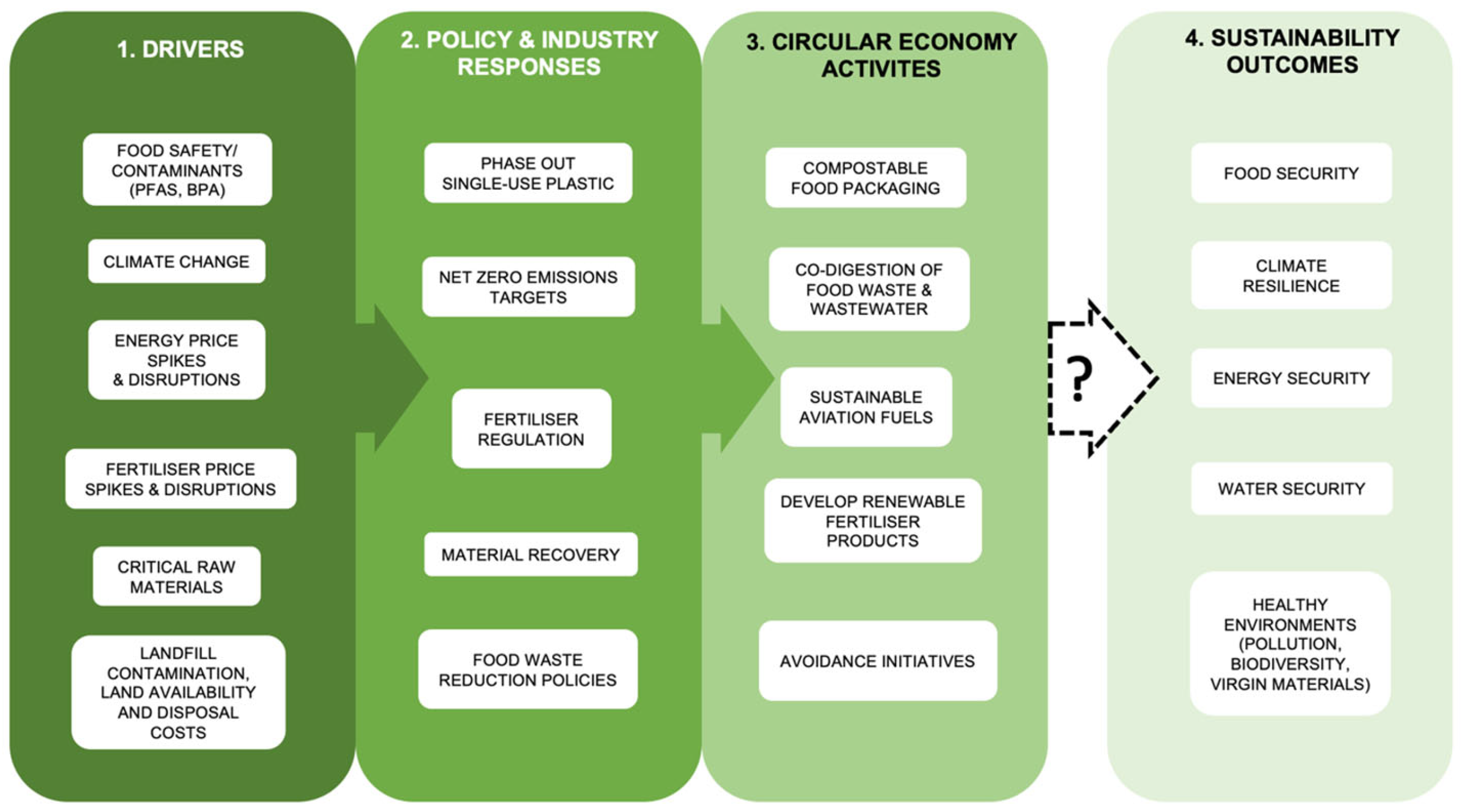
3. Competing End-Uses: Drivers and Activities Across Key Sectors in the Value Chain
3.1. Food Waste (Waste Management) Sector
3.2. Water and Wastewater Sector
3.3. Fertiliser and Agricultural Sector
3.4. Bioenergy
4. Need for Cross-Sector Integration
5. Barriers and Enablers to Integration and Transformation
5.1. Integration Barriers
5.1.1. Governance Integration Barriers
5.1.2. Market Integration Barriers
5.1.3. Technology Integration Barriers
5.1.4. Knowledge Integration Barriers
5.1.5. Engagement Integration Barriers
5.2. A Way Forward Towards Implementing Circularity: Cross-Sector Actions
- Identifying a designated department or body to oversee the circular strategy development and coordinate across other departments and sectors.
- Investing in critical research and development to fill key country-specific knowledge gaps, such as volumes of key organic byproducts, the identification of potential end-use markets, and the quantification of benefits (e.g., reduced GHG emissions, biodiversity, employment, etc).
- Prioritising country-specific and evidence-based circular practices, which take into account: (a) the largest volumes of organic byproducts and/or (b) those wastes with the greatest environmental or public health impacts, and (c) the end-uses of greatest public good (e.g., food security, energy security).
- Streamlining regulations so that they encourage rather than hinder circular practices, whilst minimising environmental and health risks.
- Supporting and stimulating the implementation of circular technologies through incentives, tax subsidies, green loans or other means.
6. Conclusions
Author Contributions
Funding
Institutional Review Board Statement
Informed Consent Statement
Data Availability Statement
Conflicts of Interest
References
- Ghisellini, P.; Cialani, C.; Ulgiati, S. A Review on Circular Economy: The Expected Transition to a Balanced Interplay of Environmental and Economic Systems. J. Clean. Prod. 2016, 114, 11–32. [Google Scholar] [CrossRef]
- Potting, J.; Hekkert, M.P.; Worrell, E.; Hanemaaijer, A. Circular Economy: Measuring Innovation in the Product Chain; PBL Netherlands Environmental Assessment Agency: The Hague, The Netherlands, 2017. [Google Scholar]
- Ellen Macarthur Foundation Circular Products and Materials. Available online: https://ellenmacarthurfoundation.org/circulate-products-and-materials (accessed on 24 February 2023).
- Reike, D.; Vermeulen, W.J.V.; Witjes, S. The Circular Economy: New or Refurbished as CE 3.0?—Exploring Controversies in the Conceptualization of the Circular Economy through a Focus on History and Resource Value Retention Options. Resour. Conserv. Recycl. 2018, 135, 246–264. [Google Scholar] [CrossRef]
- Kirchherr, J.; Yang, N.-H.N.; Schulze-Spüntrup, F.; Heerink, M.J.; Hartley, K. Conceptualizing the Circular Economy (Revisited): An Analysis of 221 Definitions. Resour. Conserv. Recycl. 2023, 194, 107001. [Google Scholar] [CrossRef]
- Geissdoerfer, M.; Savaget, P.; Bocken, N.M.P.; Hultink, E.J. The Circular Economy—A New Sustainability Paradigm? J. Clean. Prod. 2017, 143, 757–768. [Google Scholar] [CrossRef]
- Michaux, S.P.; Butcher, A.R. Some Observations on the Current Circular Economy Model in Particular, the Mineral-Metal-Material Stream Blind Spots. In The Impossibilities of the Circular Economy; Routledge: London, UK, 2022; pp. 90–102. [Google Scholar]
- Kirchherr, J.; Reike, D.; Hekkert, M. Conceptualizing the Circular Economy: An Analysis of 114 Definitions. Resour. Conserv. Recycl. 2017, 127, 221–232. [Google Scholar] [CrossRef]
- D’Amato, D.; Droste, N.; Allen, B.; Kettunen, M.; Lähtinen, K.; Korhonen, J.; Leskinen, P.; Matthies, F.D.; Toppinen, A. Green, Circular, Bio Economy: A Comparative Analysis of Sustainability. J. Clean. Prod. 2017, 168, 716–734. [Google Scholar] [CrossRef]
- FAO. Livestock in the Balance. In The State of Food and Agriculture; FAO: Rome, Italy, 2009; ISBN 978-92-5-106215-9. [Google Scholar]
- FAO; IFAD; UNICEF; WFP. WHO Repurposing Food and Agricultural Policies to Make Healthy Diets More Affordable. In The State of Food Security and Nutrition in the World; FAO: Rome, Italy, 2022. [Google Scholar]
- Von Braun, J.; Afsana, K.; Fresco, L.O.; Hassan, M.; Torero, M. Definition, Concept and Application for the UN Food Systems Summit. In Proceedings of the United Nations Food Systems Summit 2021, Scientific Group, New York, NY, USA, 23 September 2021; pp. 27–39. [Google Scholar]
- Poore, J.; Nemecek, T. Reducing Food’s Environmental Impacts through Producers and Consumers. Science 2018, 360, 987–992. [Google Scholar] [CrossRef] [PubMed]
- Crippa, M.; Solazzo, E.; Guizzardi, D.; Monforti-Ferrario, F.; Tubiello, F.N.; Leip, A. Food Systems Are Responsible for a Third of Global Anthropogenic GHG Emissions. Nat. Food 2021, 2, 198–209. [Google Scholar] [CrossRef] [PubMed]
- Webb, P.; Benton, T.G.; Beddington, J.; Flynn, D.; Kelly, N.M.; Thomas, S.M. The Urgency of Food System Transformation Is Now Irrefutable. Nat. Food 2020, 1, 584–585. [Google Scholar] [CrossRef] [PubMed]
- Searchinger, T.; Waite, R.; Hanson, C.; Ranganathan, J.; Dumas, P.; Matthews, E.; Klirs, C. Creating a Sustainable Food Future. A Menu Solutions to Feed Nearly 10 Billion People by 2050; World Resources Institute: Washington, DC, USA, 2019. [Google Scholar]
- European Commission. The Bioeconomy—Innovative Solutions for a Sustainable Future; Publications Office of the European Union: Luxembourg, 2025. [Google Scholar]
- European Commission. Circular Economy Action Plan; European Union: Luxembourg, 2020. [Google Scholar]
- Dominish, E.; Retamal, M.; Sharpe, S.; Lane, R.; Rhamdhani, M.A.; Corder, G.; Giurco, D.; Florin, N. “Slowing” and “Narrowing” the Flow of Metals for Consumer Goods: Evaluating Opportunities and Barriers. Sustainability 2018, 10, 1096. [Google Scholar] [CrossRef]
- Dominish, E.; Cordell, D.; Jacobs, B. Creating Demand for Recycled Organic Compost: Social Research on the Sydney Compost Value Chain—From Farmer to Consumer; FAO: Rome, Italy, 2017. [Google Scholar]
- Redlingshöfer, B.; Barles, S.; Weisz, H. Are Waste Hierarchies Effective in Reducing Environmental Impacts from Food Waste? A Systematic Review for OECD Countries. Resour. Conserv. Recycl. 2020, 156, 104723. [Google Scholar] [CrossRef]
- RegenAqua. Available online: https://regenaqua.com.au/ (accessed on 15 January 2026).
- NSW; EPA; FOGO. Mandates and Rollout. Available online: https://www.epa.nsw.gov.au/Your-environment/Recycling-and-reuse/business-government-recycling/Food-organics-and-garden-organics/fogo-mandates-and-rollout (accessed on 16 January 2026).
- Drechsel, P.; Madhuwanthi, P.; Nisansala, D.; Ramamoorthi, D.; Bandara, T. On the Feasibility of an Agricultural Revolution: Sri Lanka’s Ban of Chemical Fertilizers in 2021. Food Secur. 2025, 17, 585–602. [Google Scholar] [CrossRef]
- Jourdan, M.; Favoino, E. Factsheets on the Analysis of Best Practices in Communications and Engagement; LIFE BIOBEST: Barcelona, Spain, 2024. [Google Scholar]
- Milan Urban Food Policy Pact. Available online: https://www.milanurbanfoodpolicypact.org/ (accessed on 28 January 2026).
- Government of Japan, Ministry of Agriculture, Forestry and Fisheries. Food Loss and Waste & Recycling; Food Service Industry and Food Cultures Division, Food Waste and Recycling Management Office: Tokyo, Japan, 2024. [Google Scholar]
- Government of Japan Saving Precious Food from Going to Waste: Japan’s Initiatives to Reduce Food Loss and Waste. Available online: https://www.gov-online.go.jp/hlj/en/october_2025/october_2025-08.html (accessed on 15 May 2026).
- Okayama, T.; Watanabe, K. Performance of the Food Waste Recycling Law in Japan with Reference to SDG 12.3. Recycling 2024, 9, 18. [Google Scholar] [CrossRef]
- Kobayashi, S. Food Recycling Law in Japan, Briefing. Available online: https://www.seisakukikaku.metro.tokyo.lg.jp/documents/d/seisakukikaku/1501-08-shigen-e (accessed on 15 May 2026).
- FAO. Tracking Progress on Food and Agriculture-Related SDG Indicators; FAO: Rome, Italy, 2022. [Google Scholar]
- UNEP. Think Eat Save: Tracking Progress to Halve Global Food Waste; UNEP: Nairobi, Kenya, 2024; Available online: https://www.unep.org/resources/publication/food-waste-index-report-2024 (accessed on 16 May 2026).
- The World Bank. Addressing Food Loss and Waste: A Global Problem with Local Solutions; World Bank: Washington, DC, USA, 2020. [Google Scholar]
- Thyberg, K.L.; Tonjes, D.J. Drivers of Food Waste and Their Implications for Sustainable Policy Development. Resour. Conserv. Recycl. 2016, 106, 110–123. [Google Scholar] [CrossRef]
- Mourad, M. Recycling, Recovering and Preventing “Food Waste”: Competing Solutions for Food Systems Sustainability in the United States and France. J. Clean. Prod. 2016, 126, 461–477. [Google Scholar] [CrossRef]
- Rockefeller, A.A. Civilization and Sludge: Notes on the History of the Management of Human Excreta. Capital. Nat. Social. 1998, 9, 3–18. [Google Scholar] [CrossRef]
- Rip, A.; Kemp, R. Technological Change. In Human Choice and Climate Change: An International Assessment; Battelle Press: Columbus, OH, USA, 1998; Volume 2. [Google Scholar]
- Geels, F. Ontologies, Socio-Technical Transitions (to Sustainability), and the Multilevel Perspective. Res. Policy 2010, 39, 495–510. [Google Scholar] [CrossRef]
- Messner, R.; Richards, C.; Johnson, H. The “Prevention Paradox”: Food Waste Prevention and the Quandary of Systemic Surplus Production. Agric. Hum. Values 2020, 37, 805–817. [Google Scholar] [CrossRef]
- Turner, A. Transitioning Urban Organics: From Waste Management to Integrated Resource Planning Using Insights from the Water Sector. Ph.D. Thesis, University of Technology Sydney, Sydney, Australia, 2023. [Google Scholar]
- Yamakawa, H.; Williams, I.; Shaw, P.; Watanabe, K. Food Waste Prevention: Lessons from the Love Food, Hate Waste Campaign in the UK; S. Margherita di Pula: Cagliari, Italy, 2017. [Google Scholar]
- WRAP. Why We Need Global Action on Food Waste. Available online: https://www.wrap.ngo/taking-action/citizen-behaviour-change/love-food-hate-waste/love-food-hate-waste-international-movement (accessed on 20 August 2024).
- Faour-Klingbeil, D.; Todd, E. The Role of Food Safety in Food Waste and Losses. In Preventing Food Losses and Waste to Achieve Food Security and Sustainability; Burleigh Dodds Science Publishing: Cambridge, UK, 2019; p. 40. [Google Scholar]
- Ng, T. South Korea’s Waste Management Policies; Legislative Council Secretariat: Hong Kong, 2013. [Google Scholar]
- Kamczyc, A. California Law Requiring Organics to be Separated from Recycling Takes Effect. Waste Today. 3 January 2022. Available online: https://www.wastetodaymagazine.com/news/california-organics-recycling-law-begins/ (accessed on 16 May 2026).
- Condamine, P. France’s Law for Fighting Food Waste: Food Waste Prevention Legislation. Zero Waste Europe Factsheet. Zero Waste Europe. November 2020. Available online: https://zerowasteeurope.eu/wp-content/uploads/2020/11/zwe_11_2020_factsheet_france_en.pdf (accessed on 28 January 2026).
- Blackburn, C.; Boylan, G. Circular Insights, Comparative Study of Waste Recovery Taxes/Levies in Europe; Environmental Protection Agenciy (EPA Ireland): Wexford, Ireland, 2023; pp. 117–156. Available online: https://www.epa.ie/publications/circular-economy/resources/Comparative-study-of-waste-recovery-taxes-levies-in-Europe.pdf (accessed on 16 May 2026).
- Vietnam Government. Decision No. 609/QĐ-TTg Dated 25 April 2014 Approving the Master Plan on Solid Waste Disposal of Hanoi Capital to 2030, with a Vision to 2050. Hanoi: Prime Minister of Vietnam. Available online: http://faolex.fao.org/docs/pdf/vie167778.pdf (accessed on 16 May 2026).
- Spang, E.S.; Moreno, L.C.; Pace, S.A.; Achmon, Y.; Donis-Gonzalez, I.; Gosliner, W.A.; Jablonski-Sheffield, M.P.; Abdul Momin, M.; Quested, T.E.; Winans, K.S.; et al. Food Loss and Waste: Measurement, Drivers, and Solutions. Annu. Rev. Environ. Resour. 2019, 44, 117–156. [Google Scholar] [CrossRef]
- Williams, I.D. A Change of Emphasis: Waste to Resource Management. In Still Only One Earth: Progress in the 40 Years Since the First UN Conference on the Environment; Royal Society of Chemistry: London, UK, 2015. [Google Scholar]
- Angelakis, A.N.; Asano, T.; Bahri, A.; Jimenez, B.E.; Tchobanoglous, G. Water Reuse: From Ancient to Modern Times and the Future. Front. Environ. Sci. 2018, 6, 26. [Google Scholar] [CrossRef]
- Koopaei, N.; Abdollahi, M. Health Risks Associated with the Pharmaceuticals in Wastewater. DARU J. Pharm. Sci. 2017, 25, 9. [Google Scholar] [CrossRef] [PubMed]
- Turner, A.; White, S.; Chong, J.; Dickinson, M.A.; Cooley, H.; Donnelly, K. Managing Drought: Learning from Australia; Institute for Sustainable Futures (UTS): Sydney, Australia, 2016. [Google Scholar]
- Radcliff, J.C.; Page, D. Water Reuse and Recycling in Australia—History, Current Situation and Future Perspectives. Water Cycle 2020, 1, 19–40. [Google Scholar] [CrossRef]
- Jazbec, M.; Mukheibir, P.; Turner, A. Transitioning the Water Industry with the Circular Economy; Institute for Sustainable Futures (UTS): Sydney, Australia, 2020. [Google Scholar]
- Jazbec, M.; Liu, A.; Rutovitz, J.; Nghiem, L.D.; Turner, A. Unlocking the Value of Food Waste: A Case Study of Co-Digestion in the Western Parkland City; Institute for Sustainable Futures (UTS): Sydney, Australia, 2022. [Google Scholar]
- Venkatesan, A.K.; Halden, R.U. Effective Strategies for Monitoring and Regulating Chemical Mixtures and Contaminants Sharing Pathways of Toxicity. Int. J. Environ. Res. Public Health 2015, 12, 10549–10557. [Google Scholar] [CrossRef] [PubMed]
- Ashley, K.; Cordell, D.; Mavinic, D. A Brief History of Phosphorus: From the Philosopher’s Stone to Nutrient Recovery and Reuse. Chemosphere 2011, 84, 737–746. [Google Scholar] [CrossRef] [PubMed]
- Cordell, D.; Drangert, J.-O.; White, S. The Story of Phosphorus: Global Food Security and Food for Thought. Glob. Environ. Change 2009, 19, 292–305. [Google Scholar] [CrossRef]
- Schindler, D.W.; Vallentyne, J.R. The Algal Bowl: Overfertilization of the World’s Freshwaters and Estuaries; Ottawa Field-Naturalists’ Club: Ottawa, Canada, 2008. [Google Scholar]
- IFA; WFO; GACSA. Nutrient Management Handbook, 1st ed.; International Fertilizer Association: Paris, France, 2016. [Google Scholar]
- Gao, Y.; Cabrera Serrenho, A. Greenhouse Gas Emissions from Nitrogen Fertilizers Could Be Reduced by up to One-Fifth of Current Levels by 2050 with Combined Interventions. Nat. Food 2023, 4, 170–178. [Google Scholar] [CrossRef]
- Menegat, S.; Ledo, A.; Tirado, R. Greenhouse Gas Emissions from Global Production and Use of Nitrogen Synthetic Fertilisers in Agriculture. Sci. Rep. 2022, 12, 14490. [Google Scholar] [CrossRef] [PubMed]
- Cordell, D.; Turner, A.; Chong, J. The Hidden Cost of Phosphate Fertilizers: Mapping Multi-Stakeholder Supply Chain Risks and Impacts from Mine to Fork. Glob. Change Peace Secur. 2015, 27, 323–343. [Google Scholar] [CrossRef]
- Jasinski, S.M. Phosphate Rock; U.S. Geological Survey; Mineral Commodity Summaries: Reston, VA, USA, 2024. [Google Scholar]
- Edixhoven, J.D.; Gupta, J.; Savenjie, H.H.G. Recent Revisions of Phosphate Rock Reserves and Resources: A Critique. Earth Syst. Dyn. 2014, 5, 491–507. [Google Scholar] [CrossRef]
- Van Kauwenbergh, S.J. World Phosphate Rock Reserves and Resources; International Fertilizer Development Center (IFDC): Muscle Shoals, AL, USA, 2010; ISBN 978-0-88090-167-3. Available online: https://www.sciencetheearth.com/uploads/2/4/6/5/24658156/pnadw835.pdf (accessed on 28 January 2026).
- European Sustainable Phosphorus Platform—Home. Available online: https://www.phosphorusplatform.eu/ (accessed on 27 January 2026).
- Phosphorrecycling. Available online: https://www.bafu.admin.ch/en/phosphorrecycling-en (accessed on 27 January 2026).
- Chemonics; IFDC. Fertilizer Supply and Costs in Africa; Chemonics International Inc.: Washington, DC, USA; the International Center for Soil Fertility and Agricultural Development: Muscle Shoals, AL, USA, 2007. [Google Scholar]
- Mihelcic, J.R.; Fry, L.M.; Shaw, R. Global Potential of Phosphorus Recovery from Human Urine and Faeces. Chemosphere 2011, 84, 832–839. [Google Scholar] [CrossRef] [PubMed]
- Brownlie, W.J.; Sutton, M.A.; Heal, K.V.; Reay, D.S.; Spears, B.M. Our Phosphorus Future; UK Centre for Ecology & Hydrology: Edinburgh, UK, 2022. [Google Scholar]
- IRENA. World Energy Transitions Outlook: 1.5 °C Pathway; International Renewable Energy Agency (IRENA): Abu Dhabi, United Arab Emirates, 2022. [Google Scholar]
- Miyake, S.; Renouf, M.; Peterson, A.; McAlpine, C.; Smith, C. Land-Use and Environmental Pressures Resulting from Current and Future Bioenergy Crop Expansion: A Review. J. Rural Stud. 2012, 28, 650–658. [Google Scholar] [CrossRef]
- German Biogas Association Biogas Market Data in Germany 2022/2023. Available online: https://www.biogas.org/fileadmin/redaktion/dokumente/presse/branchenzahlen/23-09-25_Biogasindustryfigures_2022-2023_english.pdf (accessed on 16 May 2026).
- Yang, X.; Liu, Y.; Thrän, D.; Bezama, A.; Wang, M. Effects of the German Renewable Energy Sources Act and Environmental, Social and Economic Factors on Biogas Plant Adoption and Agricultural Land Use Change. Sustain. Soc. 2021, 11, 6. [Google Scholar] [CrossRef]
- European Parliament and the Council of the European Union. Directive (EU) 2018/2001 of 11 December 2018 on the Promotion of the Use of Energy from Renewable Sources (Recast). Off. J. Eur. Union 2018, L 328, 82–209. Available online: https://eur-lex.europa.eu/legal-content/EN/TXT/PDF/?uri=CELEX:32018L2001 (accessed on 28 January 2026).
- Perea-Moreno, M.-A.; Samerón-Manzano, E.; Perea-Moreno, A.-J. Biomass as Renewable Energy: Worldwide Research Trends. Sustainability 2019, 11, 863. [Google Scholar] [CrossRef]
- Hanssen, S.V.; Daioglou, V.; Steinmann, Z.J.N.; Frank, S.; Popp, A.; Brunelle, T.; Lauri, P.; Hasegawa, T.; Huijbregts, M.A.J.; Van Vuuren, D.P. Biomass Residues as Twenty-First Century Bioenergy Feedstock—A Comparison of Eight Integrated Assessment Models. Clim. Change 2020, 163, 1569–1586. [Google Scholar] [CrossRef] [PubMed]
- Muscat, A.; de Olde, E.M.; de Boer, I.J.M.; Ripoll-Bosch, R. The Battle for Biomass: A Systematic Review of Food-Feed-Fuel Competition. Glob. Food Secur. 2020, 25, 100330. [Google Scholar] [CrossRef]
- Cherubin, M.R.; da Silva Oliveira, D.M.; Feigl, B.J.; Pimentel, L.G.; Lisboa, I.P.; Gmach, M.R.; Varanda, L.L.; Morais, M.C.; Satiro, L.S.; Popin, G.V.; et al. Crop Residue Harvest for Bioenergy Production and Its Implications on Soil Functioning and Plant Growth: A Review. Sci. Agric. 2017, 75, 255–272. [Google Scholar]
- Andrade Díaz, C.; Clivot, H.; Albers, A.; Zamora-Ledezma, E.; Hamelin, L. The Crop Residue Conundrum: Maintaining Long-Term Soil Organic Carbon Stocks While Reinforcing the Bioeconomy, Compati-Ble Endeavors? Appl. Energy 2023, 329, 120192. [Google Scholar] [CrossRef]
- Spears, B.M.; Brownlie, W.J.; Cordell, D.; Hermann, L.; Mogollón, J.M. Concerns about Global Phosphorus Demand for Lithium-Iron-Phosphate Batteries in the Light Electric Vehicle Sector. Commun. Mater. 2022, 3, 14. [Google Scholar] [CrossRef]
- Cordell, D.; Jacobs, B.; Anderson, A.; Camargo-Valero, M.; Doody, D.; Forber, K.; Lyon, C.; Mackay, E.; Marshall, R.; Martin-Ortega, J.; et al. UK Phosphorus Transformation Strategy: Towards a Circular UK Food System; Zenodo: Geneve, Switzerland, 2022. [Google Scholar]
- OECD. The Circular Economy in Cities and Regions: Synthesis Report; OECD Publishing: Paris, France, 2020. [Google Scholar]
- NSW; EPA. Current Orders and Exemptions. Available online: https://www.epa.nsw.gov.au/your-environment/recycling-and-reuse/resource-recovery-framework/current-orders-and-exemption (accessed on 6 January 2025).
- Chandrasekaran, S.; Zaffar, A.; Balasubramanian, P. Struvite in Circular Economy: Production Techniques, Emerging Applications and Market Opportunities. Wiley Interdiscip. Reviwes Energy Environ. 2024, 13, e529. [Google Scholar] [CrossRef]
- Circular Economy. Available online: https://circularfutures.co/learning-topic/circular-economy/ (accessed on 28 January 2026).
- UNEP. Finance Initiative Financing Circularity: Demystifying Finance for Circular Economies; UNEP: Nairobi, Kenya, 2020. [Google Scholar]
- Keys, H. Waste Management Review; Prime Creative Media Pty Ltd.: Sydney, Australia, 2019. [Google Scholar]
- Cordell, D.J.; Dominish, E.; Esham, M.; Jacobs, B. Towards Phosphorus and Climate Smart Agriculture (PACSA) in Sri Lanka; Institute for Sustainable Futures (UTS): Sydney, Australia, 2017. [Google Scholar]
- Jazbec, M.; Salim, H.; Khara, T.; Cordell, D. Shifting the Menu: Reducing the Carbon Footprint of Fast-Food Consumption by Switching to Plant-Based Options; University of Technology Sydney: Sydney, Australia, 2022. [Google Scholar]
- NSW Environment Protection Authority. NSW Waste and Sustainable Materials Strategy 2041. NSW Government: Sydney, Australia, 2021. Available online: https://www.epa.nsw.gov.au/sites/default/files/nsw-waste-and-sustainable-materials-strategy-2041.pdf (accessed on 28 January 2026).



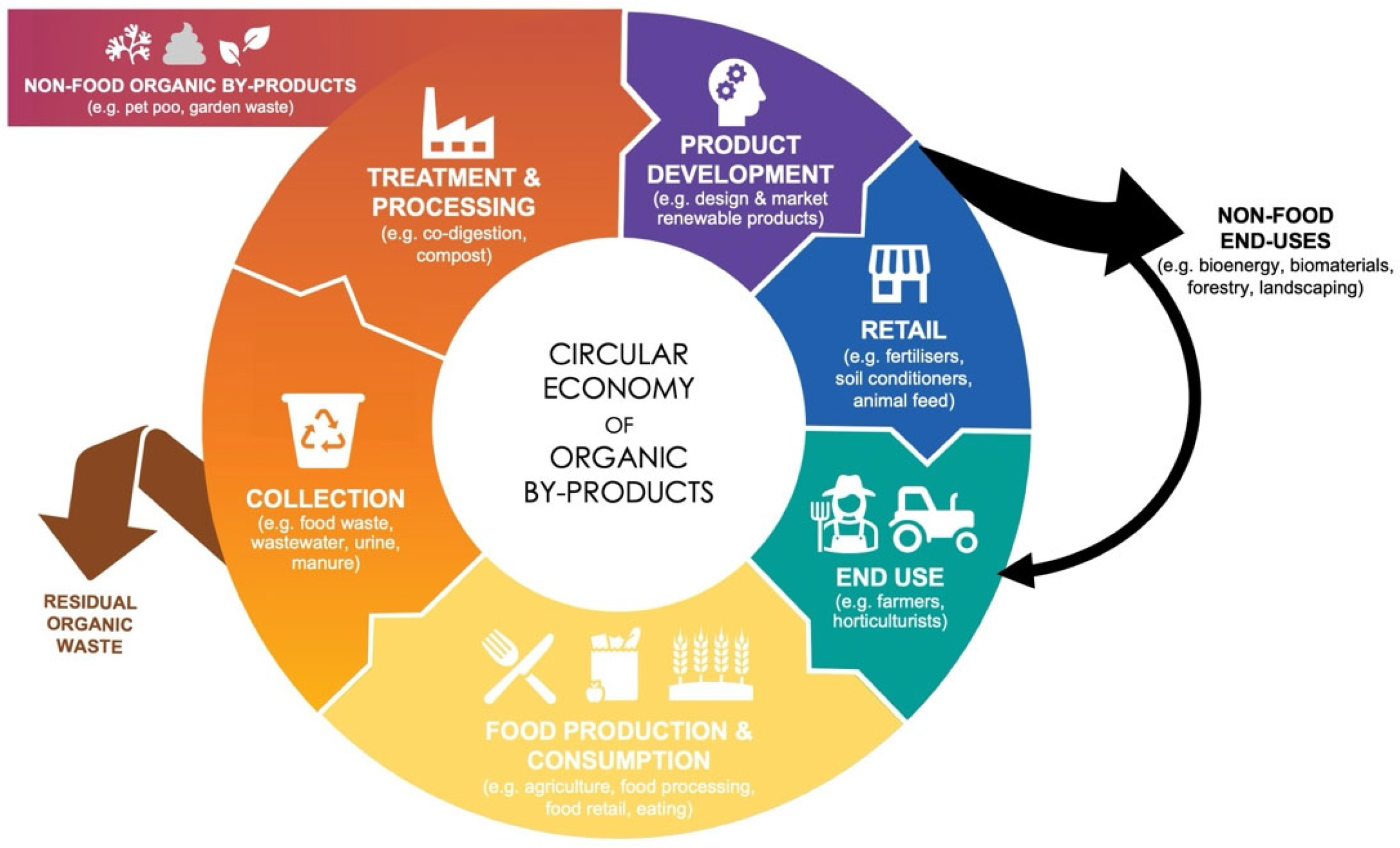
| Circular Economy of Organic Byproducts |
|---|
| Definition: The cost-effective reduction or recovery of any organic byproduct from the food system that is reprocessed for productive reuse in food, energy, or other sectors of the bioeconomy. |
| Principles: Principle 1: Prioritise the avoidance of organic waste generation before recycling. Principle 2: Prioritise food production first as the end-use. Principle 3: Seek to create clean feedstocks that are fit for purpose. Principle 4: Design recovery systems to suit targeted end-uses. |
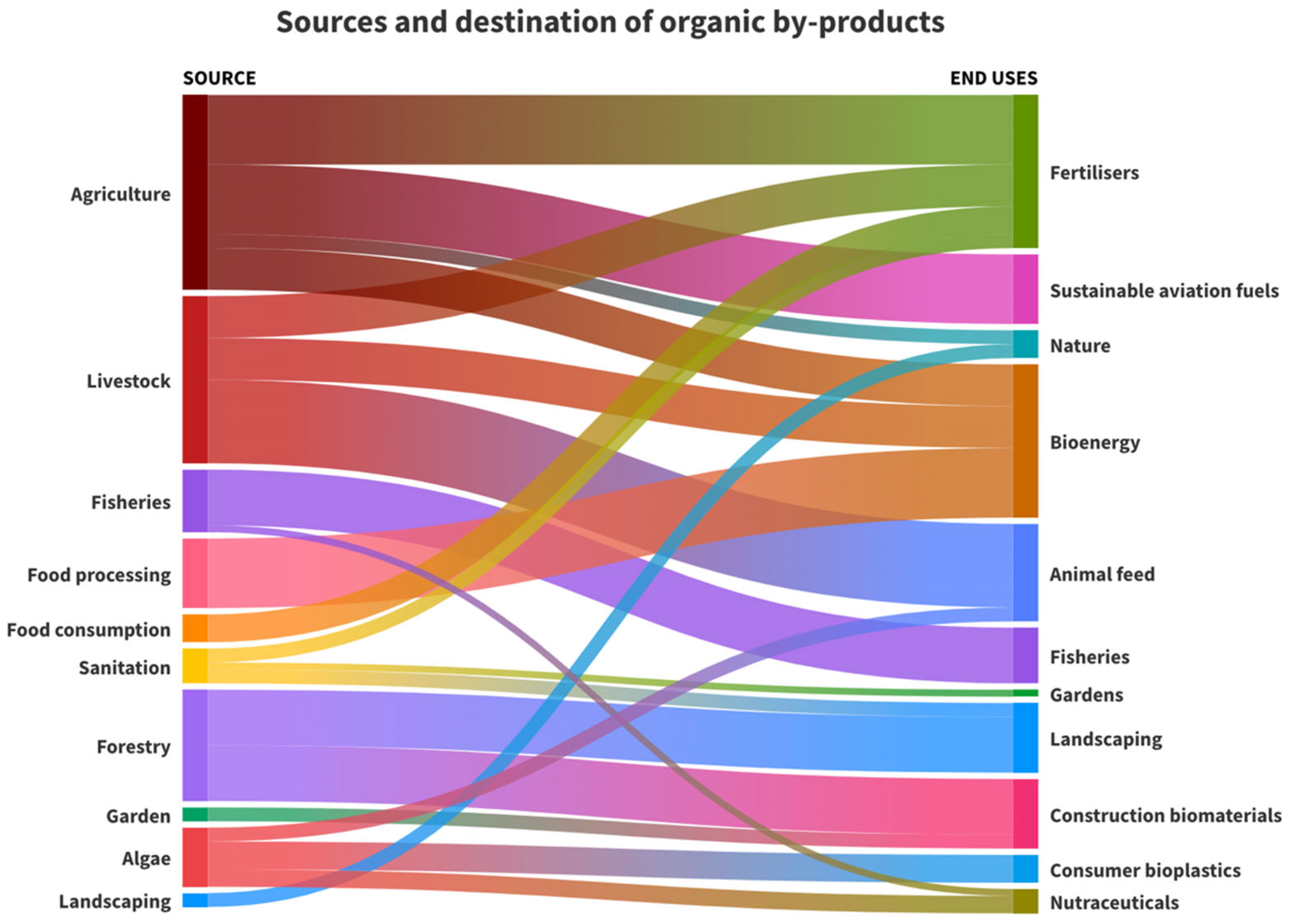
| ORGANIC BYPRODUCTS (RAW MATERIALS) | TREATMENT PROCESS | |||||||||
|---|---|---|---|---|---|---|---|---|---|---|
| Aerobic (Compost- ing Vermi-culture) | Anaerobic Digestion | Wastewater Treatment | Dehydration Dewatering Evaporation | Maceration Mulching, Chipping | Precipit-ation | Incineration | Pyrolysis | Combined Treatment | No Treatement (Direct Application) | |
| Agricultural residues (crop residues, pulp) | composted soil/mulch | digestate, liquor (+biogas) | – | residue cake | raw mulch | – | ash (+heat) | biochar | crop residues ploughed back into fields | |
| Animal manure (cow, poultry, etc.) | compost | digestate, liquor (+biogas) | slurry, biosolids | cake, pellets | – | sturvite (via dairy waste) | ash (+heat) | – | manure, slurry | |
| Animal wastes (blood, bone, carcass, other abattoir) | – | digestate, liquor (+biogas) | slurry, biosolids | – | organic fertiliser, soil conditioner? | – | ash (+heat) | – | Blood and bone (via rendering) | – |
| Farm yard waste (farm yared manure, bedding, straw) | compost | digestate, liquor (+biogas) | – | – | soil conditioner | – | ash (+heat) | biochar | – | |
| Human excreta (urine, faeces, mixed) | compost | digestate, liquor (+biogas) | effluent, biosolids, liquid injected slurry | sludge cake (via wwtp) | – | struvite (via wwtp) | ash (+heat) | ? | e.g., lime-treated biosolids (from wwtp) | – |
| Greywater – households (sink, shower, laundry, etc) | – | digestate, liquor (+biogas) | effluent, sludge, grease | – | – | – | – | – | – | |
| Liquid industrial wastes (e.g., fats, oils, grease) | – | digestate, liquor (+biogas) | effluent, sludge, grease | ? | – | ? | – | – | e.g.,liquid injection (from polymer separation) | |
| Food waste (mixed household, C&I, liquid or solid, individual food processors – cofffee beans, etc) | compost, soil conditioner | digestate, liquor (+biogas) | biosolids | cake | slury (direct injection) | – | ash (+heat) | biochar | e.g., soil conditioner (from rapid food waste decompo-ser) | injected liquid (e.g., ice cream) |
| Green waste (household garden, public or private landscaping, forestry) | composted soil/mulch | digestate, liquor (+biogas) | – | – | raw mulch, chips | – | ash (+heat) | biochar | ||
| Fish and seafood waste | compost | digestate, liquor (+biogas) | fish silage (via acid ferment-ation) | fishmeal and oils via rendering | animal feed | |||||
| Other (e.g., pet poo) | compost | digestate, liquor (+biogas) | slurry, biosolids | cake, pellets | – | – | ash (+heat) | – | – | |
| Country/Region | Circular Policy or Initiative | Organic Wastes Addressed | Progress |
|---|---|---|---|
| NSW (Australia) | Law: Mandate Food Organics and Garden Organics (FOGO) recycling (2025). Driver: Landfill cost, space limitations and organic waste GHG emissions. | Food waste, garden waste | In 2025, the Australian state of NSW mandated food organics and garden organics (FOGO) recycling to reduce food waste and stop food waste from going to landfill. By mid 2030, local councils in NSW will be required to provide all households with a FOGO waste collection service. By mid 2026, large food businesses (such as supermarkets and hospitality services) will also be required to have a source-separated food organics (FO) waste collection service. An AU$81 million FOGO Fund will support council infrastructure (and education). While the new law is focused primarily on diverting 1 million tonnes of organic waste from landfill, it is anticipated that it will be processed into compost for landscaping, sports fields and agriculture [23]. |
| Sri Lanka | Law: Ban fertiliser imports (2021). Drivers: Health concerns with fertiliser and pesticide use (chronic kidney disease of unknown aetiology); stimulating organic farming and domestic market for organic fertilisers. | Crop residues (e.g., paddy straw), manure, municipal waste compost | Following almost a decade of a cross-ministry strategy to create a “Toxin-Free Nation” due to concerns around the link between agro-chemicals and chronic kidney disease, Sri Lanka’s president banned the importation of synthetic chemicals (including fertilisers) in 2021. The intention was to stimulate the domestic organic fertiliser market and support organic agriculture more generally. Sri Lanka was the first country to transform to 100% organic farming. However, the ambitious and well-meaning ban did not have a transition plan to ensure that domestic organic fertiliser production could meet demand. The significant fertiliser shortages that ensued led to serious crop failures (including rice, considered a staple for national food security). This was set against a backdrop of severe economic turmoil in the country. The ban was eventually reversed in the same year. However, this demonstrates the need for a carefully planned transition, co-developed with key stakeholders and backed by research [24]. |
| Milan (Italy) | Policy: Food Policy for Sustainability (2015). Driver: Creating a sustainable food system for Milan. | Urban and peri-urban food waste | Milan has achieved remarkable separation results with their collection method, in the order of 87% (with less than 5% contamination). Milan has held control of their food system since the Middle Ages and includes today a big peri-urban food supply managed by a public agricultural park, university systems of knowledge, and other actors with a holistic and multilevel governance approach. Milan Food Policy is a revolutionary initiative defining 5 priorities for the city: ensuring healthy food and water for all citizens; promoting sustainability of the food system; promoting food education; fighting against food waste; and supporting scientific research in the agri-food sector. The governance model with horizontal (local) and vertical (metropolitan and regional) integration goes beyond silos mentality and is considered the reason for Milan’s success. Proper management and separation of food waste at the source is a key element of the policy. This is enabled with a door-to-door system, with dedicated space in each building that works well and is user-friendly, reaching 100% of all users in the boundaries (households, local businesses and open markets). The high participation results from user friendliness (compostable bags, frequent collection and ongoing communication). The communication channels consist of both digital and traditional avenues and are delivered in 10 different languages and via a dedicated app [25,26]. |
| EU Bioeconomy Strategy | Policy: A Strategic Framework for a Competitive and Sustainable EU Bioeconomy (2025). Drivers: Reduce reliance on imported fossil-based products; contribute to climate and environmental goals; drive economic growth and strengthen rural and coastal communities; support industry in shifting to circular production models. | Renewable biological resources (agricultural crops and residues, forestry byproducts, animal manure, food waste, municipal waste, used cooking oils, algae, marine waste) | The European Commission first launched its Bioenergy Strategy in 2012, designed to harness renewable biological resources—from agriculture, forestry, fisheries, and biotechnology—to produce food, energy, materials, and ecosystem services. The strategy was reviewed and updated in 2018 and 2022, shifting the focus towards industrial deployment, market scale-up, competitiveness and resilience. The most recent strategy, the Strategic Framework for a Competitive and Sustainable EU Bioeconomy (2024–2029), was launched in November 2025 and advances the EU’s bioeconomy policy into a fully integrated industrial agenda. Building on previous updates, it focuses on industrial deployment, scaling up biotechnologies, and stimulating green growth. It highlights that Europe’s bioeconomy is valued at €2.7 trillion and 17.1 million jobs in 2023, representing nearly 8% of EU employment. The strategy charts a path to build a sustainable and nature-positive bioeconomy by: (1) scaling innovation and investments; (2) building new lead markets for bio-based materials and technologies; (3) ensuring sustainable biomass supply across value chains; and (4) harnessing global opportunities [17]. |
| Japan | Law: Food Recycling Law (2001, amendment in 2007). Food Loss Reduction Promotion Act (2019). Drivers: Low food self-sufficiency ratio in Japan, reducing discarded food waste, promoting recycling into animal feed and fertiliser. | Food waste from businesses in the food industry (e.g., manufacturers, processors, food wholesalers, retailers, restaurants, cafes, hotels) | Recycling of household waste has been widely practised across all municipalities in Japan for decades (e.g., cans, bottles, metals, paper). However, the separated collection of organic waste from households has not progressed to the same level as other materials, as many municipalities incinerate organic waste as combustible waste. The Food Recycling Law, enacted in 2001, targets food-related business sectors only. Entities generating over 100 tonnes of food waste annually must submit annual reports to the relevant ministries and develop and implement plans to reduce waste and recycle unavoidable residues into feed, compost, biogas, or for heat recovery. If efforts are insufficient, authorities may issue guidance, orders, or public announcements and impose fines for non-compliance. In addition, the Food Loss Reduction Promotion Act, issued in 2019, focuses on reducing waste from both businesses and households by turning it into resources such as animal feed or fertiliser and promoting redistribution. The act sets goals to halve food loss by 2030 compared to 2000 levels through stakeholder cooperation and clearer responsibilities for businesses. Specifically, it aims to reduce food loss and waste from businesses by 60% and from households by 50% by FY2030, compared to FY2000 levels [27,28,29,30]. |
Disclaimer/Publisher’s Note: The statements, opinions and data contained in all publications are solely those of the individual author(s) and contributor(s) and not of MDPI and/or the editor(s). MDPI and/or the editor(s) disclaim responsibility for any injury to people or property resulting from any ideas, methods, instructions or products referred to in the content. |
© 2026 by the authors. Licensee MDPI, Basel, Switzerland. This article is an open access article distributed under the terms and conditions of the Creative Commons Attribution (CC BY) license.
Share and Cite
Cordell, D.; Jazbec, M.; Miyake, S.; Fane, S.; Dominish, E.; Turner, A.; Berry, F.; Ruoso, L.-E. Going in Circles: Integrating Food, Energy and Water Sectors to Enable a Thriving Circular Bioeconomy. Sustainability 2026, 18, 6165. https://doi.org/10.3390/su18126165
Cordell D, Jazbec M, Miyake S, Fane S, Dominish E, Turner A, Berry F, Ruoso L-E. Going in Circles: Integrating Food, Energy and Water Sectors to Enable a Thriving Circular Bioeconomy. Sustainability. 2026; 18(12):6165. https://doi.org/10.3390/su18126165
Chicago/Turabian StyleCordell, Dana, Melita Jazbec, Saori Miyake, Simon Fane, Elsa Dominish, Andrea Turner, Fiona Berry, and Laure-Elise Ruoso. 2026. "Going in Circles: Integrating Food, Energy and Water Sectors to Enable a Thriving Circular Bioeconomy" Sustainability 18, no. 12: 6165. https://doi.org/10.3390/su18126165
APA StyleCordell, D., Jazbec, M., Miyake, S., Fane, S., Dominish, E., Turner, A., Berry, F., & Ruoso, L.-E. (2026). Going in Circles: Integrating Food, Energy and Water Sectors to Enable a Thriving Circular Bioeconomy. Sustainability, 18(12), 6165. https://doi.org/10.3390/su18126165