5.2. Correlation Analysis and Multicollinearity Test
Table 3 presents the Pearson correlation coefficients among the key variables. Consistent with theoretical expectations, the focal independent variable, fintech, exhibits statistically significant but moderately correlated with the three measures of bank financial performance. Specifically, fintech is negatively and significantly associated with TQ (r = −0.139,
p < 0.05) and ROA (r = −0.103,
p < 0.10), while it shows a positive correlation with NIM (r = 0.206,
p < 0.001). These preliminary bivariate results suggest that fintech’s impact on bank performance is sensitive to performance metrics, warranting further identification through multivariate regressions to control for confounders.
Regarding the mediating variables, Green Finance (greenfinance) and ESG performance demonstrate strong positive correlations with both fintech and various performance indicators. Green finance is positively correlated with fintech (r = 0.400, p < 0.001), NIM (r = 0.335, p < 0.001), and ESG (r = 0.588, p < 0.001), highlighting the synergistic relationship between fintech development and green initiatives. Similarly, ESG displays significant positive correlations with NIM (r = 0.504, p < 0.001) and ROA (r = 0.255, p < 0.001), implying that superior ESG performance is conducive to enhancing bank profitability. These high correlations also hint at potential mediation pathways through which fintech may influence performance via green finance and ESG channels.
For the moderating variable, Ownership (SOE), the results reveal a significant negative correlation with TQ (r = −0.604, p < 0.001) and a positive correlation with NIM (r = −0.233, p < 0.001), yet no significant association with ROA. This indicates that state ownership exerts a distinct influence on different dimensions of bank performance, reflecting the unique institutional context of the Chinese financial sector.
Among the control variables, Bank Size (Size) shows significant positive correlations with most performance measures and mediating variables, confirming the scale economy effect in banking. Leverage (Lev) is negatively associated with TQ but positively with NIM, while Capital Adequacy Ratio (CAR) displays a positive relationship with ESG and ROA. Notably, the correlation coefficients between independent variables are generally below 0.60, suggesting a low risk of severe multicollinearity. Nevertheless, variance inflation factor (VIF) tests are still recommended in the subsequent regression analysis to ensure the reliability of empirical results.
The variance inflation factor (VIF) test was conducted to assess potential multicollinearity among the explanatory variables. As shown in
Table 4, the VIF values for all variables range from 1.020 to 1.650, with a mean VIF of 1.280. All individual VIF values are well below the conventional threshold of 5, indicating that multicollinearity is not a concern in the current model specification. The corresponding tolerance values (1/VIF) are all greater than 0.60, further confirming that no variable exhibits significant linear dependence on other regressors. These results validate the reliability of subsequent regression estimates and rule out multicollinearity as a confounding factor for the core coefficients of interest.
5.3. Regression Analysis
Table 5 reports the baseline fixed-effects regression results examining the impact of fintech on financial performance of commercial banks, measured by Tobin’s Q (TQ), net interest margin (NIM), and return on assets (ROA). All models include bank and year fixed effects, with robust standard errors. Consistent with theoretical expectations, fintech adoption exerts a positive and statistically significant effect on all three-performance metrics. Fintech is positively associated with TQ (β = 0.017,
p < 0.05), indicating enhanced market valuation. The effect on NIM is the strongest (β = 0.487,
p < 0.01), suggesting fintech significantly improves the banks’ interest-generating capability. Fintech also boosts ROA (β = 0.088,
p < 0.05), reflecting improved operational profitability.
This regression models exhibit strong explanatory power, with R-squared values ranging from 0.645 to 0.875. Control variables behave as expected: bank size (Size) positively impacts ROA but reduces NIM, while leverage (Lev) and non-performing loans (NPL) show adverse effects on NIM and ROA. These results provide robust initial evidence that fintech improves both market-based and accounting measures of bank financial performance, setting the stage for subsequent mediation and moderation analyses.
To verify the robustness of the baseline results, this study replaces the original financial performance measures with ROE and NIMW. The results are presented in
Table 6. The findings show that fintech remains positively associated with financial performance under alternative measurements. Specifically, fintech has a positive and significant effect on ROE (β = 0.013,
p < 0.05), indicating improved shareholder profitability. Similarly, fintech significantly enhances NIMW (β = 0.581,
p < 0.01), suggesting stronger interest-generating capability and intermediation efficiency.
The consistent coefficient signs and significance levels confirm that the main findings are robust to alternative proxies of financial performance. Among the control variables, Size and Lev positively affect ROE, while NPL negatively influences profitability. In addition, CAR shows a positive relationship with NIMW.
Overall, the robustness test results further support the conclusion that fintech development improves the financial performance of Chinese listed commercial banks.
The findings (
Table 7) indicate that lagged fintech remains positively associated with financial performance. Specifically, L.fintech has a significantly positive effect on TQ (β = 0.019,
p < 0.05) and ROA (β = 0.076,
p < 0.05). In addition, the coefficient on NIM is positive and marginally significant (β = 0.374,
p < 0.10). These results suggest that the positive impact of fintech on financial performance of banks may persist over time.
To address potential reverse causality, we use the one-year lagged fintech index as the core independent variable. The results confirm the positive effect of fintech on performance, although the statistical significance for NIM declines from p < 0.01 to p < 0.10. This attenuation is expected, as the contemporaneous relationship between fintech adoption and interest income generation is inherently stronger than the lagged effect, while the reduction in sample size also contributes to higher standard errors.
Overall, the consistency in coefficient signs and significance levels supports the robustness of the main findings and further confirms that fintech development has a positive contribution to the financial performance of Chinese listed commercial banks.
To mitigate the potential influence of extreme outliers, which might distort coefficient estimates and inflate standard errors in linear regression models, all continuous variables are winsorized at the 5th and 95th percentiles before re-estimating the baseline model. The results presented in
Table 8 are fully consistent with the main findings. Across all three specifications of financial performance, the coefficient of fintech remains positive and highly statistically significant at the 1% level (β = 0.019 for TQ, β = 0.580 for NIM, β = 0.115 for ROA, all
p < 0.01). The magnitude and significance of the estimated coefficients remain stable and are even strengthened relative to the baseline model, suggesting that the positive relationship between fintech adoption and bank performance is not driven by outlier observations. The models maintain strong explanatory power with consistent R-squared values (ranging from 0.642 to 0.875), and control variables behave as expected. These findings reinforce the reliability of our core conclusions and rule out outlier bias as a confounding factor.
To address potential endogeneity concerns and reverse causality between fintech adoption and bank financial performance, this study further employs an instrumental variable (IV) approach as a robustness test. Reverse causality may arise because banks with stronger financial performance are more likely to possess greater financial resources, technological capabilities, and digital infrastructure to invest in fintech development. Therefore, baseline panel regression estimations may suffer from endogeneity bias.
Drawing on prior fintech research, this study constructs an instrumental variable equal to the product of the number of post offices at the bank’s location in 1984 and the number of internet users in the previous year [
84]. Historical post office data and internet user data were obtained from the China Statistical Yearbook [
85]. The historical number of post offices reflects the regional communication infrastructure and early information transmission capacity, which may influence the regional foundation for subsequent digital financial development. Meanwhile, lagging internet users capture the degree of regional digitalisation and internet penetration. Therefore, the interaction term provides exogenous variation in fintech development while being less directly associated with current bank financial performance, thereby helping alleviate reverse causality concerns.
The first-stage regression results reported in
Table 9 show that the instrumental variable (“tool”) is positively and significantly associated with fintech adoption (β = 0.450,
p < 0.01), indicating that the instrument has strong explanatory power for fintech development among Chinese listed commercial banks.
The second-stage regression results further demonstrate that fintech remains positively associated with financial performance after controlling for endogeneity concerns. Specifically, fintech has a significantly positive effect on Tobin’s Q (β = 0.097, p < 0.01), Net Interest Margin (β = 4.824, p < 0.01), and Return on Assets (β = 0.149, p < 0.1). These findings are generally consistent with the baseline regression results, suggesting that the positive relationship between fintech adoption and bank financial performance remains robust after addressing potential reverse causality issues.
In addition,
Table 10 reports the weak-instrument-variable test results. The first-stage F-statistic is 38.121, which is substantially higher than the conventional threshold value of 10, indicating that the instrumental variable does not suffer from weak instrument problems. Therefore, the IV estimation results provide additional evidence supporting the robustness and reliability of the empirical findings.
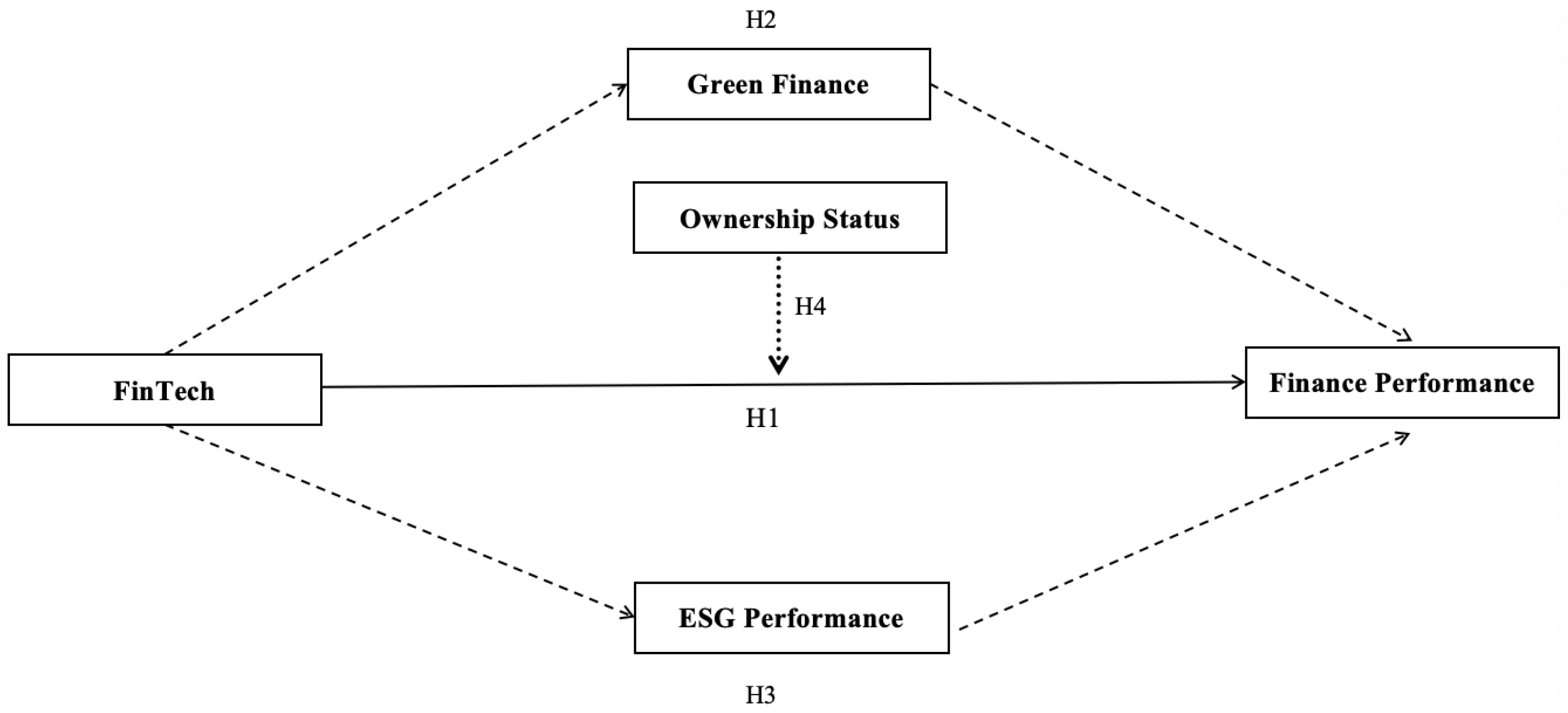
Table 11 presents the mediation effect analysis examining whether green finance serves as a channel through which fintech influences financial performance of banks. The stepwise regression results confirm a significant mediating pathway.
First, fintech adoption has a positive and significant effect on green finance (β = 0.022, p < 0.10), indicating that fintech facilitates banks’ engagement in green finance. Second, in the performance regressions, both fintech and green finance retain positive and significant coefficients across all three specifications. Specifically, green finance significantly improves TQ (β = 0.080, p < 0.01), NIM (β = 2.962, p < 0.01), and ROA (β = 0.316, p < 0.05), while the coefficients of fintech remain significant at conventional levels (β = 0.016 for TQ, β = 0.423 for NIM, β = 0.081 for ROA, all p < 0.05).
Therefore, these results satisfy the conditions for partial mediation: fintech promotes green finance, which in turn enhances bank performance, while the direct effect of fintech remains significant. This suggests that green finance acts as a complementary mechanism through which fintech exerts its positive influence on both market-based and accounting measures of bank performance. The findings remain robust to the inclusion of bank and year fixed effects and standard controls.
Table 12 presents the mediation analysis examining ESG performance as a potential channel through which fintech influences financial performance.
As the results shows, fintech is found to significantly improve banks’ ESG performance (β = 0.040, p < 0.05), suggesting that digital transformation enables banks to strengthen their environmental, social, and governance practices. In addition, when both fintech and ESG performance are included in the regressions for bank performance, ESG carries positive and statistically significant coefficients across all three specifications: TQ (β = 0.047, p < 0.01), NIM (β = 3.387, p < 0.01), and ROA (β = 0.192, p < 0.05). Meanwhile, the direct effect of fintech remains positive and significant (p < 0.05 in all models). These findings confirm the presence of partial mediation: fintech improves financial performance by enhancing ESG performance. The findings remain robust to the inclusion of bank and year fixed effects and standard controls.
Table 13 shows how ownership status (SOE versus non-SOE) moderates the link between fintech adoption and financial performance among Chinese listed commercial banks. The results reveal clear ownership-based differences in the effectiveness of fintech adoption.
The coefficient on fintech is positive and statistically significant across all three financial performance measures: Tobin’s Q (β = 0.037, p < 0.01), Net Interest Margin (β = 0.770, p < 0.01), and Return on Assets (β = 0.134, p < 0.01). This shows fintech adoption generally enhances market valuation, operational profitability, and asset utilization in Chinese listed commercial banks. The interaction term between fintech and SOE status (fintech × SOE) is negative and significant for all specifications: β = −0.039 and p < 0.01 for TQ, β = −0.571 and p < 0.05 for NIM, and β = −0.092 and p < 0.05 for ROA. This demonstrates that fintech’s positive impact on financial performance is weaker in state-owned banks than in non-state-owned banks.
This finding aligns with earlier studies on ownership heterogeneity and banking efficiency in China. Such as, these studies show that non-state-owned banks are more market-oriented, more flexible, and more innovation-driven than state-owned banks [
62,
65]. State-owned banks typically focus more on policy-related responsibilities, such as supporting strategic industries, regional development, and financial stability. These obligations may limit their flexibility in turning fintech investment into immediate profit. Previous research also finds that state-owned banks operate under multilayered governance and stricter oversight, which can slow decision-making and digital transformation compared to non-state-owned banks [
86].
The results are also broadly consistent with China’s institutional and banking structure. According to the China Banking and Insurance Regulatory Commission (CBIRC), large state-owned commercial banks continue to dominate policy-related lending and financial inclusion responsibilities. In contrast, joint-stock and city commercial banks exhibit stronger competitiveness in digital banking services, online lending innovation, and customer-oriented fintech applications. This institutional heterogeneity may explain why non-state-owned banks are better able to convert fintech adoption into greater improvements in market valuation and operational efficiency.
Overall, these findings show that ownership status is a key institutional factor shaping the impact of fintech adoption in the Chinese banking sector. The results also indicate that fintech value creation depends not only on technological investment but also on organisational flexibility, governance structures, and institutional incentives across ownership systems.