


Abstract
People with disabilities face multiple challenges in the labor sphere, including barriers to access, discrimination, lower job stability, and limited opportunities for development, all of which restrict their economic and social participation. In response to this reality, public policies aimed at labor inclusion have gained increasing relevance due to their potential to reduce inequalities and strengthen social sustainability. The aim of this study was to analyze public policies designed for the labor inclusion of people with disabilities by identifying their main characteristics, target populations, implementation barriers, and their relationship with social sustainability. The PRISMA methodology was applied, and, as a result of the search, selection, and evaluation process, 75 primary studies were included in the analysis. The results show that policies are mainly concentrated on measures to facilitate access to employment, incentives for employers, and vocational training, while entrepreneurship receives less attention. Most policies are directed toward people with disabilities in general, with limited attention to specific subgroups. Persistent barriers were identified, including prejudice, weak institutional coordination, and a gap between regulatory frameworks and their effective implementation. It is concluded that, although these policies show progress in terms of inclusion, their contribution to social sustainability depends on more effective, better coordinated, and more responsive implementation that takes into account the diversity of needs within this population.
1. Introduction
Work constitutes a fundamental element for people’s well-being, social inclusion, and economic participation, as it enables the development of autonomy, the construction of life projects, and the full exercise of rights. In the case of people with disabilities, access to decent work acquires even greater relevance because of its impact on quality of life and effective integration into society. However, this group faces multiple structural barriers that limit both access to and retention in the labor market, a situation that becomes even more acute in contexts of crisis or economic transformation, where inequalities tend to deepen [1].
In response to this reality, public policies aimed at the employment of people with disabilities have gained increasing relevance at the global level, particularly in developed countries, due to their role in promoting social and economic inclusion. In addition, their strengthening is linked to the achievement of the Sustainable Development Goals, particularly those related to reducing inequalities, promoting inclusive economic growth, and generating employment opportunities for historically excluded groups.
Despite regulatory advances and the implementation of various strategies, the employment rates of this group remain considerably lower than those of the non-disabled population. This situation can be explained by the persistence of barriers such as social prejudice, costs associated with workplace accommodations, and limitations in the design of support systems. Even some protective mechanisms, such as disability insurance, may generate unintended effects that restrict labor market integration. Consequently, there is a need for more flexible, targeted, and integrated policies that incorporate appropriate incentives and help overcome existing structural barriers [2].
Various studies have addressed the labor inclusion of people with disabilities from different analytical perspectives. From an approach centered on the evaluation of specific policies, Kiasuwa Mbengi et al. [3] analyzed the main measures and initiatives aimed at (re)integration into the labor market, assessing their suitability to benefit particular groups, such as cancer survivors. Based on a review of scientific literature and institutional documents from international organizations and member states of the European Union, they classified these measures into economic incentives and vocational rehabilitation strategies. Their findings show that, although relevant efforts exist to promote (re)employment, policies tend to be generalist, with limited focus on the specific needs of certain subgroups.
From an economic perspective, Ernst et al. [4] examine the impact of fiscal policy instruments on labor inclusion, analyzing how cash transfers, taxation, and disability benefits influence the participation of vulnerable groups. Their results indicate that the effectiveness of these policies is heterogeneous and depends on program design, institutional context, and demographic characteristics, with important variations according to gender and level of disability. This perspective highlights the need to articulate fiscal policies with other strategies in order to enhance their effects and avoid counterproductive outcomes.
In turn, Myshbayeva et al. [5] address this topic from a systematic and bibliometric perspective, analyzing the evolution of scientific production on employment policies for people with disabilities. Based on 1284 publications indexed in Scopus, they identify a gradual shift toward a human rights-based paradigm, driven by the Convention on the Rights of Persons with Disabilities. This analysis also reveals a thematic expansion of the field, the predominance of the social sciences and medicine, and the growing recognition of digital technologies as facilitators of inclusive employment opportunities.
From a training and capacity-building perspective, Lee [6] argues that special education and vocational rehabilitation constitute fundamental pillars in labor inclusion processes, as they strengthen social and work-related skills, promote self-determination, and facilitate the transition to adulthood. This perspective underscores the importance of interdisciplinary work based on collaboration among educational, social, and labor actors, as well as the implementation of individualized plans tailored to each person’s needs.
Despite these advances, significant gaps remain in the systematization and analysis of public policies aimed not only at employment but also at entrepreneurship for people with disabilities, since, although information exists on policies implemented in different countries, it is not systematically organized or consolidated in a unified manner. To this end, it is necessary to further deepen the identification, classification, and analysis of these policies in order to understand their scope, limitations, and potential impact on social sustainability.
Accordingly, the present study aims to analyze public policies intended to promote the labor inclusion of people with disabilities by identifying their main characteristics, target populations, and implementation barriers, as well as their relationship with social sustainability, the latter understood as a normative category and doctrinal reference framework for conceptual analysis. The study seeks to provide evidence that contributes to the design of more effective and inclusive strategies. To this end, the following research questions were formulated:
- What public policies focused on the labor inclusion of people with disabilities are reported in the literature?
- Which populations or types of disability are targeted by labor inclusion laws and policies?
- What are the main barriers related to the implementation and effectiveness of labor inclusion policies for people with disabilities?
- How do public policies for labor inclusion relate to social sustainability, considering the factors that limit their effectiveness and coverage?
Theoretical Framework
Social sustainability can be understood as the capacity of a society to ensure conditions of equity, inclusion, participation, and well-being for all its members over time [7,8]. From this perspective, the labor inclusion of people with disabilities goes beyond the sphere of social policy and employability, as it constitutes a central component of social sustainability insofar as it contributes to reducing structural inequalities, expanding opportunities for economic participation, and strengthening social cohesion [9]. This approach can be examined in line with the Sustainable Development Goals, particularly SDG 8, which promotes access to inclusive employment opportunities; SDG 10, aimed at reducing inequalities and fostering social, economic, and political inclusion; and SDG 16, which emphasizes the importance of effective, accountable, and inclusive institutions [10]. From this standpoint, public policies for labor inclusion can be assessed not only by their ability to increase employment rates but also by their contribution to strengthening more equitable, accessible, and sustainable environments for people with disabilities.
In turn, the social inclusion approach conceives inclusion as a process aimed at ensuring the full participation of individuals in the different spheres of social, economic, political, and cultural life. From this perspective, exclusion is not limited to a lack of income but also involves restrictions in access to opportunities, resources, and decision-making spaces that affect the exercise of citizenship [11]. In the case of people with disabilities, this approach makes it possible to understand that employment and entrepreneurship are not merely means of subsistence but fundamental mechanisms for strengthening autonomy, dignity, and active participation in society. Consequently, economic inclusion becomes a central component in the construction of more equitable and inclusive societies.
Consistent with this approach, the concept of disability has evolved toward a broader and more comprehensive understanding. The WHODAS 2.0 Disability Assessment Schedule Manual [12], based on the International Classification of Functioning, Disability and Health, states that disability should not be understood as an isolated medical condition but rather as the result of the interaction between a health condition and limitations in everyday functioning. This approach incorporates dimensions such as mobility, self-care, cognition, and social participation, including not only permanent disabilities but also conditions derived from chronic illnesses and mental disorders that affect functional performance.
Based on this conception, public policies should be designed under a comprehensive approach that articulates different levels of intervention. In this regard, the International Labour Organization [13] argues that the labor inclusion of people with disabilities should be integrated transversally into national employment policies, ensuring equal opportunities through anti-discrimination regulatory frameworks, accessibility in workplace environments, and the provision of reasonable accommodations. Likewise, the importance of strengthening employability through education, vocational training, and labor intermediation services, together with incentives for employers, is emphasized.
Additionally, in his OECD document, Kitching [14] argues that inclusion policies should not be limited to formal employment but should also consider self-employment and entrepreneurship as relevant alternatives for economic participation. From this perspective, entrepreneurship is presented as a pathway to overcome the barriers of the traditional labor market; however, its development requires enabling conditions such as access to financing, business training, and technical support. Therefore, the implementation of comprehensive policies is necessary to foster these forms of economic integration and reduce the structural obstacles faced by people with disabilities.
The international normative framework reinforces these arguments through the Convention on the Rights of Persons with Disabilities [15], which, in Article 27, recognizes the right to work on an equal basis with others in open, inclusive, and accessible work environments. This instrument establishes the obligation of States to guarantee non-discrimination at all stages of employment, promote fair working conditions, ensure access to vocational training, and encourage both employment in the public and private sectors and entrepreneurship. In addition, it incorporates the principle of reasonable accommodation and protection against inadequate working conditions, thereby consolidating a rights-based approach grounded in inclusion and human dignity.
However, from the perspective of Pressman and Wildavsky’s public policy implementation theory [16], it is recognized that the existence of normative frameworks does not guarantee effective results. This perspective makes it possible to analyze the gap between policy design and its actual implementation, showing that factors such as institutional capacity, coordination among stakeholders, availability of resources, and the socioeconomic context condition policy impact. In the field of labor inclusion of people with disabilities, these limitations explain why, despite normative advances, inequalities persist in access to, retention in, and advancement within employment.
On this theoretical basis, the analysis of public policies aimed at the inclusion of people with disabilities in employment and entrepreneurship can be organized into six categories: access to and labor market entry; retention, accommodation, and career progression; entrepreneurship, self-employment, and business support; training and capacity-building; equality, non-discrimination, and rights protection; and incentives and support for employers. This classification makes it possible to structure the study from a comprehensive approach that articulates rights, capabilities, and implementation mechanisms, thereby facilitating the understanding of the strategies used to promote effective labor inclusion.
2. Materials and Methods
For the development of this study, the PRISMA methodology (Preferred Reporting Items for Systematic Reviews and Meta-Analyses) was employed. PRISMA is a standardized approach that guides the identification, selection, appraisal, and synthesis of scientific evidence in systematic reviews, thereby ensuring transparency, rigor, and reproducibility throughout the process [17]. This methodology makes it possible to clearly structure each phase of the study, from the information search to the final inclusion of the analyzed documents. Accordingly, the procedures applied are described in detail in the following sections, which present the search stages, inclusion and exclusion criteria, study selection process, and data analysis.
All phases of the review were documented and are publicly available through OSF Records and the Supplementary Materials repository. The corresponding access information is included in the Data Availability Statement, while the full set of databases, matrices, and analytical resources employed in this study is provided in the Supplementary Materials Section.
2.1. Eligibility Criteria and Information Sources
To identify the scientific evidence, the Scopus and Web of Science databases were used, given their broad coverage and rigor in indexing academic literature. A combined search strategy was designed in which terms related to public policy were restricted to the title field, whereas terms linked to labor inclusion were applied to the title, abstract, and keyword fields. This methodological decision was based on preliminary tests that made it possible to refine the search string, achieving greater precision in retrieving studies directly related to the topic while avoiding the inclusion of irrelevant research.
The search was limited to the last ten years, including the months elapsed in the current year, in order to ensure the timeliness of the evidence. Regarding the eligibility criteria, only scientific articles, conference papers, review articles, and book chapters were considered due to their academic nature and methodological rigor.
2.2. Search Strategy
The search process was carried out iteratively, beginning with a query in the Scopus database using keywords aligned with the objectives of the study. The retrieved records were then subjected to exploratory analysis using RStudio (version 4.4.2) and the Biblioshiny tool, which made it possible to identify thematic trends, relationships among terms, and co-occurrence networks. This analysis facilitated the refinement and optimization of the search strategy by incorporating more precise and relevant terms.
Based on this refinement, the filters corresponding to the eligibility criteria were established, limiting the retrieval of documents to those containing the key terms in the predefined fields in order to ensure their relevance. The final search strategy was applied uniformly across all selected databases on 5 March 2026, ensuring consistency in the process and comparability in the results obtained (see Table 1).
Table 1.
Search strings and the results obtained.
2.3. Study Selection Process
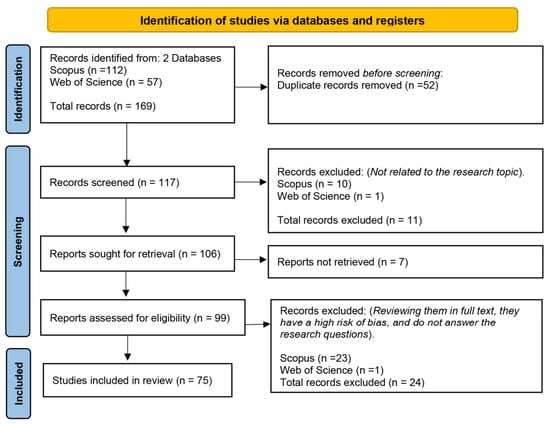
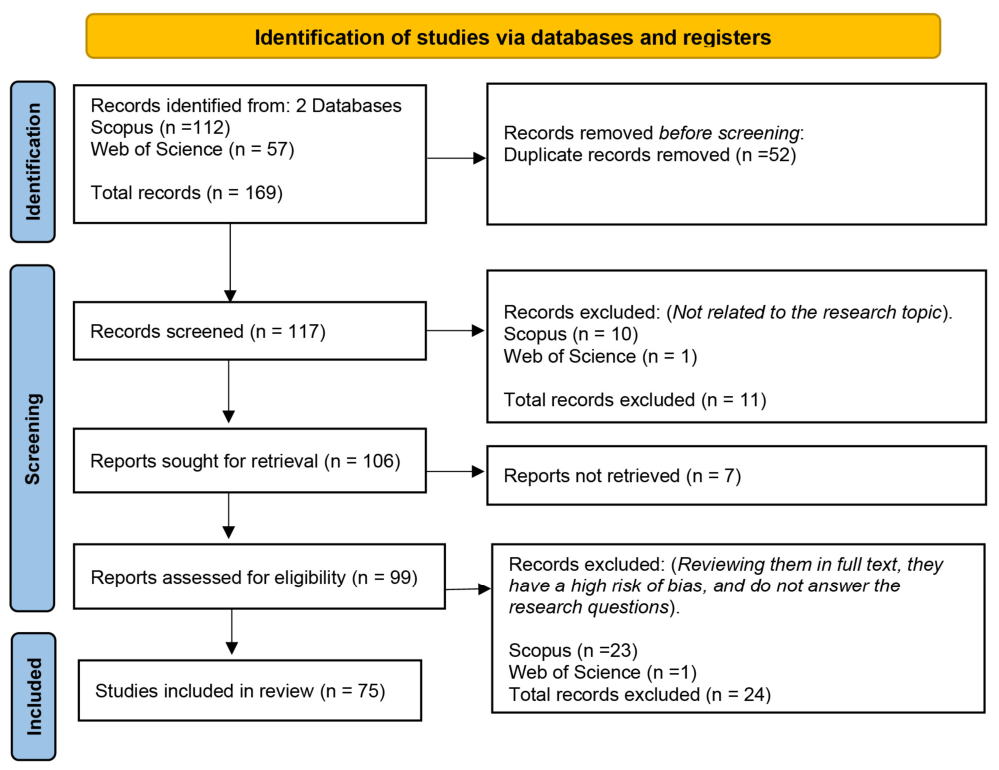
The study selection process was conducted in accordance with the stages established by the PRISMA methodology. In the identification phase, a total of 169 records were retrieved from the selected databases. Subsequently, duplicate records were manually identified, and 52 records were removed prior to the screening process.
During the screening phase, 117 studies were examined through title and abstract review, and 11 documents were excluded for not being related to the research topic. Next, 106 documents were sought for full-text assessment; however, 7 could not be retrieved.
In the eligibility stage, 99 full-text studies were assessed, of which 24 were excluded due to high risk of bias or because they did not address the research questions. Finally, 75 studies were included in the review. It should be noted that all stages of the process were carried out manually and involved the participation of all authors, who contributed to the review, validation, and consensus of the decisions made at each stage (see Figure 1).
Figure 1.
PRISMA flowchart.
2.4. Bias Risk Assessment
The risk of bias assessment was conducted through a three-stage screening process. In the first stage, titles, abstracts, and keywords were reviewed, with each author assessing a set of studies. Subsequently, a second author reviewed these assessments, and, in cases of disagreement, a third author acted as an adjudicator to reach consensus. In the second stage, the selected studies were evaluated using the QuADS tool, which allows the assessment of methodological and reporting quality based on 13 criteria, including theoretical underpinning, clarity of objectives, study design, sampling, and data collection and analysis, as well as the consideration of relevant stakeholders and the discussion of limitations. This process can be found in the Supplementary Materials. In the third stage, a full analysis of the studies was conducted, excluding those that, despite meeting methodological criteria, did not address any of the proposed research questions.
2.5. Synthesis Methods
Data extraction was carried out using a matrix designed in Microsoft Excel, in which the relevant information from each included study was systematized. Based on the analysis of the documents, specific phrases or sections that addressed the research questions were identified and extracted, and these were recorded in the matrix for subsequent analysis. In addition, contextual data such as the country of origin of each study were collected in order to provide a broader view of the evidence analyzed.
Regarding the synthesis methods, the identified policies were classified into categories previously defined according to the theoretical framework, following a primarily deductive approach based on a conceptual framework, which allowed the information to be organized and interpreted systematically. Findings related to other research questions, such as target populations and identified barriers, were synthesized through narrative analytical paragraphs, integrating the evidence with corresponding citations to ensure coherence, transparency, and theoretical support. This combination of approaches maintained methodological rigor while providing an interpretative perspective that connected the findings with the study objectives and facilitated understanding of patterns and trends in labor inclusion policies.
3. Results
3.1. Bibliometric Data
The results obtained provide a comprehensive understanding of the characteristics of public policies aimed at the labor inclusion of people with disabilities, as well as their main approaches and limitations. In order to complement this analysis, bibliometric data are also presented to contextualize the scientific production in this field, identify research trends, and recognize the geographical distribution of the studies analyzed.
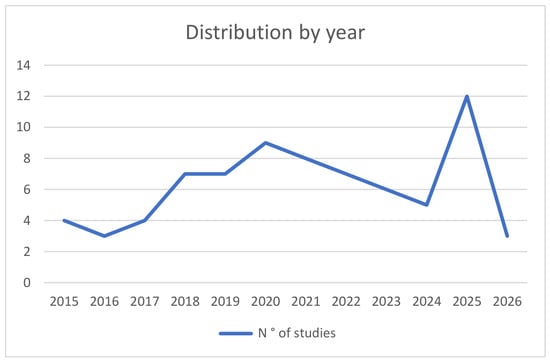
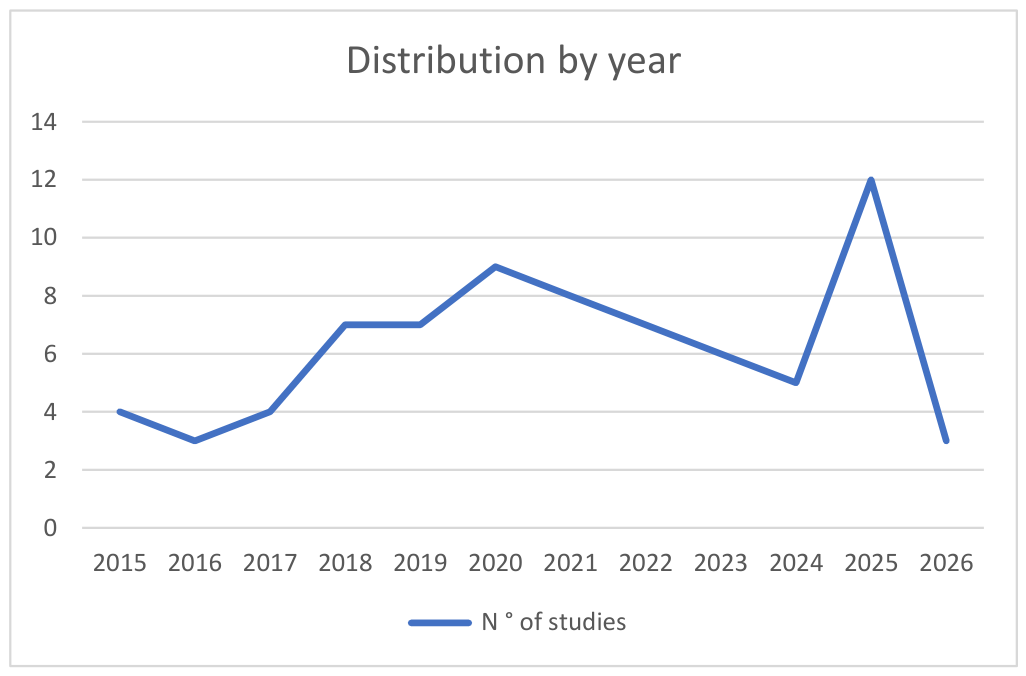
The distribution of studies by year shows a general growth trend in scientific production over time (see Figure 2), with a progressive increase beginning in 2018 and reaching an initial peak in 2020. Subsequently, a slight fluctuation can be observed between 2021 and 2024, with relatively stable levels being maintained. A significant increase is evident in 2025, which represents the highest number of publications and may reflect growing recent interest in the topic. Finally, the decrease observed in 2026 may be explained by the fact that the year is still ongoing.
Figure 2.
Distribution of studies by year.
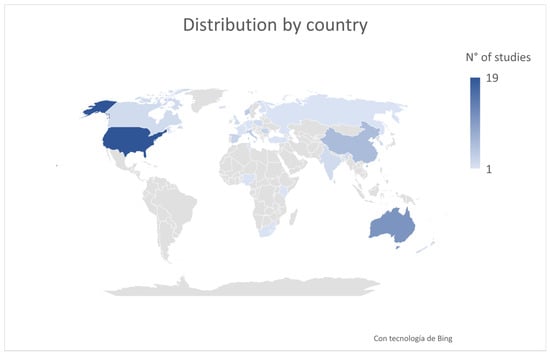
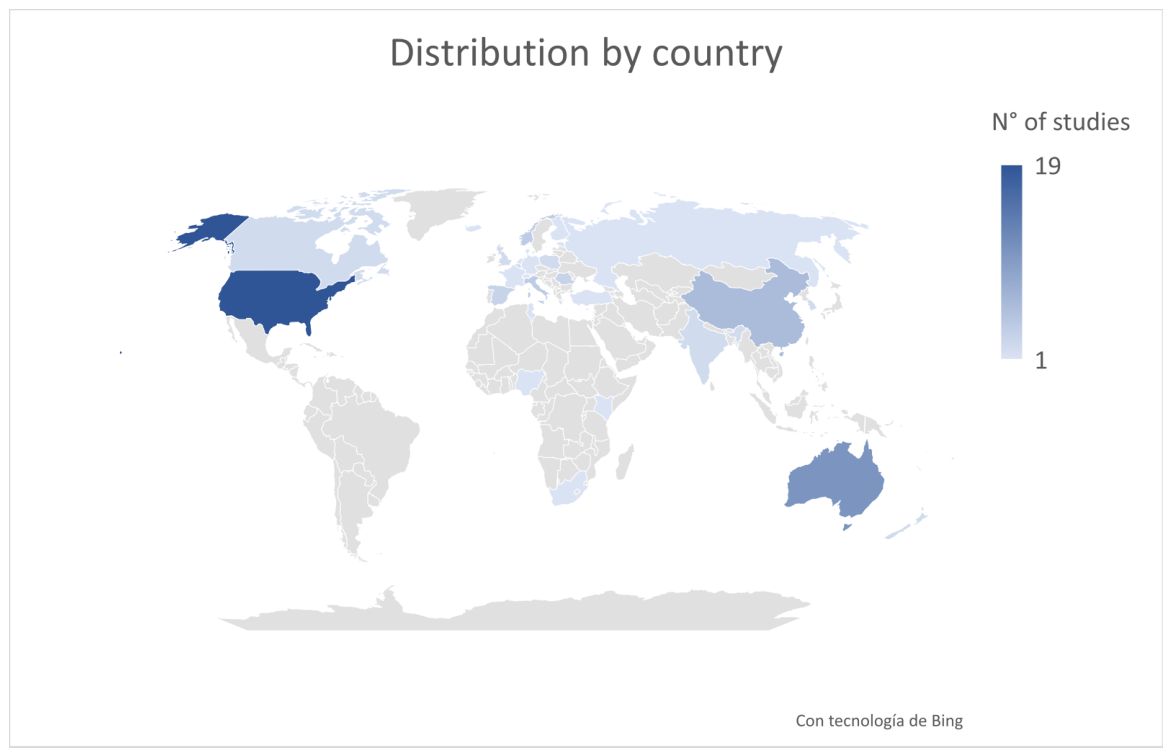
The distribution of studies by country (see Figure 3) reveals a clear concentration of scientific production in developed economies, with the United States and Australia standing out as the contexts with the highest number of studies. China also shows a significant contribution, followed by European countries such as Italy, Norway, and Spain. In contrast, lower representation is observed in countries from Africa, the Middle East, and some regions of Latin America, suggesting a possible geographical gap in the production of evidence. This distribution indicates that the analysis of labor inclusion policies for people with disabilities has been addressed more intensively in contexts with greater institutional development and research capacity, which may influence the dominant approaches and models in the literature.
Figure 3.
Distribution of studies by country.
3.2. Typology of Public Policies and Forms of Implementation
The analysis of the literature made it possible to identify a diversity of public policies aimed at the labor inclusion and entrepreneurship of people with disabilities, as well as different forms of implementation across the contexts analyzed. The findings reveal patterns in both policy design and application, which facilitate their organization into a structured typology. These findings are systematized in Table 2, where the identified policies are presented together with their main characteristics and modes of implementation.
Table 2.
Employment policies and incentives focused on people with disabilities.
Various countries have implemented public policies aimed at promoting the labor inclusion of people with disabilities by combining regulatory mechanisms, economic incentives, and support programs. In Europe, mandatory employment quota systems predominate. Germany requires companies with 20 or more employees to ensure that at least 5% of their workforce consists of persons with disabilities [59], while France establishes a 6% quota for employers with 20 or more workers, and Spain sets a 2% quota for companies with 50 or more employees. In the French case, this system has historically been strengthened through the creation of the AGEFIPH fund and its articulation with anti-discrimination legislation [26], which has enabled the labor market inclusion of more than one million people with disabilities and has contributed to transforming social perceptions toward an approach centered on integration and vocational rehabilitation.
In the United States, the approach is centered on rights protection and regulatory compliance. The Americans with Disabilities Act (ADA) prohibits employment discrimination, while Section 503 of the Rehabilitation Act establishes that federal contractors with 50 or more employees and contracts exceeding US$50,000 must achieve a target of 7% of workers with disabilities. If they fail to meet this target, companies must identify internal barriers and implement corrective measures. This framework is complemented by the Workforce Innovation and Opportunity Act (WIOA), which strengthens vocational rehabilitation and access to high-demand jobs [20]. In addition, programs such as PROMISE have shown positive results, increasing the employment rate of youth with disabilities from 1% in 2013 to 67% in 2018, exceeding the control group by 10 percentage points [59].
In Asia, approaches combine quotas and economic incentives. In China, regulations establish that 1.5% of the workforce in both the public and private sectors must be composed of people with disabilities, accompanied by subsidies and tax deductions for compliant employers, as well as mandatory contributions to the Employment Security Fund for Persons with Disabilities in cases of non-compliance [23]. South Korea, for its part, has developed a more comprehensive system that includes differentiated mandatory quotas, reaching 3.1% in the private sector and 3.6% in public institutions, along with vocational rehabilitation programs, personalized training, and the creation of adapted work environments. This model includes initiatives such as the Employment Success Package, which provides support from guidance to job placement, as well as the development of new occupational opportunities in sectors such as smart agriculture, cultural activities, and digital accessibility [24].
In Eastern Europe, Estonia implemented a reform in 2016 aimed at labor activation, shifting people with reduced work capacity from welfare schemes to active labor market policies. This model is based on individualized plans that include multidisciplinary assessment, counseling, training, and rehabilitation, with programs lasting approximately six months and partially financed by the European Social Fund [47]. In Romania, policies combine mandatory quotas for companies with more than 50 employees, workplace adaptation measures, supported employment, and tax incentives, together with the creation of sheltered units and protected jobs aimed at facilitating labor market inclusion [27].
Other countries have developed complementary policies. In Denmark, the 2013 reform sought to reduce access to disability pensions and promote labor market integration by tightening eligibility criteria and expanding subsidized employment. In the United Kingdom, Active Labour Market Policies (ALMPs) and Public Employment Services (PES) have been used to promote labor inclusion [21]. In Australia, the Disability Employment Services (DES) program constitutes the main job intermediation mechanism, complemented by national mental health and employment strategies [35]. In Turkey, quota systems applicable to private companies with more than 50 employees have been implemented, while in South Africa, a target of 2% employment of people with disabilities in the public sector has been established [48].
The analysis of the typology of public policies reveals that measures aimed at labor access and insertion predominate, probably because they represent interventions that are easily quantifiable and have an immediate impact on the inclusion of people with disabilities. These policies are more common in contexts where there are clear regulatory frameworks, sufficient institutional capacity, and active monitoring systems, which facilitate their implementation and compliance. In contrast, policies aimed at job retention, career progression, and support for entrepreneurship are less common, as they require more complex interinstitutional structures, coordination between health, education, and employment sectors, and greater commitment from employers, which explains their lower prevalence in practice.
Nevertheless, despite the diversity of policies implemented, the results reveal important limitations in their effectiveness. In China, despite the mandatory nature of the system, only 10.5% of people with disabilities were employed in 2016, and only 7.5% were employed through the quota system, showing that many companies choose to pay fines or resort to fraudulent practices, such as purchasing disability certificates [25]. In Romania and other countries, employers also tend to comply through payments to the State rather than through actual hiring. In South Africa, the 2% target has not been achieved, with only 1.2% to 1.4% recorded at senior management levels. In Australia, the DES program has shown limited success rates, with only between 23% and 24.5% of participants obtaining employment after several months of support. Likewise, in the United States, fewer than 2% of participants in vocational rehabilitation programs achieve self-employment. These limitations are associated with problems in policy design, lack of effective incentives, weak institutional coordination, limited coverage among small and medium-sized enterprises, and the persistence of structural barriers, all of which reveal a significant gap between policy objectives and their actual implementation.
Therefore, the effectiveness of policies varies according to the institutional and regional context: in countries with consolidated welfare regimes and clear incentive systems, such as mandatory quotas and wage subsidies, policies tend to produce more consistent results in labor inclusion, whereas in contexts with fragmented regulation or weak oversight, compliance may be merely formal, limiting substantive inclusion. Factors such as institutional capacity, labor market dynamics, and the structure of welfare systems largely explain these differences.
3.3. Target Populations of Labor Inclusion Policies
Existing research shows that labor policies are primarily oriented toward people with disabilities in general, without establishing specific distinctions according to the type, degree, or nature of disability [19,20,25,40,44,60,61,62,63,64]. This generalist approach is reflected in a wide variety of policy instruments. In most cases, these policies are designed under a broad integration logic aimed at ensuring access to employment and labor market participation on equal terms with the rest of the population. However, this perspective tends to group people with disabilities as a homogeneous collective, which may limit the effectiveness of interventions in addressing diverse needs.
Despite this predominant trend, policies targeting specific subgroups within the population of people with disabilities have also been identified, although less frequently. Among these are people with intellectual disabilities [18,22,43,65,66,67], who are often the target of sheltered employment programs, vocational training, and intensive support throughout labor market insertion processes. People with psychosocial disabilities or mental disorders [3,33,34,53,68,69] also constitute a relevant group, particularly in policies that integrate mental health services with labor inclusion strategies, such as supported employment, evidence-based vocational rehabilitation, and continuous support during recovery processes. Likewise, people with chronic illnesses or health conditions that affect work capacity, such as cancer, musculoskeletal diseases, or functional disorders [3,21,27,70], are also included, for whom measures such as reduced working hours, gradual return to work, and access to rehabilitation services are implemented.
At another level of analysis, there is evidence of policies directed at populations undergoing specific stages in their work or life trajectories. This group includes young people with disabilities [1,6,37,52,59,71] who are transitioning from the education system to employment and who benefit from training programs, work placements, pre-employment transition services, and early labor market insertion strategies. Interventions targeting older adults with disabilities, particularly those of advanced working age [24,72,73,74], have also been identified, as well as policies aimed at people who have experienced prolonged periods of unemployment or who have low levels of qualification, reflecting the incorporation of socioeconomic vulnerability criteria into policy design.
Another line of intervention is directed toward populations with specific characteristics derived from their social, occupational, or historical context. These include war veterans with disabilities [26,46,74,75,76], who have access to specialized vocational rehabilitation programs, hiring incentives, and support for labor market reintegration. People injured at work or affected by industrial accidents and occupational diseases [77] have also been identified as targets of policies focused on rehabilitation, compensation, and even reintegration into the labor market. In addition, groups such as ethnic minorities, immigrants, and people with severe disabilities [31,72,78] are included, although their presence in the policies analyzed is less frequent, suggesting limited targeting of these groups.
A further set of policies is aimed at people undergoing rehabilitation or labor reintegration processes, regardless of the origin of their condition. These include individuals with temporary or permanent disabilities, people with reduced work capacity, and those returning to work after prolonged periods of incapacity [58,79]. In these cases, the policies focus on capacity assessment, skills development, continuous support, and coordination among health, employment, and education services, thus reflecting a more comprehensive approach.
The results show that, although there is a diversity of target populations, a general approach aimed at people with disabilities as a whole still predominates. Policies directed at specific subgroups appear less systematically, suggesting limited segmentation and posing challenges for adapting interventions to particular needs within the labor sphere.
3.4. Barriers to the Implementation and Effectiveness of Policies
The literature shows that the main barriers to the labor inclusion of people with disabilities are concentrated in the structural weaknesses of public policies and in limitations related to their implementation. Insufficient, outdated, or unclear regulatory frameworks have been identified, together with the absence of unified definitions of disability [32,36,54,60,78,80,81,82], which generates inconsistencies in policy application and hinders the proper identification of the target population. Added to this are the lack of program impact evaluation, the scarcity of comparable statistical data [28,66,76], and the limited articulation among health, employment, and social protection systems [35], all of which reduce the effectiveness of interventions and weaken evidence-based decision-making.
Another set of barriers is related to institutional implementation and service management. Weak inter-institutional coordination [67], insufficient financial and human resources, and limited training of the professionals responsible for implementing these policies have been observed [29,44,52,77]. These limitations translate into fragmented services, low coverage, limited flexibility in support provision, and difficulties in rehabilitation and labor market integration processes. Problems in policy design have also been identified, such as an emphasis on compensation rather than labor activation, the lack of effective incentives for returning to work, and the absence of clear monitoring and control mechanisms [27,53,83].
Labor market barriers constitute another critical dimension. Prejudice, stereotypes, and negative perceptions among employers persist, as they often associate disability with low productivity, high accommodation costs, and greater occupational risks [24,39,56,66,69,84,85]. These perceptions directly affect both hiring and job retention, generating resistance to employing people with disabilities or a preference for complying with obligations by paying penalties instead of engaging in actual hiring. In addition, there is limited willingness on the part of the private sector, especially small and medium-sized enterprises, due to resource constraints and limited organizational capacity [5,22,23,25,31,60,74].
In terms of working conditions and the labor market itself, limitations such as the predominance of informal employment [54], low-skilled, temporary, or poorly paid jobs [40,80], restrict opportunities for sustainable labor market integration. These are compounded by inaccessible work environments in terms of physical infrastructure, technology, and communication [40,44,48,69], as well as by the persistence of segregated models such as sheltered employment, which hinder the transition to the open labor market [71]. These conditions reflect a significant gap between inclusion objectives and the actual practices of the labor market.
Barriers related to capacity development and access to training have also been identified. People with disabilities face limitations in access to quality education, vocational training, and skills development, which reduces their employability. The insufficiency of pre-employment programs, lack of preparation during the school stage, and poor alignment between training and labor market demands aggravate this situation [6,24,51,65,74]. In some cases, the educational and rehabilitation systems themselves fail to adequately prepare individuals for competitive labor market participation.
Limitations associated with social protection systems have also been identified. In some cases, economic benefits may discourage job seeking or generate fear of losing entitlements, thereby affecting labor market participation [53,86]. At the same time, eligibility requirements, such as minimum levels of disability or specific certifications [73], may exclude individuals who require support. These dynamics reflect tensions between protection-oriented and activation-oriented approaches within public policies.
Economic and contextual conditions also influence the effectiveness of policies. Factors such as economic crises, labor market fluctuations, and structural inequality affect employment opportunities [21,60,83]. In particular, in contexts where informality predominates or fiscal constraints exist, the implementation of inclusive policies is restricted, thereby widening employment gaps for people with disabilities.
An analysis of these barriers suggests that, although policies aim to promote labor inclusion, some may maintain or reproduce exclusionary dynamics. For example, quota or incentive systems tend to favor individuals with lower support needs, while those requiring intensive assistance remain marginalized. This situation highlights how ableism and structural inequalities operate transversally in the implementation of public policies, determining which groups receive the most effective support and which are neglected. Even when inclusion objectives are formally met, these structural dynamics can perpetuate social and labor exclusion, limiting access to equitable opportunities, affecting individuals’ retention and progression in the labor market, and reproducing historical patterns of discrimination and stigmatization.
3.5. Analysis of Public Policies for Labor Inclusion in Relation to Social Sustainability
The findings of the review show that there is a relatively broad intervention framework composed of employment quotas, employer incentives, training programs, workplace accommodation measures, and support for entrepreneurship. However, most of these policies remain focused on initial access to employment, whereas essential dimensions of social sustainability, such as job retention, career progression, employment stability, and sustained economic participation, receive more limited attention. This trend suggests that many policies continue to be aimed at facilitating entry into the labor market but do not always guarantee stable and inclusive employment trajectories over the long term.
Another relevant aspect is that social sustainability does not depend solely on the formal existence of policies but also on their effective implementation and on the institutional strength that supports them. This study identified regulatory, institutional, and operational barriers related to insufficient regulatory frameworks, weak coordination among employment, health, and social protection systems, lack of monitoring mechanisms, limited availability of resources, and insufficient training of the actors responsible for implementing these policies. These limitations reveal that the labor inclusion of people with disabilities faces obstacles that go beyond the legal sphere and extend to the actual capacity of institutions to ensure lasting inclusion processes. From the perspective of social sustainability, this situation reflects institutional fragility, since the persistence of gaps between policy design and implementation prevents the consolidation of stable conditions of participation and well-being for this population.
Along the same line, the limited development of entrepreneurship and self-employment policies also deserves attention. Although the study identifies some initiatives aimed at business support, technical assistance, and the promotion of enterprises managed by people with disabilities, these components continue to play a secondary role compared with the predominance of wage-employment insertion policies. This situation restricts the possibilities of diversifying forms of economic participation and strengthening the autonomy of people with disabilities, especially in contexts where formal employment continues to present persistent barriers. From the perspective of social sustainability, inclusive entrepreneurship may represent a relevant pathway for expanding capabilities, generating economic independence, and strengthening social integration; however, this requires more specific, accessible, and sustained policies over time.
Nevertheless, for public policies to contribute more consistently to social sustainability, it is necessary to strengthen their implementation, improve inter-institutional coordination, and move beyond excessively generalist approaches. Their contribution could be expanded through more targeted measures according to the type of disability and the level of support required, the promotion of sustained work trajectories beyond initial access to employment, the consolidation of accessible environments, and the incorporation of monitoring mechanisms that make it possible to assess concrete results in terms of equity, inclusion, and participation. In this way, public policies could not only expand employment opportunities for people with disabilities but also contribute to the construction of more cohesive, inclusive, and sustainable societies.
4. Discussion
The analysis of the literature reveals that, although there is a wide diversity of public policies aimed at the labor inclusion of people with disabilities, their effectiveness is uneven and, in many cases, limited. Policies focused on labor access and insertion, such as mandatory quotas, economic incentives, and subsidized employment programs, predominate, aiming to increase hiring through regulatory and financial mechanisms. However, these instruments do not always lead to sustainable results, as their impact largely depends on the degree of uptake by the private sector. In this sense, labor inclusion cannot rely solely on regulation but requires effective coordination between the state and companies, as noted by Lee et al. [24], emphasizing the need to integrate public policies with labor market dynamics and corporate social responsibility. In line with this, Civinskas & Dvorak [87] describe several organizational rehabilitation models that combine institutional structures, NGO participation, and co-production with users, highlighting the importance of multisectoral approaches in inclusion policies.
Mandatory quota systems tend to promote formal compliance and immediate results, while incentive-based approaches, such as wage subsidies and tax benefits, show variable effectiveness depending on resource availability, private sector awareness, and supervision mechanisms. Policies aimed at job retention, adaptation, and career progression, as well as entrepreneurship and self-employment programs, are more effective in contexts with strong institutions and coherent regulatory frameworks, whereas in fragmented contexts, their impact is reduced, perpetuating inequalities and labor exclusion.
Regarding target populations, most policies are applied generally, without differentiating by type or degree of disability, limiting the effectiveness of interventions. This particularly affects people with intellectual disabilities, mental disorders, or chronic illnesses, who face greater barriers and require intensive support. As noted by Joyce et al. [65], employers often perceive that they lack the capacity to support individuals with intellectual disabilities, reducing their willingness to hire them. Similarly, psychiatric disabilities entail significant limitations in work performance, hindering both access and job retention. People with chronic illnesses remain insufficiently visible in labor policies [70], and in the case of cancer survivors, policies lack comprehensive strategies to facilitate their effective reintegration [27].
Barriers persist not only due to structural factors but also cultural and economic ones. Stigma, prejudice, and negative perceptions regarding productivity directly affect hiring [56]. In business contexts where efficiency and performance are paramount, employers prioritize profiles that guarantee immediate results, sometimes opting to pay fines or resort to simulation mechanisms instead of hiring people with disabilities, thereby reinforcing labor exclusion. Limitations in policy design and implementation also contribute to these inequalities; for example, in China, the shift toward fiscal incentives did not compensate for the elimination of sheltered jobs [2], and economic subsidies proved insufficient against knowledge barriers and professional support needs [18].
Although some policies have incorporated entrepreneurship as a means of economic inclusion, business training programs for people with disabilities still face significant limitations, including lack of adaptations and technological resources, which restricts their impact [44]. This indicates that, while promising, entrepreneurship requires more specialized policies tailored to the actual needs of this population.
In summary, the evidence suggests that people with disabilities face structural disadvantages in the labor market, stemming from both social barriers and economic dynamics that prioritize productivity and performance. Outcome-oriented labor insertion models may favor those with higher employability and limit access for those needing intensive support, contributing to persistent employment gaps and less stable forms of labor integration, thereby restricting full participation and autonomy [42].
From the perspective of social sustainability, the findings suggest that for public policies to effectively foster labor inclusion, implementation must be strengthened beyond mere formal compliance with quotas or incentives. This involves improving inter-institutional coordination, ensuring continuous monitoring and evaluation, and adapting programs to the specific needs of different types of disabilities. In particular, support for entrepreneurship and self-employment requires specialized policies providing business training, technical assistance, technological resources, and access to financing, enabling people with disabilities to achieve economic independence and diversify their labor opportunities. Incorporating strategies that promote stable and equitable career trajectories and reduce cultural and structural barriers will contribute to substantive inclusion and generate a real impact on the economic and social participation of this group.
5. Conclusions
An examination of existing initiatives indicates that efforts to promote labor inclusion for people with disabilities primarily address employment access, job retention, training, and rights protection, while giving less attention to entrepreneurship and self-employment. Although the intervention framework is broad, the emphasis remains on initial entry into the labor market, while professional development and job sustainability receive less attention, limiting the scope of these policies.
Moreover, policies are generally applied without differentiating types of disability or career trajectories, reducing their effectiveness in addressing the specific needs of groups such as people with intellectual disabilities, mental disorders, or chronic illnesses. This heterogeneity of contexts and populations highlights the need for more differentiated approaches adapted to the diversity of needs.
The main obstacles do not stem from the absence of policies but from gaps in their implementation, including lack of institutional coordination, insufficient resources, and productivity-related biases. These barriers, combined with limited attention to professional development and entrepreneurship, restrict effective inclusion and the autonomy of people with disabilities, underscoring the importance of more comprehensive and sustainable policies.
The findings lead to the conclusion that labor inclusion for people with disabilities requires moving beyond a focus solely on legal obligations or statistical compliance. Policies need to be more specific, coordinated, and intersectoral, capable of recognizing the heterogeneity of this population and addressing both environmental barriers and the unique trajectories of each group. From a social sustainability perspective, these policies should ensure stable conditions of participation, equity, and inclusion, promoting sustainable career paths and diversifying forms of economic participation, including both employment and self-employment.
In terms of theoretical contribution, this study provides a conceptual framework that integrates labor inclusion with social sustainability, offering criteria to evaluate policy effectiveness beyond legal compliance, taking into account the diversity of populations and career trajectories.
From a policy perspective, the results suggest the need to strengthen inter-institutional coordination, establish monitoring mechanisms, and design measures tailored to different types of disability and levels of support required. Additionally, it highlights the importance of promoting policies that strengthen inclusive entrepreneurship and labor training as complementary strategies to traditional employment. These actions can guide decision-makers toward more effective and inclusive interventions.
5.1. Study Limitations
This study has several limitations that should be considered when interpreting its findings. The search was restricted to the Scopus and Web of Science databases, so relevant studies indexed in other sources may not have been included. The selection was limited to certain document types and to the last ten years, which made it possible to work with recent and rigorous evidence, although it may have excluded earlier contributions or relevant grey literature. The heterogeneity of the studies analyzed, both in their methodological approaches and in their definitions of disability, made direct comparison of results difficult and limited the scope of generalizations. In addition, there is a clear predominance of studies conducted in developed countries, which may generate a geographical bias in the interpretation of labor inclusion policies.
5.2. Future Research
Future research could deepen the analysis of public policies through more specific and comparative approaches, considering the particularities of different types of disability, especially those less frequently addressed, such as intellectual disability, mental disorders, and chronic illnesses. It is also necessary to expand the evidence base in developing-country contexts, where institutional and labor market dynamics differ significantly from the more widely studied settings.
Further empirical studies are also recommended to assess the real impact of policies in terms of labor market access, retention, and progression, as well as the effectiveness of inclusive entrepreneurship strategies. Another relevant line of inquiry involves analyzing employers’ perceptions and behaviors regarding the hiring of people with disabilities in order to better understand the cultural and economic barriers affecting the implementation of these policies. Finally, it is advisable to integrate interdisciplinary approaches that articulate social, economic, and health dimensions, thereby contributing to the design of more contextualized, sustainable, and genuinely inclusion-oriented policies.
Supplementary Materials
The following supporting information can be downloaded at: https://www.mdpi.com/article/10.3390/su18125987/s1, PRISMA_CHECKLIST; PRISMA_PROCESS.
Author Contributions
Conceptualization, M.I.P.-R. and V.A.C.-S.; methodology, E.R.D.-M. and R.B.P.-G.; software, M.D.E.-M.; validation, M.I.P.-R., V.A.C.-S., E.R.D.-M. and M.D.E.-M.; formal analysis, M.I.P.-R. and V.A.C.-S.; investigation, M.I.P.-R., V.A.C.-S., E.R.D.-M., R.B.P.-G. and M.D.E.-M.; resources, M.I.P.-R.; data curation, V.A.C.-S.; writing—original draft preparation, E.R.D.-M.; writing—review and editing, R.B.P.-G.; visualization, E.R.D.-M.; supervision, M.I.P.-R.; project administration, V.A.C.-S.; funding acquisition, M.I.P.-R., V.A.C.-S., E.R.D.-M., R.B.P.-G. and M.D.E.-M. All authors have read and agreed to the published version of the manuscript.
Funding
This research received no external funding.
Institutional Review Board Statement
Not applicable.
Informed Consent Statement
Not applicable.
Data Availability Statement
The original contributions presented in this study are included in the article. Further inquiries can be directed to the corresponding author.
Conflicts of Interest
The authors declare no conflicts of interest.
References
- Olney, S.; Devine, A.; Karanikolas, P.; Dimov, S.; Malbon, J.; Katsikis, G. Disability and Work in a Health and Economic Crisis: Mitigating the Risk of Long-Term Labour Market Exclusion for Australians with Disability through Policy Coordination. Aust. J. Public Adm. 2022, 81, 163–180. [Google Scholar] [CrossRef] [Scilit]
- Bosch, G. Employment Policy for a Just Transition—The Example of Germany. Transf. Eur. Rev. Labour Res. 2023, 29, 405–421. [Google Scholar] [CrossRef] [Scilit]
- Mbengi, R.K.; Tiraboschi, M.; de Brouwer, C.; Bouland, C. How Do Social Security Schemes and Labor Market Policies Support the Return-to-Work of Cancer Survivors? A Review Article. J. Cancer Policy 2018, 15, 128–133. [Google Scholar] [CrossRef] [Scilit]
- Ernst, E.; Merola, R.; Reljic, J. Fiscal Policy Instruments for Inclusive Labor Markets: A Review. J. Econ. Surv. 2025, 39, 2020–2041. [Google Scholar] [CrossRef] [Scilit]
- Myshbayeva, Z.T.; Sokira, T.S.; Belgibayeva, Z.Z.; Dzhulaeva, A.M. Employment Policy for Persons with Disabilities: Systematic Literature Review with Bibliometric Analysis. Monit. Obsestven. Mnenia Ekon. Soc. Perem. 2022, 150–171. [Google Scholar] [CrossRef] [Scilit]
- Lee, D.-Y. Implications of International Classification of Functioning, Disability and Health for the Special Education and Rehabilitation Counseling Research, Practice, and Policy. Korean J. Phys. Mult. Health Disabil. 2019, 62, 147–164. [Google Scholar] [CrossRef] [Scilit]
- Partridge, E. Social Sustainability. In Encyclopedia of Quality of Life and Well-Being Research; Springer: Cham, Switzerland, 2023; pp. 6695–6702. [Google Scholar]
- Galea, C. Teaching Business Sustainability: From Theory to Practice; Routledge: London, UK, 2017. [Google Scholar]
- Eizenberg, E.; Jabareen, Y. Social Sustainability: A New Conceptual Framework. Sustainability 2017, 9, 68. [Google Scholar] [CrossRef] [Scilit]
- United Nations Sustainable Development Goals. Available online: https://www.un.org/es/impacto-acad%C3%A9mico/page/objetivos-de-desarrollo-sostenible (accessed on 14 April 2026).
- Sen, A.K. Social Exclusion: Concept, Application, and Scrutiny; Social Development Papers; Office of Environment and Social Development, Asian Development Bank: Mandaluyong City, Philippines, 2000. [Google Scholar]
- World Health Organization. Measuring Health and Disability: Manual for WHO Disability Assessment Schedule (WHODAS 2.0); World Health Organization: Geneva, Switzerland, 2010. [Google Scholar]
- International Labour Organization. Inclusion of People with Disabilities in National Employment Policies; International Labour Organization: Geneva, Switzerland, 2015. [Google Scholar]
- Kitching, J. Entrepreneurship and self-employment by people with disabilities. In OECD Local Economic and Employment Development (LEED) Papers; OECD Publishing: Paris, France, 2014. [Google Scholar]
- United Nations. Convention on the Rights of Persons with Disabilities; United Nations: New York, NY, USA, 2006. [Google Scholar]
- Pressman, J.L.; Wildavsky, A. Implementation: How Great Expectations in Washington Are Dashed in Oakland; Or, Why It’s Amazing That Federal Programs Work at All; University of California Press: Oakland, CA, USA, 1984. [Google Scholar]
- Page, M.J.; Moher, D.; Bossuyt, P.M.; Boutron, I.; Hoffmann, T.C.; Mulrow, C.D.; Shamseer, L.; Tetzlaff, J.M.; Akl, E.A.; Brennan, S.E.; et al. PRISMA 2020 Explanation and Elaboration: Updated Guidance and Exemplars for Reporting Systematic Reviews. BMJ 2021, 372, n160. [Google Scholar] [CrossRef] [PubMed]
- Woynarowska, A. The Employment Policy and Vocational Activity Support System for People with Intellectual Disabilities in Poland. Alter 2021, 15, 354–362. [Google Scholar] [CrossRef] [Scilit]
- Iwanaga, K.; Chan, F.; Bezyak, J.; Wu, J.R.; Lee, D.; Rumrill, P.; West, A.E.; Zapata, P.; Ho, H.; Tansey, T.N.; et al. Fortune 500 Companies and Employment of People with Disabilities: The Intermediary Role of Disability Inclusion Policies and Practices. J. Vocat. Rehabil. 2024, 61, 17–24. [Google Scholar] [CrossRef] [Scilit]
- Chan, F.; Iwanaga, K.; Tansey, T.N.; Ditchman, N.; Wehman, P.; Wu, J.R.; Chen, X. Assessing Evidence-Based Disability Inclusion Policy and Practices to Promote Employment of People With Disabilities in the Workplace: Scale Development and Validation. Rehabil. Couns. Bull. 2025, 68, 236–248. [Google Scholar] [CrossRef] [Scilit]
- Mathisen, J.; Jensen, N.K.; Bjorner, J.B.; Brønnum-Hansen, H.; Christensen, U.; Thielen, K.; Gadeberg, A.K.; Andersen, I. Disability Pension among Persons with Chronic Disease: Differential Impact of a Danish Policy Reform. Eur. J. Public Health 2021, 31, 186–192. [Google Scholar] [CrossRef] [Scilit]
- Fang, Y.; Li, C.; Li, P. Fulfilling Social Responsibility, Fostering Business Growth: The Dual Role of the Exemption Policy on Employment Security Funds for Persons with Disabilities in Small and Newly Established Enterprises. Appl. Econ. 2025, 1–21. [Google Scholar] [CrossRef] [Scilit]
- Liao, J. The Quota System for Employment of People with Disabilities in China: Policy, Practice, Barriers, and Ways Forward. Disabil. Soc. 2020, 36, 326–331. [Google Scholar] [CrossRef] [Scilit]
- Lee, I.J.; Shin, H.U.; Kang, B.R. The Current State and Tasks of Employment Policy for Persons with Disabilities in Korea. Asian J. Hum. Serv. 2022, 22, 108–125. [Google Scholar] [CrossRef] [Scilit]
- Zhong, X. Information Technologies, Policy Leverage, and the Entrepreneurial Spirit: Building Cross-Sectoral Collaboration for Disability Employment in China. J. Asian Public Policy 2020, 13, 208–226. [Google Scholar] [CrossRef] [Scilit]
- Revillard, A. The Disability Employment Quota, between Social Policy and Antidiscrimination. Glob. Soc. Policy 2023, 23, 92–108. [Google Scholar] [CrossRef] [Scilit]
- Popa, A.E.; Popa, R.-I. Working as a Cancer Survivor in Romania: An Overview of the Statutory Policies for Return to Work. Disabil. Rehabil. 2020, 42, 2679–2686. [Google Scholar] [CrossRef] [Scilit]
- Petrescu, C.; Lambru, M. Using Evidence in Shaping Disability Policy in Romania: The Case of Sheltered Workshops. Evid. Policy 2021, 17, 243–260. [Google Scholar] [CrossRef] [Scilit]
- Oertle, K.M.; Bobroff, S.; Sax, C.L. Organizational Policies and Personnel Factors That Are Incentives for and Challenges to Collaboration as Identified by Statewide Transition Supervisors. J. Disabil. Policy Stud. 2021, 32, 36–50. [Google Scholar] [CrossRef] [Scilit]
- Majola, B.K.; Dhunpath, R. The Development of Disability-Related Employment Policies in the South African Public Service. Probl. Perspect. Manag. 2016, 14, 150–159. [Google Scholar] [CrossRef] [Scilit]
- York, J.; Sartor, T.; Lamb, S.; Schulze, S.; Jochmaring, J.; Kuhn, J.-T.; Pelka, B. Innovation Biography and Network Analysis as Instruments for Evaluating Inclusion Policy the Case of Single Contact Points for Employers. Innov. Eur. J. Soc. Sci. Res. 2026, 1–16. [Google Scholar] [CrossRef] [Scilit]
- Zana, A.; Fien, S.; Willis, E.; Sahay, A. Representation of Acquired Disabilities in Australian Research, Policy, and Practice: A Scoping Review. Disabil. CBR Incl. Dev. 2023, 33, 69–88. [Google Scholar]
- Sherman, S.G.; Schuster, R.; Eischens, P.; Limbrunner, L.; Sanders, M.P.; Bloomberg, M.; Scroggs, L.B. Perceptions of Vocational Rehabilitation Professionals Regarding Workforce Innovation and Opportunity Act Policy Changes and Employment Outcomes. J. Rehabil. 2019, 85, 50–61. [Google Scholar]
- Brinchmann, B.; Widding-Havneraas, T.; Modini, M.; Rinaldi, M.; Moe, C.F.; McDaid, D.; Park, A.-L.; Killackey, E.; Harvey, S.B.; Mykletun, A. A Meta-Regression of the Impact of Policy on the Efficacy of Individual Placement and Support. Acta Psychiatr. Scand. 2020, 141, 206–220. [Google Scholar] [CrossRef] [Scilit]
- Stirling, Y.; Higgins, K.; Petrakis, M. Challenges in Implementing Individual Placement and Support in the Australian Mental Health Service and Policy Context. Aust. Health Rev. 2018, 42, 82–88. [Google Scholar] [CrossRef] [Scilit]
- Lockett, H.; Waghorn, G.; Kydd, R. Policy Barriers to Evidence-Based Practices in Vocational Rehabilitation for People with Psychiatric Disabilities in New Zealand. Work 2018, 60, 421–435. [Google Scholar] [CrossRef] [Scilit]
- von Simon, K.; Hardoy, I. Tackling Disabilities in Young Age—Policies That Work. IZA J. Labor Policy 2020, 10, 1–27. [Google Scholar] [CrossRef] [Scilit]
- Lawrence, K.; Mellifont, D.; Bulkeley, K. Disability Employment Policy in Australia: Barriers and Facilitators to Workforce Participation. Soc. Policy Adm. 2026, 60, 112–123. [Google Scholar] [CrossRef] [Scilit]
- Li, M.; Wang, Y.; Yue, Y. From Welfare Enterprises to Broad Tax Incentives: Effects of Employment Policy Changes on Disabled in China. China Econ. Rev. 2025, 93, 102451. [Google Scholar] [CrossRef] [Scilit]
- Chui, C.H.-K.; Chan, C.H.; Chandra, Y. The Role of Social Enterprises in Facilitating Labour Market Integration for People with Disabilities: A Convenient Deflection from Policy Mainstreaming? J. Soc. Policy 2023, 52, 176–196. [Google Scholar] [CrossRef] [Scilit]
- Yao, L.; Lu, S.; Liu, X.; Huang, Z. Optimizing China’s Value-Added Tax Preferential Policies for Employment of People with Disabilities. Disabil. Soc. 2026, 41, 581–586. [Google Scholar] [CrossRef] [Scilit]
- Woodin, S. Ten: Supply- and demand-side policies and the employment of learning disabled people in Britain. In Disabled People, Work and Welfare; Policy Press: Bristol, UK, 2015; pp. 181–198. [Google Scholar]
- Fadyl, J.; Khoronzhevych, M. How Is the ‘Problem’ of Employment for Disabled People Represented in New Zealand Government Policy? A Post-Structural Discourse Analysis. SAGE Open 2025, 15, 21582440251355331. [Google Scholar] [CrossRef] [Scilit]
- Dakung, R.J.; Bell, R.; Orobia, L.A.; Yatu, L.N. Inclusive Entrepreneurship: Policy, Education and Opportunities for People Living with Disabilities in Nigeria. In A Seat at the Table: A Place for Disabled Entrepreneurs and Innovators; Routledge: London, UK, 2025; pp. 49–62. [Google Scholar] [CrossRef] [Scilit]
- Frøyland, K.; Bull, H.; Skarpaas, L.S.; Berget, G.; Spjelkavik, Ø.; Lystad, J.U. Work Inclusion of Marginalised Groups in a Troubled City District—How Can Active Labour Market Policies Improve? Soc. Policy Adm. 2025, 59, 588–601. [Google Scholar] [CrossRef] [Scilit]
- Sprong, M.E.; Hollender, H.; Pechek, A.A.; Forziat-Pytel, K.; Buono, F.D. Effects of VHA Policy Directive 1163 on Acceptance and Employment Rates for Veterans with Substance Use Disorders Referred to VHA Vocational Rehabilitation. Subst. Abus. Res. Treat. 2022, 16, 11782218221132397. [Google Scholar] [CrossRef] [Scilit]
- Pesor, R.; Põder, K. Evaluation of Active Labor Market Policy Reform: Employment Outcomes of Vocational Rehabilitation Services. J. Occup. Rehabil. 2024, 34, 116–127. [Google Scholar] [CrossRef] [Scilit]
- Yilmaz, V. An Examination of Disability and Employment Policy in Turkey through the Perspectives of Disability Non-Governmental Organisations and Policy-Makers. Disabil. Soc. 2020, 35, 760–782. [Google Scholar] [CrossRef] [Scilit]
- Pizarro, S.V.; de Fuentes García-Romero de Tejada, C. Three decades of innovation in employment policies for people with mental health problems (1991–2021): Occupational rehabilitation, supported employment and recovery of citizenship. Cuad. Relac. Labor. 2024, 42, 385–399. [Google Scholar] [CrossRef] [Scilit]
- Mallick, S.; Islam, M.S. The Impact of Co-Location Employment Partnerships within the Australian Mental Health Service and Policy Context: A Systematic Review. Int. J. Ment. Health Nurs. 2022, 31, 1125–1140. [Google Scholar] [CrossRef] [Scilit] [PubMed]
- Oertle, K.M.; O’Leary, S. The Importance of Career Development in Constructing Vocational Rehabilitation Transition Policies and Practices. J. Vocat. Rehabil. 2017, 46, 407–423. [Google Scholar] [CrossRef] [Scilit]
- Roux, A.M.; Garfield, T.; Shattuck, P.T. Employment Policy and Autism: Analysis of State Workforce Innovation and Opportunity Act (WIOA) Implementation Plans. J. Vocat. Rehabil. 2019, 51, 285–298. [Google Scholar] [CrossRef] [Scilit]
- Ringeisen, H.; Ellison, M.L.; Ryder-Burge, A.; Biebel, K.; Alikhan, S.; Jones, E. Supported Education for Individuals with Psychiatric Disabilities: State of the Practice and Policy Implications. Psychiatr. Rehab. J. 2017, 40, 197–206. [Google Scholar] [CrossRef] [Scilit]
- Ebuenyi, I.D.; Regeer, B.J.; Nthenge, M.; Nardodkar, R.; Waltz, M.; Bunders-Aelen, J.F.G. Legal and Policy Provisions for Reasonable Accommodation in Employment of Persons with Mental Disability in East Africa: A Review. Int. J. Law Psychiatry 2019, 64, 99–105. [Google Scholar] [CrossRef] [Scilit]
- Reed, K.S.; Meade, M.; Jarnecke, M.; Aust, R.; Krause, J.S. Perceptions of Policies and Programs and Their Impact in Supporting Employment among Individuals with Spinal Cord Injury. J. Vocat. Rehabil. 2018, 48, 403–415. [Google Scholar] [CrossRef] [Scilit]
- Harris, S.P.; Owen, R.; Fisher, K.R. Structural and Cultural Rights in Australian Disability Employment Policy. In Disability, Human Rights and the Limits of Humanitarianism; Routledge: London, UK, 2016; pp. 83–100. [Google Scholar] [CrossRef] [Scilit]
- Dodaro, M. Milan’s Inclusive Entrepreneurship Policies: The Risk of “Differentiated Inclusion”. J. Poverty Soc. Justice 2019, 27, 295–310. [Google Scholar] [CrossRef] [Scilit]
- Hansen, K.; Keeton, B.; Jones, J. Understanding the Provision of Self-Employment for People with Disabilities in the State Vocational Rehabilitation Services Program: A Policy Review. J. Vocat. Rehabil. 2023, 59, 25–40. [Google Scholar] [CrossRef] [Scilit]
- Hartman, E.; Schlegelmilch, A.; Roskowski, M.; Anderson, C.A.; Tansey, T.N. Early Findings from the Wisconsin PROMISE Project: Implications for Policy and Practice. J. Vocat. Rehabil. 2019, 51, 167–181. [Google Scholar] [CrossRef] [Scilit]
- Ashalatha, S.L.; Kumar, S.; Santosh, B.R.; Ravindra, B.K. Navigating UNCRPD Concluding Observations on Article 27: Policy Exploration on Disability Inclusive Employment. Cogent Soc. Sci. 2024, 10, 2425169. [Google Scholar] [CrossRef] [Scilit]
- Bond, G.R. Evidence-based Policy Strategies: A Typology. Clin. Psychol. Sci. Pract. 2018, 25, 80. [Google Scholar] [CrossRef] [Scilit]
- Brik, A.B. Social Welfare in Qatar: Historical Context, Policy Development, and Future Imperatives. In Gulf Studies; Springer: Singapore, 2025; Volume 22, pp. 1–332. [Google Scholar] [CrossRef] [Scilit]
- Garg, A.; Skempes, D.; Bickenbach, J. Legal and Regulatory Approaches to Rehabilitation Planning: A Concise Overview of Current Laws and Policies Addressing Access to Rehabilitation in Five European Countries. Int. J. Environ. Res. Public Health 2020, 17, 4363. [Google Scholar] [CrossRef] [Scilit]
- Moreno Vida, M.N. European social protection and social integration policies: The active inclusion strategy. Rev. Minist. Trab. Econ. Soc. 2024, 158, 115–143. [Google Scholar] [CrossRef] [Scilit]
- Joyce, A.; Campbell, P.; Qian-Khoo, J.; Crosbie, J.; Wilson, E. Organisational and Policy Barriers to Transitioning from Supported into Open Employment for People with an Intellectual Disability. J. Intellect. Dev. Disabil. 2025, 50, 95–105. [Google Scholar] [CrossRef] [Scilit]
- Gjertsen, H.; Hardonk, S.; Ineland, J. Work Inclusion for People with Intellectual Disabilities in Three Nordic Countries: The Current Policy and Challenges. Scand. J. Disabil. Res. 2021, 23, 360–370. [Google Scholar] [CrossRef] [Scilit]
- Butterworth, J.; Hiersteiner, D.; Engler, J.; Bershadsky, J.; Bradley, V. National Core Indicators©: Data on the Current State of Employment of Adults with IDD and Suggestions for Policy Development. J. Vocat. Rehabil. 2015, 42, 209–220. [Google Scholar] [CrossRef] [Scilit]
- O’Day, B.; Kleinman, R.; Fischer, B.; Morris, E.; Blyler, C. Preventing Unemployment and Disability Benefit Receipt among People with Mental Illness: Evidence Review and Policy Significance. Psychiatr. Rehab. J. 2017, 40, 123–152. [Google Scholar] [CrossRef] [Scilit]
- Stafford, L.; Marston, G.; Beatson, A.; Chamorro-Koc, M.; Drennan, J. Interpretative Accounts of Work Capacity Assessment Policy for Young Adults with Disabilities. Disabil. Soc. 2019, 34, 885–903. [Google Scholar] [CrossRef] [Scilit]
- Vlachou, A.; Stavroussi, P.; Roka, O.; Vasilou, E.; Papadimitriou, D.; Scaratti, C.; Kadyrbaeva, A.; Fheodoroff, K.; Brecelj, V.; Svestkova, O.; et al. Policy Guidelines for Effective Inclusion and Reintegration of People with Chronic Diseases in the Workplace: National and European Perspectives. Int. J. Environ. Res. Public Health 2018, 15, 493. [Google Scholar] [CrossRef] [Scilit]
- Leppälä, H. Welfare or Workfare?: The Principle of Activation in the Finnish Post-War Disability Policy, Early 1940s to Late 1980s. J. Soc. Hist. 2016, 49, 959–981. [Google Scholar] [CrossRef] [Scilit]
- Zarghami, S.A. The Role of Economic Policies in Achieving Sustainable Development Goal 7: Insights from OECD and European Countries. Appl. Energy 2025, 377, 124558. [Google Scholar] [CrossRef] [Scilit]
- Morris, Z.A. Examining the Relevance of Employment Integration Policies on Disability Benefit Receipt: A Multilevel Analysis of Older Working Age Adults in 16 Countries. Disabil. Rehabil. 2020, 42, 3339–3347. [Google Scholar] [CrossRef] [Scilit]
- Holler, R. Disabling Ideas—Disabling Policies: The Case of Disability Employment Policy in the Newly Established Israeli State. Soc. Policy Adm. 2017, 51, 424–441. [Google Scholar] [CrossRef] [Scilit]
- Jones, K.; Scullion, L.; Hynes, C.; Martin, P. Accessing and Sustaining Work after Service: The Role of Active Labour Market Policies (ALMP) and Implications for HRM. Int. J. Hum. Resour. Manag. 2025, 36, 824–845. [Google Scholar] [CrossRef] [Scilit]
- Shepherd-Banigan, M.; Smith, V.A.; Stechuchak, K.M.; Van Houtven, C.H. Informal Caregiver Support Policies Change Use of Vocational Assistance Services for Individuals With Disabilities. Med. Care Res. Rev. 2022, 79, 218–232. [Google Scholar] [CrossRef] [Scilit]
- Sevastianov, M.A.; Bozhkov, I.A.; Vladimirova, O.N.; Didelev, A.V.; Goryainova, M.V. The Results of the State Population Policy in the Field of Rehabilitation, Medical and Social Expertise, Social Insurance, Labor and Employment of Work-Injured People. Kazan Med. J. 2021, 102, 726–735. [Google Scholar] [CrossRef] [Scilit]
- Ward-Sutton, C.; Williams, N.F.; Moore, C.L.; Manyibe, E.O. Assistive Technology Access and Usage Barriers Among African Americans With Disabilities: A Review of the Literature and Policy. J. Appl. Rehabil. Couns. 2020, 51, 115–133. [Google Scholar] [CrossRef] [Scilit]
- Ståhl, C.; De Wispelaere, J.; MacEachen, E. The Work Disability Trap: Manifestations, Causes and Consequences of a Policy Paradox. Disabil. Rehabil. 2023, 45, 1916–1922. [Google Scholar] [CrossRef] [Scilit] [PubMed]
- Ruppel, E.H. The Making of a Reserve Army of Labor: Paradoxes of American Disability Policy. Crit. Sociol. 2025, 51, 451–469. [Google Scholar] [CrossRef] [Scilit]
- Levy, M.D.; Plosser, C.I. The Murky Future of Monetary Policy. Fed. Reserve Bank St. Louis Rev. 2022, 104, 178–188. [Google Scholar] [CrossRef] [Scilit]
- Li, B.; Fisher, K.R.; Farrant, F.Q.; Cheng, Z. Digital Policy to Disability Employment? An Ecosystem Perspective on China and Australia. Soc. Policy Adm. 2021, 55, 863–878. [Google Scholar] [CrossRef] [Scilit]
- Sahnoun, M.; Abdennadher, C. The Assessment of Active Labor Market Policies: Evidence from OECD Countries. Econ. Politica 2018, 35, 257–283. [Google Scholar] [CrossRef] [Scilit]
- Blanck, P.D. Studying Disability, Employment Policy and the ADA. In Americans with Disabilities; Routledge: London, UK, 2015; pp. 209–220. [Google Scholar]
- van der Zwan, R.; de Beer, P. The Disability Employment Gap in European Countries: What Is the Role of Labour Market Policy? J. Eur. Soc. Policy 2021, 31, 473–486. [Google Scholar] [CrossRef] [Scilit]
- Gewurtz, R.E.; Cott, C.; Rush, B.; Kirsh, B. How Is Unemployment among People with Mental Illness Conceptualized within Social Policy? A Case Study of the Ontario Disability Support Program. Work 2015, 51, 121–133. [Google Scholar] [CrossRef] [Scilit] [PubMed]
- Civinskas, R.; Dvorak, J. Exploring the content of blindness rehabilitation programs in Lithuania: Models and approaches. Soc. Policy Issues 2024, 66, 1–22. [Google Scholar] [CrossRef] [Scilit]

Disclaimer/Publisher’s Note: The statements, opinions and data contained in all publications are solely those of the individual author(s) and contributor(s) and not of MDPI and/or the editor(s). MDPI and/or the editor(s) disclaim responsibility for any injury to people or property resulting from any ideas, methods, instructions or products referred to in the content. |
© 2026 by the authors. Licensee MDPI, Basel, Switzerland. This article is an open access article distributed under the terms and conditions of the Creative Commons Attribution (CC BY) license.