Article

Spatiotemporal Dynamics of Landscape Ecological Risk Under Vegetation Loss and Urban Expansion in Dhaka

by
Mahzabin Akhter
1,2,
Md. Mahmudul Hasan
1,2,*,
Barbara Sneha Gomes
1,2,
Afroja Khanam Sonia
1,2,
Khandoker Mariatul Islam
1,2,
Most. Mitu Akter
1,2,3,
N. M. Refat Nasher
1,2,
Wafa Saleh Alkhuraiji
4,
Zoe Kanetaki
5 and
Mohamed Zhran
6,*
1
Department of Geography & Environment, Jagannath University, Dhaka 1100, Bangladesh
2
Data-Driven Research on Environment and AI Modelling (DREAM Lab), Jagannath University, Dhaka 1100, Bangladesh
3
Department of Environmental Science and Technology, Mie University, 1577 Kurimamachi Yacho, Tsu 514-0102, Japan
4
Department of Geography and Environmental Sustainability, College of Humanities and Social Sciences, Princess Nourah Bint Abdulrahman University, P.O. BOX 84428, Riyadh 11671, Saudi Arabia
5
Department of Mechanical Engineering, University of West Attica, 12241 Athens, Greece
6
Public Works Engineering Department, Faculty of Engineering, Mansoura University, Mansoura 35516, Egypt
*
Authors to whom correspondence should be addressed.
Sustainability 2026, 18(12), 5986; https://doi.org/10.3390/su18125986
Submission received: 25 April 2026 / Revised: 24 May 2026 / Accepted: 6 June 2026 / Published: 11 June 2026

Abstract

Landscape Ecological Risk (LER) reflects the potential adverse effects of landscape change on ecological structure, function, and stability. In rapidly urbanizing megacities such as Dhaka, vegetation loss and built-up expansion have intensified environmental pressure over recent decades. This study examines the spatiotemporal dynamics of LER in Dhaka from 2004 to 2024 under the combined influence of vegetation change and urban expansion. Multi-temporal remote sensing data were used to generate land cover maps, derive Fractional Vegetation Cover (FVC), and quantify urbanization intensity using Nighttime Light (NTL) data. The Landscape Ecological Risk Index (LERI) was calculated using landscape pattern metrics, while bivariate spatial autocorrelation and geographically weighted regression (GWR) were applied to examine spatial associations and local spatial heterogeneity. The results show that vegetation degradation affected 34.39% of the study area during 2004–2024, while high-risk zones increased from 24.36% in 2004 to 42.95% in 2024. Land cover analysis further indicates a substantial expansion of built-up areas, accompanied by the contraction and fragmentation of vegetation, agricultural land, and lowland classes. Spatial analyses reveal that the relationships among vegetation cover, urbanization intensity, and ecological risk vary across the city and became increasingly spatially differentiated over time. These findings suggest that vegetation loss and urban expansion are spatially associated with increasing ecological risk in Dhaka. However, the results should be interpreted with caution because of uncertainties related to remotely sensed data, unsupervised land cover classification, resampling procedures, and limited ground validation. Despite these limitations, the study provides a spatially explicit framework for understanding ecological risk dynamics and offers useful evidence for green-space conservation, ecological restoration, and sustainable urban planning in rapidly urbanizing regions.

1. Introduction

Rapid urbanization and unplanned land-use transformation have intensified environmental challenges in megacities worldwide, particularly in rapidly growing regions such as Dhaka, Bangladesh [1,2]. The population of Dhaka has increased rapidly over the past two decades, with the metropolitan population exceeding 30 million in recent estimates and continuing to grow at an annual rate of around 2–3% [3,4]. This rapid expansion has driven extensive land cover transformation, characterized by the conversion of natural and agricultural land into built-up areas, leading to vegetation loss, landscape fragmentation, and increasing ecological vulnerability [5]. Such transformations are widely recognized as key drivers of ecosystem degradation under combined anthropogenic pressure and climate change [6].
Landscape Ecological Risk (LER) provides an effective framework for assessing the potential adverse impacts of these changes on ecosystem structure, function, and stability [7,8]. At the global scale, ecological restoration, particularly Vegetation Restoration (VR), is considered one of the most effective approaches for rehabilitating degraded ecosystems [9,10]. Vegetation plays a critical role in maintaining ecological balance by supporting biodiversity, regulating microclimate, reducing soil erosion, and enhancing ecosystem services [11]. In urban systems, vegetation dynamics are closely linked to landscape structure and ecological stability, with changes in vegetation cover directly influencing LER patterns [12,13].
However, in rapidly urbanizing cities such as Dhaka, vegetation cover has been continuously reduced due to infrastructure expansion and land-use conversion, leading to increased ecological risk [14]. Urbanization, primarily characterized by the transformation of permeable surfaces into impervious built-up areas, disrupts ecosystem structure and function and accelerates environmental degradation [15]. Although urban environments may sometimes promote localized vegetation growth due to improved infrastructure and resource availability, the overall impact in tropical megacities is often negative, particularly under urban heat island (UHI) conditions, where elevated temperatures suppress vegetation productivity [16]. Consequently, urbanization and vegetation dynamics are considered key drivers influencing LER [17], with their interactions becoming increasingly complex in rapidly developing regions.
Despite growing research on urbanization and environmental change in Dhaka, existing studies have largely focused on land-use change or ecological risk independently, often relying on conventional statistical approaches that fail to capture spatial heterogeneity and dynamic interactions [5,18,19,20,21]. As a result, the combined effects of VR and urban expansion on the spatiotemporal evolution of LER remain insufficiently explored. Furthermore, most previous studies examining the relationship between vegetation dynamics and ecological risk have relied on simple statistical methods, spatial overlays, or correlation analysis [22,23], limiting their ability to address spatial non-stationarity and causal complexity.
From a landscape ecology perspective, LER assessment integrates both natural and anthropogenic factors, reflecting the interaction between human activities and environmental processes within a socio-ecological system [24,25,26]. The Landscape Ecological Risk Index (LERI), derived from landscape pattern indices, is widely used to quantify ecological risk and assess regional environmental conditions [27,28,29,30]. However, accurately capturing the spatial variability and underlying drivers of LER requires advanced analytical approaches capable of addressing spatial heterogeneity.
Spatiotemporal analysis using remote sensing and geographic information systems (GIS) provides a robust framework for monitoring landscape dynamics and identifying ecological risk patterns [7,31]. By integrating multi-source data, including land cover, vegetation indices, and urbanization proxies, it is possible to quantify changes in landscape structure and assess ecological risk across time and space. In particular, the integration of Fractional Vegetation Cover (FVC) as a proxy for vegetation dynamics and Nighttime Light (NTL) data as an indicator of urbanization intensity enables a more comprehensive assessment of the interaction between ecological processes and anthropogenic pressure [32,33,34].
Despite growing research on urbanization and environmental change in Dhaka, three important gaps remain. First, previous studies have commonly examined land cover change, green-space dynamics, urban expansion, or ecological quality as separate issues, rather than analyzing how vegetation change and urban growth interact within a unified Landscape Ecological Risk framework. Second, many existing studies rely mainly on conventional statistical methods, spatial overlay techniques, or broad correlation analysis, which are limited in explaining how these relationships vary across different parts of the city. Third, although Dhaka is one of the most densely populated and climate-vulnerable megacities in South Asia, limited research has translated ecological risk assessment into spatially explicit planning recommendations for conservation, restoration, and urban growth management [5,35,36,37].
To address these gaps, this study integrates FVC, NTL, land cover dynamics, and landscape pattern metrics to assess the spatiotemporal dynamics of LER in Dhaka from 2004 to 2024. In this framework, FVC is used to represent vegetation condition, NTL is used as a proxy for urbanization intensity, and the LERI is used to quantify ecological risk based on landscape structure. Bivariate spatial autocorrelation is applied to examine spatial associations between vegetation cover and ecological risk, while geographically weighted regression (GWR) is used to explore local spatial heterogeneity in the relationships among FVC, NTL, and LERI.
Based on this analytical framework, the study is guided by the following research questions:
  • How have FVC, NTL, land cover, and LERI changed in Dhaka between 2004 and 2024?
  • What spatial relationships exist among vegetation condition, urbanization intensity, and Landscape Ecological Risk?
  • How does spatial heterogeneity influence the relationship between vegetation loss, urban expansion, and ecological risk across Dhaka?
  • How can the identified spatial patterns support planning recommendations for ecological conservation, restoration, and urban growth management?
Accordingly, the specific objectives of this study are to: (1) quantify the spatiotemporal changes in vegetation cover, land cover, urbanization intensity, and Landscape Ecological Risk in Dhaka; (2) examine the spatial associations among FVC, NTL, and LERI; (3) identify areas of ecological degradation, stability, and transition through spatial analysis; and (4) develop spatially explicit planning recommendations for controlling ecologically sensitive urban expansion, prioritizing ecological restoration, and strengthening the urban ecological network.
This study contributes to the existing literature in three ways. First, it brings vegetation dynamics, urbanization intensity, land cover transformation, and ecological risk assessment into a single analytical framework for Dhaka. Second, it applies spatial statistical approaches, including bivariate LISA and GWR, to examine not only whether these variables are related, but also where and how their relationships vary across the city. Third, it links ecological risk assessment with planning-oriented spatial recommendations, offering evidence that can support green-space conservation, ecological restoration, and more sustainable urban development in rapidly urbanizing megacities.

2. Materials and Methods

2.1. Conceptual Framework

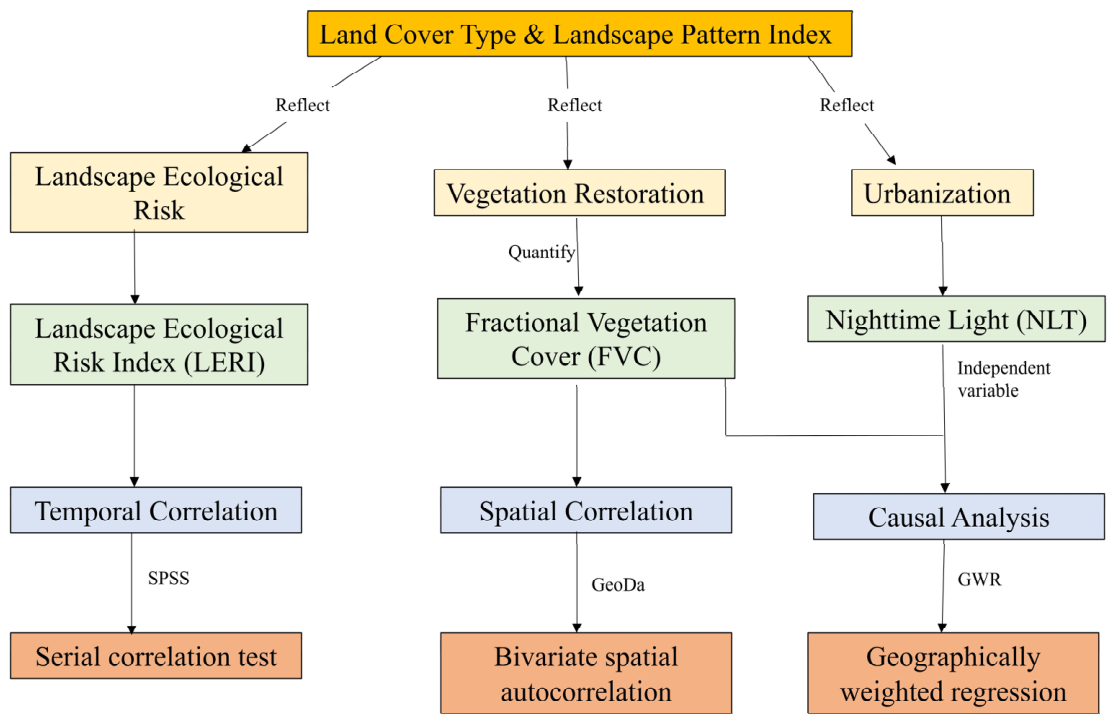
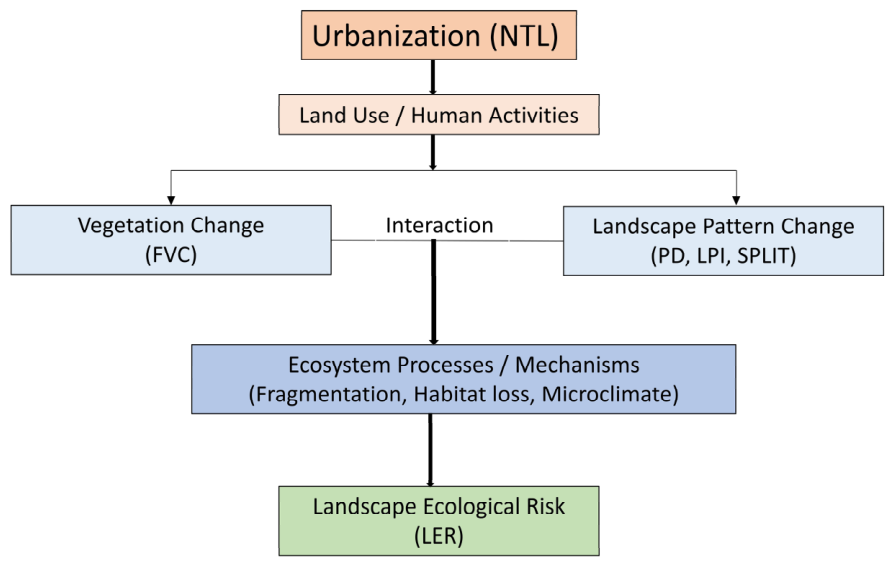
The conceptual framework of this study is grounded in a socio-ecological systems perspective, where LER emerges from the interaction between anthropogenic pressures and environmental processes [38,39]. In rapidly urbanizing regions such as Dhaka, urban expansion acts as a primary driver of landscape transformation, influencing ecological stability through both direct and indirect pathways [5]. Unlike conventional LER frameworks that rely on static or single-factor analyses, this framework explicitly integrates urbanization intensity (NTL) and vegetation dynamics (FVC) within a spatially explicit structure, enabling the identification of multi-pathway interactions and spatial heterogeneity in ecological risk [38,39,40]. This integration advances existing approaches by capturing coupled human–environment dynamics that are often overlooked. Urbanization, represented by NTL intensity, reflects the spatial concentration of human activities and infrastructure development [34]. Increasing NTL values drive the conversion of natural and agricultural land into built-up surfaces, resulting in significant LC transformation. This process reduces FVC and alters landscape composition, thereby weakening ecological resilience. FVC plays a critical mediating role in this system. Variations in FVC influence key ecological functions, including microclimate regulation, soil stability, and biodiversity maintenance. A decline in FVC increases environmental vulnerability and amplifies ecological risk. The combined effects of LC transformation and FVC change are reflected in landscape structure, characterized using the landscape pattern indices [PD (Patch Density), LPI (Largest Patch Index), SPLIT (Splitting Index)]. These metrics capture fragmentation, dominance, and spatial configuration, which are key determinants of ecological stability [41]. Within this framework (Figure 1), urbanization influences LER through two primary pathways:
(1)
Direct effects, where increasing anthropogenic pressure intensifies environmental disturbance; and
(2)
Indirect effects, where NTL-driven LC change reduces FVC and alters landscape structure, leading to increased fragmentation and ecological instability.
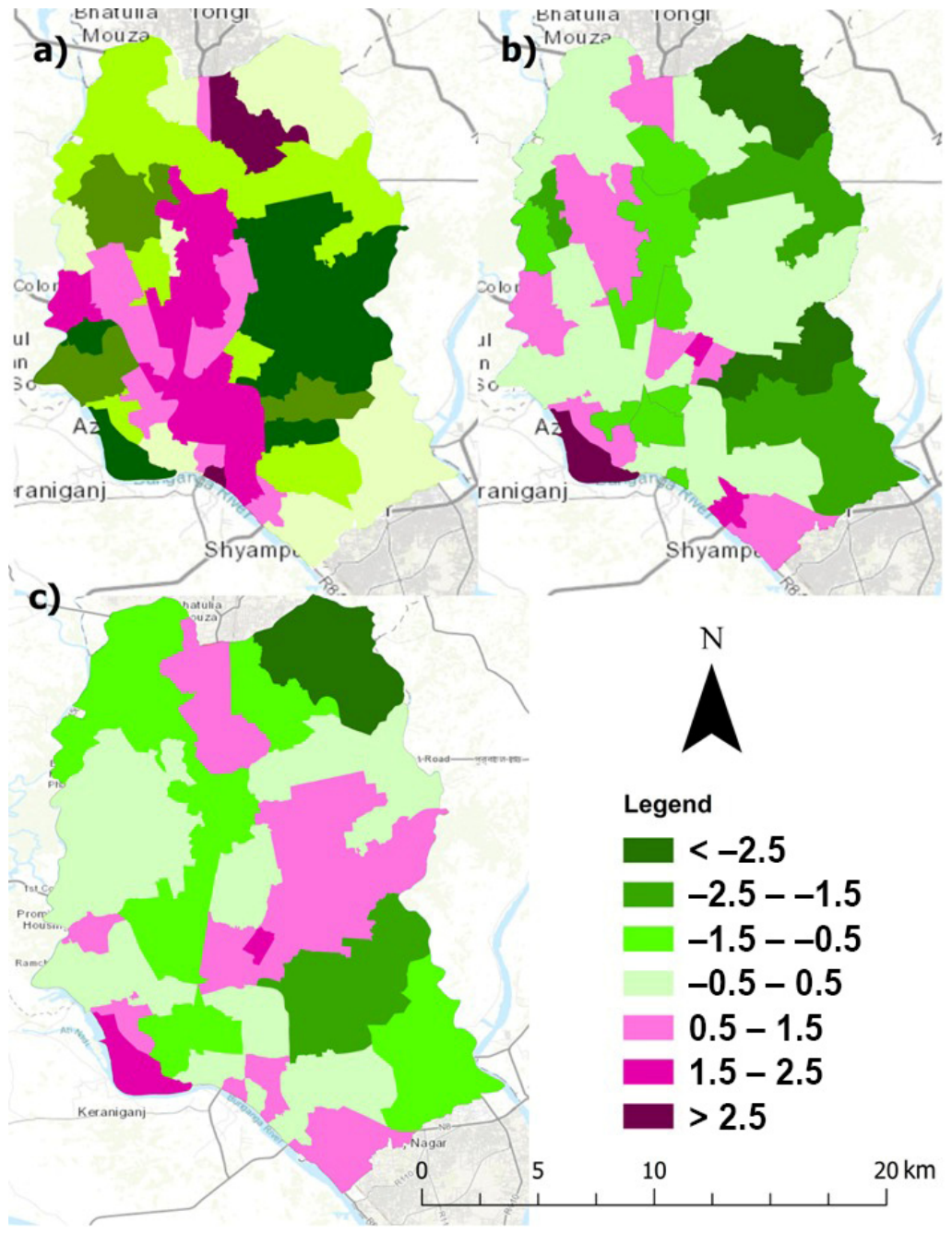
These interactions are not strictly linear. FVC may partially mitigate LER by enhancing ecosystem resilience, while increasing LER can further accelerate vegetation degradation, creating feedback mechanisms within the system. External factors such as climate variability, topography, and land management practices may further modulate these relationships [42]. Therefore, LER is conceptualized as the outcome of a dynamic and spatially heterogeneous system driven by the interplay between NTL, FVC, LC, and landscape structure. This integrative framework provides a scalable and transferable approach for analyzing ecological risk in rapidly urbanizing regions, particularly in data-constrained contexts of the Global South. The overall flowchart of the study is given in Figure 2.
The relationships among NTL, FVC, and LER may perform in a unidirectional manner through theoretical evidence. Elevated LER may, over time, stimulate compensatory green infrastructure development and ecological restoration efforts that partially restore FVC and mitigate ecological degradation [43,44]. Additionally, confounding variables such as population growth, economic development, and land-use governance may independently influence these relationships, which is a limitation this study recognizes [45]. Future research employing structural equation modeling or causal inference frameworks are encouraged to more rigorously examine these multidirectional interactions.

2.2. Study Area

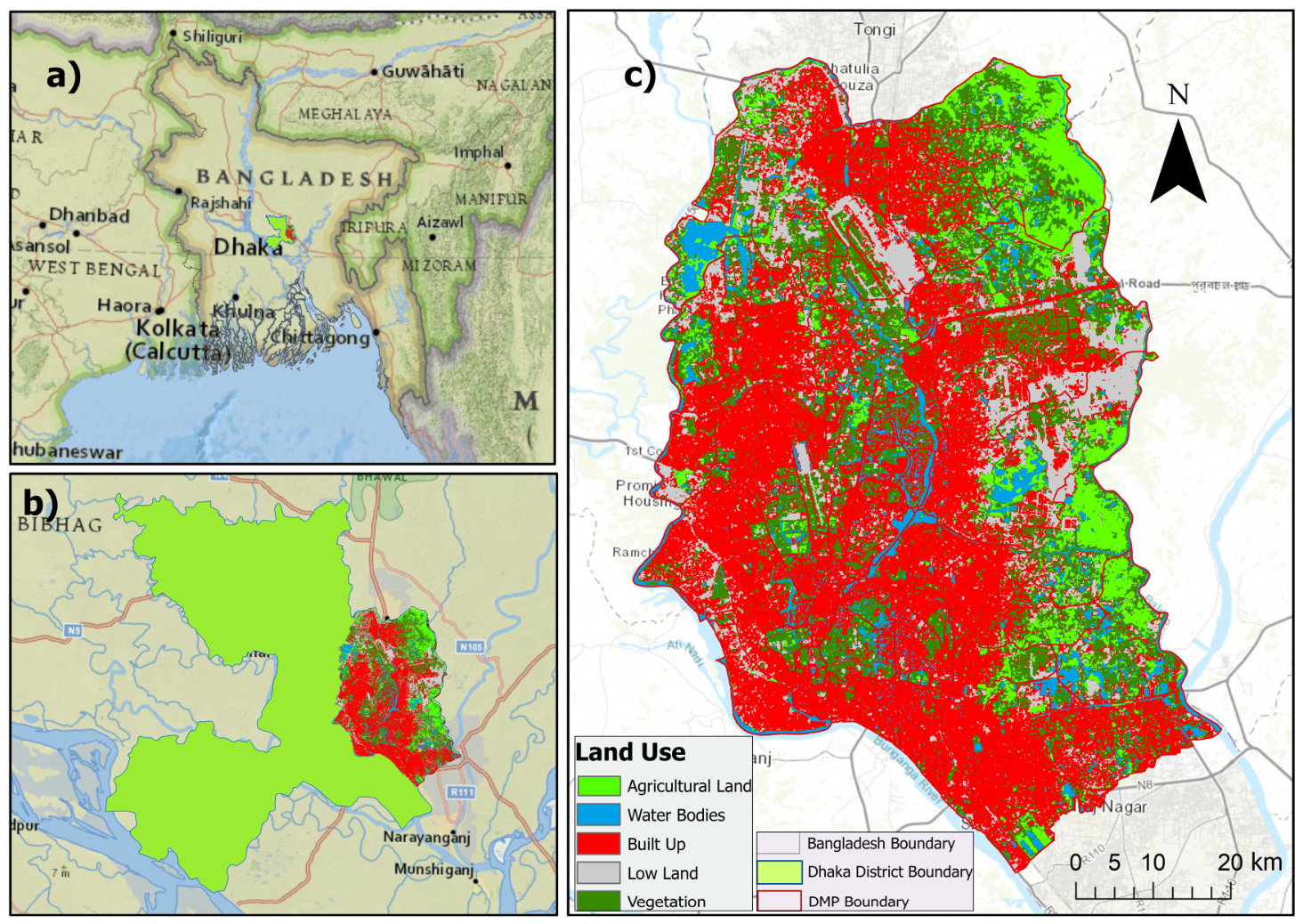
Dhaka City Corporation (DCC) is the capital and largest urban center of Bangladesh, located between 23.58 and 23.90° N latitude and 90.33–90.50° E longitude [46]. Dhaka lies in the central part of the country and is surrounded by the Buriganga River to the south, the Turag River to the west, and the Shitalakshya River to the southeast [47] (Figure 3). The study area covers approximately 306.38 km2, encompassing Dhaka North City Corporation and Dhaka South City Corporation, with a combined population of about 10.3 million, according to the 2022 Population and Housing Census of Bangladesh Bureau of Statistics [48], and represents the political, economic, and cultural part of the country. Dhaka city has experienced significant land-use changes, which causes an unbalanced land-use structure. Over the past few decades, it has experienced rapid urbanization and population growth driven by rural urban migration and economic expansion. These changes have led to severe ecological risk, including the loss of green spaces and soil erosion [49,50].

2.3. Data Sources and Preprocessing

To examine changes in LER in Dhaka during the VR process, we employed multi-source data, with their names, precision, and sources detailed in Table 1. All data were processed in ArcGIS 10.8 software. For subsequent vector analyses, and to ensure spatial consistency, all datasets were brought to a common 30 m grid before analysis. Land cover data at 30 m resolutions were generated based on Landsat Surface Reflectance imagery, processed through Google Earth Engine using Weka K-means classifier. All imagery were atmospherically corrected by the USGS using LEDAPS for the 2004, and LaSRC for the 2014 and 2024 acquisitions, converting top-of-atmosphere radiance to surface reflectance and ensuring radiometric consistency across the year. For example, VIIRS NTL data provided at 500 m were resampled to 30 m using bilinear interpolation to align with the Landsat grid [51,52]. Normalization was then applied across all variables to reduce bias introduced by differences in measurement scale [53]. Throughout the analysis, NTL data were interpreted as a relative dataset for anthropogenic pressure rather than an absolute luminosity measure. Raster datasets were resampled to ensure identical cell size, spatial resolution, and spatial extent.

2.3.1. Land Cover (LC) Data

Land cover maps for 2004, 2014, and 2024 were generated in Google Earth Engine (GEE) from Landsat Surface Reflectance imagery. Landsat 5 TM Collection 2 Level-2 data were used for 2004, Landsat 8 OLI Collection 2 Level-2 for 2014, and Landsat 9 OLI-2 Collection 2 Level-2 for 2024. For each year, images acquired between March and July were filtered to the study area and screened using a cloud-cover threshold of less than 5%. The optical bands were converted to surface reflectance using the standard USGS scale factors, and median composites were generated for each year. An unsupervised K-means classification approach was then applied to the annual composites. Six optical bands were used in the clustering process, and 5000 sample pixels were drawn from each composite to train the classifier. The Weka K-means algorithm was implemented with five clusters, and the resulting clusters were used to represent the major land cover classes within the study area. Area statistics for each cluster were subsequently calculated at 30 m spatial resolution. Because the classification was based on an unsupervised clustering procedure, no supervised training dataset or independent validation samples were used and, therefore, a conventional confusion matrix was not produced. This limitation is acknowledged in the interpretation of the land cover results [54,55].

2.3.2. Fractional Vegetation Cover (FVC) Data

FVC was derived from USGS Landsat Collection 2 Level-2 Surface Reflectance products processed in GEE. First, the normalized difference vegetation index (NDVI) was calculated from the Landsat imagery. FVC was then estimated using a standard NDVI-based linear mixture model, expressed in Equation (1):
F V C = N D V I NDVI soil NDVI veg NDVI soil
where NDVIsoil and NDVIveg represent the NDVI values of bare soil and full vegetation, respectively. These reference values were determined using the minimum and maximum NDVI values observed within the study area for each time period. The resulting FVC maps provide spatially consistent estimates of vegetation cover at 30 m resolution. Mean FVC values for 2004–2024 were extracted to quantify vegetation dynamics and assess their relationship with LER. Variations in FVC were used as indicators of spatial and temporal changes in ecological conditions [23,56].

2.3.3. Nighttime Light Index (NTL) Data

NTL data were derived from the Visible Infrared Imaging Radiometer Suite (VIIRS) monthly composites. These data were used as a proxy for urbanization intensity in Dhaka over 2004–2024. NTL values represent spatial variations in artificial illumination, reflecting the intensity and expansion of human settlements. The dataset was used to examine the relationship between urban expansion, vegetation dynamics, and LER [51,57,58,59].

2.4. Methods

We applied an integrated spatial analytical framework to examine the relationships among VR, urbanization, and LER. LERI, FVC, and NTL were used to represent LER, vegetation condition, and urbanization intensity, respectively. First, FVC and land cover change were analyzed to characterize vegetation dynamics and landscape transformation. Second, landscape pattern indices were calculated to quantify changes in landscape structure. Third, bivariate spatial autocorrelation analysis was conducted to evaluate global and local spatial associations between LERI and FVC. Finally, GWR was applied to examine spatial variability in the relationships between FVC, NTL, and LERI at the local scale. This framework was designed to capture the spatial heterogeneity of ecological risk patterns in Dhaka.
The landscape disturbance index was calculated using weighting coefficients of 0.5, 0.3, and 0.2 for fragmentation, separation, and dominance, respectively, following established studies in LER assessment. The landscape vulnerability index (LVI) was assigned using an expert-based scoring approach based on the ecological sensitivity and resilience of different land cover types. These procedures were adopted to maintain methodological consistency with previous LER studies.

2.4.1. Landscape Pattern Change Analysis

In the context of VR and urbanization, landscape pattern indices at the type level provide a quantitative means of capturing changes in the structural features and spatial patterns of various landscape types. Patch Density (PD) reflects the degree of landscape fragmentation, while Largest Patch Index (LPI) represents landscape dominance and the spatial importance of major land cover patches. The Splitting Index (SPLIT) presents the degree of landscape subdivision and fragmentation. These indices are widely used in LER assessment because changes in fragmentation and landscape structure directly influence ecological stability [52,54]. This study focused on PD, LPI, and SPLIT for evaluating fragmentation, dominance, and aggregation, respectively [60]. Computations were carried out using FRAGSTATS 4.2 software, a widely used tool for computing landscape pattern metrics [61]. The selected indices capture key dimensions of landscape change during the progression of VR. PD, LPI, and SPLIT were calculated for each land cover class, and results were compared across multiple time periods to evaluate temporal changes in landscape structure.

2.4.2. Landscape Ecological Risk Assessment

This study employed the LERI as a quantitative indicator to evaluate the LER. By measuring the proportionate areas of various landscape elements, LERI characterizes the relationship between landscape configuration and the LER system [62]. To divide the assessment units, a fishnet grid was generated covering the entire study area, and LERI values were assigned according to the centroid of each grid cell. The study area was divided into a regular grid of 30 × 30 cells, creating a total of 900 spatial units. Each grid cell was treated as an independent evaluation unit for the LER assessment. Given that the entire study area covers approximately 306 km2, each cell represents roughly 0.34 km2. This grid size allowed us to capture the spatial heterogeneity of the landscape in good detail. Because the urban area is quite fragmented, each grid cell contains multiple land cover patches. For this reason, the analysis was conducted at the grid-cell level instead of using individual land cover patches as the basic units. To calculate Area Proportion Calculation (Aij/Aj) for each evaluation unit:
(Aij): area of land cover type (i) within grid cell (j);
(Aj): total area of grid cell (j).
The Tabulate Area tool was applied to extract area statistics for each land cover type within each grid. LERI was constructed based on the landscape disturbance index (LDi) and the landscape vulnerability index (LFi) [63]. The corresponding calculation equations are shown in Equations (2) and (3):
L E R I j = i = 1 n A i j A j × L D i × L F i
L D i = a F i + b S i + c D i  
where (LERIj) denotes the LER of evaluation unit (j); (n) represents the number of landscape types. The LDi refers to the intensity of disturbance experienced by different land cover types and is composed of the landscape fragmentation index (Fi), landscape isolation index (Si), and landscape dominance index (Di) [64]. The weighting coefficients (a), (b), and (c) were set to 0.5, 0.3, and 0.2, respectively, following previous studies [65]. These weighting coefficients were taken from well-established Landscape Ecological Risk frameworks commonly used in urban and peri-urban studies to ensure consistency and comparability with previous research. Fragmentation was given the highest weight as it most directly reflects structural disruption and habitat break up in rapidly changing urban areas.
The LFi represents the sensitivity of the internal ecosystem structure of various land cover types as well as their capacity to withstand external disturbances [66]. Based on the specific characteristics of the study area and the attributes of each land cover category, an expert scoring approach was adopted (Table 2) [67,68]. An expert-based scoring method was used to assign vulnerability scores to each land cover type [69,70]. Expert-based scoring is common in ecological risk studies but involves some subjectivity. To reduce this, the scores on established literature and key ecological attributes were added, adjusted for local conditions, and cross-checked with similar studies. However, some uncertainty remains, and future work could improve robustness using data-driven methods.
LERI values were assigned to the centroids of fishnet grid cells. To illustrate the spatial pattern of LERI, the Kriging interpolation technique was applied. LERI values were extracted from 2004 to 2024 and subsequently classified into five ecological risk levels using the Natural Breaks method. Furthermore, changes in LERI levels for the periods 2004, 2014, and 2024 were computed using a raster calculator to identify areas where LER was either mitigated or intensified over time.
The expert-based vulnerability assessment employs a land cover classification consisting of built-up areas, agricultural land, lowland, vegetation, and water bodies to evaluate relative susceptibility to risk. Each class is assigned a raw vulnerability score (V) on a scale of 1 to 5 based on expert judgment, where built-up areas (V = 5) are considered the most vulnerable due to high population density and infrastructure exposure, followed by agricultural land (V = 4), lowland (V = 3), vegetation (V = 2), and water bodies (V = 1) as the least vulnerable. These raw scores are then standardized, calculated as in Equation (4):
L F i = V V m i n V m a x V m i n ,
transforming the values into a normalized range between 0 and 1 to ensure comparability across classes. Subsequently, the LFi values are further normalized, resulting in built-up areas (0.40), agricultural land (0.30), lowland (0.20), vegetation (0.10), and water bodies (0.00), with the total summing to unity. This process highlights the dominant contribution of built-up areas to overall vulnerability, while water bodies exert least influence. The approach integrates expert knowledge with quantitative normalization and is widely applicable, and uses GIS techniques for spatial vulnerability assessment and decision making.

2.4.3. Correlation Analysis Between FVC and LERI

To examine the relationship between FVC and LERI, this study applied bivariate spatial autocorrelation analysis at both the global and local scales for the selected years 2004, 2014, and 2024. This approach was used to identify spatial associations between the two variables and to examine how these associations varied across the study area. Local Indicators of Spatial Association (LISA) were further used to detect localized cluster patterns and spatial heterogeneity in the FVC-LERI relationship. Because the temporal comparison in this study was based on only three observation years, no formal temporal correlation test was used for statistical inference. Comparisons across 2004, 2014, and 2024 were therefore treated as descriptive rather than as a robust time-series statistical analyses [23,71,72].

2.4.4. GWR Analysis

GWR was applied to examine the spatially varying relationships between FVC, NTL, and LERI across the study area. The model was used as an exploratory spatial analytical approach to identify local variation in regression coefficients and to assess spatial heterogeneity in the relationships among the variables [73]. All raster variables required for the regression analysis were converted to a vector format using the administrative ward polygons of Dhaka city. GWR was implemented using an adaptive bandwidth to account for spatial variation in the distribution of observations [74,75]. The bandwidth was selected using the golden section search method, and a Gaussian function was used as the spatial weighting scheme. The purpose of applying GWR in this study was to explore local spatial variability in the FVC-LERI and NTL-LERI relationships. The GWR approach was employed to examine spatially varying relationships between FVC, NTL, and LERI across Dhaka. Because ecological conditions and urbanization intensity differ considerably across the metropolitan region, a localized modeling approach was considered more suitable for identifying geographic heterogeneity in the observed relationships. Unlike global regression approaches that assume spatially uniform relationships, GWR enables the exploration of localized spatial variability within rapidly changing urban landscapes.

3. Results

3.1. Vegetation Restoration

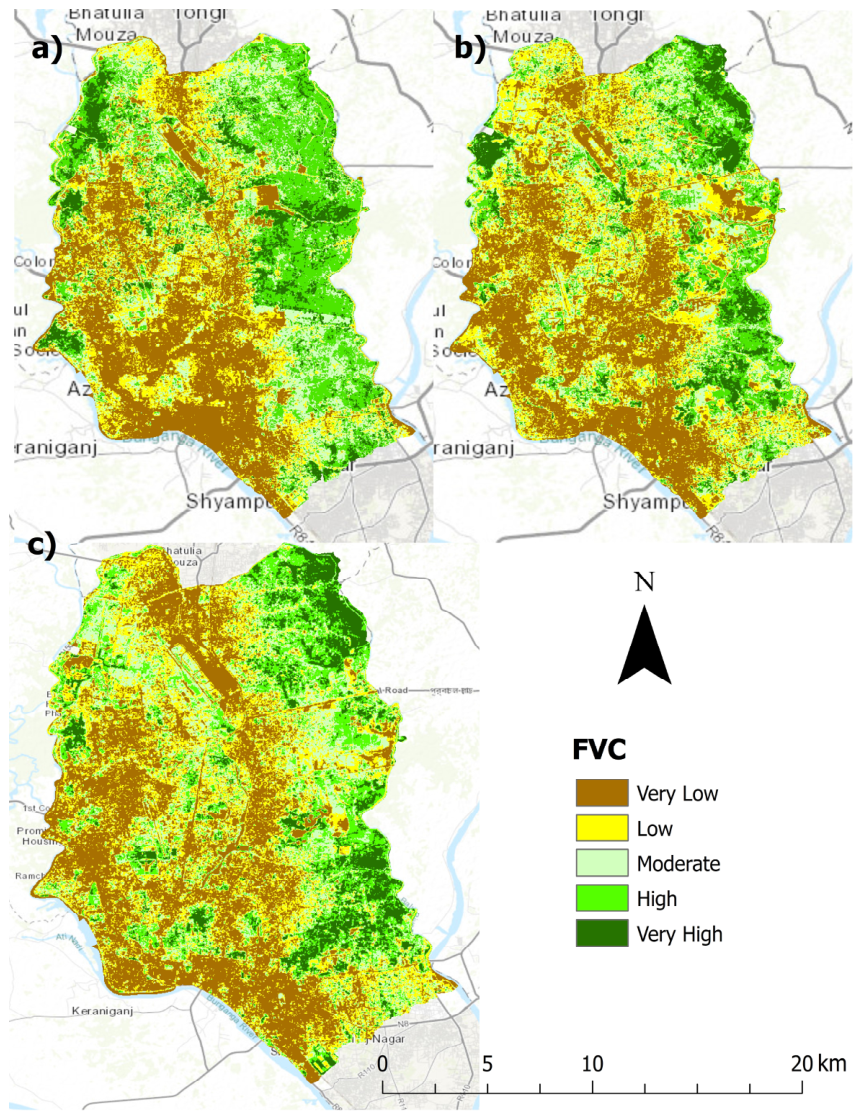
The spatiotemporal distribution of FVC classes in Dhaka changed substantially between 2004 and 2024 (Figure 4; Table 3). In 2004, the landscape was primarily characterized by the Very Low FVC class, which occupied 27.93% of the study area, followed by the High (23.90%) and Moderate (20.70%) classes. The Very High FVC class represented the smallest share (8.57%). By 2014, the proportion of the Very Low FVC class had increased to 31.81%, while the High FVC class declined markedly to 15.76%. Over the same period, the Low FVC class increased from 18.90% to 24.65%, indicating a shift in area share toward lower vegetation cover categories. In 2024, the Very Low FVC class remained the dominant category (31.02%), whereas the Low and Moderate classes accounted for 23.59% and 19.34%, respectively. The High FVC class showed only a slight increase relative to 2014, reaching 16.07%, while the Very High class rose to 9.99%. Taken together, these results indicate an overall shift toward lower FVC classes across the study period. Relative to 2004, the combined share of the Very Low and Low classes increased from 46.83% to 54.61% in 2024, whereas the High class declined by 7.83 percentage points. In contrast, the Moderate class remained comparatively stable, and the Very High class showed only a modest net increase over the 20-year period. This pattern reflects an increase in the spatial extent of low FVC classes over time.
The vegetation change analysis for 2004–2024 further supports this pattern (Table 4). Vegetation degradation affected 104.70 km2, representing 34.39% of the study area, while 110.76 km2 (36.38%) remained unchanged. In contrast, VR was identified in 89.01 km2, accounting for 29.23% of the area. Thus, the spatial extent of degradation exceeded that of restoration by 15.69 km2, equivalent to 5.16 percentage points of the study area. Overall, the results show that vegetation degradation was more widespread than restoration in Dhaka over the study period, while more than one-third of the landscape remained relatively stable.

3.2. Landscape Ecological Risk

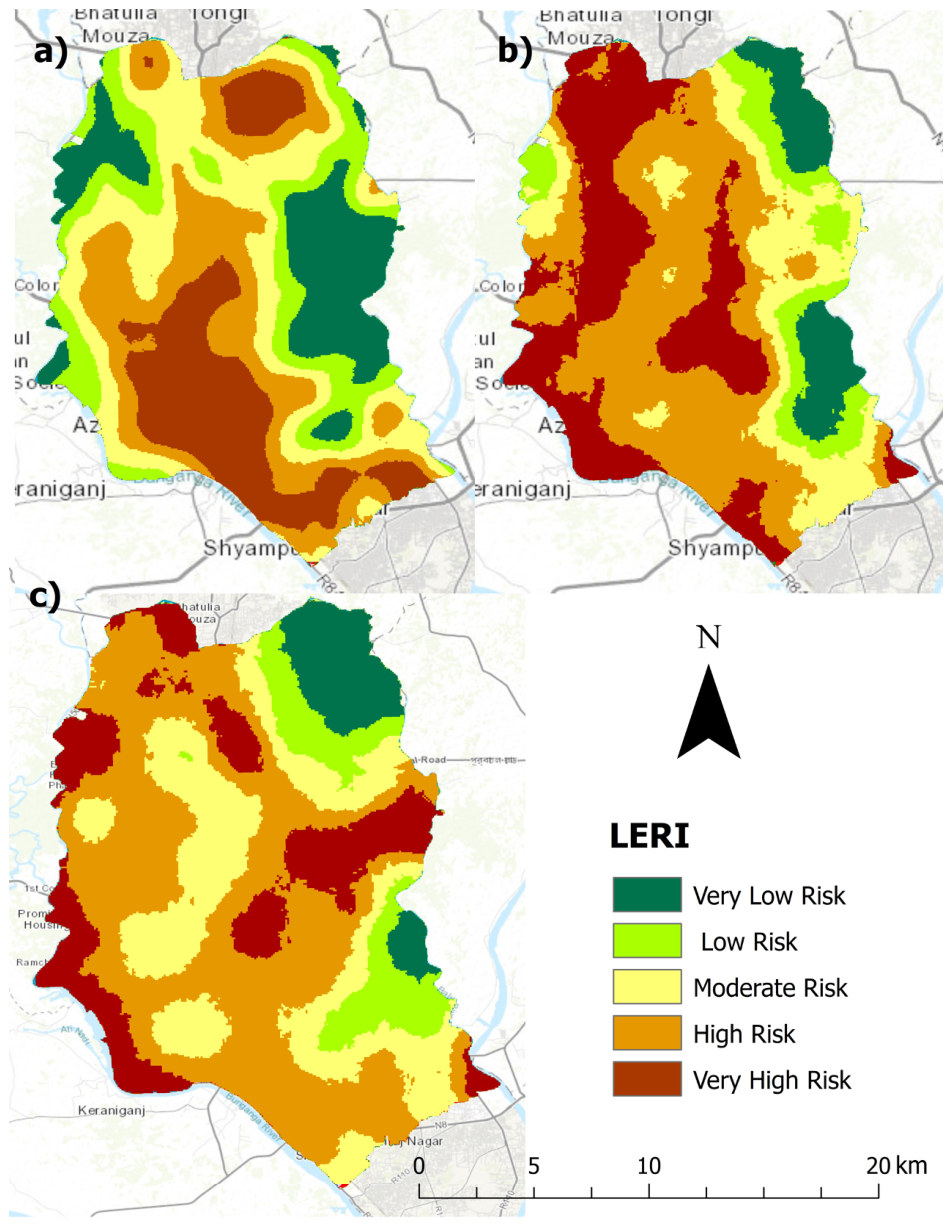
The distribution of LER classes in Dhaka shows a clear temporal shift between 2004 and 2024 (Figure 5; Table 5). In 2004, the landscape was primarily composed of the High (24.36%) and Moderate (23.75%) risk classes, followed by the Very High class (20.23%). The Very Low and Low classes together accounted for 31.66% of the study area. By 2014, the proportion of higher-risk categories increased substantially. The High-risk class expanded to 38.70%, while the Very High class rose to 27.68%, together covering 66.38% of the study area. During the same period, the Very Low and Low classes declined sharply to 8.57% and 9.16%, respectively, and the Moderate class decreased to 15.89%. In 2024, the High-risk class continued to dominate, reaching 42.95%, the highest value observed across the study period. The Moderate class increased to 24.32%, while the Very High class declined to 16.75%. The Very Low and Low classes remained limited, accounting for 7.27% and 8.71%, respectively. Across the three time periods, the combined share of High- and Very High-risk classes increased from 44.59% in 2004 to 66.38% in 2014, before slightly decreasing to 59.70% in 2024. In contrast, the combined proportion of Very Low and Low classes declined from 31.66% to 15.98%. These patterns show an increase in the spatial extent of higher-risk classes over time, with the most pronounced change occurring between 2004 and 2014.

3.3. LERI Change over Time

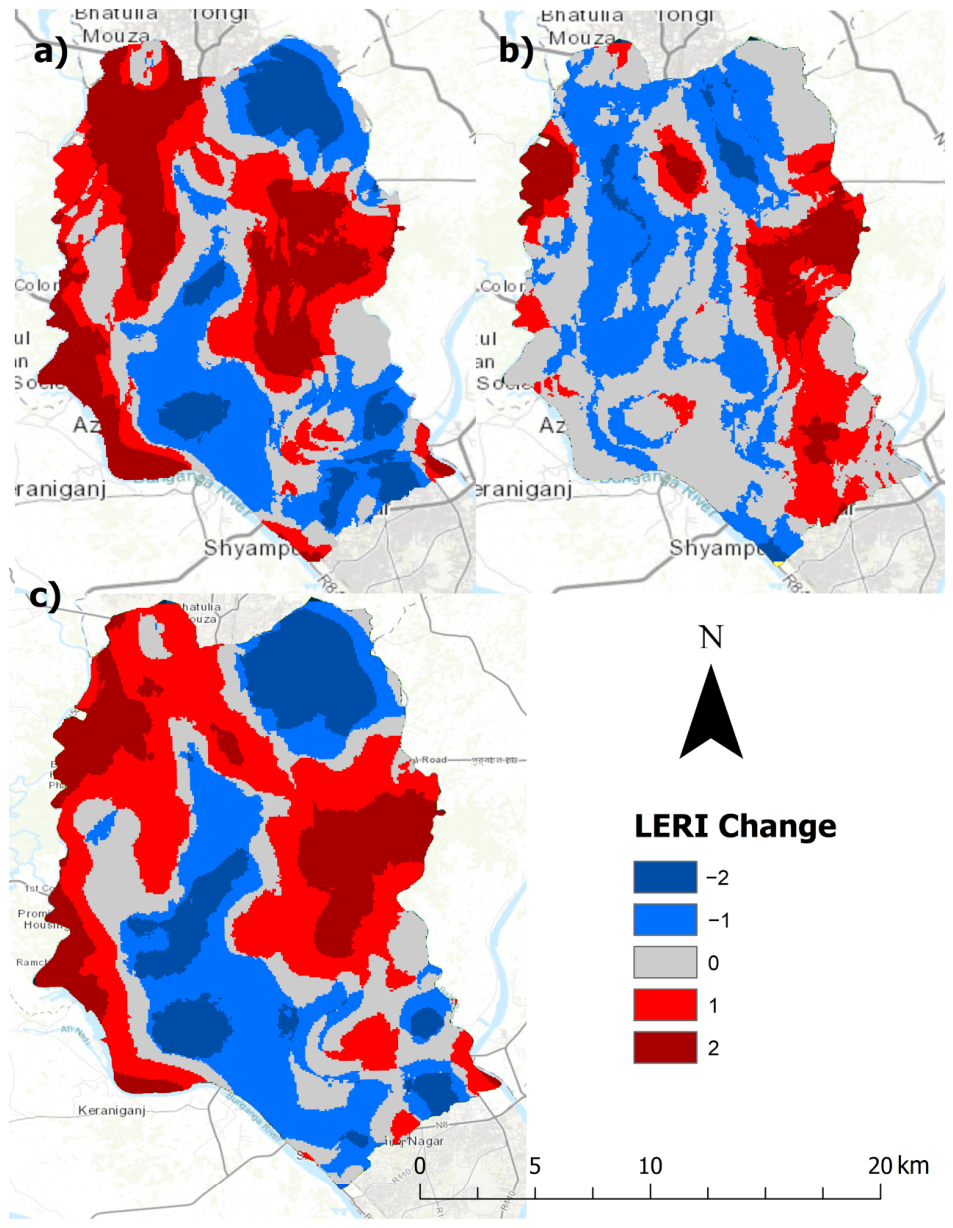
Temporal changes in LERI were evaluated using a classification of sequential differences, where +1 and +2 indicate increasing risk and −1 and −2 indicate decreasing risk (Figure 6; Table 6). The results show distinct patterns of change across the study periods. During 2004–2014, increases in LERI were observed across a substantial portion of the study area. The combined share of the +1 and +2 classes reached 44%, indicating that nearly half of the area experienced rising ecological risk during this period. In contrast, 32% of the area showed decreasing trends (−1 and −2), while 21% remained unchanged. Between 2014 and 2024, the pattern shifted toward decreasing LERI values. Approximately 63.48% of the area fell within the −1 and −2 classes, indicating a widespread reduction in ecological risk. At the same time, 30.99% of the area continued to exhibit increasing trends (+1 and +2), while only 5.52% showed no change. For the full period (2004–2024), the spatial distribution of LERI changes reflects a mixed pattern. Areas with increasing trends (+1 and +2) accounted for 44.45% of the study area, while decreasing trends (−1 and −2) covered 35.42%. Approximately 20.11% of the area remained stable over the entire period. The spatial distribution of these classes indicates that areas of increasing and decreasing LERI are unevenly distributed across the study region. Zones with consistent positive changes represent locations where LERI increased over multiple periods, whereas areas with persistent negative values correspond to locations with decreasing LERI.

3.4. Nighttime Light Index (NTL)

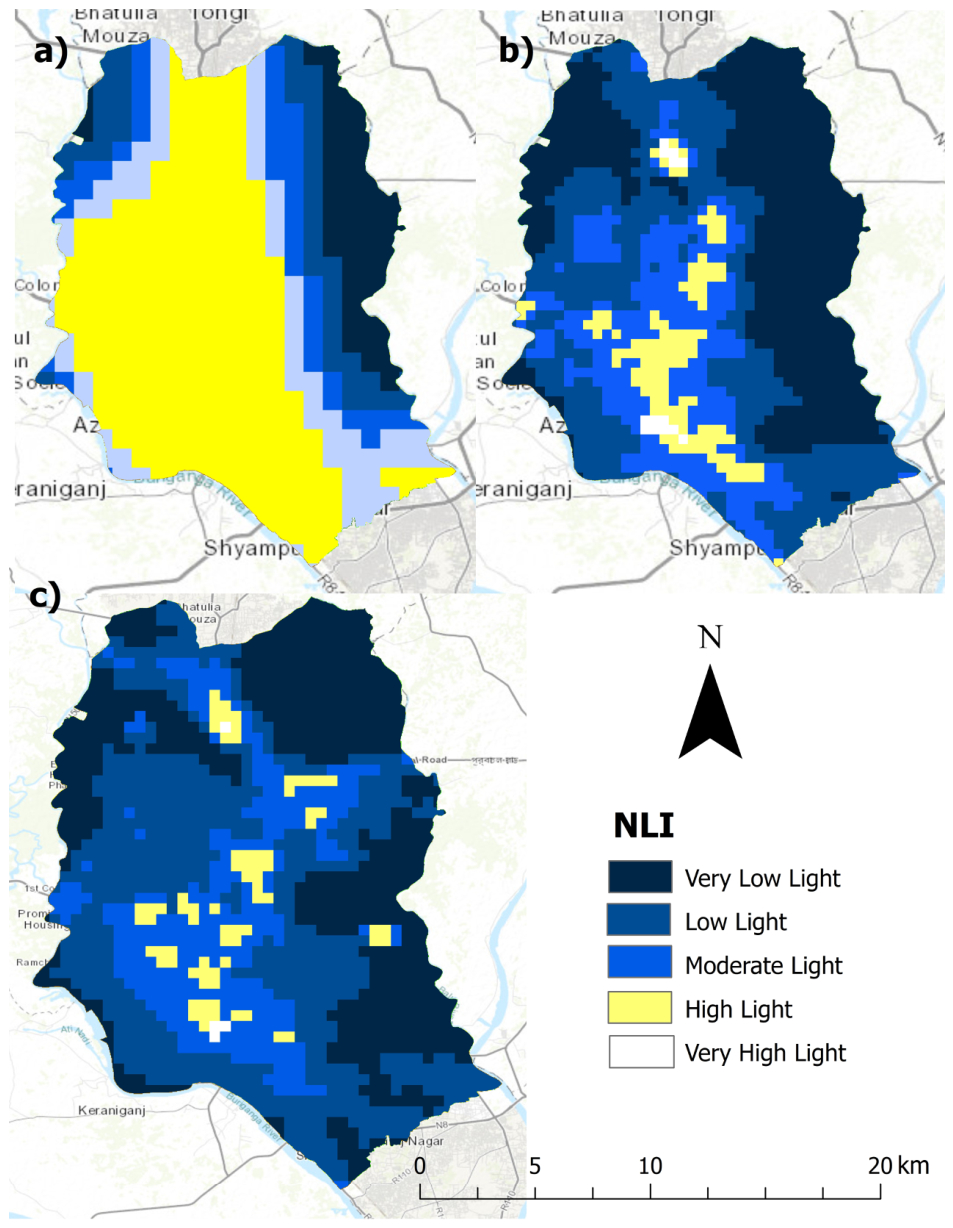
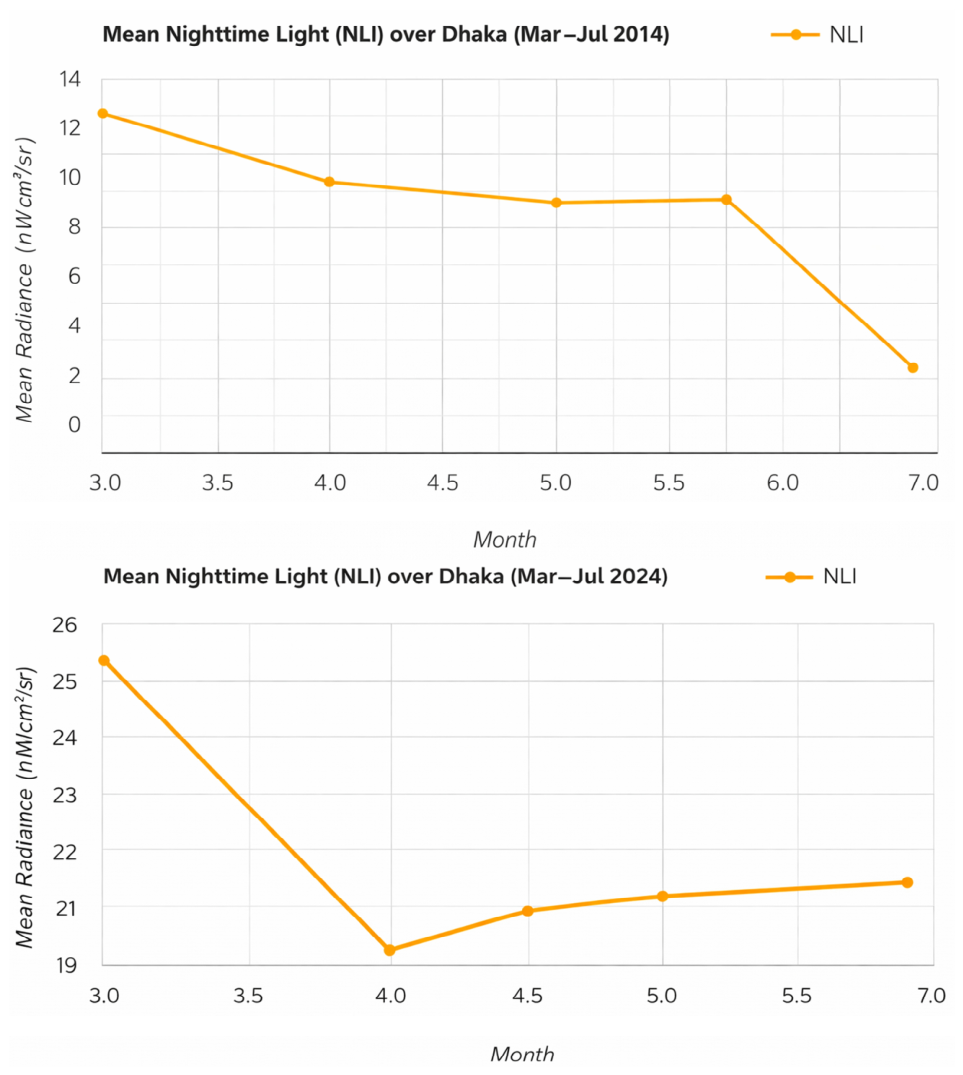
The spatial distribution of NTL intensity in Dhaka changed noticeably over the study period (Figure 7). In 2004, high-intensity illumination was widely and continuously distributed across the majority of the study area, with large contiguous zones of High Light class dominating the spatial pattern, with large contiguous zones classified as High Light. By 2014, this pattern shifted with Very Low and Low Light classes becoming dominant across most of the area, while High Light values were reduced, becoming fragmented and concentrated in specific urban zones. This shift corresponds to changes in the spatial distribution of illuminated areas rather than a uniform increase or decrease in illumination intensity. In 2024, the pattern broadly resembled that of 2014, with Very Low Light continuing to dominate the spatial extent, though High Light areas appeared more dispersed and fragmented across the study area compared to 2014. The temporal pattern indicates a significant transition between 2004 and 2014, moving from a broadly illuminated, high-intensity distribution toward a spatially heterogeneous pattern characterized by dominant low-intensity zones interspersed with localized high-intensity clusters. Between 2014 and 2024, the overall spatial structure was largely maintained, with subtle redistribution of high-intensity areas rather than any major expansion of illuminated coverage, although mean Nighttime Light intensity shows a notable increase in 2024 compared to 2014 across March–July (Figure 8).

3.5. Land Cover

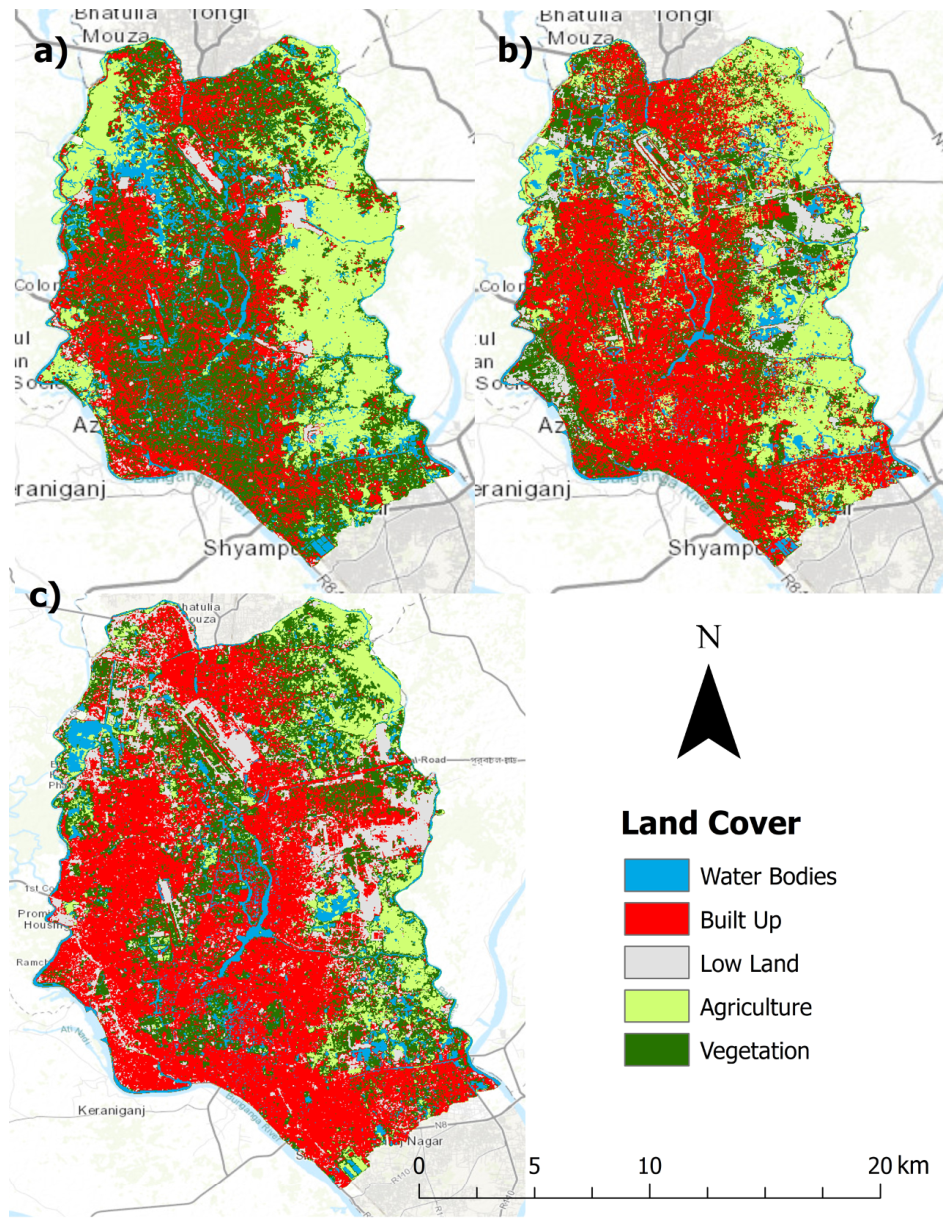
Land cover patterns in the study area changed substantially between 2004 and 2024 (Figure 9). The most prominent change was the expansion of built-up land, accompanied by reductions in agricultural land, vegetation cover, and lowland areas. In 2004, built-up land was relatively limited and concentrated mainly in the central part of the study area and along major transport corridors. By 2014, built-up areas had expanded outward from the urban core into surrounding zones. In 2024, built-up land occupied a much larger proportion of the study area, particularly in the central, southern, and southwestern parts. Agricultural land showed a progressive decline over time. In 2004, it was distributed widely, especially in the eastern and northeastern parts of the study area. By 2014, agricultural land had decreased in extent and, by 2024, it was largely restricted to peripheral areas. Vegetation covers also declined during the study period. It was more extensive in 2004, became increasingly fragmented by 2014, and was reduced to smaller and more isolated patches in 2024. Lowland and wetland areas also decreased over time, with several areas converted to other land cover types. Water bodies remained present throughout the study period, although their spatial extent became more limited and fragmented by 2024. Taken together, these results show substantial changes in land cover composition between 2004 and 2024.

3.6. Local Autocorrelation Analysis Between LERI and FVC

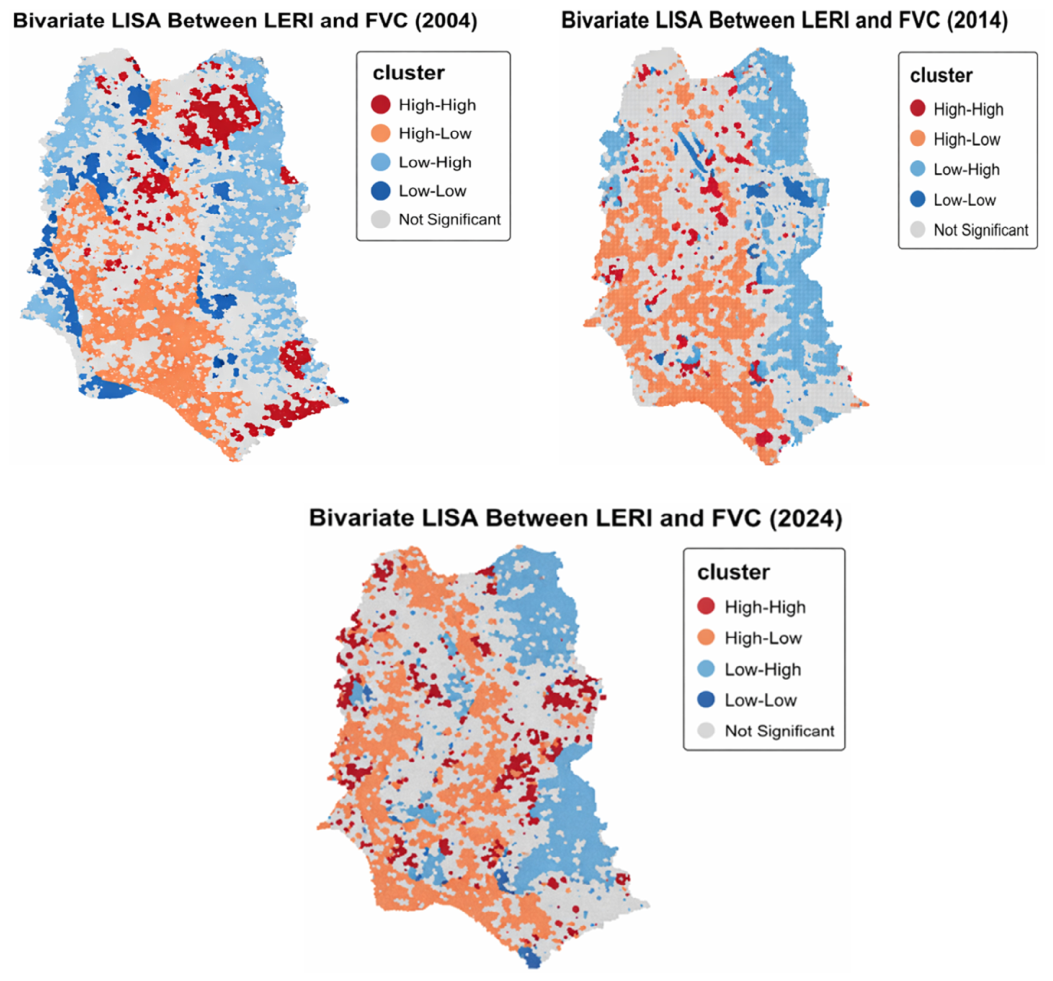
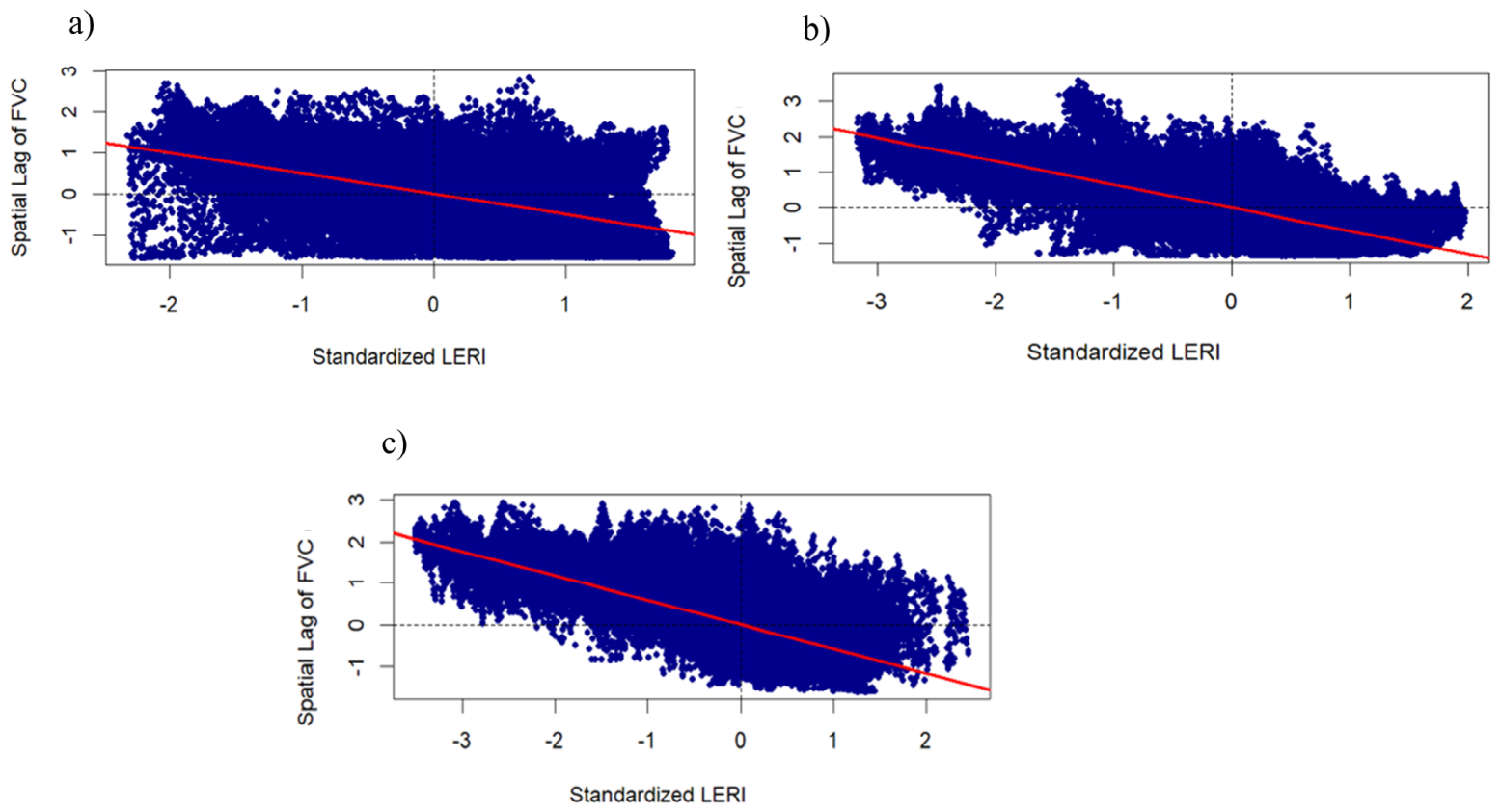
Bivariate Local Indicators of Spatial Association (LISA) analysis identified statistically significant and time-varying spatial relationships between LERI and FVC across the study area (Figure 10; Table 7). In 2004, the spatial pattern was dominated by High–Low (33%) and Low–High (28%) clusters, while High–High clusters accounted for 9% and Low–Low clusters for 6% of the study area. Areas classified as not significant represented 24%. By 2014, the proportion of High–Low clusters increased to 37%, whereas Low–High clusters declined to 22%. High–High clusters also increased slightly, from 9% to 11%, while the share of not significant areas decreased marginally to 23%. Low–Low clusters remained limited, accounting for 7% of the study area. In 2024, the High–Low cluster became the most dominant spatial association, covering 42% of the study area. High–High clusters further increased to 13%, while Low–High clusters declined to 18%. The proportion of not significant areas decreased to 20%, and Low–Low clusters remained stable at 7%. These results indicate a progressive increase in the proportion of High–Low and High–High clusters over time, accompanied by a decline in Low–High clusters. The spatial distribution shown in Figure 11 demonstrates changes in the distribution of local association cluster types between 2004 and 2024. The Moran’s I scatter plots (Figure 11) further illustrate the spatial relationship between the two variables by showing the distribution of observations across the four quadrants of local spatial association.

3.7. GWR Model

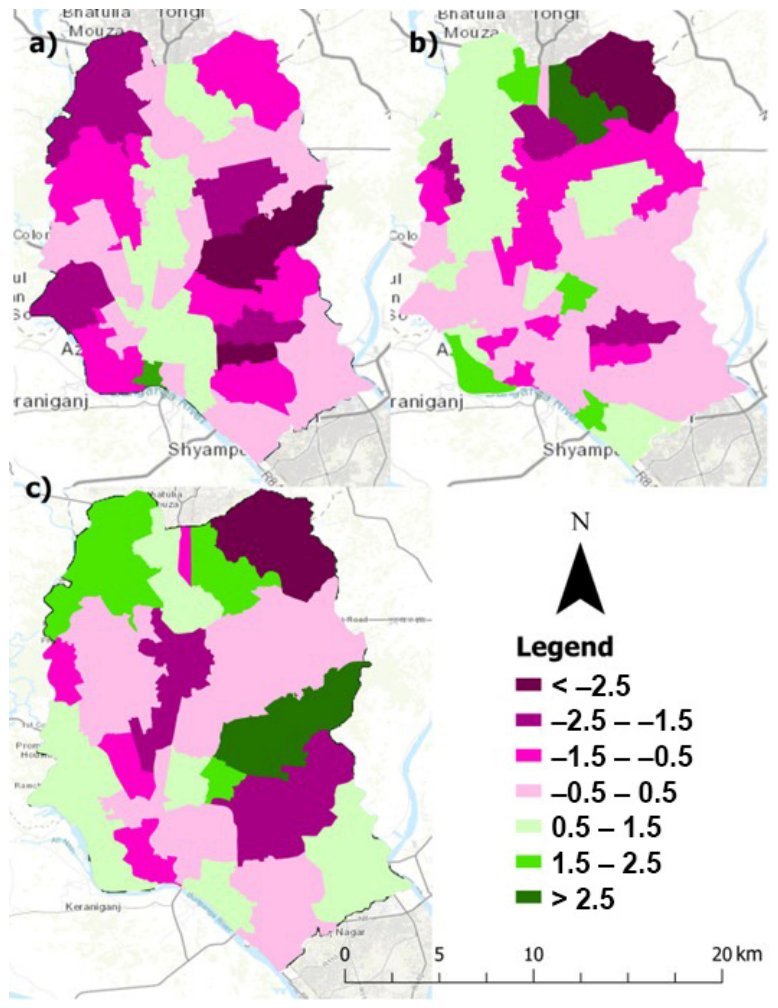
GWR was used to examine the spatially varying relationship between FVC and LERI for 2004, 2014, and 2024 (Figure 12). The results show clear spatial heterogeneity in regression coefficients across the study area. In 2004, GWR coefficients were predominantly negative, where negative coefficients correspond to locations where higher FVC values were associated with lower LERI values. The magnitude of coefficients was generally low, and positive values were limited to small and spatially scattered areas, mainly in the central and southern parts of the study area. By 2014, the spatial distribution of coefficients became more variable. Both negative and positive coefficients increased in magnitude, and their spatial extent expanded. Negative coefficients were more prominent in the eastern and southeastern regions, while positive coefficients appeared in several other areas. This indicates greater spatial variability in coefficient distributions compared to 2004. Negative coefficients remained dominant across large portions of the study area, while positive coefficients continued to appear in localized zones. The overall distribution suggests a mixed spatial pattern, with both inverse and positive spatial associations observed across different regions.
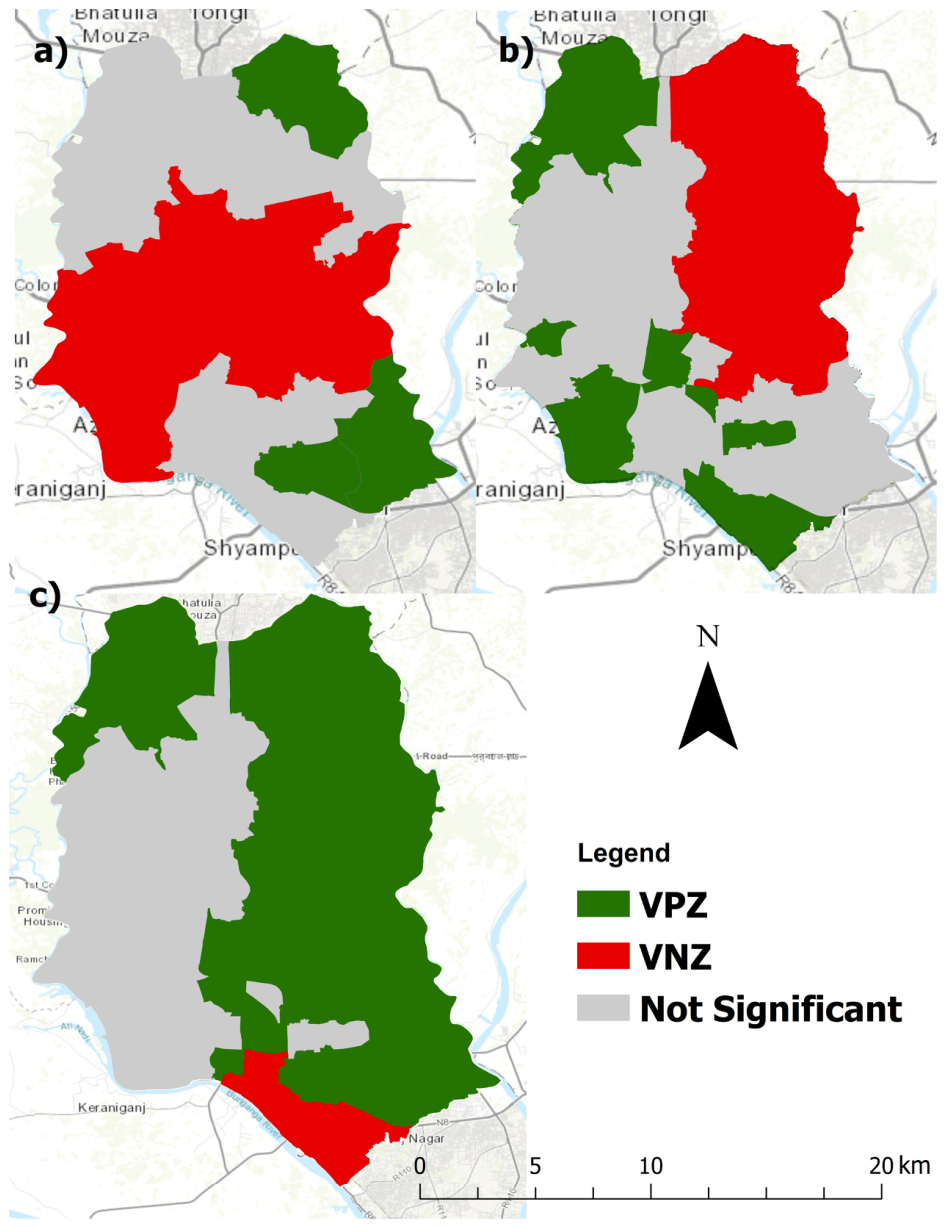
The proportion of statistically significant coefficients further highlights these changes (Figure 13; Table 8). In 2004, significant relationships were observed in 47.25% of the study area, with most areas classified as Vegetation Negative Zones (VNZ, 44.37%) and a small proportion as Vegetation Positive Zones (VPZ, 2.88%). In 2014, the total proportion of significant areas remained similar (47%), but the share of VPZ increased to 31.63%, while VNZ decreased to 15.37%. In 2024, the proportion of significant areas declined slightly to 43.47%, with VPZ further increasing to 33.98% and VNZ decreasing to 9.49%. A considerable portion of the study area remained statistically non-significant across all three periods, suggesting that the spatial association between FVC and LERI varied across locations and time periods.
GWR results examining the spatial association between NTL and LERI also show considerable spatial variation over time (Figure 14 and Figure 15). In 2004, coefficients were largely negative, with strong negative values concentrated in the northern, eastern, and southeastern regions. By 2014, the distribution became more heterogeneous, with a wider range of coefficient values, including both negative and positive ranges. In 2024, positive and near-zero coefficients became more prevalent across the study area, while negative coefficients were restricted to smaller and more localized regions. Altogether, the GWR findings should be interpreted as exploratory spatial associations rather than evidence of direct causal relationships between vegetation cover, urbanization intensity, and ecological risk patterns.
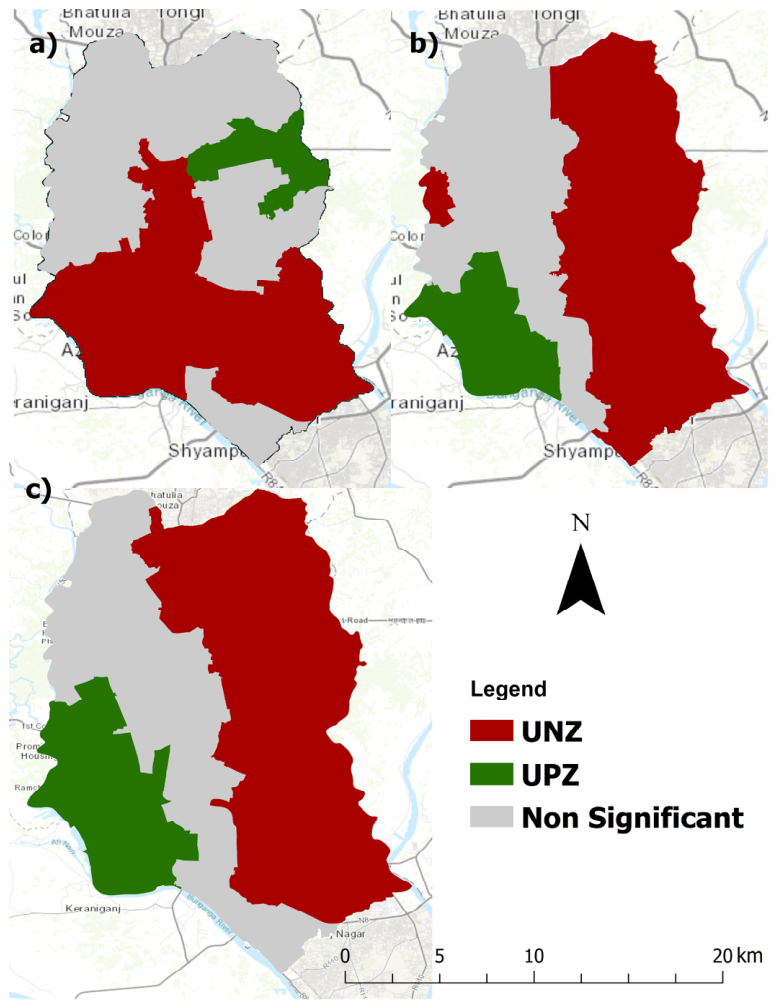
The proportion of areas with statistically significant relationships between NTL and LERI increased over time (Table 9). Significant areas accounted for 50.69% in 2004, rising to 64.82% in 2014, and 66.53% in 2024. Within these, Urban Negative Zones (UNZ) remained dominant, while Urban Positive Zones (UPZ) increased gradually from 6.7% in 2004 to 16.61% in 2024. The analyses presented here describe spatial associations and temporal patterns; causal ecological mechanisms are further considered in Section 4.

4. Discussion

4.1. Vegetation Dynamics and Urban Expansion

The results indicate a consistent spatial association between vegetation cover and LER in Dhaka, although this relationship varies across space and time. The observed increase in lower FVC classes and the overall dominance of vegetation degradation over restoration suggest a gradual decline in vegetation condition over the study period. This pattern is consistent with land cover transformations identified in the results, where vegetation and agricultural land were progressively replaced by built-up areas [75,76]. The total share of Very Low and Low FVC classes in Dhaka increased from 46.83% to 54.61% between 2004 and 2024, indicating a steady loss of vegetated land. These data support the conclusion that there is significant vegetation loss in South Asian megacities due to urban growth. Seto et al. [77] showed that worldwide urban land growth between 2000 and 2030 will cause significant losses of vegetation and agricultural land in biodiversity-rich and ecologically sensitive locations. In other rapidly urbanizing South and Southeast Asian cities, built-up land expansion on vegetated surfaces has maintained the dominance of the Very Low FVC class (27.93% in 2004, 31.02% in 2024) [78]. The 20-year vegetation change research shows that degradation surpassed restoration, resulting in a net degradation of 15.69 km2. Degradation and restoration are asymmetrical in cities without comprehensive urban greening initiatives. In Dhaka and other Bangladeshi cities, agricultural and vegetated land has been turned into impermeable surfaces [79].

4.2. Changes in Landscape Ecological Risk

LER showed a sharp rise in the share of higher-risk categories between 2004 and 2024, with High- and Very High-risk classes increasing from 44.59% in 2004 to 66.38% in 2014, then falling to 59.70% in 2024. Rapid urbanization and land cover change increase ecological pressure, as seen by this timeline. Built-up area, vegetation loss, and fragmentation of natural and semi-natural land cover types are known to increase Landscape Ecological Risk [80,81]. The High-risk class dominated the study region in 2024, accounting for 42.95%, suggesting that a large portion of the metropolitan landscape has undergone ecological degradation. This is consistent with other highly populated Asian cities, where land fragmentation, habitat loss, and impervious surface expansion increase landscape risk [82]. Between 2014 and 2024, the Very High-risk class decreased from 27.68% to 16.75%, and the Moderate class increased from 15.89% to 24.32%, suggesting that the most intensively developed zones have stabilized and ecological pressure has shifted to transitional and peri-urban areas. Similar patterns have been reported in other rapidly urbanizing regions, where vegetation fragmentation and land cover conversion are associated with increased ecological vulnerability [83,84,85].
LERI temporal analysis reveals distinct directional shifts between the study periods, with LERI trends rising in 44% of the study area, indicating significant urbanization and land cover transformation. From 2014 to 2024, LERI trends decreased across 63.48% of the study region, and from 2004 to 2024, 44.45% of the research region showed increasing trends (+1 and +2), whereas 35.42% showed falling trends. LERI trends reversed across periods, suggesting that ecological deterioration may have decreased in more recently developed places due to changes in urbanization patterns or the partial maturation of damaged landscapes [86,87,88]. The persistence of growing LERI in roughly one-third of the study region from 2014 to 2024 suggests ecological pressure exists in certain zones. Other studies of long-term landscape dynamics in rapidly urbanizing areas have found a regionally variable pattern of risk change, underscoring the need for spatially explicit ecological risk assessment [89].

4.3. Nighttime Light Intensification and Urban Growth

In 2024, Dhaka’s NTL intensity concentration increased from 2004 to 2024, with high-intensity values concentrated in well-established metropolitan centers, and this shift from dispersed to concentrated NTL is comparable to urban densification and urban core maturation in other rapidly growing cities. NTL values are used as proxies for urban economic activity, population density, and power access, with higher values indicating greater commercial and residential density [57]. Instead of a homogeneous expansion of illumination, the rising spatial concentration of NTL between 2014 and 2024 suggests that Dhaka’s recent urban growth has featured infill development and intensification within established urban zones.
Between 2004 and 2024, built-up land expanded as agricultural land, vegetation cover, lowland areas, and wetlands declined. Dhaka, one of the world’s most densely populated and rapidly growing megacities, has a well-documented pattern of urban land-use alteration [90]. The gradual shrinkage of agricultural land, particularly in the east and northeast, is consistent with previous studies [5,23,68] showing that peri-urban agricultural zones are most vulnerable to conversion pressure in rapidly urbanizing contexts. Urban ecological services, flood regulation, and biodiversity are affected by vegetation fragmentation, wetland loss, and lowland loss.

4.4. Spatial Relationship FVC and Ecological Risk

The LISA analysis demonstrates that the spatial relationship between FVC and LER is heterogeneous. The increasing dominance of High–Low (HL) and High–High (HH) clusters indicates that areas of elevated ecological risk are becoming more spatially concentrated, while Low–High (LH) clusters have declined. This shift suggests that the spatial association between vegetation cover and ecological risk has become more uneven over time. In earlier periods, areas with higher vegetation cover were more frequently associated with lower ecological risk, whereas in later periods, this relationship became less consistent across locations. This cluster type, with high ecological risk and high FVC, may reflect transitional or environmentally stressed zones where vegetation persists under high landscape risk, such as fragmented green patches surrounded by extensive urban development. In other urban ecological risk studies [91,92,93], spatially isolated vegetation patches in high-risk urban matrices may have reduced ecological function due to edge effects, reduced connectivity, and limited species interactions.
VPZs have greater FVC and LERI, a surprising association that may be due to remnant vegetation patches coinciding spatially with high-risk landscape layouts. The concurrent decline in VNZ from 44.37% in 2004 to 9.49% in 2024 suggests that landscape fragmentation and the decoupling of vegetation cover from ecological integrity may have weakened the simple inverse relationship between FVC and LERI. Other GWR-based investigations of urban ecological risk have found that local landscape context affects FVC-risk linkages [94,95]. The increasing fraction of UPZs suggests that higher NTL intensity is associated with higher LERI across a broader range of research areas. New urban growth in ecologically sensitive zones at the urban edge may lead to high NTL values in areas that are still ecologically disrupted.

4.5. Urban Planning and Ecological Management Implications

The results highlight key urban planning needs for rapidly growing cities like Dhaka. Expanding high-risk areas and declining vegetation call for the control of unplanned urban growth, especially in wetlands and peri-urban zones. Fragmented greenery shows the need for connected green infrastructure rather than isolated patches. Planning should focus on preserving vegetation, improving green-space connectivity, and promoting compact development. Additionally, since ecological risk varies spatially, place-based, locally tailored strategies are more effective than uniform planning approaches. This study possesses certain limitations that must be acknowledged when evaluating the findings. The land cover classification employed unsupervised clustering without independent validation, rendering formal assessment of classification accuracy impossible, and spectral confusion within classes may influence the results. Remote sensing indicators (FVC and NTL) possess intrinsic uncertainty due to sensor resolution and atmospheric circumstances. Resampling NTL data to 30 m may introduce spatial smoothing, thereby affecting fine-scale interpretation. The analysis encompasses only three time points (2004, 2014, 2024), thereby constraining temporal resolution. Consequently, comparisons are descriptive rather than inferential. GWR was utilized as an exploratory instrument in the absence of a baseline OLS model or spatial autocorrelation assessments. Results demonstrate geographical variability but do not establish model superiority over alternative spatial regression methods. The LER weighting method and vulnerability index incorporate expert-based subjectivity, which may affect the accuracy of risk estimates. Subsequent research should incorporate data-driven weighting, higher-resolution inputs, and field validation to enhance robustness. It is important to emphasize that the relationships identified in this study are primarily correlational and spatially descriptive in nature. Although significant spatial associations were observed among FVC, LERI, NTL, and land cover dynamics, these findings should not be interpreted as direct causal ecological mechanisms. The analyses are based on remotely sensed observations and spatial statistical approaches, which are effective for identifying spatial patterns and localized associations, but are limited in establishing causal inference. Therefore, the findings should be interpreted cautiously within the methodological scope of the study. Accordingly, the findings should be interpreted as evidence of spatial association and temporal pattern variation rather than definitive causal ecological relationships.

4.6. Limitation

Despite the important findings of this study, several limitations should be acknowledged.
1. The temporal comparisons and spatial analyses conducted in this research are primarily descriptive and correlational in nature. Therefore, the identified relationships among FVC, LERI, NTL, and LC variables should not be interpreted as direct evidence of causal ecological mechanisms. 2. The study relies on remotely sensed datasets with moderate spatial resolution, which may not fully capture fine-scale ecological heterogeneity and localized urban landscape dynamics. 3. Field-based ecological observations and ground validation data were limited, restricting direct validation of remotely sensed ecological indicators. In addition, the temporal assessment was based on selected benchmark years rather than continuous annual observations, which may overlook short term environmental fluctuations and transitional LC dynamics. Finally, although the GWR approach effectively captures spatial non-stationarity, the model may not account for all socio-economic and environmental variables influencing LER. Future studies incorporating higher-resolution datasets and field-based ecological measurements would further strengthen the understanding of urban ecological dynamics. Although in this study, unsupervised classification with K-means clustering was employed through GEE for land cover mapping, certain limitations must be acknowledged. The absence of a formal quantitative accuracy assessment, such as a confusion matrix or kappa coefficient, limits the absolute thematic reliability of the results, a methodological constraint inherent to unsupervised classification approaches. To address this limitation, the classification output was visually cross-validated against high-resolution Google Earth imagery to verify spatial consistency across identified land cover clusters. Future studies could incorporate rigorous post-classification validation including confusion matrix generation, overall accuracy assessment, and kappa coefficient estimation using independent ground-truth data that provide a more robust validation of the approach.

5. Spatial Planning Recommendations for Ecological Network Strengthening

The integrated assessment of land cover, FVC, NTL, and LERI reveals clear spatial heterogeneity in ecological conditions across Dhaka. The results show that ecological risk is not evenly distributed across the city; rather, it is concentrated in specific zones where built-up expansion, vegetation degradation, and landscape fragmentation are more intense. This spatial heterogeneity provides a planning-relevant basis for identifying where urban growth should be controlled, where ecological restoration should be prioritized, and where remaining ecological assets should be conserved and connected. To make the planning implications more operational, this study classifies Dhaka into four spatial recommendation zones: urban growth management zones, ecological restoration priority zones, ecological conservation and connectivity zones, and managed transition zones (Table 10).
The western, central, and southern parts of Dhaka should be considered priority urban growth management zones. Areas such as Mirpur-Pallabi-Mohammadpur, Tejgaon-Ramna-Motijheel, and Kamrangirchar-Lalbagh-Shyampur exhibited comparatively high to very high ecological risk, low vegetation cover, and substantial built-up expansion during the study period. These areas represent some of the most ecologically stressed parts of the city. Therefore, further conversion of remaining vegetation, wetlands, lowlands, and open spaces should be strictly regulated. In these highly urbanized sectors, sustainable planning should emphasize compact and vertical urban development, mandatory integration of green infrastructure, improvement in roadside and neighborhood greening, and stronger protection of residual ecological land from conversion into impervious surfaces.
The western, southwestern, and adjacent riverbank areas should be prioritized as ecological restoration priority zones. These areas experienced vegetation degradation, fragmentation of green and lowland patches, and persistent or increasing ecological risk. Restoration-oriented interventions are therefore necessary to improve ecological resilience and reduce environmental stress. Suitable measures include urban afforestation, restoration of degraded open spaces, wetland and lowland conservation, riverbank greening, and the creation of ecological buffer zones. Such interventions would help restore ecosystem functions, reduce fragmentation effects, and strengthen ecological stability in densely developed and hydrologically sensitive parts of Dhaka.
Inversely, the eastern and northeastern parts of Dhaka, particularly Badda-Khilgaon-Demra and surrounding peripheral landscapes, retained comparatively lower ecological risk and greater ecological stability during the study period. These areas should be designated as ecological conservation and connectivity zones. Because these landscapes still contain remaining vegetation, agricultural land, lowlands, and other ecologically valuable spaces, they can function as important ecological source areas within the broader urban ecological network. Protecting these zones from uncontrolled future urban expansion is essential for maintaining habitat continuity, conserving ecosystem services, and supporting long-term ecological resilience.
The northern peri-urban areas, including Uttarkhan, Dakshinkhan, and adjacent developing zones, showed mixed ecological conditions, where moderate ecological risk is gradually increasing due to expanding residential and infrastructural development. These areas should be considered managed transition zones. In these locations, proactive planning is required before ecological degradation becomes more severe. Development should be guided through environmentally sensitive zoning, preservation of remaining green and lowland patches, and integration of ecological corridors into future urban expansion plans. Such measures can help balance urban growth with ecological protection in areas that are still undergoing transition.
Lastly, the spatial pattern of ecological risk in Dhaka highlights the urgent need for spatially differentiated and place-based planning interventions. Rather than applying uniform planning strategies across the entire city, future urban management should distinguish between zones requiring growth control, restoration, conservation, and transitional planning. A key priority should be strengthening ecological connectivity by linking relatively stable eastern and northeastern ecological landscapes with the remaining wetlands, riverbank ecosystems, and fragmented urban green spaces. Therefore, beyond assessing ecological risk, this study provides a spatially explicit framework for identifying conservation priority areas, limiting ecologically sensitive urban expansion, and strengthening the urban ecological network in rapidly growing metropolitan regions.

6. Conclusions

This study examined the spatiotemporal dynamics of LER in Dhaka from 2004 to 2024, under the combined influence of vegetation loss and rapid urban expansion. By integrating multi-temporal remote sensing data, landscape pattern metrics, and spatial analytical methods, the study provides a spatially explicit assessment of how vegetation dynamics and urban growth are associated with ecological risk patterns in a rapidly urbanizing megacity. The findings show that Dhaka experienced substantial vegetation degradation and continuous built-up expansion during the study period. Although VR was observed in part of the study area, degradation exceeded restoration, resulting in an overall decline in vegetation condition. At the same time, high-risk ecological zones expanded markedly, while the proportion of low-risk areas declined. These changes indicate increasing ecological pressure and growing landscape fragmentation across the urban system. The spatial analyses further show that the relationships among vegetation cover, urbanization intensity, and ecological risk are not uniform across the city. Areas characterized by intense urban expansion and higher NTL intensity were generally associated with greater ecological risk, while the spatial relationship between vegetation cover and LER became increasingly differentiated over time. These findings suggest that ecological risk in Dhaka is shaped by the combined effects of vegetation change, land cover transformation, and spatially uneven urban growth. From a planning perspective, the results highlight the importance of conserving and reconnecting urban green spaces, limiting unplanned built-up expansion, and incorporating ecological risk considerations into urban development policy. The study also shows the value of spatially explicit analysis for identifying localized risk patterns and supporting place-based planning interventions. In this context, a comprehensive assessment of vegetation dynamics and urbanization factors can provide useful evidence for strengthening ecological resilience and promoting more sustainable urban management in Dhaka. However, some derived spatial patterns and ecological risk estimates remain dependent on the accuracy of the land cover classification, which was not quantitatively validated using a confusion matrix-based accuracy assessment or other formal validation procedures. In addition, the GWR results represent exploratory spatial associations rather than evidence of causal relationships among FVC, NTL, and LERI. Therefore, the findings warrant cautious interpretation within these methodological constraints. Future studies incorporating field-based ecological observations, higher-resolution spatial datasets and causal modeling approaches would further strengthen the understanding of urban ecological dynamics and improve interpretation of the relationships among urbanization, vegetation change, and ecological risk.

Author Contributions

M.A.: Data curation; Formal Analysis; Methodology; Validation; Visualization; Roles/Writing—original draft; and Writing—review and editing; M.M.H.: Supervision; Conceptualization; Data curation; Formal analysis; Investigation; Resources, Methodology; Software; Validation; Visualization; Roles/Writing—original draft; and Writing—review and editing; A.K.S., K.M.I. and M.M.A.: Visualization; Roles/Writing—original draft; Writing—review and editing; B.S.G. and N.M.R.N.: Writing—review and editing, W.S.A.: Writing—review and editing, Resources. Z.K.: Investigation, Writing—review and editing. M.Z.: Investigation, Writing—review and editing, Resources, Project Administration. All authors have read and agreed to the published version of the manuscript.

Funding

This research was funded by Princess Nourah bint Abdulrahman University Researchers Supporting Project number (PNURSP2026R680), Princess Nourah bint Abdulrahman University, Riyadh, Saudi Arabia.

Institutional Review Board Statement

Not applicable.

Informed Consent Statement

Not applicable.

Data Availability Statement

Data used in this research are available from the corresponding authors upon reasonable request.

Acknowledgments

This study is based on the first author, Mahzabin Akter’s, undergraduate dissertation conducted in the Department of Geography and Environment at Jagannath University, Dhaka-1100, Bangladesh. The authors sincerely thank the department for its institutional support and research facilities. The authors extend their appreciation to Princess Nourah bint Abdulrahman University Researchers Supporting Project number (PNURSP2026R680), Princess Nourah bint Abdulrahman University, Riyadh, Saudi Arabia. The authors also thank Pratik Mojumder for his assistance and are grateful to the Editor and Reviewers for their valuable comments and insightful suggestions, which significantly improved the quality of this paper.

Conflicts of Interest

The authors state that there are no financial or personal conflicts of interest that could have influenced this work.

References

  1. Hossain, M.J.; Mahmud, M.M.; Islam, S.T. Monitoring Spatiotemporal Changes of Urban Surface Water Based on Satellite Imagery and Google Earth Engine Platform in Dhaka City from 1990 to 2021. Bull. Natl. Res. Cent. 2023, 47, 150. [Google Scholar] [CrossRef]
  2. Roy, S.K.; Alam, M.T.; Mojumder, P.; Mondal, I.; Kafy, A.-A.; Dutta, M.; Ferdous, M.N.; Al Mamun, M.A.; Mahtab, S.B. Dynamic Assessment and Prediction of Land Use Alterations Influence on Ecosystem Service Value: A Pathway to Environmental Sustainability. Environ. Sustain. Indic. 2024, 21, 100319. [Google Scholar] [CrossRef]
  3. Saimum, A. Most Populous City: How Dhaka Can Overcome Crisis as It Rises to Top Globally. Prothomalo, 26 November 2025.
  4. World Bank World Development Indicators: Urban Population Growth (Bangladesh). 2023. Available online: https://www.worldbank.org/ext/en/home (accessed on 24 April 2026).
  5. Hasan, M.M.; Ferdous, M.T.; Talha, M.; Mojumder, P.; Roy, S.K.; Zim, M.N.F.; Akter, M.M.; Nasher, N.M.R.; Hasher, F.F.B.; Boltižiar, M.; et al. Analyzing Ecological Environmental Quality Trends in Dhaka Through Remote Sensing Based Ecological Index (RSEI). Land 2025, 14, 1258. [Google Scholar] [CrossRef]
  6. Yin, C.; Pereira, P.; Zhao, W.; Barcelo, D. Natural Climate Solutions. The Way Forward. Geogr. Sustain. 2023, 4, 179–182. [Google Scholar] [CrossRef]
  7. Yang, N.; Zhang, T.; Li, J.; Feng, P.; Yang, N. Landscape Ecological Risk Assessment and Driving Factors Analysis Based on Optimal Spatial Scales in Luan River Basin, China. Ecol. Indic. 2024, 169, 112821. [Google Scholar] [CrossRef]
  8. Li, S.; Tu, B.; Zhang, Z.; Wang, L.; Zhang, Z.; Che, X.; Wang, Z. Exploring New Methods for Assessing Landscape Ecological Risk in Key Basin. J. Clean. Prod. 2024, 461, 142633. [Google Scholar] [CrossRef]
  9. Sapkota, R.P.; Stahl, P.D.; Rijal, K. Restoration Governance: An Integrated Approach towards Sustainably Restoring Degraded Ecosystems. Environ. Dev. 2018, 27, 83–94. [Google Scholar] [CrossRef]
  10. Strassburg, B.B.N.; Iribarrem, A.; Beyer, H.L.; Cordeiro, C.L.; Crouzeilles, R.; Jakovac, C.C.; Braga Junqueira, A.; Lacerda, E.; Latawiec, A.E.; Balmford, A.; et al. Global Priority Areas for Ecosystem Restoration. Nature 2020, 586, 724–729. [Google Scholar] [CrossRef]
  11. FU, W.; LÜ, Y.; FU, B.; HU, W. Landscape Ecological Risk Assessment under the Influence of Typical Human Activities in Loess Plateau, Northern Shaanxi. J. Ecol. Rural. Environ. 2019, 35, 290–299. [Google Scholar]
  12. Han, X.; Yu, J.; Shi, L.; Zhao, X.; Wang, J. Spatiotemporal Evolution of Ecosystem Service Values in an Area Dominated by Vegetation Restoration: Quantification and Mechanisms. Ecol. Indic. 2021, 131, 108191. [Google Scholar] [CrossRef]
  13. Zhao, Z.; Dai, E. Vegetation Cover Dynamics and Its Constraint Effect on Ecosystem Services on the Qinghai-Tibet Plateau under Ecological Restoration Projects. J. Environ. Manag. 2024, 356, 120535. [Google Scholar] [CrossRef]
  14. Miah, M.T.; Fariha, J.N.; Kafy, A.-A.; Islam, R.; Biswas, N.; Duti, B.M.; Fattah, M.A.; Alsulamy, S.; Khedher, K.M.; Salem, M.A. Exploring the Nexus between Land Cover Change Dynamics and Spatial Heterogeneity of Demographic Trajectories in Rapidly Growing Ecosystems of South Asian Cities. Ecol. Indic. 2024, 158, 111299. [Google Scholar] [CrossRef]
  15. Liu, X.; Pei, F.; Wen, Y.; Li, X.; Wang, S.; Wu, C.; Cai, Y.; Wu, J.; Chen, J.; Feng, K. Global Urban Expansion Offsets Climate-Driven Increases in Terrestrial Net Primary Productivity. Nat. Commun. 2019, 10, 5558. [Google Scholar] [CrossRef]
  16. Zhang, H.; Xue, L.Q.; Wei, G.H.; Dong, Z.; Meng, X. Assessing Vegetation Dynamics and Landscape Ecological Risk on the Mainstream of Tarim River, China. Water 2020, 12, 2156. [Google Scholar] [CrossRef]
  17. Zeng, C.; Lin, C.; Liang, Y.; Stringer, L.C.; Tian, Z.; Mak, H.W.L.; Fan, X.; Chen, D.; Gao, S.; Yang, S. Unraveling the Complex Relationship between Urbanization and Landscape Ecological Risk: Insights from Chinese Cities. Ecosyst. Health Sustain. 2025, 11, 0448. [Google Scholar] [CrossRef]
  18. Zarin, T.; Esraz-Ul-Zannat, M. Assessing the Potential Impacts of LULC Change on Urban Air Quality in Dhaka City. Ecol. Indic. 2023, 154, 110746. [Google Scholar] [CrossRef]
  19. Hassan, M.; Southworth, J. Analyzing Land Cover Change and Urban Growth Trajectories of the Mega-Urban Region of Dhaka Using Remotely Sensed Data and an Ensemble Classifier. Sustainability 2017, 10, 10. [Google Scholar] [CrossRef]
  20. Nawar, N.; Sorker, R.; Chowdhury, F.J.; Mostafizur Rahman, M. Present Status and Historical Changes of Urban Green Space in Dhaka City, Bangladesh: A Remote Sensing Driven Approach. Environ. Chall. 2022, 6, 100425. [Google Scholar] [CrossRef]
  21. Hosen, M.I.; Hasan, M.M.; Talha, M.; Akter, M.M.; Nasher, N.M.R. Exploring the Cooling Benefits of Urban Lakes: A Multi-Year Analysis of Dhaka, Bangladesh. HydroResearch 2025, 8, 361–373. [Google Scholar] [CrossRef]
  22. Zhang, Z.; Wang, Z.; Zhang, X.; Liang, B.; Wang, J. Comprehensive Assessment of Potential Forestation Land in China Considering Factors of Vegetation Resilience and Top Vegetation Succession. Ecol. Indic. 2024, 166, 112476. [Google Scholar] [CrossRef]
  23. Kamran, M.; Yamamoto, K. Evolution and use of remote sensing in ecological vulnerability assessment: A review. Ecol. Indic. 2023, 148, 110099. [Google Scholar] [CrossRef]
  24. Fu, B.; Wu, X.; Wang, Z.; Wu, X.; Wang, S. Coupling Human and Natural Systems for Sustainability: Experience from China’s Loess Plateau. Earth Syst. Dynam. 2022, 13, 795–808. [Google Scholar] [CrossRef]
  25. Viñals, E.; Maneja, R.; Rufí-Salís, M.; Martí, M.; Puy, N. Reviewing Social-Ecological Resilience for Agroforestry Systems under Climate Change Conditions. Sci. Total Environ. 2023, 869, 161763. [Google Scholar] [CrossRef] [PubMed]
  26. Liu, F.; Dai, E.; Yin, J. A Review of Social–Ecological System Research and Geographical Applications. Sustainability 2023, 15, 6930. [Google Scholar] [CrossRef]
  27. Gan, L.; Halik, Ü.; Shi, L.; Welp, M. Ecological Risk Assessment and Multi-Scenario Dynamic Prediction of the Arid Oasis Cities in Northwest China from 1990 to 2030. Stoch. Environ. Res. Risk Assess. 2023, 37, 3099–3115. [Google Scholar] [CrossRef]
  28. Jin, X.; Jin, Y.; Mao, X. Ecological Risk Assessment of Cities on the Tibetan Plateau Based on Land Use/Land Cover Changes—Case Study of Delingha City. Ecol. Indic. 2019, 101, 185–191. [Google Scholar] [CrossRef]
  29. Yaermaimaiti, A.; Li, X.; Ge, X.; Liu, C. Analysis of Landscape Pattern and Ecological Risk Change Characteristics in Bosten Lake Basin Based on Optimal Scale. Ecol. Indic. 2024, 163, 112120. [Google Scholar] [CrossRef]
  30. Karimian, H.; Zou, W.; Chen, Y.; Xia, J.; Wang, Z. Landscape Ecological Risk Assessment and Driving Factor Analysis in Dongjiang River Watershed. Chemosphere 2022, 307, 135835. [Google Scholar] [CrossRef]
  31. Gabriele, M.; Brumana, R.; Previtali, M.; Cazzani, A. A Combined GIS and Remote Sensing Approach for Monitoring Climate Change-Related Land Degradation to Support Landscape Preservation and Planning Tools: The Basilicata Case Study. Appl. Geomat. 2023, 15, 497–532. [Google Scholar] [CrossRef]
  32. Anees, S.A.; Mehmood, K.; Rehman, A.; Rehman, N.U.; Muhammad, S.; Shahzad, F.; Hussain, K.; Luo, M.; Alarfaj, A.A.; Alharbi, S.A.; et al. Unveiling Fractional Vegetation Cover Dynamics: A Spatiotemporal Analysis Using MODIS NDVI and Machine Learning. Environ. Sustain. Indic. 2024, 24, 100485. [Google Scholar] [CrossRef]
  33. Lei, X.; Liu, H.; Li, S.; Luo, Q.; Cheng, S.; Hu, G.; Wang, X.; Bai, W. Coupling Coordination Analysis of Urbanization and Ecological Environment in Chengdu-Chongqing Urban Agglomeration. Ecol. Indic. 2024, 161, 111969. [Google Scholar] [CrossRef]
  34. Zheng, Q.; Seto, K.C.; Zhou, Y.; You, S.; Weng, Q. Nighttime Light Remote Sensing for Urban Applications: Progress, Challenges, and Prospects. ISPRS J. Photogramm. Remote Sens. 2023, 202, 125–141. [Google Scholar] [CrossRef]
  35. Misty, M.S.; Hoque, M.A.-A.; Mukul, S.A. Assessment of Urban Green Space Dynamics in Dhaka South City Corporation of Bangladesh Using Geospatial Techniques. Land 2024, 13, 1426. [Google Scholar] [CrossRef]
  36. Alam, I.; Nur, S.M.S.; Mitra, C. Accessibility to Public Open Space of a Densely Populated City: A Case Study of Dhaka, Bangladesh. Comput. Urban Sci. 2025, 5, 23. [Google Scholar] [CrossRef]
  37. Deng, S.; Zhu, S.; Chen, X.; Liang, J.; Zheng, R. A Multi-Scale Geographically Weighted Regression Approach to Understanding Community-Built Environment Determinants of Cardiovascular Disease: Evidence from Nanning, China. ISPRS Int. J. Geo-Inf. 2025, 14, 362. [Google Scholar] [CrossRef]
  38. Chen, C.; Zhang, X.; Hu, J.; Hu, B.; Yuan, J.; Xing, Y.; Zhou, D. Landscape Dynamics Driven by Socioeconomic Factors of the Coastal Cities along the Yellow Sea and Bohai Sea over the Last 40 Years. Ecol. Indic. 2025, 179, 114156. [Google Scholar] [CrossRef]
  39. Wang, X.; Zhu, T.; Jiang, C. Landscape Ecological Risk Based on Optimal Scale and Its Tradeoff/Synergy with Human Activities: A Case Study of the Nanjing Metropolitan Area, China. Ecol. Indic. 2025, 170, 113040. [Google Scholar] [CrossRef]
  40. Yu, H.; Hu, X.; Yao, L. Vegetation Restoration Reduces Landscape Ecological Risk in the Loess Plateau. Geogr. Sustain. 2025, 6, 100320. [Google Scholar] [CrossRef]
  41. Wu, D.; Wu, H.; Zhao, X.; Zhou, T.; Tang, B.; Zhao, W.; Jia, K. Evaluation of Spatiotemporal Variations of Global Fractional Vegetation Cover Based on GIMMS NDVI Data from 1982 to 2011. Remote Sens. 2014, 6, 4217–4239. [Google Scholar] [CrossRef]
  42. Lin, X.; Wang, Z. Landscape Ecological Risk Assessment and Its Driving Factors of Multi-Mountainous City. Ecol. Indic. 2023, 146, 109823. [Google Scholar] [CrossRef]
  43. Grimm, N.B.; Faeth, S.H.; Golubiewski, N.E.; Redman, C.L.; Wu, J.; Bai, X.; Briggs, J.M. Global Change and the Ecology of Cities. Science 2008, 319, 756–760. [Google Scholar] [CrossRef] [PubMed]
  44. Peng, J.; Liu, Y.; Wu, J.; Lv, H.; Hu, X. Linking Ecosystem Services and Landscape Patterns to Assess Urban Ecosystem Health: A Case Study in Shenzhen City, China. Landsc. Urban Plan. 2015, 143, 56–68. [Google Scholar] [CrossRef]
  45. Wang, Z.; Liang, L.; Sun, Z.; Wang, X. Spatiotemporal Differentiation and the Factors Influencing Urbanization and Ecological Environment Synergistic Effects within the Beijing-Tianjin-Hebei Urban Agglomeration. J. Environ. Manag. 2019, 243, 227–239. [Google Scholar] [CrossRef]
  46. Kamal, A.M.; Midorikawa, S. GIS-Based Geomorphological Mapping Using Remote Sensing Data and Supplementary Geoinformation: A Case Study of the Dhaka City Area, Bangladesh. Int. J. Appl. Earth Obs. Geoinf. 2004, 6, 111–125. [Google Scholar]
  47. Byomkesh, T.; Nakagoshi, N.; Dewan, A.M. Urbanization and Green Space Dynamics in Greater Dhaka, Bangladesh. Landsc. Ecol. Eng. 2012, 8, 45–58. [Google Scholar] [CrossRef]
  48. Bangladesh Bureau of Statistics (BBS). Population and Housing Census: National Report, Volume 1; Statistics and Informatics Division, Ministry of Planning, Government of the People’s Republic of Bangladesh: Dhaka, Bangladesh, 2022. Available online: https://pcs.icms.gov.bd/PHCReportNational (accessed on 5 June 2026).
  49. Yeasmin, T.; Karmaker, S.; Islam, M.S.; Hasan, I.; Rahman, S.; Hasan, M. Prediction of Land Cover Changes in an Urban City of Bangladesh Using Artificial Neural Network-Based Cellular Automata. Urban Lifeline 2025, 3, 7. [Google Scholar] [CrossRef]
  50. Abdullah, H.M.; Mukti, M.; Miah, M.G.; Karim, M.A.; Tanzir, M.T.; Hossain, M.S. Development at the Cost of Unsustainable Degradation of Wetlands: Unraveling the Dynamics (Historic and Future) of Wetlands in the Megacity Dhaka. World Dev. Sustain. 2024, 4, 100131. [Google Scholar] [CrossRef]
  51. Elvidge, C.D.; Baugh, K.; Zhizhin, M.; Hsu, F.C.; Et., A. VIIRS Night-Time Lights. Int. J. Remote Sens. 2017, 38, 5860–5879. [Google Scholar] [CrossRef]
  52. Li, X.; Zhou, Y.; Zhao, M.; Zhao, X. A Harmonized Global Nighttime Light Dataset 1992–2018. Sci. Data 2020, 7, 168. [Google Scholar] [CrossRef]
  53. Kim, Y.-S.; Kim, M.K.; Fu, N.; Liu, J.; Wang, J.; Srebric, J. Investigating the Impact of Data Normalization Methods on Predicting Electricity Consumption in a Building Using Different Artificial Neural Network Models. Sustain. Cities Soc. 2025, 118, 105570. [Google Scholar] [CrossRef]
  54. Ellis, E. Land-Use and Land-Cover Change. Available online: http://library.snls.org.sz/Encyclopedia%20of%20the%20Earth/editors.eol.org/eoearth/wiki/Land-use_and_land-cover_changes.html (accessed on 24 April 2026).
  55. Yang, J.; Huang, X. The 30 m Annual Land Cover Dataset and Its Dynamics in China from 1990 to 2019. Earth Syst. Sci. Data 2021, 13, 3907–3925. [Google Scholar] [CrossRef]
  56. Kun, J.; Yunjun, Y.; Xiangqin, W.; Shuai, G.; Bo, J.; Xiang, Z. A Review on Fractional Vegetation Cover Estimation Using Remote Sensing. Adv. Earth Sci. 2013, 28, 774. [Google Scholar] [CrossRef]
  57. Zhao, M.; Zhou, Y.; Li, X.; Cao, W.; He, C.; Yu, B.; Li, X.; Elvidge, C.D.; Cheng, W.; Zhou, C. Applications of Satellite Remote Sensing of Nighttime Light Observations: Advances, Challenges, and Perspectives. Remote Sens. 2019, 11, 1971. [Google Scholar] [CrossRef]
  58. Liu, D.; Chen, H.; Zhang, H.; Geng, T.; Shi, Q. Spatiotemporal Evolution of Landscape Ecological Risk Based on Geomorphological Regionalization during 1980–2017: A Case Study of Shaanxi Province, China. Sustainability 2020, 12, 941. [Google Scholar] [CrossRef]
  59. Rahaman, M.A.; Kalam, A.; Al-Mamun, M. Unplanned Urbanization and Health Risks of Dhaka City in Bangladesh: Uncovering the Associations between Urban Environment and Public Health. Front. Public Health 2023, 11, 1269362. [Google Scholar] [CrossRef]
  60. Li, Q.; Ma, B.; Zhao, L.; Mao, Z.; Luo, L.; Liu, X. Landscape Ecological Risk Evaluation Study under Multi-Scale Grids—A Case Study of Bailong River Basin in Gansu Province, China. Water 2023, 15, 3777. [Google Scholar] [CrossRef]
  61. McGarigal, K.; Marks, B.J. FRAGSTATS: Spatial Pattern Analysis Program for Quantifying Landscape Structure; General Technical Report PNW-GTR-351; U.S. Department of Agriculture, Forest Service, Pacific Northwest Research Station: Portland, OR, USA, 1995; 122p. [Google Scholar] [CrossRef]
  62. Cui, L.; Zhao, Y.; Liu, J.; Han, L.; Ao, Y.; Yin, S. Landscape Ecological Risk Assessment in Qinling Mountain. Geol. J. 2018, 53, 342–351. [Google Scholar] [CrossRef]
  63. Ji, Y.; Bai, Z.; Hui, J. Landscape Ecological Risk Assessment Based on LUCC—A Case Study of Chaoyang County, China. Forests 2021, 12, 1157. [Google Scholar] [CrossRef]
  64. Xie, G.-D.; Xiao, Y.; Zhen, L.; Lu, C.-X. Study on Ecosystem Services Value of Food Production in China. Chin. J. Eco-Agric. 2005, 13, 10–13. [Google Scholar]
  65. Mo, W.; Wang, Y.; Zhang, Y.; Zhuang, D. Impacts of Road Network Expansion on Landscape Ecological Risk in a Megacity, China: A Case Study of Beijing. Sci. Total Environ. 2017, 574, 1000–1011. [Google Scholar] [PubMed]
  66. Du, L.; Dong, C.; Kang, X.; Qian, X.; Gu, L. Spatiotemporal Evolution of Land Cover Changes and Landscape Ecological Risk Assessment in the Yellow River Basin, 2015–2020. J. Environ. Manag. 2023, 332, 117149. [Google Scholar] [CrossRef]
  67. Liu, L.; Wei, J.; Luo, P.; Zhang, Y.; Wang, Y.; Elbeltagi, A.; Zainol, M.R.R.M.A. A Novel Quantity Assessment of Landscape Ecological Risk Using Human-Nature Driving Mechanism for Sustainable Society. Sci. Total Environ. 2024, 947, 173892. [Google Scholar] [CrossRef] [PubMed]
  68. Ai, J.; Yu, K.; Zeng, Z.; Yang, L.; Liu, Y.; Liu, J. Assessing the Dynamic Landscape Ecological Risk and Its Driving Forces in an Island City Based on Optimal Spatial Scales: Haitan Island, China. Ecol. Indic. 2022, 137, 108771. [Google Scholar] [CrossRef]
  69. Zhang, J.; Zheng, S.; Sun, Y.; Yue, H. Landscape Ecological Risk Assessment of an Ecological Area in the Kubuqi Desert Based on Landsat Remote Sensing Data. PLoS ONE 2023, 18, e0294584. [Google Scholar] [CrossRef]
  70. Li, Y.; Liu, J.; Zhu, Y.; Wu, C. Assessment of Landscape Ecological Risks Driven by Land Use Change Using Multi-Scenario Simulation: A Case Study of Harbin, China. Land 2025, 14, 947. [Google Scholar] [CrossRef]
  71. Zhang, H.; Wang, Z.; Yang, B.; Chai, J.; Wei, C. Spatial–Temporal Characteristics of Illegal Land Use and Its Driving Factors in China from 2004 to 2017. Int. J. Environ. Res. Public Health 2021, 18, 1336. [Google Scholar] [CrossRef]
  72. Qi, W.; Deng, Y.; Fu, B. Rural Attraction: The Spatial Pattern and Driving Factors of China’s Rural in-Migration. J. Rural Stud. 2022, 93, 461–470. [Google Scholar] [CrossRef]
  73. Pang, R.Q.; Teng, F.; Wei, Z. Dynamic Mechanism Analysis of Population Urbanization in Jilin Province Based on Geographical Weighted Regression. Sci. Geogr. Sin. 2014, 34, 1210–1217. [Google Scholar]
  74. Duan, Z.; Lu, C.; Wang, X.; Tang, X.; Sheng, S. Spatiotemporal Evolution and Multi-Scenario Simulation of Rural Settlements in Liangzhou District: Evidence from an Oasis Region in the Arid Northwest. Land 2025, 14, 2397. [Google Scholar] [CrossRef]
  75. Liu, S.; Liu, Q.; Zhang, Z.L.; Deng, L. Landscape Ecological Risk and Driving Force Analysis in Red River Basin. Shengtai Xuebao/Acta Ecol. Sin. 2014, 34, 3728–3734. [Google Scholar] [CrossRef]
  76. Jin, Z.; Wang, C.; Jiao, X.; Yu, S.; Yang, C.; Xie, F.; Miao, Y. Spatiotemporal Pattern and Influencing Factors of Urbanization Quality in County Areas of Shandong Province, China. Ecol. Indic. 2024, 163, 112132. [Google Scholar] [CrossRef]
  77. Seto, K.C.; Güneralp, B.; Hutyra, L.R. Global Forecasts of Urban Expansion to 2030 and Direct Impacts on Biodiversity and Carbon Pools. Proc. Natl. Acad. Sci. USA 2012, 109, 16083–16088. [Google Scholar] [CrossRef]
  78. Schneider, A.; Friedl, M.A.; Potere, D. Mapping Global Urban Areas Using MODIS 500-m Data: New Methods and Datasets Based on ‘Urban Ecoregions’. Remote Sens. Environ. 2010, 114, 1733–1746. [Google Scholar] [CrossRef]
  79. Al-Faisal, A.; Rahman, M.S.; Kafy, A.-A.; Roy, S.; Khan, A.R.; Rahman, M.M. Impact on Land Surface Temperature and Urban Heat Island, Due to Land Use/Land Cover Change in Dhaka Metropolitan Area, Using Remote Sensing and GIS Techniques. In Re-Envisioning Advances in Remote Sensing; CRC Press: Boca Raton, FL, USA, 2022; pp. 69–102. ISBN 978-1-003-22462-4. [Google Scholar]
  80. Dhole, A.; Kadaverugu, R.; Biniwale, R. Spatio-Temporal Assessment of Landscape Ecological Risk in Godavari River Basin, India Using High-Resolution Land Use Data. J. Indian Soc. Remote Sens. 2026, 54, 1287–1298. [Google Scholar] [CrossRef]
  81. Gao, H.; Song, W. Assessing the Landscape Ecological Risks of Land-Use Change. Int. J. Environ. Res. Public Health 2022, 19, 13945. [Google Scholar] [CrossRef] [PubMed]
  82. Liang, J.; He, X.; Zeng, G.; Zhong, M.; Gao, X.; Li, X.; Li, X.; Wu, H.; Feng, C.; Xing, W.; et al. Integrating Priority Areas and Ecological Corridors into National Network for Conservation Planning in China. Sci. Total Environ. 2018, 626, 22–29. [Google Scholar] [CrossRef] [PubMed]
  83. Yin, J.; Fu, P.; Cheshmehzangi, A.; Li, Z.; Dong, J. Investigating the Changes in Urban Green-Space Patterns with Urban Land-Use Changes: A Case Study in Hangzhou, China. Remote Sens. 2022, 14, 5410. [Google Scholar] [CrossRef]
  84. Zou, L.; Liu, Y.; Wang, J.; Yang, Y. An Analysis of Land Use Conflict Potentials Based on Ecological-Production-Living Function in the Southeast Coastal Area of China. Ecol. Indic. 2021, 122, 107297. [Google Scholar] [CrossRef]
  85. Xiao, P.; Xu, J.; Zhao, C. Conflict Identification and Zoning Optimization of “Production-Living-Ecological” Space. Int. J. Environ. Res. Public Health 2022, 19, 7990. [Google Scholar] [CrossRef]
  86. Zhan, D.; Quan, B.; Liao, J. The Spatiotemporal Evolution and Coupling Coordination of LUCC and Landscape Ecological Risk in Ecologically Vulnerable Areas: A Case Study of the Wanzhou–Dazhou–Kaizhou Region. Sustainability 2025, 17, 4399. [Google Scholar] [CrossRef]
  87. Peng, X.; Tang, R.; Li, J.; Tang, H.; Guo, Z. Spatiotemporal Dynamics of Landscape Pattern and Vegetation Ecological Quality in Sanjiangyuan National Park. Sustainability 2025, 17, 373. [Google Scholar] [CrossRef]
  88. Xiong, Y.; Li, Y.; Yang, Y. Landscape Ecological Risk Assessment of Peri-Urban Villages in the Yangtze River Delta Based on Ecosystem Service Values. Sustainability 2025, 17, 7014. [Google Scholar] [CrossRef]
  89. Zhang, Y.; Li, X.; Liu, S.; Liu, Z.; Li, Y. The Cooling Effects of Greening Strategies Within High-Density Urban Built-Up Areas in Coastal Slope Terrain. Sustainability 2025, 17, 11054. [Google Scholar] [CrossRef]
  90. Sonet, M.S.; Hasan, M.Y.; Kafy, A.A.; Shobnom, N. Spatiotemporal Analysis of Urban Expansion, Land Use Dynamics, and Thermal Characteristics in a Rapidly Growing Megacity Using Remote Sensing and Machine Learning Techniques. Theor. Appl. Climatol. 2025, 156, 79. [Google Scholar] [CrossRef]
  91. Li, L.; Carter, J. Exploring the Relationship between Urban Green Infrastructure Connectivity, Size and Multifunctionality: A Systematic Review. Landsc. Ecol. 2025, 40, 61. [Google Scholar] [CrossRef]
  92. Theodorou, P.; Herbst, S.-C.; Kahnt, B.; Landaverde-González, P.; Baltz, L.M.; Osterman, J.; Paxton, R.J. Urban Fragmentation Leads to Lower Floral Diversity, with Knock-on Impacts on Bee Biodiversity. Sci. Rep. 2020, 10, 21756. [Google Scholar] [CrossRef] [PubMed]
  93. Chen, C.; Feng, X.; Yao, J.; Xiong, X. Perceived Leisure Service Benefits of Peri-Urban Community Green Spaces: Impact of Visual Environment during Day and Night. Landsc. Urban Plan. 2025, 259, 105338. [Google Scholar] [CrossRef]
  94. Mondal, B.; Sharma, P.; Kundu, D.; Bansal, S. Spatio-Temporal Assessment of Landscape Ecological Risk and Associated Drivers: A Case Study of Delhi. Environ. Urban. ASIA 2021, 12, S85–S106. [Google Scholar] [CrossRef]
  95. Wei, Y.; Zhou, P.; Zhang, L.; Zhang, Y. Spatio-Temporal Evolution Analysis of Land Use Change and Landscape Ecological Risks in Rapidly Urbanizing Areas Based on Multi-Situation Simulation—A Case Study of Chengdu Plain. Ecol. Indic. 2024, 166, 112245. [Google Scholar] [CrossRef]
Figure 1. Conceptual framework illustrating the relationships among urbanization (NTL), vegetation cover (FVC), land cover (LC), landscape metrics (PD, LPI, SPLIT) and Landscape Ecological Risk (LER).
Sustainability 18 05986 g001
Figure 2. Methodological flowchart of this study.
Sustainability 18 05986 g002
Figure 3. Geographical location of (a) Bangladesh, (b) Dhaka district, and (c) land-use map of Dhaka City Corporation.
Sustainability 18 05986 g003
Figure 4. Fractional Vegetation Cover (FVC) maps for (a) 2004, (b) 2014, and (c) 2024.
Sustainability 18 05986 g004
Figure 5. Landscape Ecological Risk maps for (a) 2004, (b) 2014, and (c) 2024.
Sustainability 18 05986 g005
Figure 6. Changes in Landscape Ecological Risk Index from (a) 2004–2014, (b) 2014–2024, and (c) 2004–2024.
Sustainability 18 05986 g006
Figure 7. Nighttime Light Index for (a) 2004, (b) 2014, and, (c) 2024 (March–May).
Sustainability 18 05986 g007
Figure 8. NTL time series overall mean (2014, 2024).
Sustainability 18 05986 g008
Figure 9. Land cover maps of Dhaka, (a) 2004, (b) 2014, (c) 2024.
Sustainability 18 05986 g009
Figure 10. Bivariate LISA between LERI and FVC (2004, 2014, 2024).
Sustainability 18 05986 g010
Figure 11. Bivariate Moran’s I scatter plot showing the spatial correlation between LERI and FVC for the years (a) 2004, (b) 2014, and (c) 2024.
Sustainability 18 05986 g011
Figure 12. GWR model showing the relationship between LERI and FVC for (a) 2004, (b) 2014, and (c) 2024.
Sustainability 18 05986 g012
Figure 13. GWR model illustrating the relationship between LERI and FVC for (a) 2004, (b) 2014, and (c) 2024.
Sustainability 18 05986 g013
Figure 14. GWR model of LERI-NTL (a) 2004, (b) 2014, (c) 2024.
Sustainability 18 05986 g014
Figure 15. GWR model of LERI-NTL (a) 2004, (b) 2014, (c) 2024.
Sustainability 18 05986 g015
Table 1. Data used in this study.
VariableData SourceDatasetData PrecisionPurpose
Fractional Vegetation Cover (FVC)Landsat 5 (TM)
Landsat 8 (OLI)
Landsat 9 (OLI-2)
Landsat/LC05/T1_L2
Landsat/LC08/T1_L2
Landsat/LC09/T1_L2
30 mVegetation Restoration or Degradation
Nighttime Light Index (NTL)NOAA-DMSP-OLS Nighttime Lights Program, USGS,(NOAA/VIIRS/DNB/
MONTHLY_V1/VCMSLCFG)
500 mUrbanization
Land Cover (LC)Landsat Collection 2 Level-2 Surface Reflectance: Landsat 5 TM, Landsat 8 OLI, Landsat 9 OLI-2LANDSAT/LT05/C02/T1_L2; LANDSAT/LC08/C02/T1_L2; LANDSAT/LC09/C02/T1_L230 mLandscape Pattern
Table 2. Normalized landscape fragmentation index using vulnerability.
ClassRaw Vulnerability
(V)
LFiLFi (Normalize)
Built Up51.000.40
Agricultural Land40.750.30
Lowland30.500.20
Vegetation20.250.10
Water Bodies10.000.00
Table 3. Proportion of different levels of FVC.
Class200420142024
Very Low27.93%31.81%31.02%
Low18.90%24.65%23.59%
Moderate20.70%19.59%19.34%
High23.90%15.76%16.07%
Very High8.57%8.19%9.99%
Table 4. Vegetation restoration table (2004–2024).
Vegetation ChangeArea (km2)Percentage
Degradation104.734.39%
No Change110.7636.38%
Restoration89.0129.23%
Table 5. Proportion of different levels of Landscape Ecological Risk.
Class2004 (%)2014 (%)2024 (%)
Very Low16.318.577.27
Low15.359.168.71
Moderate23.7515.8924.32
High24.3638.742.95
Very High20.2327.6816.75
Table 6. Proportion of different changes in LERI level (%).
Period−2−1012
2004–201410.0822.6421.8620.7124.71
2014–202424.6738.815.5219.0711.93
2004–202413.3422.120.1129.7814.67
Table 7. Bivariate cluster distribution (%).
YearH-HH-LL-HL-LNot Significant
200493328624
2014113722723
2024134218720
Table 8. Proportion of region with significant regression coefficients of FVC (%).
YearVPZVNZTotal
20042.8844.3747.25
201431.6315.3747
202433.989.4943.47
Table 9. Proportion of regions with significant regression coefficients of NTL (%).
YearUPZUNZTotal
20046.743.9950.69
201412.3652.4664.82
202416.6149.9266.53
Table 10. Spatial recommendation zones for ecological network strengthening in Dhaka.
Recommendation ZoneSpatial BasisMain Locations in DhakaPlanning ObjectiveRecommended Actions
Urban growth management zonesHigh to very high LERI, low FVC, intense built-up expansion, and relatively high NTL intensityMirpur-Pallabi-Mohammadpur; Tejgaon-Ramna-Motijheel; Kamrangirchar-Lalbagh-ShyampurLimit further ecological degradation in highly urbanized areasRestrict conversion of remaining green and open land; regulate development in ecologically sensitive sites; promote compact and vertical development; require green infrastructure and minimum urban green-space standards
Ecological restoration priority zonesVegetation degradation, fragmented ecological patches, persistent or increasing ecological riskWestern (Turag), southwestern (Kamrangir Char), and riverbank-adjacent zones. Restore ecological resilience and ecosystem functionsUrban afforestation; wetland and lowland restoration; greening of degraded open spaces; riverbank rehabilitation; establishment of ecological buffer zones
Ecological conservation and connectivity zonesRelatively low ecological risk, comparatively higher or stable vegetation cover, and remaining ecological landEastern and northeastern Dhaka, including Badda-Khilgaon-Demra and surrounding peripheral landscapesConserve stable ecological landscapes and maintain ecological connectivityPrevent uncontrolled urban expansion; conserve vegetation, agricultural land, wetlands, and lowlands; designate ecological protection areas; strengthen corridor linkages among remaining habitat patches
Managed transition zonesModerate but increasing ecological risk, expanding peri-urban development, and mixed ecological conditionsUttarkhan, Dakshinkhan, and adjacent northern peri-urban areasPrevent future ecological deterioration and guide sustainable urban expansionApply planned growth control; maintain remaining green and lowland patches; integrate ecological corridors into new development; enforce environmentally sensitive zoning
Disclaimer/Publisher’s Note: The statements, opinions and data contained in all publications are solely those of the individual author(s) and contributor(s) and not of MDPI and/or the editor(s). MDPI and/or the editor(s) disclaim responsibility for any injury to people or property resulting from any ideas, methods, instructions or products referred to in the content.