Article

A Dual-Scale Assessment System for Urban River Networks Based on the URBAN Framework

1
School of Ecological and Environmental Sciences, East China Normal University, No. 500 Dongchuan Road, Shanghai 200241, China
2
School of Landscape Architecture, Nanjing Forestry University, No. 159 Longpan Road, Nanjing 210037, China
*
Author to whom correspondence should be addressed.
Sustainability 2026, 18(11), 5279; https://doi.org/10.3390/su18115279 (registering DOI)
Submission received: 15 April 2026 / Revised: 20 May 2026 / Accepted: 22 May 2026 / Published: 24 May 2026
(This article belongs to the Section Social Ecology and Sustainability)

Abstract

Urban river networks face significant ecological challenges due to intensive urbanization. Traditional assessment methods focus mainly on individual rivers and overlook cross-scale connections. To fill this research gap, the study refined the Urban Riverscape Conditions-based Assessment for Management Needs (URBAN) framework and developed a dual-scale assessment system covering the entire river network and individual rivers. It evaluates hydrology, geomorphology, ecology, and the waterfront public service dimension. Taking the Qingxi area of Shanghai as a case study, this study integrated multi-source data and adopted field investigations, the analytic hierarchy process (AHP) and principal component analysis (PCA) to collect field data, calculate indicator weights, and extract dominant functional factors. The results show that the overall comprehensive health score of the study area is 59.39, classified as average; the river network scale scores 58.34, and the 21 monitored rivers achieve an average score of 61.80. The assessment identifies clear advantages in hydrological and geomorphological conditions, whereas waterfront public services and river morphological diversity are still deficient. Overall, this system demonstrates good operability and scientific validity, providing practical technical approaches for sustainable urban river network management and supporting refined watershed governance.

1. Introduction

Rivers are the source of life and the foundation of human activities, carrying crucial ecological functions and socio-economic values [1]. Water resources constitute the indispensable basis for human survival and development and represent core elements underpinning the sustainable progress of socio-economic systems [2,3]. Consequently, the efficient utilization and scientifically grounded management of water resources are critical to advancing long-term socio-economic development [4]. A river network refers to the interconnected drainage pattern formed by rivers, lakes, artificial channels, and other water bodies within a basin [5]. These networks function as hydrological continua that sustain species dynamics and a wide array of ecological processes. A well-connected river network promotes biological exchange, energy flow, and nutrient cycling, thereby maintaining ecological stability amid environmental changes [6,7,8,9].
However, rapid urbanization and intensive exploitation of water systems have profoundly altered river networks worldwide, transforming many natural systems in urban areas into complex natural-artificial hybrid networks [10]. Hydrological connectivity is influenced by spatial organization, and the dynamic behavior of river networks reflects the spatial-temporal heterogeneity of hydrological processes [11]. Large-scale human interventions have become the dominant driver reshaping connectivity and causing widespread degradation of freshwater ecosystems [12,13,14]. This has triggered systemic aquatic ecological crises, including deteriorating water quality, riparian habitat degradation, impaired river network connectivity, and shrinking aquatic habitats [15,16,17]. In the context of global Sustainable Development Goals (SDG 6) and advancing urban ecological civilization, scientific assessment of urban river network landscapes has become essential for balancing high-intensity urban development with ecological conservation. Such assessments are of great significance for promoting the coordinated evolution of human settlements and aquatic ecosystems. This is particularly true for densely distributed river networks, such as those on the Shanghai Plain, which play a central role in regional disaster prevention, mitigation and ecological maintenance [18].
To evaluate river health, scholars worldwide have developed various monitoring and assessment frameworks, such as the United States’ Rapid Bioassessment Protocols (RBPs) [19], the United Kingdom’s River Habitat Survey (RHS) [20], the Index of Biotic Integrity (IBI) [21], and several modified assessment systems developed in China [22,23,24,25]. Nevertheless, these frameworks predominantly focus on individual rivers or localized habitats, often neglecting the intrinsic interconnections between natural and cultural attributes of urban river networks at a systematic, basin-wide scale. In response to this gap, Murphy et al. [26] proposed the Urban Riverscape Conditions-based Assessment for Management Needs (URBAN) framework. This approach integrates hydrological, geomorphological, and socio-ecological dimensions. It emphasizes the continuity, hierarchy, and spatial diversity of river landscapes as the ecological and cultural link between nature and cities, thereby providing a robust methodological foundation for the systematic management of urban rivers. The present study adopts the URBAN framework because of its holistic perspective, which aligns closely with the need to treat urban river networks as integrated socio-ecological systems.
Previous studies on river networks have typically been conducted either at the single-river scale or at the broader basin scale, without simultaneously addressing multi-scale interactions between the overall river-network pattern and the characteristics of individual river segments. As a result, they have been unable to fully capture the structural and functional coupling mechanisms that operate across scales. Assessment of such regions therefore requires a dual-scale perspective that simultaneously encompasses the macro-level river network pattern and the micro-level characteristics of individual river segments. This study transcends the limitations of conventional single-river assessment models by developing a multi-scale comprehensive evaluation system for urban river networks. It spans four key dimensions, including hydrology, geomorphology, ecology, and waterfront public service, thereby addressing an important research gap while offering an innovative approach to understanding the multi-scale and multi-dimensional dynamics of urban river landscapes.
The urban river network of Shanghai’s Qingxi area is a typical case for this type of assessment. With a distinct urbanization gradient across its territory, the Qingxi area provides an ideal heterogeneous sample for multi-scale “river network-river” landscape monitoring in the context of urban river networks. Its dense, hybrid natural-artificial configuration, combined with its critical functions in flood control, water supply, and ecological support, makes it highly representative of rapidly urbanizing plains in China and elsewhere. Building upon the URBAN framework and refining it to suit the distinctive structural and functional traits of urban river networks, this study examines the overall supply characteristics of the water system’s structure and function alongside localized response patterns in the Qingxi area. It elucidates the multi-scale and multi-dimensional coupling mechanisms of the urban river network and explores their comprehensive influence on regional river landscape conditions. In doing so, it aims to provide scientific support for the sustainable development of urban water ecosystems and the harmonious coordination of regional ecological security with human well-being.

2. Materials and Methods

2.1. Study Area

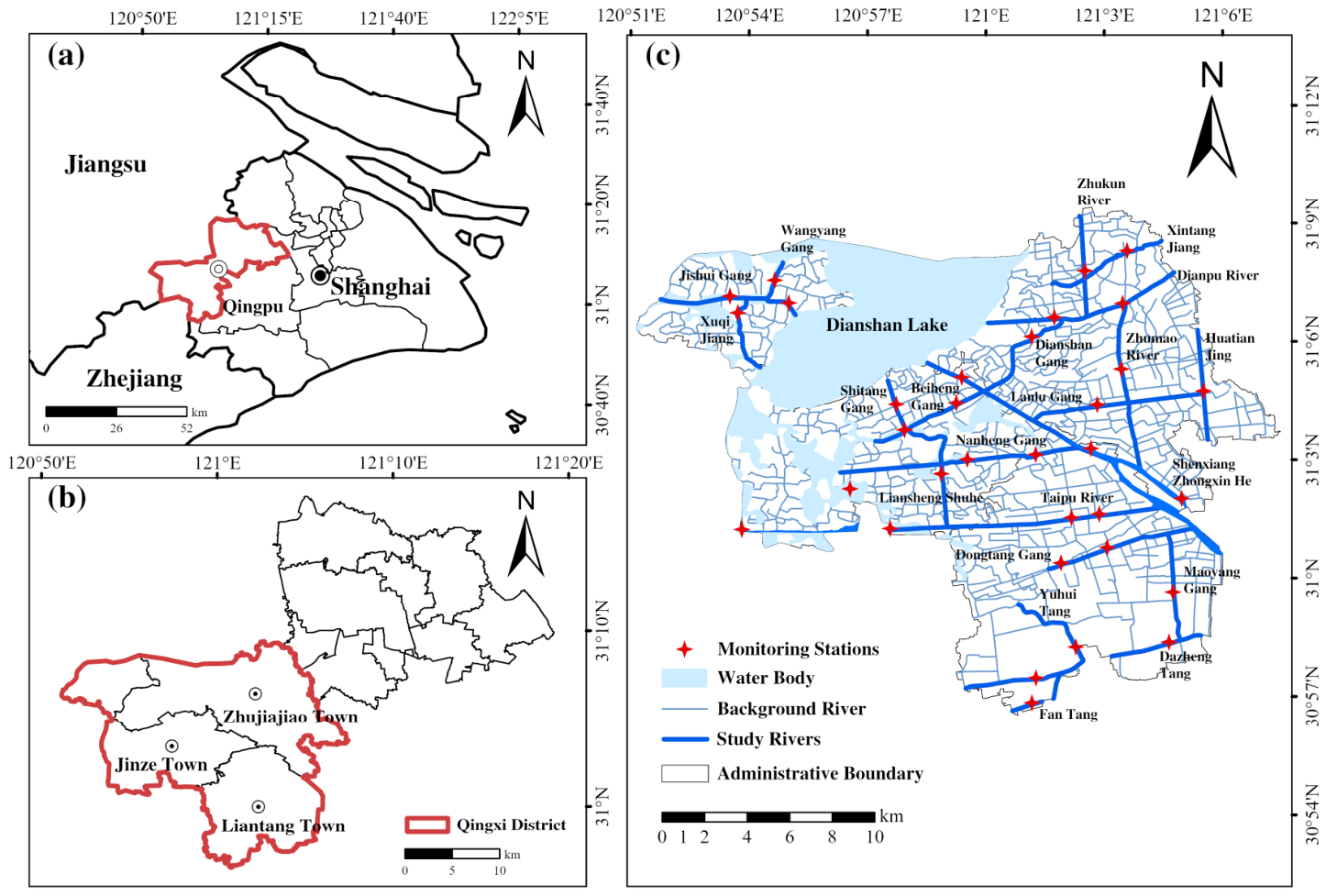
Shanghai is situated on the front of the Yangtze River Delta in eastern China (30°40′~31°53′ N, 120°52′~122°12′ E). It is a typical urban river network region. The Qingxi area encompasses the towns of Jinze, Liantang and Zhujiajiao, with a total administrative area of 670.14 km2. Located in the upper reaches of the Huangpu River, Shanghai’s mother river, the Qingxi area plays a vital role in safeguarding the ecological and hydrological quality of the entire river system. With a distinct urbanization gradient across its territory, the Qingxi area serves as an ideal heterogeneous sample for multi-scale river network and river landscape monitoring in urban settings. The study area features a well-developed river and lake system, with 2185 rivers of different levels stretching for a total of 2503.45 km; its river network density reaches 3.74 km/km2, and the water surface ratio stands at 18.8%. Figure 1 presents an overview of the study area.

2.2. Data Acquisition and Processing

This study constructed a targeted data processing chain for the Qingxi area river landscape assessment, featuring multi-source collection, classification analysis, and integrated output as core sequential steps. Multi-source research data were collected from multiple authoritative channels, as detailed in Table 1. Quantitative analysis was then implemented with dedicated tools matched to specific research indicators. In the quantitative analysis phase, MATLAB 2021b, SPSS 27, and ArcGIS 10.8were applied to calculate the full set of indicators. This analytical process ultimately integrated all obtained results to establish a fundamental database of river landscape conditions. It encompasses 4 dimensions and 20 key indicators, including 8 for the river network scale and 12 for the river scale.

2.3. River Network Landscape Condition Indicator System

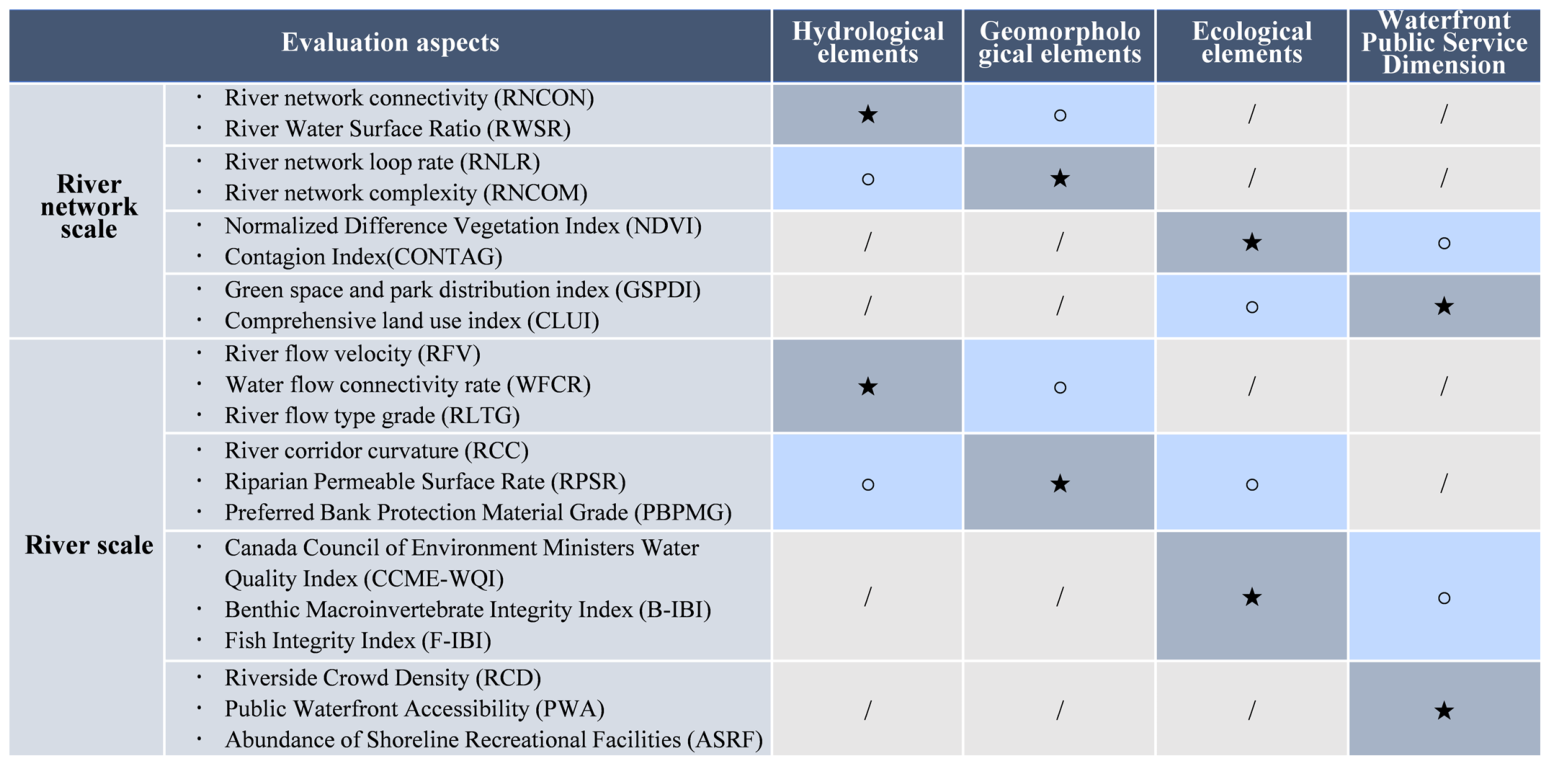
Relying on the improved URBAN framework, this study develops a dual-scale “river network–river” evaluation system. Its relationship matrix is presented in Figure 2.
Indicator selection adheres to scientific validity, representativeness and innovation. Scientific validity reflects the physical and biological characteristics of urban river networks, while representativeness covers the core management-dimension elements of the Yangtze River Delta. Key indicators, including the abundance of waterfront recreational facilities and the accessibility of public riverbanks, are selected to characterize the waterfront public service dimension. Each indicator parameter is selected based on existing river assessment protocols worldwide and validated via field monitoring of the Yangtze River Delta urban rivers. This guarantees the evaluation system’s applicability to the Shanghai urban river networks. The specific calculation methods for the four dimensions are detailed in Table 2 and Table 3.

2.4. Dual-Scale Scoring for River Network-River

For the evaluation of urban river networks in the Shanghai Plain, this study employs a dual-scale coupled scoring method based on existing standards and threshold-setting approaches for urban river network assessment [35,36]. Scoring benchmarks are developed by integrating the key threshold method, natural breakpoint method and expert consultation method (Table 4), enabling coordinated assessment of macro-structural characteristics and micro-functional performance. At the river network scale, the evaluation focuses on verifying whether the regional background health baseline is met. At the river scale, principal component analysis (PCA) is applied to accurately identify functional deficiencies of specific river sections.
This study adopts the analytic hierarchy process (AHP) to establish a dual-scale weighting system and comprehensive evaluation framework for the river network scale and river scale. This method quantifies the contribution of each scale to watershed landscape health assessment. A three-level hierarchical structure is established, as shown in Table 5. Eight experts in related fields conduct pairwise comparisons to determine the relative importance of indicators at each level. The geometric mean method is used to integrate expert judgments, and a reciprocal judgment matrix is constructed accordingly. A consistency test (consistency ratio CR < 0.1) is performed to verify the logical rationality of the matrix, and the weight values of all indicators are calculated.
This study uses a 100-point quantitative scoring system. For the river network scale, standardized scores of sub-indicators are weighted and summed to obtain the comprehensive score. For the river scale, each river in the study area is evaluated independently using corresponding indicator weights, and the average score of all rivers is regarded as the comprehensive score of the river scale. The final comprehensive assessment score of regional watershed landscape health is obtained through the weighted summation of the two scale scores based on the weights determined by the AHP method. Based on the 100-point scoring system, the water system health status is divided into five grades: Good (85–100 points), Relatively good (69–84 points), Average (53–68 points), Relatively poor (37–52 points), and Poor (0–36 points). This classification is uniformly applied to the river network scale, river scale, and the comprehensive evaluation score.
For the river network scale, the scoring criteria of each evaluation indicator differ. To eliminate dimensional differences, raw scores of all indicators are first linearly standardized to dimensionless values in the range of 0–1, as follows:
S i = X i X i , m i n X i , m a x X i , m i n
where Si is the standardized score of indicator i, derived from its raw score Xi, with Xi, min and Xi, max denoting the minimum and maximum scores defined in the corresponding scoring criteria. Next, the average standardized score for each sub-criterion layer is calculated: the arithmetic mean of the standardized scores of all indicators under the same sub-criterion layer is taken as the composite score of that element. Subsequently, the composite score of the river network scale is computed via weighted summation, using the sub-criterion layer weights determined by the AHP:
R n e t w o r k = 100 × j = 1 4 S j × w j
where Rnetwork is the composite score of the river network scale on a 100-point scale, Sj is the average standardized score of the j-th sub-criterion layer, and wj is its corresponding weight.
For the river scale, the same standardization and weighting procedure was applied. First, raw indicator scores were linearly standardized, and average standardized scores were computed for each sub-criterion layer. The composite score for each individual river was then calculated as:
R i = 100 × j = 1 4 S i j × w j
where Ri is the composite score of the i-th river on a 100-point scale, Sij is the average standardized score of the j-th sub-criterion layer for river i, and wj is the weight of the j-th sub-criterion layer under the river scale. Finally, the arithmetic mean of the composite scores of all rivers in the study area is computed to obtain the composite score of the regional river scale:
R r i v e r = 1 n × i = 1 n R i
where Rriver is the composite score of the river scale, and n is the total number of rivers in the study area. The final comprehensive assessment score of regional river landscape health is then calculated as the weighted sum of the dual-scale composite scores, using the AHP-derived weights for the two scales:
R f i n a l = w n e t w o r k × R n e t w o r k + w r i v e r × R r i v e r
where Rfinal is the overall health score of the river system on a 100-point scale, and Rnetwork and Rriver are the weights of the river network scale and river scale, respectively, determined by the AHP (Table 5).
To evaluate the robustness of the assessment results, reduce the subjective uncertainty of AHP-derived weights, and quantify the contribution of each scale’s weight to the final health score, this study adopted the one-factor-at-a-time (OAT) method, a widely used local sensitivity analysis approach in environmental assessment models [37]. We set a series of reasonable weight ratios between the river network scale and single river scale within the range of 0.1–0.9, while ensuring the sum of the two weights remained equal to 1. For each scenario, the final comprehensive health score and corresponding health grade were recalculated using the established evaluation formula to verify both the stability of the assessment outcomes and the relative influence of each scale’s weight on the final result.

3. Results

The indicator weights for the dual-scale assessment, determined by the analytic hierarchy process, are presented in Table 5. The corresponding questionnaire used in this method is provided in Table S3 of the Supplementary Material.

3.1. Assessment Results at the River Network Scale

Based on the weighting framework, the comprehensive score of the Qingxi area’s river network is 58.34, rated as average. The region has stable hydrological and geomorphological support. Human development and ecological protection maintain a relatively high degree of coordination. Overall, the river network structure remains intact, while the ecological background and waterfront public service capacity are relatively insufficient.
For hydrological and geomorphological characteristics, the node connectivity (1.24) and water system integration (0.42) indicate that the river network has developed into a mature, typical network structure. The 10.91% river water surface ratio reflects a high retention rate of natural water bodies in the region. The river network loop rate (12.27%) and complexity (61.53) confirm that its tributary system is well-developed and hierarchically rich, providing excellent geomorphological heterogeneity. These hydrological and geomorphological indicators collectively demonstrate the structural integrity of the study area’s river network.
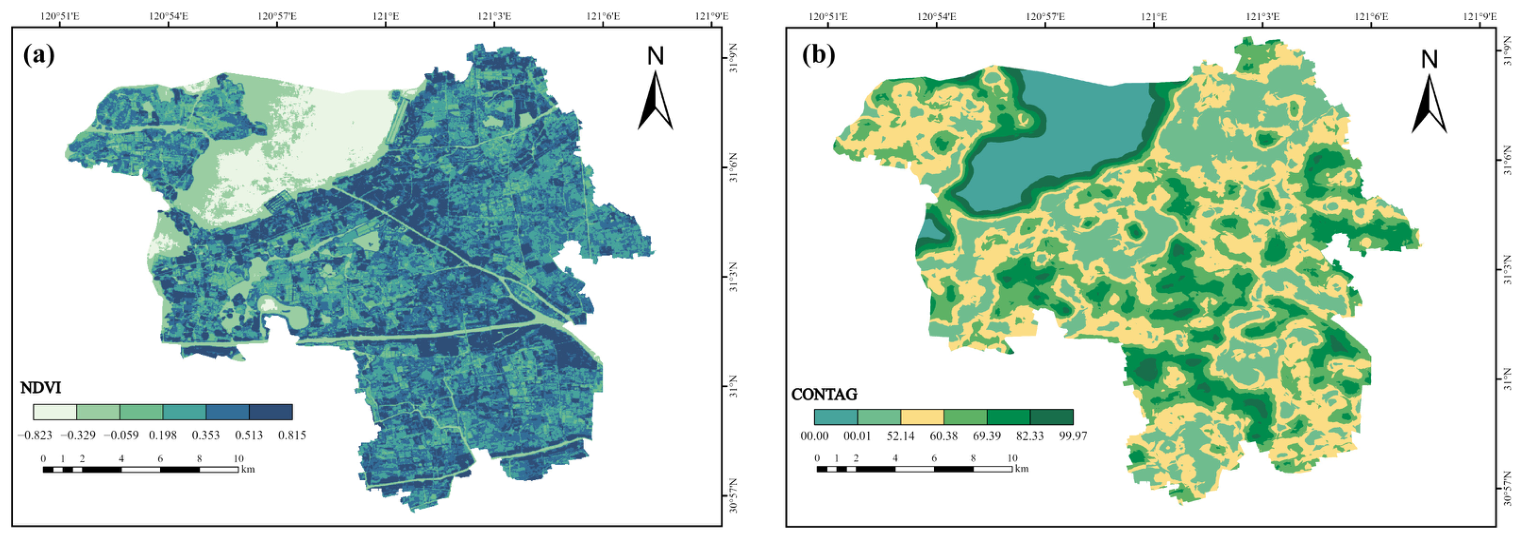
For the ecological and waterfront public service, the Normalized Difference Vegetation Index (NDVI, average 0.04) and spread index (average 53.75) exhibit a spatial pattern that is low in the northwest and high in the southeast (Figure 3). This pattern stems from habitat fragmentation caused by dense lakes and marshes in the northwest, which further leads to spatial fluctuations in landscape connectivity. The Qingxi area has nine green parks, with a green park distribution index of 0.03, reflecting low green park distribution density and inadequate spatial supply capacity for the waterfront public service dimension. The land use degree index is 252.92, with over 77.80% of land classified as natural or agricultural. These indicators confirm the region’s low-intensity urbanization characteristics, which are based on lakes and polders. Restricted by ecological spatial differentiation and inadequate supporting layout of waterfront public service facilities, the overall ecological and waterfront public service capacity of the river network fails to reach a good level.

3.2. Assessment Results at the River Scale

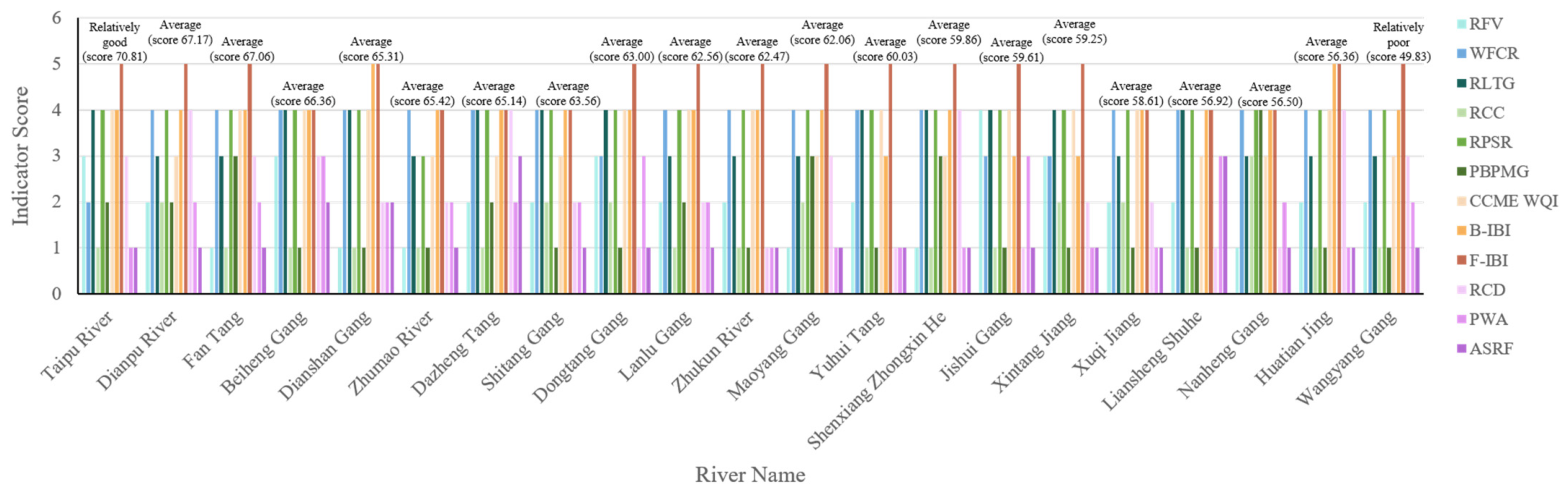
The average comprehensive score of the 21 monitored rivers is 61.80 points, which is an average grade. Among the 21 rivers, one is rated relatively good, one is rated relatively poor, and the remaining 19 are classified as average, with no rivers reaching the good level (Table 6 and Figure 4).
For hydrological characteristics, the rivers generally exhibit gentle flows. A total of 76.19% of them have flow speeds ranging from 0.03 to 0.26 m/s, with main streams flowing faster than tributaries. A total of 61.90% of the rivers maintain a connectivity rate of 97.53% to 100% and remain mostly unobstructed year-round. The only exception is the Maoyang Gang, where strict water-gate management leads to lower connectivity. Flow types are dominated by ripples, broken standing waves, and transitional states, with no stagnant water observed. These patterns reflect the effectiveness of active water regulation in the embanked area as well as the integrity of natural micro-topography. Hydrological conditions are a relatively advantageous dimension of river-scale evaluation, supporting the basic ecological functions of the river system.
Geomorphologically, natural meanders are retained in the Xuqi Jiang and Yuhui Tang. River channel curvature varies across the study area. 19.05% of rivers are moderately curved, 61.90% are slightly curved, and 9.52% are nearly straight. Shoreline permeability also differs among sites. For instance, 47.62% of rivers have permeable shorelines exceeding 90%, while the Wangyang Gang shows notably limited shoreline permeability. Embankment types are diverse. Ecological embankments such as those using timber piles and soil in the Xuqi Jiang or reed and timber piles in the Xintang Jiang help balance ecological needs with flood control. Nevertheless, hard embankments still dominate and account for 61.90% of rivers. Widespread river straightening and hard revetment construction have suppressed the geomorphological diversity of most rivers, becoming one of the main limiting factors for river health improvement.
Ecological monitoring results indicate that 57.14% of the rivers exhibit good water quality. These rivers support a total of 43 large benthic invertebrate species and 38 fish species. Clear spatial patterns emerge in biological integrity. B-IBI values show a declining trend from northeast to southwest. In contrast, F-IBI values first increase and then decrease from west to east. Generally, water quality and aquatic biological integrity are maintained at a medium-to-good level, forming a favorable ecological foundation for river landscape health.
From a waterfront public service perspective, the average riverbank population density is 23.34 people/hm2. High-density clusters are located in the northeast urbanized and tourist areas, such as the intersections of the town of Zhujiakou and Shenxiang Zhongxin He. Low-density areas lie at the regional periphery, such as Dazheng Tang and Xuqi Jiang, among others. Shore accessibility is highly variable. Approximately 47.61% of rivers have accessibility above 60%, yet 52.38% lack sufficient accessibility due to building or farmland encroachment. Waterfront facilities are generally underdeveloped. Only a few areas, like the Lanlu Gang, offer relatively diverse facilities. Waterfront boardwalks and steps, among other features, indicate consideration for public accessibility and environmental compatibility. Insufficient riverside accessibility, limited provision of leisure service facilities, and unbalanced spatial layout are prominent limiting factors at the river scale, which may constrain the overall health status of the river system.
Integrating PCA conducted on 12 river-scale indicators, this study precisely identifies the functional characteristics of river landscapes. The analysis yielded a KMO value of 0.537 and a Bartlett’s test of sphericity of 110.373 (p < 0.001). These results confirm the data’s suitability for factor analysis. Following the eigenvalue-greater-than-1 criterion, four principal components were extracted. They cumulatively explain 75.223% of the total variance. After varimax rotation (Table 7), each component was linked to distinct ecological and functional attributes. Component 1 corresponds to the water ecology and hydrological connectivity factor. It is strongly correlated with flow connectivity, B-IBI, F-IBI, and river flow velocity. Component 2 represents the waterfront public service function factor. It is closely linked to public waterfront accessibility, river flow types, and the richness of waterfront facilities. Component 3 denotes the riparian environment and water quality factor. It is highly associated with riparian permeable surface rate and CCME WQI. Component 4 reflects the river morphology and bank protection factor. It is strongly associated with river corridor sinuosity and bank protection materials.
Combined with the indicator scores, these PCA results reveal the following points: (1) Most rivers achieve scores between 3 and 4 in flow connectivity, B-IBI, and F-IBI, which confirms generally good hydrological connectivity and sound aquatic biological health across the region. (2) Scores for riverside accessibility and leisure facility richness mostly fall between 1 and 3, highlighting widespread deficiencies in waterfront public service functions. (3) Riparian permeable surface rate and CCME WQI scores are generally in the range of 3 to 4, suggesting that the degree of shoreline hardening and overall water quality remain at a moderately favorable level. (4) River corridor sinuosity and dominant bank material scores lie between 1 and 2, indicating the need to enhance morphological diversification and reduce hardening modifications.

3.3. Cross-Scale Coupling Results of River Network–River System

Based on the weighted calculation results, the dual-scale comprehensive assessment yields an overall score of 59.39 points in the Qingxi area, belonging to the average grade. Both macro river network and micro river scale are at the medium level, with no obvious hierarchical differentiation in health grade. At the river network scale, the system provides fundamental structural support for individual rivers through its hydrological and geomorphological characteristics. It features a mature network structure, high node connectivity, a favorable water surface ratio, and a well-developed tributary hierarchy, which together maintain stable hydrological connectivity and support basic ecological functions at the river scale.
However, the ecological dimension of the river network exhibits pronounced spatial heterogeneity, with NDVI and the spread index displaying a distinct northwest-low and southeast-high pattern. This heterogeneity is strongly coupled with spatial variations in the river-scale biological integrity indices (B-IBI and F-IBI). The pattern suggests that the ecological background of the river network exerts hierarchical constraints on the ecological quality of individual rivers. At the river scale, most watercourses are classified as average grade, accompanied by a small number of relatively good and relatively poor samples. This reflects the overall moderate health background of the river network yet also reveals localized functional deficits. In particular, the relatively low evaluation performance in waterfront public service, river morphology and bank protection at the river scale is largely consistent with the insufficient green space arrangement and inadequate service provision at the river network scale. Accordingly, a certain degree of cross-scale synchronous constraint can be observed in terms of service function and morphological structure.
Overall, the Qingxi area exhibits a typical coupling pattern characterized by overall support from the macro scale and localized responses at the micro scale. The macro-level river network framework largely determines the basic functional attributes of individual rivers. Meanwhile, the micro-level shortcomings at the river scale reflect the structural and functional weaknesses of the river network itself.
The results obtained via the OAT sensitivity analysis are presented in Table 8. Across all reasonable weight allocation scenarios, the overall river network health score of the Qingxi area shows only minor fluctuations, ranging from 58.69 to 61.45. Notably, the health grade remains consistently classified as “Average” in all scenarios, with no grade shift observed. This confirms that the core assessment conclusion is robust and insensitive to reasonable variations in the dual-scale weights. The small range of score changes further indicates that neither scale’s weight dominates the final outcome, reinforcing that the AHP-based weighting scheme is balanced and scientifically defensible. Accordingly, the resulting assessment outcomes are reliable.

4. Discussion

4.1. Analysis and Interpretation of Results

Among the four dimensions at the river network scale, hydrology and geomorphology perform the strongest. This is supported by high node connectivity, water system integration, river network loop rate, and complexity. These indicators reflect the well-preserved natural water structure and the mature urban river network pattern in the Qingxi area. Rapid urbanization has driven substantial transformations of river networks in many highly urbanized regions worldwide [38,39,40]. The ecological dimension shows moderate overall performance but pronounced spatial differentiation. This pattern is driven mainly by habitat fragmentation in the northwestern lake-marsh zone and uneven vegetation distribution. Hydrological characteristics of urban catchments largely determine how the system responds to urban expansion and river modification [41,42]. Waterfront public service exhibits the weakest performance, characterized by low green park distribution density and limited supply of public recreational space. This weakness stems from the low-intensity urbanization pattern centered on lakes and polders, as well as insufficient integration of human-made recreational facilities into the natural water system. In fact, stronger local community attachment and sense of belonging to their living ecosystems can greatly enhance ecological improvement and restoration efforts [43].
At the river scale, the hydrological and ecological dimensions perform best. Most rivers maintain high flow connectivity, gentle flow regimes, good water quality, and rich benthic and fish communities. This can be attributed to effective sluice regulation and the relatively intact natural micro-topography in the study area. The geomorphological dimension is moderately favorable. Most rivers retain a slight to moderate curvature yet are dominated by hardened embankments. Main rivers are typically preserved to support flood control and water storage, whereas smaller tributaries are far more vulnerable to burial or infilling during urban expansion [44]. This observation aligns with existing findings that urbanization tends to exert a weaker influence on main rivers, while primarily driving the degradation and simplification of small tributaries [45]. Meanwhile, the public’s view of urban rivers tends to focus on waterfront aesthetics, recreational opportunities, and water quality rather than on purely ecological or structural features [46]. As Junker and Buchecker observed, citizens’ everyday perceptions often diverge from the ecological and environmental standards applied by experts [47]. People also develop complex, meaningful attachments to informal green spaces such as street verges, waterfront edges, vacant lots, railway corridors, and brownfields, attributing considerable value to them [48]. Among the dimensions assessed, waterfront public service performed the weakest. This was reflected in limited shoreline accessibility, uneven provision of waterfront facilities, and insufficient public services. Such shortcomings are widespread in urban river systems, where traditional assessment frameworks commonly underrepresent social service values [49]. They largely stem from riverbank encroachment by farmland and construction, poor planning of recreational infrastructure, and a general lack of human-centered design in river management.
Taken together, these coupled findings confirm that single-scale assessments alone cannot fully capture the structural and functional dynamics of urban river networks. Evaluating only the river network scale ignores localized functional defects of individual rivers. In contrast, focusing solely on river segments overlooks the macro-structural constraints of the entire water system. The dual-scale coupling assessment employed in this study reveals the hierarchical linkages between macro-scale river network patterns and micro-scale river characteristics. It clarifies cross-scale mismatches between ecological background conditions and waterfront public service supply. At the same time, it fills a critical gap in traditional river health evaluations, which typically lack multi-scale and multi-dimensional integration. Given its relatively low technical threshold and low-cost field investigation features, this method can effectively support multi-stakeholder participation and promote the popularization of scientific evaluation [50,51]. This confirms the necessity and importance of coupled river network–river assessment. It also provides a methodological reference for systematic and refined diagnosis of urban river landscapes.

4.2. Governance Strategies and Policy Recommendations

Based on the dual-scale assessment results and coupling characteristics, targeted governance strategies are proposed from three levels to promote synergistic improvement of the river network-river system. Flood frequency has been shown to increase as the fractal dimension of river networks decreases [52]. Many global cities have experienced severe declines in stream channels during urbanization, with similar patterns observed in China [45]. At the river network scale, strictly protect the existing hydrological and geomorphological structure of the Qingxi river network. Prohibit channel straightening of naturally meandering rivers such as Xuqi Jiang and Yuhui Tang to maintain stable node connectivity and water surface ratio. To address the significant spatial heterogeneity of ecological elements, prioritize improving landscape connectivity in the northwestern lake-marsh dense area. Construct ecological greenways and wetland patches to connect fragmented water bodies and reduce habitat fragmentation. Relying on the lake-marsh polder ecosystem, implement strict planning control and reduce construction intensity in ecologically sensitive areas. In addition, improve vegetation coverage along key lake shorelines such as Dianshan Lake to alleviate ecological pressure in the northeastern urbanized and tourist areas.
Classify rivers according to assessment grades for differentiated management. For the Taipu River, classified into the relatively good health grade, protective and developmental measures should be implemented. Maintain their high hydrological and biological integrity while expanding popular science and ecological recreation functions. For the 19 rivers classified as having an average health grade, targeted optimization and remediation should be implemented. Clear occupied riverbank spaces and add slow-traffic trails and waterfront platforms to improve shoreline accessibility and facility richness. Promote ecological embankment transformation by referencing the wooden pile and soil structure of Xuqi Jiang. Changes in hydrological connectivity further affect hydrological stability and ecological responses [53]. This will moderately restore natural meandering morphology, reduce the dominance of hard revetments, and enhance habitat diversity.
Establish a long-term dual-scale dynamic monitoring system to track cross-scale mismatches in waterfront public service supply and ecological background support. Strengthen inter-departmental collaborative governance among water conservancy, ecological environment, natural resources, and cultural tourism authorities, and clarify management responsibilities for sluice ecological regulation, shoreline space optimization, and waterfront public service layout. Leveraging the cultural resources of Qingxi Ancient Town, develop a public participation mechanism to encourage community involvement in river maintenance and ecological monitoring. Public support and civil society engagement are fundamental to the success of river restoration efforts [54]. This also requires a more detailed assessment of social river connectivity for rational waterfront planning [55]. This approach will foster a sustainable governance model led by the government, coordinated by multiple departments, and supported by public participation.

4.3. Limitations and Future Prospects

The proposed dual-scale assessment framework in this study exhibits good repeatability and can be applied to multi-year datasets for long-term sequential evaluation, enabling the tracking of temporal variations in river system health and identification of its driving factors. Nevertheless, constrained by data availability and research costs, the present study still has certain limitations.
This study conducts a static cross-sectional assessment without carrying out long-term dynamic analysis on the evolutionary trends of river health. Meanwhile, the current framework lacks in-depth socio-cultural indicators, as systematic acquisition of multi-source subjective survey data remains difficult. The waterfront public service dimension can be further enriched by incorporating targeted socio-cultural metrics, including public perception surveys, cultural mapping, and historical water-town interface evaluation, to support a more comprehensive assessment of river landscape cultural value.
Furthermore, the existing indicator system and scoring criteria are calibrated primarily for urban river basins and have not been validated in rural or low-disturbance natural watersheds. Indicator settings, scoring thresholds and AHP weights can be adjusted to adapt to non-urban contexts, further improving the general applicability of the methodology across broader watershed scenarios.

5. Conclusions

Based on the localized optimization of the URBAN framework, this study developed a multi-dimensional assessment system for urban water landscape health. The system includes four dimensions, including hydrology, geomorphology, ecology, and waterfront public service. By combining the macro-scale structure of river networks with the micro-scale functions of rivers, it establishes a dual-scale coupled evaluation method. This approach overcomes the limitations of traditional single-river or single-scale assessments, which often overemphasize local characteristics.
The empirical application in Shanghai’s Qingxi area confirms the system’s strong practicality and scientific validity. It effectively identifies the overall landscape health status as well as key weak points of urban water systems. With only moderate professional requirements for operators, the system can be readily promoted and applied after simple training for grassroots personnel. This enhances public participation in water system assessment and provides essential data support for building a long-term, large-scale river landscape database.
Empirical results indicate that the Qingxi river network possesses superior hydrological and geomorphological foundations. Nevertheless, obvious spatial heterogeneity of ecological quality and inadequate supply of waterfront public services are observed at the river network scale. At the river scale, hydrological and ecological performance remains at a moderately favorable level, whereas waterfront public service and river morphology constitute the primary limiting factors. An overall support and local response coupling pattern exists between the river network and individual rivers. This pattern highlights the hierarchical constraints imposed by macro-scale water system structures on micro-scale river functions. It also reveals the feedback effects of local deficiencies on the overall system. This study strengthens the scientific rigor, sustainability, and long-term effectiveness of watershed governance. It also offers a valuable reference that supports the synergistic advancement of ecological functions and human well-being in densely urbanized plain areas with well-developed river networks.

Supplementary Materials

The following supporting information can be downloaded at: https://www.mdpi.com/article/10.3390/su18115279/s1, Table S1. Scoring criteria for flow type, dominant revetment material and richness of riparian hydrophilic facilities; Table S2. Classification and evaluation criteria of water quality indicators for ecological elements; Table S3. Expert Questionnaire for the Analytic Hierarchy Process (AHP).

Author Contributions

Conceptualization, R.W. and L.Y.; methodology, R.W.; software, W.Y.; validation, R.W. and W.Y.; formal analysis, R.W.; investigation, R.W. and W.Y.; resources, L.Y.; data curation, R.W. and W.Y.; writing—original draft preparation, R.W.; writing—review and editing, L.Y.; visualization, R.W.; supervision, L.Y. and X.Q.; project administration, X.Q.; funding acquisition, X.Q. All authors have read and agreed to the published version of the manuscript.

Funding

This research was funded by the National Key R&D Program of China, grant number 2019YFC0408200 (sub-project 2019YFC0408205).

Institutional Review Board Statement

Not applicable.

Informed Consent Statement

Not applicable.

Data Availability Statement

Data will be made available on request.

Conflicts of Interest

The authors declare no conflicts of interest.

References

  1. Ren, L.; Song, S.P.; Zhou, Y. Evaluation of river ecological status in the plain river network area in the context of urbanization: A case study of 21 Rivers’ ecological status in Jiangsu Province, China. Ecol. Indic. 2022, 142, 109172. [Google Scholar] [CrossRef]
  2. Endo, A.; Kumazawa, T.; Kimura, M.; Yamada, M.; Kato, T.; Kozaki, K. Describing and Visualizing a Water–Energy–Food Nexus System. Water 2018, 10, 1245. [Google Scholar] [CrossRef]
  3. Giannetti, B.F.; Agostinho, F.; Cabello Eras, J.J.; Yang, Z.F.; Almeida, C.M.V.B. Cleaner production for achieving the sustainable development goals. J. Clean. Prod. 2020, 271, 122127. [Google Scholar] [CrossRef]
  4. Yang, Y.F.; Zhou, X.X.; Xu, J.J.; Wang, H.R.; Liu, L.; Cao, W.M. Coupling mutual information into ecological networks to analyze the sustainability of water-energy nexus: A case study of Yangtze River Economic Belt. J. Clean. Prod. 2024, 448, 141705. [Google Scholar] [CrossRef]
  5. Li, F.W.; Luo, Q.Y.; Zhao, Y. Characterization and Classification of River Network Types. Water Resour. Manag. 2023, 37, 6219–6236. [Google Scholar] [CrossRef]
  6. Rinaldo, A.; Gatto, M.; Rodriguez-Iturbe, I. River networks as ecological corridors: A coherent ecohydrological perspective. Adv. Water Resour. 2018, 112, 27–58. [Google Scholar] [CrossRef] [PubMed]
  7. Rodriguez-Iturbe, I.; Muneepeerakul, R.; Bertuzzo, E.; Levin, S.A.; Rinaldo, A. River networks as ecological corridors: A complex systems perspective for integrating hydrologic, geomorphologic, and ecologic dynamics. Water Resour. Res. 2009, 45, W01413. [Google Scholar] [CrossRef]
  8. Biswal, B.; Marani, M. Geomorphological origin of recession curves. Geophys. Res. Lett. 2010, 37, L24403. [Google Scholar] [CrossRef]
  9. Reid, M.A.; Reid, M.C.; Thoms, M.C. Ecological significance of hydrological connectivity for wetland plant communities on a dryland floodplain river, MacIntyre River, Australia. Aquat. Sci. 2016, 78, 139–158. [Google Scholar] [CrossRef]
  10. Sun, C.; Chen, L.; Zhu, H.; Xie, H.; Qi, S.S.; Shen, Z.Y. New framework for natural-artificial transport paths and hydrological connectivity analysis in an agriculture-intensive catchment. Water Res. 2021, 196, 117015. [Google Scholar] [CrossRef]
  11. Cote, D.; Kehler, D.G.; Bourne, C.; Wiersma, Y.F. A new measure of longitudinal connectivity for stream networks. Landsc. Ecol. 2009, 24, 101–113. [Google Scholar] [CrossRef]
  12. Shao, X.J.; Fang, Y.; Cui, B.S. A model to evaluate spatiotemporal variations of hydrological connectivity on a basin-scale complex river network with intensive human activity. Sci. Total Environ. 2020, 723, 138051. [Google Scholar] [CrossRef]
  13. Nilsson, C.; Reidy, C.A.; Dynesius, M.; Revenga, C. Fragmentation and Flow Regulation of the World’s Large River Systems. Science 2005, 308, 405–408. [Google Scholar] [CrossRef]
  14. Dudgeon, D.; Arthington, A.H.; Gessner, M.O.; Kawabata, Z.-I.; Knowler, D.J.; Lévêque, C.; Naiman, R.J.; Prieur-Richard, A.-H.; Soto, D.; Stiassny, M.L.J.; et al. Freshwater biodiversity: Importance, threats, status and conservation challenges. Biol. Rev. 2006, 81, 163–182. [Google Scholar] [CrossRef] [PubMed]
  15. Vörösmarty, C.J.; McIntyre, P.B.; Gessner, M.O.; Dudgeon, D.; Prusevich, A.; Green, P.; Glidden, S.; Bunn, S.E.; Sullivan, C.A.; Liermann, C.R.; et al. Global threats to human water security and river biodiversity. Nature 2010, 467, 555–561, Erratum in Nature 2010, 468, 334. https://doi.org/10.1038/nature09549. [Google Scholar] [CrossRef] [PubMed]
  16. Beck, M.B. Vulnerability of water quality in intensively developing urban watersheds. Environ. Model. Softw. 2005, 20, 381–400. [Google Scholar] [CrossRef]
  17. Zhang, X.Y.; Li, F.W.; Zhao, Y. Impact of changes in river network structure on hydrological connectivity of watersheds. Ecol. Indic. 2023, 146, 109848. [Google Scholar] [CrossRef]
  18. Liu, S.; Lin, M.N.; Li, C.L. Analysis of the Effects of the River Network Structure and Urbanization on Waterlogging in High-Density Urban Areas—A Case Study of the Pudong New Area in Shanghai. Int. J. Environ. Res. Public Health 2019, 16, 3306. [Google Scholar] [CrossRef]
  19. Barbour, M.T.; Gerritsen, J.; Snyder, B.D.; Stribling, J.B. Rapid Bioassessment Protocols for Use in Streams and Wadeable Rivers: Periphyton, Benthic Macroinvertebrates, and Fish, 2nd ed.; EPA 841-B-99-002; US Environmental Protection Agency, Office of Water: Washington, DC, USA, 1999. Available online: https://archive.epa.gov/water/archive/web/html/index-14.html (accessed on 2 December 2025).
  20. Raven, P.J.; Holmes, N.T.H.; Dawson, F.H.; Everard, M. Quality assessment using River Habitat Survey data. Aquat. Conserv. Mar. Freshw. Ecosyst. 1998, 8, 477–499. [Google Scholar] [CrossRef]
  21. Karr, J.R. Assessment of Biotic Integrity Using Fish Communities. Fisheries 1981, 6, 21–27. [Google Scholar] [CrossRef]
  22. Xu, F.; Zhao, Y.W.; Yang, Z.F.; Zhang, Y. Multi-scale evaluation of river health in Liao River Basin, China. Front. Environ. Sci. Eng. China 2011, 5, 227–235. [Google Scholar] [CrossRef]
  23. Dong, Z.R. Theoretical framework for river ecosystem research. J. Hydraul. Eng. 2009, 40, 129–137. (In Chinese) [Google Scholar] [CrossRef]
  24. Wang, J.M.; Fu, L.; Lu, C.; Wang, S.W.; Zhu, Y.S.; Xu, Z.Q.; Gui, Z.H. Study on River Protection and Improvement Based on a Comprehensive Statistical Model in a Coastal Plain River Network. Sustainability 2024, 16, 3518. [Google Scholar] [CrossRef]
  25. Chen, W.X. A multi-scale assessment of ecosystem health based on the Pressure-State-Response framework: A case in the Middle Reaches of the Yangtze River Urban Agglomerations, China. Environ. Sci. Pollut. Res. 2022, 29, 29202–29219. [Google Scholar] [CrossRef]
  26. Murphy, B.M.; Russell, K.L.; Mould, S.; Vietz, G.; Nelson, P.A. Managing urban riverscapes: An assessment framework to integrate social-ecological values and physical processes. J. Environ. Manag. 2022, 322, 115862. [Google Scholar] [CrossRef]
  27. Gurnell, A.; Shuker, L.; Wharton, G. URS Classifications and Indices: 2015; Queen Mary University of London: London, UK, 2015; Available online: https://urbanriversurvey.org/wp-content/uploads/2015/04/URS-Classifications-and-Indices-April-2015.pdf (accessed on 2 December 2025).
  28. Deng, X.J. Correlations between water quality and the structure and connectivity of the river network in the Southern Jiangsu Plain, Eastern China. Sci. Total Environ. 2019, 664, 583–594. [Google Scholar] [CrossRef] [PubMed]
  29. Lin, Z.X.; Xu, Y.Y.; Dai, X.Y.; Wang, Q.; Yuan, J. Influence of Urbanization on the Structure and Function of Plain River Network Systems: A Case Study of Suzhou City. J. Lake Sci. 2018, 30, 1722–1731. (In Chinese) [Google Scholar] [CrossRef]
  30. Huang, S.L.; Lee, Y.C.; Budd, W.W.; Yang, M.C. Analysis of changes in farm pond network connectivity in the peri-urban landscape of the taoyuan area, taiwan. Environ. Manag. 2011, 49, 915–928. [Google Scholar] [CrossRef] [PubMed]
  31. Yuan, W.; Yang, K.; Tang, M.; Xu, Q.X. Structural Characteristics of Rivers in Plain River Network Areas and Their Impacts on Regulation and Storage Capacity. Geogr. Res. 2005, 24, 717–724. (In Chinese) [Google Scholar] [CrossRef]
  32. Wang, W.W.; Liang, S.; Yang, H.Z. Influencing Factors and Distribution Characteristics of Cold Island Effect in Urban Waterfront Blue-Green Spaces: The Case Studies of Wuhan, Nanjing and Hangzhou. J. Hum. Settl. West China 2023, 38, 22–29. (In Chinese) [Google Scholar] [CrossRef]
  33. Wang, Y.; Sun, R.X. Impact of Land Use Change on the Coupling Coordination Degree of Regional Water-Energy-Food System: A Case Study of the Beijing-Tianjin-Hebei Urban Agglomeration. J. Nat. Resour. 2022, 37, 582–599. (In Chinese) [Google Scholar] [CrossRef]
  34. Shanghai Water Authority. Technical Guidelines for River and Lake Health Assessment of Shanghai (Trial); Shanghai Water Authority: Shanghai, China, 2023. Available online: https://swj.sh.gov.cn/cmsres/ae/ae68e191378443a39bfb8eec382445d7/b5ed9b8955cbec90db7c6fdb1057d6cc.pdf (accessed on 7 December 2025). (In Chinese)
  35. Zeng, P.; Wang, Y.K.; Liu, Y.Y.; Wang, H.X.; Chen, S.Q.; Che, Y. Habitat Assessment of Urban Rivers in Taihu Lake Basin Based on Reach Scale. Chin. J. Appl. Ecol. 2020, 31, 581–589. (In Chinese) [Google Scholar] [CrossRef]
  36. Chen, X.; Jin, T.T.; Su, H.D.; Lin, J.Q.; Wang, D.B.; Liu, G.H.; Zhang, J.J. Construction and Application of River Health Assessment Index System for Lhasa River. Acta Ecol. Sin. 2019, 39, 799–809. (In Chinese) [Google Scholar] [CrossRef]
  37. Chen, W.P.; Tu, H.Z.; Peng, C.; Hou, Y. Review of Sensitivity Analysis Methods in Environmental Models. Environ. Sci. 2017, 38, 4889–4896. (In Chinese) [Google Scholar] [CrossRef]
  38. Chen, K.L.; Wang, X.; Li, D.; Xue, D. The Morphological Evolution of River and Water Body in Urban Area of Guangzhou City in 1990–2010. Geogr. Sci. 2013, 33, 223–230. (In Chinese) [Google Scholar] [CrossRef]
  39. Itsukushima, R.; Ohtsuki, K. A century of stream burial due to urbanization in the Tokyo Metropolitan Area. Environ. Earth Sci. 2021, 80, 237. [Google Scholar] [CrossRef]
  40. Napieralski, J. A century of stream burial in Michigan (USA) cities. J. Maps 2016, 12, 300–303. [Google Scholar] [CrossRef]
  41. Luo, S.; Wang, Q.; Xu, Y.P.; Lin, Z.X.; Yu, Z.H. Identifying changes in flood characteristics and their causes from an event-based perspective in the Central Taihu Basin. Sci. Total Environ. 2023, 905, 167131. [Google Scholar] [CrossRef] [PubMed]
  42. Findlay, S.J.; Taylor, M.P. Why rehabilitate urban river systems? Area 2006, 38, 312–325. [Google Scholar] [CrossRef]
  43. Escalera-Reyes, J. Place Attachment, Feeling of Belonging and Collective Identity in Socio-Ecological Systems: Study Case of Pegalajar (Andalusia-Spain). Sustainability 2020, 12, 3388. [Google Scholar] [CrossRef]
  44. Sear, D.A.; Newson, M.D. Environmental change in river channels: A neglected element. Towards geomorphological typologies, standards and monitoring. Sci. Total Environ. 2003, 310, 17–23. [Google Scholar] [CrossRef]
  45. Lin, Z.X.; Luo, S.; Lu, M.; Dai, S.Q.; Xu, Y.P. Assessing Variations in River Networks Under Urbanization Across Metropolitan Plains Using a Multi-Metric Approach. Land 2025, 14, 1994. [Google Scholar] [CrossRef]
  46. Pradilla, G.; Lamberty, G.; Hamhaber, J. Hydromorphological and socio-cultural assessment of urban rivers to promote nature-based solutions in Jarabacoa, Dominican Republic. Ambio 2021, 50, 1414–1430. [Google Scholar] [CrossRef]
  47. Junker, B.; Buchecker, M. Aesthetic preferences versus ecological objectives in river restorations. Landsc. Urban Plan. 2008, 85, 141–154. [Google Scholar] [CrossRef]
  48. Rupprecht, C.D.D.; Byrne, J.A.; Garden, J.G.; Hero, J.-M. Informal urban green space: A trilingual systematic review of its role for biodiversity and trends in the literature. Urban For. Urban Green. 2015, 14, 883–908. [Google Scholar] [CrossRef]
  49. Zhou, W.Q.; Pickett, S.T.A.; McPhearson, T. Conceptual frameworks facilitate integration for transdisciplinary urban science. npj Urban Sustain. 2021, 1, 1. [Google Scholar] [CrossRef]
  50. Beißler, M.R.; Hack, J. A Combined Field and Remote-Sensing Based Methodology to Assess the Ecosystem Service Potential of Urban Rivers in Developing Countries. Remote Sens. 2019, 11, 1697. [Google Scholar] [CrossRef]
  51. Zingraff-Hamed, A.; Hüesker, F.; Albert, C.; Brillinger, M.; Huang, J.; Lupp, G.; Scheuer, S.; Schlätel, M.; Schröter, B. Governance models for nature-based solutions: Seventeen cases from Germany. Ambio 2021, 50, 1610–1627. [Google Scholar] [CrossRef] [PubMed]
  52. Zhang, A.J.; Zheng, C.M.; Wang, S.; Yao, Y.Y. Analysis of streamflow variations in the Heihe River Basin, northwest China: Trends, abrupt changes, driving factors and ecological influences. J. Hydrol. Reg. Stud. 2015, 3, 106–124. [Google Scholar] [CrossRef]
  53. Cai, J.; Wang, X.; Cai, Y.; Wei, C.; Liao, Z.; Liu, D.; Li, C.; Liu, Q. An integrated connectivity diagnostics and dependency analysis framework for supporting water replenishment management. J. Hydrol. 2023, 620, 129442. [Google Scholar] [CrossRef]
  54. Buijs, A.E. Public support for river restoration. A mixed-method study into local residents’ support for and framing of river management and ecological restoration in the Dutch floodplains. J. Environ. Manag. 2009, 90, 2680–2689. [Google Scholar] [CrossRef] [PubMed]
  55. Kondolf, G.M.; Pinto, P.J. The social connectivity of urban rivers. Geomorphology 2017, 277, 182–196. [Google Scholar] [CrossRef]
Figure 1. Overview of the study area.
Sustainability 18 05279 g001
Figure 2. Matrix diagram of the relationship of urban river network health assessment indicators. Note: “★” indicates that the evaluation indicator is a core representation element of the corresponding evaluation dimension; “○” indicates that the evaluation indicator has an indirect cross-effect with the corresponding evaluation dimension; “/” indicates that the indicator has no significant effect relationship with the corresponding evaluation dimension. The indicator analysis in this paper is mainly based on the core representation elements “★”.
Sustainability 18 05279 g002
Figure 3. Spatial distribution characteristics of Normalized Difference Vegetation Index (NDVI) and contagion index. Note: (a) represents NDVI and (b) represents contagion index.
Sustainability 18 05279 g003
Figure 4. Scores and evaluation grades of indicators at the river scale.
Sustainability 18 05279 g004
Table 1. Data sources and characteristics.
Data NameYearData SourcesData Description
Sluice Operation Data2022Water Bureau of Qingpu District, Shanghai, https://www.shqp.gov.cn/water/ (accessed on 26 January 2024)/
Water Quality Data2022Water Bureau of Qingpu District, Shanghai, https://www.shqp.gov.cn/water/ (accessed on 26 January 2024)Mean values of monthly data.
Benthic Macroinvertebrate Data2022Water Bureau of Qingpu District, Shanghai, https://www.shqp.gov.cn/water/ (accessed on 26 January 2024)Mean values of data collected in March and August.
Fish Data2022Water Bureau of Qingpu District, Shanghai, https://www.shqp.gov.cn/water/ (accessed on 26 January 2024)Mean values of data collected in March and August.
River Network Data2021Institute of Geographic Sciences and Natural Resources Research (IGSNRR), Chinese Academy of Sciences (CAS), https://www.cas.cn/ (accessed on 30 November 2023)Vector river network data with a mapping scale of 1:25,000.
Land Use Data2020European Space Agency (ESA), https://esa-worldcover.org/ (accessed on 13 December 2023)Derived from Sentinel-1 and Sentinel-2 satellite imagery; 10 m spatial resolution. Covers six typical land use types, including cropland, forest, grassland, built-up areas, permanent water, and bare land.
Remote Sensing Image Data2020Google Earth Engine (GEE), https://earthengine.google.com/ (accessed on 07 December 2023)Based on Landsat 8 Surface Reflectance products; 30 m spatial resolution.
POI Data2020Amap (AutoNavi), https://ditu.amap.com/ (accessed on 03 December 2023)Point of Interest (POI) data for scenic spots and tourist attractions.
Population Data2020WorldPop, https://hub.worldpop.org/ (accessed on 11 December 2023)Gridded population data with a spatial resolution of 100 m.
Field Survey Data2023Field investigation conducted by trained environmental science professionalsConducted in accordance with the UK’s Urban River Survey (URS) manual [27]. Each river segment was surveyed for a distance of 1 km with 5 sampling sections set at 200 m intervals. Both banks of each section were comprehensively evaluated, and the average value was used as the final score for the entire river reach. The central location of the surveyed segment is illustrated in Figure 1.
Table 2. Calculation methods of various indicators at the river network scale.
Evaluation LevelEvaluation MetricsCalculation Method
Hydrological elements
  • RNCON [28]
  • Measured jointly by node connectivity rate β and water system integration γ. β = m/n, where m represents the number of river links between nodes, and n represents the number of nodes in the water system network; γ = m/3(n − 2), where m represents the number of river links between two nodes, and n represents the number of nodes in the water system network.
  • RWSR [29]
  • Wp = RS/S, where Wp refers to the river water surface ratio, RS represents the total area of all rivers within the study area, and S represents the area of the study area.
Geomorphological elements
  • RNLR [30]
  • α = (m − n + 1)/(2n − 5), α refers to the loop rate of the river network, m is the number of river links between two nodes, and n is the number of nodes in the water system network.
  • RNCOM [31]
  • RC = N0 × (L/Lm), RC refers to the complexity of the river network, and N0 represents the number of river orders. In this study, according to the “Shanghai River Management Regulations,” rivers are divided into four categories: municipal-managed, district-managed, town-managed, and village-level. L represents the total length of all rivers, and Lm represents the total length of main rivers, here referring to municipal-managed rivers.
Ecological elements
  • NDVI [26]
  • NDVI = (NIR − R)/(NIR + R), NDVI refers to the Normalized Difference Vegetation Index, NIR represents the reflectance of the near-infrared band, and R represents the reflectance of the visible red band.
  • CONTAG [26]
  • C O N T A G = 1 + i = 1 x k = 1 x P i G i k k = 1 x G i k × ln P i G i k k = 1 x G i k 2 ln x × 100 , CONTAG refers to the contagion index, Pi represents the ratio of the area of landscape type i to the total landscape area, and x is the total number of different landscape types. Gik represents the probability that two randomly selected adjacent grids are of landscape types i and k.
Waterfront public service dimension
  • GSPDI [32]
  • G = p S , G refers to the green space park distribution index, p represents the number of POI points classified as green space parks in each area, and S is the area of each region.
  • CLUI [33]
  • L = 100 × i = 1 k S i × A i , L refers to the comprehensive index of land use, Si indicates the grading of land use degree, and Ai represents the ratio of each type to the total area.
Table 3. Calculation methods for various river-scale indicators.
Evaluation AspectEvaluation IndicatorsCalculation Method
Hydrological elements
  • The river flow velocity is denoted by v and is measured using the LS45A cup-type current meter.
  • WFCR [26]
  • WC = TC/T, WC refers to water connectivity, TC indicates the time of water free flow, and T represents a year.
  • RFTG [23]
  • According to the 10 types of water flow listed in the RHS manual, four types suitable for Shanghai urban rivers were selected; under windless conditions, the survey river sections were scored, with the scoring criteria referring to the manual, as detailed in Table S1.
Geomorpholo-gical elements
  • S = Lr/Lv, S refers to the river corridor curvature, Lr is the actual length of the river centerline, and Lv is the straight-line distance between the start and end points of the river.
  • RPSR
  • R p = i = 1 m A p i A b , Rp refers to the permeable surface ratio of the shoreline, Api is the area of the i-th type of permeable land use, and Ab is the area of the buffer zone
  • PBPMG [23]
  • Based on the four grades of advantageous revetments listed in the RHS manual, corresponding scoring standards are set, as detailed in Table S1.
Ecological elements
  • CCME WQI [26]
  • W Q I = 100 F 1 2 + F 2 2 + F 3 2 1.732 ,   F 1 = n N × 100 , F1 represents the percentage of parameters that exceeded the standard limit at least once among all monitored water quality parameters, N refers to the total number of parameters in water quality monitoring, and n is the number of parameters that exceeded the standard limit. F 2 = m M × 100 , F2 represents the proportion of any monitored parameter exceeding its specified standard limit within the time range of the collected samples, where M is the total number of water quality monitoring samples, and m is the number of samples exceeding the standard limit. F 3 = P 0.01 P + 0.01 ,   P = i = 1 n Q M ,   Q = V o b V s , V o b < V s V s , V o b = 0 V s V o b , V o b > V s , Vob represents the specified standard value of a water quality parameter, Vs represents the actual measured value of a water quality parameter, P is the normalized index used to calculate the ratio of the cumulative sum of exceedance multiples to the total number of samples, and F3 defines the range of P between [0, 100]. The water quality grades and score ranges are shown in Table S2.
  • B-IBI [34]
  • Set reference points and disturbance points to establish candidate indicators. For biological indicators whose index value decreases with increased disturbance, the formula is B i = B / B 95 % , where Bi is the calculated score of the i-th indicator, B is the measured value of the indicator, and B95% is the 95th percentile value of the measured indicator; for indicators whose index value increases with increased disturbance, the 5th percentile value is chosen as the optimal expected value. The formula is B i = ( B m a x B ) / ( B m a x B 5 % ) , where Bmax is the maximum measured value of the i-th indicator, and B5% is the 5th percentile value of the measured indicator. By calculating the indices of each biological indicator and accumulating them, the B-IBI value at each sampling site is obtained, and the health evaluation levels are set based on the reference points, as shown in Table S2.
  • F-IBI [34]
  • Set reference points and disturbance points to establish candidate indicators. For biological indicators whose index decreases with increased disturbance, the formula is F i = F / F 95 % , where Fi is the calculated score of the i-th indicator, F is the measured value of the indicator, and F95% is the 95th percentile of the measured values of the indicator; for indicators whose index increases with increased disturbance, the 5th percentile is used as the optimal expected value. Its formula is F i = ( F m a x F ) / ( F m a x F 5 % ) , where Fmax is the maximum measured value of the i-th indicator and F5% is the 5th percentile of the measured values of the indicator. By calculating the indices of each biological indicator and summing them, the F-IBI value of each sampling site is obtained, and the health evaluation level is set according to the reference points as shown in Table S2.
Waterfront public service dimension
  • Using the Buffer tool in ArcToolbox of the ArcGIS software and the Extract by Mask tool in Spatial Analyst Tools, you can obtain the mean population density data within the buffer zone.
  • By combining remote sensing image analysis, Gaode Map data, and field survey methods, the left and right banks of the selected rivers are delineated, and the waterfront distances available for public leisure and recreational activities are determined. In this process, any buildings that may hinder the public from freely walking, engaging in sports, or enjoying waterfront services, such as residential communities, industrial facilities, and educational institutions, will be marked as inaccessible areas.
  • ASRF [23]
  • Based on the total number of types of waterfront facilities on both sides of each river, determine the richness of waterfront facilities for each river. The types of waterfront facilities, specific scoring criteria, and on-site photos are shown in Table S1.
Table 4. Scoring standards for dual-scale evaluation.
Evaluation CriteriaEvaluation IndicatorsScoring Methods
River network scale
  • RNCON
  • Evaluated jointly by node connectivity rate β and water system integration γ: 0 < β < 1, score 1; β > 1, score 2; β > 1 and γ < 1/3, score 3; β > 1 and γ > 1/3, score 4.
  • RWSR
  • Wp < 0.1%, score 1; Wp = [0.1%, 1%), score 2; Wp = [1%, 5%), score 3; Wp = [5%, 10%), score 4; Wp ≥ 10, score 5.
  • RNLR
  • α = 0, score 1; α = (0,0.2], score 2; α = (0.2,0.5], score 3; α = (0.5,0.8], score 4; α > 0.8, score 5.
  • RNCOM
  • RC < 4, score 1; RC = [4, 8), score 2; RC = [8, 16), score 3; RC > 16, score 4.
  • NDVI
  • NDVI < 0.1, score 1; NDVI = [0.1, 0.4), score 2; NDVI = [0.4, 0.7), score 3; NDVI > 0.7, score 4.
  • CONTAG
  • CONTAG = (0, 20), score 1; CONTAG = [20, 40), score 2; CONTAG = [40, 60), score 3; CONTAG = [60, 80), score 4; CONTAG = [80, 100), score 5.
  • GSPDI
  • G = [0, 5%), score 1; G = [5%, 15%), score 2; G = [15%, 30%), score 3; G = [30%, 50%), score 4; G ≥ 50%, score 5.
  • CLUI
  • L = [100, 200), score 1; L = [200, 300), score 2; L = [300, 400), score 3.
River scale
  • RFV
  • v < 0.1, score 1; v = [0.1, 0.3), score 2; v = [0.3, 0.6), score 3; v ≥ 0.6, score 4.
  • WFCR
  • WC < 40%, score 1; WC = [40%, 60%), score 2; WC = [60%, 80%), score 3; WC ≥ 80%, score 4.
  • RLTG
  • Still, score 1 point; uniform wave, score 2 points; ripple, score 3 points; broken standing wave, score 4 points. If it is a transitional state between two, take the average of the two.
  • RCC
  • S = [1.0, 1.05], score 1; S = [1.06, 1.29], score 2; S = [1.3, 3.0], score 3; S > 3.0, score 4.
  • RPSR
  • Rp < 30%, score 1; Rp = [30%, 40%), score 2; Rp = [40%, 60%), score 3; Rp > 60%, score 4.
  • PBPMG
  • Hard protective shore, score 1; open protective shore, score 2; degraded protective shore, score 3; no protective shore, score 4.
  • CCME WQI
  • Bad, score 1; Poor, score 2; Average, score 3; Good, score 4; Excellent, score 5.
  • B-IBI
  • Bad, score 1; Poor, score 2; Average, score 3; Sub-healthy, score 4; Healthy, score 5.
  • F-IBI
  • Bad, score 1; Poor, score 2; Average, score 3; Sub-healthy, score 4; Healthy, score 5.
  • RCD
  • Low aggregation level = [12.94, 19.18), score 1; medium-low aggregation level = [19.18, 22.56), score 2; medium-high aggregation level = [22.56, 29.64), score 3; high aggregation level = [29.64, 39.88], score 4
  • PWA
  • Low accessibility < 45%, score 1; Medium accessibility = [45%, 90%], score 2; High accessibility > 90%, score 3.
  • ASRF
  • 1–2 types of facilities, score 1; 3–4 types of facilities, score 2; 5–6 types of facilities, score 3; 7–8 types of facilities, score 4
Table 5. Indicator system and weights for the dual-scale assessment framework.
Goal LayerCriteria LayerWeightSub-Criteria LayerWeightFinal Weight
Comprehensive health assessment of urban river systemsRiver network scale0.70Hydrological elements0.350.24
Geomorphological elements0.190.13
Ecological elements0.350.24
Waterfront public service dimension0.110.08
River scale0.30Hydrological elements0.280.09
Geomorphological elements0.160.05
Ecological elements0.390.12
Waterfront public service dimension0.170.05
Table 6. Results of indicators at the river scale.
River NameRFVWFCRRLTGRCCRPSRPBPMGCCME-WQIB-IBIF-IBIRCDPWAASRF
Beiheng Gang0.07100.00%3.501.0496.50%1.0084.332.703.8719.8360.15%2.00
Dazheng Tang0.6175.07%4.001.0294.65%1.0092.761.424.4914.1598.46%1.00
Dianpu River0.2199.45%3.751.0476.87%1.7571.012.353.5431.2372.41%3.00
Dianshan Gang0.1199.45%3.001.1293.53%2.0069.902.203.8330.6947.44%1.00
Dongtang Gang0.1487.12%3.001.0078.79%2.0084.172.203.8721.0174.74%1.00
Fan Tang0.3475.07%4.001.1391.63%1.0083.202.404.4916.6591.71%1.00
Huatian Jing0.1999.45%4.001.0098.34%1.0083.171.873.5612.9432.41%1.00
Jishui Gang0.2185.48%3.501.0686.15%1.0069.902.233.5119.2782.41%1.00
Lanlu Gang0.2698.36%4.001.0296.70%1.0074.642.543.7915.84100.00%3.00
Liansheng Shuhe0.1897.53%3.001.1590.75%1.0083.752.323.8722.1740.86%1.00
Maoyang Gang0.4057.53%3.501.0188.68%1.5083.762.094.1826.7425.22%1.00
Nanheng Gang0.1697.53%3.001.0293.16%1.0083.792.563.8819.1832.39%1.00
Shenxiang Zhongxin He0.1699.45%3.001.0177.92%1.0069.652.453.6729.6465.94%1.00
Shitang Gang0.08100.00%3.001.0168.90%3.0083.732.603.8729.1652.62%1.00
Taipu River0.3586.85%4.001.0197.21%1.0085.372.383.4722.7695.75%2.00
Wangyang Gang0.0585.48%3.001.0142.07%1.0069.812.143.5122.3576.78%1.00
Xintang Jiang0.0399.45%3.001.1293.82%3.0070.732.383.8426.7224.16%1.00
Xuqi Jiang0.03100.00%3.001.3482.17%3.5069.452.593.5113.9857.94%1.00
Yuhui Tang0.3975.07%3.501.2984.97%1.0084.651.694.4922.5638.91%1.00
Zhukun River0.0799.45%3.501.0284.97%2.5070.492.223.8433.3641.73%1.00
Zhumao River0.1499.45%3.001.0280.14%1.0083.182.653.9039.8815.05%1.00
Table 7. Loading coefficients of principal components.
Evaluation IndicatorsComponent 1Component 2Component 3Component 4
River Flow Velocity−0.7780.3770.316−0.221
Water Flow Connectivity0.866−0.1410.0700.055
River Channel Flow Type Score−0.2830.7060.416−0.255
River Corridor Curvature−0.074−0.0080.0870.873
Shore Permeable Surface Rate−0.0190.1420.9180.087
Dominant Bank Protection Material0.341−0.286−0.1590.610
CCME WQI−0.581−0.0690.531−0.268
B-IBI0.786−0.1670.060−0.062
F-IBI−0.760−0.1640.3500.073
Riverside Population Density0.252−0.646−0.214−0.376
Accessibility of Public Waterfront−0.0840.867−0.185−0.124
Shoreline Recreational Facility Richness Score0.4430.6060.216−0.355
Table 8. Sensitivity analysis results of dual-scale evaluation weights.
Scenario No.River Network WeightSingle River WeightFinal Comprehensive ScoreHealth Grade
S10.100.9061.45Average
S20.200.8061.11Average
S30.300.7060.76Average
S40.400.6060.42Average
S50.500.5060.07Average
S60.600.4059.72Average
S7 (Baseline, AHP)0.700.3059.38Average
S80.800.2059.03Average
S90.900.1058.69Average
Note: The weight combination of S7 is the original AHP weight used in this study. All weight settings belong to the scientifically acceptable reasonable range.
Disclaimer/Publisher’s Note: The statements, opinions and data contained in all publications are solely those of the individual author(s) and contributor(s) and not of MDPI and/or the editor(s). MDPI and/or the editor(s) disclaim responsibility for any injury to people or property resulting from any ideas, methods, instructions or products referred to in the content.