


Abstract
This study assesses the environmental implications of reusing used electrical and electronic equipment (UEEE) in Slovenia. Reuse operations at four centres Ponovne Uporabe were analysed by integrating material flow analysis with a simplified life cycle assessment approach. Four scenarios were evaluated: S1 (optimistic reuse), S2 (conservative reuse), S3 (no reuse), and S4 (full reuse), each varying in allocation of materials to reuse, recycling, and incineration, as well as in the assumed reuse effectiveness. The results show that S4 (full reuse) achieved the highest emissions reduction of 7.87 kg CO2-eq per kg of material input, highlighting the substantial environmental benefits of reuse over recycling. Optimistic reuse (S1), which assumes full substitution, also yields significant environmental benefits of 7.82 kg CO2-eq per kg of material input. In contrast, S3 (the no-reuse scenario), in which materials are diverted mainly to recycling, results in an emission reduction of 5.2 kg CO2-eq per kg of material input. S2 (conservative reuse), applying a conservative reuse factor, shows the lowest emission avoided at 4.1 kg CO2-eq per kg of material input. Although based in Slovenia, this study offers transferable insights for countries aiming to scale reuse systems. The results highlight that maximizing environmental benefits within the circular economy model requires system supports, including design for reuse, durability, reparability, effective preparation for reuse operations, supportive policy frameworks and adequate financial and infrastructural capacity.
1. Introduction
With the advancement of technology and artificial intelligence (AI), shortening product lifespans and increasing consumption have a significant influence on the demand for electrical and electronic equipment (EEE) across many industries [1], which also reflects on the fast-growing waste electrical and electronic equipment (WEEE) globally. In 2022, the global WEEE generation reached 62 million tons (Mt) and is expected to increase to 82 Mt by 2030. Of this amount, only 22.3% of WEEE is formally collected and treated in an environmentally sound manner. The average WEEE generation varies depending on the region, with Europe leading at the highest rate of 17.6 kg per capita, followed by Oceania (16.1 kg), the Americas (14.1 kg), Asia (6.4 kg), and Africa (2.5 kg) [2]. WEEE contains complex material compositions comprising metals and precious metals, critical raw materials, as well as hazardous components, necessitating technological advancements for effective recycling and appropriate management [3]. In 2022, of the total of 62 Mt of WEEE, it was estimated to consist of 31 Mt of metals (including 2 kt of precious metals such as silver, gold, palladium…), 17 Mt of plastics, and 14 Mt of miscellaneous materials such as alloys, composites, glass, and concrete, which has the potential in resource recovery [2].
According to the WEEE Directive (2002/96/EC; recast 2012/19/EU), the European Union (EU) member states are mandated to collect and report statistics on the EEE placed on the market and on the WEEE collected, recycled, and recovered. Nonetheless, the end-of-life management of WEEE necessitates specialized solutions that extend beyond recycling and recovery [4]. The directive sets targets for preparation for reuse and recycling; however, the specific reporting requirement for reuse remains voluntary, resulting in an information gap and varying reuse applications across member states.
The EU Waste Framework Directive (WFD) (2008/98/EC) establishes a waste hierarchy prioritizing reuse and preparation for reuse in waste management, despite the quantitative targets placing greater emphasis on recycling [5]. For this study, the terms and definition of reuse and preparation for reuse were used according to Article 3 of WFD, in which ‘reuse’ means any operation by which products or components that are not waste are used again for the same purpose for which they were conceived; and ‘preparing for reuse’ means checking, cleaning, or repairing recovery operations, by which products or components of products that have become waste are prepared so that they can be reused without any other pre-processing [6].
In 2024, the European Commission enacted the Right to Repair Directive (Directive (EU) 2024/1799), which seeks to facilitate product repairs and mandates manufacturers to provide repair options beyond the warranty period, establishing reasonable pricing for spare parts and eliminating software restrictions, which directly facilitates product reuse rather than replacement [7].
In the EU Circular Economy (CE) context, the 9R’s strategies comprise refuse, rethink, reduce, reuse, repair, refurbish, remanufacture, repurpose and recycle, which aim to achieve an increase in resource efficiency and a reduction in environmental impact by implementing one or more of these strategies [8,9]. In this context, the European Commission has adopted policy recommendations for member states with the aim of increasing reuse and repair in EEE, thereby enhancing the transition to a CE and ensuring the conservation of critical raw materials and energy through financial incentives (e.g., vouchers, deposit-return schemes), increasing the use of postal services to improve the convenience of collection points, establishing partnerships, and increasing consumer awareness of data security to ensure the effective implementation.
Numerous promising reuse models and networks have emerged across Europe. In 2023, RREUSE had a total of 33 member organizations focused on reuse, repair, and recycling, which are located in 30 countries, including 22 EU member states. Notable examples include Re-Use Austria, Reuse Federace in the Czech Republic, Kierrätyskeskus in Finland, Re-Use Deutschland in Germany, REWARE in Italy, and Center Ponovne Uporabe (CPU) in Slovenia. However, many reuse systems remain voluntary and scattered, especially in Eastern and Central Europe. RREUSE reported that its members collected almost 1 million tonnes of waste from 27 material waste streams in 2023. Out of this total, 26% consisted of EEE, and about 26,000 tonnes were reused locally [10]. There are two types of Reuse organizations: non-profit and for-profit. These activities intersect with multiple exchange mechanisms, such as material exchanges, online platforms, and direct exchanges [11,12].
Despite growing interest, reuse remains a niche activity due to regulatory barriers, lack of funding, insufficient data, and the fact that collection for recycling is easier and more profitable than reuse [13]. The principle of reuse is emerging as a crucial element in mitigating the negative environmental impacts of products. The product life cycle can be prolonged by reuse, leading to a decrease in the necessity for new production, which leads to a reduction in greenhouse gas emissions and the usage of resources [14]. However, research on WEEE reuse and its environmental impacts has received less attention and has been underreported, especially compared to recycling. Several studies have been undertaken in recent years [15,16] due to the interest in replacing household appliances, even though they are still in good condition [17].
Slovenia’s progress toward CE’s goals has improved in recent years, but challenges persist due to the gaps in the integration of CE principles across waste streams, arising from governance fragmentation, limited sector integration, and inadequate monitoring [18]. The National Waste Prevention Programme (NWPP) emphasizes a number of objectives for waste prevention, including reducing material consumption and promoting the reuse of materials and products. In 2021, Slovenia reused 17 tonnes of textiles, 2000 tonnes of EEE, 5000 tonnes of furniture, and 40,000 tonnes of construction materials [19]. Within this total, WEEE is one of the priority waste streams for prevention. WEEE management is governed by several national regulations, including the Regulation on WEEE (Official Gazette RS, No. 55/15, 47/16, 72/18, 84/18—ZIURKOE, 108/20 and 44/22—ZVO-2) [20] and the updated WEEE management framework (Uradni list RS, No. 77/22) [21] which sets requirements for collection, reporting, and preparation for reuse but offers limited operational guidance for reuse systems and their oriented activities. Despite policy commitments, research on WEEE reuse activities and their environmental implications in Slovenia remains limited.
In this context, this study was developed through collaboration between the Center Ponovne Uporabe (CPU) and BOKU University as part of the Circular WEEEP project, which focuses on designing and testing policies for the reduction, repair, recovery, and reuse of WEEE and plastics in Central Europe, co-funded by Interreg Central Europe and the European Union. To address the existing knowledge gap on reuse and its implications, this study aims to answer two research questions:
- (i)
- What are the material flows associated with UEEE entering and leaving four the CPU centres, and how much of this material is prepared for reuse?
- (ii)
- What are the potential environmental benefits of UEEE reuse, as estimated through a simplified life cycle assessment?
By addressing these questions, this study aims to provide insight into reuse activities within the Slovenian WEEE management system and contribute to the broader discussion on how reuse-oriented interventions can support national and EU-level CE objectives. This is relevant for policymakers, practitioners, and researchers engaged in developing reuse-focused WEEE policies and operational models.
2. Materials and Methods
This study utilizes a mixed-methods approach comprising two key elements: an examination of the material flow in CPU reuse centres and a simplified life cycle assessment to evaluate the associated environmental impacts.
2.1. Case Study Context
The Center Ponovne Uporabe (CPU) emerged from an earlier waste management company and has evolved into a national network promoting reuse and circular practices. The first reuse centre was established in 2010 through a cooperation between OKP Rogaska Slatina and Dr. Marinka Vovk. By 2012, CPU had expanded to 19 locations across the country [22].
Today, CPU operates as a social enterprise managing four reuse centres and supporting additional centres run by local entities. It employs 35 full-time staff, the majority being individuals with special needs, and has participated in more than 30 EU and national projects [22]. CPU handles a wide range of products, including furniture, electronics, textiles, toys and household items, with a focus on functionality, affordability, and sustainability.
CPU’s reuse activities comprise four main components: (1) collection and sorting through donations, partnership with waste centres, and targeted collection campaigns; (2) restoration and processing, including pre-assessment for reuse or recycling, cleaning, testing, and minor repairs; (3) sales and distribution of reusable products through affordable retail and upcycling of unsold products; and (4) education and awareness activities, including repair cafés, workshops, and community outreach [22].
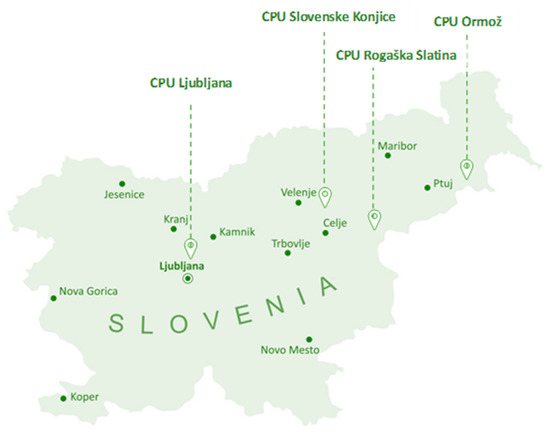
Figure 1 illustrates the map of four reuse centres (CPUs), namely CPU Rogaska Slatina, CPU Ormoz, CPU Slovenske Konjice, and CPU Ljubljana, which collectively handle a diverse range of used electrical and electronic equipment (UEEE). When UEEE items arrive at the centre, each item follows standardized intake procedures consisting of data registration, visual inspection, basic cleaning, and operational testing to determine its potential for reuse. Items assessed as suitable are forwarded to preparation for reuse activities, where items that fail functional or economic criteria are diverted directly to nearby recycling facilities, ensuring that non-reusable UEEE fractions enter appropriate material recovery streams.
Figure 1.
Map of four reuse centres (CPUs) adapted from Vectorstock [23].
2.2. Material Flow Analysis
The operational records from four CPU centres from January to December 2024 were collected and analysed for material flows. To allow consistent analysis and comparison with established literature, a multi-step harmonization and classification procedure was applied.
- Step 1: CPU intake classification
According to CPU’s internal operational guidelines, incoming UEEEs are classified by product group and functional status into the following categories: 01: cooling and freezing equipment, 02: large household appliances, 03: TV + monitor, 04: small household appliances, and 05: phones, computers and related equipment. While these categories were suitable for internal handling, they are not fully compatible with the standardised WEEE material composition framework. Therefore, the collected data were translated from Slovenian to English, cross-checked against CPU documentation, and validated to ensure consistent interpretation before further processing. All categorized items were then divided into reuse (items were resold for reuse) and recycled (unsold items were diverted to the local recycling facility).
- Step 2: Harmonization to WEEE Directive categories
To ensure methodological consistency, CPU categories were screened and classified into six categories in accordance with Annex III of the WEEE Directive (2002/96/EC; recast 2012/19/EU) [4], which are (1) temperature exchange equipment, (2) screens, monitors, and equipment containing screens with a surface area greater than 100 cm2, (3) lamps, (4) large equipment (any external dimension more than 50 cm), (5) small equipment, and (6) small IT and telecommunication equipment (no external dimension more than 50 cm). Items that did not fit these groups were excluded from further analysis.
- Step 3: Weight estimation for standardized WEEE categories
After reclassification, the next step was to estimate the average weight for each WEEE category. The average weights were obtained from the REAG project [24], based on 5847 product entries. Once the average weights were identified, they were applied to the CPU dataset. This allowed the mass of incoming items at CPU centres to be estimated, forming the basis for subsequent material composition analysis in the next step.
- Step 4: Material composition
Lastly, the six categories were then aggregated into material composition, which includes hazardous components, iron and steel, aluminium, copper, cables, plastics, printed circuit boards (PCBs), compounds/mixed materials, and other materials. This material composition analysis follows the methodology outlined by Huisman et al., 2008 [25], Salhofer & Spitzbart, 2009 [26], and Salhofer et al., 2011 [27], which provides a standardized framework for quantifying WEEE composition in both reuse and recycling pathways. A complete breakdown of all categories, by material composition and associated calculations, is provided in the Supplementary Materials.
Consequently, the authors define the material flows into four scenarios, each with varying proportions of treatment options, which will thereafter be utilized for assessing the environmental impact potential in the subsequent steps.
2.3. Simplified Life Cycle Assessment
2.3.1. Goal and Scope
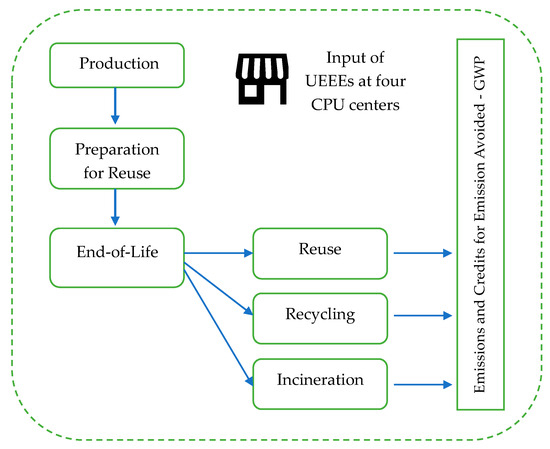
The simplified life cycle assessment (LCA) approach was adopted to quantify the benefits of reusing EEE in terms of avoided greenhouse gas emissions associated with reuse activities at four CPU centres in Slovenia. The functional unit is defined as 1 kg of UEEE processed at four CPU centres, which is then disaggregated into its material fractions. The lifecycle stages of different materials, such as the production of new material, preparation for reuse, material recycling, and incineration, are included in the model.
Due to the complex composition of WEEE materials, not all material fractions can be represented in reuse and recycling models. Fractions such as hazardous components, compounds/mixed materials, and other materials are partly assigned for reuse and incineration with energy recovery. The other six key fractions: iron and steel, aluminium, copper, cables, plastics and PCBs are modelled for reuse and recycling.
Furthermore, the impact category in this model focuses solely on global warming potential (GWP), measured in Kg CO2-eq, using literature-based emission factors for both virgin material production and end-of-life treatment.
Figure 2 illustrates the system boundaries of the simplified LCA for this study. Transportation was excluded from the model due to the lack of detailed data on travel distances and transport modes for UEEEs entering and leaving CPU centres. While this represents a limitation of our simplified LCA, a recent study shows that reuse generally retains net environmental benefits, as long as transport distances remain moderate or are reduced [28].
Figure 2.
System boundaries of the simplified LCA for CPU reuse case study.
2.3.2. Life Cycle Inventory
Different emission factors are obtained mainly from Ecoinvent datasets (with EF v3.0, climate change, global warming potential GWP 100) [29], reports, and peer-reviewed publications where data are available. All inventory calculations and impact estimation were implemented using a spreadsheet-based model developed in Microsoft Excel. The subsequent sections provide in-depth details on how the emissions factors and avoided emissions are calculated and utilized, in order to compare different scenarios.
- Production of raw material
The emission for production of raw material (GWPnew) represents the cradle-to-grave emissions of new products, which are estimated via material composition-based data and the emission factors derived from Ecoinvent version 3.11. Table 1 provides an overview of production emission factors for each material fraction.
Table 1.
Overview of production emission factors for each material fraction.
- Reuse potential
The environmental benefit of reuse depends on the degree to which a reused product can substitute for the production of a new product, defined as the reuse factor (RF) [12,28,31]. Several studies [12,31] explored the environmental implications of reuse from a wide range of products received at the reuse centre, which provides essential methodological foundations for assessing environmental implications and substitution dynamics. However, most of this research models the consumption level of product groups such as furniture, books, toys, and textiles. For the WEEE-specific product group, the RF represents the effective substitution rate, and, in principle, it could vary across WEEE categories depending on product functionality, remaining lifespan, and consumer usage, ranging from full substitution (RF = 1) for devices such as computers, televisions, and monitors to partial substitution (RF = 0.57) for hairdryers [28].
However, such detailed substitution data are not available for most WEEE product types, and measuring category-specific substitution factors would require extensive field data and consumer surveys, which are beyond the scope of this case study. Therefore, this study provides a complementary contribution by analysing the detailed material composition and reuse performance of UEEEs at CPU centres. Thus, consistent with previous peer-reviewed work on reuse potential, we apply two commonly used RF values: RF = 1, representing a full substitution scenario, and RF = 0.5, representing a partial substitution scenario.
The avoided emissions of reuse potential (GWPReuse) are calculated using the following formula:
where
GWPReuse = MReuse × RF × (GWPnew − GWPPrepReuse)
- MReuse is the quantity of materials reused [kg];
- RF is the reuse factor (RF = 1 [12,31]; RF = 0.5 [32]);
- GWPnew represents the cradle-to-grave emissions of new products [kg CO2-eq];
- GWPPrepReuse includes emissions from preparation for reuse [kg CO2-eq].
- Preparation for reuse
The GWP of preparation for reuse (GWPPrepReuse) is calculated based on the annual energy consumption (kWh) associated with UEEE reuse activities of four CPU centres and the corresponding emission factor. According to operational records, the four CPU centres utilized approximately 54,488 kWh of electricity between January and December 2024 [33]. However, these facilities handle a wide range of materials in addition to UEEE, namely textiles, furniture, books, and toys. As detailed process-level data was not available, it is necessary to allocate only a share of electricity consumption to UEEE reuse. However, based on the items received at CPU centres [34], approximately 2% of the total energy consumption is assigned to the preparation for reuse of UEEEs, and the assumption was validated through discussion with CPU centres. As a result, 1090 kWh of energy was attributed to the preparation for the reuse of UEEE. Electricity consumption was converted to GWP using the Slovenian grid emission factor of 0.34 kg CO2-eq/kWh [29].
- Recycling
Table 2 summarises the GWP emission factors for recycling for each material. Avoided emissions of recycling for each material (GWPavoided_recycling) are calculated using the following formula:
where
GWPavoided_recycling = MRecycle × (GWPnew− GWPRecycled)
Table 2.
Overview of emission factors for GWPRecycled for each material.
- MRecycle is the quantity of materials recycled [kg];
- GWPnew represents the cradle-to-grave emissions of new products [kg CO2-eq];
- GWPRecycled includes emissions associated with material recycling [kg CO2-eq].
Note that finding reliable PCB emission factors are scarce because PCBs vary in material composition and recycling technology. Literature-based values range from 7.02 kg CO2-eq [36] to 8.41 kg CO2-eq [37] in the case of hydrometallurgical treatment of PCBs from a smartphone, which represents a high quality of PCB fractions compared to the material received at CPU centres. Therefore, the Ecoinvent dataset is applied in this model.
According to Unger et al., 2017 [38], for every tonne of WEEE designated for recycling, merely 80.5% is considered suitable for the recycling process, with only 66.1% of secondary materials being processable, and around 51.5% of secondary materials being recyclable under conservative assumptions. This implies an overall material loss of approximately 48.5% during the recycling process. In this study, recycling losses are estimated differently based on the material composition of WEEE processed at four CPU centres. Therefore, approximately 70% of the total incoming mass consists of fractions with realistic recycling potential, while the remaining 30% is considered non-recyclable and, consequently, treated as a recycling loss and primarily routed to incineration.
- Incineration
As mentioned in the goal and scope, complex materials, such as hazardous materials, compound/mixed materials, and others, are assigned to incineration with energy recovery as the treatment solution. Therefore, the emission factor of 2.42 kg CO2-eq for the treatment of hazardous waste and hazardous waste incineration with energy recovery in Europe, excluding Switzerland, was used in this model.
However, in reuse scenarios (S1, S2, and S4), these fractions become part of the reused items, thereby contributing to the avoided burden by displacing a new product rather than being treated as waste. In a recycling-focused scenario, these complex fractions are fully directed to incineration. Details can be found in the next section.
2.3.3. Scenarios
Table 3 summarises the treatment allocations across the four scenarios. To capture differences in reuse effectiveness and its influence on environmental outcomes, four treatment scenarios were developed. Each scenario varies in the share of materials allocated to reuse and recycling, and incineration for material fractions that cannot be feasibly recycled. The scenarios are defined as follows:
Table 3.
The share of treatment options for UEEEs in four different scenarios.
- S1 (optimistic reuse): represents the status quo, where 87% of the materials received at CPU centres are reused with an optimistic RF = 1 [12,31], 9.1% are recycled, and 3.9% are incinerated (exported for treatment);
- S2 (conservative reuse): uses the same material distribution as S1 (87% reuse, 9.1% recycling, 3.9% incineration) but applies conservative RF = 0.5 [32], reflecting the reduced substitution effectiveness;
- S3 (no reuse): assumes the absence of reuse activities. Under this scenario, 70% of materials are recycled, and 30% are incinerated (exported for treatment);
- S4 (full reuse): assumes the theoretical maximum reuse performance, where 100% of materials are reused [39].
3. Results
3.1. Material Flows Analysis
Table 4 presents the shares of UEEE types received at four CPU centers, along with the corresponding weight estimates. In 2023, the four CPU centres received a total of 2267 units of UEEE, with the highest share of small equipment, at 1286 units (57%), followed by lamps, at 474 units (21%); small IT and telecommunication equipment, at 464 at units (20%); screens and monitors, at 38 units (2%); temperature exchange equipment, at 3 units (<1%); and large equipment, at 2 units (<1%). To determine the material compositions, the average weight per category was calculated using the data from the Rohstoffe EAG project [24], resulting in 2267 units, equivalent to 4443 kg.
Table 4.
The share of UEEE types received at four CPU centres and corresponding weight estimates.
The input of valuable materials is dominated by iron and steel, at 1546 kg, followed by plastics, at 994 kg; printed circuit board, at 291 kg; aluminium, at 117 kg; cables, at 95 kg; and other copper components, at 74 kg. Conversely, a significant proportion of the complex material requires incineration for treatment, including hazardous components (49 kg), compound/mixed materials (234 kg), and mixed materials (1044 kg). Table 5 provides an overview of materials compositions input from four CPU centres, including the allocation into various scenarios (S1–S4) and their corresponding treatment possibilities.
Table 5.
Overview of material compositions for four scenarios with different treatment options.
3.2. Environmental Potential of Reuse
The four reuse scenarios (S1–S4) were analysed and compared based on their treatment distributions and reuse factors, resulting in varied GWP outcomes focusing on the potential for emissions avoidance through the reuse and recycling of materials collected at CPU centres.
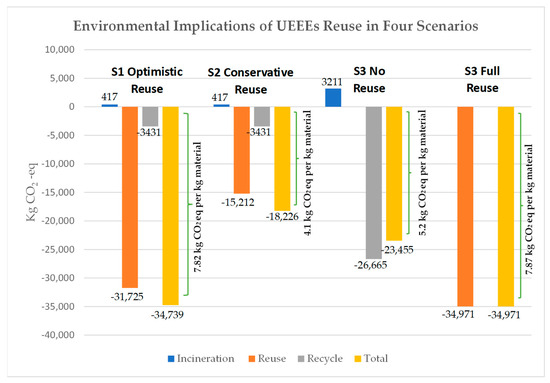
Figure 3 demonstrates the environmental potential associated with UEEEs across four scenarios. S1 (optimistic reuse) serves as the baseline scenario, representing the current system, with an optimistic RF = 1, assuming the product has reached full reuse before disposal or recycling. The results indicate a positive environmental performance of reuse, with about 34,739 kg CO2-eq avoided in total, corresponding to 7.82 kg CO2-eq of emissions avoided per kg of input material. In S2 (conservative reuse), the RF = 0.5 is applied, resulting in 18,226 kg CO2-eq (4.1 kg CO2-eq/kg input material) emissions avoided, equivalent to 48% compared to S1.
Figure 3.
Environmental potential of UEEEs reuse in four scenarios.
On the other hand, S3 (no reuse), assuming no reuse occurs, and all materials are diverted to recycling and incineration, shows similar emissions avoided as S2, at 23,455 CO2-eq (5.2 kg CO2-eq./kg input material), equivalent to 32% and 1% lower when compared to S1 and S2, respectively. S4 (full reuse) achieves the highest avoided emissions, at 34,971 kg CO2-eq (7.87 kg CO2-eq/kg input material), but its advantage over S1 is relatively small because the status quo scenario already exhibits a very high reuse rate (87%), resulting in similar levels of effective reuse.
Overall, the findings indicate that reuse delivers substantially greater emissions reductions than recycling, especially when reused products fully replace new ones. The contrast between S1 and S2 also highlights that the effectiveness of reuse significantly influences environmental outcomes. Achieving strong environmental performance, therefore, requires not only higher reuse rates but also high-quality, fully functional reused products that are capable of displacing new consumption.
4. Discussion
This study’s findings indicate that reuse provides greater positive environmental impacts than recycling, especially when reused products entirely replace new products. This maximizes reuse with a high reuse factor, resulting in the most substantial GHG emission reductions. The result aligns with prior research [8,12,31] demonstrating that high-quality, functional reuse can offset significantly more emissions than material recycling. For specific product categories such as reuse of components, notebook computers, small electronics devices, household appliances, significant environmental benefits are also observed due to avoided product production and energy savings achieved through reuse [40,41,42,43,44].
By contrast, S2, despite having the same reuse quantity as S1, shows a reduction of 48% of environmental benefit due to a conservative reuse factor (1:0.5), highlighting that reuse without effectiveness or quality provides limited climate benefits [11,32,45].
However, recycling, as modelled in S3, still provides moderate emission savings, given the status quo of WEEE recycling technology and the potentially high material losses that occur during the recycling process due to material quality degradability [8,38]. This confirms the waste hierarchy’s prioritization of reuse over recycling and suggests that circular economy policies must emphasize not only reuse volume but also product functionality, repairability, and lifespan extension. However, it is also essential to be aware that not all products are suitable for reuse, including inefficient refrigerators or white goods, which can outweigh the environmental benefits when reusing old models [40,41,44], and recycling may offer a trade-off and remains essential after the life span of reused products has reached its end of life [46,47], indicating that integrated CE strategies are needed [48].
Achieving high-quality reuse requires support through policy, financing, and infrastructure throughout the entire product life cycle, from design through end-of-life management. For instance, the repair bonus (Reparaturbonus) in Austria supports the repair of household electronics by covering up to 50% of repair costs. This model combines financial incentives, consumer awareness, and support for local repair businesses, effectively encouraging reuse and repair over replacement [49]. Moreover, the transition toward circular business, such as Product-as-Service can further enable and strengthen reuse and repair activities embedding durability, maintenance and value retention processes into product design and service delivery [50,51]. Furthermore, online platforms such as ebay, Wilhaben (Austria), and Widado (Austria) demonstrate the growing role of digital marketplaces in supporting reuse and repair and how online reuse systems can complement physical reuse centres by increasing accessibility and encouraging consumer participation [52].
Designing products for durability and repairability, as indicating in Ecodesign for Sustainable Products Regulation (ESPR) [53] and Right to Repair [7], as well as establishing reuse targets [54] and financing systems and facilities as part of extended producer responsibility schemes that enable efficient collection, assessment and preparation for reuse, offers the most promising pathway for reducing environmental impacts and generating positive social impacts [51] within circular economy frameworks. Together, these measures support a shift toward a more circular EEE sector where reuse is prioritized, and repair becomes a practical and accessible option for all.
Limitation and Uncertainty
Despite this study’s contribution, several limitations should be considered. Firstly, the analysis relies on reuse factors (0.5 and 1.0) reported in previous studies to estimate the environmental benefits of reuse rather than conducting a primary survey, which may not fully capture the variability in real-world substitution rates across different product categories and user behaviours.
Secondly, the dataset reflects the operations of four CPU centres and is therefore not nationally representative, and results should be interpreted as case-specific.
Thirdly, this model applies a general WEEE recycling loss across all material fractions, which simplifies the real WEEE treatment process. In practice, recycling efficiencies vary by material and technology, and specific fractions have significantly different recovery potentials. While material-specific loss would include accuracy, such detailed particular data are not publicly available and reported due to the complexity and variability of the WEEE recycling process. It is also important to note that the recycling loss applied in this study is lower than the overall losses reported in another study, meaning that the model may still overestimate the environmental performance of recycling in real-world conditions. As such, the results should be interpreted as conservative in favour of recycling.
Fourth, obtaining accurate emission factors for PCBs is challenging and remains uncertain due to their complex composition and the limited availability of specific data for both production and recycling. As a result, PCB-related emissions in this study should be interpreted with caution, and the estimated emissions, particularly in recycling, may not fully capture the total environmental impact.
Lastly, environmental assessment focuses solely on GWP and does not include other relevant impact categories, which may reveal additional significant environmental trade-offs. Therefore, the results should be interpreted as case-specific for the four CPU centres and future research should focus on measuring product-specific reuse performance data, refining material-specific recycling losses and expanding impact categories beyond GHG emissions, including ozone depletion, acidification, eutrophication, ecotoxicity, and human toxicity to capture additional trade-offs.
5. Conclusions
This study evaluated the material flows and associated environmental impacts of four reuse scenarios for UEEEs received at four CPU centres, indicating a different mixed treatment approach to reuse, recycling, and incineration. The results demonstrate that reuse scenarios (S1, optimistic reuse and S4, full reuse) generally achieve higher GHG emissions reduction than the recycling-only scenario (S3, no reuse). Under the optimistic reuse case, emission savings can reach 34,739 kg CO2-eq (7.82 kg CO2-eq/kg input material), highlighting the potential climate benefits when high substitution rates are achieved. While recycling still provides meaningful environmental benefits and material recovery, its potential remains limited because of the loss of material quality during recycling compared to well-executed reuse strategies.
However, the full reuse potential requires supportive system conditions, including reparable product design, a robust collection scheme, and preparation for reuse capacity to ensure that products are functional, durable, and capable of displacing new consumption. While recycling remains an essential component, particularly for products that have reached the end of their second life or are non-reusable options, it should be integrated in a complementary manner with reuse rather than prioritized over reuse. Whenever possible, products should be assessed for their potential second life before being directed to recycling. This effective circular system will balance the two strategies to optimise environmental benefits.
Nevertheless, this study acknowledges several limitations, and future research should focus on the accuracy of reuse factors on a specific product level, and a broader range of environmental impact categories, such as ozone depletion, acidification, eutrophication, ecotoxicity, and human toxicity. Although this case study is based in Slovenia, the analytical approach and insights are relevant for regions facing similar challenges related to reuse effectiveness, data constraints and WEEE treatment alternatives. Therefore, the CPU centre models, combined with scenario-based environmental analysis, offer a useful reference for policymakers and practitioners seeking to strengthen reuse-focused circular economy strategies.
Supplementary Materials
The following supporting information can be downloaded at https://www.mdpi.com/article/10.3390/su18010140/s1. The model data supporting this study are available upon request [55].
Author Contributions
Conceptualization, S.S. (Souphaphone Soudachanh) and S.S. (Stefan Salhofer); methodology, S.S. (Souphaphone Soudachanh); formal analysis, S.S. (Souphaphone Soudachanh); data curation, M.Z. and S.S. (Souphaphone Soudachanh); writing—original draft preparation, S.S. (Souphaphone Soudachanh); writing—review and editing, M.Z., M.V., N.B.M., S.S. (Souphaphone Soudachanh) and S.S. (Stefan Salhofer); validation, M.Z., M.V., N.B.M. and S.S. (Stefan Salhofer); supervision, S.S. (Stefan Salhofer); project administration, S.S. (Stefan Salhofer); funding acquisition, S.S. (Stefan Salhofer). All authors have read and agreed to the published version of the manuscript.
Funding
This study was carried out within the framework of the cooperation initiative supported by the European Union through the European Regional Development Fund within the framework of Interreg Central Europe programme: Circular WEEEP Project (CE0100183): Design and test of policies for reducing, repairing, recovering and reusing waste from electrical, electronic equipment and plastic in Central Europe.
Institutional Review Board Statement
Not applicable.
Informed Consent Statement
Not applicable.
Data Availability Statement
The data presented in this study are available on request from the corresponding author with permission of the Center Ponovne Uporabe (CPU) due to restrictions. The operational data was obtained from the CPU, which is not publicly available. All calculation procedures and modelling framework used in this study are provided in the Supplementary Materials.
Acknowledgments
The authors would like to thank the four reuse centres (CPUs), namely CPU Rogaska Slatina, CPU Ormoz, CPU Slovenske Konjice, and CPU Ljubljana, for providing data and assisting with quality assurance of the results. During preparation of this work, the authors used Grammarly for grammar correction, quilibot and ChatGPT (OpenAI) version 5.2 to improve the readability of the text, refine wording and language style and assist in drafting the cover letter. After using these tools, the authors carefully reviewed and edited the content as needed and take full responsibility for the final version of the manuscript.
Conflicts of Interest
Marin Zver, Marinka Vovk and Nathalie Beatrice Maccagnan were employed by Center Ponovne Uporabe (CPU). The remaining authors declare that the research was conducted in the absence of any commercial or financial relationships that could be construed as a potential conflict of interest.
References
- Gao, P.; Adnan, M. Overview of emerging electronics technologies for artificial intelligence: A review. Mater. Today Electron. 2025, 11, 100136. [Google Scholar] [CrossRef] [Scilit]
- Baldé, C.P.; Kuehr, R.; Yamamoto, T.; McDonald, R.; D’Angelo, E.; Althaf, S.; Bel, G.; Deubzer, O.; Fernandez-Cubillo, E.; Vanessa Forti, V.G.; et al. Global E-Waste Monitor 2024; International Telecommunication Union (ITU) and United Nations Institute for Training and Research (UNITAR): Geneva, Switzerland; Bonn, Germany, 2024. [Google Scholar]
- Jandric, A.; Tran, C.; Beigl, P.; Micuda, Z.; Salhofer, S. Exploration of the material distribution of complex components in waste electrical and electronic equipment. Glob. NEST J. 2018, 20, 725–736. [Google Scholar] [CrossRef] [Scilit]
- European Commission. Directive 2012/19/EU of the European Parliament and of the Council of 4 July 2012 on Waste Electrical and Electronic Equipment (WEEE) (Recast); European Commission: Brussels, Belgium, 2012. [Google Scholar]
- Environmental Coalition on Standards (ECOS); European Environmental Bureau (EEB); Recycling Network Beleux; RREUSE; Zero Waste Europe. Joint Paper Recommendations on Waste Prevention Targets. 2022. Available online: https://zerowasteeurope.eu/library/joint-paper-recommendations-on-waste-prevention-targets/ (accessed on 1 October 2025).
- European Commission. Directive 2008/98/EC of the European Parliament and of the Council of 19 November 2008 on Waste and Repealing Certain Directives; European Commission: Brussels, Belgium, 2008. [Google Scholar]
- European Commission. Right to Repair: Commission Introduces New Consumer Rights for Easy and Attractive Repairs; European Commission: Brussels, Belgium, 2023. [Google Scholar]
- Potting, J.; Hekkert, M.; Worrell, E.; Hanemaaijer, A. Circular Economy Measuring Innovation in Product Chains; PBL Netherlands Assessment Agency: The Hague, The Netherlands, 2017. [Google Scholar]
- European Commission. A New Circular Economy Action Plan; European Commission: Brussels, Belgium, 2020. [Google Scholar]
- RREUSE. RREUSE Annual Report 2023; RREUSE: Ixelles, Belgium, 2024. [Google Scholar]
- Fortuna, L.M.; Diyamandoglu, V. Optimization of greenhouse gas emissions in second-hand consumer product recovery through reuse platforms. Waste Manag. 2017, 66, 178–189. [Google Scholar] [CrossRef] [Scilit]
- Rückert, A.; Balkute, G.; Dornack, C. Calculating the Environmental Benefit of Reuse Platforms. Circ. Econ. Sustain. 2024, 4, 1913–1936. [Google Scholar] [CrossRef] [Scilit]
- Parajuly, K.; Wenzel, H. Potential for circular economy in household WEEE management. J. Clean. Prod. 2017, 151, 272–285. [Google Scholar] [CrossRef] [Scilit]
- Amasawa, E.; Shibata, T.; Sugiyama, H.; Hirao, M. Environmental potential of reusing, renting, and sharing consumer products: Systematic analysis approach. J. Clean. Prod. 2020, 242, 118487. [Google Scholar] [CrossRef] [Scilit]
- Anandh, G.; PrasannaVenkatesan, S.; Goh, M.; Mathiyazhagan, K. Reuse assessment of WEEE: Systematic review of emerging themes and research directions. J. Environ. Manag. 2021, 287, 112335. [Google Scholar] [CrossRef] [Scilit]
- Hunger, T.; Arnold, M.; Ulber, M. Circular value chain blind spot—A scoping review of the 9R framework in consumption. J. Clean. Prod. 2024, 440, 140853. [Google Scholar] [CrossRef] [Scilit]
- Perez-Belis, V.; Bovea, M.D.; Simo, A. Consumer behaviour and environmental education in the field of waste electrical and electronic toys: A Spanish case study. Waste Manag. 2015, 36, 277–288. [Google Scholar] [CrossRef] [Scilit]
- Džajić Uršič, E.; Pandiloska Jurak, A.; Topić Božič, J. From Policy to Practice: EU Circular Economy Legislation and Slovenia’s Implementation Challenges—A Systematic Review. Sustainability 2025, 17, 9408. [Google Scholar] [CrossRef] [Scilit]
- European Environmental Agency. Waste Prevention Country Profile Slovenia; European Environmental Agency: Copenhagen, Denmark, 2023. [Google Scholar]
- ZEOS. WEEE Legislation in Slovenia. Available online: https://www.zeos.si/en/legislation/ (accessed on 23 November 2025).
- Circular WEEEP. D.1.1.1 Conclusions on the Central Europe WEEEP. Available online: https://www.interreg-central.eu/wp-content/uploads/2024/08/Conclusions-on-the-Central-Europe-WEEEP.pdf (accessed on 9 June 2025).
- CPU. CPU Reuse General Information. Available online: https://www.cpu-reuse.com/ (accessed on 6 June 2025).
- LRV. Slovenia Map. Available online: https://www.vectorstock.com/royalty-free-vector/slovenia-cities-map-vector-27789130 (accessed on 7 April 2025).
- BOKU University. Entwicklung und Optimierung der Gesamten Rückgewinnungskette für Kritische Rohstoffe aus Elektroaltgeräten (EAG); BOKU University: Vienna, Austria, 2017. [Google Scholar]
- Huisman, J.; Magalini, F.; Kuehr, R.; Maurer, C.; Ogilvie, S.; Poll, J.; Delgado, C.; Artim, E.; Stevels, J.S.A. Review of Directive 2002/96 on Waste Electrical and Electronic Equipment (WEEE); United Nations University: Shibuya, Japan, 2008. [Google Scholar]
- Salhofer, S.; Spitzbart, M. Modelling of mechanical treatment of WEEE. In Proceedings of the 3rd BOKU Waste Conference, Vienna, Austria, 15–17 April 2009; pp. 143–150. [Google Scholar]
- Salhofer, S.; Spitzbart, M.; Maurer, K. Recycling of LCD Screens in Europe—State of the Art and Challenges. In Glocalized Solutions for Sustainability in Manufacturing; Springer: Berlin/Heidelberg, Germany, 2011; pp. 454–458. [Google Scholar]
- Nichilo, M.; Cavenago, G.; Grosso, M.; Rigamonti, L. Quantification of the environmental benefits of the reuse of goods. Environ. Sci. Pollut. Res. 2025. [Google Scholar] [CrossRef] [Scilit]
- Ecoinvent. Ecoinvent Database Version 3.11. Available online: https://ecoquery.ecoinvent.org/3.11/cutoff (accessed on 9 December 2025).
- An, J.; Wu, F.; Wang, D.; You, J. Estimated material metabolism and life cycle greenhouse gas emission of major plastics in China: A commercial sector-scale perspective. Resour. Conserv. Recycl. 2022, 180, 106161. [Google Scholar] [CrossRef] [Scilit]
- Castellani, V.; Sala, S.; Mirabella, N. Beyond the throwaway society: A life cycle-based assessment of the environmental benefit of reuse. Integr. Environ. Assess. Manag. 2015, 11, 373–382. [Google Scholar] [CrossRef] [Scilit]
- Quack, D. Ermittlung der Durch die Wiederverwendung von Gebrauchten Bauteilen Realisierbaren Energieeinsparpotenziale und CO2-Reduktionspotenziale; Öko-Institut e.V.: Freiburg, Germany, 2003. [Google Scholar]
- CPU. Data on UEEE Reuse at CPUs center in Slovenia; CPU: Tattenbachova, Slovenia, 2025. [Google Scholar]
- CPU. Report on Achieving Social Effects (Sustainable Development Goals—SDGs) for the Year 2023. Available online: https://www.cpu-reuse.com/cpu/kaj-je-cpu/druzbeni-ucinki-v-cpu (accessed on 1 October 2025).
- EuRIC. Metal Recycling Factsheet; EuRIC: Brussels, Belgium, 2019. [Google Scholar]
- Iannicelli-Zubiani, E.M.; Giani, M.I.; Recanati, F.; Dotelli, G.; Puricelli, S.; Cristiani, C. Environmental impacts of a hydrometallurgical process for electronic waste treatment: A life cycle assessment case study. J. Clean. Prod. 2017, 140, 1204–1216. [Google Scholar] [CrossRef] [Scilit]
- Lu, X.; Gong, X.; Nie, Z.; Chen, W.; Liu, Y.; Li, X. Life cycle assessment of printed circuit boards recycling from waste mobile phones. Int. J. Life Cycle Assess. 2025, 30, 1860–1876. [Google Scholar] [CrossRef] [Scilit]
- Unger, N.; Beigl, P.; Höggerl, G.; Salhofer, S. The greenhouse gas benefit of recycling waste electrical and electronic equipment above the legal minimum requirement: An Austrian LCA case study. J. Clean. Prod. 2017, 164, 1635–1644. [Google Scholar] [CrossRef] [Scilit]
- Nikolic, M.; Bergmann, G.; Schelte, N.; Severengiz, S. Closing the loop of small WEEE—Life cycle based approach for the evaluation of end-of-life strategies on the example of coffee machines. Resour. Conserv. Recycl. Adv. 2024, 23, 200220. [Google Scholar] [CrossRef] [Scilit]
- Boldoczki, S.; Thorenz, A.; Tuma, A. The environmental impacts of preparation for reuse: A case study of WEEE reuse in Germany. J. Clean. Prod. 2020, 252, 119736. [Google Scholar] [CrossRef] [Scilit]
- Bovea, M.D.; Ibanez-Fores, V.; Perez-Belis, V. Repair vs. replacement: Selection of the best end-of-life scenario for small household electric and electronic equipment based on life cycle assessment. J. Environ. Manag. 2020, 254, 109679. [Google Scholar] [CrossRef] [Scilit] [PubMed]
- Clarke, C.; Williams, I.D.; Turner, D.A. Evaluating the carbon footprint of WEEE management in the UK. Resour. Conserv. Recycl. 2019, 141, 465–473. [Google Scholar] [CrossRef] [Scilit]
- Coughlan, D.; Fitzpatrick, C.; McMahon, M. Repurposing end of life notebook computers from consumer WEEE as thin client computers—A hybrid end of life strategy for the Circular Economy in electronics. J. Clean. Prod. 2018, 192, 809–820. [Google Scholar] [CrossRef] [Scilit]
- Lu, B.; Song, X.; Yang, J.; Yang, D. Comparison on End-of-Life strategies of WEEE in China based on LCA. Front. Environ. Sci. Eng. 2017, 11, 7. [Google Scholar] [CrossRef] [Scilit]
- Cooper, D.R.; Gutowski, T.G. The Environmental Impacts of Reuse: A Review. J. Ind. Ecol. 2015, 21, 38–56. [Google Scholar] [CrossRef] [Scilit]
- Bryan, C.G.; Williamson, B.J.; Całus-Moszko, J.; van Haute, Q.; Guezennec, A.G.; Gaydardzhiev, S.; Wavrer, P.; Frączek, R. CEReS—Co-processing of coal mine & electronic wastes: Novel resources for a sustainable future. Hydrometallurgy 2020, 197, 105444. [Google Scholar] [CrossRef] [Scilit]
- Kouloumpis, V.; Yan, X. Life cycle assessment of a novel metal recovery method from co-processing of coal mine waste and low-grade printed circuit boards. J. Environ. Manag. 2022, 314, 115074. [Google Scholar] [CrossRef] [Scilit] [PubMed]
- Zink, T.; Geyer, R. Circular Economy Rebound. J. Ind. Ecol. 2017, 21, 593–602. [Google Scholar] [CrossRef] [Scilit]
- Reparaturbonus. General Information on RepairBonus Austria. Available online: https://www.reparaturbonus.at/ (accessed on 25 August 2024).
- Hidalgo-Crespo, J.; Golinska-Dawson, P.; Riel, A. Product-as-a-service transition for original equipment manufacturers: Challenges, performance metrics, and design guidelines—The case of electrical and electronic equipment. Clean. Environ. Syst. 2025, 19, 100330. [Google Scholar] [CrossRef] [Scilit]
- Maniati, E.; Chroni, C.; Boikou, K.; Lasaridi, K.; Abeliotis, K. Repair and preparing for reuse as a driver for Circular Economy. Soc. Impacts 2025, 6, 100132. [Google Scholar] [CrossRef] [Scilit]
- Freidl, M. Reuse and Repair of Electrical and Electronic Equipment in Europe: State of the Art. Master’s Thesis, BOKU—Universität für Bodenkultur Wien, Vienna, Austria, 2024. [Google Scholar]
- Bubinek, R.; Knaack, U.; Cimpan, C. Reuse of consumer products: Climate account and rebound effects potential. Sustain. Prod. Consum. 2025, 54, 190–201. [Google Scholar] [CrossRef] [Scilit]
- RREUSE. Targets for Reuse and Preparation for Reuse in the European Union; RREUSE: Ixelles, Belgium, 2025. [Google Scholar]
- Salhofer, M.; Maurer, K.; Salhofer, S. Recycling of flat screens as a new challenge in WEEE recycling. Waste Resour. Manag. 2012, 165, 37–43. [Google Scholar]

Disclaimer/Publisher’s Note: The statements, opinions and data contained in all publications are solely those of the individual author(s) and contributor(s) and not of MDPI and/or the editor(s). MDPI and/or the editor(s) disclaim responsibility for any injury to people or property resulting from any ideas, methods, instructions or products referred to in the content. |
© 2025 by the authors. Licensee MDPI, Basel, Switzerland. This article is an open access article distributed under the terms and conditions of the Creative Commons Attribution (CC BY) license.