


Abstract
Current circular economy discourse is largely shaped by metaphors similar to the ones used for a linear economy: the machine metaphor, competitive metaphor and the journey metaphor. Metaphors influence patterns of thought, what ideas and solutions are valued (and which are not). Therefore, if a radical economic change is desired, it is important to explore which radically different metaphors could inform this thinking. This study explores the use of the forest as a source domain to enrich circular economy discourse. First, through a qualitative enquiry, intuitive knowledge about a forest is mapped out. Then, circular economy experts were asked to project these insights onto circular economy discourse. The results are presented as practical subdomains that can be applied within design, business and educational contexts. The findings show rich insights related to dealing with wholeness, the importance of relationship, and response to change. The Results Section presents concrete prompts for activating these source domains and applying these as a prompt for ideation. This research contributes to circular economy education by using metaphors derived from nature as a tool for reflection and novel circular economy conceptualisations.
1. Introduction
Humans rely largely on metaphors to make sense of most abstract phenomena [1]. Because metaphors are an inherent part of human cognition, one must learn to live with their metaphors, understand them and evolve them in times of change. In the wider sustainability domain, the circular economy discourse promises a radical shift away from the current linear economy [2]. This discourse is currently dominated by metaphors “borrowed” from the linear economy, such as the machine metaphor, competitive metaphors (war and sport) and the journey metaphor [3]. This may lead to patterns of thought that emphasize reductionism, competition and incrementalism, which have been criticised by some academics [3,4,5]. New metaphors have the potential to allow the user to reflect on their current conceptual ecology as well as explore new lines of enquiry [1].
Nature is an inspiration for many who seek metaphors that could counterbalance the current “mechanistic” discourse [6]. Hanauer and Beinhocker [7] suggest metaphors that draw from natural ecosystems, such as gardens, in which governments are conceptualised as the gardeners that tend to the garden. Webster [8] proposes living system metaphors for grasping the nonlinear and complex dimensions of a circular economy and allowing a plurality of circular economies to emerge. Hutchins [9] elaborates on how leadership for the future economy should be inspired by metaphors from natural ecosystems.
Insights from natural systems and biology are already utilised in some areas within circular economy discourse, for instance through the ideas of biological nutrient cycles, regenerative agriculture and biomimicry. Using a nature-inspired metaphor may be more intuitive for those active in these areas since it is more than just a metaphor [10]. However, this research aims to conceptualise the broader idea of a circular economy through the lens of the nature-inspired metaphor, not just biological nutrients. It addresses more general “patterns of thought” instead of following a literal interpretation of nature. It goes further than biomimicry because it does not evolve around pretending to be biological [5]—it is about actually being biological.
In their paper titled Seeing the forest and not the trees: learning from nature’s circular economy, Tate et al. [11] present the discrepancy between insights from natural ecosystems—such as a forest—versus the reality of the current business ecosystem as described in Table 1.
Table 1.
Comparison of roles between natural networks and the business ecosystem [11].
This work demonstrates a clear potential for using the forest metaphor through the variety of insights that Tate et al. [11] were able to demonstrate—from supply chain insights to post-consumer insights.
This study explores the implications of specifically the forest metaphor for three reasons: (1) many in the general public have developed intuitive knowledge about this domain in their life; (2) research about how this domain applies to circular economy, such as by Tate et al. [11], demonstrates that this is potentially a fruitful metaphor for the target domain; and (3) within this metaphor, there is no single entity with agency (in contrast with the garden metaphor where the gardener has agency). It is assumed that when there is an absence of “a gardener”, this could open the potential for more creative and bottom-up ideas that do not necessarily require governments to be progressive to lead.
A previous study by the authors [12] showed that a forest metaphor in a learning context helps to emphasise interdependency, connectivity, resilience and symbiosis. Even though nature-inspired metaphors offer new insights to many, this teaching case study showed that some learners experienced a tension between these higher-level and more abstract insights of the metaphor and the reality of the business they work for [12]. In this case study, learners also came up with more ambiguous concepts that left them without clear agency to drive change [12]. To address this tension, this research aims to break down the heuristic of the forest metaphor into more applied, concrete and manageable subdomains that still use the logic and familiar knowledge from the source domain, the forest, but are more accessible for business professionals to apply.
To harvest a wide range of insights that can form the basis of this metaphor, the first part of this research focuses on mapping intuitive knowledge about how a forest works through interviews. During the second part of the research, these insights were transposed onto circular economy discourse with circular economy experts. The authors aim to present the insights in a format conducive to educational and learning contexts.
It addresses the main research question:
- What new lines of enquiry can be explored for a circular economy through the forest metaphor?
To answer this question, the following sub-research questions will be explored:
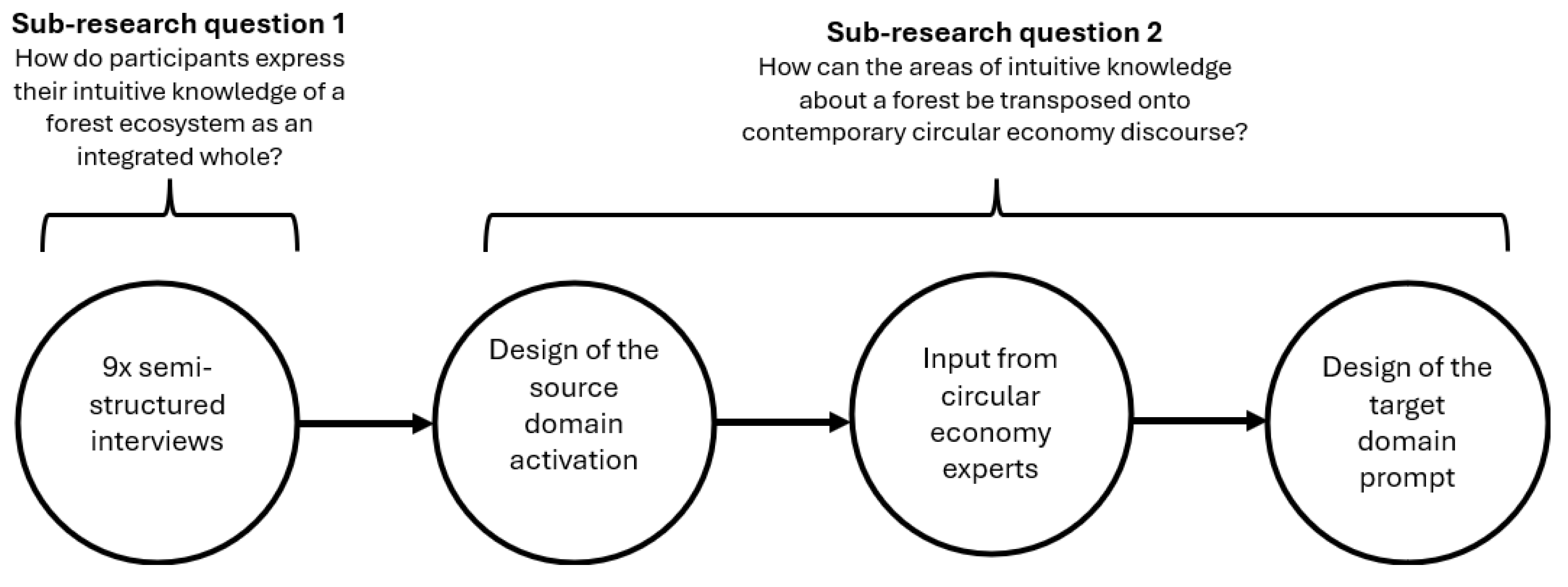
- Sub-research question 1: How do participants express their intuitive knowledge of a forest ecosystem as an integrated whole?
- Sub-research question 2: How can the areas of intuitive knowledge about a forest be transposed onto contemporary circular economy discourse?
This research contributes to conceptual metaphor theory (CMT) and aims to investigate the forest metaphor as a heuristic for business in a circular economy. The insights of this study can be used as a tool that challenges current circular economy discourse as well as for educative purposes aimed towards business and design professionals.
2. Background
A metaphor describes an abstract phenomenon (target domain) through the knowledge of a more intuitive or familiar domain (source domain). These insights do not prompt a real physical resemblance, but rather an abstract one [13]. CMT does not only elaborate on aspects of language but describes fundamental parts of human thought processes [14]. Therefore, this makes CMT an effective approach to support conceptual development from a pedagogical perspective by helping identify learning obstacles as well as providing productive entry points for instruction [15]. This study uses insights from CMT in a generative way to prompt new ways of thinking about a circular economy.
This study seeks to identify intuitive areas from the forest as a source domain and projects these insights onto circular economy discourse, the target domain. The metaphor that is analysed in this research is CIRCULAR ECONOMY AS FOREST through the formatting TARGET DOMAIN AS SOURCE DOMAIN [1]. Capitals are used for the technical representation of the conceptual metaphor [16].
A forest is considered a suitable source domain because it is an ecosystem that many have interacted with at some point in their life. However, making sense of a forest may be different from person to person—depending on how they conceptualise this phenomenon. Urlica et al. [6] (p. 135) elaborate: “While some metaphors construct Nature as an integrated whole, others conceptualise it as an assemblage of parts or as a resource”. This research will seek to investigate the interpretation of a forest as an integrated whole, from an ecological worldview. It will address areas of intuitive knowledge as suggested by Du Plessis and Brandon [17]: (1) dealing with wholeness, (2) the importance of relationship and (3) response to change.
The approach that was taken in this study explores the conceptual metaphor CIRCULAR ECONOMY AS A FOREST in a generative way—as a so-called “generative metaphor” that is an often-used ideation tool in the design discipline. Donald Schön [18] describes these as metaphors that “generate new perceptions, explanation and inventions”.
Not all generative metaphors are conceptual metaphors. For example, the work of Logler et al. [19] demonstrates a design tool that prompts designers to consider the abstract phenomenon of “international injustice” through generative metaphors: “hospital”, “museum”, “theatre”, “company”, “startup” and “laboratory”. Many, if not all, of these proposed metaphors do not have the systemic underpinnings of a conceptual metaphor but can act as a generative metaphor. They are often used in quantities to prompt new types of ideas and different lines of enquiry.
The purpose of this study is to offer a way for participants to engage more deeply with a single conceptual metaphor: CIRCULAR ECONOMY AS A FOREST. By creating subdomains that act as generative metaphors, participants can obtain a rich understanding of the implications of this conceptual metaphor.
Viewing an abstract domain, such as a circular economy, through the lens of an ecosystemic metaphor may require a conceptual change [20] from closed, engineered systems towards more open, non-linear systems. It may feel inconsistent, contradictory and unhelpful to engage in these metaphors if one is not open to this wider conceptual change [21]. However, by engaging with different conceptual metaphors, learners can decide themselves if they are open to developing their ideas or not. This research aims to develop insights that could support this process.
3. Methodology
This research is split up into consecutive parts to answer each of the sub-research questions. The research design is visualised in Figure 1.
Figure 1.
Research design.
3.1. Semi-Structured Interviews
The sub-research question answered in part one is how do participants express their intuitive knowledge of a forest ecosystem as an integrated whole? Nine business professionals were selected as participants for this study, each with varying knowledge about natural ecosystems. An overview of the interviewees can be found in Table 2 and the interview guide can be found in Appendix A.1. Most interviewees were residents of the United Kingdom at the time of interviewing. Interviews were conducted in a virtual way with the first interview starting in August 2023 and the final one in June 2024. Participants voluntarily signed up for the study and did not receive any financial gains or other for participating in the study. Upon signing up for the study, participants completed an informed consent form and were able to access a Participant Information Sheet, which also included information on how to withdraw from the study, if they wished to do so. This information sheet also explained that all data will be pseudonymised from the point of transcription and anonymised after all data have been collected. Finally, participants were asked to report their understanding of nature from a limited, everyday understanding to a deep understanding, for example, when this relates to their field of expertise. This allowed the participants to declare the extent of their prior knowledge about nature.
Table 2.
Overview of the interview participants.
Before the interview, participants were asked to visit a natural ecosystem such as a forest. During this visit, they were asked to complete a worksheet. On the worksheet, there were instructions for an exercise called Wide Angle Vision where participants were prompted to move from looking at a single entity in the ecosystem, towards the wider integrated whole that constitutes the ecosystem. This was followed by questions such as “How do the different elements of your selected area interact with each other?” and “If the place you chose had a voice, what might it say about why it is acting or ‘operating’ the way that it does?”. This activity was designed to activate any knowledge concerning the forest so this could surface during the interview. Since the season of the visit may impact the kind of observations the participants would bring up, the interviews were evenly allocated over different seasons. Participants were asked to complete this exercise a week before their interview.
During the 1-h, semi-structured interview the participants were asked about their experience in this natural ecosystem. The participants were invited to explore the phenomenon of a forest through the following themes: (1) dealing with wholeness, (2) the importance of relationship and (3) response to change [17].
The data were analysed using Atlas.ti with the help of the transcription feature of Microsoft Word and Zoom. All transcriptions were analysed using Grounded Theory [22]. The data were analysed according to the three themes (wholeness, relationship and change) and these were used as structuring elements. The final clusters are displayed in column 1 of the Results Section.
3.2. Source Domain Activation
To activate prior knowledge of the source domain, in this case, a forest, the authors grouped together clusters that resulted from the interviews. For example, the clusters: “redundancy”, “(bio)diversity”, “fragility” and “resilience” were grouped during this process and the following activation was designed to address these:
Diversity can lead to functional redundancy where multiple entities fulfil the same role in the ecosystem—such as the many leaves on one tree. If some are lost due to a disruption, there may be enough left to maintain functions.
Another way how diversity contributes to the resilience of a forest is in a complementary way where entities are slightly different and therefore dependent on, for example, different resources.
Think of an example of diversity in a forest and reflect on how this contributes to the overall health and resilience of the wider ecosystem.
These texts that form the activation of the source domain are shown in Column 2 and are generated for each of the 18 domains.
3.3. Expert Input
The results from column 3 were presented to 7 circular economy experts. Most of these experts were recruited during a “circular economy retreat”, which was a weekend-long event on 7–9 June 2024, in which individuals personally signed up to think and discuss progressive ideas related to a circular economy. An overview of the participants can be found in Table 3.
Table 3.
Overview of the circular economy expert participants.
Through a qualitative survey, the experts reviewed the source domain activations and were asked “how would you apply these insights to the domain of business in a circular economy?”. The survey consisted of an instruction together with a time estimate for completion of the total survey which was estimated at approximately 1 h. All the participants had to complete a consent form and confirm that they understood the instructions before continuing to the open questions.
If a participant was unable to answer one of the questions, they were allowed to move on and therefore some of the source domain activations were more populated than others. The input was coded and clustered according to grounded theory.
3.4. Target Domain Prompt
Finally, the authors used the thematic areas from column 3 to develop a prompt that could allow learners to transpose their intuitive knowledge about a forest onto circular economy discourse.
In a previous case study [12], it was concluded that prompting a very broad source and target domain is too ambiguous and not sufficiently fruitful. However, being too prescriptive with metaphor can be unhelpful as well because even though we can think about a target domain through a source domain, these two phenomena are different and separate. A metaphor remains figurative.
Therefore, the prompt was framed as a question rather than a statement. A proposed target domain prompt is presented in column 4 in the Results section.
4. Results
In total, 18 source domain activations were established: “diversity and redundancy”, “open nutrient networks”, “ecological niche”, “experimentation and the right conditions for life”, “communities in enmeshed layers”, “emergence and gap dynamics”, “self-organisation”, “opportunism and enhancing utilisation”, “reciprocity and interdependency”, “cooperation and co-evolution”, “competition”, “community and information sharing”, “invasion and conflict”, “evolving through feedback”, “metamorphosis”, “microclimate and homeostasis”, “adaptation and seasonal changes” and “reactive change to disruption”.
These were transposed onto circular economy discourse in Table 4, Table 5 and Table 6. The Results Section consists of three different tables, corresponding to the areas set out by Du Plessis and Brandon [17]: dealing with wholeness, the importance of relationships and the response to change. The first column presents a group of clusters resulting from the semi-structured interviews. This is followed by a source domain activation prompt as presented in column 2. The insights from column 2 were presented to circular economy experts which resulted in the topics being raised in column 3. The content in the final column is designed by the authors, based on the insights from the expert input.
Table 4 presents the insights of the clusters that address “dealing with wholeness”. The insights here relate to the holistic and nested interpretation of a wider system. Whereas mechanistic discourse mostly addresses measurable inputs and outputs [3], these insights show a more integrated approach, where social dimensions play a more critical role.
Table 4.
Dealing with wholeness.
In dealing with wholeness, the source domains “diversity and redundancy” led to the most ideas among participants, followed by “open nutrient networks”. The fewest ideas were generated for source domain “self-organisation”.
Table 5 presents the insights of the clusters that relate to “the importance of relationship”. In current circular economy discourse, there is an emphasis on competition through sports and war metaphors [3] and through the forest metaphor competition remains an important feature. However, in this conceptualisation there is an interplay between collaborative/cooperative relationships and competing behaviour.
Table 5.
The importance of relationship.
In the importance of relationship, almost all source domain led to an equal number of ideas among participants, except for “invasion and conflict”, which was the most challenging source domain.
Table 6 presents the insights of the clusters that relate to “response to change”. In current circular economy discourse, there is a focus on incremental, step-by-step change through the journey metaphor, for example through roadmaps [3]. The forest metaphor seems to emphasise a wide diversity of how change can happen. Incremental change is still conceptualised through evolutionary processes, but so is more spontaneous and sudden change through metamorphosis.
In response to change, the source domain “evolving through feedback” led to most ideas among participants. The least ideas were generated for the source domain “reactive change to disruption”.
Table 6.
Response to change.
5. Limitations
This study acknowledges several limitations that should be considered when interpreting the findings.
As indicated in the Background Section, people’s perceptions of nature, and the forest in particular, can vary [6]. To mitigate this to a certain extent, the activation exercise and the interview questions were intentionally designed to prompt insights from an ecological worldview perspective as outlined by [17].
Among the participants, the accessibility of natural environments varied. Some had limited access to forests and instead visited managed parks or gardens that contained parts of woodland. This may have influenced the depth and diversity of the ecological insights they provided, as these managed environments differ in some respects from wild(er) ecosystems in structure, biodiversity and natural processes.
The study sample was geographically and culturally limited. The majority of the participants were based in the Global North, primarily in Europe and the United Kingdom. Expanding participation to include individuals from diverse cultural and ecological backgrounds—particularly Indigenous communities—could offer richer perspectives.
More circular economy experts, from diverse industries, cultures and geographies could have further detailed the insights of Column 3 and 4. While the experts provided valuable insights, a broader range of professionals across industries, disciplines, and regions could help refine the applicability of the forest metaphor to different business contexts.
Finally, as Ken Webster and Alex Duff [23] remind us, the circular economy already has “too many lists and not enough stories”, quoted originally from Bill Law [24] (p. 25). The result of this research, and especially the insights from Column 3, have the potential to end up as a list and be used in a reductive manner. To mitigate this, Columns 2 and 4 are designed as a basis for interaction instead.
6. Discussion
The results show that the forest metaphor can be considered a rich source domain from which insights can be derived and projected onto circular economy discourse. Most intuitive areas were within the area of dealing with wholeness and least were in response to change. Especially the source domain related to open nutrient networks prompted a wealth of ideas from the circular economy experts.
Many areas of insight provided more nuance compared to current circular economy discourse as described by Fromberg et al. [3]. For example, relationships in current circular economy discourse are often conceptualised through competitive metaphors. The forest metaphor does showcase competitive behaviour, but in interplay with collaborative and cooperative relationships. The same was visible for the cluster “response to change” where in addition to step-by-step incremental change, also many other forms of change were conceptualised (spontaneous, cyclical, disruptive, etc.).
A noticeable area of contrast is how material flows are conceptualised through the forest metaphor in comparison to the currently used machine metaphor. Through the metaphor of a machine, material flows are conceptualised as if they were operating in a closed pipework. Through the forest metaphor, this is seen as a much more open system with many social elements playing a more important role compared to the machine metaphor.
Due to these conceptual differences, engaging with the forest metaphor has the potential to lead to different outcomes and support the discontinuation of some of the habits of thought that originate from a linear, or unsustainable economy. Through the generative nature of the subdomains that have been found in this research, the insights from the forest metaphor have the potential for participants to arrive at new ideas, or value existing ideas differently.
This research concluded in 18 source domain activations that have the potential to allow the conceptual metaphor CIRCULAR ECONOMY AS A FOREST to be activated in a generative way. However, this is not an exhaustive list, and further research would have the potential to expand this list. These 18 source domains encompass intuitive knowledge that was present within most of the interviewees and has the potential to allow learners to tap into a rich domain of already-existing knowledge.
However, like every metaphor, there are limitations and areas unexplained that need to be considered [1]. As outlined in his book Economics and Evolution, Hodgson [25] highlights and important limitation of “natural metaphor”: when something is considered “natural” it does not lend itself to questioning—it seems inevitable—and therefore could allow a hidden ideological agenda.
Also, as previously mentioned in the introduction, in an ecosystem that is considered “wild” there is no entity with considerable agency such as a gardener in the garden metaphor. Therefore, these wilder natural metaphors, including the forest metaphor, may suggest that the economy is a self-sustaining system that does not need governing or contribute to a narrative around small government.
There is also an emphasis on public or common infrastructure, which can set the right systems conditions for more distributed ideas to emerge. These could be established by communities, the private sector or on a municipality or governmental level. The stewardship of these infrastructures is not (clearly) conceptualised through the forest metaphor and the authors suggest that a garden metaphor would be more appropriate for this.
Also, engaging with the forest as outlined, however, does not guarantee sustainability. As one of the circular economy experts reflected upon: many of the insights from Column 3 are highly applicable to the decentralised and resilient nature of the organisation of the mafia. The insights from this research continue to require human interpretation and do not outline a moral direction for business necessarily.
7. Conclusions
The main research question that this research seeks to address is “what new lines of enquiry can be explored for a circular economy through the forest metaphor?”. By applying the lens of the forest metaphor, this study highlights how circular economy discourse can be enriched through a more holistic, interconnected and non-linear perspective.
Within the wider topic of dealing with wholeness, the source domains identified were “diversity and redundancy”, “open nutrient networks”, “ecological niche”, “experimentation and the right systems conditions for life”, “communities in enmeshed layers”, “emergence and gap dynamics” and “self-organisation”. Within the wider topic of the importance of relationship, the source domains identified were “opportunism and enhancing utilisation”, “reciprocity and interdependency”, “cooperation and co-evolution”, “competition”, “community and information sharing” and “invasion and conflict”. Within the wider topic of response to change, the source domains identified were “evolving through feedback”, “metamorphosis”, “microclimate and homeostasis”, “adaptation and seasonal changes” and “reactive change to disruption”.
The findings suggest that the forest metaphor could serve as a generative tool for business professionals, designers and educators to explore novel or overlooked ideas and solutions. Some of the source domains led to more ideas and inspiration for a circular economy than others, for example, “open nutrient networks” was considered intuitive and “reactive change to disruption” was the most challenging source domain in its application. In certain instances, similar ideas could originate from different source domains such as “enhance the interoperability of products, components and materials” that came out of “open nutrient networks” as well as “opportunism and enhancing utilisation”.
However, the proposed source domains do not form an exhaustive list and are presented to illustrate different areas of intuitive knowledge that, for example, educators can tap into. This could lead to insights that may have not been raised through the currently more dominant metaphors such as the machine metaphor, competitive metaphors and the journey metaphor. The purpose of these insights is to increase pluralism in educational settings where a circular economy is being addressed and allow for a reflection on the current, mainstream discourse.
Future research should focus on testing the practical application of these insights in business and educational settings as well as expand the list of insights that can be derived from nature. In this process, the inclusion of diverse perspectives and understandings of nature should play a central role—especially of those with a radically different relationships to nature compared to Industrial cultures.
Author Contributions
Conceptualisation, E.H.E.F., C.A.B. and D.P.; methodology, E.H.E.F., C.A.B. and D.P.; software, E.H.E.F.; validation, E.H.E.F.; formal analysis, E.H.E.F.; investigation, E.H.E.F., C.A.B. and D.P.; writing—original draft preparation, E.H.E.F.; writing—review and editing, E.H.E.F., C.A.B. and D.P.; visualization, E.H.E.F.; supervision, C.A.B. and D.P.; project administration, E.H.E.F. All authors have read and agreed to the published version of the manuscript.
Funding
This research was funded by Delft University of Technology and The University of Cambridge Institute for Sustainability Leadership.
Institutional Review Board Statement
This study was approved by the Human Research Ethics Committee of Delft University of Technology (application number 2662, date of approval: 22 December 2022).
Informed Consent Statement
Written informed consent was obtained from all subjects involved in the study.
Data Availability Statement
Original data are available upon request.
Acknowledgments
The authors would like to thank all the interview participants and circular economy experts for contributing to this research. In addition, the authors would like to thank Chris Grantham and Adam Lusby for the metaphor activation exercise, the participants of the focus group from Elemental Strategy, especially Pieter van der Boog and, finally, Jie Zhou and Ken Webster for the organisation of the circular economy event, which was part of the data collection for this research.
Conflicts of Interest
The authors declare no conflicts of interest.
Appendix A
Appendix A.1. Interview Guide
| Questions | |
| Warming up | Question 1.1 Could you please elaborate on your connection with natural systems and how deep this is? Question 1.2 Could you please start by elaborating on your experience in the forest? Question 1.3 Was this ecosystem easy or hard for you to reach? How did you get there? Question 1.4 Could you please elaborate on a feature of that ecosystem that stood out to you (such as a waterfall, stream, rock formation, dead tree, etc)? |
| Dealing with wholeness (reintegrating humans with nature, dissolving boundaries, integrating the interior and exterior aspects of existence) | Question 2.1 [5 min] Could you please take some time to make a mind map of all the entities and events in the ecosystem of a forest that you can think of? This may be through a drawing– feel free to use creative freedom. Please elaborate on the entities and events that you defined. Question 2.2 What is the smallest entity and largest entity that you identified? Question 2.3 Please reflect on what characterises these entities and their scale. Question 2.4 Please describe when you left the forest and where you believe the forest begins and ends. Question 2.5 Reflect on the entities that you found around the edge of the forest. Why do you believe they live on the edge? Question 2.6 Did you find any other boundaries or edges in the ecosystem? Question 2.7 Did you notice any movements or dynamic features in the forest such as a stream of water, a bird in flight or a squirrel climbing up a tree? |
| The importance of relationship | Question 3.1 Reflecting on the entities and events that you mapped out; did you witness any of these in relation to each other during your visit to the forest? [5 min] Please take some time to review your mind map and reflect on the relationships between the defined entities. Question 3.2 How would you describe the nature of the relationships that you mapped out? Question 3.3 Which of these entities were living a more solitary life and which ones are more part (and dependent on) a wider community? Question 3.4 Can you think of moments where entities reacted to something that was happening in the forest? This could be over the short term (eg a bird flying away after a noise) or long term when a tree grows around another entity for example) Question 3.5 How would you describe the nature of these relationships in the ecosystem? |
| Response to change | Question 4.1 What kind of season did you visit the forest? How was this visible? Question 4.2 How do you expect the forest to evolve over the seasons? Question 4.3 Would you consider the ecosystem that you visited young or old? Why? How can you identify an old forest from a young forest? Question 4.4 Did you see any evidence of development/disruption and/or decay during your forest visit? What were the signs? Question 4.5 How did the forest react to these changes? Question 4.6 Are there any underlying sources that are important for the overall health of the forest that you can identify? What would be signs that a forest is healthy or thriving? Question 4.7 What would be signs that a forest is unhealthy or in decay? Question 4.8 Did you identify any signs of recovery after a disruption, such as a fallen tree after a storm? What did recovery look like? Question 4.9 Do you believe that the forest that you visited is in good or bad health? |
| Finish | We are now at the end of the interview. Thank you for participating in this research. Question 5.1 Do you have any observations that you feel we missed addressing during this research? |
Appendix A.2. Survey
| Introduction | The first part of this research was a qualitative enquiry which identified areas of intuitive knowledge about the forest. Shortly, you will be presented with a short explanation of each of these areas. These areas are referred to as "source domains". We will ask you to think about where these insights can be applied to sustainability discourse. Please take liberty in how you wish to answer this question. Some examples are given to get you going, and you can always skip a question if you are not sure or you don’t know. |
| Diversity and redundancy | Diversity can lead to functional redundancy where multiple entities fulfil the same role in the ecosystem. If some are lost due to a disruption, there may be enough left to maintain functions – such as the leaves on a tree. Another way how diversity contributes to the resilience of a forest is in a complementary way where entities are slightly different and therefore dependent on, for example, different resources. Think of an example of diversity in a forest and reflect on how this contributes to the overall health and resilience of the wider ecosystem. Question 1 How would you apply these insights to the domain of business in a circular economy? |
| Open nutrient networks | Mycelium networks in the forest floor connect tree roots and facilitate the exchange of nutrients and information. These mycelium networks can help young seedlings to connect to mature trees. Through this mature tree, they can access necessary nutrients which enhances their ability to survive. Reflect on how these structures could allow the redistribution of nutrients – when a tree requires nutrients, or when there is an excess of nutrients in certain parts of the system. Question 2 How would you apply these insights to the domain of business in a circular economy? |
| Ecological niche | Many factors determine the right size of a single entity in nature. One factor that influences this is the individual niche: different entities may occupy different roles and positions in a forest. Imagine the largest or the smallest entity that you can think of in a forest. Processes on a micro-level such as nutrient cycling can influence meso-level dynamics (think of plant growth and interactions between species) and even macro-level (such as the role that it plays in the global carbon cycle). Reflect on how micro-, meso-, and macro-systems in a forest are deeply integrated. Question 3 How would you apply these insights to the domain of business in a circular economy? |
| Experimentation and the right conditions for life | When trees disperse their seeds, only a couple make it to an adult tree – if any. Many fall prey to birds, rodents, and insects or they could face environments that are not conducive to life. The dynamics of the forest floor act as a ground for experimentation. Reflect on the nature of a successful succession, which requires the right conditions for life to come together. This may entail sufficient light, water, and nutrients, for example, as well as protection against external threats. Question 4 How would you apply these insights to the domain of business in a circular economy? |
| Communities in enmeshed layers | When leaves fall on the forest floor they can create a rich layer of organic matter. Decomposers break these down, releasing nutrients that can be taken up again by other entities. Community is built around nutrient availability, and this makes social and material dimensions deeply intertwined. Reflect on how social activity has the potential to enhance nutrient flows. What would happen in an ecosystem if there wasn’t this social activity? Question 5 How would you apply these insights to the domain of business in a circular economy? |
| Emergence and gap dynamics | Imagine a tree falling in a forest. This event leads to a series of consequences also referred to as “gap dynamics”. This is because a gap in the canopy appears which allows juvenile trees to race towards this light. The temporary increase of light on the forest floor also allows for increased growth of the understory (plants that live closer to the forest floor) which typically receives less light. The decomposing tree releases nutrients into the forest floor which creates unique conditions for pioneering species and new growth to thrive. Reflect on how this sudden event creates a knock-on effect that is noticeable at many levels in the ecosystem. Question 6 How would you apply these insights to the domain of business in a circular economy? |
| Self-organisation | Ant colonies have organised social structures that allow the group to work together to sustain the colony. The behaviour of each ant is influenced by local information and simple rules. For example, ants lay down pheromones which create a pathway that other ants can follow (internal communication). There are also specialisations in different roles such as foragers and waste managers – led by environmental cues that allow the colony to adapt to changing conditions. Reflect on how this form of self-organisation is influenced by communication and environmental cues that allow the colony to stay in tune with contemporary conditions. Question 7 How would you apply these insights to the domain of business in a circular economy? |
| Opportunism and enhancing utilisation | Some animals can support the transportation of seeds by, for example, eating fruit and defecating the seeds often far from the original location. Alternatively, seeds can attach themselves to certain animals’ coats and hitch a lift ultimately settling in a new ecosystem. Reflect on other opportunistic relationships that you could find in natural systems. Question 8 How would you apply these insights to the domain of business in a circular economy? |
| Reciprocity and interdependency | There is a symbiotic association between the roots of a plant and the mycelium structures in the soil – these are two separate entities, but deeply and evolutionary entangled. In this relationship, trees provide the fungi with carbohydrates (sugars) produced through photosynthesis. In return, the fungi enhance the trees’ ability to absorb water and nutrients. Reflect on the interdependence that exists in natural ecosystems. Question 9 How would you apply these insights to the domain of business in a circular economy? |
| Cooperation and co-evolution | Pollinators such as bees, butterflies and birds visit flowers to obtain food by seeking nectar. Flowering plants benefit from this visit by transferring pollen from the male parts of one flower to the female parts of another. This important process contributes to the genetic diversity of the plant species. Therefore, flowering plants and pollinators have co-evolved over many years with adaptions that enhance this cooperation. Reflect on how deeply the survival of both pollinators, as well as flowering plants, relies on this cooperation. Question 10 How would you apply these insights to the domain of business in a circular economy? |
| Competition | During dry seasons, plants compete for the limited available water resources. Some deep-rooted entities may be able to access groundwater, whilst other entities with more shallow roots could rely more heavily on surface water and puddles. The process of competition could prompt plants to grow different root systems – with specialised relationships between plants and fungi to ensure reliable access to essential nutrients. Reflect on how competition is everywhere in a forest where there are limited resources. Question 11 How would you apply these insights to the domain of business in a circular economy? |
| Community and information sharing | When trees are under attack, for example by an insect or parasite population, they can send distress signals to their neighbouring trees to warn them about this threat. These trees can then start to produce enzymes to protect themselves against this threat, which could result in enhanced stability of the forest ecosystem – including the likelihood of survival for the signalling tree. Reflect on the wealth of information that flows through root networks. Question 12 How would you apply these insights to the domain of business in a circular economy? |
| Invasion and conflict | An invasive species is a non-native organism that is introduced to a new environment and causes harm to this ecosystem. Often, they grow rapidly due to the lack of natural predators, and this can displace or reduce native plants and animals. Some invasive species can alter nutrient cycling processes. For example, invasive nitrogen-fixing plants like the black locust can increase nitrogen levels which further disrupt native plant communities. Reflect on how quickly an invasive species can lead to a cascading effect in the wider ecosystem. Question 13 How would you apply these insights to the domain of business in a circular economy? |
| Evolving through feedback | Certain stressful events for trees can create a change in the DNA of the tree. Experiences such as droughts, diseases, and extreme temperatures have the potential to affect certain genes and therefore allow the tree to adapt to its unique circumstances and challenges. These changes in DNA are called epigenetic changes. This form of feedback allows the tree to learn lessons from the past and shape itself to fit better in the wider system. Besides the examples mentioned previously, reflect on what other types of feedback or lessons would be beneficial for a tree’s evolution. Question 14 How would you apply these insights to the domain of business in a circular economy? |
| Metamorphosis | Tadpoles undergo a process of metamorphosis to transform into adult frogs. Through the different stages of the metamorphosis, the tadpole undergoes profound changes orchestrated by hormonal signals. This transformation enables the entity to thrive in different ecological circumstances throughout its life. Reflect on the profoundness of the changes that suddenly happen, from a metabolic shift (from herbivorous to carnivorous) as well as the development of hind legs and lungs to function successfully above water. Question 15 How would you apply these insights to the domain of business in a circular economy? |
| Microclimate and homeostasis | A microclimate is a localised climate that differs from the surrounding regional climate. This can be due to the influence of factors such as vegetation and bodies of water. Microclimates play a crucial role in helping a forest to self-regulate and maintain homeostasis. The canopy cover is a natural insulator, moderating temperatures by providing shape. This allows a forest to be cooler in the summer and warmer in the winter in comparison to areas that do not have this cover. Reflect on how you experience the microclimate of a forest when you enter and leave the forest during a hot day. Question 16 How would you apply these insights to the domain of business in a circular economy? |
| Adaptation and seasonal changes | In the Northern Hemisphere, when the fall approaches, deciduous trees begin the process of leaf abscission, where the leaves change colour, die and eventually fall off. This process is triggered by environmental cues such as decreasing daylight hours and cooler temperatures. This allows the tree to conserve water and energy over the winter and avoids the risk of damage that could affect the overall health of the tree. Similar environmental cues signal to the tree when it is time to promote leaf growth in the spring. Reflect on the effect of climate change on these seasonal changes which may prompt trees to drop leaves too late or grow them again too early. Question 17 How would you apply these insights to the domain of business in a circular economy? |
| Reactive change to disruption | When a wildfire occurs, this can destroy trees, understory and other vegetation. Immediately after the event, the ecosystem appears barren and charred. However, shortly after the fire, pioneer species – which are often well adapted to disturbed environments, begin their colonisation. These could be grasses or certain types of shrubs. However, some trees like certain pine species, have seeds that require the heat of a fire to germinate. Over time, the initial colonisers are replaced by other species, and these allow more complex structures to emerge within the ecosystem. Reflect on different stages of recovery and the reaction to disruption. Question 18 How would you apply these insights to the domain of business in a circular economy? |
References
- Lakoff, G.; Johnson, M. Metaphors We Live By; The University of Chicago Press: Chicago, IL, USA; London, UK, 1980. [Google Scholar] [CrossRef] [Scilit]
- Temesgen, A.; Storsletten, V.; Jakobsen, O. Circular economy—Reducing symptoms or radical change? Philos. Manag. 2021, 20, 37–56. [Google Scholar] [CrossRef] [Scilit]
- Fromberg, E.H.E.; Bakker, C.A.; Peck, D. Conceptualising a Circular Economy—An Enquiry into Circular Economy Conceptual Metaphors. Circ. Econ. Sustain. 2023, 4, 827–850. [Google Scholar] [CrossRef] [Scilit]
- Corvellec, H.; Stowell, A.F.; Johansson, N. Critiques of the circular economy. J. Ind. Ecol. 2021, 26, 421–432. [Google Scholar] [CrossRef] [Scilit]
- Murray, A.; Skene, K.; Haynes, K. The circular economy: An interdisciplinary exploration of the concept and application in a global context. J. Bus. Ethics 2017, 140, 369–380. [Google Scholar] [CrossRef] [Scilit]
- Urlica, A.A.D.; Dorneanu, L.I.C.; Kamberi, L. Nature as Metaphor-An Ecosemiotic Approach to Sustainable Education. Quaestus 2020, 17, 129–136. [Google Scholar]
- Hanauer, N.; Beinhocker, E. Capitalism redefined. Democracy 2014, 31, 30–44. [Google Scholar]
- Webster, K. A circular economy is about the economy. Circ. Econ. Sustain. 2021, 1, 115–126. [Google Scholar] [CrossRef] [Scilit]
- Hutchins, G. Leading By Nature for Flourishing Future-Fit Business. Organ. Dev. Rev. 2022, 54, 57. [Google Scholar]
- Fromberg, E.H.E.; Peck, D.; Bakker, C.A.; Webster, K. Conceptualising the technosphere of a circular economy through a living systems metaphor. In Proceedings of the What’s Around Design: Designing Nature and Humanity-Centered Futures, Algarve, Portugal, 8–11 October 2024. [Google Scholar]
- Tate, W.L.; Bals, L.; Bals, C.; Foerstl, K. Seeing the forest and not the trees: Learning from nature’s circular economy. Resour. Conserv. Recycl. 2019, 149, 115–129. [Google Scholar] [CrossRef] [Scilit]
- Fromberg, E.H.E.; Bakker, C.A.; Entsminger, J.; Grantham, C.; Lusby, A.; Peck, D.P.; Webster, K. Circular economy through the lens of the forest metaphor—A teaching and learning perspective. In Proceedings of the PLATE Conference, Espoo, Finland, 31 May–2 June 2023. [Google Scholar]
- Dickmeyer, N. Metaphor, model, and theory in education research. Teach. Coll. Rec. 1989, 91, 151–160. [Google Scholar] [CrossRef] [Scilit]
- Gibbs, R.W., Jr. Evaluating conceptual metaphor theory. Discourse Process. 2011, 48, 529–562. [Google Scholar] [CrossRef] [Scilit]
- Amin, T.G. Conceptual metaphor meets conceptual change. Hum. Dev. 2009, 52, 165–197. [Google Scholar] [CrossRef] [Scilit]
- Steen, G.J. From linguistic form to conceptual structure in five steps: Analyzing metaphor in poetry. In Cognitive Poetics; Brône, G., Vandaele, J., Eds.; Mouton de Gruyter: New York, NY, USA, 2009; pp. 197–226. [Google Scholar] [CrossRef] [Scilit]
- Du Plessis, C.; Brandon, P. An ecological worldview as basis for a regenerative sustainability paradigm for the built environment. J. Clean. Prod. 2015, 109, 53–61. [Google Scholar] [CrossRef] [Scilit]
- Schön, D.A. Generative metaphor: A perspective on problem-setting in social policy. Metaphor. Thought 1979, 2, 137–163. [Google Scholar]
- Logler, N.; Yoo, D.; Friedman, B. Metaphor cards: A how-to-guide for making and using a generative metaphorical design toolkit. In Proceedings of the 2018 Designing Interactive Systems Conference, Hong Kong, China, 9–13 June 2018; pp. 1373–1386. [Google Scholar] [CrossRef] [Scilit]
- Posner, G.J.; Strike, K.A.; Hewson, P.W.; Gertzog, W.A. Accommodation of a scientific conception: Toward a theory of conceptual change. Sci. Educ. 1982, 66, 211–227. [Google Scholar] [CrossRef] [Scilit]
- Oh, D.S.; Phillips, F.; Park, S.; Lee, E. Innovation ecosystems: A critical examination. Technovation 2016, 54, 1–6. [Google Scholar] [CrossRef] [Scilit]
- Holton, J.A. Grounded theory as a general research methodology. Grounded Theory Rev. 2008, 7, 67–93. [Google Scholar]
- Webster, K.; Duff, A. Too Many Lists and Not Enough Stories. 2022. Available online: https://medium.com/@ken_53569/too-many-lists-and-not-enough-stories-2edaeae97eb5 (accessed on 1 July 2024).
- Law, B. Guidance: Too many lists, not enough stories (Chapter 2). In Challenging Biographies: Re-Locating the Theory and Practice of Careers Work; Edwards, A., Ed.; Occasional Paper Trinity Term; Canterbury Christ Church University, Department of Career and Personal Development: Canterbury, UK, 2018; pp. 25–47. [Google Scholar] [CrossRef] [Scilit]
- Hodgson, G.M. Economics and Evolution: Bringing Life Back into Economics; Blackwell Publishers: Hoboken, NJ, USA, 1993. [Google Scholar]

Disclaimer/Publisher’s Note: The statements, opinions and data contained in all publications are solely those of the individual author(s) and contributor(s) and not of MDPI and/or the editor(s). MDPI and/or the editor(s) disclaim responsibility for any injury to people or property resulting from any ideas, methods, instructions or products referred to in the content. |
© 2025 by the authors. Licensee MDPI, Basel, Switzerland. This article is an open access article distributed under the terms and conditions of the Creative Commons Attribution (CC BY) license (https://creativecommons.org/licenses/by/4.0/).