


Abstract
This paper investigates whether carbon emission intensity influences capital formation in rent-dependent economies, using the Gulf Cooperation Council (GCC) as a case study. In contrast to conventional growth models, the study tests carbon lock-in as a driver, rather than an outcome, of investment in rentier states and links it empirically to resource curse mechanisms. Using panel data for six GCC countries over 2000–2022, we estimate a fixed effects investment model and use System GMM as a robustness check. Results show that a one standard deviation increase in CO2 intensity is associated with a 2.27 percentage point increase in gross capital formation (GCF) (p < 0.01), consistent with carbon lock-in theory, while oil rents have a significant negative relationship with investment (coefficient = −0.271, p < 0.01), in line with resource curse dynamics. The study contributes by embedding carbon lock-in theory in a standard macro panel investment function, treating emissions intensity as a structural regressor alongside oil rents in the specific context of rentier states. A behavioural interpretation is also offered: high-carbon strategies persist because they continue to yield relatively high short-term returns under existing incentives, so investment systems tend to reinforce carbon-intensive pathways. These insights have implications for both theory and practice, suggesting that screening public projects by emissions intensity, greening sovereign wealth portfolios, and phasing out fossil subsidies may help break carbon-intensive investment inertia.
1. Introduction
The transition to a low-carbon economy presents existential challenges for oil-dependent states. In the Gulf Cooperation Council (GCC), long-standing reliance on fossil fuel revenues—which typically constitute 70–90% of government budgets—combined with the urgency to sustain economic growth and meet climate commitments, has raised critical questions about how investment patterns, resource rents, and carbon emissions interact at a systemic level. Redirecting investment toward low-carbon assets is central to achieving energy transition goals. Yet in oil-dependent economies, capital formation continues to favor carbon-intensive sectors. This paper asks whether emissions intensity itself can explain that persistence, reversing the usual macroeconomic logic that treats emissions as an outcome of growth. By testing whether high CO2 per unit of GDP acts as a structural determinant of gross capital formation (GCF), we bring the concept of carbon lock-in [1,2] into an empirical macroeconomic framework. To our knowledge, this is the first macro, investment-focused test of carbon lock-in in rentier (oil-dependent) states, treating emissions intensity as a structural driver of capital formation rather than an outcome.
The Gulf Cooperation Council (GCC) provides a distinctive case. These economies combine deep dependence on fossil rents with ambitious renewable energy targets, making them ideal for studying the tension between growth and decarbonization. Our approach situates GCF as a forward-looking indicator of structural change, assessing whether capital is diversifying into new sectors or reinforcing fossil pathways. The results have direct policy relevance: if carbon intensity and oil rents structurally shape investment, then energy transition strategies must target the incentive structures that govern capital flows.
This framing leads to two guiding questions:
- Does higher CO2 intensity structurally drive capital formation in oil-dependent economies?
- Do oil rents reinforce or displace productive investment in the GCC?
We hypothesize that higher CO2 intensity is positively associated with GCF (lock-in effect) and that oil rents are negatively associated with GCF (crowding-out effect). To test these hypotheses, we estimate a country fixed-effects model and use System GMM as a robustness check, while acknowledging the limitations of a small-N panel. Beyond the statistical results, we read the coefficients as evidence about the investment system: higher CO2 intensity indicates that carbon-intensive projects continue to receive a large share of capital, and larger oil rents relax fiscal constraints in ways that favour established fossil-based projects over diversified, low-carbon investment.
The paper makes three main contributions. First, it reverses the usual causal perspective by embedding carbon lock-in ideas in a macro panel investment function and treating emissions intensity as a structural driver of gross capital formation rather than a by-product of growth. Second, it links carbon lock-in to the resource-curse literature by showing empirically how oil rents and carbon intensity jointly shape capital formation in rent-dependent economies. Third, it offers a behavioural and systems-oriented interpretation of the results, describing how the existing incentive structure and feedbacks in GCC economies tend to reinforce carbon-intensive investment paths. Taken together, these contributions extend macro investment modelling to the specific context of rentier states and provide policy-relevant evidence on how carbon-intensive investment inertia can be reduced.
2. Literature Review
The transition to a low-carbon economy presents serious challenges for oil-dependent states. In the Gulf Cooperation Council (GCC), long-standing reliance on fossil fuel revenues (often 70–90% of budgets), combined with the urgency to sustain economic growth and meet climate commitments, has raised critical questions about how investment patterns, resource rents, and carbon emissions interact. While many studies examine these dynamics through frameworks like the Environmental Kuznets Curve (EKC), energy-growth models, or macroeconomic volatility, few adopt an investment-centered approach that links macroeconomic behaviour to structural emissions persistence. This study addresses that gap by analysing gross capital formation (GCF). We follow [2] in defining carbon lock-in as the tendency for new investment to remain concentrated in carbon-intensive industries despite climate policies.
2.1. Investment, Growth, and Carbon Intensity in Rentier Economies
GCF plays a key role in shaping long-term economic transformation through its effects on infrastructure, industrial structure, and productivity. However, its environmental impact depends on where the investment flows. Empirical studies show that when capital formation is concentrated in carbon-intensive infrastructure it tends to raise emissions, whereas green investment and low-carbon capital can support decarbonization [3,4], and broader transition work underscores that redirecting investment is central to escaping fossil-fuel lock-in [5,6]. In oil-exporting economies like the GCC, fossil-based sectors continue to dominate investment targets, particularly energy, heavy industry, and construction [7,8]. Similarly, ref. [9] document Saudi Arabia’s persistent focus on traditional energy, even under Vision 2030 targets.
The EKC hypothesis suggests that as income rises, environmental degradation initially increases and later declines [10,11]. However, the GCC’s experience diverges. Ref. [12] found no evidence of EKC turning points, implying that income growth alone does not reduce emissions. Ref. [13] reinforces this view, showing that in GCC economies renewable energy expansion has not yet been sufficient to fully decouple growth from emissions, so the energy mix remains carbon intensive. These studies highlight the persistence of emissions in high-income fossil economies but stop short of investigating how emissions themselves shape investment. Ref. [14] highlights the tension between growth and environmental protection, implying a short-term growth bias in energy and economic policies, but they do not connect carbon intensity directly to capital formation.
Recent cross-country evidence shows that higher GCF tends to raise CO2 emissions and carbon intensity when investment is directed toward carbon-intensive sectors [15]. In the GCC context, financial development can also shape emissions outcomes and may do so asymmetrically across regimes [16]. These studies treat the link largely as contemporaneous correlation, with limited attention to feedback effects or the role of weak green-finance and regulatory frameworks. For example, despite policy initiatives, investment inertia remains dominant. IRENA reports that fossil fuel infrastructure continues to dominate energy investments across the GCC [17]. Studies in Asia also show similar patterns of investment inertia, where carbon-intensive sectors continue to receive the largest share of capital despite renewable-energy progress [18]. Yet the macroeconomic mechanisms behind this inertia are rarely unpacked. This study builds on these findings by explicitly testing carbon lock-in theory at the macro level, using panel methods that account for investment persistence.
2.2. Oil Rents and the Resource Allocation Dilemma
Petroleum wealth systematically weakens incentives for diversification and institutional development [19], reinforcing classic resource-curse mechanisms. The allocation of oil rents represents a fundamental development dilemma for hydrocarbon rich economies: booming resource sectors crowd out industries and distort capital allocation [20,21,22,23]. This challenge is particularly acute in the GCC context, where oil revenues must now fund transitions away from the very sectors that generated them. Oil rents play a dual role: they provide financing for development but also create structural distortions [7]. In practice, GCC oil revenues have fueled short-term growth without structural change. For example, despite diversification initiatives spanning decades, hydrocarbon exports still account for over 70% of GCC export values. Ref. [24] shows that oil-funded capital in Saudi Arabia flows mainly into short-term infrastructure projects rather than innovation or renewable energy. For instance, despite Saudi Arabia’s Vision 2030 targets, ref. [9] report that over 80% of Saudi energy-sector investments (2016–2020) remained in traditional fossil fuel projects, illustrating how resource dependence perpetuates carbon-intensive pathways. Ref. [25] shows that in MENA oil exporters, poor governance and corruption lead to large, inefficient public infrastructure projects, magnifying distortions. Revenue volatility also suppresses diversification incentives [25]. Unless formal institutions and governance mechanisms are strengthened [26,27,28], resource wealth will continue to skew capital allocation away from strategic low-carbon investments. In sum, while oil rents enable financing, they tend to displace productive, low-carbon investment and reinforce carbon lock-in. We address this gap by testing whether oil rents systematically crowd out long-term GCF at the macro level in rentier states, thereby reinforcing carbon-intensive investment patterns.
2.3. Gaps and Contribution
Existing literature has yet to fully explain persistent emissions in rentier economies or link them to capital allocation. Most studies simply treat emissions as outcomes of growth. In resource-rich settings, the EKC often fails: for instance, ref. [12,13] document that GCC countries maintain carbon intensities far above OECD averages at comparable income levels. Some work observes correlations between carbon intensity and capital formation [15], but treats this link as incidental. Meanwhile, the resource-curse literature shows that oil revenues often crowd out productive private investment and bias capital toward non-tradable sectors [21,22,23], but rarely tests how this displacement reinforces carbon-intensive capital allocation. Institutional economics suggests that long-run performance in resource-rich economies hinges on formal and informal rules [26,27]. Governance indicators further imply that weak control of corruption and poor regulatory quality lead to misallocated public investment [29,30]. However, no study has jointly examined how carbon lock-in and resource curse mechanisms interact. This gap is consequential: GCC governments have committed over $100 billion to renewable energy while simultaneously expanding fossil infrastructure, creating a policy tension that extant literature cannot explain. The study addresses these dual gaps through three distinctive contributions. First, we conduct what is, to our knowledge, the first macroeconomic test of carbon lock-in as a structural driver rather than an outcome of investment in rentier states. By treating emissions intensity as an explanatory variable for capital formation, we invert the usual causal assumption and provide new empirical evidence on the “investment channel” of carbon lock-in. Second, we build a unified empirical framework that links carbon lock-in with resource-curse mechanisms, showing how hydrocarbon dependence and emissions intensity jointly shape persistent fossil-fuel investment in GCC economies. Third, we offer a behavioural and systems-based interpretation of these results, describing how existing incentives, institutions, and feedbacks in rent-dependent economies reinforce carbon-intensive capital allocation and make adjustment slow. Together, these contributions connect strands of literature that have so far developed separately and provide policy-relevant insights for rentier states where investment inertia critically impedes the energy transition.
2.4. Behavioral Feedbacks and System Dynamics
Persistent carbon-intensive investment patterns cannot be explained by technology and infrastructure alone; they also reflect how investors respond to incentives and perceived payoffs. In a system where firms and policymakers are boundedly rational, strategies that appear more profitable in the short run tend to be repeated and scaled up, while less attractive options remain marginal. Over time, this behaviour creates feedback loops: past success of high-carbon projects encourages further similar projects, reinforcing the existing capital stock and making change harder.
Recent work in environmental and climate policy modelling supports this view. For example, ref. [31] show that actors shift toward low-carbon strategies only when policy tools such as taxes and subsidies cross certain thresholds, changing the relative returns to different choices. Similarly, ref. [32] find that emission-reduction behaviour in supply chains only spreads when penalties and carbon prices outweigh the cost advantages of carbon-intensive production, and ref. [33] demonstrate that verification and sanctions are critical for firms to adopt low-carbon technologies. Together, these studies suggest that carbon-intensive outcomes are not just the result of physical lock-in, but also of behavioural inertia driven by the incentive structure of the system.
In our empirical setting, this incentive structure is summarised by the macro variables in Equation (1). Higher CO2 intensity reflects an investment system in which carbon-intensive projects have historically delivered higher effective payoffs, while larger oil rents relax fiscal and liquidity constraints in ways that favour status quo, fossil-based projects. When we estimate the effects of CO2 intensity and oil rents on GCF, we are therefore capturing how this underlying payoff environment translates into aggregate investment behaviour. This systems perspective allows us to interpret our panel results as evidence of self-reinforcing feedbacks: carbon-intensive strategies remain dominant until policy interventions change the relative attractiveness of low-carbon investment paths.
2.5. Research Questions and Hypotheses
This study therefore asks the following: (1) Does higher CO2 intensity structurally drive investment patterns in ways that reinforce high-emission sectors? (2) Do oil rents crowd out long-term, productive capital formation?
From these, we propose two hypotheses:
H1:
Higher CO2 intensity is positively associated with GCF, reflecting persistent investment in carbon-intensive sectors and supporting the carbon lock-in hypothesis.
H2:
Oil rents have a negative effect on GCF, consistent with the idea that windfall revenues undermine diversification and displace productive investment.
These hypotheses are tested using fixed-effects and system-GMM models, with inflation and GDP growth included as controls. Together, they form the basis of the study’s empirical strategy.
3. Methodology
This study investigates the structural determinants of gross capital formation (GCF) in six Gulf Cooperation Council (GCC) countries over the period 2000–2022. The empirical strategy applies a dynamic panel model to test whether carbon intensity and oil rents influence capital formation in fossil fuel-dependent economies. The methodology was designed to address several empirical challenges: country-specific heterogeneity, potential endogeneity, investment persistence, and cross-sectional dependence. The analysis integrates fixed-effects estimation with System Generalized Method of Moments (GMM) robustness checks, following a comprehensive pre-estimation testing protocol.
3.1. Model Specification
The dependent variable is gross capital formation (GCF, % of GDP). Key regressors are carbon intensity (CO2 emissions per unit of GDP, kg per 2015 USD) and oil rents (% of GDP). The control variables are the consumer price index (CPI, base year 2010 = 100) and GDP growth (% annual), which capture macroeconomic conditions that may affect investment.
The baseline panel model is:
GCFit = α + β1CO2it + β2OilRentit + β3CPIit + β4GDPGrowthit + μi + ϵit
In Equation (1), GCFit is gross capital formation as a percentage of GDP in country i and year t, CO2it is carbon intensity (CO2 emissions per unit of GDP, kilograms per 2015 US dollar), OilRentit is oil rents as a percentage of GDP, CPIit is the consumer price index (2010 = 100), and GDPGrowthit is the annual real GDP growth rate. μᵢ captures unobserved country-specific effects, and εᵢₜ is the idiosyncratic error term. We employ a one-way fixed effects model controlling for country-specific heterogeneity. While time fixed effects could control for common temporal shocks, our preliminary analysis indicated that including both country and time fixed effects in our small-N panel would over-parameterize the model. Instead, we control for time-varying macroeconomic conditions through our control variables (CPI and GDP growth).
3.2. Data and Variables Definitions
This study uses a balanced panel dataset covering six Gulf Cooperation Council (GCC) countries—Saudi Arabia, the United Arab Emirates, Kuwait, Qatar, Bahrain, and Oman—over the period 2000 to 2022. The dependent variable, GCFit, is gross capital formation as a percentage of GDP, sourced from World Bank national accounts. The key explanatory variable, CO2it, is carbon intensity, measured as CO2 emissions per unit of GDP (kg per 2015 USD), drawn from the World Development Indicators (WDI). OilRentit is Oil rents, expressed as a percentage of GDP, serve as a proxy for hydrocarbon dependence. Additional control variables include CPIit, the Consumer Price Index (CPI) with a base year of 2010, and GDPGrowthit is the annual GDP growth rates, both sourced from WDI. Unit root tests (Levin-Lin-Chu and Im-Pesaran-Shin) indicated mixed stationarity patterns across variables. Given these results and the natural economic interpretation of variables in levels, we retained level specifications for our baseline fixed effects models. For the CPI variable, which showed evidence of non-stationarity, we used first differences in our System GMM specifications to address this concern. The System GMM approach provides complementary evidence on the dynamic relationships while appropriately handling non-stationarity through its first-differenced equations. We include CPI to absorb macro price pressures that can deter investment by lowering real returns and raising uncertainty [34,35,36]. In oil exporters, inflation co-moves with revenue cycles [37]. We therefore model CPI as a control, not a mechanism of interest, to keep identification focused on carbon intensity and oil rents.
We examined histograms and skewness for all variables. The baseline uses: GCF (% of GDP), oilrents (% of GDP), CPI (index, 2010 = 100), GDPgrowth (%), and CO2 intensity (kg per 2015 USD), all in levels exactly as defined above and in Equation (1); no winsorization was applied.
3.3. Estimation Strategy
Our empirical strategy employs a sequential four-stage framework designed to systematically address our research questions while mitigating the specific challenges of analyzing GCC panel data. Each stage builds upon the previous to establish causal inference and ensure robustness.
Stage 1: Diagnostic Foundation and Data Validation
We begin with comprehensive diagnostics to validate our data structure and inform modeling choices, including:
- Descriptive statistics to identify patterns
- Panel unit root tests (Levin-Lin-Chu and Im-Pesaran-Shin) to determine stationarity.
- Cointegration analysis (Kao test) to verify long-run relationships.
- Multicollinearity assessment (VIF tests) to ensure variable independence.
Stage 2: Baseline Static Model Estimation
This stage establishes initial evidence for H1 and H2 through fixed and random effects models that control for unobserved country heterogeneity. Model selection is guided by:
- Hausman tests for model selection between fixed effects and random effects
- Heteroskedasticity, autocorrelation, and cross-sectional dependence diagnostics
- Fixed effects as the baseline choice where the Hausman test is not well defined (negative statistic), consistent with correlated country effects and the fixed effects model’s overall significance.
Stage 3: Dynamic Robustness and Endogeneity Addressing
Building on static results, we implement System GMM to address dynamic persistence and potential endogeneity specifically:
- Instruments: 11 instruments, collapsed, with lag depth restricted to 2, which is appropriate for our panel of 6 countries over 22 years and below thresholds that might cause instrument proliferation concerns. We instrument GCF~t-1~, CO2 intensity, and oil rents in GMM style, while treating CPI and GDP growth as predetermined.
- Validity checks: Hansen and Sargan (p = 1.00 and p = 0.317, respectively) and Arellano-Bond tests for autocorrelation to ensure model consistency (see Appendix A, Table A1).
Stage 4: Comprehensive Sensitivity Assessment
The framework concludes with extensive sensitivity testing, including:
- Alternative specifications
- Robust standard errors clustered by country
- Stepwise regression to verify our findings withstand methodological variations.
This multi-stage approach allows us to connect the econometric evidence with a broader behavioural and systems interpretation. The econometric models identify the structural relationships in the data, while the discussion explains why these patterns persist over time by focusing on incentives, feedbacks, and institutional settings that standard panel models do not capture on their own.
4. Results
This section presents the empirical results on the structural drivers of gross capital formation (GCF) in six GCC countries from 2000 to 2022. The analysis follows a comprehensive approach: (1) descriptive statistics and correlation analysis, (2) stationarity and cointegration testing, (3) fixed-effects and random-effects estimation, and (4) robustness checks using System GMM. The results provide new empirical evidence on how carbon intensity and oil rents shape investment patterns in hydrocarbon-dependent economies.
4.1. Descriptive Statistics and Correlation Patterns
Table 1 reports summary statistics for the key variables. The average GCF of 27.3% of GDP indicates substantial investment activity across GCC economies, with considerable variation (standard deviation of 8.175) reflecting different developmental stages and investment cycles. Oil rents average 31.2% of GDP, confirming the region’s heavy fiscal dependence on hydrocarbons. The notable dispersion in CPI (58.841 to 139.009) and CO2 intensity values reflects structural and macroeconomic differences within the GCC, providing valuable variation for our analysis.
Table 1.
Descriptive Statistics of Key Variables.
Table 2 reveals several important bivariate relationships. GCF shows a moderate positive correlation with GDP growth (r = 0.307), suggesting investment moves pro-cyclically with economic activity. The negative correlation between GCF and CPI (r = −0.389) indicates that higher price levels may deter investment. Notably, CO2 intensity shows only a weak positive correlation with GCF (r = 0.055) in bivariate analysis, suggesting that the structural relationship emerges only in multivariate frameworks that control for confounding factors.
Table 2.
Correlation Matrix of Key Variables.
4.2. Stationarity and Long-Run Relationships
Table 3 presents panel unit root test results, which informed our specification choices. The Levin-Lin-Chu tests indicate stationarity for most variables at conventional significance levels, while Im-Pesaran-Shin tests show more mixed results—a common pattern in small-N panels. The borderline stationarity of several variables justifies our complementary use of System GMM, which naturally handles persistence through its first-differenced equations.
Table 3.
Panel Unit Root Test Results.
Table 4 confirms a long-run equilibrium relationship through the Kao cointegration test (all statistics significant at p < 0.01). This cointegration supports the economic plausibility of our model and suggests that deviations from the long-run relationship are temporary, with variables tending to return to equilibrium over time.
Table 4.
Kao Cointegration Test Results.
4.3. Fixed and Random Effects Estimation
Table 5 presents the core regression results. Despite the negative Hausman statistic—which can occur when the test is not well-defined—we retain fixed effects as our primary specification based on theoretical considerations of correlated country effects and the FE model’s stronger statistical significance for our key variables of interest.
Table 5.
Fixed and Random Effects Results.
Several key findings emerge: First, CO2 intensity shows a strong positive association with GCF (coefficient = 31,261,697, p < 0.01 in FE), supporting the carbon lock-in hypothesis. To aid interpretation, a one standard deviation increase in CO2 intensity (7.26 × 10⁻⁷) corresponds to approximately a 2.27 percentage point increase in GCF—economically meaningful given the average GCF of 27.3%. Second, oil rents demonstrate a significant negative relationship with GCF (coefficient = −0.271, p < 0.01 in FE), consistent with resource curse mechanisms where hydrocarbon revenues crowd out productive investment. Third, CPI shows a robust negative association with GCF (coefficient = −0.38, p < 0.01), indicating that macroeconomic instability, as proxied by price levels, discourages capital formation. The diagnostic tests confirm the presence of heteroskedasticity, autocorrelation, and cross-sectional dependence, justifying our use of robust standard errors clustered by country.
4.4. System GMM Estimation (Robustness Analysis)
Table 6 presents System GMM results as a robustness check for potential endogeneity and dynamic persistence. The model employs 11 instruments—below thresholds that might cause proliferation concerns in our small-N panel—with collapsed instruments and restricted lag depth of 2. While statistical significance weakens in the GMM specification—common in small samples—the directional consistency for key variables supports our main findings: oil rents remain negative and CPI shows a negative association. The CO2 intensity coefficient, while negative and insignificant in the GMM specification, may reflect the model’s treatment of endogeneity and dynamic persistence. This difference from the positive fixed effects estimate highlights the methodological challenges in small-N panels but does not undermine the consistent evidence of carbon lock-in from our primary specifications. The insignificant lagged dependent variable suggests limited short-term persistence in investment levels, reinforcing the importance of structural factors like carbon intensity and oil rents. Diagnostic tests support model validity: The Hansen test (p = 1.00) and Sargan test (p = 0.317) indicate valid instruments, while the Arellano-Bond tests show no second-order autocorrelation.
Table 6.
GMM Model Results for GCF.
5. Discussion and Policy Implications
This study provides new empirical evidence on the structural determinants of gross capital formation in GCC countries, revealing how carbon lock-in and resource curse mechanisms jointly shape investment patterns in hydrocarbon-dependent economies. Our findings challenge conventional growth models by demonstrating that emissions intensity acts as a driver rather than merely an outcome of investment decisions.
5.1. Theoretical Contributions and Empirical Findings
First, we find robust evidence supporting H1: higher carbon intensity is positively associated with capital formation across model specifications. The fixed effects estimate (coefficient = 31,261,697, p < 0.01) indicates that a one standard deviation increase in CO2 intensity corresponds to approximately a 2.27 percentage point increase in GCF—economically significant given the average GCF of 27.3%. This carbon lock-in pattern persists despite official transition commitments, suggesting that structural inertia outweighs policy announcements in shaping investment flows. Second, the results strongly support H2: oil rents demonstrate a significant negative relationship with GCF (coefficient = −0.271, p < 0.01). This finding extends the resource curse literature by showing how hydrocarbon revenues systematically crowd out productive investment in rentier states, creating a dual challenge of carbon dependence and investment inefficiency.
The control variables reveal additional insights: CPI shows a consistent negative association with GCF, indicating that macroeconomic instability deters investment, while GDP growth’s mixed significance suggests that structural factors dominate short-term cyclical dynamics in shaping capital formation.
5.2. Behavioural and Evolutionary Interpretation
Our results can be understood from a behavioural and evolutionary perspective, focusing on how incentives and rules shape investment choices over time. In broad terms, evolutionary game theory suggests that strategies which yield higher payoffs tend to persist and spread in a population. In our macro setting, this idea translates into the way that existing policies, prices and fiscal conditions make some types of projects more attractive than others.
The positive and significant association between CO2 intensity and GCF (β1 > 0) shows that, in the current system, higher-emission economies attract more capital formation. This suggests that investment rules and incentives still reward carbon-intensive projects, so capital continues to flow toward activities that strengthen fossil infrastructure. In practical terms, the system behaves as if high-carbon strategies deliver higher effective returns, which helps explain why they remain dominant even when governments announce transition targets.
Recent work in environmental and energy economics supports this view: firms and public bodies tend to stay in high-emission patterns unless policy tools such as taxes, subsidies or penalties are strong enough to change the relative cost of clean and dirty options [31,32,33]. Low-carbon choices become widespread only when these instruments cross certain thresholds and make cleaner projects financially attractive. This is consistent with our finding that, in the GCC, investment continues to favour carbon-intensive pathways as long as the underlying incentive structure remains largely unchanged.
By contrast, the negative coefficient on oil rents (β2 < 0) indicates that larger resource revenues are associated with lower levels of gross capital formation. This can be read as a distortion in the investment environment: oil rents relax fiscal constraints but channel funds into uses that do not support broad, diversified, low-carbon investment. Taken together, the positive CO2 effect and the negative oil-rent effect describe an unfavourable configuration of the system, in which existing incentives both encourage carbon-intensive projects and weaken the drive to build more productive, diversified capital.
This behavioural and evolutionary interpretation helps explain the inertia behind our econometric results. In GCC economies, investors tend to repeat fossil-fuel investment patterns that have worked well in the past, because under current prices, subsidies and regulations these projects still look safer and more rewarding than cleaner alternatives. As a result, high-carbon projects keep attracting capital, reinforcing fossil infrastructure and making it harder to change course, even as climate and diversification targets are adopted.
Our econometric model captures the outcome of this process at the macro level: we observe that higher carbon intensity is associated with more capital formation, while larger oil rents are linked to weaker, less diversified investment. Although we do not include explicit variables for taxes, subsidies or penalties, the results point to an incentive system that continues to favour carbon-intensive investment. This provides indirect support for policy tools that change relative returns, such as reforming fossil fuel subsidies, tightening emissions-related standards for public projects, and redirecting resource revenues toward low-carbon assets. These interventions are needed to break the structural inertia we document empirically and to shift the system toward cleaner investment paths.
5.3. Policy Implications: Breaking the Carbon Lock-In Cycle
Our findings point to two layers of action: (i) concrete rules that change day-to-day investment decisions, and (ii) supporting measures that keep those rules credible and effective over time. The policy recommendations follow directly from our empirical evidence—in particular, the positive link between carbon intensity and gross capital formation (H1) and the negative effect of oil rents on investment (H2)—and from existing work on the energy transition and the resource curse.
Taken together, the results describe an incentive system in which high-carbon projects still enjoy relatively favourable returns, while oil revenues are not consistently channelled into productive, diversified investment. In practical terms, this means that fossil-fuel projects continue to look safer and more attractive than cleaner alternatives, even as governments announce climate and diversification goals.
Although our model does not include explicit variables for taxes, subsidies or penalties, the strong evidence of carbon lock-in (H1) points to a policy environment in which high-carbon investments remain artificially profitable. At the same time, the crowding-out effect of oil rents (H2) indicates that public revenues are often used in ways that reinforce, rather than relax, this pattern.
For this reason, reforming fossil fuel subsidies becomes a central implication of our findings. Subsidies are a key part of the distorted incentive structure: they lower the effective cost of carbon-intensive energy and make low-carbon projects less competitive. Gradually phasing out broad fossil-fuel subsidies and reallocating the fiscal space to support renewable energy, efficiency projects and green finance instruments is therefore a logical response to the empirical patterns we observe. Such reforms directly target the root causes of carbon-intensive investment and are consistent with the wider literature on subsidy distortions and transition policy. These results also align with ongoing GCC energy-efficiency and diversification efforts under national strategies such as Vision 2030 in Saudi Arabia and the UAE Energy Strategy 2050. However, despite these policies, a large share of capital spending in the region still flows toward fossil-fuel projects. For instance, the Abu Dhabi National Oil Company (ADNOC) has allocated USD 15 billion to decarbonisation and low-carbon technologies, yet our findings show that capital formation is still strongly tied to high CO2 intensity. This suggests that while policy goals have expanded, actual capital allocation lags behind—reinforcing the carbon-intensity → GCF link we observe.
5.3.1. Core Implementation Priorities
- Emissions-based screening for public investments
To directly counter the carbon lock-in effect (H1), we recommend establishing CO2-intensity criteria for all state and state-owned enterprise (SOE) capital projects. Projects exceeding a sector-specific emissions intensity threshold should be denied approval. Publish annual statistics on projects screened in or out to ensure transparency and accountability.
- 2.
- “Green sleeve” in sovereign wealth funds (SWFs)
To mitigate the crowding-out effect of oil rents (H2) and diversify investments, we recommend allocating a minimum fixed share (e.g., 10–15%) of SWF portfolios to climate-aligned and low-carbon assets. Mandate reporting of the portfolio’s carbon intensity and track year-on-year reductions in emissions exposure.
- 3.
- Energy subsidy reform and recycling
While our econometric model does not include a direct measure of fossil fuel subsidies due to data constraints, the strong evidence for carbon lock-in (H1) and the crowding-out effect of oil rents (H2) provides indirect but compelling support for subsidy reform. The logic follows from the interpretive link between our empirical findings and the well-established literature on subsidy distortions: persistent carbon-intensive investment patterns require fundamental incentive restructuring. We recommend gradually phasing out general energy subsidies that encourage excessive fossil fuel use and redirecting the fiscal savings into funding mechanisms like credit guarantees or concessional loans for renewable energy and efficiency projects. Our finding that oil rents crowd out productive investment underscores the importance of repurposing hydrocarbon revenues toward more productive, diversified investments.
- 4.
- Public capital expenditure alignment
To ensure that public spending breaks the carbon lock-in (H1) and is not distorted by short-term rentierism (H2), we require government ministries to demonstrate that new public investment projects will reduce the economy-wide emissions intensity (CO2/GDP) within a 3–5-year timeframe. This forces alignment of short-term spending with long-term decarbonization goals and can be monitored by tracking changes in emissions intensity after project implementation.
5.3.2. Complementary Enabling Measures
- Targeted green finance instruments
Redirect capital toward low-carbon sectors by scaling up green financing tools. This could include issuing sovereign green bonds, creating blended-finance platforms, and expanding sustainability-linked credit facilities, all aimed at lowering the cost of capital for clean investments.
- Integrate lock-in diagnostics into planning
Incorporate carbon lock-in risk assessments into national development planning. Major infrastructure and industrial strategy proposals should be evaluated for long-term emissions implications to avoid reinforcing carbon-intensive pathways inadvertently.
- Data and appraisal capacity building
Improve the collection and transparency of sectoral emissions and energy-use data. Standardize the inclusion of carbon-intensity metrics in the appraisal of investment projects and enhance disclosure requirements, so that both public and private stakeholders can make informed decisions aligned with climate goals.
- Workforce reskilling and R&D support
Facilitate the shift in capital and labor toward low-carbon activities by investing in workforce training programs and clean-tech research and development. A skilled labor force and local innovation in renewables or energy efficiency technologies will make low-carbon projects more viable and attractive.
- Strengthen transparency and accountability
Regularly publish metrics such as the carbon intensity of public investment portfolios (e.g., SWFs or public pension funds) and report annual progress on the above investment screening and capex alignment rules. Greater transparency creates public and market pressure to stay on course with transition objectives.
While our analysis focuses on GCC economies, similar structural dynamics likely affect other resource-dependent regions. The effectiveness of these policies will vary with institutional capacity and governance quality, suggesting the need for context-specific implementation.
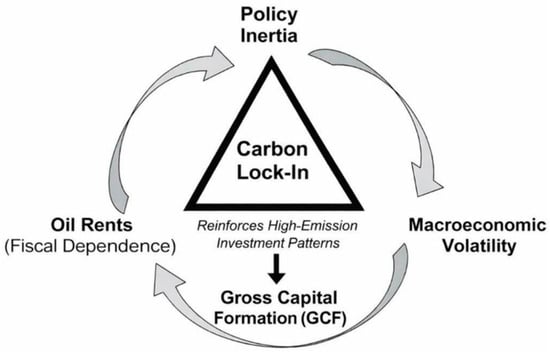
Figure 1 illustrates the self-reinforcing feedback mechanisms that maintain carbon-intensive investment patterns in GCC economies, based on our empirical findings. The diagram reveals three interconnected cycles that create persistent carbon lock-in, amplified by policy inertia.
Figure 1.
Structural Drivers of Gross Capital Formation and Carbon Lock-In in Hydrocarbon-Rich Economies.
Core Reinforcing Cycles:
- Carbon Intensity Cycle: High CO2 intensity directs capital toward carbon-intensive projects, which reinforces fossil fuel infrastructure and raises future carbon intensity—creating a self-reinforcing loop. Our empirical finding of a positive CO2 intensity-GCF relationship (coefficient = 31,261,697, p < 0.01) directly supports this mechanism.
- Oil Rents Cycle: High oil rents crowd out productive private investment and slow economic diversification, which maintains fossil-fuel dependence and sustains high rent expectations—forming a second reinforcing loop. Our negative oil rents-GCF relationship (coefficient = −0.271, p < 0.01) empirically validates this dynamic.
- Mutual Reinforcement: These cycles interact to create a dual lock-in where carbon-intensive investments and hydrocarbon dependence mutually reinforce each other.
- Amplifying Factor: Policy inertia intensifies both cycles by maintaining the status quo and delaying necessary reforms. While our current study focuses on the measurable structural relationships, future research could directly incorporate policy inertia proxies (such as subsidy persistence indicators or reform implementation lags) to quantitatively assess this amplifying effect.
Policy Intervention Points to Break the Cycles:
The policy inertia that currently amplifies these destructive cycles can be overcome through targeted interventions that systematically dismantle the feedback mechanisms. As detailed in Section 5.2, four strategic interventions can disrupt these loops:
- Emissions screening of public projects disrupts the carbon intensity cycle
- Subsidy reform converts fossil fuel support into clean investment incentives
- Green sleeves in sovereign wealth funds redirect hydrocarbon revenues to low-carbon assets
- Capex alignment rules ensure short-term spending supports long-term decarbonization
These interventions work precisely because they target the policy stagnation that supposed reinforces both cycles.
Dynamic Feedback and Adjustment
These feedback loops help explain why high-carbon strategies remain dominant: under current incentives, carbon-intensive projects still appear more profitable and less risky than cleaner alternatives. As long as this payoff structure remains in place, investors and public bodies have little reason to change their behaviour, so capital continues to flow into fossil-based activities. Policy interventions work by changing these incentives and rules, making low-carbon strategies more attractive and gradually redirecting investment toward cleaner options. The empirical evidence in our study supports the presence and strength of these feedback mechanisms: higher carbon intensity is associated with more capital formation, while larger oil rents are linked to weaker, less diversified investment.
6. Conclusions
This study investigated the structural drivers of gross capital formation in six GCC countries over the period 2000–2022, focusing on the influence of carbon intensity, oil rents, inflation, and economic growth. By shifting the analytical focus from emissions as outcomes to emissions as drivers of investment, the paper offers a novel perspective on how fossil-based development patterns shape capital allocation in rentier economies.
The empirical results provide robust quantitative evidence for the dual mechanisms of carbon lock-in and the resource curse. Our fixed effects estimates reveal a strong positive association between carbon intensity and GCF (coefficient = 31,261,697, p < 0.01), where a one standard deviation increase in CO2 intensity corresponds to a 2.27 percentage point increase in GCF—an economically significant effect given the average GCF of 27.3%. This numerical finding substantiates the carbon lock-in hypothesis, demonstrating that entrenched high-emission energy systems structurally attract investment, thereby reinforcing carbon-heavy growth trajectories. Conversely, oil rents demonstrate a significant negative relationship with GCF (coefficient = −0.271, p < 0.01), providing quantitative support for resource curse mechanisms as greater reliance on hydrocarbon revenues systematically crowds out productive, diversified investment. The diagnostic tests, including those for heteroskedasticity, autocorrelation, and cross-sectional dependence, alongside robustness checks using System GMM, lend further credibility to these core findings.
By reframing emissions as a structural determinant of investment, this study extends carbon lock-in theory into macro econometrics and links it directly with the resource curse in the unique context of rentier economies. Empirically, this integration is achieved by specifying emissions intensity as a core explanatory variable in a panel investment model, alongside traditional variables like oil rents, and demonstrating its statistically and economically significant effect on capital formation. The numerical results help close the gap between theory and data. They show that carbon lock-in can be understood as a dynamic equilibrium in which high-carbon investment strategies remain attractive because they deliver superior short-term returns under current incentives. Recent empirical and policy studies support this view, indicating that investment patterns only shift when policy interventions meaningfully change relative returns between high- and low-carbon projects.
The contribution of this research is therefore both theoretical and empirical. Theoretically, we advance the understanding of how carbon lock-in and the resource curse jointly constrain sustainable investment in rentier states. Empirically, we provide the first macroeconomic evidence, grounded in specific numerical results, that emissions intensity structurally drives capital formation in GCC economies. The concrete policy recommendations—such as emissions-based investment screening, green sovereign wealth fund sleeves, and energy subsidy reform—emerge directly from these empirical findings and theoretical advances, offering actionable pathways to overcome the investment inertia quantified in our analysis.
In conclusion, the persistence of high-carbon investment in the GCC, as numerically demonstrated by the positive CO2 intensity-GCF relationship, reflects a self-reinforcing cycle of structural dependence and adaptive behaviour. Breaking this cycle requires the deliberate fiscal, financial, and regulatory measures outlined in our policy implications, which are designed to recalibrate incentives and steer capital flows toward low-carbon assets. Aligning investment governance with transition objectives is therefore critical to overcoming the structural inertia empirically identified in this study and achieving sustainable capital formation in rentier states.
7. Limitations and Future Research
This study has several limitations that provide opportunities for future research. First, the reliance on country-level aggregate indicators for gross capital formation and emissions provides valuable macro-level signals but prevents identification of specific sectors driving carbon lock-in. Second, the time span (2000–2022) may not fully capture longer-term investment cycles. Third, the distinctive fiscal and governance structures of GCC economies limit direct generalizability to other resource-dependent contexts.
Methodologically, the small number of cross-sectional units (six countries) affects the reliability of system-GMM estimates, leading us to prioritize fixed-effects results. We detected cross-sectional dependence and employed robust standard errors clustered by country to address this concern.
Future research could build on our findings in several directions: more granular sectoral data would reveal which industries drive carbon-intensive investment; extending the temporal scope would test relationship persistence across energy transitions; comparative studies in other fossil-dependent regions (such as North Africa, Central Asia, or Latin America) would enhance external validity; and incorporating direct measures of policy inertia—such as fossil fuel subsidies or policy reform indices—would empirically test its role in reinforcing carbon lock-in cycles, as illustrated in Figure 1.
Finally, the behavioural interpretation we offer remains qualitative and does not develop a full evolutionary game-theory model of investor and policy behaviour. Future research could build formal dynamic models in this spirit and estimate them using more granular data, in order to deepen the theoretical contribution and provide a tighter link between the empirical results and the underlying behavioural mechanisms.
Funding
This research was funded by Deanship of Scientific Research, Vice Presidency for Graduate Studies and Scientific Research, King Faisal University, Saudi Arabia [Grant No. KFU 253813].
Institutional Review Board Statement
Not applicable.
Informed Consent Statement
Not applicable.
Data Availability Statement
The original contributions presented in this study are included in the article. Further inquiries can be directed to the corresponding author(s).
Conflicts of Interest
The author declares no conflicts of interest.
Appendix A
Table A1.
GMM Model Diagnostics.
References
- Unruh, G.C. Understanding carbon lock-in. Energy Policy 2000, 28, 817–830. [Google Scholar] [CrossRef] [Scilit]
- Seto, K.C.; Davis, S.J.; Mitchell, R.B.; Stokes, E.C.; Unruh, G.; Ürge-Vorsatz, D. Carbon lock-in: Types, causes, and policy implications. Annu. Rev. Environ. Resour. 2016, 41, 425–452. [Google Scholar] [CrossRef] [Scilit]
- Liu, Q.; Sun, H.; Luo, H. Resource-richness, technological innovation, and sustainable development: Evidence from emerging economies. Resour. Policy 2022, 79, 103047. [Google Scholar] [CrossRef] [Scilit]
- Chen, M.; Chen, J. Natural resources extraction in emerging economies: Does it promote sustainable development or crowd-out real sector? Resour. Policy 2023, 83, 103751. [Google Scholar] [CrossRef] [Scilit]
- Blazquez, J.; Fuentes, R.; Manzano, B. On some economic principles of the energy transition. Energy Policy 2020, 147, 111807. [Google Scholar] [CrossRef] [Scilit]
- Barbier, E.B. A Global Green New Deal: Rethinking the Economic Recovery; Cambridge University Press: Cambridge, UK, 2010. [Google Scholar]
- Mahmood, H.; Furqan, M. Oil rents and greenhouse gas emissions: Spatial analysis of Gulf Cooperation Council countries. Environ. Dev. Sustain. 2021, 23, 6215–6233. [Google Scholar] [CrossRef] [Scilit]
- Al-Tamimi, K.A.M.; Jaradat, M.S.; Aityassine, F.L.Y.; Soumadi, M.M. Impact of renewable energy on the economy of Saudi Arabia. Int. J. Energy Econ. Policy 2023, 13, 20–27. [Google Scholar] [CrossRef] [Scilit]
- Amran, Y.A.; Amran, Y.M.; Alyousef, R.; Alabduljabbar, H. Renewable and sustainable energy production in Saudi Arabia according to Saudi Vision 2030; Current status and future prospects. J. Clean. Prod. 2020, 247, 119602. [Google Scholar] [CrossRef] [Scilit]
- Grossman, G.M.; Krueger, A.B. Economic growth and the environment. Q. J. Econ. 1995, 110, 353–377. [Google Scholar] [CrossRef] [Scilit]
- Acheampong, A.O. Economic growth, CO2 emissions and energy consumption: What causes what and where? Energy Econ. 2018, 74, 677–692. [Google Scholar] [CrossRef] [Scilit]
- Mahmood, H.; Saqib, N. Oil rents, economic growth, and CO2 emissions in 13 OPEC member economies: Asymmetry analyses. Front. Environ. Sci. 2022, 10, 1025756. [Google Scholar] [CrossRef] [Scilit]
- Naz, F.; Tanveer, A.; Karim, S.; Dowling, M. The decoupling dilemma: Examining economic growth and carbon emissions in emerging economic blocs. Energy Econ. 2024, 138, 107848. [Google Scholar] [CrossRef] [Scilit]
- Antonakakis, N.; Chatziantoniou, I.; Filis, G. Energy consumption, CO2 emissions, and economic growth: An ethical dilemma. Renew. Sustain. Energy Rev. 2017, 68, 808–824. [Google Scholar] [CrossRef] [Scilit]
- Mitić, P.; Kostić, A.; Petrović, E.; Cvetanovic, S. The relationship between CO2 emissions, industry, services and gross fixed capital formation in the Balkan countries. Eng. Econ. 2020, 31, 425–436. [Google Scholar] [CrossRef] [Scilit]
- Hasanov, F.J.; Shannak, S.; Mukhtarov, S.; Suleymanov, E. Emissions effect of financial development in the GCC: Is the effect asymmetric? Environ. Econ. Policy Stud. 2024. [Google Scholar] [CrossRef] [Scilit]
- IRENA. Renewable Energy Market Analysis: GCC 2023; International Renewable Energy Agency: Abu Dhabi, United Arab Emirates, 2023. [Google Scholar]
- Azam, M.; Khan, F.; Ozturk, I.; Noor, S.; Yien, L.C.; Bah, M.M. Effects of renewable energy consumption on human development: Empirical evidence from Asian countries. J. Asian Afr. Stud. 2025, 60, 420–441. [Google Scholar] [CrossRef] [Scilit]
- Auty, R.M. (Ed.) Resource Abundance and Economic Development; Oxford University Press: Oxford, UK, 2001. [Google Scholar]
- Ross, M.L. The Oil Curse: How Petroleum Wealth Shapes the Development of Nations; Princeton University Press: Princeton, NJ, USA, 2012. [Google Scholar]
- Sachs, J.D.; Warner, A.M. The curse of natural resources. Eur. Econ. Rev. 2001, 45, 827–838. [Google Scholar] [CrossRef] [Scilit]
- Corden, W.M.; Neary, J.P. Booming sector and de-industrialisation in a small open economy. Econ. J. 1982, 92, 825–848. [Google Scholar] [CrossRef] [Scilit]
- Abdelkawy, N.A. Diversification and the Resource Curse: An Econometric Analysis of GCC Countries. Economies 2024, 12, 287. [Google Scholar] [CrossRef] [Scilit]
- Matallah, S. Economic Diversification in MENA Oil Exporters: Understanding the Role of Governance. Resour. Policy 2020, 66, 101602. [Google Scholar] [CrossRef] [Scilit]
- van der Ploeg, F.; Poelhekke, S. Volatility and the natural resource curse. Oxf. Econ. Pap. 2009, 61, 727–760. [Google Scholar] [CrossRef] [Scilit]
- North, D.C. Institutions, Institutional Change and Economic Performance; Cambridge University Press: Cambridge, UK, 1990. [Google Scholar]
- Rodrik, D. Institutions for high-quality growth: What they are and how to acquire them. Stud. Comp. Int. Dev. 2000, 35, 3–31. [Google Scholar] [CrossRef] [Scilit]
- Borhan, H.; Ahmed, E.M.; Hitam, M. The impact of CO2 on economic growth in ASEAN-8. Procedia-Soc. Behav. Sci. 2012, 35, 389–397. [Google Scholar] [CrossRef] [Scilit]
- Kaufmann, D.; Kraay, A.; Mastruzzi, M. The worldwide governance indicators: Methodology and analytical issues. Hague J. Rule Law 2011, 3, 220–246. [Google Scholar] [CrossRef] [Scilit]
- Arezki, R.; Brückner, M. Oil rents, corruption, and state stability: Evidence from panel data regressions. Eur. Econ. Rev. 2011, 55, 955–963. [Google Scholar] [CrossRef] [Scilit]
- Zhang, T.; Hong, C.; Kramberger, T.; Wang, Y. Integrating carbon tax and subsidies: An evolutionary game model in conjunction with system dynamics. Systems 2025, 13, 239. [Google Scholar] [CrossRef] [Scilit]
- Guo, W.; Chen, S.; Lei, M. Evolutionary game and strategy analysis of carbon emission reduction behaviors in supply chain enterprises. Sustainability 2023, 15, 8933. [Google Scholar] [CrossRef] [Scilit]
- Liu, Y.; Gao, C.; Liu, J. A game study on the evolution of carbon emission reduction behavior of Chinese power enterprises. Sci. Rep. 2025, 15, 23137. [Google Scholar] [CrossRef] [Scilit]
- Tobin, J. A general equilibrium approach to monetary theory. J. Money Credit. Bank. 1969, 1, 15–29. [Google Scholar] [CrossRef] [Scilit]
- Jorgenson, D.W. Capital theory and investment behavior. Am. Econ. Rev. 1963, 53, 247–259. [Google Scholar]
- Saudi Central Bank. Monthly Statistics. 2023. Available online: https://www.sama.gov.sa/en-US/EconomicReports/Pages/Monthlystatistics.aspx (accessed on 5 December 2025).
- Dagar, V.; Dagher, L.; Rao, A.; Doytch, N.; Kagzi, M. Economic policy uncertainty: Global energy security with diversification. Econ. Anal. Policy 2024, 82, 248–263. [Google Scholar] [CrossRef] [Scilit]

Disclaimer/Publisher’s Note: The statements, opinions and data contained in all publications are solely those of the individual author(s) and contributor(s) and not of MDPI and/or the editor(s). MDPI and/or the editor(s) disclaim responsibility for any injury to people or property resulting from any ideas, methods, instructions or products referred to in the content. |
© 2025 by the author. Licensee MDPI, Basel, Switzerland. This article is an open access article distributed under the terms and conditions of the Creative Commons Attribution (CC BY) license (https://creativecommons.org/licenses/by/4.0/).