Article

Climate-Driven Conflicts in Nigeria: Farmers’ Strategies for Coping with Herders’ Incursion on Crop Lands

by
Okechukwu George Eke
1,*,
Jan Moudry
1,
Festus Onyebuchi Eze
1,
Sunday Alagba Obazi
2,
Ifechukwu Precious Ifoh
2,
Chisenga Emmanuel Mukosha
1,
Marie Grace Ntezimana
1 and
Atif Muhammad
1
1
Department of Agroecosystems, Faculty of Agriculture and Technology, University of South Bohemia in Ceske Budejovice, 370 05 Ceske Budejovice, Czech Republic
2
Department of Agricultural Extension, Faculty of Agriculture, University of Nigeria, Nsukka 410001, Nigeria
*
Author to whom correspondence should be addressed.
Sustainability 2025, 17(24), 11316; https://doi.org/10.3390/su172411316
Submission received: 11 September 2025 / Revised: 22 October 2025 / Accepted: 24 October 2025 / Published: 17 December 2025
(This article belongs to the Section Air, Climate Change and Sustainability)

Abstract

Conflicts between crop farmers and herdsmen in Nigeria have intensified in recent decades, posing a danger to agricultural sustainability, rural livelihoods, and food security. This study investigated coping strategies that arable crop farmers have adopted in Enugu State, Nigeria, against herders’ incursions. Data were collected through the use of a structured questionnaire. According to the result, herders’ activities, including crop destruction, assaults on women, and intimidation, have severely affected livelihoods, which has resulted in reduced income and declining productivity. In response, most farmers applied some measures such as fencing, group farming, and cultivating small plots near homesteads to avoid clashing with the marauding Fulani pastoralists. Among all the measures adopted by the farmers, results reveal that only collective strategies, such as group farming and cultivating small plots close to homesteads, were sustainable. The study pointed out the limited capacity of rural households to cope alone and suggested the need for government assistance, such as the provision of less expensive protective infrastructure and stronger community security arrangements. The study recommends that the government should ensure and employ conflict management strategies through empowering traditional institutions with delegated legislation to ameliorate further occurrences. The research contributes to the body of literature by revealing the farmers’ viewpoints and strategies within the broader discourse on farmer–herder conflicts in Nigeria.

1. Introduction

Conflicts over land and natural resources are among the most complicated and persistent challenges facing rural communities worldwide [1,2]. Competition for land, water, and pasture has been a persistence cause of conflict from South America to sub-Saharan Africa and South Asia, especially in agrarian communities where access and control of natural resources are essential to livelihoods [3,4]. Globally, such conflicts are usually caused by a combination of demographic pressure, environmental change, and weak governance, which together compromise human security and rural sustainability [5,6]. Scholarly debates on land-use conflicts have highlighted three major frameworks for analysis [7]. First, resource-based conflict theory, which emphasizes the scarcity of natural resources, including land, water, and grazing areas, as the root of violent competition, particularly when institutional mechanisms for allocation and conflict resolution are weak [8,9]. Second, political ecology provides insight into how environmental degradation, climate variability, and socio-political structures relates to one another to produce inequalities in resource access, thereby fueling conflicts [10,11,12]. Third, a human security approach situates conflicts within broader concerns of livelihood security, displacement, and vulnerability, arguing that these disputes threaten not just immediate survival but also long-term community resilience [13,14,15,16].
Conflicts between farmers and herders are an example of these processes throughout Africa. In the Sahel, prolonged droughts and advancing desertification have forced pastoralists to migrate southwards, sparking violent confrontations with sedentary farmers in Mali, Niger, and Burkina Faso [17,18]. In East Africa, recurrent clashes between pastoralists and farming communities in Kenya, Ethiopia, and Sudan are caused by both environmental stress and contested land tenure systems [19,20]. Outside of Africa, similar cases have been witnessed. In India, conflicts between herders and farmers over land are a typical example of the intersection of environmental stress and deficiencies in local government [21]. These comparative examples reveal that Nigeria’s farmer–herder conflict is not an isolated phenomenon but part of a global pattern of land-use contestation driven by environmental change, demographic expansion, and governance challenges.
Within Nigeria, these broader forces converge in particularly acute ways. The incessant clashes between crop farmers and Fulani herders remain one of the challenges undermining the tranquility in Nigeria and bedeviling the continuous coexistence of the country [4,22]. In recent decades, Nigeria has witnessed a growing tension between crop farmers and pastoral herders, resulting in significant socio-economic and environmental consequences [23,24]. The northeastern part of Nigeria, consisting of Adamawa, Taraba, and Plateau State, initially witnessed the clashes, and this has extended to the middle belt of the country and the southern part, which has been reputed for its serenity and calmness [25]. The incursion of herdsmen into agricultural farms, usually resulting in crop damage and violent collisions with the sedentary farmers in the communities, has become a serious challenge for agricultural sustainability and rural livelihoods [23,26]. In Nigeria, the population pressure, climate change, land use conflicts, and weak governance have been identified as the causes of these clashes, which have continued to threaten food security in many states. The rapid population growth, now exceeding 220 million, has also intensified pressure on land and food systems [27]. As the population continues to rise, the need to increase crop farmland intensifies, which has led to deforestation, soil erosion, and desertification, especially in the northern part of the country [28]. In northern Nigeria, climate change has reduced grazing land and water availability, accelerating desertification and rainfall variability [29,30]. Environmental forces in Nigeria have exacerbated land competition, pushing pastoralists southward and putting them at odds with sedentary farmers [31]. As a result, herders migrate in search of pasture, inevitably colliding with farming communities where land is already scarce. The consequences are severe, which include farmland destruction, declining productivity, forced migration, food insecurity, and ecological degradation [32,33].
In addition to the physical impacts, these conflicts present serious threats to livelihood and human security. Farming households face not only crop losses but also displacement, threats to food access, and weakened resilience to future attacks [34,35]. In response, farmers around Africa have developed coping strategies that complement the sustainable livelihood approach, such as securing assets, diversifying income sources, and building social networks to buffer against shocks [26,36,37]. In Nigeria, farmers apply different strategies ranging from fencing, vigilante patrols, crop diversification, petty trading to cooperative farming [38,39,40]. Similar adaptive strategies are documented in Ethiopia, where communities negotiate grazing rights [41,42], in Kenya, where group farming strengthens resilience [43,44], and in Sudan, where livelihood diversification mitigates vulnerability to conflict [45,46]. Although several studies have examined the drivers and impacts of farmer–herder conflicts, few studies have explicitly analyzed the adaptive strategies crop farmers use to endure and bounce back from herder-related conflicts. It’s, therefore, very essential to understand these tactics to enhance community-led resilience mechanisms in agricultural areas that are vulnerable to these related attacks, as well as to formulate policies that can curtail future occurrences. This study examines the coping mechanisms adopted by farmers to the herders’ invasion of crop farms in Enugu State, Nigeria.
Specifically, the study sought to:
  • Describe the socio-economic characteristics of farmers in the area.
  • Identify herdsmen’s activities and forms of incursion on arable crop farms.
  • Ascertain the effects of herders’ intrusion on the arable crop farm.
  • Determine farmers’ coping strategies in response to herders’ incursion.
  • Ascertain the challenges faced by farmers in adopting coping strategies against herders’ incursion.
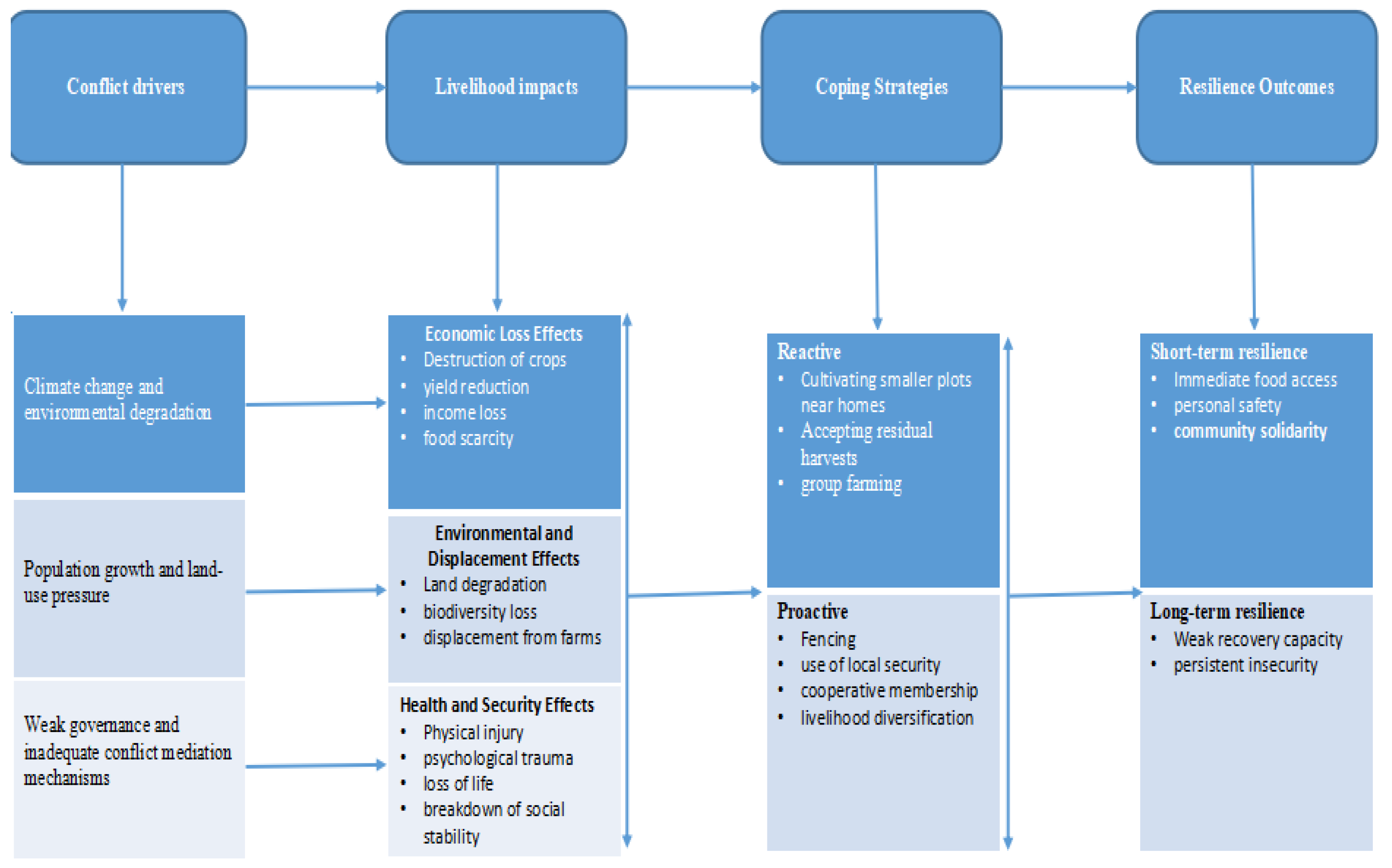
Theoretical Framework: Farmer’s Coping Strategies to Herder Incursions (Figure 1).
This research is grounded in a theoretical framework centered on resilience, which draws on concepts from livelihood theory and resilience theory [47,48,49]. The combination of this approach offers a way to analyze how disturbances caused by conflict affect people’s livelihoods, the strategies they adopt to cope, and their ability to recover. These drivers influence livelihoods in diverse ways, prompting people to adopt different coping strategies. Over time, these responses shape the level of resilience within affected communities, revealing how they confront and recover from socio-economic shocks. The diagram begins by illustrating the main drivers of conflict and how they evolved. These are the initial pressures that create the conflict. Conflict is viewed here not as a single event, but as an ongoing process stemming from complex issues such as competition for scarce resources, political instability, ethnic tensions, or weak institutions [50,51]. This conflict destroys the economic, social, and environmental foundation of the communities, which affects them to sustain a stable livelihood due to the institutional weakness. This rendered their access to necessary resources, income streams, and support networks difficult. In response, the communities create coping strategies to reduce their losses and survive temporarily. These responses are divided into reactive and proactive coping strategies. Reactive strategies like group farming, accepting residual harvest, and growing a small plot close to home may offer short-term relief. Proactive strategies, which include fencing the farms, use of local security, cooperative membership, and livelihood diversification such as learning new skills and migrating for work, can provide better relief by building capacity, which makes households better equipped to handle future crises.
Within this framework, resilience isn’t viewed as a fixed endpoint, but as an active, evolving process of learning, adapting, and sometimes even transforming. The relationship between the coping strategies adopted and the livelihood assets remains the basis for determining whether the recovery is restorative or transformative. Basically, this framework posits that the drivers of conflict set off a chain reaction of livelihood disruption. This disturbance forces people to adopt coping strategies. The nature of those strategies, whether they preserve or deplete assets, shapes the final outcome in terms of resilience. This provides a comprehensive picture of how populations caught in conflict navigate hardship and strive to rebuild their lives within fragile and often volatile environments.

2. Methodology

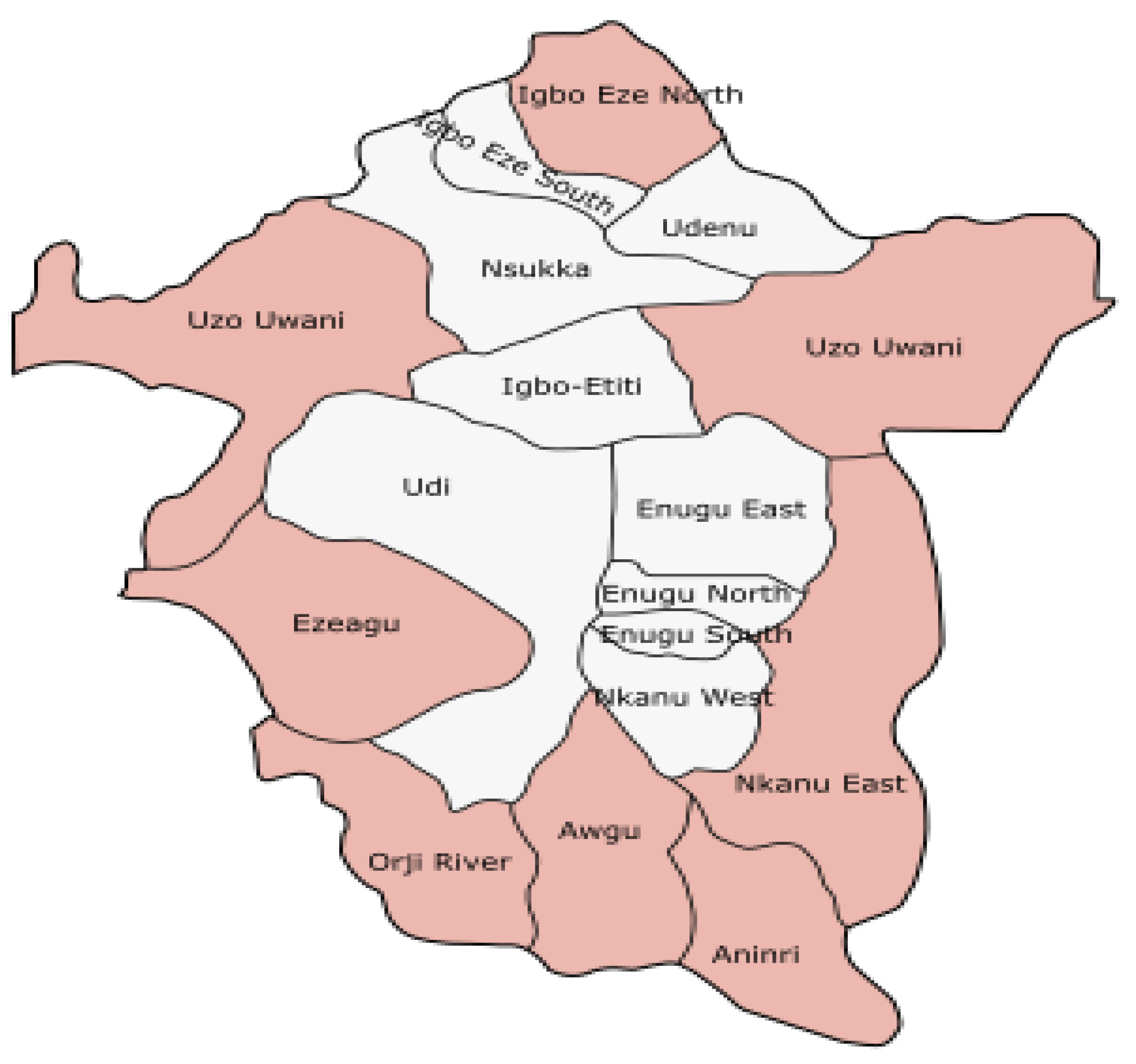
The study took place in Enugu State, located in southeastern Nigeria. A multistage sampling approach was adopted. First, twelve out of the state’s seventeen Local Government Areas (LGAs) were purposively chosen because of their experience of frequent attacks from herdsmen. From these twelve, eight LGAs were randomly selected. Afterward, snowball and simple random sampling techniques were used to generate a list of 10 farming households and household heads affected by the Fulani herdsmen attacks, respectively. A total of 80 household heads took part in the study (Figure 2).
Data for the study were gathered through a questionnaire, which contained questions that were carefully designed to meet the main objectives of the study. The first section of the interview schedule generated information on the personal characteristics of respondents, while the second part was designed to identify the activities and forms of incursion on arable crop farms. A list of possible herders’ activities on the farms was provided, such as the destruction of the growing crops by cattle, overgrazing of farmlands, using cattle to trample on crop beds, ridges, or mounds, feeding cattle with arable crops, and much more. They were asked to tick yes (1) or no (0) against those options and were also allowed to list other activities experienced on their farms.
To ascertain the effects of the herders’ incursion on arable crop farms, a list of possible effects of the herder’s incursions on the farmers’ farm were provided such as loss of farmers’ life, loss of farmers’ properties like farm implements and farmstead, displacement of farmers from their home/farmstead, damage to crops, loss of biodiversity on the farm, etc. The respondents were asked to answer using a five-point Likert-type scale of ‘strongly agree (4)’, ‘agree (3)’, ‘undecided (2)’, ‘disagree (1)’, and ‘strongly disagree (0)’. The values were added and divided by 5 to obtain 2.0. To determine the cut-off mean score, a margin of 0.05 was added to and subtracted from the benchmark value of 2.0, giving 2.05 and 1.95, respectively. Any variable with a mean score of 2.05 or higher was considered a major effect of the incursion, while those below 2.05 were regarded otherwise.
In assessing how farmers coped with herders’ incursions on arable crop farms, a series of statements was presented on a five-point Likert-type scale ranging from very effective (4) to very ineffective (0), with undecided (2) at the midpoint. Using the same cut-off procedure, strategies scoring 2.05 and above were regarded as effective, while those below were not.
To evaluate the challenges farmers faced in applying these coping strategies, another set of statements was provided on a five-point Likert-type scale, ranging from very serious (4) to very unserious (0). Once again, the 2.05 cut-off served as the threshold, with values at or above this point treated as major challenges while scores below 2.05 were not regarded as major challenges. The data collected from the survey were analyzed using descriptive statistics such as frequency counts, percentages, mean scores, correlation, and factor analysis. All statistical analyses were carried out with the aid of the Statistical Package for the Social Sciences (SPSS) version 20.

3. Results and Discussion

3.1. Socio-Economic Characteristics of the Respondents

3.1.1. Sex

Results in Table 1 show that a greater proportion (56.3%) of the farmers were male. This suggests moderate male dominance but also a relatively significant female participation in farming. Gender distribution usually influences access to resources, in which men often have greater access to land, credit, and extension services, whereas women’s contributions, though substantial, may face structural constraints. This conforms with the findings of [52,53], who asserted that although women are actively involved in a wide array of agricultural production activities, they have limited access to farm productive resources and their influence in decision-making are also restricted compared with men. However, the notable involvement of women could indicate that women play a key role in crop production and food security. According to [54,55], about 68.0% of the total agricultural workforce in the country is concentrated in family farming, with almost half of them being women.

3.1.2. Age

The average age of the farmers was 49.48 years, with the majority (64.0%) falling within the age range of 36 to 55 years (Table 1). This implies a mature and experienced farming population, though the low percentage (10.0%) of farmers aged 35 or younger raises concerns about the aging of the agricultural workforce. The reduced involvement of youth in farming may also reflect a fear of insecurity, especially in conflict-prone regions where clashes between farmers and herders discourage young people from investing in agriculture [56]. Furthermore, the low proportion of young farmers could be due to rural-urban migration, limited access to land, or a lack of interest among youth in farming as a profession [57].

3.1.3. Educational Level

Table 1 shows that the mean education level of the respondents was 9.79 years, with 15.0% having no formal education, 33.8% having elementary education, 42.5% having secondary education, and 8.8% having university education. This shows a relatively moderate literacy level, with a majority having at least a basic education. This corroborates the work of [58,59], who state that a greater proportion of farming households acquired formal education.
While this suggests a reasonable literacy rate among farmers, the 15.0% without formal education may find it difficult to access government programs, early warning systems, or modern farming equipment. Refs. [48,49] note that peace-building and conflict resolution depend heavily on education. Educated farmers are more likely to participate constructively in policy frameworks, join cooperative societies, and report grievances through appropriate legal channels rather than resorting to retaliation [60,61].

3.1.4. Farm Size (Plot)

Table 1 reveals that the majority (88.8%) of the crop farmers cultivate on a small area of land measuring 10 plots or less, while only 7.5% and 3.8% of the respondents farm on 11–20 plots and ≥20 plots, respectively. This distribution highlights a predominance of smallholder farmers within the study area, a factor that has great implications for their exposure to and experiences in the ongoing conflict with armed Fulani herdsmen. Farmers’ fear of being attacked by armed Fulani herdsmen could be one of the primary reasons influencing their behavior, including the quantity of land they cultivate. Even when there is enough available land, the fear of being attacked by the herdsmen may limit the farmers from using the actual agricultural land, leading to lower yields and consequently resulting in additional economic hardship. Refs. [56,62] reveal that in many conflict-affected rural communities, farmers intentionally reduce their field size to remain close to home for safety reasons or to reduce the risk of crop loss due to cattle incursions. In such environments, the fear of ambush, abduction, or violence limits farmers from working in distant fields or expanding cultivation, even when the land is available [63]. The psychological effects of always being in danger should not be underestimated. Many young or active farmers may give up farming for long periods, or even be forced to move away, because of the lasting fear and trauma they experience.

4. Primary Occupation of the Respondents

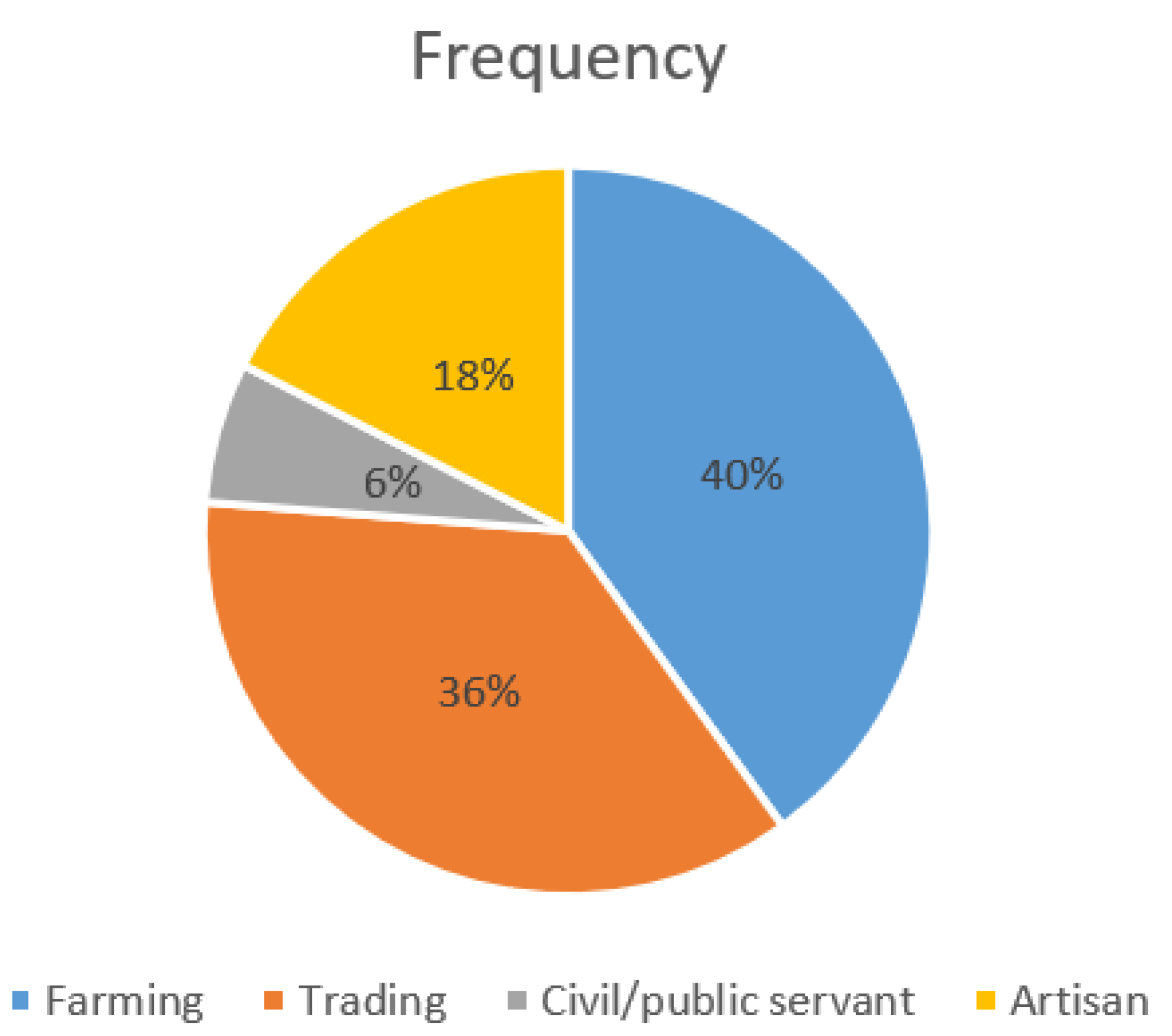
Figure 3 reveals that farming is the primary occupation for a greater percentage (40.0%) of the respondents, which is closely followed by trading (36.3%), artisanship (17.5%), and a smaller proportion in civil or public service (6.3%). This portrays that the study area is likely rural or agrarian, where farming serves as the main source of income and sustenance for households. This finding supports the work of [64,65], who found that farming is the major source of livelihood and employment opportunity for many rural dwellers. The high number of traders indicates a strong informal economy that is known for small-scale commercial activities such as the buying and selling of goods in local markets. The artisans are made up of people with practical skills like carpenters, tailors, mechanics, and others who work in different trades. Their presence signifies the importance of skilled trades in promoting the local economy and providing essential services within the community. The low percentage of civil servants suggests limited access to formal employment opportunities, possibly due to factors such as low educational attainment, poor infrastructure, or a limited government establishment in the area. According to [66,67], lower educational attainment in rural communities limits the pool of qualified individuals for civil service positions, making it difficult to work in rural populations and a potentially smaller or less developed government presence in these areas.
The findings presented in Table 2 reveal that all (100.0%) respondents indicated that allowing cattle to feed on the growing crops, overgrazing of farmland, trampling on crops/ridges/mounds, feeding cattle with arable crops, and pollution of farms with cattle defecation were the various activities and forms of incursion by herdsmen on the farm. This unanimity emphasizes the centrality of resource-use-conflict in farmer–herder relations, consistent with prior studies that identify crop damage and overgrazing as the primary triggers of farmer–herder disputes in sub-Saharan Africa [23,68]. According to [69,70,71], over-grazing and trampling of farmlands by cattle not only cause immediate yield losses but also undermine soil fertility, alter planting structures, and contribute to long-term land degradation, thereby threatening the sustainability of arable farming systems.
In addition, 96.3% of the farmers indicated that herdsmen harvest their crops to feed their cattle, indicating widespread intentional crop appropriation. While physical destruction may sometimes be accidental to grazing, deliberate harvesting shows a shift towards intentional expropriation [72], blurring the line between environmental conflict and outright theft. Similarly, the high incidence of intimidation of farmers (95.0%) and building settlements around the farms (92.5%) suggests that the conflict often goes beyond isolated encounters, resulting in sustained territorial encroachment, which is an indication of a breakdown in traditional migration routes, driven by climatic stressors [73,74]. Gender violence is another challenging report for farmers-herders conflicts. More than half of the respondents (52.5%) reported incidents of sexual violence against women farmers. This aligns with [75,76], which identified assaults on women farmers as one of the factors responsible for the prevalent farmers-herdsmen conflicts.
The less frequent but highly severe activities, such as pollution of water points (38.8%), Kidnapping (23.8%), burning of farms (7.5%), use of cutlasses to attack farmers (6.3%), and shooting of farmers (3.8%), represent an escalation from economic damage to violent criminality. This corroborates the findings of [77], which state that although the farmers-herdsmen conflicts occur less often, their implications for rural livelihoods, community resilience, and investor confidence in agriculture are disproportionately large. Even infrequent lethal encounters can trigger displacement, abandonment of farmland, and the collapse of local agricultural markets.
Table 3 demonstrates the major effects of herdsmen incursion on arable crop production. The Varimax Rotation results on constraints were classified into three factors based on the variable loading. The factor grouped the effects of the herdsmen’s incursion on arable crop production into three broad dimensions: economic/yield loss effects, migration/environmental hazard effects, and assault/health hazard effects. These factors show how the conflict directly and indirectly disrupts agricultural productivity and rural well-being.
Economic/yield loss effects (Factor 1) had the highest concentration of strongly loading variables, demonstrating the immediate consequences of herdsmen incursion on farm productivity and household income. Some of the most significant effects identified include scarcity of food in the community (0.873), loss of peace in the community (0.912), destruction of crops (0.847), reduction in farm output (0.861), and hike in prices of food crops (0.788). These results show how the destruction of crops and falling yields set off a chain reaction, causing food scarcity, price hikes, and loss of income. The loss of yields due to conflicts has far-reaching economic implications, as farmers experience a decline in household income and reduced capacity to reinvest in agriculture [77,78]. This finding also aligns with earlier studies, which highlight how farmer–herder conflicts worsen rural poverty, increase food insecurity, and heighten economic vulnerability among smallholder households [79].
Likewise, the migration and environmental hazard effects (Factor 2) underscore how grazing activities displace farming households and contribute to environmental degradation. Notably, loss of biodiversity on the farm (0.753), displacement of farmers from their home/farmstead (0.661), infestation of pests and diseases (0.547), and loss of farmers’ property, like farm implements and farmstead. These findings illustrate the ecological stress and forced migration associated with the incursion, which not only dislocates farmers but also neglects sustainable land use practices. According to [80,81], conflicts, including armed conflicts and resource-based disputes, frequently lead to the forced displacement of farmers, significantly impacting agricultural livelihoods and food security. Environmental stress linked to overgrazing and trampling of farmlands by cattle has been identified as an agent of land degradation and soil compaction in sub-Saharan Africa [82]. The displacement of farmers further compounds food insecurity, as labor is withdrawn from production [83,84].
Furthermore, assault and health hazard effects (Factor 3) capture the physical and psychological toll of the herdsmen’s incursion. Loss of farmers’ lives (0.702), soil compaction due to trampling by cattle (0.582), increase in crime rate in the community (0.533), and maiming of farmers (0.395) were the major loadings under this component. This factor points to violent and traumatic dimensions of the conflict, where loss of life, abduction, and insecurity intersect with agricultural disruption. In line with this finding, [85] state that the loss of lives, abductions, and general insecurity directly impact agricultural labor and production, while also causing displacement, disrupting markets, and decreasing access to vital resources. Beyond physical danger, these experiences emphasize the psychosocial toll of insecurity, ranging from loss of confidence in farming as a livelihood to long-term psychological scars that undermine household productivity. The rise in crime rates associated with herdsmen incursions points to a larger breakdown of social stability and trust, which frequently leaves farming communities open to cycles of retaliation and violence.
Data in Table 4 show a wide range of coping strategies employed by farmers to mitigate the effects of herder intrusion on arable crop farms. The majority (97.5%) of respondents reported cultivating a small portion of land around homes, accepting whatever remains from the affected farm (93.8%), and going to farms in groups (92.5%) as coping strategies. The high rates signify that farmers have reduced the risk of cultivation, adopted collective awareness, and mentally prepared for crop loss to cope with the ongoing instability. This is consistent with adaptive coping theory, reviewed by [86,87,88], which posits that individuals in resource-limited settings often choose strategies that preserve personal safety and social cohesion over maximal productivity. The high proportion of farmers who reported going to farms in groups indicates that group farming enhances safety by providing mutual protection and reducing the likelihood of attacks when working together. This collective strategy reduces individual vulnerability and contributes to community resilience in the face of recurring conflicts. According to [89,90], group farming is not only a practical security measure but also a social safety net that reinforces farmers’ adaptive capacity and sense of belonging during period of crisis.
Moderately adopted strategies included fencing or barricading farms (83.8%), possessing multiple farms (82.5%), and using local security (65.0%). These measures require additional resources, whether financial (fencing), land access (multiple farms), or social capital (Organizing security). The fact that a greater proportion of farmers still engage in them indicates both the severity of herders’ intrusions and the value placed on proactive protection. This result also supports the findings of [91,92], which state that fencing, especially electric or expensive live fences, can reduce field incursions by marauding pastoralists and encourage peaceful coexistence between the community. Receiving remittances from family and friends (61.3%) and from unions or associations (58.8%) indicates that there is a significant importance of social networks and cooperative structures in rural resilience. According to [89,93], agricultural communities that practice kinship ties and cooperative membership strongly reduce livelihood shock impact. Additionally, diversification into other jobs (45.0%) suggests that some farmers opt for partial or complete shifts in livelihood to reduce dependence on vulnerable agricultural output.
Verbal warning/engaging in open communication with herders (16.3%) and engaging in physical attack (6.3%) were comparatively low, mostly due to the risks of possible violence and escalation. Similarly, compensation from insurance firms (6.3%) or the government (2.3%) was low, signifying either limited access to such mechanisms or inefficiencies in their implementation. Early harvesting (8.8%), early planting (5.0%), avoiding dry season planting (5.0%), and planting early maturing crops (3.8%) emphasize agronomic adjustments that need specific planning and may be limited by environmental factors. Other strategies, such as selling farms (3.8%), avoiding riverine areas (2.5%), or relocation to new farmland (47.5%), represent long-term or irreversible decisions, usually showing severe and persistent pressure from herder intrusion. The litigation report (1.3%) or appeasement of the gods (1.3%) indicates that these are culturally or institutionally niche mechanisms with little perceived effectiveness in the context.
The majority of the coping strategies adopted by the farmers against herder incursions failed largely due to institutional, financial, and structural weakness. Strategies that depended on formal systems such as litigation, government compensation, insurance, and bank loans were rarely used because of weak institutional support, poor access, and lack of trust in public agencies. This result align with the findings of [94,95], which report that farmers facing conflicts often underutilize formal risk management tools such as litigation, government compensation, agricultural insurance, and bank loans, primarily due to weak institutional frameworks, limited accessibility to these services, and a pervasive lack of trust in public agencies. Overall, the limited effectiveness of these coping strategies reflect deeper governance and economic constraints, emphasizing the need for institutional support, affordable protective measures, and community-based conflict resolution strategies to enhance farmers’ long-term security and productivity.
The findings in Table 5 show a significant variation in the perceived effectiveness of the various coping mechanisms that farmers have adopted in response to the herders’ activities on the farm. The most highly rated coping strategies were cultivating a small area of land around homes (M = 3.90) and going to farms in groups (M = 3.37). The mean ratings, assisted by standard deviation, reveal that farmers’ decisions are mostly influenced by cost, security, and the level of autonomy each approach permits. The high mean scores indicate widespread consensus on their effectiveness, particularly for the first strategy, which has the lowest standard deviation among all of them.
Growing smaller farm plots close to homes likely reduces the exposure of crops to destruction and makes it easier for farmers to monitor and protect their farms. In addition, group farming appears to serve as a deterrent against conflict, enhancing security through collective presence. This corroborates the findings of [96,97], which state that group farming builds relationships and interdependence, and the sheer presence of more people reduces the likelihood of opportunistic attacks, whether from rival groups, armed actors, or even wildlife. Strategies with a moderate rating, such as possession of several farms (M = 2.96), receiving remittances from unions/associations (M = 2.14), suggest a dependency on diversification and external financial support. The relatively high changes in answers imply that this technique is not equally accessible to all farmers, likely due to land and financial challenges, even though possessing multiple farms can spread risk across different locations. Similarly, financial remittances are helpful when available, but remain unreliable and not regular, as reflected by the large standard deviations.
Lower mean scores were recorded for strategies such as accepting whatever remains from the affected farms (M = 1.95), diversification to another job (M = 1.75), and praying for peace (M = 1.10). These approaches tend to be either passive (acceptance of losses) or non-material (religious appeals), which may describe their lower perceived effectiveness in terms of visible outcomes. Diversification of off-farm employment, though possibly reducing dependence on farming, might be constrained by skill gaps, limited rural employment opportunities, or socio-cultural preferences for agriculture. Other strategies, which include the use of local security (M = 0.40), fencing/barricading of farms (M = 0.56), and relocation to new farmland (M = 0.50), received very low mean scores. These low ratings could be a result of prohibitive costs, scarcity of alternative farmland, and the challenge of sustaining such measures over time. Similarly, strategies involving early planting and or early harvesting received negligible acceptance, despite their agronomic advantage of mitigating seasonal risks, suggesting a possible lack of knowledge or extension service outreach. This finding supports the work of [98,99], who assert that many rural farming households lack adequate access to agricultural extension agents, which has a significant impact on the productivity and the adoption of improved technologies.
Data in Table 6 reveal that the significant challenges that hinder farmers’ ability to cope effectively with herdsmen’s attacks on their farms were: insufficient inspection/patrol of vigilantes (M = 3.91), lack of land around homes (M = 3.87), lack of firm protection by the police and law (M = 3.82), illegal acquisition of weapon by the herders (M = 3.80), accepting of bribes by the local leaders/police (M = 3.53), and lack of training on coping strategies (M = 2.59).
The most rated challenge was the insufficient inspection and patrol of vigilantes, which shows that farmers depend heavily on community vigilante groups for security due to the perceived inefficiency of state security agencies. However, inconsistent patrols and poor coverage expose many farming households to sudden attack by armed herdsmen. This supports the findings of [100,101], which note that local security groups in rural areas are often underfunded, poorly trained, and ill-equipped to handle armed conflicts. Ref. [102] also, assert that without consistent monitoring, herders exploit security lapses to invade farms, leading to the destruction of crops and the displacement of farmers.
The lack of farmland around homesteads was another major barrier militating against farmers to cope with the herdsmen’s incursion. Many farmers cultivate plots distant from their residences, which increases exposure to attacks as they cannot easily monitor or protect their crops. Studies show that land scarcity in densely populated regions of Nigeria compels farmers to cultivate in remote locations, often close to cattle grazing routes [103]. This spatial separation reduces farmers’ ability to safeguard their livelihood and exposes them to violent clashes.
The lack of strong protection by the police and legal institutions emerged as a critical challenge facing farmers in coping with the herdsmen attacks. Farmers reported that security forces often fail to respond promptly to distress calls or prosecute offenders effectively when found guilty of heinous crimes. Ref. [104], in their findings, reveal that the ineffectiveness of law enforcement not only emboldens herders but also deepens farmers’ sense of abandonment. Weak law enforcement, characterized by corruption, inadequate resources, poor training, and lack of accountability, indeed fosters impunity and discourages farmers from relying on formal security structures [105,106].
Closely related is the illegal possession of sophisticated weapons by herders. Armed herders often possess automatic rifles, rendering farmers’ crude self-defense strategies inadequate. Ref. [107] reported that the proliferation of small arms in Nigeria is one of the major drivers of farmer–herder violence. This finding also mirrors the work of [108], who opined that the proliferation of sophisticated arms by herders exacerbates local land disputes, transforming them into violent armed conflicts by increasing the lethality of confrontations and empowering communities to engage in more destructive actions, such as cattle rustling and crop destruction.
The challenges of local leaders and security officers accepting bribes were also significant. According to [109], corruption undermines justice and fairness, as perpetrators are protected from prosecution through patronage networks within the justice system and government. This destroys trust in conflict resolution mechanisms and perpetuates hatred between farmers and herders [110]. When farmers realize that security agents are compromised, they become reluctant to report attacks, further weakening coping strategies.
Another prominent factor was the lack of training on coping strategies. Many farmers have limited knowledge of non-violent conflict resolution, early warning systems, or adaptive livelihood strategies. As reported by [14,111], farmer–herder conflicts continued partly because there is no organized conflict management training and awareness at the grassroots. Farmers are unable to adequately anticipate and manage possible intrusions due to this constraint. Economic difficulties also restrict coping mechanisms; farmers listed the inability to pay for fencing, insurance, and defense as significant but comparatively lower-ranked difficulties. Although these problems are significant, the lower mean ratings show that they might not be as urgent as the structural and security difficulties. This has been earlier reported by [23], who state that poverty significantly hinders farmers’ ability to cope with herdsmen invasions by limiting their access to resources, such as sophisticated weapons for self-defense and financial capacity for compensation or rebuilding after losses.
Table 7 presents the Pearson correlation coefficients showing the relationships between farmers’ socioeconomic characteristics and their coping strategies adopted in response to herders’ incursions on their cropland. The result indicates a positive and significant relationship between farm size and coping strategies (r = 0.262, p ≤ 0.019).
Farmers with larger farms often take more steps to protect their land from herders’ incursions. Since they have more at stake and better access to resources, they are more willing to invest in measures like fencing, working together with other farmers to monitor their fields, or spreading their crops across different plots to reduce risk. In line with this study, refs. [38,112] report that resource endowment enhances adaptive capacity in conflict-prone agricultural systems. Ref. [113] in his study further states that farmers with greater resource endowments, such as land size, livestock assets, income diversity, education, and social networks, exhibit stronger adaptive capacity in conflict-prone or climate-stressed agricultural environments.
In contrast, age (r = 0.019, p ≤ 0.869), sex (r = 0.121, p = 0.285), educational level (r = −0.103, p = 0.364, and primary occupation (r = −0.152, p ≤ 0.177) all exhibit non-significant relationships with the coping strategies. The non-significant correlation between age and coping strategies suggests that both younger and older farmers adopt similar coping behaviors, showing that adaptation may be more influenced by external constraints, such as insecurity and resource access, than by age or farming experience. Similarly, the lack of a significant gender effect suggests that both male and female farmers are equally affected by the incursions and respond using comparable strategies, perhaps due to the shared nature of coping in rural settings.
The educational level also shows a weak and negative relationship with coping strategies, implying that education does not necessarily enhance the adoption of the coping measures against herder incursion. This could indicate that the coping responses are more practical, experience-based, and locally driven rather than dependent on formal education. This finding is in contrast with the works of [114,115], who report that education improves farmers’ awareness, decision-making, and access to innovation, thereby increasing their likelihood of adopting multiple and effective coping strategies against herders’ incursions. The non-significant relationship between primary occupation and coping strategies further portrays whether farming is the main livelihood or a secondary activity; farmers are generally compelled to adopt similar forms of coping behavior within the affected communities.
Beyond the coping strategies examined, several relationships among the variables stand out. For example, the analysis shows a negative and significant link between age and educational level (r = −0.262, p ≤ 0.019). This indicates that younger farmers tend to have higher levels of education than older ones. Similar observations have been reported by previous studies [116,117], which note that younger farmers not only receive more formal education but also have better access to agricultural training opportunities. In addition, the result reveals a negative correlation between sex and farm size (r = 0.282, p ≤ 0.011). This means that male farmers usually own larger farm holdings than their female counterparts, likely showing persistent gender disparities in access to land and productive resources. The finding supports earlier research [118], which attributes men’s larger farm sizes to their comparatively greater access to land, credit facilities, and farm inputs.

5. Recommendation

In order to improve resilience and reduce the rate of farmer–herder disputes, interventions should concentrate on practical and locally driven solutions instead of merely urging security to be strengthened. The government should assist the groups defending the farms, which are coordinated with local police and vigilantes to provide continuous monitoring and timely action during peak farming season. Farmers should be able to get soft loans for fencing their land by creating microcredit and small-loan programs targeted at collective farm fencing and group agricultural cooperatives. The introduction of an early warning and information-sharing system using mobile alerts and local radio would help farmers anticipate potential incursions and coordinate collective safety actions. Agricultural extension agents should be equipped to train farmers in non-violent conflict management, sustainable land use, and group-based production models. Importantly, sustainable solutions must move beyond farmer-centered interventions to include pastoral herders as active partners in peace-building and resource management. This can be achieved through dialogue-based initiatives, shared grazing and land-use agreements, and participatory conflict-resolution platforms where both groups can negotiate and plan collaboratively. Policy frameworks should promote mutual understanding, resource-sharing innovations, and co-designed adaptation practices that benefit both farming and herding livelihoods. Therefore, future research should explicitly include the perspectives of herders to better understand their challenges, mobility patterns, and coping strategies. Including herders in research and intervention programs will foster inclusive policy design and enhance long-term coexistence between both communities.

6. Conclusions

This study reveals that herders’ incursions on croplands in Enugu State, due to climate change, have deeply affected farmers’ livelihoods through intertwined economic, environmental, and social disruptions. The incursions have caused yield losses, displacement of farmers, and insecurity, which collectively have affected the rural livelihoods and weakened their stability. The findings show that the characteristics of farmers, particularly farm size and access to resources, strongly influenced their ability to cope with the conflict. Farmers with larger resources tended to adopt proactive measures, such as group farming and multiple farm plots, while farmers with limited resources or education relied on short-term, reactive strategies like cultivating near homesteads or accepting what remains on the farm. Although collective coping methods, including group vigilance and cooperative farming, offered a short-term relief, their effectiveness was constrained by poor institutional support, corruption, and weak law enforcement. Strategies that require financial or structural inputs, such as fencing and relocation, were relatively unattainable for most farmers due to poverty and lack of government support. These challenges perpetuate a cycle of vulnerability, where reduced productivity and income restrict farmers’ ability to invest in long-term protective measures. For sustainable resilience, the study emphasizes the need for an integrated approach that links the adaptive behaviors of the farmers with formal institutional and policy frameworks. Strengthening community-based security networks, expanding microcredit for farm protection, and training farmers in conflict management and land-use planning are crucial. Ultimately, true resilience depends not only on farmers’ ingenuity but also on how well institutions empower and protect them to sustain livelihoods, improve food security, and promote peaceful coexistence with pastoral herders.

7. Limitations and Future Research

This study provides valuable insights into the coping strategies employed by farmers when faced with herders’ incursions; however, certain limitations must be acknowledged. The combined use of snowball and random sampling, along with a relatively small sample size (n = 80), may limit the generalizability of the findings. Snowball sampling can introduce selection bias by relying on participants’ networks, potentially excluding less connected individuals. Nevertheless, the choice of this sampling approach was deliberate, given the sensitive and conflict-prone nature of the research context. Snowball sampling proved effective in identifying affected farmers who might otherwise be difficult to reach due to safety concerns and the dispersed nature of the population. The focused sample size allowed for detailed, in-depth engagement with participants, ensuring rich, context-specific insights. Future research should aim to expand the sample size and adopt broader random sampling methods to strengthen representativeness and further validate the findings. Another limitation is the exclusion of pastoral herders’ perspectives. Security risks and the mobility of herders prevented their participation, resulting in a one-sided understanding of the conflict. Future research should therefore include herders and other stakeholders such as community leaders and security actors to capture a more balanced view and inform inclusive conflict management and policy responses.

Author Contributions

Conceptualization, O.G.E., methodology, O.G.E., S.A.O. and I.P.I., visualization, O.G.E. and S.A.O., validation, J.M. and O.G.E., supervision: J.M. and O.G.E., data curation, O.G.E., F.O.E., S.A.O. and I.P.I., software, S.A.O. and I.P.I., writing-review and editing, O.G.E., F.O.E., C.E.M., M.G.N. and A.M., formal analysis, S.A.O., C.E.M. and O.G.E., writing original draft, O.G.E., S.A.O. and I.P.I. All authors have read and agreed to the published version of the manuscript.

Funding

This research received no external funding.

Institutional Review Board Statement

This study is waived for ethical review by the University of South Bohemia as all participants participated anonymously, informed consent was obtained in advance, and no identifiable or sensitive personal information was collected.

Informed Consent Statement

Informed consent was obtained from all subjects involved in the study.

Data Availability Statement

The original contributions presented in this study are included in the article. Further inquiries can be directed to the corresponding author.

Conflicts of Interest

The authors declare no conflicts of interest.

References

  1. Yunusa, E.; Owoyemi, J.O. Rural Development and Resource-Based Conflict in North-Central Nigeria: Escalation, Consequences and Management. Int. J. Multi Discip. Sci. (IJ-MDS) 2025, 3, 1–25. Available online: https://www.researchgate.net/publication/390742820_Rural_Development_And_Resource-Based_Conflict_In_North-_Central_Nigeria_Escalation_Consequences_And_Management (accessed on 27 September 2025).
  2. Froese, R.; Pinzón, C.; Aceitón, L.; Argentim, T.; Arteaga, M.; Navas-Guzmán, J.S.; Pismel, G.; Scherer, S.F.; Reutter, J.; Schilling, J.; et al. Conflicts over Land as a Risk for Social-Ecological Resilience: A Transnational Comparative Analysis in the Southwestern Amazon. Sustainability 2022, 14, 6520. [Google Scholar] [CrossRef]
  3. Tamou, C.; Ripoll-Bosch, R.; de Boer, I.J.M.; Oosting, S.J. Pastoralists in a Changing Environment: The Competition for Grazing Land in and around the W Biosphere Reserve, Benin Republic. Ambio 2018, 47, 340–354. [Google Scholar] [CrossRef]
  4. Obaisi, A.; Adegbeye, M.J.; Elghandour, M.M.Y.; Melado, M.; Salem, A.Z.M. Climate Change and Agriculture: The Competition for Limited Resources amidst Crop Farmers-Livestock Herding Conflict in Nigeria—A Review. J. Clean. Prod. 2020, 272, 123104. Available online: https://www.researchgate.net/publication/342965782_Climate_change_and_Agriculture_The_competition_for_limited_resources_amidst_crop_farmers-livestock_herding_conflict_in_Nigeria_-_A_review (accessed on 27 September 2025).
  5. Nguyen, T.T.; Grote, U.; Neubacher, F.; Rahut, D.B.; Do, M.H.; Paudel, G.P. Security Risks from Climate Change and Environmental Degradation: Implications for Sustainable Land Use Transformation in the Global South. Curr. Opin. Environ. Sustain. 2023, 63, 101322. [Google Scholar] [CrossRef]
  6. European Commission Climate Change, Hydro-Conflicts and Human Security|FP7. Available online: https://cordis.europa.eu/project/id/244443/reporting (accessed on 27 September 2025).
  7. Zou, L.; Liu, Y.; Wang, J.; Yang, Y. An Analysis of Land Use Conflict Potentials Based on Ecological-Production-Living Function in the Southeast Coastal Area of China. Ecol. Indic. 2021, 122, 107297. [Google Scholar] [CrossRef]
  8. Schellens, M.K.; Diemer, A. Natural Resource Conflicts: Definition and Three Frameworks to Aid Analysis. Available online: https://www.researchgate.net/publication/351174024_Natural_Resource_Conflicts_Definition_and_Three_Frameworks_to_Aid_Analysis (accessed on 28 September 2025).
  9. Bayramov, A. Review: Dubious Nexus between Natural Resources and Conflict. J. Eurasian Stud. 2018, 9, 72–81. [Google Scholar] [CrossRef]
  10. Aysan, A.F.; Bakkar, Y.; Ul-Durar, S.; Kayani, U.N. Natural Resources Governance and Conflicts: Retrospective Analysis. Resour. Policy 2023, 85, 103942. [Google Scholar] [CrossRef]
  11. Nwankwo, C.F. The Moral Economy of the Agatu “Massacre”: Reterritorializing Farmer-Herder Relations. Society 2023, 60, 359–371. [Google Scholar] [CrossRef] [PubMed]
  12. Bebbington, A.J.; Batterbury, S.P.J. Transnational Livelihoods and Landscapes: Political Ecologies of Globalization. Ecumene 2001, 8, 369–380. [Google Scholar] [CrossRef]
  13. Bamidele, S. A New Twist to an Age-Long Friendship: The Role of Local Defence Groups in the Conflict Between Farmers and Herders. S. Afr. J. Secur. 2024, 2, 18. [Google Scholar] [CrossRef]
  14. Adams, E.A.; Thill, A.; Kuusaana, E.D.; Mittag, A. Farmer–Herder Conflicts in Sub-Saharan Africa: Drivers, Impacts, and Resolution and Peacebuilding Strategies. Environ. Res. Lett. 2023, 18, 123001. [Google Scholar] [CrossRef]
  15. Nasu, H. Operationalizing the Responsibility to Protect in the Context of Civilian Protection by UN Peacekeepers. Int. Peacekeeping 2011, 18, 364–378. [Google Scholar] [CrossRef]
  16. Lawal, L.A. Human Security in a Post-Conflict Livelihoods Change Context: Case of Buni Yadi Northeast, Nigeria. Available online: https://www.researchgate.net/publication/383457059_Human_Security_in_a_Post-conflict_Livelihoods_Change_Context_Case_of_Buni_Yadi_Northeast_Nigeria (accessed on 28 September 2025).
  17. Henrico, I.; Doboš, B. Shifting Sands: The Geopolitical Impact of Climate Change on Africa’s Resource Conflicts. S. Afr. Geogr. J. 2024, 1–27. [Google Scholar] [CrossRef]
  18. Puig Cepero, O.; Desmidt, S.; Detges, A.; Tondel, F.; Van Ackern, P.; Foong, A.; Volkholz, J. Climate Change, Development and Security in the Central Sahel; The Barcelona Centre for International Affairs: Barcelona, Spain, 2021. [Google Scholar]
  19. Navarro, R.; Saleh, L.; Owino, E. Pastoral Conflict on the Greener Grass? Exploring the Climate-Conflict Nexus in the Karamoja Cluster. Int. J. Disaster Risk Reduct. 2025, 119, 105287. [Google Scholar] [CrossRef]
  20. Musa, B.; Godesso, A.; Tesema, D. Dynamics of Pastoral Conflicts in Eastern Rift Valley of Ethiopia: Contested Boundaries, State Projects and Small Arms. Pastor. Res. Policy Pract. 2023, 13, 2–13. Available online: https://www.researchgate.net/publication/368713465_Dynamics_of_pastoral_conflicts_in_eastern_Rift_Valley_of_Ethiopia_Contested_boundaries_state_projects_and_small_arms (accessed on 28 September 2025).
  21. Malhotra, A.; Nandigama, S.; Bhattacharya, K.S. Puhals: Outlining the Dynamics of Labour and Hired Herding among the Gaddi Pastoralists of India. Pastoralism 2022, 12, 30. [Google Scholar] [CrossRef]
  22. Bamidele, S. “Sweat Is Invisible in the Rain”: Civilian Joint Task Force and Counter-Insurgency in Borno State, Nigeria. Secur. Def. Q. 2020, 31, 171–188. [Google Scholar] [CrossRef]
  23. Efobi, U.; Adejumo, O.; Kim, J. Climate Change and the Farmer-Pastoralist’s Violent Conflict: Experimental Evidence from Nigeria. Ecol. Econ. 2025, 228, 108449. [Google Scholar] [CrossRef]
  24. Fasona, M.J.; Omojola, A.S. Climate Change, Human Security and Communal Clashes in Nigeria; Global Environmental Change and Human Security (GECHS): Oslo, Norway, 2005. [Google Scholar]
  25. Ogunbode, T.O.; Jazat, J.O.; Akande, J.A. Economic Factors Affecting Environmental Pollution in Two Nigerian Cities: A Comparative Study. Sci. Prog. 2023, 106, 00368504231153489. [Google Scholar] [CrossRef]
  26. Kugbega, S.K.; Aboagye, P.Y. Farmer-Herder Conflicts, Tenure Insecurity and Farmer’s Investment Decisions in Agogo, Ghana. Agric. Food Econ. 2021, 9, 19. [Google Scholar] [CrossRef]
  27. Aliyu, A.A.; Amadu, L. Urbanization, Cities, and Health: The Challenges to Nigeria—A Review. Ann. Afr. Med. 2017, 16, 149–158. [Google Scholar] [CrossRef]
  28. Fakana, S. Causes of Climate Change: Review Article. Glob. J. Sci. Front. Res. 2020, 20, 7–12. [Google Scholar]
  29. Okoli, A.C.; Ogayi, C.O. Herdsmen Militancy and Humanitarian Crisis in Nigeria: A Theoretical Briefing. Afr. Secur. Rev. 2018, 27, 129–143. [Google Scholar] [CrossRef]
  30. Yahaya, I.; Xu, R.; Zhou, J.; Jiang, S.; Su, B.; Huang, J.; Cheng, J.; Dong, Z.; Jiang, T. Projected Patterns of Land Uses in Africa under a Warming Climate. Sci. Rep. 2024, 14, 12315. [Google Scholar] [CrossRef]
  31. Egbule, P.O.; Okonta, E.C. How Climate Change Induced Land Conflicts and Food Insecurity in Africa: A Case of Herdsmen-Farmers Crisis in Nigeria: Climate Change, Land Conflicts, Food Insecurity, Herdsmen, Farmers, Land Policies. Afr. J. Land Policy Geospat. Sci. 2024, 7, 251–265. [Google Scholar] [CrossRef]
  32. Yeleliere, E.; Antwi-Agyei, P.; Guodaar, L. Farmers Response to Climate Variability and Change in Rainfed Farming Systems: Insight from Lived Experiences of Farmers. Heliyon 2023, 9, e19656. [Google Scholar] [CrossRef]
  33. Yuan, X.; Li, S.; Chen, J.; Yu, H.; Yang, T.; Wang, C.; Huang, S.; Chen, H.; Ao, X. Impacts of Global Climate Change on Agricultural Production: A Comprehensive Review. Agronomy 2024, 14, 1360. [Google Scholar] [CrossRef]
  34. Sulieman, H.M. Causes and Impacts of Farmer-Herder Conflicts Through a Political Economy and Food Production Lens: Case Study in Gadarif State, Sudan. Available online: https://www.researchgate.net/publication/388066353_Causes_and_impacts_of_farmer-herder_conflicts_through_a_political_economy_and_food_production_lens_Case_study_in_Gadarif_State_Sudan (accessed on 1 October 2025).
  35. Mohammed, I. Farmers-Herders Conflict and Human Security in Northeast, Nigeria. Available online: https://www.researchgate.net/publication/382817092_FARMERS-HERDERS_CONFLICT_AND_HUMAN_SECURITY_IN_NORTHEAST_NIGERIA (accessed on 1 October 2025).
  36. Nabweteme, H.; Bostedt, G.; Turinawe, A. Livelihood Security Shocks and Coping Strategies in the Drylands of Kenya and Uganda—A Seasonal Analysis. Dev. Stud. Res. 2025, 12, 2516434. [Google Scholar] [CrossRef]
  37. Fadare, O.; Srinivasan, C.; Zanello, G. Livestock Diversification Mitigates the Impact of Farmer-Herder Conflicts on Animal-Source Foods Consumption in Nigeria. Food Policy 2024, 122, 102586. [Google Scholar] [CrossRef]
  38. Adisa, B.O.; Famakinwa, M.; Adeloye, K.A.; Adigun, A.O. Crop Farmers’ Coping Strategies for Mitigating Conflicts with Cattle Herders: Evidence from Osun State, Nigeria. Agric. Trop. Subtrop. 2022, 55, 191–201. [Google Scholar] [CrossRef]
  39. Osimen, G.U.; Mary, E.F.; Oluwatobi, D.I. Herdsmen and Farmers Conflict in Nigeria: A Threat to Peace-Building and National Security in West Africa. Available online: https://www.researchgate.net/publication/361857460_Herdsmen_and_Farmers_Conflict_in_Nigeria_A_Threat_to_Peace-building_and_National_Security_in_West_Africa (accessed on 20 August 2025).
  40. Linus, O.O.; Alex, A.A. Resolving Farmers-Herders Conflict Through Security-Necessitated Technologies in Nigeria. ASRIC J. Soc. Sci. Humanit. 2023, 4, 254–264. [Google Scholar]
  41. Gashure, S. Adaptation Strategies of Smallholder Farmers to Climate Variability and Change in Konso, Ethiopia. Sci. Rep. 2024, 14, 19203. Available online: https://www.researchgate.net/publication/383235677_Adaptation_strategies_of_smallholder_farmers_to_climate_variability_and_change_in_Konso_Ethiopia (accessed on 1 October 2025).
  42. Bekele, M. Resistance as Agency: Reimagining Participation in Forest Landscape Restoration in Tigray, Ethiopia. Trees For. People 2025, 21, 100967. [Google Scholar] [CrossRef]
  43. Asule, P.A.; Musafiri, C.; Nyabuga, G.; Kiai, W.; Kiboi, M.; Nicolay, G.; Ngetich, F.K. Awareness and Adoption of Climate-Resilient Practices by Smallholder Farmers in Central and Upper Eastern Kenya. Heliyon 2024, 10, e38368. [Google Scholar] [CrossRef] [PubMed]
  44. Orangi, P.N.; Nomura, H.; Nyambok, L.O. Nurturing Self-Efficacy through Inclusivity and Support Systems: Improving Livelihoods of Vulnerable Farmers via SHEP Approach in Kenya. Sci. Afr. 2025, 29, e02871. [Google Scholar] [CrossRef]
  45. Turner, M.D.; Ayatunde, A.A.; Patterson, E.D., III. Livelihood Transitions and the Changing Nature of Farmer–Herder Conflict in Sahelian West Africa. J. Dev. Stud. 2011, 47, 183–206. Available online: https://www.researchgate.net/publication/51053310_Livelihood_Transitions_and_the_Changing_Nature_of_Farmer-Herder_Conflict_in_Sahelian_West_Africa (accessed on 1 October 2025). [CrossRef] [PubMed]
  46. Alfadul, H.; Siddig, K.; Ahmed, M.; Abushama, H. Sustainable Livestock Development in Sudan; International Food Policy Research Institute: Washington, DC, USA, 2024. [Google Scholar]
  47. Shumi, G.; Loos, J.; Fischer, J. Applying Social-Ecological System Resilience Principles to the Context of Woody Vegetation Management in Smallholder Farming Landscapes of the Global South. Ecosyst. People 2024, 20, 2339222. [Google Scholar] [CrossRef]
  48. Wang, S.; Xue, J.; Zhang, Z.; Sun, H.; Li, X.; Chang, J.; Liu, X.; Yao, L. An Adaptive Cycle Resilience Perspective to Understand the Regime Shifts of Social-Ecological System Interactions over the Past Two Millennia in the Tarim River Basin. Heliyon 2024, 10, e34184. [Google Scholar] [CrossRef]
  49. Bebbington, A. Capitals and Capabilities: A Framework for Analyzing Peasant Viability, Rural Livelihoods and Poverty. World Dev. 1999, 27, 2021–2044. [Google Scholar] [CrossRef]
  50. Balcells, L.; Stanton, J.A. Violence Against Civilians During Armed Conflict: Moving Beyond the Macro- and Micro-Level Divide. Annu. Rev. Polit. Sci. 2021, 24, 45–69. [Google Scholar] [CrossRef]
  51. Besaw, C.; Ritter, K.; Tezcür, G.M. Beyond Collateral Damage: The Politics of Civilian Victimization in a Civil War. Glob. Stud. Q. 2023, 3, ksad050. [Google Scholar] [CrossRef]
  52. Mwalyagile, N.; Jeckoniah, J.N.; Salanga, R.J. Understanding Gender Power Relations in Irrigation Resource Access and Decision-Making in Small-Scale Irrigation Schemes in Mbarali District, Tanzania. IIMT J. Manag. 2025, 18, 101390. [Google Scholar] [CrossRef]
  53. Quaye, W.; Fuseini, M.; Boadu, P.; Asafu-Adjaye, N.Y. Bridging the Gender Gap in Agricultural Development through Gender Responsive Extension and Rural Advisory Services Delivery in Ghana. J. Gend. Stud. 2017, 28, 1–19. Available online: https://www.researchgate.net/publication/322104494_Bridging_the_gender_gap_in_agricultural_development_through_gender_responsive_extension_and_rural_advisory_services_delivery_in_Ghana (accessed on 6 August 2025). [CrossRef]
  54. Gomes, D.; Jesus, M.; Rosa, R.; Bandeira, C.; da Costa, C.A. Women in Family Farming: Evidence from a Qualitative Study in Two Portuguese Inner Regions. Front. Sociol. 2022, 7, 939590. [Google Scholar] [CrossRef]
  55. Nuryati, M.N.; Djono, A.; Chotimah, N. The Role of Women in Empowering Family Economy Through Agriculture in Koro Village. Interdiscip. Soc. Stud. 2022, 1, 726–732. Available online: https://www.researchgate.net/publication/361850254_THE_ROLE_OF_WOMEN_IN_EMPOWERING_FAMILY_ECONOMY_THROUGH_AGRICULTURE_IN_KORO_VILLAGE (accessed on 6 August 2025).
  56. Amare, M.; Abay, K.A.; Berhane, G.; Andam, K.S.; Adeyanju, D. Conflicts, Crop Choice, and Agricultural Investments: Empirical Evidence from Nigeria. Land Use Policy 2025, 148, 107391. [Google Scholar] [CrossRef]
  57. Gutu Sakketa, T. Urbanisation and Rural Development in Sub-Saharan Africa: A Review of Pathways and Impacts. Res. Glob. 2023, 6, 100133. [Google Scholar] [CrossRef]
  58. Maduekwe, C.A. World Bank Assisted Intervention Development Projects on Poverty Alleviation in Nigeria: An Impact Evaluation of National FADAMA III in Enugu State. 2023. Available online: https://lup.lub.lu.se/student-papers/search/publication/9116724 (accessed on 14 August 2025).
  59. Udoh, E.; Akpan, S.B.; Francis, U.K. Assessment of Sustainable Livelihood Assets of Farming Households in Akwa Ibom State, Nigeria. J. Sustain. Dev. 2017, 10, 83. Available online: https://www.researchgate.net/publication/318789747_Assessment_of_Sustainable_Livelihood_Assets_of_Farming_Households_in_Akwa_Ibom_State_Nigeria (accessed on 6 August 2025). [CrossRef]
  60. Sahar, A.; Kaunert, C. Higher Education as a Catalyst of Peacebuilding in Violence and Conflict-Affected Contexts: The Case of Afghanistan. Peacebuilding 2021, 9, 57–78. [Google Scholar] [CrossRef]
  61. Ajogbeje, K.; Sylwester, K. How Conflict Affects Education: Differences between Boko Haram and Farmer-Herder Conflicts in Nigeria. World Dev. 2024, 177, 106540. [Google Scholar] [CrossRef]
  62. Asresie, A.; Seid, A.; Muhie, S.H.; Hassen, S. War and Its Impact on Farmers’ Crop and Livestock Productivity in South Wollo Zone, Northeastern Ethiopia. Sci. Afr. 2025, 27, e02589. [Google Scholar] [CrossRef]
  63. Mejlumyan, D.; Maru, T.; Kusadokoro, M.; Urutyan, V.; Yeghiazaryan, G.; Kawabata, Y. Understanding Farmers’ Intentions to Abandon Farmland in Mountainous Regions of Armenia. J. Environ. Manag. 2025, 391, 126573. [Google Scholar] [CrossRef] [PubMed]
  64. Ashagidigbi, W.M.; Ishola, T.M.; Omotayo, A.O. Gender and Occupation of Household Head as Major Determinants of Malnutrition among Children in Nigeria. Sci. Afr. 2022, 16, e01159. [Google Scholar] [CrossRef]
  65. Begho, T.; Begho, M.O. The Occupation of Last Resort? Determinants of Farming Choices of Small Farmers in Nigeria. Int. J. Rural Manag. 2023, 19, 298–318. [Google Scholar] [CrossRef]
  66. FAO. Almost Half the World’s Population Lives in Households Linked to Agrifood Systems. Available online: https://www.fao.org/newsroom/detail/almost-half-the-world-s-population-lives-in-households-linked-to-agrifood-systems/en (accessed on 5 August 2025).
  67. Adeoye, P.A.; Afolaranmi, T.O.; Ofili, A.N.; Chirdan, O.O.; Agbo, H.A.; Adeoye, L.T.; Su, T.T. Socio-Demographic Predictors of Food Security among Rural Households in Langai District in Plateau-Nigeria: A Cross-Sectional Study. Pan Afr. Med. J. 2022, 43, 36. [Google Scholar] [CrossRef]
  68. Uduji, J.I.; Okolo-Obasi, N.E.V.; Uduji, J.U.; Odoh, L.C.; Otei, D.C.; Obi-Anike, H.O.; Nwanmuoh, E.E.; Okezie, K.O.; Ngwuoke, O.U.; Ojiula, B.U.; et al. Herder-Farmer Conflict in Sub-Saharan Africa and Corporate Social Responsibility in Nigeria’s Oil Host Communities. Local Environ. 2024, 29, 1244–1263. [Google Scholar] [CrossRef]
  69. Mesele, S.A.; Mechri, M.; Okon, M.A.; Isimikalu, T.O.; Wassif, O.M.; Asamoah, E.; Ahmad, H.A.; Moepi, P.I.; Gabasawa, A.I.; Bello, S.K.; et al. Current Problems Leading to Soil Degradation in Africa: Raising Awareness and Finding Potential Solutions. Eur. J. Soil Sci. 2025, 76, e70069. [Google Scholar] [CrossRef]
  70. Mugari, E.; Mamabolo, E.; Mathebula, N.; Mogale, T.E.; Mashala, M.J.; Mabitsela, K.; Ayisi, K.K. Barriers and Enablers to Implementing On-Farm Sustainable Land Management (SLM) Practices among Smallholder Farmers in Mphanama, Limpopo Province, South Africa. Sci. Afr. 2025, 28, e02750. [Google Scholar] [CrossRef]
  71. Srivastava, R.K.; Purohit, S.; Alam, E.; Islam, M.K. Advancements in Soil Management: Optimizing Crop Production through Interdisciplinary Approaches. J. Agric. Food Res. 2024, 18, 101528. [Google Scholar] [CrossRef]
  72. Brottem, L. The Growing Complexity of Farmer-Herder Conflict in West and Central Africa; Africa Center: Manhattan, NY, USA, 2021. [Google Scholar]
  73. Obuzor, M.; Chukwu, S.G.A.; Chukwu, C.C. An Examination of The Threats of Climate Change, Herdsmen Migration and the Proliferation of Arms: Issues, Challenges and the Way Forward in Southeast Nigeria. Available online: https://www.researchgate.net/publication/343136273_An_Examination_of_The_Threats_of_Climate_Change_Herdsmen_Migration_and_the_Proliferation_of_Arms_Issues_Challenges_and_the_Way_Forward_in_Southeast_Nigeria (accessed on 13 August 2025).
  74. Richard, A.T. Pastoralists and Farmers Conflict in Benue State: Changes in Climate in Northern Nigeria as a Contributing Factor. World J. Adv. Res. Rev. 2023, 17, 325–344. [Google Scholar] [CrossRef]
  75. Antriyandarti, E.; Suprihatin, D.N.; Pangesti, A.W.; Samputra, P.L. The Dual Role of Women in Food Security and Agriculture in Responding to Climate Change: Empirical Evidence from Rural Java. Environ. Chall. 2024, 14, 100852. [Google Scholar] [CrossRef]
  76. Bello, B.; Abdullahi, M.M. Farmers–Herdsmen Conflict, Cattle Rustling, and Banditry: The Dialectics of Insecurity in Anka and Maradun Local Government Area of Zamfara State, Nigeria. SAGE Open 2021, 11, 21582440211040117. [Google Scholar] [CrossRef]
  77. Tope, T.; Olutumise, A.I.; Oguntade, A.; Oladoyin, O.P. Herdsmen-Farmer Conflicts and Their Effects on Agricultural Productivity and Rural Livelihoods. Available online: https://www.researchgate.net/publication/389937362_Herdsmen-Farmer_Conflicts_and_Their_Effects_on_Agricultural_Productivity_and_Rural_Livelihoods (accessed on 13 August 2025).
  78. Sowunmi, F.A.; Odaudu, M.N.; Awoyemi, A.E. Assessing the Economic and Social Consequences of Crop Farmer-Herder Conflicts on Crop Production in Benue State. Agri. Res. 2025, 29, 556440. [Google Scholar] [CrossRef]
  79. Nnaji, A.; Ma, W.; Ratna, N.; Renwick, A. Farmer-Herder Conflicts and Food Insecurity: Evidence from Rural Nigeria. Agric. Resour. Econ. Rev. 2022, 51, 391–421. [Google Scholar] [CrossRef]
  80. George, J.; Adelaja, A. Armed Conflicts, Forced Displacement and Food Security in Host Communities. World Dev. 2022, 158, 105991. [Google Scholar] [CrossRef]
  81. Leonardo, E.; Dorward, P.; Garforth, C.; Sutcliffe, C.; Van Hulst, F. Conflict-Induced Displacement as a Catalyst for Agricultural Innovation: Findings from South Sudan. Land Use Policy 2020, 90, 104272. [Google Scholar] [CrossRef]
  82. Slayi, M.; Zhou, L.; Dzvene, A.R.; Mpanyaro, Z. Drivers and Consequences of Land Degradation on Livestock Productivity in Sub-Saharan Africa: A Systematic Literature Review. Land 2024, 13, 1402. [Google Scholar] [CrossRef]
  83. Osman, A.A.; Abebe, G.K. Rural Displacement and Its Implications on Livelihoods and Food Insecurity: The Case of Inter-Riverine Communities in Somalia. Agriculture 2023, 13, 1444. [Google Scholar] [CrossRef]
  84. Tambo, E.; Zhang, C.-S.; Tazemda, G.B.; Fankep, B.; Tappa, N.T.; Bkamko, C.F.B.; Tsague, L.M.; Tchemembe, D.; Ngazoue, E.F.; Korie, K.K.; et al. Triple-Crises-Induced Food Insecurity: Systematic Understanding and Resilience Building Approaches in Africa. Sci. One Health 2023, 2, 100044. [Google Scholar] [CrossRef] [PubMed]
  85. Babarinde, S.A. Assessing the Effects of Fulani Herdsmen Violence on Farmer’s Productivity in Nigeria: A Mixed Method Analogy. SSRN Electron. J. 2021. Available online: https://papers.ssrn.com/sol3/papers.cfm?abstract_id=3935703 (accessed on 14 August 2025).
  86. Chowdhury, M.R.; Latif, S. What Is Coping Theory? Definition & Worksheets. 2019. Available online: https://positivepsychology.com/ (accessed on 14 August 2025).
  87. Holahan, C.J.; Moos, R.H. Adaptive Coping—An Overview | ScienceDirect Topics. Available online: https://www.sciencedirect.com/topics/psychology/adaptive-coping (accessed on 14 August 2025).
  88. Joseph, W. Coping Mechanisms in Psychology: An In-Depth Exploration of Strategies for Managing Stress and Adversity. Available online: https://www.researchgate.net/publication/391154953_Coping_Mechanisms_in_Psychology_An_In-Depth_Exploration_of_Strategies_for_Managing_Stress_and_Adversity (accessed on 14 August 2025).
  89. Zhu, X.; Wang, G. Impact of Agricultural Cooperatives on Farmers’ Collective Action: A Study Based on the Socio-Ecological System Framework. Agriculture 2024, 14, 96. [Google Scholar] [CrossRef]
  90. Ma, W.; Marini, M.A.; Rahut, D.B. Farmers’ Organizations and Sustainable Development: An Introduction. Ann. Public Coop. Econ. 2023, 94, 683–700. [Google Scholar] [CrossRef]
  91. Burudi, J.W.; Tormáné Kovács, E.; Katona, K. Wildlife Fences to Mitigate Human–Wildlife Conflicts in Africa: A Literature Analysis. Diversity 2025, 17, 87. [Google Scholar] [CrossRef]
  92. Feuerbacher, A.; Lippert, C.; Kuenzang, J.; Subedi, K. Low-Cost Electric Fencing for Peaceful Coexistence: An Analysis of Human-Wildlife Conflict Mitigation Strategies in Smallholder Agriculture. Biol. Conserv. 2021, 255, 108919. [Google Scholar] [CrossRef]
  93. Krendelsberger, A.; Alpizar, F.; Syll, M.M.A.; van Dijk, H. Climate Change, Collective Shocks, and Intra-Community Cooperation: Evidence from a Public Good Experiment with Farmers and Pastoralists. World Dev. 2025, 189, 106941. [Google Scholar] [CrossRef]
  94. Hazell, P.; Timu, A.G. What’s Holding Back Private Sector Agricultural Insurance; International Food Policy Research Institute: Washington, DC, USA, 2024. [Google Scholar]
  95. Rutt, L. Farmers and Farmers’ Associations in Developing Countries and Their Use of Modern Financial Instruments. Available online: https://www.researchgate.net/publication/23743480_Farmers_and_farmers'_associations_in_developing_countries_and_their_use_of_modern_financial_instruments (accessed on 8 October 2025).
  96. Barange, L. Sustainable Agricultural Development: Roots of Peacebuilding. Available online: https://alliancebioversityciat.org/stories/sustainable-agricultural-development-roots-peacebuilding (accessed on 14 August 2025).
  97. Geier, B. Gardens Instead of Machine Guns–Making Peace through Organic Farming. Available online: https://www.welthungerhilfe.org/global-food-journal/rubrics/agricultural-food-policy/vegetables-instead-of-guns-organic-farming-for-peace (accessed on 14 August 2025).
  98. Girma, Y.; Kuma, B. A Meta Analysis on the Effect of Agricultural Extension on Farmers’ Market Participation in Ethiopia. J. Agric. Food Res. 2022, 7, 100253. [Google Scholar] [CrossRef]
  99. Rahman, M.M.; Connor, J.D. Impact of Agricultural Extension Services on Fertilizer Use and Farmers’ Welfare: Evidence from Bangladesh. Sustainability 2022, 14, 9385. [Google Scholar] [CrossRef]
  100. International Crisis Group Managing Vigilantism in Nigeria: A Near-Term Necessity|International Crisis Group. Available online: https://www.crisisgroup.org/africa/west-africa/nigeria/managing-vigilantism-nigeria-near-term-necessity (accessed on 21 August 2025).
  101. Saheed, O. Security Funding, Accountability and Internal Security Management in Nigeria. Available online: https://www.researchgate.net/publication/334643035_Security_Funding_Accountability_and_Internal_Security_Management_in_Nigeria (accessed on 21 August 2025).
  102. Marfo, S.; Bolaji, M.H.A.-G.; Tseer, T. A Human Security Angle of Conflicts: The Case of Farmer–Herder Conflict in Ghana. Int. Ann. Criminol. 2022, 60, 62–78. [Google Scholar] [CrossRef]
  103. Usman, M.; Nichol, J.E. Changes in Agricultural and Grazing Land, and Insights for Mitigating Farmer-Herder Conflict in West Africa. Landsc. Urban Plan. 2022, 222, 104383. [Google Scholar] [CrossRef]
  104. Iwuno, O.J. Examining the Nexus of Extra-Judicial Killings and Security Crisis in South-East Nigeria: Beyond the Law. Available online: https://www.researchgate.net/publication/392398262_Examining_the_nexus_of_extra-Judicial_Killings_and_Security_Crisis_in_South-East_Nigeria_Beyond_the_Law (accessed on 22 August 2025).
  105. Ekundayo, O.B. Beyond Law Making: Law Enforcement as a Critical Tool in Tackling Fulani Herdsmen Crisis in Nigeria. Lesotho Law J. 2022, 27, 81–159. Available online: https://hdl.handle.net/10520/ejc-lesotho_v27_n1_a4 (accessed on 14 August 2025).
  106. Joshua, M.; Patrick, K.; Maikomo, M.J. Banditry and Its Implications on the Livelihood of Small Scale Famers in Nigeria: A Study of Taraba State, Nigeria. Soc. Sci. 2024, 7, 443–464. [Google Scholar]
  107. Ajala, O. New Drivers of Conflict in Nigeria: An Analysis of the Clashes between Farmers and Pastoralists. Third World Q. 2020, 41, 1–19. Available online: https://www.researchgate.net/publication/344765216_New_drivers_of_conflict_in_Nigeria_an_analysis_of_the_clashes_between_farmers_and_pastoralists (accessed on 24 August 2025). [CrossRef]
  108. Drew, J.; Knutsson, P. Boundary-Making, Tenure Insecurity, and Conflict: Regional Dynamics of Land Tenure Change and Commodification in East Africa’s Pastoralist Rangelands. World Dev. 2025, 194, 107068. [Google Scholar] [CrossRef]
  109. Nwozor, A.; Olanrewaju, J.S.; Oshewolo, S.; Okidu, O. Herder-Farmer Conflicts: The Politicization of Violence and Evolving Security Measures in Nigeria. Afr. Secur. 2021, 14, 1–25. Available online: https://www.researchgate.net/publication/350212284_Herder-Farmer_Conflicts_The_Politicization_of_Violence_and_Evolving_Security_Measures_in_Nigeria (accessed on 22 August 2025). [CrossRef]
  110. Ezemenaka, K.E.; Ekumaoko, C.E. Contextualising the Fulani-Herdsmen Conflict in Nigeria. Cent. Eur. J. Int. Secur. Stud. 2025, 12, 30–55. [Google Scholar]
  111. Mohammed, M.M.; Umar, B.F.; Hamisu, S. Farmer-Herder Conflicts Management: The Role of Traditional Institution in Borno State, Nigeriia. Available online: https://www.researchgate.net/publication/375697659_Farmer_-_Herder_Conflicts_Management_The_Role_of_Traditional_Institution_in_Borno_State_Nigeriia (accessed on 24 August 2025).
  112. Idris, A.B.; Najmudeen, A.M. Herders-Farmers Conflict: A |Review of Consequences and Mitigation Strategies on Food Security in Nigeria. Available online: https://www.researchgate.net/publication/357327094_Herders-Farmers_Conflict_A_Review_of_Consequences_and_Mitigation_Strategies_on_Food_Security_in_Nigeria (accessed on 12 October 2025).
  113. Beltran-Tolosa, L.M.; Ccruz-Garcia, G.S.; Ocampo, J.; Pradhan, P.; Quintero, M. Rural Livelihood Diversification Is Associated with Lower Vulnerability to Climate Change in the Andean-Amazon Foothills. Available online: http://ouci.dntb.gov.ua/en/works/l1g8Qk57/?utm_source=chatgpt.com (accessed on 12 October 2025).
  114. Olatinwo, L.K.; Komolafe, S.E.; Faronbi, K.O. Post Farmer-Herder Conflict Management and Relief Strategies of Farmers in Nigeria. J. Agric. Sci.–Sri Lanka 2025, 20, 144–152. [Google Scholar] [CrossRef]
  115. Alhassan, S.; Kyereh, B.; Pouliot, M.; Derkyi, M. Effect of Farmer–Herder Conflict Adaptation Strategies on Multidimensional Poverty and Subjective Wellbeing in Ghana. Afr. J. Agric. Resour. Econ. 2024, 19, 181–213. [Google Scholar] [CrossRef]
  116. Yap, C.S.; Keling, W.; Ho, P.L.; Omar, Q. Technology Readiness of Farmers in Sarawak: The Effect of Gender, Age, and Educational Level. Inf. Dev. 2025, 41, 37–47. [Google Scholar] [CrossRef]
  117. Woh, P.Y.; Sengxayalath, P.; Van Pham Thi, K. Impact of Generational Differences on Rice Farmer’s Perception and Challenges in Champassak, Laos. Agric. Food Secur. 2025, 14, 15. [Google Scholar] [CrossRef]
  118. Duvivier, P.; Tescar, R.P.; Halliday, C.; Murphy, M.M.; Guell, C.; Howitt, C.; Augustus, E.; Haynes, E.; Unwin, N. Differences in Income, Farm Size and Nutritional Status between Female and Male Farmers in a Region of Haiti. Front. Sustain. Food Syst. 2024, 8, 1275705. [Google Scholar] [CrossRef]
Figure 1. Theoretical framework diagram.
Sustainability 17 11316 g001
Figure 2. Map of Enugu state showing affected areas (light red).
Sustainability 17 11316 g002
Figure 3. Primary occupation of the respondents.
Sustainability 17 11316 g003
Table 1. Socio-economic characteristics of the respondents.
VariablesFrequencyPercentageMean
Sex
Male4556.3
Female3543.8
Age (years)
≤35810.0
36–452329.0
46–552835.049.50
56–651620.0
≥6556.0
Educational level
No formal education1215.0
Primary2733.8
Secondary3442.59.80
Tertiary78.8
Farm size (plot)
≤107188.8
11–2067.55.10
≥2033.8
Table 2. Activities and forms of incursion by herdsmen on arable crop farms.
Activities of Herdsmen on Arable Crop FarmsFrequencyPercentage
Allowing cattle to feed on growing crops80100.0
Overgrazing of farmlands80100.0
Using cattle to trample on crop beds, ridges, or mounds80100.0
Pollution of farms with defecations80100.0
Harvesting of crops to feed cattle7796.3
Intimidation of the farmers on the farm7595.0
Building of settlements around the farms7492.5
Sexual violence against women farmers4252.5
Cutting down crops on the farms3240.0
Pollution of water points around the farms3138.8
Kidnapping of farmers1923.8
Stealing of farm produce911.3
Burning of farms67.5
Use of a cutlass to hurt the farmers56.3
Shooting of farmers on the farm33.8
Table 3. Factor analysis of effects of herdsmen incursion on croplands.
Effects of Herdsmen’s Intrusion on Arable Crop ProductionEconomic/Yield Loss EffectMigration/Environmental Hazard EffectAssault/Health Hazard Effects
Loss of income from the farm0.6900.1100.186
Destruction of crops0.8470.0950.107
Reduction in farm output0.8610.0980.115
Scarcity of food in the community0.8730.001−0.077
Hike in prices of food crops0.7880.023−0.135
Loss of peace in the community0.9120.0720.031
Pollution of farms and their environments0.9120.0720.031
Reduction in the number of farmers through abduction0.8270.024−0.100
Low participation in farm production0.6900.1100.186
Discouragement of innovation on the farm0.8600.028−0.028
Loss of farmers’ properties, like farm implements and farmsteads−0.077−0.6870.160
Maiming of farmers0.293−0.6620.395
Infestation of farms with pests and diseases−0.1570.547−0.165
Loss of biodiversity on the farm−0.0540.7530.204
Displacement of farmers from their home/farmstead−0.3020.6610.290
Increase in the crime rate in the community−0.0390.0480.533
Causes anxiety, depression, or emotional trauma to farmers−0.0610.202−0.401
Soil compartment due to trampling by cattle−0.042−0.0070.582
Overdependence on other people in the community−0.1580.3370.429
Loss of farmer’s life−0.195−0.1780.702
Extraction Method: Principal Component Analysis. Rotation Method: Varimax with Kaiser Normalization.
Table 4. Farmers’ coping strategies in response to herders’ incursions.
Farmers’ Coping Strategies to Herder Incursion on Arable Crop FarmsFrequencyPercentage
Cultivating a small area of land around homes7897.5
Accept whatever remains from the affected farms7593.8
Going to farms in groups7492.5
Fencing/barricading of the farm6783.8
Possession of multiple farms6682.5
Use of local security5265.0
Receive remittance from family and friends4961.3
Remittance from union/association4758.8
Praying for peace4455.0
Reallocation/relocation to new farmland3847.5
Diversification to another job3645.0
Reduce growing crops in places affected by attack2126.3
Verbal warning/engaging in dialogue with the herders1316.3
Early harvesting of crops78.8
Engaging in physical combat with herders56.3
Receive compensation from an insurance firm56.3
Borrow from banks56.3
Killing of cattle with poison45.0
Avoid dry seasons planting45.0
Planting of early-maturing crops33.8
Selling of farms33.8
Avoid planting in riverine areas22.5
Receive compensation from the government22.5
Sought litigation11.3
Appeasement of the gods11.3
Table 5. Effectiveness of the coping strategies used by the farmers.
Effectiveness of the Coping Strategies Used by the FarmersMeanStd. Deviation
Cultivating a small area of land around homes3.90 *0.628
Going to farms in groups3.37 *1.354
Possession of multiple farms2.96 *1.732
Remittance from union/association2.21 *1.973
Receive remittance from family and friends2.14 *1.921
Accept whatever remains from the farm1.951.509
Diversification to another job1.751.978
Use of local security0.400.936
Fencing/barricading of the farm0.561.281
Reallocation/relocation to new farmland0.501.232
Verbal warning/engaging in dialogue with herders0.051.232
Engaging in physical combat with herders0.210.882
Planting of early-maturing crops0.100.628
Praying for peace1.101.239
Killing of cattle with poison0.200.877
Reduce growing crops in places far from homes0.791.540
Avoid dry seasons0.100.565
Avoid planting in riverine areas0.050.314
Early harvesting of crops0.290.996
Receive compensation from an insurance firm0.100.565
Sought litigation0.040.335
Borrow from banks0.100.628
Selling of farms0.050.314
Appeasement of the gods0.030.224
Receive compensation from the government0.000.000
Arrest and prosecution of herders0.000.000
Planting of toxic plants on the farm (e.g., tobacco, coaster plants)0.000.000
Use of charms0.000.000
Poisoning of cattle0.000.000
* significant variables.
Table 6. Challenges faced by farmers in adopting coping strategies.
Challenges of Farmers to the Coping StrategiesMeanStd. Deviation
Insufficient inspection/patrol of the vigilantes3.91 *0.508
Lack of land around homes3.87 *0.663
Lack of firm protection by the police and law3.82 *0.742
Illegal acquisition of weapons by the herders3.80 *0.877
Accepting bribes by the local leaders/police3.53 *0.914
Lack of training on coping strategies2.59 *0.910
Lack of income for fencing the farm1.561.764
Lack of an insurance firm0.761.314
Lack of weapons to fight herders0.601.208
Cutoff 2.05 and above. * significant variables.
Table 7. Relationship between farmers’ socioeconomic variables and their coping strategies to herders incursion on crop farm land.
VariablesFarmers’ Coping StrategiesAgeSexFarm Size (Plots)Educational
Level
Primary
Occupation
Farmers’ coping strategies10.019−0.1210.262 *−0.103−0.152
Age0.0191−0.0230.010−0.262 *−0.011
Sex−0.121−0.0231−0.2820.0830.330
Farm size 0.262 *0.010−0.282 *10.021−0.175
Educational level−0.103−0.262 *0.0830.02110.268
Primary occupation−0.152−0.0110.330−0.1750.268 *1
Correlation is significant at the 0.05 level (2-tailed). * Significant variables.
Disclaimer/Publisher’s Note: The statements, opinions and data contained in all publications are solely those of the individual author(s) and contributor(s) and not of MDPI and/or the editor(s). MDPI and/or the editor(s) disclaim responsibility for any injury to people or property resulting from any ideas, methods, instructions or products referred to in the content.