


Abstract
Organizations are expected to follow trends and adapt their management to market conditions. In an era of rapid change and an environment that is difficult to predict, this is an extremely complicated task. In order to effectively respond to the needs coming from the market, companies implement various methods and adapt available concepts, translating them into the language of practice. Contemporary quality management methods and tools seem to combine the need to skilfully respond to customer expectations and ensure the appropriate level of sustainability issues in the organization’s activities. The main purpose of this article is to analyze the possibilities of using contemporary quality management methods and tools for the sustainable development of the organization. The main method in this article was a literature review that covered the area of the sustainable development of enterprises and the search for good practices in the field of quality management instruments in this area. The other methods are observation and direct interview. Twenty quality methods and tools were selected and divided according to their functions. The research identified benefits and good practices in their use, which can support action for sustainable development.
1. Introduction
Quality management is timeless and is based on quality. The idea of quality is an essential element of human development. Considering the definition of the concept of quality, a certain difficulty arises due to the subjectivity of this concept.
Quality requires specific criteria for its assessment that clearly define its nature and, in this respect, appropriate management actions should be taken in enterprises in order to maintain a satisfactory level [1]. The essence of quality management as a real tool of enterprises concerns the variability that accompanies all implemented processes. Variability in manufacturing processes is the result of many disruptions that occur during their implementation and by their nature cannot be 100% eliminated. The above indicates the need to use quality management methods and tools in engineering practice, which play an important role in shaping production processes by eliminating the causes of the effects of product defects that arise during their implementation [2], which determine the quality of the final product but also the economics of the enterprise [3]. According to many authors writing on quality management, the use and selection of contemporary quality management tools and methods are essential to support and develop the process of quality improvement in organizations [4]. It is worth mentioning that several authors touch on the benefits of quality tools as a reliable strategy for achieving sustainable business improvements [5].
Opportunities from using contemporary quality management methods and tools can contribute to the sustainable development of the organization. According to the statement of Vincent Desmond (CEO, Chartered Quality Institute) “Today’s quality is tomorrow’s sustainability” [6]. Various quality management methods can support organizations in achieving sustainable development goals, such as reducing environmental impact and improving working conditions or resource efficiency. Researchers draw attention to the potential of quality systems in the context of achieving long-term sustainable development goals, emphasizing the need to integrate these two areas [7]. Research on the relationship between quality management and sustainable development shows that quality management methods and techniques can support goals related to environmental protection, production efficiency and social responsibility [8]. Another review of the literature on the integration of Lean Management with the principles of sustainable development, focusing on the so-called “Lean and Green” concept, confirms that quality tools and methods can contribute to reducing the impact of production processes on the environment, which is an important element of sustainable development [9]. Other research studies propose tools based on Quality Function Deployment (QFD), called Green Karma, to manage environmental sustainability [10].
The assumptions of the concept of sustainable development should include measures for the development of modern businesses. However, decision-making in this area is difficult, as it often results from subjective assessments of environmental problems [11]. It is reasonable to try to identify quality management methods and tools, supporting the search for solutions to environmental problems and improving the quality of products or processes while taking into account their impact on the environment. Finally, contemporary quality management methods and tools are integral to quality management, and therefore can assist organizations in the pursuit of sustainable development. A research gap was identified in the area of possibilities of using quality management methods and tools in the field of sustainable development. Accordingly, the purpose and hypothesis of the article were established in relation to this very contemporary issue. The main purpose of the article is to analyze the possibilities of using contemporary quality management methods and tools for the sustainable development of the organization.
In addition, the hypothesis is proposed that it is possible to identify examples of good practice from the use of contemporary quality management methods and tools for the sustainable development of the organization.
2. Literature Review
The concept of quality management has evolved over time and is not attributed to a single author or individual. Instead, it has been shaped by the contributions of various thought leaders and practitioners in the field of business and industrial management. However, several key figures played major roles in the development of quality management principles and practices [12]:
- Walter A. Shewhart (1891–1967)—Often considered the “father” of statistical quality control, he introduced the concept of using statistical methods to monitor and control quality, most notably through the Shewhart Cycle (Plan–Do–Check–Act), which later influenced the Deming Cycle [13].
- W. Edwards Deming (1900–1993)—A prominent statistician and quality management expert, Deming is credited with helping improve Japanese manufacturing post-WWII and introducing the Deming 14 Points for management. His work emphasized continuous improvement and the importance of a systems approach to quality [14].
- Joseph M. Juran (1904–2008)—Known for his work in quality management and his development of the Juran Trilogy (quality planning, quality control and quality improvement), which forms the foundation for many quality management systems today [15].
- Philip Crosby (1926–2001)—A quality management expert who introduced the concept of “Zero Defects” and the idea that “quality is free”, Crosby emphasized the importance of prevention over inspection [13].
- Kaoru Ishikawa (1915–1989)—A Japanese quality management expert who developed the Ishikawa Diagram (also known as the Fishbone Diagram or Cause-and-Effect Diagram), which is used to identify the root causes of problems in a process [13].
- Genichi Taguchi (1924–2012)—A Japanese engineer and statistician who developed the Taguchi Method, a systematic approach to improving product quality by minimizing variation and improving robustness [13].
Together, these individuals contributed to the development of quality management principles and practices that are now standard in industries worldwide.
An integral part of quality management is a vast, endless set of quality methods and tools. The selection of contemporary quality management methods and tools that will bring the most opportunities and benefits is made based on various criteria, depending on the needs. Contemporary manufacturing companies are constantly struggling to continuously improve production and ensure the quality of products expected by customers. To meet these challenges, they use a number of methods and tools to support quality management. They are used during quality improvement and checking, as well as in analyzing the results after the implementation of the changes [16].
Nevertheless, the results of using the methods or tools depend on the skills and experience applied in implementing them. The quality of each quality management instrument is unique and emphasizes the same data in different ways [17].
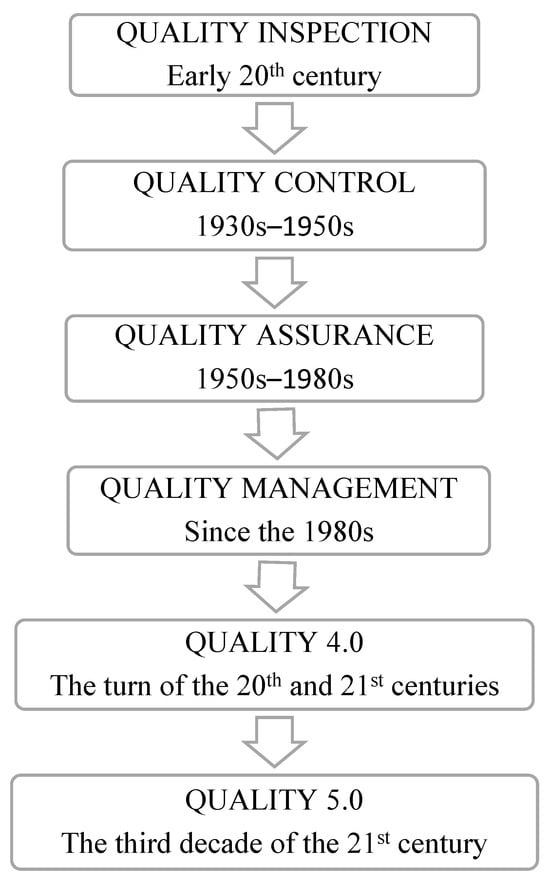
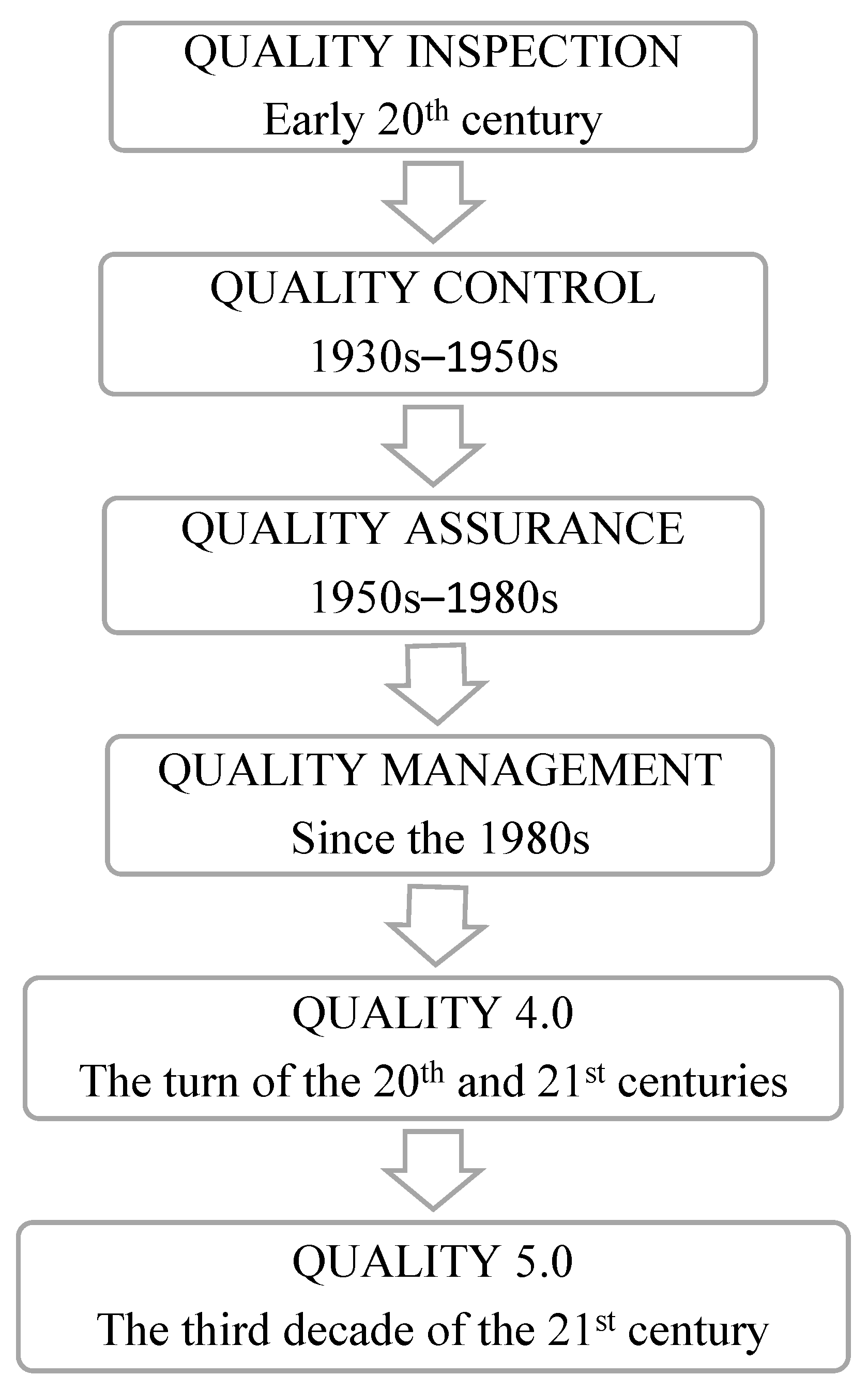
Also observable in the literature is the emergence of the Quality 4.0 concept as an adaptation of the developing Industry 4.0. This quality management concept uses artificial intelligence (AI), the Internet of Things (IoT) and Big Data, among others. These activities result from the use of automated sensors, data analysis, defect identification and performance improvement, and real-time monitoring of manufacturing processes [18].
Figure 1 shows the stages of quality management development [19]. The crux of the introduction of Quality 5.0 has become the refocusing of the world on sustainability, including a focus on people and the environment with the use of IT and automation. Enhanced data analysis is broadening the approach to optimizing production processes, leading to more efficient use of resources and reduced waste, ultimately resulting in greener production methods [20].
Figure 1.
Stages of quality management development [19].
Fundin pinpoints five areas that will be of concern for quality in the current decade. These include viewpoints of the system, consistency of modification, frameworks of smart self-assembly, merging of lasting progress and greater goals as backing for excellent governance. The challenges faced by NATO have included establishing systematic approaches and methodologies to investigate and comprehend various root causes and diversity, along with acquiring expertise in enhancing organizational capacity for learning, change and adaptation [21].
The determinants of the development of contemporary enterprises are complex, being the result of the processes of globalization, the development of modern information and communication technologies, social changes and a change in the approach to the course and organization of economic processes. Development based not only on economic goals but also on social and environmental goals is gaining importance.
A negligible number of publications on the possibilities of using contemporary methods and tools for the sustainable development of the organization prompted us to focus on this topic in the article. The systematic in-depth literature review was conducted by searching the Scopus database entries.
Analyzing the data from Table 1, it can be stated that the topic of quality management for the sustainable development of organizations is discussed in the literature. However, the issue of the possibility of using quality methods and tools in sustainable development has received little attention, which is confirmed by the lack of any sources in the extensive Scopus database (accessed on 16 December 2024). The areas indicate the paths of the data that were searched consecutively in the Scopus database (first column). The research was expanded to include Google Scholar. In total, the SLR covered almost fifty sources on which the author’s own research was based. Most of the publications selected for the article have been published since 2020.
Table 1.
Search results for key terms in the Scopus database in 2024.
Sustainability is a complex concept. The sustainability of an organization is one of the key elements that determine the level of competitiveness of an organization. The concept was developed as early as the 1970s (the 1st UN Conference on Environment and Development in 1972). Undoubtedly of great importance for the modern understanding of the concept of sustainable development is the report entitled Our Common Future by the UN World Commission on Environment and Development in 1987, defining it as a socio-economic development that will take into account the needs of future generations when meeting the needs of the present generation [22].
In contrast, the first definitions of sustainable development came from the 1975 Session of the Governing Council of the United Nations Environment Program (UNEP) and the 1987 Brundtland Report of the World Commission on Environment and Development. Sustainable development is defined as “Our Common Future” and as “development that meets present needs without compromising the ability of future generations to meet their needs” [23]. Its goal is to reconcile the pursuit of prosperity and economic growth with social inclusion and care for the environment, so it forms the basis for all European Union strategies and initiatives.
Accordingly, sustainable development can be understood as “maximizing the net benefits of economic development while protecting and ensuring the reproduction of the utility and quality of natural resources over the long term” [24].
The direction of development was also emphasized by the Second UN Conference on Environment and Development in Rio de Janeiro in 1992. At the time, the Rio Declaration was drafted, containing twenty-seven principles to guide countries [25]. The European Union is committed to the 17 Sustainable Development Goals contained in the 2030 Agenda for Sustainable Development developed by the United Nations and adopted in September 2015. The European Union is implementing various policies, strategies and initiatives to address challenges such as combating climate change, transforming to a low-carbon economy, supporting innovation and entrepreneurship, and promoting equal opportunities, access to jobs, education and health care, and social protection. In 2023, the European Union published and submitted to the UN its first-ever voluntary review of the implementation of Agenda 2030 [26].
In 2017, the EU adopted the European Consensus on Development, which sets out its development cooperation policy, and in 2021 it introduced the Instrument for Neighbourhood and International and Development Cooperation—Global Europe, its latest development cooperation instrument. Through its trade policy, the EU seeks to promote sustainable development in the trade agreements it signs with partner countries. Sustainable development is officially one of the long-term goals of the European Union, according to Article 3(3) of the Treaty on European Union [26].
Sustainable development is followed by the conviction that economic activity must not contribute to the deterioration of the level and quality of life of future generations [27,28,29]. Thus, the pursuit of business development based on the triad of economic, social and environmental goals is a sign of the implementation of the concept of sustainable development at the microeconomic level. It is of key importance to the conservation of natural resources from the perspective of a long-term approach [30].
Conducting sustainable development-oriented business requires the skilful use of nature’s resources, the introduction of environmentally friendly technologies and taking measures aimed at the development and improvement of labour quality.
The implementation of the concept of sustainable development by enterprises, according to many researchers on the subject, allows them to gain a competitive advantage [31]. The realization of sustainable development by enterprises is associated with the need to adapt to the changing environment, continuous learning and reorientation of the enterprise’s goals towards increasing value for contractors [32]. The harmonization of activities towards the realization of predetermined strategic goals must not only take into account the current conditions of operation, but also express the need to take care of the future of the business entity [33].
This approach to the development of the organization in accordance with sustainable development indicates that the goal of the company is not only to improve its financial and asset situation, but also to take a strategic approach to issues related to ethics, economics, environment, ergonomics and psychology [34].
There are studies that make some connections between quality practices, explaining how manufacturing companies could improve social, economic and environmental sustainability through integrated Lean and Green Six Sigma practices in their supply chains [35]. Next, researchers have presented evidence from a study of the digital business maturity model suggesting that quality-based principles such as continuous improvement approaches, effective leadership, people-centred management, evidence-based management [36] and a continuous focus on the customer have a positive impact on sustainability in organizations [37].
In contrast, studies on the impact of quality management methods and tools on the environmental performance of 250 manufacturing organizations around the world indicated that TPM and JiT had the greatest impact, while Kaizen/continuous improvement only showed an impact on material use and pollution release [38]. Further evidence can be found indicating that quality management and, in particular, total quality management (TQM) programs can positively impact the sustainability of businesses [39]. What is more, quality management philosophies, methods and tools are also considered essential means for value creation and sustainability in organizations [40].
In the context of sustainability, Lean helps organizations not only improve efficiency [41] but also create more sustainable processes that save resources and minimize carbon footprints. Six Sigma is a quality management methodology that aims to improve processes by eliminating defects and variability. Although originally focused on product quality, today its principles can be adapted to sustainability. By shortening production cycles, reducing errors and optimizing resource use, organizations can achieve greater operational efficiency and reduce their environmental impact. In addition, 5S is a workspace management technique that aims to increase the efficiency and organization of work. Although often associated with improving efficiency, it also has a positive impact on sustainability because it helps minimize resource waste, improves working conditions and increases operational efficiency, which can contribute to reduced energy and material consumption [42].
Research exists showing that the FMEA method is increasingly being modified to further align decisions in organizations with environmental and social criteria that support sustainability [43]. Some sources confirm that the FMEA method focuses on a wide variety of sustainability-relevant criteria, such as safety, cost, efficiency, quality, reliability and environmental standards [44].
Nowadays, sustainability can be observed creeping into standards and quality models that customers may recognize or demand. An example is the new EFQM model, which refers to the United Nations Sustainable Development Goals. Also, the ISO management system standards incorporate the concept of “stakeholders” relevant to the sustainable development of an organization. Moreover, ISO places a strong emphasis on sustainability. The Union of Japanese Scientists and Engineers (JUSE) conducted a review of total quality management. TQM in this context views quality as creating value for society and customers through ESG (environmental, social and corporate governance). This emphasizes that the principles and methods of quality management are relevant and useful for a sustainable development program for the organization and society [6].
3. Materials and Methods
The main method in this article was a systematic literature review. The other methods are observation and direct interview. Both authors have auditing experience (conducting internal audits, audits regarding the use of quality methods and tools in organizations). They have the skills to conduct systematic and detailed reviews of processes, systems and procedures in an organization in order to assess compliance with specific quality standards, norms and internal and external requirements.
3.1. Systematic Literature Review
Systematic reviews are a method for identifying and synthesizing all available existing publications [45]. The literature review covered the concepts of quality management, contemporary quality management methods and tools, and sustainable development. The focus was also on finding opportunities for contemporary quality management methods and tools in the context of application and suitability for sustainable development of the organization. The research questions that were asked by the authors of the article for the review of the literature were:
- Can quality management support sustainable development in organizations?
- Which quality methods and tools are suitable for sustainable development?
- Which quality methods and tools can be suitable for sustainable development?
- Are there examples of good practice based on the use of quality methods and tools for sustainable development?
SLR’s purpose was to find answers to the questions posed. Valuable content was ranked according to the basic functions of quality methods and tools that appeared most frequently in the articles. The literature on quality methods for sustainable development is extensive and includes both theoretical approaches and practical applications. Familiarisation with the above-mentioned publications provides solid knowledge on integrating quality management with the goals related to the sustainable development of the organization.
3.2. Interview Method
The literature research was complemented and verified by empirical qualitative research in organizations in which quality management methods and tools have implemented. The interview involved nearly 30 respondents from different organisations. They answered various questions regarding the use and suitability of contemporary quality management methods and tools, including those related to the topics discussed in the article:
- Which quality methods and tools are used in the organization?
- Which of the quality methods and tools used can be suitable for sustainable development?
- Are there any examples of good practice based on the use of quality methods and tools for sustainable development?
- What possibilities for the use of contemporary quality methods and tools for sustainable development can be identified?
The method used to analyze their responses was qualitative analysis. The responses obtained from the enterprise surveys were ranked according to the basic functions of quality methods and tools that appeared most frequently in the articles. The purpose of the interviews was to complement the content obtained from the SLR and enrich it with experiences from the enterprises.
4. Results
In the course of ongoing literature research, as well as our own research conducted in manufacturing companies in 2021–2022 (manufacturing companies from the Greater Poland region in Poland) on the application and suitability of various quality management methods and tools, data were collected and results were identified. The most important element of the work was to examine examples of good practice (using information from the authors’ auditing experience and research conducted in companies) that can contribute even more to the sustainable development of the organization. The interviews allowed us to identify the most frequently used quality methods and tools. Twenty quality management instruments (most often indicated as useful and suitable in organizations) were selected for analysis. They are presented divided into main functions: organization of production processes, continuous improvement, assessment of the organization’s functioning, organization design, identification and data collection, product design and improvement and process management. Table 2 indicates the selected contemporary quality methods and tools for the function organization of production processes.
Table 2.
Possibilities for sustainable development of the organization from the use of quality methods and tools—organization of production processes.
One of the selected tools for management support of executive management in the organization is 5S. Various problems with production nuisances were identified, as well as with waste nuisances, devices for teamwork action and joint connection for the purpose of minimizing waste, including waste. The 5S system was discussed as a way of organizing use that leads to an effect in the context of waste [46]. The 5S method, as indicated in Table 2, helps eliminate waste, reduce defects and improve company productivity. What is more, reducing clutter and trash in the workplace is hygienic and ergonomic. The garment industry uses the 5S method to get rid of waste and use the factory production layout to work smoothly, remove waste and maintain space regularly [47]. One of the indicated quality methods is Poka Yoke, which is related to prevent faults from arising during production processes. It deals with “fail-safing” or “mistake-proofing” [48]. The Poka Yoke method was confirmed to reduce production waste and improve the consistency of the final product quality (regarding the peanut snack production process) [49]. One of the organizations, during the interview, indicated solutions using JiT software for inventory management (recommended—Netsuite ERP, ShipBob, Zoho Inventory and Sortly). Other studies that implement Lean construction practices, including Just in Time (JIT), provide improvements in project efficiency and waste reduction [50].
In Table 3 there are studies indicating that Lean Six Sigma is the result of a mediating event that occurred as a result of the implementation of Industry 4.0 [51]. In connection with the circular economy, it is a reference point for achieving a triple bottom line (environmental, social and economic) [52]. Analyzing various aspects of Industry 5.0 in connection with Kaizen measures and application areas provides the opportunity to improve the level of environmental and social sustainability of the organization [53]. The surveyed organizations that use performance management systems apply 5 why methods to minimize waste.
Table 3.
Possibilities for sustainable development of the organization from the use of quality methods and tools—continuous improvement.
Analyzing another group of methods in Table 4—assessment of the organization’s functioning—it is worth adding that organizations focus on implementing preventive and improvement measures. In the context of stakeholders, a change in approach is required in the way the company is managed, especially with regard to ongoing communication with stakeholders and real-time sustainability reporting [54]. Based on the interviews, it can be concluded that self-assessment is performed infrequently, perhaps without awareness of the benefits it brings. Some researchers believe that the assumptions of the EFQM model can be used to create a set of good practices for the operation of organizations [55], that will result in better sustainability management, which has already been confirmed in many studies [56].
Table 4.
Possibilities for sustainable development of the organization from the use of quality methods and tools—assessment of the organization’s functioning.
As shown in Table 5, both benchmarking and quality planning have a great many advantages. These include complex external and internal environment, quantitative and qualitative indicators, processes, functions, strategies or achieving the best [57]. One of the companies indicated as an example of good practice the use of Eco-Design, the implementation of low-emission technologies that minimize the criteria for production waste in terms of durability and ease of repair of products. Examples of quality plans for the production of machine parts confirm that it is possible to clearly identify the various stages of production with the guarantee that the company declares to its customers. It can be proven that production takes place under supervised conditions [58].
Table 5.
Possibilities for sustainable development of the organization from the use of quality methods and tools—organization design.
According to Table 6, the Pareto principle plays an important role in quality man-agement, highlighted by the American Society for Quality (ASQ), which recognizes it as one of the seven basic tools used in the area of process improvement [59]. There is evidence to support the usefulness of the Pareto principle in implementing product or process sustainability [11]. However, the opinion of the surveyed companies in the A3 report clearly indicated that it should be performed at the source of the problem, not just from documents. The matrix diagram is a useful tool, not yet sufficiently appreciated by enterprises. The possibilities of analysis can affect the effectiveness of activities related to the introduction of the sustainable development of enterprises.
Table 6.
Possibilities for sustainable development of the organization from the use of quality methods and tools—identification and data collection.
From Table 7, it can be concluded that the indicated methods such as FMEA and CAPA focus on preventive actions in the pursuit of improvement. FMEA is increasingly modified in order to additionally align decisions in companies with ecological and social criteria [43]. Research at an industrial metals processing plant confirmed that with FMEA, manufacturing operations can be significantly improved, increasing productivity and saving costs, resulting in overall company efficiency, and not only beneficial from a health and safety perspective [60]. The QFD method integrated with the Kano model can yield even better results. An example of this was the design of ergonomic chairs for students [61].
Table 7.
Possibilities for sustainable development of the organization from the use of quality methods and tools—product design and improvement.
As an example of good practice, modern approaches are proposed that apply process capability and stability concurrently, which allows samples to be refreshed more frequently, thereby capturing the dynamic shifts in processes. The Competency Chart also proved useful for promotions in one of the surveyed organizations. It is a tool used to provide recommendations regarding an upcoming career/practice change in the medical community [62]. One study integrated process capability analysis with machine learning (ML) methods to optimize business processes. This integration enabled real-time monitoring and predictive analytics, enabling the proactive identification of process variations and the making of timely adjustments to maintain or increase process capability [63].
Related to the previously mentioned quote “Today’s quality is tomorrow’s sustainability” [6], the research proper highlighted evidence of the suitability of the methods and tools in question from a qualitative perspective, as well as opportunities strictly for the sustainability of the organization. The results obtained in the form of possibilities may constitute added value, especially for organizations that are beginning to implement the principles of sustainable organizational development. In the organization of production processes, identification and data collection and continuous improvement functional groups, examples of advantages focused mainly on waste elimination, waste reduction and economic cost savings. The next functional group—assessment of the organization’s functioning—focused on identifying organizational strengths and weaknesses and areas and ways of improvement and innovation, improving the organization’s vision, promoting stakeholder engagement. It is possible to identify sources that confirm that job satisfaction is a very important criterion that cannot be overestimated, which is why it is the subject of many studies. Satisfied employees often state that the success of the organization depends on the level of employee perception, with respect to which the workplace affects the attitude to the tasks performed [64]. However, in the group of methods responsible for product design and improvement, opportunities were noticed related to activities aimed at multi-area cost reduction, recognition of one’s own advantages and weaknesses in relation to the competition. Moreover, attention was paid to defining risk and ensuring appropriate actions to minimize it, and increasing employee knowledge and experience. It is worth noting that the methods of organization design and process management are oriented around organizational processes and the identification of stakeholders and quality requirements.
A summary of the results shown in Table 2, Table 3, Table 4, Table 5, Table 6, Table 7 and Table 8 can be found in Table 9. The literature review and interviews made it possible to summarize the data. Each of the quality management methods and tools studied was identified as an opportunity after its application.
Table 8.
Possibilities for sustainable development of the organization from the use of quality methods and tools—process management.
Table 9.
Opportunities from the implementation of the method/tool for sustainable development.
In the context of the sustainable development of an organization, quality management is crucial not only from the perspective of operational efficiency, but also due to the impact of the organization on the environment, society and economy. Therefore, various quality methods have been identified that support the achievement of sustainable development goals, such as reducing environmental impact, caring for employee well-being, taking an ethical approach to business activities and showing social responsibility.
5. Discussion
The adaptation of quality methods and tools to sustainable development is noticeable. This is manifested by shortening production cycles, optimizing the use of organizational resources, minimizing resource waste, improving working conditions and increased operational efficiency [42].
There are management and Lean methods that can be used by organizations to achieve development goals [9], such as environmental impact, production efficiency and social responsibility [7]. It is indicated in many studies on the FMEA method that it is increasingly modified in order to adapt and support decisions in organizations [43] to environmental and social criteria that support sustainable development [44].
There is evidence that incorporating quality management knowledge into sustainability efforts has great potential to contribute to achieving ecologically, socially and economically sustainable goals [40]. Total quality management (TQM) programs could positively affect corporate sustainability [39]. Also, QM philosophies, methods and tools are considered to be necessary means towards value creation and sustainable development from the micro-perspective in organizations, even if there are several challenges and barriers [41].
This diversity of contemporary methods and tools allows the entrepreneur to choose freely depending on the priority of the expected actions. The methods can be used comprehensively, which will certainly significantly improve their suitability and holistic approach to the obtained results [61]. Data obtained in this way will constitute a reliable basis for indicating accurate recommendations and making informed decisions. These, in turn, will contribute to obtaining measurable effects of improvement for the sustainable development of products and processes [43].
The above proves that the topic of using quality management methods and tools in the context of sustainable development has been discussed in the literature. However, the measurable possibilities offered by their appropriate use have not been previously investigated. The topic has been exhausted in this article.
6. Conclusions
The purpose of the article has been achieved, because the possibilities of using contemporary quality management methods and tools for the sustainable development of the organization have been analyzed. The research gap on the possibility of using quality management methods and tools in the area of sustainable development was partially filled. It was possible to identify examples of good practice in this area. The result of the work on this issue was the identification of the opportunities that the implemented methods bring. As many as 30% of the surveyed methods and tools carry the opportunity to minimize waste of the organization’s resources, while 25% carry the opportunity to improve quality in a broad sense. The main methods and tools that were studied include FMEA, QFD, 5S, Lean and process capability analysis. The usefulness for sustainability of the various quality instruments has already been partially confirmed.
Contemporary quality assessment methods and tools that support the sustainable development of an organization focus on the effective management of resources, minimizing negative impacts on the environment, taking care of the health and well-being of employees, and promoting responsible social practices. Implementing appropriate quality management systems combined with quality management methods allows organizations to achieve sustainable development goals in a systematic and measurable way.
The examples of good practice presented in this article may be an inspiration for individual use by entrepreneurs. The article does not exhaust the possibilities of using quality methods and tools for sustainable development. Each company can create its own scenarios of analysis and inference systems. It is certain that activities supporting the improvement of the quality of products and processes can be effectively integrated with the requirements for sustainable development. This will ensure both efficiency and systematicity as well as the coherence of mutual goals. The directions of further research are to determine the barriers and limitations to sustainable development in the context of quality management methods and tools.
Author Contributions
Conceptualization, K.R. and A.M.; methodology, K.R. and A.M.; formal analysis, K.R. and A.M.; investigation, K.R. and A.M.; resources, K.R. and A.M.; data curation, K.R. and A.M.; writing—original draft preparation, K.R. and A.M.; writing—review and editing, K.R. and A.M.; visualization, K.R. and A.M.; supervision, K.R. and A.M.; project administration, K.R. and A.M.; funding acquisition, K.R. and A.M. All authors have read and agreed to the published version of the manuscript.
Funding
This research received no external funding.
Institutional Review Board Statement
The study was conducted in accordance with the Declaration of Helsinki, and approved by the Institutional Review Board of the Committee for the Ethics of Scientific Research involving human participants at the Poznan University of Technology—approval number 0012/22.
Informed Consent Statement
Informed consent was obtained from all subjects involved in the study, annex No. 2 to the regulations of the Committee for Ethics of Scientific Research Involving Humans at the Poznan University of Technology.
Data Availability Statement
Data are contained within the article.
Conflicts of Interest
The authors declare no conflict of interest.
References
- Mazur, A. Quality Management; Politechnika Poznańska: Poznan, Poland, 2022. [Google Scholar]
- Roszak, M. Quality Management in Engineering Practice; Open Access Library: Wuhan, China, 2014; Volume 1. [Google Scholar]
- Vinokurova, K.; Pīlēna-Dālberga, A. Tools and Methods for the Enhancement of the Quality Management System in Multiapartment Building Management and Maintenance Companies. In Proceedings of the 27th World Multi-Conference on Systemics, Cybernetics and Informatics: WMSCI, Online, 12–15 September 2023. [Google Scholar]
- Antony, J.; McDermott, O.; Sony, M. Revisiting Ishikawa’s Original Seven Basic Tools of Quality Control: A Global Study and Some New Insights. IEEE Trans. Eng. Manag. 2023, 70, 4005–4020. [Google Scholar] [CrossRef] [Scilit]
- Vo, B.; Kongar, E.; Suarez-Barraza, M. Root-Cause problem solving in an Industry 4.0 context. IEEE Eng. Manag. 2020, 48, 48–56. [Google Scholar] [CrossRef] [Scilit]
- Available online: https://www-quality-org.translate.goog/blog/why-sustainability-important-quality-management?_x_tr_sl=en&_x_tr_tl=pl&_x_tr_hl=pl&_x_tr_pto=rq (accessed on 23 December 2024).
- Malek, J.; Desai, T.N. A systematic literature review to map literature focus of sustainable manufacturing. Int. J. Prod. Res. 2020. [Google Scholar] [CrossRef] [Scilit]
- Zhong, Y.; Lai, I.K.W.; Guo, F.; Tang, H. Effects of Partnership Quality and Information Sharing on Express Delivery Service Performance in the E-commerce Industry. Sustainability 2020, 12, 8293. [Google Scholar] [CrossRef] [Scilit]
- Filho, J.; Silva, A.; de Almeida, L. Lean and Green: A Systematic Review of the Literature on Sustainable Lean Production. J. Clean. Prod. 2019, 102, 18–29. [Google Scholar]
- Cronemyr, P.; Huge-Brodin, M. Green Karma–promoting environmental initiatives by adapting and using QFD as a proactive tool. Total Qual. Manag. Bus. Excell. 2022, 33, 1826–1845. [Google Scholar] [CrossRef] [Scilit]
- Pacana, A.; Siwiec, D.; Pacana, J. Fuzzy Method to Improve Products and Processes Considering the Approach of Sustainable Development (FQE-SD Method). Sustainability 2023, 15, 9927. [Google Scholar] [CrossRef] [Scilit]
- Tague, N. The Quality Toolbox; Quality Press: Welshpool, Australia, 2023. [Google Scholar]
- Available online: https://asq.org (accessed on 23 December 2024).
- Available online: https://deming.org (accessed on 23 December 2024).
- Available online: https://www.juran.com (accessed on 23 December 2024).
- Winkowska, J.; Winkowski, C. Review of Quality Methods and Tools Used in a Manufacturing Enterprise; Publishing House of the Polish Society for Production Management: Warszawa, Poland, 2018; pp. 370–381. [Google Scholar]
- Spring, M.; McQuater, R.; Swift, K.; Dale, B.; Booker, J. The use of quality tools and techniques in product introduction: An assessment methodology. TQM Mag. 1988, 10, 45–50. [Google Scholar] [CrossRef] [Scilit]
- Salimbeni, S.; Redchuk, A.; Rousserie, H. Quality 4.0: Technologies and readiness factors in the entire value flow life cycle. Prod. Manuf. Res. 2023, 11, 2238797. [Google Scholar] [CrossRef] [Scilit]
- Ratajszczak, K.; Misztal, A.; Marczewska-Kuźma, R. Classification of Quality Management Methods and Tools in a Functional Approach. Ann. Univ. Mariae Curie-Skłodowska Sect. H–Oeconomia 2024, 58, 171–186. [Google Scholar] [CrossRef] [Scilit]
- Tadić Stanić, D. The role of consulting organizations in the introduction of quality 5.0. In Proceedings of the International Conference “Industrial Engineering And Environmental Protection”, Zrenjanin, Serbia, 6–7 October 2022. [Google Scholar]
- Fundin, A.; Lilja, J.; Bergquist, B.; Lagrosen, Y. Quality 2030: Quality management for the future. Total Qual. Manag. Bus. Excell. 2020, 1–17. [Google Scholar] [CrossRef] [Scilit]
- Available online: https://www.un.org/en/conferences/environment/stockholm1972 (accessed on 23 December 2024).
- Available online: https://sustainabledevelopment.un.org/content/documents/5987our-common-future.pdf (accessed on 23 December 2024).
- Pearce, D.; Turner, R. Economics of Natural Resources and the Environment; Johns Hopkins University Press: Baltimore, MD, USA, 1990. [Google Scholar]
- Palmer, R.; Nursey-Bray, M. Rio Declaration on Environment and Development. In Encyclopedia of Environment and Society; Robbins, P., Ed.; Sage Publications: Thousand Oaks, CA, USA, 2007; Volume 4, pp. 1512–1514. [Google Scholar]
- Available online: https://eur-lex.europa.eu/PL/legal-content/glossary/sustainable-development.html (accessed on 23 December 2024).
- Paszkiewicz, A.; Szadziewska, A. Reporting on the sustainable development of enterprises according to GRI guidelines. In Scientific Papers of the University of Szczecin. Finance, Financial Markets, Insurance; University of Szczecin: Szczecin, Poland, 2011. [Google Scholar]
- Pawłowska, H.; Tabor, A.; Rączka, M.; Truś, S. Modern Quality Management, Volume I; Management Systems, Documentation, Processes, Audit, Center for Training and Organization of Quality Systems of the Tadeusz Kościuszko University of Technology in Krakow: Kraków, Poland, 2004. [Google Scholar]
- Ropiejko, J. How to Make Your Company Better from the Inside Out, Episode 9, Solving Problems Together—A3 Report. In Bakery and Confectionery Review; Sigma: Kawasaki, Japan, 2019; Volume 67. [Google Scholar]
- Alla, K.; Rowland, Z.; Yakove, Y. EDP Sciences. Modern management tools for sustainable development of mining enterprises. E3S Web Conf. 2019, 123, 01017. [Google Scholar]
- Koszel, M.; Weinert, A. The use of the concept of corporate social responsibility and sustainable development in creating an innovative product—Case studies. In Studies and Works of the Faculty of Economic Sciences and Management; Museum of Polish History: Szczecin, Poland, 2013. [Google Scholar]
- Grudzewski, W.; Hejduk, I.; Sankowska, A.; Wańtuchowicz, M. Sustainability in Business, or the Enterprise of the Future, Changes in Paradigms and Management Concepts; Poltext: Warsaw, Poland, 2010. [Google Scholar]
- Misztal, A. Sustainable development of Polish enterprises-evaluation. Intern. Trade 2018, 2, 27–40. [Google Scholar]
- Misztal, A. Logistic processes and sustainable development of the enterprise. In Scientific Papers of the Poznań University of Technology. Organization and Management; Poznań University of Technology: Poznań, Poland, 2017; pp. 201–212. [Google Scholar]
- Gaikwad, L.; Sunnapwar, V. Development of an integrated framework of LGSS strategies for Indian manufacturing firms to improve business performance: An empirical study. TQM J. 2021, 33, 257–291. [Google Scholar] [CrossRef] [Scilit]
- Rosvall, M.; Gremyr, I. Focus on processes contextualised: How QM process tools and practices can support sustainable development. TQM J. 2024, 36, 94–113. [Google Scholar] [CrossRef] [Scilit]
- Savastano, M.; Zentner, H.; Spremić, M.; Cucari, N. Assessing the relationship between digital transformation and sustainable business excellence in a turbulent scenario. Total Qual. Manag. Bus. Excell. 2022, 1–22. [Google Scholar] [CrossRef] [Scilit]
- Garza-Reyes, J.; Kumar, V.; Chaikittisilp, S.; Tan, K. The effect of lean methods and tools on the environmental performance of manufacturing organisations. Int. J. Prod. Econ. 2018, 200, 170–180. [Google Scholar] [CrossRef] [Scilit]
- Makhlouf, H.; Chatti, N.; Lakhal, L. The impact of TQM and green innovation on corporate sustainability: The mediating role of green supply chain management. Int. J. Qual. Reliab. Manag. 2023, 40, 2592–2611. [Google Scholar] [CrossRef] [Scilit]
- Antony, J.; Bhat, S.; Fundin, A.; Sony, M.; Sorqvist, L.; Bader, M. Quality management as a means for micro-level sustainability development in organizations. TQM J. 2023, 36, 2260–2280. [Google Scholar] [CrossRef] [Scilit]
- Xu, L.; Wei, X.; Cao, Y.; Peng, X.; Prybutok, V. Achieving business excellence through sustainable supply chain management. In Total Quality Management and Business Excellence; Taylor & Francis: Abingdon, UK, 2023. [Google Scholar]
- Calvo-Amodio, J.; Martínez, H. Towards lean for sustainability: Understanding the interrelationships between lean and sustainability from a systems thinking perspective. J. Clean. Prod. 2017, 142, 4384–4402. [Google Scholar]
- Von Ahsen, A.; Petruschke, L.; Frick, N. Sustainability Failure Mode and Effects Analysis—A systematic literature review. J. Clean. Prod. 2022, 363, 132413. [Google Scholar] [CrossRef] [Scilit]
- Prajapati, D. Implementation of failure mode and effect analysis: A literature review. Int. J. Manag. IT Eng. 2012, 2, 264–292. [Google Scholar]
- Scheerder, A.; Deursen, A.; Van Dijk, J. Determinants of Internet skills, uses and outcomes. A systematic review of the second- and third-level digital divide. Telemat. Inform. 2017, 34, 1607–1624. [Google Scholar] [CrossRef] [Scilit]
- Ciecinska, B.; Majka, A.; Sobotová, L. Identifying waste problems using quality tools. In Waste Forum; Environmental Management Center: Praha, Czech, 2024; pp. 120–131. [Google Scholar]
- Almaktoom, A.; Alasbali, M. Impact of 5S Method in Apparel Industry; Springer: Berlin/Heidelberg, Germany, 2023; pp. 145–153. [Google Scholar]
- Misztal, A.; Mazəre, A.; Belu, N.; Lonescu, L. Poka Yoke system based on image analysis and object recognition. IOP Conf. Ser. Mater. Sci. Eng. 2015, 95, 012138. [Google Scholar]
- Aldave-Vasquez, Y.; Morales-Vargas, S.; Corzo-Chavez, J. Production Management Model for Waste Reduction Using 5s, Tpm and Poka Yoke Tools in a Peanut Snack Manufacturing Company. In Proceedings of the World Congress on Mechanical, Chemical, and Material Engineering, Barcelona, Spain, 22–24 August 2024. [Google Scholar]
- Xing, W.; Hao, J.; Qian, L.; Tam, V.; Sikora, K. Implementing lean construction techniques and management methods in Chinese projects: A case study in Suzhou, China. J. Clean. Prod. 2021. [Google Scholar] [CrossRef] [Scilit]
- Skalli, D.; Charkaoui, A.; Cherrafi, A.; Garza-Reyes, J.; Antony, J.; Shokri, A. Analyzing the integrated effect of circular economy, Lean Six Sigma, and Industry 4.0 on sustainable manufacturing performance from a practice-based view perspective. Bus. Strategy Environ. 2024, 33, 1208–1226. [Google Scholar] [CrossRef] [Scilit]
- Farrell, F.; McHugh, A. IFIP Advances in Information and Communication Technology. In Sustaining the Effectiveness of Lean Six Sigma Implementation in a Medical Device Company; Springer: Berlin/Heidelberg, Germany, 2023. [Google Scholar]
- Kumar, U.; Kaswan, M.; Kumar, R.; Chaudhary, R.; Joshi, R.; Garza-Reyes, J.; Rathi, R. A systematic review of Industry 5.0 from main aspects to the execution status. TQM J. 2024, 36, 1526–1549. [Google Scholar] [CrossRef] [Scilit]
- Adamczyk, J. Digital roles in the implementation of development in the context of interests. In Cracow Malopolska Studies; Adam Marszalek Publisher: Toruń, Poland, 2023; pp. 9–27. [Google Scholar]
- Martusewicz, J.; Szewczyk, K.; Wierzbic, A. The EFQM Radar-Based Assessment of Industry 4.0 Solutions—The Plan of Research. In Education Excellence and Innovation Management: A 2025 Vision to Sustain Economic Development During Global Challenges; International Business Information Management Association (IBIMA): Granada, Spain, 2022; pp. 18547–18554. [Google Scholar]
- Chomiak-Orsaa, I.; Martusewicz, J. Creating good practice in effective sustainability management by implementing the EFQM model. In Proceedings of the 27th International Conference on Knowledge-Based and Intelligent Information & Engineering Systems (KES 2023), Athens, Greece, 6–8 September 2023. [Google Scholar]
- Tkachowa, N.; Pererva, P.; Kobielieva, T. Formation of competitive advantages of machine-building enterprises on the basis of the benchmarking concept. Int. Mark. Manag. Innov. 2021, 6, 1–10. [Google Scholar]
- Misztal, A.; Bachorz, S. Quality planning of parts machine production based on housing of cylinder head milling machines. Appl. Mech. Mater. 2014, 657, 986–990. [Google Scholar] [CrossRef] [Scilit]
- Kardas, M.; Kwilinski, A. The role of the pareto principle in quality management within industry 4.0: A comprehensive bibliometric analysis. Virtual Econ. 2024, 7, 7–24. [Google Scholar]
- Kalkis, H.; Roja, Z.; Babris, S. Human factor and LEAN analysis at industrial manufacturing plants. In Advances in Intelligent Systems and Computing; Springer: Berlin/Heidelberg, Germany, 2019; pp. 274–281. [Google Scholar]
- Ishak, A.; Ginting, R.; Suwandira, B.; Malik, A. Integration of kano model and quality function deployment (QFD) to improve product quality: A literature review. IOP Conf. Ser. Mater. Sci. Eng. 2020, 1003, 012025. [Google Scholar] [CrossRef] [Scilit]
- Harzman, A.; Go, M.; Arnold, M.; Ellison, E. Cumulative Sum Chart as Complement to Objective Assessment of Graduating Surgical Resident Competency: An Exploratory Study. J. Am. Coll. Surg. 2023, 237, 894–901. [Google Scholar]
- Altuntaş, T.; Atalan, A. Process Capability Analysis of Prediction Data of ML Algorithms. Ekon. İşletme Maliye Araştırmaları Derg. 2024, 6, 208–220. [Google Scholar] [CrossRef] [Scilit]
- Butlewski, M.; Misztal, A.; Ciulu, R. Non-financial factors of job satisfaction in the development of a safety culture based on examples from Poland and Romania. In Digital Human Modeling. Applications in Health, Safety, Ergonomics and Risk Management; Lecture Notes in Computer Science; Springer: Berlin/Heidelberg, Germany, 2014. [Google Scholar]

Disclaimer/Publisher’s Note: The statements, opinions and data contained in all publications are solely those of the individual author(s) and contributor(s) and not of MDPI and/or the editor(s). MDPI and/or the editor(s) disclaim responsibility for any injury to people or property resulting from any ideas, methods, instructions or products referred to in the content. |
© 2025 by the authors. Licensee MDPI, Basel, Switzerland. This article is an open access article distributed under the terms and conditions of the Creative Commons Attribution (CC BY) license (https://creativecommons.org/licenses/by/4.0/).