


Abstract
Carbon cap-and-trade is a practical policy in guiding manufacturers to produce economic and environmental production plans. However, previous studies on carbon cap-and-trade are from a macro level to guide manufacturers to make production plans, rather than from a perspective of specific production scheduling, which leads to a lack of theoretical guidance for manufacturers to develop reasonable production scheduling schemes for specific production orders. This article investigates a specific scheduling problem in a flexible job-shop environment that considers the carbon cap-and-trade policy, aiming to provide guidance for specific production scheduling (i.e., resource allocation). In the proposed problem, carbon emissions have an upper limit. A penalty will be generated if the emissions overpass the predetermined cap. To satisfy the carbon emission cap, the manufacturer can trade carbon credits or adopt outsourcing strategy, that is, outsourcing partial orders to partners at the expense of outsourcing costs. To solve the proposed model, a novel and efficient memetic algorithm (NEMA) is proposed. An initialization method and four local search operators are developed to enhance the search ability. Numerous experiments are conducted and the results validate that NEMA is a superior algorithm in both solution quality and efficiency.
1. Introduction
Carbon cap-and-trade is a common carbon policy based on the carbon trading market. It aims to achieve a balance between economy and environment by setting emission caps and allowing carbon credit trading [1,2]. That is to say, excessive parts of carbon emission will incur additional costs and thus prompt production managers to optimize the arrangement of production resources. To a certain extent, the carbon cap-and-trade policy achieves the same effect as considering machine on/off control [3,4], machine speed adjustment [5,6], and time-of-use tariffs [7,8] in previous production scheduling research. Up to now, the cap-and-trade policy has been effectively employed in various fields, such as integrated energy scheduling [2], supply chain management [9], and life cycle assessment [10].
However, existing studies primarily explore emission-reducing production schemes from a macroscopic perspective, rarely addressing the specific scheduling of production resources (i.e., production scheduling). In fact, resource scheduling is the fundamental unit for achieving emission reduction, and how to rationally allocate production resources according to order tasks is crucial for manufacturers to decrease emissions [11]. In the actual production process, manufacturers face significant challenges in implementing the carbon cap-and-trade policy, manifested in two key issues: (1) excessive focus on emission reduction, leading to diminished economic benefits; (2) failure to meet order commitments under government-mandated carbon caps.
Therefore, it is necessary to conduct research on carbon cap-and-trade policy from a production scheduling perspective. Currently, the primary challenge in such research lies in allocating carbon credits to specific orders. Notably, methodologies for carbon credit application and allocation within the power generation industry, along with big data analytics techniques, offer valuable insights for assigning credits to specific orders in manufacturing [12,13,14]. In recent years, an increasing number of studies have incorporated carbon emission constraints into production scheduling models. For example, Zheng et al. [15] have explored single-machine scheduling problems in shared manufacturing environments, where uncertain processing times and carbon emission constraints pose challenges in low-carbon production. Xu et al. [16] have developed swarm intelligence algorithms to address distributed low-carbon scheduling problems in large-scale equipment manufacturing, demonstrating the potential of bio-inspired optimization in reducing emissions. Additionally, for smart factories and networked microgrids, low-carbon energy-aware scheduling models have been proposed, incorporating mechanisms such as carbon capture, carbon trading, and time-based allocation of emission quotas [17,18,19,20]. These studies collectively reflect the growing emphasis on integrating carbon emission policies into operational decision-making.
In addition, outsourcing is another important means for manufacturers to reduce carbon emissions [21,22], which affects the achievement of balanced schedules between economy and environment. Through outsourcing, manufacturers can not only reduce carbon emissions but also respond more rapidly to market demands. This implies a complementary relationship between outsourcing and carbon cap-and-trade policy. Current research has explored connections between outsourcing and carbon emissions. For example, Papież et al. [23] examined cross-border carbon emission transfers driven by global outsourcing trends. Li, Su, and Ma [21] investigated production and transportation outsourcing decisions under various carbon policies, demonstrating reduced transportation emissions through third-party logistics (3PL) partnerships. Xia et al. [22] found that original equipment manufacturers (OEMs) could increase profits and reduce emissions by outsourcing remanufacturing to third-party remanufacturers (3PRs). Critically, existing studies lack integration with production scheduling frameworks.
Under the carbon cap-and-trade policy, manufacturers are constrained by an upper limit on carbon emissions. When internal production plans exceed this limit, outsourcing offers an alternative to avoid high penalties or trading costs. By transferring part of the production to external partners, the manufacturer can effectively reduce its carbon footprint while maintaining order fulfillment. Thus, outsourcing acts as a strategic complement to the cap-and-trade mechanism in the flexible job-shop scheduling environments. Motivated by these findings, this article investigates a production scheduling problem under carbon cap-and-trade and outsourcing strategies. We investigate this problem in flexible job shop environments, with objectives focused on minimizing makespan and total cost. For clarity, we refer to the proposed model as the FPCO, denoting the flexible job-shop scheduling problem integrating carbon cap-and-trade policy and outsourcing strategy. Given the superiority of the memetic algorithm (MA) in solving multi-objective scheduling problems [24,25], an efficient memetic algorithm (NEMA) with problem-dependent operators is designed to solve the proposed problem.
The remainder of this research is organized as follows. Section 2 reviews the related research. Section 3 describes the FPCO. In Section 4, the description of the NEMA is provided. In Section 5, the experimental results are analyzed. Finally, in Section 6, the conclusions and future research are described.
2. Literature Review
Following the promulgation of carbon cap-and-trade policies, enterprises have sought strategies to achieve a balance between emission penalties and economic benefits. Correspondingly, theoretical research on manufacturing operation decisions incorporating carbon cap-and-trade mechanisms has garnered growing scholarly attention. These studies primarily involve three aspects: production planning, remanufacturing decision-making, and inventory optimization.
For production planning, Xu et al. [26] analyzed how manufacturers develop production strategies for multi-category products to optimal benefits under both carbon tax and carbon cap-and-trade policies. Ma et al. [27] investigated production quantity decisions under carbon cap-and-trade constraints, demonstrating that investments in green manufacturing technologies enable more profitable production strategies. Hong et al. [28] developed a manufacturing planning model minimizing total cost under emission cap-and-trade, offering manufacturers two production modes: conventional and green technologies. In remanufacturing, Chai et al. [29] proposed a production decision model for remanufactured products in dual markets (normal and green) to optimize manufacturer profits under carbon cap-and-trade. Wang and Chen [30] studied manufacturing decisions incorporating carbon trading costs, determining optimal production quantities for new/remanufactured products. For inventory optimization, Tang et al. [31] established an inventory–transportation collaboration model under three carbon policies (tax, cap, cap-and-trade) and analyzed its sensitivity to carbon cap levels. Hasan et al. [32] quantified inventory–transportation emissions and designed benefit-maximization models under multiple carbon policies (including cap-and-trade), with decision variables covering inventory levels and green technology investments. Yu et al. [33] formulated two inventory optimization models based on carbon tax and cap-and-trade mechanisms under fixed product demand. Additionally, Foumani and Smith-Miles [34] constructed flow shop scheduling models under three carbon policies, demonstrating their superiority over traditional models under carbon constraints. Bok et al. [35] addressed production scheduling for unrelated parallel machines with heterogeneous energy sources and carbon reduction requirements, aiming to simultaneously minimize total costs and carbon emissions during production Takan [36] presented a mixed integer programming model for real-world production scheduling, incorporating machine costs, operation outsourcing, and schedule carbon footprint to minimize total costs.
Except for Foumani and Smith-Miles [34], most existing studies on carbon trading in manufacturing focus on macro-level decision-making, lacking detailed scheduling-oriented models. Although some insights can be drawn from research on carbon cap-and-trade in integrated energy systems [13,14,31,37,38], the integration of environmental policies into fine-grained production scheduling remains limited. Notably, in other domains such as edge computing and cognitive radio networks, deep reinforcement learning (DRL) has been effectively applied to complex scheduling and resource allocation problems under dynamic constraints. For instance, Lyapunov-guided DRL frameworks have demonstrated strong adaptability in stochastic environments [39]. These approaches highlight the potential of learning-based methods, which may inspire future extensions of production scheduling models under carbon constraints.
To enhance clarity and better position our work within the existing literature, Table 1 summarizes recent representative studies on carbon-constrained production and scheduling. While many of them address production planning, remanufacturing, or inventory control under carbon policies, few studies consider flexible job-shop scheduling that integrates both carbon cap-and-trade policy and production outsourcing, as integrated in our model. This table highlights the specific gaps that our research aims to address.
Table 1.
Summary of carbon policy literature review.
3. Mathematical Model of the Proposed FPCO
3.1. Problem Description
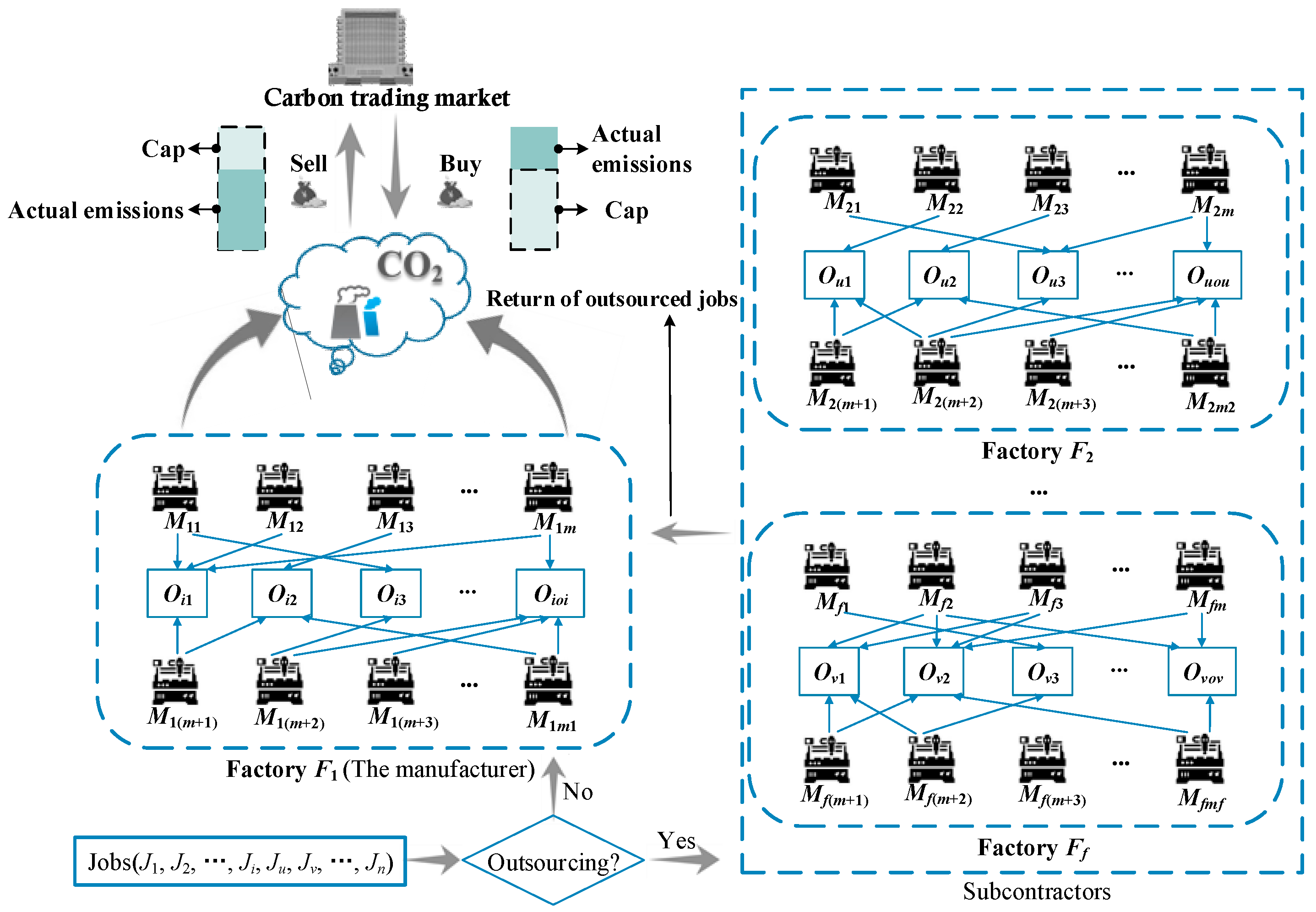
The FPCO can be described as follows. There is a manufacturer (denoted as the core factory F1), which owns f-1 partners, denoted as F2, …, Ff. Each factory Fc (c = 1, 2, …, f) consists of a flexible job shop. At the beginning of a production cycle, F1 receives n jobs , each of which has oi operations to be processed sequentially according to precedence constraints. For any , the manufacturer can either process it in-house or outsource it to partner factories. Once Ji is assigned to a factory, it cannot be transferred to another factory until its processing is completed. Carbon emissions are inevitably generated during both processing and transportation Ji. According to the carbon cap-and-trade policy and the workload in the current cycle, the total carbon emissions related to the manufacturer must not exceed a specified cap Q [34]. The objectives of F1 are to minimize the makespan (Ob1) and the total cost (Ob2), where Ob2 includes transportation, processing, outsourcing, and carbon trading costs.
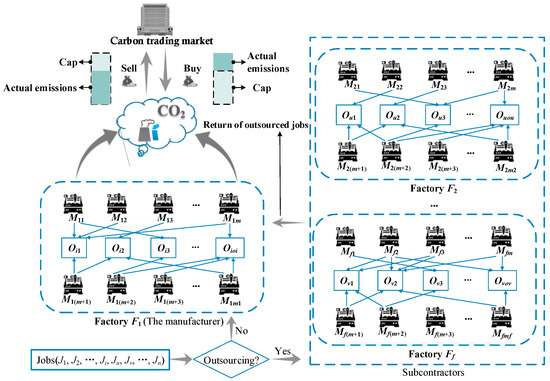
As shown in Figure 1, if carbon emissions exceed the cap Q, F1 needs to buy carbon credits or adopt the outsourcing strategy. Conversely, F1 can sell surplus carbon credits to increase its income if emissions remain below the cap. With limited pre-allocated carbon credits and multiple production orders to be processed, to maximize its profit, F1 must address the following two problems: (1) whether to purchase carbon credits, and if so, how many should be bought; (2) whether to outsource part of the orders to its partner factories, and which orders should be selected for outsourcing. From a scheduling perspective, three key decisions need to be made: (1) Assign a factory for each job. (2) Select a machine for each operation. (3) Determine the processing sequence of operations on each machine.
Figure 1.
An example of the FPCO. The following assumptions are put forward: No preemption is allowed. A machine is kept on until all jobs assigned to it are completed. The carbon credits in the carbon trading market are sufficient.
3.2. Mathematical Formulation
The notations of parameters, indexes, and variables involved in the model are described in Table 2.
Table 2.
The notations of parameters, indexes, and variables.
Objective functions:
(1) Minimize Ob1.
(2) Minimize Ob2.
where the carbon trading price p fluctuates widely across different trading markets and different working days [14].
The following formula, which is clearer and more detailed, expresses the calculation processes of Cemission.
where the data of carbon emission coefficients α1, α2, and α3 are set to 0.7 [40], 0.3, and 0.3.
This is subject to the following:
Two optimization objectives are expressed in Equations (1)–(3). Constraint (4) denotes that the operation precedence constraint of the same job should be met. Constraint (5) ensures precedence constraint of operations on the same machine. Constraint (6) means that no more than one operation can be handled at any position on each machine at the same time. Constraint (7) ensures that each operation can only be processed at one location on one machine in one factory. Constraint (8) guarantees that there are no empty locations before a filled location on the same machine. Constraint (9)–(10) represent that the operation is not processed on the same machine as the previous operation if it is transferred between machines. Constraint (11) calculates the idle time on machines. Constraint (12) represents that all operations of the same job are processed in the same factory.
4. Proposed Algorithm
MA [41] evolved from NSGA-II [42] has been extensively employed to solve complex FJSPs. In this section, we propose a novel and effective MA, termed NEMA, to solve the FPCO, which incorporates several enhancements based on the characteristics of the problem: an I_GLR method is designed to generate a high-quality initial population, and four well-designed local-search structures are introduced to perform efficient exploration and exploitation of the solution space.
The computational complexity of the proposed NEMA primarily depends on the population size (Popsize), the number of generations (G), and the number of operations (N) in each individual. Specifically, the decoding procedure of each individual has a time complexity of O(N), and the local search operations applied to elite individuals introduce an additional overhead of O (N log N) due to sorting and neighborhood exploration. Given that the algorithm includes genetic operators (crossover and mutation), initialization (I_GLR), and local search for each generation, the total time complexity can be approximated as O (G × Popsize × N log N). Although this is polynomial in the problem size, the actual runtime increases significantly with problem scale. Nevertheless, our experimental results on small, medium, and large-scale instances. Section 5.1 demonstrates that the NEMA can efficiently handle instances of realistic size within acceptable computation time.
4.1. Encoding and Decoding
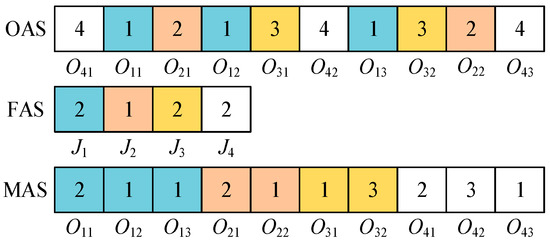
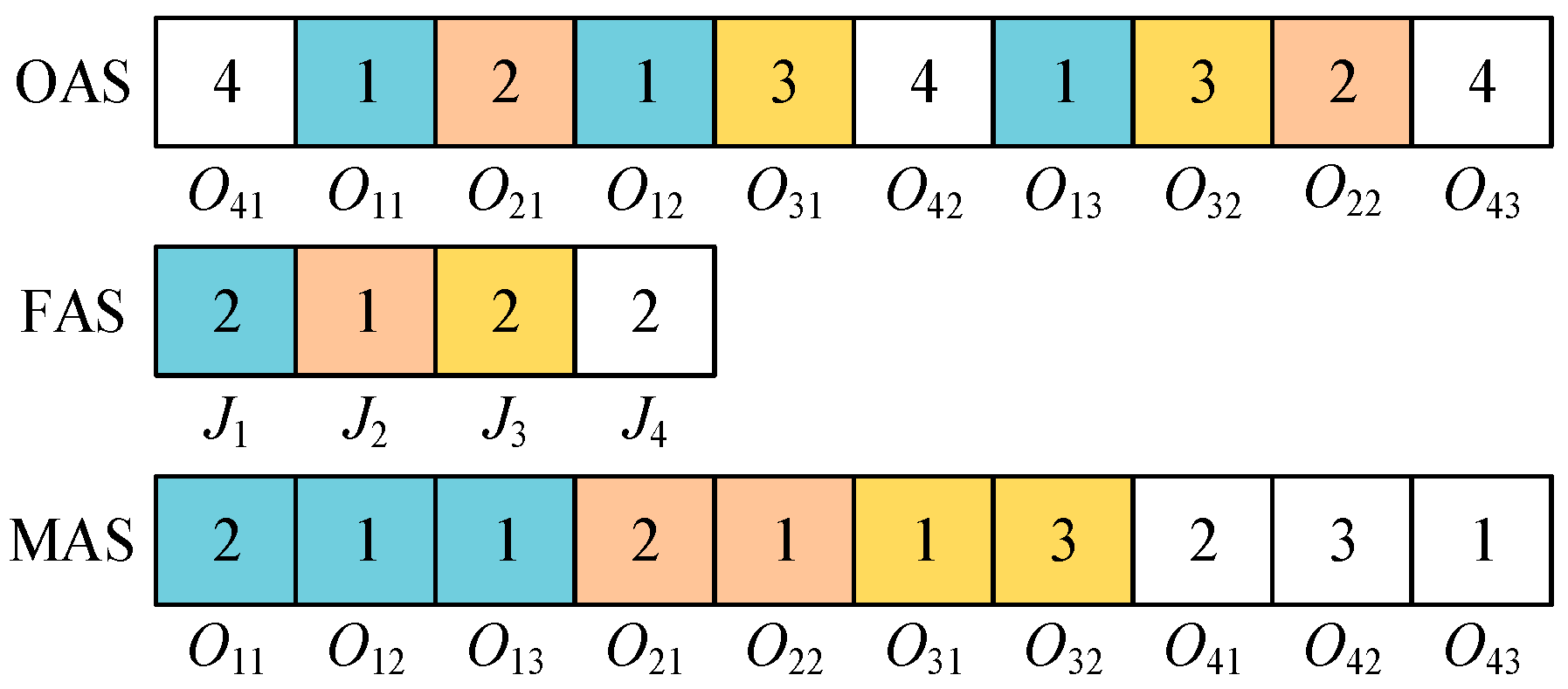
A three-part encoding vector is designed to represent a solution: the operation assignment string (OAS), the factory assignment string (FAS), and the machine assignment string (MAS). For the OAS, each gene is sequentially encoded using the job index. The jth occurrence of index i represents the jth operation Oij of Ji, and the index sequence indicates the processing order of operations. For the FAS, genes are sequentially encoded by the factory index and have a one-to-one mapping with jobs arranged in ascending order. For the MAS, all operations are arranged in ascending order and then assigned to machines from left to right.
For better illustration, an encoding example is shown in Figure 2, based on the data from Table 3. For the numbers in the OAS of Figure 2, the numbers represent the operation order {O41, O11, O21, O12, O31, O42, O13, O32, O22, O43}. The numbers in the FAS indicate that J1, J3, and J4 are assigned to F2, and J2 is assigned to F1. For the numbers in the MAS, decoding must be done in combination with the FAS. For example, the first three numbers {2 1 1} in MAS represent that operations O11 to O13 are processed by M2, M1, and M1, respectively, in F1.
Figure 2.
An encoding example.
Table 3.
Simple example for FPCO.
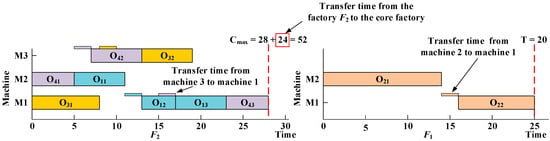
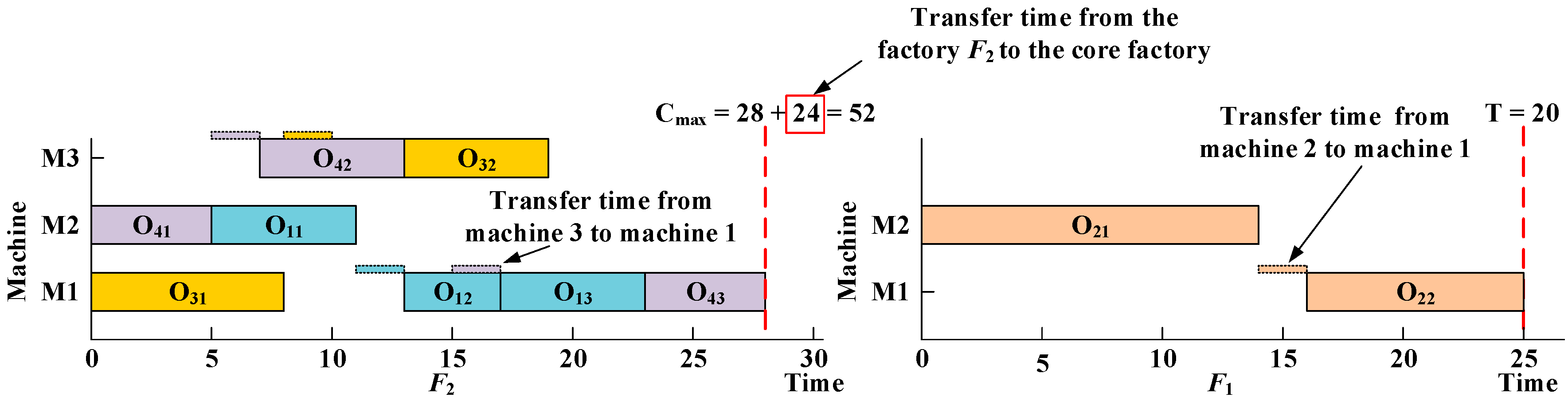
Considering the advantage of the insertion decoding method in accelerating the convergence speed [43], the insertion decoding method that considers the transfer is introduced when decoding. Figure 3 shows the decoding result of Figure 2.
Figure 3.
The Gantt chart of the decoding result.
4.2. Initialization
Based on the GLR initialization proposed by Zhang, Gao, and Shi [41], an improved GLR (I_GLR) method is developed in this section. See Algorithm 1 for the specific implementation of the heuristic algorithm.
| Algorithm 1 I_GLR |
|
4.3. Crossover
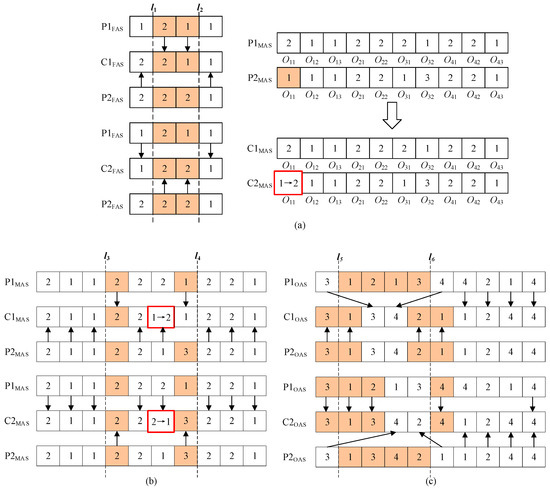
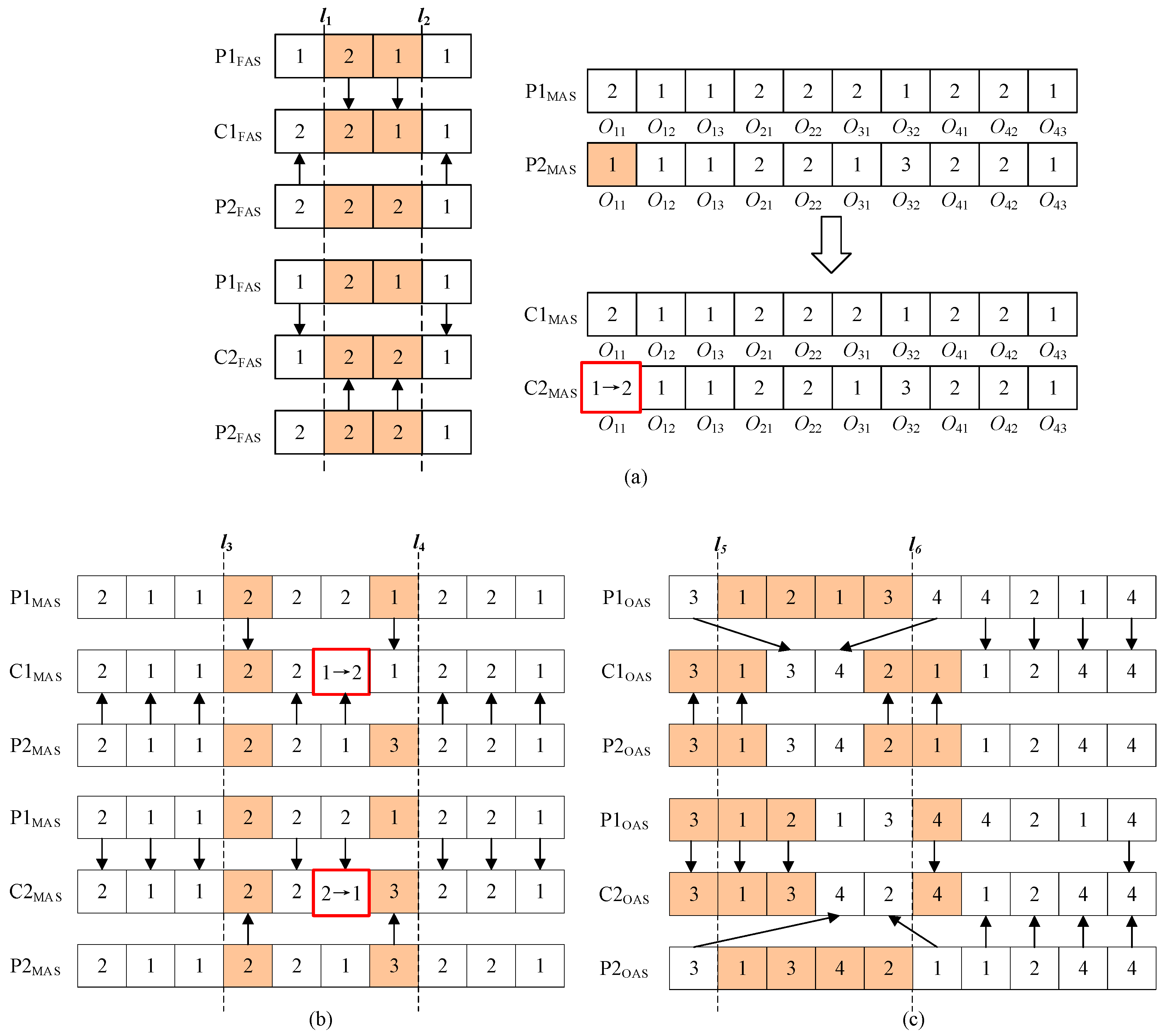
In this part, two individuals are randomly selected from the population for crossover. Two uniform crossover operators with repair strategies (RUX1 and RUX2) are applied for the FAS and MAS, respectively. For OAS, a position-based crossover operator for multiple operations (MOPX) is employed, which maintains the feasibility of the gene string. The crossover probability is denoted by Pc. Figure 4 presents the details of the three crossover operators, where the chromosomes of the two parents are constructed based on the data in Table 2.
Figure 4.
Crossover operators used in the algorithm: (a) RUX1 for FAS; (b) RUX2 for MAS; (c) MOPX for OAS.
Description of RUX1 (see Figure 4a):
Step 1: Randomly select two positions, l2 and l2, on the FAS.
Step 2: For each offspring, copy the genes at positions l1 and l2 from the FAS of one parent to the same positions in the offspring. Then, fill the remaining positions in the offspring with genes from the FAS of the other parent, preserving their original order.
Step 3: Copy the MAS from the two parents to the two offspring, respectively, and perform a validity check and repair on each offspring in turn.
Description of RUX2 (see Figure 4b):
Step 1: Use the two offspring generated by RUX1 as the new parent individuals.
Step 2: Apply the same operations as in Step 1 and Step 2 of RUX1.
Details of MOPX (see Figure 4c):
Step 1: Randomly select two positions, l5 and l6, on the OAS.
Step 2: For each offspring, record the genes between position l5 and l6 in one parent. Then, find the first occurrence of these genes in the other parent and copy them to the corresponding positions in the offspring. Finally, fill the remaining positions of the offspring, in order, using the genes from the other parent that were not yet used.
4.4. Mutation
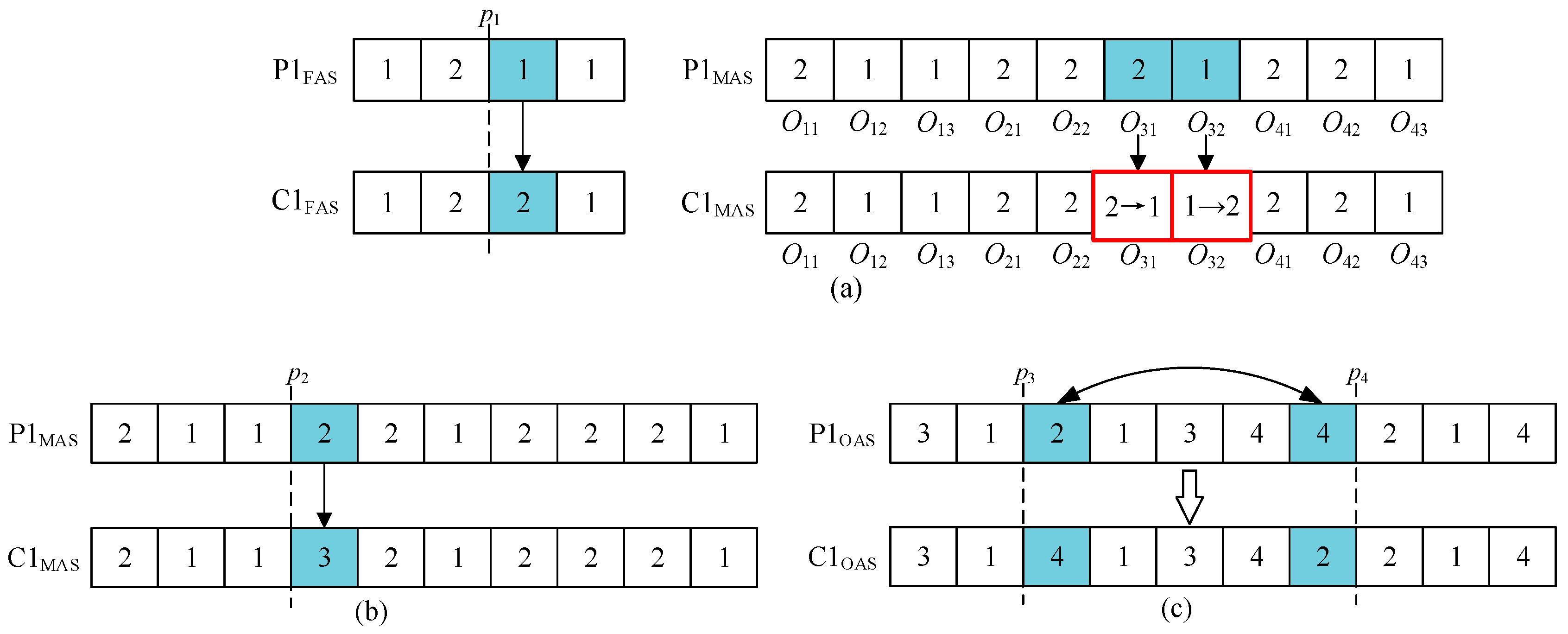
The FAS is processed using a single-point mutation method with a repair strategy (RSM). First, randomly select a position p1 on FAS. Then, replace the gene at position p1 with the index of a randomly selected available factory to generate an offspring. Finally, perform a validity check and repair on the offspring. The mutation probability is denoted by Pm.
The MAS is processed using a standard single-point mutation (SM) method. First, take the offspring generated by the RSM as the new parent. Then, apply the same operations as in the first two steps of the RSM.
An exchange mutation (EM) method is applied to the OAS. Randomly generate two positions, p3 and p4, on the OAS. Then, swap the genes at these two positions in the parent to form a new offspring. An example is illustrated in Figure 5, where p1 = 3, p2 = 4, p3 = 3, and p4 = 7.
Figure 5.
Mutation operators applied in the algorithm: (a) RSM for FAS; (b) SM for MAS; (c) EM for OAS.
4.5. Local Search
The neighborhood structure based on the critical path is effective in addressing problems related to makespan minimization. Inspired by Zhang, Deng, Gong, and Han [24] and Wang et al. [44], four local search operators are developed to optimize solutions in two ways: by transferring operations from the current machine to alternative machines and by transferring jobs from the current factory to other factories. The overall process of the local search is presented in Algorithm 2. Considering the time-consuming nature, the local search is applied only to the first frontier individuals in each generation. The details of the local search operators are provided in Algorithms 3 and 4.
| Algorithm 2 Main local search |
|
| Algorithm 3 Local search A |
|
| Algorithm 4 Local search B |
|
The specific procedures for the four operators are as follows.
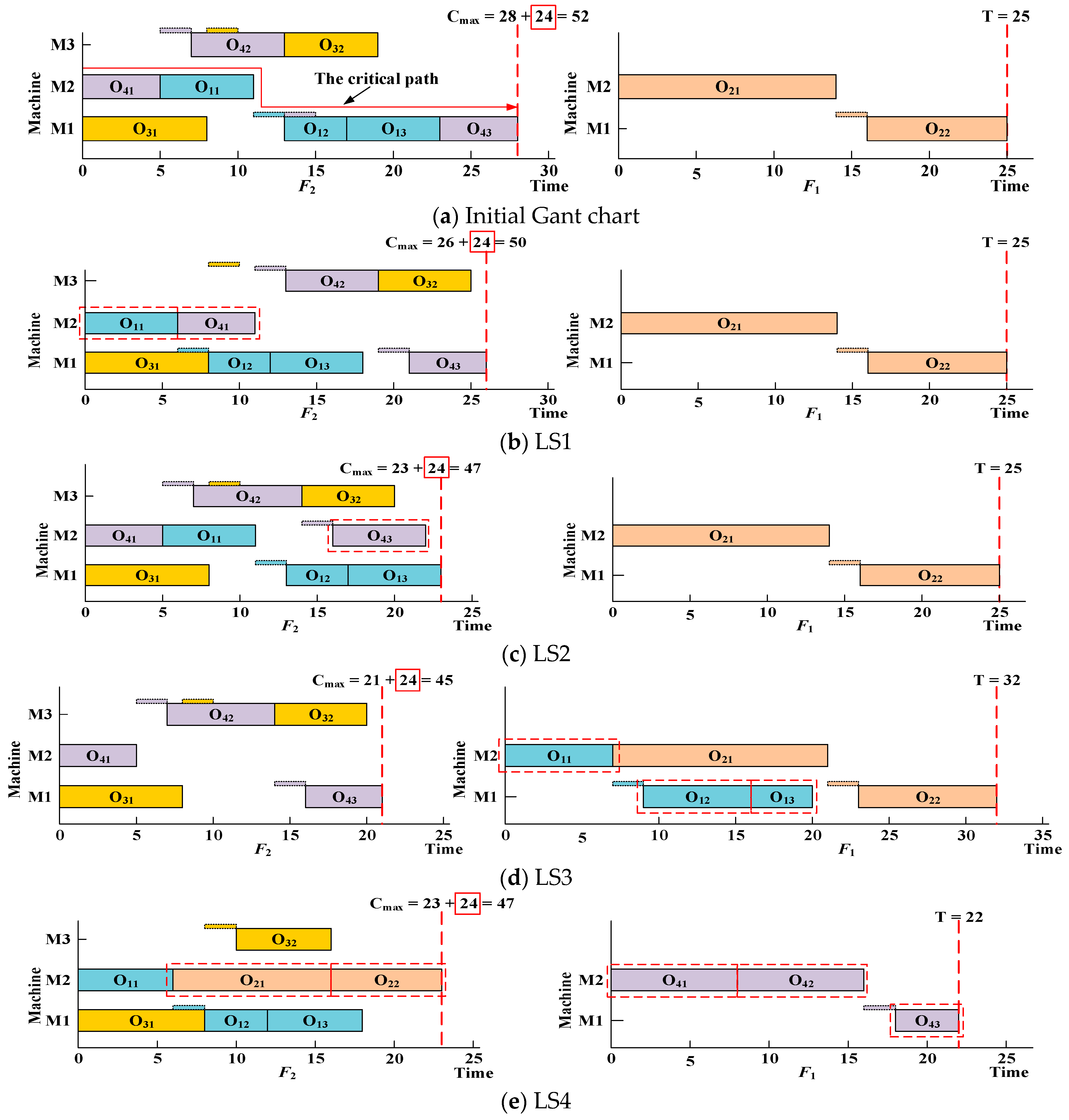
LS1: Randomly select two critical operations from different jobs and exchange their processing sequences.
LS2: Randomly select a critical operation and insert it into a different machine within the same factory, provided that this insertion improves both Ob1 and Ob2.
LS3: Randomly choose a critical operation and insert the job it belongs to into the factory with the minimum completion time.
LS4: Randomly select two factories and pick a job in each of the two factories. Subsequently, swap the factories of these two jobs.
For a more intuitive process of the algorithm, we can refer to the example shown in Figure 6, where Figure 6a is an initial Gantt chart obtained by decoding an individual before performing the local search. From Figure 6, we can see that Ob1 is reduced by 2, 5, 7, and 5, respectively, after performing the four operators on the initial individual.
Figure 6.
Example of local search.
5. Experimental Results and Analysis
Several types of experiments are designed to verify the performance of the NEMA in this section. The first type of experiment is intended to obtain the optimal combination of parameters for each algorithm, as shown in Section 5.2. The second type of experiment is used to test the effectiveness of the initialization method and local search operators. The third type of experiment demonstrates the superiority of the NEMA by comparing it with four other multi-objective evolutionary algorithms. For the sake of fairness, the stopping criterion for each algorithm is set to 1.2 N CPU time, where N is the total number of operations for all jobs. All experiments are coded by MATLAB 2016a and run on a computer configured with an Intel Xeon Gold 6226R CPU at 2.9 GHz and 128 GB RAM.
5.1. Benchmark Instances Construction
Many famous standard benchmarks have been designed for the FJSP. The benchmarks named Cs 01-60 constructed in this paper are extended from these benchmarks. The size of each instance is expressed as n × f × m, where n is the number of jobs, f represents the number of factories, and m means the number of available machines in each factory. Inspired by Zhang et al. [24], the 60 instances are divided into three levels: (1) small-scale instances, namely Cs 01-15; (2) medium-scale instances, namely Cs 16-45; (3) large-scale instances, namely Cs 46-60. Cs 01-30, Cs 36-40, and Cs 56-60 are constructed based on the benchmarks of vdata (la01-30, la36-40, and la31-35) proposed by Hurink et al. [45]. Cs 31-35 and Cs 46-55 are designed according to the benchmarks (01-05a, 08-12a, and 12-18a) presented in Brandimarte [46]. Cs 41-45 are obtained by doubling the size of Cs 16-20. The unit processing energy consumption and unit no-load energy consumption of each machine are set to 50 and 20, respectively. Additionally, the transfer time of each operation within the factory is set to 2, and the transfer time of each job between factories is randomly generated within [40, 80]. The processing cost of the operations in the core factory and other factories is set to 0.3 Tj and 0.6 Tj, respectively, where Tj is the processing time of the operation.
5.2. Parameters Setting
A full factorial design of experiments is applied to obtain the best combination of parameters for all algorithms. Ten numerical instances (C 01, 08, 12, 21, 27, 34, 42, 49, 55) at different scales from Section 5.1 are chosen for the experiments.
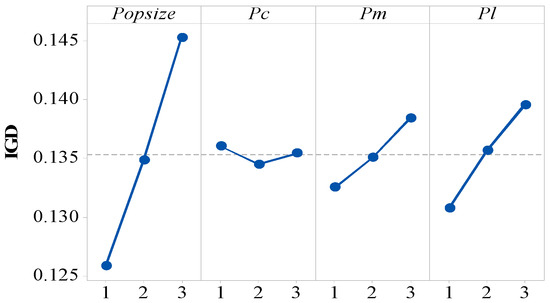
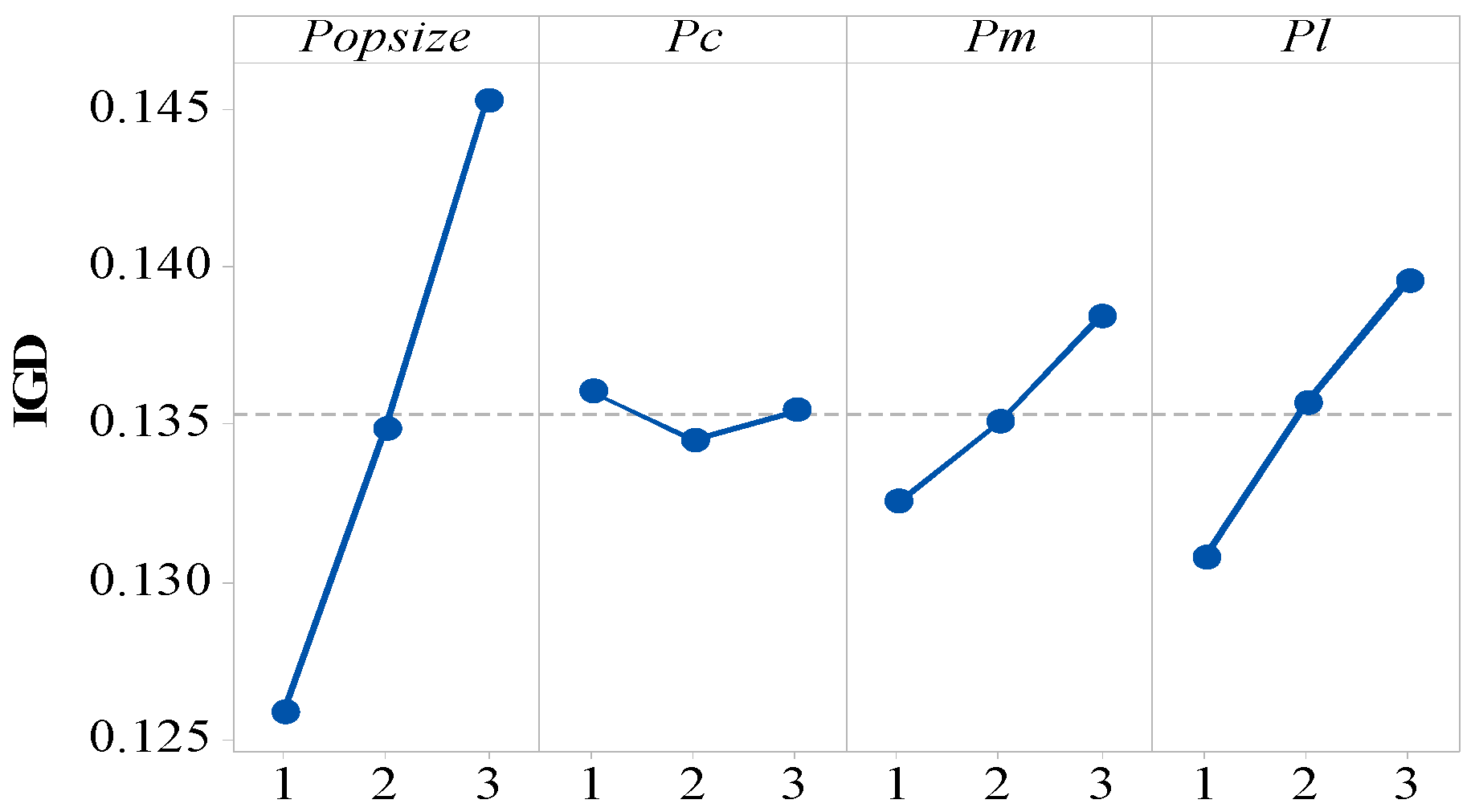
For the NEMA, four key parameters are considered, including population size Popsize, crossover probability Pc, mutation probability Pm, and local search probability Pl. Each parameter is set to three levels, i.e., Popsize = [50, 100, 150], Pc = [0.7, 0.8, 0.9], Pm = [0.1, 0.2, 0.4], Pl = [0.3, 0.5, 0.7]. For each instance, 5 independent experiments are carried out for each combination of parameters to enhance the reliability of the results, so a total of 3 × 3 × 3 × 3 × 5 = 405 experiments are required to be performed for a single case. The results of all experiments for the ten instances are pooled and each result is evaluated using the metric of IGD. Next, we can plot the trend of each key parameter using Minitab 18, as in Figure 7. From Figure 7, it is clear that the best combination is Popsize = 50, Pc = 0.8, Pm = 0.1, and Pl = 0.3.
Figure 7.
Trend of key parameters.
We take NSGA-III [47], MOEAD [48], SFLA [49], and MOPSO [50], four popular evolutionary algorithms for solving multi-objective problems, as our comparison algorithms. These comparison algorithms are also calibrated in the same way as the NEMA, and it is not detailed here due to limited space.
5.3. Effect of the Initialization and Local Search
Two comparison algorithms, MA1 and MA2, are employed to evaluate the effectiveness of the initialization and local search components. Specifically, replacing the initialization operator of the NEMA by randomly generating an initial population, MA1 is generated. And MA2 denotes the NEMA without the local search module, using the optimal parameters determined in Section 5.2. Under the optimal combination of parameters, 30 repeated experiments are performed for each instance. The experimental results based on IGD and the C-metric are shown in Table A1 and Table A2 of Appendix A. Note that the best results are in bold. From Table A1, we can observe that the NEMA reflects superior results over the other two algorithms on IGD in almost all instances except C 05. This means that the solutions generated by the NEMA are more uniformly distributed and are closer to the optimal Pareto front. Similar excellent results can be seen in Table A2. From the results of the C-metric, we can see that the NEMA produces more high-quality non-dominated solutions than the other two algorithms in almost all instances. Therefore, it can be demonstrated that the initialization and local search we developed can effectively improve the performance of the NEMA.
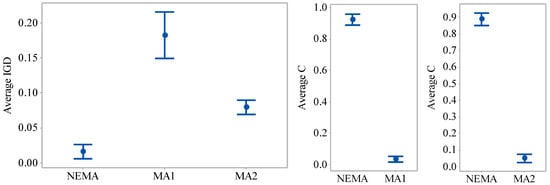
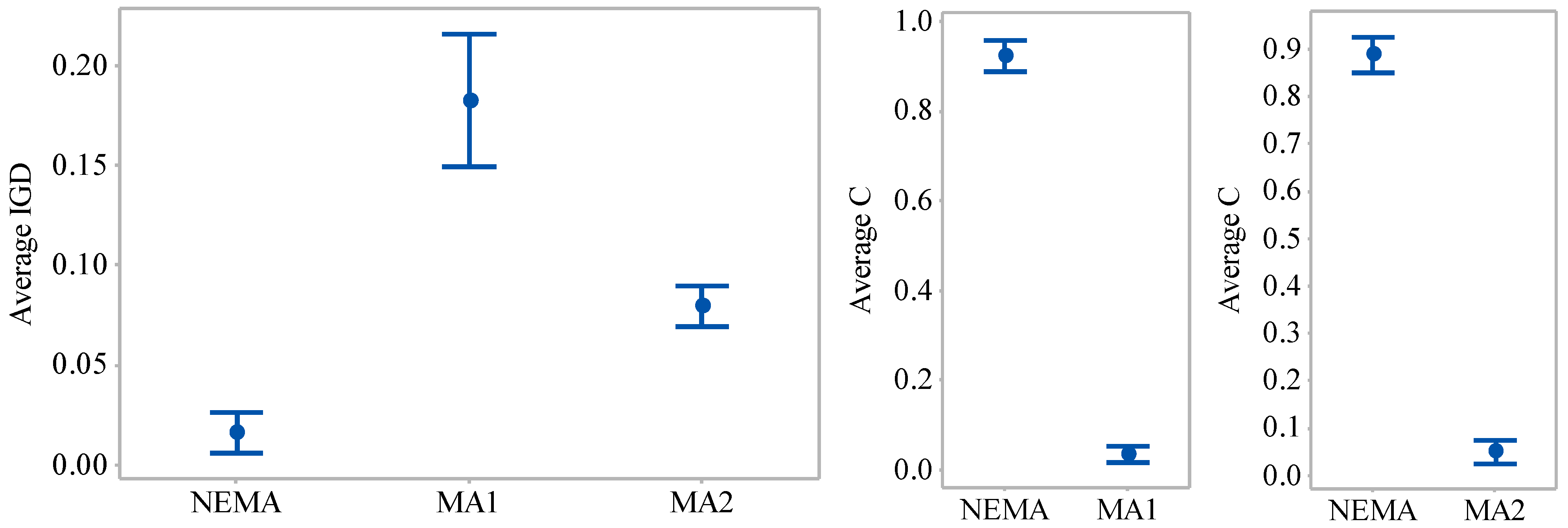
To demonstrate the significant superiority of the NEMA, mean plots with 95% confidence intervals based on the C-metric and IGD are drawn in Figure 8. It can be clearly seen that there is no common interval between NEMA and the other two algorithms, which means that it is significantly better than MA1 and MA2.
Figure 8.
Mean plots of NEMA, MA1, and MA2 based on IGD and C-metric.
5.4. Comparison of the NEMA with Four Other Algorithms
In this section, the NEMA is compared with four algorithms introduced in Section 5.2 to further verify its performance. As comparison algorithms, they are popular for solving multi-objective scheduling problems.
Each algorithm independently runs 30 times under its respective optimal combination of parameters. The experimental results are shown in Table A3 and Table A4 of Appendix A, where the best result for each instance is highlighted in bold. In terms of IGD, the NEMA can generate smaller IGD values than MOEAD and MOPSO in all instances, which means that the NEMA is superior to these two algorithms. In most instances, the evaluation results of the NEMA outperform NSGA-III and SFLA. As for the C-metric, C (NEMA, MOEAD/MOPSO/NSGA-III) is much larger than C (MOEAD/MOPSO/NSGA-III, NEMA) in each instance and C (NEMA, SFLA) > C (SFLA, NEMA) is suitable for most instances, implying that the NEMA has a great advantage in generating non-dominated solutions. It is worth noting that in Table A4, some C-metric values are 0. Specifically, C (X, Y) = 0 indicates that none of the non-dominated solutions found by algorithm X dominate any solution found by algorithm Y. For example, C (MOEA/D, NEMA) = 0 means that no solution in the final non-dominated set obtained by MOEA/D dominates any solution in the final non-dominated set obtained by NEMA. This further confirms the superiority and robustness of the NEMA in this context.
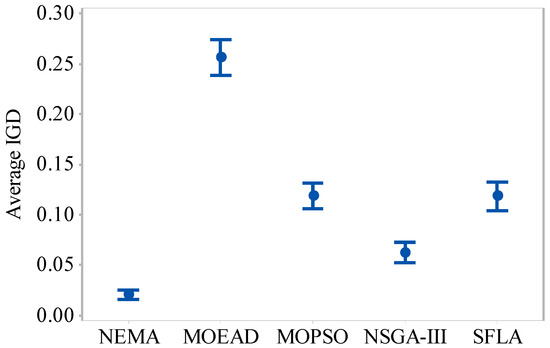
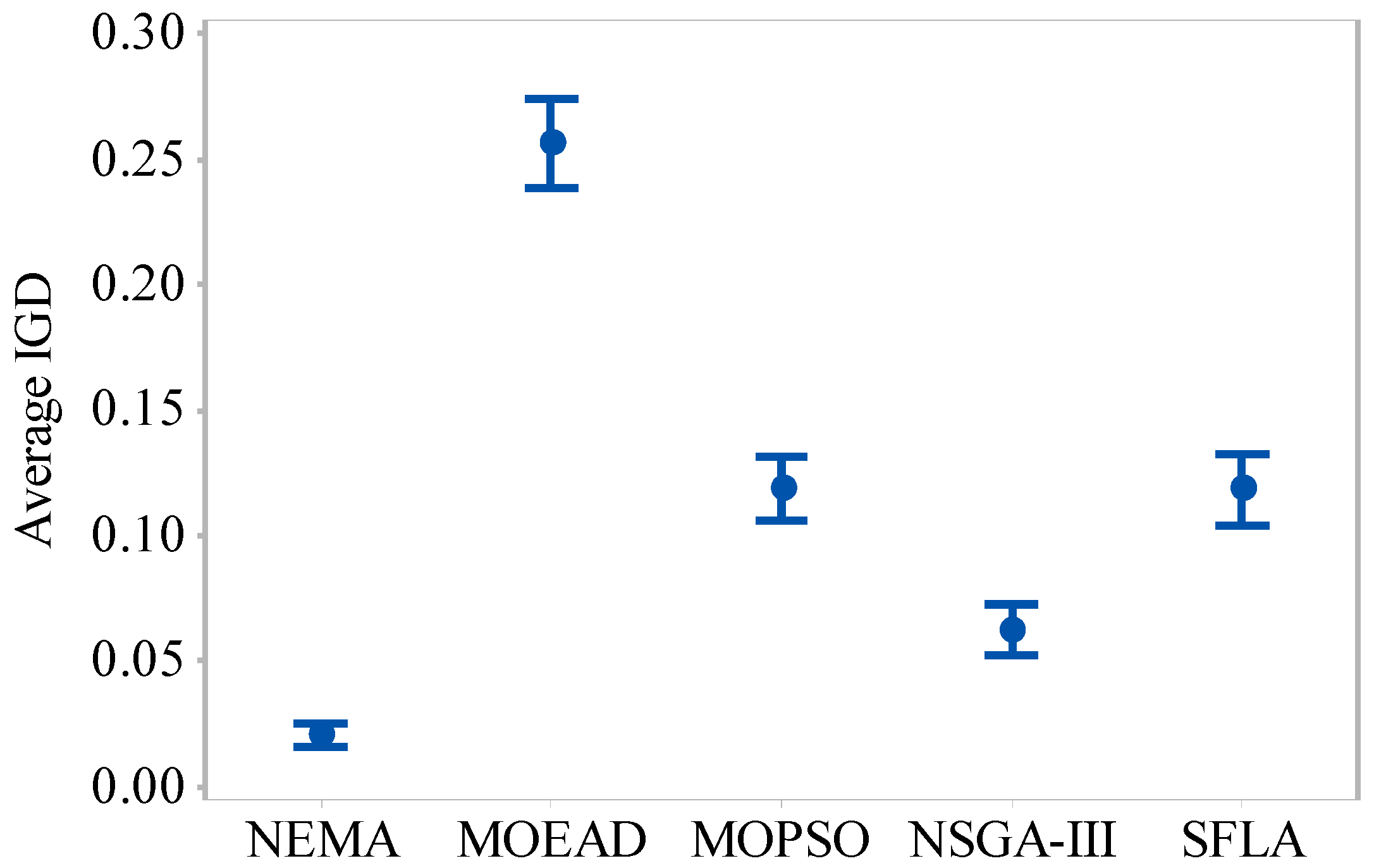
Likewise, to visualize the significant difference between the NEMA and the comparison algorithms, the mean plots with 95% confidence intervals based on the C-metric and IGD are depicted in Figure 9. From Figure 9, we can see that the performance of our NEMA is significantly better than the four comparison algorithms.
Figure 9.
Mean plots of NEMA and four comparison algorithms based on IGD.
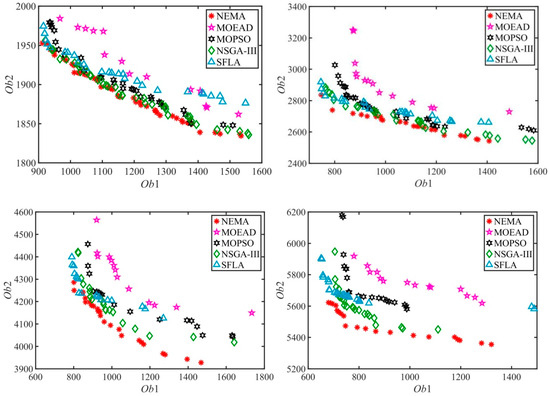
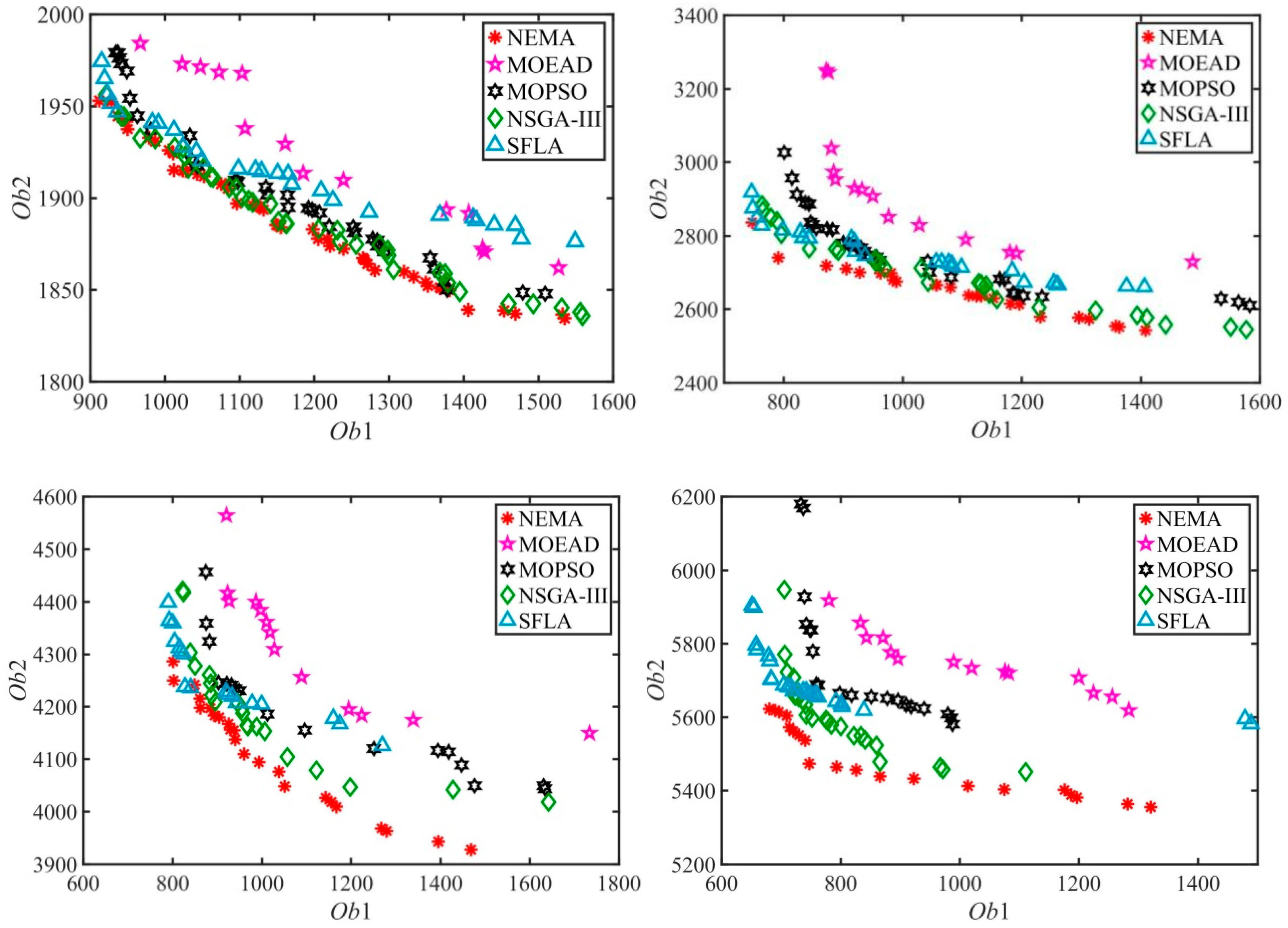
Four instances covering different scales (C14, C25, C40, C51) are selected to plot the distribution of the first Pareto front, as in Figure 10. Clearly, the solutions obtained by the NEMA are closer to the optimal Pareto front of all algorithms, which is consistent with the argument above.
Figure 10.
Optimal Pareto front diagrams of selected instances.
6. Conclusions
This paper pioneers the integration of carbon cap-and-trade policy and outsourcing strategy into flexible job shop scheduling (FPCO). According to these two strategies, manufacturers can not only outsource orders to reduce carbon emissions and makespan but also manufacture orders by themselves and bear the penalty for carbon emissions. This problem took into account transportation in the actual scheduling environment, such as the return of outsourced jobs, as well as the transfer within all factories. FPCO simultaneously minimizes total cost and makespan, enabling bidirectional optimization of economic and efficiency objectives.
In order to solve the FPCO, an efficient algorithm called the NEMA was developed. A novel I_GLR initialization method was designed to improve the quality of the initial solutions, and four local search operators were developed to enhance the search capability. Numerical experiments demonstrated the effectiveness and superiority of the NEMA. In the new manufacturing environment, our research expands the theory of production scheduling and offers provides practical significance. The proposed FPCO model integrates carbon cap-and-trade policies with outsourcing strategies in flexible job-shop scheduling, offering a novel perspective for carbon-constrained manufacturing environments. This model contributes to the advancement of sustainable and multi-objective scheduling theory under realistic production constraints. From a practical viewpoint, it provides manufacturers with a decision-making framework to balance carbon emissions, cost, and delivery performance in an integrated manner. This research offers valuable guidance for enterprises aiming to comply with environmental regulations while maintaining operational competitiveness.
It is worth noting, however, that certain assumptions were made in the model to maintain computational tractability. Specifically, we assumed an unlimited supply of carbon credits in the trading market and fixed unit energy consumption rates for each machine. In practice, carbon markets may experience price volatility or quota scarcity, and energy use may vary based on machine conditions or load levels. These simplifications, while enabling efficient optimization, may limit the direct applicability of the model in some real-world contexts. Future work should incorporate dynamic carbon pricing, state-dependent energy profiles, and carbon credit availability constraints to enhance practical applicability.
Although our proposed model and algorithm have demonstrated superior performance on benchmark instances, future work will focus on validating the approach with real production data from manufacturing enterprises. Collaborating with industry partners will allow us to assess the algorithm’s adaptability and effectiveness in actual scheduling scenarios, thereby bridging the gap between theory and practice.
Author Contributions
Conceptualization, L.Z.; Formal analysis, W.L.; Methodology, L.Z.; Software, G.S. and X.Y.; Supervision, H.W. and Q.D.; Validation, G.S. and X.Y.; Writing—original draft, L.Z. and W.L.; Writing—review and editing, H.W. and Q.D. All authors have read and agreed to the published version of the manuscript.
Funding
This research was funded by the National Natural Science Foundation of China [grant number 52305560]; Henan Provincial Science and Technology Research Project [grant numbers 23210222104]; Doctoral Program of Zhengzhou University of Light Industry [grant number 2022BSJJZK04].
Institutional Review Board Statement
Not applicable.
Informed Consent Statement
Not applicable.
Data Availability Statement
All data and models that support the findings of this study are available from the corresponding author upon reasonable request.
Conflicts of Interest
The authors declare no conflicts of interest.
Appendix A. Experimental Results
Table A1.
Comparison of NEMA, MA1, and MA2 based on IGD.
Table A2.
Comparison of NEMA, MA1, and MA2 based on C-metric.
Table A3.
Comparison of all algorithms based on IGD.
Table A4.
Comparison of all algorithms based on C-metric.
References
- Zhou, J.; Deng, Q.; Li, T. Optimal acquisition and remanufacturing policies considering the effect of quality uncertainty on carbon emissions. J. Clean. Prod. 2018, 186, 180–190. [Google Scholar] [CrossRef] [Scilit]
- Wang, R.; Cheng, S.; Zuo, X.; Liu, Y. Optimal management of multi stakeholder integrated energy system considering dual incentive demand response and carbon trading mechanism. Int. J. Energ. Res. 2021, 46, 6246–6263. [Google Scholar] [CrossRef] [Scilit]
- Zhang, L.; Tang, Q.; Wu, Z.; Wang, F. Mathematical modeling and evolutionary generation of rule sets for energy-efficient flexible job shops. Energy 2017, 138, 210–227. [Google Scholar] [CrossRef] [Scilit]
- Gong, G.; Chiong, R.; Deng, Q.; Han, W.; Zhang, L.; Huang, D. Energy-efficient production scheduling through machine on/off control during preventive maintenance. Eng. Appl. Artif. Intell. 2021, 104, 104359. [Google Scholar] [CrossRef] [Scilit]
- Li, Y.; Huang, W.; Wu, R.; Guo, K. An improved artificial bee colony algorithm for solving multi-objective low-carbon flexible job shop scheduling problem. Appl. Soft Comput. 2020, 95, 106544. [Google Scholar] [CrossRef] [Scilit]
- Salido, M.A.; Escamilla, J.; Giret, A.; Barber, F. A genetic algorithm for energy-efficiency in job-shop scheduling. Int. J. Adv. Manuf. Technol. 2016, 85, 1303–1314. [Google Scholar] [CrossRef] [Scilit]
- Cheng, J.H.; Chu, F.; Zhou, M.C. An Improved Model for Parallel Machine Scheduling Under Time-of-Use Electricity Price. IEEE Trans. Autom. Sci. Eng. 2018, 15, 896–899. [Google Scholar] [CrossRef] [Scilit]
- Far, M.H.; Haleh, H.; Saghaei, A. A fuzzy bi-objective flexible cell scheduling optimization model under green and energy-efficient strategy using Pareto-based algorithms: SATPSPGA, SANRGA, and NSGA-II. Int. J. Adv. Manuf. Technol. 2019, 105, 3853–3879. [Google Scholar] [CrossRef] [Scilit]
- Marufuzzaman, M.; Eksioglu, S.D.; Huang, Y. Two-stage stochastic programming supply chain model for biodiesel production via wastewater treatment. Comput. Oper. Res. 2014, 49, 1–17. [Google Scholar] [CrossRef] [Scilit]
- Wang, J.; Yu, Z.; Zeng, X.; Wang, Y.; Li, K.; Deng, S. Water-energy-carbon nexus: A life cycle assessment of post-combustion carbon capture technology from power plant level. J. Clean. Prod. 2021, 312, 127727. [Google Scholar] [CrossRef] [Scilit]
- Jiang, T.; Zhu, H.; Liu, L.; Gong, Q. Energy-conscious flexible job shop scheduling problem considering transportation time and deterioration effect simultaneously. Sustain. Comput. Inform. Syst. 2022, 35, 100680. [Google Scholar] [CrossRef] [Scilit]
- Ma, Y.; Wang, H.; Hong, F.; Yang, J.; Chen, Z.; Cui, H.; Feng, J. Modeling and optimization of combined heat and power with power-to-gas and carbon capture system in integrated energy system. Energy 2021, 236, 121392. [Google Scholar] [CrossRef] [Scilit]
- Wang, R.; Wen, X.; Wang, X.; Fu, Y.; Zhang, Y. Low carbon optimal operation of integrated energy system based on carbon capture technology, LCA carbon emissions and ladder-type carbon trading. Appl. Energy 2022, 311, 118664. [Google Scholar] [CrossRef] [Scilit]
- Tan, M.; Chen, Y.; Su, Y.X.; Li, S.H.; Li, H. Integrated optimization model for industrial self-generation and load scheduling with tradable carbon emission permits. J. Clean. Prod. 2019, 210, 1289–1300. [Google Scholar] [CrossRef] [Scilit]
- Zheng, F.; Wang, Z.; Xu, Y.; Liu, M. Single machine scheduling with uncertain processing times and carbon emission constraint in the shared manufacturing environment. Ann. Oper. Res. 2023. [Google Scholar] [CrossRef] [Scilit]
- Xu, W.; Wang, L.; Liu, D.; Tang, H.; Li, Y. Solving distributed low carbon scheduling problem for large complex equipment manufacturing using an improved hybrid artificial bee colony algorithm. J. Intell. Fuzzy Syst. 2023, 45, 147–175. [Google Scholar] [CrossRef] [Scilit]
- Hu, C.; Bai, H.; Li, W.; Xie, K.; Liu, Y.; Liu, T.; Shao, C. Optimal Scheduling of Networked Microgrids Considering the Temporal Equilibrium Allocation of Annual Carbon Emission Allowance. Sustainability 2024, 16, 10986. [Google Scholar] [CrossRef] [Scilit]
- Jin, S.; Wang, B.; Zhang, G.; Fan, X.; Jiang, S.; Cao, M.; Wang, Y. Research on Low-Carbon-Emission Scheduling of Workshop under Uncertainty. Appl. Sci. 2024, 14, 4976. [Google Scholar] [CrossRef] [Scilit]
- Lin, C.-C.; Zhang, S.-Y.; Chou, Y.-L.; Liu, W.-Y. Energy management scheduling of a smart factory with carbon capture and storage, carbon emission quota cap-and-trade, and green energy trading. Energy 2025, 333, 137231. [Google Scholar] [CrossRef] [Scilit]
- Zhao, J.; Song, Y.; Fan, H. Optimization Scheduling of Hydrogen-Integrated Energy Systems Considering Multi-Timescale Carbon Trading Mechanisms. Energies 2025, 18, 1612. [Google Scholar] [CrossRef] [Scilit]
- Li, J.; Su, Q.; Ma, L. Production and transportation outsourcing decisions in the supply chain under single and multiple carbon policies. J. Clean. Prod. 2017, 141, 1109–1122. [Google Scholar] [CrossRef] [Scilit]
- Xia, X.; Li, M.; Li, B.; Wang, H. The Impact of Carbon Trade on Outsourcing Remanufacturing. Int. J. Environ. Res. Public Health 2021, 18, 10804. [Google Scholar] [CrossRef] [Scilit]
- Papież, M.; Śmiech, S.; Frodyma, K. The role of energy policy on the decoupling processes in the European Union countries. J. Clean. Prod. 2021, 318, 128484. [Google Scholar] [CrossRef] [Scilit]
- Zhang, L.; Deng, Q.; Gong, G.; Han, W. A new unrelated parallel machine scheduling problem with tool changes to minimise the total energy consumption. Int. J. Prod. Res. 2020, 58, 6826–6845. [Google Scholar] [CrossRef] [Scilit]
- Wu, X.; Che, A. A memetic differential evolution algorithm for energy-efficient parallel machine scheduling. Omega 2019, 82, 155–165. [Google Scholar] [CrossRef] [Scilit]
- Xu, X.Y.; Xu, X.P.; He, P. Joint production and pricing decisions for multiple products with cap-and-trade and carbon tax regulations. J. Clean. Prod. 2016, 112, 4093–4106. [Google Scholar] [CrossRef] [Scilit]
- Ma, C.; Yuan, T.; Yao, Y.; Wang, L.; Gao, H.; Zhang, M.; Liang, Z.; Li, J.; Guan, L. A Decision-Making System for Low Carbon Manufacturing. Comput. Intell. Neurosci. 2022, 2022, 5791880. [Google Scholar] [CrossRef] [Scilit]
- Hong, Z.; Chu, C.; Yu, Y. Dual-mode production planning for manufacturing with emission constraints. Eur. J. Oper. Res. 2016, 251, 96–106. [Google Scholar] [CrossRef] [Scilit]
- Chai, Q.F.; Xiao, Z.D.; Lai, K.H.; Zhou, G.H. Can carbon cap and trade mechanism be beneficial for remanufacturing? Int. J. Prod. Econ. 2018, 203, 311–321. [Google Scholar] [CrossRef] [Scilit]
- Wang, Y.J.; Chen, W.D. Effects of emissions constraint on manufacturing/remanufacturing decisions considering capital constraint and financing. Atmos. Pollut. Res. 2017, 8, 455–464. [Google Scholar] [CrossRef] [Scilit]
- Tang, Z.; Liu, X.; Wang, Y.; Ma, D. Integrated Inventory-Transportation Scheduling with Sustainability-Dependent Demand under Carbon Emission Policies. Discret. Dyn. Nat. Soc. 2020, 2020, 2510413. [Google Scholar] [CrossRef] [Scilit]
- Hasan, M.R.; Roy, T.C.; Daryanto, Y.; Wee, H.-M. Optimizing inventory level and technology investment under a carbon tax, cap-and-trade and strict carbon limit regulations. Sustain. Prod. Consum. 2021, 25, 604–621. [Google Scholar] [CrossRef] [Scilit]
- Yu, C.H.; Qu, Z.B.; Archibald, T.W.; Luan, Z.N. An inventory model of a deteriorating product considering carbon emissions. Comput. Ind. Eng. 2020, 148, 106694. [Google Scholar] [CrossRef] [Scilit]
- Foumani, M.; Smith-Miles, K. The impact of various carbon reduction policies on green flowshop scheduling. Appl. Energy 2019, 249, 300–315. [Google Scholar] [CrossRef] [Scilit]
- Bok, Y.; Lee, N.K.; Jo, S.; Lee, S.; Kweon, S.J.; Na, H.S. The production scheduling problem employing non-identical parallel machines with due dates considering carbon emissions and multiple types of energy sources. Expert Syst. Appl. 2024, 238, 121990. [Google Scholar] [CrossRef] [Scilit]
- Takan, M.A. A novel MIP model and a hybrid genetic algorithm for operation outsourcing in production scheduling with carbon tax policy. Expert Syst. Appl. 2024, 251, 123983. [Google Scholar] [CrossRef] [Scilit]
- Zhang, X.H.; Zhao, X.X.; Zhong, J.Q.; Ma, N. Low carbon multi-objective scheduling of integrated energy system based on ladder light robust optimization. Int. Trans. Electr. Energy Syst. 2020, 30, e12498. [Google Scholar] [CrossRef] [Scilit]
- Ma, X.; Liang, Y.; Wang, K.; Jia, R.; Wang, X.; Du, H.; Liu, H. Dispatch for energy efficiency improvement of an integrated energy system considering multiple types of low carbon factors and demand response. Front. Energy Res. 2022, 10, 953573. [Google Scholar] [CrossRef] [Scilit]
- Xu, C.; Zhang, P.; Yu, H. Lyapunov-Guided Resource Allocation and Task Scheduling for Edge Computing Cognitive Radio Networks via Deep Reinforcement Learning. IEEE Sens. J. 2025, 25, 12253–12264. [Google Scholar] [CrossRef] [Scilit]
- Xu, W.; Hu, Y.; Luo, W.; Wang, L.; Wu, R. A multi-objective scheduling method for distributed and flexible job shop based on hybrid genetic algorithm and tabu search considering operation outsourcing and carbon emission. Comput. Ind. Eng. 2021, 157, 107318. [Google Scholar] [CrossRef] [Scilit]
- Zhang, G.; Gao, L.; Shi, Y. An effective genetic algorithm for the flexible job-shop scheduling problem. Expert Syst. Appl. 2011, 38, 3563–3573. [Google Scholar] [CrossRef] [Scilit]
- Deb, K.; Pratap, A.; Agarwal, S.; Meyarivan, T. A fast and elitist multiobjective genetic algorithm: NSGA-II. IEEE Trans. Evol. Comput. 2002, 6, 182–197. [Google Scholar] [CrossRef] [Scilit]
- Gong, X.; Deng, Q.; Gong, G.; Liu, W.; Ren, Q. A memetic algorithm for multi-objective flexible job-shop problem with worker flexibility. Int. J. Prod. Res. 2017, 56, 2506–2522. [Google Scholar] [CrossRef] [Scilit]
- Wang, G.C.; Gao, L.; Li, X.Y.; Li, P.; Tasgetiren, M.F. Energy-efficient distributed permutation flow shop scheduling problem using a multi-objective whale swarm algorithm. Swarm Evol. Comput. 2020, 57, 100716. [Google Scholar] [CrossRef] [Scilit]
- Hurink, J.; Jurisch, B.; Thole, M. Tabu search for the job-shop scheduling problem with multi-purpose machines. Oper.-Res.-Spektrum 1994, 15, 205–215. [Google Scholar] [CrossRef] [Scilit]
- Brandimarte, P. Routing and scheduling in a flexible job shop by tabu search. Ann. Oper. Res. 1993, 41, 157–183. [Google Scholar] [CrossRef] [Scilit]
- Deb, K.; Jain, H. An Evolutionary Many-Objective Optimization Algorithm Using Reference-Point-Based Nondominated Sorting Approach, Part I: Solving Problems With Box Constraints. IEEE Trans. Evol. Comput. 2014, 18, 577–601. [Google Scholar] [CrossRef] [Scilit]
- Qingfu, Z.; Hui, L. MOEA/D: A Multiobjective Evolutionary Algorithm Based on Decomposition. IEEE Trans. Evol. Comput. 2007, 11, 712–731. [Google Scholar] [CrossRef] [Scilit]
- Lei, D.; Zheng, Y.; Guo, X. A shuffled frog-leaping algorithm for flexible job shop scheduling with the consideration of energy consumption. Int. J. Prod. Res. 2016, 55, 3126–3140. [Google Scholar] [CrossRef] [Scilit]
- Coello, C.A.C.; Pulido, G.T.; Lechuga, M.S. Handling multiple objectives with particle swarm optimization. IEEE Trans. Evol. Comput. 2004, 8, 256–279. [Google Scholar] [CrossRef] [Scilit]

Disclaimer/Publisher’s Note: The statements, opinions and data contained in all publications are solely those of the individual author(s) and contributor(s) and not of MDPI and/or the editor(s). MDPI and/or the editor(s) disclaim responsibility for any injury to people or property resulting from any ideas, methods, instructions or products referred to in the content. |
© 2025 by the authors. Licensee MDPI, Basel, Switzerland. This article is an open access article distributed under the terms and conditions of the Creative Commons Attribution (CC BY) license (https://creativecommons.org/licenses/by/4.0/).