Review

A Comprehensive Review of Remediation Strategies for Soil and Groundwater Contaminated with Explosives


by
Christiana Mystrioti
* and
Nymphodora Papassiopi
School of Mining and Metallurgical Engineering, National Technical University of Athens, 15780 Athens, Greece
*
Author to whom correspondence should be addressed.
Sustainability 2024, 16(3), 961; https://doi.org/10.3390/su16030961
Submission received: 13 December 2023 / Revised: 8 January 2024 / Accepted: 19 January 2024 / Published: 23 January 2024
(This article belongs to the Section Environmental Sustainability and Applications)

Abstract

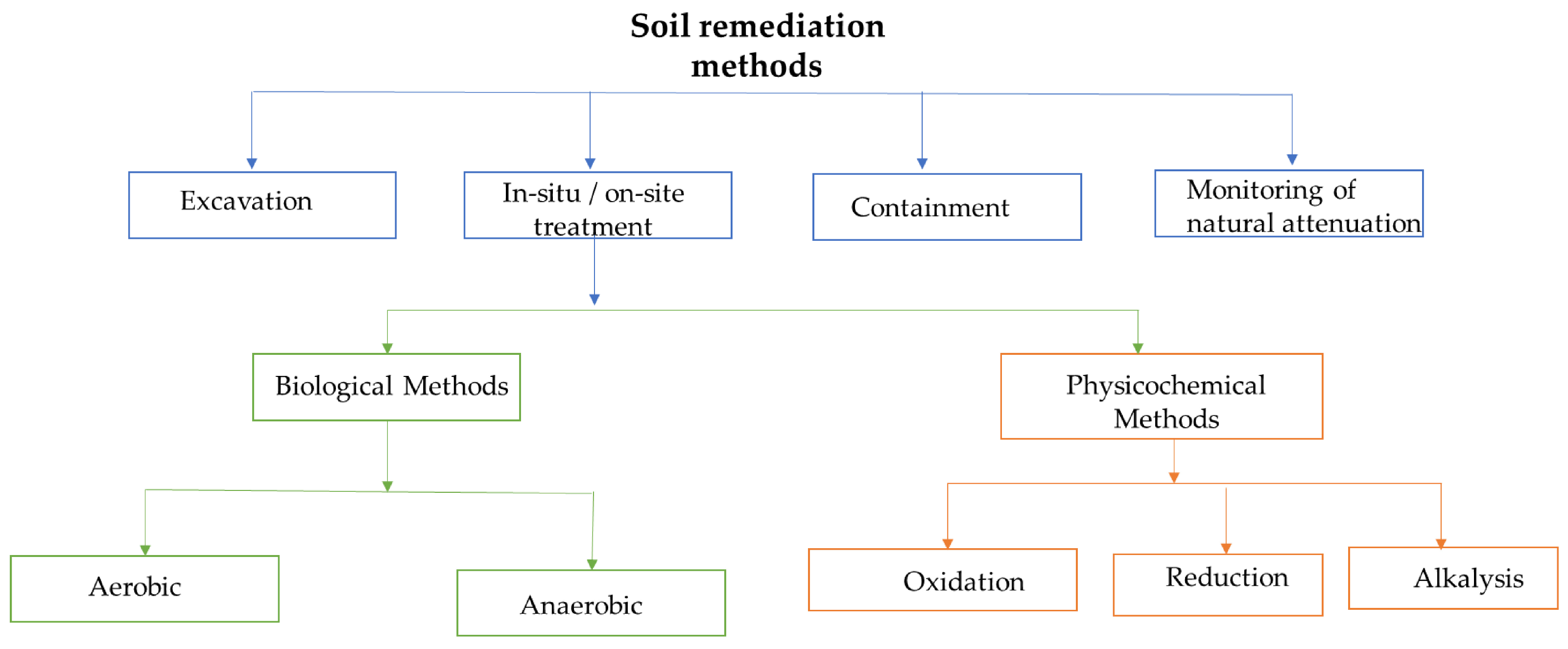
This study offers an updated overview of the soil and water remediation strategies employed to address the widespread environmental and public health risks associated with explosive compounds, particularly TNT and RDX. Recognizing soil contamination originating from military activities, industrial accidents, and historical land use, this review delves into physical, chemical, and biological approaches to mitigating ecological and human health concerns. While physical methods like excavation and disposal are effective, their applicability is constrained by cost and logistical challenges for large contaminated areas. Chemical methods, such as oxidation and reduction, focus on transforming explosives into less toxic byproducts. Biological remediation utilizing plants and microorganisms emerges as a cost-effective and sustainable alternative. This review highlights challenges, including the persistence of explosive compounds, potential groundwater leaching, and the necessity for long-term monitoring. Emphasizing the need for site-specific strategies, considering the contaminant type, concentration, soil properties, and regulatory requirements, this study advocates for integrated and sustainable remediation approaches in pilot-scale applications. It concludes by evaluating the appropriate solution based on the advantages and disadvantages of the categories of soil and groundwater remediation methods. The duration, the effectiveness, and the cost of available technologies were estimated.
Keywords: soil contamination; explosives; 2,4,6-trinitrotoluene (TNT); rapid detention explosive (RDX); soil remediation; soil sustainability soil contamination; explosives; 2,4,6-trinitrotoluene (TNT); rapid detention explosive (RDX); soil remediation; soil sustainability