


Abstract
Zero waste (ZW) and sustainable waste management (SWM) can vary based on environmental factors, economic and technological developments, social and cultural norms, and political and administrative differences across countries, as well as within rural or highly urbanized regions of the same country. The research aims to obtain a valid and reliable scale that measures the multidimensional structure of ZW and SWM. Three hundred and thirty participants, including 213 women and 117 men, participated in the study. Participants had a mean age of 41.09 ± 12.31, with the majority (56.7%) holding a Bachelor’s degree. The study unfolded in two phases: initially, the item pool was reviewed, leading to the development of the final scale by eliminating unsuitable items. Exploratory Factor Analysis (EFA) and Confirmatory Factor Analysis (CFA) were conducted using IBM SPSS and IBM SPSS AMOS, and the scale provided construct validity with seven subdimensions and acceptable DFA parameters: χ2 = 933.249; df = 437; CMIN/DF = 2.136; CFI = 0.913; NFI = 0.905; RMSEA = 0.056; p = 0.010. The internal consistency of the scale was calculated using Cronbach’s alpha, and total scores and subdimensions ranged from 0.701 to 0.912, indicating an acceptable level of internal consistency. Thus, this new measurement tool can be used in various studies on ZW and SWM by facilitating the analysis of behavioral motivation, satisfaction, expectation, awareness, e-waste knowledge, and access to facilities regarding existing zero waste and sustainable waste management opportunities.
1. Introduction
Historically, solid waste has been perceived as an undesirable but inevitable phenomenon. Since an average individual produces 435 kg of waste yearly [1], waste has increased massively due to population growth, industrialization, rapid urbanization, economic growth, and technological developments [2,3]. However, the problems caused by the decrease in limited resources and the increase in waste (water and soil pollution, greenhouse gas emissions, global climate change) have made it inevitable to consider waste as a resource. Thus, waste management policies had to shift from a linear (production consumption use) to a circular (long term, multiple life cycles) approach, introducing the term circular economy. Circular economy (CE) is based on the efficient and adequate consumption of resources, as well as the emphasis on the responsibilities of stakeholders towards society and environmental ecology [4,5,6]. Environmental responsibility is part of a broader philosophy of modern economy, namely sustainable development. The term sustainable development was first coined in the 1970s and is an interdisciplinary and global approach, with the United Nations setting 17 sustainable development goals that addressed a broad range of issues covering technology, ecology, economics, politics, and sociology [7,8]. The twelfth sustainable development goal is about responsible consumption and production. The UN called for a significant reduction in waste generation by 2030 via prevention, reduction, recycling, and reuse [9].
The holistic zero waste (ZW) approach was based on the effective management of resources and waste while meeting the demands of the current environmental, economic, and social requirements. ZW is an ethical, economical, efficient, and forward-thinking approach where people can change their lifestyles and habits to mimic natural cycles; all discarded materials are transformed into resources that others could utilize. Since ZW aims to avoid waste and requires effective use of resources, it became a global approach and was widely adopted by local governments, social activists, consumers, and industries [10,11]. The seven essential steps to adhere to zero waste principles are rethink, refuse, reduce, repurpose, reuse, repair, and recycle [12]. ZW is a visionary lifestyle where people strive to produce as little waste as possible to avoid environmental pollution. The ZW approach starts with responsible individual procurement (conscious choices, purchase of the minimum amount of products to meet the needs). It includes reusing the products as often and as long as possible (bartering products among individuals, repurposing products) [13]. The other goal of the ZW approach, sustainable resource management, requires the following three overarching objectives: (1) producer responsibility at the root of the problem: design and industrial production; (2) consumer responsibility at the end of the cycle: consumption, waste management, and disposal; and (3) political responsibility, the glue between social and producer responsibility. Therefore, every individual produces waste and is a part of a wasteful society. Good policies, the establishment of infrastructural requirements, and increased individual knowledge and responsibility would involve everyone in transforming to a more sustainable consumption [10,14,15].
There are significant differences between waste generation in Türkiye and the EU. According to the EU Statistical Office Eurostat 2020 data, the largest share of total waste in the EU is construction waste, with 37.5% belonging to Türkiye, while the share of construction in Türkiye is 0%, and the largest share of total waste in Türkiye is domestic waste with 26.5% [16]. In the EU, waste generation per capita was 4.8 tons in 2020, of which 3.1 tons was main mineral waste, 1.7 tons was non-main mineral waste. In Türkiye, 0.9 tons of waste per capita was non-main mineral waste, 0.4 tons were main mineral waste, and total waste generation was 1.3 tons [17]. In the EU, 39.9% of the total waste is recycled, 12.7% is backfilled, and 6.5% is used for energy recovery, resulting in 59.1% recycling and 40.4% disposal by landfilling in the EU, while in Türkiye, the recycling rate is 31.2% and disposal by landfilling is 67.7%. In 2021, 49.6% of municipal waste is recycled in the EU, while in Türkiye, the municipal waste recycling rate in 2020 is reported to be 12.3% [16,17]. The fact that household waste, which has the highest share in waste generation in Türkiye, is primarily disposed of in landfills is contrary to the concepts of sustainable waste management and zero waste. It was determined that knowledge, awareness, behavioral habits, opportunities, intent, social norms, waste management services, and motivation affected sustainable waste management and zero waste practices [18,19,20,21,22]. Limon and Vilarino (2020) reported that the reasons for not separating waste were the lack of awareness and willingness to participate, financial inadequacy, lack of separate bins, and the stressful nature of waste segregation [23]. Dixon and Parker (2022) determined that systemic problems, such as limited facilities offered by municipalities, were among the barriers to recycling [24].
It was determined that knowledge, awareness, behavioral habits, opportunities, intent, social norms, waste management services, and motivation affected sustainable waste management and zero waste practices in societies. There are only a few studies where a scale was developed to analyze the social behavior in Türkiye, especially the aptitude for zero waste. The present study aimed to develop a zero waste and sustainable waste management scale and determine the factors affecting zero waste and sustainable waste management. Thus, (1) the aim and methodology of the study were determined, (2) statistical data were collected (survey application), (3) statistical data were categorized and presented, and (4) statistical inferences and discussions were presented.
2. Materials and Methods
2.1. Item Pool Development
The Zero Waste and Sustainable Waste Management Scale (ZW-SWMS) was developed based on an item pool based on the statements in the literature and original scales. In the initial phase, duplicate or similar statements were eliminated, resulting in a 45-item question pool. The item pool included topics such as Waste Management Knowledge, Behavioral Motivation, Awareness, Waste Management Opportunities, Attitudes Towards Waste Management, Norms, Social Impact, Waste Management Intent, Behavioral Frequency, Recycling Aptitude, Government and Local Authority, and NGO services. The item pool was a 5-point Likert type scale (1-Strongly Disagree, 5-Strongly Agree), and no item was reverse scored. The study was approved by the Süleyman Demirel University (Isparta/Türkiye) Ethics Committee on 22 January 2024.
2.2. Study Model and Participants
The survey was distributed to participants online, and 405 individuals who voluntarily agreed to participate in the study completed the survey. The study was conducted between 25 February and 25 March 2024, with the general screening model. Based on the population of Türkiye (α = 83,000,000), the confidence interval of 0.95, and a significance of 0.05, the minimum sample size was calculated as 384 participants [25]. After the Exploratory Factor Analysis (EFA) to validate the survey structure, Confirmatory Factor Analysis (CFA) was conducted with 330 participants to finalize the scale.
2.3. Data Collection Instrument
Exploratory Factor Analysis (EFA) and Confirmatory Factor Analysis (CFA) were conducted on the “Zero Waste and Sustainable Waste Management Scale” developed in the present study to determine structural validity and reliability. The reliability coefficient was calculated, and the data were analyzed with SPSS 25.0 and AMOS 23.0 software. The sample fitness was determined with the Kaiser–Meyer–Olkin (KMO) test, and the suitability of the data for factor analysis was determined with Bartlett’s Sphericity test [26]. To determine whether the “Zero Waste and Sustainable Waste Management” scale was a reliable measurement instrument, the internal consistency coefficient Cronbach’s alpha (α) was calculated. Descriptive statistics, which aim to summarize observation findings with specific statistical measures, include techniques to measure central aptitudes (mean, median, and mode), deviations from the mean (standard deviation and variance), and deviations from normality [27].
3. Results and Discussion
3.1. Exploratory Factor Analysis
Exploratory Factor Analysis (EFA) was conducted on 45 items in the item pool to determine the construct validity. The significance of all correlations across the items was calculated, and it was determined that there were significant correlations, indicating that the data were adequate for factor analysis. Thus, sampling adequacy and Bartlett’s Sphericity tests were conducted. The Kaiser–Meyer–Olkin (KMO) sampling adequacy coefficient was 0.925, and Bartlett’s Sphericity test yielded χ2 = 8735.388 with 664 degrees of freedom, which was significant at p < 0.01.
The Exploratory Factor Analysis analyzed data collected from 405 participants. To address missing data, item means were attributed for the analyses, ensuring that the missing data did not affect the EFA and CFA results.
The initial survey used in the first stage is presented in Table 1. The sequence of the items created in the item pool and their different orders in the final scale are presented in Table 1, indicating relative item numbers.
Table 1.
The item pool and the order of items in the scale.
The EFA conducted in the first stage demonstrated that the initial coefficients (communalities) were within the expected values (greater than 0.400) and varied between 0.419 (item 45) and 0.763 (item 10). In this first analysis, the Varimax rotation method was employed to determine the subdimensions, and the subdimensions (components) were analyzed with the Principal Component Analysis method (where the Eigenvalue was higher than 1). It was determined that the items in 8 factors explained about 58% of the total variance in responses (cumulative: 58.212%). Then, the rotated content matrix was investigated, and the items associated with more than one factor with similar coefficients (with differences less than 0.100) were removed from the analysis. In the first analysis, item 6, “I am ready to sort my solid waste in the future”; item 7, “I plan to engage in activities such as sorting my municipal solid waste”; and item 8, “I sort my paper, glass, plastic, and glass waste if I have access to recycling bins in my neighborhood”, were removed from the analysis. In the EFAs conducted after removal, since the 14th, 15th, 30th, and 31st items were associated with more than one factor and prevented a healthy content matrix, these items were also removed. Before the scale was finalized, the 18th and 45th items were removed. The EFA conducted on the 36-item scale revealed that the initial coefficients (communalities) were within the expected range (higher than 0.400) and varied between 0.505 (9th item) and 0.772 (27th item). The Varimax rotation method was used in the final analysis to determine the subdimensions, and the subdimensions (components) were analyzed with the Principal Component Analysis method (where the Eigenvalue was higher than 1). It was determined that the items in 7 factors explained about 65% of the total variance in responses (cumulative: 65.226%). The content matrix demonstrated that the items were associated with the factors with adequate coefficients, and no item coefficient was low. The initial ZW-SWMS content matrix is presented in Table 2.
Table 2.
Initial Zero Waste and Sustainable Waste Management Scale content matrix based on EFA results.
The analysis presented in Table 2 indicated that the items associated with the Local Governments, Non-Governmental Organizations (NGOs), and Governments formed the first factor. At the same time, four items related to opportunities and behavioral motivation also loaded into this factor, albeit with lower coefficients. The second factor included items about Local Authorities, Civil Society Organizations (CSOs), and Governments, and 1 item about Knowledge/Awareness was related to this factor. Factor 3 mainly included items on Knowledge/Awareness, items 3, 4, and 5 on Recycling Opportunities were associated with Factor 5, and items 29, 38, and 39 were associated with Factor 6. Items 19, 20, 21, and 22 associated with Knowledge and Awareness were included in the last factor, and two items (items 26 and 27) on Behavioral Motivation were included in the 4th Factor. The internal consistency coefficients of these subdimensions were calculated based on Cronbach’s alpha. They were 0.895 for Factor 1, 0.811 for Factor 2, 0.904 for Factor 3, 0.801 for Factor 4, 0.797 for Factor 5, 0.771 for Factor 6, and 0.808 for the last factor, and it was determined that all coefficients were satisfactory. To name the subdimensions to finalize the scale and organize the subdimensions, the scale was applied again to obtain the final version and determine the subdimensions and item order.
The author applied the 36-item scale to 330 participants online, who were sampled adequately. EFA was conducted again on the 36-item ZW-SWMS. Descriptive data about the people who participated in the last measurements are given in Table 3.
Table 3.
Descriptive data about people participating in ZW-SWM Scale.
In the initial analysis conducted on the second scale, sampling adequacy and Bartlett’s Sphericity tests were conducted. The Keiser Meyer Olkin (KMO) sampling adequacy coefficient for the suitability of the data for factor analysis was 0.923, and the Bartlett’s Sphericity test was significant (p < 0.01; χ2 = 11,534.470) at 630 degrees of freedom.
The EFA demonstrated that the initial coefficients (communalities) were within the expected range and higher than 0.400 and varied between 0.499 (item 17) and 0.781 (item 26). In this initial analysis, the Varimax rotation method was employed to determine the subdimensions, and the subdimensions (components) were analyzed with the Principal Component Analysis method (where the Eigenvalue was higher than 1). It was determined that the items in 7 factors explained about 62% of the total variance in responses (cumulative: 62.261%). To determine the content matrix, since items 29, 12, and 36 were associated with more than one factor, an alternative EFA was conducted, and it was determined that the factor distribution was adequate when items 36 and 12 were removed. The Keiser Meyer Olkin (KMO) sampling suitability coefficient for this last EFA was 0.921, and the Bartlett’s Sphericity test was significant (p < 0.01; χ2 = 9738.567) at 561 degrees of freedom. It was determined that the items under seven factors explained about 66% of the variance in total responses (cumulative: 65.867%). The variance explained by the ZW-SWM Scale is given in Table 4.
Table 4.
Variance explained by final Zero Waste and Sustainable Waste Management Scale.
The content matrix of the final ZW-SWMS revealed a similar factor distribution to the content revealed by the initial EFA. Although specific items were associated with multiple factors, no collinearity was lower than 0.100, and item coefficients were adequate based on the related factor. The coefficients and the content matrix for the final scale are presented in Table 5.
Table 5.
Content matrix for final Zero Waste and Sustainable Waste Management Scale.
In the final version of the scale, factor 1 included items 12, 13, 16, 17, 23, 24, 25, 32, 34, 43, and 44; factor 2 included items 10, 11, 33, 40, 41, and 42; factor 3 included items 19, 20, 21, and 22; factor 4 included items 1, 2, 35, and 37; factor 5 included items 3, 4, and 5; factor 6 included items 26 and 27; and factor 7 included items 38 and 39. The internal consistency coefficients of the subdimensions were calculated with Cronbach’s alpha. They were 0.912 for factor 1, 0.870 for factor 2, 0.892 for factor 3, 0.716 for factor 4, 0.749 for factor 5, 0.749 for factor 5, 0.785 for factor 6, and 0.701 for the final factor. It was determined that the internal consistency coefficients were adequate.
All standardized regression coefficients were significant according to the factors to which the scale items are connected. (p < 0.05). Regression coefficients and Multiple Correlation Square values are shown in Tables S1 and S2.
Based on the factors determined by the author in the initial item pool and reanalyzed after the initial EFA, factor 1 was determined as expectations from ZW-SWM, factor 2 was determined as satisfaction with ZW-SWM, factor 3 was determined as knowledge of e-waste, factor 4 was determined as awareness about ZW-SWM, factor 5 was determined as ZW-SWM facilities, factor 6 was determined as motivation for ZW-SWM behavior, and factor 7 was determined as access to ZW-SWM facilities.
3.2. Confirmatory Factor Analysis
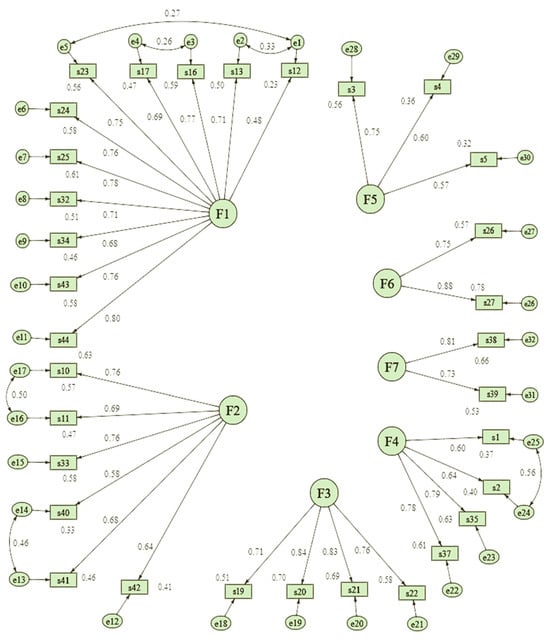
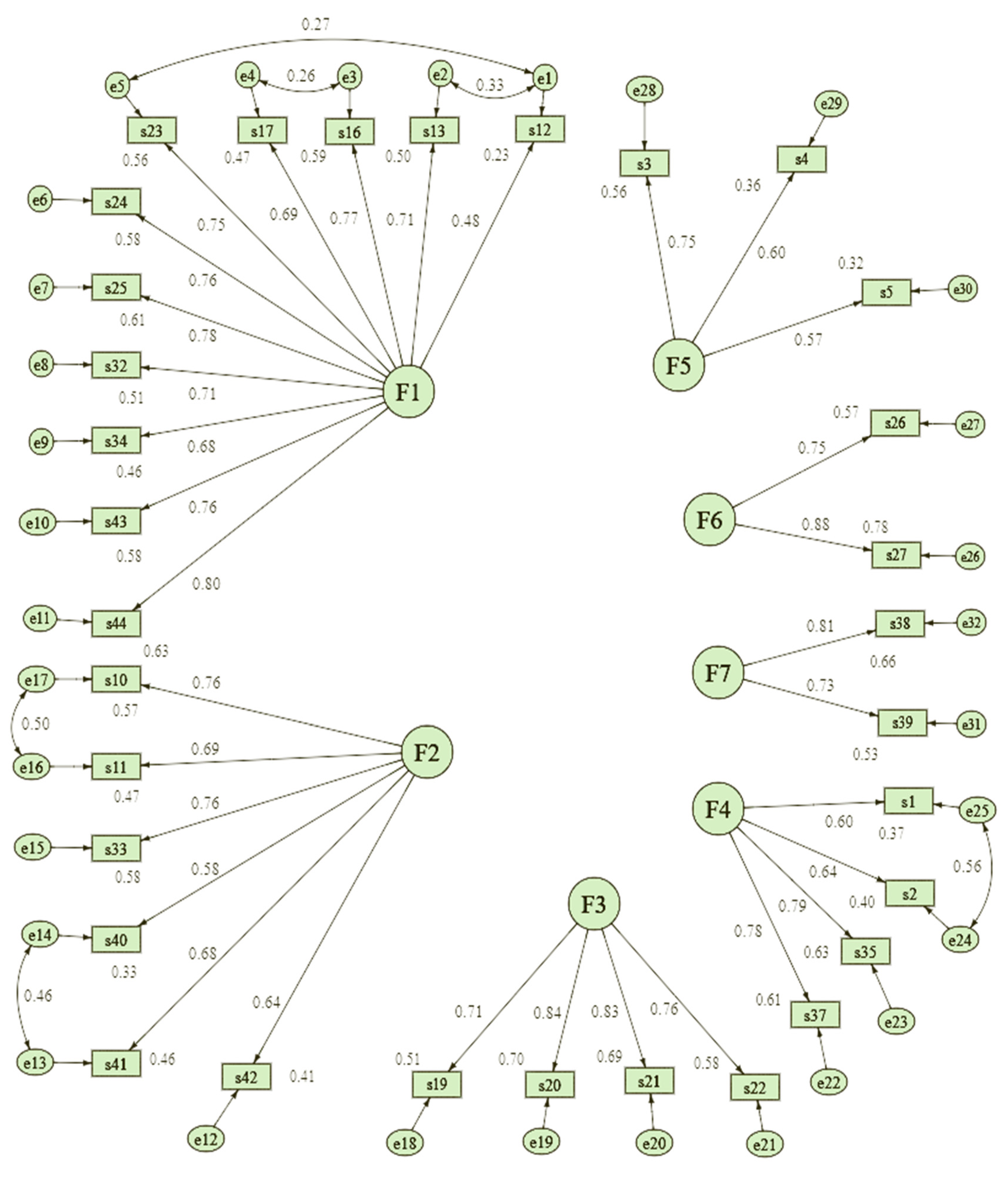
The findings of the Confirmatory Factor Analysis (CFA) conducted on the final scale are presented in Figure 1. The CFA demonstrated that the fit indices of the scale revealed an acceptable fit (χ2 = 933.249; df = 437; CMIN/DF = 2.136; CFI = 0.913; NFI = 0.905; RSMEA = 0.056; p = 0.010) [28].
Figure 1.
Multi-factor analysis model for final ZW-SWM Scale.
Thus, the content of the ZW-SWMS was adequate based on construct validity and reliability. It was determined that the scale could measure ZW-SWM in 7 subdimensions. These seven subdimensions were expectations from ZW-SWM (items 12, 13, 16, 17, 23, 24, 25, 32, 34, 43, and 44), satisfaction with ZW-SWM (items 10, 11, 33, 40, 41, and 42), knowledge on e-waste (items 19, 20, 21, and 22), awareness about ZW-SWM (items 1, 2, 35, and 37), ZW-SWM facilities (items 3, 4, and 5), ZW-SWM behavioral motivation (items 26 and 27), and access to ZW-SWM facilities (items 38 and 39). The items in the final version of the scale are given in Table 6.
Table 6.
The final Zero Waste and Sustainable Waste Management Scale.
The scale subdimensions in the reordered final version were expectations from ZW-SWM (items 8, 9, 10, 11, 16, 17, 18, 21, 23, 31, and 32), satisfaction with ZW-SWM (items 6, 7, 22, 28, 29, and 30), knowledge on e-waste (items 12, 13, 14, and 15), awareness about ZW-SWM (items 1, 2, 24, and 25), ZW-SWM facilities (items 3, 4, and 5), ZW-SWM behavioral motivation (items 19 and 20), and access to ZW-SWM facilities (items 26 and 27). The scale was a 5-point Likert type scale; no items were reverse scored. A high score reflected higher aptitude in the relevant subdimension. The minimum scale score was 32, and the maximum was 160. Descriptive data (mean, standard deviation, minimum, and maximum scores) regarding the subdimensions and total scores of the scale scores obtained according to the final version of the scale are shown in Table 7.
Table 7.
Descriptive data of Zero Waste and Sustainable Waste Management Scale.
Different factors probably play a role in developing waste management behavior [29]. Individual perception is governed by past and current situations and determined by social conditions and individual expectations [30]. They found that individual expectations were a determinant of behavioral choices and significantly positively affected environmentally friendly behavioral intent [31,32]. Wang et al. 2021 revealed that the expectations of urban residents from waste management should be supported by the government and decision makers [33].
Satisfaction will affect a society’s social and environmental sustainability by accelerating service expectations, waste sorting behavior, and perceived quality and social interactions between communities [34,35,36]. It could also provide feedback and opportunities for the legislators to improve waste management systems [37]. Wang et al. 2022 identified waste management fees and services as two critical factors in community satisfaction and found that national satisfaction was influenced by waste rules, waste advertisements, and waste recycling services [38]. Chu et al. 2020 reported that the six factors affecting satisfaction were waste collection method and collection frequency, waste promotion and education, funding and supply status, waste treatment fees, compliance with laws and regulations, and organization of waste sorting facilities [39]. Delcea et al. 2020, assuming that actions taken by NGOs and governments impact e-waste recycling intent, determined that attitude and awareness towards e-waste recycling are the primary influencing factors for recycling intent, social influence, and self-efficacy also affect e-waste recycling intention. They also found that people need campaigns to increase their knowledge and awareness about the harm of e-waste to the environment and human health [40]. A critical component in any waste management program is public awareness and participation, appropriate legislation, strong technical support, and adequate funding [41]. Wang et al. 2020 in their research covering ten different provinces in China, found that public awareness of household waste (HSW) recycling is insufficient, which is reflected in environmentally irresponsible public behavior and inadequate public recycling information [42]. In waste management, the availability and accessibility of recycling facilities and reducing the distance to collection points have been reported to be critical in waste management behavior [2,43]. Reducing the distance to waste drop off points has resulted in better classification of recyclables [44,45]. It was reported that behavioral intent to recycle waste is mainly driven by personal motivation, regulatory laws, and environmental awareness [46]. Noting the importance of awareness in improving the quality of sustainable waste management, individuals are willing and motivated as long as stakeholders such as municipalities and governments continue their awareness campaigns [47,48].
Several facilities were expected from zero waste and sustainable waste management, including the improvement of infrastructure, organization of waste management training to raise awareness, development of regulations, audits and incentives, data collection and analysis, improvement of cooperation, and promotion of innovation and social participation [49,50,51,52,53,54,55]. The significance of meeting these expectations in the achievement of zero waste targets and building a sustainable future has been reported in various studies. As reported by multidimensional studies on waste management, since several social and psychological factors affect waste management behaviors and attitudes, Raghu and Rodrigues [56] argued that basic behavioral, learning, and practice patterns could be measured with such a scale. Jusoh et al. [57] identified the factors that could explain basic waste management behavior, including knowledge, norms, and attitudes. It was suggested that the scale could provide a comprehensive and multidimensional analysis that would include behavioral and attitudinal factors and different practices and opportunities in various cultures and societies [58]. Satisfaction is critical for the effectiveness and sustainability of waste management. Satisfaction promotes social participation, leads to permanent behavioral changes, ensures the effectiveness and acceptance of adopted policies, and increases local governments’ economic efficiency, transparency, and accountability. E-waste knowledge is crucial in zero waste and waste management since e-waste includes hazardous materials that could negatively affect the environment and human health. Knowledge ensures effective e-waste management and promotes recycling, reuse, or adequate disposal of e-waste. The survey findings indicated a requirement to improve e-waste knowledge. Thus, training courses and information campaigns should be organized on media and social media by the SCOs, and social awareness should be raised. Awareness of ZW-SWM requires comprehensive and in-depth knowledge.
High awareness of individuals and organizations on issues such as waste management processes, environmental impact, legal requirements, and sustainability plays a critical role in achieving ZW-SWM targets. Thus, a widespread and continuous awareness-raising campaign would ensure a successful ZW-SWM. It was reported that the improvement of ZW-SWM infrastructure (increasing the number of recycling facilities, expansion of waste sorting facilities, the establishment of composting facilities), the introduction of incentive and support programs, advanced technologies, and national and international collaboration would contribute to the success of waste management. Behavioral motivation would allow individuals and institutions to commit to targets, sustain behavioral changes, and cope with new challenges. It would also promote innovation and broader participation by raising ZW-SWM awareness in society. Thus, strategies that increase motivation are crucial for achieving zero waste and sustainability goals. It was determined that opportunities would facilitate individual participation in waste management, improve society’s motivation, and contribute to developing a more effective ZW-SWM system.
Public awareness, attitude, and sustainable public behavior can be improved by increasing convenience, education, legal regulations, economic incentives, and public participation in decision making processes [59,60]. It was reported that for waste management to be improved and sustainable, the municipality should develop site-specific solutions to its problems in solid waste management, community based efforts need to be mobilized to increase community participation [61], public acceptance is significant in influencing the effectiveness and smooth functioning of the management plan [62], education and public involvement in waste management are positively correlated [63], and incentives in waste management should be considered in two different classes: social and economic (deposit return systems, product fees, etc.) [64].
In one study where behaviors towards household recycling were measured, the factors were determined as importance, discomfort, recycling behavior, subjective social and moral norms, and warm glow [65]. In another study to develop a valid scale for the evaluation of attitudes towards recycling, attitudes towards recycling, attitudes towards reduction and reuse, and attitudes towards the importance of recycling were determined [66]. In the scale of development research investigating the effects of segregation of solid waste on the intention to practice segregation of solid waste, the influencing factors were determined as descriptive norm, injunctive norm, egoistic concern, altruistic concern, biospheric concern, and intention to practice segregation at source of solid waste [67]. In the study that measured the effects of sociodemographic characteristics on municipal waste and separate collection efficiency, the influencing factors were determined to be age, gender, education, income, housing location, housing type, and number of people living in the household [68]. The study conducted in Nigeria with multivariate statistical analysis determined four factors that affected the adoption of sustainable management of municipal solid waste: operational barriers, socioeconomic barriers, natural and physical barriers, and institutional and physical barriers [69]. While determining the factors affecting zero waste behavior before and after the pandemic as saving attitudes and attitudes towards recycling [70], in the research where zero waste management behavior was measured, the presence of facilities, knowledge level, motivation, and awareness were determined [2]. In the present study, where zero waste and sustainable waste management were measured, seven factors were determined: motivation, satisfaction, expectation, awareness, e-waste knowledge, facilities, and access to facilities.
4. Conclusions
Zero waste is a globally accepted sustainable approach that addresses environmental, economic, and social problems and aims to minimize, recycle, reuse, or prevent waste generation. Sustainable waste management requires comprehensive and integrated approaches. Thus, the KMO and Bartlett’s test findings provided substantial correlations between items. Explanatory Factor Analysis demonstrated that the 32-item and 7 subscales exhibited construct validity, and these 7 subscales had quite acceptable levels of Confirmatory Factor Analysis markers. The primary aim of the current study, conducted with 330 volunteer individuals online, was to develop a scale to measure ZW and SWM behavior since only a few studies were conducted in Türkiye. The statistical analyses yielded seven subdimensions: expectation, satisfaction, motivation, awareness, e-waste information, facilities, and accessibility to facilities. This new scale facilitates the evaluation of waste management behaviors in 7 subdimensions and paves the way for its use in different studies in the future. Zero waste and sustainable waste management could be ensured by improving the infrastructure and access to facilities, organizing educational and promotional activities, meeting expectations, increasing motivation, awareness, and satisfaction, and inducing behavioral change in society to adopt zero waste and sustainable waste management.
Since the scale included a multidimensional structure related to psychological, sociological, and managerial areas such as waste management and emphasizes environmental sensitivity, it should be taken into consideration while evaluating the responses and scale scores that the participants may exhibit “positive bias“ in online data collection methods and may have given more socially acceptable responses. The findings in future studies should be interpreted according to the presence of such measurement limitations. Since the scale validity was determined with the KMO-Bartlett’s test, the subdimensions were determined with EFA, and the final scale was analyzed with CFA, the analysis findings should be interpreted with fundamental limitations such as multicollinearity or covariance between the factors, measurement errors, and mediation of the measurement errors with covariance methods in CFA. In addition, the sample size was limited to internet users and the citizens of the Republic of Türkiye. Participants were determined using the conventional sampling method, and most had a Bachelor’s degree or above. Thus, the findings should be interpreted considering these limitations and for contextual evaluation in Türkiye, future studies with different samples like students, participants with an average level of education, or employees in environmental industrial fields should be considered. The construct validity and reliability coefficients were also limited to the assigned sample, and the scale factors, covariance, and regressions between the factors and potential new independent and dependent factors should be investigated in future studies that would be conducted with different and larger samples for generalizability.
Supplementary Materials
The following supporting information can be downloaded at: https://www.mdpi.com/article/10.3390/su162310181/s1, Table S1: Factor relationship coefficients of the items according to CFA; Table S2: Covariance and correlation relationships between factors of the scale.
Funding
This research received no external funding.
Institutional Review Board Statement
The scope of the study was determined to be in compliance with ethical principles and human rights by the SDU Science and Engineering Ethics Committee (Date: 19.01. 2024-78-1).
Informed Consent Statement
Informed consent was obtained from all subjects involved in the study.
Data Availability Statement
Data are contained within the article/Supplementary Material, further inquiries can be directed to the corresponding author.
Acknowledgments
I would like to thank my family, my deceased father, Yılmaz Ikizoglu, my mother, Saadet Ikizoglu, and my older brother, Aykan Ikizoglu, for their support and encouragement in this work as always.
Conflicts of Interest
The author declares no conflicts of interest.
References
- Zaman, A.U.; Swapan, M.S.H. Performance evaluation and benchmarking of global waste management systems. Resour. Conserv. Recycl. 2016, 114, 32–41. [Google Scholar] [CrossRef] [Scilit]
- Coskun, S. Zero Waste Management Behavior: Conceptualization, Scale Development and Validation—A Case Study in Turkey. Sustainability 2022, 14, 12654. [Google Scholar] [CrossRef] [Scilit]
- Çankaya, S.Y.; Sezen, B. Effects of green supply chain management practices on sustainability performance. J. Manuf. Technol. Manag. 2019, 30, 98–121. [Google Scholar] [CrossRef] [Scilit]
- Pércsi, K.N.; Ujj, A.; Jancsovszka, P. Segmentation of Hungarian Consumers Based on Circular Economy Values and Awareness of Food Waste. Sustainability 2023, 15, 8838. [Google Scholar] [CrossRef] [Scilit]
- Agyabeng-Mensah, Y.; Tang, L.; Afum, E.; Baah, C.; Dacosta, E. Organisational identity and circular economy: Are inter and intra organisational learning, lean management and zero waste practices worth pursuing? Sustain. Prod. Consum. 2021, 28, 648–662. [Google Scholar] [CrossRef] [Scilit]
- Dada, M.A.; Majemite, M.T.; Obaigbena, A.; Oliha, S.O.; Biu, P.W. Zero-waste initiatives and circular economy in the U.S.: A review: Exploring strategies, outcomes, and challenges in moving towards a more sustainable consumption model. Int. J. Sci. Res. Arch. 2024, 11, 204–221. [Google Scholar] [CrossRef] [Scilit]
- Prieto-Sandoval, V.; Jaca, C.; Ormazabal, M. Towards a consensus on the circular economy. J. Clean. Prod. 2018, 179, 605–615. [Google Scholar] [CrossRef] [Scilit]
- Geissdoerfer, M.; Savaget, P.; Bocken, N.; Hultink, E.J. The circular economy—A new sustainability paradigm? J. Clean. Prod. 2017, 143, 757–768. [Google Scholar] [CrossRef] [Scilit]
- Zaman, A. Zero-Waste: A New Sustainability Paradigm for Addressing the Global Waste Problem. In The Vision Zero Handbook: Theory, Technology and Management for a Zero Casualty Policy; Springer International Publishing: Cham, Switzerland, 2022; pp. 1–24. ISBN 78-3-030-76505-7. [Google Scholar] [CrossRef] [Scilit]
- Awasthi, A.K.; Cheela, V.S.; D’Adamo, I.; Iacovidou, E.; Islam, M.R.; Johnson, M.; Miller, T.R.; Parajuly, K.; Parchomenko, A.; Radhakrishan, L.; et al. Zero waste approach towards a sustainable waste management. Resour. Environ. Sustain. 2021, 3, 100014. [Google Scholar] [CrossRef] [Scilit]
- Parchomenko, A.; Nelen, D.; Gillabel, J.; Vrancken, K.C.; Rechberger, H. Evaluation of the resource effectiveness of circular economy strategies through multilevel Statistical Entropy Analysis. Resour. Conserv. Recycl. 2020, 161, 10492. [Google Scholar] [CrossRef] [Scilit]
- Winnipeg: 7R Basics. Available online: https://guides.wpl.winnipeg.ca/greenchoices/basics#:~:text=Getting%20started%20with%20the%207Rs,Reuse%2C%20Repair%2C%20Regift%2C%20Recycle (accessed on 1 September 2024).
- Parajuly, K.; Colin Fitzpatrick, C.; Orla Muldoon, O.; Ruediger Kuehr, R. Behavioral change for the circular economy: A review with focus on electronic waste management in the EU. Resour. Conserv. Recycl. X 2020, 6, 100035. [Google Scholar] [CrossRef] [Scilit]
- Lee, R.P.; Meyer, B.; Huang, Q.; Voss, R. Review Article Sustainable waste management for zero waste cities in China: Potential, challenges and opportunities. Clean Energy 2020, 4, 169–201. [Google Scholar] [CrossRef] [Scilit]
- Nassani, A.A.; Hussain, H.; Condrea, E.; Grigorescu, A.; Yousaf, Z.; Haffar, M. Zero Waste Management: Investigation of Green Technology, the Green Supply Chain, and the Moderating Role of CSR Intentions. Sustainability 2023, 15, 4169. [Google Scholar] [CrossRef] [Scilit]
- Recycling Rate: What is the Situation in Turkey and Europe in Waste Treatment? Available online: https://tr.euronews.com/2023/08/01/geri-donusum-orani-atik-aritmada-turkiyede-ve-avrupada-durum-ne (accessed on 4 October 2024).
- Recycling Rates in Waste Treatment in Türkiye and Europe. Available online: https://gekader.org.tr/turkiye-ve-avrupadaki-atik-aritiminda-geri-donusum-oranlari/ (accessed on 5 October 2024).
- Lakhan, C. Differences in selfreported recycling behavior of first and second generation South Asians in Ontario, Canada. Resour. Conserv. Recycl. 2015, 97, 31–43. [Google Scholar] [CrossRef] [Scilit]
- Lakhan, C. Out of sight, out of mind: Issues and obstacles to recycling in Ontario’s multi residential buildings. Resour. Conserv. Recycl. 2016, 108, 1–9. [Google Scholar] [CrossRef] [Scilit]
- Lee, M.; Choi, H.; Koo, Y. Inconvenience cost of waste disposal behavior in South Korea. Ecol. Econ. 2017, 140, 58–65. [Google Scholar] [CrossRef] [Scilit]
- Echegaray, F.; Hansstein, F.V. Assessing the intention-behavior gap in electronic waste recycling: The case of Brazil. J. Clean. Prod. 2017, 142, 180–190. [Google Scholar] [CrossRef] [Scilit]
- Tümer Kabadayı, E.; Dursun, İ.; Gökmen Köksal, C.; Durmaz, A.; Yüksel, M. A systematic literature review on barriers to individual recycling behavior. Int. J. Eurasia Soc. Sci. 2023, 14, 800–835. [Google Scholar] [CrossRef] [Scilit]
- Limon, M.R.; Villarino, C.B.J. Knowledge, attitudes and practices on household food waste: Bases for formulation of a recycling system. Glob. J. Environ. Sci. 2020, 6, 323–340. [Google Scholar] [CrossRef] [Scilit]
- Dixon, J.; Parker, J. Don’t be a waster! Student perceptions of recycling strategies at an English University’s halls of residence. Int. J. Sustain. High. Educ. 2022, 23, 461–477. [Google Scholar] [CrossRef] [Scilit]
- Adam, A.M. Sample size determination in survey research. J. Sci. Res. Rep. 2020, 26, 90–97. [Google Scholar] [CrossRef] [Scilit]
- Hair, J.F.; Black, W.C.; Babin, B.J.; Anderson, R.E.; Tatham, R.L. Multivariate Data Analysis, 8th ed.; Cengage Learning EMEA: Hampshire, UK, 2018; ISBN 978-1-4737-5654-0. [Google Scholar]
- Arıcı, H. Statistics, Methods and Applications; Meteksan Printing House: Ankara, Turkey, 1998; ISBN 978-975-7746-05-8. [Google Scholar]
- Hu, L.; Bentler, P.M. Cutoff criteria for fit indexes in covariance structure analysis: Conventional criteria versus new alternatives. Struct. Equ. Model. A Multidiscip. J. 1999, 6, 1–55. [Google Scholar] [CrossRef] [Scilit]
- Abbasi, S.A.; Khalil, A.B.; Arslan, M. Extensive use of face masks during COVID-19 pandemic: Micro-plastic pollution and potential health concerns in the Arabian Peninsula Saudi. J. Biol. Sci. 2020, 27, 3181–3186. [Google Scholar] [CrossRef] [Scilit]
- Kaoje, A.U.; Sabir, A.A.; Yusuf, S.; Jimoh, A.O.; Raji, M.O. Residents’ perception of solid waste disposal practices in Sokoto, Northwest Nigeria. Afr. J. Environ. Sci. Technol. 2017, 11, 94–102. [Google Scholar] [CrossRef] [Scilit]
- Kiatkawsin, K.; Han, H. Young travelers’ intention to behave pro-environmentally: Merging the value-belief-norm theory and the expectancy theory. Tour. Manag. 2017, 59, 76–88. [Google Scholar] [CrossRef] [Scilit]
- Tang, H.; Liu, Z.; Long, X. Analyzing the farmers’ pro-environmental behavior intention and their rural tourism livelihood in tourist village where its ecological environment is polluted. PLoS ONE 2021, 16, e0247407. [Google Scholar] [CrossRef] [Scilit]
- Wang, H.; Gui, H.; Ren, C.; Lui, G. Factors Influencing Urban Residents’ Intention of Garbage Sorting in China: An Extended TPB by Integrating Expectancy Theory and Norm Activation Model. Sustainability 2021, 13, 12985. [Google Scholar] [CrossRef] [Scilit]
- Puche-Regaliza, J.C.; Porras-Alfonso, S.; Jiménez, A.; Aparicio-Castillo, S.; Arranz-Val, P. Exploring determinants of public satisfaction with urban solid waste collection services quality. Environ. Dev. Sustain. 2021, 23, 9927–9948. [Google Scholar] [CrossRef] [Scilit]
- Wang, Q.; Long, X.; Li, L.; Kong, L.; Zhu, X.; Liang, H. Engagement factors for waste sorting in China: The mediating effect of satisfaction. J. Clean. Prod. 2020, 267, 122046. [Google Scholar] [CrossRef] [Scilit]
- Chatterjee, R.; Suy, R. An overview of citizen satisfaction with public service: Based on the model of expectancy disconfirmation. Open J. Soc. Sci. 2019, 7, 243–258. [Google Scholar] [CrossRef]
- Deus, R.M.; Bezerra, B.S.; Battistelle, R.A.G. Solid waste indicators and their implications for management practice. Int. J. Environ. Sci. Technol. 2019, 16, 1129–1144. [Google Scholar] [CrossRef] [Scilit]
- Wang, A.; Chen, X.; Wang, X.; Wei, J.; Song, L. Determinants of Satisfaction with Solid Waste Management Services: A Central–Local Comparison in China. Int. J. Environ. Res. Public Health 2022, 19, 4610. [Google Scholar] [CrossRef] [Scilit] [PubMed]
- Chu, X.; He, Z.; Fan, X.; Ling Zhang, L.; Hong Wen, H.; Huang, W.C.; Wang, T. The influencing factors of Harbin (China) residents’ satisfaction with municipal solid waste treatment. Waste Manag. Res. 2021, 39, 83–92. [Google Scholar] [CrossRef] [Scilit] [PubMed]
- Delcea, C.; Craciun, L.; Ioanas, C.; Ferruzzi, G.; Cotfas, L.A. Determinants of Individuals’ E-Waste Recycling Decision: A Case Study from Romania. Sustainability 2020, 12, 2753. [Google Scholar] [CrossRef] [Scilit]
- Hasan, S.E. Public Awareness Is Key to Successful Waste Management. J. Environ. Sci. Health Part A 2004, 39, 483–492. [Google Scholar] [CrossRef] [Scilit] [PubMed]
- Wang, H.; Liu, X.; Wang, N.; Zhang, K.; Wang, F.; Zhang, S.; Wang, R.; Zheng, P.; Matsushita, M. Key factors influencing public awareness of household solid waste recycling in urban areas of China: A case study. Resour. Conserv. Recycl. 2020, 158, 104813. [Google Scholar] [CrossRef] [Scilit]
- Varotto, A.; Spagnolli, A. Psychological strategies to promote household recycling. A systematic review with meta-analysis of validated field interventions. J. Environ. Psychol. 2017, 51, 168–188. [Google Scholar] [CrossRef] [Scilit]
- Arain, A.L.; Pummill, R.; Adu-Brimpong, J.; Becker, S.; Green, M.; Ilardi, M.; Van Dam, E.; Neitzel, R.L. Analysis of e-waste recycling behavior based on survey at a Midwestern US University. Waste Manag. 2020, 105, 119–127. [Google Scholar] [CrossRef] [Scilit]
- Rousta, K.; Bolton, K.; Lundin, M.; Dahlén, L. Quantitative assessment of distance to collection point andimproved sorting information on source separation of household waste. Waste Manag. 2015, 40, 22–30. [Google Scholar] [CrossRef] [Scilit]
- Jain, S.; Singhal, S.; Jain, K.N.; Bhaskar, K. Construction and demolition waste recycling: Investigating the role of theory of planned behavior, institutional pressures and environmental consciousness. J. Clean. Prod. 2020, 263, 121405. [Google Scholar] [CrossRef] [Scilit]
- Joshi, R.; Ahmed, S. 2016. Status and challenges of municipal solid waste management in India: A review. Cogent Environ. Sci. 2016, 2, 1139434. [Google Scholar] [CrossRef] [Scilit]
- Talyan, V.; Dahiya, R.P.; Sreekrishnan, T.R. State of Municipal Solid Waste Management in Delhi, the Capital of India. Waste Manag. 2008, 28, 1276–1287. [Google Scholar] [CrossRef] [Scilit] [PubMed]
- Lehmann, S. Optimizing urban material flows and waste streams in urban development through principles of zero waste and sustainable consumption. Sustainability 2011, 3, 155–183. [Google Scholar] [CrossRef] [Scilit]
- Farmer, T.D.; Shaw, P.J.; Williams, I.D. Destined for indecision? A critical analysis of waste management practices in England from 1996 to 2013. Waste Manag. 2015, 39, 266–276. [Google Scholar] [CrossRef] [Scilit]
- Curran, T.; Williams, I.D. A zero waste vision for industrial networks in Europe. J. Hazard. Mater. 2012, 207, 3–7. [Google Scholar] [CrossRef] [Scilit]
- Mourad, M. Recycling, recovering and preventing ‘‘food waste”: Competing solutions for food systems sustainability in the United States and France. J. Clean. Prod. 2016, 126, 461–477. [Google Scholar] [CrossRef] [Scilit]
- Yazan, D.M.; Romano, V.A.; Albino, V. The design of industrial symbiosis: An input–output approach. J. Clean. Prod. 2016, 129, 537–547. [Google Scholar] [CrossRef] [Scilit]
- Pitkänen, K.; Antikainen, R.; Droste, N.; Loiseau, E.; Saikku, L.; Aissani, L.; Hansjürgens, B.; Kuikman, P.J.; Leskinen, P.; Thomsen, M. What can be learned from practical cases of green economy? studies from five European countries. J. Clean. Prod. 2016, 139, 666–676. [Google Scholar] [CrossRef] [Scilit]
- Zaman, A.U. A Strategic Framework for Working toward Zero Waste Societies Based on Perceptions Surveys. Recycling 2017, 2, 1. [Google Scholar] [CrossRef] [Scilit]
- Raghu, S.J.; Rodrigues, L.L.R. Behavioral aspects of solid waste management: A systematic review. J. Air Waste Manag. Assoc. 2020, 70, 1268–1302. [Google Scholar] [CrossRef] [Scilit]
- Jusoh, Z.M.; Kasim, N.; Ibrahim, M.U.; Sarpin, N.; Noh, H.M.; Zainal, R. Influential factors for effective materials management in construction projects. Int. J. Sustain. Constr. Eng. Technol. 2018, 9, 45–54. [Google Scholar] [CrossRef] [Scilit]
- Ibáñez, M.E.; Ferrer, D.M.; Muñoz, L.V.A.; Claros, F.M.; Ruiz, F.J.O. University as Change Manager of Attitudes towards Environment (The Importance of Environmental Education). Sustainability 2020, 12, 4568. [Google Scholar] [CrossRef] [Scilit]
- Tarasova, N.P.; Gorbunova, V.V.; Ivanova, S.A.; Zaitsev, V. A The problem of utilization of spent household batteries. Russ. J. Gen. Chem. 2012, 82, 1027–1030. [Google Scholar] [CrossRef] [Scilit]
- Che, Y.; Yang, K.; Jin, Y.; Zhang, W.; Shang, Z.; Tai, J. Residents’ concerns and attitudes toward a municipal solid waste landfill: Integrating a questionnaire survey and GIS techniques. Environ. Monit. Assess. 2013, 185, 10001–10013. [Google Scholar] [CrossRef] [Scilit]
- Rotich, K.; Henry, R.K.; Yongsheng, Z.; Jun, D. Municipal solid waste management challenges in developing countries—Kenyan case study. Waste Manag. 2006, 26, 92–100. [Google Scholar] [CrossRef] [Scilit]
- Achillas, C.; Vlachokostas, C.; Moussiopoulos, N.; Banias, G.; Kafetzopoulos, G.; Karagiannidis, A. Social acceptance for the development of a waste-to-energy plant in an urban area. Resour. Conserv. Recycl. 2011, 55, 857–863. [Google Scholar] [CrossRef] [Scilit]
- Zen, I.S.; Noor, Z.Z.; Yusuf, R.O. The profiles of household solid waste recyclers and non-recyclers in Kuala Lumpur, Malaysia. Habitat Int. 2014, 42, 83–89. [Google Scholar] [CrossRef] [Scilit]
- Ma, J.; Hipel, K.W. Exploring social dimensions of municipal solid waste management around the globe—A systematic literature review. Waste Manag. 2016, 56, 3–12. [Google Scholar] [CrossRef] [Scilit] [PubMed]
- Nguyen, N.; Nguyen, H.V.; Lobo, A.; Dao, S. Encouraging Vietnamese Household Recycling Behavior: Insights and Implications. Sustainability 2017, 9, 179. [Google Scholar] [CrossRef] [Scilit]
- Ugulu, I. Development and validation of an instrument for assessing attitudes of high school students about recycling. Environ. Educ. Res. 2014, 21, 916–942. [Google Scholar] [CrossRef] [Scilit]
- Klufová, R.; Skibiński, A. The Importance of Selected Demographic Factors in Municipal Waste Management. Pol. J. Manag. Stud. 2024, 29, 161–181. [Google Scholar] [CrossRef] [Scilit]
- Chenga, K.W.; Syuhaily Osmana, S.; Jusoha, Z.M.; Laua, J.L. Multidimensional factors that influence the intention to practice segregation-at-source of solid waste: An empirical study. Manag. Sci. Lett. 2021, 11, 379–390. [Google Scholar] [CrossRef] [Scilit]
- Ezeah, C.; Roberts, C.L. Analysis of barriers and success factors affecting the adoption of sustainable management of municipal solid waste in Nigeria. J. Environ. Manag. 2012, 103, 9–14. [Google Scholar] [CrossRef] [Scilit] [PubMed]
- Coskun, S. Effect of the COVID-19 pandemic period on Zero Waste Awareness: A scale development survey in Turkey. Glob. NEST J. 2021, 23, 581–589. [Google Scholar] [CrossRef] [Scilit]

Disclaimer/Publisher’s Note: The statements, opinions and data contained in all publications are solely those of the individual author(s) and contributor(s) and not of MDPI and/or the editor(s). MDPI and/or the editor(s) disclaim responsibility for any injury to people or property resulting from any ideas, methods, instructions or products referred to in the content. |
© 2024 by the author. Licensee MDPI, Basel, Switzerland. This article is an open access article distributed under the terms and conditions of the Creative Commons Attribution (CC BY) license (https://creativecommons.org/licenses/by/4.0/).