1. Introduction
Fruits are an important component of the human diet due to their health-promoting properties related to many valuable vitamins, minerals, and other biologically active substances, e.g., those with potent antioxidant properties [
1]. Fruits that grow in warm temperature zones have more excellent health-promoting properties [
2,
3,
4]. These qualities result from intense solar radiation during the growing season [
5]. Such fruits are called superfruits. An example of this type of fruit is the pomegranate [
6]. Its leading producers are India, Iran, the USA, Turkey, Spain, and Israel. At the beginning of the 21st century, the Republic of South Africa joined the pomegranate producer group.
Regarding pomegranate production, South Africa competes with countries such as Chile, Argentina, and Australia [
7] because it delivers these fruits to international markets during the pre-season [
8]. The global pomegranate market was valued at
$8.2 billion in 2018 and is expected to reach
$23.14 billion by 2026. The growing demand for pomegranates and other pomegranate-based products is due to their widespread popularity as functional food and a source of nutraceuticals [
9,
10]. Although interest in producing the so-called superfruits is growing worldwide, access to them is restrained due to climatic requirements or the necessity to transport them over long distances.
However, superfruits are certainly, most of all, the result of marketing, and the interest in them is growing [
11]. In the era of s globalisation, a modern, demanding consumer wants to benefit from the advantages of nature regardless of the climate zone he lives in and whether he needs food with such unique properties. Although superfruits can be replaced by other fruits local in particular areas, interest in them is, and will be, high. An example of this statement may be the growing interest in avocados [
12].
Unfortunately, due to their high water content, the vast majority of fruits, on the one hand, have relatively restrained shelf life even in optimal storage conditions, and on the other hand, they are extremely demanding cargo in the transport process [
8]. Therefore, solutions to improve their availability are being sought [
13]. One such solution is producing fruit juices in the areas where they are obtained and, subsequently, the organisation of their transport to their destination [
9]. Temperature, oxygen, and solar radiation are the main factors contributing to the quality of fresh fruit juice. However, some of these factors can be modified and even controlled to maintain a high quality of the product. This approach is compatible with reducing food loss and waste, an essential element of sustainable development [
14].
One of the most critical elements of food distribution is its transport. It enables the delivery of food from the place of its production to consumers worldwide. The condition for successful transport of food products is their delivery in unchanged quality. To achieve this, the means of transport should be selected appropriately to the transport duration and the cargo’s characteristics. Therefore, planning the transport and proceeding carefully while conducting it is important. The essential element is to provide the appropriate environmental parameters and to monitor them permanently during motion. This enables maintaining proper parameters of the cargo, which determine its quality and, consequently, its suitability for consumption by the consumer. Food belongs to the group of perishable goods; hence, it is essential to plan a detailed itinerary and duration of transport. Moreover, it is also fundamental to select the means of transport appropriate to the requirements of a particular foodstuff [
14,
15].
Tankships may be used to conduct maritime transport of juices. These vessels are also called tankers, and they are designed as cisterns. Furthermore, the specialised ships adapted to transport one specific type of liquid goods, e.g., water, oil, juice, or wine, may also be exploited. In addition, isometric containers, which reduce heat transfer, may be applied to juice transport. Another way to transport liquid cargo in a container is to utilise a flexitank. The advantages of using a flexitank in transporting liquid materials include a diminution in packaging costs and a reduction in the volume required to transport the same amount of cargo. This tank is also one of the most ecological types of liquid cargo transport.
Most foodstuffs need to be transported at a constant, reduced temperature and appropriate humidity in an atmosphere with adequate gas composition and without the impact of solar radiation [
16,
17]. If this is not preserved, their quality deteriorates, meaning they may partially or entirely lose their valuable properties for the human body. In extreme conditions, they may not be suitable for consumption at all. This will subsequently lead to the necessity of their disposal. It is worth emphasising that the complete degradation of a product, which makes it unsuitable for consumption, is a highly unfavourable situation. This is mainly because this product is produced using energy-advanced processes, far from the place of its intended consumption, and requires transportation. This situation would be a failure for everyone, from producers to consumers, from an ecological and economic point of view [
18,
19].
This study includes a comparison of the results of a simulation of the influence of selected parameters (temperature, gas, mixing) during the transport of pomegranate juice on changes in such quality parameters as the content of polyphenols and the degree of reduction in DPPH free radicals. The research aimed to identify the significance of differences in changes in two selected parameters characterising the quality of pomegranate juice under the influence of various combinations of three controlled external factors. It was achieving this goal that enabled us to indicate the optimal conditions for preserving the quality of pomegranate juice during its maritime transport. Three preliminary assumptions were made in the study. The first one stated that lowering the temperature to 278.15 K is the most influential factor inhibiting the reduction in the polyphenol content and the degree of reduction in DPPH free radicals over time. The second one indicated that filling the pomegranate juice package with nitrogen would significantly restrain the reduction in the polyphenol content and the degree of reduction in DPPH free radicals over time compared to control samples. Finally, the third assumption implied that mixing the juice during transport in the presence of nitrogen would enhance the blanketing effect. In contrast, the presence of air would accelerate the quality deterioration.
2. Materials and Methods
2.1. Materials
The research material was pomegranate juice, produced by the company “PPHU KORKUS-Jan Korkus”, reconstituted from concentrated juice and preserved by pasteurisation. It was packed in 750 mL glass bottles. In order to carry out a complete simulation, 17 bottles of juice were purchased at the Auchan store in Gdynia, and then their contents were mixed.
The research material was poured into 24 plastic bottles with a capacity of 500 mL. Each bottle had been adequately prepared in advance. Holes had been drilled in the cap and the bottom of each bottle. The valve stems had been placed into these holes and hermetically sealed with the bottle using silicone. During the research, nitrogen was injected through a valve stem into 12 bottles containing the same amount of juice. The remaining 12 bottles were injected with air. Six bottles with air were placed at a temperature of 278.15 K, and the same number of bottles were placed at a temperature of 293.15 K. The analogous procedure was applied to bottles filled with nitrogen. Half of the air-filled bottles were subjected to mixing on the laboratory rocker shaker to simulate the ship rolling during maritime transport. The other half was not exposed to mixing. The same procedure was applied to bottles filled with nitrogen. Thus, the experiment included measuring parameter changes indicating the diversification of juice quality during storage in 8 different storage conditions. The influence of mixing or lack of this kind of impact on the product was defined as a storage method in the further part of the research. The study lasted 11 days. Measurements of the examined parameters of juice quality began with determining the initial value of these parameters in the research material, and then on the 3rd, 7th, and 11th day of the research process, simulating the conditions prevailing during the maritime transport of juice took place.
The simulation was conducted in laboratory conditions on research material standardised regarding quality parameters. It determined the sum of polyphenolic compounds and the degree of reduction in DPPH free radicals.
2.2. Preparation of Ethanol Extract from Juice for Research
A volume of 30 mL of 80% ethanol alcohol was added to the five grams of the analysed juice, and extraction was performed. It was carried out for one hour at a temperature of 293.15 K without light. The mixture was then centrifuged at 1130 rpm. After 20 min of centrifugation, the extract was filtered into a 50 mL volumetric flask. The contents were filled to the mark with 80% alcohol. The resulting extract was used to determine the content of total polyphenols and their ability to inhibit free radicals.
2.3. Assessment of the Total Polyphenolic Compounds Content
The Folin–Ciocalteu method was used to determine the total polyphenol content. The essence of this method is the measurement of the absorbance of the complex formed under the influence of the reduction in salts of /acids, i.e., the Folin–Ciocalteu reagent.
Then, 0.1 mL of ethanol extract of the analysed samples, 6 mL of distilled water, 0.5 mL of Folin–Ciocalteu reagent (2.0 mol L), and 1.5 mL of saturated Na
2CO
3 solution were added to a 10 mL volumetric flask. The contents of the flask were filled to the mark with distilled water. After 30 min of incubation at 313.15 K, the absorbance of the samples was measured three times. The measurement was performed with a Semco S/Ec spectrophotometer at the wavelength of λ = 765 nm. The average polyphenol content was presented as the equivalent of gallic acid in 100 g of the tested material (mg GAE 100 g) [
20,
21].
2.4. Assessment of the Extent of Reduction in DPPH Free Radicals
The total antiradical activity was determined using the method described by Brand-Williams, Cuvelier, and Berset (1995). It uses a synthetic DPPH radical (2,2-diphenyl-1-picrylhydrazyl). To prepare a 0.5 mM DPPH alcohol solution, 19.71 mg of synthetic DPPH (M = 392.32 g/mol) was dissolved in 100 mL of ethanol. The resulting solution was diluted, and its absorbance at a wavelength of λ = 517 nm was 0.9.
The test sample was a mixture of 1.5 mL of DPPH solution and 0.02 mL of extract with a concentration of 100 mg of juice per 1 mL of extract. Thirty minutes after initiating the reaction, the absorbance of the analysed solutions was measured with a Semco S/EC spectrophotometer at a wavelength of 517 nm against a blank sample. It consisted of 1.5 mL of ethanol and 0.02 mL of test solutions. A mixture of 1.5 mL of DPPH solution and 0.02 mL of ethanol was used as a control sample. The measurements were performed three times. On their basis, the average absorbance value was determined for each juice.
The ability of the tested juices to counteract the oxidation reaction, defined as the percentage inhibition of a free radical, was calculated based on Equation (1):
where:
2.5. Kinetic Models
Based on the Arrhenius model, empirical data on changes in critical quality characteristics of grant juice during storage were presented as kinetic parameters, such as the first-order rate constant, half-life, and activation energy.
The above parameters were determined based on the equations:
first-order rate constant:
where:
half-life of transformation:
where:
activation energy:
where:
k1—reaction rate constant at a lower temperature (days−1),
k2—reaction rate constant at a higher temperature (days−1),
R—universal gas constant (8.314 J mol−1 K−1),
T1—lower storage temperature (K),
T2—higher storage temperature (K) [
23].
2.6. Statistical Methods
The results of determining individual quality characteristics are presented as the arithmetic mean of three samples for each storage variant.
Statistica 13.3 (TIBCO Software Inc., Palo Alto, California, USA) was used for statistical analysis. Determining the influence of storage parameters (temperature, gas, storage method) on the analysed quality characteristics was completed using multivariate variance analysis (MANOVA).
The existence of normality of distribution was checked using the Shapiro–Wilk test. The obtained p-statistic values were above 0.05 (p > 0.05). Therefore, there were no grounds to reject the hypothesis about the lack of normality in the distribution of the analysed data.
However, the Brown–Fortyhe test was used to check the homogeneity of variances. It verified the null hypothesis regarding the existence of equality of variances. The obtained p values were higher than 0.05 (p > 0.05), so an assumption of homogeneity of variance was made.
The Tukey test was used to determine the significance of differences between the analysed samples of research material. p values lower than 0.05 indicated statistically significant differences.
The results of the statistical assessment are presented in charts indicating middle-class affiliation using a letter classification [
24].
3. Results
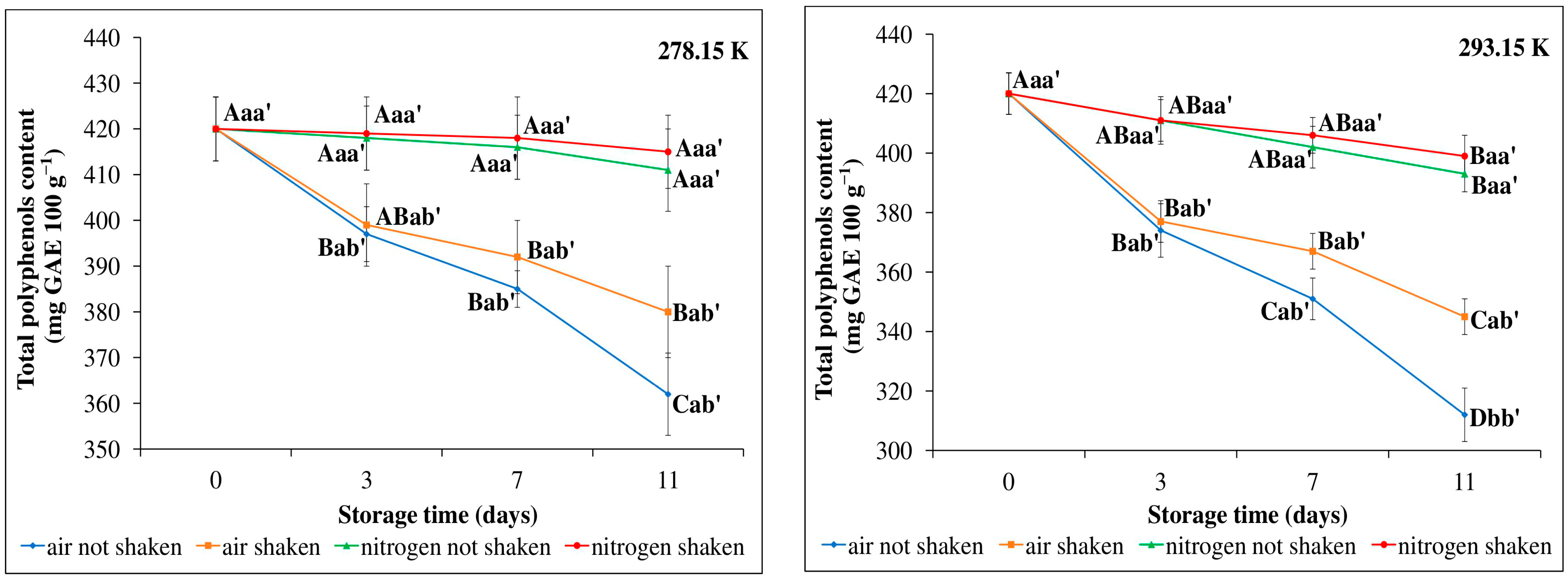
Changes in the quality of pomegranate juice, caused by its maritime transport under simulated conditions, were identified based on the content of polyphenols and the ability to reduce free radicals. These parameters were considered critical for the quality of pomegranate juice, which is becoming increasingly popular among consumers due to its advantageous health-promoting properties. The content of polyphenols in pomegranate juice, depending on the storage conditions, is shown in
Figure 1.
The initial polyphenol content in the examined pomegranate juice was 420 ± 7 mg GAE per 100 g product. In most of the variants of the experiment, a systematic decrease in the polyphenol content was observed during storage (see the capital letters in
Figure 1). The dynamics of this change were determined by the combination of storage parameters (temperature, gas, mixing). The slightest changes in the content of polyphenols were identified in juice stored at a temperature of 278.15 K, in a nitrogen atmosphere that was systematically mixed during storage. The content of polyphenols decreased by 1.2% of the initial value (415 ± 8 mg GAE per 100 g of product) after 11 days of storage. Under the same conditions, the polyphenol content in unmixed juice decreased by 2.1% of the initial value (411 ± 9 mg GAE·100 g). Increasing the temperature of juice storage in a nitrogen atmosphere to 293.15 K with simultaneous mixing generated a decrease in the polyphenol content by 5.0% of the initial value (399 ± 7 mg GAE·100 g).
On the other hand, eliminating the mixing of juice stored in these conditions decreased the polyphenol content by 6.4% of the initial value (393 ± 6 mg GAE·100 g). Replacing nitrogen with air and storing the juice at a temperature of 278.15 K combined with its systematic mixing resulted in a decrease in polyphenol content by 9.5% of the initial value (380 ± 10 mg GAE·100 g). Furthermore, eliminating the mixing of juice stored in the same conditions caused a decrease in polyphenol content by 13.8% of the initial value (362 ± 9 mg GAE·100 g). Increasing the temperature of juice storage in an air atmosphere to 293.15 K, combined with its systematic mixing, decreased polyphenol content by 17.6% of the initial value (346 ± 6 mg GAE·100 g). In the juice stored in the same conditions but not mixed, the polyphenol content decreased by 25.7% of the initial value (312 ± 9 mg GAE·100). Therefore, it has been proven that this storage variant is highly unfavourable for the quality of pomegranate juice in terms of polyphenol content.
The dominant factor limiting the dynamics of polyphenol content reduction was using nitrogen as a gas that filled the packaging. Regardless of other storage conditions parameters, the quality of this juice was the most stable over time (see the lowercase letters with apostrophes in
Figure 1). The second important factor inhibiting the dynamics of polyphenol content decrease was the low storage temperature (278.15 K). Despite the type of gas filling the packaging and whether the samples were mixed or not, the polyphenol content reduction was consistently lower in samples stored at 278.15 K compared to the reduction in this parameter at 293.15 K. The combination of both factors (nitrogen and temperature of 278.15 K) resulted in the indication that the best final quality, determined by the presence of polyphenols, had the juice stored in a nitrogen atmosphere at a temperature of 278.15 K and mixed during the storage.
On the other hand, the most unfavourable final quality, associated with a reduction in the polyphenol content, had the juice stored in an air atmosphere at a temperature of 293.15 K, which was not mixed during the storage. Mixing the juice with the gas that filled the packaging, regardless of the gas type, diminished ongoing changes. In most cases, this difference could not be considered significant (see the lowercase letters in
Figure 1).
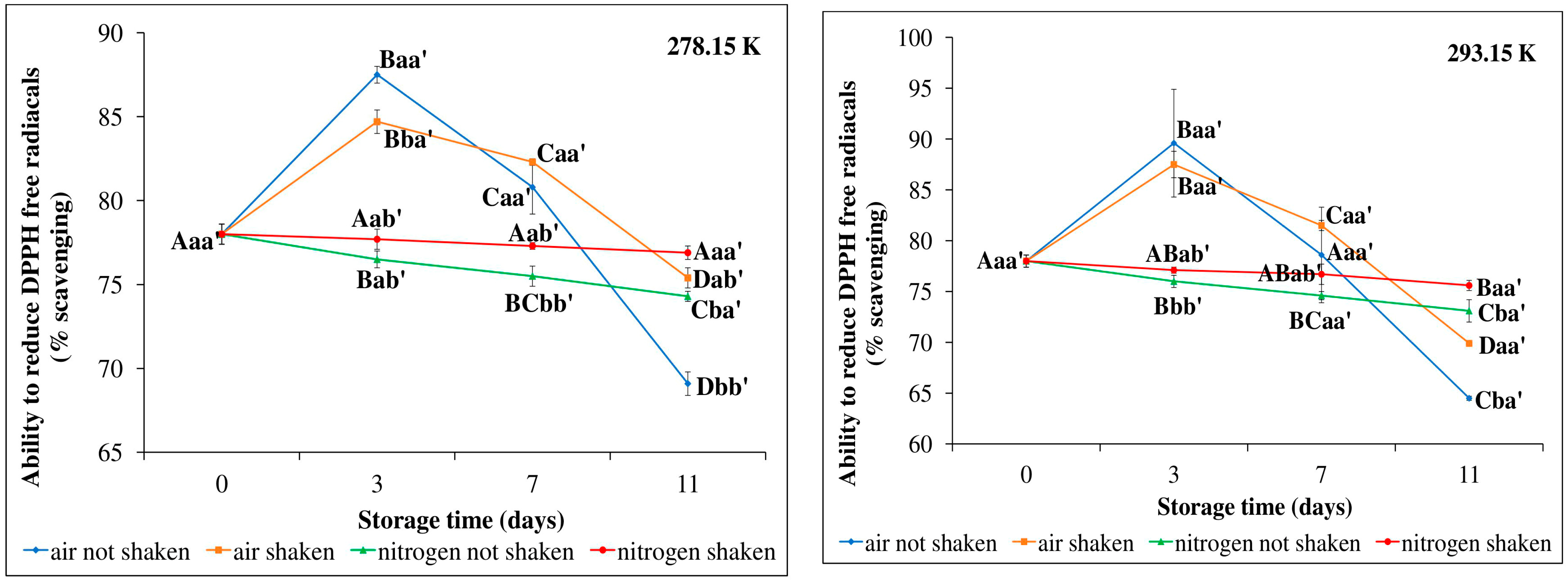
The ability to reduce free radicals in pomegranate juice depending on the storage conditions is shown in
Figure 2.
The initial ability to reduce free radicals in the examined pomegranate juice was 78.0%. In variants of the experiment that involved the utilisation of nitrogen, a systematic decrease in the ability to reduce free radicals was observed. On the other hand, in the variant of the experiment that involved the utilisation of air, an increase in the ability to reduce free radicals was observed in the initial phase of storage (up to 3rd day), and this increase was higher at a temperature of 293.15 K (see the capital letters in
Figure 2). Then, a systematic decrease in the ability to reduce free radicals was observed in the later phase (from the 3rd to the 11th day). The dynamics of this change were related to the combination of storage parameters (temperature, gas, mixing). The most minor changes were identified in juice stored at a temperature of 278.15 K, in a nitrogen atmosphere that was systematically mixed during storage (decreased by 1.3% of the initial value-approximately 77.0% inhibition after 11 days of storage). A higher decrease in capacity was noted in the case of the juice that was stored in a nitrogen atmosphere, at a temperature of 293.15 K, with simultaneous mixing (3.0% of the initial value-75.7% inhibition). In addition, another decrease in the ability to reduce free radicals was noted in the juice stored in an air atmosphere, at a temperature of 278.15 K, which was mixed (3.3–75.4% inhibition).
Nonetheless, an even lower ability to reduce free radicals was found in the juice stored in a nitrogen atmosphere at 278.15 K, which was not mixed (4.8–74.3% inhibition). Increasing the temperature of juice storage in nitrogen and eliminating mixing resulted in a reduction in the ability to reduce free radicals (6.1–73.2% inhibition). However, the utilisation of air at a temperature of 293.15 K as the gas that filled the packaging and the implementation of mixing the juice led to a decrease in the ability to reduce free radicals by 10.4% of the initial value—69.8% inhibition. In addition, greater diminution in the ability to reduce free radicals was identified in juice stored in an air atmosphere, at a temperature of 278.15 K, which was not mixed (11.4–69.1% inhibition). Moreover, increasing only the temperature of juice storage in the air atmosphere to 293.15 K led to a decrease in the ability to reduce free radicals by 17.3% of the initial value—64.5% inhibition. Hence, this storage variant turned out to be extremely unfavourable for the quality of pomegranate juice in terms of its ability to reduce free radicals.
The main factor stabilising the ability to reduce free radicals was using nitrogen as a gas that filled the juice packaging. Regardless of other parameters of storage conditions, the quality of the juice subjected to nitrogen blanketing was the most stable over time. Storing the juice in an air atmosphere resulted in a short-term increase in the ability to reduce free radicals in the initial phase. Then, it caused a sharp decrease in this parameter (see the lowercase letters with apostrophes in
Figure 2). Another factor contributing to the stabilisation of the ability to reduce free radicals, regardless of the type of gas that filled the juice packages, was mixing. It was found that increasing the storage temperature (293.15 K) diminished the ability to reduce free radicals to a lesser extent than eliminating the mixing of the juice when the low temperature was maintained (278.15 K) (see lowercase letters in
Figure 2).
Moreover, the low temperature (278.15 K) of juice storage also limited the decrease in the ability to reduce free radicals. However, its impact was not as clear as in the case of changes in the polyphenol content. Lowering the temperature of juice storage in nitrogen did not significantly stabilise the ability to reduce free radicals. However, in the case of juice stored in an air atmosphere, maintaining a low temperature contributed to reducing changes observed in this quality parameter.
In conclusion, the best final quality, related to the ability to reduce free radicals, had the juice stored in a nitrogen atmosphere at 278.15 K and mixed during this time. On the other hand, the most unfavourable final quality had the juice stored in an air atmosphere at a temperature of 293.15 K and not mixed during this time.
In order to objectify the measurements taken and deepen the level of data exploration, the kinetic Arrhenius model was used. This approach allowed for the determination of the reaction rate constant, half-life, and activation energy. These kinetic model parameters estimated based on changes in total polyphenol content and free radical scavenging capacity during storage of pomegranate juice are presented in
Table 1 and
Table 2.
A comparison of the estimated values of the rate constants showed that the decrease in the polyphenol content was most dynamic in unmixed juice stored in an air atmosphere at 293.15 K. Under these conditions, their half-life was only less than 26 days. Changes in the content of polyphenols in unmixed juice stored in an air atmosphere occur with a relatively low activation energy of 31.3 ± 3.1 kJ mol−1. The lowest dynamics of polyphenol changes were identified in mixed juice when stored in a nitrogen atmosphere at a temperature of 273.15 K. Changing the juice storage conditions resulted in an increase in the activation reaction to 63.1 ± 8.1 kJ mol−1 and ensured an extension of the half-life of polyphenols at a temperature of 273.15 K to over 590 days.
Changes in the ability to scavenge free radicals occurred most dynamically in unmixed juice stored in an air atmosphere at a temperature of 293.15 K, which resulted in a half-life of just over 40 days. This ability disappeared most slowly when storing the mixed juice in a nitrogen atmosphere at a temperature of 273.15 K, which resulted in its half-life estimated at almost 580 days. At the same time, it should be noted that the highest activation energy value (53.2 ± 2.8 kJ mol−1) was estimated when storing mixed juice in an air atmosphere. These conditions favour the partial oxidation of polyphenols, which results in a short-term increase in the ability to scavenge free radicals.
4. Discussion
Using nitrogen as a gas that fills the space in containers with pomegranate juice is a highly favourable recommendation. This statement results from the high effectiveness of this action and the relatively low cost of its use, compared to the costs associated with lowering the temperature and then maintaining this low temperature [
16].
There were no significant differences in polyphenol content between juice that was or was not mixed during transport. The observed trend applies to both gases in the case of low storage temperature and nitrogen, even in higher temperature storage conditions. Only in the case of juice stored in air, at a temperature of 293.15 K, and systematically mixed was a significantly higher final polyphenol content specified compared to juice stored in the same conditions but not mixed. It is presumed that during the first phase of storage (up to 3rd day), due to mixing and the simultaneous impact of higher temperature, oxygen was rapidly depleted due to oxidation reactions, which were accompanied by the degradation of polyphenols. However, considering that the dominant component of air is nitrogen, it could be assumed that mixing took place in a nitrogen atmosphere in the later storage phase (from the 3rd to the 11th day). Therefore, this process followed the mechanism that determined the changes caused by the presence of nitrogen.
The research results have significant practical importance for optimising storage conditions for pomegranate juice during maritime transport because this process affects the final quality of the cargo. The quality and, first of all, the health-promoting properties of the prepared juice that reaches the consumer depend on the quality of the raw material used. Fruits for juice production must reach the peak of ripeness, characterised by appropriate taste, smell, colour, and size [
25]. Pomegranate juice is cloudy, dark burgundy, and has a tart, sour taste. This is due to the presence of various substances, including biologically active ones. These substances determine the sensory quality of the juice and, especially, its health-promoting quality [
26]. Food quality is not a constant parameter; it changes over time in relation to its storage conditions. Therefore, it is important to strive for optimisation of these conditions in order to stabilise food quality. These actions help avoid food loss and waste from significant reduction quality or complete disqualification [
27].
Pomegranate juice is a rich source of antioxidants, which determines the beneficial effect of its consumption on human health [
28]. These substances are exogenous and must be supplied from the food because the human body cannot produce them. In addition to the polyphenols examined in this work, its compounds include flavonoids, carotenoids, anthocyanins, vitamins C and E, and microelements, i.e., copper, zinc, selenium, and manganese [
29]. Therefore, regular consumption of this juice helps to reduce the risk of many diseases, such as cardiovascular diseases, cancer, and neurodegenerative diseases (Parkinson’s and Alzheimer’s), related to the impact of free radicals. Moreover, it also slows down the ageing process, supports digestion, and improves the appearance of the skin [
28].
A side effect of oxidation processes is the formation of particles with unpaired electrons, which are called “free radicals”. The basic function of these compounds is to transmit information between cells and fight microorganisms, which is beneficial to the body. However, their significant accumulation in the human body changes the situation dramatically because it is the cause of many dangerous diseases [
30]. Therefore, it was assumed that the second critical parameter of the quality of pomegranate juice would be the ability to reduce free radicals. This parameter shows the quantitative ability of various substances in the juice to reduce the number of free radicals. The choice of this parameter was related to the necessity of a comprehensive approach to assessing the impact of storage conditions on changes in juice quality during transport. The ability to scavenge free radicals results from the presence and effectiveness of various antioxidant compounds. Furthermore, it provides an in-depth explanation of the assumption regarding the influence of mixing on the quality of juice during transport.
Utilising nitrogen as a gas that filled the space in containers with pomegranate juice could also be worth mentioning when the critical parameter of the juice quality is the ability to reduce free radicals.
Significant differences were found in reducing free radicals between mixed and unmixed juice. The observed trend applies to juice stored in both nitrogen and air atmospheres at both temperatures. Mixing the juice in a nitrogen atmosphere resulted in a systematic increase in the differentiation between the ability to reduce free radicals in the mixed and unmixed juice in favour of the former. This is tantamount to the statement that this parameter stabilised under intense interaction between the juice and the nitrogen atmosphere.
On the other hand, the air atmosphere in the first phase of storage (up to the third day) caused an increase in the ability to reduce free radicals in comparison to the initial value. A change in the oxidation degree of polyphenols during juice storage explains this phenomenon. Partly oxidised polyphenols increase their ability to bind free radicals compared to unoxidised polyphenols. This is due to their greater capacity to release the hydrogen atom of the hydroxyl group at the aromatic ring and/or the greater capacity of the aromatic ring to retain unpaired electrons through delocalisation in the layer. However, a higher degree of oxidation of polyphenols causes a significant loss of their antioxidant activity [
31]. Therefore, it could be assumed that storing the juice in an air atmosphere, due to the presence of oxygen, contributed to a much greater oxidation of polyphenols and, thus, to a higher dynamic of diminution in the ability to reduce free radicals in comparison to storing the juice in a nitrogen atmosphere (
Figure 2). This parameter decreased rapidly during further storage (from the 3rd to the 11th day), which was enhanced by the higher temperature. The dynamics of the decrease in the ability to reduce free radicals were lower in the case of mixed juice. An oxidation reaction occurred when the juice was stored in an air atmosphere. As a result, the antioxidant potential of the juice, expressed in the ability to reduce free radicals, decreased. At the same time, these reactions depleted the oxygen in the air. Therefore, it should be assumed that nitrogen became the dominant component of the atmosphere in which the juice was stored. Thus, it can be implied that in the later phase of storage (from the 3rd to the 11th day), the juice was mixed in a nitrogen atmosphere, and the reactions determining the ability to reduce free radicals took place according to the mechanism determined by the presence of nitrogen. Nitrogen, intensively spread across the entire volume of juice as a result of mixing, stabilised this parameter of its quality.
Activation energy indicates the minimum energy needed to trigger a reaction leading to a quality change [
32]. The estimated values of kinetic parameters used to predict the durability of the juice, based on changes in the content of polyphenols and the ability to scavenge free radicals, were different. This was related to the fact that changes in the polyphenol content were systematically reduced. At the same time, the ability to scavenge free radicals periodically reached higher values due to partial oxidation of polyphenols. Partially oxidised polyphenols have a greater ability to release hydrogen atoms and/or a greater ability to retain unpaired electrons [
31]. Therefore, it can be concluded that to estimate changes in the quality of pomegranate juice in a short time, the ability to scavenge free radicals will be a better predictor. However, the total polyphenol content will be a better predictor if they must be stored for a long time (beyond the relatively short transport time).
Lowering the temperature to 278.15 K was not the most effective factor in inhibiting the reduction in the polyphenol content and the degree of free radical reduction during storage. Filling the pomegranate juice packaging with nitrogen was the main factor significantly limiting the reduction in the polyphenol content and the degree of free radicals reduction during storage. Mixing the juice during transport stabilized both critical parameters of its quality, regardless of the type of gas that fills the packaging where the juice is stored.
Blanketing pomegranate juice with nitrogen is an effective, as well as economically and ecologically rational, action. Mixing the juice during transport, besides the fact that it does not accelerate the degradation of its quality, also stabilises it. Lowering the storage temperature is a factor that enhances the protective effect of utilising nitrogen, but it escalates the costs of maintaining it.
These research results will help practitioners optimise storage conditions for fruit juices during their transport by sea, promote solutions that limit the loss of food quality during transport, minimise food waste, and have a measurable impact on implementing sustainable development. This study also has some limitations. The study was carried out in a relatively short time corresponding to transport, and no large-scale study describing changes occurring during stationary storage was conducted. This approach will allow for us to create a second model of changes conditioned by a specific set of environmental factors. Additionally, given that operators’ needs change over time, empirical research should be conducted on the factors influencing juice quality in supply chain management in the food sector.