


Abstract
Small and Medium-Scale Enterprises (SMEs) have been adopting corporate governance and international strategies to improve performance. However, little is known about the success of corporate governance practices and the international orientation of SMEs, especially in developing countries. Therefore, the objective of this paper is to examine the influence of corporate governance practices and international orientation on the performance of SMEs in a developing country. We used a survey to hand-collect data from 270 SMEs in Ghana in 2022. Consistent with prior studies, we perform robust reliability tests, including confirmatory factor analysis and the Cronbach alpha test. Further, we use the structural equation modelling to test the hypothesis of whether corporate governance and international orientation affect firm performance in SMEs. Our results are as follows. First, we found that international orientation drives good corporate governance practices, and this exerts a positive influence on firm performance. Second, we established that international orientation positively and significantly moderates the relationship between corporate governance and firm performance. The results imply that engaging in the international market offers new knowledge to SMEs in developing countries. Therefore, investors and the government should develop strategies and policies that support the internationalization of SMEs in developing countries.
1. Introduction
Corporate governance remains a problem in most emerging economies, mainly due to the failure to comply with basic principles. The Bank of Ghana noted this in revoking the licenses of 23 financial institutions that were continually engaging in unethical and potentially fraudulent business practices [1]. Singh and Pillai [2] suggest that a proper corporate governance framework is integral to firm performance because it promotes an investment atmosphere and motivates economic development. This has also been supported by [3], who accepted that governance structures positively impacted firms’ output. Even though a modicum of consideration has been geared towards corporate governance in emerging economies [4], there is a lot which still lags in ensuring the appropriate corporate governance system.
Corporate governance remains a challenge to almost all firms, particularly as agency exists. The agency problem arises due to the associations between owners and managers [5]. It is, however, fascinating to believe the perception that corporate governance practices should not be critical to SMEs because agency problems are not a major issue since they do not rely on the resources or assets of the masses.
Despite these arguments, there is a considerable call for the full realization of corporate governance codes, specifically for SMEs. This is mainly because good corporate governance can promote the SME sector by injecting better operational practices, tighter internal controls and greater prospects for expansion across borders [2,3]. This is likely to allow SMEs to expand their businesses into foreign markets due to globalization, the African Continental Free Trade Area and the advancements in information and communication technology [6]. There has been a strong argument that good corporate governance practice is an avenue for internationalization. Internationalization indisputably leads to numerous rewards, even though a number of barriers may hamper SMEs from seeking to access international markets (including the lack of international mindset/orientation to take their businesses across borders) [7]. These barriers reduce the ability of SMEs to achieve their full potential in international markets.
Corporate governance is believed to be a major driver for possible future growth among SMEs locally and internationally [2,8]. In a recent literature review, ref. [2] report that SMEs’ effective and discrete corporate governance practices promote growth and high performance. In sum, ensuring proper corporate governance structures in the mainstream work of SMEs undoubtedly tends to significantly increase output, especially in a developing economy like Ghana.
The preceding discussions highlight the increasing significance of corporate governance and internationalization to SMEs in developing countries; yet there are limited studies that provide empirical evidence. Given the significant contributions of SMEs to the economy of developing countries and the rate of globalization and internationalization around the world, it is interesting to provide empirical insights into how these factors affect the performance of SMEs. Therefore, this paper examines the relationship between corporate governance practices and performance in SMEs. We further investigate how internationalization drives corporate governance practices and its concomitant effect on SME performance.
To achieve this objective, we use survey-based data on 270 SMEs in Ghana. We employ robust econometric modelling on the data to ascertain the impact of corporate governance (board of directors, disclosure, auditing, and ownership characteristics) on performance, and the moderation of international orientation on the relation between corporate governance and SME performance. Our results are as follows. We find a positive and significant association between the board of directors, disclosure, external auditing and firm performance. Similarly, we find a positive and significant impact of international orientation on firm performance. Further analyses indicate that internationalization significantly moderates the impact of corporate governance on firm performance. These results suggest that internationalization could be a potential medium through which SMEs adopt good corporate governance practices.
Regarding ownership, our results show that concentrated ownership negatively affects performance, which is unsurprising given the dominance of family ownership in SMEs [9]. Our study, therefore, suggests that SMEs should strive to adopt a good corporate governance system to enhance their competitiveness and performance. Further, SMEs should develop strategies targeting internationalization, such as export-oriented activities. Our paper adds to a body of knowledge and extends both corporate governance and international orientation to emerging economies and SMEs, which have been largely ignored.
Our study differs from existing studies and offers new insights into the literature. First, compared with prior studies, we update findings on the importance of corporate governance in SMEs in Africa, which is largely neglected in the literature [10,11]. For instance, [11] is based in Asia, which has a different business environment, such as the dominance of family and state-owned enterprises. Further, we provide findings on the individual components of corporate governance. Our analysis also covers all sectors in Ghana compared with [12], which is limited to only manufacturing firm SMEs.
Compared with prior studies such as [11,12,13], we examine the moderating role of internationalization in the relationship between corporate governance and firm performance. Most prior studies have examined the impact of internationalization and corporate governance on firm performance separately [1,3,9,12,14,15,16]. By incorporating internationalization, we demonstrate the channel through which corporate governance significantly influences firm performance.
Moreover, compared with developed countries, emerging and developing countries have distinctive political, cultural, social and environmental aspects that impact firm performance such as state control, weak regulative and legal systems and lack of effective governance practices [17,18,19,20]. In their literature review, ref. [17] emphasized that contextual research is significant to gaining in-depth understanding regarding corporate governance and its impact on SMEs due to the defining national and contextual differences. They underlined the need for more research into the context of emerging economies, reflecting that SMEs play a significant role in developing countries; thus, research could yield fruitful insights into corporate governance practices within such contexts. Hence, our study contributes to the emerging and developing countries literature by providing evidence from a developing country, namely, Ghana.
Antwi [21] indicated that within the corporate governance literature in Ghana, additional research examining themes such as firm performance and corporate ownership within different industries was needed to enrich our understanding. Thereby, our research offers valuable insights to this strand of literature, as it examines the corporate governance, internationalization and firm performance of SMEs in Ghana.
2. Literature and Hypotheses Development
2.1. Corporate Governance and Performance of SMEs
Corporate governance is concerned with bringing the interests of investors/owners and managers in line and ensuring that firms are run for the benefit of investors [1,2]. The concept of corporate governance is to allow firms to perform more effectively by encouraging accountability and conformity. The corporate governance literature establishes that corporate governance is one of the significant factors influencing performance [1,2,22]. According to [6], corporate governance is an effective means of realizing a company’s corporate strategies, giving it a competitive advantage over its rivals through increased success and growth. However, [23] argues that there is no link between a superior firm that practices the best governance systems and performance. Other competing arguments suggest that corporate governance does not necessarily matter, but it depends on the prevailing economic condition in the industry [24]. Musah [25] portrayed the importance of incorporating effective corporate governance practices within SMEs in Ghana, as corporate governance plays a major role in moderating the relationship between firm performance and the internal control systems of SMEs. In similar veins, in their empirical research, ref. [26] found that corporate governance moderates a positive relationship between firm performance and financing choice decisions in SMEs.
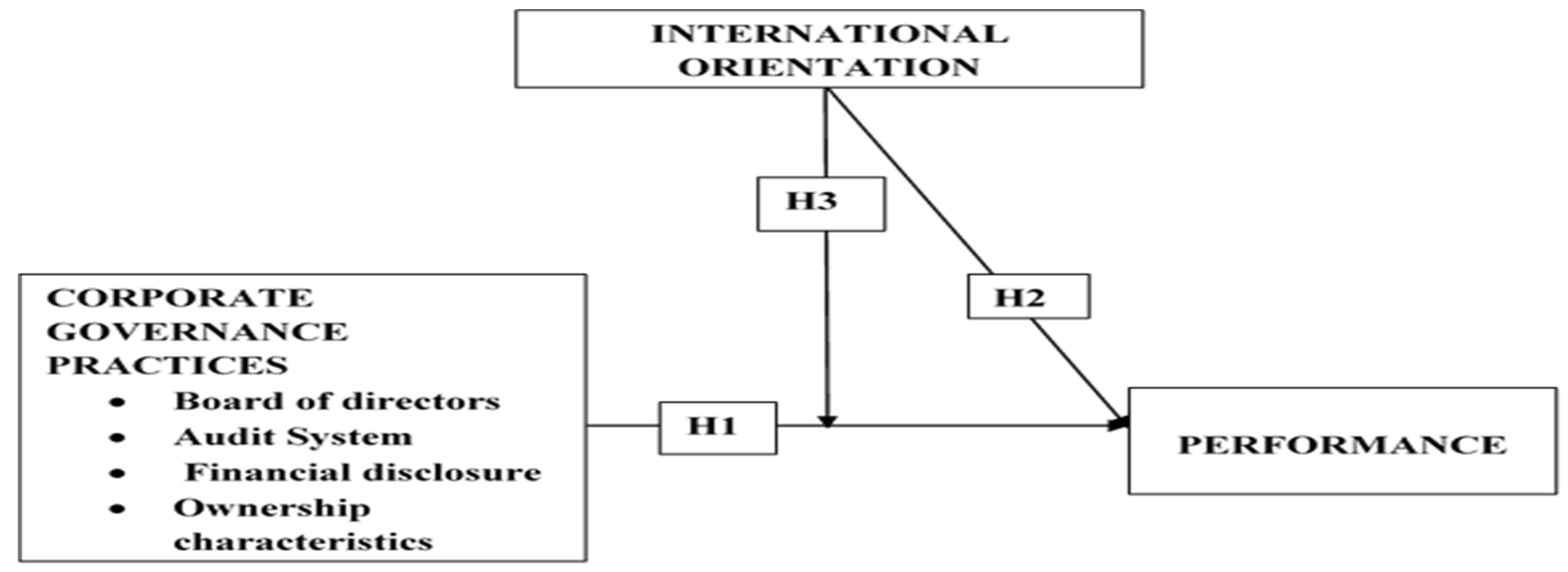
In Kenya, ref. [13] reported that corporate governance structures were practical, as they influenced both managerial and financial performance. Abor and Biekpe [27] studied corporate governance, ownership structure and performance of SMEs in Ghana. The outcome was that the size of the board, its composition, management skills, and the duality of the CEO, inside, family and foreign ownership had a considerably optimistic impact on the success of SMEs. Koch-Bayram and Wernicke [28] added that managers endowed with the skill of persuading workers to abide by company rules are not likely to be implicated in any fraud. Following the empirical evidence of a positive relationship between corporate governance and firm performance, we put our first hypothesis as follows:
Hypothesis 1 (H1):
Corporate governance positively influences the performance of SMEs.
2.2. International Orientation and Performance of SMEs
International Orientation refers to one’s capacity to function effectively in a highly complex business environment across national boundaries [9]. According to [29], the process of internationalization among SMEs is now taking its feet. Researchers have established that the international orientation of SME managers seems to be linked with the improved success of the firm’s internationalization efforts [6]. Arguably, managers with a global mindset are better equipped to deal with the complexity and dynamics of multicultural business environments [30]. Misati et al. [25] shed light on the antecedents, behavior and outcomes of SME internationalization. Among the positive outcomes was found improved firm growth and product innovation, emphasizing that SMEs are motivated by a number of drivers such as entrepreneurs’ education and experience, sustainability messages and technology.
Researchers such as [31,32] conclude that high profits, sustained performance and survival of SMEs are associated with internationalization. Beamish and Lu [33] reveal the presence of a positive correlation between profitability and strategic alliances, and exports and foreign direct investments. However, [34] argues that an international orientation on its own might not significantly increase a firm’s international performance. In developing an international mindset, SMEs will be able to integrate viewpoints, expertise and knowledge into their decision-making process, which will positively impact performance. Based on this, we put our second hypothesis as follows:
Hypothesis 2 (H2):
International orientation positively influences the performance of SMEs.
2.3. International Orientation on Corporate Governance and Performance of SMEs
Nahapiet and Goshal [35] argue that the differences in the performance of companies could be attributed to differences in creating and exploiting social capital (networking). Firms can use relationships with external agents (international) to gain access to valuable information, new technologies, market access and other complementary resources, resulting in increased performance. Johanson and Vahlne [36] suggest that to develop internationalization processes, a firm acquires the necessary knowledge about foreign markets and operations mainly from experience operating abroad in increasingly more engaged entry modes. Networks built on trust enabled knowledge dissemination, market information and expertise sharing among SMEs [20]. Comparably, ref. [37] identified institutional networking, production innovation and market knowledge as critical success factors for SMEs’ successful internationalization process in Indonesia. This corresponds with existing research that emphasizes the importance of network integration and network extension for SME internationalization [38]. A recent study [9] stresses the influence of some managers’ international experiential knowledge of the firm’s internationalization performance. This international orientation requires good corporate governance structures that make the formation of alliances possible.
Scholars of SMEs have also shown a positive correlation between productivity and exports [33]. For firms that use corporate governance practices, it leads to better performance. However, it could be that these companies may be focused too much on the domestic or local market. This might limit our thinking and conclusions in an era of globalization. There is a voracious increase in international trade sweeping across all continents which is, to a large extent, outgrowing domestic markets. In light of this, an international orientation allows companies to direct their corporate governance standards and market orientation across borders, where they can spend sufficient time and resources to gain profit. We therefore argue that an international orientation is a possible moderator in the corporate governance and firm performance relationship. Based on this study, we hypothesize:
Hypothesis 3 (H3):
International orientation has a positive moderating effect on corporate governance practices and the performance of SMEs.
3. Research Design
This study aims to examine the influence of corporate governance practice and international orientation on the performance of SMEs in developing countries. Over the years, SMEs have been adopting different forms of corporate governance practices [4], but little is known about how such practices affect the overall performance of SMEs. Similarly, in the wake of globalization, most SMEs are beginning to venture outside their home country in the form of internationalization, yet existing literature has only focused on the internationalization of large corporations. Given the significant contributions of SMEs to the economies of developing countries [12], this paper seeks to provide insights into the relationship between corporate governance practice, internationalization and firm performance in SMEs.
3.1. The Conceptual Model
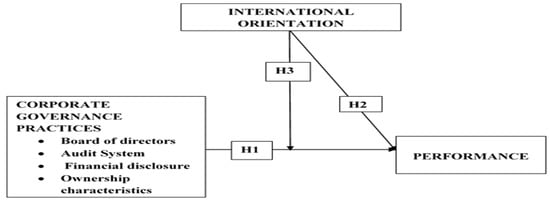
The conceptual model below (Figure 1) shows a summary of the investigated concepts and hypotheses. It illustrates the relationship between corporate governance practices and performance, international orientation and performance, and the moderation of international orientation on the relationship between corporate governance practices and performance.
Figure 1.
The conceptual model.
3.2. Measurement of Variables and Data Collection Instrument
Questionnaires were used to gather primary data for the research. Questionnaires were used because of their reliability and validity, which pertinently serves the purpose of this study. Measurement scales for this study were adopted from previous studies. Questions on international orientation were adopted from questionnaires advanced by [39]. Performance measures were adopted from questionnaires developed by [40] and corporate governance practices espoused by [40,41]. The questionnaires are structured to solicit information from various aspects of respondents’ activities. They also highlight corporate governance practices that impact SMEs’ performance, for which four key dimensions of corporate governance were put in perspective. The questionnaires are structured in Likert scale type. The researcher administered the questionnaires to respondents at their respective convenient places of work.
Data was collected from management members and other senior workers of these SMEs who were in a good position to assess the directors of the firm, the audit system and performance. Data was sent to all 291 sample SMEs, but only 270 were returned and usable. Each sample SME received one questionnaire. The demographic characteristics of the respondents are presented in Appendix A.
3.3. Source of Data and Sample Selection
Given the nature of this study and the focus on SMEs in developing countries, we could not ascertain publicly available data. Therefore, consistent with prior studies on SMEs such as [8,22], we used primary data which was hand-collected from respondents through a survey. The survey was conducted in Ghana in 2022. The total population was clustered into four categories, that is, wholesale and retail trade, services industry, manufacturing and other sectors; a quota was proportionately assigned to each cluster in arriving at the sample size. The research applied 10–30% sampling across the strata.
To ensure the reliability and validity of our findings, we adopted purposive sampling to target SMEs that have existed for at least three years and have some form of business structure in place. Some of the features we looked for include having a bank account, a designated management team or its equivalent, an auditing system and an oversight board or its equivalent. Following these criteria, our sample selection yielded 291 SMEs, of which we received a response from 270 firms. We admit that our selection criteria might not be perfect and could have eliminated some firms unintentionally. Notwithstanding this potential challenge, our procedure thoroughly covers most key firms that increase the sample’s reliability and variability.
3.4. Econometric Analyses
Regression analysis was performed to determine the connection between corporate governance practices and performance, international orientation and performance, and the moderation effect of an international orientation on the corporate governance practices and performance of SMEs in the study area. Variables in this study were classified into dependent and independent variables. The relationship between the variables was stated using the linear multiple regression equation below:
where P = Performance of SMEs, β0 = Constant, β1–β9= Coefficients, BOD = Board of Directors, AUD = Auditing system, FD = Financial Disclosure, OC = Ownership Characteristics, IO = International Orientation and ɛ = Error term.
P = β0 + β1BOD + β2AUD + β3FD + β4OC+ β5IO+ Controls+ ɛ
P = β0 + β1BOD + β2AUD + β3FD + β4OC+ β5IO+ β6BOD*IO + β7AUD*IO + β8FD*IO+ β9OC*IO + ɛ
3.5. Reliability and Validity Test
Reliability and validity tests were conducted to determine the suitability of the data and the various constructs used in this study. This was done using confirmatory factor analysis (CFA). We used Cronbach alpha to measure the reliability of the respective constructs. The results of the tests performed, as shown in Table 1 below, indicate Alpha values ranging from 0.791 to 0.890, all of which are satisfactorily above the minimum threshold of 0.70 [42], indicating that the measures employed to measure the constructs have internal consistency [43].
Table 1.
Reliability and validity test table.
The results in Table 2 show that the Normed chi-square (χ2) value for Model 3 (χ2/DF: 32.28/20 = 1.614) is significantly smaller compared with that of Model 2 (χ2/DF: 9.69/5 = 1.938). This shows that Model 3 provides a substantial improvement in the model fit relative to the restricted models. Additionally, appropriate fit heuristics for Model 3 (RMSEA = 0.055, NNFI = 0.970, CFI = 0.979 and SRMR = 0.0331) show better improvements.
Table 2.
Fit indices for Measurement Constructs table.
4. Results and Discussion
4.1. Descriptive Statistics
This segment of our study presents the descriptive results of the primary constructs of the study. The analysis encompasses findings of data collected on corporate governance practice, international mindset and performance. The result of the analysis is depicted in Table 3 below. Univariate normality was assessed using skewness and kurtosis indices. Both the skewness and kurtosis indices were within the recommended thresholds of ≤|3.00| and ≤|8.00|, respectively.
Table 3.
Descriptive statistics.
4.2. Pearson Correlation Analysis
The correlation among this study’s variables was measured using Pearson’s Moment Correlation Analysis. The five main variables, together with demographic variables, were included in the correlation analysis. Table 4 shows the bivariate correlational analysis of this study. The results demonstrate that multicollinearity is minimized since the links among the independent variables are not above the threshold of 0.8. Pallant [44] posited that having a correlation of more than 0.8 between independent variables suggests some form of multicollinearity.
Table 4.
Pearson Correlation Analysis.
4.3. Regression Results
The results of the regression estimation for testing the hypothesis are presented in Table 5. Column 1 contains the result for testing the first and second hypotheses, while column 2 contains the estimations for testing hypothesis 3. The results in column 1 indicate a positive and significant association between most of the corporate governance variables except for ownership characteristics. For instance, the coefficient of the board of directors is 0.047 with a p-value of 0.004, indicating a positive and significant impact of the board of directors on the performance of SMEs. Similarly, the coefficient of auditing is 0.172 with a p-value of 0.000, suggesting a positive association between auditing and performance at a 0.1% significant level. International orientation also has a positive and significant association with firm performance at a 0.1% significant level. However, ownership characteristics measured by the level of ownership concentration are negatively related to performance but insignificant.
Table 5.
Multiple Regression Analysis.
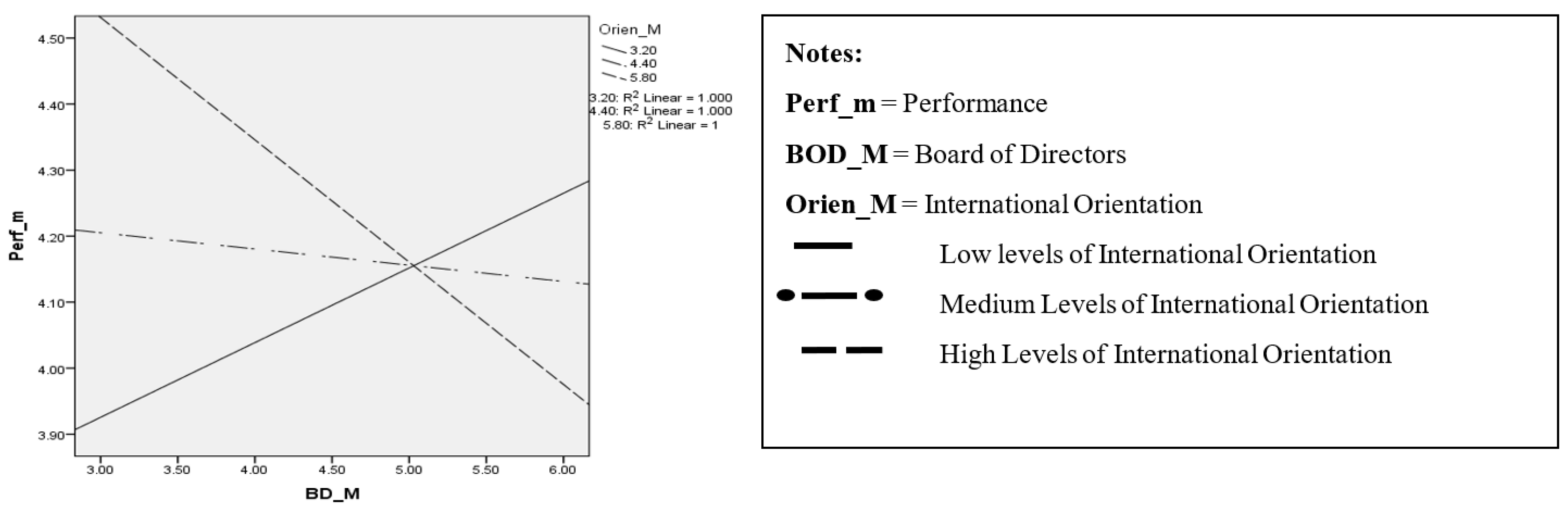
The estimation of the moderating effect of international orientation is presented in column 2. To generate the moderating variable, we multiply each corporate governance variable with international orientation. Similar to the results in column 1, we observe a positive and significant association between the moderating variables and firm performance except for ownership characteristics. We also observe that the coefficient of most moderating variables is larger and at a higher significance level than the coefficient of individual variables in both column 1 and column 2. For example, the coefficient of the moderating variable of the board of directors and international orientation is 0.092, which is larger than the coefficient of the board of directors (0.047) in column 1, and 0.052 in column 2. We observe a similar trend with other corporate governance variables, suggesting a significant effect of internationalization driving the positive impact of corporate governance on performance in SMEs.
The direction of most control variables is consistent with standard assumptions and expectations. For instance, firm size is positively associated with firm performance [3,12].
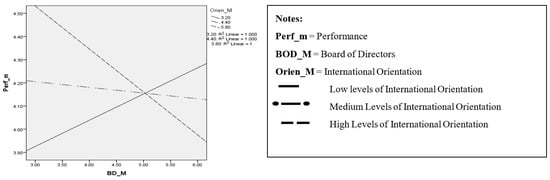
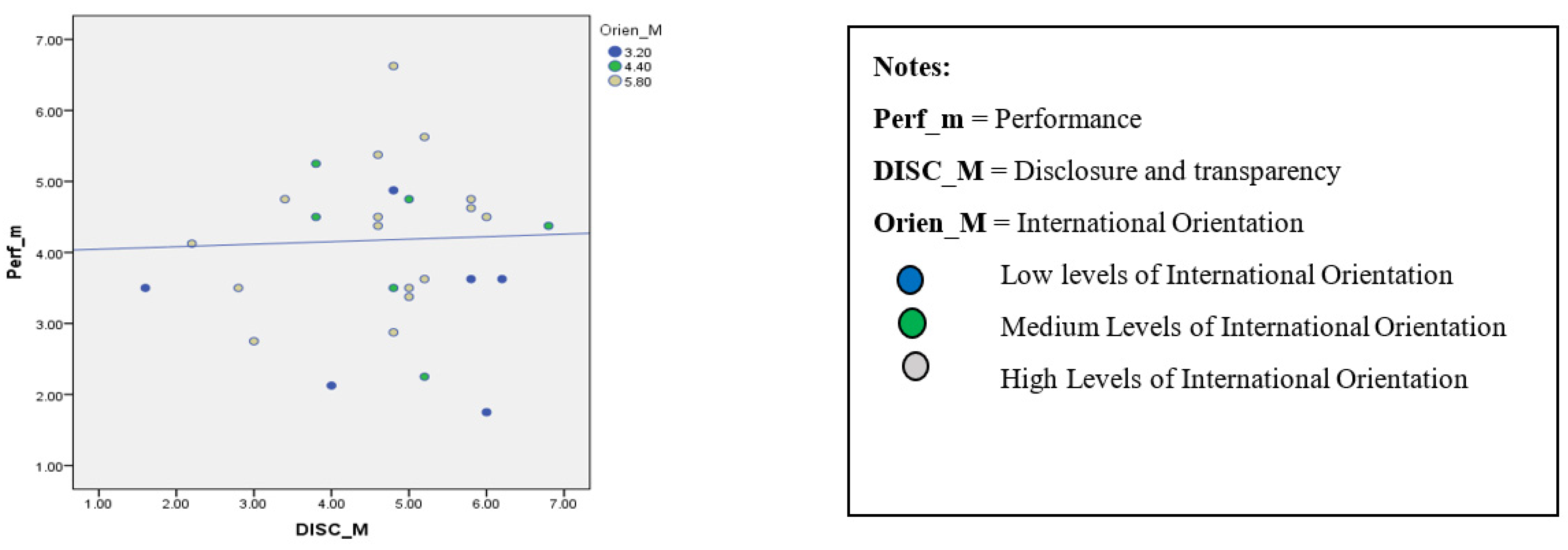
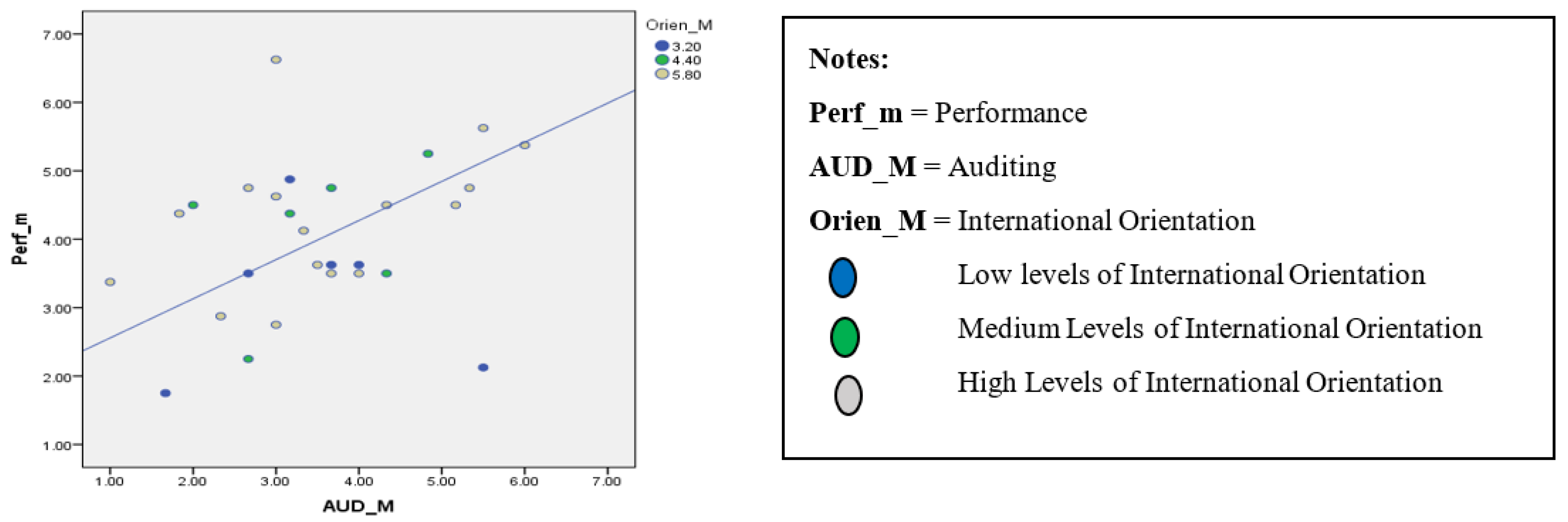
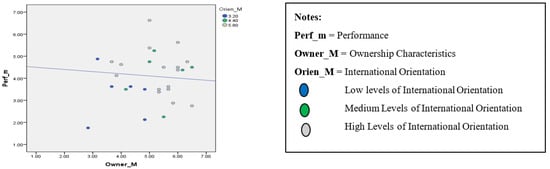
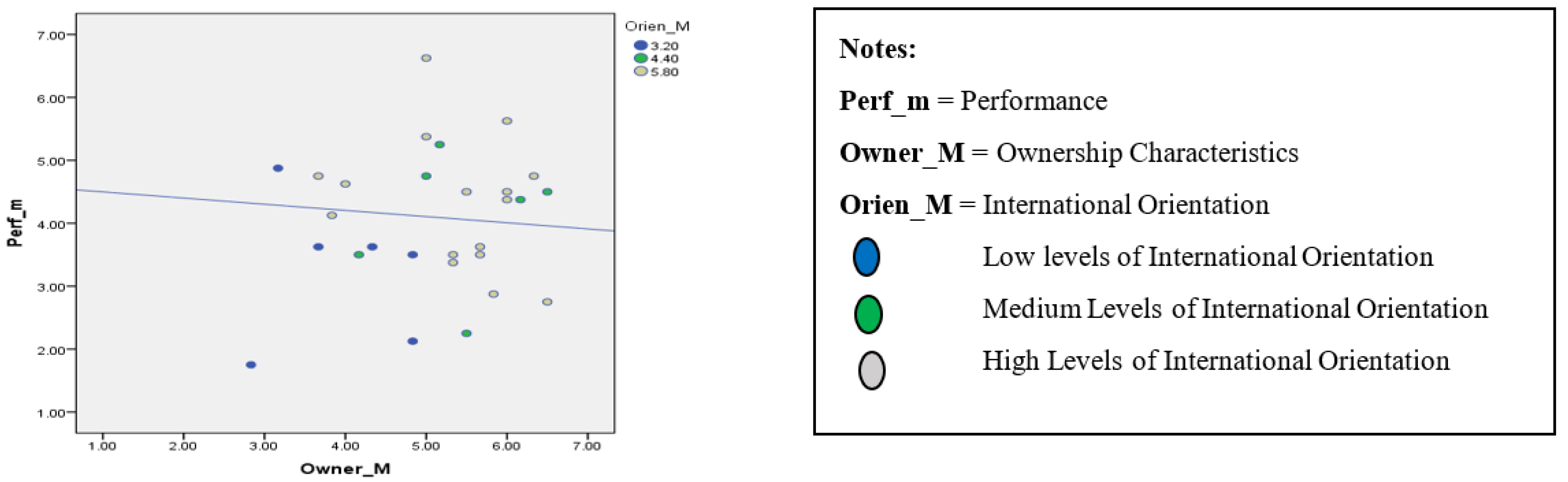
For robustness, and to strengthen our empirical analysis, we have presented the results of the moderating effect in graphs. The graphical presentation is contained in Figure 2, Figure 3, Figure 4 and Figure 5. The direction of the graph is consistent with the estimations in Table 5.
Figure 2.
Board of directors * international orientation on performance.
Figure 3.
Disclosure * international orientation on performance.
Figure 4.
Auditing * international orientation on SMEs.
Figure 5.
Ownership * international orientation on performance.
Graphical presentation of the moderating effect of international orientation on corporate governance and performance.
4.4. Discussion
This study hypothesized (H1) that corporate governance represented by the board of directors, disclosures, auditing and ownership characteristics positively influences the performance of SMEs. From column 1, it can be observed that there is a positive and significant relationship between corporate governance practices and performance, except for ownership characteristics, which is negative. Singh and Pillai [2] stated that corporate governance compliance in SMEs makes the organization more attractive when it is visibly managed and directed. This positive relationship is in line with studies conducted by [3,45], which show that adopting proper governance mechanisms has affirmatively impacted a firm’s performance. This suggests that good corporate governance, especially auditing, board of directors and disclosures, promotes a robust management system among SMEs because managers make decisions through accepted processes, practices and policies that boost output. Many local governments and other international contracts are primarily subject to, or awarded based on, good corporate governance practices. This makes SMEs with good corporate governance more advantageous during procurement processes. This study showed a negative association between ownership characteristics and the performance of SMEs. The results are consistent with prior studies [3,12] that showed there was no significant relationship between ownership and firm financial performance. Singh and Pillai [2] argue that family firm entrepreneurs and managers are more prone to engage in managerial entrenchment to the firm’s detriment, resulting in unconvincing performance.
This study argued in H2: international orientation positively influences the performance of SMEs. The results in column 1 of Table 5 suggest that international orientation positively and significantly affects firm performance. The result is consistent with [9], who found similar results in Asia. Arguably, internationalization increases the firm’s market size, leading to an increase in performance. Moreover, going global incentivizes SMEs to efficiently allocate resources through best business practices [9].
The results in column 2 confirmed that international orientation significantly positively affects the link between corporate governance practices and SME performance. This further suggests that an increase in the international orientation of SMEs leads to a positive association between corporate governance practices and SMEs’ performance. This means that when the international mindset of SMEs in the region is high, corporate governance practices will automatically impact favorably on performance. It is commendable for business owners/ managers to periodically arrange training sessions for employees to enhance their level of international orientation to improve firm performance by practicing best corporate governance practices. It is important that, in most cases, SMEs encounter a raging market attitude and aggressive competition; these difficulties, to a large extent, can be curtailed through international orientation as a means of strategic approach. In light of this, business managers and leaders can act more creative, proactive, and risk-taking, which will undoubtedly distinguish them from their competing market.
5. Conclusions
In this paper, we have examined the impact of corporate governance on the firm performance of SMEs in an emerging economy. We use hand-collected primary data from 270 SMEs in Ghana. Using robust econometric estimation, we document a positive relationship between corporate governance and firm performance. Given the rapid globalization and growing exports by SMEs, we perform further analysis to establish whether international orientation moderates the relationship between corporate governance and firm performance. We found that international orientation significantly drives corporate governance practices in SMEs. International orientation also significantly enhances the positive relationship between corporate governance and firm performance.
Our study offers several implications for policymakers and management. First, our findings imply that policymakers such as the National Board or Agency for SMEs are encouraged to develop comprehensive corporate governance guidelines specifically for SMEs to ensure the sustainability of business in the face of the global market and the introduction of the African Free Continental Trade Area. Second, governments of developing countries should incentivize SMEs through tax credits and subsidies to expand beyond the home country. As evidenced in our results, going global not only improves financial performance, it also strengthens corporate governance practices in SMEs. For management, our findings indicate that internationalization and good corporate governance practices are essential ingredients for good performance; hence, they should try to adopt and implement these strategies. Investors are also encouraged to support SMEs with capital to grow their international outlook.
In terms of regulative and policy implications, the results showcase the need for government and policymakers to ascertain regulations and policies that mitigate current challenges and existent barriers; and to facilitate establishing effective corporate governance structures and promote internationalization within SMEs in Ghana. This is of particular importance as prior research reflected that the internationalization of SMEs in developing countries requires improving firm, entrepreneurial, industry and/or country level characteristics [25,37].
Author Contributions
Conceptualization, V.T.; Methodology, K.M. and K.K.; Validation, K.K.; Formal analysis, K.W.; Resources, K.W., K.M. and E.S.A.; Writing—original draft, N.A. and K.K.; Writing—review & editing, K.W., N.A., K.M. and V.T.; Supervision, V.T.; Funding acquisition, N.A. All authors have read and agreed to the published version of the manuscript.
Funding
This project was funded by Princess Nourah bint Abdulrahman University Researchers Supporting Project number (PNURSP2023R391). Princess Nourah bint Abdulrahman University, Riyadh, Saudi Arabia.
Informed Consent Statement
Informed consent was obtained from all subjects involved in the study.
Data Availability Statement
Data will be provided on request.
Conflicts of Interest
The authors declare no conflict of interest.
Appendix A
Table A1.
Background Characteristics of Respondents.
References
- Osei, A.A.; Yusheng, K.; Caesar, A.E.; Tawiah, V.K.; Angelina, T.K. Collapse of bigbanks in Ghana: Lessons on its corporate governance. Res. J. Financ. Account. 2019, 10, 27–36. [Google Scholar]
- Singh, K.; Pillai, D. Corporate governance in small and medium enterprises: A review. Corp. Gov. Int. J. Bus. Soc. 2021, 22, 23–41. [Google Scholar] [CrossRef] [Scilit]
- Afande, F.O. Adoption of corporate governance practices and financial performance of small and medium enterprises in Kenya. Res. J. Financ. Account. 2015, 6, 36–73. [Google Scholar]
- Owusu, A.; Weir, C. The governance-performance relationship: Evidence from Ghana. J. Appl. Account. Res. 2016, 17, 285–310. [Google Scholar] [CrossRef] [Scilit]
- Fama, E.F.; Jensen, M.C. Separation of Ownership and Control. J. Law Econ. 1983, 26, 301–325. [Google Scholar] [CrossRef] [Scilit]
- Agyemang, O.S.; Castellini, M. Corporate governance in an emergent economy: A case of Ghana. Corp. Gov. 2015, 15, 52–84. [Google Scholar] [CrossRef] [Scilit]
- Dakorah, M.P. Entrepreneurial Behavior, International Mindset and Performance of Small and Medium Enterprises (SMEs) in The Greater Accra Region. Unpublished. Master’s Thesis, Kwame Nkrumah University of Science Technology, Kumasi, Ghana, 2018. [Google Scholar]
- Süsi, V.; Lukason, O. Corporate governance and failure risk: Evidence from Estonian SME population. Manag. Res. Rev. 2019, 42, 703–720. [Google Scholar] [CrossRef] [Scilit]
- Chen, H.; Hsu, W.; Chang, C. Family Ownership, Institutional Ownership, and Internationalization of SMEs. J. Small Bus. Manag. 2014, 52, 771–789. [Google Scholar] [CrossRef] [Scilit]
- Almashhadani, M.; Almashhadani, H. Corporate Governance as an Internal Control Mechanism and its Impact on Corporate Performance. Int. J. Bus. Manag. Invent. (IJBMI) 2022, 11, 53–59. [Google Scholar] [CrossRef]
- Nasrallah, N.; El Khoury, R. Is corporate governance a good predictor of SMEs financial performance? Evidence from developing countries (the case of Lebanon). J. Sustain. Financ. Investig. 2022, 12, 13–43. [Google Scholar] [CrossRef] [Scilit]
- Quaye, D.; Mensah, I. Marketing innovation and sustainable competitive advantage of manufacturing SMEs in Ghana. Manag. Decis. 2019, 57, 1535–1553. [Google Scholar] [CrossRef] [Scilit]
- Marikio, D.N. The Relationship between Corporate Governance Structures and Financial Performance of Manufacturing Firms in Kenya. Master’s Thesis, University of Nairobi, Nairobi, Kenya, 2014. Available online: http://erepository.uonbi.ac.ke/handle/11295/77942 (accessed on 1 November 2022).
- Agyei, S.K. Culture, financial literacy, and SME performance in Ghana. Cogent Econ. Financ. 2018, 6, 1463813. [Google Scholar] [CrossRef] [Scilit]
- Boateng, R.N.; Tawiah, V.; Tackie, G. Corporate governance and voluntary disclosures in annual reports: A post-International Financial Reporting Standard adoption evidence from an emerging capital market. Int. J. Account. Inf. Manag. 2022, 30, 252–276. [Google Scholar] [CrossRef] [Scilit]
- Hsu, W.-T.; Chen, H.-L.; Cheng, C.-Y. Internationalization and firm performance of SMEs: The moderating effects of CEO attributes. J. World Bus. 2013, 48, 1–12. [Google Scholar] [CrossRef] [Scilit]
- Handley, K.; Molloy, C. SME corporate governance: A literature review of informal mechanisms for governance. Meditari Account. Res. 2022, 30, 310–333. [Google Scholar] [CrossRef] [Scilit]
- Kabir, M.A.; Chowdhury, S.S. Empirical analysis of the corporate social responsibility and financial performance causal nexus: Evidence from the banking sector of Bangladesh. Asia Pac. Manag. Rev. 2022, in press. [Google Scholar] [CrossRef] [Scilit]
- Mnif, Y.; Borgi, H. The association between corporate governance mechanisms and compliance with IFRS mandatory disclosure requirements: Evidence from 12 African countries. Corp. Gov. Int. J. Bus. Soc. 2020, 20, 1371–1392. [Google Scholar] [CrossRef] [Scilit]
- Udomkit, N.; Schreier, C. Tie the ties: The significance of the binding networks in SMEs’ internationalization process. J. Asia-Pac. Bus. 2017, 18, 4–20. [Google Scholar] [CrossRef] [Scilit]
- Antwi, I.F.; Carvalho, C.; Carmo, C. Corporate Governance research in Ghana through bibliometric method: Review of existing literature. Cogent Bus. Manag. 2022, 9, 2088457. [Google Scholar] [CrossRef] [Scilit]
- Mahmood, A.; Naveed, R.T.; Ahmad, N.; Scholz, M.; Khalique, M.; Adnan, M. Unleashing the Barriers to CSR Implementation in the SME Sector of a Developing Economy: A Thematic Analysis Approach. Sustainability 2021, 13, 12710. [Google Scholar] [CrossRef] [Scilit]
- Young, B. Corporate governance and firm performance: Is there a relationship? Ivey Bus. J. 2003. Available online: https://iveybusinessjournal.com/publication/corporate-governance-and-firm-performance-is-there-a-relationship/ (accessed on 1 September 2022).
- Horstmeyer, D.; Wells, K. When Do Governance Mechanisms Matter Most? Q. J. Financ. 2020, 10, 2050003. [Google Scholar] [CrossRef] [Scilit]
- Misati, E.; Walumbwa, F.O.; Lahiri, S.; Kundu, S.K. The internationalization of African small and medium enterprises (SMEs): A South-North pattern. Afr. J. Manag. 2017, 3, 53–81. [Google Scholar] [CrossRef] [Scilit]
- Tetteh, L.A.; Kwarteng, A.; Gyamera, E.; Lamptey, L.; Sunu, P.; Muda, P. The effect of small business financing decision on business performance in Ghana: The moderated mediation role of corporate governance system. Int. J. Ethics Syst. 2022, 3, 53–81. [Google Scholar] [CrossRef] [Scilit]
- Abor, J.; Biekpe, N. Small Business Financing Initiatives in Ghana. Probl. Perspect. Manag. 2006, 4, 69–77. [Google Scholar]
- Koch-Bayram, I.F.; Wernicke, G. Drilled to obey? Ex-military CEOs and financial misconduct. Strateg. Manag. J. 2018, 39, 2943–2964. [Google Scholar] [CrossRef] [Scilit]
- Schweizer, R. The internationalization process of SMEs: A muddling-through process. J. Bus. Res. 2012, 65, 745–751. [Google Scholar] [CrossRef] [Scilit]
- Levy, O.; Beechler, S.; Taylor, S.; Boyacigiller, N.A. What We Talk about When We Talk about “Global Mindset”: Managerial Cognition in Multinational Corporations. J. Int. Bus. Stud. 2007, 38, 231–258. [Google Scholar] [CrossRef] [Scilit]
- Bloodgood, J.M.; Sapienza, H.J.; Almeida, J.G. The internationalization of new high-potential U.S. ventures: Antecedents and outcomes. Entrep. Theory Pract. 1996, 20, 61–76. [Google Scholar] [CrossRef] [Scilit]
- Oviatt, B.M.; McDougall, P.P. Toward a theory of international new ventures. J. Int. Bus. Stud. 1994, 25, 45–64. [Google Scholar] [CrossRef] [Scilit]
- Beamish, P.; Lu, J. The Internationalization and Performance of SMEs. Strateg. Manag. J. 2001, 22, 565–586. [Google Scholar]
- Wiering, E.M. Entrepreneurial Orientation and International Performance: The Moderating Effect of International Orientation. Ph.D. Thesis, University of Groningen Faculty of Economics and Business, Groningen, The Netherlands, 2014. [Google Scholar]
- Nahapiet, J.; Ghoshal, S. Social Capital, Intellectual Capital, and the Organizational Advantage. Acad. Manag. Rev. 1998, 23, 242–266. [Google Scholar] [CrossRef] [Scilit]
- Johanson, J.; Vahlne, J. The Internationalization Process of the Firm: A Model of Knowledge Development and Increasing Foreign Market Commitments. J. Int. Bus. Stud. 1977, 8, 23–32. [Google Scholar] [CrossRef] [Scilit]
- Handoyo, S.; Yudianto, I.; Fitriyah, F.K. Critical success factors for the internationalisation of small–medium enterprises in indonesia. Cogent Bus. Manag. 2021, 8, 1923358. [Google Scholar] [CrossRef] [Scilit]
- Ahimbisibwe, G.M.; Ntayi, J.M.; Ngoma, M.; Bakunda, G.; Kabagambe, L.B. The internationalization of small to medium-sized enterprises: Do all levels in international networking matter? J. Small Bus. Enterp. Dev. 2020, 27, 817–837. [Google Scholar] [CrossRef] [Scilit]
- Ciszewska-Mlinaric, M.; Obloj, K.; Wasowska, A. Effectuation and causation: Two decision-making logics of INVs at the early stage of growth and internationalization. J. East Eur. Manag. Stud. 2016, 21, 275–297. [Google Scholar] [CrossRef] [Scilit]
- Otman, K.A.M. Corporate Governance and Firm Performance in Listed Companies in the United Arab Emirates. Ph.D. Thesis, Victoria University, Melbourne, VIC, Australia, 2014. Available online: http://vuir.vu.edu.au/ (accessed on 1 November 2022).
- Onzere, W.M. The Relationship between Corporate Governance and Financial Performance of Small and Medium Enterprises in Nairobi. Master’s Thesis, University of Nairobi, Nairobi, Kenya, 2011. [Google Scholar]
- Bagozzi, R.P.; Yi, Y. Specification, evaluation, and interpretation of structural equation models. J. Acad. Mark. Sci. 2012, 40, 8–34. [Google Scholar] [CrossRef] [Scilit]
- Field, A.P. Discovering Statistics Using SPSS for Windows: Advanced Techniques for the Beginner; SAGE: Thousand Oaks, CA, USA, 2000. [Google Scholar]
- Pallant, J. SPSS Survival Manual: A Step by Step Guide to Data Analysis Using the SPSS Program, 4th ed.; Allen & Unwin: Berkshire, UK, 2011. [Google Scholar]
- Klapper, L.F.; Love, I. Corporate Governance, Investor Protection and Performance in Emerging Markets. J. Corp. Financ. 2004, 10, 703–728. [Google Scholar] [CrossRef] [Scilit]

Disclaimer/Publisher’s Note: The statements, opinions and data contained in all publications are solely those of the individual author(s) and contributor(s) and not of MDPI and/or the editor(s). MDPI and/or the editor(s) disclaim responsibility for any injury to people or property resulting from any ideas, methods, instructions or products referred to in the content. |
© 2023 by the authors. Licensee MDPI, Basel, Switzerland. This article is an open access article distributed under the terms and conditions of the Creative Commons Attribution (CC BY) license (https://creativecommons.org/licenses/by/4.0/).