


Abstract
The traditional energy-saving evaluation method for industrial buildings is intended for all industrial buildings; however, substation buildings belong to a special category of industrial buildings, and their energy consumption characteristics are different from those of general industrial buildings. Consequently, it is necessary to establish an energy-saving evaluation system for substation buildings according to the characteristics of their energy consumption. In view of the issue that the energy consumption characteristics of substation buildings are different from those of other industrial buildings, an analytic hierarchy process (AHP) and fuzzy comprehensive evaluation (FCE) are used to establish a more comprehensive energy saving evaluation model that is more applicable to substation buildings. This paper determines 19 quantitative indicators and 13 qualitative indicators through the screening of relevant standards and norms, as well as the literature, and then determines the weight of each indicator by using AHP before finally establishing a secondary evaluation model based on FCE. In this paper, a substation in Shandong, China was selected as a case study to verify the proposed evaluation model, scoring 80.4 points, which falls within the “Good” grade. This method is of great significance for the future establishment of energy-saving evaluation system for substation buildings.
1. Introduction
China’s current total energy consumption includes building, industrial, and transportation energy consumption, of which building energy consumption occupies an important position. Along with the continuous increase in China’s urbanization rate, China’s building energy consumption is also increasing.
According to the BP World Energy Outlook (2018 Edition), energy demand is expected to increase by about 1/3 over the next 25 years. Additionally, global electrification will continue to expand, with the power sector accounting for 70% of the incremental primary energy consumption [1]. In light of the current state of the world’s energy situation, China needs to reduce building energy consumption within a reasonable range through building energy efficiency measures. This will serve as a crucial step towards achieving the “2030—Carbon Peak” and “2050—Carbon Neutral” goals while maintaining quality building services, controlling energy costs, and reducing environmental pollution. Therefore, conducting a comprehensive evaluation of building energy efficiency is necessary.
At present, many scholars have extensively explored the evaluation of building energy efficiency. Guo, C. et al. [2] constructed a public building energy efficiency evaluation model using a combination of AHP and FCE, which is interesting for the study of building energy efficiency evaluation, but the evaluation is too broad and not applicable to individual special buildings. Yanru Li et al. [3] adopts FAHP to investigate and study satisfaction with living environments among the rural elderly and to find improvement strategies. Xinghui Zhang et al. [4] adopt FAHP to research the performance evaluation of various rural houses’ space heating systems. Lizana et al. [5] proposed a new modelling method for evaluating the cooling, heating, lighting, and hot water systems in schools. Wei et al. [6] established the first energy efficiency benchmark system for public buildings in China. Wang et al. [7] introduced a novel evaluation model that combines entropy weighting and a fuzzy comprehensive evaluation approach. This model takes into account both qualitative and quantitative indicators that impact a building’s energy efficiency. As a result, a new comprehensive evaluation method was developed. Huang Gao-Lin [8] proposed an energy efficiency evaluation model for industrial buildings using fuzzy comprehensive evaluation. Yin Fangqiang [9] established an energy efficiency evaluation system for old industrial building recycling projects based on a hierarchical analysis method and topological evaluation method. The above researchers have analyzed the effect of energy efficiency in public buildings or specific public buildings such as schools using FCE or AHP. This approach provides a new way of thinking about assessing the effectiveness of energy efficiency, but it has not been applied to industrial buildings. In this paper, FCE and AHP are combined to conduct research on specific industrial building substation buildings. The FAHP method, which is a combination of FCE and AHP, avoids the excessive influence of subjective factors, is able to deal with fuzzy decision-making problems, and its results are expressed more accurately and clearly. The application of this method in this paper will aid in finding a more suitable energy efficiency evaluation method for substation buildings.
There are also many standards related to building energy efficiency in China, such as the Assessment Standard for Green Building (GB/T 50378-2019) [10], the Design Standard For Energy Efficiency Of Public Buildings (GB 50189-2015) [11], and the Evaluation Standard For Green Industrial Building (GB/T 50878-2013) [12]. However, they are not fully utilized or have low applicability for some specific buildings. Especially among industrial buildings, different buildings have different energy consumption characteristics, and substations are typical examples of them. Unlike other industrial buildings, substations do not require a large number of people to work in the building, nor do they require a large number of personnel to supply equipment, and the energy consumption of the equipment inside them to maintain specific environmental conditions is mainly used to maintain the normal operation of the equipment. Moreover, substations are of huge scale in China and have considerable potential for energy saving, so it is necessary to propose a set of more efficient and practical evaluation models for energy saving in substation buildings.
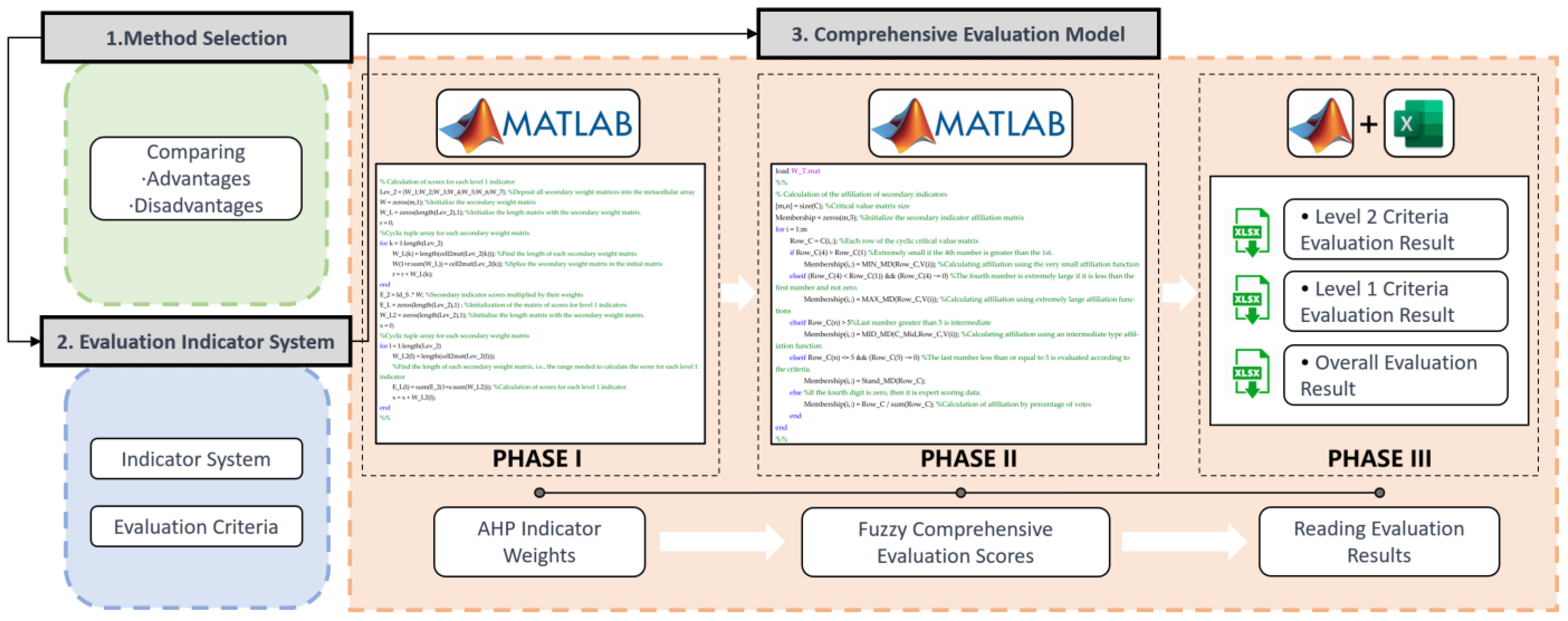
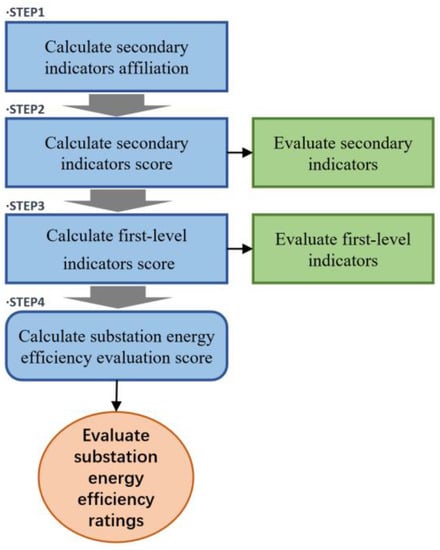
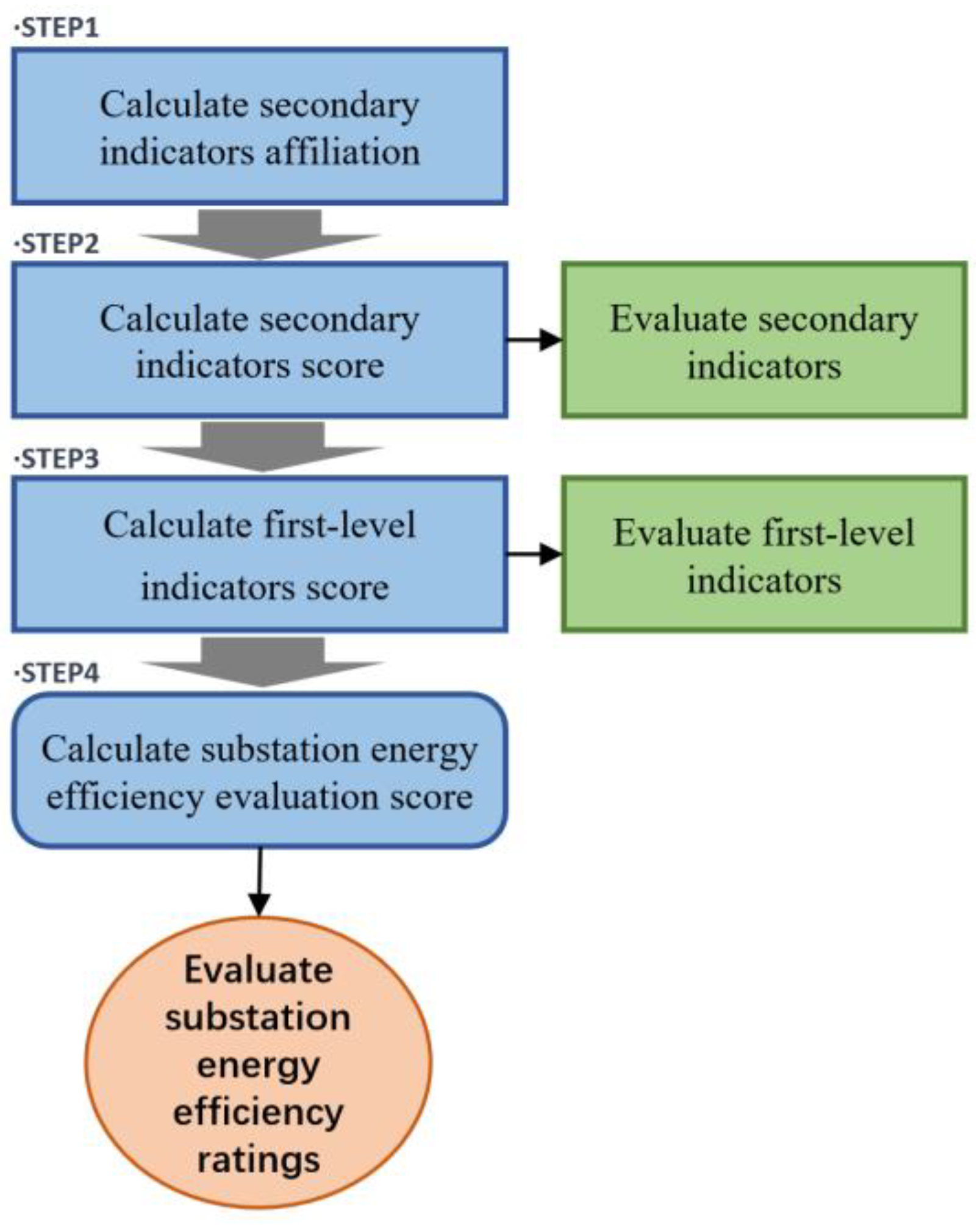
In this research paper, the energy conservation of substation buildings is examined through the creation of a new evaluation index system and model. It uses a substation in Shandong as a case study to verify and analyze the evaluation index system. The Section 1 explains the evaluation methods used. In the Section 2, the evaluation model is established and integrated into MATLAB R2022b software. The Section 3 discusses and analyzes the results of the case evaluation. Finally, the Section 4 summarizes the study’s conclusions. You can see the flow of our study in Figure 1 below.
Figure 1.
Modeling process for comprehensive evaluation of energy efficiency in substation buildings.
2. Comprehensive Evaluation Methodology
2.1. Comparison of Comprehensive Evaluation Methods
Evaluation methods commonly used today include grey relation analysis (GRA), fuzzy comprehensive evaluation, the technique for order preference by similarity to ideal solution (TOPSIS), data envelopment analysis (DEA), and artificial neural networks (ANNs). The selection of an appropriate evaluation method is crucial for obtaining rational and reliable results [2]. Table 1 compares three of the most commonly used comprehensive evaluation methods for easy reference.
Table 1.
Comparison of comprehensive evaluation methods.
2.2. Comprehensive Evaluation Methodology Selection
The energy efficiency evaluation system for substation buildings discussed in this paper involves numerous indicators that can be challenging to quantify. Due to the complexity of multi-factor problems, the fuzzy comprehensive evaluation method is selected as the best approach for handling both qualitative and quantitative indicators. This method has proven to be very effective in dealing with complex problems involving multiple factors.
3. Evaluation System Construction
3.1. Identifying Evaluation Indicators
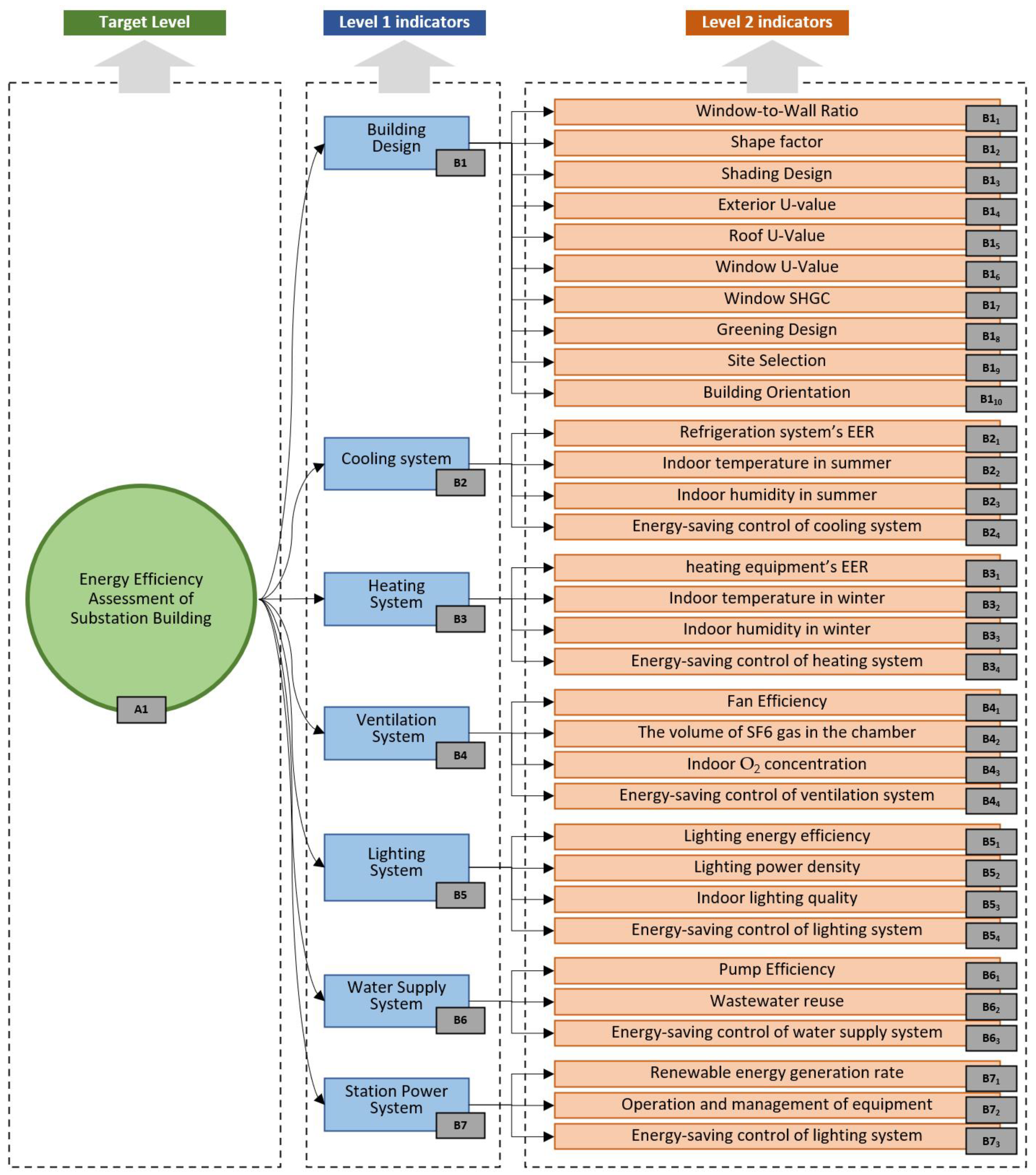
To achieve accurate evaluation results, it is important to carefully select the evaluation indices. Substation buildings are affected by various factors that can impact energy consumption during both the design and operation stages. Therefore, the energy-saving evaluation of substation buildings should include primary indices for building design during the design stage, as well as energy consumption system indices during the operation stage. These systems include cooling, heating, ventilation, lighting, water supply, and station power. To create a comprehensive evaluation, secondary indicators are gathered from existing building energy efficiency evaluation methods, codes, and academic papers. These secondary indicators are then carefully screened and refined to create a final indicator system consisting of seven primary indicators and thirty-two secondary indicators, as shown in Figure 2.
Figure 2.
Substation building energy efficiency evaluation system.
3.2. Identifying Weights for Indicators with AHP
Each building energy efficiency indicator has varying impacts; therefore, the weights for each indicator must be determined before establishing an evaluation system. The AHP is a practical and systematic method [16] that combines the subjective evaluation of experts and objective mathematical models. This study utilizes AHP to calculate the weights of indicators.
3.2.1. Obtaining Expert Questionnaires to Construct Judgment Matrix
When using AHP, the optimal number of questionnaires is 15 [17], but this paper, which took into account differences in questionnaire completion quality, conducted a questionnaire survey of 22 experts and obtained their opinions on the relative importance of indicators.
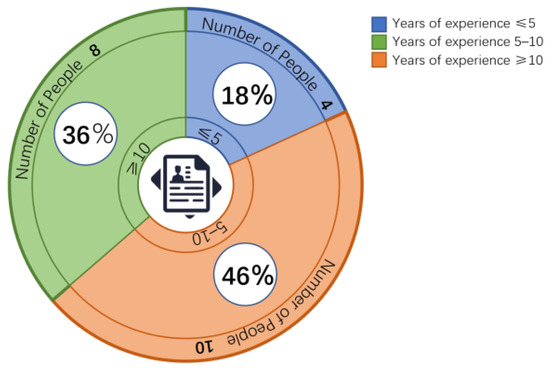
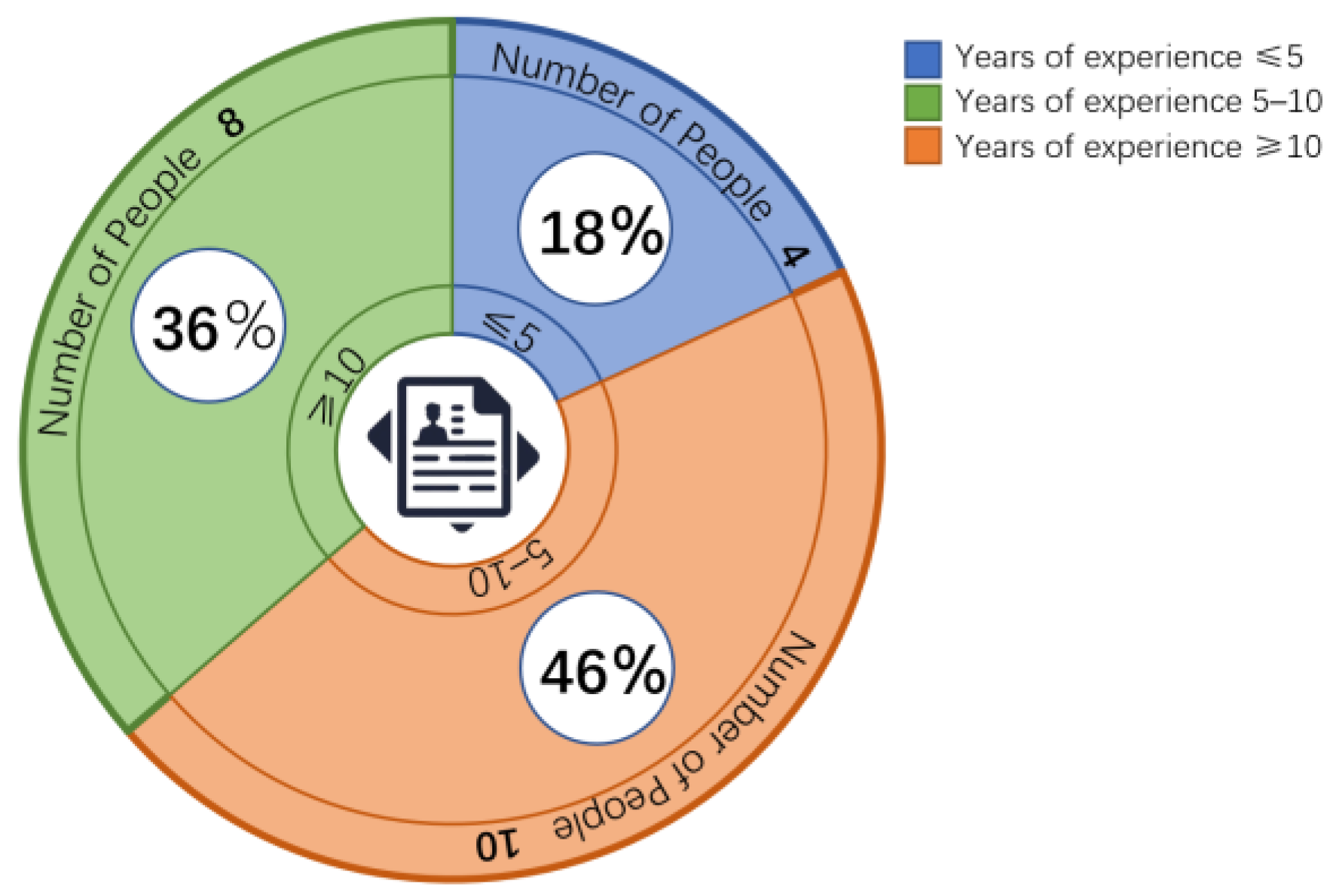
These experts were mainly involved in building energy efficiency, structure, HVAC, and electrical work, and their work units included design units and scientific research institutions. Among them, eight had been in the field for over 10 years, ten for 5–10 years, and four for 3–5 years. All of them held the titles of intermediate engineers or associate professors or higher, as illustrated in Figure 3. The details of the questionnaire are in Appendix A Table A1, Consultation Questionnaire on the Relative Importance of Energy Efficiency Evaluation Indicators for Substation Buildings.
Figure 3.
Distribution of experts’ years of experience.
3.2.2. Consistency Test and Weight Calculation
To calculate weights, there are three commonly used methods: the arithmetic average, the geometric average, and the eigenvalue method. In this paper, the accuracy of our results was ensured by averaging the calculations from all three methods. Before calculating the weights of each index, it is important to test the comparison matrix’s consistency using the consistency ratio (CR). Equation (1) shows how to calculate the CR.
Here, CI is the consistency index, λmax is the maximum eigenvalue of the judgment matrix, n is the number of indicators, RI is the average random consistency index, and CR is the consistency ratio; if its value is less than 0.1, then it passes the consistency test, otherwise it is necessary to construct a new judgment matrix [18].
In this study, MATLAB was used to write the program to calculate the consistency and weights. The consistency of the judgment matrices of the retrieved questionnaires was tested. Then, the weight results obtained from each expert questionnaire were synthesized using the geometric mean and the final set of indicator weights was obtained as presented in Table 2. The detailed MATLAB code is shown in Appendix B, and the MATLAB calculation steps are shown in Figure 4.
Table 2.
Indicator weight set.
Figure 4.
MATLAB calculation steps.
3.3. Constructing the Comprehensive Evaluation Model
FCE is based on determining the evaluation levels and weights of the evaluation factors, applying fuzzy set transformation, using the degree of affiliation to describe the evaluation object, and converting qualitative evaluation into quantitative evaluation and ranking [19]. Substation building energy efficiency evaluation involves a large number of unquantifiable fuzzy indicators, so this paper adopts this method to construct the evaluation model.
3.3.1. Constructing Evaluation Sets
The evaluation set is the collection of the final evaluation results of each index, and this study defines the evaluation set as V = [v1, v2, v3, v4, v5] = [Excellent, Good, Fair, Pass, Fail] according to the relevant specifications. The evaluation set is then quantized as V = [v1, v2, v3, v4, v5] = [95, 85, 70, 55, 45], and its corresponding grades are shown in Table 3 below.
Table 3.
The scores corresponding to different evaluation levels.
3.3.2. Defining Evaluation Criteria
Before calculating the degree of affiliation it is necessary to determine the evaluation criteria for different levels of each indicator. In this paper, the evaluation criteria for different indicators of energy efficiency of substation buildings are determined concerning relevant national standards from China, existing criteria, and the literature, as shown in Table 4 and Table 5 below.
Table 4.
Quantitative indicators evaluation criteria.
Table 5.
Qualitative indicators evaluation criteria.
3.3.3. Constructing a Single-Factor Evaluation Model
- Quantitative Indicator
This study uses quantitative indicators that fall into three categories: extremely large, extremely small, and intermediate indicators. To calculate the affiliation of the indicators, a trapezoidal affiliation function was chosen. The specific functions for affiliation are listed in Table 6.
Table 6.
Affiliation functions.
- 2.
- Qualitative Indicators
To determine the affiliation of qualitative indicators, expert voting was used. Equation (2) was used to calculate the degree of affiliation for each indicator.
Here, is the affiliation degree of a certain evaluation level of the indicator, is the number of votes for a certain evaluation level, r is the total number of votes, and the p in the ∈ [1, 2, 3, 4, 5].
The final single-indicator affiliation vector for qualitative indicators can be obtained as .
- 3.
- Single-Indicator Evaluation Matrix
Equation (3) shows a single-indicator evaluation matrix that can be constructed based on the calculation results of the second-level indicators’ affiliation degree.
Here, is the degree of affiliation of the corresponding evaluation level, and .
3.3.4. Constructing the FCE Model
- 4.
- Second-Level Fuzzy Integrated Evaluation
By combining the weights, and , of the second-level indicators, the FCE vector of the ith first-level indicator can be obtained, as shown in Equation (4).
In the above equation, . The final evaluation matrix of level 1 indicators can be obtained as .
- 5.
- First-Level FCE
The first-level fuzzy comprehensive evaluation has the same principle as the second-level fuzzy comprehensive evaluation and is constructed based on the second-level FCE, as shown in Equation (5).
- 6.
- FCE Score
The formula for calculating the FCE score is shown in Equation (6).
4. Case Study
4.1. Case Introduction
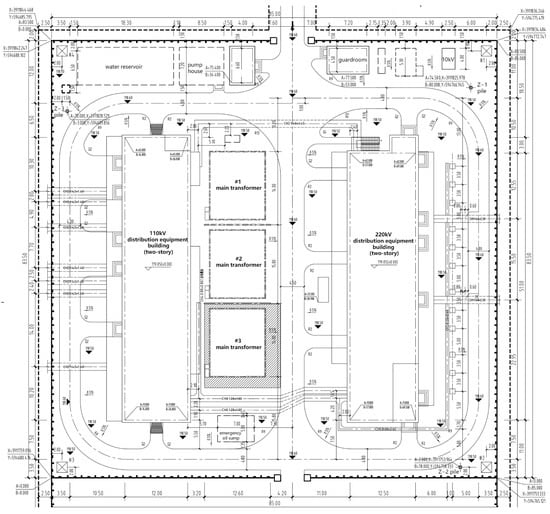
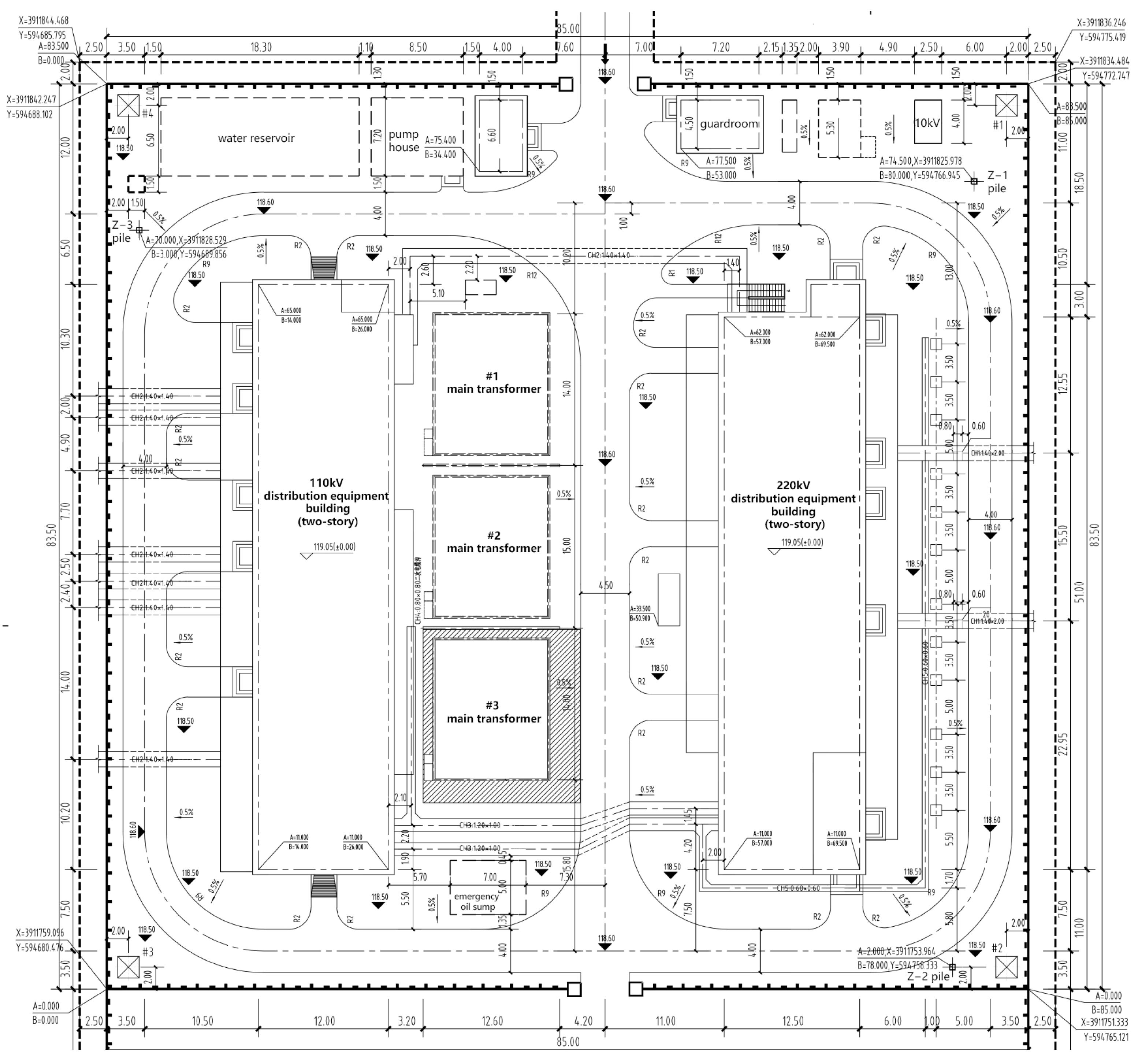
In this paper, a substation building in Shandong Province, China was selected as a research object to verify the evaluation effect of an energy-saving evaluation model of the substation building. The substation site has a total land area of 0.98 hm2 and mainly consists of a 110 kV electrical distribution building and a 220 kV electrical distribution building, of which the 110 kV electrical distribution building has a floor area of 1586.16 m2 and the 220 kV electrical distribution building has a floor area of 1637.41 m2. The two buildings are completely above ground with two floors and they are the main sources of energy consumption for the whole substation. The general plan of the substation is shown in Figure 5 below. The quantitative energy-saving evaluation index parameters of the substation are shown in Table 7. There is no data to support the qualitative indicators of the substation, so 15 experts familiar with the project were invited to score and evaluate the qualitative indicators of the project.
Figure 5.
Substation floor plan.
Table 7.
Quantitative index parameters for energy saving evaluation of a substation.
4.2. Comprehensive Evaluation Results
The affiliation degree of each secondary index evaluated in this case is shown in Table 8. The comprehensive evaluation model for the FCE was used to get the evaluation scores of each secondary index, primary index, and the substation’s energy-saving effect, as shown in Table 9. It can be seen that the scores of the cooling system, heating system, ventilation system, and lighting system in each level of indicators are all greater than 80, with good energy-saving effects. The scores of the water supply system and station power system are both below 80, belonging to the medium level. Most of the secondary indicators of these two primary indicators are evaluated by experts, so it is necessary to collect relevant data at a later stage to re-validate the results of this evaluation.
Table 8.
Evaluation index affiliation.
Table 9.
Substation comprehensive evaluation score.
The score of the building design is below 70, belonging to the lower level; the main reason for this is the improper selection of the window material. The U-values of the window and the SHGC are consequently only at the qualified level, while the building shape coefficient is larger and is only at the medium level. These three first-level indices have seriously lowered the evaluation results of the building design. The cooling system scored 83.7, which is at the lower end of the good range. The energy efficiency ratio of the water-cooling operation and the energy efficiency ratio of the cooling tower operation scored low; therefore, the design of the circulating cooling water system can be modified to improve the energy efficiency of the cooling system. The heating system scored only 80.4 points, which is close to the fair level. The energy efficiency ratios of the heating equipment and hot water operation were too low, being categorized as fair level. The main reason may be that the heating of the substation relies on the heat dissipation of the electrical panel equipment itself. The designers may think that the heating system has a low utilization rate, so the energy efficiency of the heating system is neglected. The ventilation system scored 83.4 points. Although the energy-saving design of the ventilation system is good, the ventilation system may neglect to minimize the concentration of SF6 gas in the GIS room and increase the concentration of O2. The lighting system scored 83.8 points, and it also can be improved. The quality of indoor lighting is close to fair level, which indicates that, in order to reduce energy consumption by controlling the window-to-wall ratio, the quality of light in the room was neglected. If the window-to-wall ratio is too low, it may be counterproductive, making it impossible to dissipate excess indoor heat and causing the air conditioner to increase energy consumption by lowering the set temperature; consequently, a reasonable design of the window-to-wall ratio is needed.
The substation in this case has an energy efficiency evaluation score of 80.4, which is a good grade. To assess its energy-saving impact and compare it to existing standards, the “Evaluation Standard for Green Industrial Building“ in China includes a chapter on “Energy Saving and Energy Utilization” that evaluates the substation. Calculated on the basis of this standard, the energy efficiency score of this substation building is 78.4 points, which is consistent with our evaluation model. However, the energy efficiency evaluation section of “Evaluation Standard for Green Industrial Building“ lacks energy efficiency evaluations of substation-specific parts, such as the control of indoor SF6 gas during ventilation. SF6 gas, with its excellent insulation and arc extinguishing properties, has been widely used in the power system. SF6 gas itself is non-toxic, but under the action of high-voltage arcs, SF6 gas is partially decomposed, and its decomposition products are often highly toxic; therefore, in order to meet the special needs of the substation building design, reductions in the energy-saving design weighting of the ventilation system are necessary. In contrast, the evaluation system established in this paper is mainly applicable to substations, and this evaluation system only evaluates the energy saving effect, so the selection of indicators is more refined and the evaluation results will be more accurate.
5. Conclusions
This paper establishes a secondary evaluation index system for substation building energy efficiency. The weights of the indicators in this evaluation system are determined by the AHP based on the expert questionnaire. Then, an FCE is established using fuzzy mathematical theory before the whole comprehensive evaluation model is integrated into MATLAB. Finally, the model is successfully applied to the energy-saving evaluation of the real substation. The main conclusions are as follows:
- When using AHP to calculate the weights of each indicator, in order to ensure the robustness of the results, arithmetic average, geometric average, and eigenvalue methods were used to calculate the weights and then calculate the average. This avoids the bias arising from the use of a single method and results in a more comprehensive and effective weighting system for evaluation indicators at all levels.
- Using fuzzy mathematical theory, an FCE model for energy saving in substation design is created. This is achieved by weighing evaluation indices and following the principle of multi-layer FCE. The model is integrated into MATLAB, which can be used to develop software for energy saving evaluation of substations in the future.
- The energy-saving evaluation system in this paper is entirely based on the characteristics of the substation, is highly adaptable to the substation, and avoids the evaluation paradox that may be caused by the wide scope of application of the “Evaluation Standard for Green Industrial Building”.
- The case study in this paper is special and is tailored to the evaluation of energy efficiency in substation buildings. The drawback is that the specific operation process cannot be generalized and applied among different buildings, but the research method can be borrowed. The energy-saving evaluation of different buildings according to their characteristics is beneficial to energy-saving design.
In China, buildings consume a substantial amount of energy, making it crucial to assess the energy efficiency of buildings during the design stage. This helps identify issues that can be addressed with corresponding improvements. While substations have different energy consumption characteristics than other industrial buildings, it’s important to establish a unique energy efficiency evaluation system for them. The proposed evaluation model in this study can serve as a pilot study for assessing the energy efficiency of substations. To improve accuracy, future research should focus on strengthening the monitoring of substation equipment operation data. Additionally, with the continuous development of intelligence, the relevant software for energy efficiency evaluation of buildings should also be developed, not only to help more buildings to carry out energy efficiency evaluation and improvement, but also to help designers pay attention to energy efficiency design in the design stage.
Author Contributions
Conceptualization, B.X., F.L. and J.G.; Methodology, Z.W.; Software, Z.W.; Investigation, B.X. and F.L.; Writing—original draft, Z.W., Z.Z. and Y.L.; Writing—review & editing, B.X., F.L., J.G., Z.Z. and Y.L.; Visualization, Y.L.; Funding acquisition, B.X., F.L. and J.G. All authors have read and agreed to the published version of the manuscript.
Funding
This research was funded by State Grid Corporation of China (China) grant number 5200-202216099A-1-1-ZN.
Institutional Review Board Statement
Not applicable.
Informed Consent Statement
Not applicable.
Data Availability Statement
Not applicable.
Conflicts of Interest
The authors declare no conflict of interest.
Appendix A
Table A1.
Consultation Questionnaire on the Relative Importance of Energy Efficiency Evaluation Indicators for Substation Buildings.
Appendix B
Table A2.
Energy Savings Effectiveness Score Calculation Code in MATLAB.
References
- BP Energy Outlook—2018 Edition. 2018. Available online: https://www.bp.com/content/dam/bp/business-sites/en/global/corporate/pdfs/energy-economics/energy-outlook/bp-energy-outlook-2018.pdf (accessed on 22 August 2023).
- Guo, C.; Bian, C.; Liu, Q.; You, Y.; Li, S.; Wang, L. A New Method of Evaluating Energy Efficiency of Public Buildings in China. J. Build. Eng. 2022, 46, 103776. [Google Scholar] [CrossRef] [Scilit]
- Li, Y.; Zhou, T.; Wang, Z.; Li, W.; Zhou, L.; Cao, Y.; Shen, Q. Environment Improvement and Energy Saving in Chinese Rural Housing Based on the Field Study of Thermal Adaptability. Energy Sustain. Dev. 2022, 71, 315–329. [Google Scholar] [CrossRef] [Scilit]
- Zhang, X.; Yang, J.; Zhao, X. Optimal Study of the Rural House Space Heating Systems Employing the AHP and FCE Methods. Energy 2018, 150, 631–641. [Google Scholar] [CrossRef] [Scilit]
- Lizana, J.; Serrano-Jimenez, A.; Ortiz, C.; Becerra, J.A.; Chacartegui, R. Energy Assessment Method towards Low-Carbon Energy Schools. Energy 2018, 159, 310–326. [Google Scholar] [CrossRef] [Scilit]
- Wei, Z.; Xu, W.; Wang, D.; Li, L.; Niu, L.; Wang, W.; Wang, B.; Song, Y. A Study of City-Level Building Energy Efficiency Benchmarking System for China. Energy Build. 2018, 179, 1–14. [Google Scholar] [CrossRef] [Scilit]
- Wang, J.; Zhang, Y.; Wang, Y.; Gu, L. China’s Building Energy Efficiency Standards Assessment Based on Fuzzy Evaluation Algorithm. Proc. Inst. Civ. Eng.-Eng. Sustain. 2020, 173, 291–302. [Google Scholar] [CrossRef] [Scilit]
- Huang, G. Study on Energy Conservation Evaluation and Reconstruction of an Industrial Building Project in Ningbo. Master’s Thesis, Zhejiang University, Hangzhou, China, 2018. [Google Scholar]
- Yin, F. Study on the Energy Conservation Evaluation System for Recycling Projects of Industrial Buildings. Master’s Thesis, Xi’an University of Architecture and Technology, Xi’an, China, 2014. [Google Scholar]
- GB/T 50378-2019; Ministry of Housing and Urban-Rural Development of the People’s Republic of China; Assessment Standard for Green Building. China Architecture & Building Press: Beijing, China, 2019. Available online: https://www.gongbiaoku.com/book/c6r20359lki (accessed on 22 August 2023).
- GB 50189-2015; Ministry of Housing and Urban-Rural Development of the People’s Republic of China; Design Standard For Energy Efficiency Of Public Buildings. China Architecture & Building Press: Beijing, China, 2015. Available online: https://www.gongbiaoku.com/book/kom17591zs4 (accessed on 22 August 2023).
- GB/T 50878-2013; Ministry of Housing and Urban-Rural Development of the People’s Republic of China; Evaluation Standard for Green Industrial Building. China Architecture & Building Press: Beijing, China, 2013. Available online: https://www.gongbiaoku.com/book/4s917892w4u (accessed on 22 August 2023).
- The Use of Taguchi, ANOVA, and GRA Methods to Optimize CFD Analyses of Ventilation Performance in Buildings. Build. Environ. 2022, 225, 109587. [CrossRef] [Scilit]
- Student Residential Apartment Performance Evaluation Using Integrated AHP-FCE Method. J. Build. Eng. 2023, 67, 106000. [CrossRef] [Scilit]
- Grey-Box and ANN-Based Building Models for Multistep-Ahead Prediction of Indoor Temperature to Implement Model Predictive Control. Eng. Appl. Artif. Intell. 2023, 126, 107115. [CrossRef] [Scilit]
- Ma, W.J.; Li, W.; Yang, J.B.; Pan, Z. Application of AHP-VIKOR in post evaluation of wind power projects. Guangdong Electr. Power 2023, 36, 1–9. [Google Scholar]
- Zhu, J.P.; Jin, L.R. Economic Forecasting and Decision-Making; Xiamen University Press: Xi’an, China, 2012. [Google Scholar]
- Xu, S.B. AHP Principles:a Practical Decision-Making Approach; Tianjin University Press: Tianjin, China, 1988. [Google Scholar]
- Zhang, X.Y.; Lai, L.Y.; Ceng, Q.B.; Deng, W.Y.; Li, Q.H. Maturity model of new smart electricity technology based on fuzzy evaluation. Guangdong Electr. Powe 2022, 35, 69–78. [Google Scholar]
- GB 51245-2017; Ministry of Housing and Urban-Rural Development of the People’s Republic of China; Unified Standard for Energy Efficiency Design of Industrial Buildings. China Architecture & Building Press: Beijing, China, 2017. Available online: https://www.gongbiaoku.com/book/q1t179768t0 (accessed on 22 August 2023).
- GB/T 17981-2007; Ministry of Housing and Urban-Rural Development of the People’s Republic of China; Economic Operation of Air Conditioning Systems. China Architecture & Building Press: Beijing, China, 2007. Available online: https://max.book118.com/html/2017/0412/100005757.shtm (accessed on 22 August 2023).
- Zhu, C.; Li, N. Study on Indoor Air Quality Evaluation Index Based on Comfort Evaluation Experiment. In Proceedings of the 10th International Symposium on Heating, Ventilation and Air Conditioning, Ishvac2017, Jinan, China, 19–22 October 2017; Cui, P., Liu, J., Zhang, W., Eds.; Elsevier Science Bv: Amsterdam, The Netherlands, 2017; Volume 205, pp. 2246–2253. [Google Scholar]
- Liu, M.; Lv, L.; Sun, C.; Diao, W.B. Research on Fuzzy Comprehensive Evaluation Criteria and Classification of Indoor Environment. Low Temp. Archit. Technol. 2018, 40, 109–112+124. [Google Scholar] [CrossRef]
- GB19577-2004; General Administration of Quality Supervision, Inspection and Qurantine of the People’s Republic of China; The Minimum Allowable Values of the Energy Efficiency and Energy Efficiency Grades for Water Chillers. Standards Press of China: Beijing, China, 2004. Available online: https://www.renrendoc.com/p-24335266.html (accessed on 22 August 2023).
- Zhang, B.L. Research on Energy Saving of Air-Conditioning System Based on Operation Energy Efficiency Ratio. Master’s Thesis, Tianjin University, Tianjin, China, 2014. [Google Scholar]
- GB 19761-2009; General Administration of Quality Supervision, Inspection and Qurantine of the People’s Republic of China; Minimum Allowable Values of Energy Efficiency and Energy Efficiency Grades for Fan. Standards Press of China: Beijing, China, 2009. Available online: https://max.book118.com/html/2018/1028/7121061125001154.shtm (accessed on 22 August 2023).
- DL/T 5218-2012; National Energy Administration of China; Technical code for the design of 220kV~750kV substation. China Planning Press: Beijing, China, 2012. Available online: https://www.gongbiaoku.com/book/zaw173765jg (accessed on 22 August 2023).
- GB 50034-2013; Ministry of Housing and Urban-Rural Development of the People’s Republic of China; Standard for Lighting Design of Buildings. China Architecture & Building Press: Beijing, China, 2013. Available online: https://www.gongbiaoku.com/book/gtk17819jsm (accessed on 22 August 2023).
- GB19762-2007; General Administration of Quality Supervision, Inspection and Qurantine of the People’s Republic of China; The Minimum Allowable Values of Energy Efficiency and Evaluating Values of Energy Conservation of Centrifugal Pump for Fresh Water. Standards Press of China: Beijing, China, 2007. Available online: https://www.doc88.com/p-23473258373190.html (accessed on 22 August 2023).

Disclaimer/Publisher’s Note: The statements, opinions and data contained in all publications are solely those of the individual author(s) and contributor(s) and not of MDPI and/or the editor(s). MDPI and/or the editor(s) disclaim responsibility for any injury to people or property resulting from any ideas, methods, instructions or products referred to in the content. |
© 2023 by the authors. Licensee MDPI, Basel, Switzerland. This article is an open access article distributed under the terms and conditions of the Creative Commons Attribution (CC BY) license (https://creativecommons.org/licenses/by/4.0/).