Article

Durability Evaluation of Hydraulic Tunnel Lining Structure Based on Set Pair Analysis and Extension Coupling Model


School of Water Conservancy and Civil Engineering, Zhengzhou University, Zhengzhou 450001, China
*
Author to whom correspondence should be addressed.
Sustainability 2023, 15(14), 11326; https://doi.org/10.3390/su151411326
Submission received: 26 May 2023 / Revised: 6 July 2023 / Accepted: 19 July 2023 / Published: 20 July 2023

Abstract

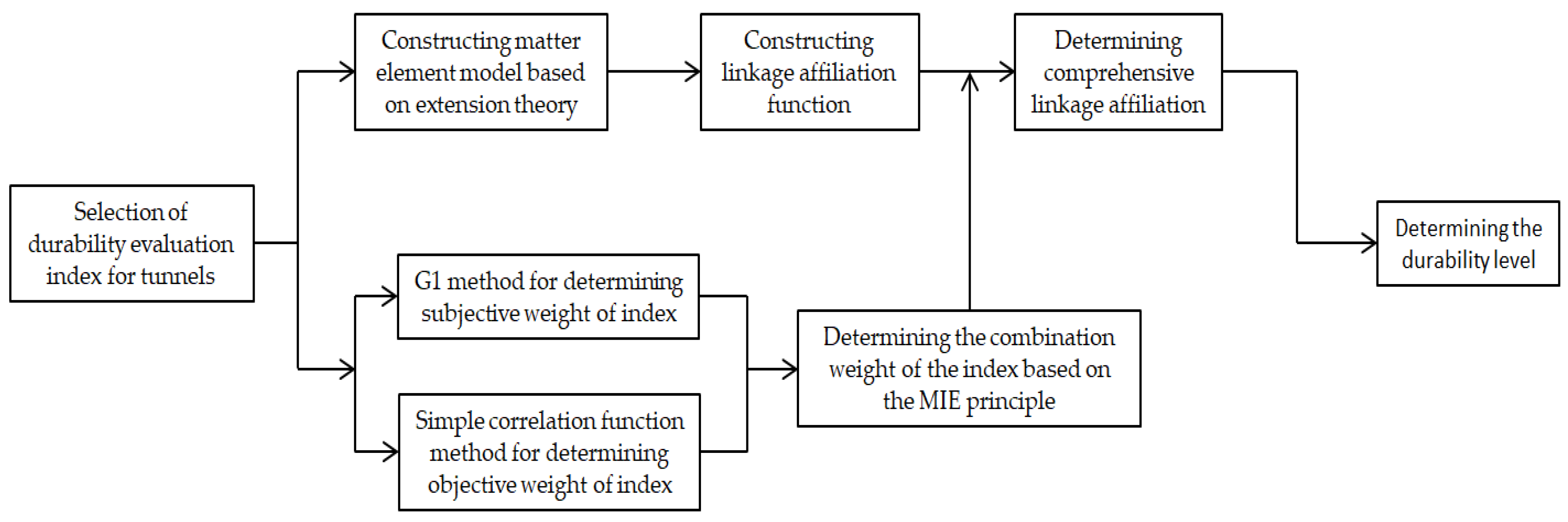
A series of water diversion projects to address the uneven distribution of water resources in China have involved the construction of a large number of hydraulic tunnels. As the lining structure is there to maintain the stability and durability of the tunnels, durability damage can easily occur in the operation process, thus affecting the safety of water transmission and water supply capacity. Therefore, it is important to evaluate the durability of hydraulic tunnel lining structure. Considering the randomness and fuzziness of the factors affecting the durability of hydraulic tunnel lining structure, this paper proposes a comprehensive evaluation model based on the coupling of set pair analysis and extension. The G1 method and the simple correlation function method are used to determine the subjective and objective weights of the evaluation indexes, respectively, and the combination weight of them is assigned based on the principle of minimum entropy; next, the set pair analysis principle is used to establish the linkage affiliation function, which can calculate the comprehensive linkage affiliation of the object to be evaluated, and then the maximum affiliation principle is used to judge the durability level of the hydraulic tunnel lining structure. Finally, taking a section of hydraulic tunnel as an example, the model proposed in this paper is used to calculate its durability grade as Class III, with the set pair potential SHI(H) = 7.5856, which is consistent with the actual engineering practice, and a comparative study is done in combination with the AHP-Extenics method. It is verified that the evaluation model can scientifically and reasonably evaluate the durability of hydraulic tunnel lining structure, providing a basis for subsequent maintenance and reinforcement.
Keywords: set pair analysis; extension theory; lining structure; durability evaluation; G1 method; simple correlation function method set pair analysis; extension theory; lining structure; durability evaluation; G1 method; simple correlation function method