Clustering Analysis of Multilayer Complex Network of Nanjing Metro Based on Traffic Line and Passenger Flow Big Data


Abstract
1. Introduction
2. Methods
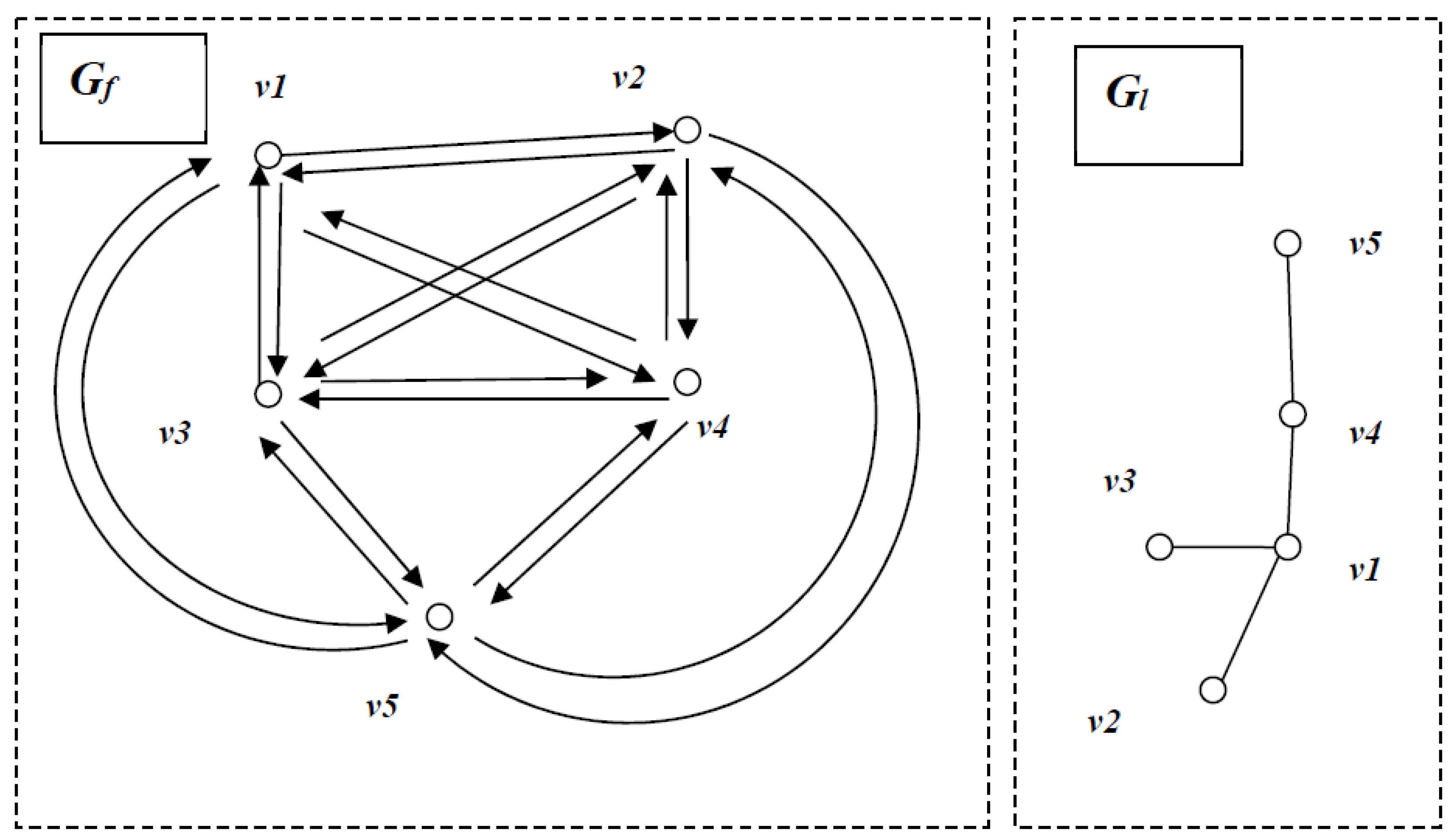
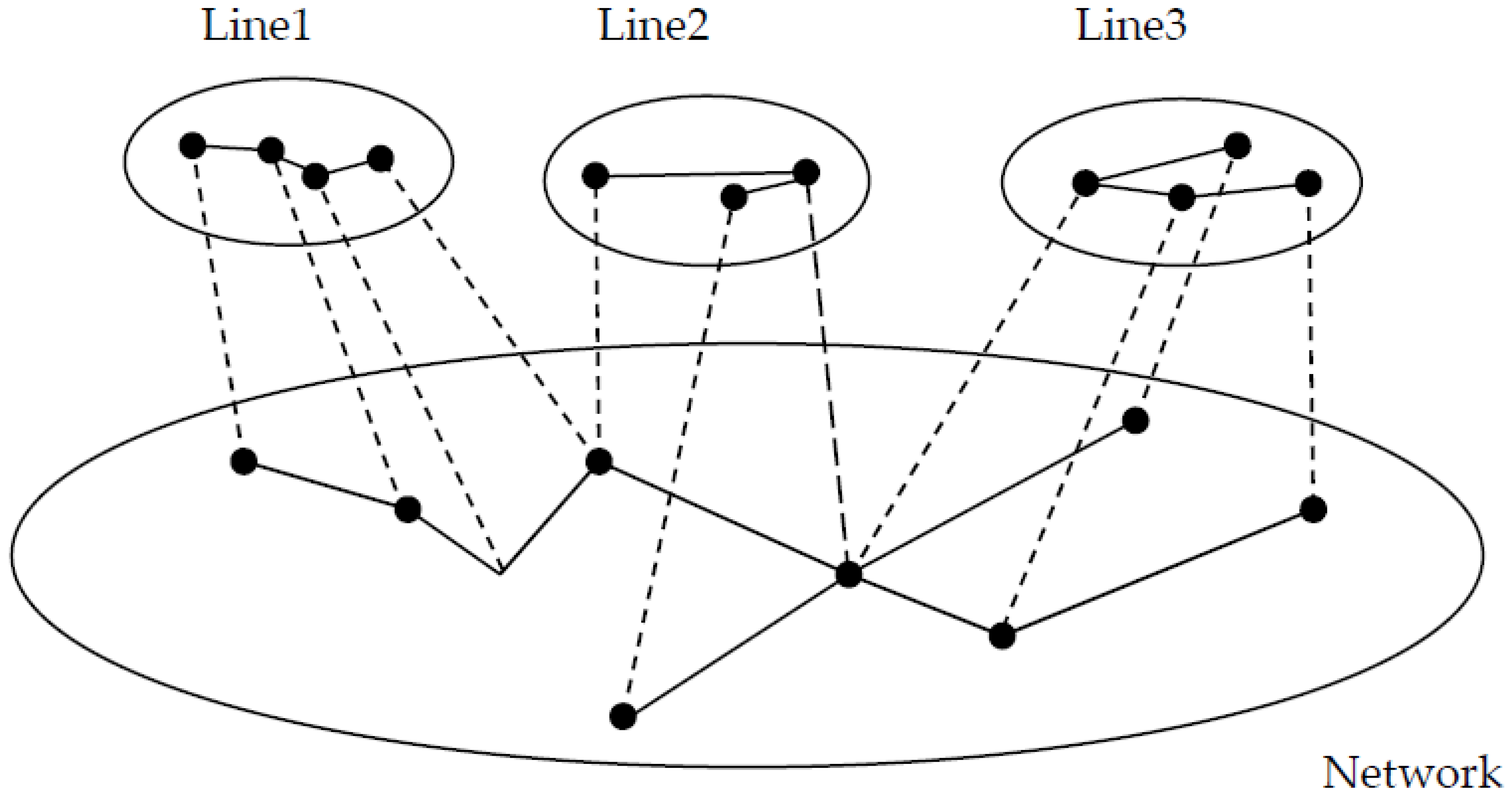
2.1. Problem Description
2.2. Previous Calculation Methods of Clustering Coefficient
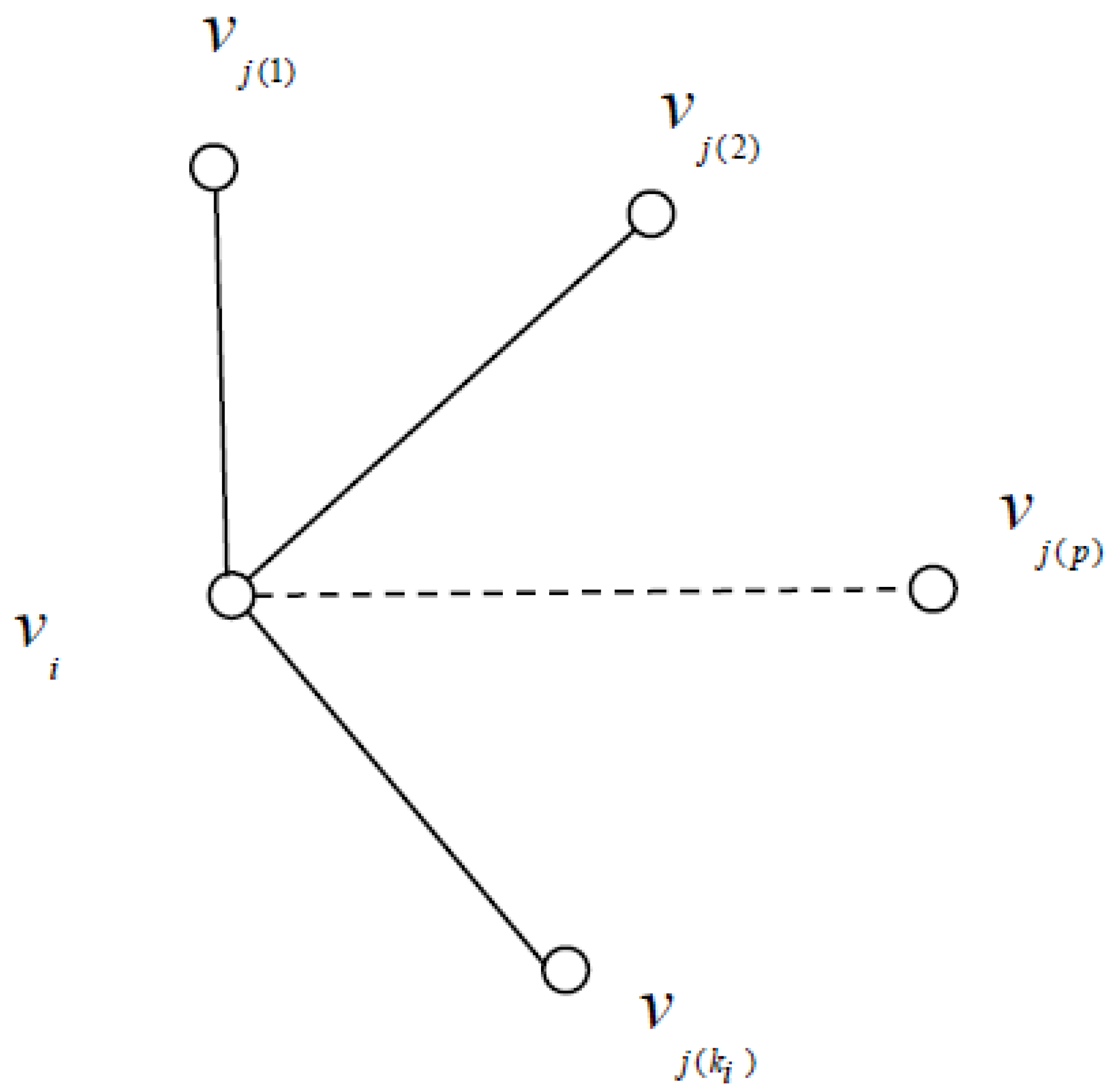
2.3. Calculation Assumption of Clustering Coefficient of Line-Flow Multilayer Network
- (1)
- The clustering coefficient of the node can be divided into inflow and outflow.
- (2)
- The contribution of nodes to the clustering coefficient should be proportional to the weight of the edge.
- (3)
- The network clustering coefficient is the average value of the clustering coefficient of all nodes.
- (4)
- The clustering coefficient of the node or the multilayer network ranges from 0 to 1. The higher the value, the higher the degree of clustering.
- (5)
- When the line network becomes a globally coupled network, the clustering coefficient of the line-flow multilayer network is 1.
2.4. Calculation Process of Clustering Effect of Line-Flow Multilayer Network
- (1)
- Step 1: Establish the flow network according to the directed weighted flow between nodes.
- (2)
- Step 2: Establish the line network according to the adjacent stations in the line network. It is the undirected unweighted network.
- (3)
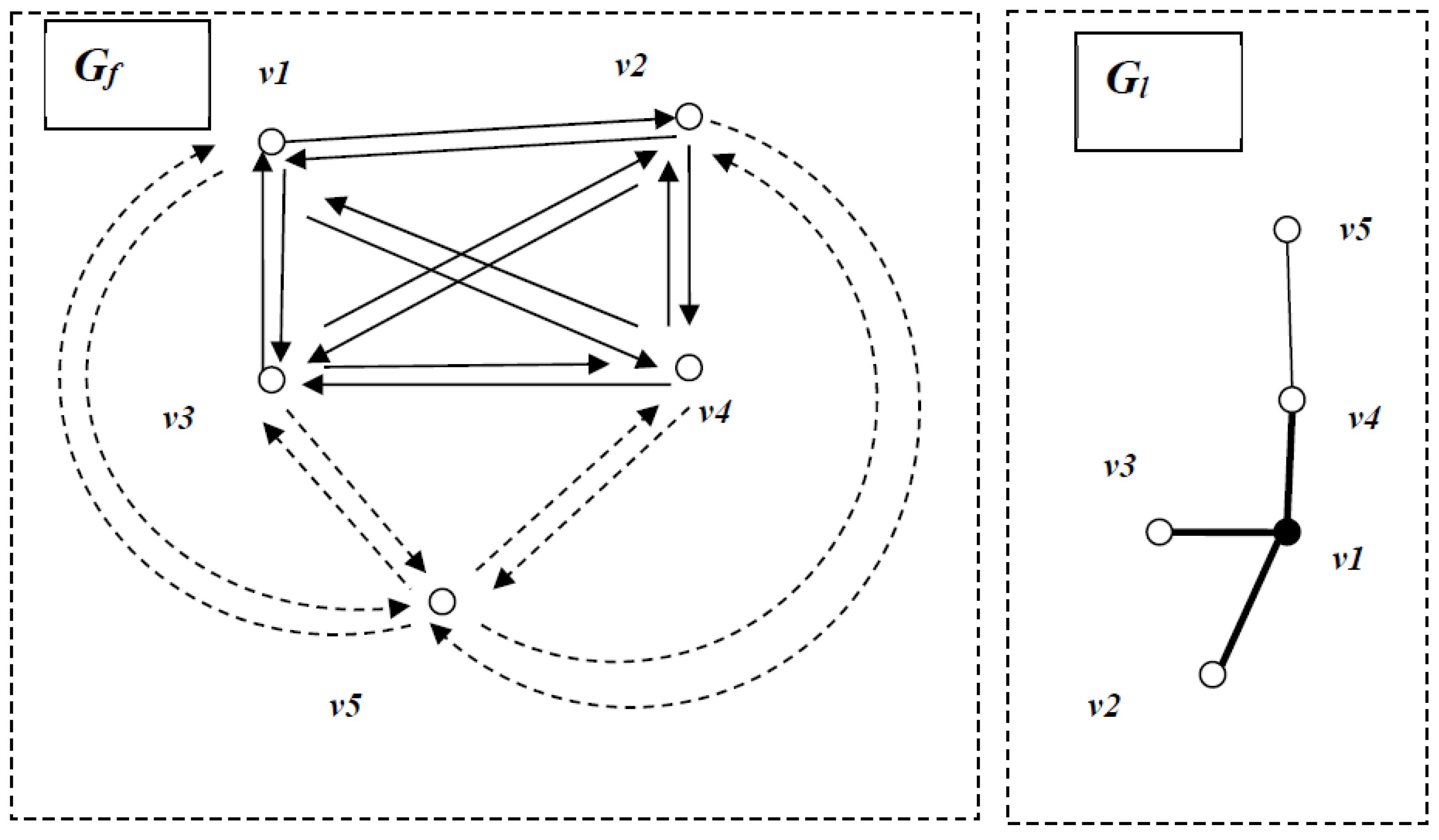
- Step 3: Calculate the total flow of the node groups.
- (4)
- Step 4: Calculate the inner flow of the node groups, including inner inflow and inner outflow. The flow between the same nodes is zero.
- (5)
- Step 5: Calculate the flow clustering coefficient of the node, including inflow clustering coefficient and outflow clustering coefficient.
- (6)
- Step 6: Calculate the flow clustering coefficient of the line-flow multilayer network, including inflow clustering coefficient and outflow clustering coefficient.
3. Results
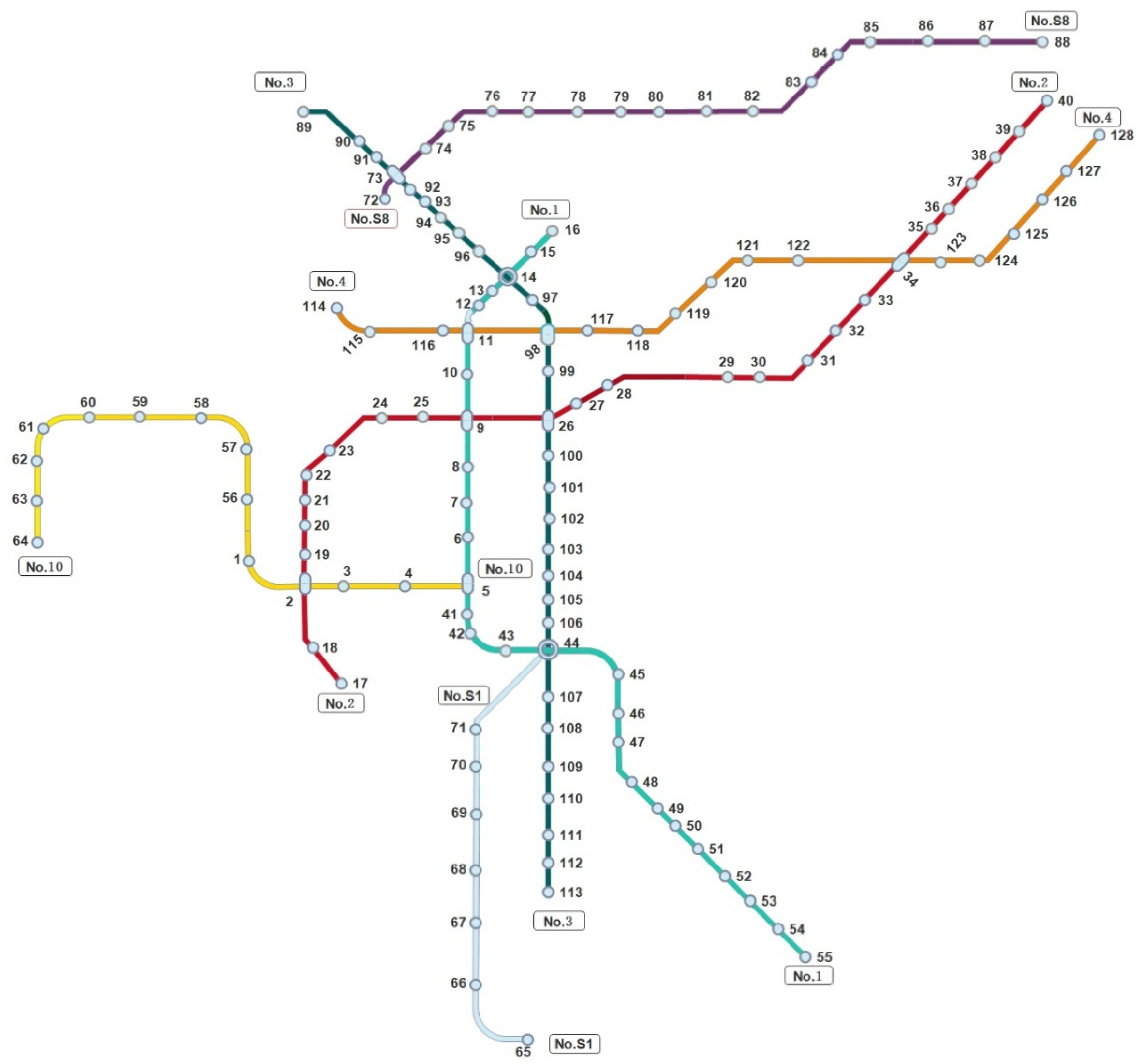
3.1. Situation of Nanjing Metro
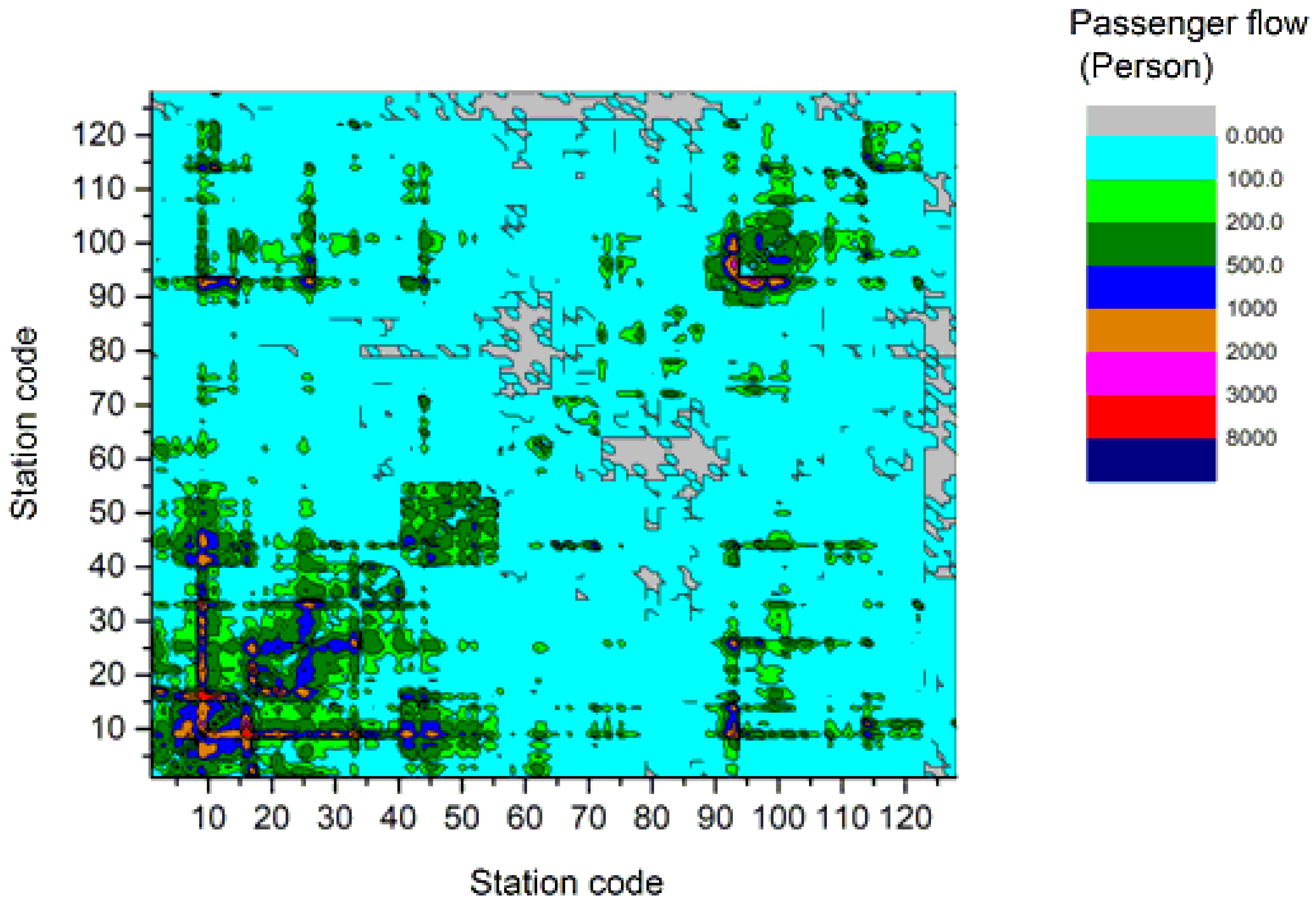
3.2. Flow Network of Nanjing Metro
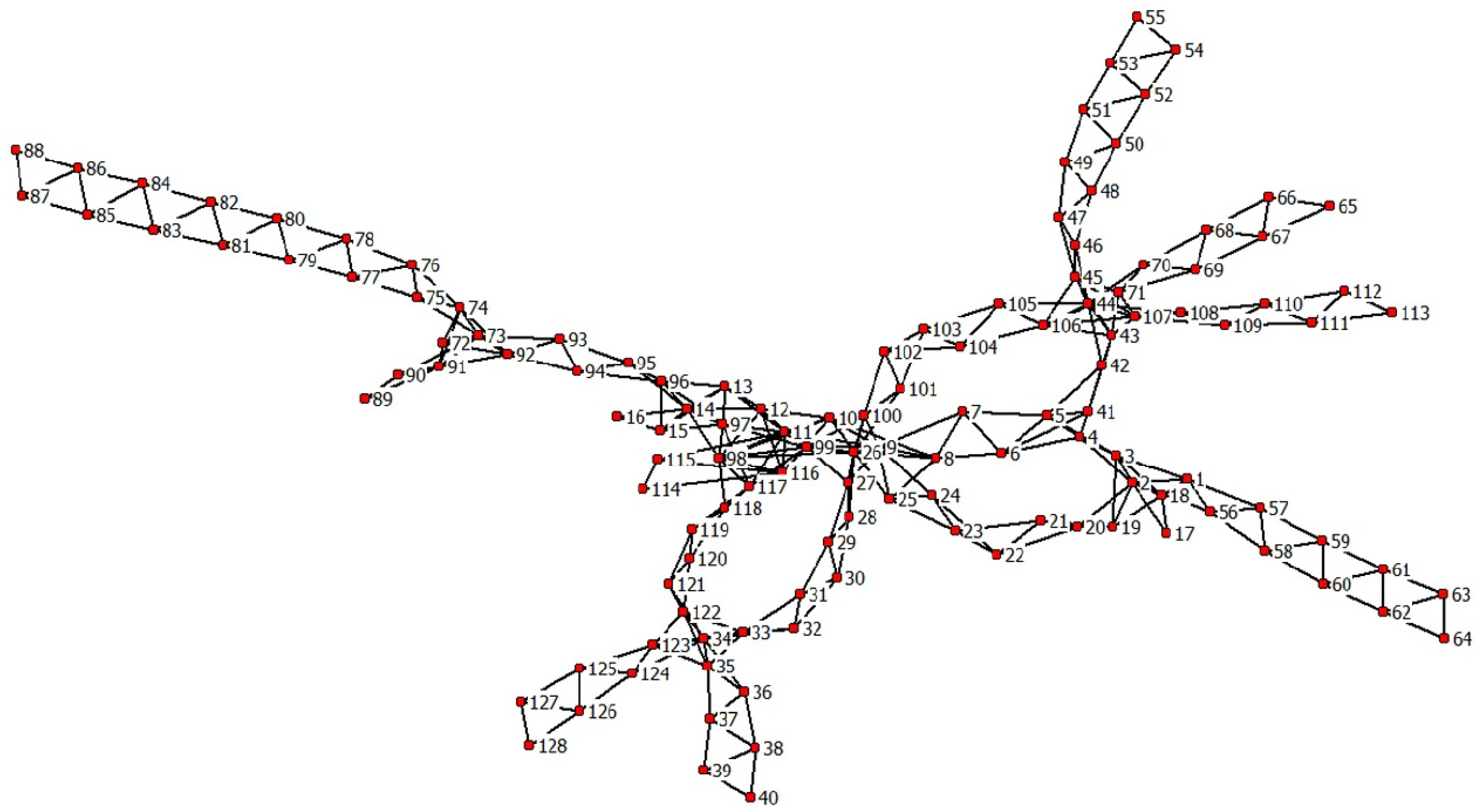
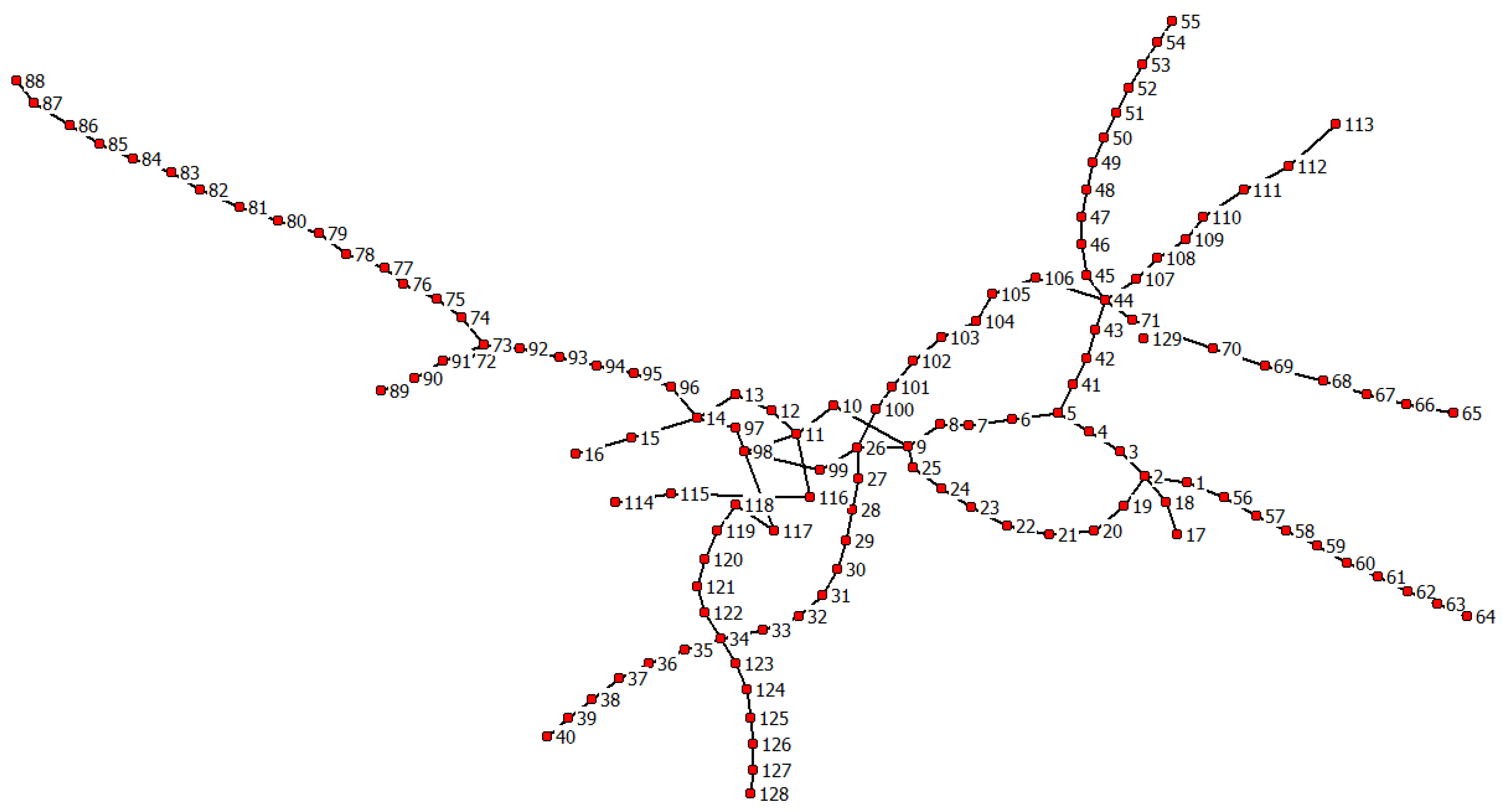
3.3. Line Network of Nanjing Metro
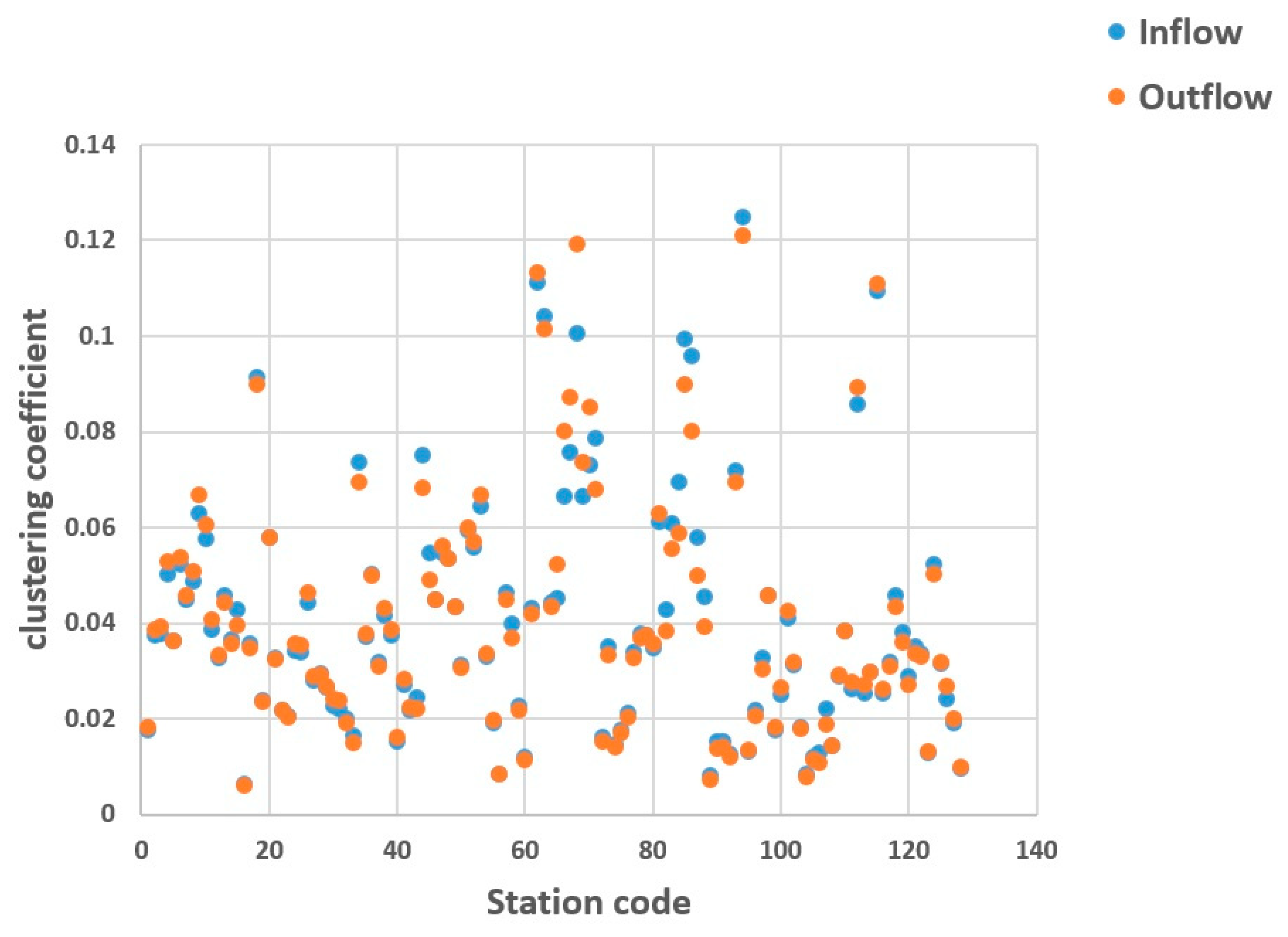
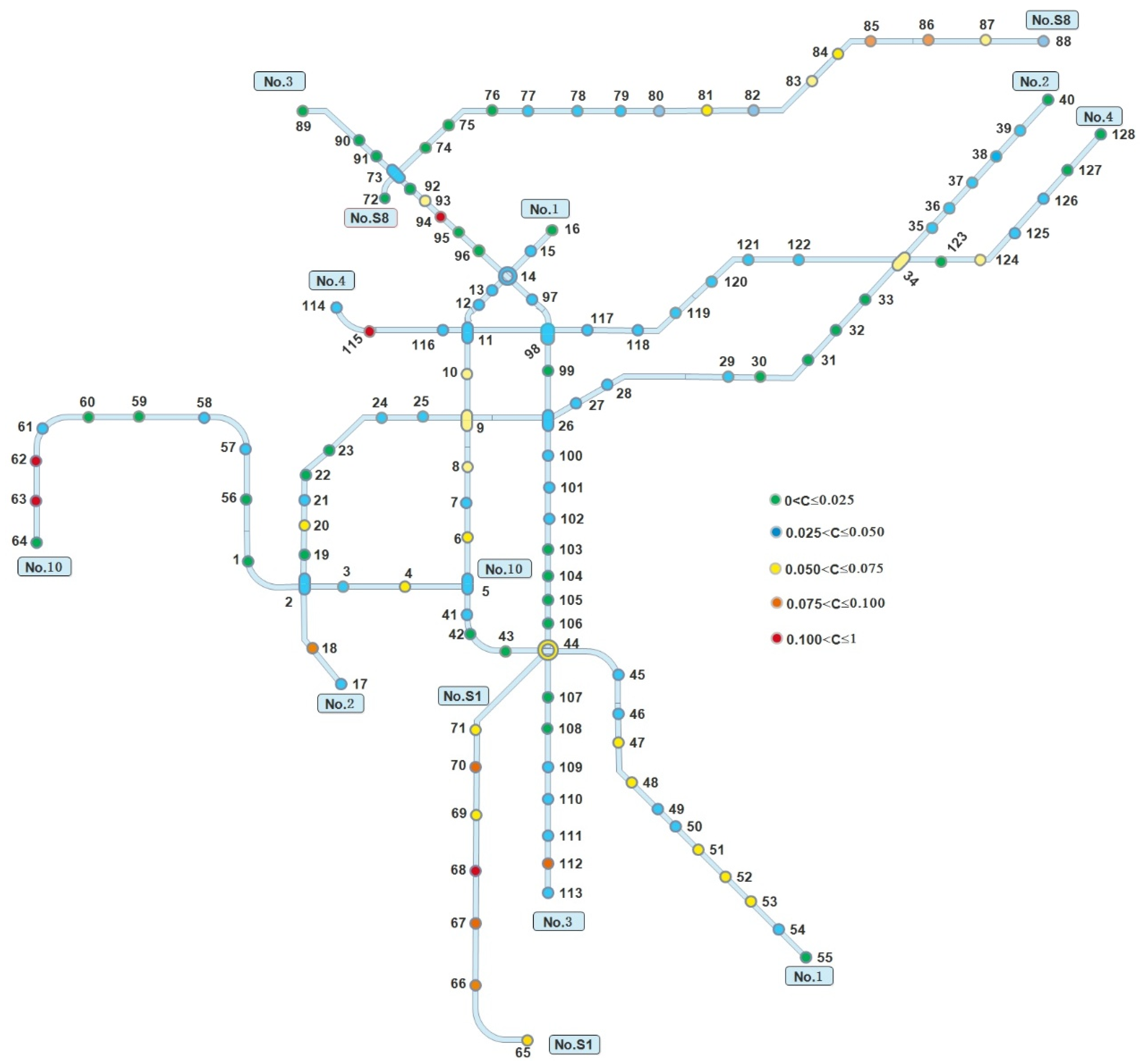
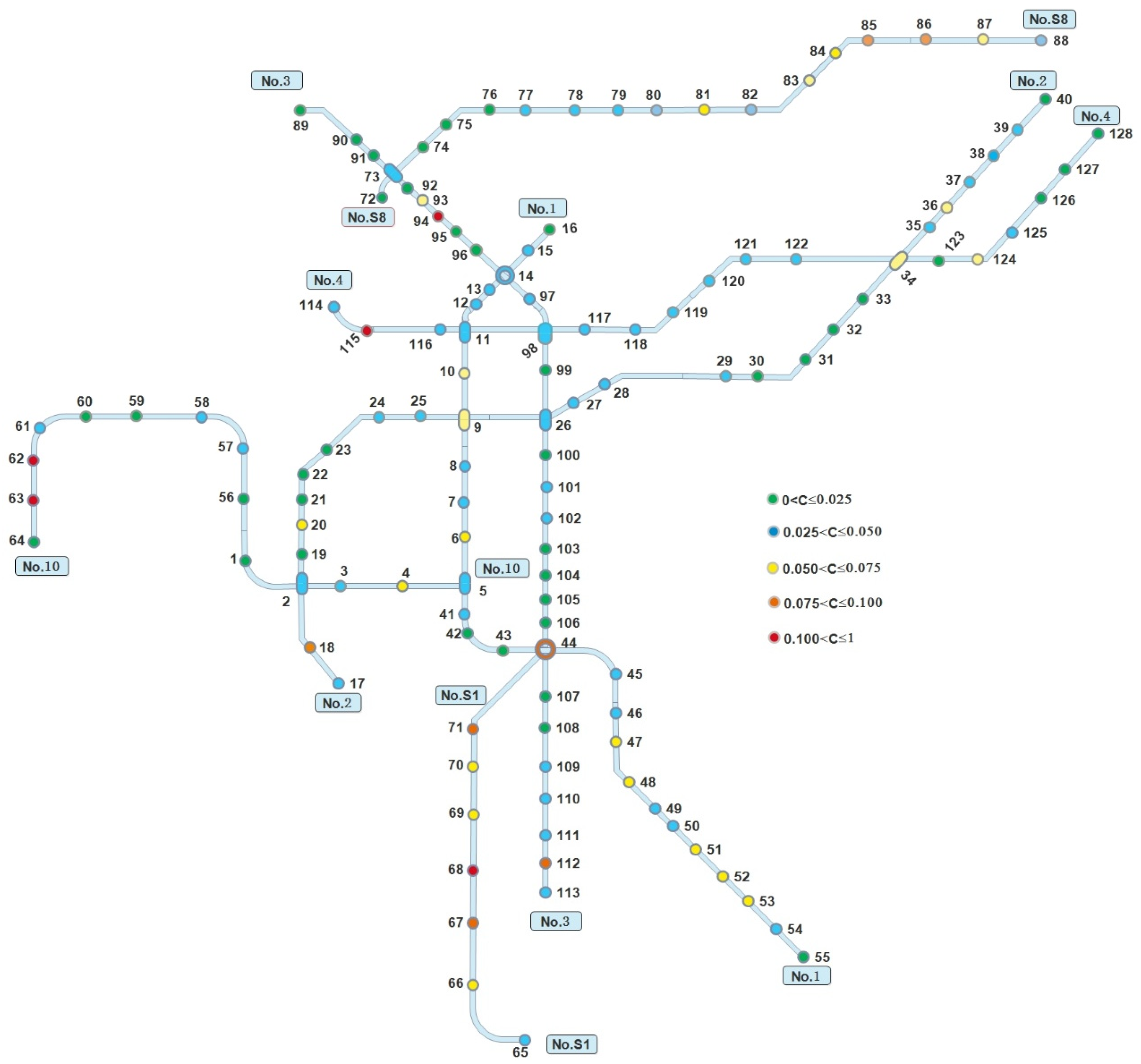
3.4. Inflow and Outflow Clustering Coefficient of the Stations in Line-Flow Multilayer Network
3.5. Inflow and Outflow Clustering Coefficient of Line-Flow Multilayer Network
4. Discussion
5. Conclusions
Author Contributions
Funding
Institutional Review Board Statement
Informed Consent Statement
Data Availability Statement
Conflicts of Interest
References
- Li, C.; Sun, W.; Kurths, J. Synchronization between two coupled complex networks. Phys. Rev. E 2007, 76, 046204. [Google Scholar] [CrossRef] [Scilit]
- Wu, W.; Zhou, W.; Chen, T. Cluster Synchronization of Linearly Coupled Complex Networks Under Pinning Control. IEEE Trans. Circuits Syst. I Regul. Pap. 2009, 56, 829–839. [Google Scholar] [CrossRef] [Scilit]
- Wang, X.; Gu, H.; Chen, Y.; Lü, J. Recovering node parameters and topologies of uncertain non-linearly coupled complex networks. IET Control. Theory Appl. 2020, 14, 105–115. [Google Scholar] [CrossRef] [Scilit]
- Chen, S.; Horng, Y.; Lee, C. Fuzzy information retrieval based on multi-relationship fuzzy concept networks. Fuzzy Sets Syst. 2003, 140, 183–205. [Google Scholar] [CrossRef] [Scilit]
- Bin, S.; Sun, G.; Cao, N.; Qiu, J.; Zheng, Z.; Yang, G.; Zhao, H.; Jiang, M.; Xu, L. Collaborative Filtering Recommendation Algorithm Based on Multi-Relationship Social Network. Comput. Mater. Contin. 2019, 60, 659–674. [Google Scholar] [CrossRef] [Scilit]
- Li, M.; Zhang, Q.; Deng, Y. Evidential identification of influential nodes in network of networks. Chaos Solitons Fractals 2018, 117, 283–296. [Google Scholar] [CrossRef] [Scilit]
- De Domenico, M.; Solé-Ribalta, A.; Cozzo, E.; Kivelä, M.; Moreno, Y.; Porter, M.A.; Gómez, S.; Arenas, A. Mathematical Formulation of Multilayer Networks. Phys. Rev. X 2013, 3, 041022. [Google Scholar] [CrossRef] [Scilit]
- De Domenico, M.; Solé-Ribalta, A.; Omodei, E.; Gómez, S.; Arenas, A. Ranking in interconnected multilayer networks reveals versatile nodes. Nat. Commun. 2015, 6, 6868. [Google Scholar] [CrossRef] [Scilit]
- De Arruda, G.F.; Rodrigues, F.A.; Moreno, Y. Fundamentals of spreading processes in single and multilayer complex networks. Phys. Rep.-Rev. Sect. Phys. Lett. 2018, 756, 1–59. [Google Scholar] [CrossRef] [Scilit]
- Mucha, P.J.; Richardson, T.; Macon, K.; Porter, M.A.; Onnela, J.-P. Community Structure in Time-Dependent, Multiscale, and Multiplex Networks. Science 2010, 328, 876–878. [Google Scholar] [CrossRef] [Scilit]
- Gómez, S.; Díaz-Guilera, A.; Gómez-Gardeñes, J.; Pérez-Vicente, C.J.; Moreno, Y.; Arenas, A. Diffusion Dynamics on Multiplex Networks. Phys. Rev. Lett. 2013, 110, 028701. [Google Scholar] [CrossRef] [Scilit] [PubMed]
- Saumell, M.A.; Angeles, S.M.; Boguna, M. Epidemic spreading on interconnected networks. Phys. Rev. E 2012, 86, 026106. [Google Scholar]
- Radicchi, F.; Arenas, A. Abrupt transition in the structural formation of interconnected networks. Nat. Phys. 2013, 9, 717–720. [Google Scholar] [CrossRef] [Scilit]
- Watts, D.J.; Strogatz, S.H. Collective dynamics of “small-world” networks. Nature 1998, 393, 440–442. [Google Scholar] [CrossRef] [Scilit]
- Barthélemy, M.; Barrat, A. Pastor-Satorras, R.; Vespignani, A. Characterization and modeling of weighted networks. Phys. A Stat. Mech. Its Appl. 2005, 346, 34–43. [Google Scholar] [CrossRef] [Scilit]
- Onnela, J.-P.; Saramäki, J.; Kertész, J.; Kaski, K. Intensity and coherence of motifs in weighted complex networks. Phys. Rev. E 2005, 71, 065103. [Google Scholar] [CrossRef] [Scilit]
- Holme, P.; Park, S.M.; Kim, B.J.; Edling, C.R. Korean university life in a network perspective: Dynamics of a large affiliation network. Phys. A Stat. Mech. Its Appl. 2007, 373, 821–830. [Google Scholar] [CrossRef] [Scilit]
- Guo, S.; Lu, Z.; Kang, G. Degree-degree correlation measures and clustering coefficients for directed complex network analysis. ICIC Express Lett. Part B Appl. 2011, 2, 859–864. [Google Scholar]
- Saramäki, J.; Kivelä, M.; Onnela, J.-P.; Kaski, K.; Kertész, J. Generalizations of the clustering coefficient to weighted complex networks. Phys. Rev. E 2007, 75, 027105. [Google Scholar] [CrossRef] [Scilit]
- Zhang, Y.; Zhang, Z.; Guan, J.; Zhou, S. An analytic derivation of clustering coefficients for weighted networks. J. Stat. Mech. Theory Exp. 2010, 2010, P03013. [Google Scholar] [CrossRef] [Scilit]
- Wang, Y.; Ghumare, E.; Vandenberghe, R.; Dupont, P. Comparison of Different Generalizations of Clustering Coefficient and Local Efficiency for Weighted Undirected Graphs. Neural Comput. 2017, 29, 313–331. [Google Scholar] [CrossRef] [Scilit]
- Berenhaut, K.S.; Kotsonis, R.C.; Jiang, H. A new look at clustering coefficients with generalization to weighted and multi-faction networks. Soc. Netw. 2018, 52, 201–212. [Google Scholar] [CrossRef] [Scilit]
- Tabak, B.M.; Takami, M.; Rocha, J.M.; Cajueiro, D.O.; Souza, S.R. Directed clustering coefficient as a measure of systemic risk in complex banking networks. Phys. A Stat. Mech. Its Appl. 2014, 394, 211–216. [Google Scholar] [CrossRef] [Scilit]
- Wei, Y.; Ning, S. Establishment and Analysis of the Supernetwork Model for Nanjing Metro Transportation System. Complexity 2018, 2018, 4860531. [Google Scholar] [CrossRef] [Scilit]
- Yu, W.; Chen, J.; Yan, X. Space–Time Evolution Analysis of the Nanjing Metro Network Based on a Complex Network. Sustainability 2019, 11, 523. [Google Scholar] [CrossRef] [Scilit]
- Yu, W.; Wang, T.; Zheng, Y.; Chen, J. Parameter Selection and Evaluation of Robustness of Nanjing Metro Network Based on Supernetwork. IEEE Access 2019, 7, 70876–70890. [Google Scholar] [CrossRef] [Scilit]
- Yu, W.; Bai, H.; Chen, J.; Yan, X. Anomaly detection of passenger OD on Nanjing metro based on smart card big data. IEEE Access 2019, 7, 138624–138636. [Google Scholar] [CrossRef] [Scilit]
- Yu, W.; Bai, H.; Chen, J.; Yan, X. Analysis of space-time variation of passenger flow and commuting characteristics of residents using smart card data of Nanjing metro. Sustainability 2019, 11, 4989. [Google Scholar] [CrossRef] [Scilit]
- Yu, W.; Ye, X.; Chen, J.; Yan, X.; Wang, T. Evaluation indexes and correlation analysis of Origination–Destination travel time of Nanjing Metro based on complex network method. Sustainability 2020, 12, 1113. [Google Scholar] [CrossRef] [Scilit]
- Yin, C.; Wang, X.; Shao, C. Do the Effects of ICT Use on Trip Generation Vary across Travel Modes? Evidence from Beijing. J. Adv. Transp. 2021, 2021, 6699674. [Google Scholar] [CrossRef] [Scilit]
- Han, B.; Sun, D.; Yu, X.; Song, W.; Ding, L. Classification of Urban Street Networks Based on Tree-Like Network Features. Sustainability 2020, 12, 628. [Google Scholar] [CrossRef] [Scilit]
- Zhu, Z.; Zeng, J.; Gong, X.; He, Y.; Qiu, S. Analyzing Influencing Factors of Transfer Passenger Flow of Urban Rail Transit: A New Approach Based on Nested Logit Model Considering Transfer Choices. Int. J. Environ. Res. Public Health 2021, 18, 8462. [Google Scholar] [CrossRef] [Scilit]
- Zhu, Z.; Chen, H.; Ma, J.; He, Y.; Chen, J.; Sun, J. Exploring the Relationship between Walking and Emotional Health in China. Int. J. Environ. Res. Public Health 2020, 17, 8804. [Google Scholar] [CrossRef] [Scilit]
- Jiang, X.; Wang, H.; Guo, X.; Gong, X. Using the FAHP, ISM, and MICMAC Approaches to Study the Sustainability Influencing Factors of the Last Mile Delivery of Rural E-Commerce Logistics. Sustainability 2019, 11, 3937. [Google Scholar] [CrossRef] [Scilit]
- Jiang, X.; Tang, T.; Sun, L.; Lin, T.; Duan, X.; Guo, X. Research on Consumers’ Preferences for the Self-Service Mode of Express Cabinets in Stations Based on the Subway Distribution to Promote Sustainability. Sustainability 2020, 12, 7212. [Google Scholar] [CrossRef] [Scilit]





| Opening Sequence | Number of Stations | Length (km) | Opening Year |
|---|---|---|---|
| 1 | 27 | 38.9 | 2005 |
| 2 | 26 | 37.95 | 2010 |
| 10 | 14 | 21.6 | 2014 |
| S1 | 8 | 37.3 | 2014 |
| S8 | 17 | 45.2 | 2014 |
| 3 | 29 | 44.9 | 2015 |
| 4 | 18 | 33.8 | 2017 |
| Date | Week | Number after Filtering | Network Inflow Clustering Coefficient | Network Outflow Clustering Coefficient |
|---|---|---|---|---|
| 2.13 | Monday | 1,218,423 | 0.0405 | 0.0404 |
| 2.14 | Tuesday | 1,294,948 | 0.0426 | 0.0427 |
| 2.15 | Wednesday | 1,229,704 | 0.0412 | 0.0414 |
| 2.16 | Thursday | 1,192,083 | 0.0409 | 0.0409 |
| 2.17 | Friday | 1,313,340 | 0.0408 | 0.0414 |
Disclaimer/Publisher’s Note: The statements, opinions and data contained in all publications are solely those of the individual author(s) and contributor(s) and not of MDPI and/or the editor(s). MDPI and/or the editor(s) disclaim responsibility for any injury to people or property resulting from any ideas, methods, instructions or products referred to in the content. |
© 2023 by the authors. Licensee MDPI, Basel, Switzerland. This article is an open access article distributed under the terms and conditions of the Creative Commons Attribution (CC BY) license (https://creativecommons.org/licenses/by/4.0/).
Share and Cite
Li, M.; Yu, W.; Zhang, J. Clustering Analysis of Multilayer Complex Network of Nanjing Metro Based on Traffic Line and Passenger Flow Big Data. Sustainability 2023, 15, 9409. https://doi.org/10.3390/su15129409
Li M, Yu W, Zhang J. Clustering Analysis of Multilayer Complex Network of Nanjing Metro Based on Traffic Line and Passenger Flow Big Data. Sustainability. 2023; 15(12):9409. https://doi.org/10.3390/su15129409
Chicago/Turabian StyleLi, Ming, Wei Yu, and Jun Zhang. 2023. "Clustering Analysis of Multilayer Complex Network of Nanjing Metro Based on Traffic Line and Passenger Flow Big Data" Sustainability 15, no. 12: 9409. https://doi.org/10.3390/su15129409
APA StyleLi, M., Yu, W., & Zhang, J. (2023). Clustering Analysis of Multilayer Complex Network of Nanjing Metro Based on Traffic Line and Passenger Flow Big Data. Sustainability, 15(12), 9409. https://doi.org/10.3390/su15129409