Article

Spatial-Temporal Evolution and Driving Forces of Cultivated Land Based on the PLUS Model: A Case Study of Haikou City, 1980–2020


College of Forestry, Hainan University, Haikou 570228, China
*
Author to whom correspondence should be addressed.
Sustainability 2022, 14(21), 14284; https://doi.org/10.3390/su142114284
Submission received: 26 September 2022 / Revised: 19 October 2022 / Accepted: 28 October 2022 / Published: 1 November 2022
(This article belongs to the Special Issue Agricultural Land Change and Soil Degradation)

Abstract

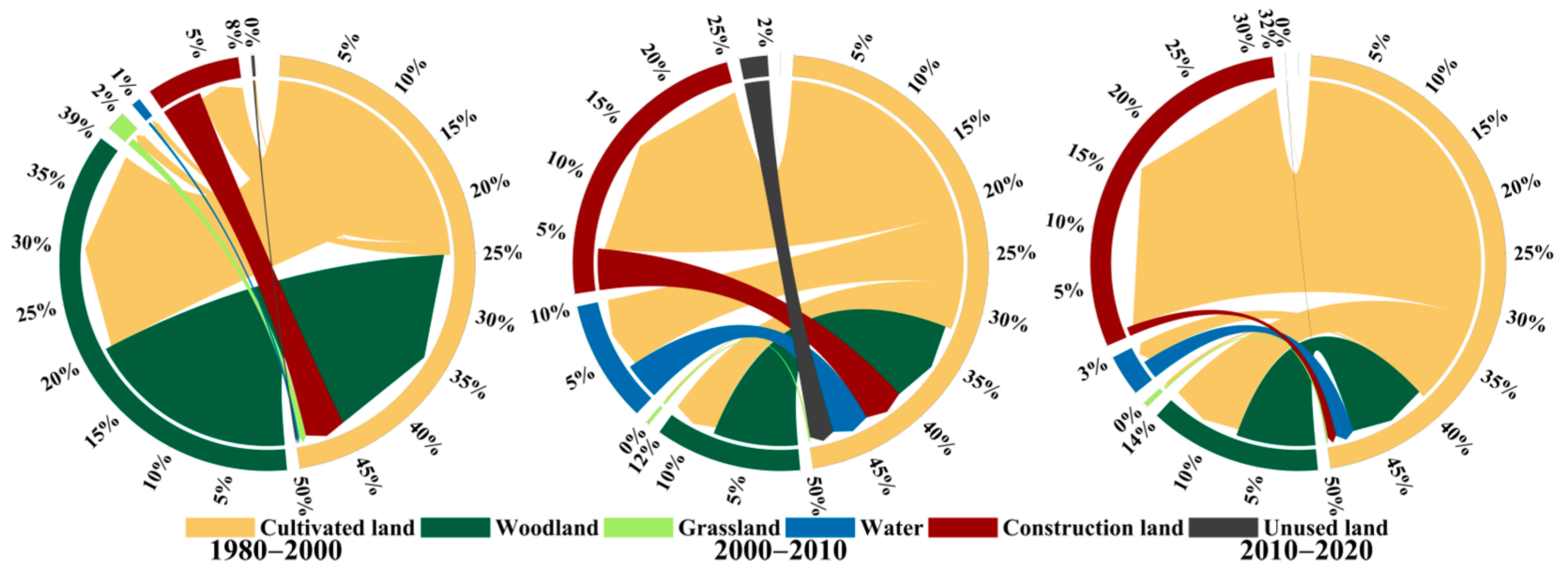
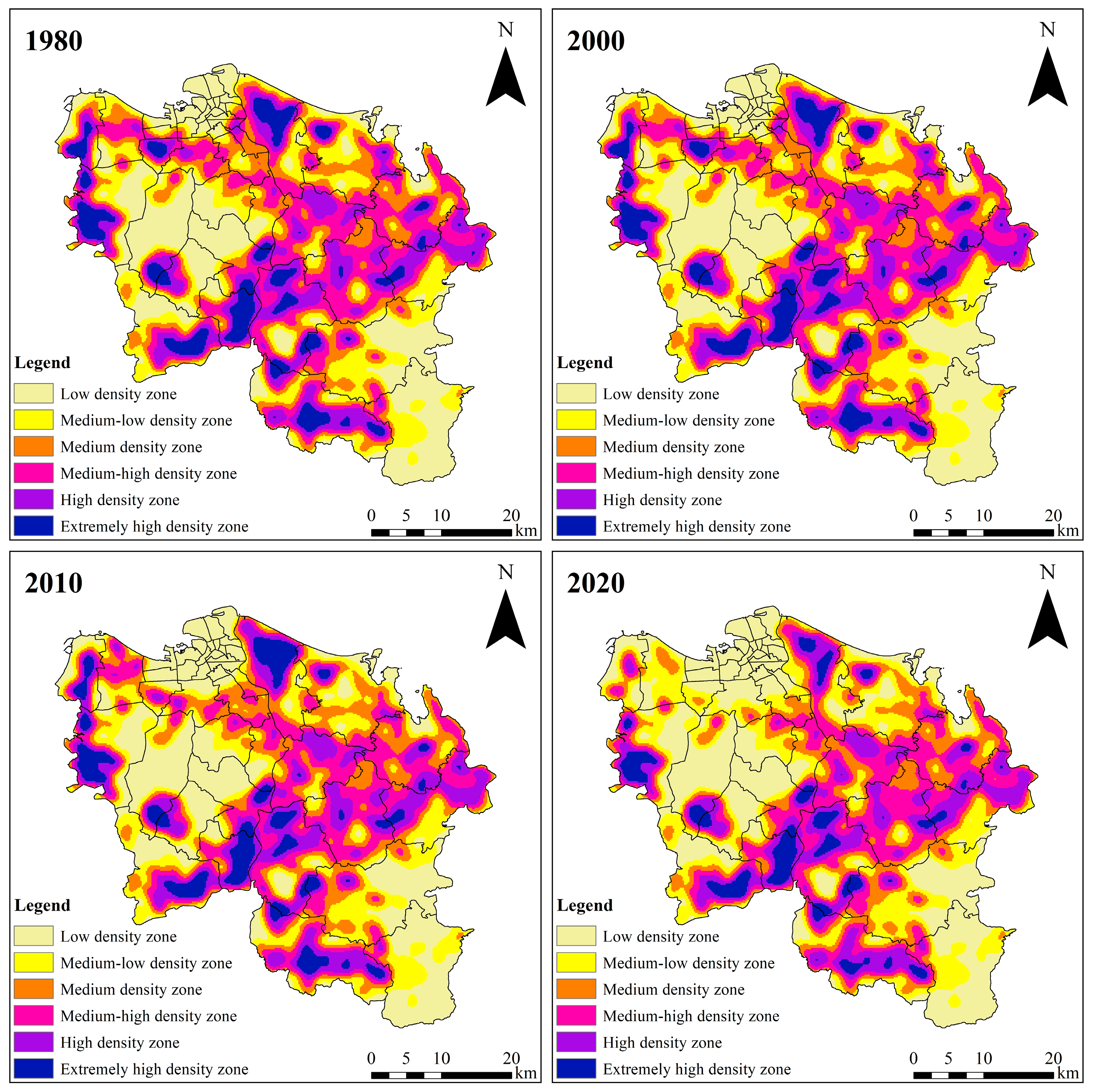
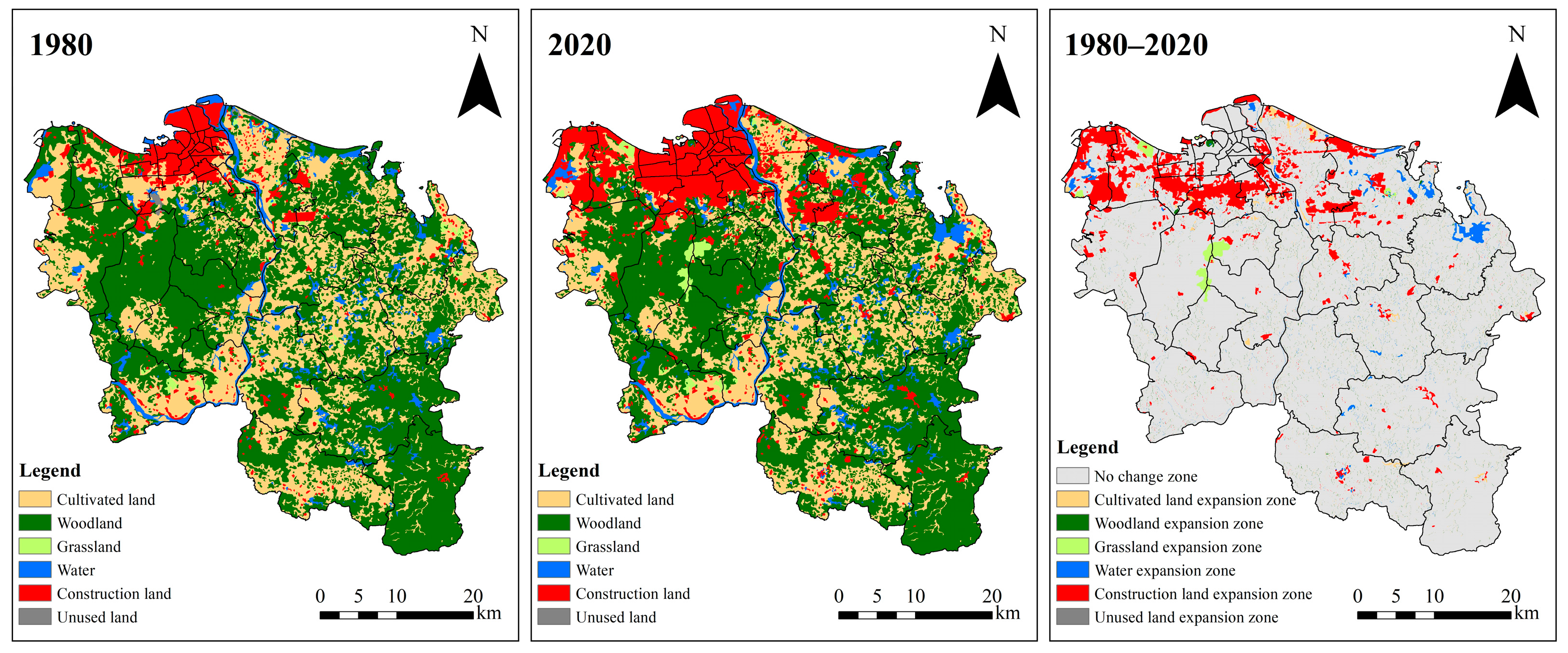
The security of cultivated land is the foundation for stable social and economic development. In recent years, with rapid economic development, urbanization around the world has been accelerating. The demand for urban construction expansion is increasing day by day and lands used for cultivation are being infiltrated by construction, posing a serious threat to food security. This study used the land-use data from Haikou City in 1980, 2000, 2010 and 2020, to generate a transfer matrix, kernel density analysis and landscape pattern index to analyze the spatial-temporal evolution of cultivated land in Haikou. The PLUS model was used to explore potential factors driving land-use evolution. Results show that cultivated land in Haikou was continuously lost from 1980 to 2020 and the area of cultivated land decreased by 7020.58 ha. Loss was most significant during 2010–2020 when cultivated land ascended into construction land in the northern region of the city. Spatial distribution of cultivated land in Haikou is generally characterized by “dense in the southwest and sparse in the northwest”, and the spatial density of cultivated land in the northwest continuously decreased from 1980 to 2020. In the past 40 years, the degree of spatial aggregation for cultivated land in Haikou has decreased and the degree of fragmentation has increased. The primary factors driving changes in spatial-temporal patterns over the past 40 years has been the distance from roads and high-speed railways and the distance from water. During the 40-year timespan, Haikou continued to lose cultivated land areas due to the interaction of social and natural factors such as road traffic and water resources. The juxtaposition between the demand for urban construction lands and the protection of cultivated land has become increasingly evident. Due to the threat cultivated lands are facing in the northern area of Haikou, we suggest future expansion of construction development land should be strictly controlled.
Keywords: cultivated land change; spatial-temporal pattern; driving forces; PLUS model; Haikou City cultivated land change; spatial-temporal pattern; driving forces; PLUS model; Haikou City