


Abstract
The green innovation of family enterprises under environmental regulation is essentially the balance between emotional benefits and emotional costs, which manifests as the reputation incentive and risk aversion, respectively. The reputation incentive refers to inheriting extended social–emotional wealth, and risk aversion means maintaining constrained social–emotional wealth. Based on the theoretical framework of social–emotional wealth, this paper selects 3006 family enterprises in China from 2015 to 2020, establishes a panel model of fixed effects, and discusses the impact of environmental regulation on the green innovation efficiency in family enterprises from the perspective of family involvement. The findings indicate that command-based environmental regulation promotes green innovation efficiency in family enterprises, while market-based environmental regulation inhibits the green innovation efficiency of family enterprises. The involvement of family ownership strengthens the positive effect of command-based environmental regulation on green innovation efficiency, while the involvement of family management rights strengthens the negative effect of market-based environmental regulation on green innovation efficiency. Through mechanism analysis, it is found that command-based environmental regulation promotes green innovation efficiency in family enterprises through reputation incentives, while market-based environmental regulation reduces the green innovation efficiency of family enterprises by avoiding risks. Further analysis shows that high-competition and high-pollution industries are more significantly affected by the relationship between them. Therefore, this paper proposes improvements to green innovation efficiency in family enterprises based on the adjustment of four aspects: improving the risk management level, consolidating family control, increasing the shareholding ratio of nonfamily shareholders, and giving full play to the role of reputation incentives to achieve the sustainable development of family enterprises. Furthermore, we strive to contribute to the realization of the dual carbon goals and the United Nations Sustainable Development Goals (SDGs).
1. Introduction
As the economy enters the stage of double-cycle high-quality development, China is striving to achieve sustainable development of ecology and the economy. The Fifth Plenary Session of the 18th CPC Central Committee put forward the new development concept of “innovation, coordination, green, openness and sharing”. Green refers to the requirement of protecting the environment and saving resources. Innovation promotes institutional change by changing potential profits [1]. Green innovation is the combination of both the aforementioned development concepts. On 25 September 2015, 193 member states of the United Nations formally adopted 17 Sustainable Development Goals (SDGs) at the Sustainable Development Summit, aiming to thoroughly solve the development problems in the three dimensions of society, economy, and environment in a comprehensive way between 2015 and 2030, and turn to the path of sustainable development. The 19th National Congress of the Communist Party of China proposed the implementation of the strictest possible ecological and environmental protection systems and the establishment of a market-oriented system for green technology innovation. In 2020, the Guiding Opinions on Building a Modern Environmental Governance System made a clear commitment to improving the corporate responsibility system and began the construction of the responsibility system for environmental governance; additionally, they set the long-term goal of “widely forming a green way of production and life, driving carbon emissions to stabilize and reduce after reaching the peak”. It can be seen that green innovation is an important link to achieve a “win-win” situation between enterprise competitiveness and environmental protection (Qi Shaozhou and Xu Jia, 2018) [2], which means the implementation and development of innovations that minimize environmental and social damage; finally, it will produce economic improvements (Jacob Guinot et al., 2022) [3]. Its practice and report will improve the performance of enterprises’ sustainable development goals (Khan, P.A. et al., 2021) [4].
Since green innovation itself has significant “dual externalities”, it is difficult to optimize the allocation of environmental resources by relying on the market. Therefore, it is necessary to improve the effectiveness of policy tools while relying on various mechanisms to play a role [5]. Environmental regulation, as a way for the government to regulate environmental pollution socially, is the mandatory screening of “cleaning up pollution” for enterprises (Jin Bei, 2009) [6]. Environmental regulation not only internalizes environmental externalities but also changes the way resources are allocated. Technological change and institutional change are the keys to social and economic evolution, and both of them are path-dependent and directly, or indirectly, shape performance through external effects [7]. Environmental regulation is the external institutional change for solving environmental problems, while green innovation is the internal technological change for promoting industrial transformation and upgrading. Through dual drives, family enterprises can achieve sustainable development of the environment. As shown in Figure 1, China’s investment in industrial pollution control increased significantly from 2011 to 2014, then fluctuated and declined after 2015. As shown in Figure 2, the number of environmental punishment cases in China has increased significantly since 2015, and the overall performance of the environmental proposals of the “two sessions” is relatively stable. This shows that in recent years, environmental regulation with the government as the main body has gradually strengthened, environmental regulation with the market as the main body has gradually weakened, and environmental regulation with the public as the main body has remained stable. From the perspective of the changing supervision strength of different regulatory subjects, environmental regulation is bound to have an important impact on the green innovation in enterprises.
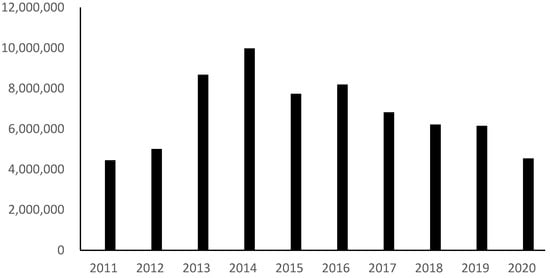
Figure 1.
Investment in China’s industrial pollution from 2011 to 2020.
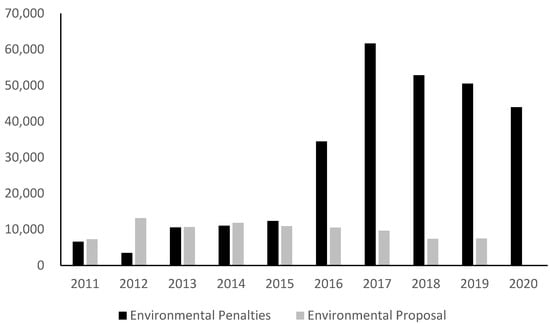
Figure 2.
Environmental punishment cases and environmental proposals of the “Two Sessions” in China from 2011 to 2020.
As a special form of business organization, family enterprises can more actively transform environmental policies into innovation and corporate performance (Craig J and Dibrell C, 2006) [8]. The family regards enterprises as a tool to protect the environment and benefit future generations, so it regards green innovation as the source of business opportunities and competitive advantages, rather than nonfamily enterprises as the need to retain market share and customers, and lags behind family enterprises in identifying opportunities (Dangelico R M, 2019) [9]. Specifically, green innovation in family enterprises has the dual attributes of environmental protection and innovation, and faces the dual pressures of environmental protection and innovation (Ma Jun et al., 2020) [10]. On one hand, family enterprises are relatively conservative, have high organizational commitment to traditional products, and tend to avoid risks. On the other hand, family enterprises pay more attention to noneconomic goals. Their long-term strategic vision and patient capital, as well as the symbiotic development concept of bringing benefit to surrounding communities, are consistent with the long-term commitment to environmental protection and pay more attention to environmental protection issues. As an old family enterprise of printing and dyeing, Fu Shengda promotes green development with technological innovation. While gradually developing self-operated export fabrics and taking the road of brand development, we have also increased investment in energy conservation and emission reduction to improve the ecological effect. It can be seen that family businesses are realizing the transformation, upgrading and sustainable development of traditional industries in a green and innovative way, and moving towards the goal of “100 year heritage”. Family involvement represents the ability of family to intervene in business decision making, and reflects the governance will of family owners (Zhou Weizhong and Zhao Jinlong, 2017) [11]. As the embedded subject of the unique social organization in the enterprise organization, the family may have different social responsibility consciousness and efficiency due to different dimensions and contents involved.
Based on different situations of family involvement, the text analysis method and empirical analysis method are comprehensively used to study the impact of environmental regulation on the green innovation efficiency in family enterprises, so as to achieve the sustainable development of family enterprises and strive to contribute to the realization of the dual carbon goals and the United Nations Sustainable Development Goals (SDGs). This paper is divided into eight parts: introduction, literature review, theoretical analysis and research hypothesis, research design, empirical results and analysis, mechanism analysis, heterogeneity analysis, conclusions, and suggestions.
2. Literature Review
This paper classifies the existing literature from three aspects: environmental regulation tools, green innovation efficiency, and green innovation of family enterprises. The first category focuses on environmental regulation tools. On one hand, it mainly discusses the impact differences of the three environmental regulation tools. Zhang JX et al. (2020) [12] found that market-based and public-based environmental regulation can more effectively stimulate green innovation than command-based environmental regulation. Fan Dan and Sun Xiaoting (2020) [13] believed that market-based environmental regulation shows a linear to nonlinear transition when it exceeds the threshold, and has a significant role in promoting green technology innovation, while imperative environmental regulation has no significant role in promoting green technology innovation. Wu lei (2020) [14] analyzed two aspects of cost and benefit compensation; public-based and market-based environmental regulation in the short term inhibit green growth in total factor productivity, and in the long term, promote green growth in total factor productivity, but the effects of command-based environmental regulation on green total factor productivity growth are not obvious.
On the other hand, in terms of specific environmental regulation tools, Harrison et al. (2015) [15] believed that India’s mandatory environmental regulation not only did not reduce pollution, but also reduced its total factor productivity. Hu Jun et al. (2020) [16] The carbon-emission-trading mechanism based on market incentives shows that market-based environmental regulation can promote technological innovation of enterprises. Zhao Xiaomeng et al. (2021) [17] assessed from the perspective of environmental nongovernmental organizations that informal environmental regulation represented by the public has induced urban innovation.
As for other types of environmental regulation tools, Zhang Ping (2016) [18] compared cost-based environmental regulation with investment-based environmental regulation, which produced a “crowding out effect” and “incentive effect” on enterprise technological innovation. Li Qingyuan and Xiao Zehua (2020) [19] used pollution charge and environmental protection subsidies as heterogeneous environmental regulation tools to affect green innovation in enterprises, which are shown as a “backward forcing effect” and “crowding out effect”, respectively. Chen Yuke et al. (2021) [20] found that the impact of environmental regulation tools such as direct regulation, economic incentives, and public participation on green technology innovation in enterprises has significant differences in different regions.
The second category needs to consider the externalities of economy and environment at the same time as green innovation efficiency. Huang Qinghua et al. (2018) [21] confirmed that there is a two-way dynamic relationship between environmental regulation and productivity. They believed that, in the long run, environmental policies not only did not promote the sustainable growth of green total factor productivity, but also induced enterprises to improve their polluting economic output. Yang Y and Wang Y (2021) [22] showed that there are significant regional differences in the green innovation efficiency of China’s industrial enterprises, among which the environmental regulation in the eastern region has a U-shaped relationship with the green innovation efficiency. Huang Suyu et al. (2022) [23] found that the environmental protection tax policy is conducive to improving the green innovation efficiency of enterprises in heavy pollution industries.
The third category, from the perspective of green innovation in family enterprises, mainly refers to external interests and internal social–emotional wealth. Dangelico R M et al. (2019) [9] used the multi-case-study method; a sample study was conducted on 14 small enterprises (7 family enterprises and 7 nonfamily enterprises) engaged in the agricultural food industry in Italy. It was found that there were obvious differences between family enterprises and nonfamily enterprises in green innovation motivation, pressure, and the green innovation concept. Ma Jun et al. (2020) [10] found that family enterprises have a stronger green innovation tendency due to the preservation motivation of extended social–emotional wealth and the drive of external institutional pressure. Lv Feifei et al. (2020) [24] believed that the industry-leading family enterprises used an external driving force and internal redundant resources to implement green innovation, so as to obtain legitimacy and long-term development orientation.
The current literature only focuses on the motivation of green innovation in family enterprises, but has not yet deepened the theoretical connotation and logical framework to analyze the green innovation in family enterprises under environmental regulation. Therefore, this paper attempts to integrate emotional benefits and emotional costs with reputation and risk as the core, build a theoretical analysis framework of social–emotional wealth, and explore the relationship between environmental regulation and green innovation efficiency in family enterprises. Considering that the intervention of family involvement will affect the decision making, it studies how to affect the relationship between them from the two dimensions of ownership and management involvement. The research contributions of this paper are as follows: First, this paper innovatively integrates emotional benefits and emotional costs with reputation and risk as the core, constructs a theoretical analysis framework of social–emotional wealth, and fills the theoretical gap between social–emotional wealth and green innovation in family enterprises. Second, this paper focuses on the heterogeneity of family enterprises and tries to explain the green innovation efficiency in family enterprises under environmental regulation from the perspective of reputation and risk governance. Third, this paper further considers the intermediary role of reputation and risk mechanism to reflect how environmental regulations affect the green innovation efficiency in family enterprises. In the future, this paper will focus on the impact and involvement of public environmental regulation to make up for the lack of existing research.
3. Theoretical Analysis and Research Hypothesis
3.1. Theoretical Analysis
As a kind of special goods which are neither private nor public, it is difficult to determine the property right and price environmental resources. The existence of environmental externalities leads to market failure. Individuals or enterprises with economic behaviors will not take the initiative to regulate the environment, so it is necessary to strengthen environmental regulations. Pigou [25] emphasized the solution of environmental externalities through government intervention, and Coase [26] further strengthened the internalization of environmental externalities through the market transaction mechanism. If environmental damage has externalities, the market itself cannot reach this optimal level, and policy formulation may play a role [5]. As a resource, the “system” is scarce, and its arrangement or allocation has an efficiency problem [27]. The government improves resource allocation through regulation to correct market failure. Many of the externalities under common and state-owned property rights are internalized under private property rights, creating incentives to use resources more efficiently [1]. However, regulatory policies, as an alternative to market forces, are not always able to achieve their goals, and are usually not fully understood. The formulation process is time-consuming and arbitrary, and they are often manipulated for political purposes unrelated to their original intention [28]. Command-based and market-based environmental regulations are typical policies adopted by the government to control environmental resources.
What is the green innovation efficiency of family firms under command-based and market-based environmental regulations? This paper tries to fuse the emotional benefit and cost with reputation and risk as the core, and constructs the theoretical analysis framework of social–emotional wealth. Emotional benefit and emotional cost not only run through different stages of intergenerational inheritance in family enterprises (Xu Yongbin, Hui Nanan, 2013) [29], but also should be considered in specific behavioral choices, which conforms to the importance principle of cost-effectiveness. Zellweger and Astrachan (2008) [30] explained emotional benefits and costs with positive feelings and negative feelings. In this paper, reputation was taken as the positive feelings of emotional benefits and risk was taken as the negative feelings of emotional costs to explain the green innovation in family enterprises under environmental regulations. In the process of green innovation, family enterprises need to give full consideration to reputation and risk. Reputation is an important factor affecting the value of human capital (Fama, Jensen, 1983) [31], and risk is a key factor affecting innovation decisions (Li J., Tang Y., 2010) [32]. Under the command-based environmental regulation, family enterprises pay attention to the development of external interests with the government, and establish a good family reputation and corporate image. Under market-based environmental regulations, family enterprises try to avoid the risk of fierce market competition and reduce the loss of high-risk green innovation investment. Miller and Breton-Miller (2014) [33] divide social–emotional wealth into constrained and extended types. The former emphasizes the narrow and highly centralized short-term interests of maintaining family control, while the latter focuses on the long-term interests and cooperation of family intergenerational transmission. In contrast to the emotional benefits and costs centered on reputation and risk, it is obvious that reputation incentive, as the social capital of family enterprises, is to better inherit the extended social–emotional wealth and realize the immortality of family enterprises. Risk avoidance is to consolidate constrained social–emotional wealth and avoid the loss of social–emotional wealth caused by excessive risks in market research and development. With the involvement of family control and management, the incentive motivation and risk aversion level of reputation are amplified, and family owners strive to maintain the interests related to family reputation (Faccio, 2006) [34]. In order to maximize the utility of family members, family managers tend to avoid more risks (Gonzalez M et al., 2013) [35], and finally change the green innovation efficiency in family enterprises with the goal of inheriting extended social–emotional wealth and consolidating constrained social–emotional wealth. This paper argues that the green innovation of family enterprises under environmental regulation is essentially a trade-off between emotional benefit and emotional cost, which is manifested as reputation incentive and risk avoidance. Reputation incentive is to inherit extended social–emotional wealth, while risk avoidance is to maintain constrained social–emotional wealth.
Based on the above analysis, the theoretical framework constructed in this paper is shown in Figure 3.
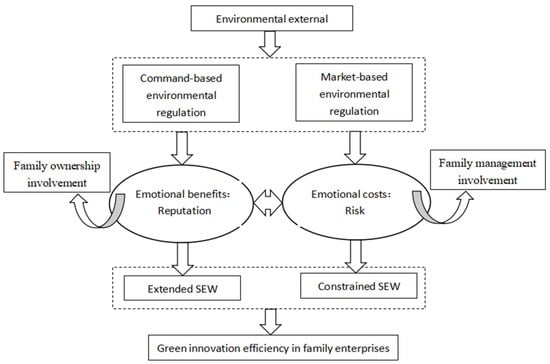
Figure 3.
Theoretical framework.
3.2. Research Hypothesis
Command-based environmental regulation emphasizes the control of enterprises’ pollution behavior by administrative means, and requires the government to rely on its decision-making ability to set reasonable environmental regulation standards to play an effective regulation effect, such as the government’s setting of pollution emission standards. The imperative environmental regulation takes reputation as its core element, which is manifested in three aspects. The first is family reputation. Managers of family enterprises have a natural emotional connection with shareholders, and their green innovation behavior is always spontaneous. They pay more attention to the protection of the family’s social–emotional wealth, and establish a positive family reputation and corporate image. The second is public reputation. Family enterprises can implement differentiated standards according to government regulations and provide differentiated green products to the public, which is conducive to improving credibility and recognition; finally, it will gain sustainable competitive advantages. The third is external reputation. Family enterprises actively build lasting relationships and common benefits with external stakeholders (Berrone P et al., 2010) [36] in order to obtain regulatory legitimacy (Chang K H, Gotcher D F, 2020) [37]. A good reputation enhances the image of family enterprises of stakeholders, so family enterprises try to reduce pollution levels and improve the efficiency in green innovation.
Market-based environmental regulation mainly relies on market competition and price mechanisms to achieve the optimal allocation of governance resources, such as the market transaction of emission rights. Market-based environmental regulation takes risk as its core element, which is embodied in three aspects. The first is market risk. Market risk is brought by price and supply demand changes, and families are more willing to reduce market risk in order to continue social–emotional wealth (Zellweger et al., 2012) [38]. The second is research and development risk. The research and development activities of green innovation are characterized by long-term and irreversibility, and are faced with high cost, resource constraint and failure risk. Green innovation is a high-risk investment, and the high innovation input and the uncertainty of R&D products will inevitably bring greater innovation risks to family enterprises. The third is disclosure risk. The second serious agency problem caused by the “trench effect” generally exists. In the market competition, green innovation will disclose more family insider information to the public, which harms the vested interests of the controlling family to some extent. The existence of risks urges family enterprises to pay more attention to the maintenance of social–emotional wealth, so family enterprises are more inclined to reduce the efficiency in green innovation. Therefore, the hypothesis is proposed:
H1a:
Command-based environmental regulation is positively correlated with green innovation efficiency in family enterprises.
H1b:
Market-based environmental regulation is negatively correlated with green innovation efficiency in family enterprises.
Under different family involvement modes, environmental regulation has different impacts on the green innovation efficiency in family enterprises. The main reason is that the family enterprises themselves are a contradictory unit full of different demands, which will not only make long-term investment in pursuit of lasting foundation [33], but also show preference for ownership and management rights (Zata Poutziouris P, 2001) [39]. The involvement of family ownership leads to the increase in family members’ control rights. In order to better inherit extended social–emotional wealth, family members take family reputation, long-term orientation, and the interests of internal and external stakeholders into account as the primary goal. Therefore, the family members’ intention of inheritance may be realized by actively improving the efficiency of green innovation. Family management involvement led to closer emotional ties between managers and family enterprises, the management has the motive of risk aversion, tend to choose the innovation of the conservative strategy (John K., 2008) [40], so it may reduce risk by lowering the green innovation efficiency, to better maintain constrained social–emotional wealth. Therefore, the hypothesis is proposed:
H2a:
Family ownership involvement positively moderates the impact of environmental regulations on the green innovation efficiency of family enterprises.
H2b:
Family management involvement negatively moderates the impact of environmental regulations on the green innovation efficiency of family enterprises.
Based on the above analysis, this paper constructs an empirical framework as shown in Figure 4.
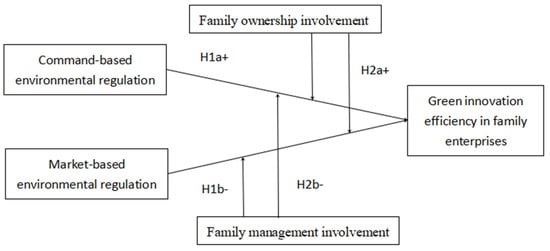
Figure 4.
Empirical framework.
4. Research Design
4.1. Data Sources
Considering that the new Environmental Protection Law was officially implemented on 1 January 2015, the law enforcement and supervision were more strict, and the impact of environmental regulation was more obvious. At the same time, the environmental regulation data in the statistical yearbook had reached the end of 2020. Therefore, taking 2015 to 2020 as the research interval, this paper collected 3006 family enterprises listed in Shanghai and Shenzhen A shares, a total of 13,039 research samples. The national environmental regulation indicators are matched according to “year-city-enterprise”. In order to ensure the reliability of the data, in this paper, we screened the data as follows: (1) 13,654 research samples were selected from family businesses in the research interval; (2) we excluded ST, * ST, and SST companies with abnormal operating conditions during the sample period; (3) all continuous variables were winsorized by 1% and 99%, and cluster clustering standard error was conducted at the enterprise level to reduce heteroscedasticity. A total of 13,039 research samples were obtained between 2015 and 2020. The environmental regulation indicators in this paper were from the China Statistical Yearbook and China Environmental Statistical Yearbook, and the data of green innovation efficiency and other family businesses were from the CSMAR database. Excel, deap2.1, Python, and Stata16.0 software were used for empirical analysis.
4.2. Variable Selection
Green innovation efficiency in family enterprises. This paper constructs the index system of green innovation efficiency in family enterprises (Table 1), in which input indicators are measured from three aspects of human resources, capital, and resources, and output indicators are measured from two aspects of expected output and unexpected output. The DEA method is adopted for calculation.

Table 1.
Indicators of green innovation efficiency in family enterprises.
Environmental regulation: Command-based environmental regulation: the words related to the word “environmental protection” in the local government work report were crawled through Python text, and the word frequency by city was counted. Market-based environmental regulation: in order to exclude the impact of regional industrial scale, the investment in industrial pollution control completed by provinces/added value of the secondary industry were selected to measure.
Family involvement: this paper is based on whether the chairman of the board position is held by a family member and whether the general manager position is held by a family member as the judgment standard of family involvement.
Reputation value: This paper draws on the research of Etter et al. (2018) [41], and the analysis of reports based on news media is the source of judgment. Reputation value uses the emotional tendency analysis of media reports to judge whether corporate behavior conforms to social norms and customs. The media reports are divided into three categories: positive, neutral, and negative, and these data are processed by computer technology. Using the Janis Fadner coefficient, the range of this coefficient is (−1, 1), where 1 represents all positive coverage; the closer to 1, the higher the reputation value; −1 represents all negative coverage; the closer to −1, the lower the reputation value; and 0 represents the balance between the two.
e is the total number of positive media reports, c is the total number of negative media reports, and t is the total number of reports.
Risk-undertaking level: This paper uses the measurement method of John K et al. (2008) [40] for reference, and uses the earnings return volatility index to calculate enterprise risk bearing. The greater the volatility of earnings return rate, the more high-risk projects enterprises engage in, and the stronger their risk bearing level. Risk is the standard deviation of the adjusted ROA of each company, taking every five years as an observation period (t − 2 years to t + 2 years). The specific calculation formula is as follows:
Control variables: In this paper, growth, financial leverage, profitability, and other aspects are considered as control variables, and fixed effects of year and industry are controlled. The description of variables in this paper is shown in Table 2.
Table 2.
Specific description of each variable.
4.3. Model Setting
In order to test hypothesis 1 on the impact of environmental regulation on the green innovation efficiency in family enterprises, this paper constructs benchmark regression models (1) and (2), which reflect the impact of command-based and market-based environmental regulation on the green innovation efficiency in family enterprises respectively:
If environmental regulation improves the green innovation efficiency in family enterprises, α1 is positive; otherwise, it is negative. In order to improve the robustness of the coefficient significance, empirical regression was carried out by further considering the control variables, and the fixed effects of year, province, and industry were controlled.
In order to test the moderating effect of family involvement in hypothesis 2, we constructed the moderating effect models (3) and (4), which reflect the two cases of family ownership and management involvement, respectively.
On the basis of model (1) and model (2), the cross term of family ownership involved OI, family management involved MI, and environmental regulation is added, respectively. On the basis of significant values α1 and α3, if the symbols are the same, family involvement strengthens the impact of environmental regulation on the green innovation efficiency of family firms; otherwise, it weakens.
5. Empirical Results and Analysis
5.1. Descriptive Statistics
Table 3 reflects the descriptive statistical results of each variable. It can be seen that the mean (median) of GIE is 7.527 (8.633), showing a left-skewed distribution. According to p25 and p75, there are many data on the right side of the mean, with a long tail on the left and a minimum. It shows that the green innovation efficiency of most family businesses is above the average level. GOV-ER and Market-ER are both distributed to the right, mainly in [0, 0.005] and [0.0004, 0.0006], which indicates that family enterprises are generally subject to low environmental regulation. Therefore, it is necessary to further explore how to improve the environmental regulation level to promote the improvement of green innovation efficiency of family enterprises.
Table 3.
Descriptive statistics of each variable.
5.2. Baseline Regression
Table 4 is the model (1) and (2) the results of the benchmark return; as can be seen, whether or not considering the control variable (command-based environmental regulation of the estimated coefficients to 1% significance level) is positive, or market-based environmental regulation of the estimated coefficients to 1% significance level is negative, this proves that command-based environmental regulation promotes the green innovation efficiency in family enterprises. However, market-based environmental regulation inhibits the green innovation efficiency in family enterprises.
Table 4.
Baseline regression results.
When analyzing the impact of environmental regulation on enterprise green innovation, most literature sources generally believe that command-based environmental regulation is negative to green innovation, while market-based environmental regulation is positive to green innovation. However, when analyzing the efficiency of green innovation in family enterprises, this paper draws a completely opposite conclusion. Investigating its reason, on one hand, family enterprises tend to spontaneously improve the green innovation efficiency in the face of command-based environmental regulation, which is to enhance the social reputation, reap more external benefits associated with government, and accumulate more extended social–emotional wealth, which is in compliance with family reputation, long-term orientation, and internal–external stakeholders’ interests. On the contrary, nonfamily enterprises are state-owned and assume the role of performance of social public services, and are therefore more likely to passively respond to command-based environmental regulation; because of information asymmetry, family enterprises tend to distort the real pollution situation in order to achieve the government’s regulation requirements, thus reducing its own green innovation efficiency.
On the other hand, market-based environmental regulation mainly relies on market competition and price mechanisms to achieve the optimal allocation of pollution control resources. Family enterprises have a low level of risk bearing. Faced with high-cost, long-term, and uncertain green innovation input, they usually choose to reduce the efficiency of green innovation to avoid the survival of the fittest in the market. In addition, family enterprises have concentrated control; altruistic motives which drive family members to better maintain constrained social–emotional wealth; show distinct risk aversion characteristics; and tend to reduce green innovation efficiency to distort market information. However, nonfamily enterprises are motivated to gain a market competitive advantage by improving green innovation efficiency and producing products with low pollution. This conclusion supports H1a and H1b.
5.3. Moderating Effects Regression
As shown in Table 5, the coefficient of family ownership involvement and command-based environmental regulation is significantly positive at the level of 1%, and the coefficient of family management involvement and market-based environmental regulation is significantly negative at the level of 1%. It shows that the involvement of family ownership strengthens the positive effect of command-based environmental regulation on green innovation efficiency, and the involvement of family management rights strengthens the negative effect of market-based environmental regulation on green innovation efficiency. It shows that the emotional value depends on ownership control [29]. The higher the involvement of family ownership, the stronger the family’s dependence on the enterprise (Chen Ling and Chen Huali, 2014) [42], which causes family members to become psychologically attached to the enterprise and treat the enterprise as “our own enterprises” [30]. The involvement of owners is higher than that of managers. For family owners, they pay more attention to the inheritance of extended social–emotional wealth. Therefore, they are more willing to further improve the efficiency of green innovation, consolidate the external interest relationship with government, and strengthen the reputation relationship between the holding family and the enterprises under the command-based environmental regulation. Under the market-based environmental regulation, family managers, compared with family owners, weigh more constrained social–emotional wealth and pursue conservatism and stability in economic decision making (Gentry et al., 2016) [43], which urges family managers to avoid risks excessively and strengthens the negative effect of green innovation efficiency. The conclusion partially supports H2a and H2b.
Table 5.
Regression results of moderating effects.
5.4. Robustness Test
5.4.1. PSM Matching
In this paper, considering that some family enterprises may, in fact, not be under the influence of environmental regulation, they can still, through statistical yearbook data, match the environmental regulation indicators. Therefore, this article, from the manual to the annual report and the related materials of family enterprises, clearly mentioned in the text, gives an assignment of 1 to the environmental regulation of family enterprises; the rest of the assignment is 0. Then, the PSM sample matching method is used for neighbor matching, radius matching, and kernel matching to overcome the influence of sample self-selection bias. The standard deviations of the relevant variables after final matching are all less than 10% and basically insignificant, indicating good matching results. As shown in Table 6, no matter which matching method is adopted, the result is still robust.
Table 6.
PSM results.
5.4.2. IV Instrumental Variable Method
This paper also considers that there may be a reverse causality between environmental regulation and green innovation efficiency in family enterprises. In the regions with high green innovation efficiency, command-based environmental regulation is stronger, while market-based environmental regulation is weaker, which further affects the green innovation efficiency in family enterprises in this region. Therefore, panel two-stage least square (2SLS) regression was used to solve the endogeneity problem. In this paper, the lag period of environmental regulation variables was selected as the first instrumental variable according to the traditional method. The previous period affects the current environmental regulation, but does not affect the current green innovation efficiency. According to Wang Jie and Liu Bin (2014) [44], the consumption of energy standard coal of each region is used as the second instrumental variable. On one hand, the energy standard coal of each region is an exogenous historical variable, which has no influence on the current green innovation efficiency. On the other hand, the consumption of energy standard coal in each region affects the intensity of environmental regulation.
As shown in Table 7, the F values of IV1 and IV2 are both greater than 10, ruling out the possibility of weak instrumental variables. The coefficient of IV1 in the first stage is significantly positive. This indicates that the previous positively affects the current environmental regulation. At the same time, the higher the value of standard coal, the more serious the pollution to the environment, the weaker the command-based environmental regulation, and the stronger the market-based environmental regulation. In the second stage, after eliminating the possible endogeneity problems, the conclusion is still robust.
Table 7.
Panel two-stage least square regression (2SLS).
5.4.3. Other Robustness Test Methods
As shown in Table 8, ① this paper replaced the research sample with a listed family-owned directly established family business, and the conclusion is still stable. ② In this paper, the measurement indicators of independent variables were replaced, the command-based environmental regulation indicators were replaced with 1/3 × (industrial wastewater discharge × corresponding standardization coefficient + industrial exhaust emissions × corresponding standardization coefficient + industrial smoke and dust emissions × corresponding standardization coefficient)/added value of the secondary industry, and the market-based environmental regulation indicators were replaced with the completed investment in industrial pollution/the number of family businesses by province. The conclusion is still stable.
Table 8.
Other robustness tests.
6. Mechanism Analysis
According to the above analysis, environmental regulation affects the green innovation efficiency in family enterprises through the reputation mechanism and risk mechanism. As shown in Table 9, this paper adopts the J-F coefficient of media evaluation and risk-taking level as the measurement indexes of the reputation mechanism and risk mechanism, respectively. It can be found that both the reputation mechanism and risk mechanism play partial mediating roles. Command-based environmental regulation promotes the green innovation efficiency in family enterprises through reputation incentive, while market-based environmental regulation reduces the green innovation efficiency in family enterprises by avoiding risks.
Table 9.
Regression results of mechanism analysis.
7. Heterogeneity Analysis
7.1. High and Low Pollution Industries
Due to the differences in pollution emissions, governance capacity, industrial output, value, and innovation activities, this paper divided high-pollution industries and low-pollution industries according to the Guidance on Environmental Information Disclosure of Listed Companies (draft) published by the Ministry of Environmental Protection in 2010 (Table 10).
Table 10.
Polluting and cleaning industries’ classification.
Pollution industries are mainly affected by the positive effects of command-based environmental regulation and the negative effects of market-based environmental regulation. Due to the high governance cost of the pollution industry (Sun Haibo and Liu Zhonglu, 2021) [45], family members have a stronger motivation to reduce pollution emissions, so they actively establish a good family reputation and try their best to avoid potential market risks (Table 11).
Table 11.
Heterogeneity analysis: polluting and cleaning industries.
7.2. High- and Low-Competition Industries
In this paper, the price cost differential (PCM) was used to represent market concentration to measure the degree of competition in the industry (Table 12):
Table 12.
High- and low-competition industries’ classification.
High-competition industries are mainly affected by the positive effects of command-based environmental regulation and the negative effects of market-based environmental regulation. On the one hand, in order to maintain their core competitiveness in the fierce market competition, family enterprises in highly competitive industries often have stronger family reputation and political connection motivation to better shape their social image. On the other hand, because there are many competitors of the same kind in highly competitive industries, capital holding and financing constraints have significantly affected the risk attitude (Mao Qilin and Xu Jiayun, 2015) [46], so they are more inclined to avoid the survival of the fittest in the market. However, there are few competitors of the same kind in low-competition industries, and some industries are even in a monopoly position. They have a strong capital scale and human resource base, so they are less affected by environmental regulations (Table 13).
Table 13.
Heterogeneity analysis: high- and low-competition industries.
8. Conclusions and Suggestions
This paper attempts to integrate emotional benefits and emotional costs with reputation and risk as the core. Based on the theoretical framework of social–emotional wealth, 3006 family enterprises in China between 2015 and 2020 were selected to build a panel model of fixed effects. From the perspective of family involvement, this paper discussed the impact of environmental regulation on the green innovation efficiency in family enterprises. The main conclusions are as follows:
- (1)
- Command-based environmental regulation promotes the green innovation efficiency in family enterprises, while market-based environmental regulation inhibits the green innovation efficiency in family enterprises. The involvement of family ownership strengthens the positive effect of command-based environmental regulation on green innovation efficiency, while the involvement of family management rights strengthens the negative effect of market-based environmental regulation on green innovation efficiency.
- (2)
- Through mechanism analysis, it was found that command-based environmental regulation promotes green innovation efficiency in family enterprises through reputation incentives, while market-based environmental regulation reduces green innovation efficiency in family enterprises by avoiding risks.
- (3)
- Further analysis shows that high-competition and high-pollution industries are more significantly affected by the relationship between them.
The research conclusion of this paper will provide important enlightenment for improving green innovation efficiency in family enterprises: the improvement in green innovation efficiency in family enterprises is conducive to giving full play to the reputation incentive effect, consolidating the connection of external interests, extending social–emotional wealth, and finally, realizing the sustainable development and lasting foundation of family enterprises. In view of the above research conclusions, this paper provides the following policy suggestions: (1) Improve the level of risk management. It is necessary that family enterprises should improve risk management and the internal control system so as to better deal with market risk and promote core competitiveness. (2) Consolidate family control. Families should try their best to protect the right of control (Burkart et al., 2003) [47]. For emerging industries with high risk and high competition, family owners should bear the risk of innovation and research, adapt to the competition of survival of the fittest in the market, and produce differentiated green products with low pollution. For traditional industries with low risk and low competition, family owners should improve the efficiency in green innovation, establish external interest connections and family reputation, and realize the intergenerational transmission of social–emotional wealth. (3) Increase the shareholding ratio of nonfamily shareholders. The participation of nonfamily shareholders in family enterprise governance leads to more balanced interest relations and diversified equity rights, which enhances the risk-bearing capacity of family enterprises (Du Shanzhong, 2021) [48] and thus improves innovation efficiency. (4) Give full play to the motivational role of reputation. With reputation incentives as a hidden incentive mechanism, owners can maximize their enthusiasm, strive to develop external interest links, improve employee reward and punishment systems, and ultimately improve green innovation efficiency in family enterprises.
Author Contributions
Conceptualization, Z.Z.; methodology, Z.Z.; software, Z.Z.; validation, Y.X.; formal analysis, Z.Z.; investigation, Z.Z.; resources, Y.X.; data curation, Z.Z.; writing—original draft preparation, Z.Z.; writing—review and editing, Z.Z.; visualization, Z.Z.; supervision, Y.X.; project administration, Y.X.; funding acquisition, Y.X. All authors have read and agreed to the published version of the manuscript.
Funding
This research was funded by [Zhejiang provincial first-class discipline construction fund for Business Administration], The funder is Yongbin Xu and the funding number is 1010JYN4118003G; Additionally, The APC was funded by [Zhejiang provincial first-class discipline construction fund for Business Administration (1010JYN4118003G)].
Institutional Review Board Statement
Compliance with ethical standards. No animal studies are presented in this manuscript. No human studies are presented in this manuscript. No potentially identifiable human images or data are presented in this study.
Data Availability Statement
The control variable data and the adjusting variable used to support the findings of this study have been deposited in the CSMAR repository (http://cndata1.csmar.com/). The dependent variable GIE data and the independent variable ER data are used to support the findings of this study are from National Bureau of Statistics (http://www.stats.gov.cn/).The intermediary variable data are used to support the findings of this study are from Data Pipi Shrimp (http://www.ppmandata.cn/).
Conflicts of Interest
The authors declare no conflict of interest.
References
- Ronald, H. Coase Waits. Property Rights and Institutional Change; Shanghai People’s Publishing Press: Shanghai, China, 2017. [Google Scholar]
- Shaozhou, Q.; Jia, X. Environmental Regulation and Low Carbon International Competitiveness of Manufacturing Industry-A Retest Based on the “Porter Hypothesis” of the G20. J. Wuhan Univ. (Philos. Soc. Sci. Ed.) 2018, 1, 132–144. [Google Scholar]
- Guinot, J.; Barghouti, Z.; Chiva, R. Understanding Green Innovation: A Conceptual Framework. Sustainability 2022, 14, 5787. [Google Scholar] [CrossRef]
- Khan, P.A.; Johl, S.K.; Akhtar, S. Firm Sustainable Development Goals and Firm Financial Performance through the Lens of Green Innovation Practices and Reporting: A Proactive Approach. J. Risk Financ. Manag. 2021, 14, 605. [Google Scholar] [CrossRef]
- Sidner, T. Policy Tools for Environment and Natural Resources Management; Shanghai People’s Publishing Press: Shanghai, China, 2005. [Google Scholar]
- Bei, J. Theoretical study on the relationship between resource and environment regulation and industrial competitiveness. Xinhua Abst. 2009, 12, 44–48. [Google Scholar]
- North, D.C. Institution, Institutional Change and Economic Performance; Shanghai People’s Publishing Press: Shanghai, China, 2014; pp. 121–122. [Google Scholar]
- Craig, J.; Dibrell, C. The natural environment, innovation, and firm performance: A Comparative Study. Fam. Bus. Rev. 2006, 19, 275–288. [Google Scholar] [CrossRef]
- Dangelico, R.M.; Nastasi, A.; Pisa, S. A comparison of family and non-family small firms in their approach to green innovation: A study of Italian Companies in the agri-food industry. Bus. Strategy Environ. 2019, 28, 1434–1448. [Google Scholar] [CrossRef]
- Jun, M.; Bin, Z.; Xuan, H. How can family firms become more active drivers of green innovation?-social emotional wealth and institutional legitimacy. J. Manag. Sci. 2020, 9, 31–60. [Google Scholar]
- Weizhong, Z.; Jinlong, Z. Family involvement, international operation and corporate environmental responsibility. J. Jilin Univ. (Soc. Sci. Ed.) 2017, 11, 205. [Google Scholar]
- Zhang, J.; Kang, L.; Li, H.; Ballesteros-Pérez, P.; Skitmore, M.; Zuo, J. The impact of environmental regulations on urban Green innovation efficiency: The case of Xi’an. Sustain. Cities Soc. 2020, 57, 102123. [Google Scholar] [CrossRef]
- Dan, F.; Xiaoting, S. Environmental regulation, green technology innovation and green economic growth. China Popul. Resour. Environ. 2020, 6, 105–115. [Google Scholar]
- Lei, W.; Xiaoyan, J.; Chao, W.; Jiachao, P. Impact of heterogeneous environmental regulation on green total factor productivity in China. China Popul. Resour. Environ. 2020, 10, 82–92. [Google Scholar]
- Harrison, A.; Hyman, B.; Martin, L.; Nataraj, S. When Do Firms Go Green? Comparing Command and Control Regulations with Price Incentives in India; National Bureau of Economic Research: Cambridge, MA, USA, 2015. [Google Scholar]
- Jun, H.; Nan, H.; Hongtao, S. Can market-motivated environmental Regulation promote Enterprise technological Innovation?-A natural experiment based on China’s carbon emission trading mechanism. Financ. Res. 2020, 1, 171–189. [Google Scholar]
- Xiaomeng, Z.; Luyao, C.; Chuanjiang, L. Can informal environmental regulation induce green Innovation? China Popul. Resour. Environ. 2021, 3, 87–95. [Google Scholar]
- Ping, Z.; Pengpeng, Z.; Guoqing, C. Comparative study on the impact of different types of environmental regulations on enterprise technological innovation. China Popul. Resour. Environ. 2016, 4, 8–13. [Google Scholar]
- Qingyuan, L.; Zehua, X. Heterogeneity of environmental regulation tools and green innovation incentives: Evidence from green patents of listed firms. Econ. Res. J. 2020, 9, 192–208. [Google Scholar]
- Yuke, C.; Lantian, L.; Jingrong, D. Environmental regulation tools, regional differences and enterprise green technology innovation: A Chinese provincial data analysis based on systematic GMM and dynamic threshold. Res. Manag. 2021, 9, 1–14. [Google Scholar]
- Qinghua, H.; Jiangfeng, H.; Xiding, C. Environmental Regulation and Green Total Factor Productivity: Dilemma or Win-win? China Popul. Resour. Environ. 2018, 11, 140–149. [Google Scholar]
- Yang, Y.; Wang, Y. Research on the Impact of Environmental Regulations on the Green Innovation Efficiency of Chinese Industrial Enterprises. J. Environ. Stud. 2021, 30, 1433–1445. [Google Scholar] [CrossRef]
- Huang, S.; Lin, H.; Zhou, Y.; Ji, H.; Zhu, N. The Influence of the Policy of Replacing Environmental Protection Fees with Taxes on Enterprise Green Innovation—Evidence from China’s Heavily Polluting Industries. Sustainability 2022, 14, 6850. [Google Scholar] [CrossRef]
- Feifei, L.; Lina, Z.; Hao, G.; Xiaogang, H. “Bellwether” effect? Research on the relationship between family firm industry status and green strategy. Manag. Rev. 2020, 3, 252–264. [Google Scholar]
- Pigou, A. Welfare Economics; Huaxia Publishing Press: Beijing, China, 2017. [Google Scholar]
- Coase, R.H. On the Institutional Structure of Production; Shanghai Sanlian Bookstore: Shanghai, China; Shanghai People’s Publishing Press: Shanghai, China, 1994. [Google Scholar]
- Shaoan, H. Introduction to the Economics of Property Rights; Economic Science Press: Beijing, China, 2004; p. 257. [Google Scholar]
- Botney, P.R.; Stevens, R.N. Public Policy of Environmental Protection; Shanghai People’s Publishing House: Shanghai, China, 2003. [Google Scholar]
- Yongbin, X.; Nannan, H. Analysis on the emotional value motivation of family business intergenerational inheritance. Account. Res. 2013, 7, 97. [Google Scholar]
- Zellweger, T.M.; Astrachan, J.H. On the Emotional Value of Owning a Firm. Fam. Bus. Rev. 2008, 21, 347–363. [Google Scholar] [CrossRef]
- Fama, E.; Jensen, M.C. Separation of Ownership and Control. J. Law Econ. 1983, 26, 301–325. [Google Scholar] [CrossRef]
- Li, J.; Tang, Y. CEO Hubris and Firm Risk Taking in China: The Moderating Role of Managerial Discretion. Acad. Manag. J. 2010, 53, 45–68. [Google Scholar] [CrossRef]
- Miller, D.; le Breton-Miller, I. Deconstructing Socio-emotional Wealth. Entrep. Theory Pract. 2014, 38, 713–720. [Google Scholar] [CrossRef]
- Faccio, M. Politically connected firms. Am. Econ. Rev. 2006, 96, 369–386. [Google Scholar] [CrossRef]
- Gonzalez, M.; Guzman, A.; Pombo, C.; Trujillo, M.A. Family firms and Debt: Risk aversion versus risk of losing control. J. Bus. Res. 2013, 66, 2308–2320. [Google Scholar] [CrossRef]
- Berrone, P.; Cruz, C.; Gomez-Mejia, L.R.; Larraza-Kintana, M. Socioemotional wealth and corporate responses to institutional pressures: Do family-controlled firms pollute less? Adm. Sci. Q. 2010, 55, 82–113. [Google Scholar] [CrossRef]
- Chang, K.H.; Gotcher, D.F. How and when does co-production facilitate eco-innovation in international buyer-supplier relationships? The role of environmental innovation ambidexterity and institutional pressures. Int. Bus. Rev. 2020, 29, 101–131. [Google Scholar] [CrossRef]
- Zellweger, T.M.; Nason, R.S.; Nordqvist, M. From Longevity of Firms to Transgenerational Entrepreneurship of Families Introducing Family Entrepreneurial Orientation. J. Fam. Bus. Rev. 2012, 25, 136–155. [Google Scholar]
- Zata Poutziouris, P. The views of family companies on venture capital: Empirical Study on The Determinants of Human Enterprising in Urban Agglomeration. J. Empir. Res. 2001, 14, 277–291. [Google Scholar]
- Etter, M.; Colleoni, E.; Illia, L.; Meggiorin, K.; D’Eugenio, A. Measuring organizational Legitimacy in Social Media: Assessing Citizens Judgments with Sentiment Analysis. Bus. Soc. 2018, 57, 60–97. [Google Scholar] [CrossRef]
- John, K.; Litov, L.P.; Yeung, B.Y. Corporate Governance and Risk Taking. J. Financ. 2008, 63, 1679–1728. [Google Scholar] [CrossRef]
- Ling, C.; Huali, C. Family involvement, social emotional wealth and corporate charitable giving: An empirical study. Manag. World 2014, 8, 90–101. [Google Scholar]
- Gentry, R.; Dibrell, C.; Kim, J. Long-term orientation in publicly traded family businesses: Evidence of a dominant logic. Entrep. Theory Pract. 2016, 40, 733–757. [Google Scholar] [CrossRef]
- Jie, W.; Bin, L. Environmental regulation and total factor productivity: A test and analysis based on the data of Chinese industrial enterprises. China Ind. Econ. 2014, 3, 44–56. [Google Scholar]
- Haibo, S.; Zhonglu, L. Environmental regulation, clean technology innovation and China’s industrial green transformation. Sci. Res. Manag. 2021, 42, 54–61. [Google Scholar]
- Qilin, M.; Jiayun, X. Government subsidies, heterogeneity and firm risk-taking. Econ. Q. 2016, 4, 1533–1562. [Google Scholar]
- Burkart, M.; Panunzi, F.; Andrei, S. Family Firm. J. Financ. 2003, 58, 2167–2202. [Google Scholar] [CrossRef]
- Shanzhong, D. The impact of corporate governance on corporate governance. Nankai Manag. Rev. 2021, 4, 1–22. [Google Scholar]
Publisher’s Note: MDPI stays neutral with regard to jurisdictional claims in published maps and institutional affiliations. |
© 2022 by the authors. Licensee MDPI, Basel, Switzerland. This article is an open access article distributed under the terms and conditions of the Creative Commons Attribution (CC BY) license (https://creativecommons.org/licenses/by/4.0/).