


Abstract
Sliding pressure control is a well-known method of controlling supercritical power plants that improves energy efficiency and reduces pressure dynamic stresses. This paper presents a novel approach for developing a supercritical cleaner coal power plant’s sliding pressure control strategy. First, using Whale Optimizer, a nonlinear identified transfer matrix model was created (WO). By comparing simulations and errors, the WO clearly outperforms the GA and Grey-Wolf Optimizer (GWO) techniques on parameter identification. The model also includes a multivariable PI/PD controller for improved plant operation. Again, WO controller tuning outperformed GA and GWO in terms of pressure deviations, power deviations, rise time, and fuel usage. It is now argued that the WO is superior to other techniques in modeling and controlling system dynamics, energy efficiency, and cleaner operation.
1. Introduction
1.1. Background and Motivation
Worldwide, power grids are experiencing security and stability challenges due to the increasing stochasticity produced by the growing usage of renewable energy sources (REs). This growth in renewables causes considerable challenges in power system control with emphasis on different issues of small signal and large signal stability. As a result, flexible generating technologies have become a leading solution to follow the rapid load changes and allow the penetration of REs safely. Conventional thermal power plants, which are fed by fossil fuels, can be considered promising choices to offer such flexibility; however, their negative impact on the environment will increase the global warming effect, and therefore, they must be cleaner. The situation is far more challenging when dealing with coal power plants in regards to increasing their flexibility and clean production in order to compete with gas and petroleum power stations [1,2]. Fortunately, clean coal technologies will gain the dual advantage of flexibility and cleaner operation. Clean coal technologies may be implemented via increased energy efficiency, carbon capture and storage (CCS), or a combination of the two. Energy efficiency methods include Supercritical (SC)/Ultra-Supercritical (USC) power plants, Fluidized-Bed (FB) power plants, and Coal-Gasification [3]. The performance of supercritical and ultra-supercritical units in terms of control is still far from what is required, necessitating a more robust, cost-effective, and adaptable unit operation. In this situation, the unit can be more amenable via an integrated control system, allowing for better operation in terms of coal consumption and the performance of the load-following responses. The coordinated control system (CCS), which is at the heart of ultra-supercritical units’ control systems, is in charge of coordinating the operation of boiler and turbine in response to grid dispatching orders. This work has a direct influence on the stability, flexibility, safety, and economy of the plant, and it is critical to improving unit control performance. The reaction from the main steam pressure to the fuel flow is accompanied by significant inertia and delay in ultra-supercritical plants, and there is a significant relationship between the main steam valve, the water feed flow, and the fuel flow, which increases the complexity of CCS coordination in these units [4]. However, for safety and efficiency reasons, sliding pressure control may be more attractive (Rayaprulo, 2009) [4], in which the pressure setpoint is further adjusted as a function of the load demand of the unit, which in turn offers greater flexibility and higher efficiency in part-load operation (Rayaprulo, 2009) [5].
According to the motivations and background stated above, in this paper, a simplified modeling and control strategy is developed in order to enhance unit safety, stability, economy, and cleaner operation.
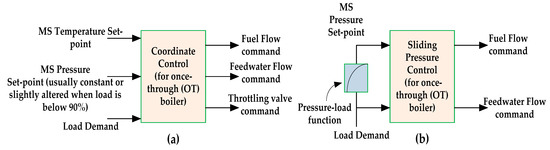
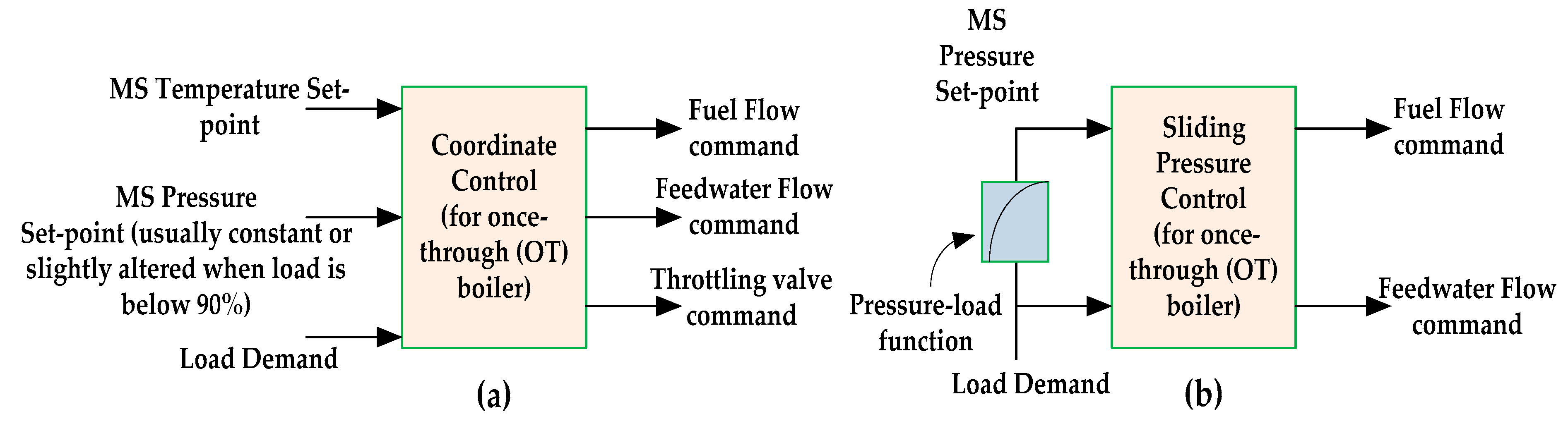
Sliding pressure control is known to be a control mode for thermal power plants, drum, and once-through types, in which the steam throttling valves are kept fully opened, and the feedwater flow pump speed and the fuel flow are manipulated together to follow the load demand in partial load changes, which result in variable or sliding pressure operation (SPO), decreased stress levels on the materials, lower power consumption for the feedwater pump, and improved partial load efficiencies (Rayaprulo, 2009 & Basu et al. 2015) [5,6]. Although that SPO could lead to a slower response than that of the coordinated control with a constant pressure set-point for the plant [2], however, the aforementioned features of a sliding pressure operation (SPO) are apparently more valuable in practice, and the issue of slower response can be resolved through optimal control theory. Figure 1a,b shows the possible control strategies of sliding operation and the coordinated control modes. From these two figures, one more theoretical aspect that could be added is that the SPO requires the manipulation of only two control inputs to regulate two outputs, which further reduces the computational effort for control optimization and parameterizations. This advantage can be deduced by default under the assumption that the outlet high-pressure (HP) turbine temperature and the main steam (MS) temperature is nearly constant (Kundur, 1994) [7], and this deduction is practically supported by prior practical knowledge about the existing units, which commonly states that the temperature is already regulated by the local attemperator and therefore, it eliminates the need of including the temperature as an additional plant output when adopting a sliding MS pressure control. Hence, a complete-range SPO can be preferable. The objectives of this paper have been theoretically and practically justified; the next subsection details the literature published about this research area and the paper’s contributions.
Figure 1.
(a) Coordinated (integrated) control mode with nearly constant pressure set-point (b) Complete-range Sliding pressure mode.
1.2. Literature Review and Paper Contributions
Coal-fired power stations are critical components of the worldwide power grid. Despite the rapid rise of alternative energy, such as solar and wind, Coal-fired power stations continue to generate the majority of electricity. Due to the intermittent and unpredictable nature of renewable energy, an ever-increasing number of coal-fired power plants are participating in bottomless peak-shaving by quickly raising their power production in response to an (AGC) instruction. It is critical to develop a high-fidelity coal-fired power plant model to assess their dynamic features better and devise control techniques for wide-load operations. Recent research has used a variety of methodologies to investigate the models and control strategies of various power plants. It is then valuable to divide the literature review into two sub-reviews for modeling and control, respectively.
1.2.1. Review on Modeling
Modeling SCPP for control orientation can be simplified or detailed. The model development depends on the control system objectives and sophistication. However, the targeted mode of operation usually seeks a simplified structure of modeling; the situation can be more demanding for the sliding pressure mode of operation. Most of the models developed within the recent decade have focused on modeling for the sake of a coordinated control mode without sufficient practical reasoning for not adopting the sliding pressure mode.
Mohamed et al. (2011) [8] constructed a mathematical model for a coal-fired SCPP; the modeling approach is based on engineering and thermodynamic concepts. With 600 MW supercritical power plant on-site measurement data, Genetic Algorithms (GAs) have been implemented to optimize the unknown parameters of the model, which lead to covering the whole once-through mode of the plant. Haddad et al. (2021) [9] offered a simpler physics-based model that is more accurate than the previously published model (Mohamed et al., 2011, Mohamed, 2012). The authors identified the model parameters using two different techniques: particle swarm optimization (PSO) and a multi-objective Genetic Algorithm (MOGA), then presented the dynamic response analysis, which indicated SCPP’s appropriateness for maintaining a cleaner operation while adhering to power system rules.
Ultra-supercritical power plants (USCPP) have gained similar attention from industry and academia. Liu et al. (2015) [10] modeled a once-through 1000 MW SCPP. The model structure was constructed using fundamental physical rules, appropriate simplifications, and data analysis. The authors used static and dynamic parameter estimation to identify the model parameters.
Using an enhanced bird swarm technique, Huang and Sheng (2020) [11] suggested a data-driven model for a 1000-megawatt ultra-supercritical plant. The authors used a multivariable model of the boiler-turbine coupled process to build a transfer function matrix that makes future control schemes and performance optimization much simpler to design.
A physics-informed model of a once-through power plant was built by Fan et al. (2020) [12]. Following the principle that mass and energy are always conserved, the authors created the model’s structure using nonlinear regression and optimization techniques to determine its static parameters. After dynamic validation, an open-loop simulation demonstrated that the model might be used for simulation analysis and controller design.
Al-Momani et al. (2022) [13] presented a hybrid data-driven physical model for multiple processes starting from the startup recirculation to the once-through mode of operation and, finally, an emergency shutdown scenario. The presented model was built based on fundamental thermodynamics concepts, and the model parameters were identified using grey-wolf optimizer GWO; the study has shown that an adaptation in some parameters is enough for the transition between the processes without building a separate model for each process.
The modeling review has ended, and the next subsection introduces the control system reviews.
1.2.2. Control System Review
This subsection reports the main achievements of the control system for SCPP and USCPP.
Mohamed et al. (2012) [14] introduced a model predictive control (MPC) approach for improving the dynamic responses of SCPP. The authors examined the dynamic responses of the plant and developed a mathematical model that properly represents the SCPP’s characteristics. To find the parameters, genetic algorithms (GA) were applied. The MPC determined the optimum water feed flow, coal feed flow, and steam valve position, then passed these values to the local controllers. A more rapid reaction is achievable with an ideal estimate of the predicted coal flow in advance. Thus, by using MPC to control the reference values of local controls, the overall dynamic response speed is enhanced.
A high-fidelity dynamic model for a 605 MW sub-critical power plant with minimal boundary parameterization was constructed by Chen et al. (2017) [15]. They used on-site measured data from a coal-fired power station to test their model. The feed water valve was controlled to retain the superheated steam at 538 °C, and the authors incorporated a PID control loop to manage the excess oxygen in the combustor in order to ensure near-complete combustion.
Thermal-control system coupling influences the dynamic responsiveness of thermal power plants during load cycling operations. Standard water flow control strategies were modified by Wang et al. (2018) [16] based on the thermal storage differential between stationary and real-time values. In order to enhance the load response and energy use of the coal-fired plant with a supercritical boiler. In-depth findings and a comparison of optimized and real-time data may be found in this publication.
Sarda et al. (2018) [17] designed a steady-state model for an SCPP, which was then turned into a pressure-driven model utilizing an Aspen Plus simulator and ACM transaction. Due to the fact that low temperatures result in decreased efficiency and that high temperatures result in damage to the boiler’s superheater pipe and turbine’s front end. The design and installation of a Smith predictor for a time-delay system have been performed as part of the overall CCS for the purpose of controlling the temperature of the main steam when the load fluctuates. In order to evaluate the CCS performance, the plant load is dropped from 100% to 40% at a rate of 3% load change/min.
Liang et al. (2018) [18] proposed a multi-model predictive control technique for a coal-fired power plant pulverizing system based on moving horizon estimates. The control approach is intended to improve the control accuracy of unmeasurable or poorly monitored important operational variables, as well as the tracking performance of the system over a broad operating range.
The model described in [10] was used by Zeng et al. (2019) [19] to suggest an optimal control strategy. The core of this boiler combustion delay and inertia control technique is a stair-like predictive control algorithm. Consistent with conventional control, decoupling and feedforward control methods are used. Using this method, the feedwater and fuel flow may be optimally controlled, according to the simulation results. With the decoupling mode, the strategy reduces mid-point enthalpy and main steam pressure fluctuations greatly, boosting control system stability and interference immunity while ensuring safe, reliable, and cost-effective operation.
Because ADRC is better at rejecting disturbances than traditional control techniques, it has a delayed response to the setpoint for high-order systems. In an in-service circulating fluidized bed unit, Wu et al. (2019) [20] demonstrated an improved ADRC and modified ADRC with PI controllers that increase superheated steam temperature control performance. High tracking and disturbance rejection resilience allows these controllers to regulate loads throughout a wider temperature deviation range while also providing improved load regulation capabilities.
Circulating fluidized-bed units (CFB) have larger control challenges than regular pulverized-coal units because of the mismatch between their fast reaction to an AGC command and their considerable inertia characteristics. Improved control methods for CFB units are being developed using dynamic models of the units. New control-oriented dynamic models of a subcritical CFB unit were developed by Zhang et al. (2019) [21].
Using a hybrid ADRC technique, Shi et al. (2020) [22] suggested a single-loop control strategy for coal-fired plant super steam temperature (SST). The theory of the hybrid ADRC is improved by analyzing the stability and capacity to reject secondary disturbances conceptually. It is then outlined how to tune the hybrid ADRC’s control performance by studying the effects of all parameters on control.
Cheng et al. (2021) [23] developed a sophisticated fuzzy k-means cluster networker plant’s nonlinear dynamic process for the USC power plant. The improved FKN model is believed to be a more accurate representation of the actual USC unit due to the inclusion of data distribution features in the simulation. The author has also developed a well-designed and updated generalized predictive control (GPC) based on the FKN model. In contrast to the regular GPC, this GPC is unique. Scheduling software has been presented that employs FKN membership to improve control efficiency for global GPC, which is an objective of the proposed scheduling program.
Based on energy and mass conservation principles, Wu et al. (2021) [4] developed a clean fluidized-bed (FB) coal-fired power station model with a 300 MW capacity that is environmentally friendly. The researchers utilized field running data to validate model correctness, assess the control challenges associated with an already created model, and compare the control performance of “proportional integral derivative” (PID) and “active disturbance rejection control” (ADRC) control systems, among other things.
Arastou et al. (2022) [24] created a universal model for dynamic analysis of all steam production units, including boiler-follow, turbine-follow, and coordinated control. The authors suggested a technique for extending the approach to AGC applications by calculating the appropriate input and output quantities. They determined the turbine’s mechanical torque using the unknown input reconstruction (UIR) approach. Due to the model’s nonlinearity and the lack of consistent parameter initialization, the GA was employed to find the model parameters.
Environmental and energy engineers believe that the Air/Fuel Rate (AFR) must be decreased to limit the impact of thermal power plants on the environment and minimize emissions. An additional control for the air/fuel ratio has been suggested by Lee et al. (2020) [25]. The authors used a dynamic matrix control system for supplementary control (DMC). For modeling purposes, two possibilities are considered: an ultra-supercritical once-through power plant with a capacity of 1000 MW and a drum-type thermal power plant with a capacity of 600 MW. The results indicate that the DMC additional control effectively lowered the squared error total to 4.93 percent without compromising the operation of the current power plant. Thus, as compared to the conventional control, the extra DMC control successfully lowered emissions.
In order to speed up the starting process of an SCPP, Abu Znad et al. (2022) [26] developed an improved control approach based on classical MPC. The plant’s start-up process was modeled using a state-space model MISO structure. After implementing the new control technique, the boiler’s pressure and the temperature were tested using Hammerstein–Wiener models to ensure their safety and efficiency. Checking environmental effects were achieved using the notion of the Air–Fuel Ratio. The results reveal that the MPC performed well, and the plant successfully integrated into the grid in 66 m less time than the previous control method and with a lower level of unwanted emissions.
Hou et al. (2020) [27] introduced an approach for gas turbine system control called “multi-objective economic model predictive control” MOEMPC, which is based on an enhanced WOA known as the quantum simultaneous whale optimization algorithm (QSWOA). Several economic indicators, as well as stability restrictions and the terminal cost function, are taken into consideration while developing the objective function for the MOEMPC approach. The economic index is updated in real-time to reflect changes in throttle losses and energy consumption. The stability restriction and the terminal cost function operate together to assure monitoring accuracy throughout various operational conditions and external disturbances. According to the simulation results, the suggested approach outperformed the competition regarding the required economic performance, robustness, high accuracy, and speed.
The Whale Optimization Method (WOA) was used by Bhatt et al. (2020) [28] to enhance the load frequency management and autonomous generator control of two area-linked non-reheat thermal units. This innovative meta-heuristic optimization algorithm was inspired by nature. The authors created two similar PID controllers. The WOA has been used to establish parameters for both locations in order to reduce frequency settling time and tie-line power variation.
The majority of reviews in the literature are either excessively comprehensive or comparative. However, Mohamed et al. (2020) [29] provided a recent critical review on supercritical and ultra-supercritical power plant modeling and control, with an emphasis on the model-based control of SCPP. The advantages are objectively reviewed, as is the supercritical process, the modeling methodologies utilized for these kinds of plants, the control tactics, and lastly, some issues that may be addressed for future studies that may bring advances to this field are suggested.
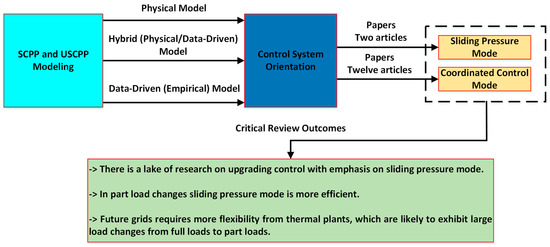
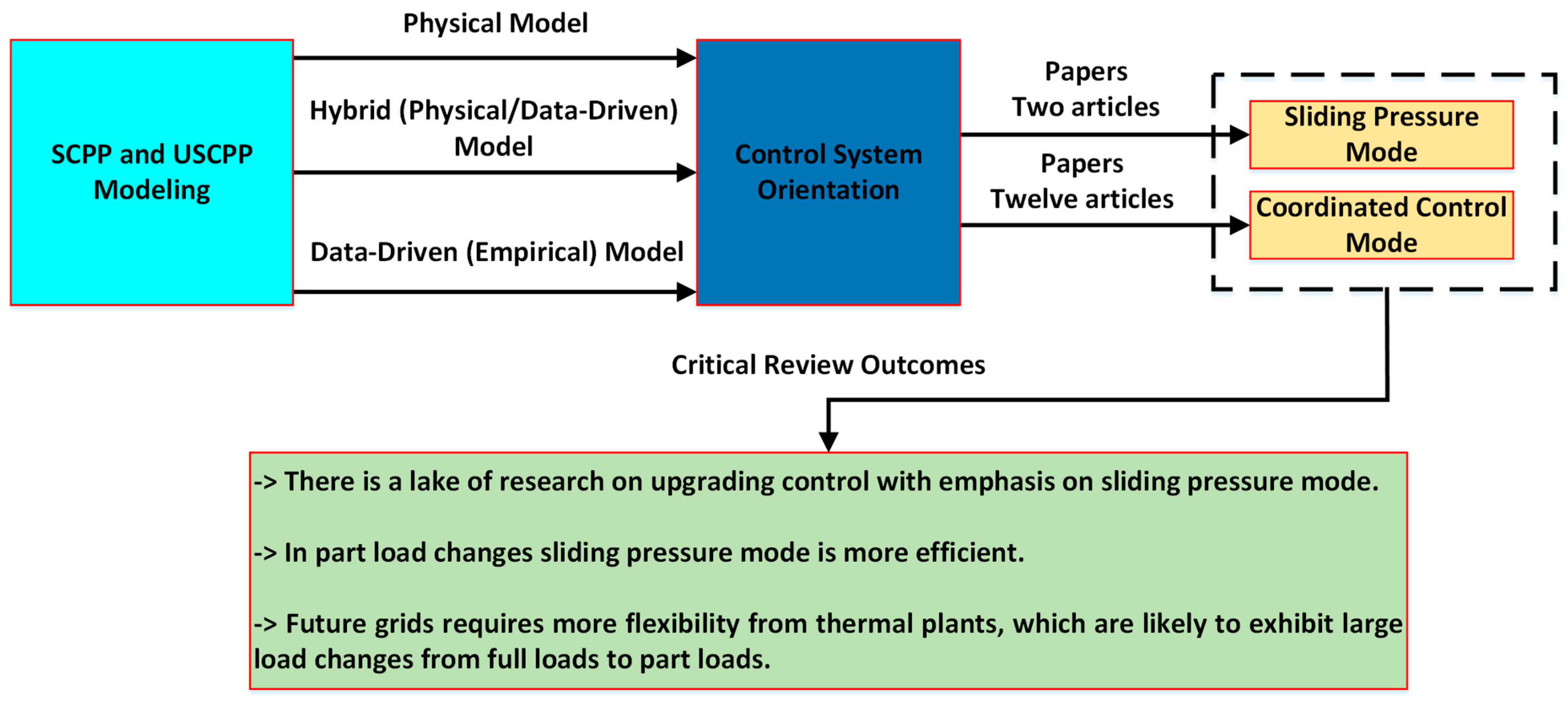
Figure 2 shows the graphical summary of the path encountered during the aforementioned critical review, and Table 1 below summarizes the plant modeling and control strategy in prior research in the literature, as well as the methods employed for optimization and identification.
Figure 2.
Graphical summary of literature analysis.
Table 1.
Summary of the literature review including this paper.
The goal of this paper is to improve the control system of a 600 MW SCPP by building a simplified non-linear mathematical model for a supercritical clean coal power plant, and optimizing its parameter based on three meta-heuristic algorithms, then designing a robust MIMO control system for the model built above. The primary goal of the control system is to cover the variations in load demand over the complete once-through process. The second control system goal is to minimize the amount of fuel flow and feedwater entering the SCPP. The reason behind using this control strategy will be examined in total throughout verified simulation studies, with appropriate background and details. The meta-heuristic optimizers have been compared in terms of simulation accuracy and control system performance.
The SCPP has been intentionally chosen since it has a cleaner effect on the environment than other subcritical units, and it is believed that the SCPP will contribute heavily to future global power generating scenarios, which is then likely to contribute to the target of zero-emissions power generation. Furthermore, another essential goal of the controller is to cover the load variation as quickly as possible while keeping lower amounts of fuel flow and feedwater.
Based on the literature stated above, the following three main contributions are presented in this study:
- A simplified MIMO Transfer matrix model for the sliding pressure operation mode of the supercritical power plant has been built. This model is validated for the entire OT operational characteristic.
- The second potential addition is that state-of-the-art optimization techniques will be applied to identify the parameters, which are the Whale Optimizer (WO) and Grey-Wolf Optimizer (GWO). It would be fascinating to compare these techniques against commonly used techniques, such as Genetic Algorithms, to see which one is truly more accurate for SC plants and control systems. It can be newly argued that the WO is more accurate in modeling and control than other techniques in both objectives concerned with system dynamics, energy efficiency, and cleaner operation.
- The third feasible contribution is that the study presents the design of a practically adequate multivariable PI/PD control system that is compatible with sliding pressure operation and integrates into the previously mentioned model for system dynamics and sudden load changes. This control system is capable of increasing the speed of load demand response while simultaneously lowering the plant’s fuel and feedwater consumption.
The rest of this paper is organized as follows: an overview of the whale optimizer (WO) is discussed in Section 2. Section 3 provides the model description of a MIMO transfer matrix for the sliding pressure operation mode of SCPP, as well as its parameter identification and validation. Section 4 presents the PID controller tuning and testing. Section 5 discusses the simulated results of this study. Finally, the conclusion is presented in Section 6.
2. An Overview of the Whale Optimizer (WO)
Meta-heuristic optimization algorithms are famous for being simple, flexible, and stochastic in nature, resulting in a large search space. Whale Optimizer is a Swarm Intelligence (SI) population-based meta-heuristic optimization approach inspired by humpback whales, which was initially presented by Mirjalili et al. (2016) [30]. The algorithm’s inspiration and mathematical model are discussed in this section.
2.1. Inspiration
Whales are awe-inspiring, majestic animals. They are often considered to be the biggest creatures on the planet. Depending on the species, an adult whale may grow to be 30 m long and weigh 180 t. This huge mammal is divided into seven species: killer, humpback, Sei, blue, finback, right, and Minke. Whales are often regarded as predators. They cannot sleep since they acquire oxygen from the ocean’s surface. In actuality, around half of the brain is at rest. Whales are intriguing because they are believed to be intelligent and emotional creatures.
The most remarkable part of humpback whales is their one-of-a-kind hunting strategy, which is known as lunge-netting (also known as bubble-netting). These agent whales begin to blow bubbles as they move in a circular pattern, forming a ring of bubbles that scare the fish and prevent them from swimming through or skipping the bubbles. The whales move in tighter and smaller circles, tightening the spiral and emitting high-pitched noises to confuse the fish. The whales then leap into the bubble net, jaws open, eating hundreds of fish in a single breath [30].
2.2. Modeling and Optimization of the Algorithm
In this part, the mathematical models of the prey surrounding technique, the spiral bubble-net feeding mechanism, and the searching method are introduced. After that, the algorithm of the WOA is presented.
2.2.1. Encircling Prey
In the hunt, encircling the prey simulates forming a neighborhood around the solution; this behavior has been represented mathematically as follows:
where vectors and may be computed in the following manner:
As is a random vector in the range [0,1] and vector declines linearly from 2 to 0, the components and are vectors that vary the coefficient vectors and , which will consequently adjust the whale location. The whale’s position will be updated at random and will be around the supposed prey.
2.2.2. Hunting Technique
Humpback whales use several hunting strategies, both as a group or individually; After the search agents find or approach the prey, . they begin to surround the prey in order to chase it in two mechanisms at the same time. These approaches are presented in the following:
- 1.
- Shrinking encircling technique:
This mechanism is produced by reducing vector ’s value. As a result, the value of vector will drop as well. As mentioned before, the value decreases from 2-0, substituting in Equation (2) the range of is [−1,1]. The new location of a search agent may be given at any point in the neighborhood circle between the starting location of the agent and the current best location.
- 2.
- Spiral updating position:
This procedure starts by computing the distance between the current whale (best solution) and the supposed prey location. To imitate the helix-shape behavior of humpback whales, the spiral formula between the whale’s location and its prey is developed as follows:
where denotes the vector representing the distance between the nearest whale and the prey.
Humpback whales hunt their prey in a spiral-shaped pattern around their target, which shrinks as they do. The equation underlying this behavior is as follows, assuming that there is a 50% probability of picking any of the approaches mentioned above [22]:
2.2.3. Searching for Prey
Vector may be modified to locate prey using the same technique (exploration). Humpback whales, in reality, explore at random, dependent on where they are in relation to other whales. As a consequence, random numbers greater than or equal to 1 are used to move the search agent away from the reference whale in order to avoid detection. A randomly picked search agent is used to update the location of search agents in the exploration phase, rather than the best search agent discovered so far. Mathematically, it may be expressed as follows:
where in this phase the vector , allows the humpback whales to search globally for prey.
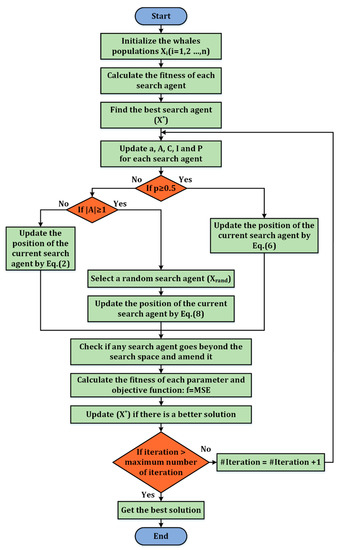
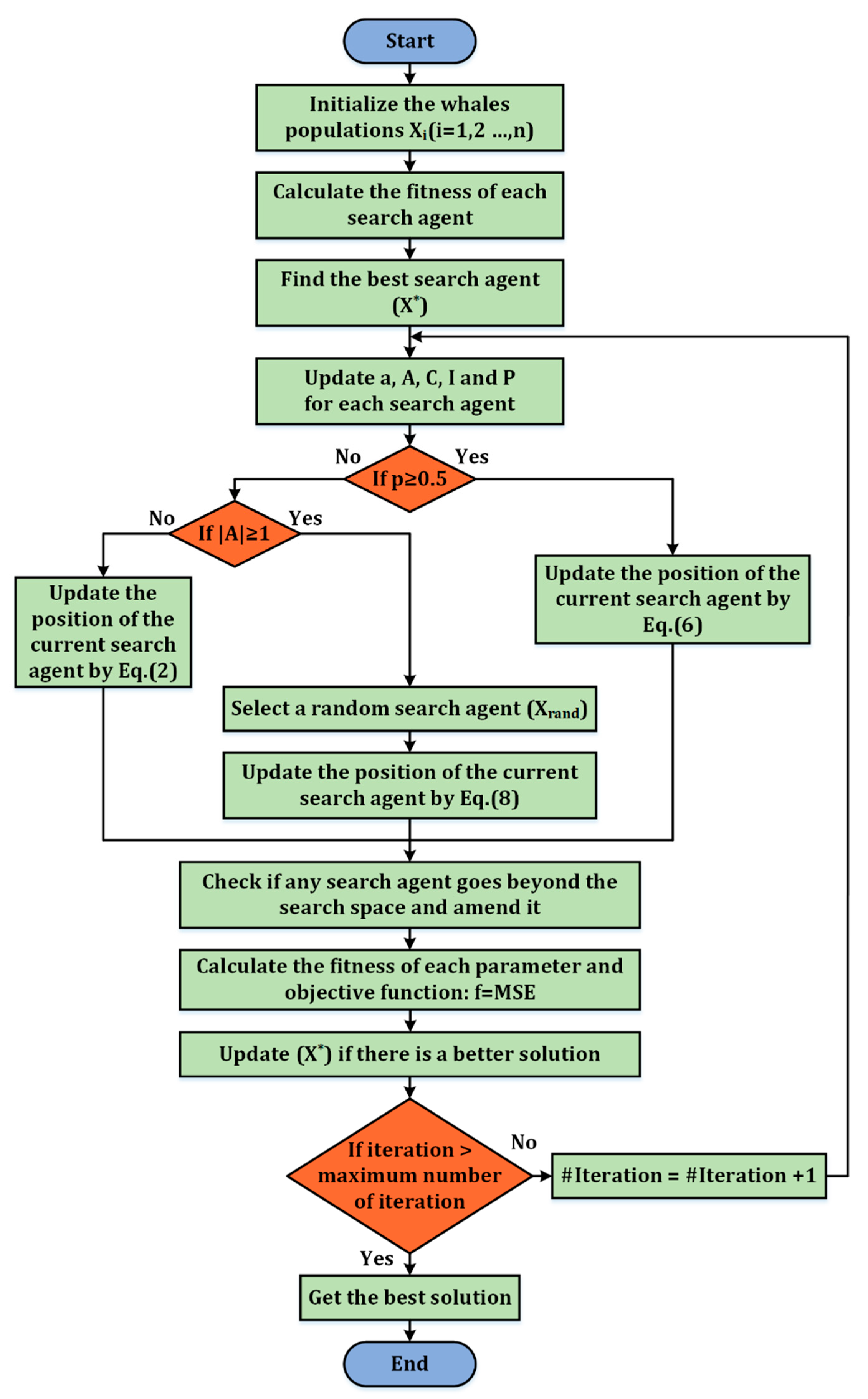
The WOA algorithm begins with a set of random solutions. A random search agent or the best solution so far is used to compare the search agents’ positions at the end of each iteration. Vector is lowered from 2 to 0 to facilitate exploitation and exploration. When , a random search agent is selected, whereas when the optimal solution being used to update the search agent locations. Based on the value of p, the WOA may transition between spiral and circular motions. Finally, when a termination condition is met, the WOA algorithm ends. Figure 3 shows the WOA algorithm’s flowchart.
Figure 3.
Whale optimizer algorithm flowchart.
3. Model Structure and Parameter Identification
3.1. MIMO Transfer Matrix for Sliding Pressure Mode
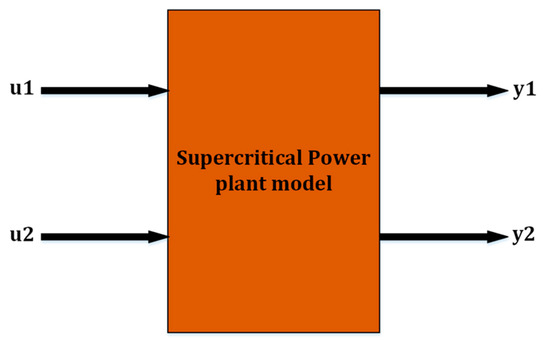
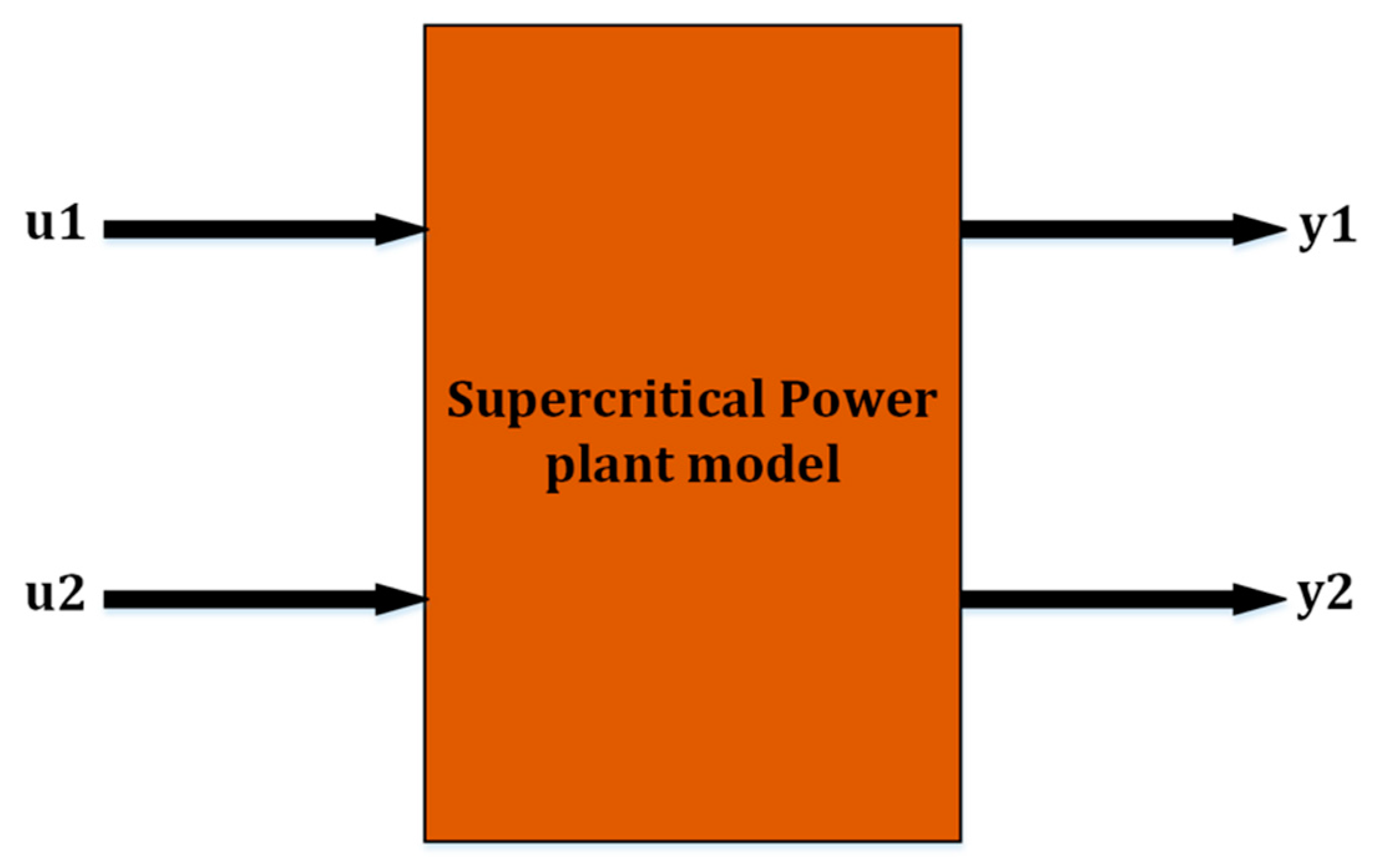
A multi-input multi-output transfer matrix was constructed to relate the outputs of a 600 MW power plant with a SC boiler under sliding pressure to its inputs. The model structure had two-input and two-output for the multivariable control system. Physically, concentrating on load demand following while ignoring other safety limitations is insufficient. When the turbine valve is opened to enable additional heat energy to be transferred to the turbine, the pressure and temperature of the boiler fall, as a result, the feedwater and fuel flow rates must be raised in order to maintain energy production while maintaining the boiler’s thermal balance. Therefore, maintaining the desired values of temperature and pressure [31,32]. The model structure is shown in Figure 4.
Figure 4.
2-input 2-output supercritical SC scheme.
Assuming the turbine control valve is fully opened, DEH command = 100% the inputs u1 and u2 correspond to the coal feed flow and water feed flow, respectively. Many indirect inputs may be incorporated into the control system depending on the objectives of the system, but these are the ones that are required to achieve the basic operational requirements [32]. Power and boiler pressure are represented via the 1 and 2 outputs, which are the produced output power and boiler pressure. The MIMO system with a 2 × 2 transfer function matrix equation is as follows:
Therefore,
And,
where the vector G [G11, …, G22] is the desired transfer function matrix that is both proper and stable. It is feasible to express system dynamics using algebraic equations in the s-domain utilizing the principle of the transfer function. A standard second-order transfer function with zero was chosen for this model as follows:
where a, b, c, d, and e are unknown parameters to be identified. To maintain the stability of this MIMO transfer function, all of its poles must lie on the left complex half of the s-plane. The poles of the transfer function are derived by identifying the frequencies (values of s) that cause the denominator to equal zero as follows [33]:
The placement of that zero has a significant impact on overshoot and settling time. The zero of the transfer function is calculated by finding the frequency (value of s) that makes the numerator equal to zero as follows:
The trial-and-error method was used to find the poles and zeros of the transfer function matrix, and then the various meta-heuristic algorithms were implemented in order to identify and optimize these parameters.
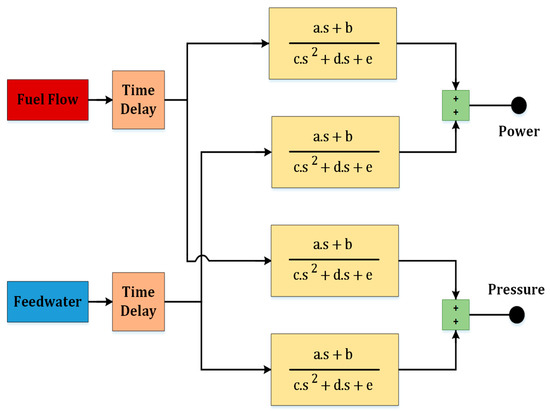
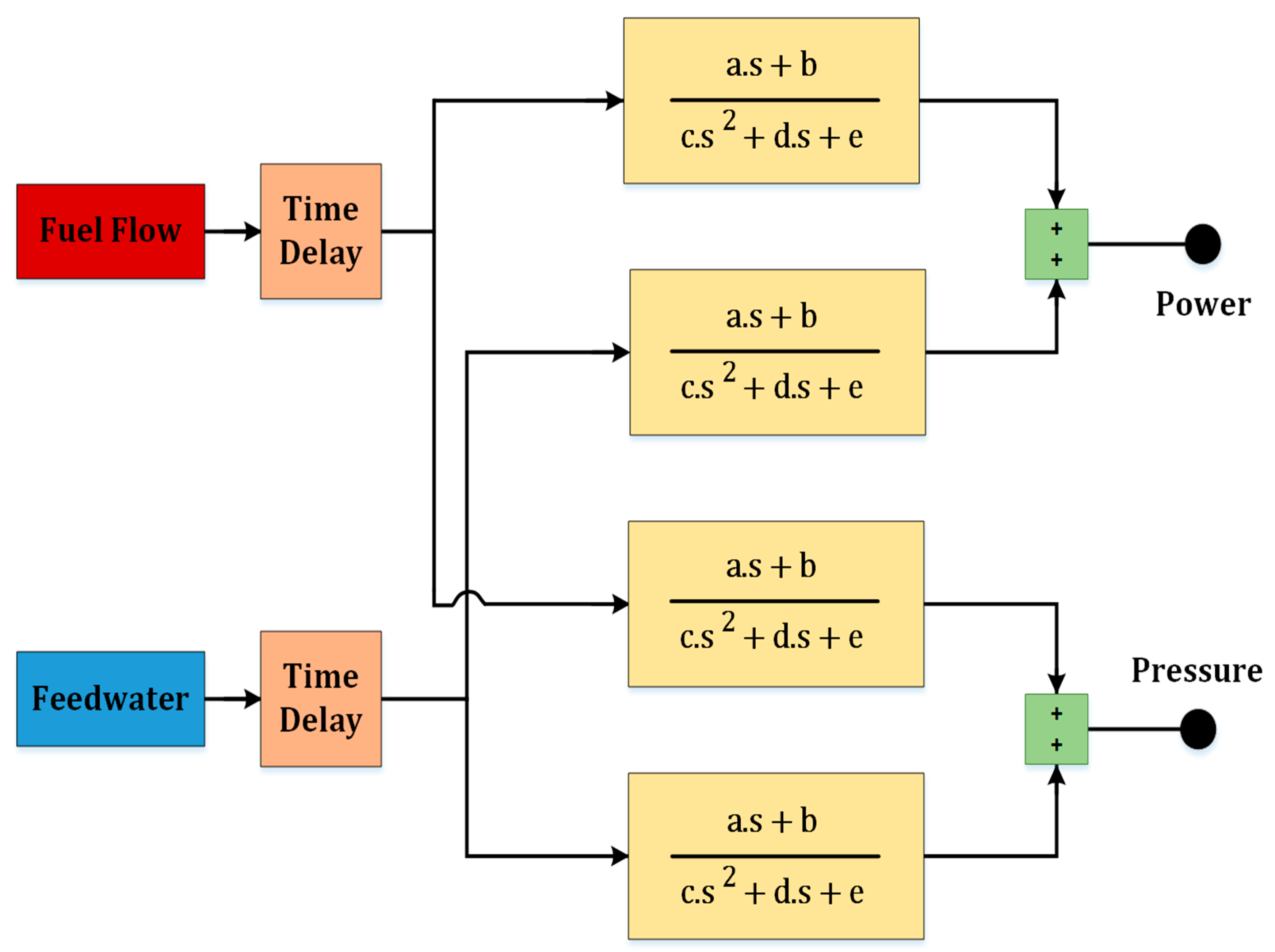
The SCPP mathematical model is shown in a simplified form in Figure 5.
Figure 5.
MIMO transfer function model of the SCPP.
In order to minimize thermal shocks in the waterwalls, the economizer begins preheating the feedwater before it enters the waterwalls to turn water into steam. As well, an induction motor is used to mill the coal before it enters the burner [13,34]. A time delay block was used in the model to reflect the slow dynamics and reactions in the economizer and milling process.
3.2. Parameter Identification
In this work, a real data set has been utilized to represent the behavior of a power plant with a supercritical boiler. This plant has these specifications or operating characteristics a final superheater outlet temperature and steam pressure of 571 °C, 25.1 MPa, respectively, a pulverized coal fuel flow rate of 72.29 Kg/s, and a superheated steam flow rate of 480 Kg/s [8].
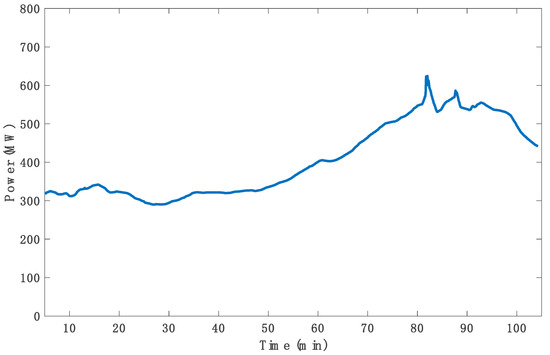
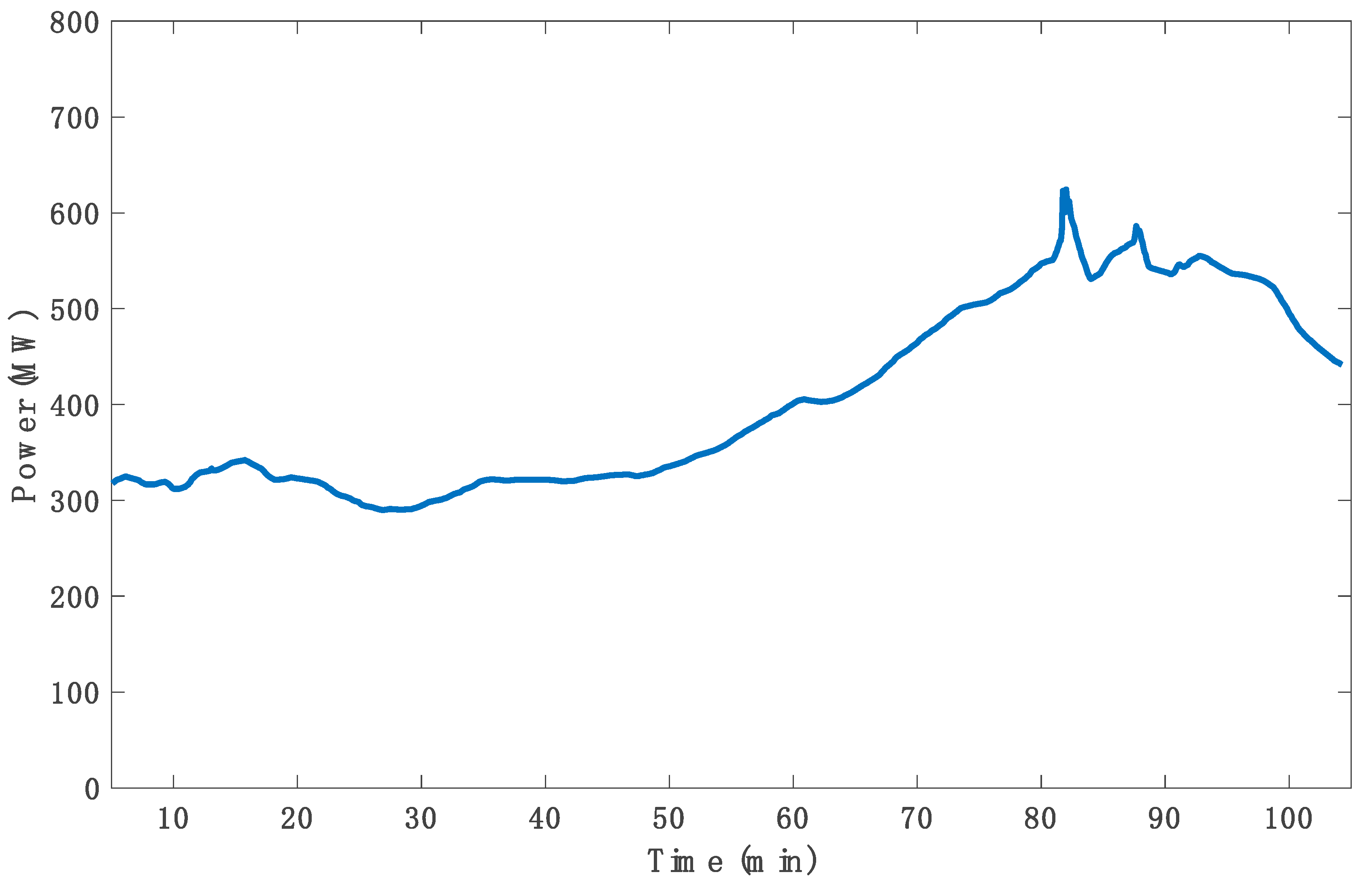
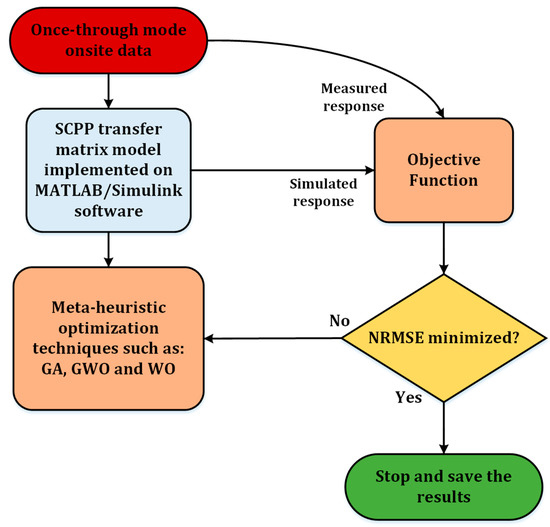
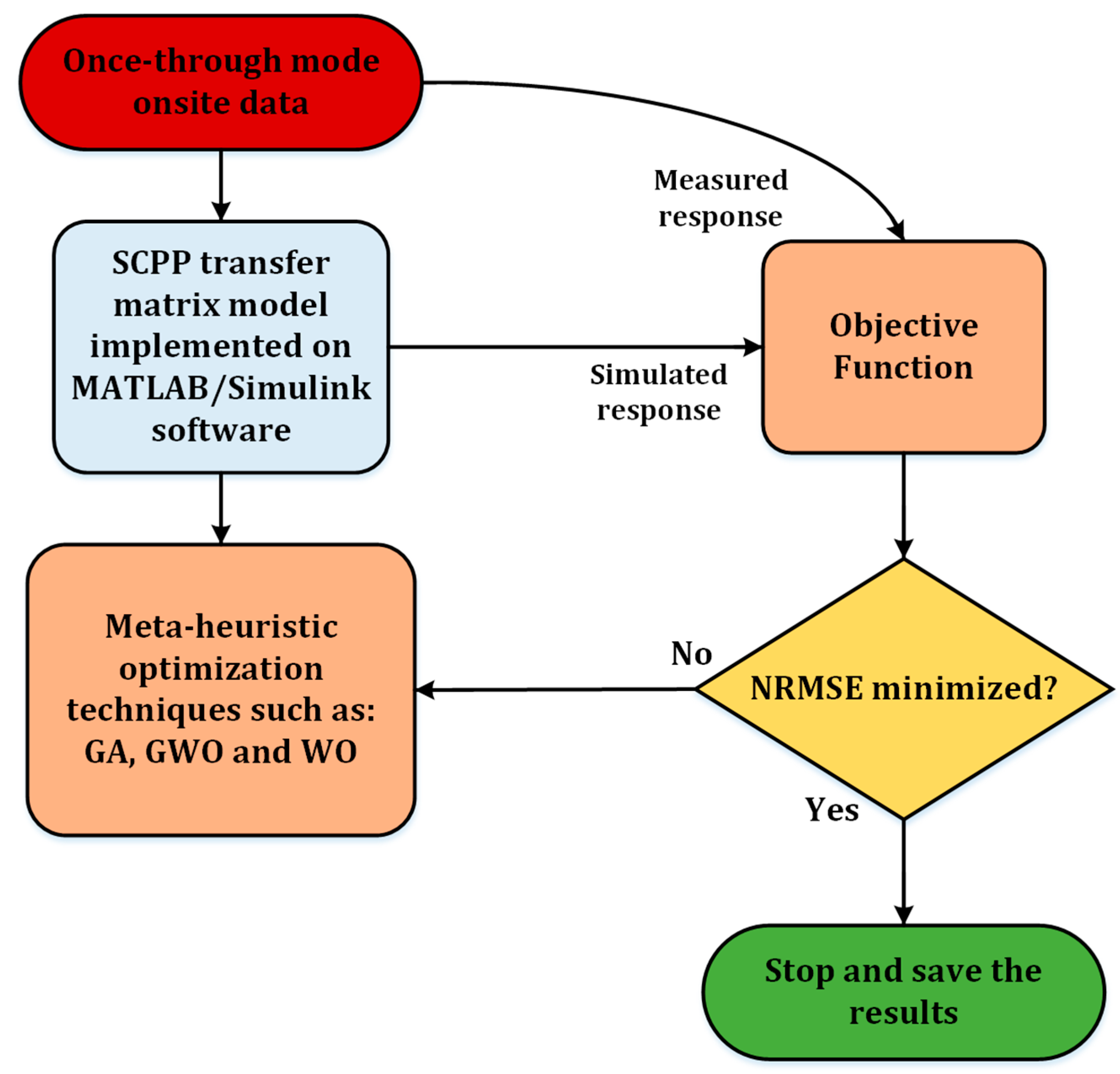
Figure 6 illustrates a sample power data set that demonstrates the once-through operation loading up to the rated power of the plant. In a MATLAB environment, the MIMO transfer function matrix parameters will be identified using three different meta-heuristic optimization techniques such as GA with heuristic crossover, Grey-wolf optimizer, and Whale optimizer. It has been decided that the output power (MW) and main steam pressure (MPa) are the responses that will be determined and validated. The generalized technique for parameter identification is represented in Figure 7. The objective function that has been adopted is the mean squared error (MSE) as follows:
Figure 6.
Data set sample for the once-through operation.
Figure 7.
The generalized technique for parameter identification flowchart.
3.2.1. Genetic Algorithm
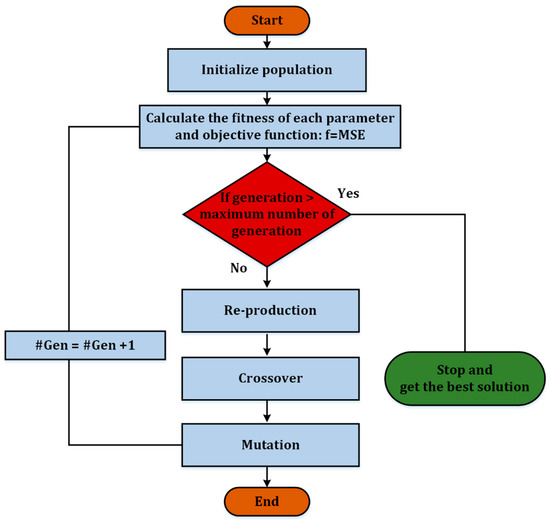
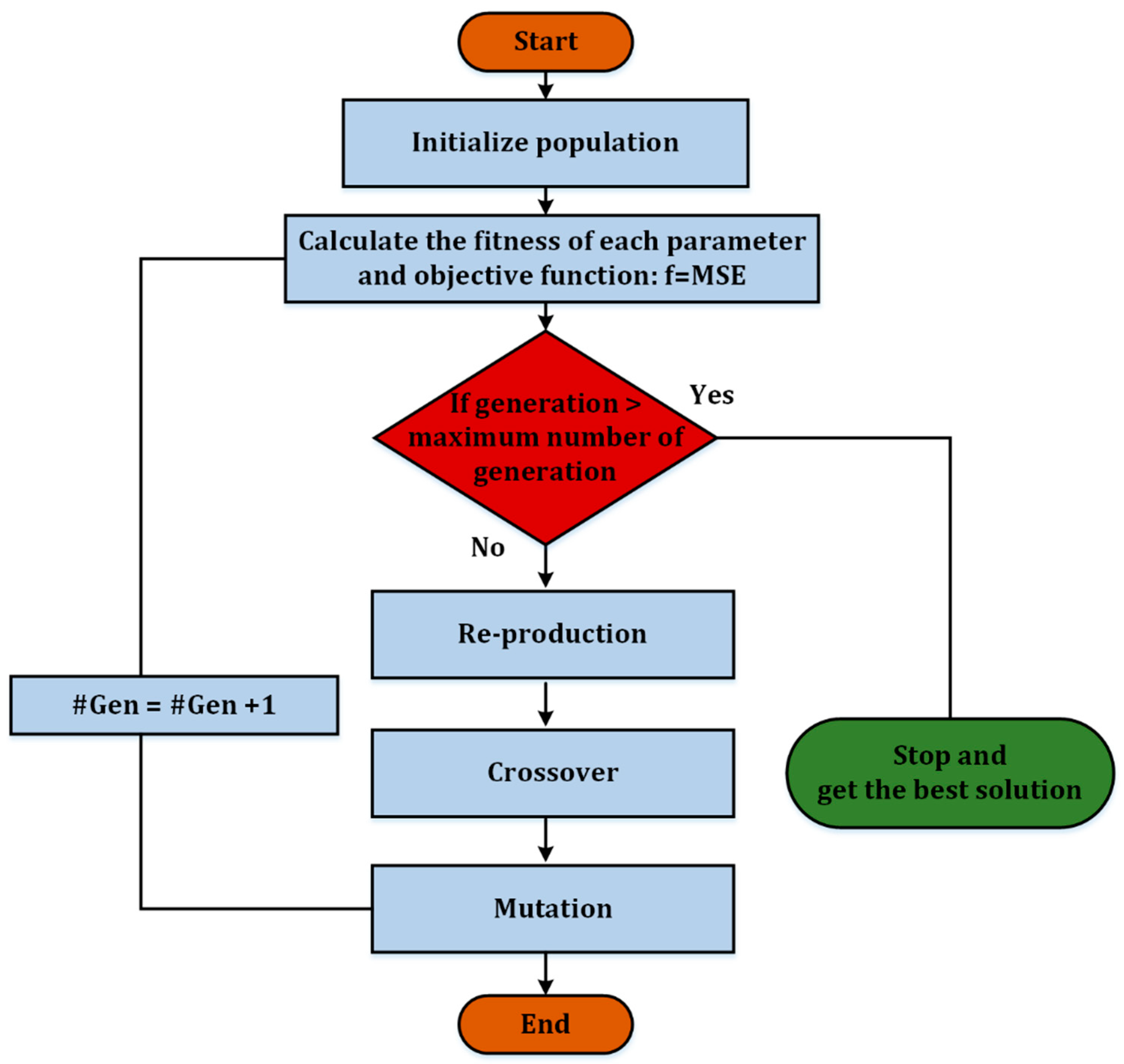
GA is a population-based optimization technique that progresses through the phases of reproduction, crossover, and mutation to identify a solution to a given problem in its supplied copy of the gene data structure. During the reproduction stage, the fittest individuals of the population have a strong chance of contributing to the generation of the next generation of offspring, and they are chosen for generation by a selection operator. This is also referred to as selecting. The crossover step, also known as recombination, occurs when each of the two selected individuals (solutions) combines to generate two new solutions for the future generation. There are numerous crossover methodologies, and this research employs the heuristic crossover. Finally, in the mutation stage, which is a secondary activity that occurs at a certain pace, one or maybe more people are modified as a result of the development of new solutions (children) [35,36]. The GA parameters are listed in Table 2. Finally, a GA flowchart was developed and presented in Figure 8, which simplifies the idea.
Table 2.
GA parameters configuration.
Figure 8.
Genetic algorithm (GA) flowchart.
3.2.2. Grey-Wolf Optimizer
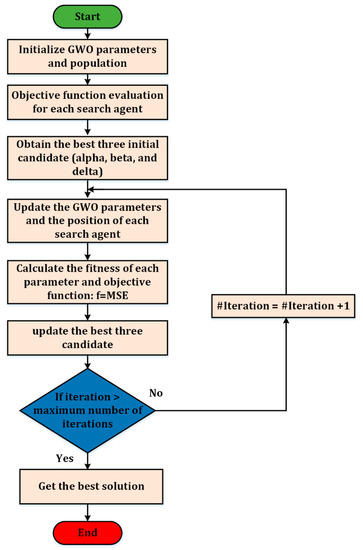
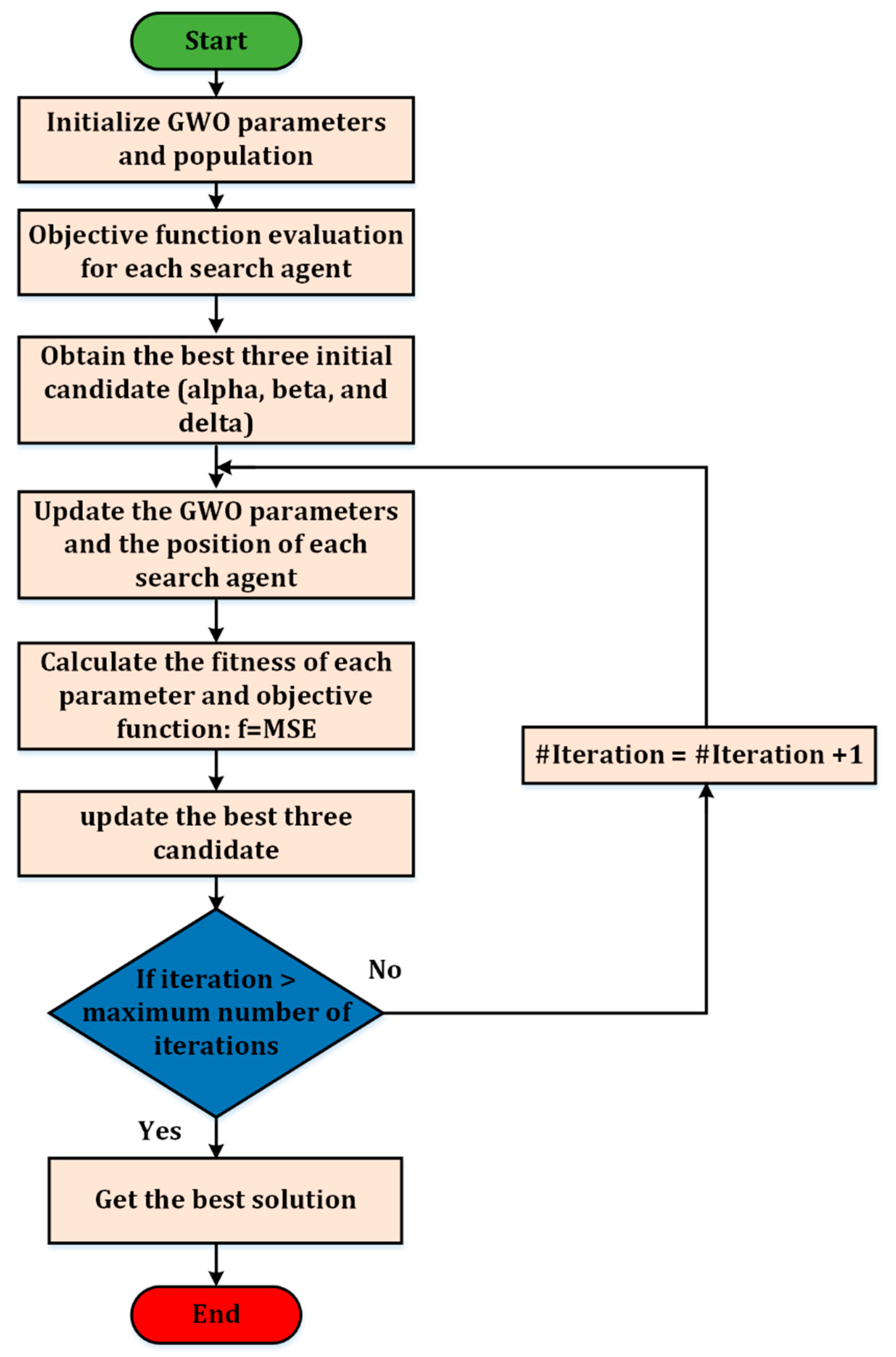
The Grey wolf optimization algorithm is abbreviated as GWO. It is a novel method of meta-heuristic optimization that was initially produced by Mirjalili et al. (2014). Its overarching concept is to replicate the cooperative hunting behavior of grey wolves in the wild. The search procedure starts with the generation of a random population of grey wolves via the GWO algorithm (potential solutions). Alpha, beta, and delta wolves evaluate the prey’s expected location throughout the iteration phase. Each possible solution’s distance from the prey is updated. As in the whale optimizer, the vector a is lowered from 2 to 0 to promote exploitation and exploration phases. Table 3 shows the GWO configurations. Finally, Figure 9 depicts the GWO flowchart, which is drawn to describe its concept [37].
Table 3.
GWO parameters configuration.
Figure 9.
Grey-wolf algorithm (GA) flowchart.
3.2.3. Whale Optimizer
The whale optimizer that was discussed in Section 2 is applied to identify the unknown SCPP transfer function matrix parameters. The WO settings are shown in Table 4.
Table 4.
WO parameters configuration.
The normalized root-mean-squared error (NRMSE) between both the real-time operating unit measured data and the simulated response model data was used to validate the power and pressure responses. The general NRMSE formula is the following:
where n indicates the number of data points, y indicates the real values, and indicates the simulated values. The once-through mode, as illustrated in Figure 6, was simply used for identification, while the validation trends are load-up data starting at 300 MW and growing to the rated power. The identified parameters of each transfer function are shown in Table 5. Finally, the minimized NRMSE of power and pressure for each optimization technique are shown in Table 6.
Table 5.
The identified parameter for each meta-heuristic optimization technique.
Table 6.
NRMSE values for each algorithm.
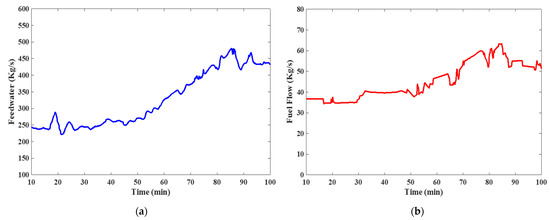
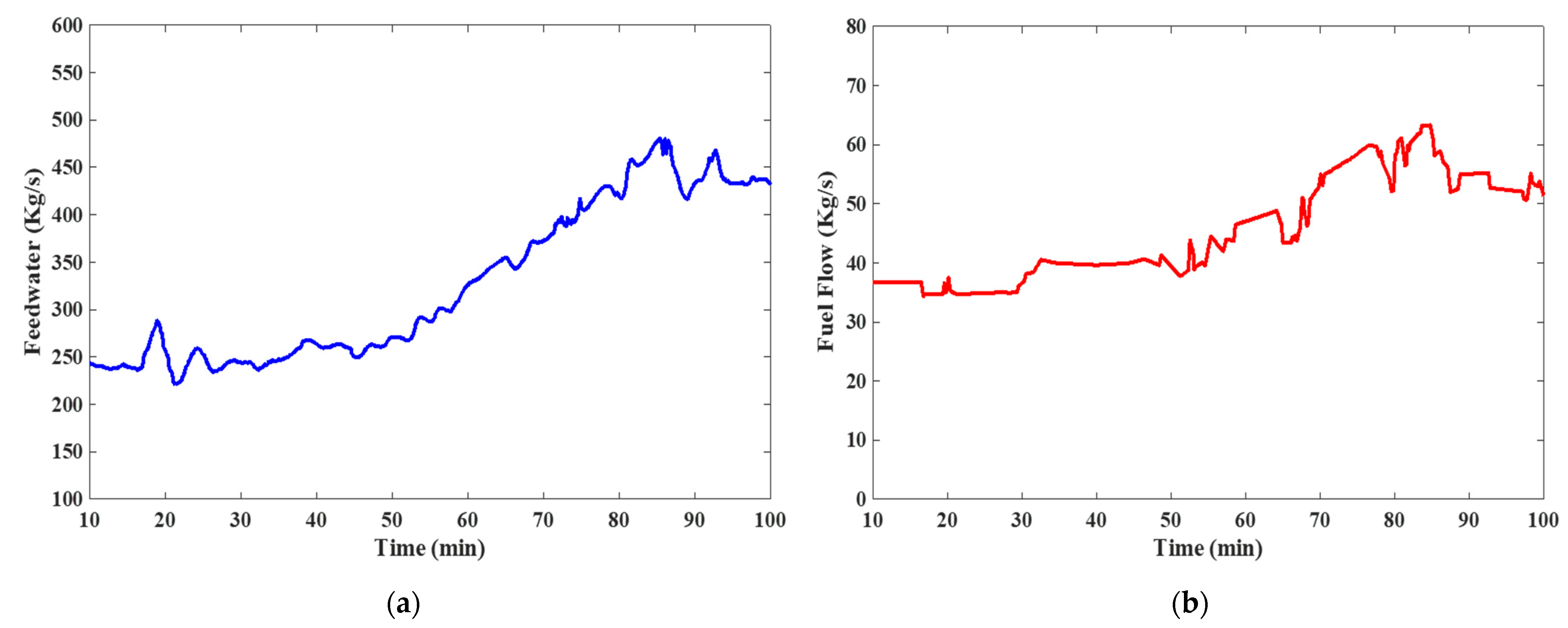
Figure 10 depicts the input feedwater flow and fuel flow that have been utilized to run and operate the plant for a total of 100 min in the once-through and sliding pressure operation mode.
Figure 10.
Supercritical power plant input flow over 100 min (a) input feedwater flow. (b) input fuel flow.
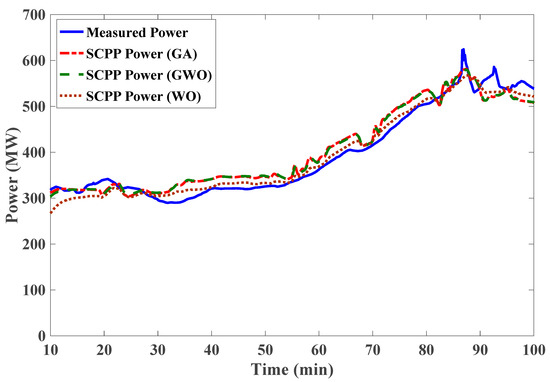
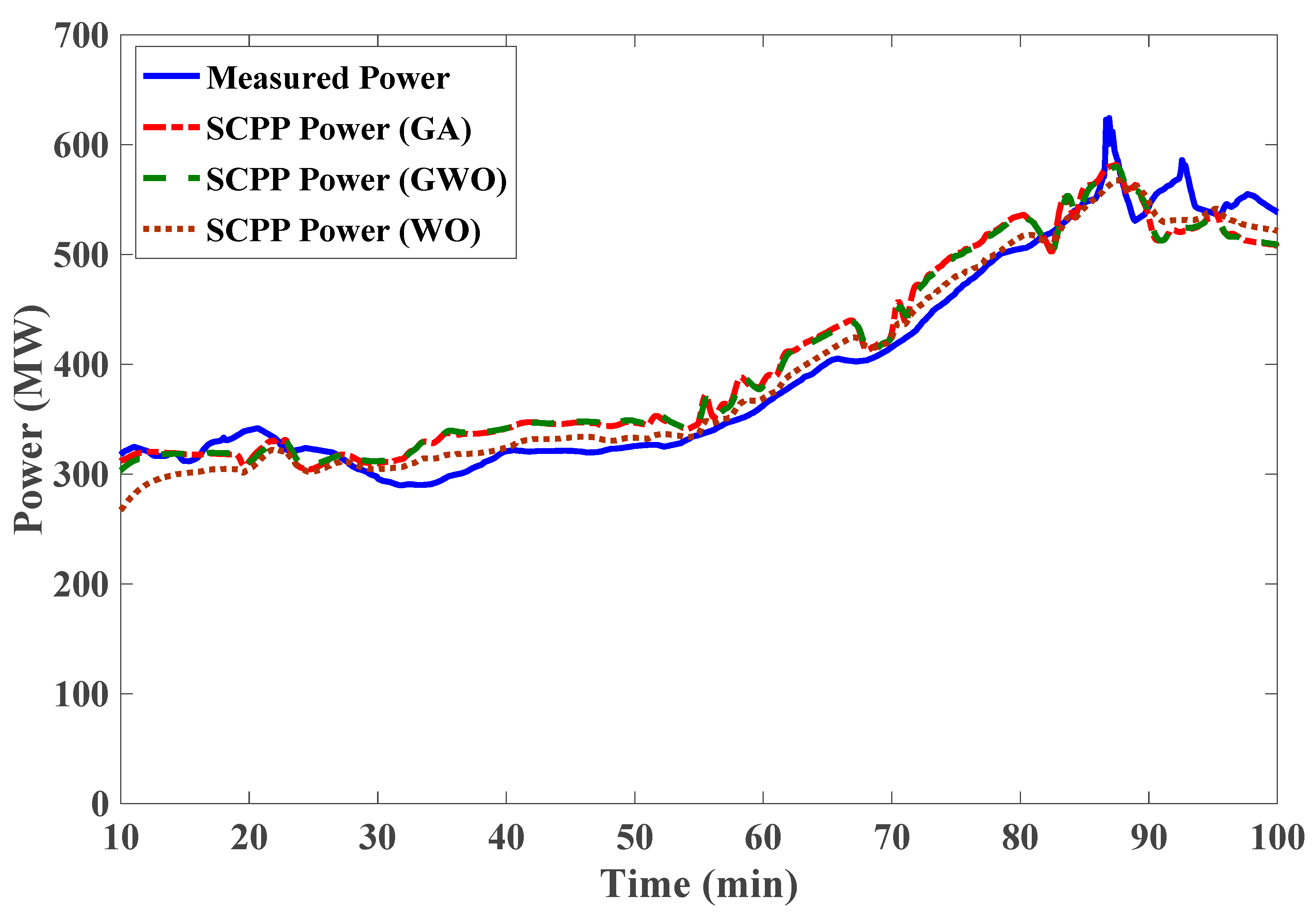
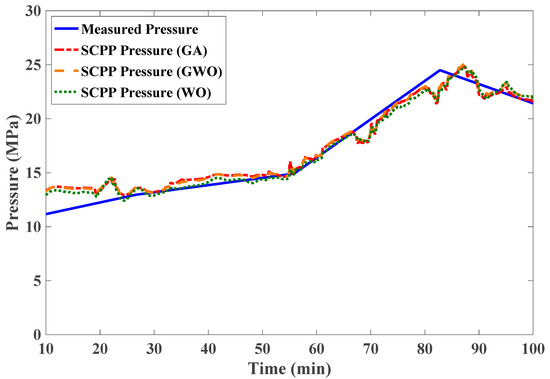
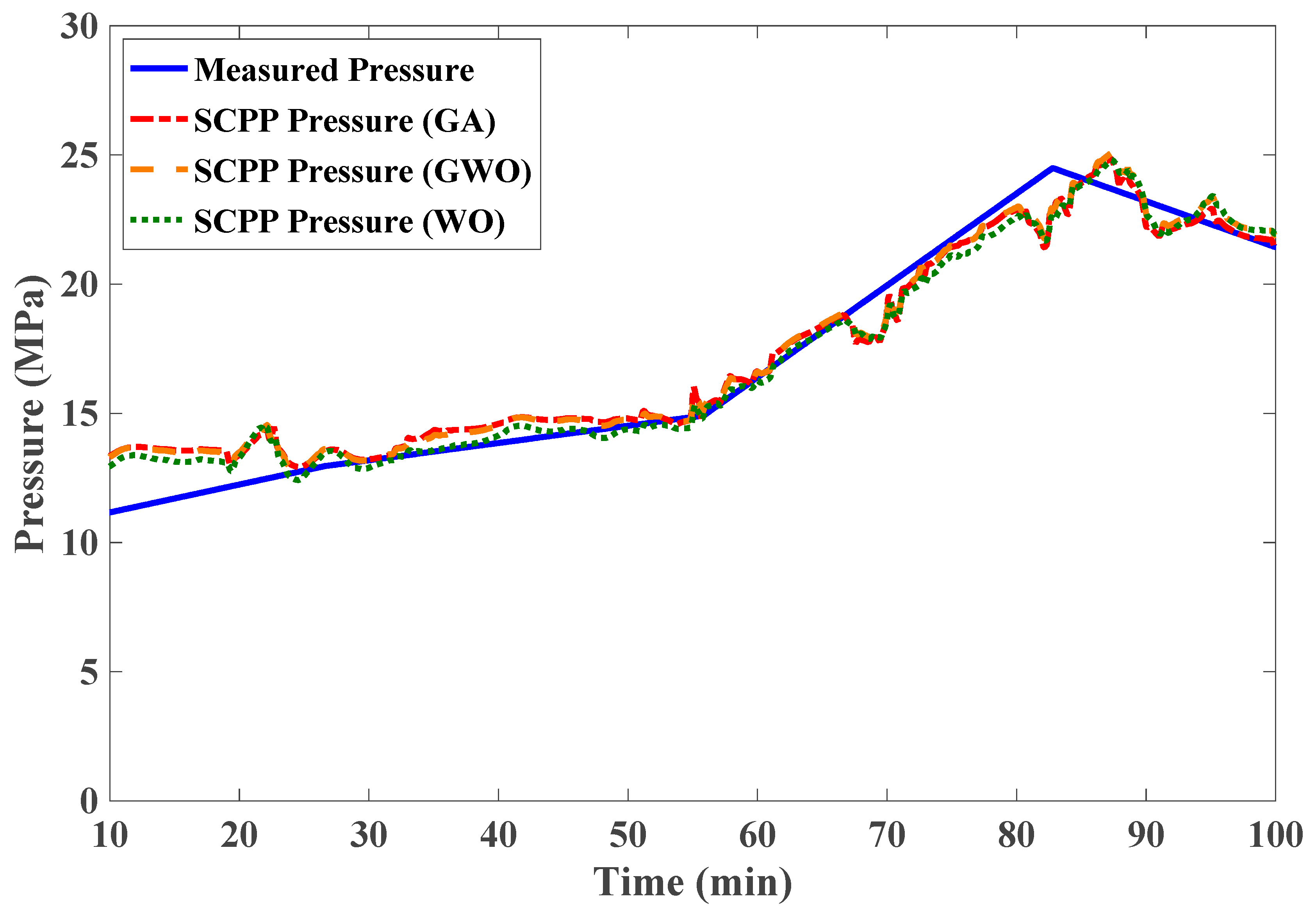
Figure 11 and Figure 12 demonstrate that the simulated responses of the plant’s power (MW) and main steam pressure (MPa) have effectively tracked the measured results of the actual plant, with the same trend as the measured results. On the other hand, error quantification is necessary in order to pick the most accurate optimization strategy available. According to Table 6, it is obvious that the WO obtained lower NRMSE than the other approaches in both power and pressure responses, with values of 0.0561 and 0.0409, respectively. The reason why WO has superiority over the other strategies is because of its phenomenal spiral movement, which is used to update search agent positions and find the optimal solutions.
Figure 11.
Simulated power responses for each optimization technique.
Figure 12.
Simulated pressure responses for each optimization technique.
The following discussion will be in-depth; it is important to mention that the optimized parameters of the assumed transfer functions have successfully captured the dynamic behavior of the power plant under study with sufficiently high accuracy as the power changes from around 289 MW to 628 MW and the pressure from 11.16 MPa to 24.48 MPa. These parameters are practically meaningful per se; for example, the parameter d of all the elements in the transfer matrix should be much higher than a and c in order to follow the variation trends of the practical power plant more accurately. Further practical implications can be realized by introducing the transpose delays, saturation, and rate limiters. With the aid of the pre-described robust optimization techniques, the optimum parameters are found as three different sets of parameters with the highest accuracy attained by the WO technique. The computational reason that causes the WO to be superior is because of the spiral movements of the search agents to reach the globally optimum parameter (say a, b, c, d, and e), whereas the progressive iterative mechanism of the GWO (encircling) and GA (parallel population of parameters) are found to be lower in optimality than WO.
However, the above algorithmic comparison among the optimizers is meaningless in terms of cleaner production in order to prove the practical value of WO; it has been used in the next section to tune the controller along with other optimizers.
4. Control Tuning and Testing
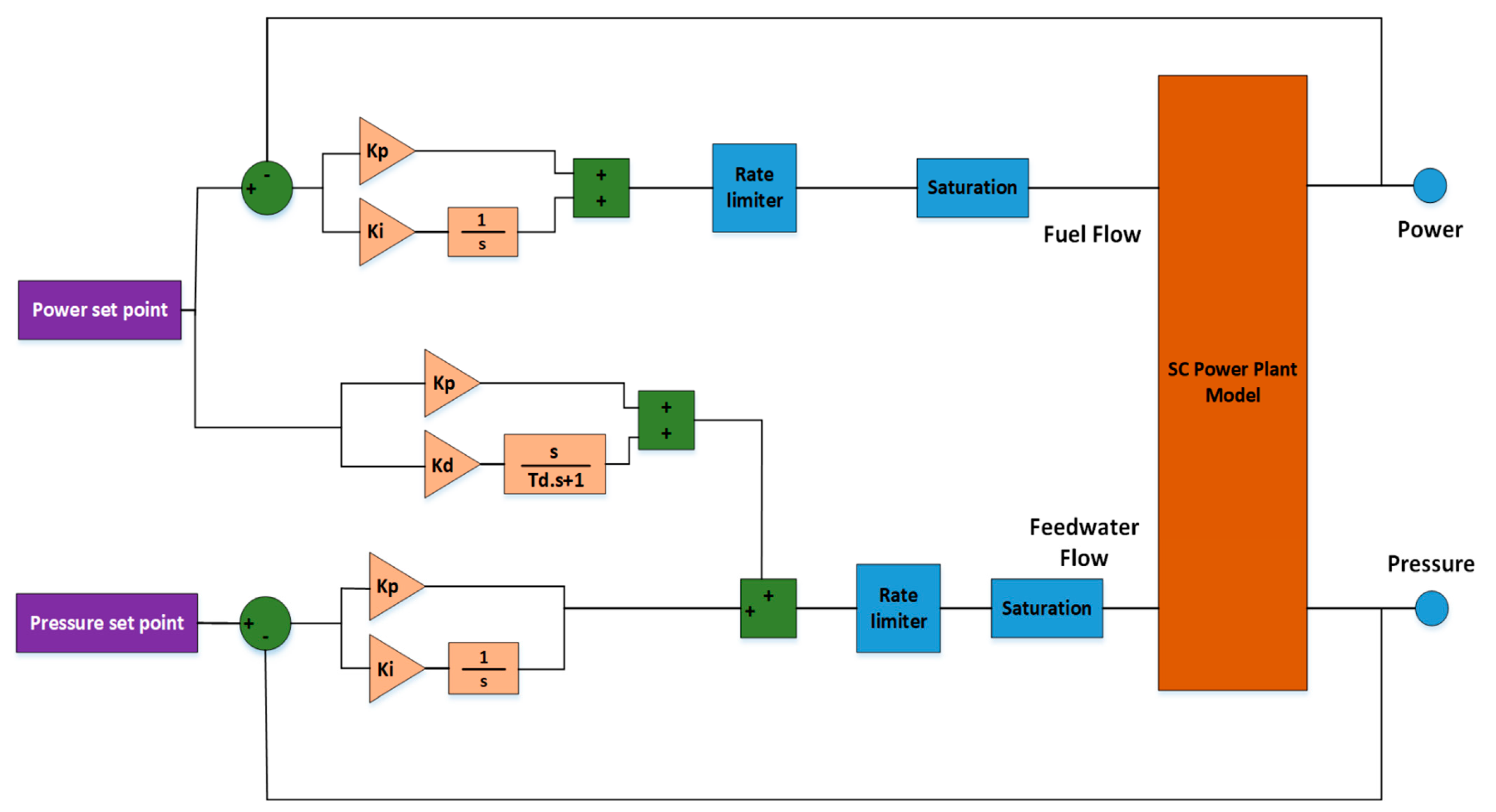
A MIMO control system with a multivariable PI/PD controller has been designed and integrated into the previous model in order to enhance the load demand following responses while simultaneously reducing the fuel flow and feedwater flow consumption of the plant. The reason behind choosing the conventional PID controller is because it is the most stable and accurate of the available controllers. Additionally, it has the potential to improve the plant while keeping the changed inputs within prescribed limitations.
The PID control equation is written as follows:
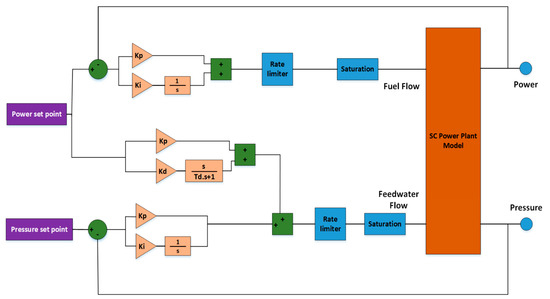
The proportional gain, integral gain, and derivative gain are represented by Kp, Ki, and Kd, respectively. Where the constant Td is corresponded to filter time. It is worth noting that when Kd = 0, PID becomes PI. Figure 13 shows the SCPP control system model.
Figure 13.
MIMO PI/PD control system structure.
The PID controller, which is comparable to the lag-lead compensator, has been created by utilizing PI and PD controllers in a cascading configuration. The PI controller is a limited version of the lag compensator that is designed to reduce the steady-state error. On the other hand, the PD controller is a limited version of the lead compensator that increases the rising time and, as a result, improves the fast reactions [33]. The same meta-heuristic optimization techniques are implanted for tuning the controller parameters in order to provide a faster load demand following responses and lower fuel consumption for the plant. The optimal parameters of the controller have been obtained by minimizing the mean squared error function “MSE” as follows:
The three optimization techniques are used to achieve the smallest possible value of the objective function. The identified controller parameters for each optimization technique are shown in Table 7.
Table 7.
Identified controller parameter for each technique.
The average (mean) values of feedwater and fuel flow consumption have been used to validate the control system. The average value is defined as:
where , and N correspond to the summation and the total number of data values. The average consumption values of the plant for each algorithm are shown in Table 8.
Table 8.
Average feedwater and fuel consumption for each algorithm.
5. Control System Performance Results
This section demonstrates the simulation results of the power plant’s control performance. The simulations have been carried out on a PC using the MATLAB/Simulink program. The proposed control system shown in Figure 13 is applied to the plant model that has been mentioned previously to study the system dynamics and power plant consumption under sudden load changes. The same data set shown in Figure 5 and model parameters shown in Table 5 have been used to compare the newly implemented algorithms WO, GWO, and the most common algorithm GA.
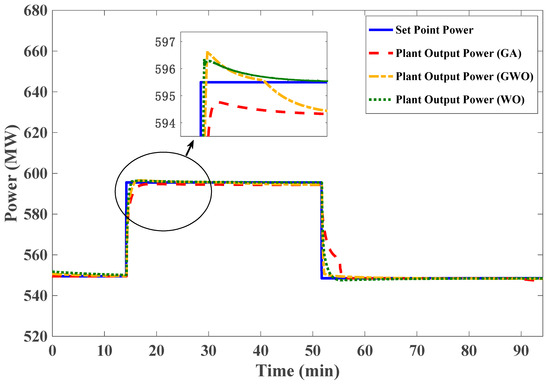
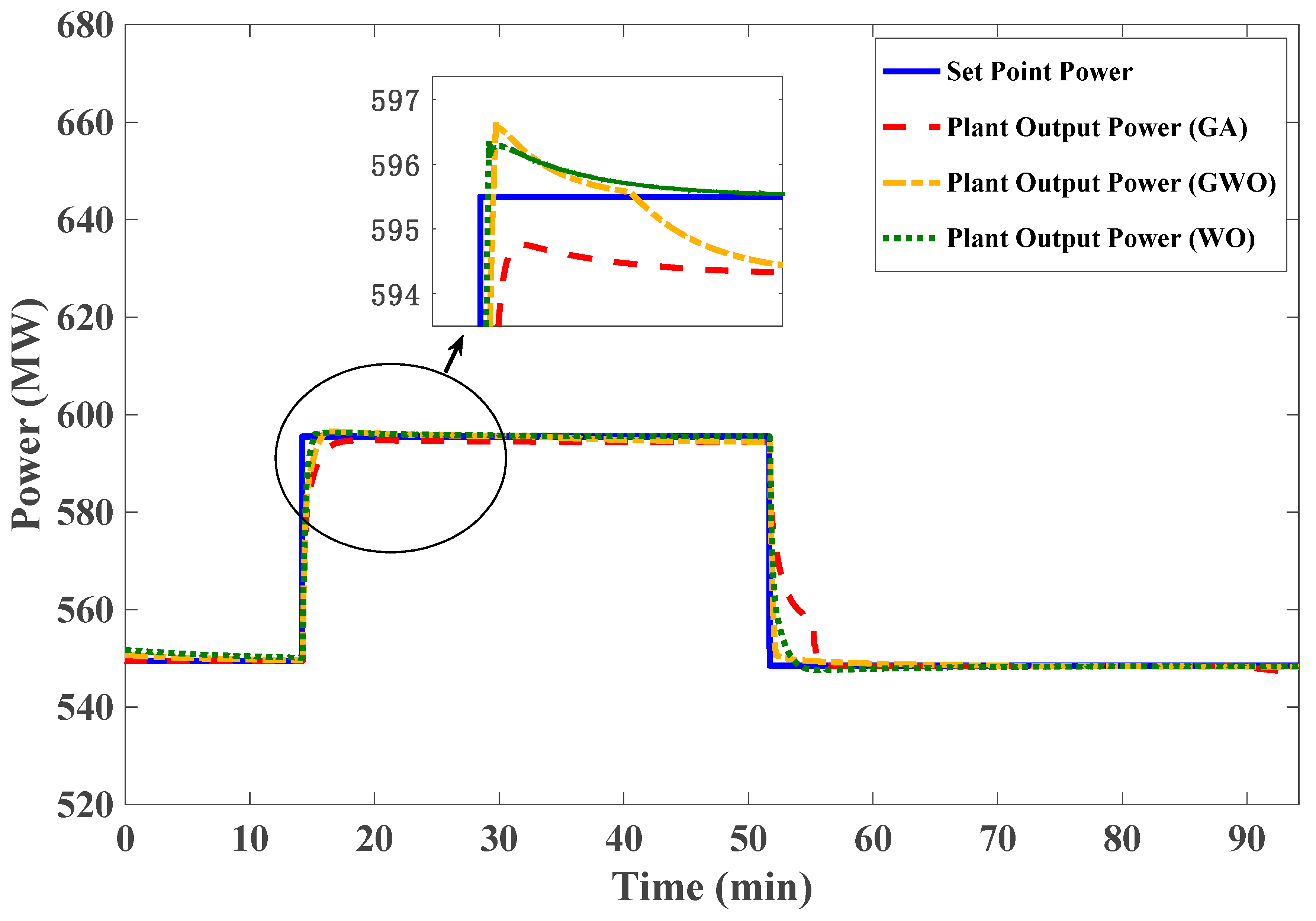
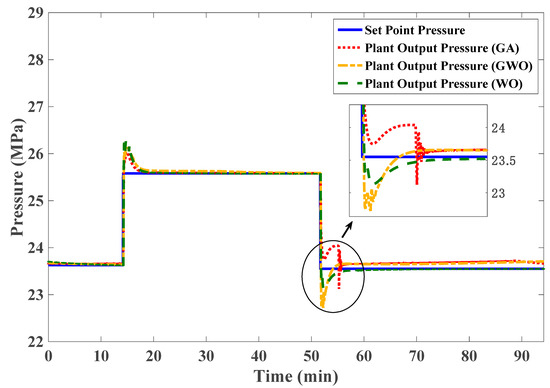
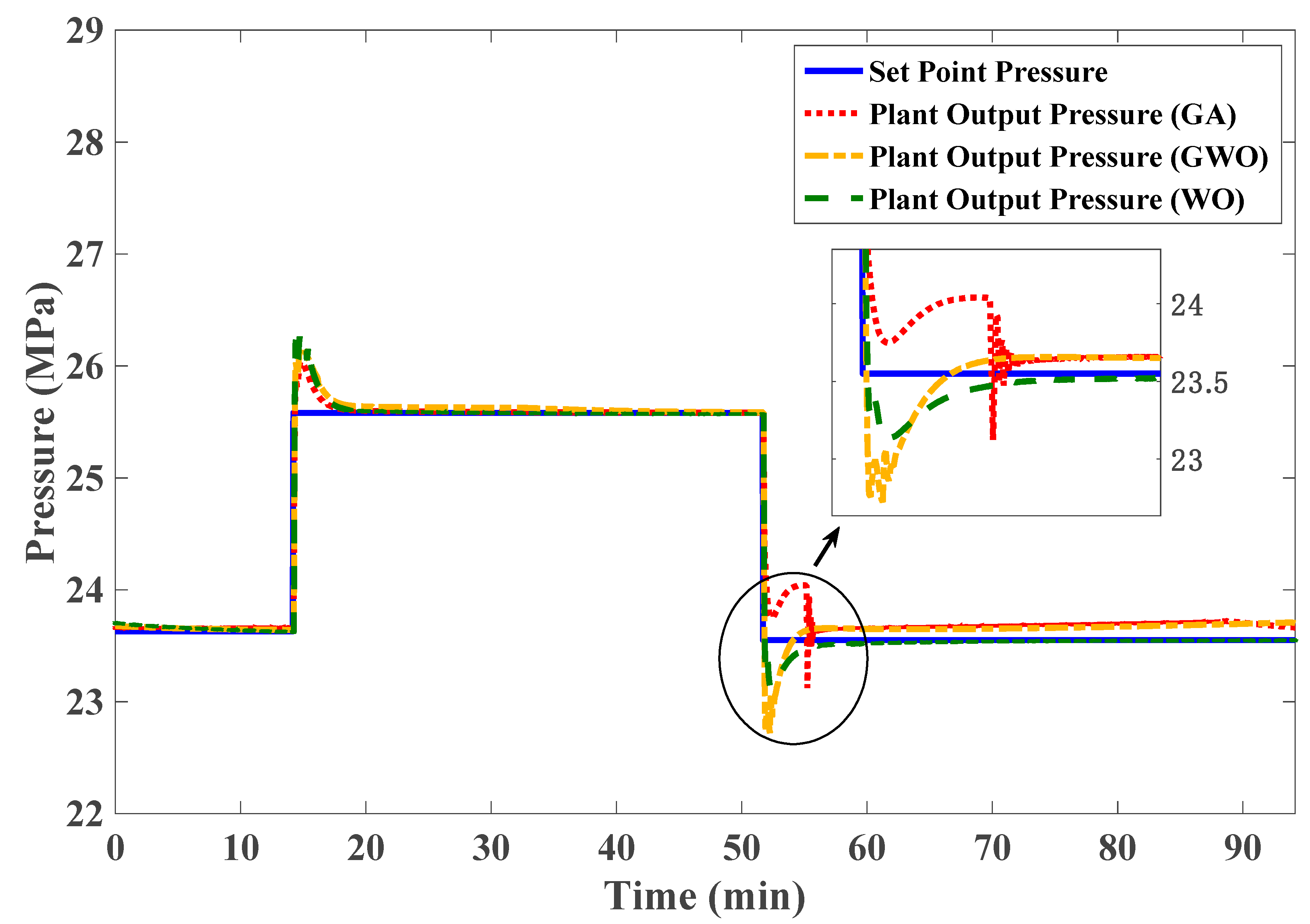
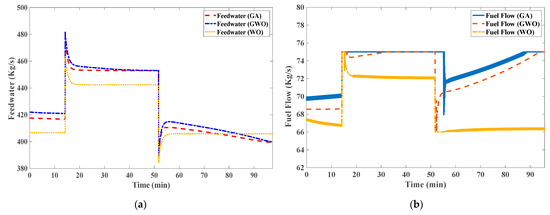
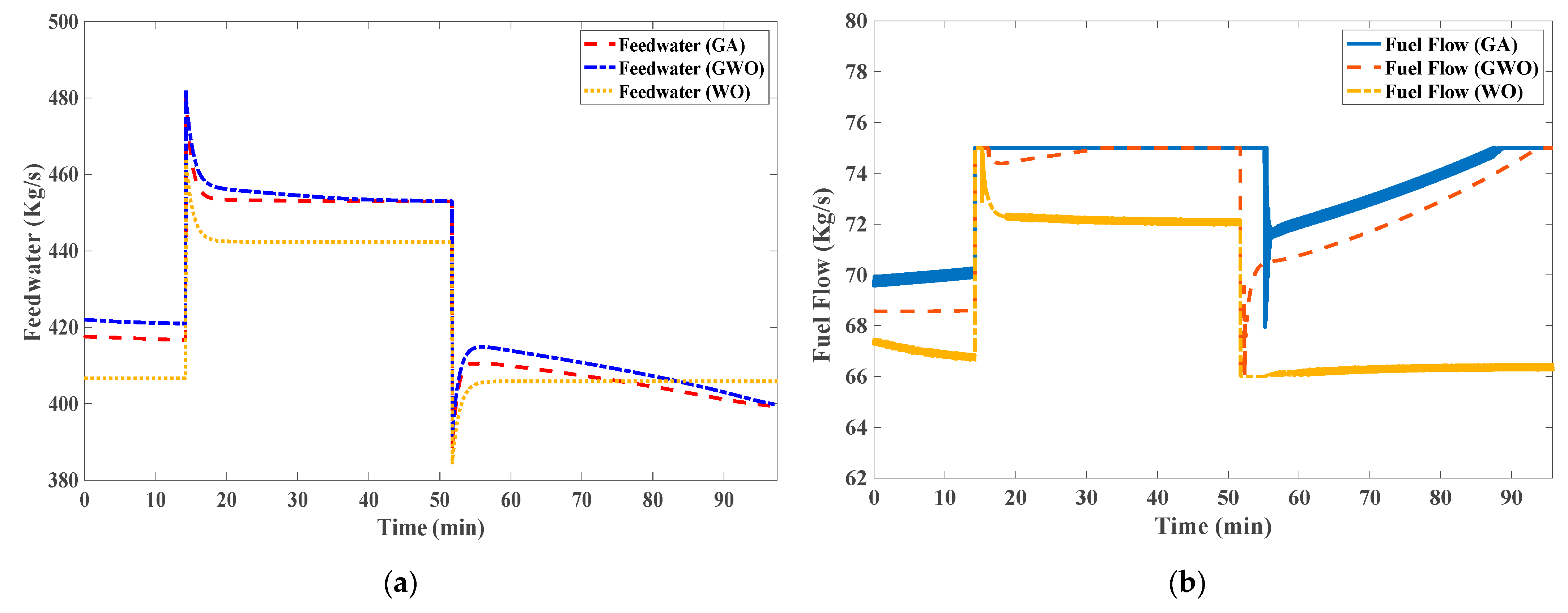
Figure 14 and Figure 15 demonstrate the control model’s power and pressure performance responses following a sudden and fictitious change in load demand from 550 MW to 595.5 MW and main steam pressure from 23.5 MPa to 25.5 MPa. In terms of power response, the WO outperforms the other approaches. It has smaller overshoots and undershoots with a range of ±1 MW, as well as a shorter settling time of less than 10 min. While in the pressure response, GA has a somewhat smaller overshoot than WO and GWO only when there is a sudden increase in pressure. On the other hand, the WO has a superior overall performance with ±0.6 MPa overshoot and undershoot, as well as a faster settling time of less than 8 min. Figure 16 illustrates that the plant’s optimized inputs, such as feedwater flow (FWF) and the fuel flow for each algorithm are regulated within the restrictions set by the 600 MW SCPP. This demonstrates that the suggested multi-variable PI/PD controller improved the plant’s dynamic reactions while maintaining the inputs within safe operating ranges. By using the WO algorithm, the enhanced control technique has resulted in a reduction in fuel consumption. The average quantity of fuel saved over the GWO was 3.4426 Kg/s, which equals 12.393 t/h on average. In a similar manner, the feedwater consumption of the WO is 7.3495 kg/s lower than that of the GA. The average usage of the SCPP is shown in Table 8.
Figure 14.
Power responses for a sudden change in the load demand.
Figure 15.
Pressure responses for a sudden change in the main steam pressure.
Figure 16.
Optimized input flow of the SCPP (a) optimized feedwater flow. (b) optimized fuel flow.
A further in-depth discussion to justify the WO performance. It can be seen that the WO attained the optimum controller parameters globally because of the following two reasons: first, it is capable of updating positions and searching for another optimum solution at the same time. Second, since the last advantage is also gained by GWO, it is worth repeating that the screw or spiral motion of WO towards the optimal solution is the ultimate way to obtain the controller parameters in order to have practically feasible and economical investments on the input.
6. Conclusions
The paper presents a modern tuning strategy for a MIMO PI/PD controller for supercritical power plants with an emphasis on better output responses and lower fuel consumption. The motivation and challenge of such research are still evident for some practical reasons, mainly the introduction of renewable energy resources worldwide, which requires more flexible and repeated part-load operation of the flexible generators. Because the flexible power stations are likely to operate in a part-load mode, the sliding pressure mode can be the best choice for control to obtain higher part-load efficiency and hence cleaner operation. However, further improvements in sliding pressure control are found in this research over what has been already published, which can be shown as the salient features and new findings of the paper as follows:
- -
- A simplified transfer matrix model for supercritical generation units has been developed with some additional blocks to capture the system nonlinearities and delays in the fuel preparation system. This structure is more suitable from a control point of view in sliding pressure operational modes.
- -
- The parameters of the transfer matrix are identified to fit a practical 600 MW SCPP via three different metaheuristic optimization techniques, which are the Whale Optimizer, Grey-Wolf Optimizer, and Genetic Algorithms. Considerable effort has been made to adjust the settings of the various optimization methods to yield the best possible results for all chosen techniques.
- -
- The Whale Optimizer has proven to be more robust and accurate than the Grey-Wolf Optimizer and Genetic Algorithms for parameter estimation. The criterion chosen for the modeling part is the NRMSE of the pressure and power responses and through a basic inspection of the depicted responses.
- -
- A robust controller has been designed and successfully implemented to govern part-load operation changes. Again, the three techniques of Whale Optimizer, Grey-Wolf Optimizer, and Genetic Algorithms have been evaluated against tuning the parameters for optimum control performance. The Whale Optimizer technique of parameter tuning is found to be better than other techniques in terms of lower fuel consumption and better output responses.
As a future recommendation, it is suggested to test more advanced optimization algorithms for better or comparable performance with the existing ones. More effort can be appreciated to integrate both modes of coordinated control and sliding pressure control as switchable controllers in the same power station. The disturbance effect maybe also analyzed and included. Although some practical and economical constraints may arise for practical implementation of the controllers, however, new conclusions could be reached through accurate simulation studies. The study can feasibly be extended to ultra-supercritical power plants, combined-cycle gas turbines (CCGT), concentrated solar-thermal power plants (CSP), and so on.
Author Contributions
Conceptualization, O.M. and M.Q.; methodology, O.M. and M.Q.; software, M.Q.; validation, M.Q., O.M. and W.A.E.; formal analysis, O.M. and M.Q; investigation O.M. and W.A.E.; resources, O.M. and M.Q.; data curation, O.M.; writing—original draft preparation, and M.Q. and O.M.; writing—review and editing, M.Q., O.M. and W.A.E.; visualization, M.Q.; supervision, O.M. and W.A.E.; project administration, O.M. All authors have read and agreed to the published version of the manuscript.
Funding
This research received no external funding.
Institutional Review Board Statement
Not applicable.
Informed Consent Statement
Not applicable.
Data Availability Statement
The data presented in this study are available on request from the corresponding author. The data are not publicly available due to the preference of its availability upon reasonable request.
Conflicts of Interest
The authors declare no conflict of interest.
Nomenclature
List of abbreviations.
| CFP | Coal-fired Plant |
| DEH | Digital Electro-Hydraulic |
| FWF | Feedwater Flow |
| GA | Genetic Algorithm |
| GWO | Grey-wolf Optimizer |
| MIMO | Multi-input Multi-output |
| MSE | Mean-squared Error |
| NRMSE | Normalized Mean-squared Error |
| OT | Once-Through |
| PID | Proportion integration differentiation |
| SCPP | Supercritical Power Plant |
| SLO | Sliding Pressure Operation |
| DMC | Dynamic Matrix Control |
| CCS | Coordinated Control System |
| MST | Main Steam Temperature |
| WO | Wolf Optimizer |
| AGC | Automatic Generation Control |
| MPC | Model Predictive Control |
| ADRC | Active Disturbance Rejection Control |
| SI | Swarm Intelligence |
References
- Heard, B.P.; Brook, B.W.; Wigley, T.M.; Bradshaw, C.J. Burden of proof: A comprehensive review of the feasibility of 100% renewable-electricity systems. Renew. Sustain. Energy Rev. 2017, 76, 1122–1133. [Google Scholar] [CrossRef] [Scilit]
- Machowski, J.; Lubosny, Z.; Bialek, J.W.; Bumby, J.R. Power System Dynamics: Stability and Control; John Wiley & Sons: Hoboken, NJ, USA, 2020. [Google Scholar]
- Pudasainee, D.; Kurian, V.; Gupta, R. Coal: Past, present, and future sustainable use. In Future Energy; Elsevier: Amsterdam, The Netherlands, 2020; pp. 21–48. [Google Scholar]
- Wu, Z.; He, T.; Liu, Y.; Li, D.; Chen, Y. Physics-informed energy-balanced modeling and active disturbance rejection control for circulating fluidized bed units. Control Eng. Pract. 2021, 116, 104934. [Google Scholar] [CrossRef] [Scilit]
- Rayaprolu, K. Boilers for Power and Process; CRC Press: Boca Raton, FL, USA, 2009. [Google Scholar]
- Basu, S.; Debnath, A.K. Power Plant Instrumentation and Control Handbook: A Guide to Thermal Power Plants; Academic Press: Cambridge, MA, USA, 2014. [Google Scholar]
- Kundur, P. Power System Stability and Control; McGraw Hill: Columbus, OH, USA, 1994. [Google Scholar]
- Mohamed, O.; Wang, J.; Guo, S.; Wei, J.; Al-Duri, B.; Lv, J.; Gao, Q. Mathematical modelling for coal fired supercritical power plants and model parameter identification using genetic algorithms. In Electrical Engineering and Applied Computing; Springer: Dordrecht, The Netherlands, 2011; pp. 1–13. [Google Scholar]
- Haddad, A.; Mohamed, O.; Zahlan, M.; Wang, J. Parameter identification of a highly promising cleaner coal power station. J. Clean. Prod. 2021, 326, 129323. [Google Scholar] [CrossRef] [Scilit]
- Liu, J.Z.; Yan, S.; Zeng, D.L.; Hu, Y.; Lv, Y. A dynamic model used for controller design of a coal fired once-through boiler-turbine unit. Energy 2015, 93, 2069–2078. [Google Scholar] [CrossRef] [Scilit]
- Huang, C.; Sheng, X. Data-driven model identification of boiler-turbine coupled process in 1000 MW ultra-supercritical unit by improved bird swarm algorithm. Energy 2020, 205, 118009. [Google Scholar] [CrossRef] [Scilit]
- Fan, H.; Su, Z.G.; Wang, P.H.; Lee, K.Y. A dynamic mathematical model for once-through boiler-turbine units with superheated steam temperature. Appl. Therm. Eng. 2020, 170, 114912. [Google Scholar] [CrossRef] [Scilit]
- Al-Momani, A.; Mohamed, O.; Elhaija, W.A. Multiple processes modeling and identification for a cleaner supercritical power plant via Grey Wolf Optimizer. Energy 2022, 252, 124090. [Google Scholar] [CrossRef] [Scilit]
- Mohamed, O.; Al-Duri, B.; Wang, J. Predictive control strategy for a supercritical power plant and study of influences of coal mills control on its dynamic responses. In Proceedings of the 2012 UKACC International Conference on Control, Cardiff, UK, 3–5 September 2012; pp. 918–923. [Google Scholar]
- Chen, C.; Zhou, Z.; Bollas, G.M. Dynamic modeling, simulation and optimization of a subcritical steam power plant. Part I: Plant model and regulatory control. Energy Convers. Manag. 2017, 145, 324–334. [Google Scholar] [CrossRef] [Scilit]
- Wang, C.; Zhao, Y.; Liu, M.; Qiao, Y.; Chong, D.; Yan, J. Peak shaving operational optimization of supercritical coal-fired power plants by revising control strategy for water-fuel ratio. Appl. Energy 2018, 216, 212–223. [Google Scholar] [CrossRef] [Scilit]
- Sarda, P.; Hedrick, E.; Reynolds, K.; Bhattacharyya, D.; Zitney, S.E.; Omell, B. Development of a dynamic model and control system for load-following studies of supercritical pulverized coal power plants. Processes 2018, 6, 226. [Google Scholar] [CrossRef] [Scilit]
- Liang, X.; Li, Y.; Wu, X.; Shen, J. Nonlinear modeling and inferential multi-model predictive control of a pulverizing system in a coal-fired power plant based on moving horizon estimation. Energies 2018, 11, 589. [Google Scholar] [CrossRef] [Scilit]
- Zeng, D.; Gao, Y.; Hu, Y.; Liu, J. Optimization control for the coordinated system of an ultra-supercritical unit based on stair-like predictive control algorithm. Control Eng. Pract. 2019, 82, 185–200. [Google Scholar] [CrossRef] [Scilit]
- Wu, Z.; He, T.; Li, D.; Xue, Y.; Sun, L.; Sun, L. Superheated steam temperature control based on modified active disturbance rejection control. Control Eng. Pract. 2019, 83, 83–97. [Google Scholar] [CrossRef] [Scilit]
- Zhang, H.; Gao, M.; Hong, F.; Liu, J.; Wang, X. Control-oriented modelling and investigation on quick load change control of subcritical circulating fluidized bed unit. Appl. Therm. Eng. 2019, 163, 114420. [Google Scholar] [CrossRef] [Scilit]
- Shi, G.; Wu, Z.; Guo, J.; Li, D.; Ding, Y. Superheated steam temperature control based on a hybrid active disturbance rejection control. Energies 2020, 13, 1757. [Google Scholar] [CrossRef] [Scilit]
- Cheng, C.; Peng, C.; Zhang, T. Fuzzy K-means cluster based generalized predictive control of ultra supercritical power plant. IEEE Trans. Ind. Inform. 2020, 17, 4575–4583. [Google Scholar] [CrossRef] [Scilit]
- Arastou, A.; Rabieyan, H.; Karrari, M. Inclusive modelling and parameter estimation of a steam power plant using an LMI-based unknown input reconstruction algorithm. IET Gener. Transm. Distrib. 2021, 16, 1425–1437. [Google Scholar] [CrossRef] [Scilit]
- Lee, T.; Han, E.; Moon, U.C.; Lee, K.Y. Supplementary control of air–fuel ratio using dynamic matrix control for thermal power plant emission. Energies 2020, 13, 226. [Google Scholar] [CrossRef] [Scilit]
- Znad, O.A.; Mohamed, O.; Elhaija, W.A. Speeding-up Startup Process of a Clean Coal Supercritical Power Generation Station via Classical Model Predictive Control. Process Integr. Optim. Sustain. 2022, 1–14. [Google Scholar] [CrossRef] [Scilit]
- Hou, G.; Gong, L.; Yang, Z.; Zhang, J. Multi-objective economic model predictive control for gas turbine system based on quantum simultaneous whale optimization algorithm. Energy Convers. Manag. 2020, 207, 112498. [Google Scholar] [CrossRef] [Scilit]
- Bhatt, R.; Parmar, G.; Gupta, R. Whale optimized PID controllers for LFC of two area interconnected thermal power plants. ICTACT J. Microelectr. 2018, 3, 467–472. [Google Scholar]
- Mohamed, O.; Khalil, A.; Wang, J. Modeling and control of supercritical and ultra-supercritical power plants: A review. Energies 2020, 13, 2935. [Google Scholar] [CrossRef] [Scilit]
- Mirjalili, S.; Lewis, A. The whale optimization algorithm. Adv. Eng. Softw. 2016, 95, 51–67. [Google Scholar] [CrossRef] [Scilit]
- Mohamed, O.; Wang, J.; Guo, S.; Al-Duri, B.; Wei, J. Modelling study of supercritical power plant and parameter identification using genetic algorithms. In Proceedings of the World Congress on Engineering ; Springer: Berlin/Heidelberg, Germany, 2010; Volume 2. [Google Scholar]
- Mohamed, O.R.I. Study of Energy Efficient Supercritical Coal-Fired Power Plant Dynamic Responses and Control Strategies. Ph.D. Thesis, University of Birmingham, Birmingham, UK, 2012. [Google Scholar]
- Ogata, K. Modern Control Engineering; Prentice Hall: Upper Saddle River, NJ, USA, 2010; Volume 5. [Google Scholar]
- Zhao, Y.; Wang, C.; Liu, M.; Chong, D.; Yan, J. Improving operational flexibility by regulating extraction steam of high-pressure heaters on a 660 MW supercritical coal-fired power plant: A dynamic simulation. Appl. Energy 2018, 212, 1295–1309. [Google Scholar] [CrossRef] [Scilit]
- Mirjalili, S. Genetic algorithm. In Evolutionary Algorithms and Neural Networks; Springer: Cham, Switzerland, 2019; pp. 43–55. [Google Scholar]
- Holland, J.H. Genetic algorithms. Sci. Am. 1992, 267, 66–73. [Google Scholar] [CrossRef] [Scilit]
- Mirjalili, S.; Mirjalili, S.M.; Lewis, A. Grey wolf optimizer. Adv. Eng. Softw. 2014, 69, 46–61. [Google Scholar] [CrossRef] [Scilit]

Publisher’s Note: MDPI stays neutral with regard to jurisdictional claims in published maps and institutional affiliations. |
© 2022 by the authors. Licensee MDPI, Basel, Switzerland. This article is an open access article distributed under the terms and conditions of the Creative Commons Attribution (CC BY) license (https://creativecommons.org/licenses/by/4.0/).